
In the adjoining figure, △ABC ~ △QPR.
Then ∠R is

60°
50°
70°
80°
Answer
Given, △ABC ~ △QPR
∴ ∠A = ∠Q, ∠B = ∠P and ∠C = ∠R
∠C = 180° - (70° + 50°) = 180° - 120° = 60°.
∴ ∠R = 60°.
Hence, Option 1 is the correct option.
In the adjoining figure, △ABC ~ △QPR.

The value of x is
2.25 cm
4 cm
4.5 cm
5.25 cm
Answer
Since triangles are similar hence the ratio of their corresponding sides are equal.
Hence, Option 1 is the correct option.
In the adjoining figure, two line segments AC and BD intersect each other at the point P such that PA = 6 cm, PB = 3 cm, PC = 2.5 cm, PD = 5 cm, ∠APB = 50° and ∠CDP = 30°. Then, ∠PBA is equal to

50°
30°
60°
100°
Answer
Considering △APB and △CPD,
and ∠APB = ∠CPD (Vertically opposite angles are equal)
∴ △APB ~ △CPD
Hence, ∠PAB = ∠PDC = 30°
∠PBA = 180° - (∠PAB + ∠APB) = 180° - (30° + 50°) = 180° - 80° = 100°.
Hence, Option 4 is the correct option.
In triangles ABC and DEF, ∠B = ∠E, ∠F = ∠C and AB = 3DE, then the two triangles are
congruent but not similar
similar but not congruent
neither congruent nor similar
congruent as well as similar
Answer
Given,
∠B = ∠E, ∠F = ∠C and AB = 3DE.
∴ Two angles of the one triangles are equal to corresponding two angles of the other, but sides are not equal.
∴ Triangles are similar but not congruent.
Hence, Option 2 is the correct option.
The adjoining figure, AB || DE. The length of CD is

2.5 cm
2.7 cm
cm
3.5 cm
Answer
Given AB || DE.
Considering △ABC and △DEC,
∠ ACB = ∠ DCE (Vertically opposite angles are equal)
∠ ABC = ∠ CDE (Alternate angles are equal)
Hence, by AA axiom △ABC ~ △DEC.
Since, both the triangles are similar, hence ratio of their corresponding sides are equal,
Hence, Option 2 is the correct option.
If △PQR ~ △ABC, PQ = 6 cm, AB = 8 cm and perimeter of △ABC is 36 cm, then perimeter of △PQR is
20.25 cm
27 cm
48 cm
64 cm
Answer
Let perimeter of △PQR be x cm.
Since triangles are similar,
∴ Perimeter of △PQR = 27 cm.
Hence, Option 2 is the correct option.
In the adjoining figure, DE || BC and all measurements are in centimetres. The length of AE is

2 cm
2.25 cm
3.5 cm
4 cm
Answer
Given DE || BC.
Considering △ABC and △ADE,
∠ A = ∠ A (Common angles)
∠ ABC = ∠ ADE (Corresponding angles are equal)
Hence, by AA axiom △ABC ~ △ADE.
Let the length of AE be x cm.
Since, both the triangles are similar,
∴ Length of AE = 2.25 cm.
Hence, Option 2 is the correct option.
In the adjoining figure, PQ || CA and all lengths are given in centimetres. The length of BC is

6.4 cm
7.4 cm
8 cm
9 cm
Answer
Given PQ || CA.
Considering △ABC and △PBQ,
∠ B = ∠ B (Common angles)
∠ CAB = ∠ QPB (Corresponding angles are equal)
Hence, by AA axiom △ABC ~ △PBQ.
Let length of QC be x cm.
Since triangles are similar,
BC = BQ + QC = 5 + x = 5 + 3 = 8 cm.
Hence, Option 3 is the correct option.
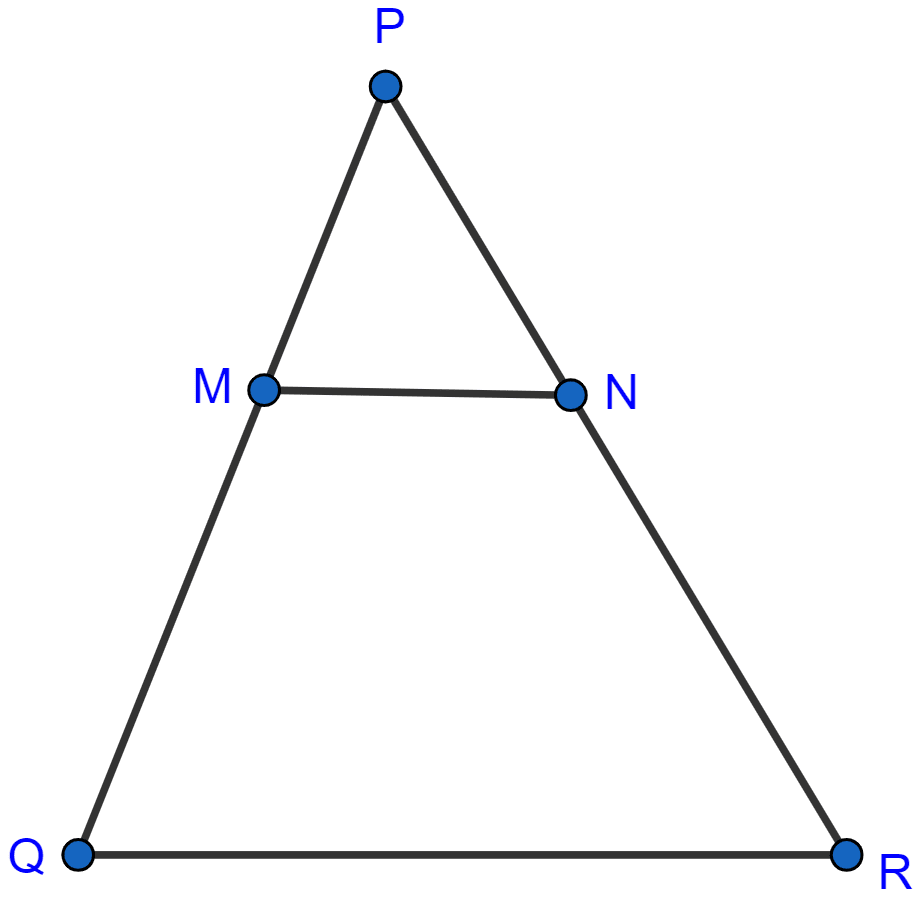
In the adjoining figure, MN || QR. If PN = 3.6 cm, NR = 2.4 cm and PQ = 5 cm, then PM is
4 cm
3.6 cm
2 cm
3 cm
Answer
Given MN || QR.
Considering △PMN and △PQR,
∠P = ∠P (Common angles)
∠PMN = ∠PQR (Corresponding angles are equal)
Hence, by AA axiom △PMN ~ △PQR.
Let length of PM be x cm.
Since triangles are similar by basic proportionality theorem,
∴ Length of PM = 3 cm.
Hence, Option 4 is the correct option.
It is given that △ABC ~ △PQR with , then is equal to
9
3
Answer
Given
So, .
Since triangles are similar. We know that, the ratio of the areas of two similar triangles is equal to the ratio of the square of their corresponding sides.
Hence, Option 1 is the correct option.
If the areas of two similar triangles are in the ratio 4 : 9, then their corresponding sides are in the ratio
9 : 4
3 : 2
2 : 3
16 : 81
Answer
Given, ratio of the areas of the two similar triangles = 4 : 9
We know that, the ratio of the areas of two similar triangles is equal to the ratio of the square of their corresponding sides.
= 2 : 3.
Hence, Option 3 is the correct option.
If △ABC ~ △PQR, BC = 8 cm and QR = 6 cm, then the ratio of the areas of △ABC and △PQR is
8 : 6
3 : 4
9 : 16
16 : 9
Answer
Since triangles are similar. We know that, the ratio of the areas of two similar triangles is equal to the ratio of the square of their corresponding sides.
Hence, Option 4 is the correct option.
If △ABC ~ △QRP, , AB = 18 cm and BC = 15 cm, then the length of PR is equal to
10 cm
12 cm
cm
8 cm
Answer
Since triangles are similar. We know that, the ratio of the areas of two similar triangles is equal to the ratio of the square of their corresponding sides.
Given, .
So,
∴ PR = 10 cm.
Hence, Option 1 is the correct option.
If △ABC ~ △PQR, area of △ABC = 81 cm2, area of △PQR = 144 cm2 and QR = 6 cm, then length of BC is
4 cm
4.5 cm
9 cm
12 cm
Answer
Since triangles are similar. We know that, the ratio of the areas of two similar triangles is equal to the ratio of the square of their corresponding sides.
∴ BC = 4.5 cm.
Hence, Option 2 is the correct option.
In the adjoining figure, DE || CA and D is a point on BD such that BD : DC = 2 : 1. The ratio of area of △ABC to area of △BDE is

4 : 1
9 : 1
9 : 4
3 : 2
Answer
Given DE || CA.
Considering △BDE and △BCA,
∠B = ∠B (Common angles)
∠BDE = ∠BCA (Corresponding angles are equal)
Hence, by AA axiom △BDE ~ △BCA.
Since triangles are similar. We know that, the ratio of the areas of two similar triangles is equal to the ratio of the square of their corresponding sides.
.....(i)
Given,
Putting this value in (i) we get,
Hence, Option 3 is the correct option.
If ABC and BDE are two equilateral triangles such that D is mid-point of BC, then the ratio of the areas of triangles ABC and BDE is
2 : 1
1 : 2
1 : 4
4 : 1
Answer
Since triangles ABC and BDE are equilateral triangles so, each angle will be equal to 60°.
Since all angles are equal to 60°.
Hence, by AAA axiom △ABC ~ △BDE.
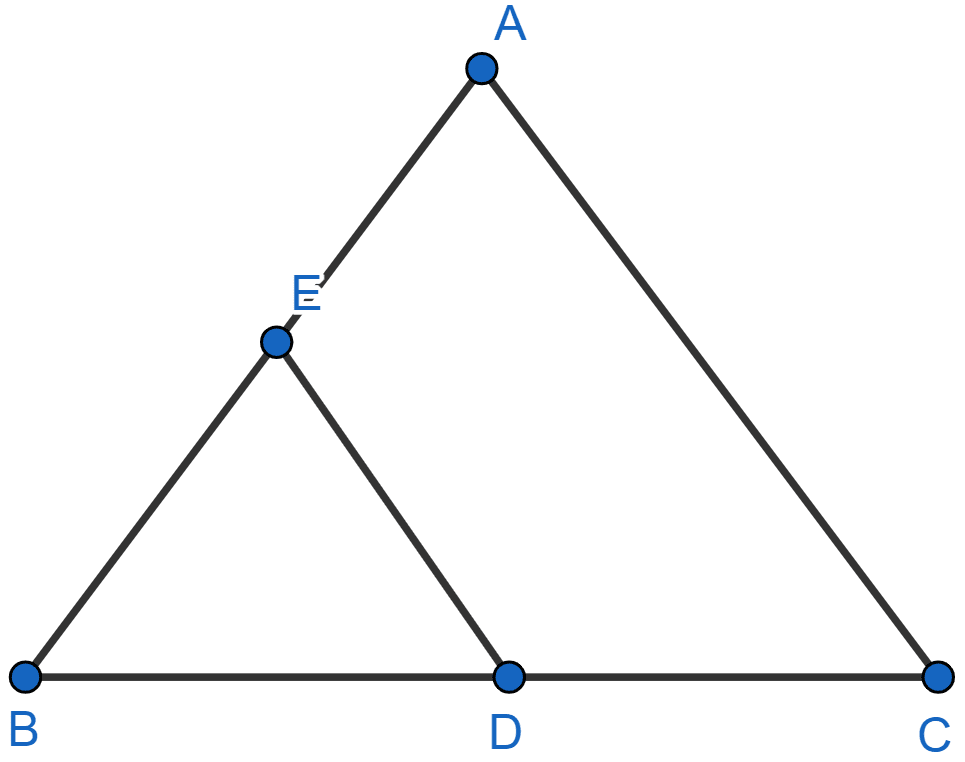
Since D is the midpoint of BC so,
We know that, the ratio of the areas of two similar triangles is equal to the ratio of the square of their corresponding sides.
Hence, Option 4 is the correct option.
The areas of two similar triangles are 81 cm2 and 49 cm2 respectively. If an altitude of the smaller triangle is 3.5 cm, then the corresponding altitude of the bigger triangle is
9 cm
7 cm
6 cm
4.5 cm
Answer
Let the altitude of bigger triangle be x cm.
We know that, the ratio of the areas of two similar triangles is equal to the ratio of the square of their corresponding altitudes.
Hence, altitude of the bigger triangle is 4.5 cm.
Hence, Option 4 is the correct option.
Given △ABC ~ △PQR, area of △ABC = 54 cm2 and area of △PQR = 24 cm2. If AD and PM are medians of △'s ABC and PQR respectively, and length of PM is 10 cm, then length of AD is
cm
cm
15 cm
22.5 cm
Answer
Given, △ABC ~ △PQR.
We know that, the ratio of the areas of two similar triangles is equal to the ratio of the square of their corresponding medians.
Hence, length of AD = 15 cm.
Hence, Option 3 is the correct option.
In the given diagram, △ ABC ~ △ PQR and . The value of AB : PQ is :
8 : 3
3 : 5
3 : 8
5 : 8

Answer
Given,
△ ABC ~ △ PQR
⇒ ∠B = ∠Q (Corresponding angles of similar triangle are equal)
In △ ABD and △ PQS,
⇒ ∠B = ∠Q (Proved above)
⇒ ∠D = ∠S (Both equal to 90°)
∴ △ ABD ~ △ PQS (By A.A. axiom)
We know that,
Corresponding sides of similar triangles are proportional.
.
∴ AB : PQ = 3 : 8.
Hence, Option 3 is the correct option.
In the given diagram, ∆ABC ∼ ∆PQR. If AD and PS are bisectors of ∠BAC and ∠QPR respectively then:
∆ABC ∼ ∆PQS
∆ABD ∼ ∆PQS
∆ABD ∼ ∆PSR
∆ABC ∼ ∆PSR

Answer
Given,
∆ABC ∼ ∆PQR
∴ ∠A = ∠P
⇒
⇒ ∠BAD = ∠QPS
∠B = ∠Q [∵ ∆ABC ∼ ∆PQR]
In ∆ABD ∼ ∆PQS,
⇒ ∠BAD = ∠QPS
⇒ ∠B = ∠Q
∴ ∆ABD ∼ ∆PQS (By A.A. axiom)
Hence, Option 2 is the correct option.