
Assertion (A): In a Δ ABC, if D is a point on the side BC such that AD divides BC in ratio AB : AC, then AD is the bisector of ∠A.
Reason (R): The internal bisector of an angle of a triangle divides the opposite side internally in the ratio of the sides containing the angle.
Assertion (A) is true, but Reason (R) is false.
Assertion (A) is false, but Reason (R) is true.
Both Assertion (A) and Reason (R) are correct, and Reason (R) is the correct reason for Assertion (A).
Both Assertion (A) and Reason (R) are correct, and Reason (R) is incorrect reason for Assertion (A).
Answer
By angle bisector theorem,
The internal bisector of an angle of a triangle divides the opposite side internally in the ratio of the sides containing the angle.
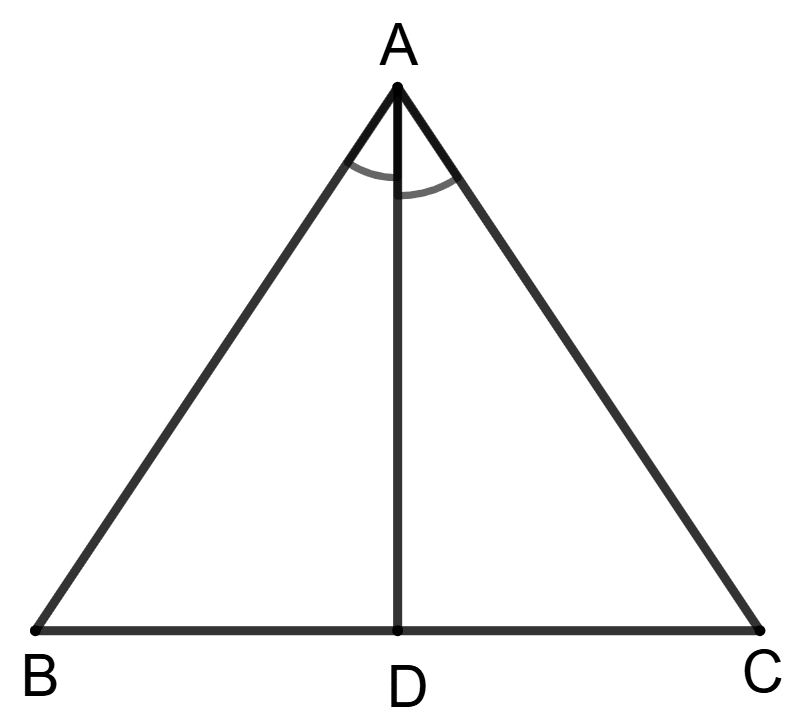
In a ΔABC, if AD is the internal angle bisector of ∠A, then it divides the opposite side BC in the ratio:
So, reason (R) is true.
In a ΔABC, if D is a point on the side BC such that AD divides BC in ratio AB : AC, then AD is the bisector of ∠A.
This is the converse of the Angle Bisector Theorem.
So, assertion (A) is true.
Thus, both Assertion (A) and Reason (R) are correct, and Reason (R) is the correct reason for Assertion (A).
Hence, option 3 is the correct option.
Given Δ ABC ∼ Δ PQR.
Assertion (A): If area of Δ ABC : area of Δ PQR = 16 : 25, then perimeter of Δ ABC : perimeter of Δ PQR = 4 : 5.
Reason (R): The ratio of perimeter of two similar triangle is equal to the ratio of their corresponding sides.
Assertion (A) is true, but Reason (R) is false.
Assertion (A) is false, but Reason (R) is true.
Both Assertion (A) and Reason (R) are correct, and Reason (R) is the correct reason for Assertion (A).
Both Assertion (A) and Reason (R) are correct, and Reason (R) is incorrect reason for Assertion (A).
Answer
Given Δ ABC ∼ Δ PQR
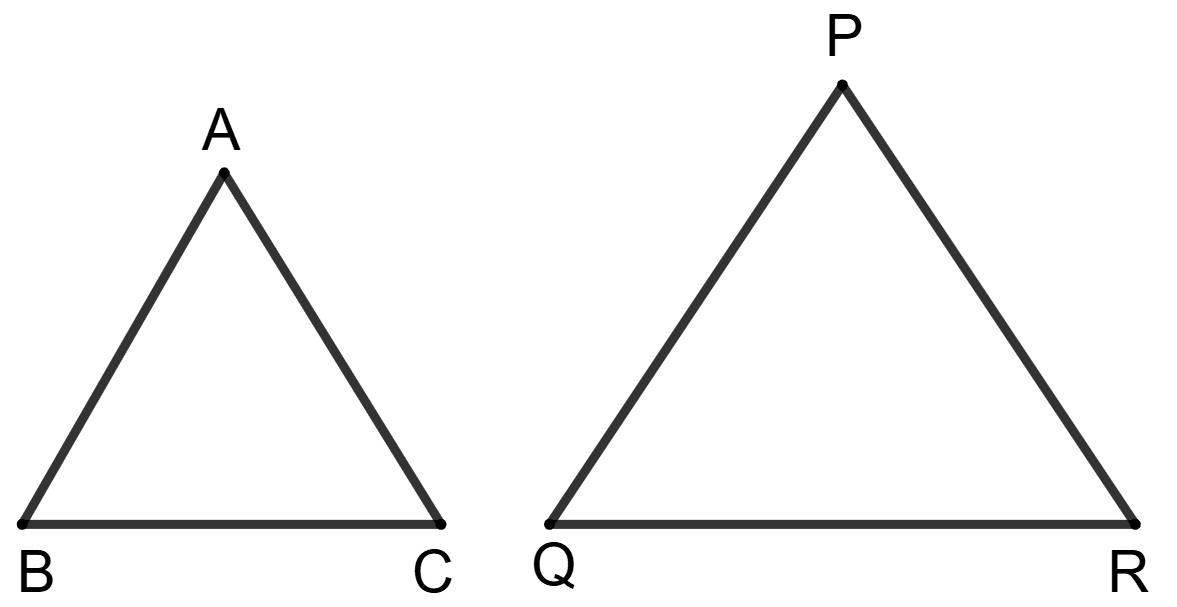
If area of Δ ABC : area of Δ PQR = 16 : 25
We know that,
The ratio of the areas of two similar triangles is equal to the square of the ratio of their corresponding sides.
Since, corresponding sides of similar triangle are proportional.
We know that,
For any two or more equal ratios, each ratio is equal to the ratio between sum of their antecedents and sum of their consequents.
Thus, both Assertion (A) and Reason (R) are correct, and Reason (R) is the correct reason for Assertion (A).
Hence, option 3 is the correct option.
Given Δ PQR ∼ Δ DEF.
Assertion (A): If area of Δ PQR : area of Δ DEF = 9 : 49, then the ratio of their corresponding medians is also 4 : 9.
Reason (R): For the similar triangles, the ratio of their corresponding sides is equal to the ratio of their corresponding medians.
Assertion (A) is true, but Reason (R) is false.
Assertion (A) is false, but Reason (R) is true.
Both Assertion (A) and Reason (R) are correct, and Reason (R) is the correct reason for Assertion (A).
Both Assertion (A) and Reason (R) are correct, and Reason (R) is incorrect reason for Assertion (A).
Answer
Given Δ PQR ∼ Δ DEF and PX is median of triangle PQR, DY is median of triangle DEF.
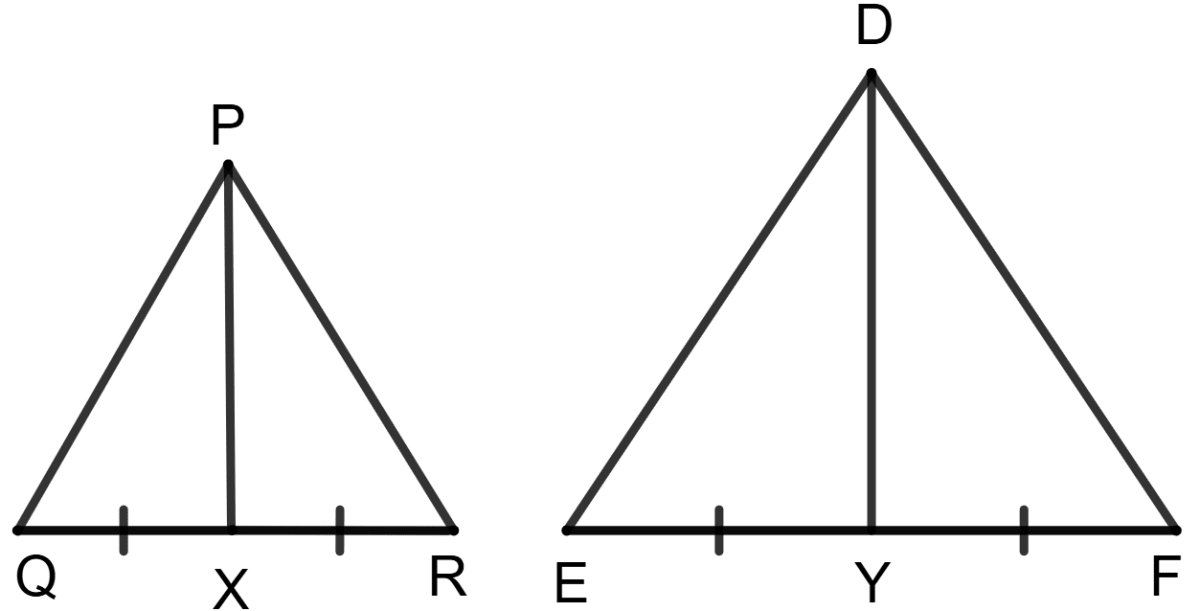
Since Δ PQR ∼ Δ DEF, corresponding sides of similar triangle are proportional.
And we also know that corresponding angles of similar triangles are equal.
∴ ∠Q = ∠E
Now, in Δ PQX and Δ DEY,
⇒ ∠Q = ∠E
Using SAS similarity,
⇒ Δ PQX ∼ Δ DEY
Since, corresponding sides of similar triangle are proportional,
If two triangles are similar, then the ratio of their areas equals the square of the ratio of their corresponding sides.
So, for the similar triangles, the ratio of their corresponding sides is equal to the ratio of their corresponding medians.
So, reason (R) is true.
Given,
area of Δ PQR : area of Δ DEF = 9 : 49
So, assertion (A) is false.
Thus, Assertion (A) is false, but Reason (R) is true.
Hence, option 2 is the correct option.
Given Δ ABC ∼ Δ DEF.
Assertion (A): If area of Δ ABC = 64 cm2, area of Δ DEF = 49 cm2 and BC = 4 cm, then EF is 7 cm.
Reason (R): The ratio of area of two similar triangle is equal to the ratio of square of their corresponding sides.
Assertion (A) is true, but Reason (R) is false.
Assertion (A) is false, but Reason (R) is true.
Both Assertion (A) and Reason (R) are correct, and Reason (R) is the correct reason for Assertion (A).
Both Assertion (A) and Reason (R) are correct, and Reason (R) is incorrect reason for Assertion (A).
Answer
Given Δ ABC ∼ Δ DEF.
As we know that the ratio of area of two similar triangle is equal to the ratio of square of their corresponding sides.
So, reason (R) is true.
So, assertion (A) is false.
Thus, Assertion (A) is false, but Reason (R) is true.
Hence, option 2 is the correct option.