KnowledgeBoat Logo
|
OPEN IN APP

Chapter 13

Similarity — Chapter Test

Class - 10 ML Aggarwal Understanding ICSE Mathematics


Chapter Test

Question 1

In the adjoining figure, ∠1 = ∠2 and ∠3 = ∠4. Show that PT × QR = PR × ST.
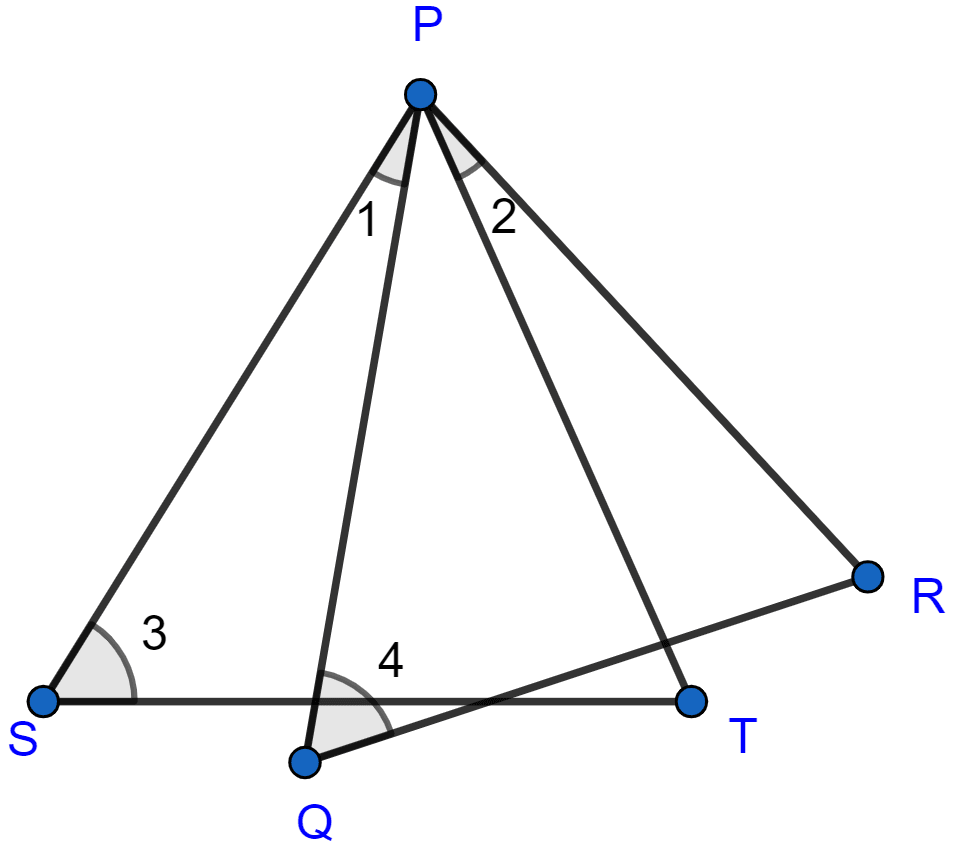
In the adjoining figure, ∠1 = ∠2 and ∠3 = ∠4. Show that PT × QR = PR × ST. Similarity, ML Aggarwal Understanding Mathematics Solutions ICSE Class 10.

Answer

Given, ∠1 = ∠2

Adding ∠QPT to both the sides,

∠1 + ∠QPT = ∠2 + ∠QPT

∴ ∠SPT = ∠QPR

∠PST = ∠PQR (As ∠3 = ∠4)

Hence, by AA axiom △PQR ~ △PST.

Since, triangles are similar so ratio of their corresponding sides will be equal.

PTPR=STQRPT×QR=PR×ST.\Rightarrow \dfrac{PT}{PR} = \dfrac{ST}{QR} \\[1em] \Rightarrow PT \times QR = PR \times ST.

Hence, proved that PT × QR = PR × ST.

Question 2

In the adjoining figure, AB = AC. If PM ⊥ AB and PN ⊥ AP, show that PM × PC = PN × PB.
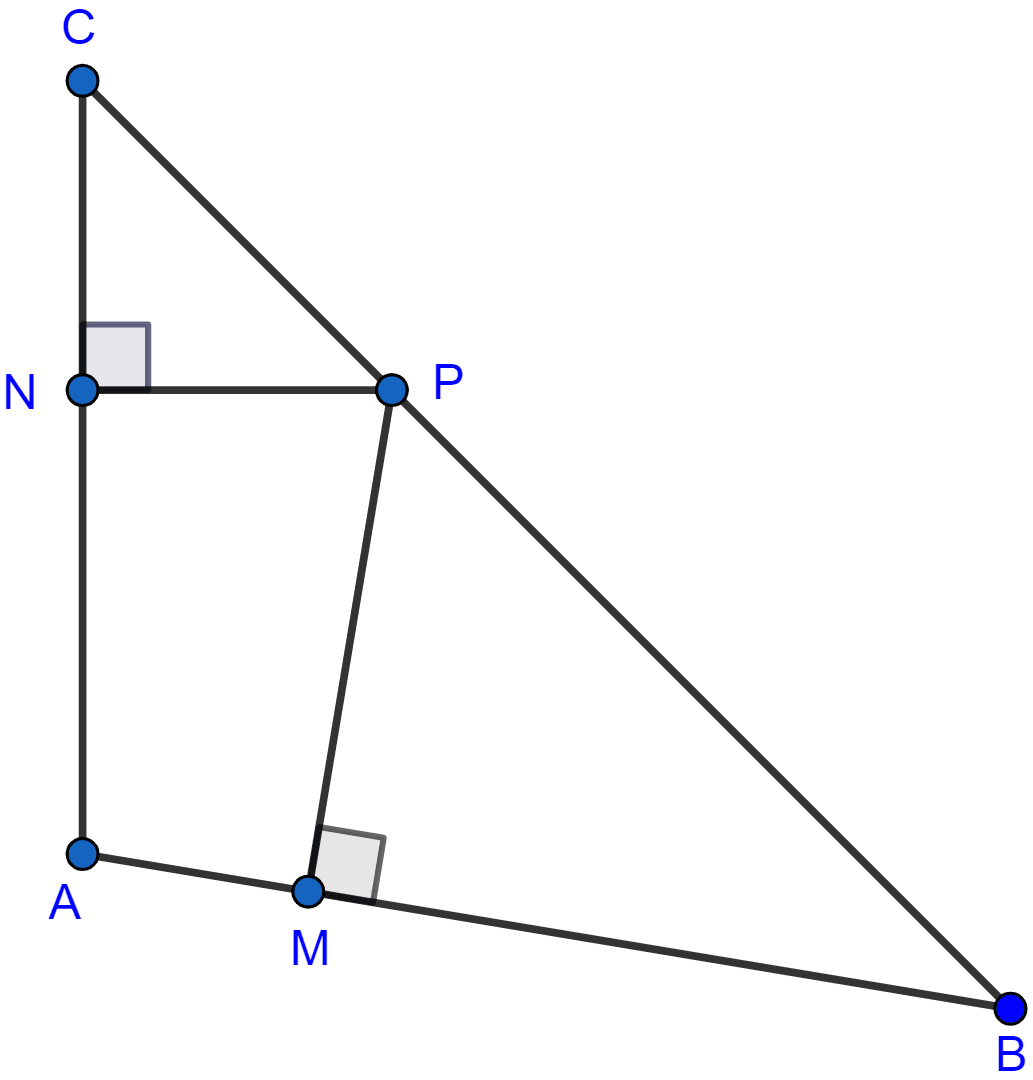
In the adjoining figure, AB = AC. If PM ⊥ AB and PN ⊥ AP, show that PM × PC = PN × PB. Similarity, ML Aggarwal Understanding Mathematics Solutions ICSE Class 10.

Answer

Considering △PNC and △PMB,

∠PNC = ∠PMB (Both are equal to 90°)

∠NCP = ∠PBM (As AB = AC)

Hence by AA axiom △PNC ~ △PMB.

Since, triangles are similar so ratio of their corresponding sides will be equal.

PCPB=PNPMPC×PM=PN×PB.\Rightarrow \dfrac{PC}{PB} = \dfrac{PN}{PM} \\[1em] \Rightarrow PC \times PM = PN \times PB.

Hence, proved that PC × PM = PN × PB.

Question 3(a)

In the figure (1) given below, ∠AED = ∠ABC. Find the values of x and y.
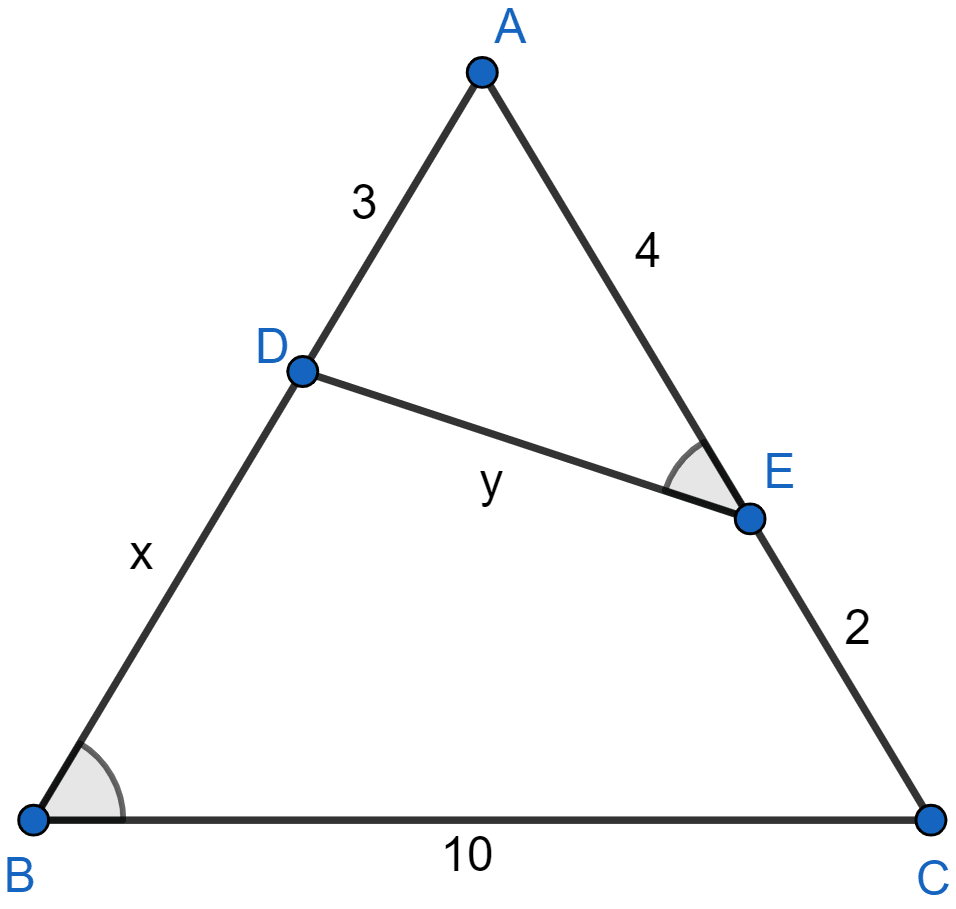
In the figure (1) given below, ∠AED = ∠ABC. Find the values of x and y. Similarity, ML Aggarwal Understanding Mathematics Solutions ICSE Class 10.

Answer

Considering △ABC and △ADE,

∠AED = ∠ABC (Given)

∠A = ∠A (Common angles)

Hence by AA axiom △ABC ~ △ADE.

Since, triangles are similar so ratio of their corresponding sides will be equal.

ADAC=DEBCADAE+EC=DEBC34+2=y1036=y10y=306y=5.\Rightarrow \dfrac{AD}{AC} = \dfrac{DE}{BC} \\[1em] \Rightarrow \dfrac{AD}{AE + EC} = \dfrac{DE}{BC} \\[1em] \Rightarrow \dfrac{3}{4 + 2} = \dfrac{y}{10} \\[1em] \Rightarrow \dfrac{3}{6} = \dfrac{y}{10} \\[1em] \Rightarrow y = \dfrac{30}{6} \\[1em] \Rightarrow y = 5.

Similarly,

ABAE=BCDEAD+DBAE=BCDE3+x4=10y3+x4=1053+x=4053+x=8x=5.\Rightarrow \dfrac{AB}{AE} = \dfrac{BC}{DE} \\[1em] \Rightarrow \dfrac{AD + DB}{AE} = \dfrac{BC}{DE} \\[1em] \Rightarrow \dfrac{3 + x}{4} = \dfrac{10}{y} \\[1em] \Rightarrow \dfrac{3 + x}{4} = \dfrac{10}{5} \\[1em] \Rightarrow 3 + x = \dfrac{40}{5} \\[1em] \Rightarrow 3 + x = 8 \\[1em] \Rightarrow x = 5.

Hence, the value of x = 5 and y = 5.

Question 3(b)

In the figure (2) given below, medians BE and CF of a △ABC meet at G. Prove that :

(i) △FGE ~ △CGB

(ii) BG = 2GE
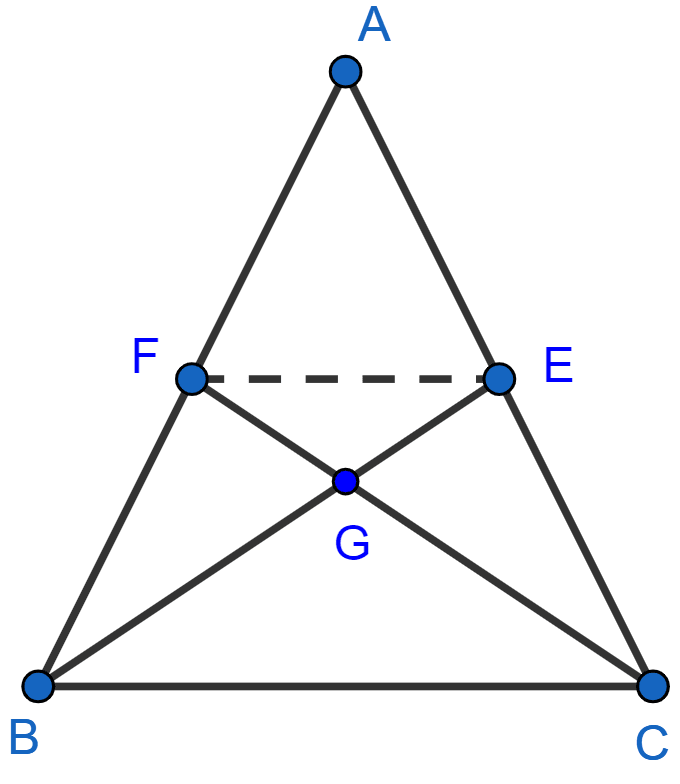
In the figure (2) given below, medians BE and CF of a △ABC meet at G. Prove that (i) △FGE ~ △CGB (ii) BG = 2GE. Similarity, ML Aggarwal Understanding Mathematics Solutions ICSE Class 10.

Answer

(i) Considering △FGE and △CGB,

∠FGE = ∠BGC (Vertically opposite angles are equal)

∠GFE = ∠GCB (Alternate angles are equal)

Hence by AA axiom △FGE ~ △CGB.

(ii) Considering △AFE and △ABC,

∠A = ∠A (Common angles)

∠AFE = ∠ABC (Corresponding angles are equal)

Hence by AA axiom △AFE ~ △ABC.

Given BE is the median of AC, so

AE = EC

AC = AE + EC = AE + AE = 2AE.

AEAC=12.\therefore \dfrac{AE}{AC} = \dfrac{1}{2}.

Since, △AFE ~ △ABC, so the ratio of their corresponding sides are equal,

FEBC=AEACFEBC=12.\therefore \dfrac{FE}{BC} = \dfrac{AE}{AC} \\[1em] \Rightarrow \dfrac{FE}{BC} = \dfrac{1}{2}.

Since, △FGE ~ △CGB, so the ratio of their corresponding sides are equal,

FEBC=GEBGGEBG=12BG=2GE.\therefore \dfrac{FE}{BC} = \dfrac{GE}{BG} \\[1em] \Rightarrow \dfrac{GE}{BG} = \dfrac{1}{2} \\[1em] \Rightarrow BG = 2GE.

Hence, proved that BG = 2GE.

Question 4

In the given figure, P is a point on AB such that PB : AP = 3 : 4 and PQ || AC.
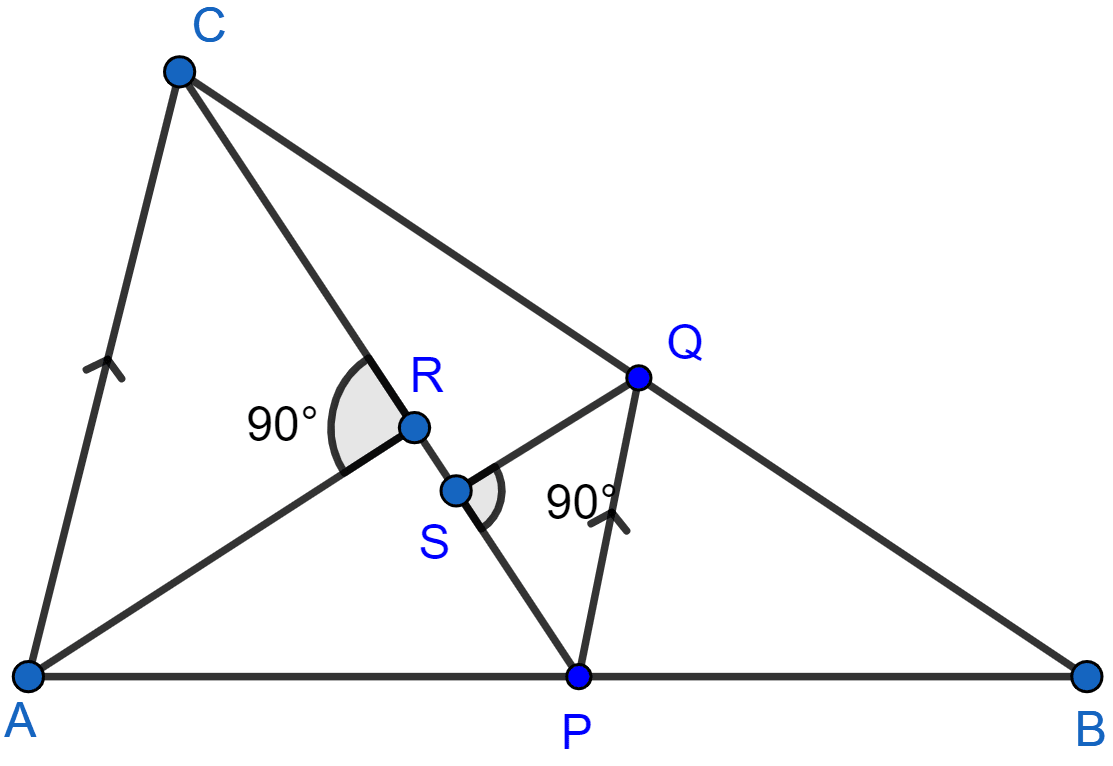
In the given figure, P is a point on AB such that PB : AP = 3 : 4 and PQ || AC. (i) Calculate PQ : AC. (ii) If AR ⊥ CP, QS ⊥ CB and QS = 6 cm, calculate the length of AR. Similarity, ML Aggarwal Understanding Mathematics Solutions ICSE Class 10.

(i) Calculate PQ : AC.

(ii) If AR ⊥ CP, QS ⊥ CB and QS = 6 cm, calculate the length of AR.

Answer

(i) Given, AP : PB = 4 : 3.

Since, PQ || AC. By using Basic Proportionality Theorem,

APPB=CQQBCQQB=43BCBQBQ=433(BCBQ)=4BQ3BC3BQ=4BQ3BC=7BQBQBC=37[....Eq 1]\Rightarrow \dfrac{AP}{PB} = \dfrac{CQ}{QB} \\[1em] \Rightarrow \dfrac{CQ}{QB} = \dfrac{4}{3} \\[1em] \Rightarrow \dfrac{BC - BQ}{BQ} = \dfrac{4}{3} \\[1em] \Rightarrow 3(BC - BQ) = 4BQ \\[1em] \Rightarrow 3BC - 3BQ = 4BQ \\[1em] \Rightarrow 3BC = 7BQ \\[1em] \Rightarrow \dfrac{BQ}{BC} = \dfrac{3}{7} \qquad \text{[....Eq 1]}

Considering △PBQ and △ABC,

∠QPB = ∠CAB (Corresponding angles are equal)

∠PQB = ∠ACB (Corresponding angles are equal)

Hence by AA axiom △PBQ ~ △ABC. Since triangles are similar so the ratio of the corresponding sides are equal,

PQAC=BQBCPQAC=37[From Eq 1].\Rightarrow \dfrac{PQ}{AC} = \dfrac{BQ}{BC} \\[1em] \Rightarrow \dfrac{PQ}{AC} = \dfrac{3}{7} \qquad \text{[From Eq 1]}.

Hence, PQ : AC = 3 : 7.

(ii) Considering △ARC and △QSP,

∠ARC = ∠QSP (Both are equal to 90°)

∠ACR = ∠SPQ (Alternate angles are equal)

Hence by AA axiom △ARC ~ △QSP. Since triangles are similar so the ratio of the corresponding sides are equal,

ARQS=ACPQAR=ACPQ×QS\Rightarrow \dfrac{AR}{QS} = \dfrac{AC}{PQ} \\[1em] \Rightarrow AR = \dfrac{AC}{PQ} \times QS \\[1em]

We calculated PQ : AC = 3 : 7 above.

ACPQ=73\therefore \dfrac{AC}{PQ} = \dfrac{7}{3}

Putting this value of ACPQ\dfrac{AC}{PQ} we get,

AR=73×6AR=7×2AR=14.\Rightarrow AR = \dfrac{7}{3} \times 6 \\[1em] \Rightarrow AR = 7 \times 2 \\[1em] \Rightarrow AR = 14.

Hence, length of AR = 14 cm.

Question 5

In a △ABC, D and E are points on the sides AB and AC respectively such that DE || BC. If AD = 2.4 cm, AE = 3.2 cm, DE = 2 cm and BC = 5 cm, find BD and CE.

Answer

The below figure shows △ABC and the points D and E on the sides AB and AC respectively:

In a △ABC, D and E are points on the sides AB and AC respectively such that DE || BC. If AD = 2.4 cm, AE = 3.2 cm, DE = 2 cm and BC = 5 cm, find BD and CE. Similarity, ML Aggarwal Understanding Mathematics Solutions ICSE Class 10.

Considering △ABC and △ADE,

∠A = ∠A (Common angles)

∠ADE = ∠ABC (Corresponding angles are equal)

Hence by AA axiom △ABC ~ △ADE. Since triangles are similar so the ratio of the corresponding sides are equal,

ADAB=AEAC=DEBC\therefore \dfrac{AD}{AB} = \dfrac{AE}{AC} = \dfrac{DE}{BC}

Consider ADAB=DEBC\dfrac{AD}{AB} = \dfrac{DE}{BC}

2.4AB=25AB=2.4×52AB=122AB=6.\Rightarrow \dfrac{2.4}{AB} = \dfrac{2}{5} \\[1em] \Rightarrow AB = \dfrac{2.4 \times 5}{2} \\[1em] \Rightarrow AB = \dfrac{12}{2} \\[1em] \Rightarrow AB = 6.

Now consider AEAC=DEBC\dfrac{AE}{AC} = \dfrac{DE}{BC}

3.2AC=25AC=3.2×52AC=162AC=8.\Rightarrow \dfrac{3.2}{AC} = \dfrac{2}{5} \\[1em] \Rightarrow AC = \dfrac{3.2 \times 5}{2} \\[1em] \Rightarrow AC = \dfrac{16}{2} \\[1em] \Rightarrow AC = 8.

From figure we see that,

⇒ BD = AB - AD = 6 - 2.4 = 3.6 cm.

⇒ CE = AC - AE = 8 - 3.2 = 4.8 cm.

Hence, the length of BD = 3.6 cm and CE = 4.8 cm.

Question 6

In a △ABC, D and E are points on the sides AB and AC respectively such that AD = 5.7 cm, BD = 9.5 cm, AE = 3.3 cm and AC = 8.8 cm. Is DE || BC? Justify your answer.

Answer

EC = AC - AE = 8.8 - 3.3 = 5.5 cm.

ADDB=5.79.5=5795=35.\dfrac{AD}{DB} = \dfrac{5.7}{9.5} \\[1em] = \dfrac{57}{95} \\[1em] = \dfrac{3}{5}.

Calculating AEEC\dfrac{AE}{EC},

AEEC=3.35.5=3355=35.\dfrac{AE}{EC} = \dfrac{3.3}{5.5} \\[1em] = \dfrac{33}{55} \\[1em] = \dfrac{3}{5}.

So, ADDB=AEEC\dfrac{AD}{DB} = \dfrac{AE}{EC}.

Hence, by basic proportionality theorem DE || BC.

Question 7

If the areas of two similar triangles are 360 cm2 and 250 cm2 and if one side of the first triangle is 8 cm, find the length of the corresponding side of the second triangle.

Answer

Let the corresponding side of the second triangle be x cm.

We know that, the ratio of the areas of two similar triangles is equal to the ratio of the square of their corresponding sides.

Area of 1Area of 2=(Side of 1)2(Side of 2)2360250=82x2x2=64×250360x2=16000360x2=160036x=160036x=406x=203=623.\therefore \dfrac{\text{Area of } △_1}{\text{Area of } △_2} = \dfrac{(\text{Side of } △_1)^2}{(\text{Side of } △_2)^2} \\[1em] \Rightarrow \dfrac{360}{250} = \dfrac{8^2}{x^2} \\[1em] \Rightarrow x^2 = \dfrac{64 \times 250}{360} \\[1em] \Rightarrow x^2 = \dfrac{16000}{360} \\[1em] \Rightarrow x^2 = \dfrac{1600}{36} \\[1em] \Rightarrow x = \sqrt{\dfrac{1600}{36}} \\[1em] \Rightarrow x = \dfrac{40}{6} \\[1em] \Rightarrow x = \dfrac{20}{3} = 6\dfrac{2}{3}.

Hence, the length of corresponding side of second triangle is 6236\dfrac{2}{3} cm.

Question 8

In the adjoining figure, D is a point on BC such that ∠ABD = ∠CAD. If AB = 5 cm, AC = 3 cm and AD = 4 cm, find

(i) BC

(ii) DC

(iii) area of △ACD : area of △BCA

In the adjoining figure, D is a point on BC such that ∠ABD = ∠CAD. If AB = 5 cm, AC = 3 cm and AD = 4 cm, find (i) BC (ii) DC (iii) area of △ACD : area of △BCA. Similarity, ML Aggarwal Understanding Mathematics Solutions ICSE Class 10.

Answer

(i) Considering △ABC and △ACD,

∠C = ∠C (Common angles)

∠ABC = ∠CAD (Given)

Hence by AA axiom △ABC ~ △ACD. Since triangles are similar hence the ratio of the corresponding sides will be equal

ABAD=BCAC54=BC3BC=154BC=3.75\therefore \dfrac{AB}{AD} = \dfrac{BC}{AC} \\[1em] \Rightarrow \dfrac{5}{4} = \dfrac{BC}{3} \\[1em] \Rightarrow BC = \dfrac{15}{4} \\[1em] \Rightarrow BC = 3.75

Hence, the length of BC = 3.75 cm.

(ii) Since triangles △ABC and △ACD are similar hence the ratio of the corresponding sides will be equal.

ABAD=ACDC54=3DCDC=125DC=2.4\therefore \dfrac{AB}{AD} = \dfrac{AC}{DC} \\[1em] \Rightarrow \dfrac{5}{4} = \dfrac{3}{DC} \\[1em] \Rightarrow DC = \dfrac{12}{5} \\[1em] \Rightarrow DC = 2.4

Hence, the length of DC = 2.4 cm.

(iii) We know that, the ratio of the areas of two similar triangles is equal to the ratio of the square of their corresponding sides.

Area of △ACDArea of △BCA=AD2AB2=4252=1625\therefore \dfrac{\text{Area of △ACD}}{\text{Area of △BCA}} = \dfrac{AD^2}{AB^2} \\[1em] = \dfrac{4^2}{5^2} \\[1em] = \dfrac{16}{25}

Hence, the ratio of area of △ACD : area of △BCA is 16 : 25.

Question 9

In the adjoining figure, the diagonals of a parallelogram intersect at O. OE is drawn parallel to CB to meet AB at E, find area of △AOE : area of ||gm ABCD.
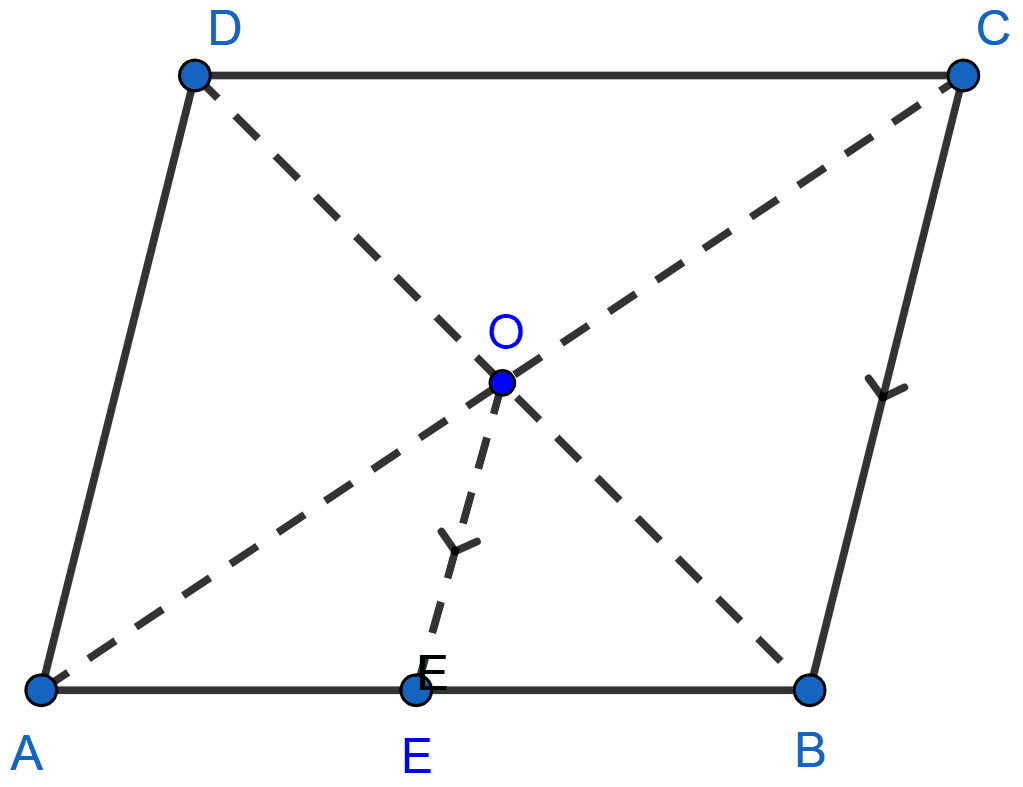
In the adjoining figure, the diagonals of a parallelogram intersect at O. OE is drawn parallel to CB to meet AB at E, find area of △AOE : area of ||gm ABCD. Similarity, ML Aggarwal Understanding Mathematics Solutions ICSE Class 10.

Answer

In the figure,

Diagonals of parallelogram ABCD are AC and BD which intersect each other at O. OE is drawn parallel to CB to meet AB in E.

In the figure four triangles have equal area.

So, Area of △OAB = 14\dfrac{1}{4} Area of parallelogram ABCD

Then, O is the midpoint of AC as diagonals of parallelogram intersect at centre.
OE || CB. We know that, ABCD is a parallelogram and opposite sides are parallel in parallelogram. Thus OE || AD also,

∴ E is the midpoint of AB.

∴ OE is the median of △AOB.

Area of △AOE=12Area of △AOB=12×14Area of parallelogram ABCD=18Area of parallelogram ABCDArea of △AOE=18Area of parallelogram ABCDArea of △AOEArea of parallelogram ABCD=18.\text{Area of △AOE} = \dfrac{1}{2} \text{Area of △AOB} \\[1em] = \dfrac{1}{2} \times \dfrac{1}{4} \text{Area of parallelogram ABCD} \\[1em] = \dfrac{1}{8} \text{Area of parallelogram ABCD} \\[1em] \therefore \text{Area of △AOE} = \dfrac{1}{8} \text{Area of parallelogram ABCD} \\[1em] \therefore \dfrac{\text{Area of △AOE}}{\text{Area of parallelogram ABCD}} = \dfrac{1}{8}.

Hence, the ratio of area of △AOE : area of ||gm ABCD is 1 : 8.

Question 10

In the adjoining figure, ABCD is a trapezium in which AB || DC. If 2AB = 3DC, find the ratio of the areas of △AOB and △COD.

In the adjoining figure, ABCD is a trapezium in which AB || DC. If 2AB = 3DC, find the ratio of the areas of △AOB and △COD. Similarity, ML Aggarwal Understanding Mathematics Solutions ICSE Class 10.

Answer

Given, 2AB = 3DC

ABDC=32\Rightarrow \dfrac{AB}{DC} = \dfrac{3}{2}.

Considering △AOB and △COD,

∠AOB = ∠COD (Vertically opposite angles are equal)

∠OAB = ∠OCD (Alternate angles are equal)

Hence by AA axiom △AOB ~ △COD.

We know that, the ratio of the areas of two similar triangles is equal to the ratio of the square of their corresponding sides.

Area of △AOBArea of △COD=AB2DC2=3222=94\therefore \dfrac{\text{Area of △AOB}}{\text{Area of △COD}} = \dfrac{AB^2}{DC^2} \\[1em] = \dfrac{3^2}{2^2} \\[1em] = \dfrac{9}{4}

Hence, the ratio of area of △AOB : area of △COD is 9 : 4.

Question 11

In the adjoining figure, ABCD is a parallelogram. E is mid-point of BC. DE meets the diagonal AC at O and meet AB (produced) at F. Prove that

(i) DO : OE = 2 : 1

(ii) area of △OEC : area of △OAD = 1 : 4
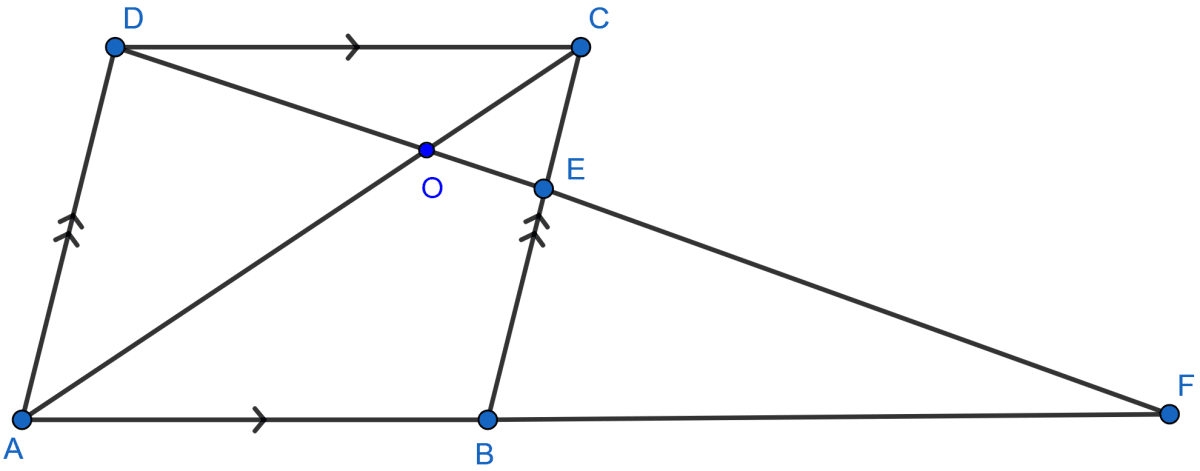
In the adjoining figure, ABCD is a parallelogram. E is mid-point of BC. DE meets the diagonal AC at O and meet AB (produced) at F. Prove that (i) DO : OE = 2 : 1 (ii) area of △OEC : area of △OAD = 1 : 4. Similarity, ML Aggarwal Understanding Mathematics Solutions ICSE Class 10.

Answer

(i) Given E is the mid-point of BC,

∴ 2EC = BC

Since ABCD is a parallelogram so, BC = AD or, 2EC = AD.

Considering △AOD and △EDC,

∠AOD = ∠EOC (Vertically opposite angles are equal)

∠OAD = ∠OCB (Alternate angles are equal)

Hence by AA axiom △AOD ~ △EOC. Since triangles are similar so the ratio of their corresponding sides are equal.

DOOE=ADEC=2ECEC=21\therefore \dfrac{DO}{OE} = \dfrac{AD}{EC} = \dfrac{2EC}{EC} \\[1em] = \dfrac{2}{1} \\[1em]

Hence, proved that DO : OE = 2 : 1.

(ii) From (i) we have proved that △AOD ~ △EOC.

Area of △OECArea of △AOD=OE2DO2=1222=14=1:4.\therefore \dfrac{\text{Area of △OEC}}{\text{Area of △AOD}} = \dfrac{OE^2}{DO^2} \\[1em] = \dfrac{1^2}{2^2} \\[1em] = \dfrac{1}{4} \\[1em] = 1 : 4.

Hence, proved that area of △OEC : area of △OAD = 1 : 4.

Question 12

In the given diagram ∆ADB and ∆ACB are two right angled triangles with ∠ADB = ∠BCA = 90°. If AB = 10 cm, AD = 6 cm, BC = 2.4 cm and DP = 4.5 cm

In the given diagram ∆ADB and ∆ACB are two right angled triangles with ∠ADB = ∠BCA = 90°. If AB = 10 cm, AD = 6 cm, BC = 2.4 cm and DP = 4.5 cm. ICSE 2024 Maths Solved Question Paper.

(a) Prove that ∆APD ∼ ∆BPC.

(b) Find the length of BD and PB

(c) Hence, find the length of PA

(d) Find area ∆APD : area ∆BPC

Answer

(a) In ∆APD and ∆BPC,

⇒ ∠APD = ∠BPC (Vertically opposite angles are equal)

⇒ ∠ADP = ∠BCP (Both equal to 90°)

Hence, proved that ∆APD ∼ ∆BPC.

(b) In ∆ADB,

By pythagoras theorem,

⇒ AB2 = AD2 + BD2

⇒ 102 = 62 + BD2

⇒ BD2 = 100 - 36

⇒ BD2 = 64

⇒ BD = 64\sqrt{64} = 8 cm.

⇒ PB = BD - PD = 8 - 4.5 = 3.5 cm

Hence, BD = 8 cm and PB = 3.5 cm.

(c) In ∆APD,

By pythagoras theorem,

⇒ AP2 = AD2 + DP2

⇒ AP2 = 62 + (4.5)2

⇒ AP2 = 36 + 20.25

⇒ AP2 = 56.25

⇒ AP = 56.25\sqrt{56.25} = 7.5 cm

Hence, length of AP = 7.5 cm.

(d) We know that,

Ratio of area of similar triangles is equal to the square of the corresponding sides.

Area of △APDArea of △BPC=AD2BC2=62(2.4)2=6×62.4×2.4=1×10.4×0.4=10×104×4=10016=254=25:4.\therefore \dfrac{\text{Area of △APD}}{\text{Area of △BPC}} = \dfrac{AD^2}{BC^2} \\[1em] = \dfrac{6^2}{(2.4)^2} \\[1em] = \dfrac{6 \times 6}{2.4 \times 2.4} \\[1em] = \dfrac{1 \times 1}{0.4 \times 0.4} \\[1em] = \dfrac{10 \times 10}{4 \times 4} \\[1em] = \dfrac{100}{16} \\[1em] = \dfrac{25}{4} \\[1em] = 25 : 4.

Hence, area ∆APD : area ∆BPC = 25 : 4.

Question 13

A model of a ship is made to a scale of 1 : 250. Calculate :

(i) the length of the ship, if the length of model is 1.6 m.

(ii) the area of the deck of the ship, if the area of the deck of model is 2.4 m2.

(iii) the volume of the model, if the volume of the ship is 1 km3.

Answer

(i) Since, the model of the ship is made to the scale of 1 : 250.

∴ K (Scale factor) = 250.

Actual length of the ship = k × (the length of model) = 250 × 1.6 = 400 m.

Hence, the length of the ship is 400 m.

(ii) Area of the deck of the ship = k2 × (Area of the deck of the model)
= (250)2 x 2.4
= 250 x 250 x 2.4
= 1,50,000 m2

Hence, the area of the deck of the ship is 1,50,000 m2.

(iii) Volume of the ship = k3 × (the volume of the model)

Given, volume of ship = 1 km3 = (1000)3 m3

Let the volume of the model be x m3.

10003=2503×xx=1000×1000×1000250×250×250x=4×4×4x=64.\Rightarrow 1000^3 = 250^3 \times x \\[1em] \Rightarrow x = \dfrac{1000 \times 1000 \times 1000}{250 \times 250 \times 250} \\[1em] \Rightarrow x = 4 \times 4 \times 4 \\[1em] \Rightarrow x = 64.

Hence, the volume of the model of the ship is 64 m3.

PrevNext