
The adjacent figure shows a circle with center O and while OABC is a quadrilateral.
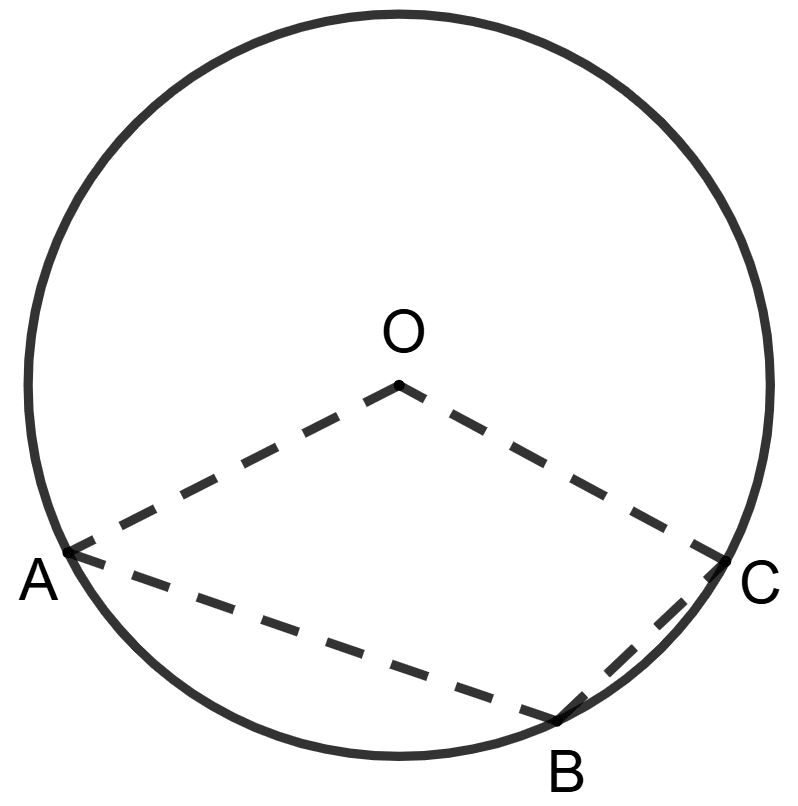
Assertion (A): OABC is a cyclic quadrilateral.
Reason (R): A quadrilateral inscribed in a circle is a cyclic quadrilateral.
Assertion (A) is true, but Reason (R) is false.
Assertion (A) is false, but Reason (R) is true.
Both Assertion (A) and Reason (R) are correct, and Reason (R) is the correct reason for Assertion (A).
Both Assertion (A) and Reason (R) are correct, and Reason (R) is incorrect reason for Assertion (A).
Answer
A cyclic quadrilateral is defined as a quadrilateral whose all four vertices lie on the circumference of a circle. In other words, it is a quadrilateral that is inscribed in a circle.
So, reason (R) is true.
In the given figure, O is center of the circle. Hence, it does not lie on the circumference of the circle.
Therefore, OABC is not a cyclic quadrilateral.
So, assertion (A) is false.
Thus, Assertion (A) is false, but Reason (R) is true.
Hence, option 2 is the correct option.
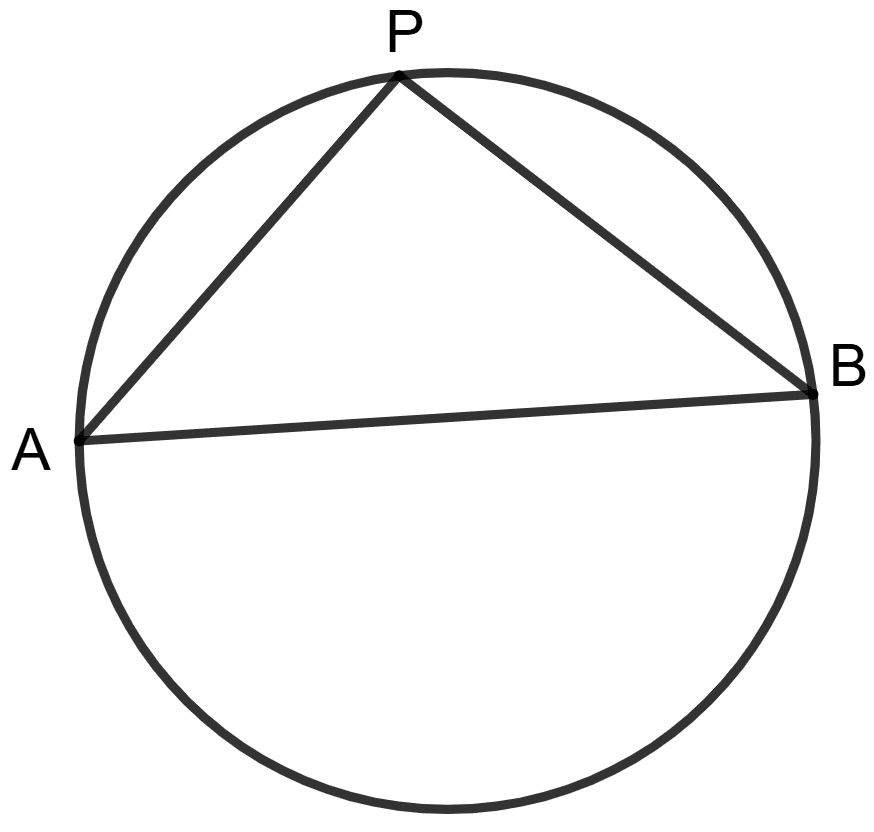
Assertion (A): In the adjoining figure, AB is a diameter of the circle. If P is any point on the circle, then AB2 = AP2 + BP2.
Reason (R): Angle in a semicircle is 90°.
Assertion (A) is true, but Reason (R) is false.
Assertion (A) is false, but Reason (R) is true.
Both Assertion (A) and Reason (R) are correct, and Reason (R) is the correct reason for Assertion (A).
Both Assertion (A) and Reason (R) are correct, and Reason (R) is incorrect reason for Assertion (A).
Answer
Given,
AB is the diameter of the circle.
We know that,
Angle in a semi-circle is a right angle.
So, reason (R) is true.
∠APB = 90°
We know that,
Side opposite to 90° is hypotenuse.
Thus, in triangle APB, AB is the hypotenuse.
Using pythagoras theorem in ΔAPB,
⇒ Hypotenuse2 = Base2 + Perpendicular2
⇒ AB2 = BP2 + AP2
So, assertion (A) is true.
Thus, both Assertion (A) and Reason (R) are correct, and Reason (R) is the correct reason for Assertion (A).
Hence, option 3 is the correct option.
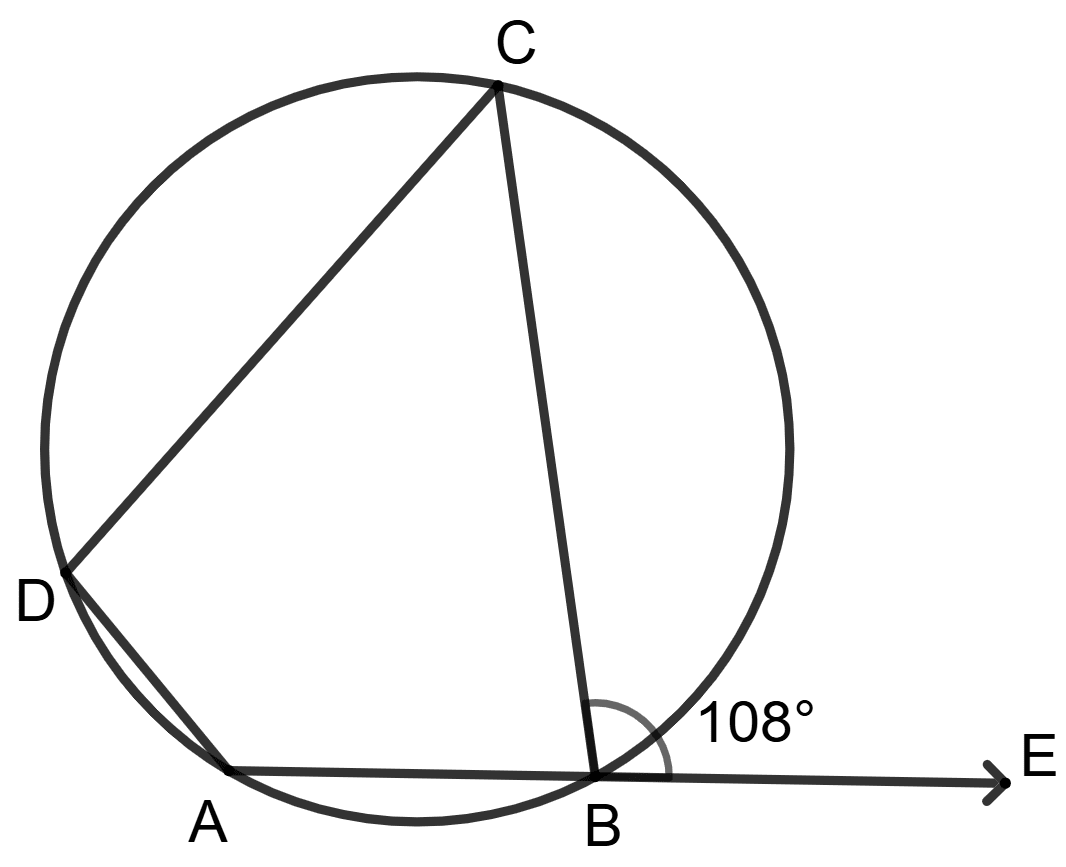
Assertion (A): In the adjoining figure, ABCD is a cyclic quadrilateral. If ∠CBE = 108°, then ∠ADC = 108°.
Reason (R): In a cyclic quadrilateral, opposite angles are supplementary.
Assertion (A) is true, but Reason (R) is false.
Assertion (A) is false, but Reason (R) is true.
Both Assertion (A) and Reason (R) are correct, and Reason (R) is the correct reason for Assertion (A).
Both Assertion (A) and Reason (R) are correct, and Reason (R) is incorrect reason for Assertion (A).
Answer
From figure,
∠CBE and ∠CBA forms a linear pair.
⇒ ∠CBE + ∠CBA = 180°
⇒ 108° + ∠CBA = 180°
⇒ ∠CBA = 180° - 108°
⇒ ∠CBA = 72°
ABCD is a cyclic quadrilateral, opposite angles are supplementary.
So, reason (R) is true.
⇒ ∠CBA + ∠ADC = 180°
⇒ 72° + ∠ADC = 180°
⇒ ∠ADC = 180° - 72°
⇒ ∠ADC = 108°.
So, assertion (A) is true.
Thus, both Assertion (A) and Reason (R) are correct, and Reason (R) is the correct reason for Assertion (A).
Hence, option 3 is the correct option.
Assertion (A): An exterior angle of a cyclic quadrilateral is equal to an interior angle.
Reason (R): If an exterior angle of a quadrilateral is equal to opposite interior angle, then the quadrilateral is cyclic.
Assertion (A) is true, but Reason (R) is false.
Assertion (A) is false, but Reason (R) is true.
Both Assertion (A) and Reason (R) are correct, and Reason (R) is the correct reason for Assertion (A).
Both Assertion (A) and Reason (R) are correct, and Reason (R) is incorrect reason for Assertion (A).
Answer
We know that,
In a cyclic quadrilateral, an exterior angle is equal to the opposite interior angle.
So, reason (R) is true.
In case of assertion (A) : An exterior angle of a cyclic quadrilateral is equal to an interior angle.
This statement is incorrectly stated as the exterior angle is equal to the opposite interior angle.
So, assertion (A) is false.
Thus, Assertion (A) is false, but Reason (R) is true.
Hence, option 2 is the correct option.
In the adjoining figure P, Q and R the points of the circle, PT is the tangent to the circle at point P.
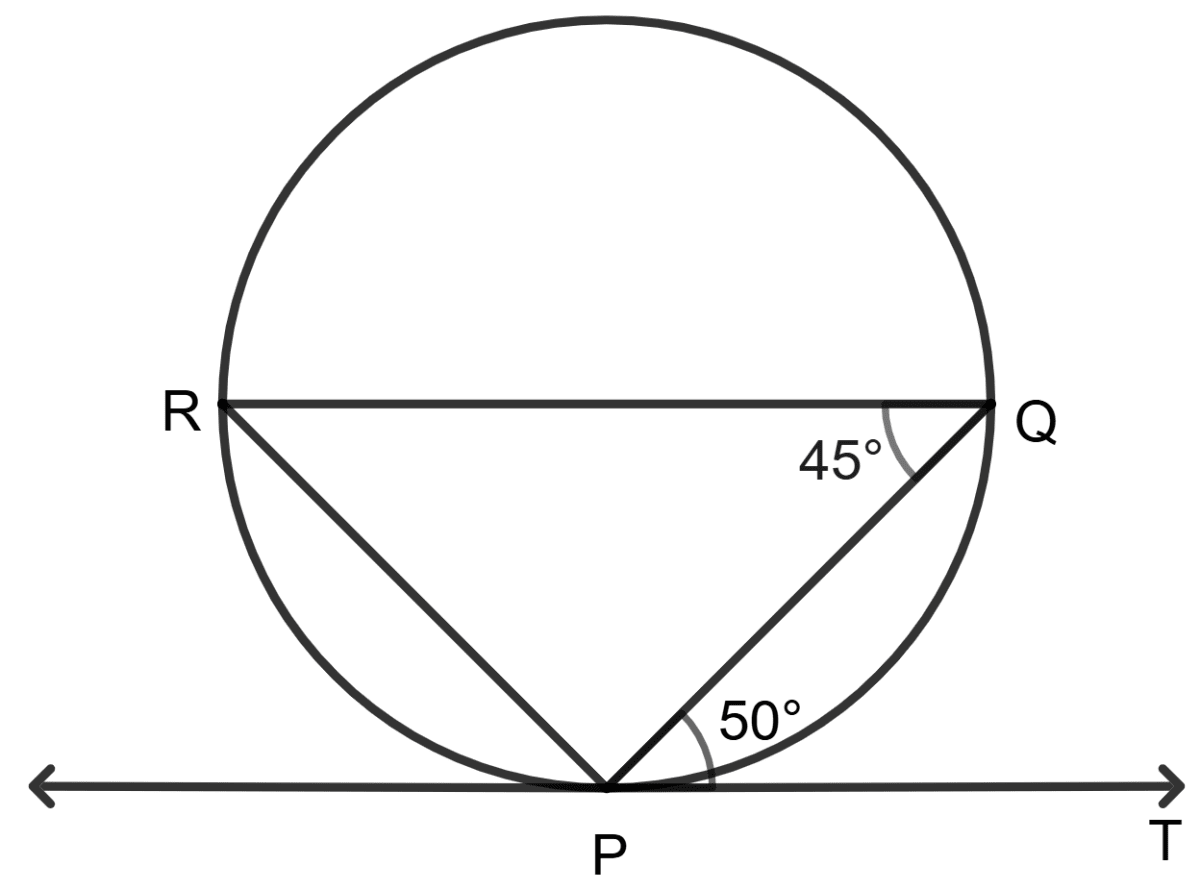
Assertion (A): If ∠QPT = 50° and ∠PQR = 45°, then ∠QPR = 95°.
Reason (R): Angles in alternate segments are equal.
Assertion (A) is true, but Reason (R) is false.
Assertion (A) is false, but Reason (R) is true.
Both Assertion (A) and Reason (R) are correct, and Reason (R) is the correct reason for Assertion (A).
Both Assertion (A) and Reason (R) are correct, and Reason (R) is incorrect reason for Assertion (A).
Answer
According to alternate Segment theorem,
The angle between a tangent to a circle and a chord drawn from the point of contact is equal to the angle subtended by the chord in the alternate segment of the circle.
So, reason (R) is true.
∴ ∠QRP = ∠QPT (By alternate segment theorem)
⇒ ∠QRP = 50°
In ΔPQR, according to angle sum property,
∴ ∠PQR + ∠PRQ + ∠QPR = 180°
⇒ 45° + 50° + ∠QPR = 180°
⇒ 95° + ∠QPR = 180°
⇒ ∠QPR = 180° - 95°
⇒ ∠QPR = 85°
So, assertion (A) is false.
Thus, Assertion (A) is false, but Reason (R) is true.
Hence, option 2 is the correct option.