
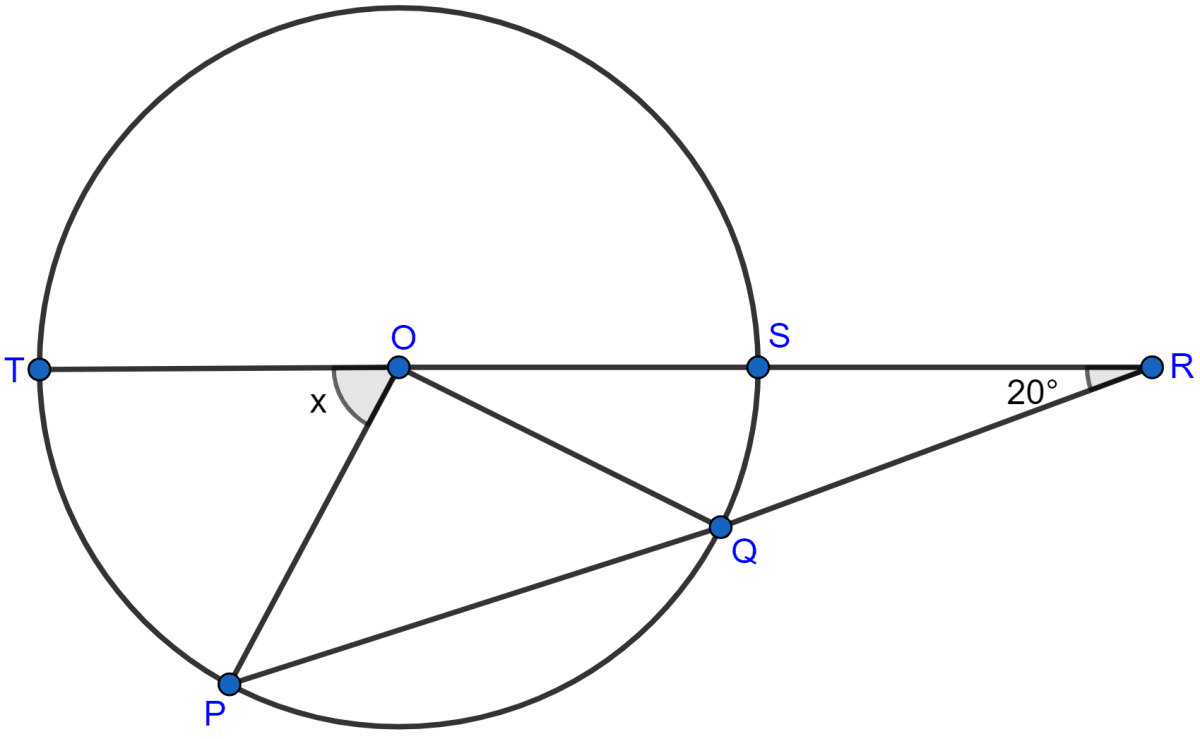
In the adjoining figure, O is the centre of the circle. If QR = OP and ∠ORP = 20°, find the value of 'x' giving reasons.
Answer
Given,
QR = OP ⇒ QR = OQ
⇒ ∠QOR = ∠ORQ = 20° (∵ angles opposite equal sides of a triangle are equal)
Exterior angle in a triangle is equal to the sum of two opposite interior angles.
∴ ∠OQP = ∠QOR + ∠ORQ = 20° + 20° = 40°.
As OP = OQ, ∠OPQ = ∠OQP
⇒ ∠OPQ = 40°
⇒ ∠OPR = 40°.
Exterior angle in a triangle is equal to the sum of two opposite interior angles.
∴ x = ∠TOP = ∠OPR + ∠ORP = 40° + 20° = 60°.
Hence, the value of x = 60°.
In the figure (i) given below, triangle ABC is equilateral. Find ∠BDC and ∠BEC.

Answer
Since ABC is an equilateral triangle so,
∠A = ∠B = ∠C = 60°.
From figure,
∠BDC = ∠BAC (∵ angles in alternate segments are equal.)
∴ ∠BDC = 60°.
BDCE is a cyclic quadrilateral. Hence, sum of the opposite angles = 180°.
⇒ ∠BDC + ∠BEC = 180°
⇒ 60° + ∠BEC = 180°
⇒ ∠BEC = 180° - 60° = 120°.
Hence, the value of ∠BDC = 60° and ∠BEC = 120°.
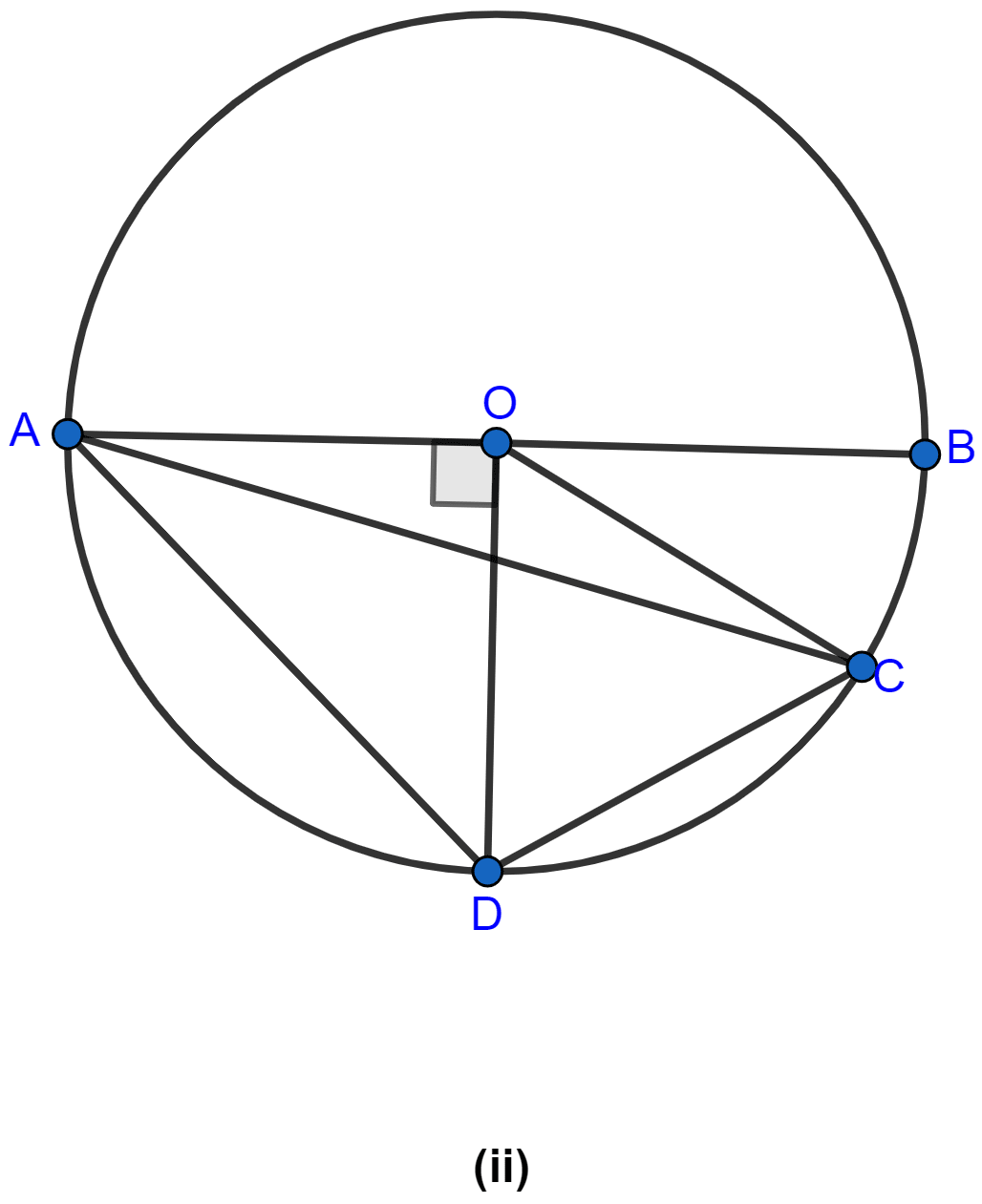
In the figure (ii) given below, AB is a diameter of a circle with centre O. OD is perpendicular to AB and C is a point on the arc DB. Find ∠BAD and ∠ACD.
Answer
In △AOD, ∠AOD = 90°.
OA = OD (Radii of the semi-circle)
∠OAD = ∠ODA (∵ angles opposite equal side are equal.)
We know that sum of angles in a triangle = 180°.
In △OAD,
⇒ ∠AOD + ∠OAD + ∠ODA = 180°
⇒ 90° + ∠OAD + ∠OAD = 180°
⇒ 90° + 2∠OAD = 180°
⇒ 2∠OAD = 180° - 90°
⇒ ∠OAD = = 45°.
From figure,
∠BAD = ∠OAD = 45°.
Arc AD subtends ∠AOD at the centre and ∠ACD at the remaining part of the circle.
∠AOD = 2∠ACD (∵ angle subtended on centre is double the angle subtended at remaining part of the circle.)
⇒ 90° = 2∠ACD
⇒ ∠ACD = = 45°.
Hence, the value of ∠BAD = 45° and ∠ACD = 45°.
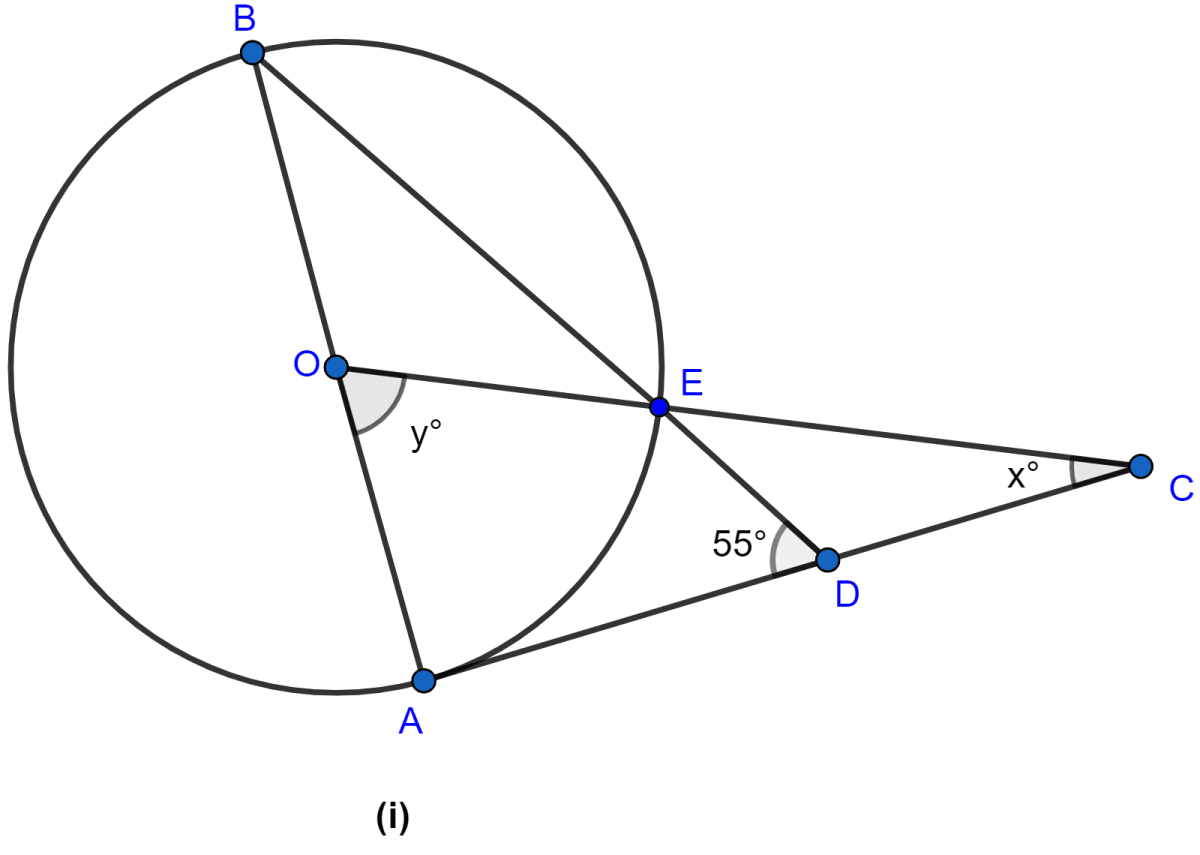
In the figure (i) given below, AC is a tangent to the circle with centre O. If ∠ADB = 55°, find x and y. Give reasons for your answers.
Answer
We know that angle between the radius and tangent at the point of contact is right angle.
∴ ∠A = 90°.
Also in △OBE, OB = OE = radius of the circle.
∴ ∠B = ∠OEB .....(i)
In △ABD,
⇒ ∠A + ∠B + ∠ADB = 180°
⇒ 90° + ∠B + 55° = 180°
⇒ ∠B + 145° = 180°
⇒ ∠B = 180° - 145° = 35°.
∴ ∠OEB = 35°.
From figure,
∠DEC = ∠OEB = 35° (∵ vertically opposite angles are equal.)
∠EDC + ∠ADE = 180° (∵ both form a linear pair)
∠EDC + 55° = 180°
∠EDC = 180° - 55°
∠EDC = 125°.
In △EDC,
⇒ ∠DEC + ∠EDC + ∠DCE = 180°
⇒ 35° + 125° + x° = 180°
⇒ x° + 160° = 180°
⇒ x° = 180° - 160° = 20°.
In △AOC,
⇒ ∠AOC + ∠OAC + ∠ACO = 180°
⇒ y° + 90° + x° = 180°
⇒ y° + 90° + 20° = 180°
⇒ y° + 110° = 180°
⇒ y° = 180° - 110° = 70°.
Hence, the value of x = 20 and y = 70.
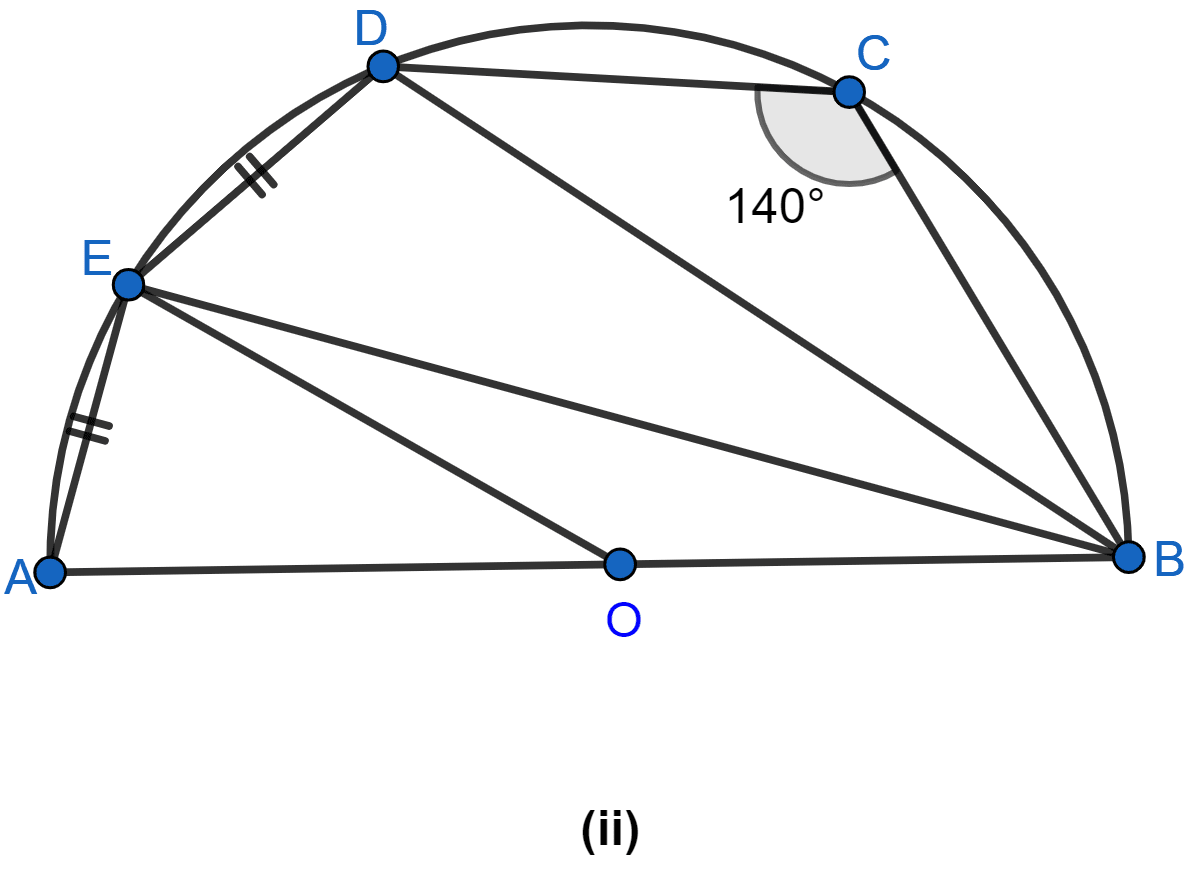
In the figure (ii) given below, AB is a diameter of the semicircle ABCDE with centre O. If AE = ED and ∠BCD = 140°, find ∠AED and ∠EBD. Also prove that OE is parallel to BD.
Answer
We know that in a cyclic quadrilateral the sum of opposite interior angles = 180°.
In cyclic quadrilateral BCDE,
⇒ ∠BCD + ∠BED = 180°
⇒ 140° + ∠BED = 180°
⇒ ∠BED = 180° - 140° = 40°.
∠AEB = 90°. (∵ angle in semicircle = 90°.)
From figure,
∠AED = ∠AEB + ∠BED = 90° + 40° = 130°.
In cyclic quadrilateral AEDB,
⇒ ∠AED + ∠DBA = 180°
⇒ 130° + ∠DBA = 180°
⇒ ∠DBA = 180° - 130° = 50°.
Given chord AE = ED
∴ ∠DBE = ∠EBA
From figure,
⇒ ∠DBA = ∠DBE + ∠EBA
⇒ 50 = ∠DBE + ∠DBE
⇒ 2∠DBE = 50°
⇒ ∠DBE = = 25°.
or, ∠EBD = 25°.
In △OEB, OE = OB (Radii of the same circle.)
∠OEB = ∠EBO = ∠DBE
But these are alternate angles.
∴ OE || BD.
Hence, the value of ∠AED = 130° and ∠EBD = 25°.
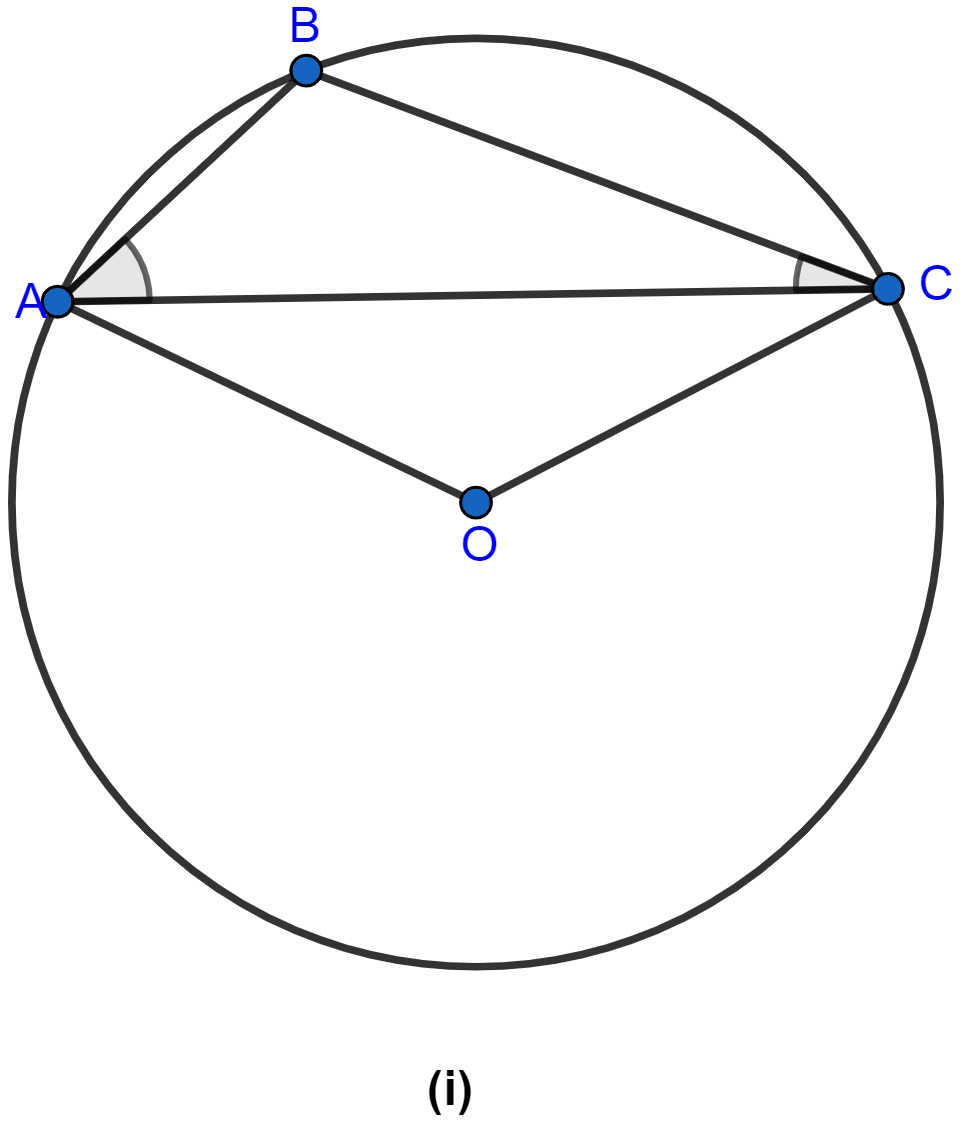
In the figure (i) given below, O is the centre of the circle. Prove that ∠AOC = 2(∠ACB + ∠BAC).
Answer
We know that sum of angles in a triangle = 180°.
In △ABC,
∠ACB + ∠BAC + ∠ABC = 180°
∠ABC = 180° - (∠ACB + ∠BAC) .....(i)
In the circle arc AC subtends Reflex ∠AOC at centre and ∠ABC at remaining part of the circle.
∴ Reflex ∠AOC = 2∠ABC (∵ angle subtended on centre is double the angle subtended at remaining part of the circle.)
From (i)
Reflex ∠AOC = 2(180° - (∠ACB + ∠BAC))
We know
Reflex ∠AOC = 360° - ∠AOC.
or,
360° - ∠AOC = 2(180° - (∠ACB + ∠BAC))
360° -∠AOC = 360° - 2(∠ACB + ∠BAC)
∠AOC = 360° - (360° - 2(∠ACB + ∠BAC))
∠AOC = 2(∠ACB + ∠BAC).
Hence, proved that ∠AOC = 2(∠ACB + ∠BAC).
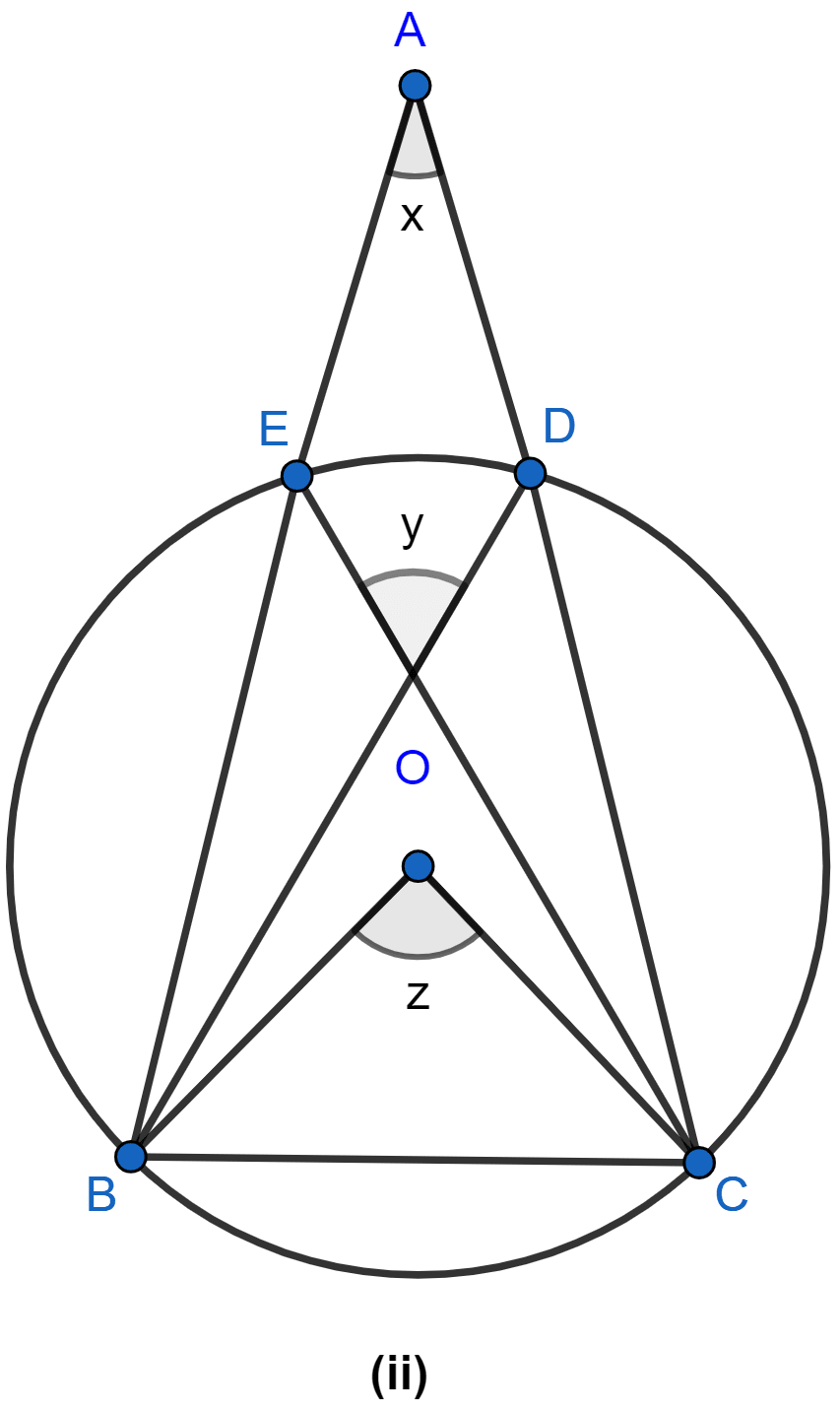
In the figure (ii) given below, O is the centre of the circle. Prove that x + y = z.
Answer
From figure,
∠BEC = ∠BDC (∵ angles in same segment are equal)
Arc BC subtends ∠BOC at the centre and ∠BEC at the remaining part of the circle.
∴ ∠BOC = 2∠BEC (∵ angle subtended on centre is double the angle subtended at remaining part of the circle.)
⇒ ∠BOC = ∠BEC + ∠BEC = ∠BEC + ∠BDC
⇒ ∠BOC = ∠BEC + ∠BDC .....(i)
In △OBE,
⇒ ∠EOD = ∠EBO + ∠BEO ....(ii) (∵ exterior angle is equal to the sum of two opposite interior angles.)
From figure,
∠EBO = ∠EBD and ∠BEO = ∠BEC and Exterior angle ∠EOD = y.
Putting these values in eqn (ii) we get,
⇒ y = ∠EBD + ∠BEC
⇒ ∠BEC = y - ∠EBD .....(iii)
In △ABD,
∠BDC = ∠BAD + ∠ABD ....(iv) (∵ exterior angle is equal to the sum of two opposite interior angles.)
From figure,
∠ABD = ∠EBD and ∠BAD = x.
Putting these values in eqn (iv) we get,
∠BDC = x + ∠EBD ......(v)
Putting value of ∠BEC and ∠BDC from eqn (iii) and (v) respectively in (i) we get,
⇒ ∠BOC = ∠BEC + ∠BDC
⇒ ∠BOC = y - ∠EBD + x + ∠EBD
⇒ ∠BOC = x + y
From figure,
∠BOC = z.
∴ z = x + y.
Hence, proved that x + y = z.
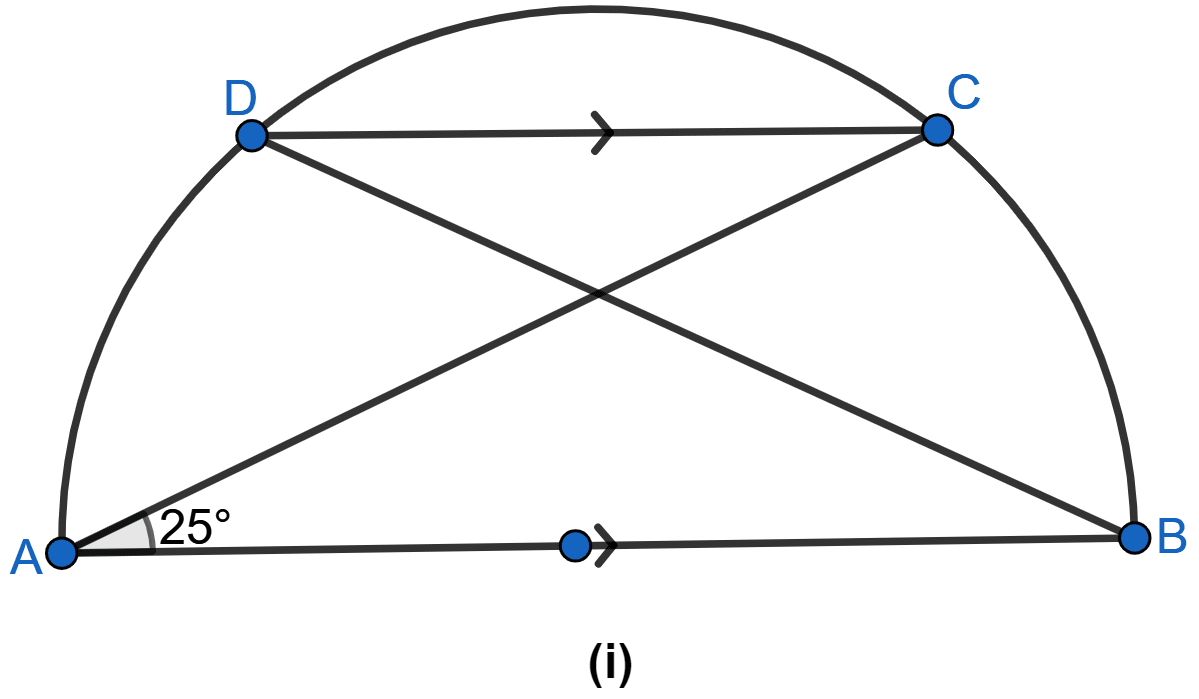
In the figure (i) given below, AB is diameter of a circle. If DC is parallel to AB and ∠CAB = 25°, find (i) ∠ADC (ii) ∠DAC.
Answer
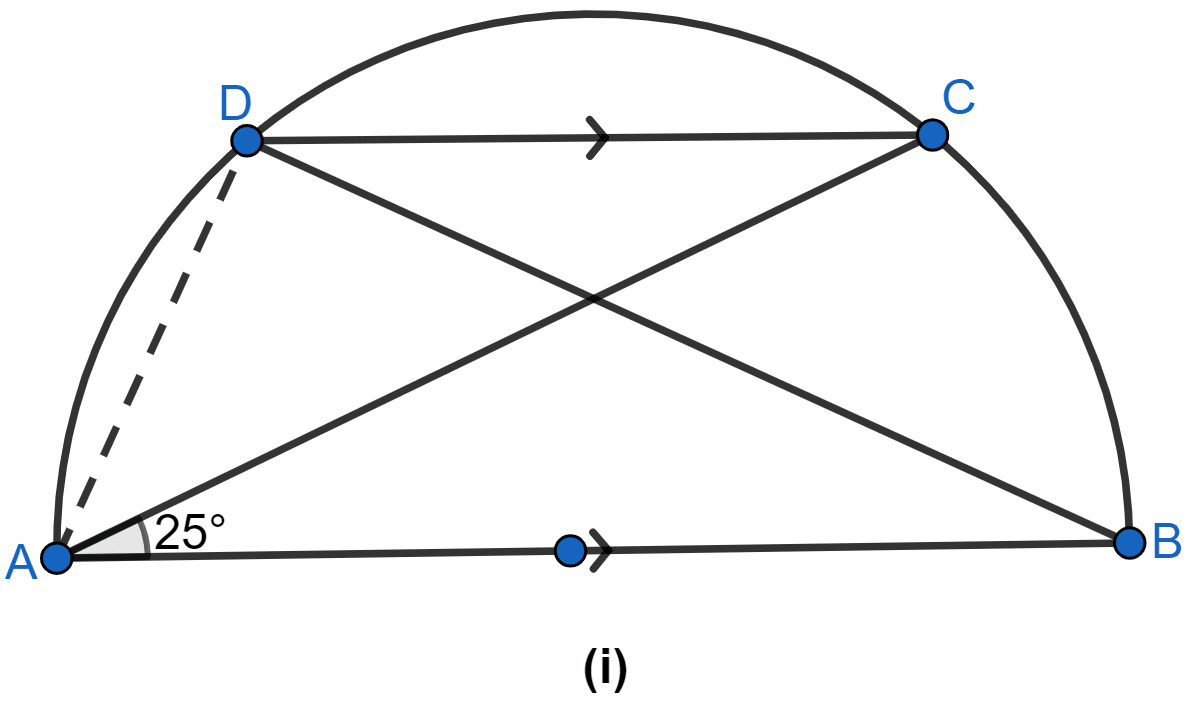
(i) Join AD.
From figure,
∠BDC = ∠BAC = 25°. (∵ angles in same segment are equal.)
∠ADB = 90° (∵ angle in semicircle = 90°.)
∠ADC = ∠ADB + ∠BDC = 90° + 25° = 115°.
Hence, the value of ∠ADC = 115°.
(ii) ∠ACD = ∠CAB = 25° (∵ alternate angles are equal)
Since sum of angles in a triangle = 180°.
In △ADC,
⇒ ∠ADC + ∠DAC + ∠ACD = 180°
⇒ 115° + ∠DAC + 25° = 180°
⇒ ∠DAC + 140° = 180°
⇒ ∠DAC = 180° - 140° = 40°.
Hence, the value of ∠DAC = 40°.
In the figure (ii) given below, sides AB and DC of a cyclic quadrilateral are produced to meet at a point P and the sides AD and BC produced to meet at a point Q. If ∠ADC = 75° and ∠BPC = 50°, find ∠BAD and ∠CQD.

Answer
Since sum of angles in a triangle = 180°.
In △ADP,
⇒ ∠ADP + ∠DAP + ∠DPA = 180°
⇒ 75° + ∠DAP + 50° = 180°
⇒ ∠DAP + 125° = 180°
⇒ ∠DAP = 180° - 125° = 55°.
From figure,
∠BAD = ∠DAP = 55°.
In cyclic quadrilateral sum of opposite angles = 180°
In ABCD,
∴ ∠ADC + ∠CBA = 180°
⇒ 75° + ∠CBA = 180°
⇒ ∠CBA = 180° - 75° = 105°.
In △ABQ,
⇒ ∠ABQ + ∠BAQ + ∠AQB = 180°
From figure, ∠BAQ = ∠BAD and ∠ABQ = ∠CBA or,
⇒ 105° + 55° + ∠AQB = 180°
⇒ ∠AQB + 160° = 180°
⇒ ∠AQB = 180° - 160° = 20°.
From figure,
∠CQD = ∠AQB = 20°.
Hence, the value of ∠BAD = 55° and ∠CQD = 20°.
In the figure (i) given below, ABDC is a cyclic quadrilateral. If AB = CD, prove that AD = BC.
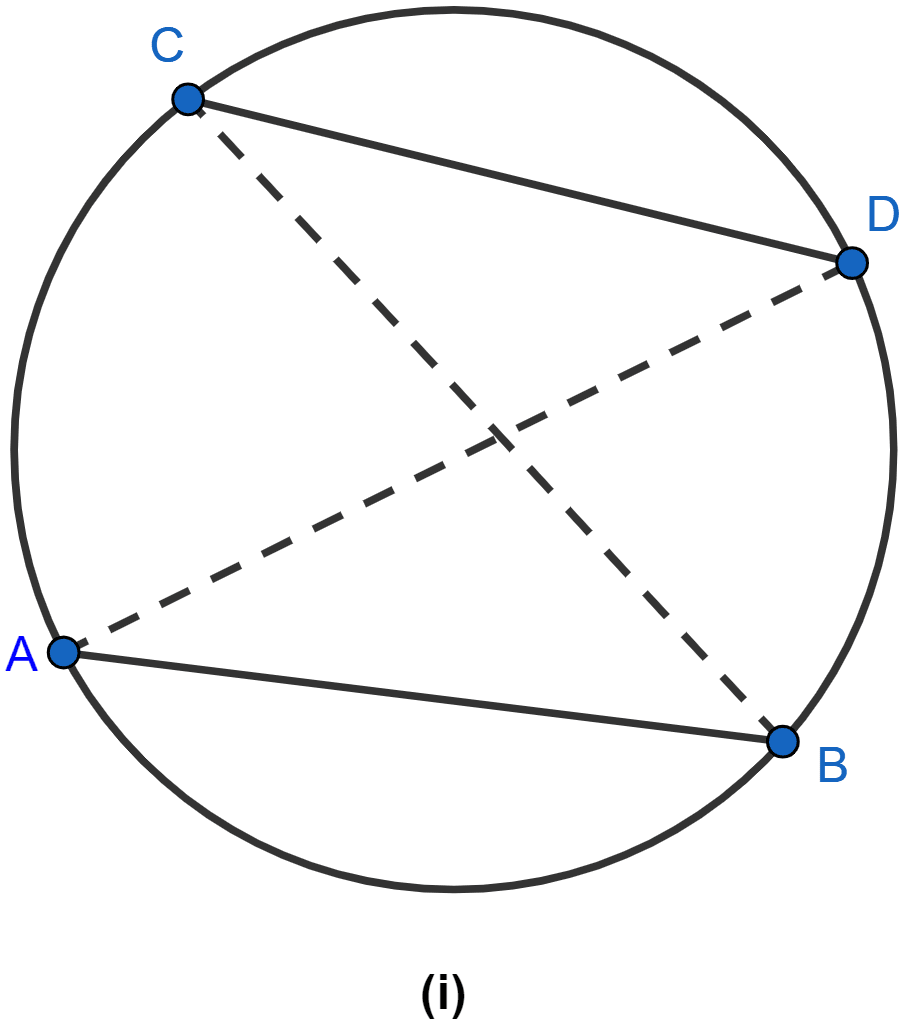
Answer
Join AC and BD.
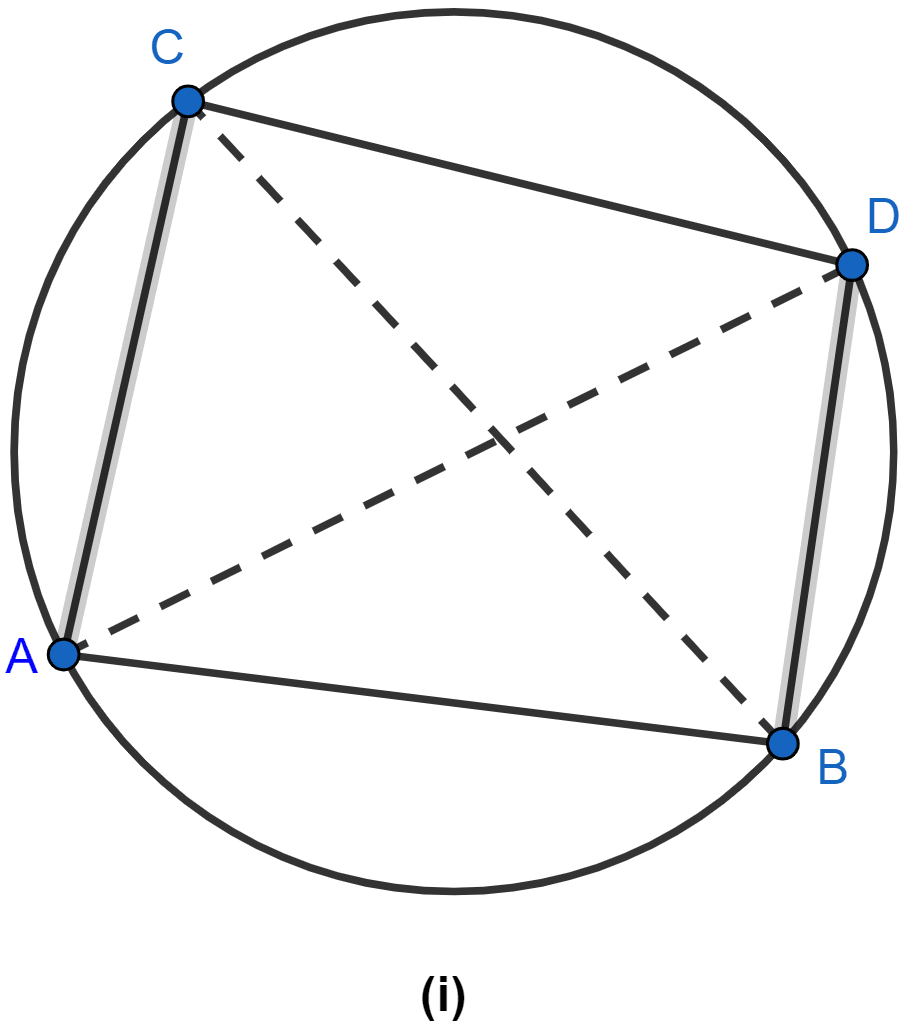
In △ABD and △CBD,
AB = CD (Given)
BD = BD (Common side)
∠BAD = ∠BCD (∵ angles in same segment are equal.)
∴ △ABD ≅ △CBD. (By SSA axiom of congruency.)
∴ BC = AD (As corresponding parts of congruent triangles are congruent.)
Hence, proved that BC = AD.
In the figure (ii) given below, ABC is an isosceles triangle with AB = AC. If ∠ABC = 50°, find ∠BDC and ∠BEC.

Answer
Since, AB = AC.
Hence, in △ABC,
∠ACB = ∠ABC = 50°.
Since sum of angles in a triangle = 180°.
In △ABC,
⇒ ∠ABC + ∠ACB + ∠BAC = 180°
⇒ 50° + 50° + ∠BAC = 180°
⇒ ∠BAC + 100° = 180°
⇒ ∠BAC = 180° - 100° = 80°.
From figure,
∠BDC = ∠BAC = 80° (∵ angles in same segment are equal.)
In cyclic quadrilateral sum of opposite angles = 180°,
Hence in BDCE,
⇒ ∠BDC + ∠BEC = 180°
⇒ 80° + ∠BEC = 180°
⇒ ∠BEC = 180° - 80° = 100°.
Hence, the value of ∠BDC = 80° and ∠BEC = 100°.
A point P is 13 cm from the centre of a circle. The length of the tangent drawn from P to the circle is 12 cm. Find the distance of P from the nearest point of the circle.
Answer
Let T be the point of contact of the tangent from point P to the circle with centre O.
From figure,

OT ⊥ PT (As tangent and radius from point of contact are perpendicular to each other.)
In right-angled triangle OPT
⇒ OP2 = OT2 + PT2
⇒ 132 = OT2 + 122
⇒ 169 - 144 = OT2
⇒ OT2 = 25
⇒ OT = 5 cm.
From figure,
⇒ OA = OT = 5 cm (Radius of the circle.)
⇒ PA = OP - OA = 13 - 5 = 8 cm.
Hence, the distance of P from the nearest point of circle = 8 cm.
Two circles touch each other internally. Prove that the tangents drawn to the two circles from any point on the common tangent are equal in length.
Answer
Let two circles touch each other at point P and T is a point on common tangent as shown in the figure below:
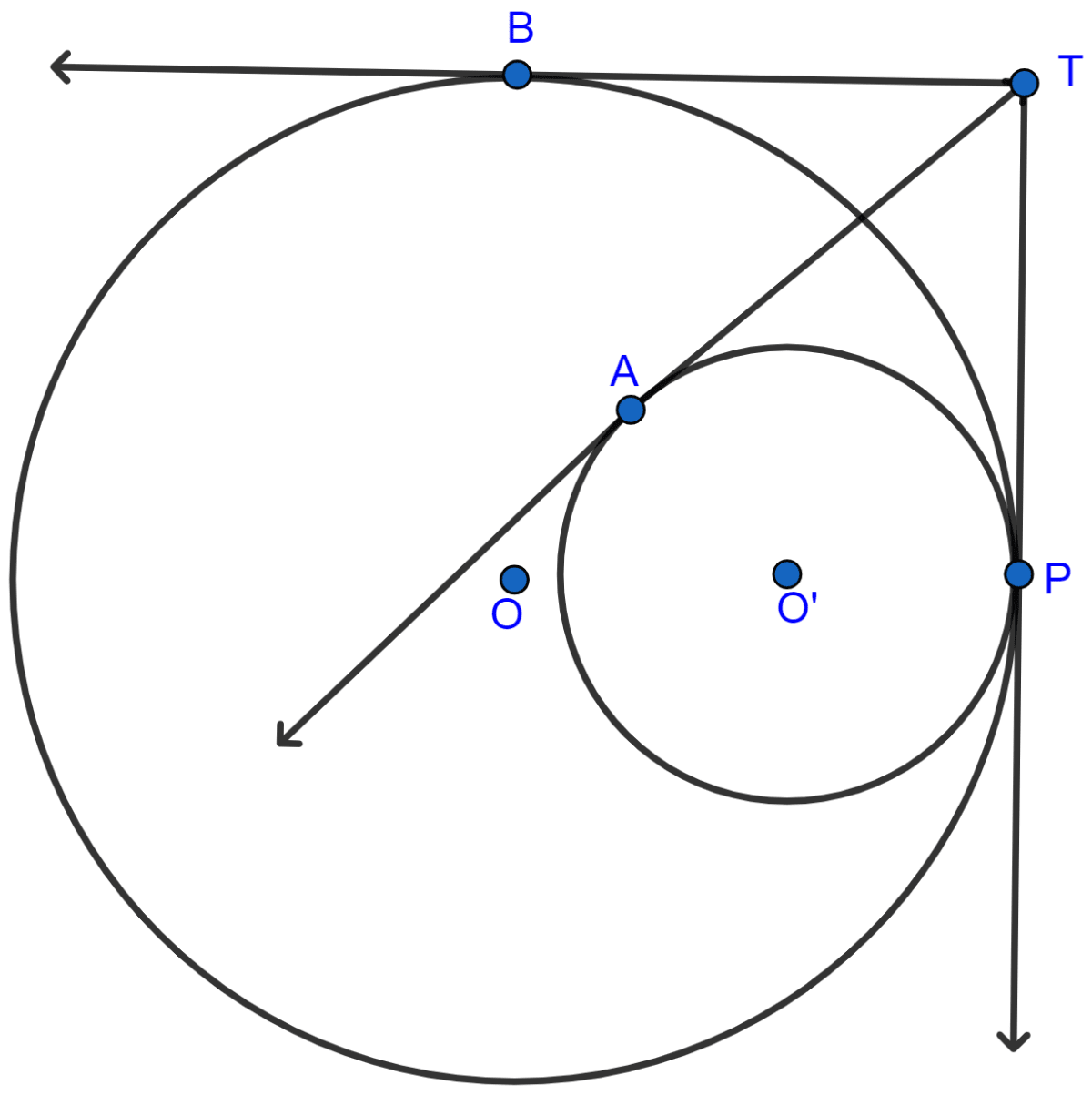
As tangents drawn from an external point to a circle are equal in length.
From T, TA and TP are tangents to the circle with centre O'.
TA = TP .....(i)
From T, TB and TP are tangents to the circle with centre O.
TB = TP .....(ii)
From (i) and (ii),
TA = TB.
Hence, proved that tangents drawn to two circles from any point on common tangent are equal in length.
From a point outside a circle, with centre O, tangents PA and PB are drawn. Prove that
(i) ∠AOP = ∠BOP
(ii) OP is the perpendicular bisector of the chord AB.
Answer
The figure is shown below:
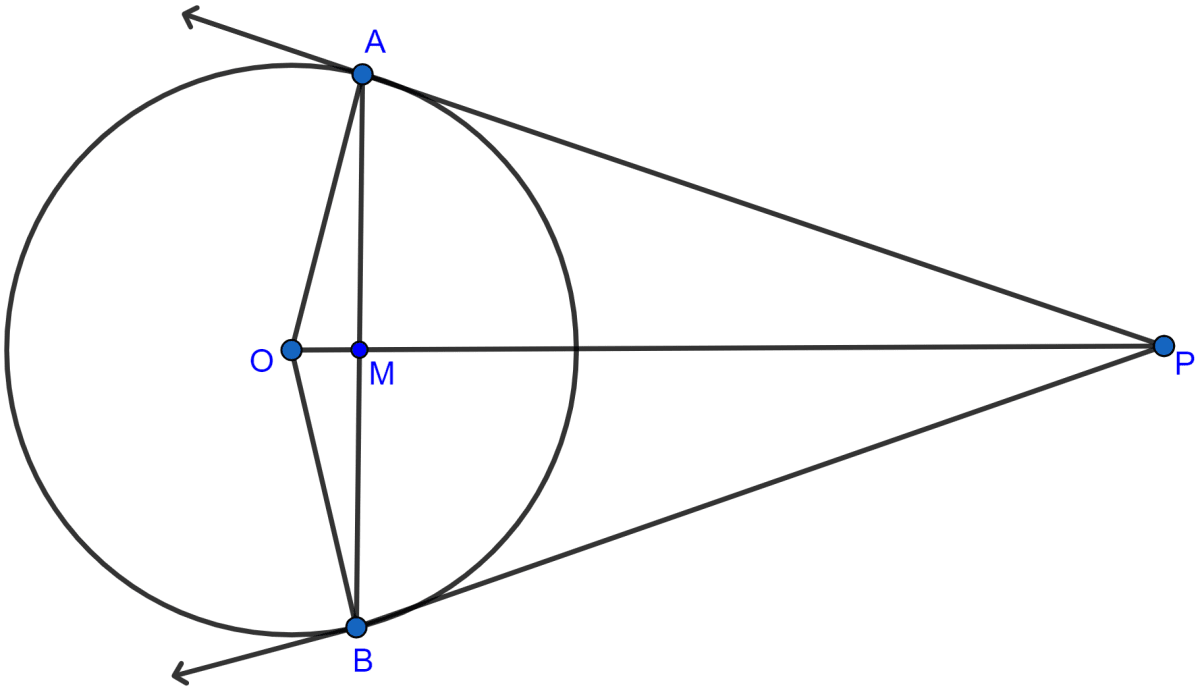
(i) In △AOP and △BOP,
OP = OP (Common sides)
OA = OB (Radius of the circle)
∠OAP = ∠OBP (Both are equal to 90° as tangents and radius on point of contact are perpendicular to each other.)
∴ △OAP ≅ △OBP (S.A.S. axiom of congruency)
(As Corresponding parts of congruent triangles are congruent)
∴ ∠AOP = ∠BOP and ∠APO = ∠BPO.
Hence, proved that ∠AOP = ∠BOP.
(ii) In △APM and △BPM,
PM = PM (Common side)
∠APM = ∠BPM (Proved above)
AP = BP (∵ tangents from an exterior point to a circle are equal in length)
∴ △APM ≅ △BPM (S.A.S. axiom of congruency)
(Congruent parts of congruent triangles are congruent.)
∴ AM = BM and ∠AMP = ∠BMP
But ∠AMP + ∠BMP = 180°
∴ ∠AMP = ∠BMP = 90°.
Hence, proved that OP is perpendicular bisector of AB at M.
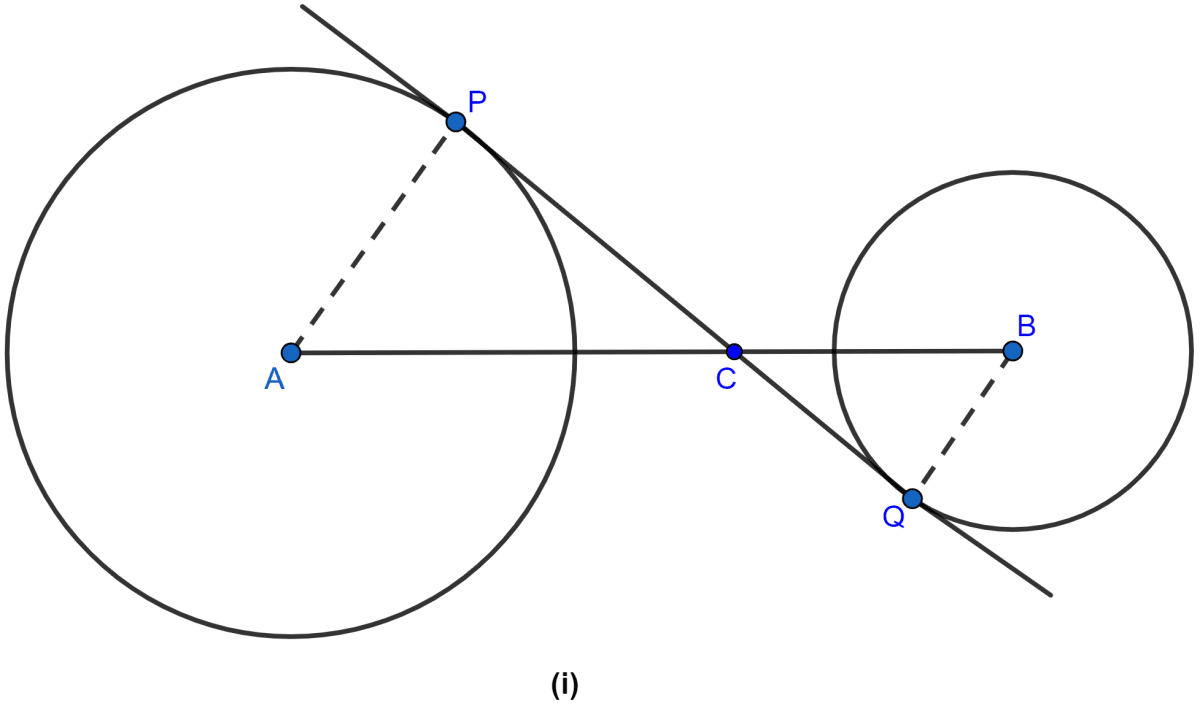
The figure given below shows two circles with centres A, B and a transverse common tangent to these circles meet the straight line AB in C. Prove that :
AP : BQ = PC : CQ.
Answer
In △APC and △BQC
∠PCA = ∠QCB (∵ vertically opposite angles are equal)
∠APC = ∠BQC (∵ both are equal to 90 as radius and tangent to a circle at the point of contact are perpendicular to each other.)
∴ △APC ~ △BQC (By AA axiom of similarity)
Since triangles are similar hence the ratio of their corresponding sides are equal.
Hence, proved that AP : BQ = PC : CQ
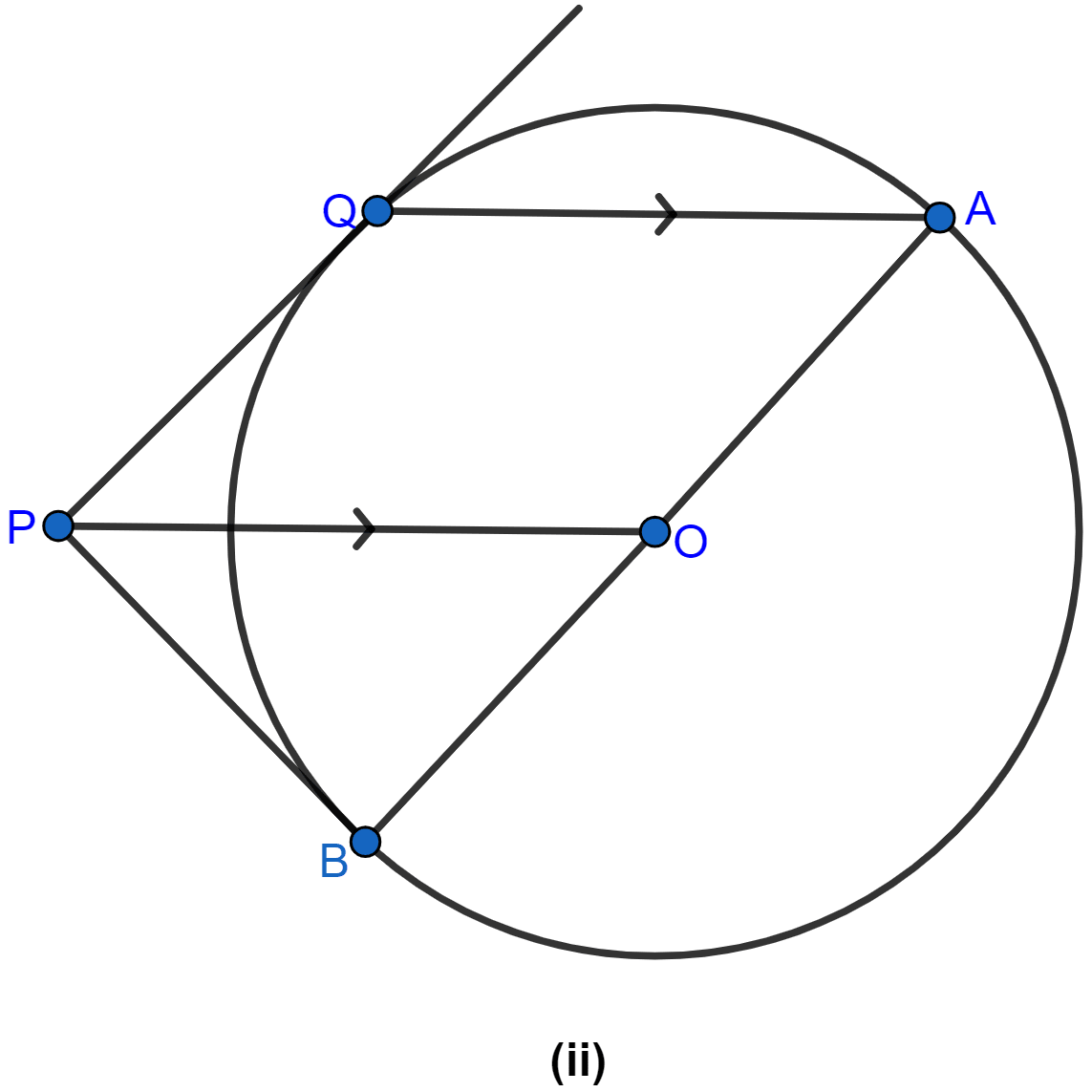
In the figure (ii) given below, PQ is a tangent to the circle with centre O and AB is a diameter of the circle. If QA is parallel to PO, prove that PB is tangent to the circle.
Answer
Join OQ as shown in the figure below:
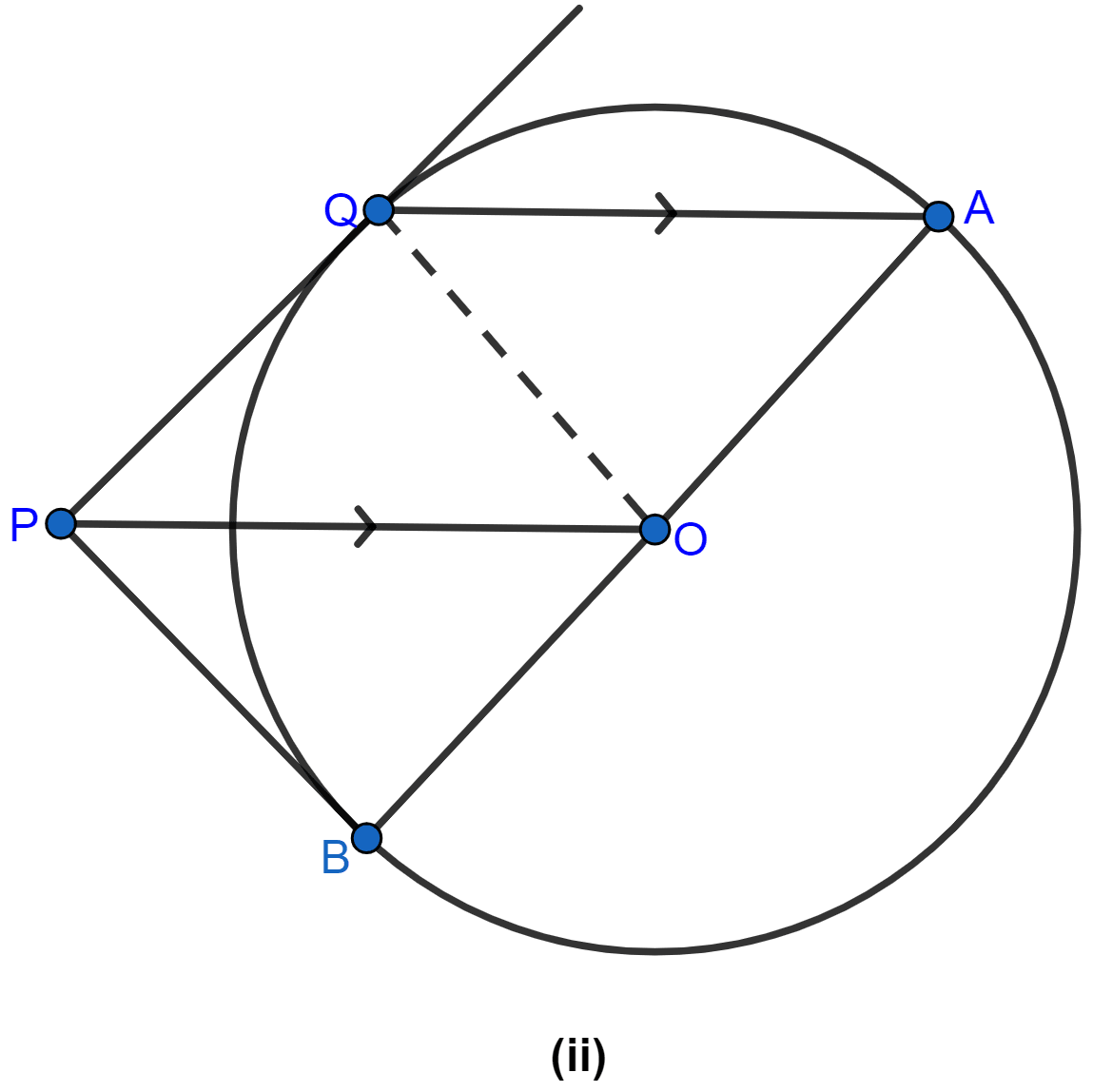
In △OAQ,
OA = OQ (Radius of the same circle.)
∠OAQ = ∠OQA.
Given QA || PO
∴ ∠OAQ = ∠POB (∵ corresponding angles are equal.)
and ∠OQA = ∠QOP (∵ alternate angles are equal.)
But ∠OAQ = ∠OQA,
∴ ∠POB = ∠QOP
Now in △OPQ and △OBP
OP = OP (Common sides)
OQ = OB (Radius of the same circle.)
∠QOP = ∠POB
∴ △OPQ ≅ △OBP (S.A.S. axiom of congruency)
As corresponding parts of congruent triangles are congruent,
∴ ∠OQP = ∠OBP
But ∠OQP = 90°
∴ ∠OBP = 90°
∴ PB is the tangent of the circle.
Hence, proved that PB is the tangent of the circle.
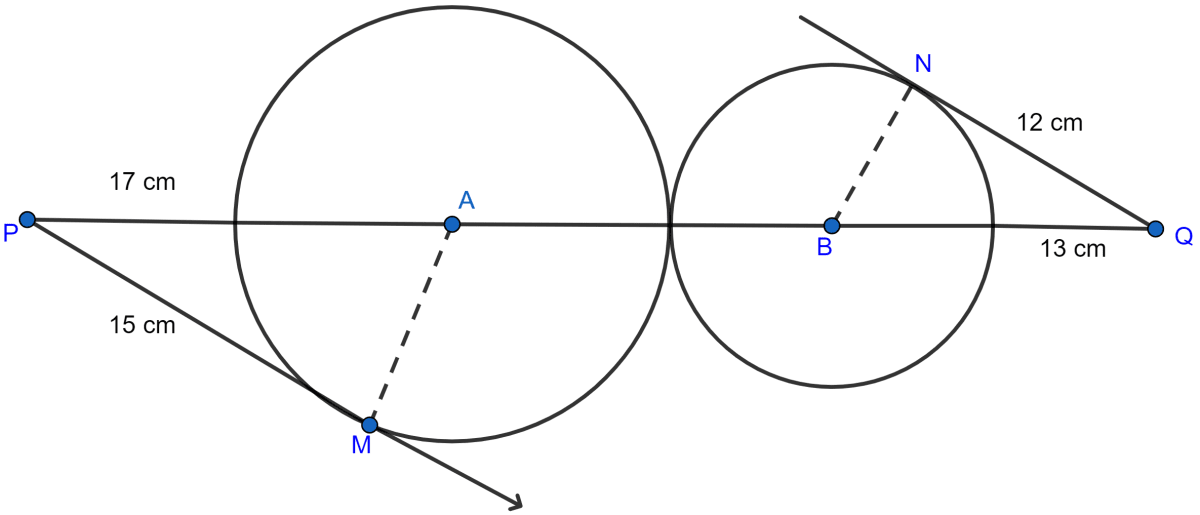
In the figure given below, two circles with centres A and B touch externally. PM is a tangent to the circle with centre A and QN is a tangent to the circle with centre B. If PM = 15 cm, QN = 12 cm, PA = 17 cm and QB = 13 cm, then find the distance between the centres A and B of the circles.
Answer
Since radius and tangent at the point of contact of a circle are perpendicular to each other.
∴ ∠AMP = ∠BNQ = 90°.
In right angled triangle △AMP
AP2 = AM2 + PM2 (By pythagoras theorem)
⇒ AM2 = AP2 - PM2
⇒ AM2 = 172 - 152
⇒ AM2 = 289 - 225
⇒ AM2 = 64
⇒ AM =
⇒ AM = 8 cm.
Similarly in right angled triangle △BNQ
BQ2 = BN2 + NQ2 (By pythagoras theorem)
⇒ BN2 = BQ2 - NQ2
⇒ BN2 = 132 - 122
⇒ BN2 = 169 - 144
⇒ BN2 = 25
⇒ BN =
⇒ BN = 5 cm.
From figure the distance between A and B is equal to the sum of their radius = 8 + 5 = 13 cm.
Two chords AB, CD of a circle intersect externally at a point P. If PB = 7 cm, AB = 9 cm and PD = 6 cm, find CD.
Answer
We know that,
If two chords of a circle intersect externally, then the products of the length of segments are equal.
From figure,
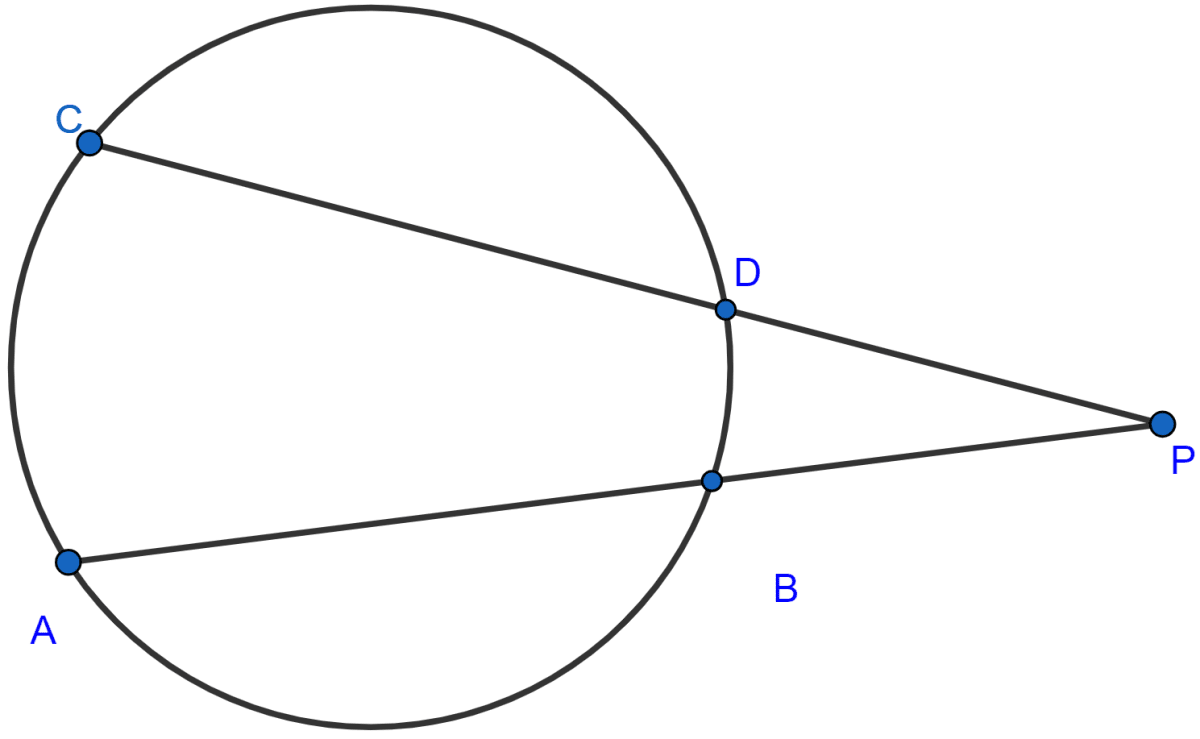
PA.PB = PC.PD .....(i)
PA = PB + AB = 7 + 9 = 16 cm.
Putting values in equation (i) we get,
⇒ 16 × 7 = PC × 6
⇒ 112 = PC × 6
⇒ PC =
⇒ PC = .
From figure,
CD = PC - PD =
Hence, the value of CD = cm.
In the figure (i) given below, chord AB and diameter CD of a circle with centre O meet at P. PT is tangent to the circle at T. If AP = 16 cm, AB = 12 cm and DP = 2 cm, find the length of PT and the radius of the circle.

Answer
We know that if a chord and a tangent intersect externally, then the product of the lengths of the segments of the chord is equal to the square of the length of the tangent from the point of contact to the point of intersection.
∴ PA.PB = PT2 .....(i)
From figure,
PB = PA - AB = 16 - 12 = 4 cm.
Putting values in equation (i),
16 x 4 = PT2
PT2 = 64
PT = = 8 cm.
Join OT as shown in the figure below:

In △OTP,
OT ⊥ TP (∵ tangents and radius at the point of contact are perpendicular to each other.)
In right angled triangle OTP,
OP2 = OT2 + PT2 (By pythagoras theorem)
(OD + DP)2 = OT2 + PT2
Since, OD = OT = radius of circle = r.
(r + 2)2 = r2 + 82
r2 + 4 + 4r = r2 + 64
r2 - r2 + 4r = 64 - 4
4r = 60
r = 15 cm.
Hence, the length of PT = 8 cm and radius of circle = 15 cm.
In the figure (ii) given below, chord AB and diameter CD of a circle meet at P. If AB = 8 cm, BP = 6 cm and PD = 4 cm, find the radius of the circle. Also find the length of the tangent drawn from P to the circle.

Answer
We know that if a chord and a tangent intersect externally, then the product of the lengths of the segments of the chord is equal to the square of the length of the tangent from the point of contact to the point of intersection.
∴ PA.PB = PT2 .....(i)
From figure,
PA = AB + PB = 8 + 6 = 14 cm.
Putting values in equation (i),
14 x 6 = PT2
PT2 = 84
PT = cm.
Joining OT as shown in the figure below:

In △OTP,
OT ⊥ TP (∵ tangents and radius at a point of contact are perpendicular to each other.)
In right angled triangle OTP,
Since, OD = OT = radius of circle = r.
Hence, the radius of the circle = 8.5 cm and length of tangent = cm.
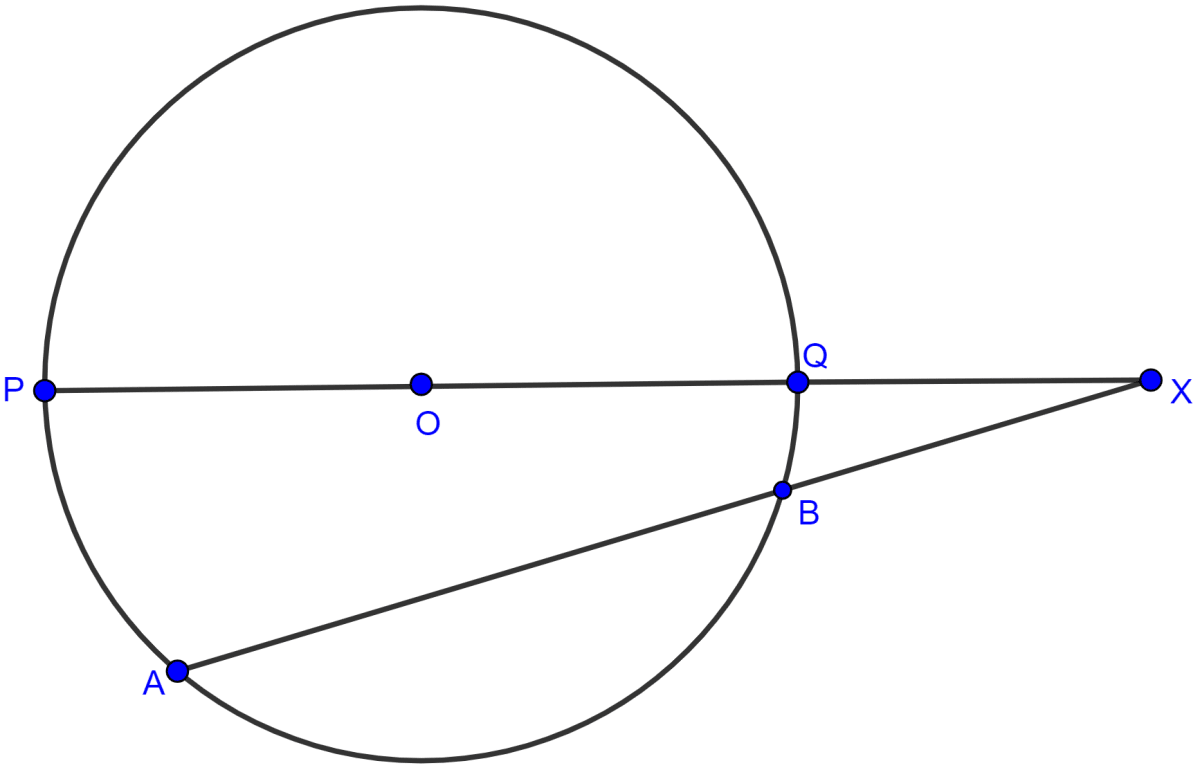
In the adjoining figure, chord AB and diameter PQ of a circle with centre O meet at X. If BX = 5 cm, OX = 10 cm and the radius of the circle is 6 cm, compute the length of AB. Also find the length of tangent drawn from X to the circle.
Answer
From figure,
OP = OQ = radius of circle = 6 cm.
XP = XO + OP = 10 + 6 = 16 cm.
XQ = XO - OQ = 10 - 6 = 4 cm.
We know that,
If two chords of a circle intersect externally, then the products of the length of segments are equal.
From figure,
XA XB = XP XQ
5 XA = 16 4
XA = = 12.8 cm.
AB = XA - XB = 12.8 - 5 = 7.8 cm
Let XT be the tangent to the circle as shown in the figure below:
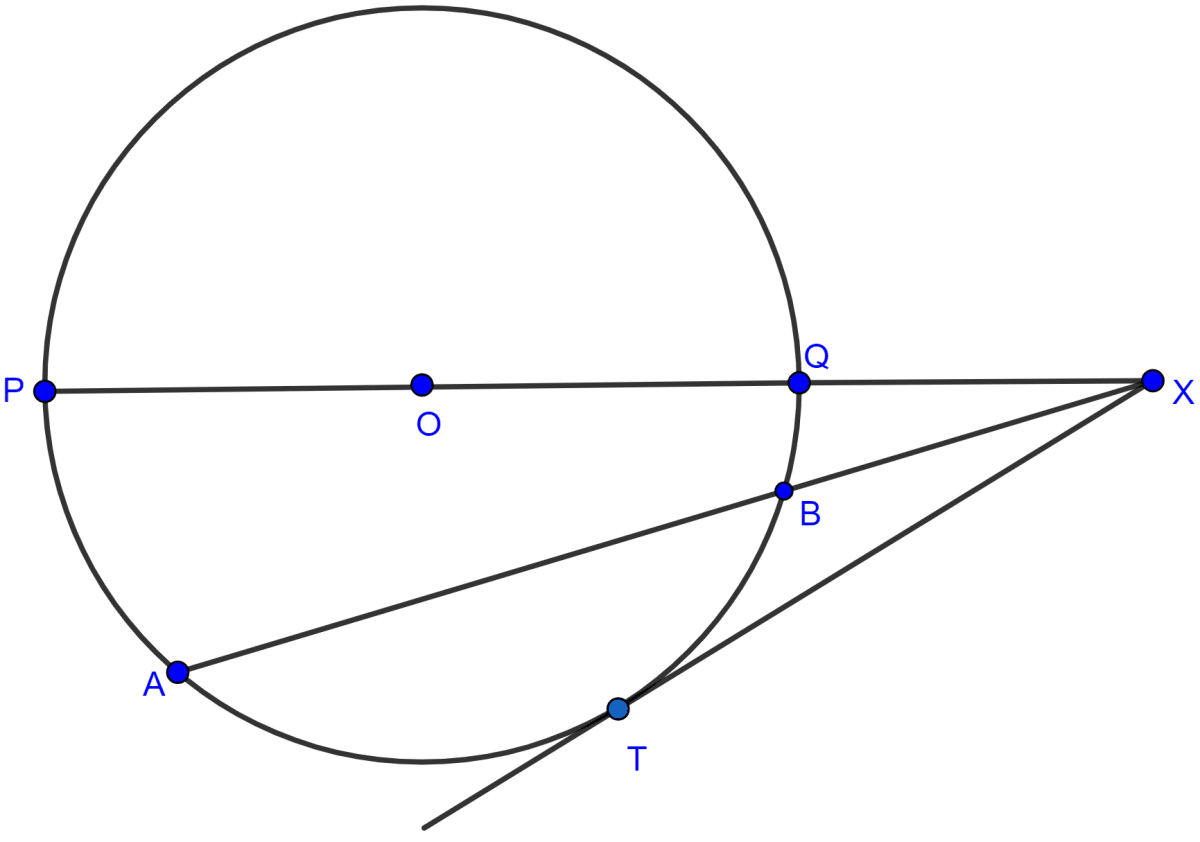
We know that if a chord and a tangent intersect externally, then the product of the lengths of the segments of the chord is equal to the square of the length of the tangent from the point of contact to the point of intersection.
∴ XP.XQ = XT2 .....(i)
XT2 = 16 x 4 = 64
XT = = 8 cm.
Hence, the length of AB = 7.8 cm and length of tangent = 8 cm.
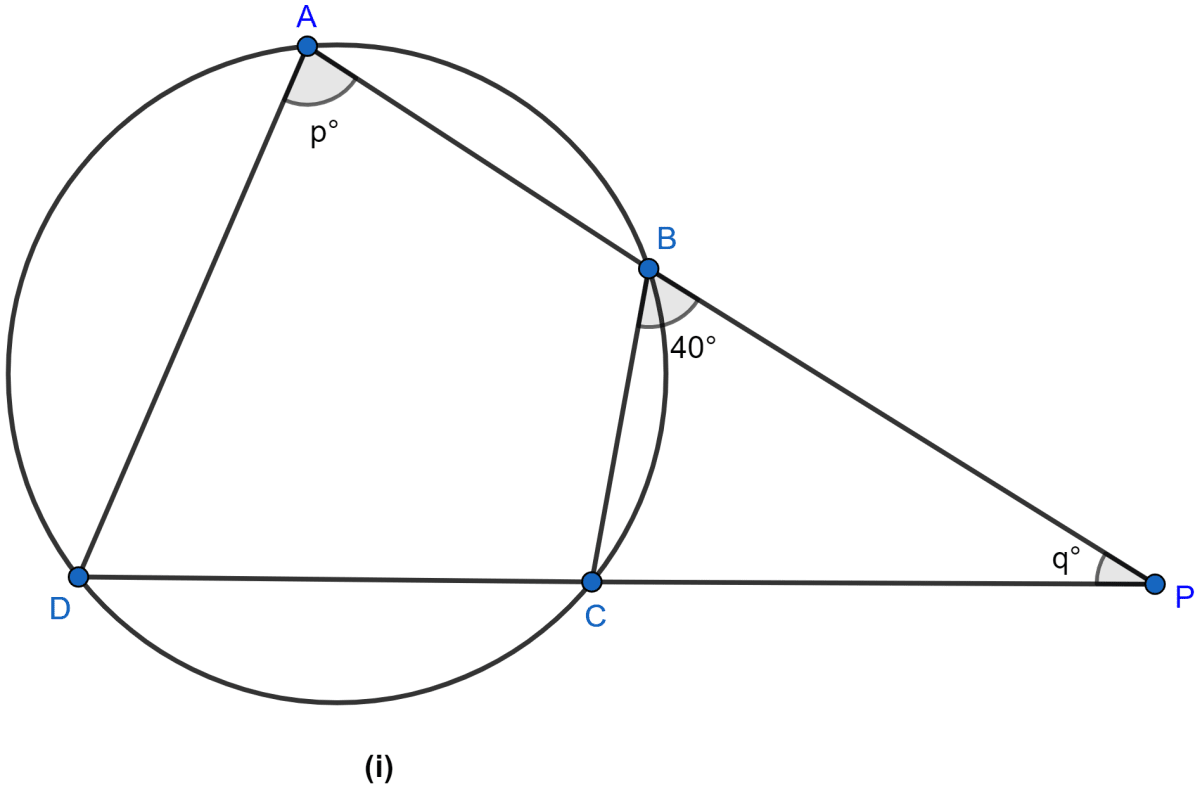
In the figure (i) given below, ∠CBP = 40°, ∠CPB = q° and ∠DAB = p°. Obtain an equation connecting p and q. If AC and BD meet at Q so that ∠AQD = 2q° and the points C, P, B and Q are concyclic, find the values of p and q.
Answer
From figure,
∠ADC = ∠CBP = 40°. (∵ angles in alternate segments are equal.)
Since sum of angles in a triangle = 180°.
In △ADP,
∠DAP + ∠APD + ∠ADP = 180°
From figure, ∠ADP = ∠ADC = 40°.
⇒ p° + q° + 40° = 180°
⇒ p° + q° = 180° - 40°
⇒ p° + q° = 140° .....(i)
Join AC and BD as shown in the figure below:
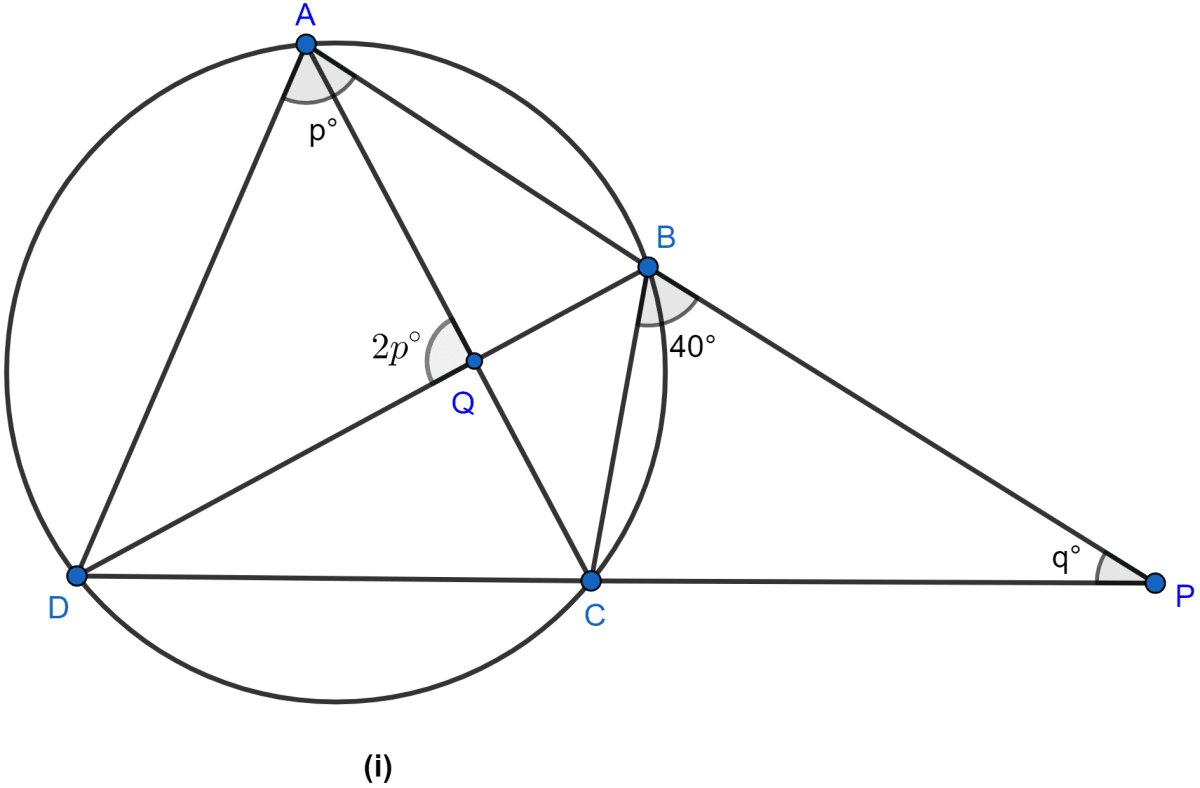
∠CQB = ∠AQD = 2q° (∵ vertically opposite angles are equal.)
Given C, P, B, Q are concyclic.
∴ ∠CPB + ∠CQB = 180°
⇒ q° + 2q° = 180°
⇒ 3q° = 180°
⇒ q° = 60°.
Putting value of q in equation (i) we get,
⇒ p° + 60° = 140°
⇒ p° = 140° - 60° = 80°.
Hence, the value of p = 80 and q = 60 and the relation between p and q is p + q = 140.
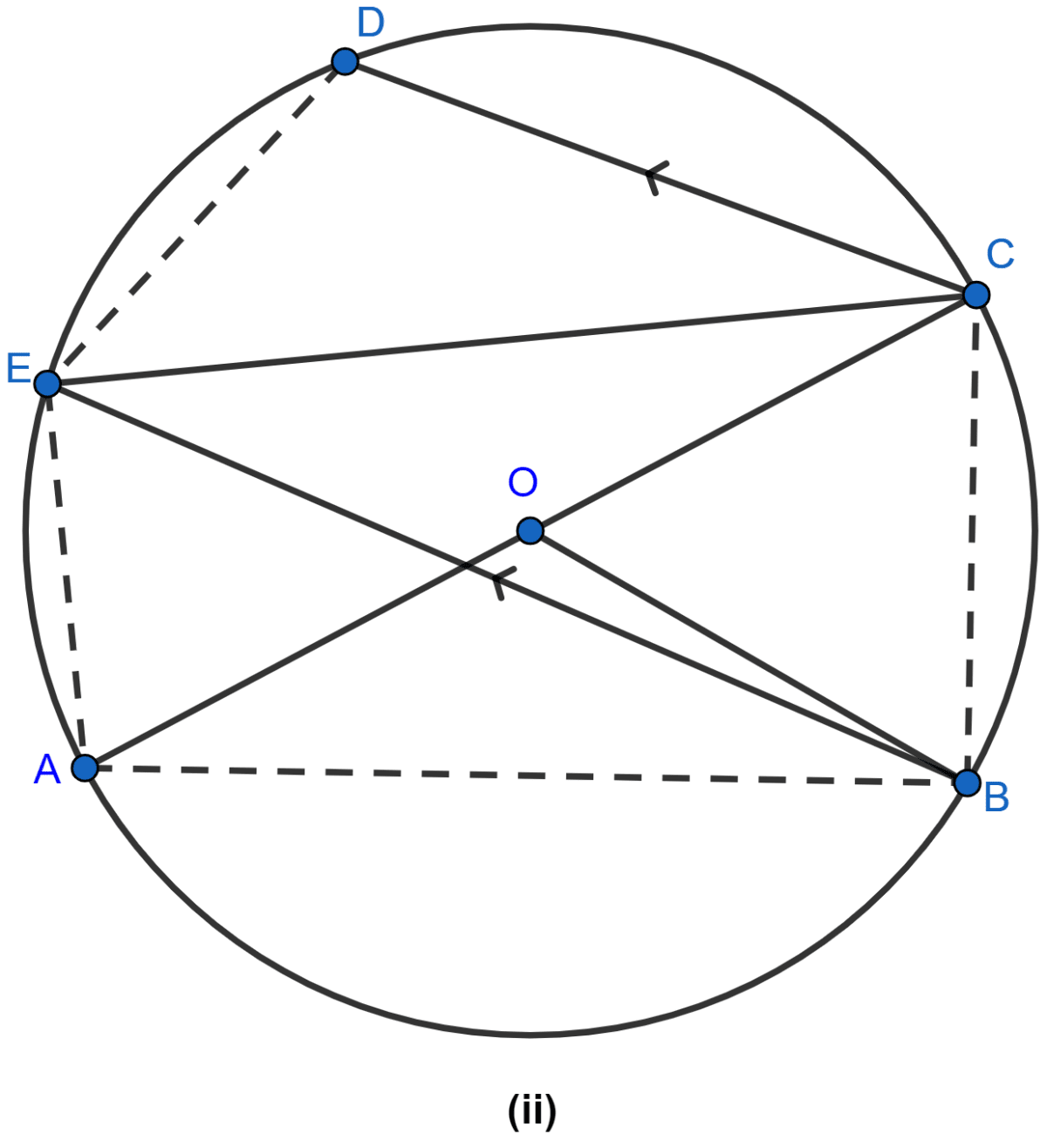
In the figure (ii) given below, AC is a diameter of the circle with centre O. If CD || BE, ∠AOB = 130° and ∠ACE = 20°, find :
(i) ∠BEC
(ii) ∠ACB
(iii) ∠BCD
(iv) ∠CED.
Answer
∠AOB = 130°.
∠AOB + ∠BOC = 180° (∵ these angles form linear pair.)
130° + ∠BOC = 180°
∠BOC = 180° - 130° = 50°.
(i) Arc BC subtends ∠BOC at the centre and ∠BEC at the remaining part of the circle.
∠BOC = 2∠BEC (∵ angle subtended on centre is twice the angle subtended on the remaining part of the circle).
⇒ 50° = 2∠BEC
⇒ ∠BEC =
Hence, the value of ∠BEC = 25°.
(ii) Arc AB subtends ∠AOB at the centre and ∠ACB at the remaining part of the circle.
⇒ ∠AOB = 2∠ACB (∵ angle subtended on centre is twice the angle subtended on the remaining part of the circle).
⇒ 130° = 2∠ACB
⇒ ∠ACB =
Hence, the value of ∠ACB = 65°.
(iii) Given, CD || EB,
∠ECD = ∠CEB = 25°. (∵ alternate angles are equal.)
From figure,
∠BCD = ∠ACB + ∠ACE + ∠ECD = 65° + 20° + 25° = 110°.
Hence, the value of ∠BCD = 110°.
(iv) EBCD is a cyclic quadrilateral hence the sum of opposite interior angles = 180°.
∴ ∠BED + ∠BCD = 180°
⇒ ∠BEC + ∠CED + ∠BCD = 180°
⇒ 25° + ∠CED + 110° = 180°
⇒ ∠CED + 135° = 180°
⇒ ∠CED = 180° - 135° = 45°.
Hence, the value of ∠CED = 45°.
In the figure (i) given below, chords AB, BC and CD of a circle with center O are equal. If ∠BCD = 120°, find
(i) ∠BDC
(ii) ∠BEC
(iii) ∠AEB
(iv) ∠AOB.
Hence, prove that △OAB is equilateral.

Answer
(i) In △BCD, BC = CD
∴ ∠CBD = ∠BDC (∵ angles opposite to equal sides are equal.)
Since sum of angles in a triangle = 180°.
In △BCD,
∠BCD + ∠CBD + ∠CDB = 180°
⇒ 120° + ∠CBD + ∠CBD = 180°
⇒ 120° + 2∠CBD = 180°
⇒ 2∠CBD = 180° - 120°
⇒ ∠CBD = = 30°.
As ∠CBD = ∠BDC,
∴ ∠BDC = 30°.
Hence, the value of ∠BDC = 30°.
(ii) From figure,
∠BDC = ∠BEC (∵ angles in same segment are equal.)
∴ ∠BEC = 30°
Hence, the value of ∠BEC = 30°.
(iii) Given AB = CB
∴ ∠BEC = ∠AEB (∵ equal chords subtend equal angles.)
∴ ∠AEB = 30°
Hence, the value of ∠AEB = 30°.
(iv) Arc AB subtends ∠AOB at the centre and ∠AEB at the remaining part of the circle.
⇒ ∠AOB = 2∠AEB (∵ angle subtended on centre is twice the angle subtended on the remaining part of the circle).
⇒ ∠AOB = 2 × 30°
⇒ ∠AOB = 60°.
Hence, the value of ∠AOB = 60°.
In the figure (i) given below, AB and XY are diameters of a circle with centre O. If ∠APX = 30°, find
(i) ∠AOX
(ii) ∠APY
(iii) ∠BPY
(iv) ∠OAX.

Answer
(i) Arc AX subtends ∠AOX at the centre and ∠APX at the remaining part of the circle.
⇒ ∠AOX = 2∠APX (∵ angle subtended on centre is twice the angle subtended on the remaining part of the circle).
⇒ ∠AOX = 2 × 30°
⇒ ∠AOX = 60°.
Hence, the value of ∠AOX = 60°.
(ii) From figure,
∠XPY = 90° (∵ angle in semicircle = 90°.)
∴ ∠APY = ∠XPY - ∠APX = 90° - 30° = 60°.
Hence, the value of ∠APY = 60°.
(iii) From figure,
∠APB = 90° (∵ angle in semicircle = 90°.)
∴ ∠BPY = ∠APB - ∠APY = 90° - 60° = 30°.
Hence, the value of ∠BPY = 30°.
(iv) In △AOX,
OA = OX (Radius of the same circle.)
∴ ∠OAX = ∠OXA
Since sum of angles of a triangle = 180°
∴ ∠AOX + ∠OAX + ∠OXA = 180°
⇒ 60° + ∠OAX + ∠OAX = 180°
⇒ 2∠OAX = 180° - 60°
⇒ 2∠OAX = 120°
⇒ ∠OAX = 60°.
Hence, the value of ∠OAX = 60°.
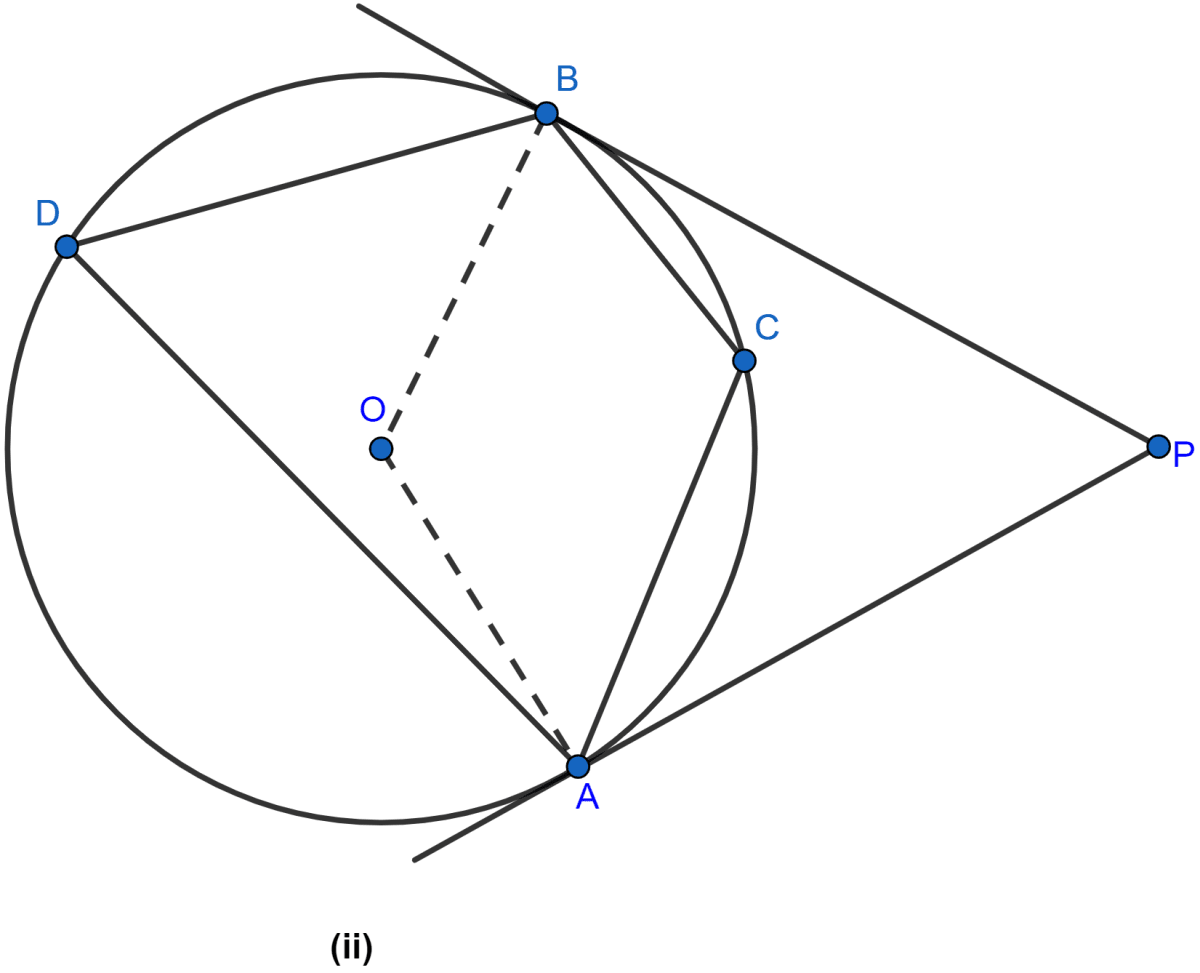
In the figure (ii) given below, AP and BP are tangents to the circle with centre O. If ∠CBP = 25° and ∠CAP = 40°, find
(i) ∠ADB
(ii) ∠AOB
(iii) ∠ACB
(iv) ∠APB.
Answer
(i) ∠CDB = ∠CBP (∵ angles in alternate segments are equal.)
∴ ∠CDB = 25° ....(i)
Similarly, ∠CDA = ∠CAP = 40° (∵ angles in alternate segments are equal.)
∴ ∠ADB = ∠CDA + ∠CDB = 40° + 25° = 65°.
Hence, the value of ∠ADB = 65°.
(ii) Arc AB subtends ∠AOB at the centre and ∠ADB at the remaining part of the circle.
⇒ ∠AOB = 2∠ADB (As angle subtended on centre is twice the angle subtended on the remaining part of the circle).
⇒ ∠AOB = 2 × 65°
⇒ ∠AOB = 130°.
Hence, the value of ∠AOB = 130°.
(iii) ACBD is a cyclic quadrilateral.
∴ ∠ACB + ∠ADB = 180° (∵ sum of opposite angles = 180°.)
⇒ ∠ACB + 65° = 180°
⇒ ∠ACB = 180° - 65° = 115°.
Hence, the value of ∠ACB = 115°.
(iv) From figure,
⇒ ∠AOB + ∠APB = 180°
⇒ 130° + ∠APB = 180°
⇒ ∠APB = 180° - 130° = 50°.
Hence, the value of ∠APB = 50°.
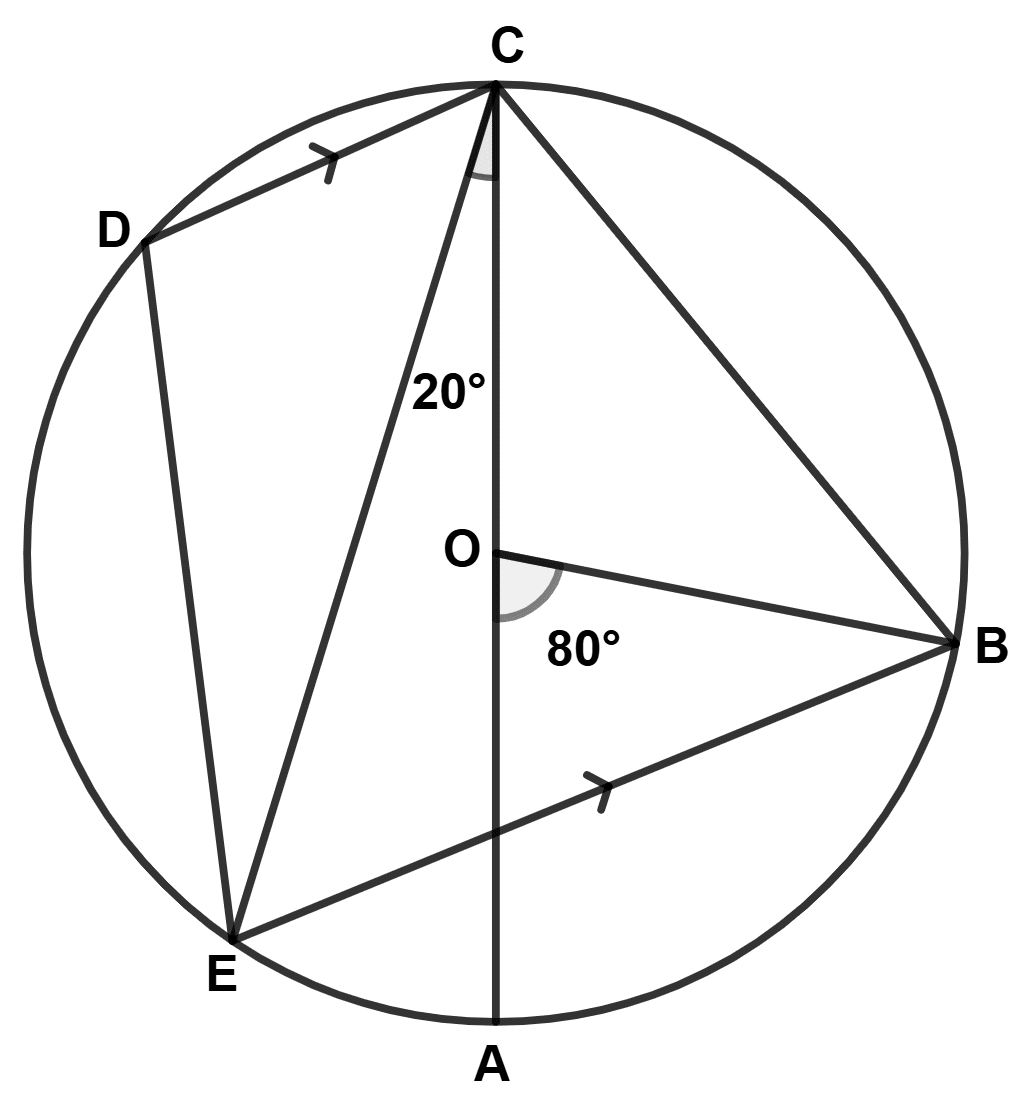
In the given figure AC is the diameter of the circle with center O. CD is parallel to BE. ∠AOB = 80° and ∠ACE = 20°. Calculate :
(a) ∠BEC
(b) ∠BCD
(c) ∠CED
Answer
(a) Join AE.
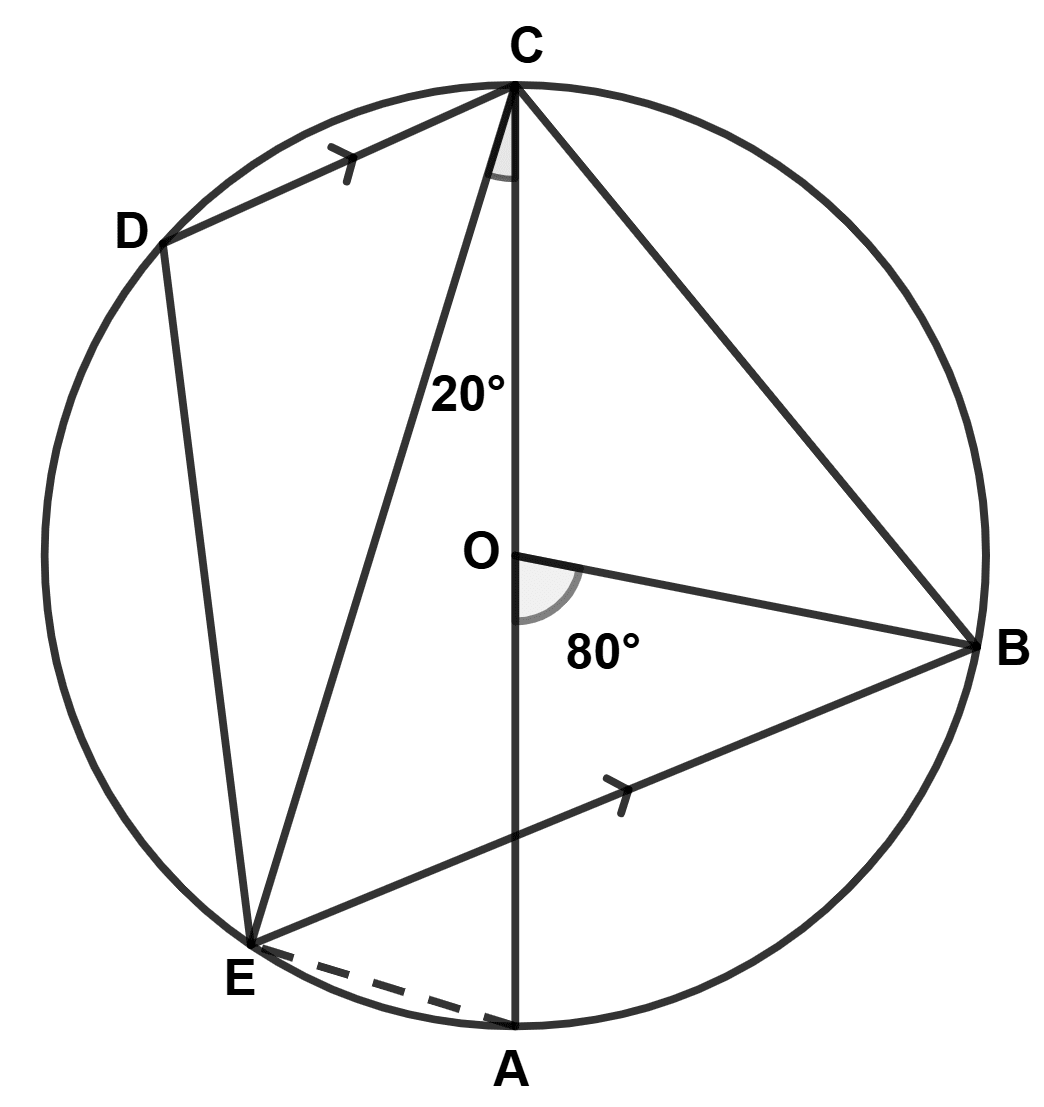
We know that,
The angle subtended by a chord at the centre is twice the angle subtended on the circumference.
∴ ∠AOB = 2∠AEB
⇒ 80° = 2∠AEB
⇒ ∠AEB = = 40°.
We know that,
Angle in a semi-circle is a right angle.
⇒ ∠AEC = 90°
From figure,
⇒ ∠BEC = ∠AEC - ∠AEB = 90° - 40° = 50°.
Hence, ∠BEC = 50°.
(b) From figure,
⇒ ∠ECD = ∠CEB = 50° (Alternate angles are equal)
We know that,
The angle subtended by a chord at the centre is twice the angle subtended on the circumference.
⇒ ∠AOB = 2∠BCA
⇒ 80° = 2∠BCA
⇒ ∠BCA = = 40°.
From figure,
⇒ ∠BCD = ∠BCA + ∠ACE + ∠ECD = 40° + 20° + 50° = 110°.
Hence, ∠BCD = 110°.
(c) As sum of opposite angles of cyclic quadrilateral = 180°.
⇒ ∠BED + ∠BCD = 180°
⇒ ∠BED = 180° - ∠BCD = 180° - 110° = 70°.
From figure,
⇒ ∠BED = ∠BEC + ∠CED
⇒ 70° = 50° + ∠CED
⇒ ∠CED = 70° - 50° = 20°.
Hence, ∠CED = 20°.
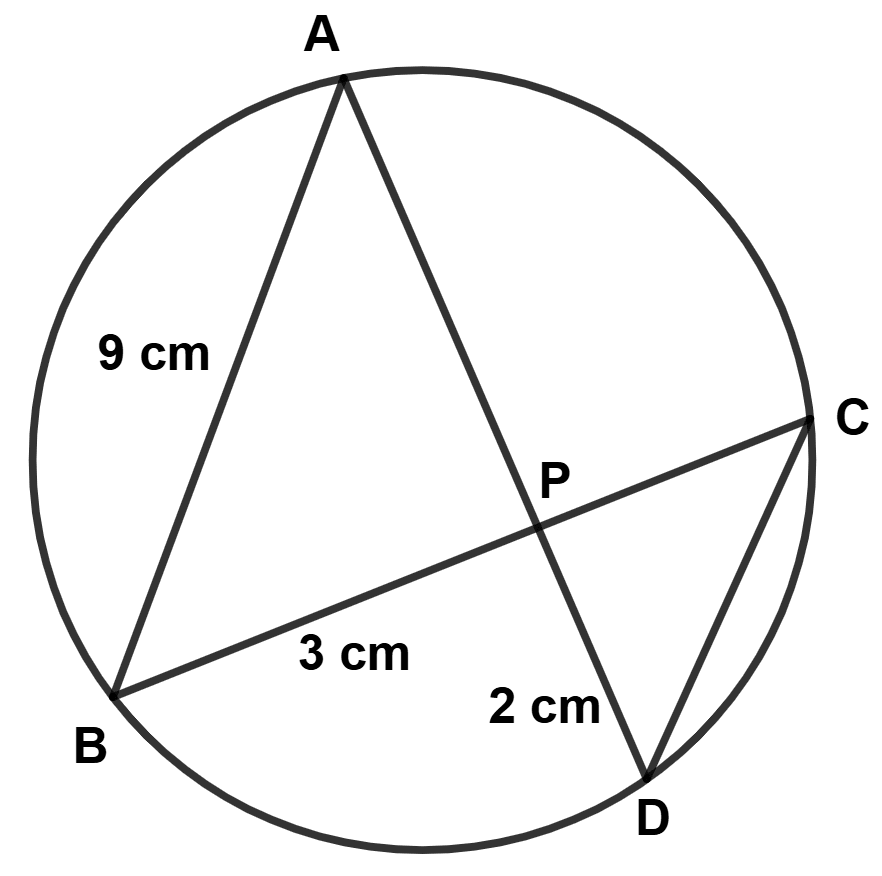
In the given figure (drawn not to scale) chords AD and BC intersect at P, where AB = 9 cm, PB = 3 cm and PD = 2 cm.
(a) Prove that △ APB ~ △ CPD
(b) Find the length of CD
(c) Find area △ APB : area △ CPD.
Answer
(a) In △ APB and △ CPD,
⇒ ∠APB = ∠CPD (Vertically opposite angles are equal)
⇒ ∠BAP = ∠DCP (Angles in same segment are equal)
∴ △ APB ~ △ CPD (By A.A. axiom)
Hence, proved that △ APB ~ △ CPD.
(b) We know that,
Corresponding sides of similar triangles are proportional.
Hence, CD = 6 cm.
(c) We know that,
Ratio of area of similar triangles is equal to the ratio of square of the corresponding sides.
Hence, area △ APB : area △ CPD = 9 : 4.
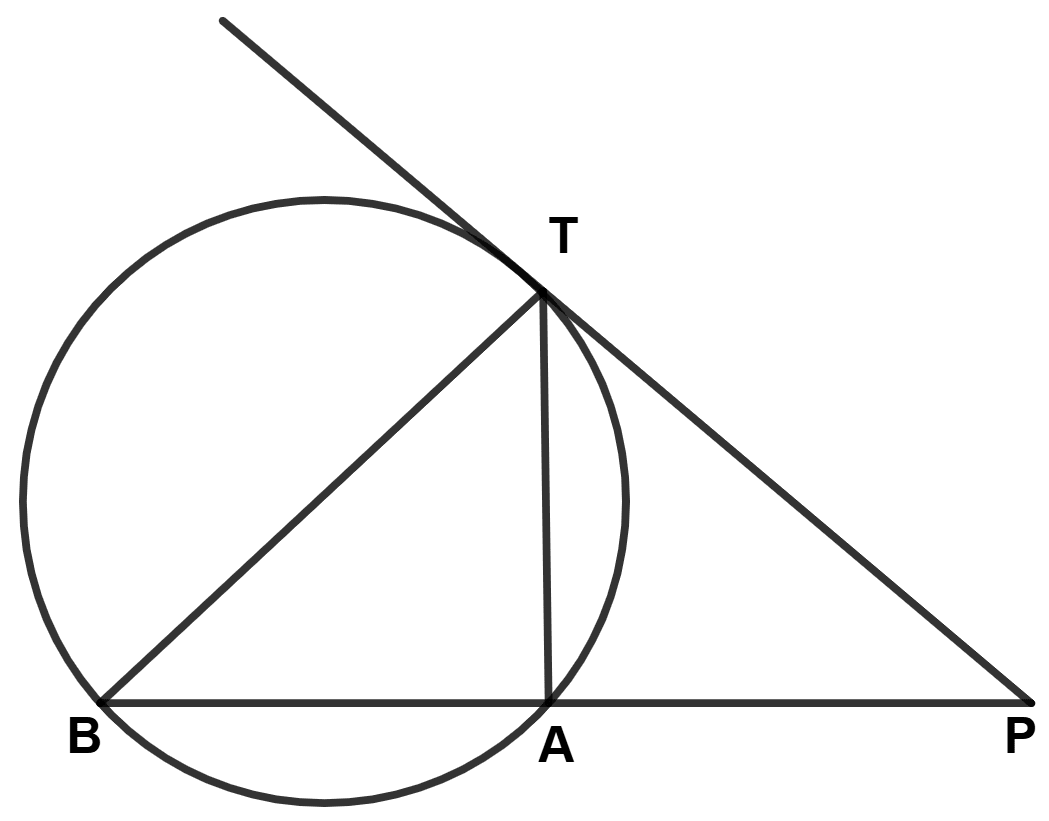
In the given figure PT is a tangent to the circle. Chord BA produced meets the tangent PT at P. Given PT = 20 cm and PA = 16 cm.
(a) Prove △ PTB ~ △ PAT
(b) Find the length of AB.
Answer
(a) In △ PTB and △ PAT,
⇒ ∠PTA = ∠PBT (Alternate segment theorem)
⇒ ∠TPA = ∠BPT (Common angle)
∴ △ PTB ~ △ PAT (By A.A. axiom)
Hence, proved that △ PTB ~ △ PAT.
(b) We know that,
If a chord and a tangent intersect externally, then the product of the lengths of segments of the chord is equal to the square of the length of the tangent from the point of contact to the point of intersection.
⇒ PA × PB = PT2
⇒ PA × (PA + AB) = PT2
⇒ 16 × (16 + AB) = 202
⇒ 16 × (16 + AB) = 400
⇒ 16 + AB = 25
⇒ AB = 25 - 16 = 9 cm.
Hence, AB = 9 cm.
Prove that any four vertices of a regular pentagon are concyclic.
Answer
Let the regular pentagon be ABCDE.
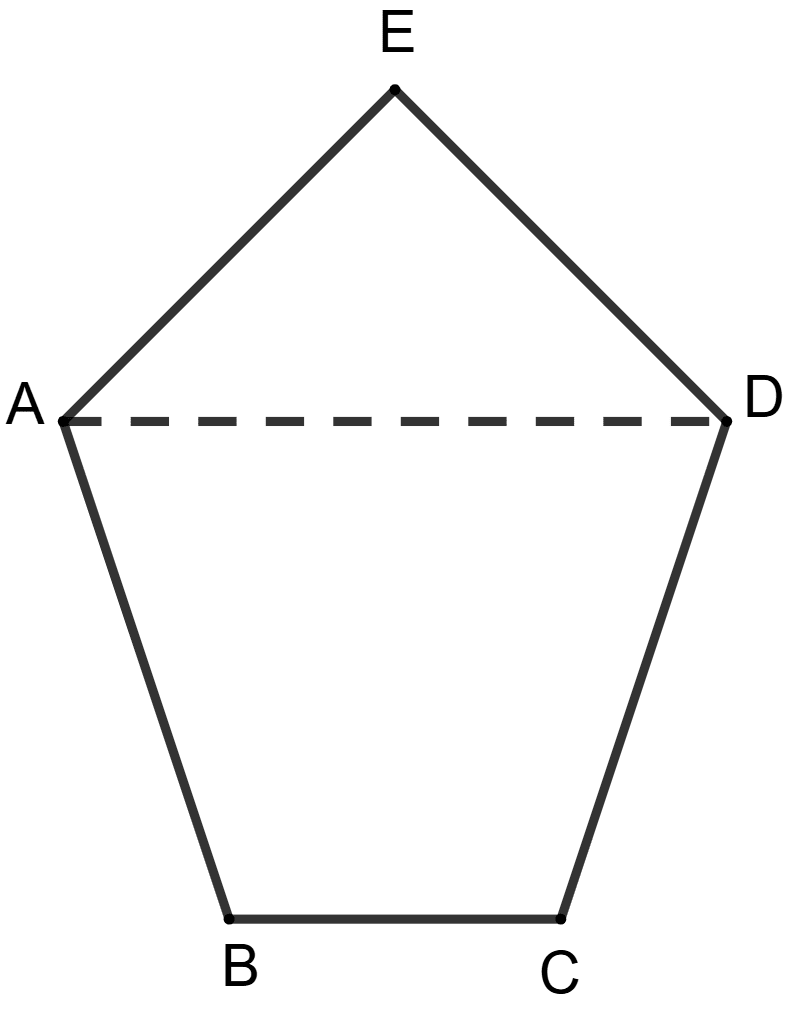
Since it's regular, and all interior angles are equal to 108°.
∴ ∠ABC = ∠BCD = ∠CDE = ∠DEA = ∠EAB
Interior angle of a regular polygon is given by :
So, each interior angle of a regular pentagon = - 108°.
In triangle AED,
AE = ED [Sides of a regular pentagon are equal]
∴ ∠EAD = ∠EDA [Angles opposite to equal sides are equal] ......(1)
⇒ ∠AED + ∠EAD + ∠EDA = 180°
⇒ 108° + ∠EAD + ∠EAD = 180°
⇒ 2∠EAD = 180° - 108°
⇒ 2∠EAD = 72°
⇒ ∠EAD =
⇒ ∠EAD = 36°
∴ ∠EDA = 36°.
From figure,
⇒ ∠BAD = ∠BAE - ∠EAD = 108° - 36° = 72°.
In quadrilateral ABCD,
∠BAD + ∠BCD = 72° + 108° = 180°.
Since, sum of opposite angles = 180°,
which is possible when the quadrilateral is cyclic quadrilateral.
Hence, proved that any four vertices of a regular pentagon are concylic.