
In the adjoining figure, O is the centre of the circle. If ∠OAB = 40°, then ∠ACB is equal to
50°
40°
60°
70°

Answer
From figure,
OA = OB (Radius of the circle.)
So, △OAB is an isosceles triangle with ∠OBA = ∠OAB (As angles opposite to equal sides are equal.)
∠OBA = 40°.
Since, sum of angles in a triangle = 180°.
⇒ ∠OAB + ∠OBA + ∠AOB = 180°
⇒ 40° + 40° + ∠AOB = 180°
⇒ 80° + ∠AOB = 180°
⇒ ∠AOB = 180° - 80°
⇒ ∠AOB = 100°.
Arc AB subtends ∠AOB at centre and ∠ACB at remaining part of circle.
∠AOB = 2∠ACB (∵ angle subtended at centre is double the angle subtended at remaining part of circle.)
100° = 2∠ACB
∠ACB = = 50°.
Hence, Option 1 is the correct option.
ABCD is a cyclic quadrilateral such that AB is a diameter of the circle circumscribing it and ∠ADC = 140°, then ∠BAC is equal to
80°
50°
40°
30°
Answer
Cyclic quadrilateral ABCD is shown in the figure below:
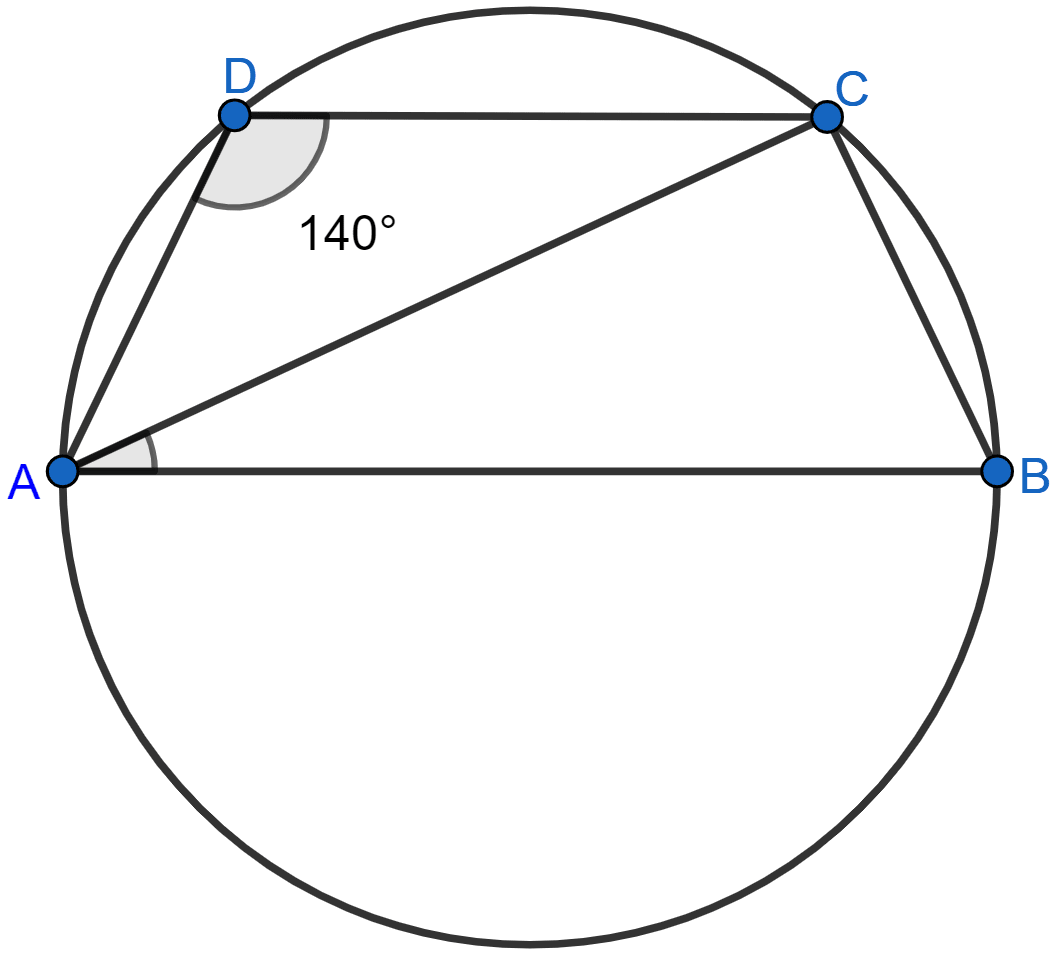
The sum of opposite angles in a quadrilateral = 180°.
∴ ∠ADC + ∠ABC = 180°
140° + ∠ABC = 180°
∠ABC = 180° - 140° = 40°.
In △ABC,
∠ACB = 90° (∵ angles in semicircle = 90°.)
Since, sum of angles in a triangle = 180°.
In △ABC,
⇒ ∠ABC + ∠ACB + ∠BAC = 180°
⇒ 40° + 90° + ∠BAC = 180°
⇒ 130° + ∠BAC = 180°
⇒ ∠BAC = 180° - 130°
⇒ ∠BAC = 50°.
Hence, Option 2 is the correct option.
In the adjoining figure, O is the centre of the circle. If ∠BAO = 60°, then ∠ADC is equal to
30°
45°
60°
120°

Answer
In the figure,
OA = OB (Radius of the circle.)
So, △OAB is an isosceles triangle with ∠OBA = ∠BAO (∵ angles opposite to equal sides are equal.)
∠OBA = 60°.
In a triangle the exterior angle is equal to the sum of opposite interior angle.
∴ ∠AOC = ∠BAO + ∠OBA = 60° + 60° = 120°.
Arc AC subtends ∠AOC at centre and ∠ADC at remaining part of circle.
∠AOC = 2∠ADC (∵ angle subtended at centre is double the angle subtended at remaining part of circle.)
120° = 2∠ADC
∠ADC = = 60°.
Hence, Option 3 is the correct option.
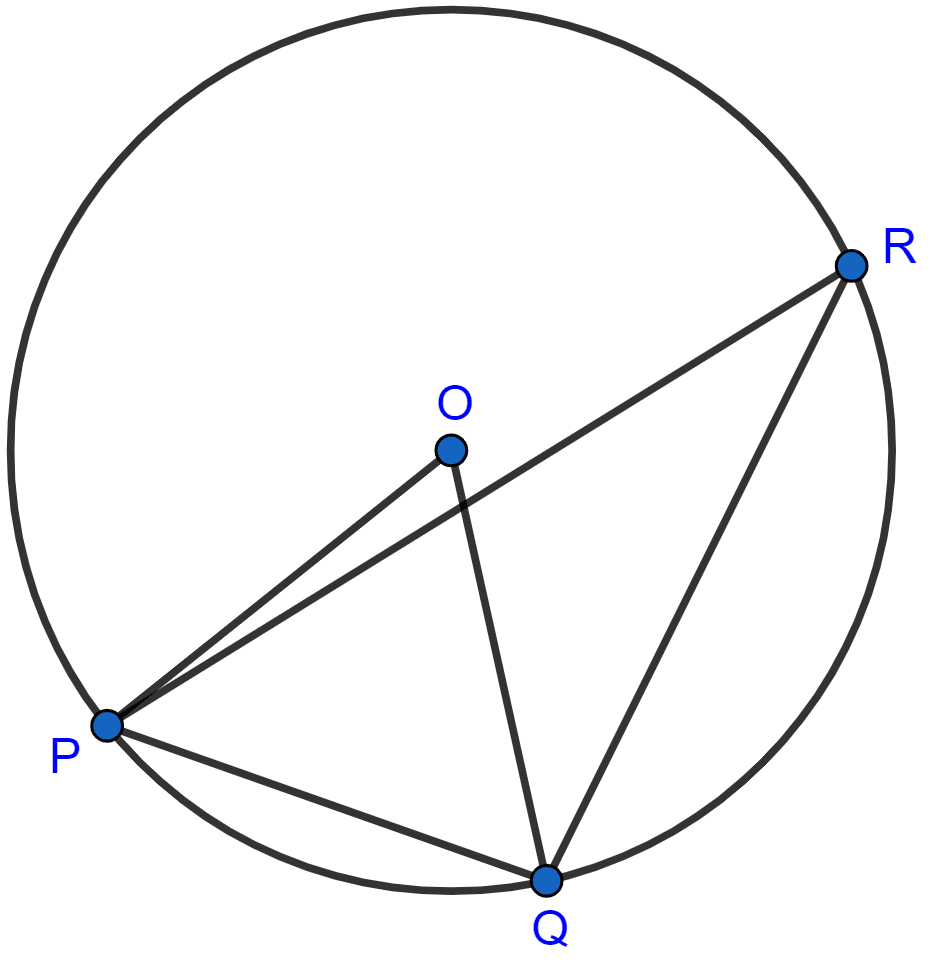
In the adjoining figure, O is the centre of the circle. If the length of the chord PQ is equal to the radius of the circle, then ∠PRQ is
60°
45°
30°
15°
Answer
From figure,
In △OPQ,
OP = OQ = PQ = (Radius of the circle.)
Hence, △OPQ is an equilateral triangle.
∴ ∠POQ = 60° (∵ all angles of an equilateral triangle = 60°.)
Arc PQ subtends ∠POQ at centre and ∠PRQ at remaining part of circle.
∠POQ = 2∠PRQ (∵ angle subtended at centre is double the angle subtended at remaining part of circle.)
60° = 2∠PRQ
∠PRQ = = 30°.
Hence, Option 3 is the correct option.
In the adjoining figure, if O is the centre of the circle then the value of x is
18°
20°
24°
36°

Answer
From figure,
∠ADB = ∠ACB = 2x (∵ ∵ angles in same segment are equal.)
Join OA as shown in the figure below:

Arc AB subtends ∠AOB at centre and ∠ADB at remaining part of circle.
∠AOB = 2∠ADB = 2(2x) = 4x (∵ angle subtended at centre is double the angle subtended at remaining part of circle.)
In △OAB,
OA = OB (Radius of the circle.)
So, △OAB is an isosceles triangle with ∠OBA = ∠OAB (∵ angles opposite to equal sides are equal.)
∠OAB = 3x.
Since, sum of angles in a triangle = 180°.
⇒ ∠OAB + ∠OBA + ∠AOB = 180°
⇒ 3x + 3x + 4x = 180°
⇒ 10x = 180°
⇒ x = 18°
Hence, Option 1 is the correct option.
From a point which is at a distance of 13 cm from the centre O of a circle of radius 5 cm, the pair of tangents PQ and PR to the circle are drawn. Then the area of the quadrilateral PQOR is
60 cm2
65 cm2
30 cm2
32.5 cm2
Answer
Given, the point P is 13 cm from O, the centre of the circle as shown in the figure below:
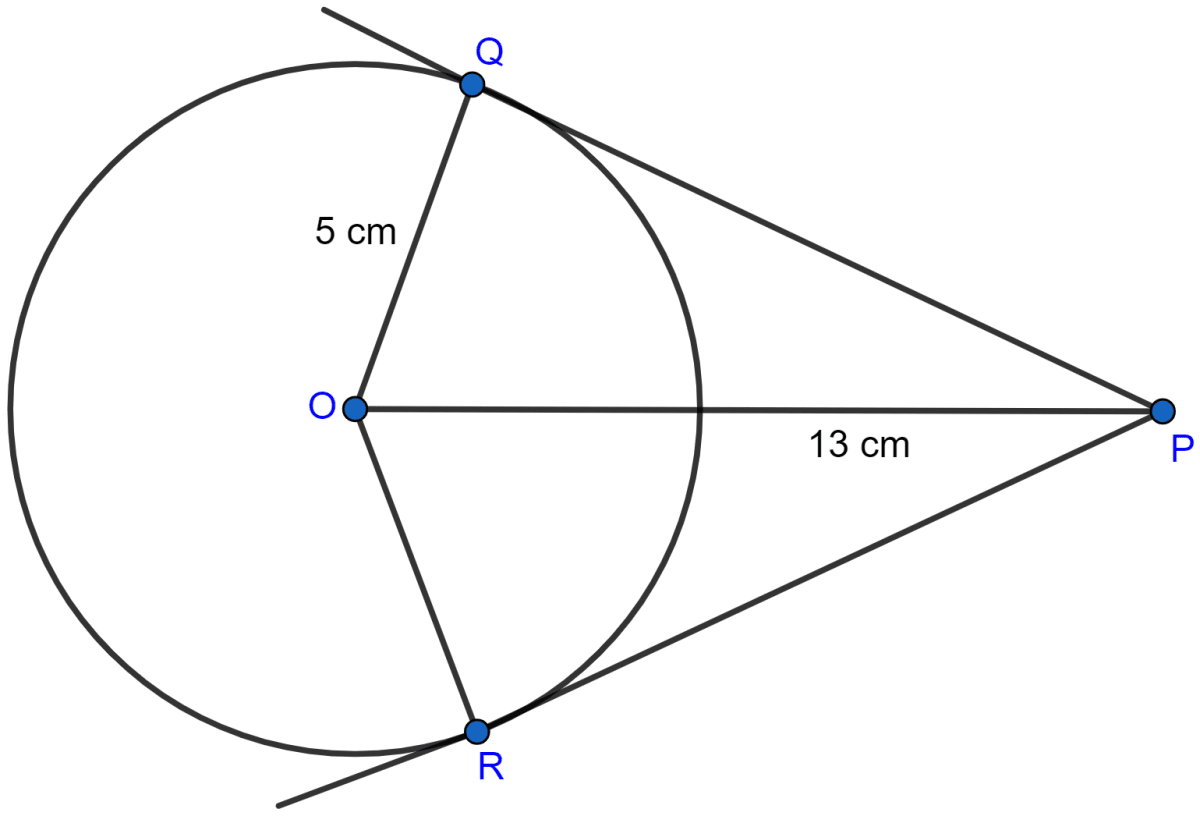
Radius of the circle (OQ) = 5 cm
PQ and PR are tangents from P to the circle.
PQ ⊥ OQ (∵ radius of a circle and tangent through that point are perpendicular to each other.)
∴ OQP = 90°.
So, in △OQP,
Area of △OPQ = = cm2.
Similarly,
PR ⊥ OR (∵ radius of a circle and tangent through that point are perpendicular to each other.)
∴ ∠ORP = 90°.
So, in △ORP,
Area of △POR = = cm2.
Area of quadrilateral PQOR = Area of △POR + Area of △OPQ = 30 + 30 = 60 cm2.
Hence, Option 1 is the correct option.
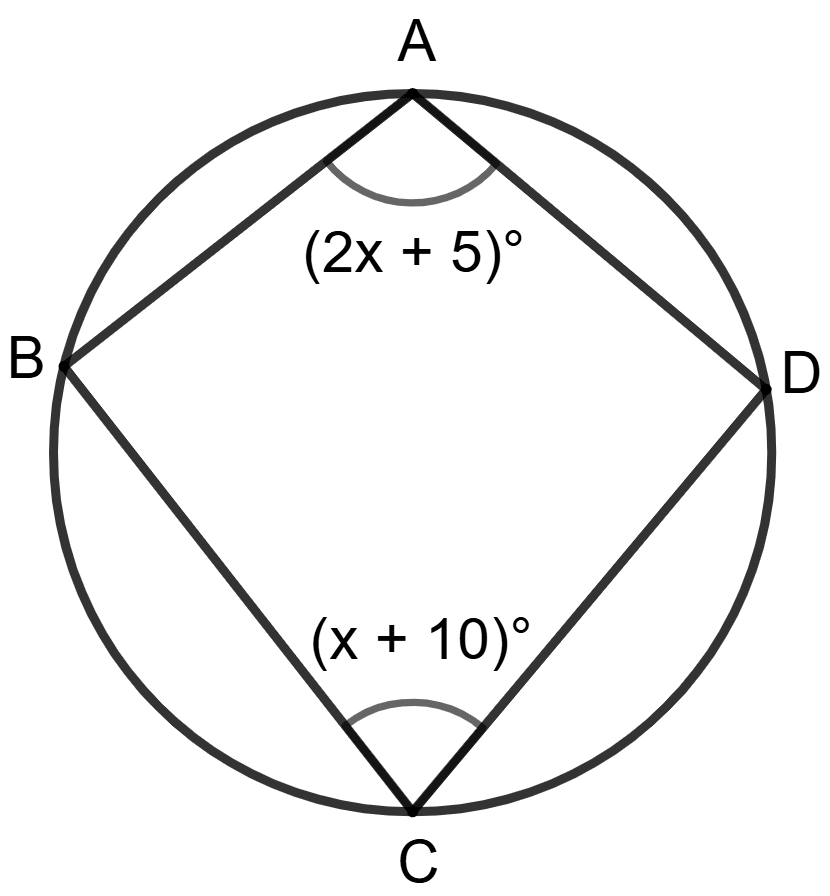
In the adjoining figure, ABCD is a cyclic quadrilateral. If ∠BAD = (2x + 5)° and ∠BCD = (x + 10)°, then x is equal to
65
45
55
50
Answer
Since, ABCD is a cyclic quadrilateral.
We know that,
The sum of opposite angles of a cyclic quadrilateral is 180°.
⇒ ∠BAD + ∠BCD = 180°
⇒ (2x + 5)° + (x + 10)° = 180°
⇒ 3x° + 15° = 180°
⇒ 3x° = 180° - 15°
⇒ 3x° = 165°
⇒ x° =
⇒ x° = 55°
⇒ x = 55.
Hence, Option 3 is the correct option.
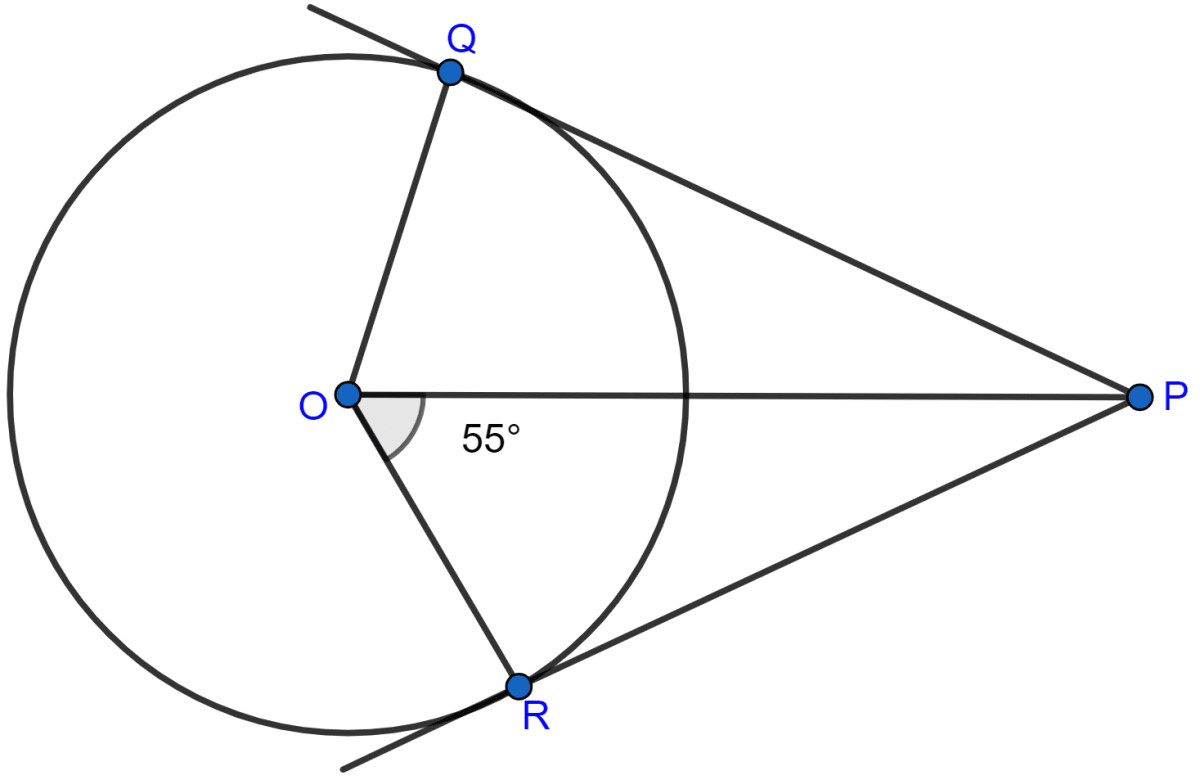
In the adjoining figure, PQ and PR are tangents from P to a circle with centre O. If ∠POR = 55°, then ∠QPR is
35°
55°
70°
80°
Answer
OR ⊥ PR (∵ radius of a circle and tangent through that point are perpendicular to each other.)
∴ ∠ORP = 90°.
Since, sum of angles in a triangle = 180°.
⇒ ∠ORP + ∠POR + ∠OPR = 180°
⇒ 90° + 55° + ∠OPR = 180°
⇒ 145° + ∠OPR = 180°
⇒ ∠OPR = 180° - 145°
⇒ ∠OPR = 35°.
∠QPO = ∠OPR = 35° (∵ the tangents are equally inclined to the line joining the point and the centre of the circle.)
From figure,
∠QPR = ∠OPR + ∠QPO = 35° + 35° = 70°.
Hence, Option 3 is the correct option.
In the adjoining figure, PA and PB are tangents from point P to a circle with centre O. If the radius of the circle is 5 cm and PA ⊥ PB, then the length OP is equal to
5 cm
10 cm
7.5 cm
5√2 cm

Answer
Join OA as shown in the figure below:

OA ⊥ PA (∵ radius of a circle and tangent through that point are perpendicular to each other.)
∴ ∠OAP = 90°.
Given, PA ⊥ PB
∴ ∠APB = 90°.
∵ the tangents are equally inclined to the line joining the point and the centre of the circle.
∠APO = x ∠APB = 45°.
Since, sum of angles in a triangle = 180°.
In △OAP,
⇒ ∠APO + ∠OAP + ∠AOP = 180°
⇒ 45° + 90° + ∠AOP = 180°
⇒ 135° + ∠AOP = 180°
⇒ ∠AOP = 180° - 135°
⇒ ∠AOP = 45°.
Since, ∠AOP = ∠APO hence, △OAP is an isosceles triangle with OA = AP = 5 cm.
In right angled triangle △OAP,
Hence, Option 4 is the correct option.
At one end A of a diameter AB of a circle of radius 5 cm, tangent XAY is drawn to the circle. The length of the chord CD parallel to XY and at a distance 8 cm from A is
4 cm
5 cm
6 cm
8 cm
Answer
The figure is shown below:

Since tangent and radius at point of contact of a circle are perpendicular to each other. Hence,
XAY ⊥ AO
Given XAY || to CD hence,
CD ⊥ AB.
In right angled triangle OEC,
OE = AE - AO = 8 - 5 = 3 cm.
⇒ OC2 = OE2 + CE2 (By pythagoras theorem)
⇒ 52 = 32 + CE2
⇒ CE2 = 25 - 9
⇒ CE2 = 16
⇒ CE = 4 cm.
Similarly in right angled triangle OED,
⇒ OD2 = OE2 + ED2 (By pythagoras theorem)
⇒ 52 = 32 + ED2
⇒ ED2 = 25 - 9
⇒ ED2 = 16
⇒ ED = 4 cm.
⇒ CD = CE + ED = 4 + 4 = 8 cm.
Hence, Option 4 is the correct option.
If radii of two concentric circles are 4 cm and 5 cm, then the length of each chord of one circle which is tangent to the other is
3 cm
6 cm
9 cm
1 cm
Answer
From figure,
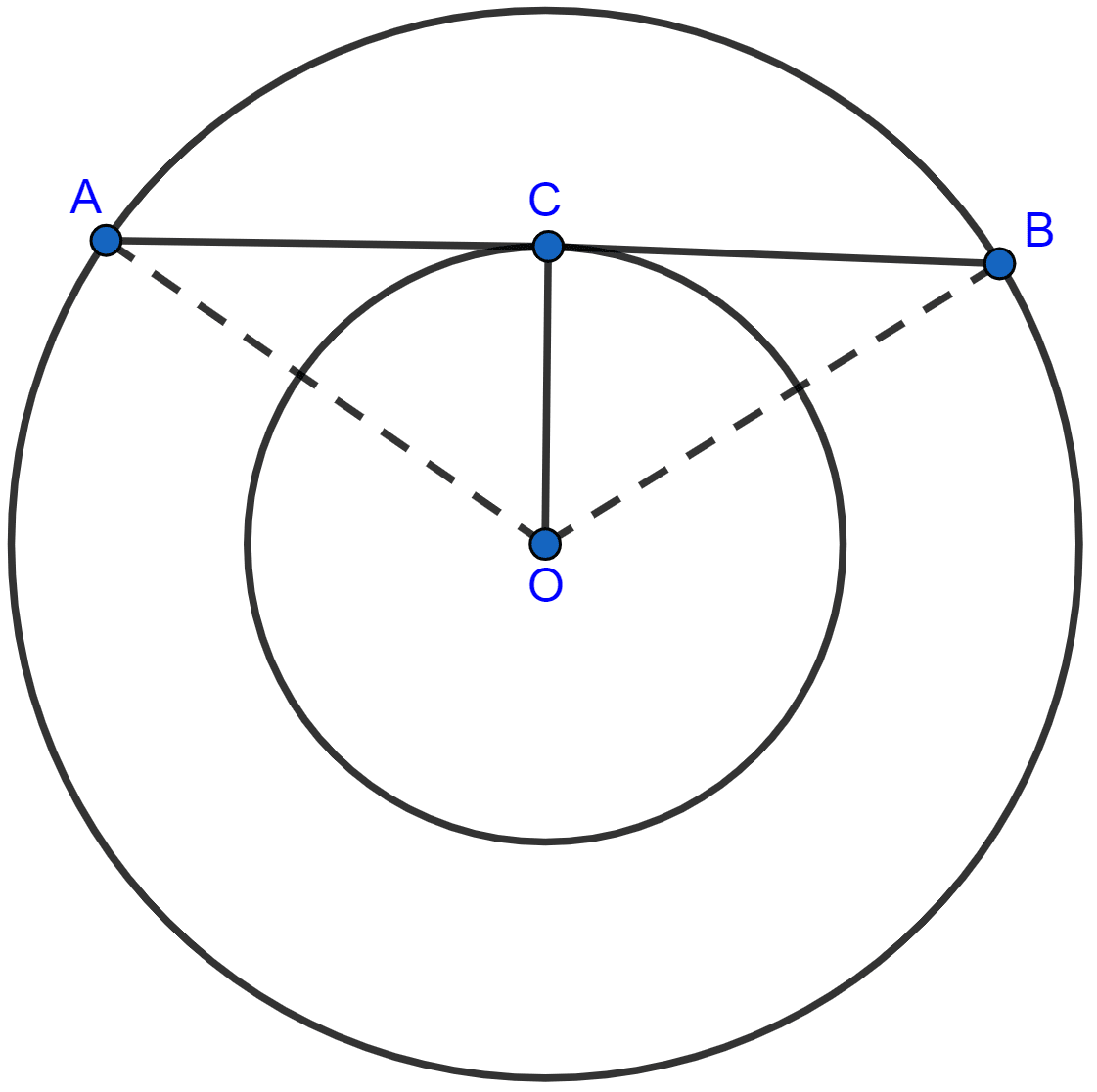
AB is chord to the bigger circle which is tangent to the smaller circle at C.
OC ⊥ AC (∵ radius of a circle and tangent through that point are perpendicular to each other.)
∴ ∠ACO = 90°.
In △ACO,
Length of chord AB = 2 × AC = 2 × 3 = 6 cm.
Hence, Option 2 is the correct option.
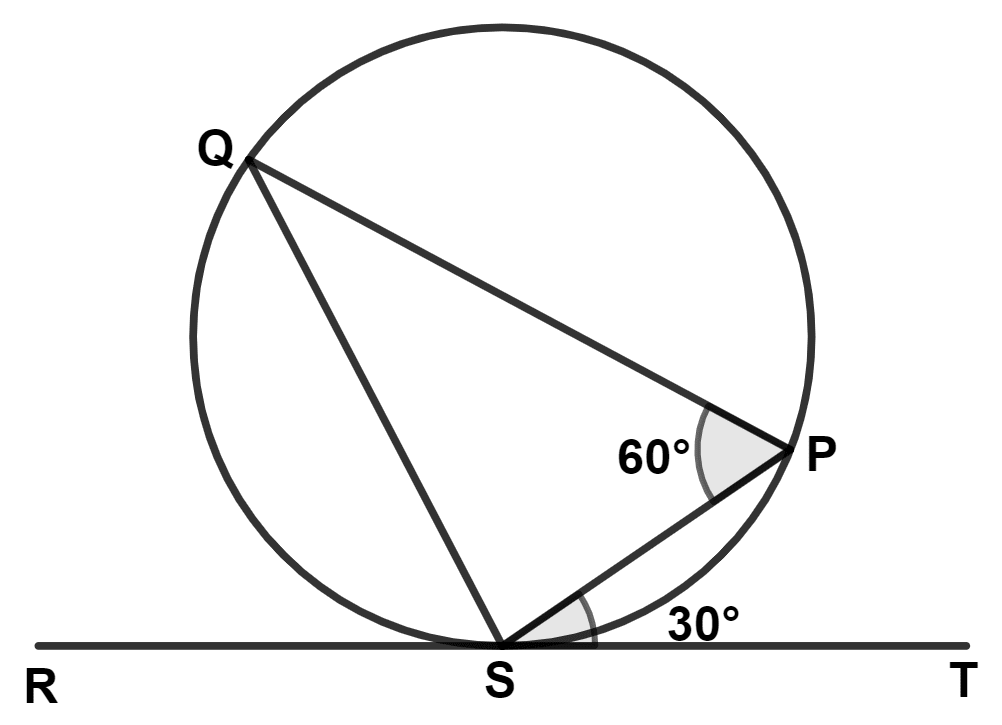
In the adjoining diagram, RT is a tangent touching the circle at S. If ∠PST = 30° and ∠SPQ = 60° then ∠PSQ is equal to
40°
30°
60°
90°
Answer
We know that,
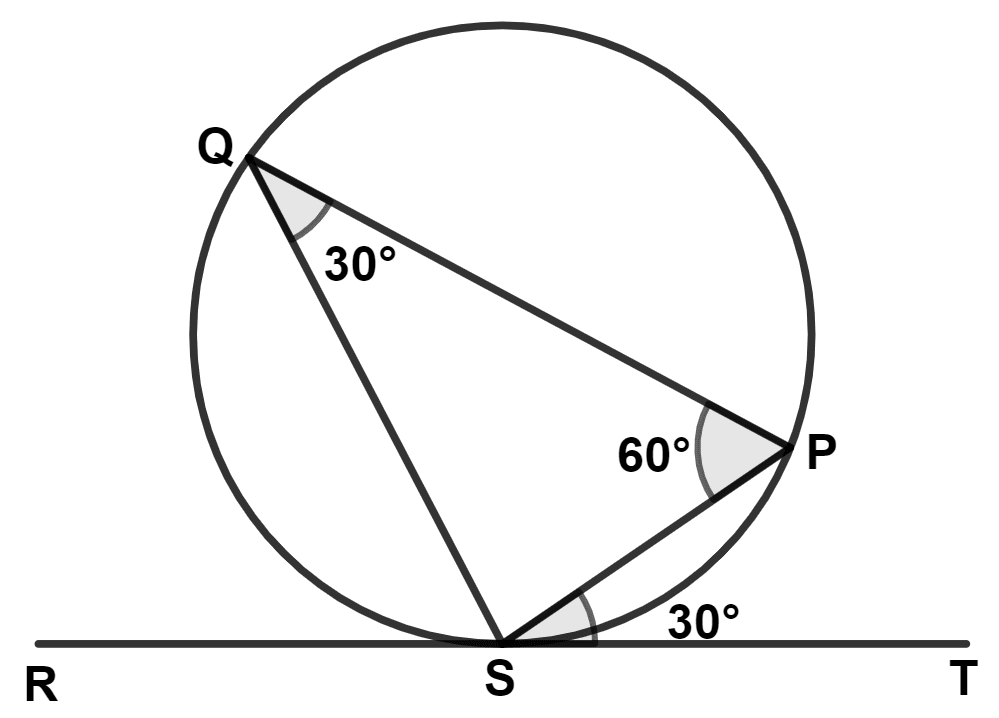
Angle between tangent and the chord at the point of contact is equal to angle of the alternate segment.
∴ ∠PQS = ∠PST = 30°
In △ PQS,
By angle sum property of triangle,
⇒ ∠PQS + ∠QPS + ∠PSQ = 180°
⇒ 30° + 60° + ∠PSQ = 180°
⇒ ∠PSQ + 90° = 180°
⇒ ∠PSQ = 180° - 90° = 90°.
Hence, Option 4 is the correct option.
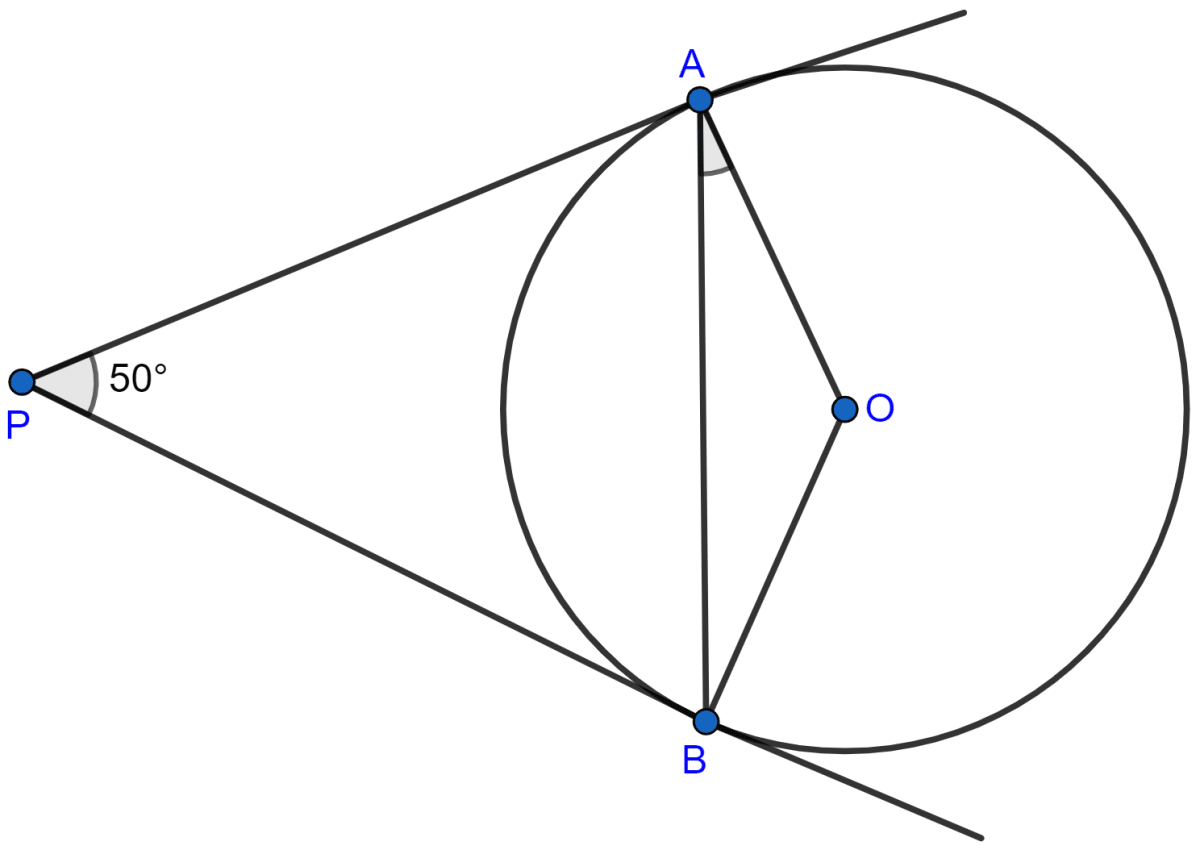
In the adjoining figure, PA and PB are tangents to a circle with centre O. If ∠APB = 50°, then ∠OAB is equal to
25°
30°
40°
50°
Answer
In the given figure,
PA and PB are tangents to the circle with centre O.
∠APB = 50°
Since sum of opposite angles of quadrilateral = 180°.
∴ ∠AOB + ∠APB = 180°
⇒ ∠AOB + 50° = 180°
⇒ ∠AOB = 180° - 50° = 130°.
In △OAB,
OA = OB (Radius of the same circle)
Hence, △OAB is an isosceles triangle with ∠OAB = ∠OBA.
Since, sum of angles of a triangle = 180°.
In △OAB,
⇒ ∠OAB + ∠OBA + ∠AOB = 180°
⇒ ∠OAB + ∠OAB + 130° = 180°
⇒ 2∠OAB = 180° - 130°
⇒ 2∠OAB = 50°
⇒ ∠OAB = 25°.
Hence, Option 1 is the correct option.
In the adjoining figure, sides BC, CA and AB of △ABC touch a circle at point D, E and F respectively. If BD = 4 cm, DC = 3 cm and CA = 8 cm, then the length of side AB is
12 cm
11 cm
10 cm
9 cm

Answer
We know that if two tangents are drawn from an external point to a circle then, the lengths of the tangents are equal.
∴ BF = BD = 4 cm, CE = CD = 3 cm and AF = AE.
Given, CA = 8 cm.
From figure,
⇒ CA = AE + CE
⇒ 8 = AE + 3
⇒ AE = 8 - 3 = 5 cm.
We know AF = AE = 5cm.
From figure,
AB = AF + BF = 5 + 4 = 9 cm.
Hence, Option 4 is the correct option.
In the adjoining figure, sides BC, CA and AB of △ABC touch a circle at the points P, Q and R respectively. If PC = 5 cm, AR = 4 cm and RB = 6 cm, then the perimeter of △ABC is
60 cm
45 cm
30 cm
15 cm

Answer
We know that if two tangents are drawn from an external point to a circle then, the lengths of the tangents are equal.
∴ BP = BR = 6 cm, CQ = CP = 5 cm and AQ = AR = 4 cm.
Perimeter of △ABC ⇒ AB + BC + CA
⇒ AR + BR + BP + CP + AQ + CQ
⇒ 4 + 6 + 6 + 5 + 4 + 5
⇒ 30 cm.
Hence, Option 3 is the correct option.
PQ is a tangent to a circle at point P. Centre of circle is O. If △OPQ is an isosceles triangle, then ∠QOP is equal to
30°
60°
45°
90°
Answer
The circle with centre O and PQ as tangent is shown in the figure below:
We know that,
OP ⊥ PQ (∵ tangent through a point and radius from that point are perpendicular to each other)
Given, △OPQ is an isosceles triangle.
Since, ∠OPQ = 90° hence, the other two angles will be equal to each other.
∴ ∠QOP = ∠OQP
We know that sum of angles in a triangle = 180°.
In △OPQ,
⇒ ∠OPQ + ∠QOP + ∠OQP = 180°
⇒ ∠OPQ + ∠QOP + ∠QOP = 180°
⇒ 90° + 2∠QOP = 180°
⇒ 2∠QOP = 180° - 90
⇒ ∠QOP =
⇒ ∠QOP = 45°.
Hence, Option 3 is the correct option.
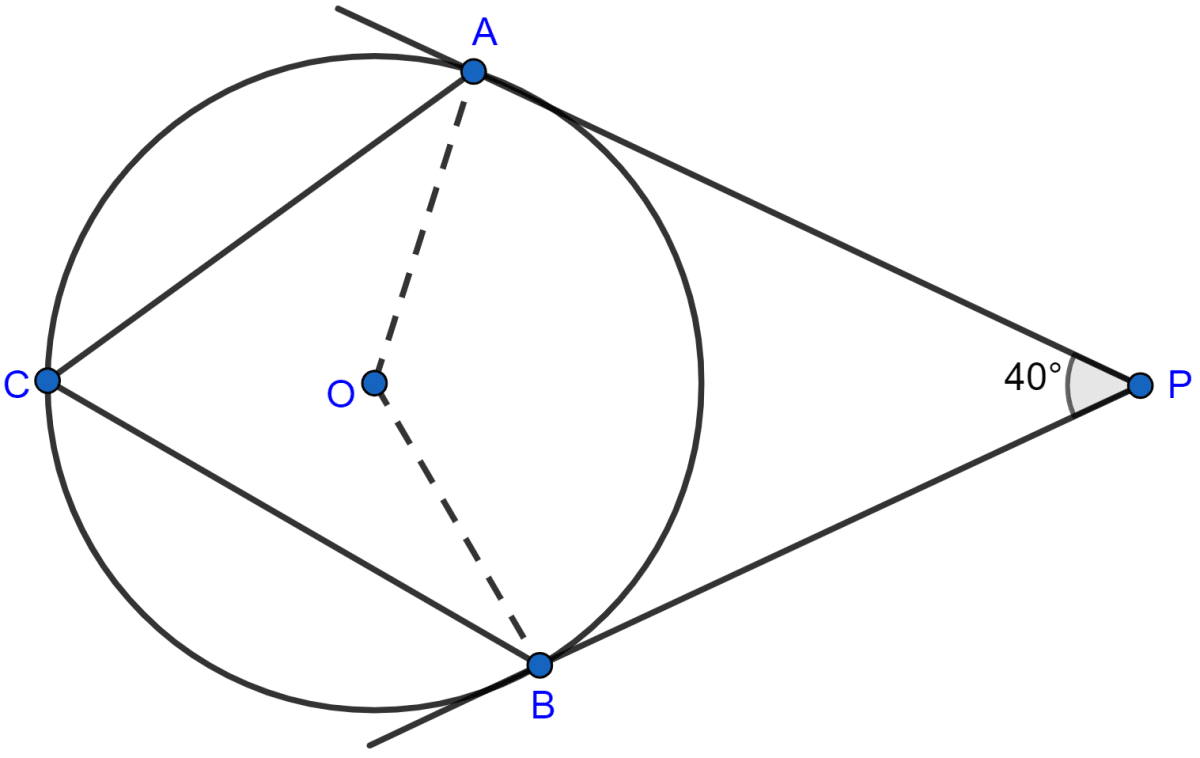
In the adjoining figure, PA and PB are tangents at points A and B respectively to a circle with centre O. If C is a point on the circle and ∠APB = 40°, then ∠ACB is equal to
80°
70°
90°
140°
Answer
Join OP.
We know that the tangents are equally inclined to the line joining the point and the centre of the circle.
∴ ∠APO = = 20°.
AP ⊥ OA.
∴ ∠OAP = 90°.
In right angle triangle OAP,
⇒ ∠APO + ∠AOP + ∠OAP = 180°
⇒ 20° + ∠AOP + 90° = 180°
⇒ ∠AOP + 110° = 180°
⇒ ∠AOP = 180° - 110° = 70°.
As the tangents subtends equal angles at centre.
∴ ∠BOP = ∠AOP = 70°.
∠AOB = ∠AOP + ∠BOP = 70° + 70° = 140°.
Arc AB subtends ∠AOB at center and ∠ACB on the remaining part of the circle.
∴ ∠AOB = 2∠ACB
⇒ ∠ACB = ∠AOB
⇒ ∠ACB =
⇒ ∠ACB = 70°.
Hence, Option 2 is the correct option.
In the adjoining figure, two circles touch each other at A. BC and AP are common tangents to these circles. If BP = 3.8 cm, then the length of BC is equal to
7.6 cm
1.9 cm
11.4 cm
5.7 cm

Answer
We know that if two tangents are drawn from an external point to a circle then, the lengths of the tangents are equal.
From figure,
PA and PB are the tangents to the first circle.
∴ PA = PB = 3.8 cm
PA and PC are tangents to the second circle.
∴ PC = PA = 3.8 cm
From figure,
BC = PB + PC = 3.8 + 3.8 = 7.6 cm.
Hence, Option 1 is the correct option.
In the adjoining figure, if sides PQ, QR, RS and SP of a quadrilateral PQRS touch a circle at points A, B, C and D respectively, then PD + BQ is equal to
PQ
QR
PS
SR

Answer
We know that if two tangents are drawn from an external point to a circle then, the lengths of the tangents are equal.
From figure,
PA and PD are the tangents to the circle from P.
∴ PA = PD
QB and QA are the tangents to the circle from Q.
∴ QB = QA
Hence,
⇒ PD + BQ
⇒ PA + QA
⇒ PQ.
Hence, Option 1 is the correct option.
In the adjoining figure, PQR is a tangent at Q to a circle. If AB is a chord parallel to PR and ∠BQR = 70°, then ∠AQB is equal to
20°
40°
35°
45°

Answer
From figure,
BQ is chord and PQR is a tangent.
∠BQR = ∠A (∵ angles in alternate segment are equal.)
As AB || PQR
∠BQR = ∠B (∵ alternate angles are equal)
∴ ∠A = ∠B = 70°
We know that sum of angles in a triangle = 180°.
In △AQB,
⇒ ∠A + ∠B + ∠AQB = 180°
⇒ 70° + 70° + ∠AQB = 180°
⇒ 140° + ∠AQB = 180°
⇒ ∠AQB = 180° - 140°
⇒ ∠AQB = 40°.
Hence, Option 2 is the correct option.
Two chords AB and CD of a circle intersect externally at a point P. If PC = 15 cm, CD = 7 cm and AP = 12 cm, then AB is
2 cm
4 cm
6 cm
none of these

Answer
We know that if two chords of a circle intersect internally or externally, then the products of the lengths of segments are equal.
Hence, from figure,
PA.PB = PC.PD .....(i)
Given,
PC = 15 cm and CD = 7 cm
From figure,
PD = PC - CD = 15 - 7 = 8 cm.
Let BP = x cm then AB = (12 - x) cm
Putting values in equation (i),
⇒ PA.PB = PC.PD
⇒ 12.x = 15.8
⇒ 12x = 120
⇒ x = = 10 cm.
AB = 12 - x = 12 - 10 = 2 cm.
Hence, Option 1 is the correct option.
In a circle with radius R, the shortest distance between two parallel tangents is equal to :
R
2R
2πR
πR
Answer
Let l and m be tangents to circle with center O, touching the circle at point A and B.

From figure,
Shortest distance between tangents = OA + OB = R + R = 2R.
Hence, Option 2 is the correct option.
In the given diagram, PS and PT are the tangents to the circle. SQ || PT and ∠SPT = 80°. The value of ∠QST is :
140°
90°
80°
50°

Answer
In △ PST,
⇒ PS = PT (Tangents from an external point to a circle are equal in length)
⇒ ∠PST = ∠PTS = a (let) (Angles opposite to equal sides are equal)
By angle sum property of triangle,
⇒ ∠PST + ∠PTS + ∠SPT = 180°
⇒ a + a + 80° = 180°
⇒ 2a = 180° - 80°
⇒ 2a = 100°
⇒ a = = 50°.
From figure,
⇒ ∠QST = ∠STP = 50° (Alternate angles are equal)
Hence, Option 4 is the correct option.
The circumcentre of a triangle is the point which is ∶
at equal distance from the three sides of the triangle.
at equal distance from the three vertices of the triangle.
the point of intersection of the three medians.
the point of intersection of the three altitudes of the triangle.
Answer
The circumcenter of a triangle is defined as the point equidistant from the three vertices of the triangle.
Hence, Option 2 is the correct option.
The three vertices of a scalene triangle are always equidistant from a fixed point. The point is :
Orthocenter of the triangle
Incenter of the triangle
Circumcenter of the triangle
Centroid of the triangle
Answer
Let ABC be the triangle and O is the circumcenter of triangle.

Circumcenter is the center of circle which passes through all vertices of triangle.
∴ OA = OB = OC (Radius of circle)
Hence, Option 3 is the correct option.
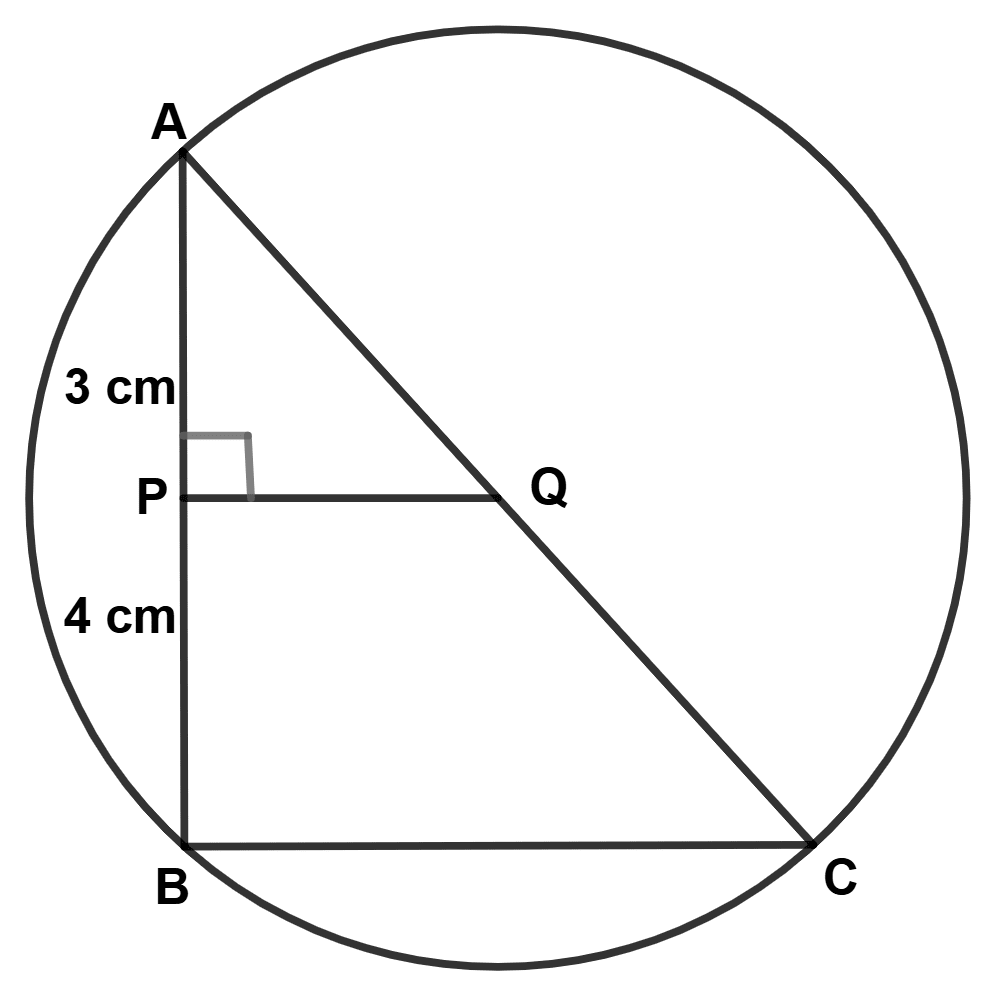
In the adjoining figure, AC is a diameter of the circle, AP = 3 cm and PB = 4 cm and QP ⊥ AB. If the area of △ APQ is 18 cm2, then the area of shaded portion QPBC is :
32 cm2
49 cm2
80 cm2
98 cm2
Answer
We know that,
Angle in a semi-circle is a right angle.
∴ ∠ABC = 90°.
In △ APQ and △ ABC,
⇒ ∠APQ = ∠ABC (Both equal to 90°)
⇒ ∠PAQ = ∠BAC (Common angles)
∴ △ APQ ~ △ ABC (By A.A. axiom)
We know that,
The ratio of area of similar triangles is equal to the ratio of the square of the corresponding sides.
From figure,
Area of QPBC = Area of △ ABC - Area of △ APQ = 98 - 18 = 80 cm2.
Hence, Option 3 is the correct option.
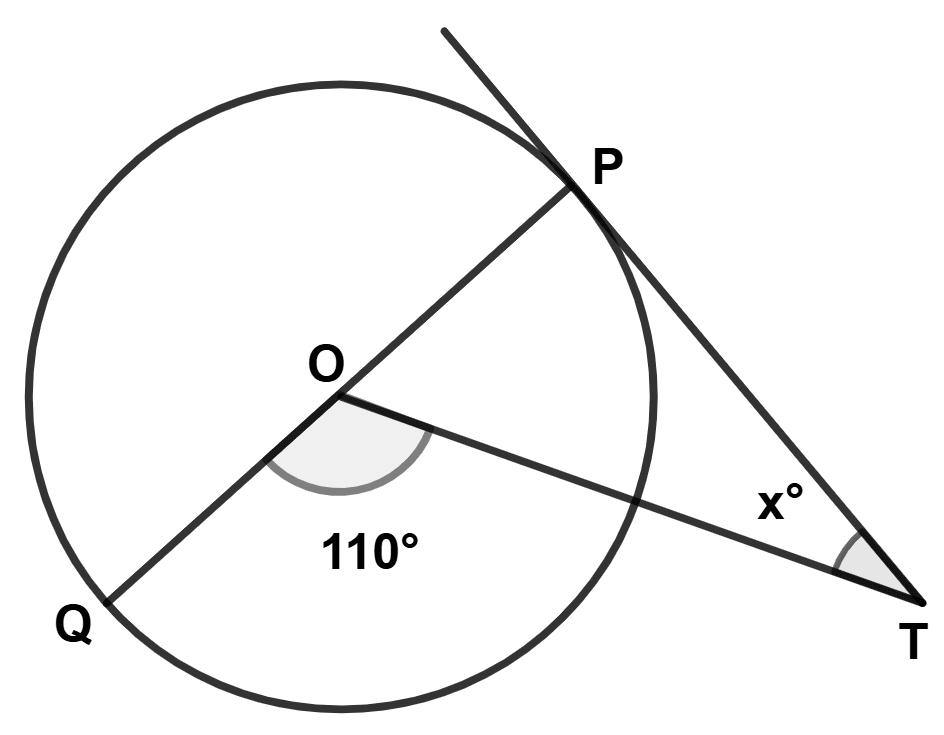
In the adjoining diagram, O is the center of the circle and PT is a tangent. The value of x is :
20°
40°
55°
70°
Answer
From figure,
⇒ ∠QOT + ∠TOP = 180° (Linear Pair)
⇒ 110° + ∠TOP = 180°
⇒ ∠TOP = 180° - 110° = 70°.
⇒ ∠OPT = 90° (Tangent is perpendicular to radius at point of intersection)
In △ TOP,
⇒ ∠OPT + ∠TOP + ∠PTO = 180°
⇒ 90° + 70° + x°= 180°
⇒ x° + 160° = 180°
⇒ x° = 180° - 160° = 20°.
Hence, Option 1 is the correct option.