
Find the length of the tangent drawn to a circle of radius 3 cm, from a point distant 5 cm from the centre.
Answer
Let tangent be drawn from point P.
In a circle with centre O and radius = 3 cm and P is at a distance of 5 cm.

OT = 3 cm and OP = 5 cm
OT ⊥ PT
In right angle △OTP,
By pythagoras theorem,
Hence, the length of tangent = 4 cm.
A point P is at a distance 13 cm from the centre C of a circle, and PT is a tangent to the given circle. If PT = 12 cm, find the radius of the circle.
Answer
The below diagram shows the circle and the tangent:
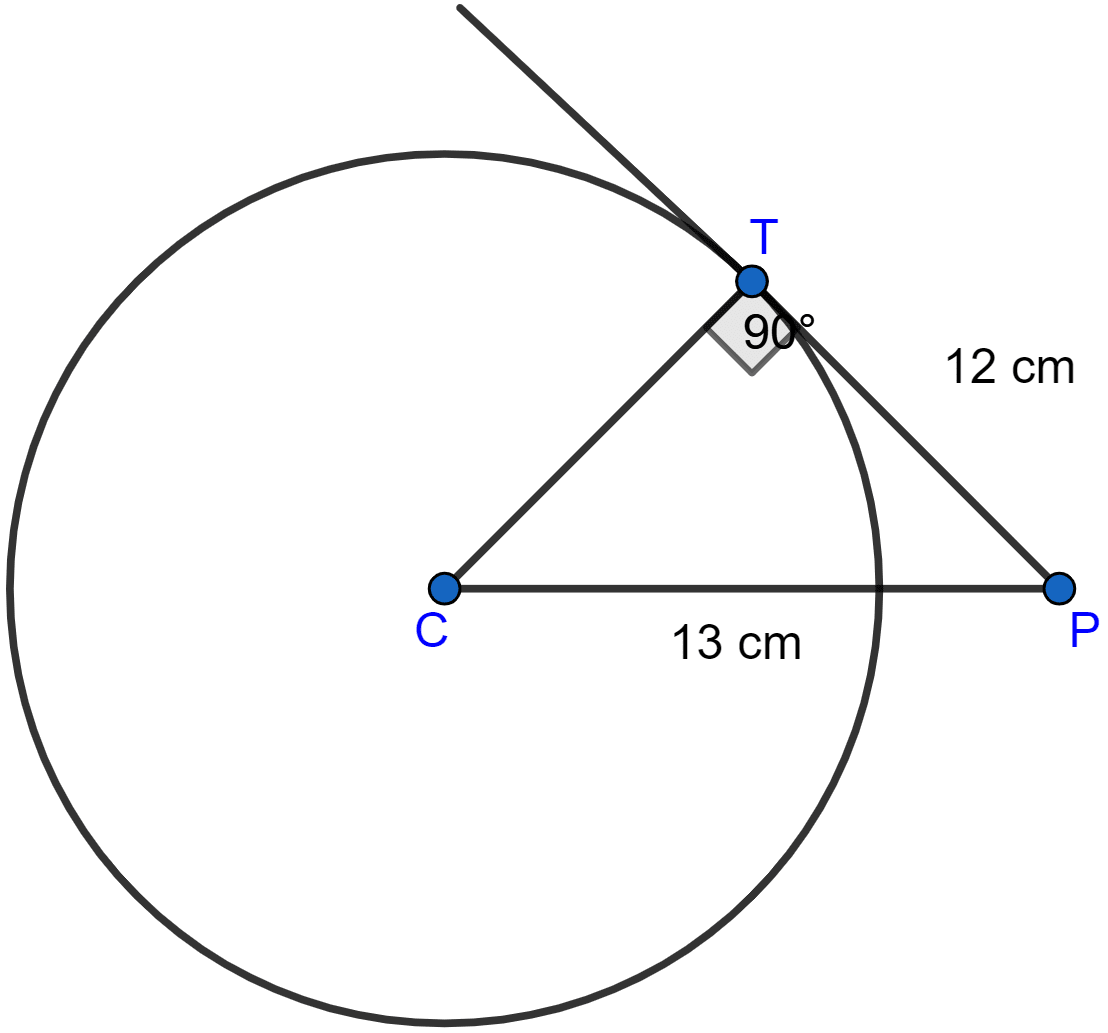
Given point P is 13 cm away from centre C, so CP = 13 cm.
PT = 12 cm
CT = radius of the circle.
Since the tangent at any point of a circle and the radius through the point are perpendicular to each other.
So, CT ⊥ PT
So, in right angled △CPT by pythagoras theorem,
Hence, radius of circle = 5 cm.
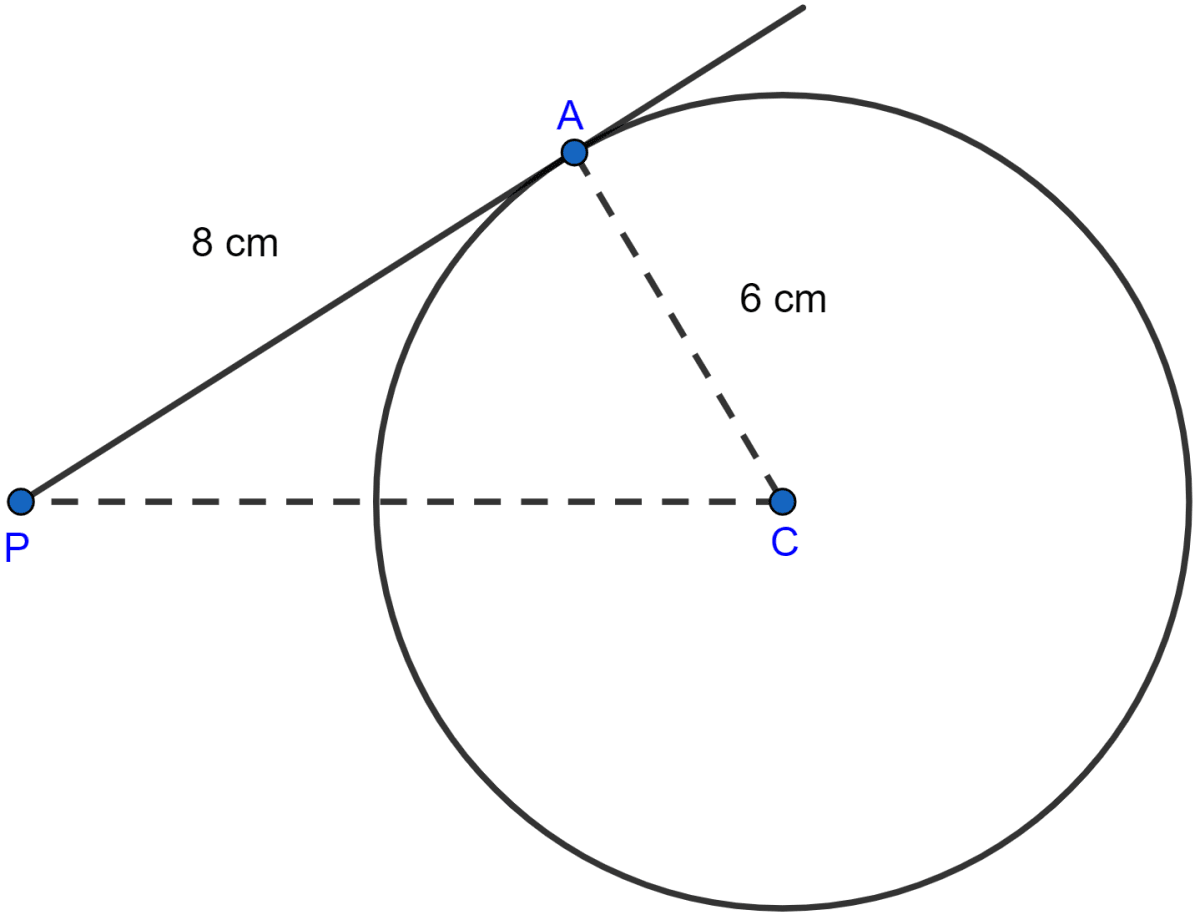
The tangent to a circle of radius 6 cm from an external point P, is of length 8 cm. Calculate the distance of P from the nearest point of the circle.
Answer
Since the tangent at any point of a circle and the radius through the point are perpendicular to each other.
So, from figure,
AP ⊥ CP
So, in right angled △CAP by pythagoras theorem,
From figure, nearest point to P on the circle is D,
PD = CP - CD = 10 - 6 = 4 cm.
Hence, the distance of P from the nearest point of the circle is 4 cm.
The figure shows a circle of radius 9 cm with O as the centre. The diameter AB produced meets the tangent PQ at P. If PA = 24 cm, find the length of tangent PQ.

Answer
Given,
Radius of circle (r) = OA = OB = 9 cm
From figure,
AB = OA + OB = 9 + 9 = 18 cm
PB = PA - AB = 24 - 18 = 6 cm
We know that,
If a secant segment and tangent segment are drawn to a circle from the same external point, the length of the tangent segment is the geometric mean between the length of the secant segment and the length of the external part of the secant segment.
⇒ PQ2 = PB × PA
⇒ PQ2 = 6 × 24
⇒ PQ2 = 144
⇒ PQ = = 12 cm.
Hence, length of tangent PQ = 12 cm.
Two concentric circles are of radii 13 cm and 5 cm. Find the length of the chord of the outer circle which touches the inner circle.
Answer
From figure,
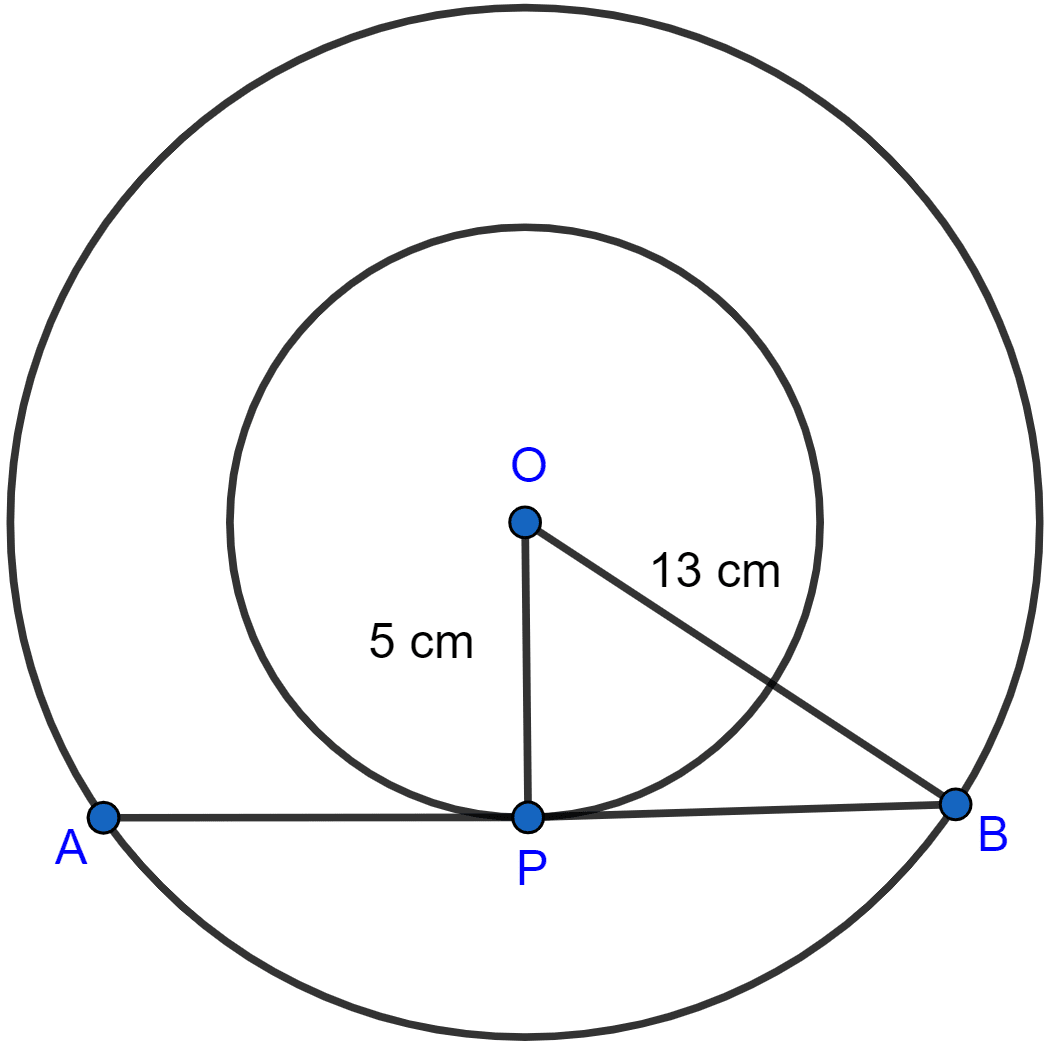
AB is the chord of the outer circle which touches the inner circle at P.
OP is the radius of the inner circle and APB is the tangent to the inner circle.
In the right angled triangle OPB, by pythagoras theorem,
As perpendicular line from centre bisects the chord of the circle so,
AP = PB = 12 cm.
AB = AP + PB = 12 + 12 = 24 cm.
Hence, the length of chord = 24 cm.
Two circles of radii 5 cm and 2.8 cm touch each other. Find the distance between their centres if they touch
(i) Externally
(ii) Internally
Answer
(i) From figure,
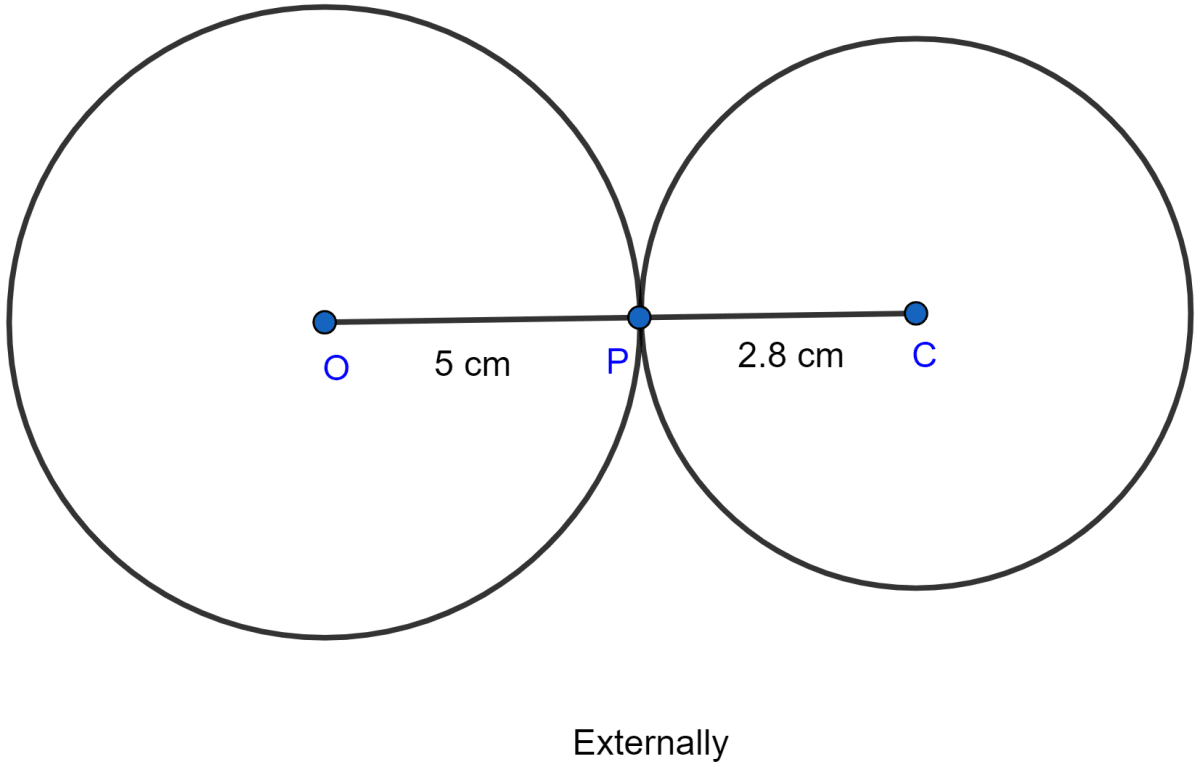
OC = OP + PC = 5 + 2.8 = 7.8 cm
Hence, the distance between centres of circle = 7.8 cm when circles touch externally.
(ii) From figure,

OC = OP - CP = 5 - 2.8 = 2.2 cm.
Hence, the distance between centres of circle = 2.2 cm when circles touch internally.
In figure (i) given below, triangle ABC is circumscribed, find x.

Answer
From figure, AP and AQ are the tangents to the circle.
∴ AQ = AP = 4 cm. (∵ if two tangents are drawn to a circle from an external point then the tangents have equal lengths.)
From figure, BP and BR are the tangents to the circle.
∴ BR = BP = 6 cm. (∵ if two tangents are drawn to a circle from an external point then the tangents have equal lengths.)
From figure,
CQ = CA - AQ = 12 - 4 = 8 cm.
From figure, CQ and CR are the tangents to the circle.
∴ CR = CQ = 8 cm. (∵ if two tangents are drawn to a circle from an external point then the tangents have equal lengths.)
From figure,
x = BR + CR = 6 + 8 = 14 cm.
Hence, the value of x = 14 cm.
In figure (ii) given below, quadrilateral ABCD is circumscribed, find x.

Answer
From A, AP and AQ are the tangents to the circle.
∴ AP = AQ = 5 cm. (∵ if two tangents are drawn to a circle from an external point then the tangents have equal lengths.)
From C, CR and CS are the tangents to the circle.
∴ CS = CR = 3 cm. (∵ if two tangents are drawn to a circle from an external point then the tangents have equal lengths.)
From figure,
BS = BC - CS = 7 - 3 = 4 cm.
From B, BS and BP are the tangents to the circle.
∴ BP = BS = 4 cm. (∵ if two tangents are drawn to a circle from an external point then the tangents have equal lengths.)
From figure,
x = BP + AP = 4 + 5 = 9 cm.
Hence, the value of x = 9 cm.
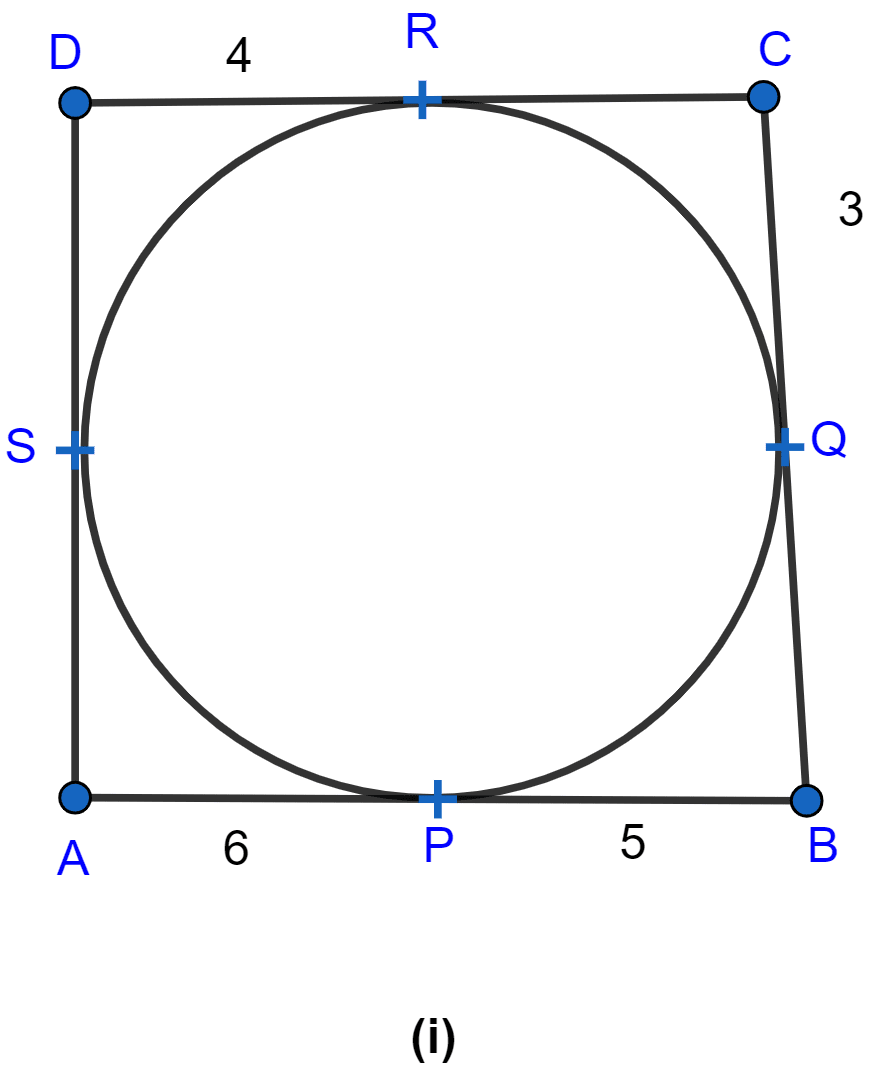
In figure (i) given below, quadrilateral ABCD is circumscribed ; find the perimeter of quadrilateral ABCD.
Answer
From A, AP and AS are the tangents to the circle.
∴ AS = AP = 6 cm. (∵ if two tangents are drawn to a circle from an external point then the tangents have equal lengths.)
From B, BP and BQ are the tangents to the circle.
∴ BQ = BP = 5 cm. (∵ if two tangents are drawn to a circle from an external point then the tangents have equal lengths.)
From C, CQ and CR are the tangents to the circle.
∴ CR = CQ = 3 cm. (∵ if two tangents are drawn to a circle from an external point then the tangents have equal lengths.)
From D, DS and DR are the tangents to the circle.
∴ DS = DR = 4 cm. (∵ if two tangents are drawn to a circle from an external point then the tangents have equal lengths.)
Therefore, perimeter of the quadrilateral ABCD
Hence, the perimeter of ABCD = 36 cm.
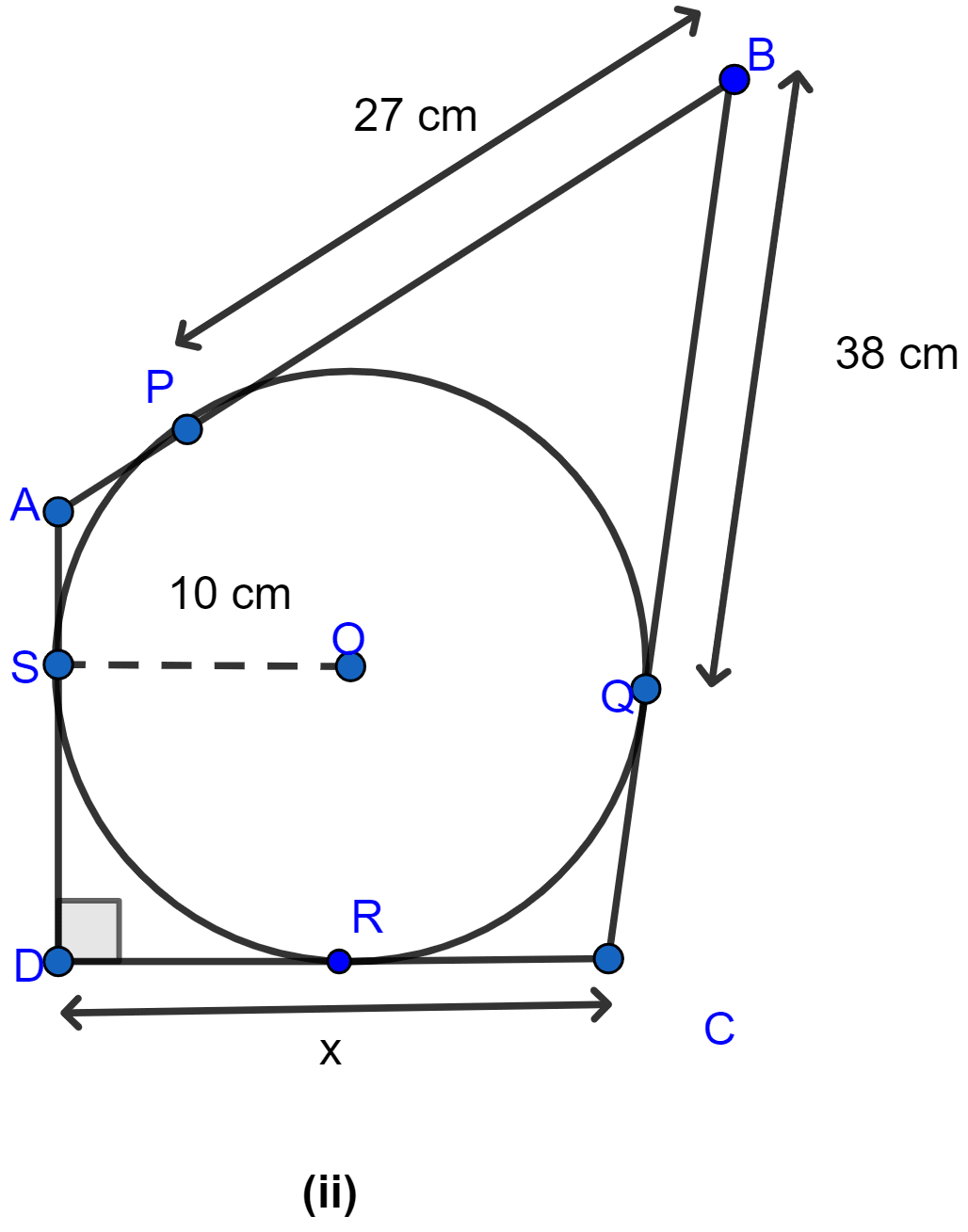
In Figure (ii) given below, quadrilateral ABCD is circumscribed and AD ⊥ DC; find x if radius of incircle is 10 cm.
Answer
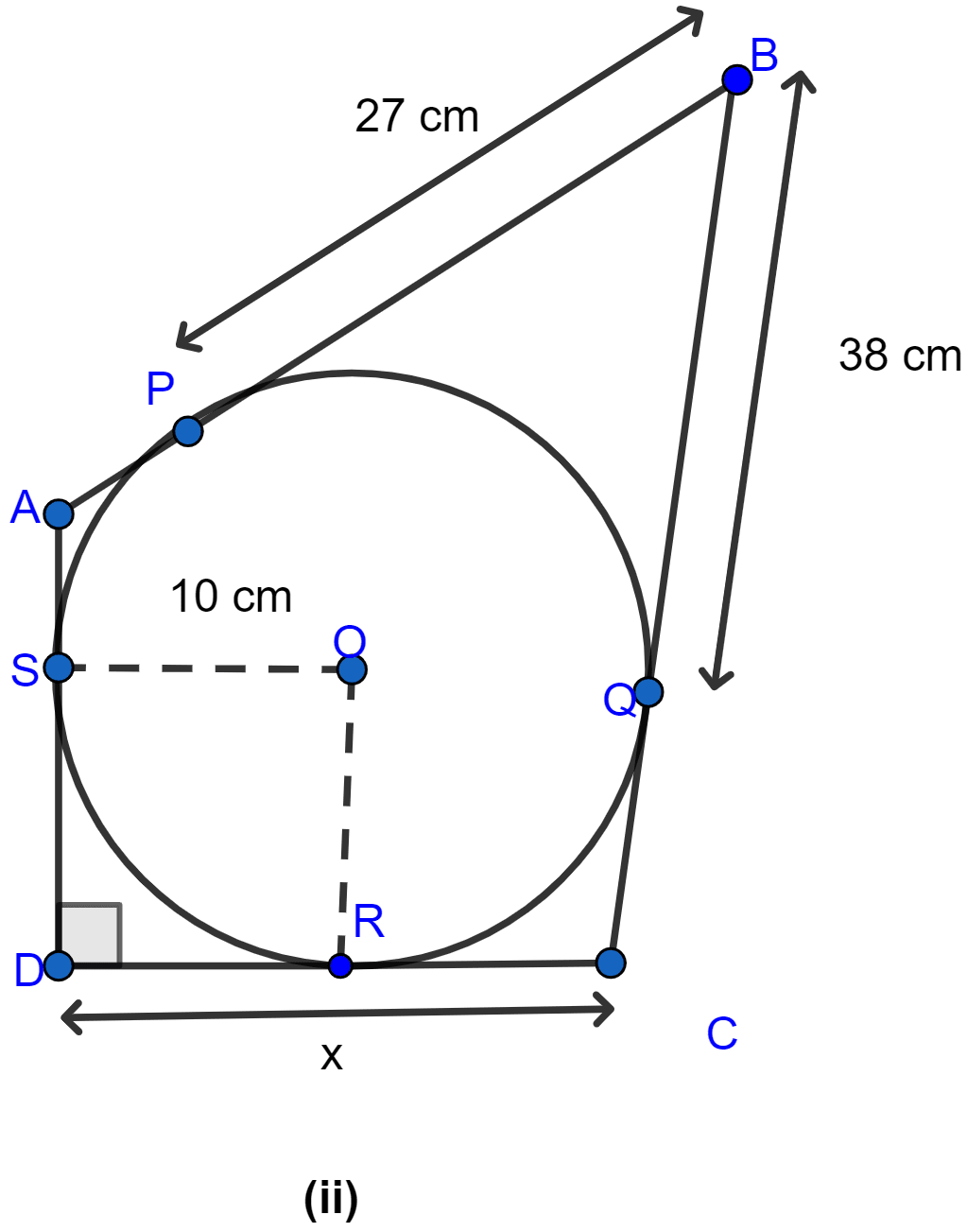
Join OR as shown in the figure below:
From figure,
OS = OR (As both are radius of circle.)
SD = OR (As OSDR form a square.)
∴ SD = OS.
From D, DS and DR are the tangents to the circle.
∴ DR = DS = 10 cm. (∵ if two tangents are drawn to a circle from an external point then the tangents have equal lengths.)
From B, BP and BQ are the tangents to the circle.
∴ BQ = BP = 27 cm. (∵ if two tangents are drawn to a circle from an external point then the tangents have equal lengths.)
From figure,
CQ = BC - BQ = 38 - 27 = 11 cm.
Now from C, CQ and CR are the tangents to the circle
CR = CQ = 11 cm.
⇒ DC = x = DR + CR = 10 + 11 = 21 cm.
Hence, the length of x = 21 cm.
In figure (i) given below, O is the centre of the circle and AB is a tangent at B. If AB = 15 cm and AC = 7.5 cm, find the radius of the circle.

Answer
Since the tangent at any point of a circle and the radius through the point are perpendicular to each other.
So, from figure,
OB ⊥ AB
In right angled △OBA,
Hence, radius of the circle = 11.25 cm.
In the figure (ii) given below, from an external point P, tangents PA and PB are drawn to a circle. CE is a tangent to the circle at D. If AP = 15 cm, find the perimeter of the triangle PEC.

Answer
From P, PA and PB are the tangents to the circle.
∴ PA = PB = 15 cm. (∵ if two tangents are drawn to a circle from an external point then the tangents have equal lengths.)
From E, EA and ED are the tangents to the circle.
∴ EA = ED (∵ if two tangents are drawn to a circle from an external point then the tangents have equal lengths.)
From C, BC and CD are the tangents to the circle.
∴ BC = CD (∵ if two tangents are drawn to a circle from an external point then the tangents have equal lengths.)
Now perimeter of triangle PEC,
Hence, perimeter of triangle PEC = 30 cm.
If a, b, c are the sides of a right angled triangle where c is the hypotenuse, prove that the radius r of the circle which touches the sides of the triangle is given by r = .
Answer
Let the circle touch the sides BC, CA and AB of the right triangle ABC at points D, E and F respectively,
where BC = a, CA = b and AB = c (as shown in the given figure).
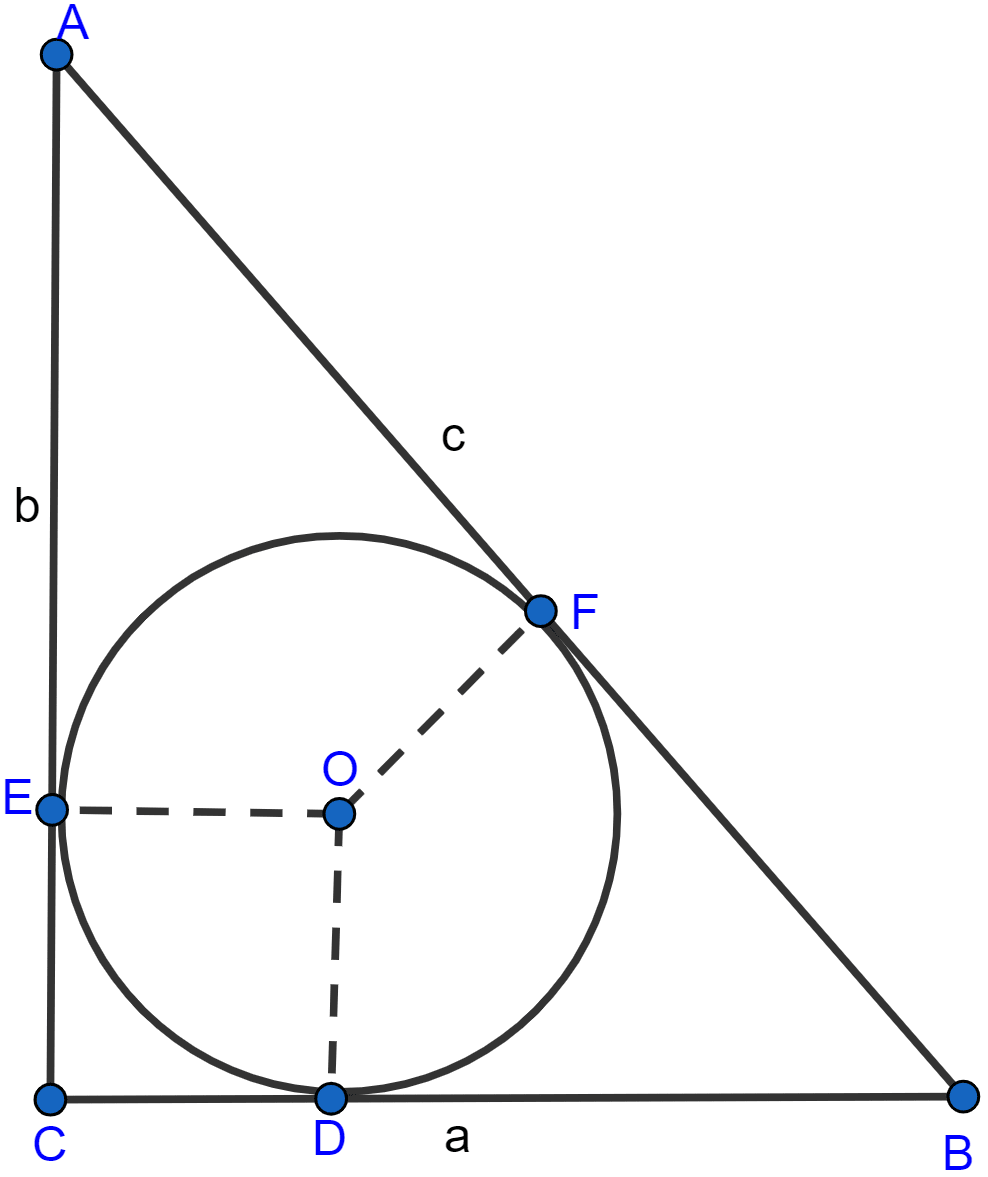
As the lengths of tangents drawn from an external point to a circle are equal
AE = AF, BD = BF and CD = CE
OD ⊥ BC and OE ⊥ CA (∵ tangents is ⊥ to radius)
ODCE is a square of side r
DC = CE = r
AF = AE = AC - EC = b - r and,
BF = BD = BC - DC = a - r
Now,
AB = AF + BF
⇒ c = (b - r) + (a - r)
⇒ c = b + a - 2r
⇒ 2r = a + b - c
⇒ r = .
Hence, proved that r =
In the given figure, PB is a tangent to a circle with centre O at B. AB is a chord of length 24 cm at a distance of 5 cm from the centre. If the length of the tangent is 20 cm, find the length of OP.

Answer
Join OB as shown in figure below:

OM = 5 cm
OM ⊥ AB and M is mid-point of AB,
MB = 12 cm.
In right-angled triangle △OMB,
As BP is tangent to circle at B, OB ⊥ BP.
In right-angled triangle △OBP,
Hence, the length of OP = cm.
Three circles of radii 2 cm, 3 cm and 4 cm touch each other externally. Find the perimeter of the triangle obtained on joining the centres of these circles.
Answer
Three circles with centres A, B and C touch each other externally and the radii of these circles are 2 cm, 3 cm and 4 cm respectively.
From figure,

By joining the centres of circles, triangle ABC is formed in which,
AB = 2 + 3 = 5 cm
BC = 3 + 4 = 7 cm
CA = 4 + 2 = 6 cm.
Therefore, perimeter of the triangle ABC = AB + BC + CA = 5 + 7 + 6 = 18 cm.
Hence, the perimeter of triangle ABC = 18 cm.
In the figure (i) given below, the sides of the quadrilateral touch the circle. Prove that AB + CD = BC + DA.
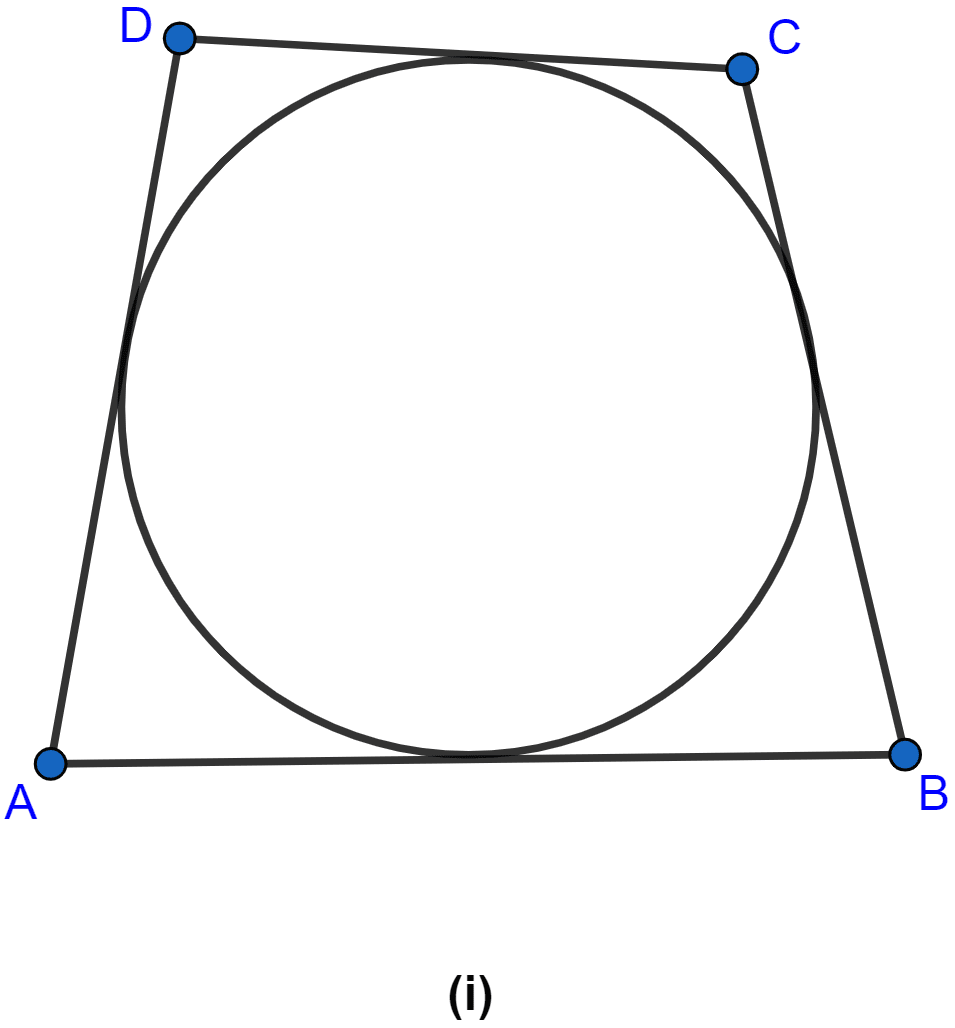
Answer
Let p, Q, R, S be the points where the circle touches the sides of the quadrilateral as shown in the figure below:
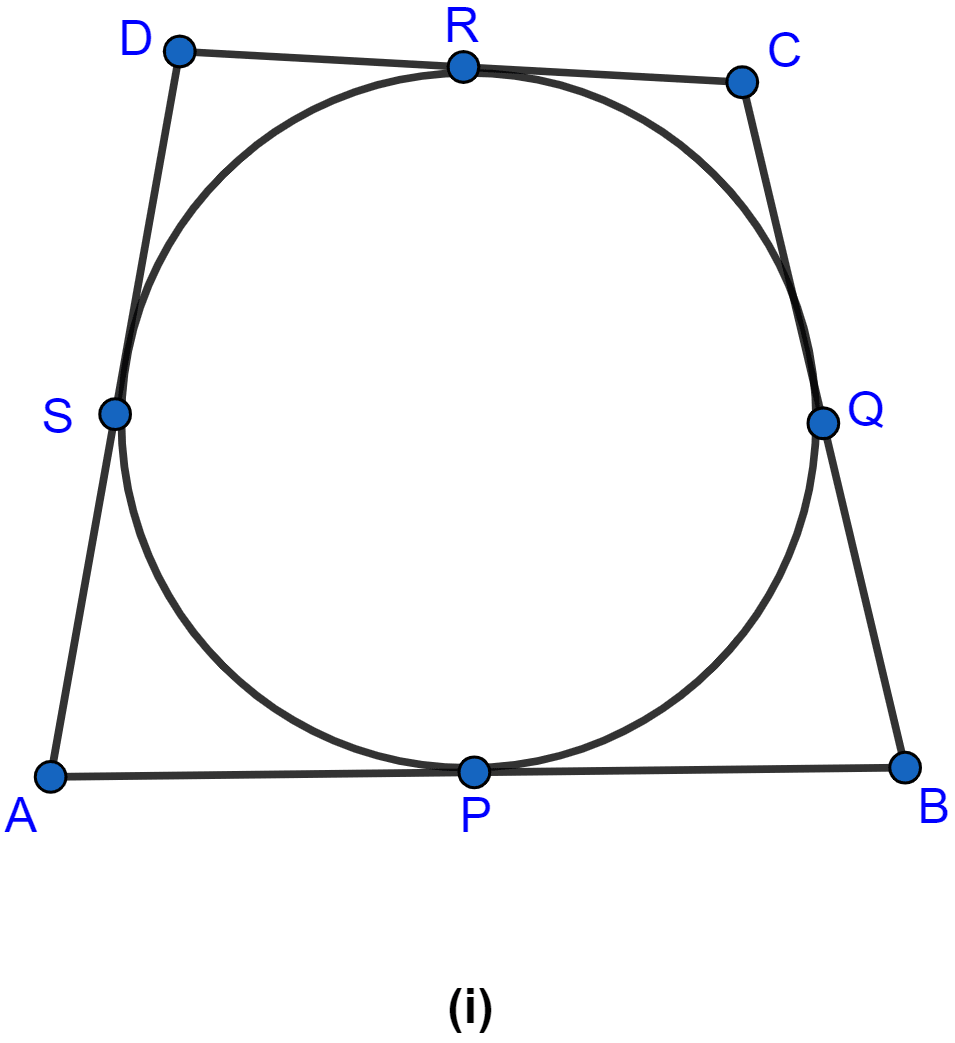
From A, AP and AS are the tangents to the circle.
∴ AP = AS ...(i) (∵ if two tangents are drawn to a circle from an external point then the tangents have equal lengths.)
From B, BP and BQ are the tangents to the circle.
∴ PB = BQ ....(ii) (∵ if two tangents are drawn to a circle from an external point then the tangents have equal lengths.)
From C, CR and CQ are the tangents to the circle.
∴ CR = CQ ....(iii) (∵ if two tangents are drawn to a circle from an external point then the tangents have equal lengths.)
From D, DR and DS are the tangents to the circle.
∴ DR = DS ....(iv) (∵ if two tangents are drawn to a circle from an external point then the tangents have equal lengths.)
Adding L.H.S. and R.H.S. of equations (i), (ii), (iii) and (iv) we get,
⇒ AP + PB + CR + DR = AS + BQ + CQ + DS
⇒ AB + CD = BC + DA
Hence, proved that AB + CD = BC + DA.
In the figure (ii) given below, ABC is a triangle with AB = 10 cm, BC = 8 cm and AC = 6 cm (not drawn to scale). Three circles are drawn touching each other with vertices A, B and C as their centres. Find the radii of the three circles.
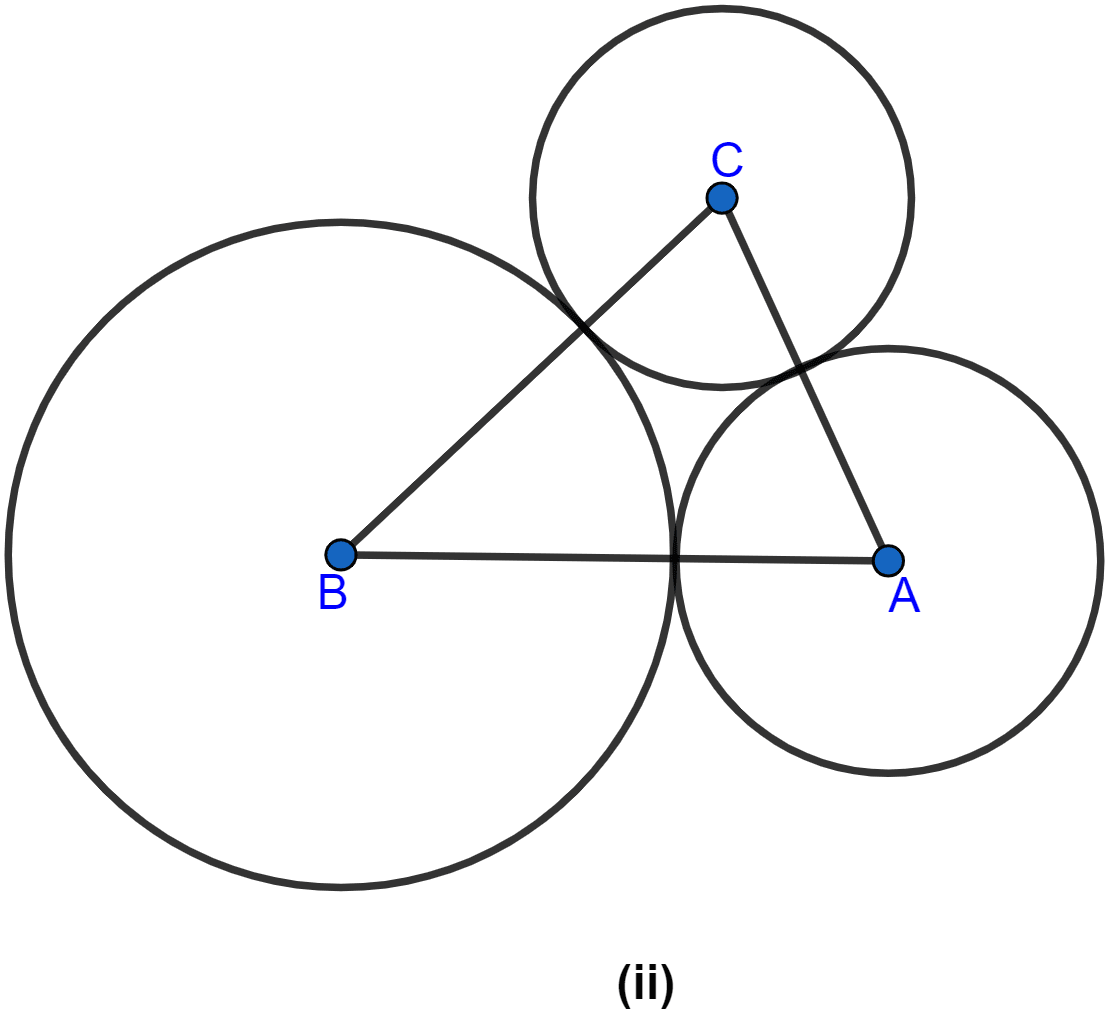
Answer
Given, AB = 10 cm, BC = 8 cm, AC = 6 cm
Let the radius of the circles with centre A, B and C be x cm, y cm and z cm.
From figure,
AB = 10 cm.
⇒ x + y = 10 cm ....(i)
BC = 8 cm.
⇒ y + z = 8 cm ....(ii)
AC = 6 cm.
⇒ x + z = 6 cm .....(iii)
Adding eqn. (i), (ii) and (iii) we get,
⇒ x + y + y + z + x + z = (10 + 8 + 6) cm
⇒ 2x + 2y + 2z = 24 cm
⇒ 2(x + y + z) = 24 cm
⇒ x + y + z = 12 cm .....(iv)
Now, (iv) - (i) we get,
⇒ x + y + z - (x + y) = (12 - 10) cm
⇒ x + y + z - x - y = 2 cm
⇒ z = 2 cm.
Also, by (iv) - (ii) we get,
⇒ x + y + z - (y + z) = (12 - 8) cm
⇒ x + y + z - y - z = 4 cm
⇒ x = 4 cm
Also, by (iv) - (iii) we get,
⇒ x + y + z - (x + z) = (12 - 6) cm
⇒ x + y + z - x - z = 6 cm
⇒ y = 6 cm.
Hence, the radius of the circle with centre A, B and C are 4 cm, 6 cm and 2 cm.
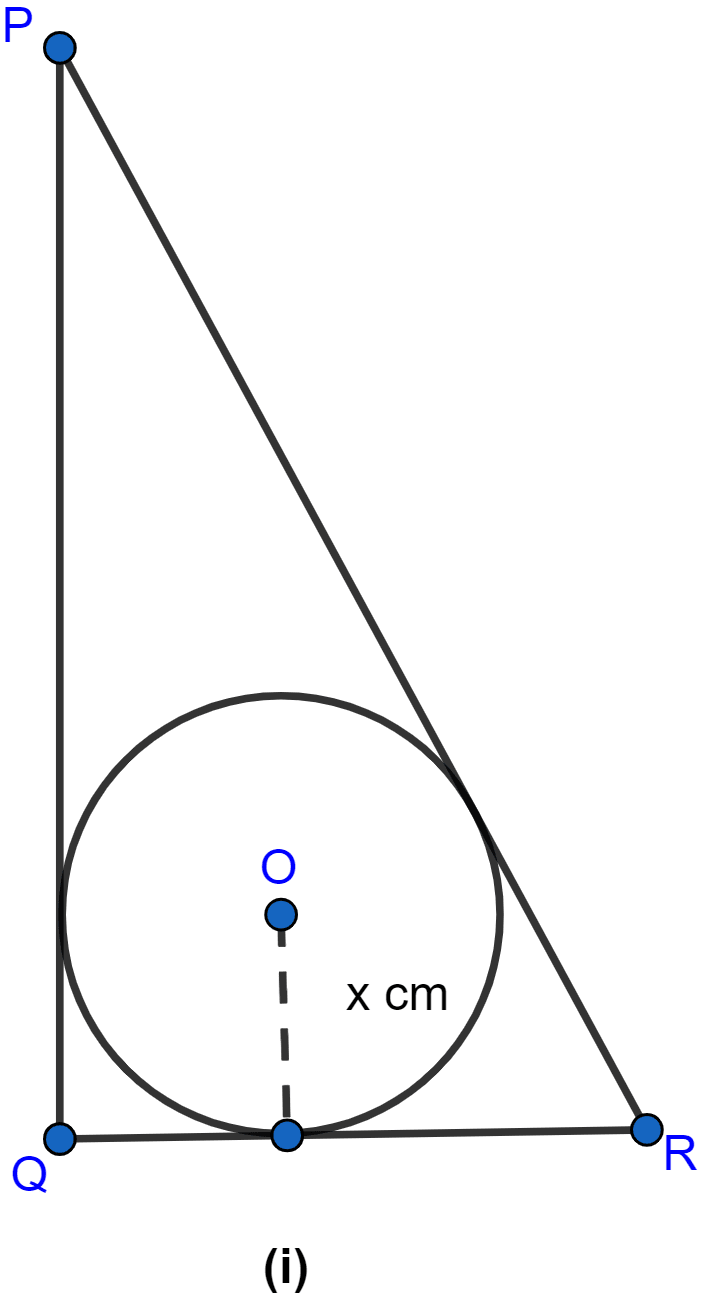
In the figure (i) given below, PQ = 24 cm, QR = 7 cm and ∠PQR = 90°. Find the radius of the inscribed circle of △PQR.
Answer
Let the sides of triangle PQ, QR and PR meet the circle at L, M and N respectively.
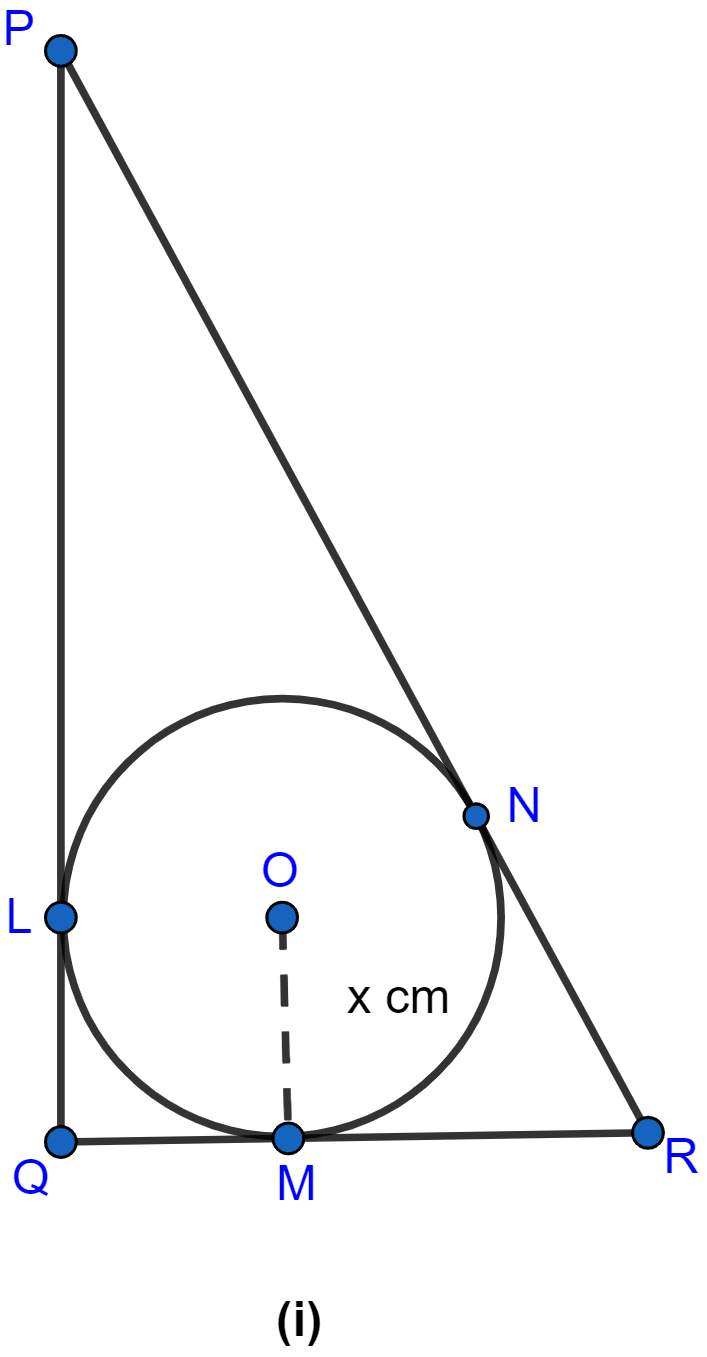
In right-angled triangle PQR
From figure,
RM = RN = (∵ tangents drawn from a common external point to a circle are equal.)
RM = RQ - QM = (7 - x) cm.
PL = PN = (∵ tangents drawn from a common external point to a circle are equal.)
PL = PQ - QL = (24 - x) cm.
We can see,
PR = PN + RN = PL + RM.
⇒ 25 = 24 - x + 7 - x
⇒ 25 = 31 - 2x
⇒ 2x = 31 - 25
⇒ 2x = 6
⇒ x = 3.
Hence, the radius of the inscribed circle is 3 cm.
In the figure (ii) given below, two concentric circles with centre O are of radii 5 cm and 3 cm. From an external point P, tangents PA and PB are drawn to these circles. If AP = 12 cm, find BP.
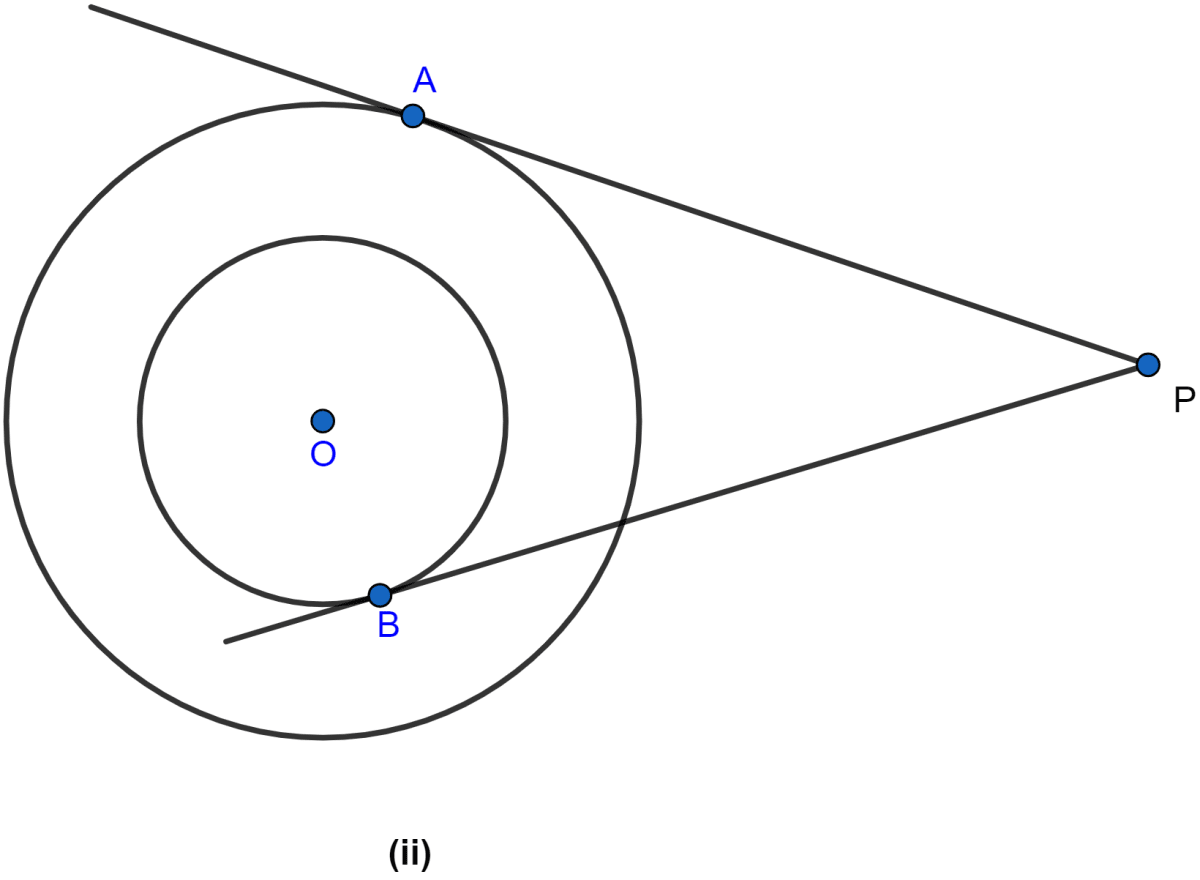
Answer
Join OA and OB.
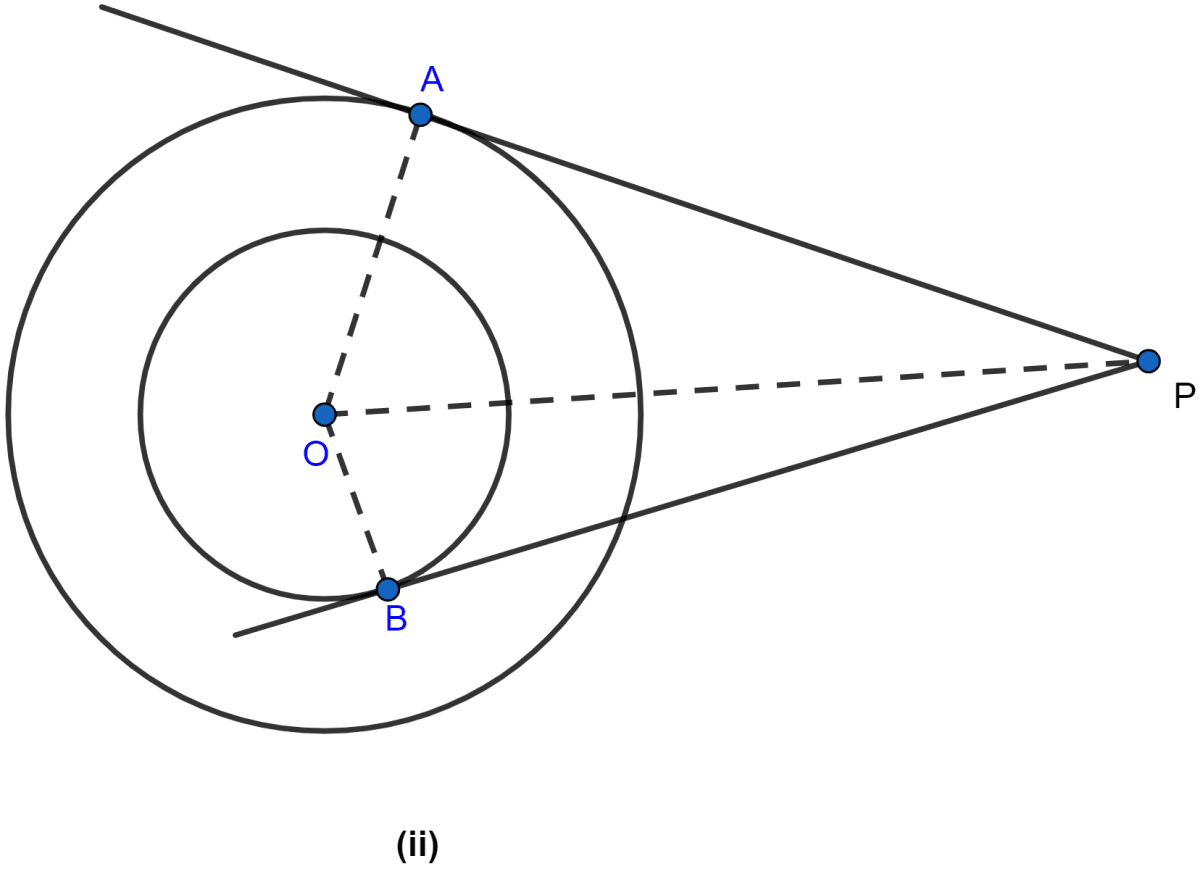
OA ⊥ AP. (∵ tangent at a point and radius through the point are perpendicular to each other.)
So, in right angled triangle OAP,
OB ⊥ BP. (∵ tangent at a point and radius through the point are perpendicular to each other.)
So, in right angled triangle OBP,
Hence, the length of BP = cm.
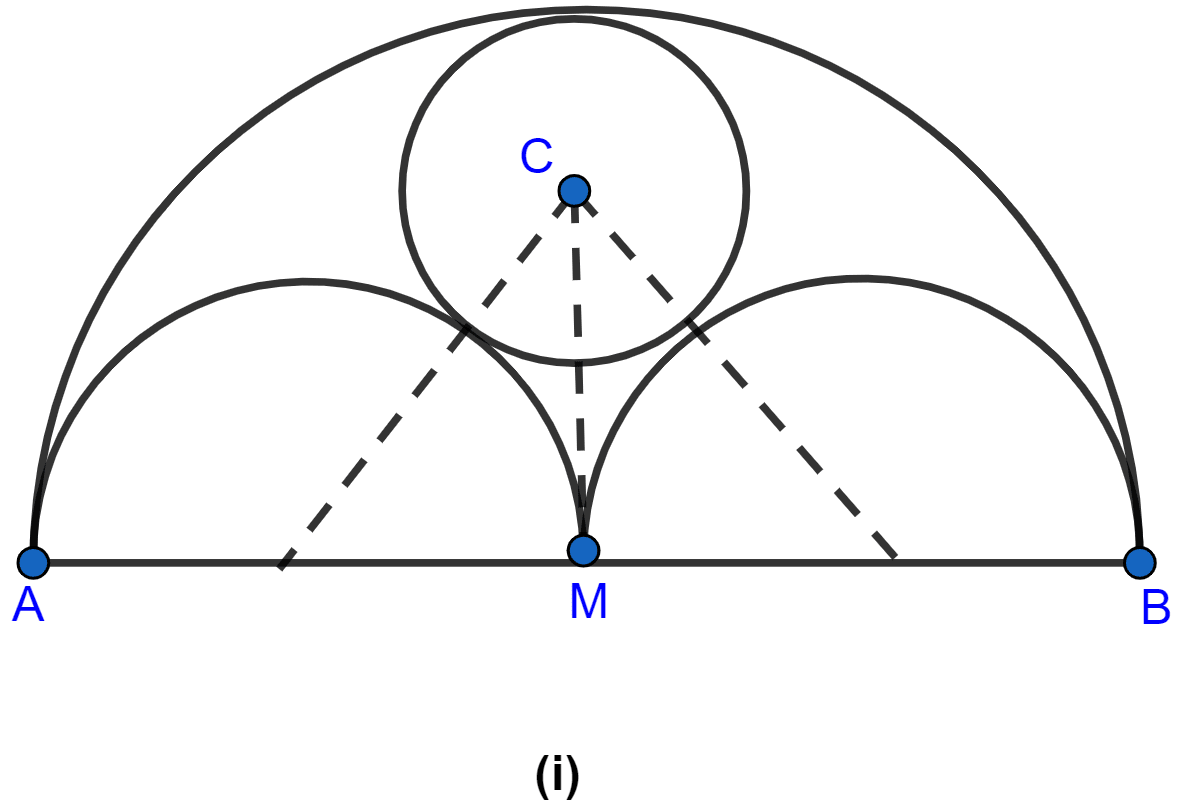
In the figure (i) given below, AB = 8 cm and M is mid-point of AB. Semicircles are drawn on AB, AM and MB as diameters. A circle with centre C touches all three semicircles as shown, find its radius.
Answer
Let x be the radius of the circle with centre C.
Since M is the mid-point of AB hence, AM = MB = 4 cm.
Two semicircles are thus drawn on AB with diameters as AM and MB.
Since radius = .
Hence, radius of both the semicircles with diameters AM and MB = 2 cm.
From figure,
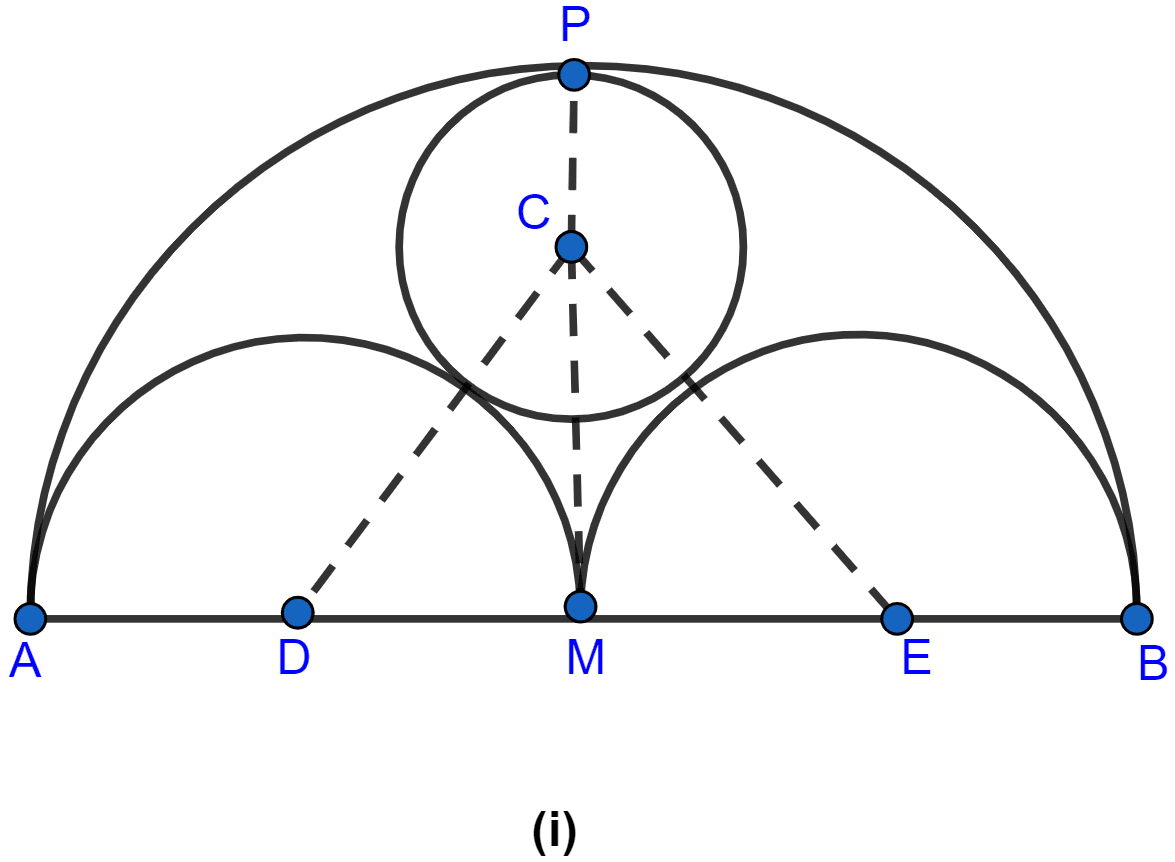
CM = MP - PC = (4 - x) cm.
In right angled triangle CMD,
Hence, the radius of small circle = cm.
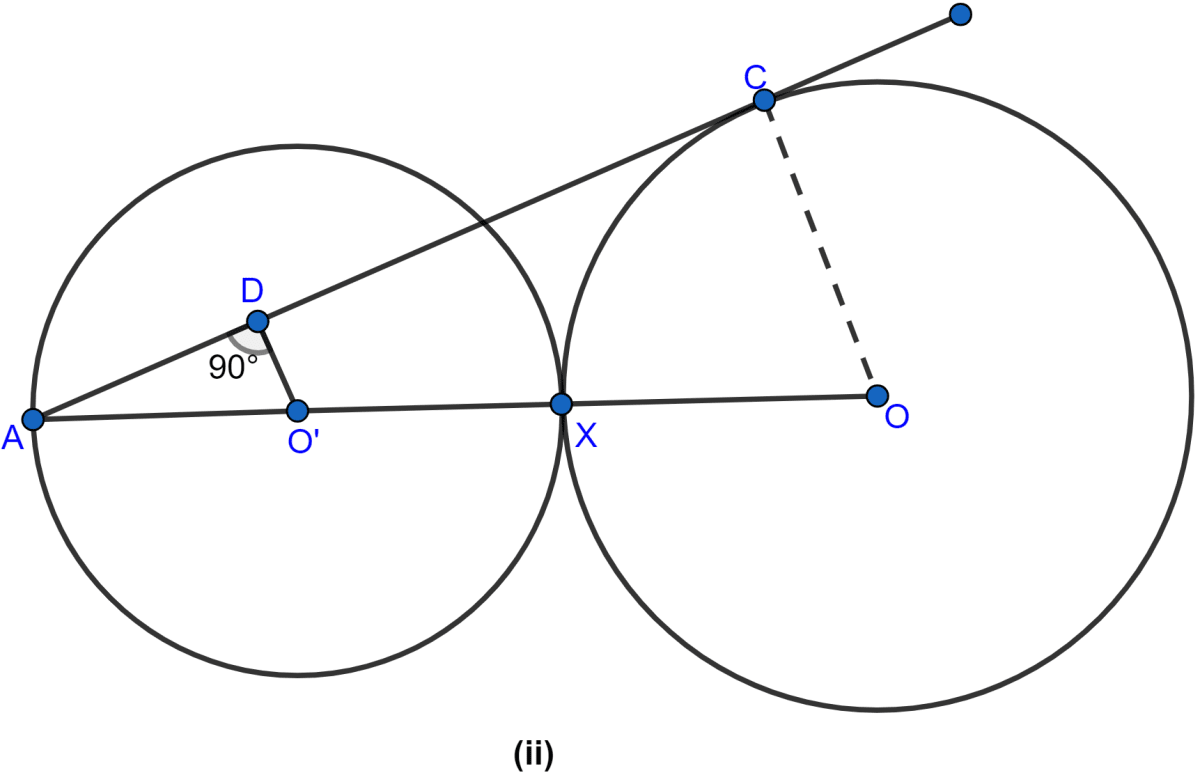
In the figure (ii) given below, equal circles with centres O and O' touch each other at X. OO' is produced to meet a circle O' at A. AC is tangent to the circle whose centre is O. O'D is perpendicular to AC. Find the value of
(i)
(ii)
Answer
From figure,
OC is radius and AC is tangent, then OC ⊥ AC.
Let radius of each equal circle = r.
(i) From figure,
AO = AO' + O'X + XO and AO' = O'X = XO = r (radius of circle)
AO = r + r + r = 3r.
Hence, the value of .
(ii) Considering △ADO' and △ACO
∠A = ∠A (Common angles)
∠D = ∠C (Both are equal to 90°)
∴ By AA axiom △ADO' ~ △ACO.
Since triangles are similar hence the ratio of their areas is equal to the ratio of the square of the corresponding sides.
Hence, the value of
The length of the direct common tangent to two circles of radii 12 cm and 4 cm is 15 cm. Calculate the distance between their centres.
Answer
Let there be two circles with center A and B and radius 12 and 4 cm respectively.
From figure,
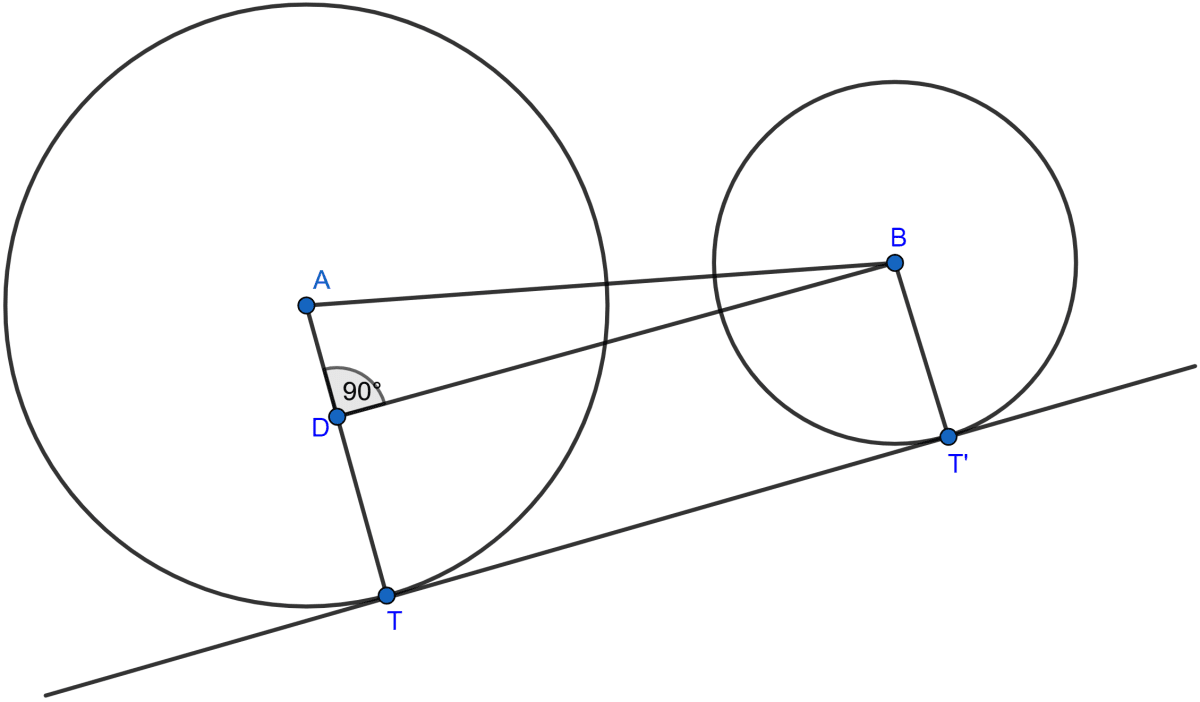
TT' is the common tangent.
DT = BT' = 4 cm.
DB = TT' = 15 cm.
In right angled triangle ADB
AD = AT - DT = 12 - 4 = 8 cm
Hence, the distance between two centres = 17 cm.
Calculate the length of a direct common tangent to two circles of radii 3 cm and 8 cm with their centres 13 cm apart.
Answer
Let there be two circles with centre A and B with radius 8 cm and 3 cm respectively.
Let TT' be the length of common tangent.
From figure,

DT = BT' = 3cm.
AD = AT - DT = 8 - 3 = 5 cm.
In right angled triangle ADB
Since, TDBT' is a rectangle,
So, TT' = DB = 12 cm.
Hence, the length of direct common tangent is 12 cm.
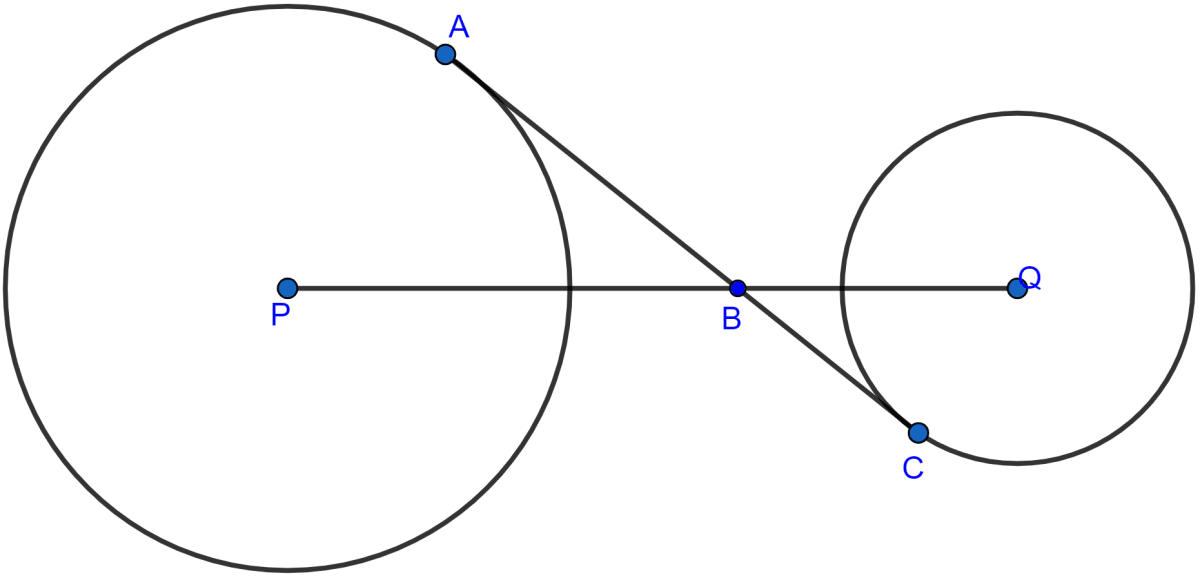
In the given figure, AC is a transverse common tangent to two circles with centres P and Q and of radii 6 cm and 3 cm respectively. Given that AB = 8 cm, calculate PQ.
Answer
Join AP and CQ.
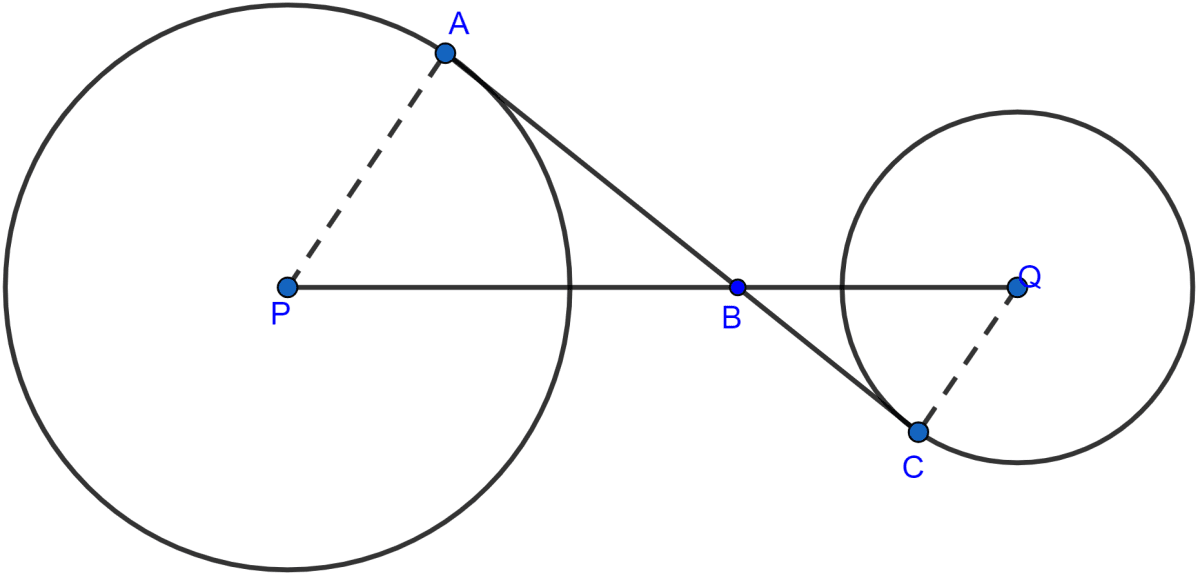
AB ⊥ AP (∵ tangent at a point and radius through the point are perpendicular to each other.)
In right angled triangle PAB.
Considering △PAB and △BCQ,
∠A = ∠C (Each are equal to 90°)
∠ABP = ∠CBQ (Vertically opposite angles are equal)
△PAB ~ △BCQ by AA axiom.
Since triangles are similar hence, the ratio of their corresponding sides are equal.
From figure,
PQ = PB + BQ = 10 + 5 = 15 cm.
Hence, the length of PQ = 15 cm.
Two circles with centres A, B are of radii 6 cm and 3 cm respectively. If AB = 15 cm, find the length of a transverse common tangent to these circles.
Answer
The two circles with centres A, B are of radii 6 cm and 3 cm and AB = 15 cm are shown in the figure below:
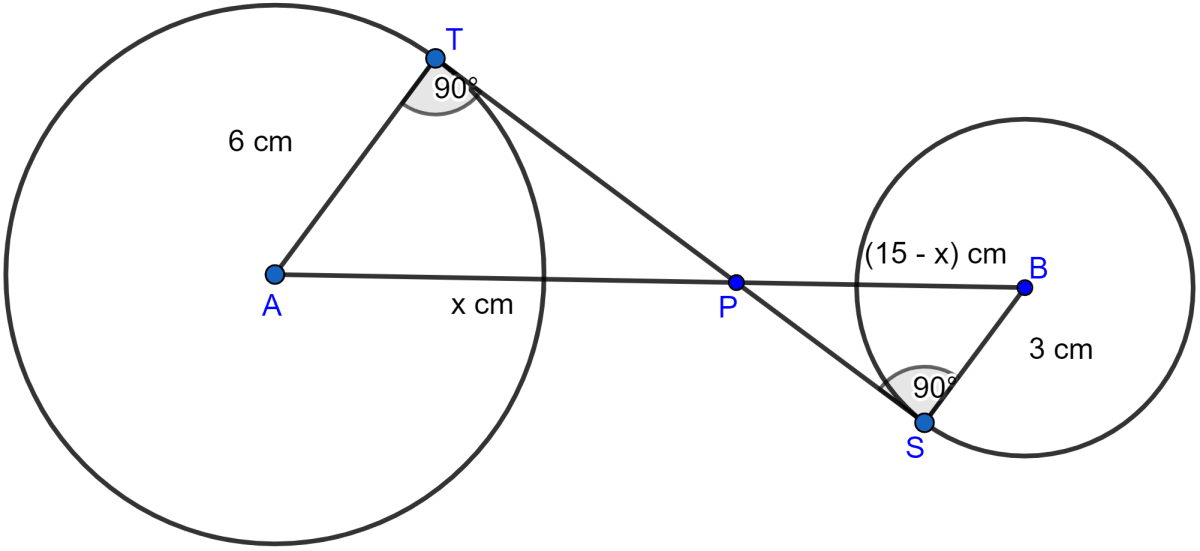
Given, AB = 15 cm.
Let AP = x, then PB = 15 - x
Considering △ATP and △SBP,
∠T = ∠S (Each are equal to 90°)
∠APT = ∠BPS (Vertically opposite angles are equal)
△ATP ~ △SBP by AA axiom.
Since triangles are similar hence, the ratio of their corresponding sides are equal.
∴ AP = 10 cm,
From figure,
PB = AB - AP = 15 - 10 = 5 cm.
Now in right-angled triangle ATP,
Similarly in right angled triangle PSB,
Hence, TS = TP + PS = 8 + 4 = 12 cm.
Hence, the length of a transverse common tangent to these circles are 12 cm.
In the figure (i) given below, PA and PB are tangents at the points A and B respectively of a circle with centre O. Q and R are points on the circle If ∠APB = 70°, find
(i) ∠AOB
(ii) ∠AQB
(iii) ∠ARB

Answer
AP and BP are tangents to the circle and OA and OB are radius of the circle.
∴ OA ⊥ AP and OB ⊥ BP.
∴ ∠OAP = ∠OBP = 90°
Sum of angles of a quadrilateral = 360°.
Hence, in quadrilateral OAPB,
⇒ ∠APB + ∠OAP + ∠OBP + ∠AOB = 360°
⇒ 70° + 90° + 90° + ∠AOB = 360°
⇒ 250° + ∠AOB = 360°
⇒ ∠AOB = 360° - 250°
⇒ ∠AOB = 110°.
Hence, the value of ∠AOB = 110°.
(ii) Arc AB subtends ∠AOB at centre and ∠AQB at remaining part of circle.
∴ ∠AOB = 2∠AQB (As angle at centre is double the angle subtended at remaining part of circle.)
⇒ 2∠AQB = 110°
⇒ ∠AQB = = 55°.
Hence, the value of ∠AQB = 55°.
(iii) Reflex ∠AOB = 360° - ∠AOB = 360° - 110° = 250°.
Arc AB subtends Reflex ∠AOB at centre and ∠ARB at remaining part of circle.
∴ Reflex ∠AOB = 2∠ARB (As angle at centre is double the angle subtended at remaining part of circle.)
⇒ 2∠ARB = 250°
⇒ ∠ARB = = 125°.
Hence, the value of ∠ARB = 125°.
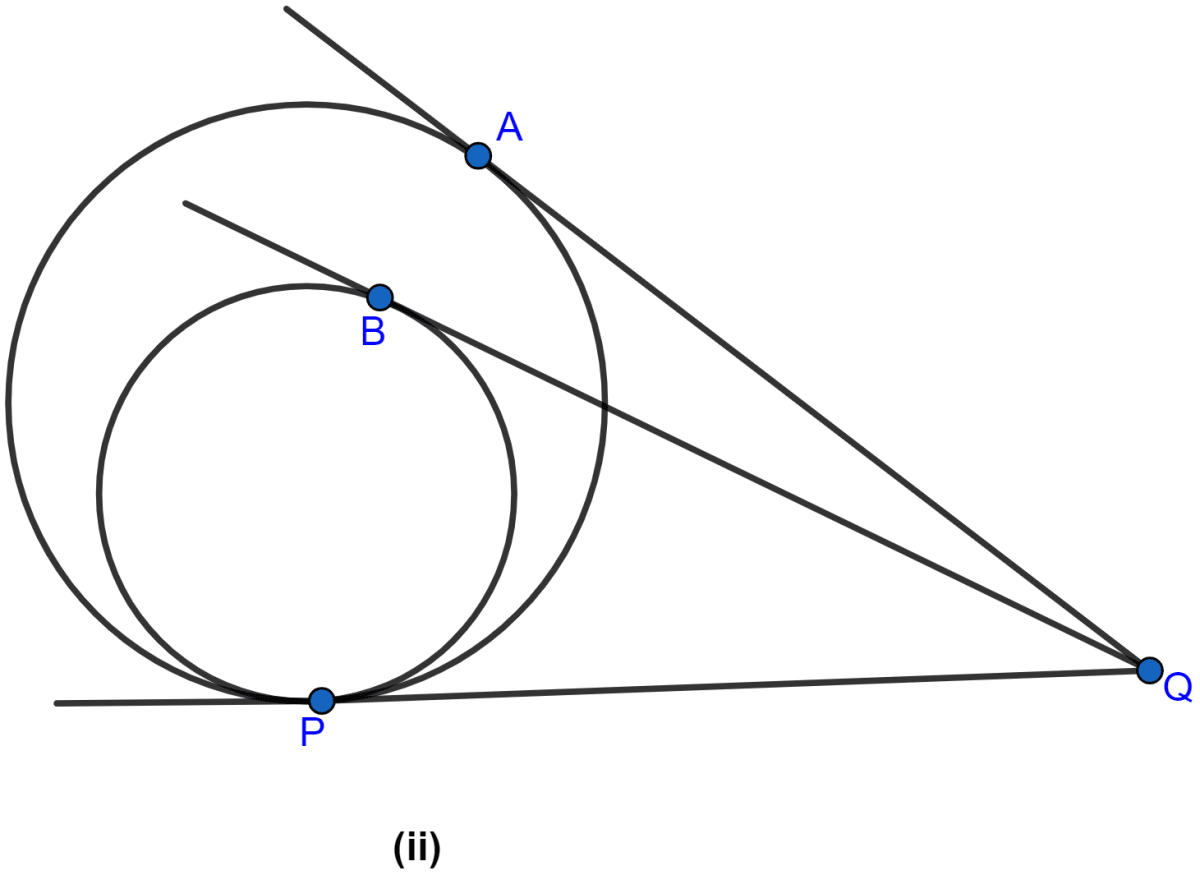
In the figure (ii) given below, two circles touch internally at P from an external point Q on the common tangent at P, two tangents QA and QB are drawn to the two circles. Prove that QA = QB.
Answer
From figure,
QA and QP are the tangents to the outer circle.
∴ QA = QP .....(i) (∵ the length of the different tangents to a circle from a single point are equal.)
Similarly, from Q, QB and QP are the tangents to the inner circle.
∴ QB = QP .....(ii) (∵ the length of the different tangents to a circle from a single point are equal.)
From (i) and (ii),
QA = QB.
Hence, proved that QA = QB.
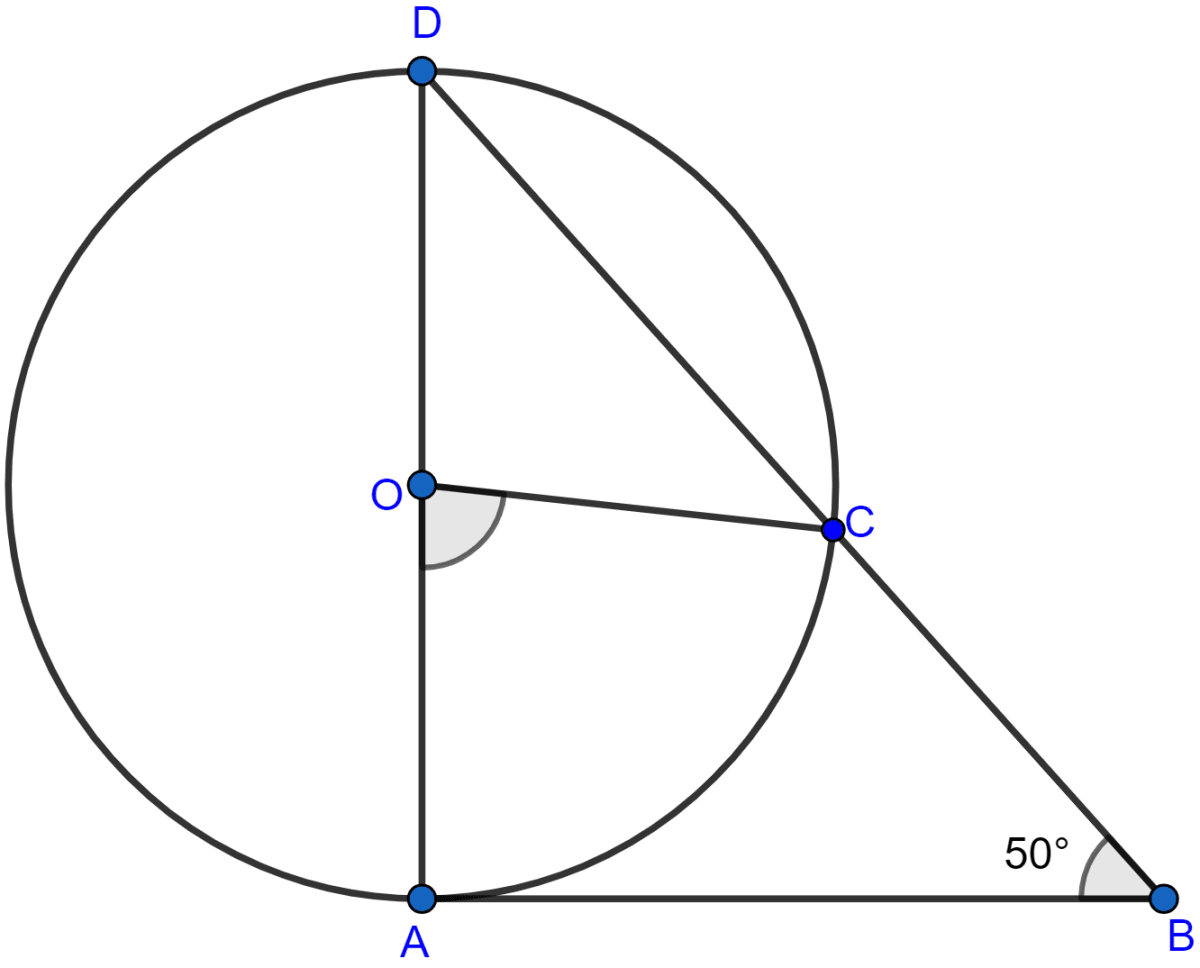
In the given figure, AD is a diameter of a circle with centre O and AB is tangent at A. C is a point on the circle such that DC produced intersects the tangent at B. If ∠ABC = 50°, find ∠AOC.
Answer
In the figure,
AB ⊥ AD. (∵ tangent at a point and radius through the point are perpendicular to each other.)
From figure,
∠ABD = ∠ABC = 50°
In △ABD,
∠ABD + ∠BDA + ∠DAB = 180°
⇒ 50° + ∠BDA + 90° = 180°
⇒ ∠BDA + 140° = 180°
⇒ ∠BDA = 180° - 140°
⇒ ∠BDA = 40°.
From figure,
∠ADC = ∠BDA = 40°.
Arc AC subtends ∠AOC at the centre and ∠ADC on point D.
∴ ∠AOC = 2∠ADC (∵ angle subtended at centre by an arc is double the angle subtended at remaining part of circle.)
∠AOC = 2 × 40° = 80°.
Hence, value of ∠AOC = 80°.
In the given figure, tangents PQ and PR are drawn from an external point P to a circle such that ∠RPQ = 30°. A chord RS is drawn parallel to the tangent PQ. Find ∠RQS.

Answer
Given,
RS || PQ,
∠TRS = ∠RPQ = 30° (∵ Corresponding angles are equal)
∠RQS = ∠TRS = 30° (∵ Angles in alternate segments are equal.)
Hence, value of ∠RQS = 30°.
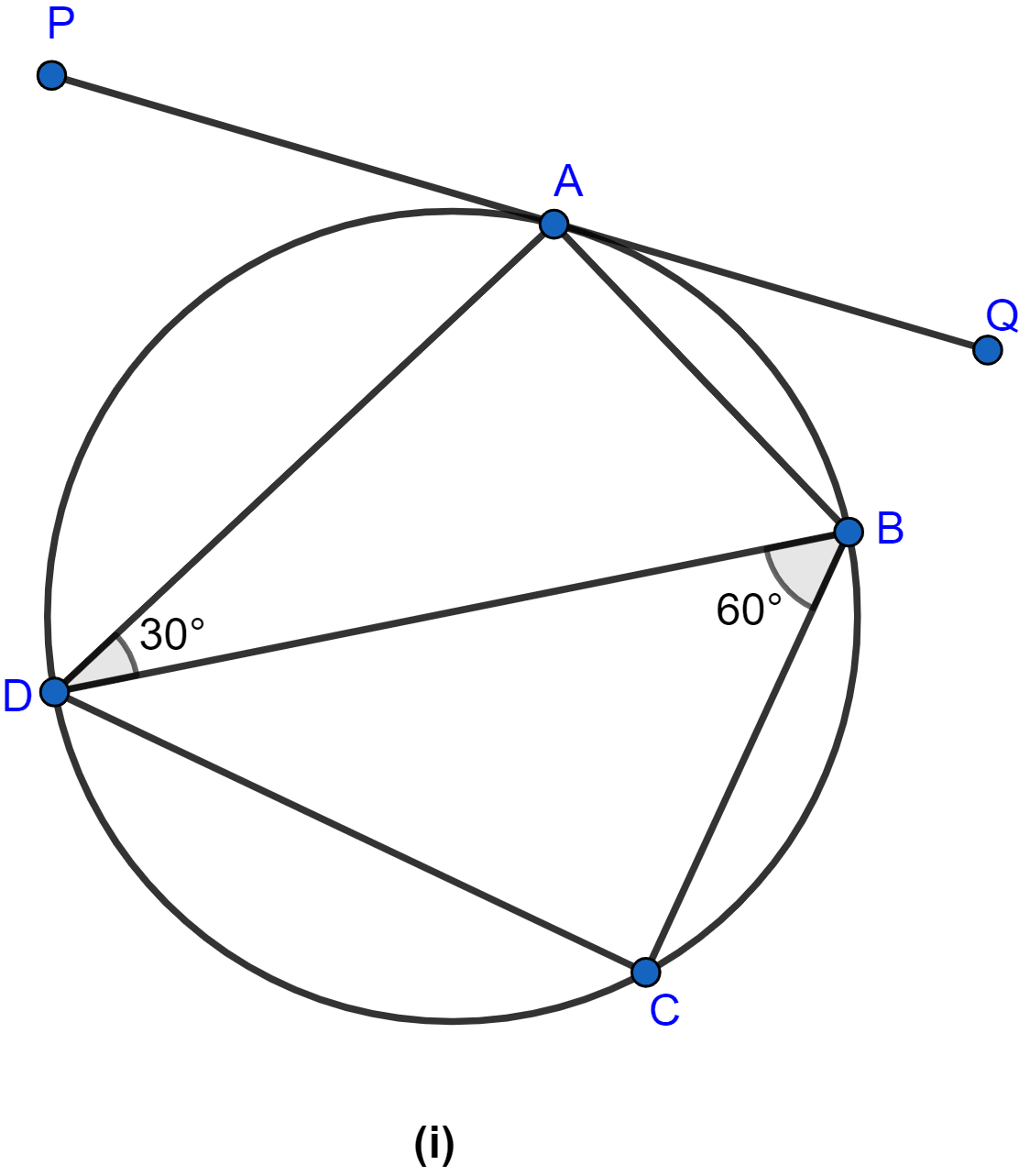
In the figure (i) given below, PQ is a tangent to the circle at A, DB is a diameter, ∠ADB = 30° and ∠CBD = 60°, calculate
(i) ∠QAB
(ii) ∠PAD
(iii) ∠CDB.
Answer
(i) ∠QAB = ∠BDA (∵ angles in alternate segment are equal.)
∴ ∠QAB = 30°.
Hence, the value of ∠QAB = 30°.
(ii) In △ADB,
∠DAB = 90° (∵ angle in semi-circle is 90°.)
Since, sum of angles in a triangle is 180°.
⇒ ∠ABD + ∠ADB + ∠DAB = 180°
⇒ ∠ABD + 30° + 90° = 180°
⇒ ∠ABD + 120° = 180°
⇒ ∠ABD = 60°.
From figure,
∠PAD = ∠ABD = 60° (∵ angles in alternate segment are equal)
Hence, the value of ∠PAD = 60°.
(iii) In △BCD,
∠BCD = 90° (As angle in semi-circle is 90°.)
∠CBD = 60°
Since, sum of angles in a triangle is 180°.
⇒ ∠BCD + ∠CBD + ∠CDB = 180°
⇒ 90° + 60° + ∠CDB = 180°
⇒ ∠CDB + 150° = 180°
⇒ ∠CDB = 30°.
Hence, the value of ∠CDB = 30°.
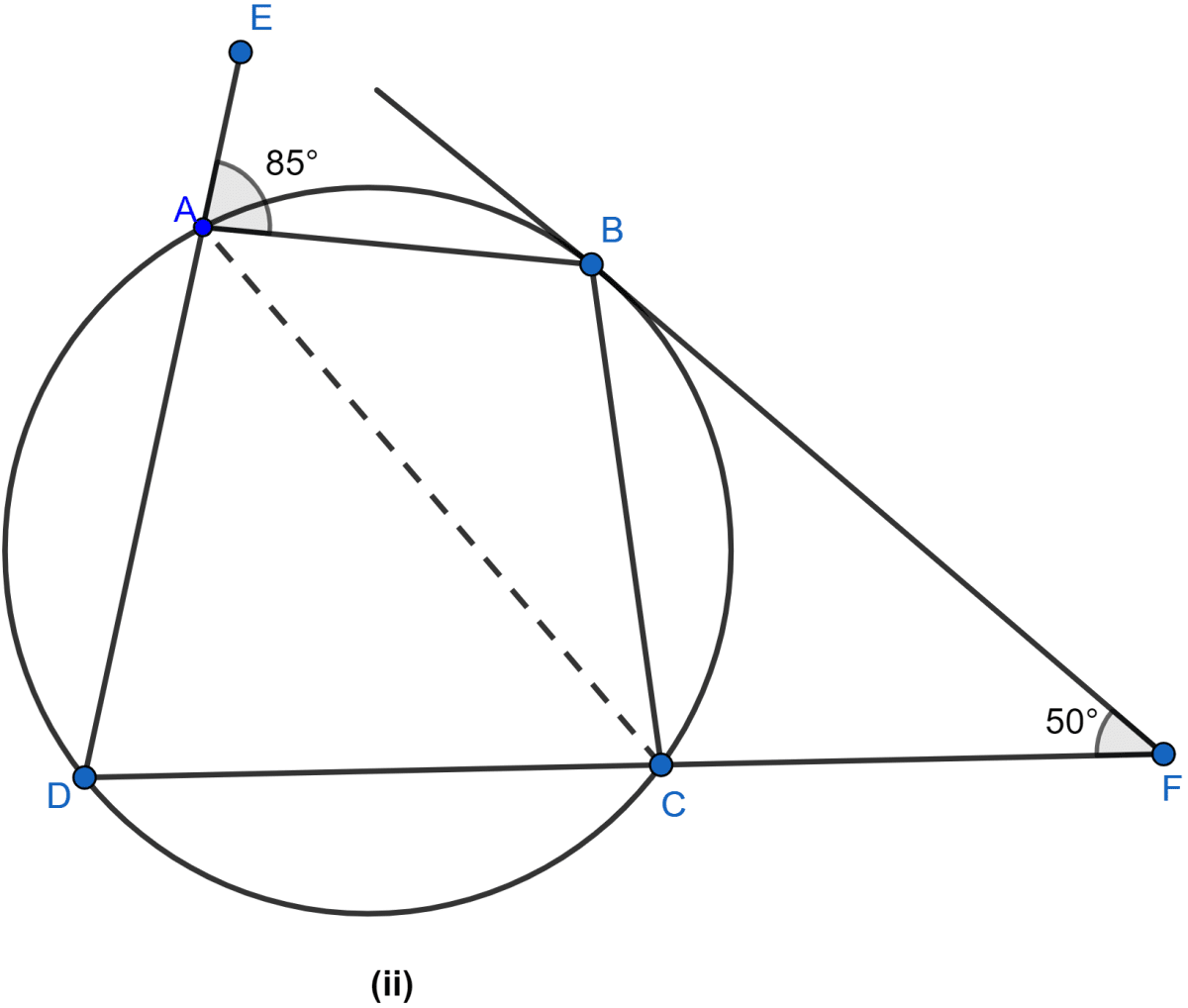
In the figure (ii) given below, ABCD is a cyclic quadrilateral. The tangent to the circle at B meets DC produced at F. If ∠EAB = 85° and ∠BFC = 50°, find ∠CAB.
Answer
ABCD is a cyclic quadrilateral.
In cyclic quadrilateral, the exterior angle = opposite interior angle.
∴ ∠BCD = ∠EAB = 85°
From figure,
⇒ ∠BCD + ∠BCF = 180° (∵ both are linear pair)
⇒ ∠BCF + 85° = 180°
⇒ ∠BCF = 95°.
Now in △BCF,
Since, sum of angles in a triangle is 180°.
⇒ ∠BCF + ∠BFC + ∠CBF = 180°
⇒ 95° + 50° + ∠CBF = 180°
⇒ ∠CBF + 145° = 180°
⇒ ∠CBF = 35°.
We know, BF is a tangent and BC is a chord.
∴ ∠CAB = ∠CBF = 35° (∵ angles in alternate segment are equal.)
⇒ ∠CAB = 35°.
Hence, the value of ∠CAB = 35°.
In the figure (i) given below, O is the centre of the circle and SP is a tangent. If ∠SRT = 65°, find the values of x, y and z.

Answer
From figure,
In △SRT,
SR ⊥ ST (∵ tangent is perpendicular to radius from that point.)
so, ∠TSR = 90°
Since, sum of angles in a triangle = 180°
⇒ ∠TSR + ∠SRT + ∠STR = 180°
⇒ 90° + 65° + x = 180°
⇒ x + 155° = 180°
⇒ x = 25°.
SQ subtends ∠SOQ at the centre and ∠STQ on point D.
∴ ∠SOQ = 2∠STQ (∵ angle subtended at centre by an arc is double the angle subtended at remaining part of circle.)
y = 2x = 2 × 25° = 50°.
In △OSP,
Since, sum of angles in a triangle = 180
⇒ ∠OSP + ∠SOP + ∠SPO = 180°
⇒ 90° + y + z = 180°
⇒ 90° + 50° + z = 180°
⇒ z + 140° = 180°
⇒ z = 180° - 140° = 40°.
Hence, the value of x = 25°, y = 50° and z = 40°.
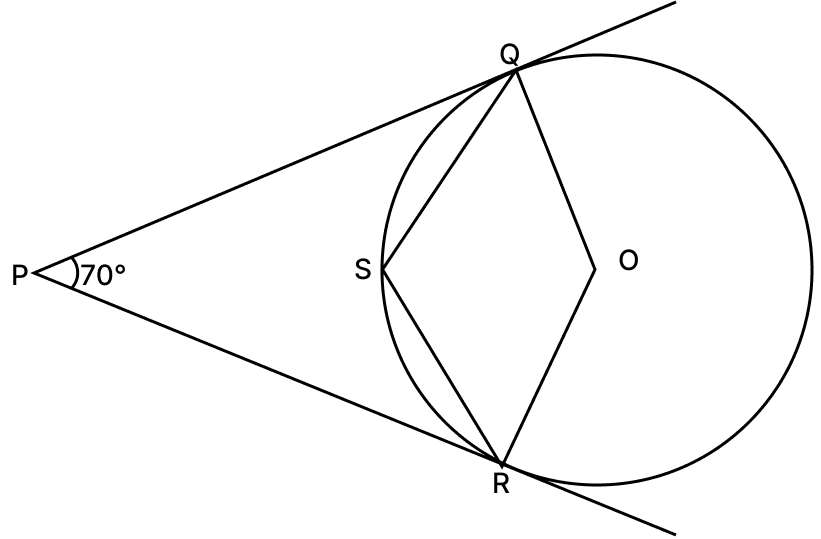
In the figure (ii) given below, O is the centre of the circle, PQ and PR are tangents and ∠QPR = 70°. Calculate :
(i) ∠QOR
(ii) ∠QSR
Answer
(i) We know that,
The tangent at any point of a circle and the radius through this point are perpendicular to each other.
In quadrilateral ORPQ,
∠OQP = ∠ORP = 90° [∵ The tangent at any point of a circle and the radius through this point are perpendicular to each other]
∠QPR = 70° [Given]
⇒ ∠OQP + ∠ORP + ∠QPR + ∠QOR = 360° [By angle sum property of quadrilateral]
⇒ 90° + 90° + 70° + ∠QOR = 360°
⇒ 250° + ∠QOR = 360°
⇒ ∠QOR = 110°.
Hence, ∠QOR = 110°.
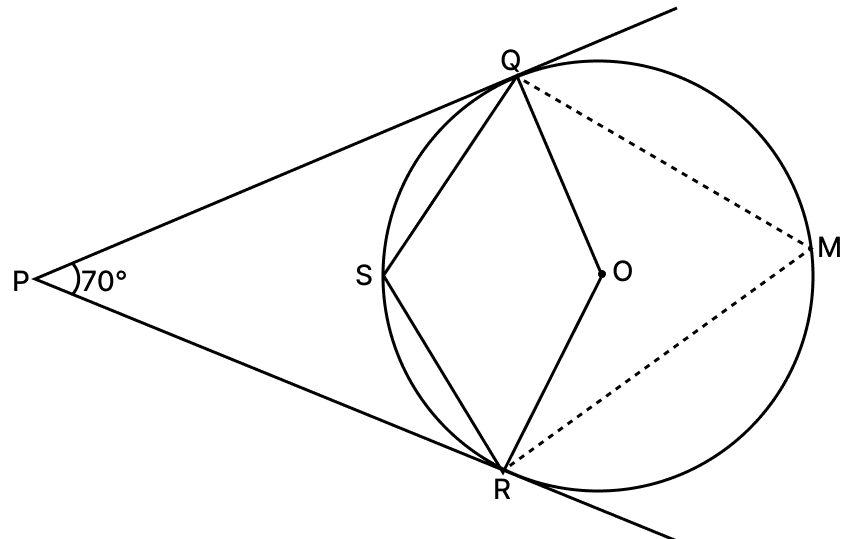
(ii) Let M be a point on circumference of circle.
We know that,
The angle subtended by an arc at the centre is twice the angle subtended at the circumference.
⇒ ∠QMR = ∠QOR
=
= 55°.
Sum of opposite angles in cyclic quadrilateral is 180°.
⇒ ∠QSR + ∠QMR = 180°.
⇒ ∠QSR = 180° - 55°
⇒ ∠QSR = 125°.
Hence, ∠QSR = 125°.
In the adjoining figure, O is the centre of the circle. Tangents to the circle at A and B meet at C. If ∠ACO = 30°, find
(i) ∠BCO
(ii) ∠AOB
(iii) ∠APB

Answer
(i) ∠BCO = ∠ACO = 30° (∵ C is the intersecting point of tangent AC and BC. So, OC divides ∠ACB in two halves.)
Hence, the value of ∠BCO = 30°.
(ii) We know that the tangent at any point of a circle and the radius through the point are perpendicular to each other.
∴ ∠OAC = ∠OBC = 90°.
∴ ∠AOC = ∠BOC (∵ tangents are equally inclined to the line joining the point and the centre of the circle.)
Since sum of angles in a triangle = 180.
In AOC
⇒ ∠AOC + ∠OAC + ∠ACO = 180°
⇒ ∠AOC + 90° + 30° = 180°
⇒ ∠AOC + 120° = 180°
⇒ ∠AOC = 180° - 120° = 60°.
∴ ∠BOC = 60°.
From figure,
∠AOB = ∠AOC + ∠BOC = 60° + 60° = 120°.
Hence, the value of ∠AOB = 120°.
(iii) Arc AB subtends ∠AOB at the centre and ∠APB at the remaining part of the circle.
∴ ∠AOB = 2∠APB (∵ angle subtended at centre by an arc is double the angle subtended at remaining point of the circle.)
∠APB = x ∠AOB = x 120° = 60°.
Hence, the value of ∠APB = 60°.
In the figure (i) given below, O is the centre of the circle. The tangents at B and D meet at P. If AB is parallel to CD and ∠ABC = 55°, find
(i) ∠BOD
(ii) ∠BPD.
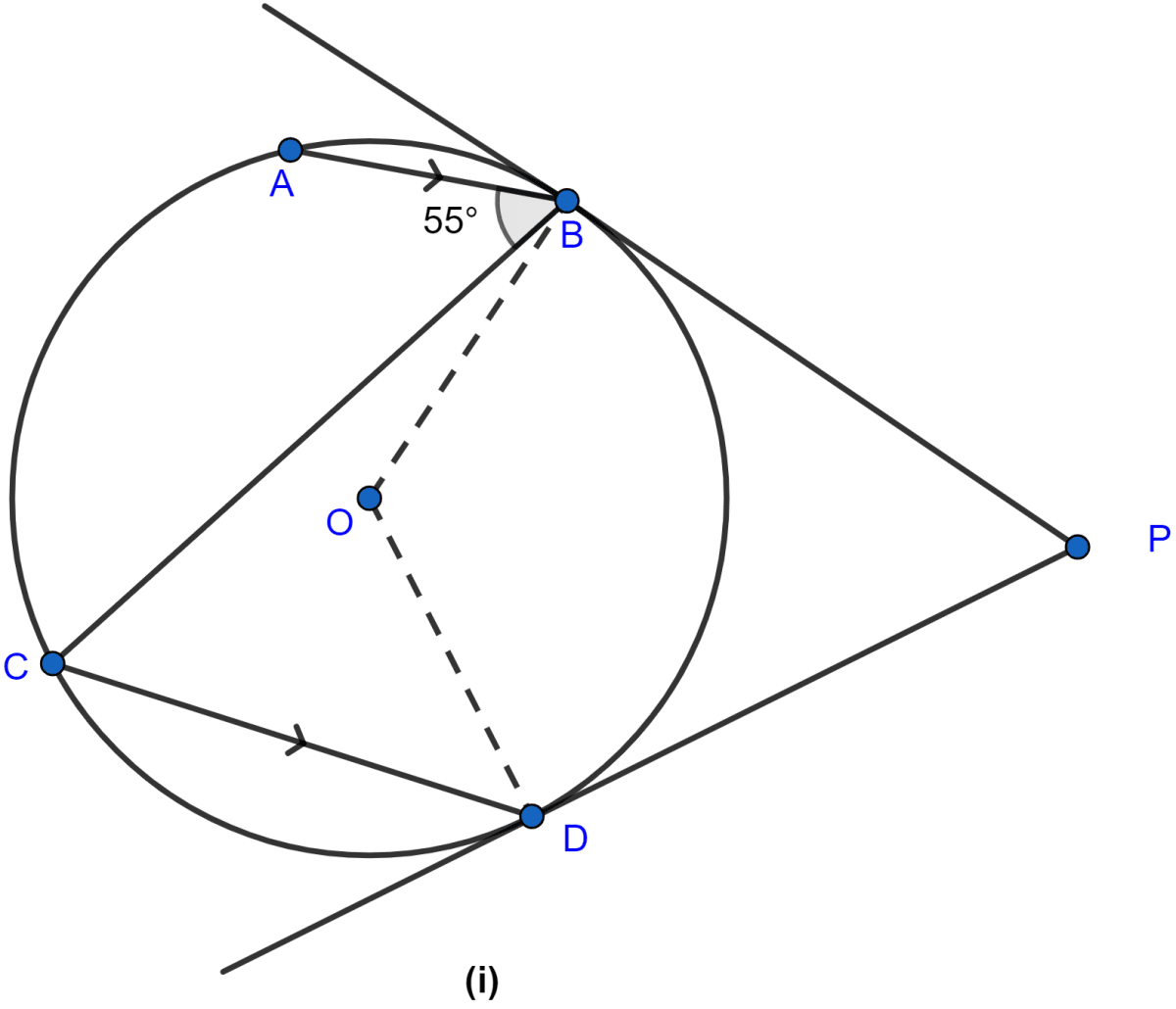
Answer
(i) From figure,
∠BCD = ∠ABC (∵ alternate angles are equal)
∠BCD = 55°.
Arc BD subtends ∠BOD at the centre and ∠BCD at the remaining part of the circle.
∴ ∠BOD = 2∠BCD (∵ angle subtended at centre by an arc is double the angle subtended at remaining point of circle.)
∠BOD = 2 × 55° = 110°.
Hence, the value of ∠BOD = 110°
(ii) OB and OD are radius and, BP and DP are tangents to the circle.
∴ OB ⊥ BP and OD ⊥ DP.
In quadrilateral OBPD, sum of angles = 360°
∠BOD + ∠ODP + ∠OBP + ∠BPD = 360°
110° + 90° + 90° + ∠BPD = 360°
290° + ∠BPD = 360°
∠BPD = 360° - 290°
∠BPD = 70°.
Hence, the value of ∠BPD = 70°.
In the figure (ii) given below, O is the centre of the circle. AB is a diameter, TPT' is a tangent to the circle at P. If ∠BPT' = 30°, calculate
(i) ∠APT
(ii) ∠BOP

Answer
From figure,
∠APB = 90° (∵ angles in semicircle is equal to 90)
From figure,
∠APT + ∠APT' = 180° (∵ they form linear pair)
⇒ ∠APT + ∠APB + ∠BPT' = 180°
⇒ ∠APT + 90° + 30° = 180°
⇒ ∠APT + 120° = 180°
⇒ ∠APT = 180° - 120°
⇒ ∠APT = 60°.
Hence, the value of ∠APT = 60°.
(ii) From figure,
BAP = BPT' = 30. (∵ angles in alternate segment are equal.)
Arc BP subtends ∠BOP at the centre and ∠BAP at the remaining part of the circle.
∴ ∠BOP = 2∠BAP (∵ angle subtended at centre by an arc is double the angle subtended at remaining part of circle.)
∠BOP = 2 × 30° = 60°.
Hence, the value of ∠BOP = 60°.
In the adjoining figure, ABCD is a cyclic quadrilateral. The line PQ is the tangent to the circle at A. If ∠CAQ : ∠CAP = 1 : 2, AB bisects ∠CAQ and AD bisects ∠CAP, then find the measures of the angles of the cyclic quadrilateral. Also prove that BD is a diameter of the circle.
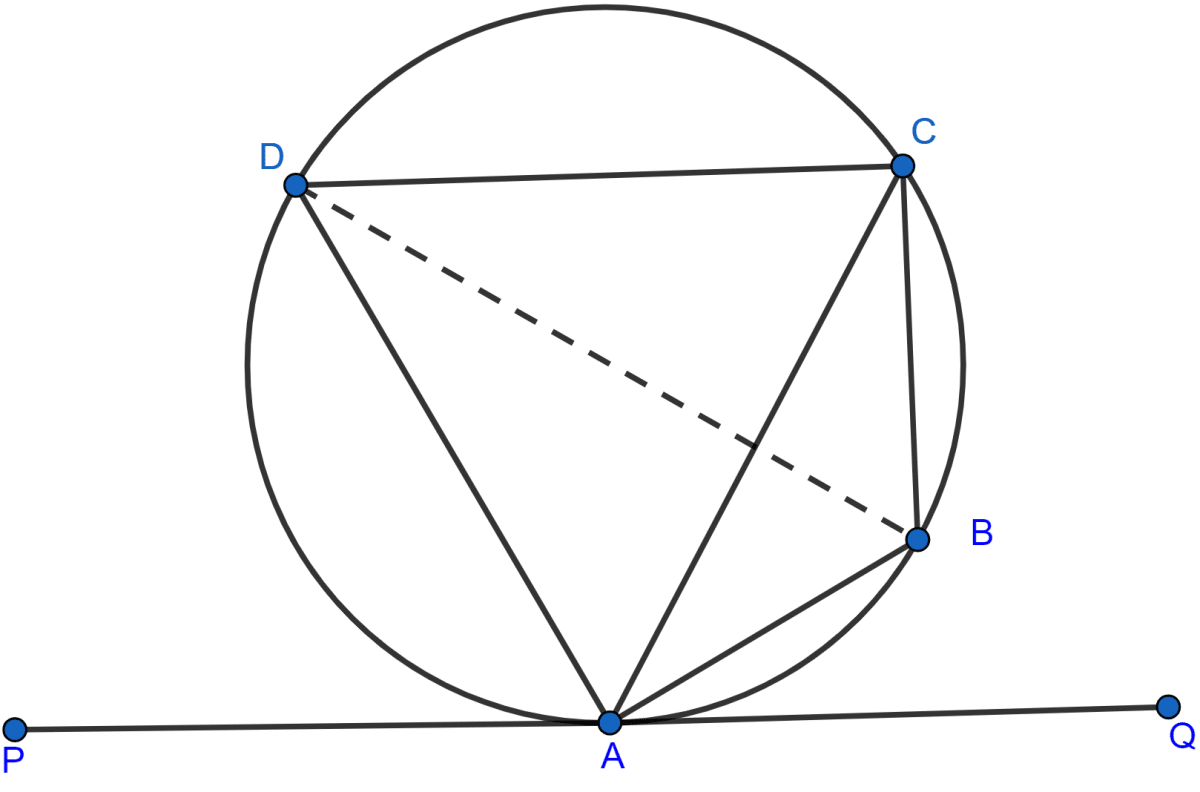
Answer
Given,
AB and AD are bisectors of ∠CAQ and ∠CAP respectively.
Let AB bisects ∠CAQ in two halves of each value x.
∴ ∠CAB = x and ∠BAQ = x.
Let AD bisects ∠CAP in two halves of each value y.
∴ ∠CAD = y and ∠DAP = y.
Since, ∠CAQ and ∠CAP are linear pair so,
⇒ ∠CAQ + ∠CAP = 180°
⇒ ∠CAB + ∠BAQ + ∠CAD + ∠DAP = 180°
⇒ x + x + y + y = 180°
⇒ 2x + 2y = 180°
⇒ x + y =
⇒ x + y = 90°.
∴ ∠CAB + ∠CAD = 90° ⇒ ∠BAD = 90°.
Since angle in semicircle is equal to 90°.
Hence, proved BD is the diameter of the circle.
Given, ∠CAQ : ∠CAP = 1 : 2.
Let ∠CAQ = k so ∠CAP = 2k.
Since ∠CAQ and ∠CAP are linear pair so,
⇒ ∠CAQ + ∠CAP = 180°
⇒ k + 2k = 180°
⇒ 3k = 180°
⇒ k = 60°.
∠CAQ = 60° and ∠CAP = 2 × 60° = 120°.
From figure,
∠ADC = ∠CAQ = 60° (∵ angles in alternate segments are equal)
∠ABC = ∠CAP = 120° (∵ angles in alternate segments are equal)
Since sum of opposite angles in cyclic quadrilateral is 180°.
⇒ ∠D + ∠B = 180°
⇒ 60° + ∠B = 180°
⇒ ∠B = 180° - 60°
⇒ ∠B = 120°.
Similarly,
⇒ ∠A + ∠C = 180°
⇒ 90° + ∠C = 180°
⇒ ∠C = 180° - 90°
⇒ ∠C = 90°.
Hence, the angles of cyclic quadrilateral are ∠A = 90°, ∠B = 120°, ∠C = 90° and ∠D = 60°.
In a triangle ABC, the incircle (centre O) touches BC, CA and AB at P, Q and R respectively. Calculate :
(i) ∠QOR
(ii) ∠QPR, given that ∠A = 60°.
Answer
(i) From figure,

OQ ⊥ AC and OR ⊥ AB (∵ OQ and OR are the radii and AC and AB are tangents.)
Now in quadrilateral AROQ,
∠A = 60°, ∠ORA = 90° and ∠OQA = 90°.
∠A + ∠ORA + ∠OQA + ∠QOR = 360°
60° + 90° + 90° + ∠QOR = 360°
240° + ∠QOR = 360°
∠QOR = 360° - 240°
∠QOR = 120°.
Hence, the value of ∠QOR = 120°.
(ii) Arc QR subtends ∠QOR at the centre and ∠QPR at the remaining part of the circle.
∴ ∠QOR = 2∠QPR (∵ angle subtended at centre by an arc is double the angle subtended at remaining part of circle)
120° = 2∠QPR
∠QPR = = 60°.
Hence, the value of ∠QPR = 60°.
In the figure (i) given below, AB is a diameter. The tangent at C meets AB produced at Q, ∠CAB = 34°. Find :
(i) ∠CBA
(ii) ∠CQA
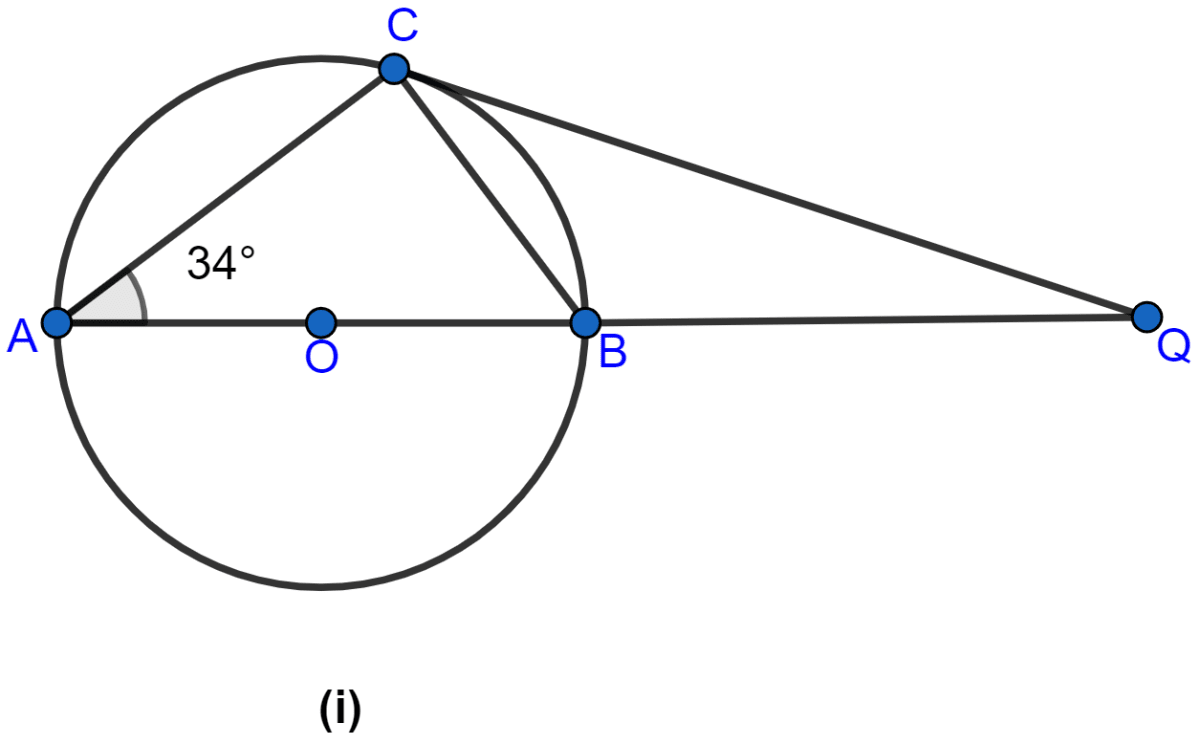
Answer
From figure,
∠ACB = 90 (∵ angles in semicircle is equal to 90.)
Since sum of angles in a triangle = 180.
In △ABC,
⇒ ∠CAB + ∠ACB + ∠CBA = 180°
⇒ 34° + 90° + ∠CBA = 180°
⇒ 124° + ∠CBA = 180°
⇒ ∠CBA = 180° - 124°
⇒ ∠CBA = 56°.
Hence, the value of ∠CBA = 56°.
(ii) From figure,
∠BCQ = ∠CAB = 34°. (∵ angles in alternate segments are equal.)
∠ACQ = ∠ACB + ∠BCQ = 90° + 34° = 124°.
Since sum of angles in a triangle = 180°.
In △ACQ,
⇒ ∠CAQ + ∠ACQ + ∠CQA = 180°
⇒ 34° + 124° + ∠CQA = 180°
⇒ 158° + ∠CQA = 180°
⇒ ∠CQA = 180° - 158°
⇒ ∠CQA = 22°.
Hence, the value of ∠CQA = 22°.
In the figure (ii) given below, AP and BP are tangents to the circle with centre O. Given ∠APB = 60°, calculate :
(i) ∠AOB
(ii) ∠OAB
(iii) ∠ACB

Answer
(i) From figure,
OA ⊥ AP and OB ⊥ BP (∵ OA and OB are the radii and AP and BP are tangents.)
Now in quadrilateral AOBP,
∠P = 60°, ∠OAP = 90° and ∠OBP = 90°.
∠P + ∠OAP + ∠OBP + ∠AOB = 360°
60° + 90° + 90° + ∠AOB = 360°
240° + ∠AOB = 360°
∠AOB = 360° - 240°
∠AOB = 120°.
Hence, the value of ∠AOB = 120°.
(ii) Join AB as shown in the figure below:

Considering △OAB,
The triangle is isosceles as OA = OB = radii of the circle so, ∠OAB = ∠OBA = x.
Since sum of angles in a triangle = 180.
In △OAB,
⇒ ∠AOB + ∠OAB + ∠OBA = 180°
⇒ 120° + x + x = 180°
⇒ 120° + 2x = 180°
⇒ 2x = 180° - 120°
⇒ 2x = 60°
⇒ x = 30°
Hence, the value of ∠OAB = 30°.
(iii) Arc AB subtends ∠AOB at the centre and ∠ACB at the remaining part of the circle.
∴ ∠AOB = 2∠ACB (∵ angle subtended at centre by an arc is double the angle subtended at remaining part of circle)
120° = 2∠ACB
∠ACB = = 60°.
Hence, the value of ∠ACB = 60°.
In the figure (i) given below, O is the centre of the circumcircle of triangle XYZ. Tangents at X and Y intersect at T. Given ∠XTY = 80° and ∠XOZ = 140°, calculate the value of ∠ZXY.
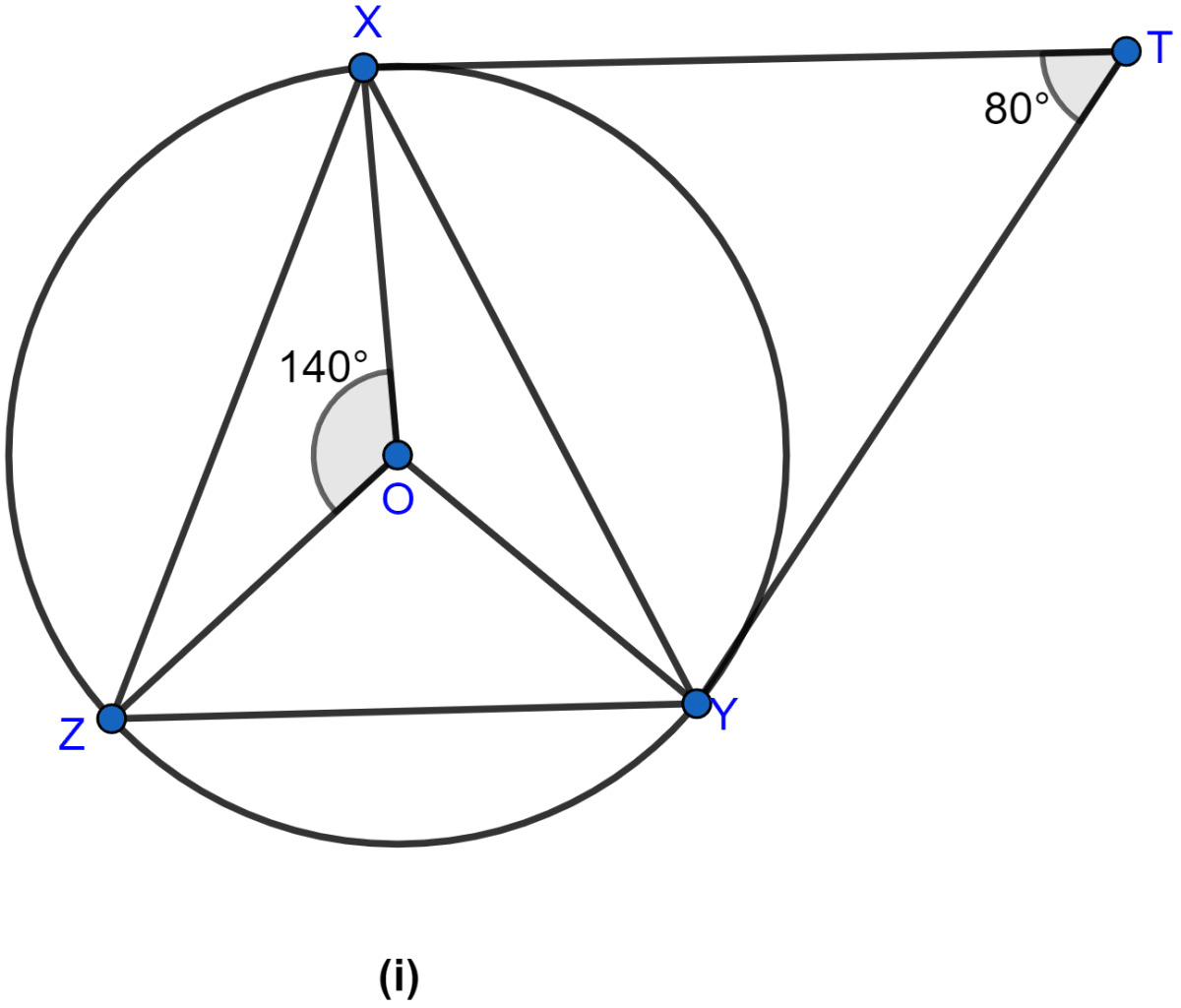
Answer
From figure,
XT = YT (∵ tangents from an external point to a circle are of equal length.)
So, △XTY is an isosceles triangle with
∠YXT = ∠XYT = a.
Since sum of angles in a triangle = 180°.
In △XTY,
⇒ ∠YXT + ∠XYT + ∠XTY = 180°
⇒ a + a + 80° = 180°
⇒ 2a + 80° = 180°
⇒ 2a = 180° - 80°
⇒ 2a = 100°
⇒ a = 50°.
From figure,
OX = OZ = radius of the circle
So, △OXZ is an isosceles triangle with
∠OXZ = ∠OZX = b.
Since sum of angles in a triangle = 180°.
In △OXZ,
⇒ ∠OXZ + ∠OZX + ∠XOZ = 180°
⇒ b + b + 140° = 180°
⇒ 2b + 140° = 180°
⇒ 2b = 180° - 140°
⇒ 2b = 40°
⇒ b = 20°.
From figure,
OX ⊥ XT (∵ tangent at a point and radius through the point are perpendicular to each other.)
∴ ∠OXT = 90°
∠OXY + ∠YXT = 90°
∠OXY + 50° = 90°
∠OXY = 90° - 50°
∠OXY = 40°.
From figure,
∠ZXY = ∠OXZ + ∠OXY = 20° + 40° = 60°.
Hence, the value of ∠ZXY = 60°.
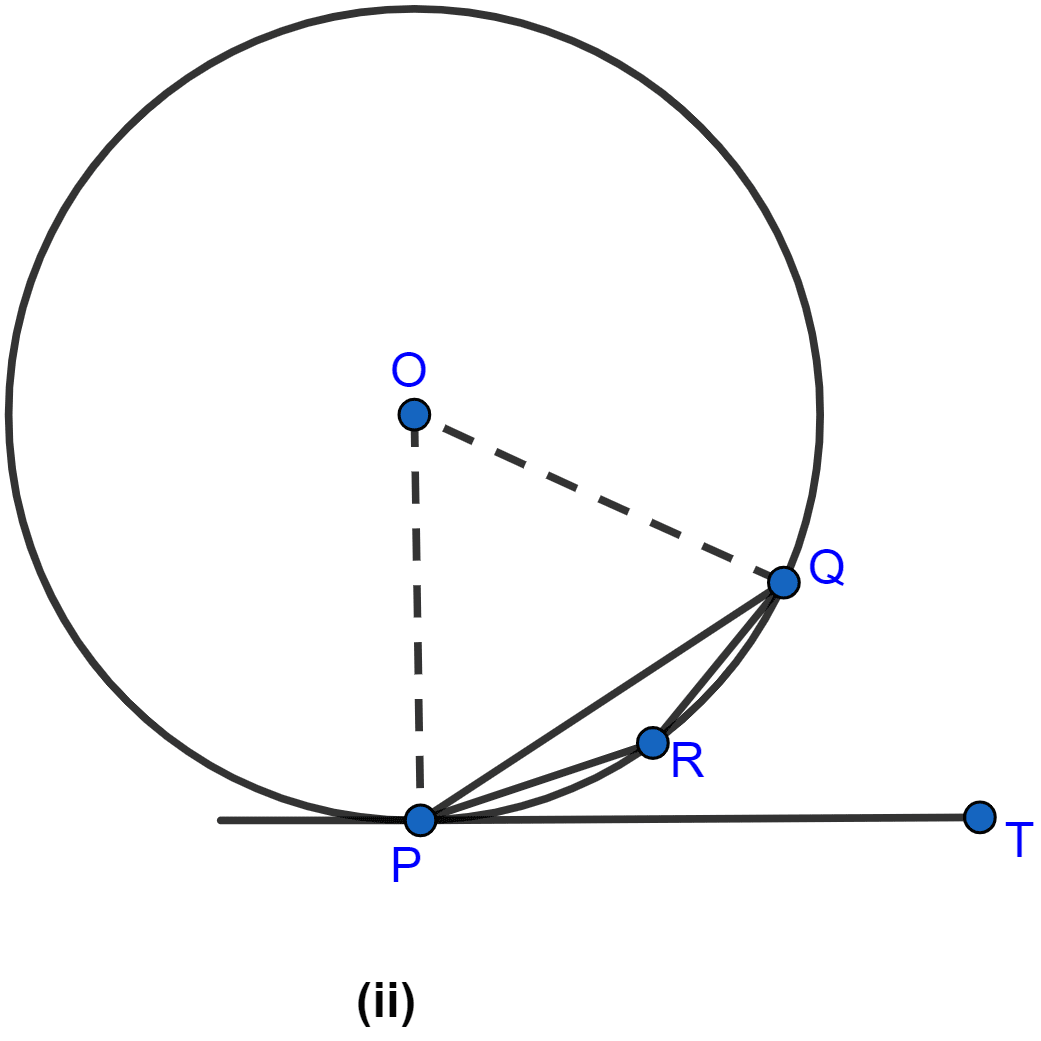
In the figure (ii) given below, O is the center of the circle and PT is the tangent to the circle at P. Given ∠QPT = 30°, calculate
(i) ∠PRQ
(ii) ∠POQ.
Answer
From figure,
OP ⊥ PT (∵ tangent at a point and radius through the point are perpendicular to each other.)
∴ ∠OPT = 90°.
Given, ∠QPT = 30°.
From figure,
∠OPT = 90°
∠OPQ + ∠QPT = 90°
∠OPQ + 30° = 90°
∠OPQ = 90° - 30° = 60°.
In △OPQ,
OP = OQ (∵ both are equal to radius of the circle.)
So, the triangle is isosceles. So,
∠OQP = OPQ = 60°.
Since sum of angles in a triangle = 180°.
In △OPQ,
⇒ ∠OQP + ∠OPQ + ∠POQ = 180°
⇒ 60 + 60 + ∠POQ = 180°
⇒ 120 + ∠POQ = 180°
⇒ ∠POQ = 180° - 120°
⇒ ∠POQ = 60°
Reflex ∠POQ = 360° - ∠POQ = 360° - 60° = 300°.
Arc PQ subtends Reflex ∠POQ at the centre and ∠PRQ at the remaining part of the circle.
∴ Reflex ∠POQ = 2∠PRQ (∵ angle subtended at centre by an arc is double the angle subtended at remaining part of circle)
300° = 2° × ∠PRQ
∠PRQ = = 150°.
(i) Hence, the value of ∠PRQ = 150°.
(ii) Hence, the value of ∠POQ = 60°.
Two chords AB, CD of a circle intersect internally at a point P. If
(i) AP = 6 cm, PB = 4 cm and PD = 3 cm, find PC.
(ii) AB = 12 cm, AP = 2 cm, PC = 5 cm, find PD.
(iii) AP = 5 cm, PB = 6 cm and CD = 13 cm, find CP.
Answer
We know that when two chords of a circle intersect internally or externally, then the products of the lengths of segments are equal.
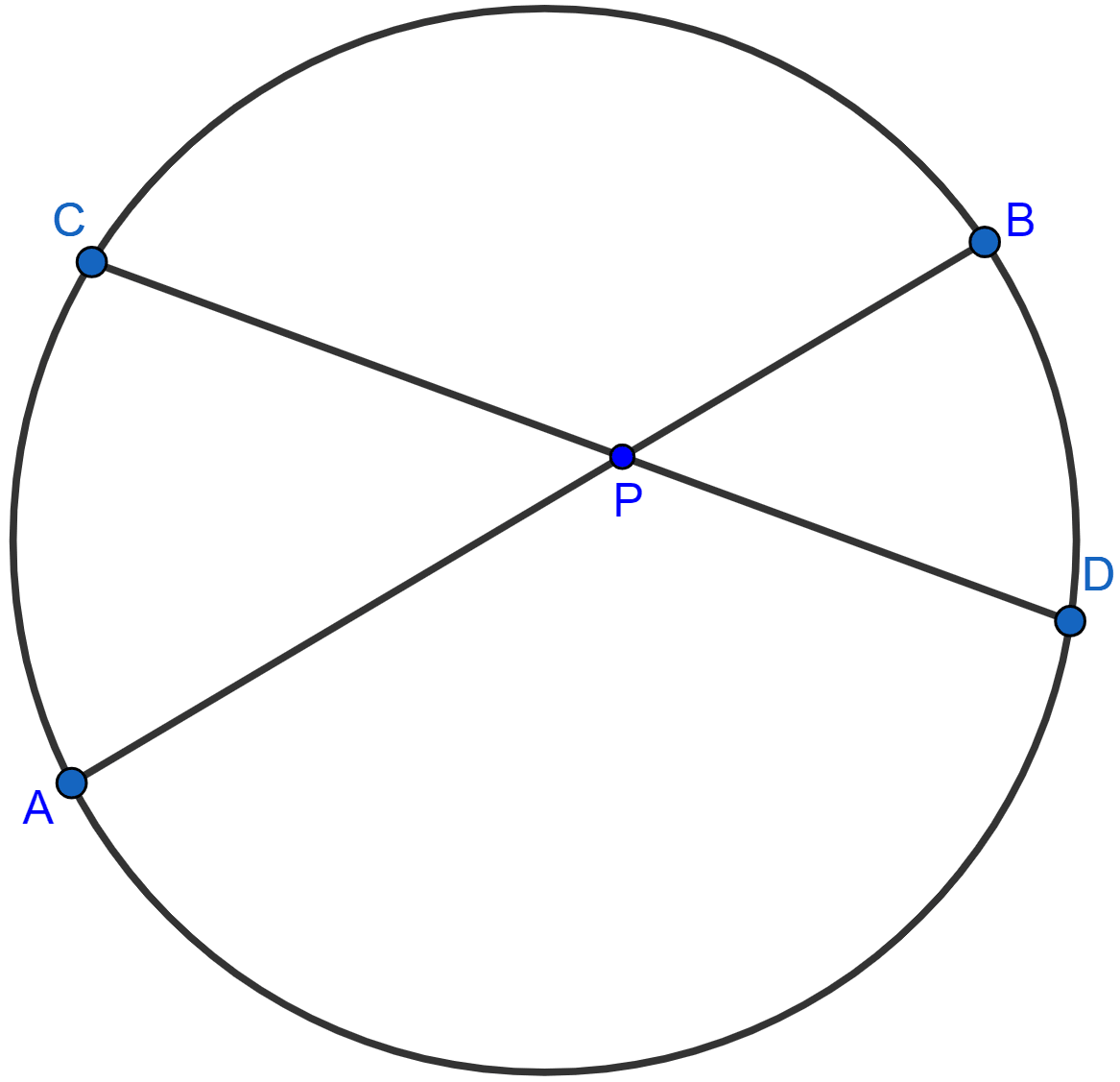
Given, chords AB and CD of a circle intersect internally at a point P. So,
PA.PB = PC.PD
(i) Given, AP = 6 cm, PB = 4 cm and PD = 3 cm.
We know that,
PA.PB = PC.PD
⇒ 6 × 4 = PC × 3
⇒ 24 = 3PC
⇒ PC = = 8 cm.
Hence, the length of PC = 8 cm.
(ii) Given, AB = 12 cm, AP = 2 cm, PC = 5 cm
PB = AB - AP = 12 - 2 = 10 cm.
We know that,
PA.PB = PC.PD
⇒ 2 × 10 = 5 × PD
⇒ 20 = 5PD
⇒ PD = = 4 cm.
Hence, the length of PD = 4 cm.
(iii) Given, AP = 5 cm, PB = 6 cm and CD = 13 cm
Let PC = x, so PD = 13 - x
We know that,
PA.PB = PC.PD
⇒ 5 × 6 = x(13 - x)
⇒ 30 = 13x - x2
⇒ x2 - 13x + 30 = 0
⇒ x2 - 10x - 3x + 30 = 0
⇒ x(x - 10) - 3(x - 10) = 0
⇒ (x - 3)(x - 10) = 0
⇒ x - 3 = 0 or x - 10 = 0
⇒ x = 3 or x = 10.
Hence, PC = 3 cm or 10 cm.
In the figure (i) given below, PT is a tangent to the circle. Find TP if AT = 16 cm and AB = 12 cm.

Answer
We know that,
If a chord and a tangent intersect externally, then the product of lengths of the segments of the chord is equal to the square of the length of the tangent from the point of contact to the point of intersection.
∴ TP2 = AT × BT
From figure,
BT = AT - AB = 16 - 12 = 4 cm.
Putting values we get,
⇒ TP2 = 16 × 4
⇒ TP2 = 64
⇒ TP =
⇒ TP = 8 cm.
Hence, the length of TP = 8 cm.
In the figure (ii) given below, diameter AB and chord CD of a circle meet at P. PT is a tangent to the circle at T. CD = 7.8 cm, PD = 5 cm, PB = 4 cm. Find :
(i) AB
(ii) the length of tangent PT.

Answer
We know that,
If a chord and a tangent intersect externally, then the product of lengths of the segments of the chord is equal to the square of the length of the tangent from the point of contact to the point of intersection.
∴ TP2 = PC × PD
From figure,
PC = PD + CD
= 5 + 7.8
= 12.8 cm.
⇒ TP2 = 12.8 × 5
⇒ TP2 = 64
⇒ TP =
⇒ TP = 8 cm.
Similarly,
⇒ TP2 = AP × BP
⇒ 82 = AP × 4
⇒ 64 = 4AP
⇒ AP =
⇒ AP = 16 cm.
(i) From figure,
AB = AP - BP = 16 - 4 = 12 cm.
Hence, the length of AB = 12 cm.
(ii) The length of tangent PT = 8 cm.
PAB is a secant and PT is tangent to a circle. If
(i) PT = 8 cm and PA = 5 cm, find the length of AB.
(ii) PA = 4.5 cm and AB = 13.5 cm, find the length of PT.
Answer
We know that,
If a chord and a tangent intersect externally, then the product of lengths of the segments of the chord is equal to the square of the length of the tangent from the point of contact to the point of intersection.
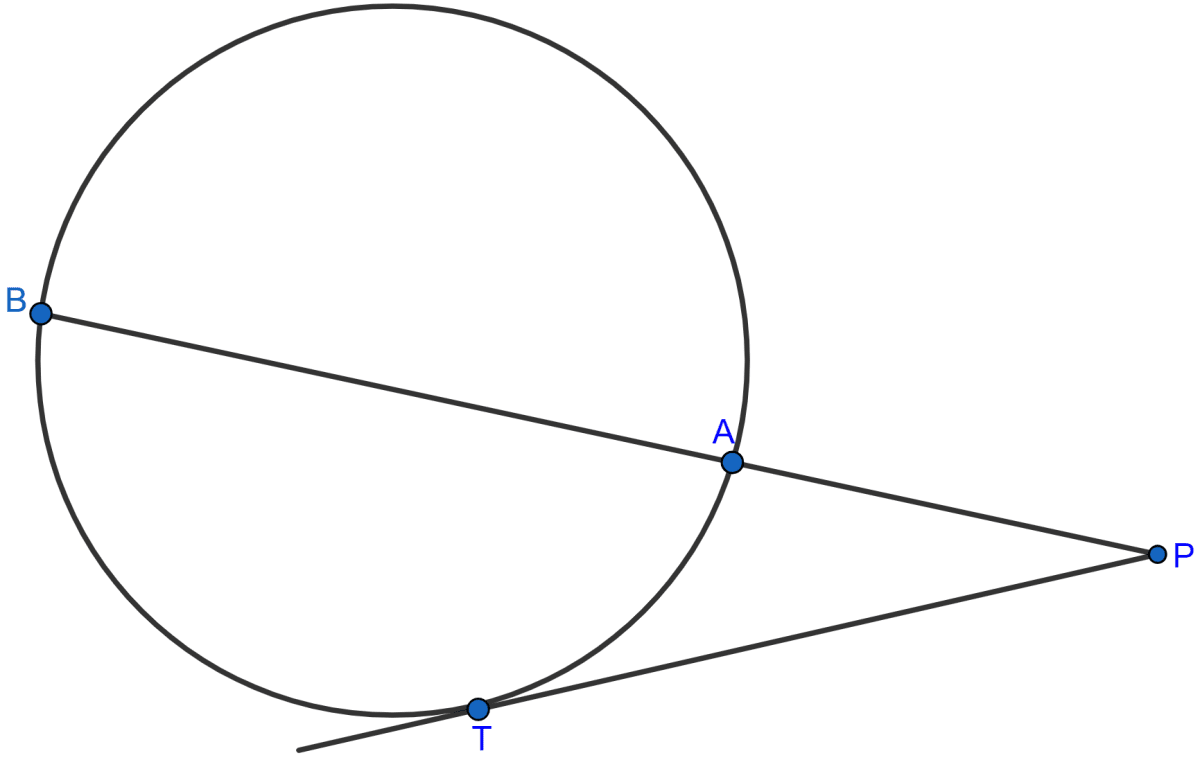
∴ PT2 = PA × PB
(i) Putting values in above equation:
⇒ 82 = 5 × PB
⇒ 82 = 5PB
⇒ PB =
⇒ PB = 12.8 cm.
AB = PB - PA = 12.8 - 5 = 7.8 cm.
Hence, the length of AB = 7.8 cm.
(ii) We know,
PB = AB + PA = 13.5 + 4.5 = 18 cm.
PT2 = PA × PB
⇒ PT2 = 4.5 × 18
⇒ PT2 = 81
⇒ PT =
⇒ PT = 9 cm.
Hence, the length of PT = 9 cm.
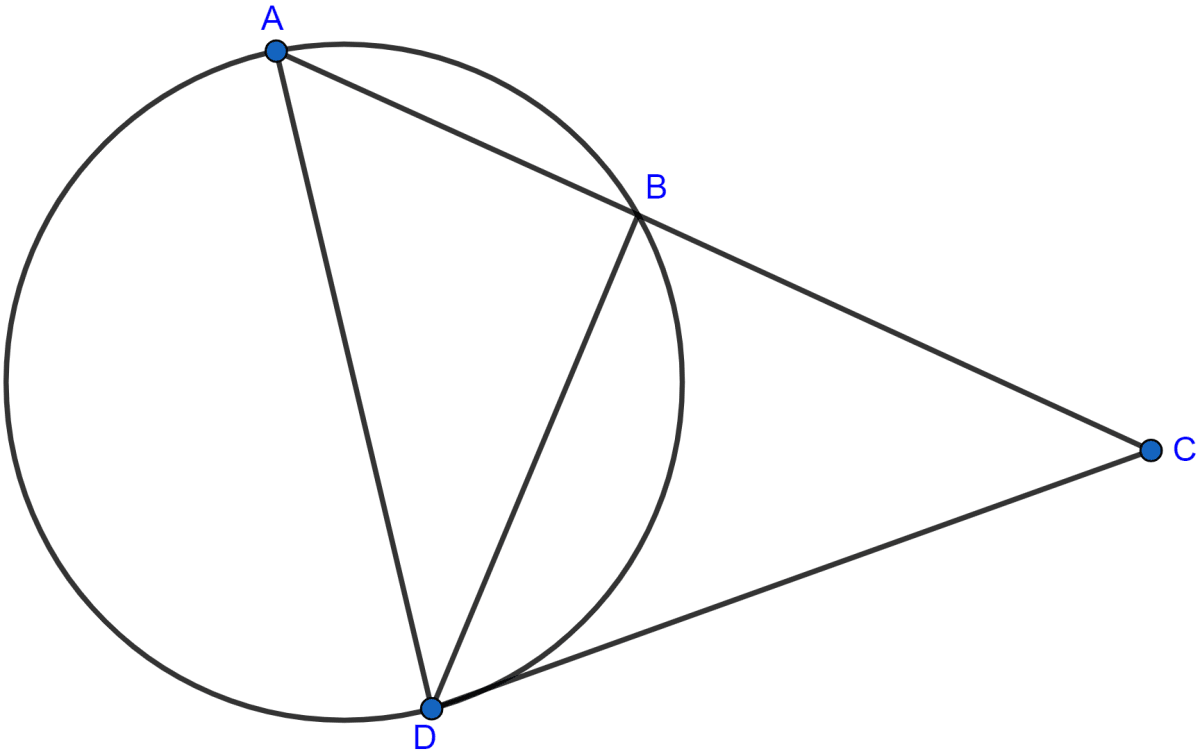
In the adjoining figure, CBA is a secant and CD is tangent to the circle. If AB = 7 cm and BC = 9 cm, then
(i) Prove that △ACD ~ △DCB
(ii) find the length of CD.
Answer
(i) In △ACD and △DCB
∠C = ∠C (Common angles)
∠CAD = ∠CDB (Angles in alternate segments are equal)
∴ △ACD ~ △DCB (By AA axiom.)
Hence, proved that △ACD ~ △DCB.
(ii) Since triangles are similar hence, the ratio of their corresponding sides are equal.
Hence, the length of DC = 12 cm.
In the figure (i) given below, PAB is a secant and PT is tangent to a circle. If PA : AB = 1 : 3 and PT = 6 cm, find the length of PB.

Answer
Given, PA : AB = 1 : 3.
Let PA = k, so AB = 3k.
PB = PA + AB = k + 3k = 4k.
We know that,
If a chord and a tangent intersect externally, then the product of lengths of the segments of the chord is equal to the square of the length of the tangent from the point of contact to the point of intersection.
∴ PT2 = PA × PB
⇒ 62 = k × 4k
⇒ 36 = 4k2
⇒ k2 =
⇒ k = cm
⇒ k = 3 cm.
PB = 4k = 4(3) = 12 cm.
Hence, the length of PB = 12 cm.
In the figure (ii) given below, ABC is an isosceles triangle in which AB = AC and Q is mid-point of AC. If APB is a secant and AC is tangent to the circle at Q, prove that AB = 4AP.
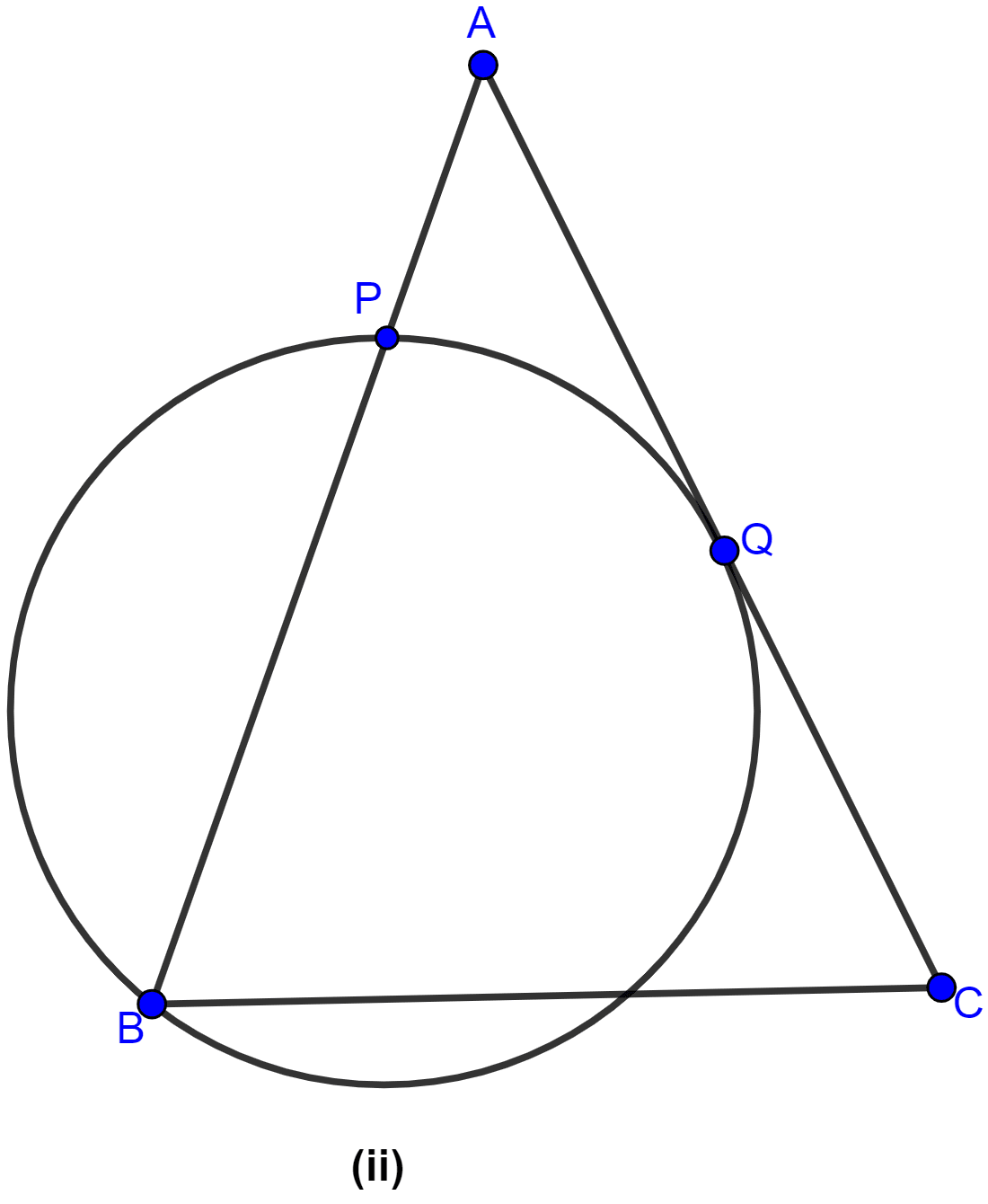
Answer
We know that,
If a chord and a tangent intersect externally, then the product of lengths of the segments of the chord is equal to the square of the length of the tangent from the point of contact to the point of intersection.
∴ AQ2 = AP × AB .....(Eq. 1)
Given Q is mid-point of AC, so AQ = .
Since, AC = AB.
Dividing both sides by AB,
AB = 4 x AP.
Hence, proved that AB = 4AP.
Two chords AB, CD of a circle intersect externally at a point P. If PA = PC, prove that AB = CD.
Answer
We know that when two chords of a circle intersect internally or externally, then the products of the lengths of segments are equal.
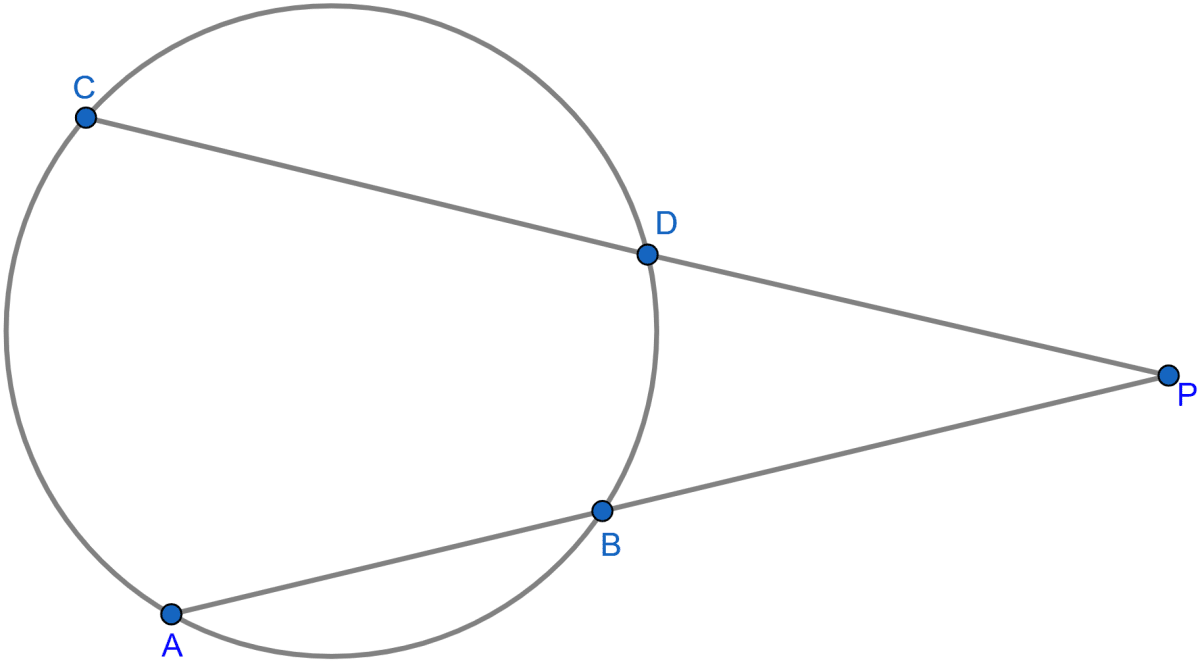
Given, chords AB and CD of a circle intersect externally at a point P. So,
PA.PB = PC.PD .....(Eq. 1)
Let PA = a, so PC = a. (∵ PA = PB)
Putting these value in Eq. 1 we get,
a.PB = a.PD
Dividing both sides by a we get,
PB = PD.
Let PB = PD = b
From figure,
AB = PA - PB = a - b.
CD = PC - PD = a - b.
Hence, proved that AB = CD.
In the figure (i) given below, AT is tangent to a circle at A. If ∠BAT = 45° and ∠BAC = 65°, find ∠ABC.

Answer
From figure,
∠ACB = ∠BAT = 45° (∵ angles in alternate segments are equal)
Since sum of angles in a triangle = 180°.
In △ABC,
⇒ ∠ACB + ∠CAB + ∠ABC = 180°
⇒ 45° + 65° + ∠ABC = 180°
⇒ 110° + ∠ABC = 180°
⇒ ∠ABC = 180° - 110°
⇒ ∠ABC = 70°.
Hence, the value of ∠ABC = 70°.
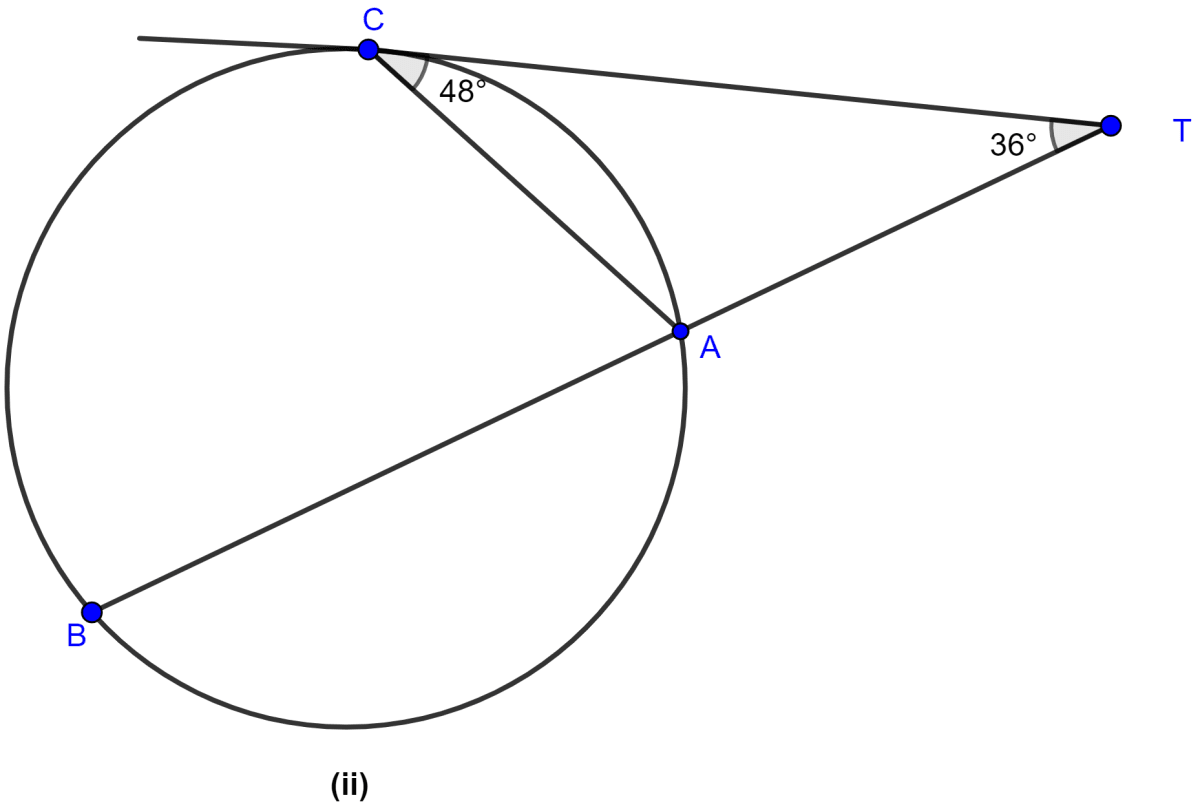
In the figure (ii) given below, A, B and C are three points on a circle. The tangent at C meets BA produced at T. Given that ∠ATC = 36° and ∠ACT = 48°, calculate the angle subtended by AB at the centre of the circle.
Answer
Join OA, OB and CB. In △ATC,
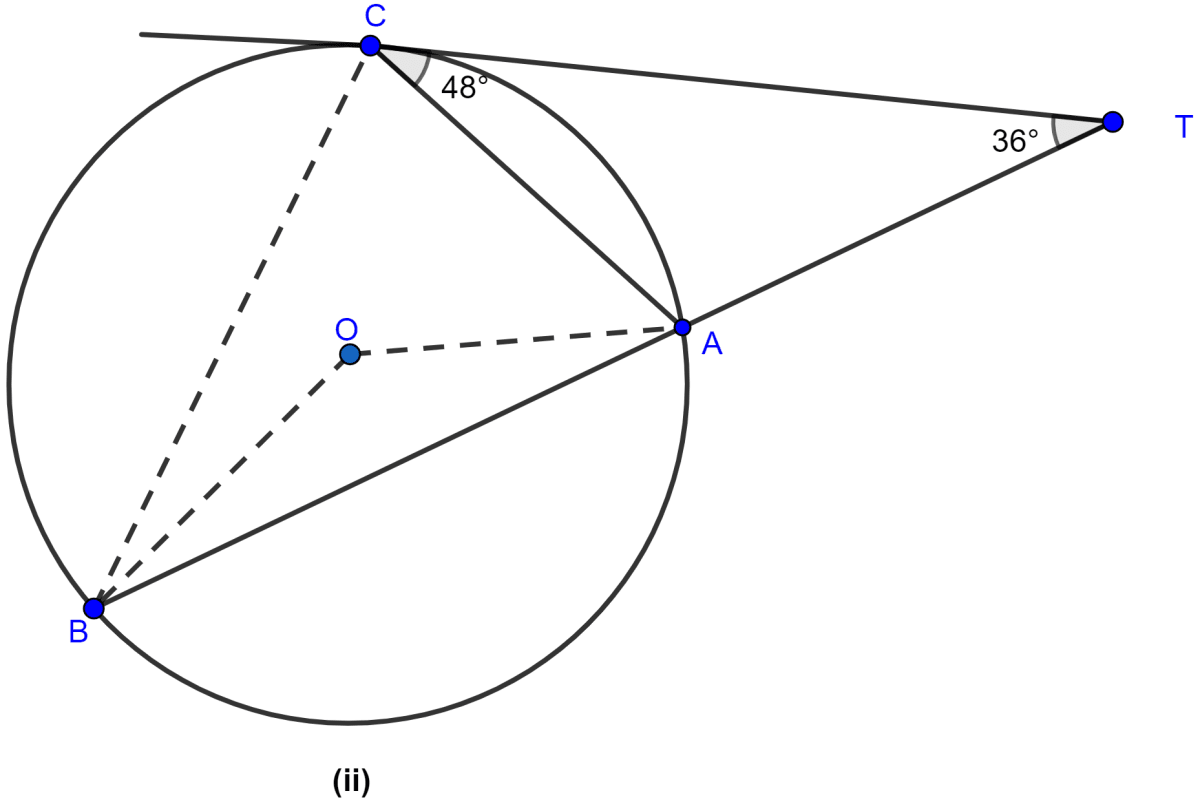
Ext. ∠CAB = ∠ATC + TCA (∵ external angle in a triangle is equal to the sum of opposite interior angles.)
Ext. ∠CAB = 36° + 48° = 84°.
From figure,
∠ABC = ∠TCA = 48° (∵ angles in alternate segment are equal.)
Since sum of angles in a triangle = 180°.
In △ABC,
⇒ ∠ABC + ∠BAC + ∠ACB = 180°
⇒ 48° + 84° + ∠ACB = 180°
⇒ 132° + ∠ACB = 180°
⇒ ∠ACB = 180° - 132°
⇒ ∠ACB = 48°.
Arc AB subtends ∠AOB at the centre and ∠ACB at the remaining part of the circle.
∴ ∠AOB = 2∠ACB (∵ angle subtended at centre is double the angle subtended at remaining part of the circle.)
∠AOB = 2 × 48° = 96°.
Hence, the angle subtended by AB at the center of the circle is 96°.
In the adjoining figure, △ABC is isosceles with AB = AC. Prove that the tangent at A to the circumcircle of △ABC is parallel to BC.

Answer
In △ABC,
AB = AC (Given)
∴ ∠C = ∠B (∵ angles opposite to equal sides are equal.)
From figure,
∠TAC = ∠B (∵ angles in alternate segment are equal.)
But ∠B = ∠C
∴ ∠TAC = ∠C
But angles ∠TAC and ∠C are alternate angles. Since, they are equal
Hence, proved that AT || BC.
If the sides of a rectangle touch a circle, prove that the rectangle is a square.
Answer
The figure below shows a rectangle ABCD with its sides touching the circle at points P, Q, R and S.
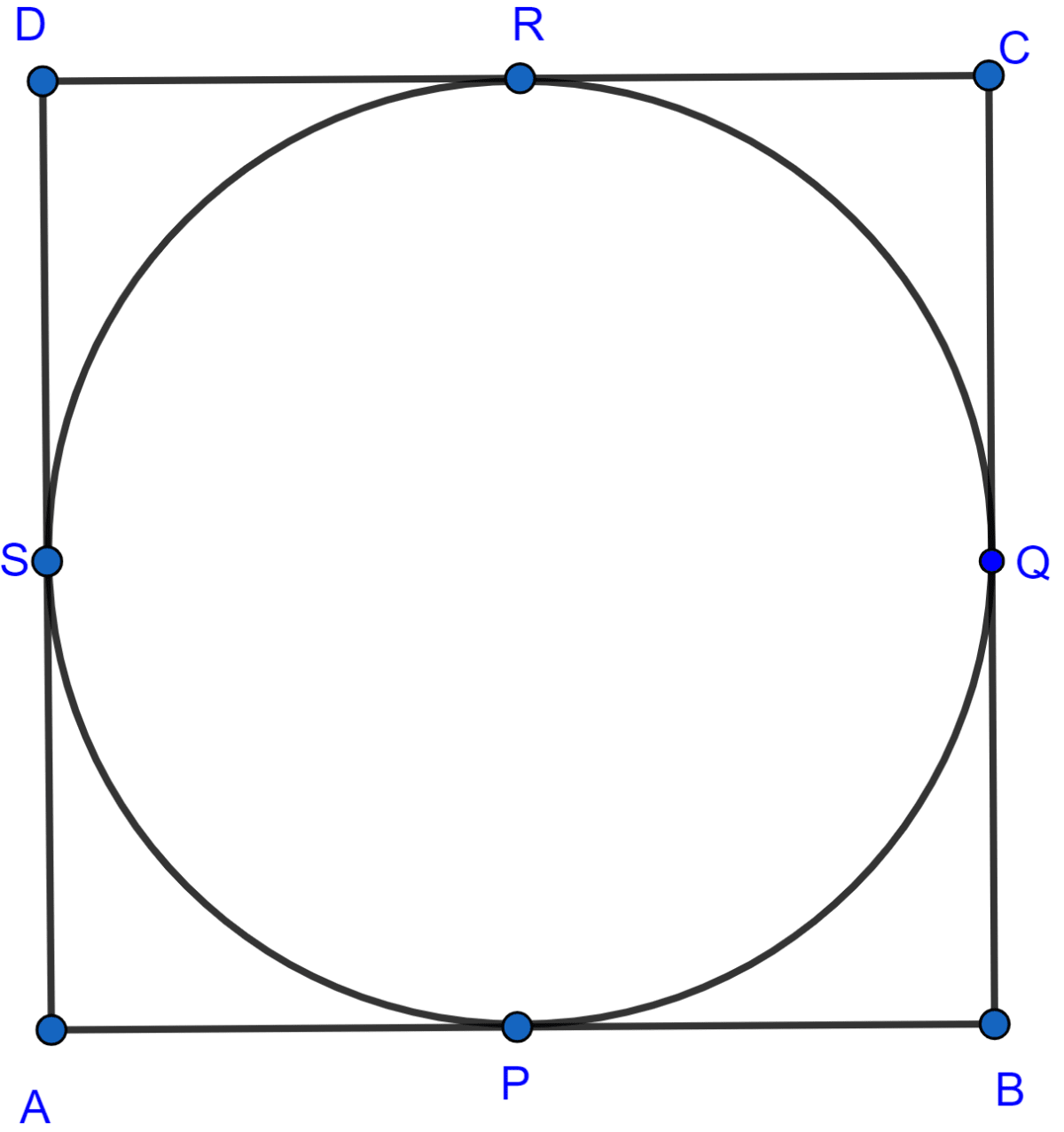
We know that,
Length of tangents from an external point to the circle are equal.
Hence,
AP = AS .....(Eq. 1)
BP = BQ .....(Eq. 2)
CR = CQ .....(Eq. 3)
DR = DS .....(Eq. 4)
Adding the above 4 equations,
⇒ AP + BP + CR + DR = AS + BQ + CQ + DS
⇒ AB + CD = AD + BC
But AB = CD and AD = BC (As opposite sides of a rectangle are equal.)
⇒ AB + AB = BC + BC
⇒ 2AB = 2BC
⇒ AB = BC.
∴ AB = BC = CD = DA.
Hence, proved that ABCD is a square.
In the figure (i) given below, two circles intersect at A, B. From a point P on one of these circles, two line segments PAC and PBD are drawn, intersecting the other circles at C and D respectively. Prove that CD is parallel to the tangent at P.

Answer
From figure,
PT is a tangent and PA is chord.
∠APT = ∠ABP (∵ angles in alternate segments are equal.) ...(i)
BDCA is a cyclic quadrilateral as all the vertices lie on the circumference of the circle.
In cyclic quadrilateral the exterior angle is equal to the opposite interior angle.
∴ ∠ABP = ∠ACD ....(ii)
From (i) and (ii),
∠APT = ∠ACD
The angles ∠APT and ∠ACD are alternate angles, but since they are equal,
Hence, proved that CD || PT.
In the figure (ii) given below, two circles with centres C, C' intersect at A, B and the point C lies on the circle with C'. PQ is a tangent to the circle with centre C' at A. Prove that AC bisects ∠PAB.

Answer
In △ACB,
AC = BC (Radius of the same circle)
∴ ∠BAC = ∠ABC ....(i)
PAQ is tangent and AC is the chord of the circle.
∠PAC = ∠ABC (∵ angles in alternate segment are equal) ....(i)
From (i) and (ii)
∠BAC = ∠PAC
Hence, proved that AC bisects ∠PAB.
In the figure (i) given below, AB is a chord of the circle with centre O, BT is tangent to the circle. If ∠OAB = 32°, find the values of x and y.
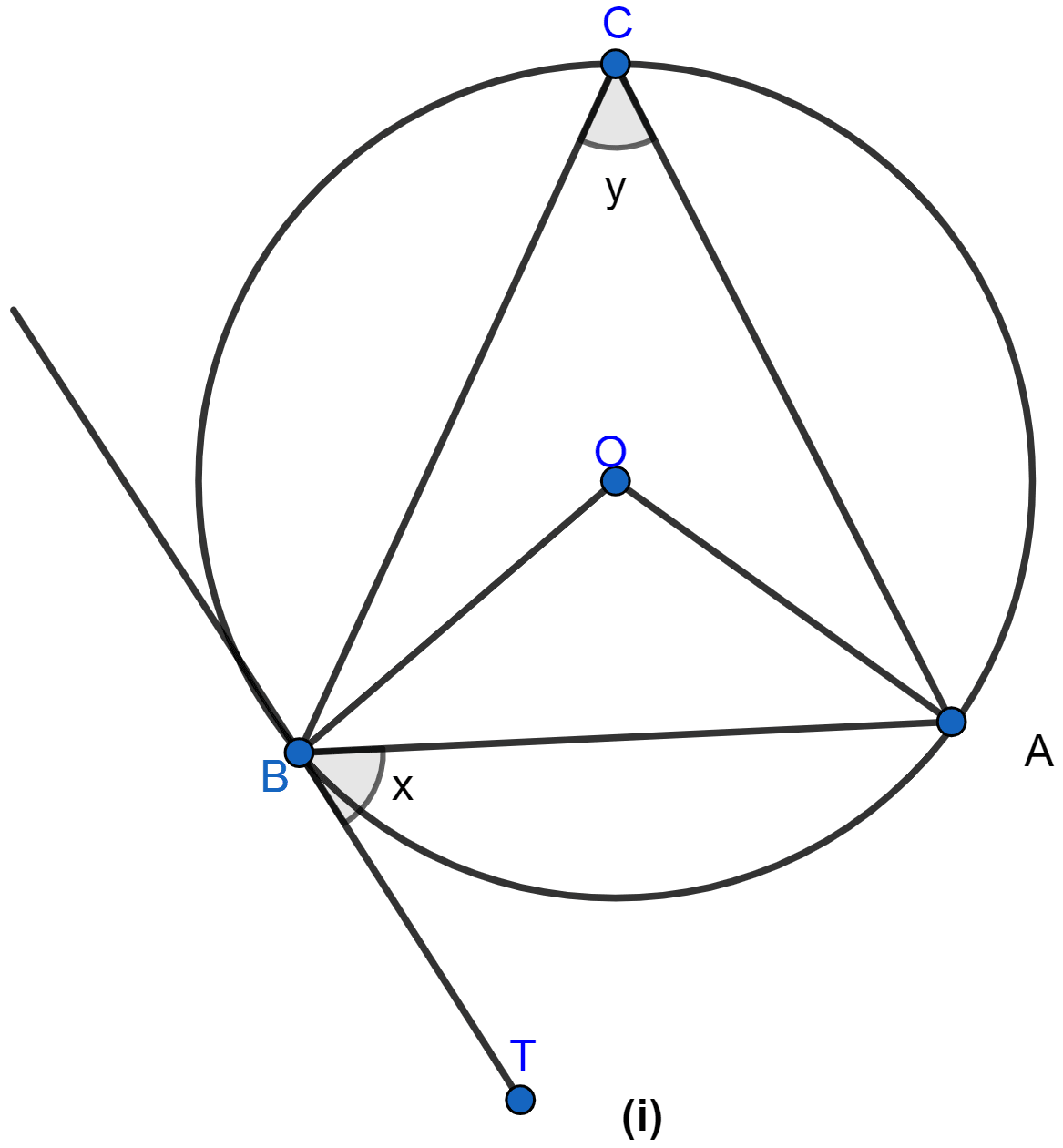
Answer
In △OAB,
OA = OB (∵ both are radius of the common circle.)
So, △OAB is a isosceles triangle with,
∠OBA = ∠OAB = 32°.
Since sum of angles in a triangle = 180°.
In △OAB,
⇒ ∠OBA + ∠OAB + ∠AOB = 180°
⇒ 32° + 32° + ∠AOB = 180°
⇒ 64° + ∠AOB = 180°
⇒ ∠AOB = 180° - 64°
⇒ ∠AOB = 116°.
Arc AB subtends ∠AOB at centre and ∠ACB at remaining part of circle.
∴ ∠AOB = 2∠ACB (∵ angle subtended at centre is double the angle subtended at remaining part of the circle.)
⇒ 116° = 2y
⇒ y =
⇒ y = 58°.
From figure,
∠ABT = ∠ACB = 58° (∵ angles in alternate segments are equal.)
∴ x = 58°.
Hence, the value of x = 58° and y = 58°.
In the figure (ii) given below, O and O' are centres of two circles touching each other externally at the point P. The common tangent at P meets a direct common tangent AB at M. Prove that,
(i) M bisects AB.
(ii) ∠APB = 90°.

Answer
(i) From figure,
From M, MA and MP are the tangents.
∴ MA = MP.....(i) (∵ length of the different tangents to a circle from a single point are equal.)
Similarly,
From M, MB and MP are the tangents.
∴ MB = MP.....(ii) (∵ length of the different tangents to a circle from a single point are equal.)
From (i) and (ii),
MA = MB.
Hence, proved that M bisects AB.
(ii) Since MA = MP
Hence in triangle APM,
∠MAP = ∠MPA ....(i) (∵ angles opposite to equal sides are equal.)
Since MB = MP
Hence in triangle BPM,
∠MPB = ∠MBP ....(ii) (∵ angles opposite to equal sides are equal.)
Adding equations (i) and (ii)
⇒ ∠MAP + ∠MPB = ∠MPA + ∠MBP
⇒ ∠MAP + ∠MBP = ∠APB
Since sum of angles in a triangle = 180°
In triangle APB
⇒ ∠APB + ∠MAP + ∠MBP = 180°
Putting value of ∠MAP + ∠MBP = ∠APB in above equation
⇒ ∠APB + ∠APB = 180°
⇒ 2∠APB = 180°
⇒ ∠APB = = 90°.
Hence, proved that ∠APB = 90°.
In adjoining figure, P and Q are the centers of two circles touching externally at R and CD is the common tangent.
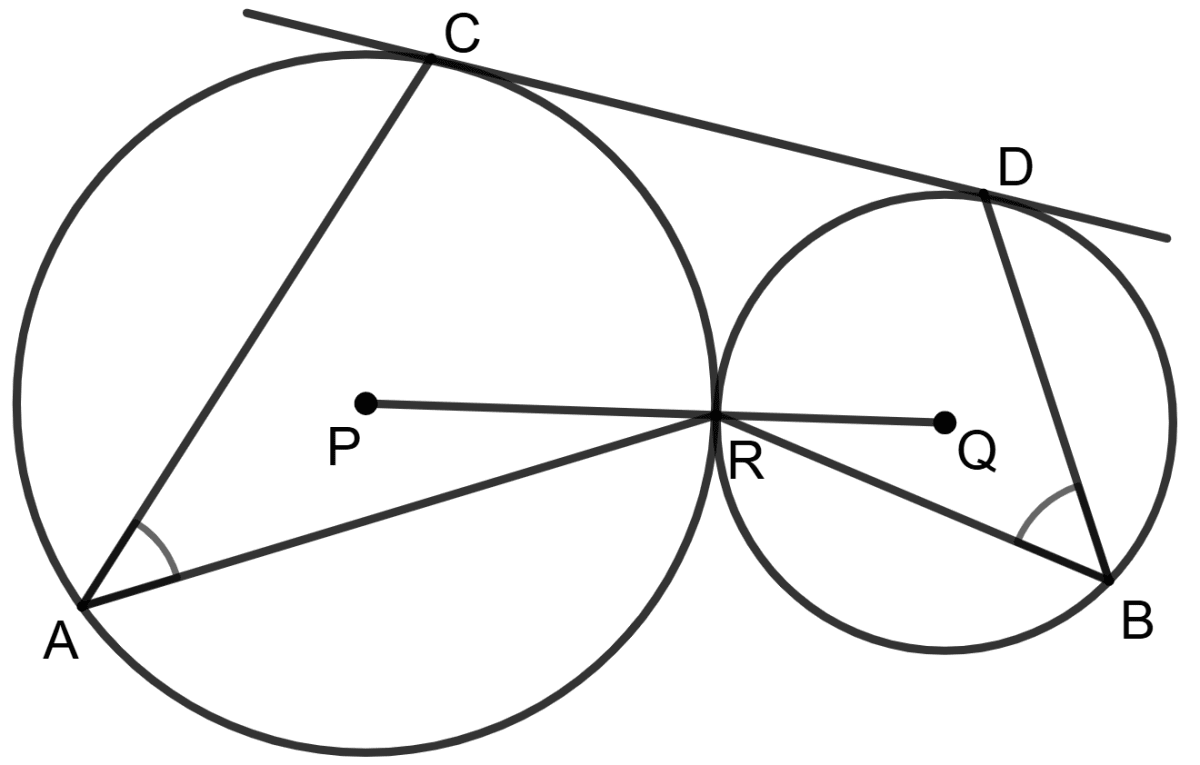
If ∠CAR = 38°, then find ∠DBR.
Answer
Join PC and QD.
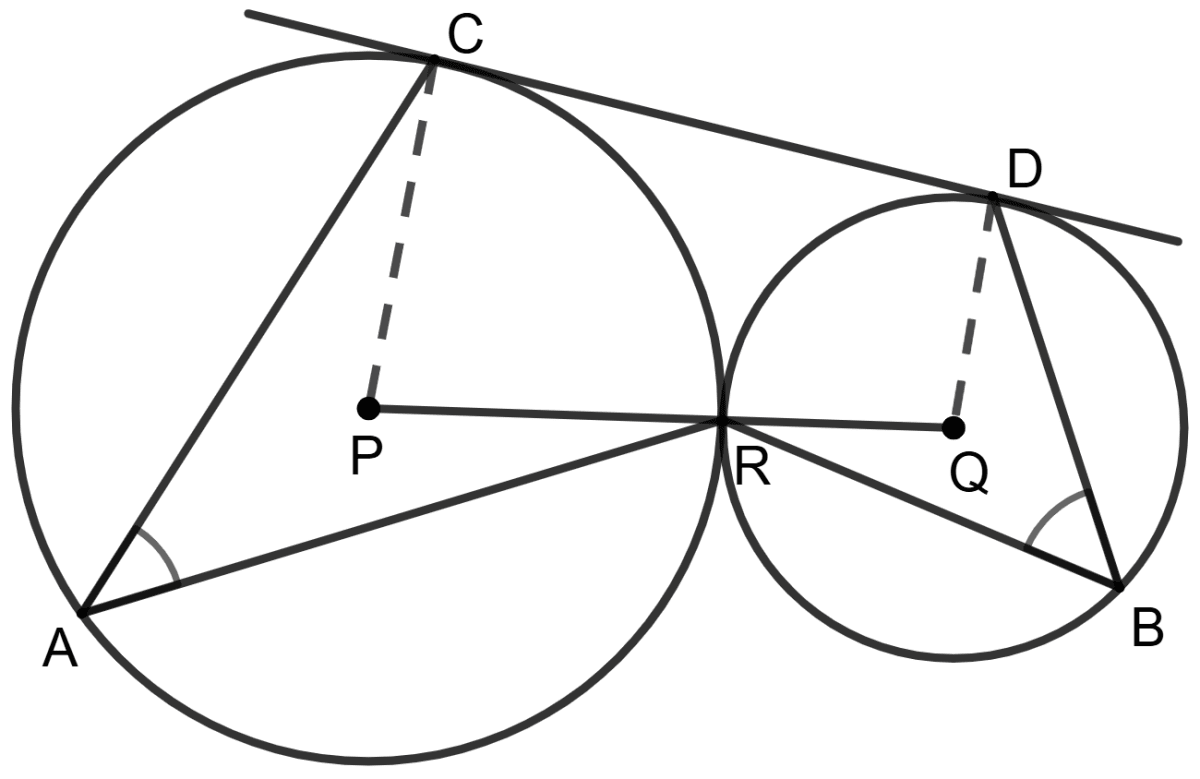
We know that,
The tangent at any point of a circle is perpendicular to the radius through the point of contact.
∴ PC ⊥ CD and QD ⊥ CD
⇒ ∠PCD = 90° and ∠QDC = 90°
The angle subtended by an arc of a circle at the center is double the angle subtended by it at any point on the remaining part of the circle.
⇒ ∠CPR = 2 x ∠CAR = 2 x 38° = 76°
⇒ ∠CPR = ∠CPQ = 76°
CDQP is quadrilateral.
∴ ∠PCD + ∠QDC + ∠DQP + ∠CPQ = 360°
⇒ 90° + 90° + ∠DQP + 76° = 360°
⇒ 256° + ∠DQP = 360°
⇒ ∠DQP = 360° - 256°
⇒ ∠DQP = 104°
From figure,
⇒ ∠DQR = ∠DQP
⇒ ∠DQR = 104°
The angle subtended by an arc of a circle at the center is double the angle subtended by it at any point on the remaining part of the circle.
⇒ ∠DQR = 2 x ∠DBR
⇒ 104° = 2 x ∠DBR
⇒ ∠DBR =
⇒ ∠DBR = 52°.
Hence, ∠DBR = 52°.