
If O is the center of the circle find the value of x in each the following figure (using the given information) :

Answer
From figure,

ABCD is a cyclic quadrilateral.
By property of cyclic quadrilateral — An exterior angle of cyclic quadrilateral is equal to opposite interior angle.
We get,
∠BAD = ∠DCE = x°
Arc BD subtends ∠BOD on center and ∠BAD at point A of the circle.
∴ ∠BOD = 2∠BAD (∵ as angle subtended on center of circle is double the angle subtended on any other part.)
⇒ 150° = 2x°
⇒ x° =
⇒ x° = 75°.
Hence, the value of x = 75.
If O is the center of the circle find the value of x in each the following figure (using the given information) :

Answer
From figure,

ABCD is a cyclic quadrilateral.
By property of cyclic quadrilateral — An exterior angle of cyclic quadrilateral is equal to opposite interior angle.
We get,
∠BAD = ∠DCE = 80°
Arc BD subtends ∠BOD on center and ∠BAD at point A of the circle.
From figure,
∠BOD = 360° - x°
∴ ∠BOD = 2∠BAD (∵ as angle subtended on center of circle is double the angle subtended on any other part.)
⇒ 360° - x° = 2 × 80°
⇒ x° = 360° - 160°
⇒ x° = 200°.
Hence, the value of x = 200.
If O is the center of the circle find the value of x in each the following figure (using the given information) :

Answer
From figure,
ABCD is a cyclic quadrilateral.
∠ACB = 90°. (∵ angle in semi circle is 90°)
Since sum of angles in triangle is 180°.
∴ In △ABC
⇒ ∠CAB + ∠ACB + ∠ABC = 180°
⇒ 25° + 90° + ∠ABC = 180°
⇒ 115° + ∠ABC = 180°
⇒ ∠ABC = 65°.
Since opposite angles sum is 180° in cyclic quadrilateral
⇒ ∠ABC + ∠ADC = 180°
⇒ 65° + x° = 180°
⇒ x° = 180° - 65°
⇒ x° = 115°.
Hence, the value of x = 115.
In the figure (i) given below, O is the center of the circle. If ∠AOC = 150°, find
(i) ∠ABC
(ii) ∠ADC.

Answer
(i) Arc AC subtends ∠AOC on center and ∠ABC at point B of the circle.
∴ ∠AOC = 2∠ABC (∵ as angle subtended on center of circle is double the angle subtended on any other part.)
⇒ 150° = 2∠ABC
⇒ ∠ABC =
⇒ ∠ABC = 75°.
Hence, the value of ∠ABC = 75°.
(ii) From figure,
ABCD is a cyclic quadrilateral.
Since opposite angles sum is 180° in cyclic quadrilateral
⇒ ∠ABC + ∠ADC = 180°
⇒ 75° + x° = 180°
⇒ x° = 180° - 75°
⇒ x° = 105°.
Hence, the value of ∠ADC = 105°.
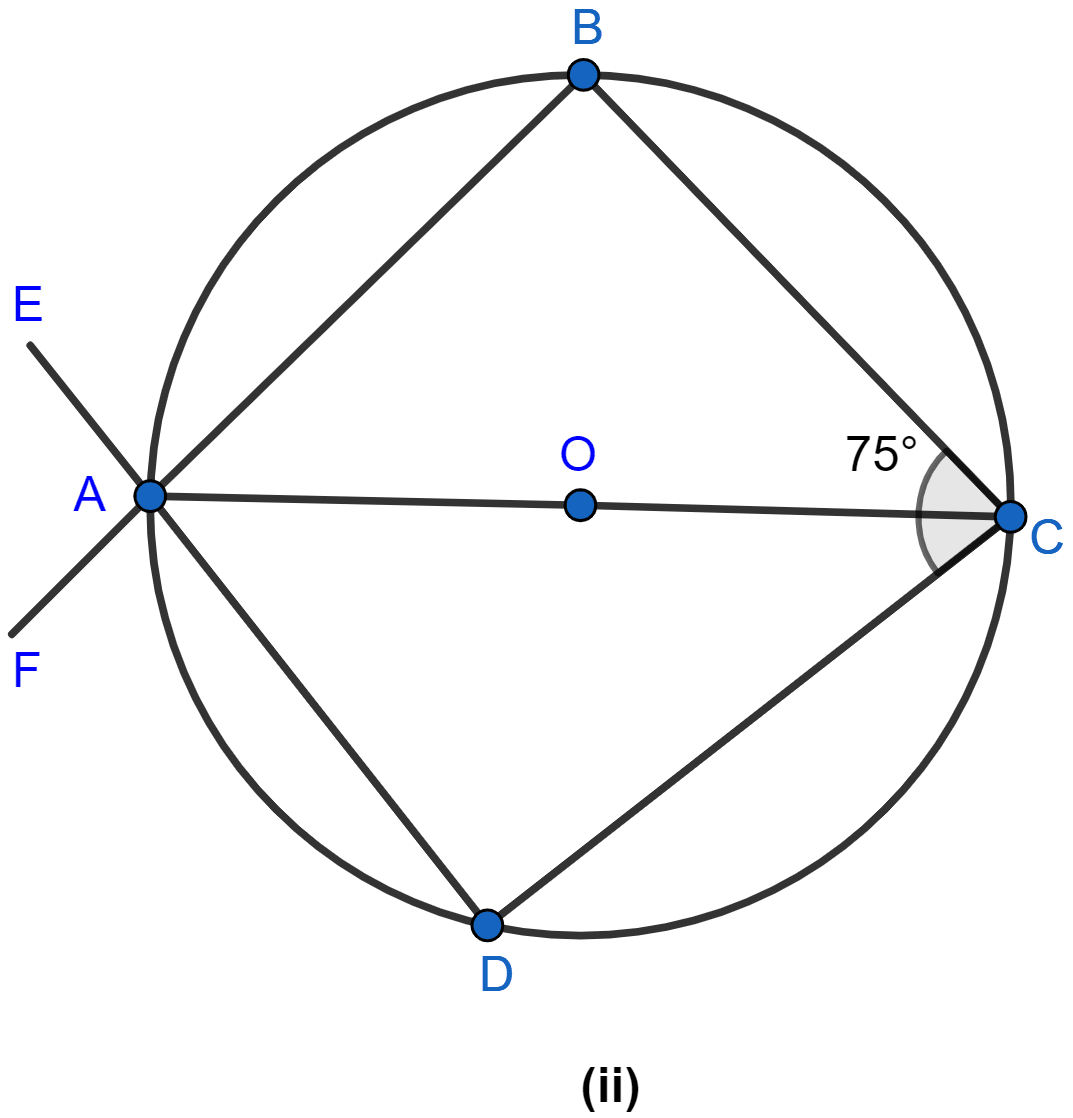
In the figure (ii) given below, AC is a diameter of the given circle and ∠BCD = 75°. Calculate the size of
(i) ∠ABC
(ii) ∠EAF
Answer
(i) From figure,
∠ABC = 90° (∵ angle in semicircle is equal to 90°)
Hence, the value of ∠ABC = 90°.
(ii) Since opposite angles sum is 180° in cyclic quadrilateral
⇒ ∠BAD + ∠BCD = 180°
⇒ ∠BAD + 75° = 180°
⇒ ∠BAD = 180° - 75°
⇒ ∠BAD = 105°.
From figure,
∠EAF = ∠BAD = 105°.
Hence, the value of ∠EAF = 105°.
In the figure (i) given below, if ∠DCB = 58° and BD is a diameter of the circle, calculate
(i) ∠BDC
(ii) ∠BEC
(iii) ∠BAC

Answer
(i) Given,
∠DBC = 58°
From figure,
∠BCD = 90° (∵ angle in semicircle is equal to 90°.)
Since sum of angles in triangle is 180°.
∴ In △BCD
⇒ ∠DBC + ∠BCD + ∠BDC = 180°
⇒ 58° + 90° + ∠BDC = 180°
⇒ 148° + ∠BDC = 180°
⇒ ∠BDC = 180° - 148°
⇒ ∠BDC = 32°.
Hence, the value of ∠BDC = 32°.
(ii) Considering quadrilateral BDCE.
From figure,
BDCE is a cyclic quadrilateral.
Since opposite angles sum is 180° in cyclic quadrilateral
⇒ ∠BDC + ∠BEC = 180°
⇒ 32° + ∠BEC = 180°
⇒ ∠BEC = 180° - 32°
⇒ ∠BEC = 148°.
Hence, the value of ∠BEC = 148°.
(iii) From figure,
∠BAC = ∠BDC (∵ angles in same segment are equal.)
∴ ∠BAC = 32°.
Hence, the value of ∠BAC = 32°.
In the figure (ii) given below, AB is parallel to DC, ∠BCE = 80° and ∠BAC = 25°. Find :
(i) ∠CAD
(ii) ∠CBD
(iii) ∠ADC

Answer
(i) ABCD is a cyclic quadrilateral.
Since exterior angle of a cyclic quadrilateral is equal to the opposite interior angle.
∴ ∠BCE = ∠DAB
⇒ ∠BCE = ∠CAD + ∠BAC
⇒ 80° = ∠CAD + 25°
⇒ ∠CAD = 80° - 25°
⇒ ∠CAD = 55°.
Hence, the value of ∠CAD = 55°.
(ii) From figure,
∠CBD = ∠CAD (∵ angles in same segment are equal.)
∠CBD = 55°.
Hence, the value of ∠CBD = 55°.
(iii) ∠BAC = ∠BDC (∵ angles in same segment are equal.)
∠BDC = 25°.
Now AB || DC and BD is the transversal
∠ABD = ∠BDC (∵ ∵ alternate angles are equal.)
⇒ ∠ABD = 25°
From figure,
∠ABC = ∠ABD + ∠CBD = 25° + 55° = 80°.
Since, sum of opposite angles of a cyclic quadrilateral is 180°.
⇒ ∠ABC + ∠ADC = 180°
⇒ 80° + ∠ADC = 180°
⇒ ∠ADC = 180° - 80°
⇒ ∠ADC = 100°.
Hence, the value of ∠ADC = 100°.
In the figure (i) given below, ABCD is a cyclic quadrilateral. If ∠ADC = 80° and ∠ACD = 52°, find the values of ∠ABC and ∠CBD.

Answer
In the given figure,
ABCD is a cyclic quadrilateral.
Since, sum of opposite angles of a cyclic quadrilateral is 180°.
⇒ ∠ABC + ∠ADC = 180°
⇒ ∠ABC + 80° = 180°
⇒ ∠ABC = 180° - 80°
⇒ ∠ABC = 100°.
From figure,
∠DBA = ∠DCA = 52°. (∵ angles in same segment are equal.)
⇒ ∠ABC = ∠DBA + ∠CBD
⇒ 100° = 52° + ∠CBD
⇒ ∠CBD = 100° - 52°
⇒ ∠CBD = 48°.
Hence, ∠ABC = 100° and ∠CBD = 48°.
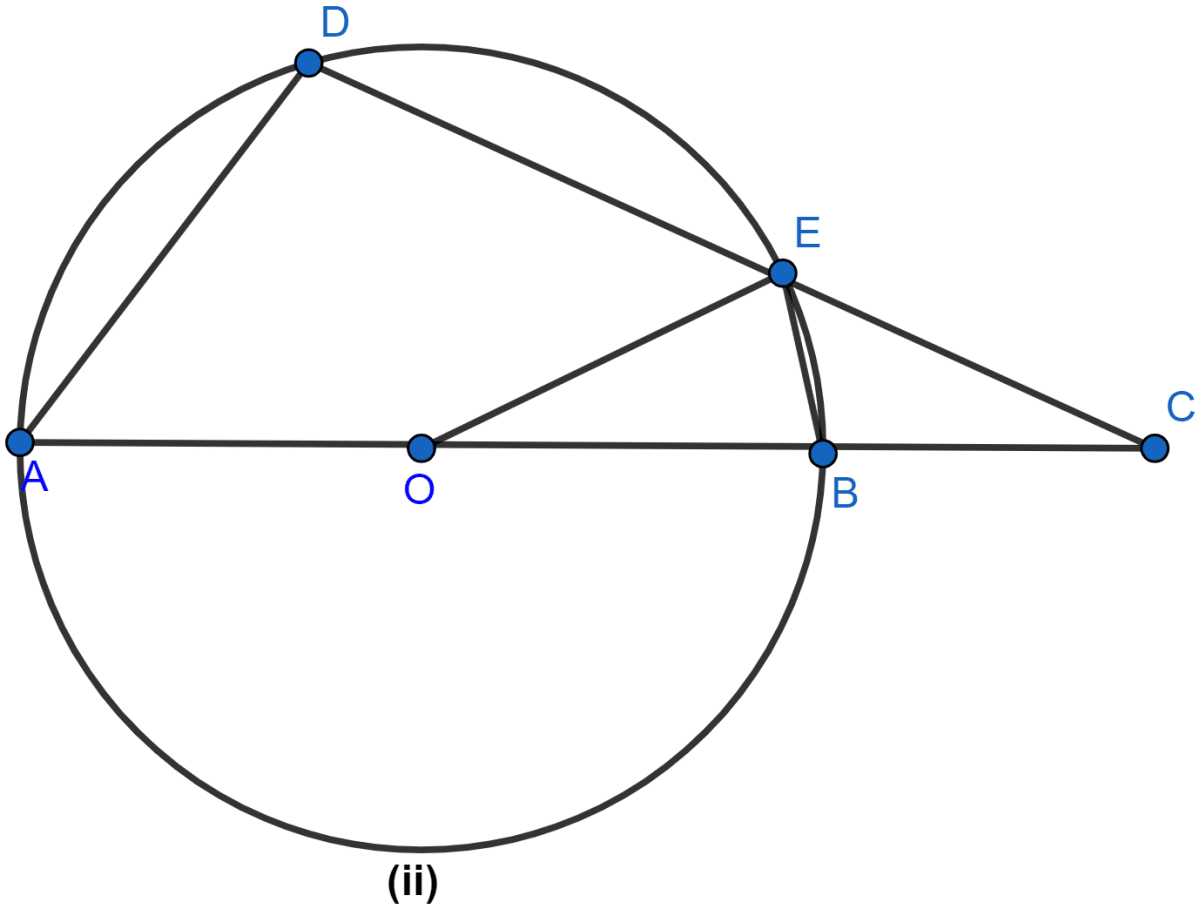
In the figure (ii) given below, O is the center of the circle. ∠AOE = 150°, ∠DAO = 51°. Calculate the sizes of ∠BEC and ∠EBC.
Answer
From figure,
∠DAB = ∠DAO = 51°.
ABED is a cyclic quadrilateral as all vertices lie on the circumference of the circle.
∠BEC = ∠DAB = 51° (∵ exterior angle of a cyclic quadrilateral is equal to the opposite interior angle.)
Reflex ∠AOE = 360° - ∠AOE = 360° - 150° = 210°.
Arc AE subtends ∠ADE at point D and Reflex ∠AOE at center.
Reflex ∠AOE = 2∠ADE (∵ angle subtended by an arc at center is double the angle subtended at any other point of the circle.)
210° = 2∠ADE
∠ADE =
∠ADE = 105°.
∠EBC = ∠ADE = 105° (∵ exterior angle of a cyclic quadrilateral is equal to the opposite interior angle.)
Hence, ∠BEC = 51° and ∠EBC = 105°.
In the figure (i) given below, ABCD is a parallelogram. A circle passes through A and D and cuts AB at E and DC at F. Given that ∠BEF = 80°, find ∠ABC.

Answer
ADFE is a cyclic quadrilateral as all vertices lie on the circumference of the circle.
∠ADF = ∠FEB = 80° (∵ exterior angle of a cyclic quadrilateral is equal to the opposite interior angle.)
As opposite angles of a parallelogram are equal.
∠ABC = ∠ADC
From figure,
∠ADC = ∠ADF = 80°.
∴ ∠ABC = 80°.
Hence, the value of ∠ABC = 80°.
In the figure (ii) given below, ABCD is a cyclic trapezium in which AD is parallel to BC and ∠B = 70°, find
(i) ∠BAD
(ii) ∠BCD

Answer
(i) In trapezium sum of angles on same side = 180°.
⇒ ∠ABC + ∠BAD = 180°
⇒ 70° + ∠BAD = 180°
⇒ ∠BAD = 180° - 70°
⇒ ∠BAD = 110°
Hence, the value of ∠BAD = 110°.
(ii) ABCD is a cyclic quadrilateral as all vertices lie on the circumference of the circle.
Sum of opposite angles of cyclic quadrilateral = 180°
⇒ ∠BAD + ∠BCD = 180°
⇒ 110° + ∠BCD = 180°
⇒ ∠BCD = 180° - 110°
⇒ ∠BCD = 70°.
Hence, the value of ∠BCD = 70°.
In the figure (i) given below, O is the center of the circle. If ∠BAD = 30°, find the values of p, q and r.

Answer
From figure,
ABCD is a cyclic quadrilateral as all vertices lie on the circumference of the circle.
Sum of opposite angles of cyclic quadrilateral = 180°
⇒ ∠A + ∠C = 180°
⇒ 30° + p = 180°
⇒ p = 180° - 30°
⇒ p = 150°.
∠BAD = ∠BED (∵ angles in same segment are equal.)
⇒ r = 30°.
Arc BD subtends ∠BAD at point A and ∠BOD at center.
∠BOD = 2∠BAD (∵ angle subtended by an arc at center is double the angle subtended at any other point of the circle.)
q = 2 × 30°
q = 60°.
Hence, the value of p = 150°, q = 60° and r = 30°.
In the figure (ii) given below, two circles intersect at points P and Q. If ∠A = 80° and ∠D = 84°, calculate
(i) ∠QBC
(ii) ∠BCP

Answer
Join PQ as shown in the figure below:

PQAD is a cyclic quadrilateral as all vertices lie on the circumference of the circle.
Sum of opposite angles of cyclic quadrilateral = 180°
⇒ ∠DAQ + ∠DPQ = 180°
⇒ 80° + ∠DPQ = 180°
⇒ ∠DPQ = 180° - 80°
⇒ ∠DPQ = 100°.
Also,
⇒ ∠PDA + ∠PQA = 180°
⇒ 84° + ∠PQA = 180°
⇒ ∠PQA = 180° - 84°
⇒ ∠PQA = 96°.
Since exterior angle of a cyclic quadrilateral is equal to the opposite interior angle.
∠QBC = ∠DPQ = 100°
∠BCP = ∠PQA = 96°.
Hence, the value of ∠QBC = 100° and ∠BCP = 96°.
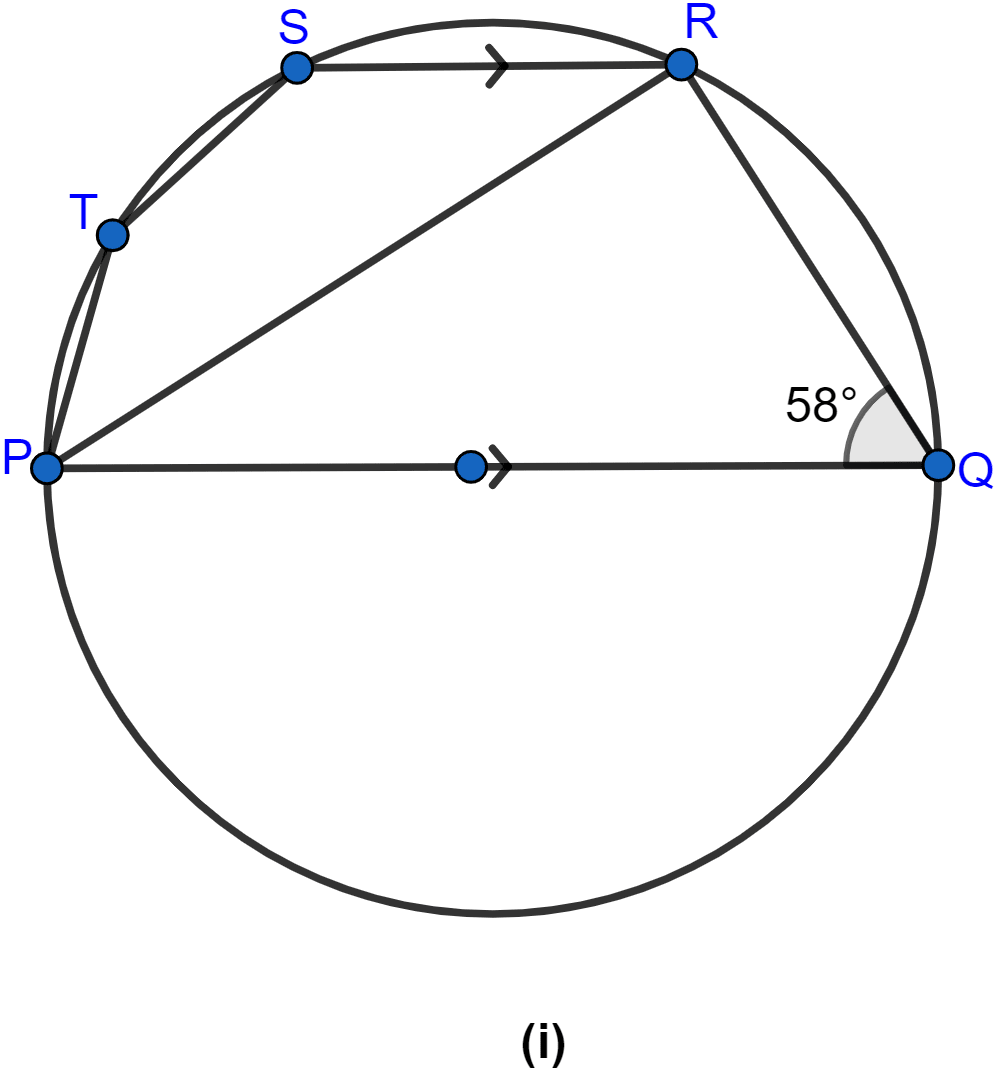
In the figure (i) given below, PQ is a diameter. Chord SR is parallel to PQ. Given ∠PQR = 58°, calculate
(i) ∠RPQ
(ii) ∠STP
(T is a point on the minor arc SP)
Answer
(i) From figure,
∠PRQ = 90° (∵ angle in semicircle is equal to 90°.)
Since sum of angles in triangle is 180°.
⇒ ∠PRQ + ∠RQP + ∠RPQ = 180°
⇒ 90° + 58° + ∠RPQ = 180°
⇒ ∠RPQ + 148° = 180°
⇒ ∠RPQ = 180° - 148
⇒ ∠RPQ = 32°.
Hence, the value of ∠RPQ = 32°.
(ii) From figure,
∠SRP = ∠RPQ = 32° (∵ alternate angles are equal.)
Since, PTSR is a cyclic quadrilateral so sum of its opposite angles is equal to 180°.
⇒ ∠SRP + ∠STP = 180°
⇒ 32° + ∠STP = 180°
⇒ ∠STP = 180° - 32°
⇒ ∠STP = 148°.
Hence, the value of ∠STP = 148°.
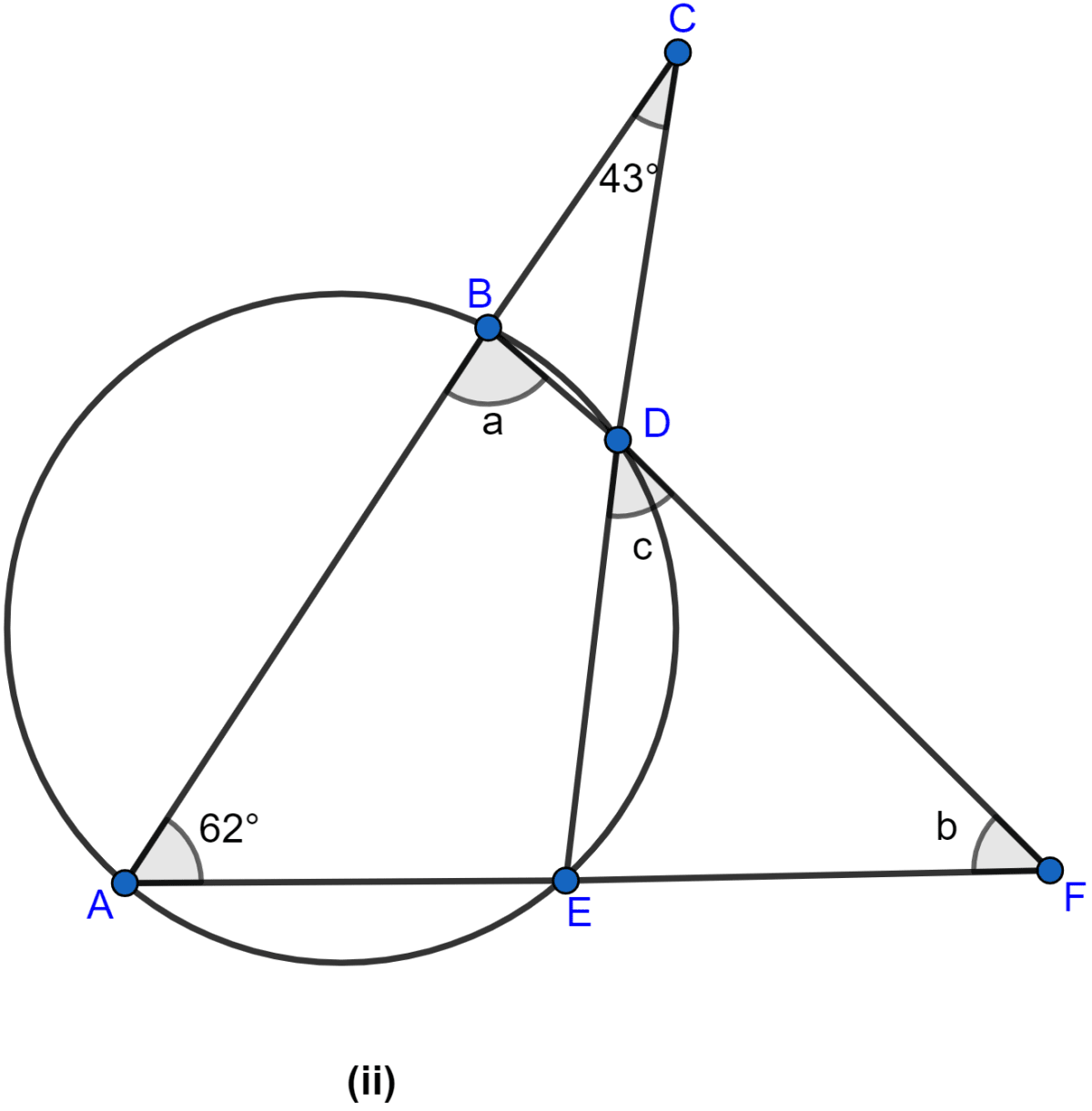
In the figure (ii) given below, if ∠ACE = 43° and ∠CAF = 62°, find the values of a, b and c.
Answer
From figure,
∠CAE = ∠CAF = 62°
Since sum of angles in triangle is 180°.
In △ACE,
⇒ ∠CAE + ∠ACE + ∠CEA = 180°
⇒ 62° + 43° + ∠CEA = 180°
⇒ ∠CEA + 105° = 180°
⇒ ∠CEA = 180° - 105°
⇒ ∠CEA = 75°.
From figure,
⇒ ∠CEA + ∠DEF = 180° (As they are linear pair.)
⇒ 75° + ∠DEF = 180°
⇒ ∠DEF = 180° - 75°
⇒ ∠DEF = 105°.
ABDE is a cyclic quadrilateral as all of its vertices lie on the circumference of the circle.
Since exterior angle of a cyclic quadrilateral is equal to the opposite interior angle.
⇒ ∠ABD = ∠DEF = 105°
⇒ a = 105°.
Since sum of angles in triangle is 180°.
In △ABF,
⇒ ∠BAF + ∠ABF + ∠BFA = 180°
⇒ 62° + a + b = 180°
⇒ 62° + 105° + b = 180°
⇒ b + 167° = 180°
⇒ b = 180° - 167°
⇒ b = 13°
Since exterior angle of a cyclic quadrilateral is equal to the opposite interior angle.
⇒ ∠EDF = ∠BAE = 62°
⇒ c = 62°.
Hence, the value of a = 105°, b = 13° and c = 62°.
In the figure (i) given below, AB is a diameter of the circle. If ∠ADC = 120°, find ∠CAB.
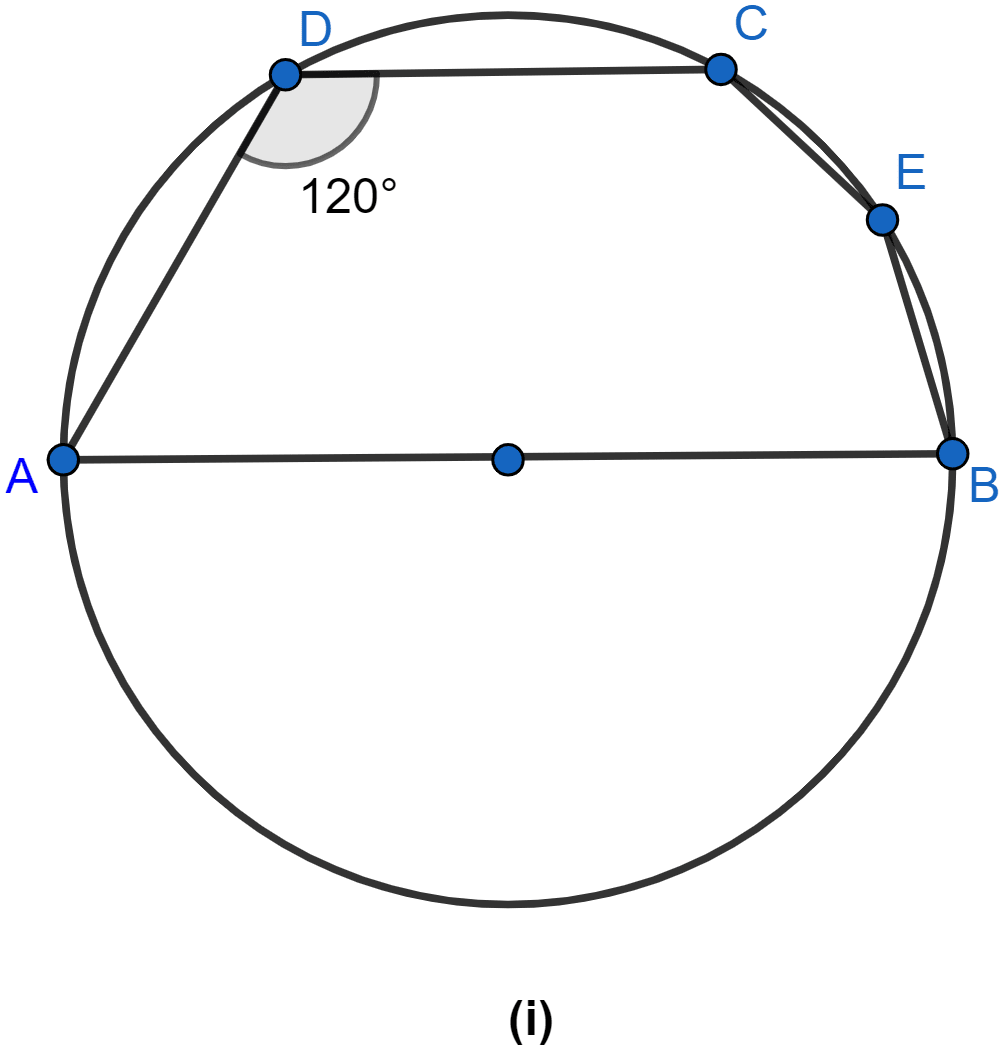
Answer
Join CB as shown in the figure below:
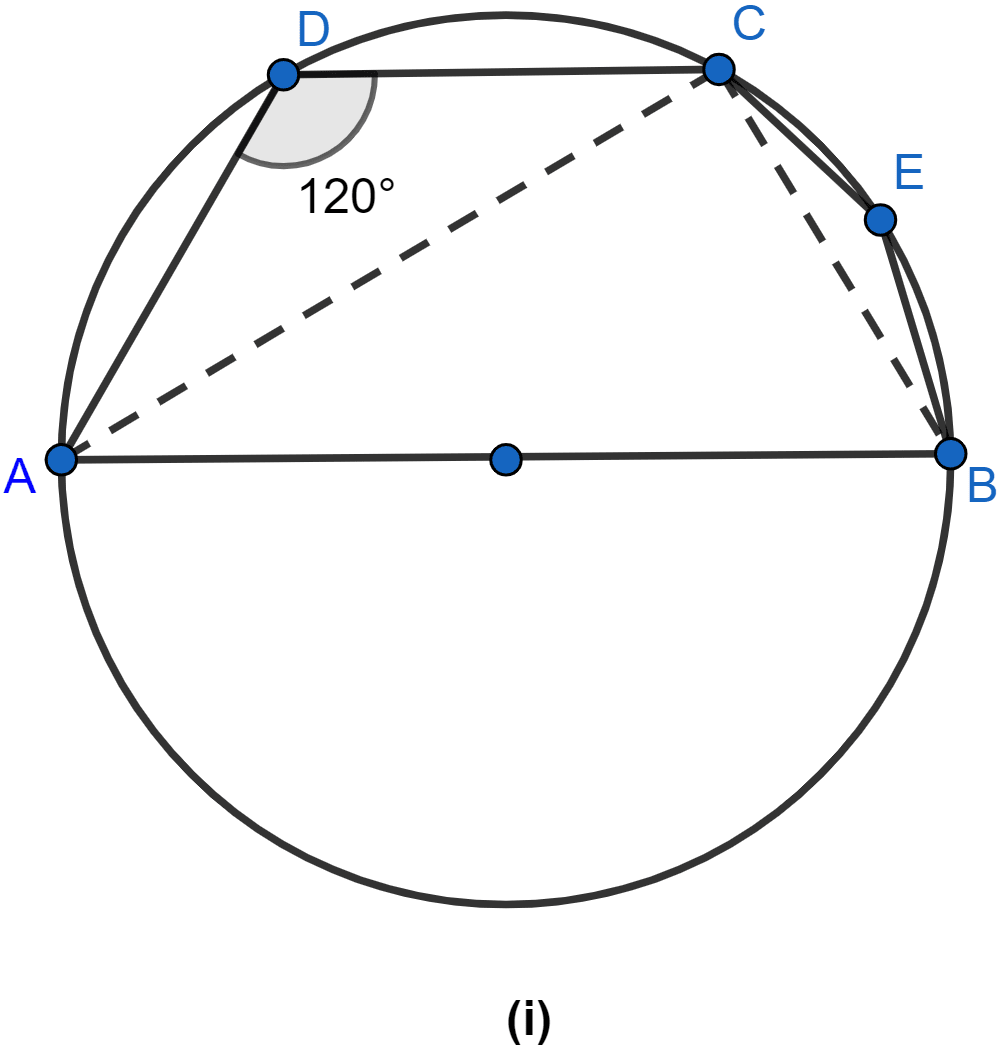
So, ABCD becomes a cyclic quadrilateral.
Sum of opposite angles of cyclic quadrilateral = 180°
⇒ ∠CBA + ∠ADC = 180°
⇒ ∠CBA + 120° = 180°
⇒ ∠CBA = 180° - 120°
⇒ ∠CBA = 60°.
Join AC.
In △ABC
∠ACB = 90° (∵ angle in semicircle is equal to 90°.)
Sum of angles of triangle = 180°
⇒ ∠CAB + ∠ACB + ∠CBA = 180°
⇒ ∠CAB + 90° + 60° = 180°
⇒ ∠CAB + 150° = 180°
⇒ ∠CAB = 180° - 150°
⇒ ∠CAB = 30°.
Hence, the value of ∠CAB = 30°.
In the figure (ii) given below, sides AB and DC of a cyclic quadrilateral ABCD are produced to meet at E, the sides AD and BC are produced to meet at F. If x : y : z = 3 : 4 : 5, find the values of x, y and z.
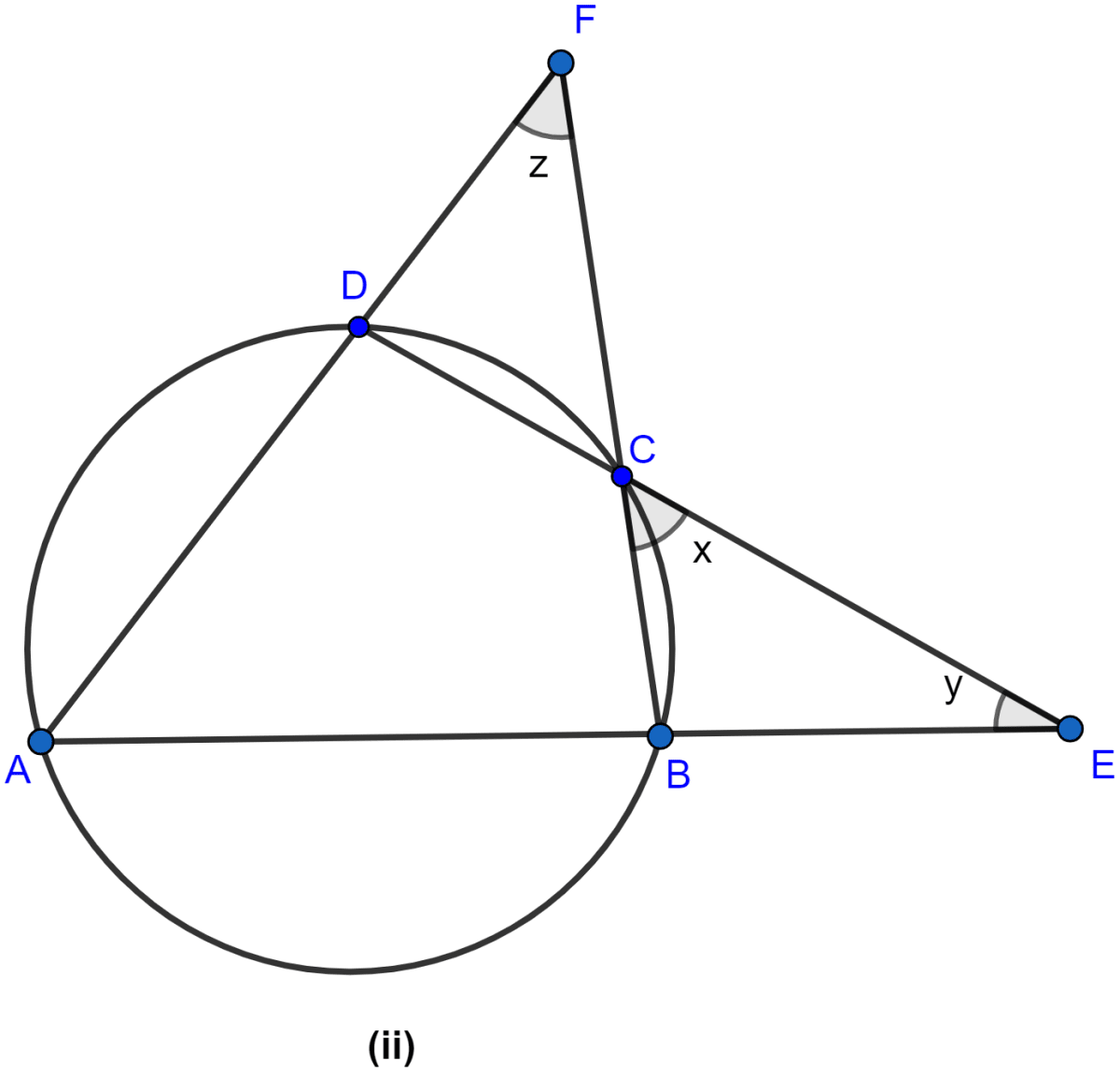
Answer
In figure,
ABCD is a cyclic quadrilateral.
∠DAB = ∠BCE = x (Property of cyclic quadrilateral by which an exterior angle = opposite interior angle.)
In △BCE
∠CBE = 180° - (x° + y°)
From figure,
∠CBE and ∠CBA are linear pairs.
So,
⇒ ∠CBE + ∠CBA = 180°
⇒ 180° - (x° + y°) + ∠CBA = 180°
⇒ ∠CBA = 180° - 180° + (x° + y°)
⇒ ∠CBA = x° + y°
In △ABF,
So,
∠BAF + ∠ABF + ∠AFB = 180°
x + (x + y) + z = 180° (∵ From figure, ∠BAF = ∠DAB and ∠ABF = ∠CBA)
Given x : y : z = 3 : 4 : 5 , so x = 3k, y = 4k and z = 5k
3k + (3k + 4k) + 5k = 180°
15k = 180°
k = 12°
Hence, x = 3k = 3 × 12° = 36°, y = 4k = 4 × 12° = 48° and z = 5k = 5 × 12° = 60°.
Hence, the value of x = 36°, y = 48° and z = 60°.
In the figure (i) given below, ABCD is a quadrilateral inscribed in a circle with centre O. CD is produced to E. If ∠ADE = 70° and ∠OBA = 45°, calculate
(i) ∠OCA
(ii) ∠BAC
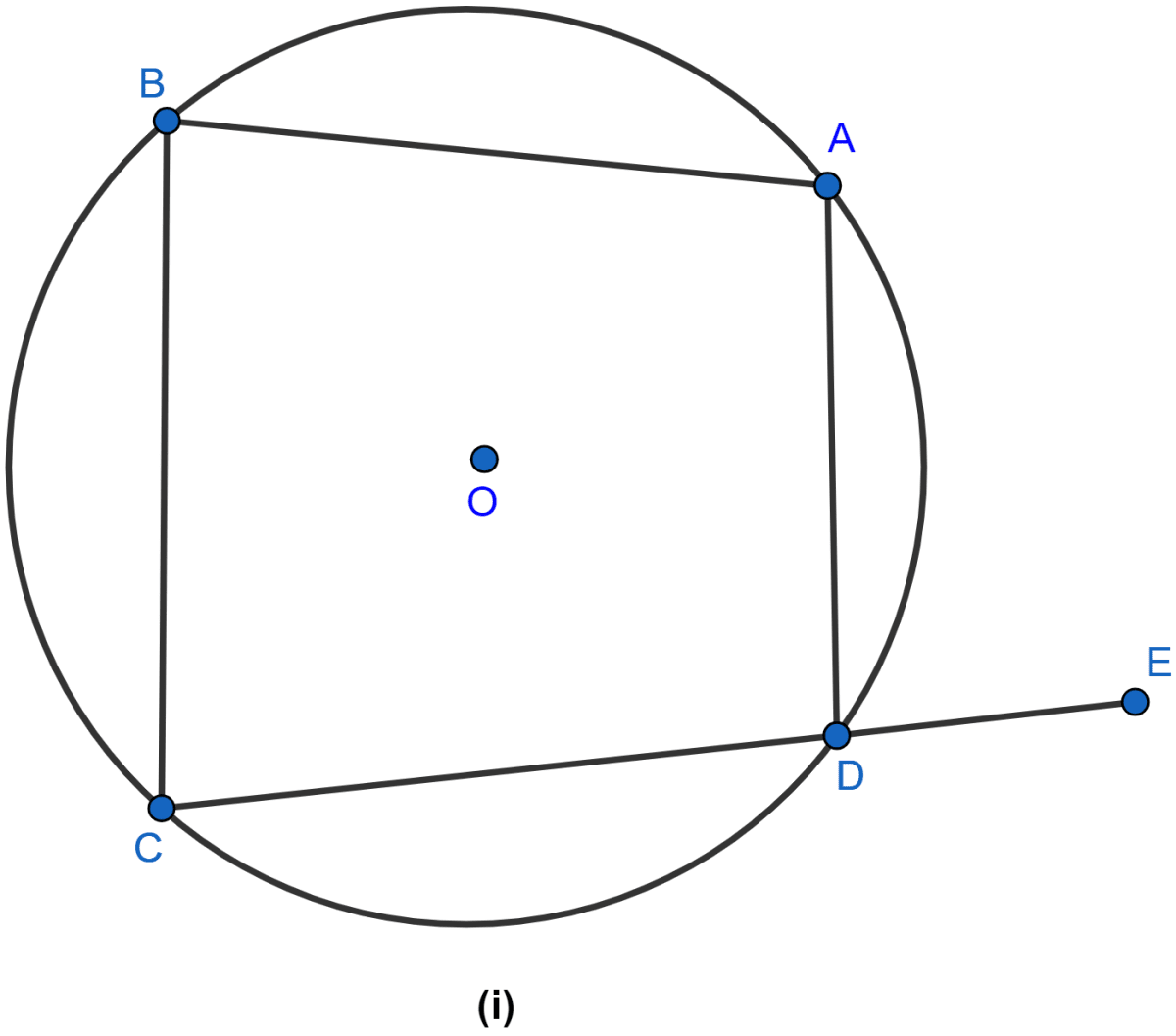
Answer
Join OA, OB, OC and AC as shown in the figure below:
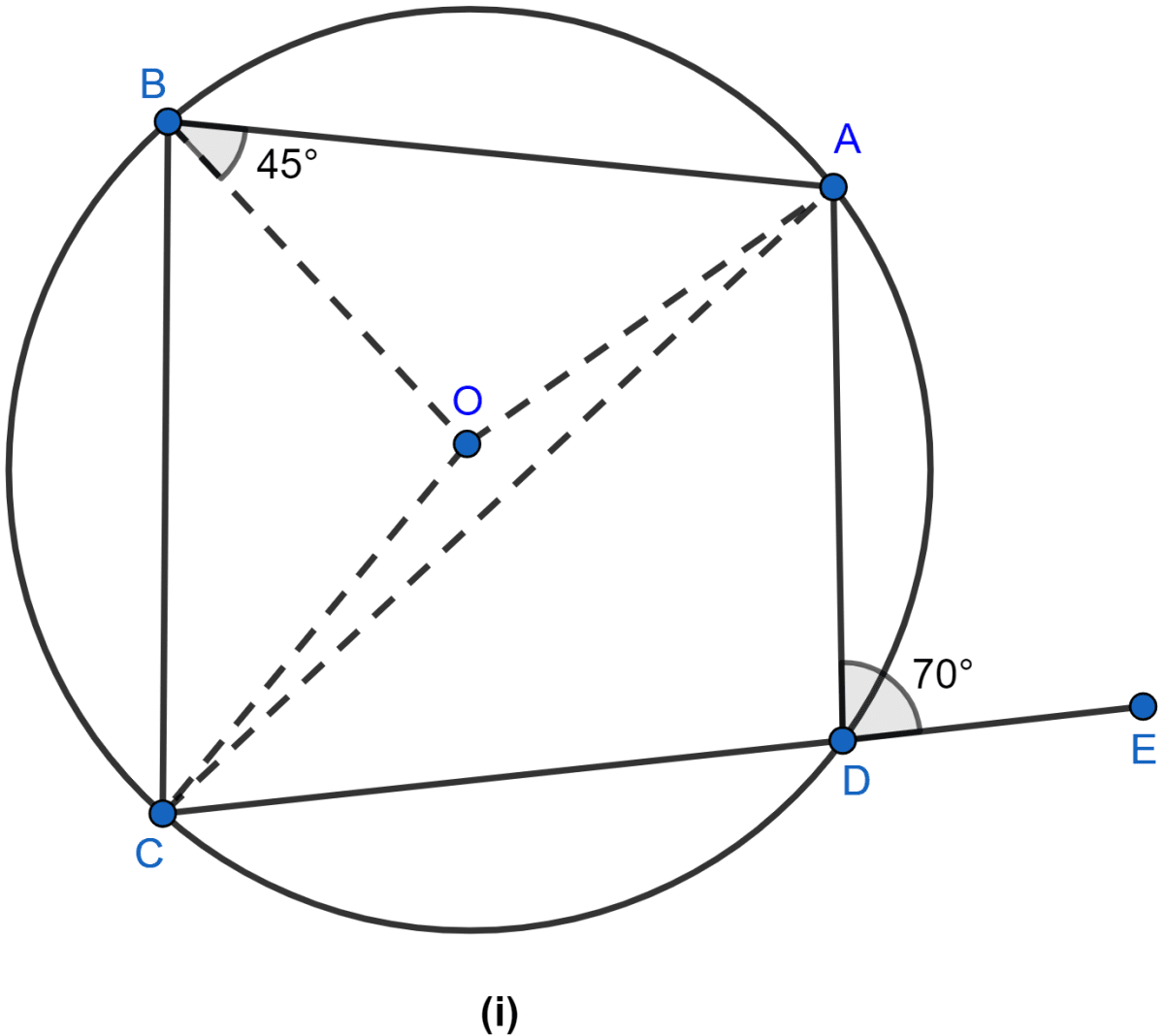
(i) ABCD is a cyclic quadrilateral as all the vertices lie on the circumference.
Since exterior angle of a cyclic quadrilateral is equal to the opposite interior angle.
⇒ ∠ADE = ∠ABC = 70°.
Arc AC subtends ∠AOC at center and ∠ABC at point B,
∠AOC = 2∠ABC (∵ angle subtended by an arc at centre is double the angle subtended at any other point of the circle.)
⇒ ∠AOC = 2 × 70° = 140°.
From figure,
OA = OC = Radius of the circle.
So, ∠OCA = ∠OAC = x.
Since sum of angles of triangle = 180°
In △OCA,
⇒ ∠AOC + ∠OCA + ∠OAC = 180°
⇒ 140° + x + x = 180°
⇒ 140° + 2x = 180°
⇒ 2x = 180° - 140°
⇒ 2x = 40°
⇒ x = 20°.
Hence, the value of ∠OCA = 20°.
(ii) From above solution,
∠ABC = 70°
From figure,
∠ABC = ∠OBA + ∠OBC
70° = 45° + ∠OBC
∠OBC = 70° - 45°
∠OBC = 25°.
As, OB = OC = radius of the circle.
∴ ∠OCB = ∠OBC = 25°.
From figure,
⇒ ∠ACB = ∠OCB + OCA
⇒ ∠ACB = 25° + 20° = 45°
Since sum of angles of triangle = 180°
In △ABC,
⇒ ∠ABC + ∠ACB + ∠BAC = 180°
⇒ 70° + 45° + ∠BAC = 180°
⇒ 115° + ∠BAC = 180°
⇒ ∠BAC = 180° - 115°
⇒ ∠BAC = 65°
Hence, the value of ∠BAC = 65°.
In figure (ii) given below, ABF is a straight line and BE || DC. If ∠DAB = 92° and ∠EBF = 20°, find
(i) ∠BCD
(ii) ∠ADC
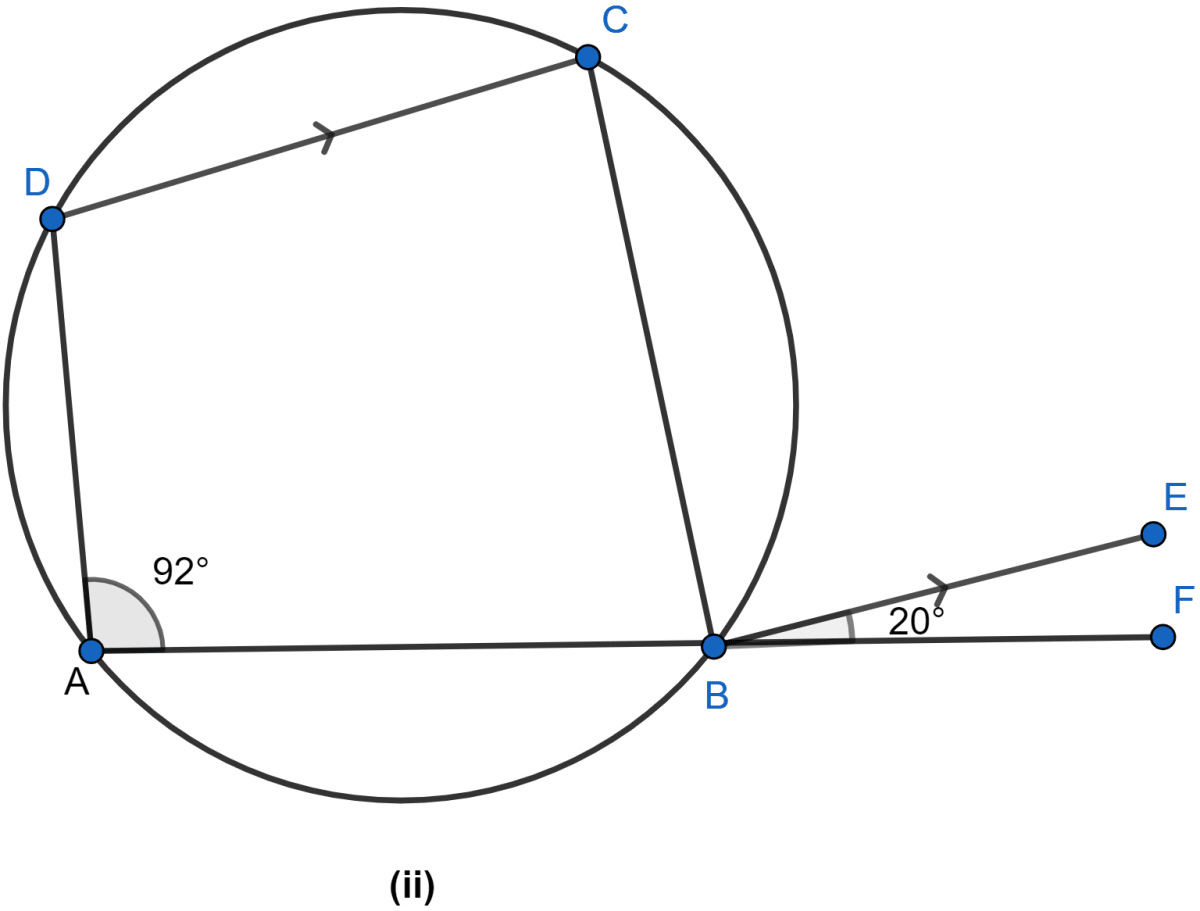
Answer
(i) Sum of opposite angles of cyclic quadrilateral = 180°
⇒ ∠DAB + ∠BCD = 180°
⇒ 92° + ∠BCD = 180°
⇒ ∠BCD = 180° - 92°
⇒ ∠BCD = 88°.
Hence, the value of ∠BCD = 88°.
(ii) ∠CBE = ∠BCD = 88° (∵ ∠CBE and ∠BCD are alternate angles)
∵ exterior angle of a cyclic quadrilateral is equal to the opposite interior angle.
⇒ ∠ADC = ∠CBF
⇒ ∠ADC = ∠CBE + ∠EBF
⇒ ∠ADC = 88° + 20°
⇒ ∠ADC = 108°.
Hence, the value of ∠ADC = 108°.
In the figure (i) given below, PQRS is a cyclic quadrilateral in which PQ = QR and RS is produced to T. If ∠QPR = 52°, calculate ∠PST.

Answer
Given, ∠QPR = 52°.
Since PQ = PR so, ∠QRP = ∠QPR = 52°.
Since sum of angles of triangle = 180°
In △PQR
⇒ ∠QPR + ∠QRP + ∠PQR = 180°
⇒ 52° + 52° + ∠PQR = 180°
⇒ 104° + ∠PQR = 180°
⇒ ∠PQR = 180° - 104°
⇒ ∠PQR = 76°.
∵ exterior angle of a cyclic quadrilateral is equal to the opposite interior angle.
∠PST = ∠PQR = 76°
Hence, the value of ∠PST = 76°
In the figure (ii) given below, O is the center of the circle. If ∠OAD = 50°, find the values of x and y.

Answer
From figure,
ABCD is a cyclic quadrilateral as all vertices lie on the circumference of the circle.
Sum of opposite angles of cyclic quadrilateral = 180°
⇒ ∠BCD + ∠BAD = 180°
⇒ x + 50° = 180°
⇒ x = 180° - 50°
⇒ x = 130°.
OA = OD = radius of the circle.
So, in △ODA,
∠ODA = ∠OAD = 50°.
In triangle exterior angle is equal to the sum of the opposite two interior angle.
y = ∠ODA + ∠OAD = 50° + 50° = 100°.
Hence, the value of x = 130° and y = 100°.
In the figure (i) given below, O is the center of the circle. If ∠COD = 40° and ∠CBE = 100°, then find :
(i) ∠ADC
(ii) ∠DAC
(iii) ∠ODA
(iv) ∠OCA

Answer
(i) ABCD is a cyclic quadrilateral.
∵ exterior angle of a cyclic quadrilateral is equal to the opposite interior angle.
∠ADC = ∠CBE = 100°.
Hence, the value of ∠ADC = 100°
(ii) Arc DC subtends ∠DOC at center and ∠DAC at point A.
⇒ ∠DOC = 2∠DAC (∵ angle subtended on center by an arc is double the angle subtended on the remaining part of circle.)
⇒ 40° = 2∠DAC
⇒ ∠DAC = 20°
Hence, the value of ∠DAC = 20°.
(iii) In △COD, OC = OD = radius of the same circle.
∠CDO = ∠DCO = x
Since sum of angles of triangle = 180°
In △COD
⇒ ∠CDO + ∠DCO + ∠COD = 180°
⇒ x + x + 40° = 180°
⇒ 40° + 2x = 180°
⇒ 2x = 180° - 40°
⇒ 2x = 140°
⇒ x = 70°.
From figure,
⇒ ∠ADC = ∠ODA + ∠CDO
⇒ 100° = ∠ODA + 70°
⇒ ∠ODA = 100° - 70° = 30°.
Hence, the value of ∠ODA = 30°.
(iv) Since sum of angles of triangle = 180°
In △ADC
⇒ ∠ADC + ∠DAC + ∠ACD = 180°
⇒ 100° + 20° + ∠ACD = 180°
⇒ 120° + ∠ACD = 180°
⇒ ∠ACD = 180° - 120°
⇒ ∠ACD = 60°.
From figure,
∠OCA = ∠DCO - ∠ACD = 70° - 60° = 10°.
Hence, the value of ∠OCA = 10°.
In the figure (ii) given below, O is the center of the circle. If ∠BAD = 75° and BC = CD, find:
(i) ∠BOD
(ii) ∠BCD
(iii) ∠BOC
(iv) ∠OBD
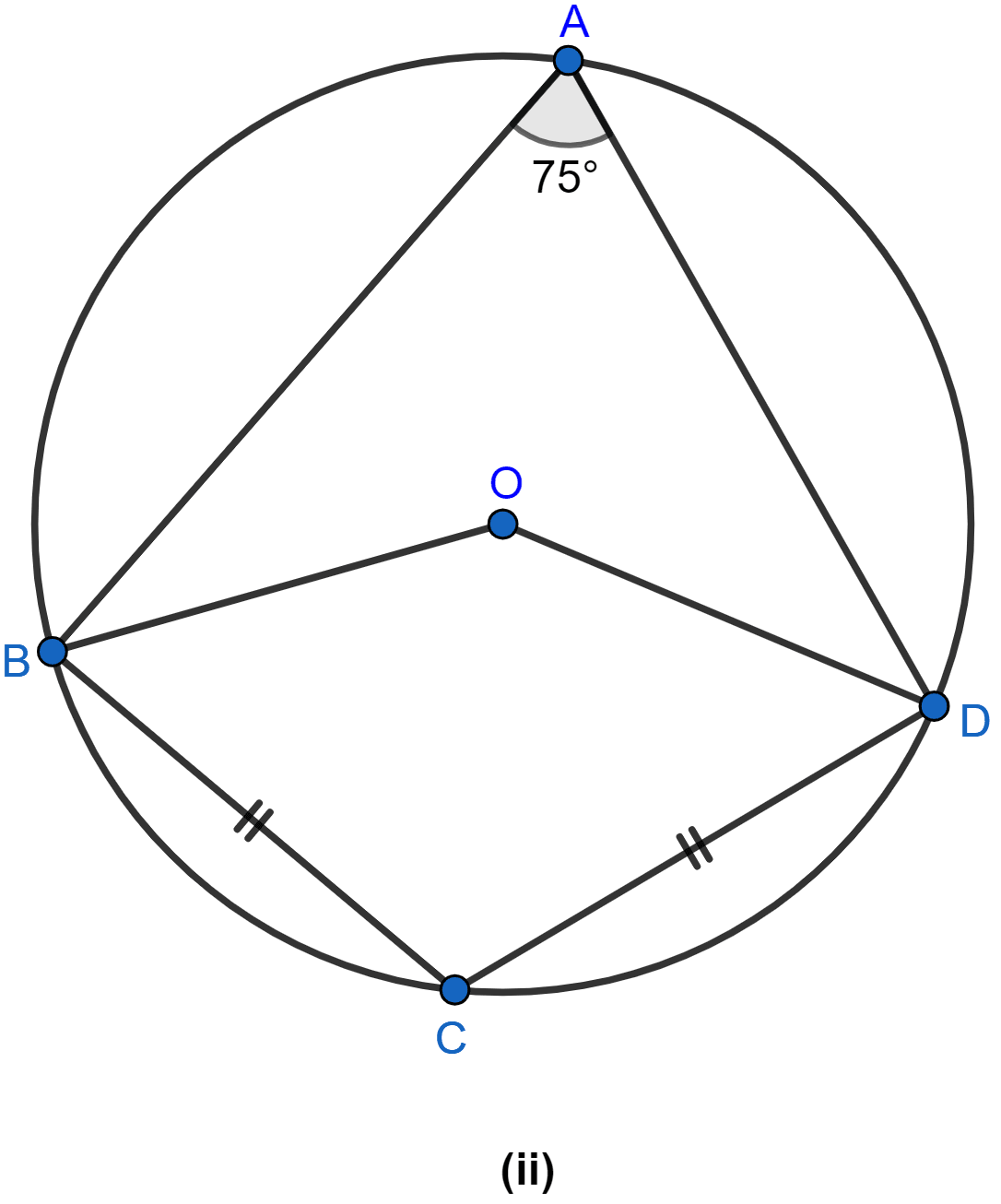
Answer
Join OC and BD as shown in the figure below:
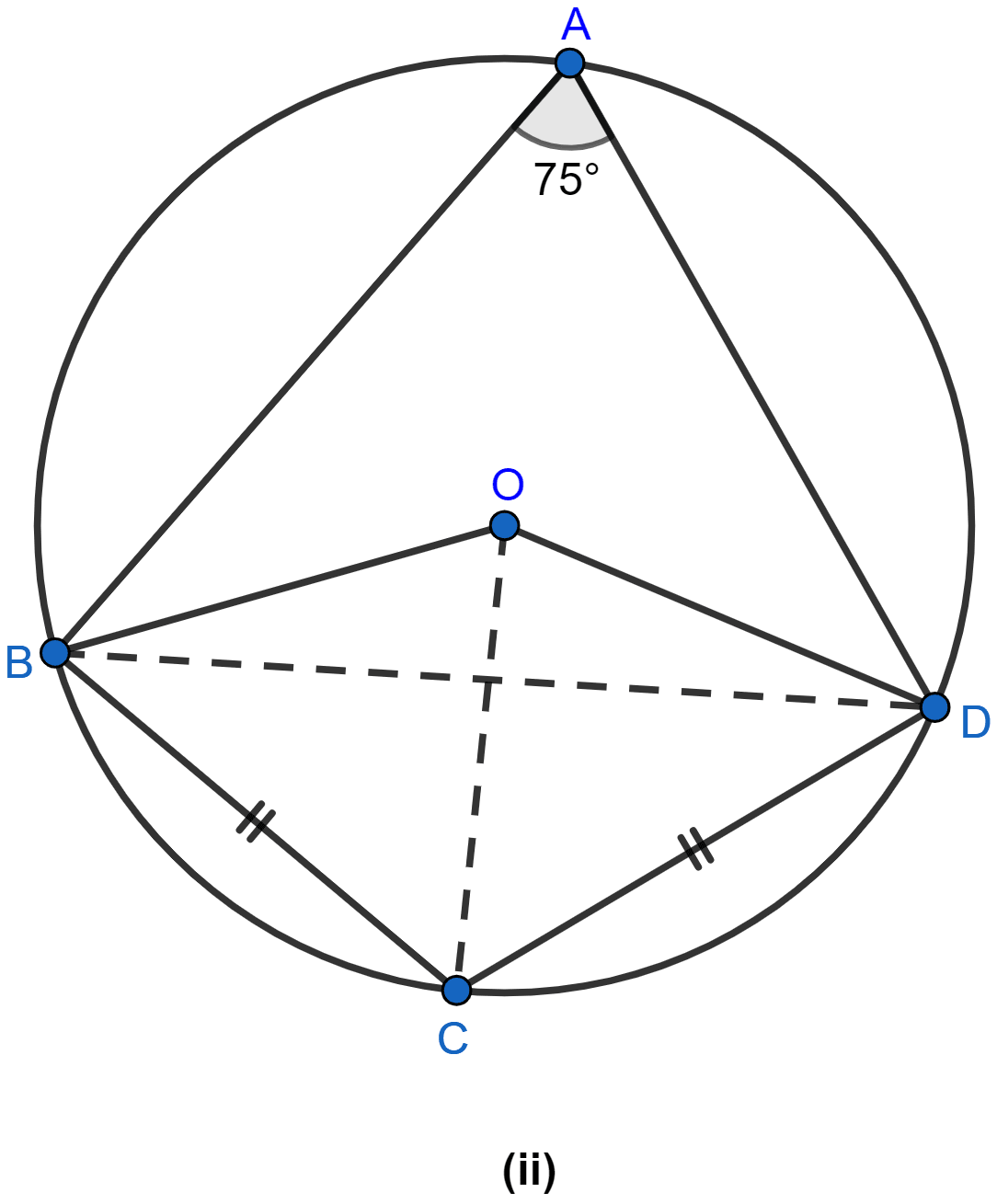
(i) ∠BOD = 2 × ∠BAD (∵ angle subtended by an arc at center is double the angle subtended at any point on the remaining part of the circle.)
∠BOD = 2 × 75° = 150°.
Hence, the value of ∠BOD = 150°.
(ii) ABCD is a cyclic quadrilateral as all of its vertices lie on the circumference of the circle.
We know that sum of opposite angles of a cyclic quadrilateral = 180°.
⇒ ∠BCD + ∠BAD = 180°
⇒ ∠BCD + 75° = 180°
⇒ ∠BCD = 180° - 75°
⇒ ∠BCD = 105°.
Hence, the value of ∠BCD = 105°.
(iii) Join OC.
As equal chords of a circle subtend equal angles at the center and chord BC = chord CD, so ∠BOC = ∠COD.
∠BOC = ∠BOD = = 75°.
Hence, the value of ∠BOC = 75°.
(iv) Join BD.
Since, OB = OD
∴ ∠OBD = ∠ODB = x
Since sum of angles of triangle = 180°
In △OBD
⇒ ∠BOD + ∠OBD + ∠ODB = 180°
⇒ 150° + x + x = 180°
⇒ 150° + 2x = 180°
⇒ 2x = 180° - 150°
⇒ 2x = 30°
⇒ x = 15°.
Hence, the value of ∠OBD = 15°.
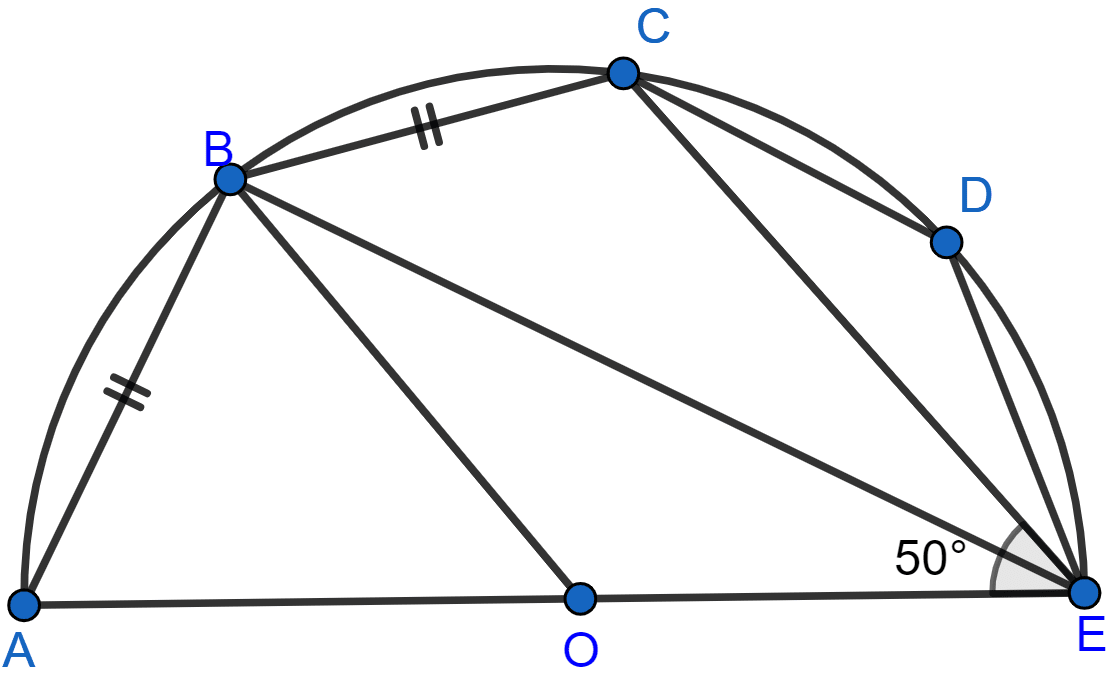
In the adjoining figure, O is the center and AOE is the diameter of the semicircle ABCDE. If AB = BC and ∠AEB = 50°, find :
(i) ∠CBE
(ii) ∠CDE
(iii) ∠AOB.
Prove that OB is parallel to EC.
Answer
(i) AECB is a cyclic quadrilateral as all of its vertices lie on the circumference of the circle.
From figure,
∠ABE = 90° (∵ angle in semicircle is 90°.)
We know that sum of opposite angles of a cyclic quadrilateral = 180°.
⇒ ∠AEC + ∠ABC = 180°
⇒ ∠AEC + ∠ABE + ∠CBE = 180°
⇒ 50° + 90° + ∠CBE = 180°
⇒ ∠CBE + 140° = 180°
⇒ ∠CBE = 180° - 140° = 40°.
Hence, the value of ∠CBE = 40°.
(ii) BEDC is a cyclic quadrilateral as all of its vertices lie on the circumference of the circle.
We know that sum of opposite angles of a cyclic quadrilateral = 180°.
⇒ ∠CBE + ∠CDE = 180°
⇒ 40° + ∠CDE = 180°
⇒ ∠CDE = 180° - 40° = 140°.
Hence, the value of ∠CDE = 140°.
(iii) Given,
AB = BC
∴ ∠AEB = ∠BEC = ∠AEC = (∵ equal chords subtend equal angle at circumference.)
In △OBE,
OB = OE = radius of the same circle
∴ ∠OBE = ∠OEB = 25°.
In triangle exterior angle is equal to the sum of opposite two interior angles.
∠AOB = ∠OBE + ∠OEB = 25° + 25° = 50°.
Hence, the value of ∠AOB = 50°.
∠AOB = ∠OEC (∵ both are equal to 50°)
Since these angles are corresponding angles and are equal which is property of parallel lines.
Hence proved that OB || EC.
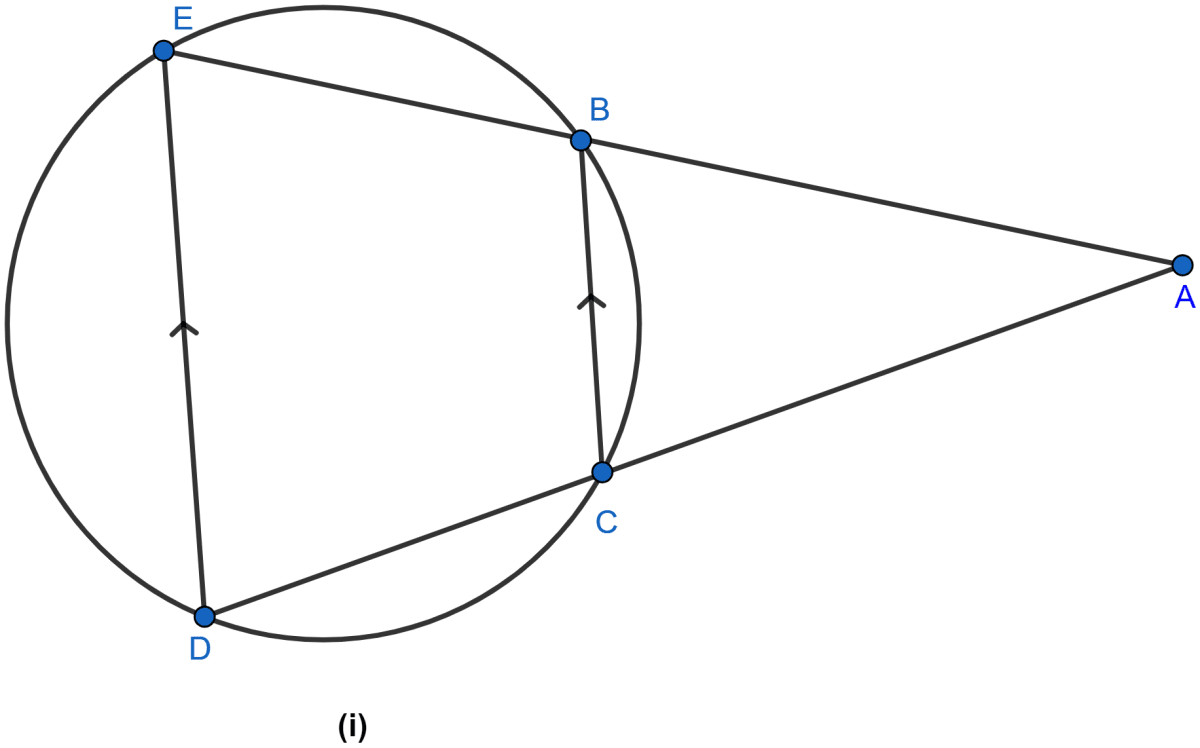
In the figure (i) given below, ED and BC are two parallel chords of the circle and ABE, ACD are two st. lines. Prove that AED is an isosceles triangle.
Answer
BEDC is a cyclic quadrilateral as all of its vertices lie on the circumference of the circle.
∵ exterior angle of a cyclic quadrilateral is equal to the opposite interior angle.
∠ABC = ∠D ....(i)
From figure, as ED is parallel to BC, ∠ABC and ∠E are corresponding angles,
∴ ∠ABC = ∠E ....(ii)
From (i) and (ii)
∠D = ∠E
In △AED,
∠D = ∠E,
∴ AE = AD. (As sides opposite to equal angles are equal)
Hence, proved that △AED is an isosceles triangle.
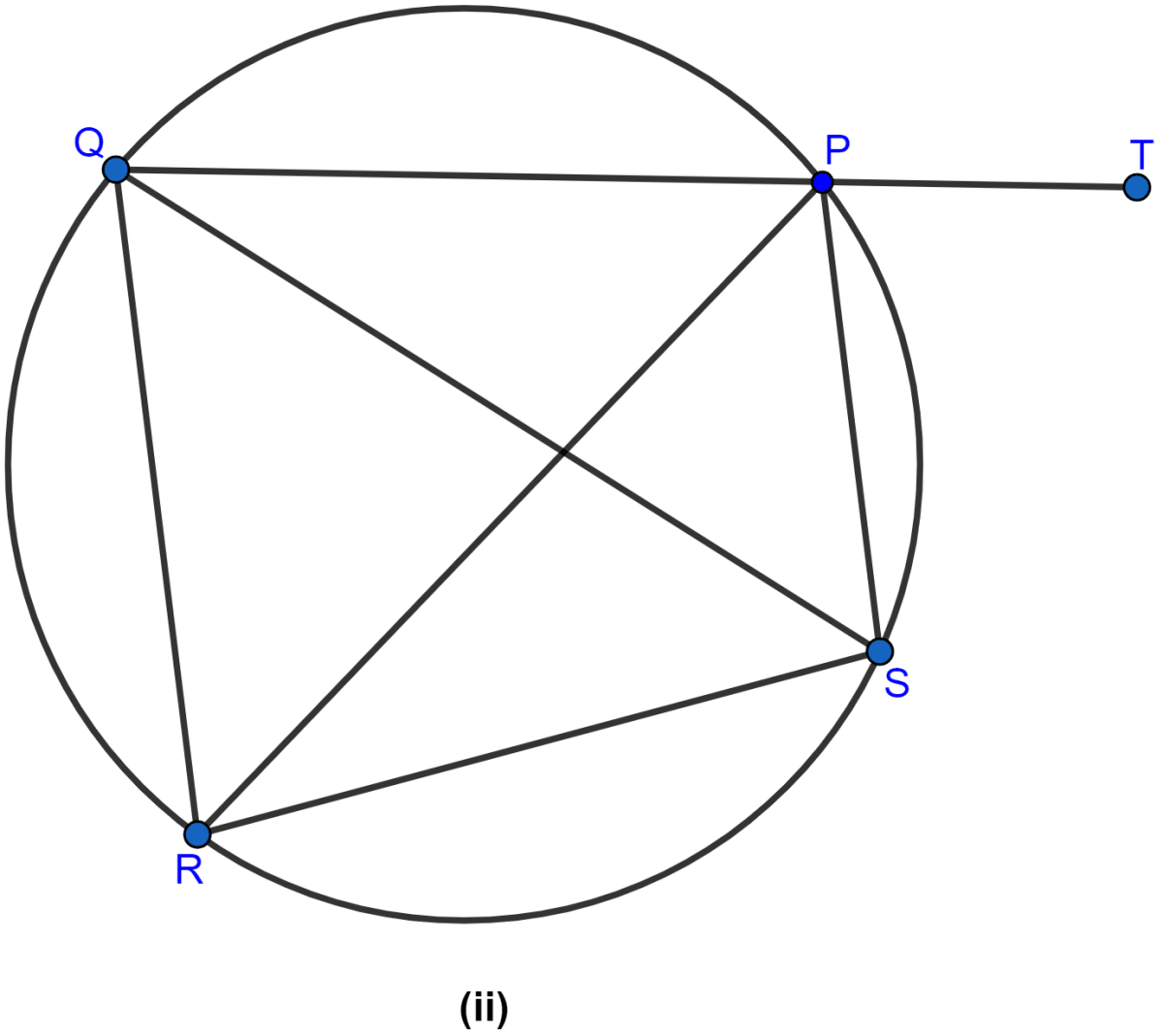
In the figure (ii) given below, SP is the bisector of ∠RPT and PQRS is a cyclic quadrilateral. Prove that SQ = RS.
Answer
Since, SP is the bisector of the angle ∠RPT.
So, ∠RPS = ∠SPT
From figure,
∠RPS = ∠RQS (As angle in same segment are equal)
Given, PQRS is a cyclic quadrilateral.
∵ exterior angle of a cyclic quadrilateral is equal to the opposite interior angle.
∠QRS = ∠SPT
∴ ∠QRS = ∠RPS
or,
∠QRS = ∠RQS
In △QRS,
∠QRS = ∠RQS
∴ SQ = RS (As sides opposite to equal angles are equal.)
Hence, proved that SQ = RS.
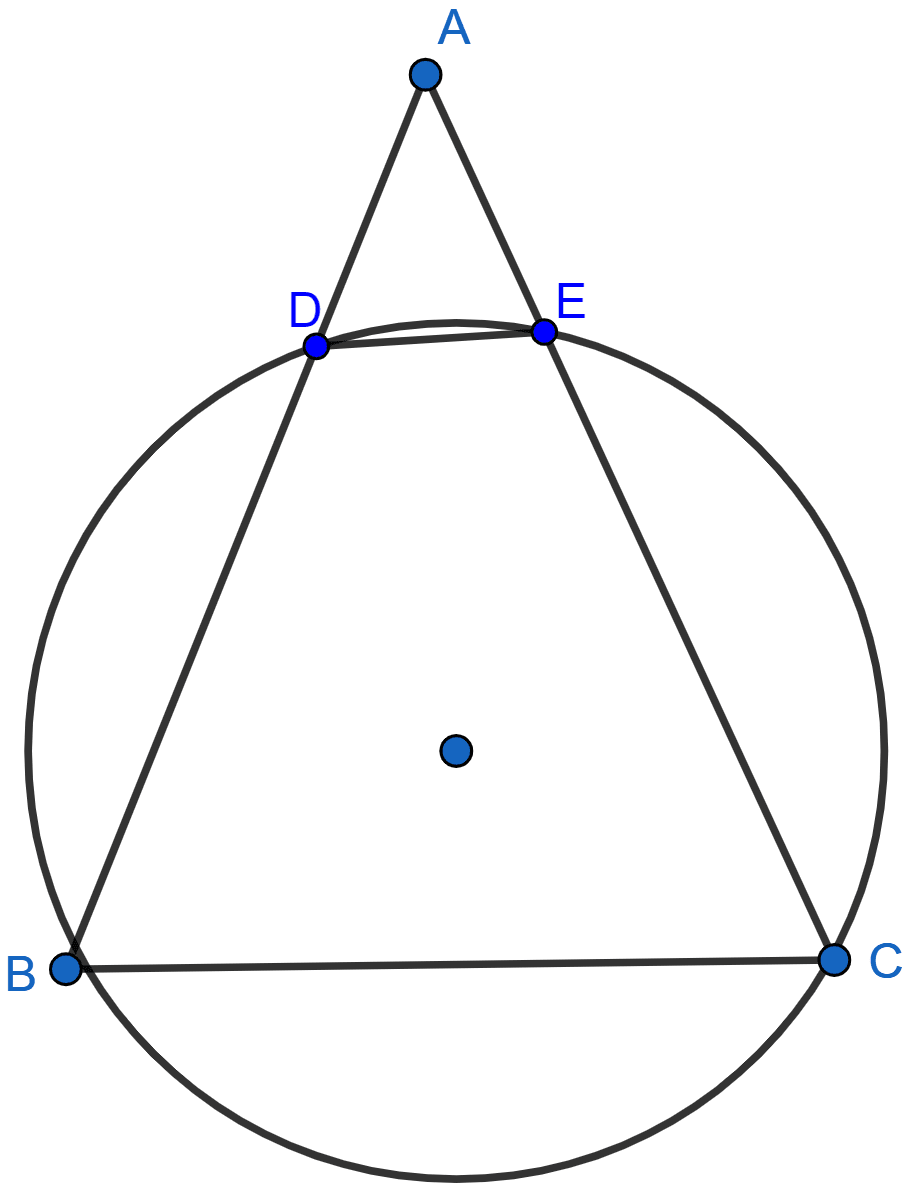
In the adjoining figure, ABC is an isosceles triangle in which AB = AC and circle passing through B and C intersects sides AB and AC at points D and E. Prove that DE || BC.
Answer
Given, AB = AC
∴ ∠ABC = ∠ACB (As angles opposite to equal sides are equal)
As BCED is a cyclic quadrilateral,
∠ADE = ∠BCE (∵ exterior angle of a cyclic quadrilateral is equal to the opposite interior angle.)
∴ ∠ADE = ∠ABC
Since these angles are equal and are corresponding this is the property of parallel lines,
∴ DE || BC.
Hence, proved that DE || BC.
Prove that a cyclic parallelogram is a rectangle.
Answer
Let ABCD be a cyclic parallelogram.
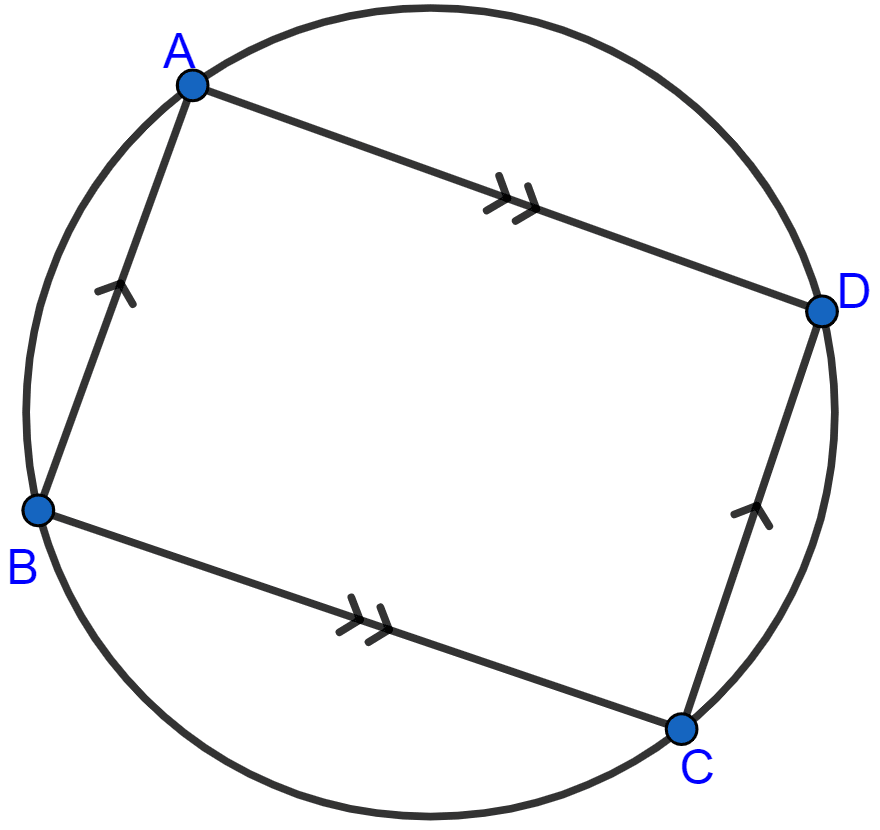
In parallelogram opposite angles are equal.
∴ ∠A = ∠C and ∠B = ∠D.
Sum of opposite angles of a cyclic quadrilateral is 180°
⇒ ∠A + ∠C = 180°
⇒ ∠A + ∠A = 180°
⇒ 2∠A = 180°
⇒ ∠A = 90°.
∴ ∠C = 90°.
Similarly,
⇒ ∠B + ∠D = 180°
⇒ ∠B + ∠B = 180°
⇒ 2∠B = 180°
⇒ ∠B = 90°.
∴ ∠D = 90°.
Hence, ∠A = ∠B = ∠C = ∠D = 90°.
In parallelogram opposite sides are equal i.e. AD = BC and AB = CD.
Hence, ABCD is a rectangle as opposite sides are equal and all the angles are equal to 90°.
Prove that a cyclic rhombus is a square.
Answer
Let ABCD be a cyclic rhombus.

In rhombus opposite angles are equal.
∴ ∠A = ∠C and ∠B = ∠D.
Sum of opposite angles of a cyclic quadrilateral is 180°
⇒ ∠A + ∠C = 180°
⇒ ∠A + ∠A = 180°
⇒ 2∠A = 180°
⇒ ∠A = 90°.
∴ ∠C = 90°.
Similarly,
⇒ ∠B + ∠D = 180°
⇒ ∠B + ∠B = 180°
⇒ 2∠B = 180°
⇒ ∠B = 90°.
∴ ∠D = 90°.
Hence, ∠A = ∠B = ∠C = ∠D = 90°.
In rhombus all sides are equal i.e. AD = BC = AB = CD.
Hence, ABCD is a square as all sides are equal and all the angles are equal to 90°.
In the adjoining figure, chords AB and CD of the circle are produced to meet at O. Prove that triangles ODB and OAC are similar. Given that CD = 2 cm, DO = 6 cm and BO = 3 cm, calculate AB. Also find

Answer
In △ODB and △OAC,
∠ODB = ∠C
∠O = ∠O (Common)
∴ △ODB ~ △OAC (AA axiom)
Since, in similar triangles the ratio of the corresponding sides are equal.
AB = OA - OB = 16 - 3 = 13 cm.
Since, △ODB ~ △OAC
Subtracting 1 from both sides we get,
Dividing (ii) by (i),
Hence, the length of AB = 13 cm and