
Draw a straight line AB of length 8 cm. Draw the locus of all points which are equidistant from A and B. Prove your statement.
Answer
We know that locus of point equidistant from two points is the perpendicular bisector of the line segment joining them.
From the figure,
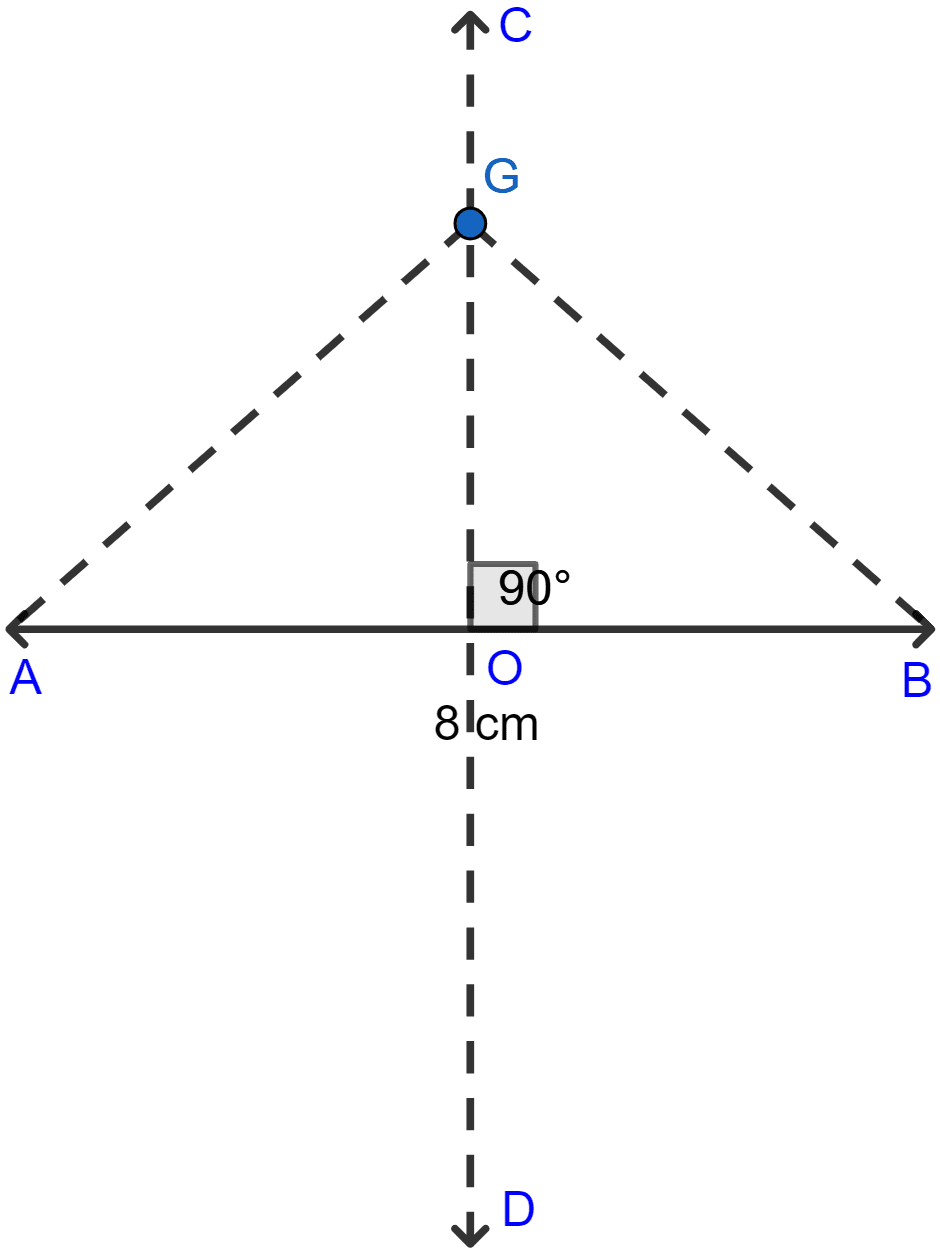
CD is the locus of all points which are equidistant from A and B.
Proof :
Consider △GOA and △GOB.
∠GOA = ∠GOB (Both are equal to 90°)
OG = OG (Common side)
AO = OB (They are equal as CD bisects AB at O).
Hence, by SAS congruence, △GOA ≅ △GOB.
Therefore, .
Thus, any point on CD is equidistant from A and B.
A point P is allowed to travel in space. State the locus of P so that it always remains at a constant distance from a fixed point C.
Answer
Since, the point P is allowed to travel in space hence, the point can be any dimension.
Hence, the locus will be a sphere with C as center and constant distance as radius.
Draw a line segment AB of length 7 cm. Construct the locus of a point P such that area of triangle PAB is 14 cm2.
Answer
Let the height of triangle PAB = h cm.
So, area of triangle = × base × height
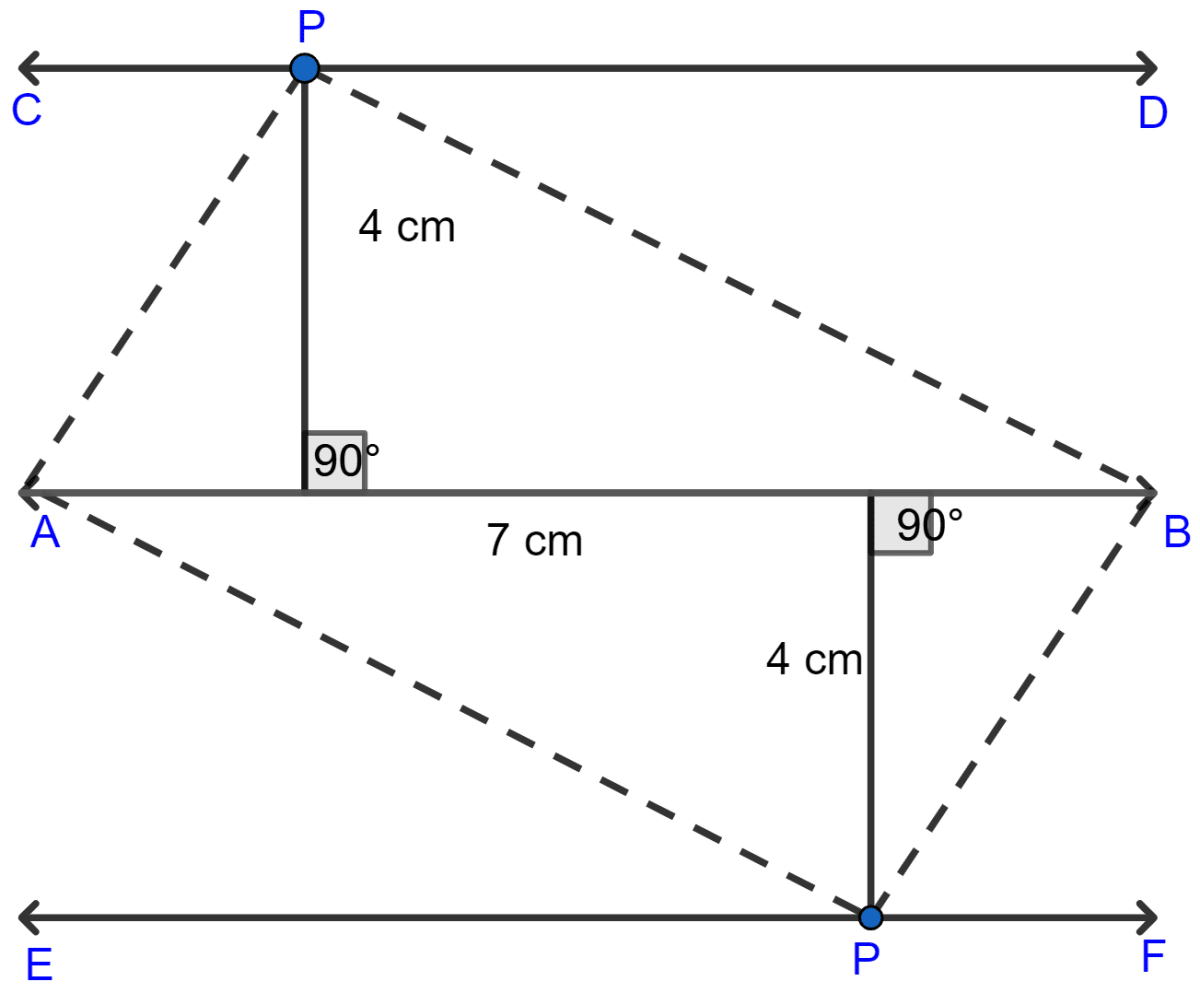
Hence, the locus of point P will be a pair of straight lines (CD and EF in figure) at a distance of 4 cm from AB.
Draw a line segment AB of length 12 cm. Mark M, the mid-point of AB. Draw and describe the locus of a point which is
(i) at a distance of 3 cm from AB.
(ii) at a distance of 5 cm from the point M.
Mark the points P, Q, R, S which satisfy both the above conditions. What kind of quadrilateral is PQRS ? Compute the area of quadrilateral PQRS.
Answer
The figure is shown below:

(i) Draw the line segment CD and EF parallel to AB, at a distance of 3 cm from it.
Hence, the locus is a pair of straight lines at a distance of 3 cm from AB.
(ii) Mark M as the mid-point of AB. Take M as centre and radius 5 cm and draw a circle.
Hence, the locus is a circle with centre M and radius 5 cm.
(iii) The circle meets the segments CD and EF at P, Q, R and S.
P, Q, R and S are joined to form a rectangle.
Area of rectangle = Length × Breadth = PQ × PR.
On measuring, cm and cm.
So, area = cm2.
Hence, PQRS is a rectangle and its area is 48 cm2.
AB and CD are two intersecting lines. Find the position of a point which is at a distance of 2 cm from AB and 1.6 cm from CD.
Answer
As shown in figure,

Draw EF at a distance of 2 cm and parallel to AB.
Draw GH at a distance of 1.6 cm and parallel to CD.
The point M is the point of intersection of EF and GH.
Hence, point M is the position of point which is at a distance of 2 cm from AB and 1.6 cm from CD.
Two straight roads PQ and PK cross each other at P at an angle of 75°. S is a stone on the road PQ, 800 m from P towards Q. By drawing a figure to scale 1 cm = 100 m, locate the position of a flag staff X, which is equidistant from P and S, and is also equidistant from the roads.
Answer
Scale given 1 cm = 100m so, 800m = 8 cm.
Two roads PK and PQ are drawn with an angle of 75°.

We know that locus of point equidistant from two lines is the angle bisector between them.
From the figure we see that,
PR is the angle bisector of ∠KPQ.
We know that locus of point equidistant from two points is the perpendicular bisector of line segment joining the points.
From the figure we see that,
AB is the perpendicular bisector of PS.
AB and PR intersects at X.
Hence, point X is equidistant from P and S also from roads PK and PQ.
Construct a rhombus PQRS whose diagonals PR, QS are 8 cm and 6 cm respectively. Find by construction a point X equidistant from PQ, PS and equidistant from R, S. Measure XR.
Answer
Steps of construction :
Draw QS = 6 cm and PR = 8 cm as diagonals. Join the points to form rhombus PQRS.
Since, diagonals of rhombus bisects vertices, hence, PR is angular bisector of SPQ.
Draw CD, the perpendicular bisector of RS.
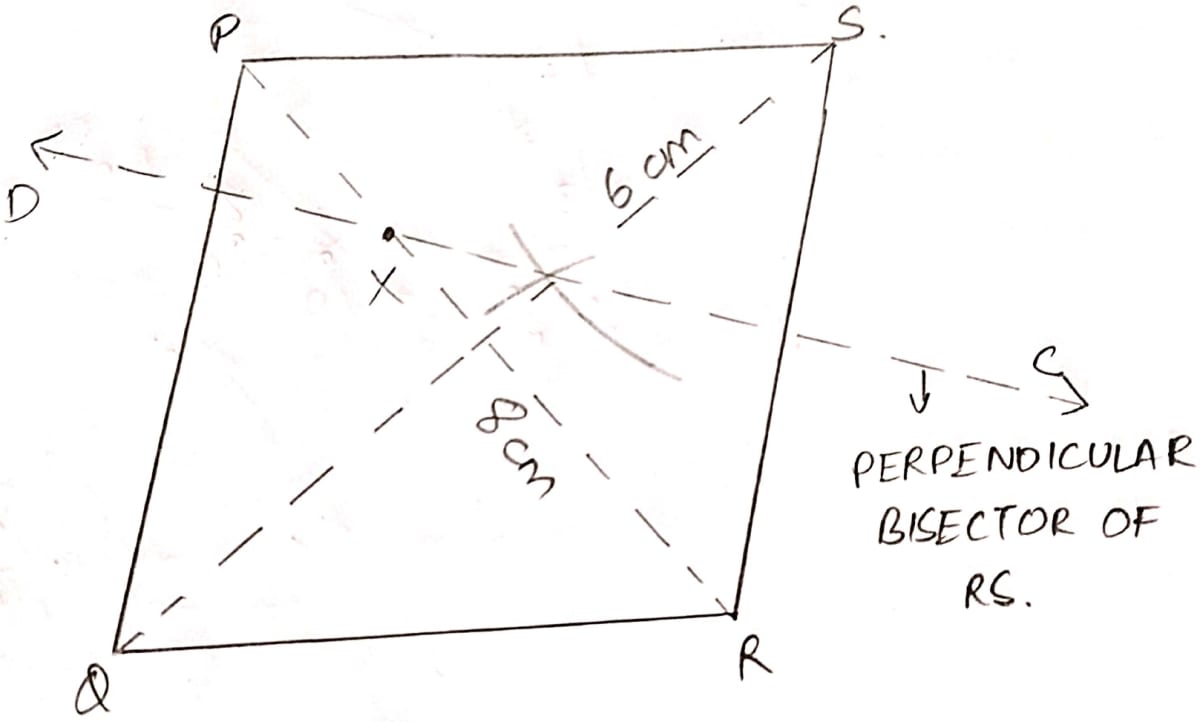
The intersection of CD and PR is the point X which satisfies both i.e. it is equidistant from PQ, PS and R and S also.
On measuring we get, XR = 3.15 cm.
Without using set square or protractor, construct the parallelogram ABCD in which AB = 5.1 cm, the diagonal AC = 5.6 cm and the diagonal BD = 7 cm. Locate the point P on DC, which is equidistant from AB and BC.
Answer
Steps of construction :
Draw AB = 5.1 cm as base.
At A, with radius 2.8 cm and at B with radius 3.5 cm draw two arcs intersecting each other at O.
Join AO and produce it till C such that OC = AO = 2.8 cm and join BO and produce it till D such that OD = BO = 3.5 cm.
Join A, B, C and D forming parallelogram ABCD.

We know that locus of point equidistant from two lines is the angle bisector of the two lines.
From the figure,
BE is the angle bisector of ∠ABC which meets DC at P.
By using ruler and compasses only, construct a quadrilateral ABCD in which AB = 6.5 cm, AD = 4 cm and ∠DAB = 75°. C is equidistant from the sides AB and AD, also C is equidistant from the points A and B.
Answer
Steps of construction :
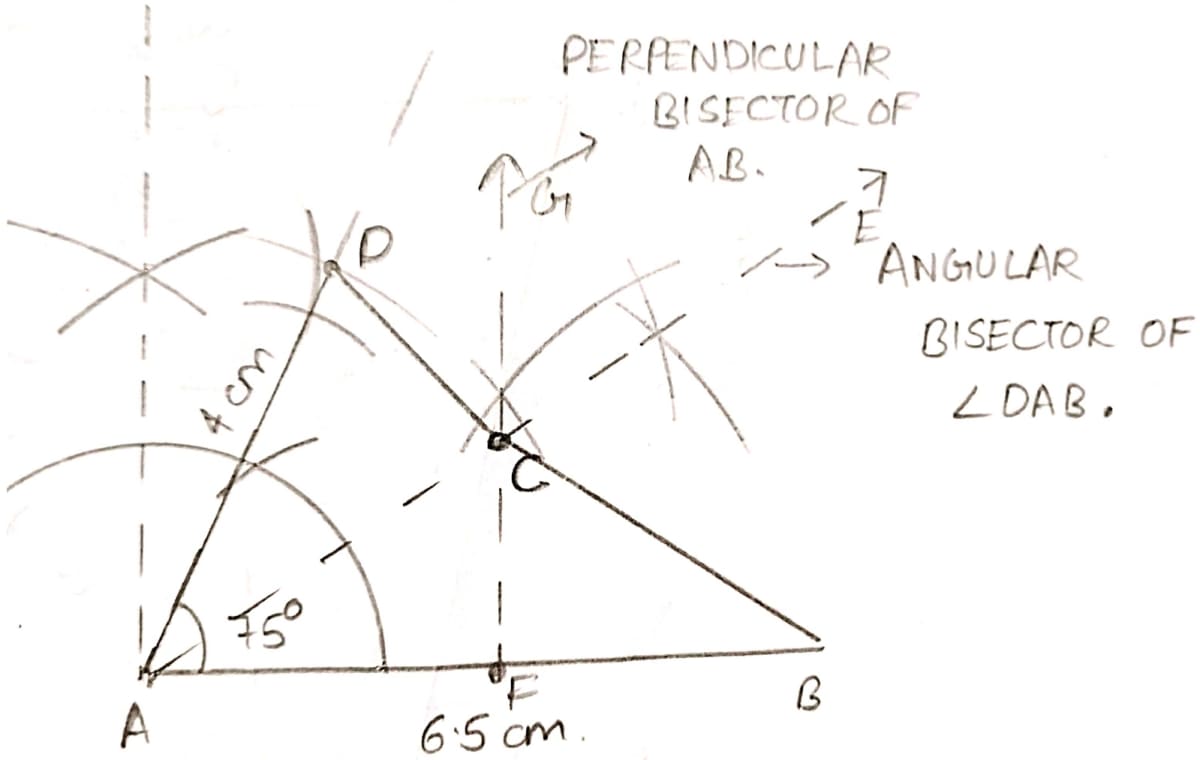
Draw AB = 6.5 cm as base.
At A, construct angle ∠DAB = 75° and cut an arc from A on it and mark point D such that AD = 4 cm.
Since, C is equidistant from the sides AB and AD, also C is equidistant from the points A and B hence it will be the intersection point of perpendicular bisector of AB i.e. FG and angle bisector of ∠DAB i.e. AE.
Join A, B, C and D forming quadrilateral ABCD.
Use ruler and compass to answer this question. Construct ∠ABC = 90°, where AB = 6 cm, BC = 8 cm.
(a) Construct the locus of points equidistant from B and C.
(b) Construct the locus of points equidistant from A and B.
(c) Mark the point which satisfies both the conditions (a) and (b) as O. Construct the locus of points keeping a fixed distance OA from the fixed point O.
(d) Construct the locus of points which are equidistant from BA and BC.
Answer
Steps of construction :
Draw a line segment BC = 8 cm.
Construct ∠ABC = 90°, such that AB = 6 cm.
Draw XY, the perpendicular bisector of BC.
Draw PQ, the perpendicular bisector of AB.
Mark point O, the intersection of segment XY and PQ.
Draw BZ, the angle bisector of ∠ABC.

We know that,
The locus of points equidistant from two points is the perpendicular bisector of the line segment joining the two points.
(a) Locus of points equidistant from B and C is XY.
(b) Locus of points equidistant from A and B is PQ.
(c) The required locus is the circle with centre O and radius OA.
We know that,
The locus of points equidistant from two sides is the angle bisector of the angle between them.
(d) Locus of points which are equidistant from BA and BC is BZ.