
Find the length of the tangent drawn to a circle of radius 8 cm, from a point which is at a distance of 10 cm from the centre of the circle.
Answer
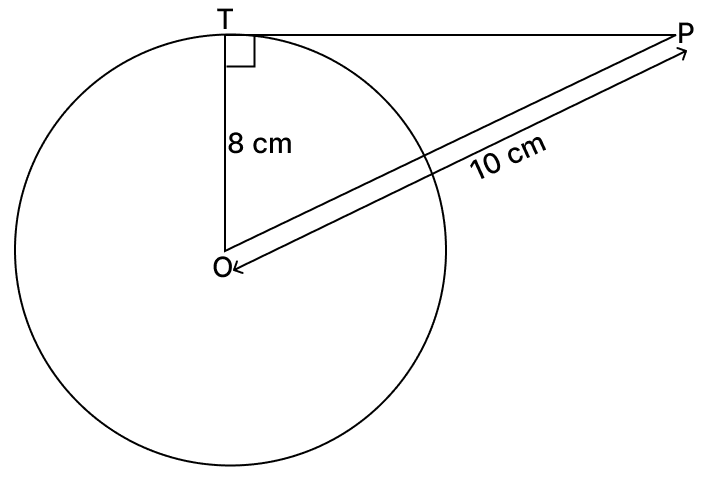
Consider a circle with centre O and radius 8 cm.
Let P be an external point from where a tangent is drawn to meet the circle at T. Join OT.
∴ OP = 10 cm and OT = 8 cm
We know that,
The tangent at any point of a circle and the radius through this point are perpendicular to each other.
In right angled ∆OTP, we have
⇒ OP2 = OT2 + PT2
⇒ 102 = 82 + PT2
⇒ PT2 = 100 - 64 = 36
⇒ PT = 6 cm
Hence, the length of tangent = 6 cm.
A point P is 17 cm away from the centre of the circle and the length of the tangent drawn from P to the circle is 15 cm. Find the radius of the circle.
Answer
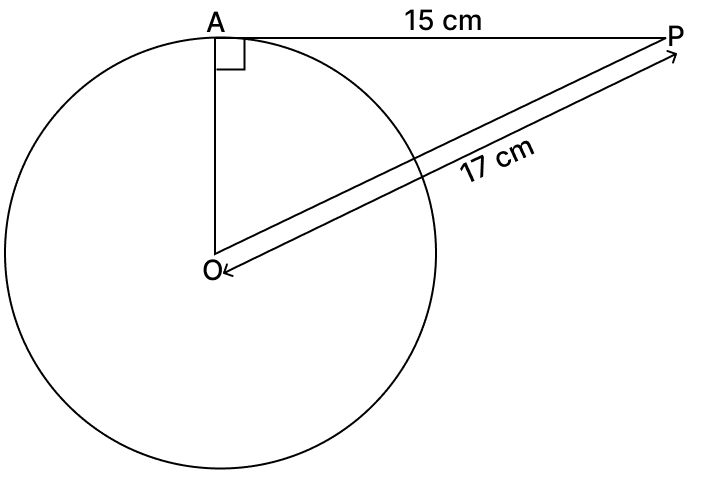
Consider a circle with centre O,
Let P be an external point from where a tangent is drawn to meet the circle at A.
∴ OP = 17 cm and AP = 15 cm
We know that,
The tangent at any point of a circle and the radius through this point are perpendicular to each other.
In right angled ∆OAP, we have
⇒ OP2 = OA2 + AP2
⇒ 172 = OA2 + 152
⇒ 289 = OA2 + 225
⇒ OA2 = 289 - 225
⇒ OA2 = 64
⇒ OA =
⇒ OA = 8 cm
Hence, the radius of circle is 8 cm.
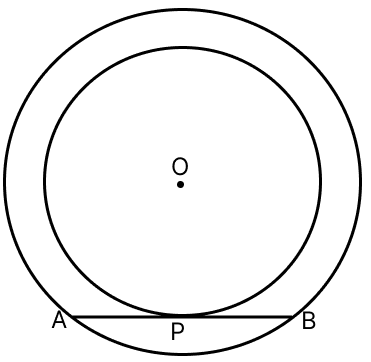
There are two concentric circles, each with centre O and of radii 10 cm and 26 cm respectively. Find the length of the chord AB of the outer circle which touches the inner circle at P.
Answer
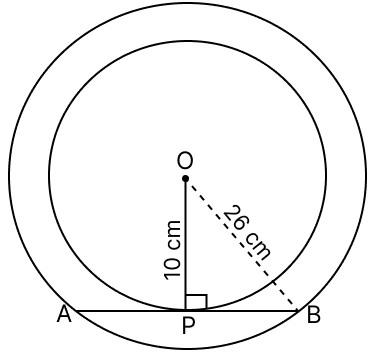
AB is the chord of the outer circle which touches the inner circle at P.
OP is the radius of the inner circle and APB is the tangent to the inner circle.
In the right angled triangle OPB, by pythagoras theorem,
⇒ OB2 = OP2 + PB2
⇒ 262 = 102 + PB2
⇒ 676 = 100 + PB2
⇒ PB2 = 676 - 100
⇒ PB2 = 576
⇒ PB =
⇒ PB = 24 cm
As perpendicular line from centre bisects the chord of the circle so,
AP = PB = 24 cm.
AB = AP + PB = 24 + 24 = 48 cm.
Hence, the length of chord (AB) = 48 cm.
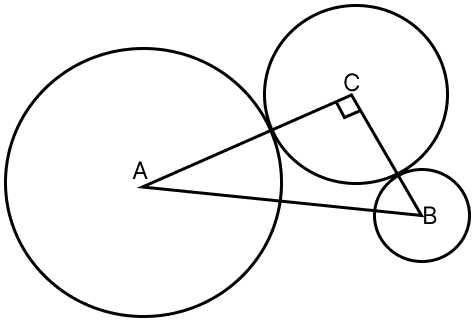
A and B are centres of circles of radii 9 cm and 2 cm such that AB = 17 cm and C is the centre of the circle of radius r cm which touches the above circles externally. If ∠ACB = 90°, write an equation in r and solve it.
Answer
From figure,
In △ABC,
By pythagoras theorem,
⇒ AB2 = AC2 + BC2
⇒ 172 = (r + 9)2 + (r + 2)2
⇒ 289 = r2 + 81 + 18r + r2 + 4 + 4r
⇒ 289 = 2r2 + 85 + 22r
⇒ 2r2 + 22r + 85 - 289 = 0
⇒ 2r2 + 22r - 204 = 0
⇒ 2(r2 + 11r - 102) = 0
⇒ r2 + 11r - 102 = 0
⇒ r2 + 17r - 6r - 102 = 0
⇒ r(r + 17) - 6(r + 17) = 0
⇒ (r - 6)(r + 17) = 0
⇒ r - 6 = 0 or r + 17 = 0
⇒ r = 6 or r = -17.
Since, radius cannot be negative.
⇒ r = 6 cm.
Hence, equation is r2 + 11r - 102 = 0 and r = 6 cm.
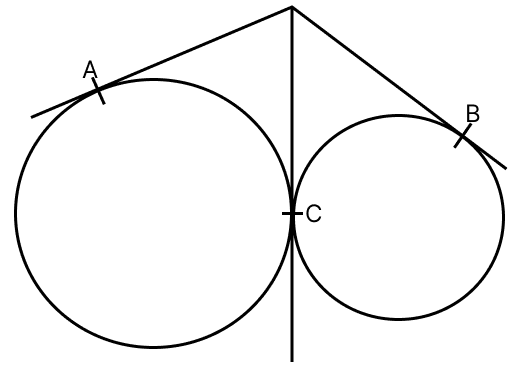
Two circles touch each other externally at a point C and P is a point on the common tangent at C. If PA and PB are tangents to the two circles, prove that PA = PB.
Answer
The tangents from a point outside the circle are equal.
The point P is also external to the right circle. The segments PB and PC are tangents drawn from P to this circle.
PB = PC .........(1)
The point P is external to the left circle. The segments PA and PC are tangents drawn from P to this circle.
PA = PC .........(2)
From (1) and (2), we get :
∴ PA = PB.
Hence, proved that PA = PB.
Two circles touch each other internally. Prove that the tangents drawn to the two circles from any point on the common tangent are equal in length.
Answer
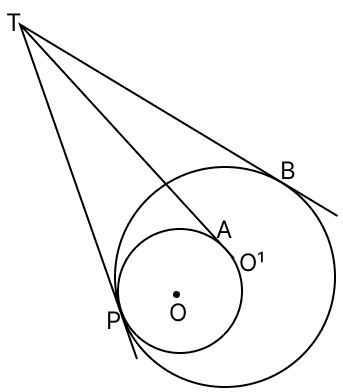
As tangents drawn from an external point to a circle are equal in length.
From T, TA and TP are tangents to the circle with centre O.
TA = TP .....(1)
From T, TB and TP are tangents to the circle with centre O'.
TB = TP ........(2)
From (1) and (2),
TA = TB.
Hence, proved that tangents drawn to two circles from any point on common tangent are equal in length.
Two circles of radii 18 cm and 8 cm touch externally. Find the length of a direct common tangent to the two circles.
Answer
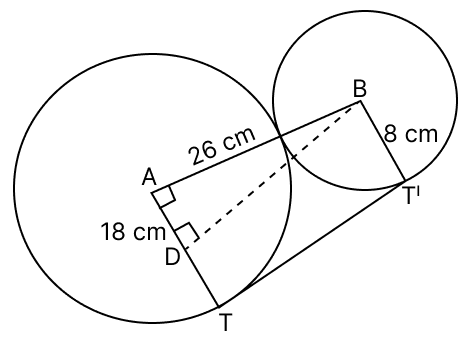
Let there be two circles with centre A and B with radius 18 cm and 8 cm respectively.
Let TT' be the length of common tangent.
Construct a right-angled triangle Δ ADB by drawing a line from center B parallel to TT' to intersect radius AT at D.
From figure,
DT = BT' = 8cm.
AD = AT - DT = 18 - 8 = 10 cm.
AB = 18 + 8 = 26 cm
In right angled triangle ADB,
⇒ AB2 = AD2 + DB2
⇒ 262 = 102 + DB2
⇒ 676 = 100 + DB2
⇒ DB2 = 676 - 100
⇒ DB2 = 576
⇒ DB = 24 cm
Since, TDBT' is a rectangle,
So, TT' = DB = 24 cm.
Hence, the length of direct common tangent is 24 cm.
Two circles of radii 8 cm and 3 cm have their centres 13 cm apart. Find the length of a direct common tangent to the two circles.
Answer
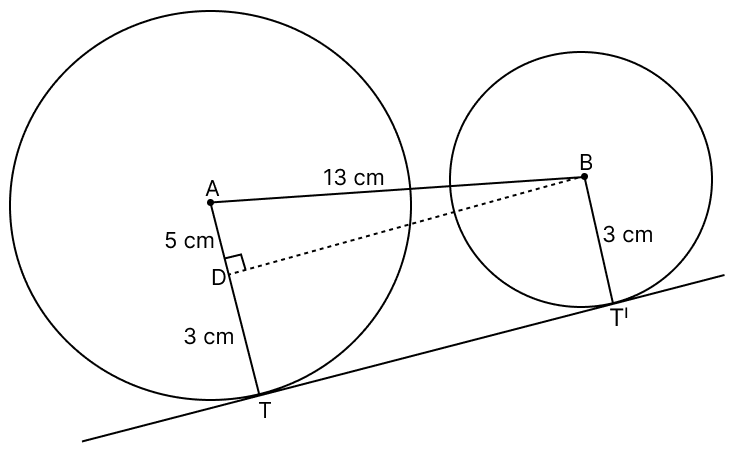
Let there be two circles with centre A and B with radius 8 cm and 3 cm respectively.
Let TT' be the length of common tangent.
Construct a right-angled triangle ΔADB by drawing a line from center B parallel to TT' to intersect radius AT at D.
From figure,
DT = BT' = 3cm.
AD = AT - DT = 8 - 3 = 5 cm.
In right angled triangle ADB,
⇒ AB2 = AD2 + DB2
⇒ 132 = 52 + DB2
⇒ DB2 = 132 - 52
⇒ DB2 = 169 - 25
⇒ DB2 = 144
⇒ DB = 12 cm
Since, TDBT' is a rectangle,
So, TT' = DB = 12 cm.
Hence, the length of direct common tangent is 12 cm.
Two circles of radii 8 cm and 3 cm have a direct common tangent of length 10 cm. Find the distance between their centres, upto two places of decimal.
Answer
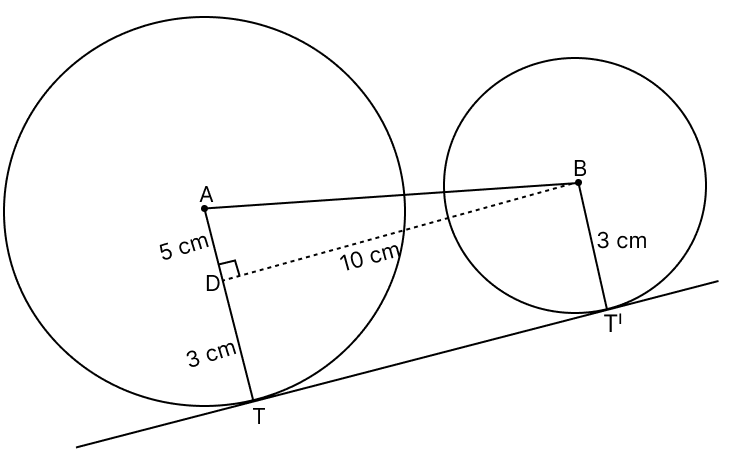
Let there be two circles with centre A and B with radius 8 cm and 3 cm respectively.
Let TT' be the length of common tangent.
Construct a right-angled triangle Δ ADB by drawing a line from center B parallel to TT' to intersect radius AT at D.
From figure,
⇒ TT' = BD = 10 cm
⇒ DT = BT' = 3 cm.
⇒ AD = AT - DT = 8 - 3 = 5 cm.
In right angled triangle ADB,
⇒ AB2 = AD2 + DB2
⇒ AB2 = 102 + 52
⇒ AB2 = 100 + 25
⇒ AB2 = 125
⇒ AB =
⇒ AB = 11.18 cm.
Hence, the distance between the centres 11.18 cm.
With the vertices of Δ PQR as centres, three circles are described, each touching the other two externally. If the sides of the triangle are 7 cm, 8 cm and 11 cm, find the radii of the three circles.
Answer
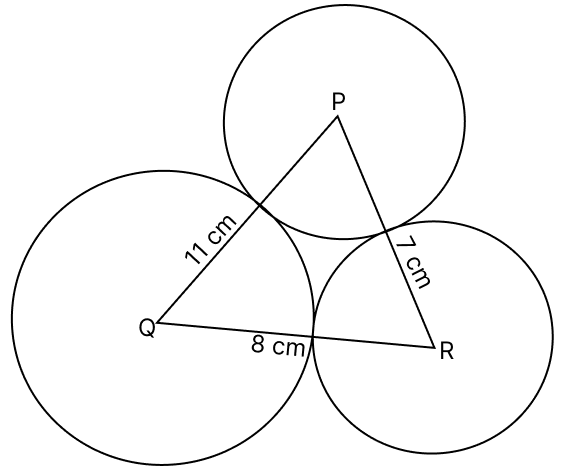
Let radius of circles with center P, Q and R be r1, r2 and r3.
⇒ PQ = r1 + r2 = 7 …………(1)
⇒ PR = r1 + r3 = 8 …………(2)
⇒ QR = r2 + r3 = 11 ………….(3)
Adding all the above equations, we get
⇒ r1 + r2 + r1 + r3 + r2 + r3 = 7 + 8 + 11
⇒ 2(r1 + r2 + r3) = 26
⇒ r1 + r2 + r3 = ⇒ r1 + r2 + r3 = 13 cm ………..(4)
Substituting value of r2 + r3 = 11 in equation (4) we get :
⇒ r1 + 11 = 13
⇒ r1 = 13 - 11
⇒ r1 = 2 cm.
Substituting value of r1 + r2 = 7 in equation (4) we get :
⇒ 7 + r3 = 13
⇒ r3 = 13 - 7
⇒ r3 = 6 cm.
Substituting value of r1 + r3 = 8 in equation (4) we get :
⇒ 8 + r2 = 13
⇒ r2 = 13 - 8
⇒ r2 = 5 cm.
Hence, the radii of the circles with center P, Q and R are 2 cm, 5 cm and 6 cm.
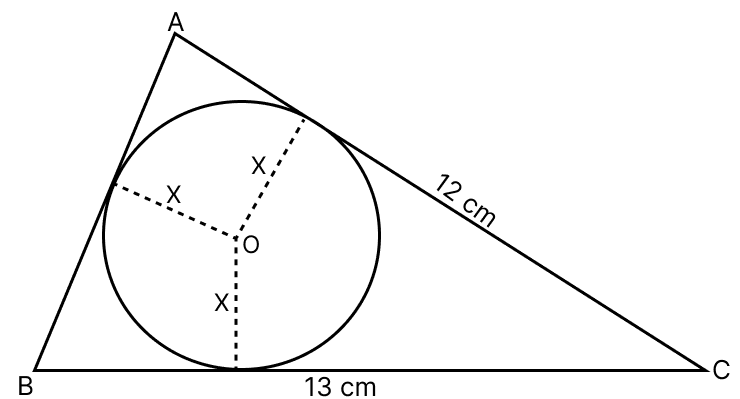
ΔABC is a right-angled triangle in which ∠A = 90°, AC = 12 cm and BC = 13 cm. A circle with centre O has been inscribed inside the triangle. Calculate the value of x, the radius of the inscribed circle.
Answer
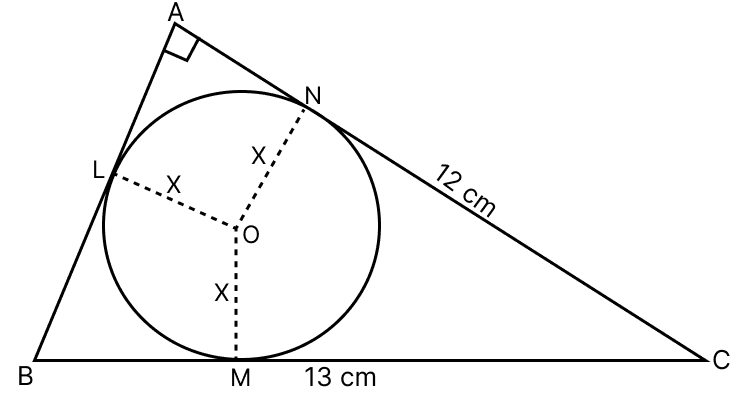
Let AB touches the circle at L, AC at N and BC at M.
From figure,
ANLO is a square
AL = LO = ON = AN = x
NC = AC - AN = (12 - x) cm
NC = MC = (12 - x) cm [∵ Tangents from exterior point are equal in length.]
Since, ABC is a right angled triangle,
∴ BC2 = AC2 + AB2 [By pythagoras theorem]
⇒ 132 = 122 + AB2
⇒ AB2 = 132 - 122
⇒ AB2 = 169 - 144
⇒ AB2 = 25
⇒ AB =
⇒ AB = 5 cm.
From figure,
LB = AB - AL = (5 - x) cm.
LB = BM = (5 - x) cm.[∵ Tangents from exterior point are equal in length.]
Then,
⇒ BC = BM + CM
⇒ 13 = (5 - x) + (12 - x)
⇒ 13 = 17 - 2x
⇒ 2x = 17 - 13
⇒ 2x = 4
⇒ x =
⇒ x = 2 cm.
Hence, x = 2 cm.
PQR is a right-angled triangle with PQ = 3 cm and QR = 4 cm. A circle which touches all the sides of the triangle is inscribed in the triangle. Calculate the radius of the circle.
Answer
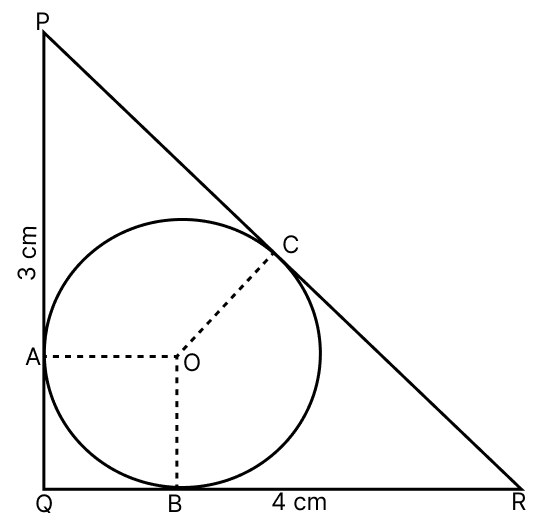
Let the inscribed circle touch the sides PQ, QR and PR at A, B and C respectively.
PQR is a right-angled triangle with PQ = 3 cm and QR = 4 cm.
By pythagoras theorem,
⇒ PR2 = PQ2 + QR2
⇒ PR2 = 32 + 42
⇒ PR2 = 9 + 16
⇒ PR2 = 25
⇒ PR = 5 cm.
By tangent property we have,
∠OAQ = ∠OBQ = 90°
∠AQB = 90°
Since, all the angles of OAQB equals to 90°.
From figure,
OAQB is a square.
OA = OB = AQ = BQ = x (let)
PA = PQ - AQ = (3 - x) cm
PA = PC = (3 - x) cm.[∵ Tangents from exterior point are equal in length.]
RB = RQ - QB = (4 - x) cm
RC = RB = (4 - x) cm.[∵ Tangents from exterior point are equal in length.]
PR = PC + RC = 3 - x + 4 - x = 7 - 2x
5 = 7 - 2x
2x = 7 - 5
2x = 2
x = 1 cm.
Hence, radius of the circle inscribed in the triangle equals to 1 cm.
In the given figure, O is the centre of each one of two concentric circles of radii 4 cm and 6 cm respectively. PA and PB are tangents to outer and inner circle respectively. If PA = 10 cm, find the length of PB, upto two places of decimal.
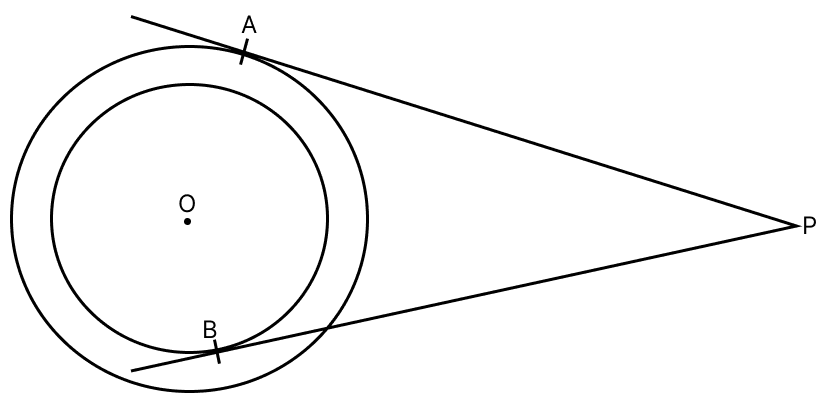
Answer
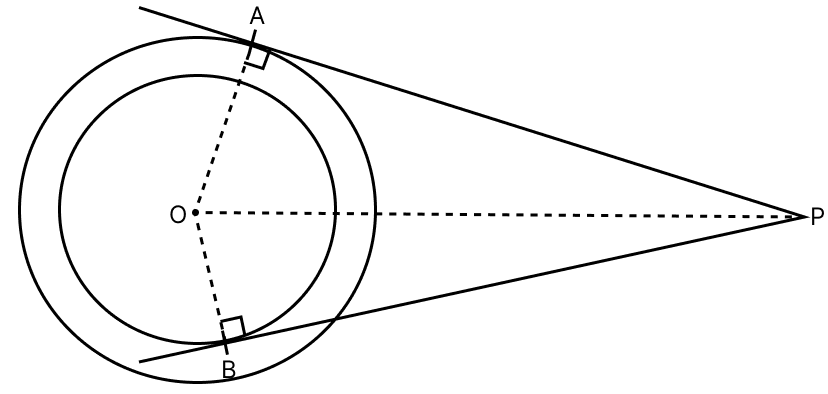
Given,
O is the centre of two concentric circles of radii OA = 6 cm and OB = 4 cm.
PA and PB are the two tangents to the outer and inner circles respectively and PA = 10 cm.
We know that,
The tangent at any point of a circle and the radius through this point are perpendicular to each other.
∠OAP = ∠OBP = 90°
Since, OAP is a right angled triangle,
∴ OP2 = OA2 + PA2 [By pythagoras theorem]
⇒ OP2 = 62 + 102
⇒ OP2 = 36 + 100
⇒ OP2 = 136
⇒ OP =
Since, OBP is a right angled triangle,
⇒ OP2 = OB2 + PB2
⇒ PB2 = OP2 - OB2
⇒ PB2 =
⇒ PB2 = 136 - 16
⇒ PB2 = 120
⇒ PB =
⇒ PB = 10.95 cm
Hence, length of PB is 10.95 cm.
In the given figure, ΔABC is circumscribed. The circle touches the sides AB, BC and CA at P, Q, R respectively. If AP = 5 cm, BP = 7 cm, AC = 14 cm and BC = x cm, find the value of x.
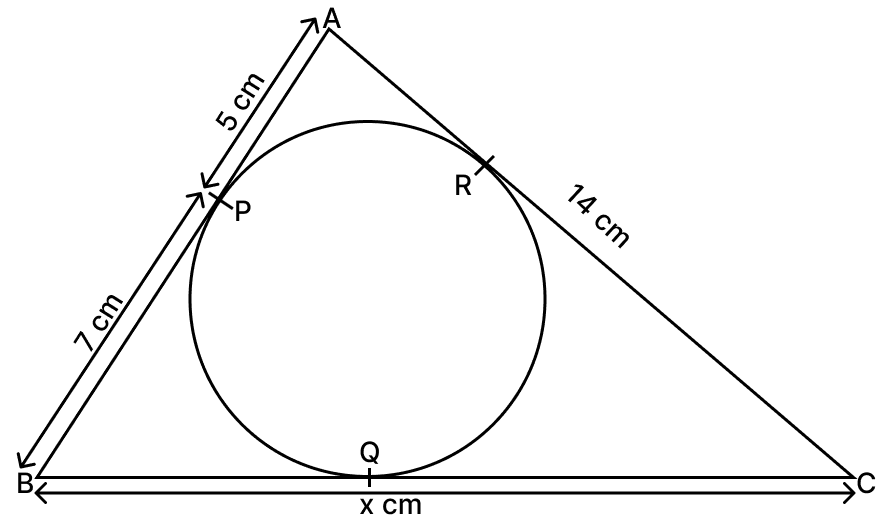
Answer
We know that,
Tangents from an exterior point to a circle are equal in length.
From A,
⇒ AP = AR = 5 cm
From figure,
⇒ AC = AR + RC
⇒ 14 = 5 + RC
⇒ RC = 14 - 5 = 9 cm
From B,
BP = BQ = 7 cm
From C,
CQ = CR = 9 cm
From figure,
⇒ BC = BQ + QC = 7 + 9 = 16 cm
⇒ x = 16 cm.
Hence, x = 16 cm.
In the given figure, quadrilateral ABCD is circumscribed. The circle touches the sides AB, BC, CD and DA at P, Q, R, S respectively. If AP = 9 cm, BP = 7 cm, CQ = 5 cm and DR = 6 cm, find the perimeter of quadrilateral ABCD.
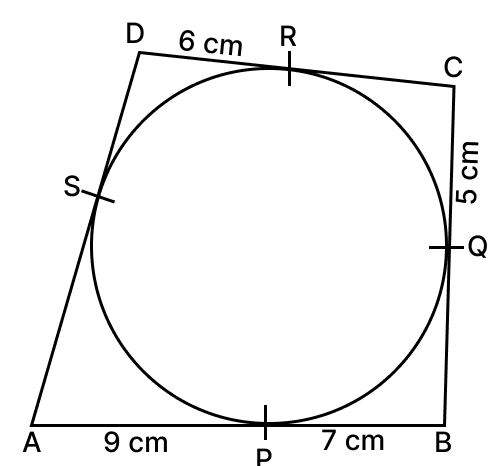
Answer
We know that,
Tangents from an exterior point to a circle are equal in length.
From A,
AP = AS = 9 cm
From B,
BP = BQ = 7 cm
From C,
CQ = CR = 5 cm
From D,
DR = DS = 6 cm
From figure,
⇒ AB = AP + PB = 9 + 7 = 16 cm
⇒ BC = BQ + QC = 7 + 5 = 12 cm
⇒ CD = CR + RD = 5 + 6 = 11 cm
⇒ DA = AS + SD = 9 + 6 = 15 cm
Perimeter of ABCD = AB + BC + CD + DA
= 16 + 12 + 11 + 15
= 54 cm.
Hence, perimeter of ABCD = 54 cm.
In the given figure, the circle touches the sides AB, BC, CD and DA of a quadrilateral ABCD at the points P, Q, R and S respectively. If AB = 11 cm, BC = x cm, CR = 4 cm and AS = 6 cm, find the value of x.
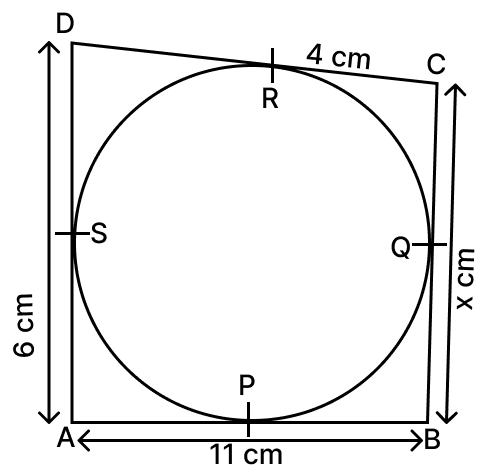
Answer
We know that,
Tangents from an exterior point to a circle are equal in length.
From A,
⇒ AP = AS = 6 cm
From C,
⇒ CR = CQ = 4 cm
⇒ BP = AB - AP = 11 - 6 = 5 cm.
From B,
⇒ BQ = BP = 5 cm
From figure,
BC = BQ + CQ = 5 + 4 = 9 cm
x = 9 cm
Hence, x = 9 cm.
In the given figure, a circle touches the side BC of ΔABC at P and AB and AC produced at Q and R respectively. If AQ = 15 cm, find the perimeter of ΔABC.
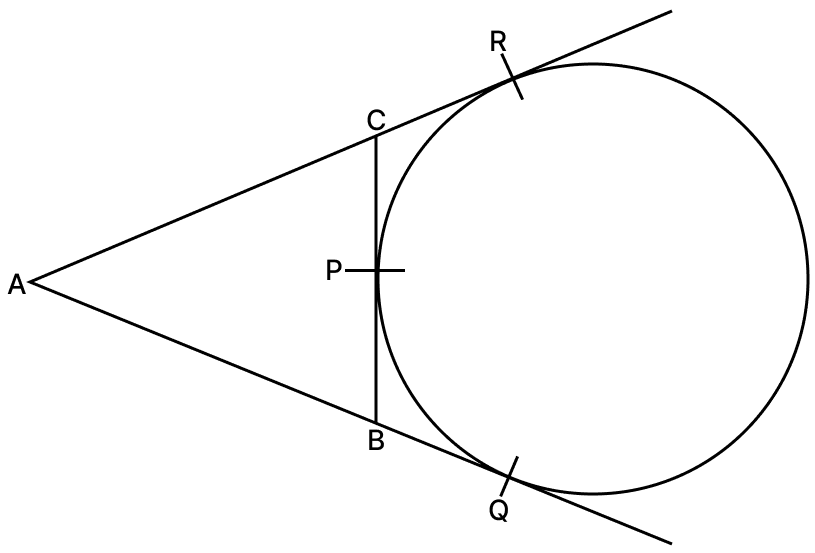
Answer
We know that,
Tangents from an exterior point to a circle are equal in length.
From A,
⇒ AQ = AR ....(1)
From B,
⇒ BQ = BP ....(2)
From C,
⇒ CP = CR .....(3)
Perimeter of triangle ABC = AB + BC + CA
= AB + (BP + PC) + (AR - CR)
= (AB + BP) + PC + (AQ - CP) ...[From equation (1) and (3)]
= (AB + BQ) + PC + (AQ - CP) ...[From equation (2)]
= AQ + PC + AQ - PC
= 2AQ
= 2(15)
= 30 cm.
Hence, perimeter of triangle ABC = 30 cm.
In the given figure, PA and PB are two tangents to the circle with centre O. If ∠APB = 40°, find ∠AQB and ∠AMB.
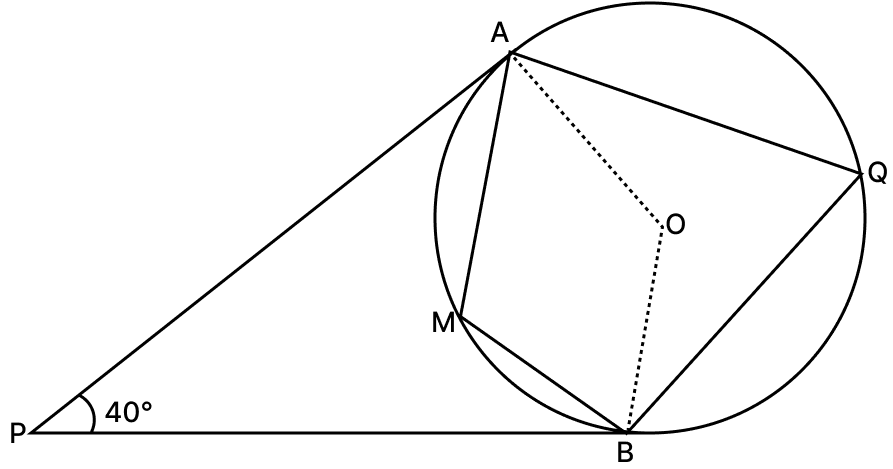
Answer
Join OA and OB.
We know that,
The tangent at any point of a circle and the radius through this point are perpendicular to each other.
∠PAO = ∠PBO = 90°
In quadrilateral AOPB, By angle sum property of quadrilateral,
⇒ ∠OAP + ∠APB + ∠PBO + ∠AOB = 360°
⇒ 90° + 40° + 90° + ∠AOB = 360°
⇒ 220° + ∠AOB = 360°
⇒ ∠AOB = 360° - 220°
⇒ ∠AOB = 140°.
Arc AB subtends ∠AOB at center and ∠AQB on the remaining part of the circle.
⇒ ∠AQB = ∠AOB
⇒ ∠AQB =
⇒ ∠AQB = 70°.
Sum of opposite angles in cyclic quadrilateral is 180°.
⇒ ∠AQB + ∠AMB = 180°
⇒ 70° + ∠AMB = 180°
⇒ ∠AMB = 180° - 70°
⇒ ∠AMB = 110°.
Hence, ∠AMB = 110° and ∠AQB = 70°.
In the given figure, PA and PB are two tangents to the circle with centre O. If ∠APB = 50°, find :
(i) ∠AOB
(ii) ∠OAB
(iii) ∠ACB
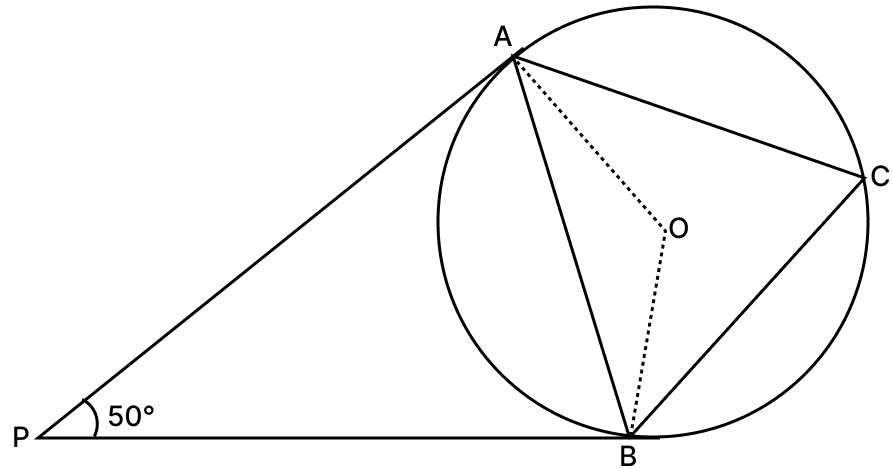
Answer
(i) We know that,
The tangent at any point of a circle and the radius through this point are perpendicular to each other.
∠OBP = ∠OAP = 90°
In quadrilateral AOPB, By angle sum property of quadrilateral,
⇒ ∠OBP + ∠OAP + ∠AOB + ∠APB = 360°
⇒ 90° + 90° + ∠AOB + 50° = 360°
⇒ 230° + ∠AOB = 360°
⇒ ∠AOB = 360° - 230°
⇒ ∠AOB = 130°.
Hence, ∠AOB = 130°.
(ii) From figure,
OA = OB (Radii)
In triangle OAB,
∠OBA = ∠OAB [Angles opposite to equal sides]
In triangle OAB,
⇒ ∠OBA + ∠OAB + ∠AOB = 180°
⇒ 2∠OAB + 130° = 180°
⇒ 2∠OAB = 180° - 130°
⇒ 2∠OAB = 50°
⇒ ∠OAB = 25°.
Hence, ∠OAB = 25°.
(iii) Arc AB subtends ∠AOB at center and ∠ACB on the remaining part of the circle.
⇒ ∠ACB = ∠AOB
⇒ ∠ACB =
⇒ ∠ACB = 65°.
Hence, ∠ACB = 65°.
In the given figure, PQ is a diameter of a circle with centre O and PT is a tangent at P. QT meets the circle at R. If ∠POR = 72°, find ∠PTR.
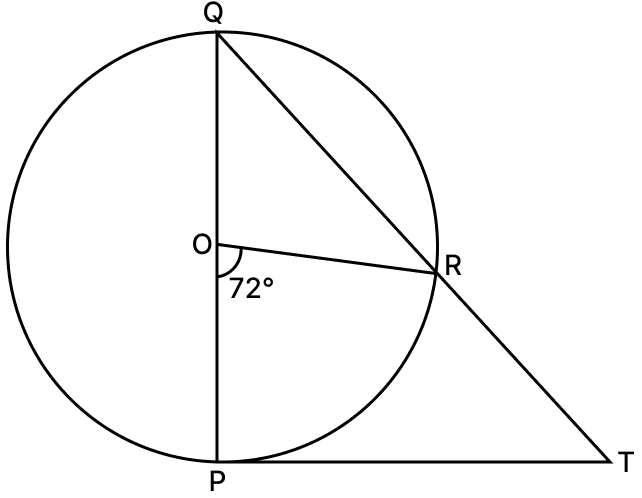
Answer
Arc PR subtends ∠POR at center and ∠PQR on the remaining part of the circle.
⇒ ∠PQR = ∠POR
⇒ ∠PQR =
⇒ ∠PQR = 36°.
We know that,
The tangent at any point of a circle and the radius through this point are perpendicular to each other.
∠QPT = 90°
In triangle QPT,
⇒ ∠QPT + ∠PQR + ∠PTR = 180°
⇒ 90° + 36° + ∠PTR = 180°
⇒ 126° + ∠PTR = 180°
⇒ ∠PTR = 180° - 126°
⇒ ∠PTR = 54°.
Hence, ∠PTR = 54°.
In the given figure, O is the centre of the circumcircle of ΔABC. Tangents at A and B intersect at T. If ∠ATB = 80° and ∠AOC = 130°, calculate ∠CAB.
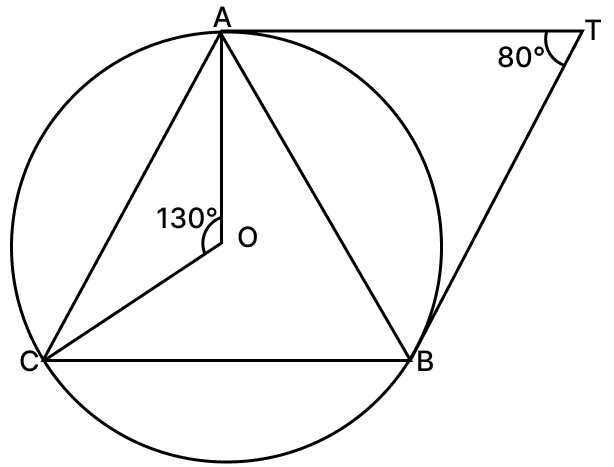
Answer
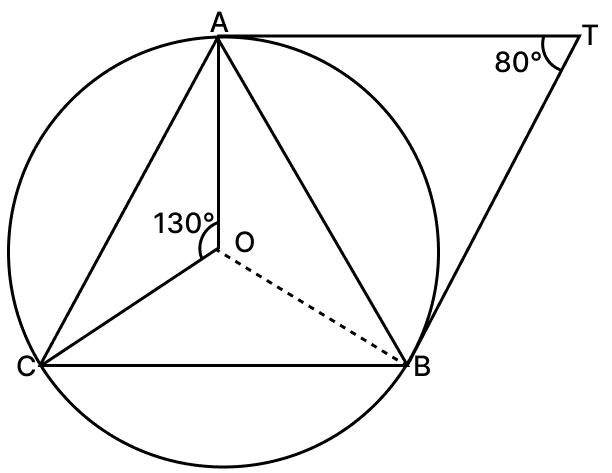
From figure,
TA and TB are the tangents.
∴ OA ⊥ TA and OB ⊥ TB
In quadrilateral AOBT,
By angle sum property,
⇒ ∠ATB + ∠TAO + ∠TBO + ∠AOB = 360°
⇒ ∠ATB + ∠AOB + 90° + 90° = 360°
⇒ ∠ATB + ∠AOB = 180°
⇒ 80° + ∠AOB = 180°
⇒ ∠AOB = 180° - 80°
⇒ ∠AOB = 100°.
From figure,
∠BOC = 360° - (∠AOC + ∠AOB)
= 360° - (130° + 100°)
= 360° - 230° = 130°.
We know that,
The angle at the centre of a circle is twice the angle at the circumference, subtended by the same arc.
Now arc BC subtends ∠COB at the centre and ∠CAB at the remaining part of the circle.
∴ ∠CAB = ∠COB
= × 130° = 65°.
Hence, ∠CAB = 65°.
In the given diagram, an isosceles ∆ABC is inscribed in a circle with centre O. PQ is a tangent to the circle at C. OM is perpendicular to chord AC and ∠COM = 65°. Find :
(a) ∠ABC
(b) ∠BAC
(c) ∠BCQ

Answer
(a) From figure,
∠AOC = ∠AOM + ∠COM = 65° + 65° = 130°.
We know that,
Angle at the center is twice the angle formed by the same arc at any other point of the circle.
⇒ ∠AOC = 2∠ABC
⇒ ∠ABC = = 65°.
Hence, ∠ABC = 65°.
(b) In △ABC,
⇒ AB = AC (Given)
⇒ ∠ACB = ∠ABC = 65° (Opposite angles of equal sides are equal)
By angle sum property of triangle,
⇒ ∠ACB + ∠ABC + ∠BAC = 180°
⇒ 65° + 65° + ∠BAC = 180°
⇒ ∠BAC = 180° - 65° - 65° = 50°.
Hence, ∠BAC = 50°.
(c) We know that,
The angle formed between the tangent and the chord through the point of contact of the tangent is equal to the angle formed by the chord in the alternate segment.
∴ ∠BCQ = ∠BAC = 50°.
Hence, ∠BCQ = 50°.
Show that the tangent lines at the end points of a diameter of a circle are parallel.
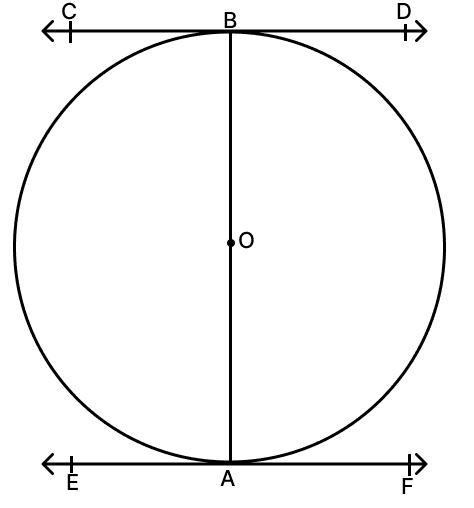
Answer
The tangent at any point of a circle is perpendicular to the radius through the point of contact.
Thus, OA ⊥ EF and OB ⊥ CD
Since the tangents are perpendicular to the radius,
⇒ ∠CBO = 90°, ∠EAO = 90°
⇒ ∠FAO = 90°, ∠OBD = 90°
∴ ∠DBO = ∠OAE, ∠CBO = ∠OAF
These are pair of alternate interior angles.
If the alternate interior angles are equal, then lines CD and EF should be parallel.
CD and EF are the tangents drawn to the circle at the ends of the diameter AB.
Hence, proved that tangents drawn at the ends of a diameter of a circle are parallel.
Prove that the tangents at the extremities of any chord make equal angles with the chord.
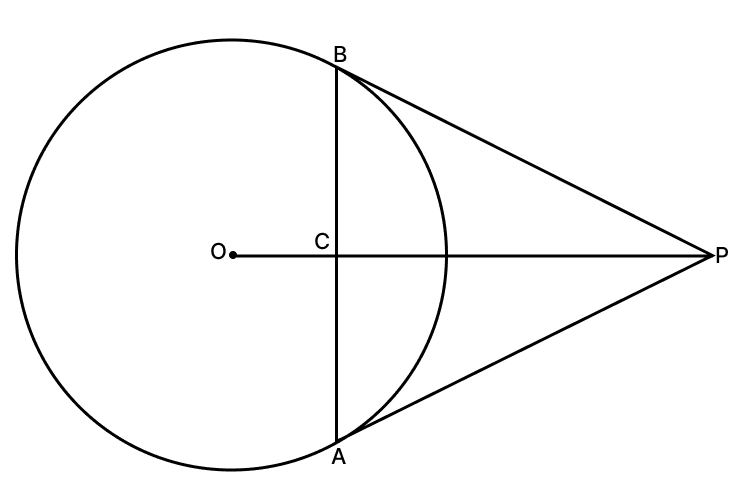
Answer
Let AB be a chord of a circle with centre O, and AP, BP be the tangents at A and B respectively.
From figure,
PA = PB [∵ Tangents from an external point to a circle are equal]
In triangle PAB,
∠PAB = ∠PBA [Angles opposite to equal sides in a triangle are equal]
∴ ∠PAC = ∠PBC.
Hence, proved any chord make equal angles with the chord.
Show that the line segment joining the points of contact of two parallel tangents passes through the centre.
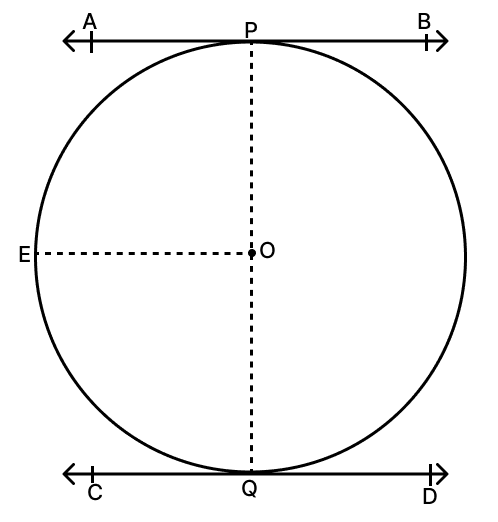
Answer
Let AB and CD are parallel tangents of circle with centre O.
The tangent at any point of a circle is perpendicular to the radius through the point of contact.
∠APO = 90°
⇒ ∠APO + ∠EOP = 180° (sum of adjacent interior angles)
⇒ ∠EOP = 180° - 90°
⇒ ∠EOP = 90°
Similarly,
⇒ ∠EOQ + ∠CQO = 180° (sum of adjacent interior angles)
⇒ ∠EOQ = 180° - 90°
⇒ ∠EOQ = 90°
∠EOP + ∠EOQ = 90° + 90° = 180°
∴ POQ is a straight line.
Hence, line segment joining the points of contact of two parallel tangents passes through the centre.
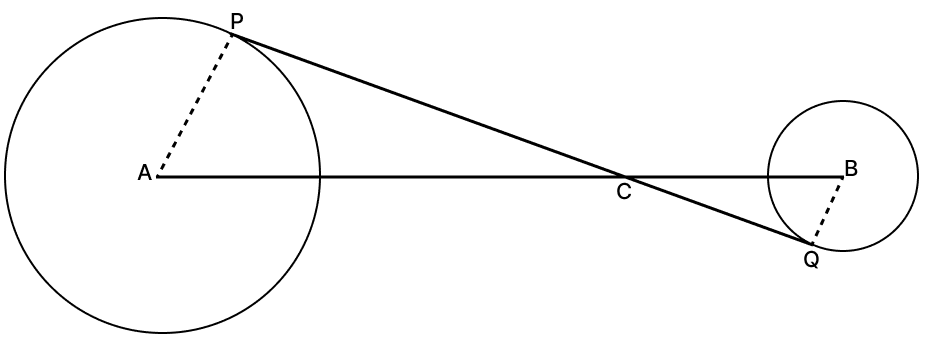
In the given figure, PQ is a transverse common tangent to two circles with centres A and B and of radii 5 cm and 3 cm respectively. If PQ intersects AB at C such that CP = 12 cm, calculate AB.
Answer
From figure,
AP ⊥ PQ (∵ tangent at a point and radius through the point are perpendicular to each other.)
In right angled triangle PAC.
⇒ CA2 = PC2 + AP2
⇒ CA2 = 122 + 52
⇒ CA2 = 144 + 25
⇒ CA2 = 169
⇒ CA =
⇒ CA = 13 cm.
Considering triangles PAC and BCQ,
⇒ ∠APC = ∠BQC = 90°
⇒ ∠PCA = ∠QCB (Vertically opposite angles are equal)
△PAC ~ △QBC by AA axiom.
Since triangles are similar hence, the ratio of their corresponding sides are equal.
⇒ CB = 7.8 cm.
From figure,
AB = AC + CB = 13 + 7.8 = 20.8 cm
Hence, AB = 20.8 cm.
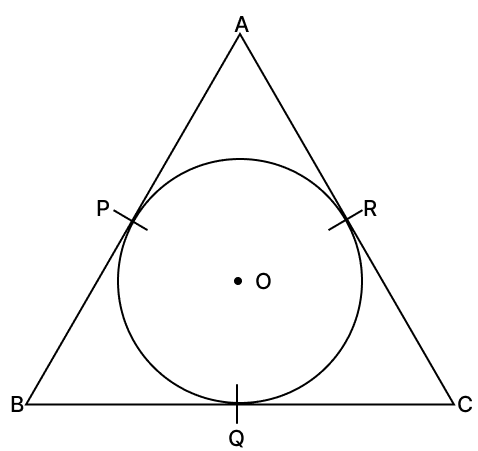
ΔABC is an isosceles triangle in which AB = AC, circumscribed about a circle. Prove that the base is bisected by the point of contact.
Answer
We know that,
Tangents from exterior point are equal in length.
We have,
AR = AP, BQ = BP and CQ = CR
Now, AB = AC
⇒ AP + PB = AR + RC
⇒ AR + PB = AR + RC [∵ AR = AP]
⇒ PB = RC
⇒ BQ = CQ.
It means BC is bisected at point Q.
Hence, proved that the base is bisected by the point of contact.
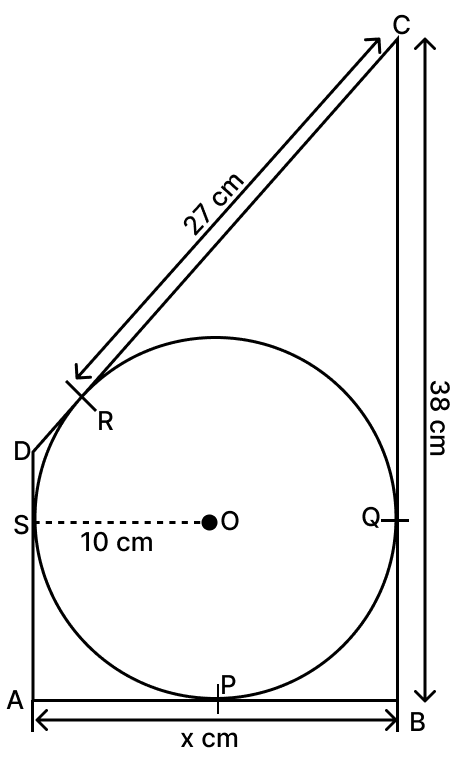
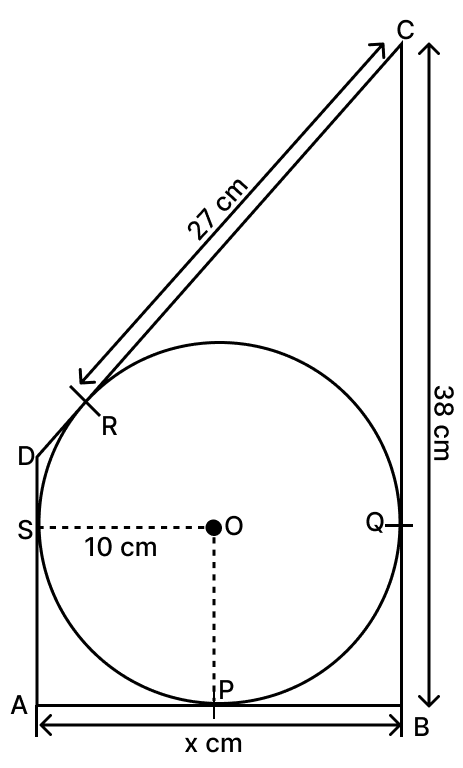
In the given figure, quadrilateral ABCD is circumscribed and AD ⟂ AB. If the radius of the incircle is 10 cm, find the value of x.
Answer
From figure,
OS = OP (As both are radius of circle.)
Since,
Adjacent sides are equal and each angle is a right angle.
∴ AP = OS.
From A, AS and AP are the tangents to the circle.
∴ AP = AS = 10 cm. (∵ if two tangents are drawn to a circle from an external point then the tangents have equal lengths.)
From C, CR and CQ are the tangents to the circle.
∴ CQ = CR = 27 cm. (∵ if two tangents are drawn to a circle from an external point then the tangents have equal lengths.)
From figure,
BQ = BC - CQ = 38 - 27 = 11 cm.
Now from B, BQ and BP are the tangents to the circle
BP = BQ = 11 cm.
⇒ AB = x = AP + BP = 10 + 11 = 21 cm.
Hence, x = 21 cm.
In the given figure, a circle is inscribed in quadrilateral ABCD. If BC = 38 cm, BQ = 27 cm, DC = 25 cm and AD ⟂ DC, find the radius of the circle.
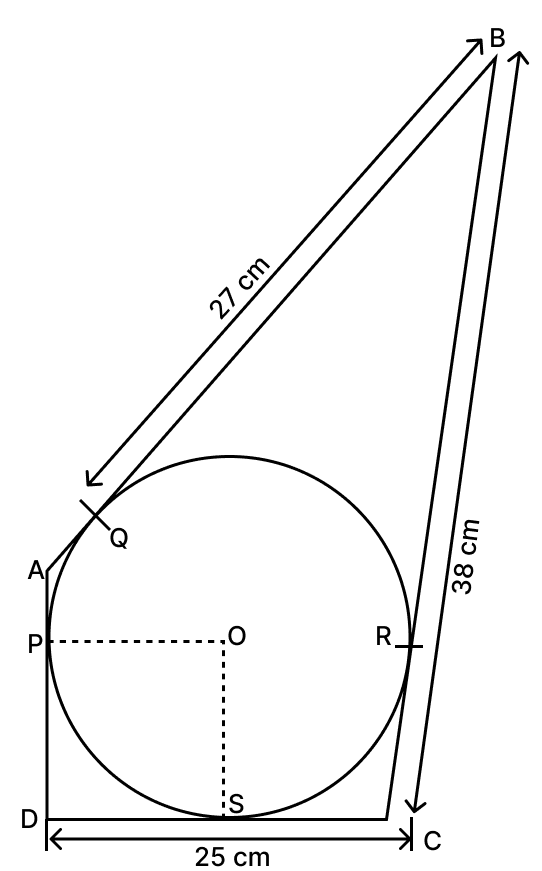
Answer
From figure,
⇒ BR = BQ = 27 cm [∵ Length of tangents form an external point to a circle are equal.]
⇒ CR = BC - BR = 38 - 27 = 11 cm.
⇒ CR = CS = 11 cm [∵ Length of tangents form an external point to a circle are equal.]
⇒ DS = DC - CS = 25 - 11 = 14 cm.
In quadrilateral DSOP,
⇒ ∠SDP + ∠DPO + ∠OSD + ∠POS = 360°
⇒ 90° + 90° + 90° + ∠POS = 360°
⇒ ∠POS = 360° - 270° = 90°.
Since, all angles are 90° and OS = OP [∵ Both equal to radius of same circle]
Hence, proved that DPOS is a square.
OP = DS = 14 cm.
Hence, radius of circle = 14 cm.
In the given figure, O is the centre of the circle and SP is a tangent. If ∠SRT = 65°, find the values of x, y and z.
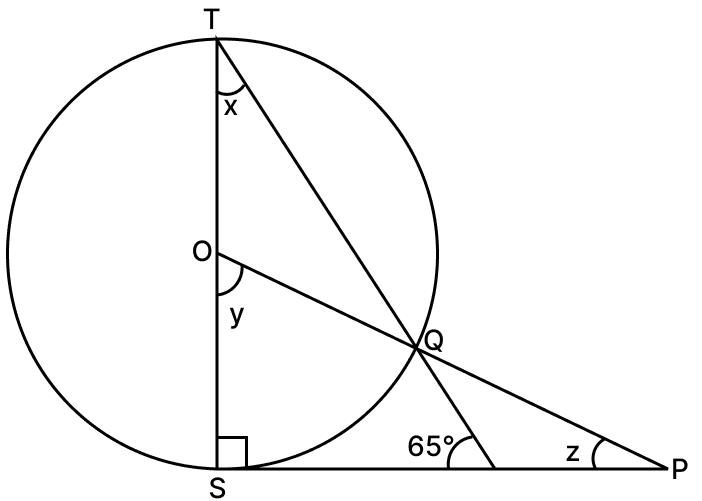
Answer
From figure,
In △SRT,
SP ⊥ ST (∵ tangent is perpendicular to radius from that point.)
so, ∠TSR = 90°
Since, sum of angles in a triangle = 180°
⇒ ∠TSR + ∠SRT + ∠STR = 180°
⇒ 90° + 65° + x = 180°
⇒ x + 155° = 180°
⇒ x = 25°.
SQ subtends ∠SOQ at the centre and ∠STQ on point T.
∴ ∠SOQ = 2∠STQ (∵ angle subtended at centre by an arc is double the angle subtended at remaining part of circle.)
y = 2x = 2 × 25° = 50°.
In △OSP,
Since, sum of angles in a triangle = 180°
⇒ ∠OSP + ∠SOP + ∠SPO = 180°
⇒ 90° + y + z = 180°
⇒ 90° + 50° + z = 180°
⇒ z + 140° = 180°
⇒ z = 180° - 140° = 40°.
Hence, the value of x = 25°, y = 50° and z = 40°.
In the given figure, TP and TQ are two tangents to the circle with centre O, touching at A and C respectively. If ∠BCQ = 55° and ∠BAP = 60°, find :
(i) ∠OBA and ∠OBC
(ii) ∠AOC
(iii) ∠ATC
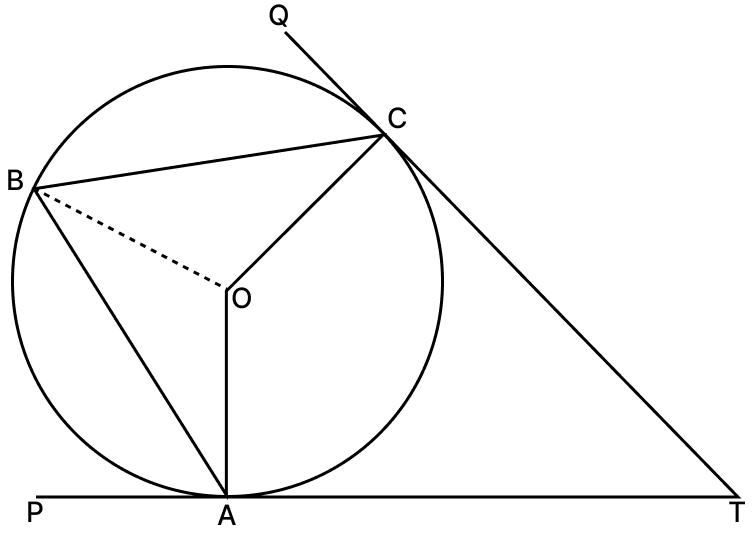
Answer
(i) ∠OAP = 90° [As TP is tangent at point A]
From figure,
⇒ ∠OAB = ∠OAP - ∠BAP = 90° - 60° = 30°.
⇒ OA = OB (Radius of same circle)
⇒ ∠OBA = ∠OAB = 30° (Angles opposite to equal sides are equal)
∠OCQ = 90° [As TQ is tangent at point C]
From figure,
∠OCB = ∠OCQ - ∠BCQ = 90° - 55° = 35°.
⇒ OB = OC (Radius of same circle)
⇒ ∠OBC = ∠OCB = 35° (Angles opposite to equal sides are equal)
Hence, ∠OBA = 30° and ∠OBC = 35°.
(ii) We know that,
The angle subtended by an arc at the centre is double the angle subtended by it at any point on the remaining part of the circle.
⇒ ∠AOC = 2∠ABC
⇒ ∠AOC = 2(∠OBA + ∠OBC)
⇒ ∠AOC = 2(30° + 35°)
⇒ ∠AOC = 2 × 65° = 130°.
Hence, ∠AOC = 130°.
(iii) In quadrilateral OATC,
⇒ ∠AOC + ∠OAT + ∠OCT + ∠ATC = 360°
⇒ 130° + 90° + 90° + ∠ATC = 360°
⇒ 310° + ∠ATC = 360°
⇒ ∠ATC = 360° - 310° = 50°.
Hence, ∠ATC = 50°.
In the given figure, O is the centre of the circle. PQ and PR are tangents and ∠QPR = 70°. Calculate :
(i) ∠QOR
(ii) ∠QSR
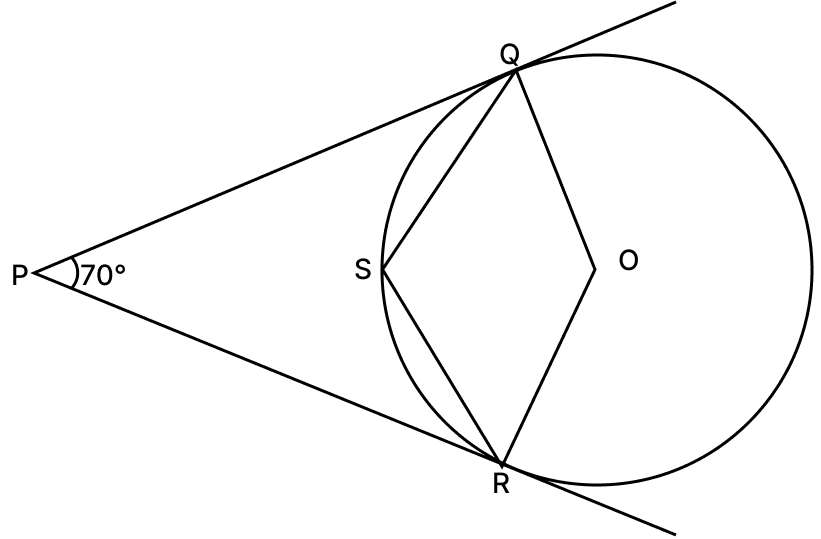
Answer
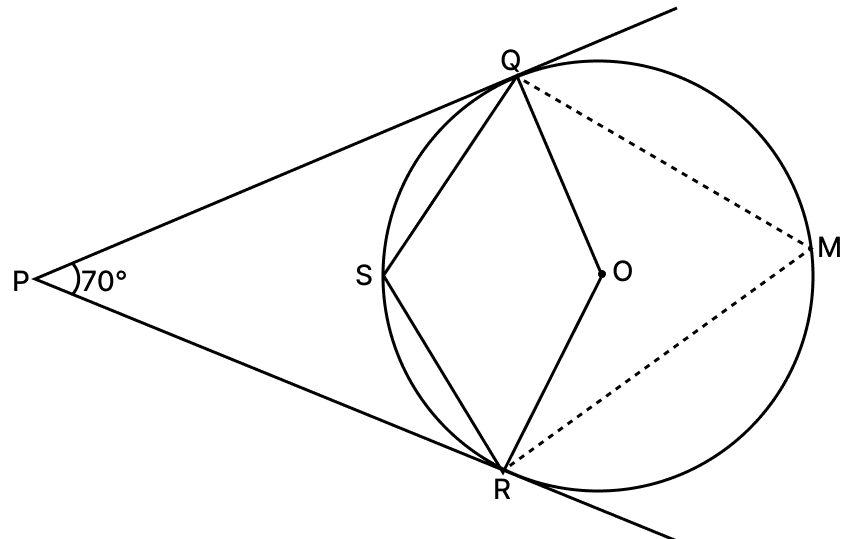
(i) We know that,
The tangent at any point of a circle and the radius through this point are perpendicular to each other.
In quadrilateral ORPQ,
∠OQP = ∠ORP = 90° [∵ The tangent at any point of a circle and the radius through this point are perpendicular to each other]
∠QPR = 70° [Given]
⇒ ∠OQP + ∠ORP + ∠QPR + ∠QOR = 360° [By angle sum property of quadrilateral]
⇒ 90° + 90° + 70° + ∠QOR = 360°
⇒ 250° + ∠QOR = 360°
⇒ ∠QOR = 110°.
Hence, ∠QOR = 110°.
(ii) Let M be a point on circumference of circle.
We know that,
The angle subtended by an arc at the centre is twice the angle subtended at the circumference.
⇒ ∠QMR = ∠QOR
=
= 55°.
Sum of opposite angles in cyclic quadrilateral is 180°.
⇒ ∠QSR + ∠QMR = 180°.
⇒ ∠QSR = 180° - 55°
⇒ ∠QSR = 125°.
Hence, ∠QSR = 125°.
In the given figure, O is the centre of the circle. CE is a tangent to the circle at A. If ∠ABD = 26°, then find :
(i) ∠BDA
(ii) ∠BAD
(iii) ∠CAD
(iv) ∠ODB
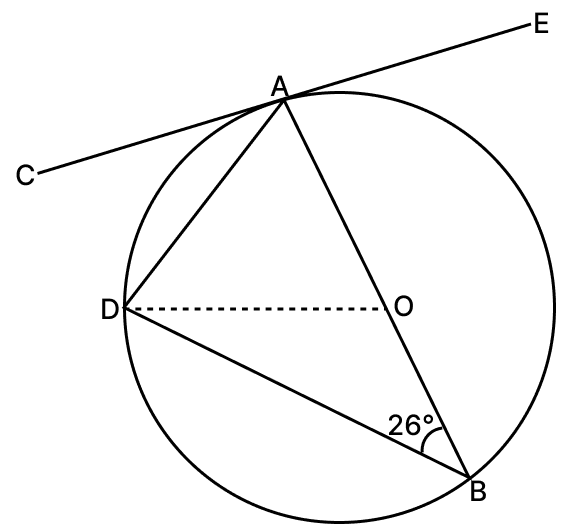
Answer
(i) We know that,
Angle in a semi-circle is a right angle.
∴ ∠BDA = 90°.
Hence, ∠BDA = 90°.
(ii) In △ BAD,
By angle sum property of triangle,
⇒ ∠BDA + ∠BAD + ∠ABD = 180°
⇒ 90° + ∠BAD + 26° = 180°
⇒ ∠BAD + 116° = 180°
⇒ ∠BAD = 180° - 116° = 64°.
Hence, ∠BAD = 64°.
(iii) From figure,
CE is tangent to the circle.
Angle between tangent and radius of the circle is 90°.
From figure,
⇒ ∠CAB = 90°
⇒ ∠CAD + ∠BAD = 90°
⇒ ∠CAD + 64° = 90°
⇒ ∠CAD = 90° - 64° = 26°.
Hence, ∠CAD = 26°.
(iv) In △ OBD,
⇒ OD = OB (Radius of same circle)
We know that,
Angles opposite to equal sides are equal.
⇒ ∠ODB = ∠OBD = 26°.
Hence, ∠ODB = 26°.
In the given diagram, PS and PT are the tangents to the circle. SQ || PT and ∠SPT = 80°. Find the measure of ∠QST.

Answer
In △ PST,
⇒ PS = PT (Tangents from an external point to a circle are equal in length)
⇒ ∠PST = ∠PTS = a (let) (Angles opposite to equal sides are equal)
By angle sum property of triangle,
⇒ ∠PST + ∠PTS + ∠SPT = 180°
⇒ a + a + 80° = 180°
⇒ 2a = 180° - 80°
⇒ 2a = 100°
⇒ a = = 50°.
From figure,
⇒ ∠QST = ∠STP = 50° (Alternate angles are equal)
Hence, ∠QST = 50°.
In the given diagram, O is the centre of the circle. PR and PT are two tangents drawn from the external point P and touching the circle at Q and S respectively. MN is a diameter of the circle. Given ∠PQM = 42° and ∠PSM = 25°.
Find :
(i) ∠OQM
(ii) ∠QNS
(iii) ∠QOS
(iv) ∠QMS

Answer
(i) From figure,
⇒ ∠OQP = 90° (Tangent is perpendicular to radius at the point of contact)
⇒ ∠OQM = ∠OQP - ∠PQM
⇒ ∠OQM = 90° - 42° = 48°.
Hence, ∠OQM = 48°.
(ii) From figure,
⇒ ∠QNM = ∠PQM = 42° (By alternate segment theorem)
⇒ ∠SNM = ∠PSM = 25° (By alternate segment theorem)
⇒ ∠QNS = ∠QNM + ∠SNM
⇒ ∠QNS = 42° + 25° = 67°.
Hence, ∠QNS = 67°.
(iii) We know that,
Angle subtended by an arc at the center is twice the angle subtended by the arc at any other point of the circle.
⇒ ∠QOS = 2∠QNS
⇒ ∠QOS = 2 × 67° = 134°.
Hence, ∠QOS = 134°.
(iv) From figure,
QMSN is a cyclic quadrilateral.
We know that,
Sum of opposite angles of a cyclic quadrilateral is 180°.
⇒ ∠QMS + ∠QNS = 180°
⇒ ∠QMS + 67° = 180°
⇒ ∠QMS = 180° - 67° = 113°.
Hence, ∠QMS = 113°.