
Use ruler and compass to answer this question. Construct a triangle ABC where AB = 5.5 cm, BC = 4.5 cm and angle ABC = 135°. Construct the circumcircle to the triangle ABC. Measure and write down the length of AC.
Answer
Steps of construction :
Draw a line segment BC = 4.5 cm
Construct XB such that ∠XBC = 135°.
Cut AB = 5.5 cm from XB.
Join and measure AC.
Draw PQ and RS the perpendicular bisectors of BC and AB.
Mark point O the intersection of PQ and RS.
With O as center and radius as OA, draw a circle touching the vertices A, B and C.
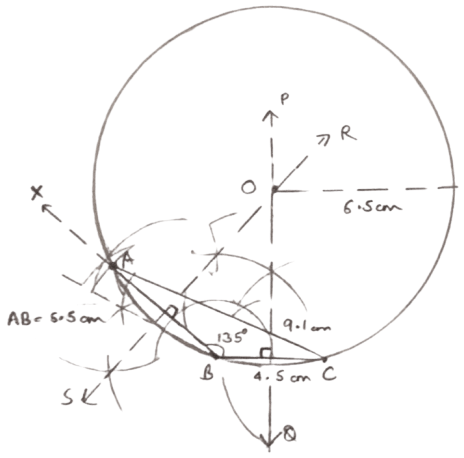
On measuring AC = 9.1 cm and radius = 6.5 cm.
Use a ruler and a compass for this question.
Construct a regular hexagon ABCDEF of side 4.3 cm and construct its circumscribed circle. Also, construct tangents to the circumscribed circle at points B and C which meets each other at point P. Measure and record ∠BPC.
Answer
We know that each angle in a regular hexagon = 120°.
Draw a line segment AB = 4.3 cm.
At A and B draw rays making an angle of 120° each and cut off AF = BC = 4.3 cm.
At F and C, draw rays making angle of 120° each and cut off EF = CD = 4.3 cm.
Join ED. Hence, ABCDEF is the required hexagon.
Draw the perpendicular bisector of AB and AF. Let these bisectors meet at the point O.
With O as center and radius equal to OA or OB draw a circle which passes through the vertices of the hexagon. This is the required circumcircle of hexagon ABCDEF.
Draw the radius OB and OC.
At point B, construct a line perpendicular to OB. This line is the tangent at B.
At point C, construct a line perpendicular to OC. This line is the tangent at C.
The two tangents will intersect at point P.
Measure ∠BPC.
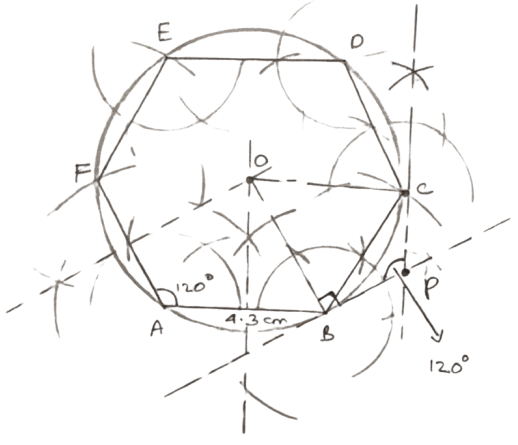
Hence, ∠BPC = 120°.
Use a ruler and a compass for this question.
(a) Construct a triangle ABC such that BC = 8 cm, AC = 10 cm and ∠ABC = 90°.
(b) Construct an incircle to this triangle. Mark the centre as I.
(c) Measure and write the length of the in-radius.
(d) Measure and write the length of the tangents from vertex C to the incircle.
(e) Mark points P, Q and R where the incircle touches the sides AB, BC, and AC of the triangle respectively. Write the relationship between ∠RIQ and ∠QCR.
Answer
Steps of construction :
Draw a line segment BC = 8 cm.
Draw BX perpendicular to BC.
With C as center and radius = 10 cm, draw an arc cutting BX at A.
Join AB and AC.
Draw AW, BY and CZ the angle bisectors of A, B and C respectively.
Mark the point of intersection as I.
Draw IR perpendicular to side AC.
With I as center and radius IR draw a circle, which is the required incircle.
Mark points P, Q and R where the incircle touches the sides AB, BC, and AC of the triangle respectively.
Measure CQ and CR.
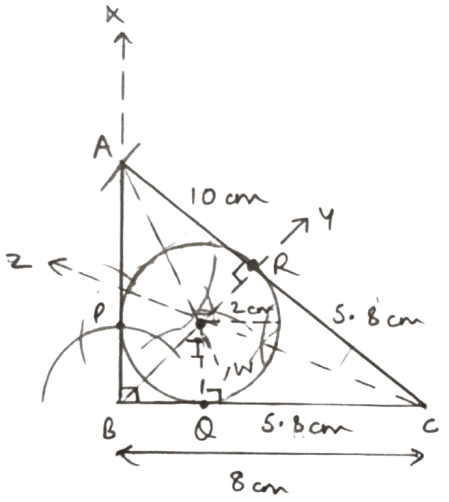
From figure,
⇒ ∠IRC = ∠IQC = 90° (The radius from the center of the circle to the point of tangency is perpendicular to the tangent line.)
⇒ ∠RCI = ∠QCI = (As CZ is angle bisector)
In △ IRC,
⇒ ∠RIC = 180° - ∠RCI - ∠IRC [∵ Sum of ∠'s in a Δ = 180°]
⇒ ∠RIC = 180° - - 90°
⇒ ∠RIC = 90° - ............(1)
In △ IQC,
⇒ ∠QIC = 180° - ∠IQC - ∠ICQ [∵ Sum of ∠'s in a Δ = 180°]
⇒ ∠QIC = 180° - 90° -
⇒ ∠QIC = 90° - ............(2)
Adding equations (1) and (2), we get :
⇒ ∠RIC + ∠QIC = 90° - + 90° -
⇒ ∠RIQ = 180° - ∠C
⇒ ∠RIQ = 180° - ∠RCQ
⇒ ∠RIQ + ∠RCQ = 180°.
Hence, ∠RIQ + ∠QCR = 180°.