Multiple Choice Questions
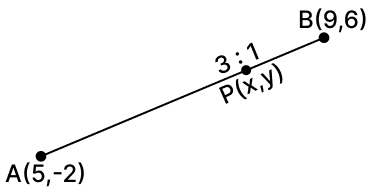
The coordinates of the point P which divides the join of A(5, -2) and B(9, 6) in the ratio 3 : 1 are :
(4, -7)
(27,4)
(8, 4)
(12, 8)
Answer
Let point P be (x, y).
Given,
m1 : m2 = 3 : 1
By section-formula,
(x, y) = (m1+m2m1x2+m2x1,m1+m2m1y2+m2y1)
Substituting values we get :
⇒(x,y)=(3+13×9+1×5,3+13×6+1×−2)=(427+5,418−2)=(432,416)=(8,4).
Hence, Option 3 is the correct option.
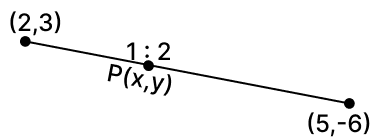
The coordinates of the point on x-axis which divides the line segment joining the points (2, 3) and (5, -6) in the ratio 1 : 2 are :
(2, 0)
(-2, 0)
(3, 0)
(-3, 0)
Answer
Let point P be (x, y).
Given,
m1 : m2 = 1 : 2
By section-formula,
(x, y) = (m1+m2m1x2+m2x1,m1+m2m1y2+m2y1)
Substituting values we get :
⇒(x,y)=(1+21×5+2×2,1+21×(−6)+2×3)=(35+4,3−6+6)=(39,30)=(3,0).
Hence, Option 3 is the correct option.
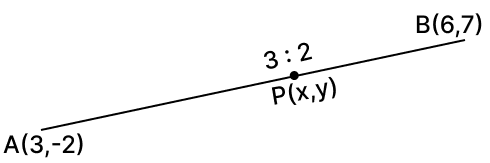
The point which divides the line segment joining the points A(3, -2) and B(6, 7) internally in the ratio 3 : 2 lies in which of the following quadrants?
I
II
III
IV
Answer
Let point P be (x, y).
Given,
m1 : m2 = 3 : 2
By section-formula,
(x, y) = (m1+m2m1x2+m2x1,m1+m2m1y2+m2y1)
Substituting values we get :
⇒(x,y)=(3+23×6+2×3,3+23×7+2×(−2))=(518+6,521−4)=(524,517).
Here, both x and y are positive.
Therefore, the point lies in the 1st Quadrant.
Hence, Option 1 is the correct option.
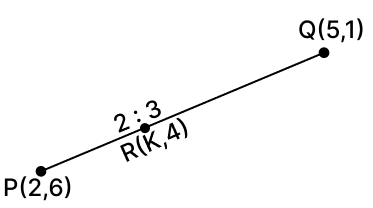
If the point R(k, 4) divides the line segment joining the points P(2, 6) and Q(5, 1) in the ratio 2 : 3, then the value of k is:
-5
(5−16)
5
(516)
Answer
Given,
R = (k, 4)
m1 : m2 = 2 : 3
R(k, 4) divides the line segment joining the points P(2, 6) and Q(5, 1) in the ratio 2 : 3.
By section-formula,
(x, y) = (m1+m2m1x2+m2x1,m1+m2m1y2+m2y1)
Substituting values we get :
⇒(k,4)=(2+32×5+3×2,2+32×1+3×6)⇒(k,4)=(510+6,52+18)⇒(k,4)=(516,520)⇒(k,4)=(516,4).
Thus, k = 516.
Hence, Option 4 is the correct option.
Points A(x, y), B(3, -2) and C(4, -5) are collinear. The value of y in terms of x is ∶
3x - 11
11 - 3x
3x - 7
7 - 3x
Answer
Since, points A, B and C are collinear.
∴ Slope of AB = Slope of BC.
⇒3−x−2−y=4−3−5−(−2)⇒3−x−2−y=1−5+2⇒3−x−2−y=−3⇒−2−y=−3(3−x)⇒−2−y=−9+3x⇒y=−2+9−3x⇒y=7−3x.
Hence, Option 4 is the correct option.
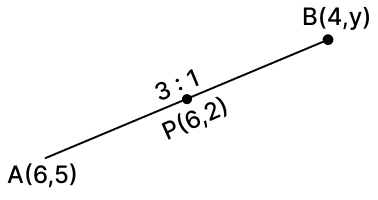
If the point P(6, 2) divides the line segment joining A(6, 5) and B(4, y) in the ratio 3 : 1, then the value of y is :
1
2
3
4
Answer
Let point P be (6, 2).
Given,
m1 : m2 = 3 : 1
P(6, 2) divides the line segment joining A(6, 5) and B(4, y) in the ratio 3 : 1.
By section-formula,
(x, y) = (m1+m2m1x2+m2x1,m1+m2m1y2+m2y1)
We use the y–coordinate to find y.
⇒2=3+13×y+1×5⇒2=43y+5⇒8=3y+5⇒3y=3⇒y=1.
Hence, Option 1 is the correct option.
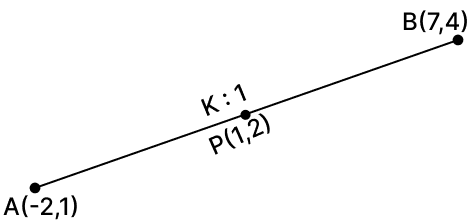
The ratio in which the point P(1, 2) divides the join of the points A(-2, 1) and B(7, 4) is:
1 : 2
2 : 1
3 : 2
2 : 3
Answer
Let the ratio in which P divides AB be k : 1.
By section-formula,
(x, y) = (m1+m2m1x2+m2x1,m1+m2m1y2+m2y1)
Using the y–coordinate to find ratio.
⇒2=(k+1k(4)+1(1))⇒2=(k+14k+1)⇒2(k+1)=4k+1⇒2k+2=4k+1⇒2−1=4k−2k⇒2k=1⇒k=21⇒k:1=21:1=1:2.
Hence, Option 1 is the correct option.
The line segment joining A(-7, 2) and B(3, -8) is divided by the x-axis in the ratio:
1 : 4
3 : 7
4 : 1
7 : 3
Answer
Given,
AB is divided by the x-axis, thus y-coordinate = 0 at point of division.
A(-7, 2) and B(3, -8)
Let ratio be m : n.
By section-formula,
y = m+nmy2+ny1
Substituting values we get :
⇒ 0 = m+nm×(−8)+n×(2)
⇒ 0 = -8m + 2n
⇒ 8m = 2n
⇒ nm=82
⇒ nm=41
⇒ m : n = 1 : 4.
Hence, option 1 is the correct option.
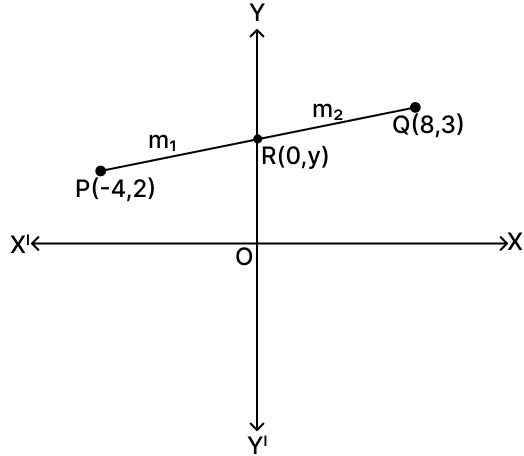
In what ratio is the line segment joining the points P(-4, 2) and Q(8, 3) divided by y-axis?
1 : 3
3 : 1
1 : 2
2 : 1
Answer
Let the point where y-axis divides the line segment be R(0, y).
Let the ratio be m1 : m2.
Using section-formula,
⇒x=m1+m2m1x2+m2x1⇒0=m1+m2m1×8+m2×(−4)⇒0=8m1−4m2⇒8m1=4m2⇒m2m1=84=21.
Thus, the required ratio is 1 : 2.
Hence, Option 3 is the correct option.
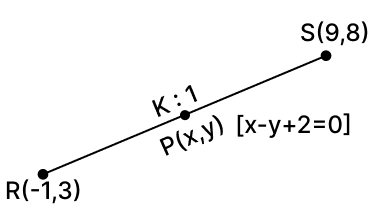
Point P divides the line segment joining R(-1, 3) and S(9, 8) in the ratio k : 1. If P lies on the line x - y + 2 = 0, then the value of k is:
21
31
41
32
Answer
Let point P be (x, y).
Given,
m1 : m2 = k : 1
By section-formula,
(x, y) = (m1+m2m1x2+m2x1,m1+m2m1y2+m2y1)
Substituting values we get :
⇒(x,y)=(k+1k×9+1×(−1),k+1k×8+1×3)=(k+19k−1,k+18k+3).
Since P lies on the line x - y + 2 = 0, substituting values of x and y:
⇒k+19k−1−k+18k+3+2=0⇒k+19k−1−(8k+3)+2=0⇒k+19k−1−8k−3+2=0⇒k+1k−4+2=0⇒k+1k−4+2(k+1)=0⇒k+1k−4+2k+2=0⇒k+13k−2=0⇒3k−2=0⇒3k=2⇒k=32.
Hence, Option 4 is the correct option.
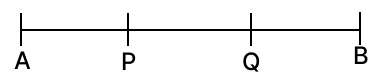
In the adjoining figure, P(5, -3) and Q(3, y) are the points of trisection of the line segment joining A(7, -2) and B(1, -5). Then, y equals :
-4
(2−5)
2
4
Answer
Since P and Q trisect the line segment AB, the point Q(3, y) divides A(7, -2) and B(1, -5) in the ratio 2 : 1.
Let point Q be (3, y).
Given,
m1 : m2 = 2 : 1
By section-formula,
(x, y) = (m1+m2m1x2+m2x1,m1+m2m1y2+m2y1)
Substituting values we get :
⇒(3,y)=(2+12×1+1×7,2+12×(−5)+1×(−2))⇒(3,y)=(32+7,3−10−2)⇒(3,y)=(39,3−12)⇒(3,y)=(3,−4).
Thus, y = -4.
Hence, Option 1 is the correct option.
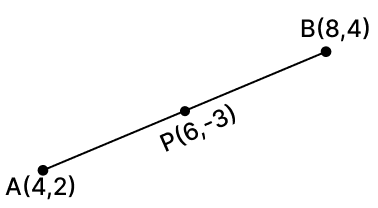
If the point P(6, -3) lies on the line segment joining points A(4, 2) and B(8, 4), then:
AP = 43 AB
AP = 41 AB
PB = 31 AB
AP = 21 AB
Answer
Let the ratio in which P divides AB be k : 1.
By section-formula,
x = m1+m2m1x2+m2x1
Substituting values we get :
⇒6=(k+1k(8)+1(4))⇒6=(k+18k+4)⇒6(k+1)=8k+4⇒6k+6=8k+4⇒6−4=8k−6k⇒2=2k⇒k=11=1:1.
This means that P is the midpoint of AB.
∴ AP = 21 AB.
Hence, Option 4 is the correct option.
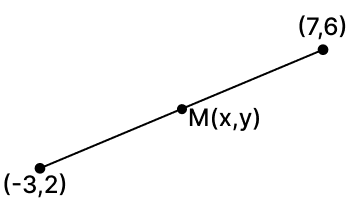
The mid-point of the line segment joining the points (-3, 2) and (7, 6) is:
(-2, -4)
(-2, 4)
(2, 4)
(4, 2)
Answer
Let the mid-point be M(x, y).
By mid-point formula,
(x, y) = (2x1+x2,2y1+y2)
Substituting values we get :
⇒M(x,y)=(2−3+7,22+6)⇒(24,28)⇒(2,4).
Hence, Option 3 is the correct option.
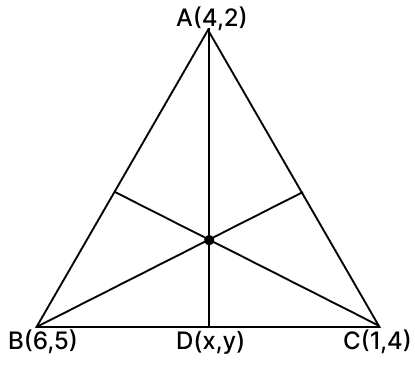
If A(4, 2), B(6, 5) and C(1, 4) be the vertices of ΔABC and AD is a median, then the coordinates of D are:
(25,3)
(5,27)
(27,29)
none of these
Answer
Since AD is a median, D is the mid-point of BC.
Let point D be (x, y).
By mid-point formula,
(x, y) = (2x1+x2,2y1+y2)
⇒(x,y)=(26+1,25+4)⇒(27,29).
Hence, Option 3 is the correct option.
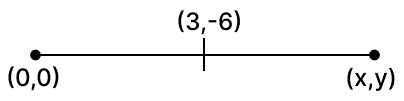
If (3, -6) is the mid-point of the line segment joining (0, 0) and (x, y), then the point (x, y) is:
(-3, 6)
(6, -6)
(6, -12)
(23,−3)
Answer
Given, (3, -6) is the mid-point of the line segment joining (0, 0) and (x, y).
∴(3,−6)=(20+x,20+y)⇒(3,−6)=(2x,2y)⇒3=2x and −6=2y⇒x=6 and y=−12
(x, y) = (6, -12).
Hence, Option 3 is the correct option.
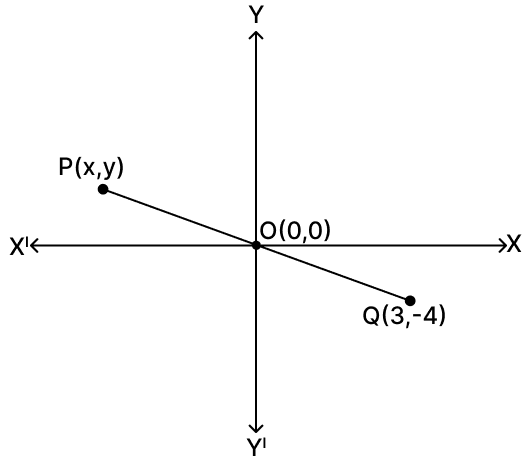
If the line segment joining the points P and Q(3, -4) is bisected at the origin, then the coordinates of P are:
(3, -2)
(3, -4)
(-3, -4)
(-3, 4)
Answer
Let the coordinates of P be (x, y).
Given, the origin (0, 0) is the mid-point of PQ.
By mid-point formula,
(x, y) = (2x1+x2,2y1+y2)
Substituting values we get :
⇒(0,0)=(2x+3,2y+(−4))⇒0=2x+3 and 0=2y−4⇒x+3=0 and y−4=0⇒x=−3 and y=4⇒P=(x,y)=(−3,4).
Hence, Option 4 is the correct option.
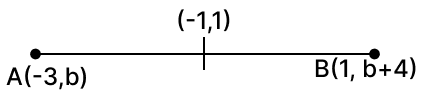
A(-3, b) and B(1, b + 4) are two points. If the coordinates of the mid-point of AB are (-1, 1), then the value of b is :
-1
0
1
2
Answer
Given,
Mid-point of AB = (-1, 1).
By mid-point formula,
(x, y) = (2x1+x2,2y1+y2)
Substituting values we get :
⇒(−1,1)=(2−3+1,2b+(b+4))⇒(−1,1)=(2−2,22b+4)⇒(−1,1)=(−1,b+2)
Comparing the y-coordinates, we get :
⇒ 1 = b + 2
⇒ b = -1.
Hence, Option 1 is the correct option.
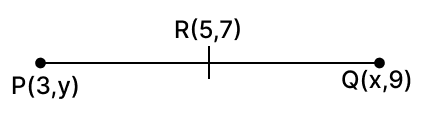
If the point R(5, 7) is the mid-point of the line segment joining the points P(3, y) and Q(x, 9), then (x + y) equals:
7
9
12
14
Answer
Given,
R(5, 7) is the mid-point of the line segment joining the points P(3, y) and Q(x, 9).
By mid-point formula,
(x, y) = (2x1+x2,2y1+y2)
Substituting values we get :
⇒(5,7)=(23+x,2y+9)⇒5=23+x and 7=2y+9⇒10=3+x and 14=y+9⇒x=7 and y=5.
x + y = 7 + 5 = 12.
Hence, Option 3 is the correct option.
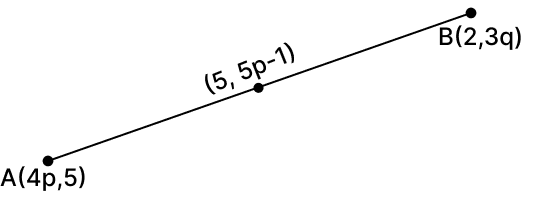
The mid-point of the line segment joining (4p, 5) and (2, 3q) is (5, 5p - 1). The values of p and q are respectively:
2, 38
-2, 38
2, 313
-2, 313
Answer
Given,
Mid-point of the line segment joining (4p, 5) and (2, 3q) is (5, 5p - 1).
By mid-point formula,
(x, y) = (2x1+x2,2y1+y2)
Substituting values we get :
⇒(5,5p−1)=(24p+2,25+3q)⇒(5,5p−1)=(22(2p+1),25+3q)⇒(5,5p−1)=(2p+1,25+3q)
Comparing the x coordinates, we get :
⇒ 2p + 1 = 5
⇒ 2p = 5 - 1
⇒ 2p = 4
⇒ p = 24
⇒ p = 2.
Comparing y-coordinates we get :
⇒5p−1=25+3q⇒5×2−1=25+3q⇒9=25+3q⇒18=5+3q⇒3q=18−5⇒3q=13⇒q=313.
p = 2 and q = 313.
Hence, Option 3 is the correct option.
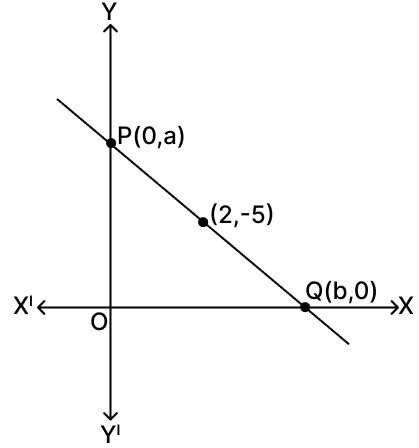
A line intersects the y-axis and x-axis at the points P and Q respectively. If (2, -5) is the mid-point of PQ, then the coordinates of P and Q are respectively:
(0, 10) and (-4, 0)
(0, -5) and (2, 0)
(0, 4) and (-10, 0)
(0, -10) and (4, 0)
Answer
Let P(0, a) be the point on y-axis and Q(b, 0) be the point on x-axis.
Given, (2, -5) is the mid-point of PQ.
By mid-point formula,
(x, y) = (2x1+x2,2y1+y2)
Substituting values we get :
⇒(2,−5)=(20+b,2a+0)⇒(2,−5)=(2b,2a)⇒2=2b and −5=2a⇒b=4 and a=−10.
P(0, -10) and Q(4, 0)
Hence, Option 4 is the correct option.
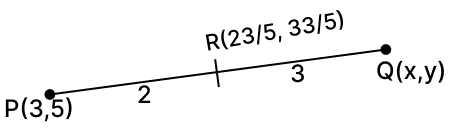
If a point R(523,533) divides the line segment PQ joining the points P(3, 5) and Q(x, y) in the ratio 2 : 3 internally, then the values of x and y respectively are :
4, 7
5, 9
7, 8
7, 9
Answer
Given,
Point R = (523,533) and P(3, 5), Q(x, y).
Given,
m1 : m2 = 2 : 3
By section-formula,
(x, y) = (m1+m2m1x2+m2x1,m1+m2m1y2+m2y1)
Substituting values we get :
⇒(523,533)=(2+32x+3×3,2+32y+3×5)⇒523=52x+9,533=52y+15⇒23=2x+9,33=2y+15⇒23−9=2x,33−15=2y⇒14=2x,18=2y⇒x=214,y=218⇒x=7,y=9.
Therefore, the values of x and y are 7 and 9 respectively.
Hence, Option 4 is the correct option.
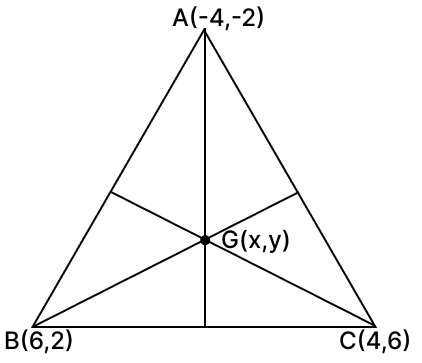
The coordinates of the vertices of ΔABC are respectively (-4, -2), (6, 2) and (4, 6). The centroid G of ΔABC is:
(2, 2)
(2, 3)
(3, 3)
(0, -1)
Answer
By centroid formula,
G(x, y) = (3x1+x2+x3,3y1+y2+y3)
Substituting values we get :
⇒G=(3−4+6+4,3−2+2+6)=(36,36)=(2,2).
Hence, Option 1 is the correct option.
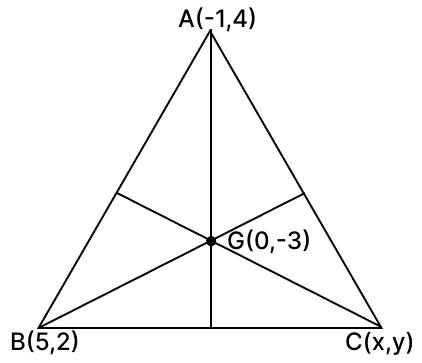
Two vertices of a ΔABC are A(-1, 4) and B(5, 2) and its centroid is (0, -3). The coordinates of C are :
(4, 3)
(4, 15)
(-4, -15)
(-15, -4)
Answer
Let the coordinates of C be (x, y).
By centroid formula,
Centroid = (3x1+x2+x3,3y1+y2+y3)
Given,
G(0, -3) is the centroid of the triangle.
Substituting values we get :
⇒(0,−3)=(3−1+5+x,34+2+y)⇒(0,−3)=(34+x,36+y)⇒0=34+x and −3=36+y⇒4+x=0 and 6+y=−9⇒x=−4 and y=−9−6⇒x=−4 and y=−15.
C = (x, y) = (-4, -15).
Hence, Option 3 is the correct option.
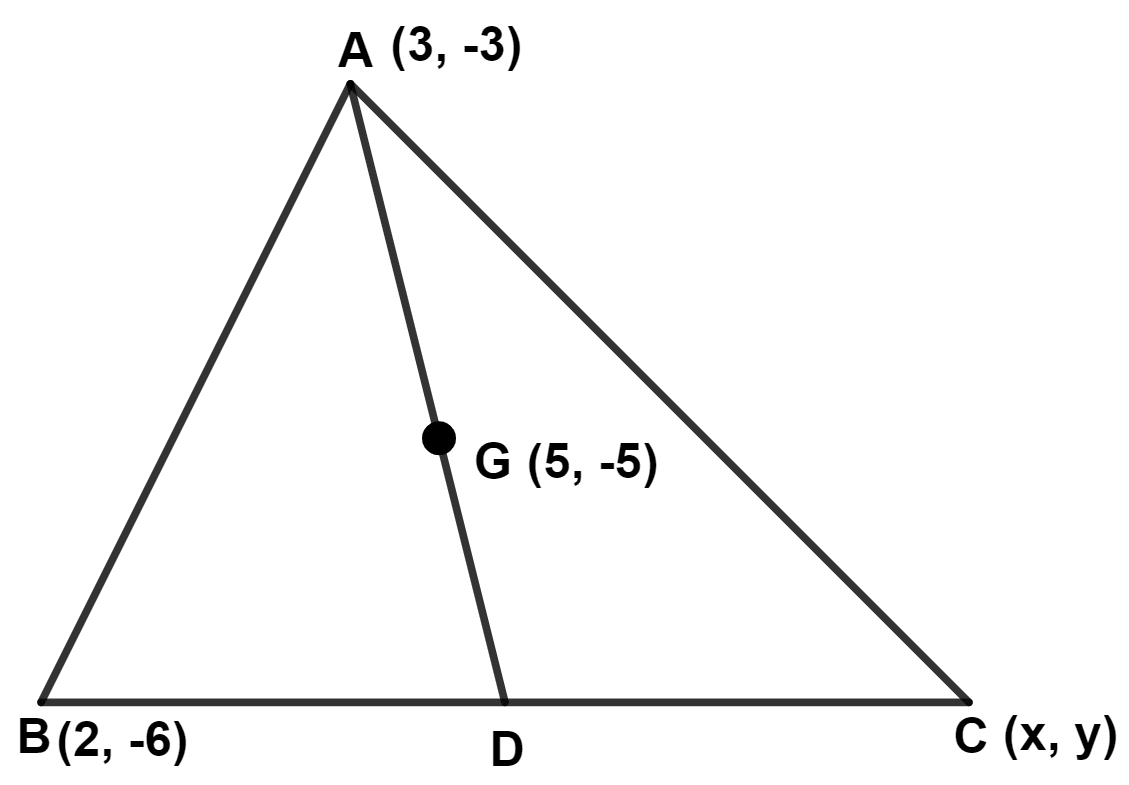
In the adjoining diagram, G is the centroid of △ ABC. A(3, -3), B(2, -6), C(x, y) and G(5, -5). The coordinates of point D are :
(2, -6)
(3, -6)
(6, -6)
(10, -6)
Answer
By formula,
Centroid of triangle = (3x1+x2+x3,3y1+y2+y3)
∴(5,−5)=(33+2+x,3(−3)+(−6)+y)⇒(5,−5)=(3x+5,3y−9)⇒3x+5=5 and 3y−9=−5⇒x+5=15 and y−9=−15⇒x=15−5=10 and y=−15+9=−6.
C(x, y) = (10, -6).
Since, centroid is the point of intersection of all the three medians of a triangle.
∴ AD is the median.
∴ D is mid-point of BC.
D=(22+10,2(−6)+(−6))=(212,2−12)=(6,−6).
Hence, Option 3 is the correct option.
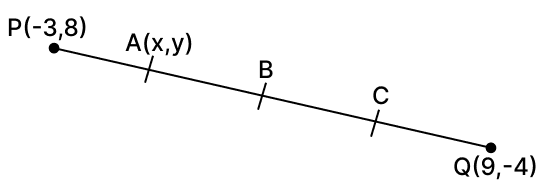
The points A, B and C divide the line segment joining the points P(-3, 8) and Q(9, -4) into four equal parts. If A is nearest to P, then the coordinates of A are:
(-3, 5)
(0, 5)
(3, 5)
(6, -1)
Answer
Given,
The points dividing PQ into four equal parts be A, B and C such that A is nearest to P.
Since the line segment PQ is divided into four equal parts, the point A divides PQ in the ratio 1 : 3.
By section-formula,
(x, y) = (m1+m2m1x2+m2x1,m1+m2m1y2+m2y1)
Substituting values we get :
⇒(x,y)=(1+31×9+3×(−3),1+31×(−4)+3×8)⇒(49−9,4−4+24)⇒(40,420)⇒(0,5).
Hence, Option 2 is the correct option.
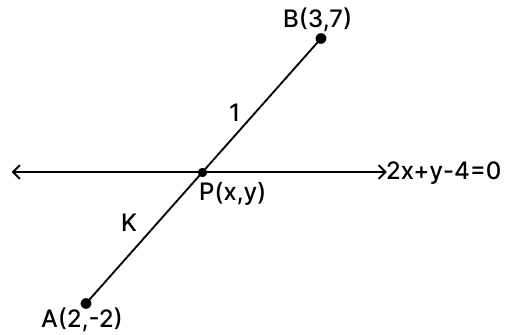
The line 2x + y - 4 = 0 divides the line segment joining A(2, -2) and B(3, 7) in the ratio:
2 : 3
2 : 5
2 : 7
2 : 9
Answer
Let the required point be P(x, y) which divides A(2, -2) and B(3, 7) in the ratio k : 1.
By section-formula,
(x, y) = (m1+m2m1x2+m2x1,m1+m2m1y2+m2y1)
Substituting values, we get :
⇒(x,y)=(k+1k×3+1×2,k+1k×7+1×(−2))⇒(x,y)=(k+13k+2,k+17k−2)
Since P lies on the line 2x + y - 4 = 0, substituting the values of x and y:
⇒2(k+13k+2)+(k+17k−2)−4=0⇒k+16k+4+7k−2−4=0⇒k+113k+2=4⇒13k+2=4(k+1)⇒13k+2=4k+4⇒9k=2⇒k=92⇒k:1=92:1=2:9.
Hence, Option 4 is the correct option.
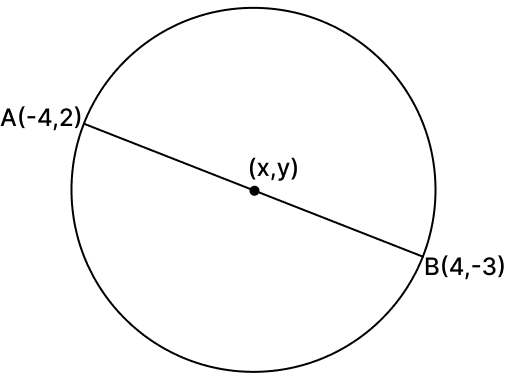
The centre of the circle having end points of its one diameter as (-4, 2) and (4, -3) is:
(0, -1)
(2, -1)
(0,−21)
(4,−25)
Answer
Let the end points of the diameter be A(-4, 2) and B(4, -3). The centre of the circle is the mid-point of the diameter AB.
By mid-point formula,
(x, y) = (2x1+x2,2y1+y2)
Substituting values we get :
⇒(x,y)=(2−4+4,22+(−3))=(20,2−1)=(0,−21).
Hence, Option 3 is the correct option.
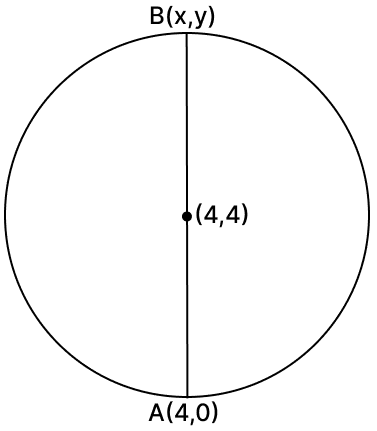
A circle has its centre at (4, 4). If one end of a diameter is (4, 0), then the coordinates of the other end are:
(0, 4)
(4, 8)
(4, -8)
(-4, -8)
Answer
Let one end of the diameter be A(4, 0) and the other end be B(x, y). Given that the centre of the circle is (4, 4), which is the mid-point of AB.
By mid-point formula,
(x, y) = (2x1+x2,2y1+y2)
Substituting values we get :
⇒(4,4)=(24+x,20+y)⇒4=24+x and 4=2y⇒x+4=8 and y=8⇒x=8−4=4 and y=8.
The coordinates of the other end of the diameter are (4, 8).
Hence, Option 2 is the correct option.
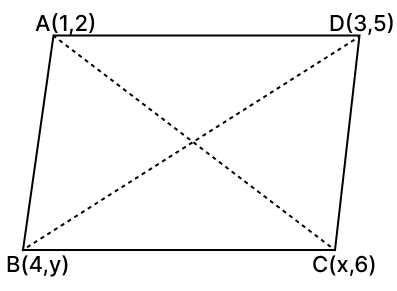
The vertices of a parallelogram in order are A(1, 2), B(4, y), C(x, 6) and D(3, 5). Then (x, y) is:
(6, 3)
(3, 6)
(5, 6)
(1, 4)
Answer
In a parallelogram, the diagonals bisect each other. Therefore, the mid-point of AC = mid-point of BD.
By mid-point formula,
(x, y) = (2x1+x2,2y1+y2)
Substituting values, we get :
For diagonal AC :
Mid-point of AC=(21+x,22+6)=(21+x,4)
For diagonal BD:
Mid-point of BD=(24+3,2y+5)=(27,2y+5)
Since both mid-points are equal, we equate their coordinates:
⇒(21+x,4)=(27,2y+5)⇒21+x=27,4=2y+5⇒1+x=7,y+5=8⇒x=7−1,y=8−5⇒x=6,y=3.
(x, y) = (6, 3).
Hence, Option 1 is the correct option.
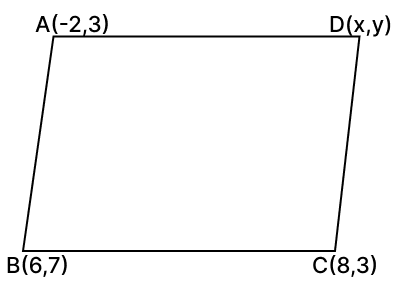
The fourth vertex D of a parallelogram ABCD whose three vertices are A(-2, 3), B(6, 7) and C(8, 3) is:
(0, 1)
(0, -1)
(-1, 0)
(1, 0)
Answer
In a parallelogram, the diagonals bisect each other. Therefore, the mid-point of AC = mid-point of BD.
By mid-point formula,
(x, y) = (2x1+x2,2y1+y2)
Substituting values, we get :
For diagonal AC:
Mid-point of AC=(2−2+8,23+3)=(26,26)=(3,3).
Let point D be (x, y).
For diagonal BD:
Mid-point of BD=(26+x,27+y)⇒(3,3)=(26+x,27+y)⇒3=26+x and 3=27+y⇒6=6+x and 6=7+y⇒x=0 and y=6−7=−1.
D = (x, y) = (0, -1).
Hence, Option 2 is the correct option.
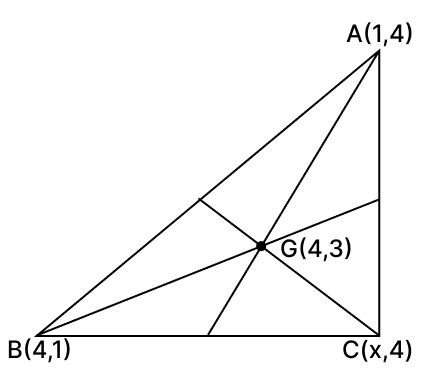
A(1, 4), B(4, 1) and C(x, 4) are the vertices of ΔABC. If the centroid of the triangle is G(4, 3), then x is equal to:
2
1
7
4
Answer
Given,
The vertices of the triangle be A(1, 4), B(4, 1) and C(x, 4). The centroid G of a triangle is given by the formula:
Centroid = (3x1+x2+x3,3y1+y2+y3)
Substituting the given values we get :
⇒(4,3)=(31+4+x,34+1+4)⇒(4,3)=(35+x,39)⇒(4,3)=(35+x,3)⇒4=35+x⇒12=5+x⇒x=12−5=7.
Hence, Option 3 is the correct option.