
Assertion (A): The coordinates of a point which divides a line segment joining the points (-3, 4) and (7, -6) in the ratio 1 : 2 internally are .
Reason (R): The coordinates of the point which divides the line segment joining the points (x1, y1) and (x2, y2) internally in the ratio m : n are given by .
options
Both A and R are true, and R is the correct explanation of A.
Both A and R are true, but R is not the correct explanation of A.
A is true, but R is false.
A is false, but R is true.
Answer
Let point P be (x, y), which divides the line segment joining the points (-3, 4) and (7, -6) in the ratio 1 : 2.
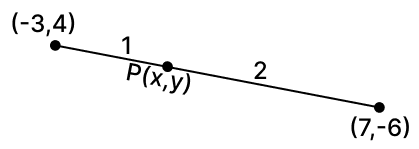
Given,
m1 : m2 = 1 : 2
By section-formula,
(x, y) =
Substitute values we get:
So, Assertion (A) is true.
The reason states the standard section formula, which is exactly the formula used to obtain the point in the Assertion.
So, Reason (R) is true and it is the correct explanation of Assertion (A).
Hence, Option 1 is the correct option.
Assertion (A): The coordinates of one end of a diameter of a circle are (1, 4). If its centre is at (2, -3), then the coordinates of the other end of the diameter are (-3, -10).
Reason (R): The centre of a circle is equidistant from each end of a diameter.
options
Both A and R are true, and R is the correct explanation of A.
Both A and R are true, but R is not the correct explanation of A.
A is true, but R is false.
A is false, but R is true.
Answer
By mid-point formula,
(x, y) =
We know that the centre is the mid-point of a diameter of a circle.
Given,
Centre = (2, -3)
One end of diameter = (1, 4)
Let the other end of the diameter be (a, b).
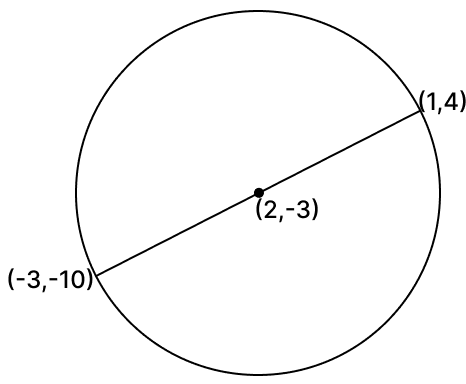
Substituting values, we get :
The correct coordinates of the other end are (3, -10).
So, Assertion (A) is false.
Since the centre is the mid-point of a diameter, it is equidistant from each end of the diameter.
So, Reason (R) is true.
Hence, Option 4 is the correct option.
Assertion (A): If the points A(x, 1), B(8, 2), C(9, 4) and D(7, 3) are the vertices of a parallelogram, taken in order, then the value of x is 6.
Reason (R): Adjacent angles of a parallelogram are supplementary.
options
Both A and R are true, and R is the correct explanation of A.
Both A and R are true, but R is not the correct explanation of A.
A is true, but R is false.
A is false, but R is true.
Answer
By mid-point formula,
(x, y) =
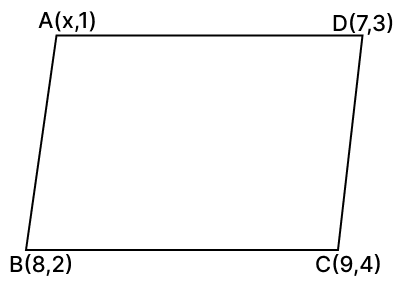
Mid-point of AC :
Mid-point of BD :
Diagonals of a parallelogram bisect each other.
Thus,
Mid-point of AC = Mid-point of BD
So, Assertion (A) is true.
It is also true that the adjacent angles of a parallelogram are supplementary. However, the value of x is obtained using the property that the diagonals of a parallelogram bisect each other, not from the adjacent angles being supplementary.
So, Reason (R) is true, but it is not the correct explanation of Assertion (A).
Hence, Option 2 is the correct option.
Assertion (A): The coordinates of the centroid of a triangle whose vertices are (-1, -4), (4, 3) and (6, -2) are (3, -1).
Reason (R): If the vertices of a triangle are (x1, y1), (x2, y2) and (x3, y3), then the coordinates of its centroid are .
options
Both A and R are true, and R is the correct explanation of A.
Both A and R are true, but R is not the correct explanation of A.
A is true, but R is false.
A is false, but R is true.
Answer
By the centroid formula,
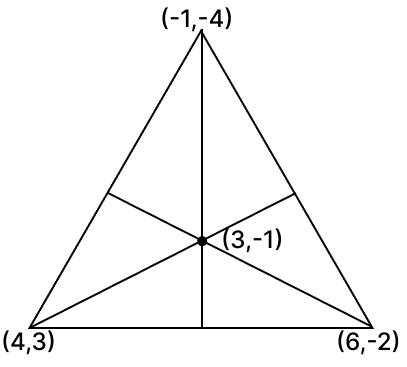
Substitute values we get,
So, Assertion (A) is true.
The correct centroid formula is . The formula given in the Reason has the wrong denominator (2 instead of 3) and uses x-coordinates in place of the y-coordinates for the second term.
So, Reason (R) is false.
Hence, Option 3 is the correct option.