KnowledgeBoat Logo
|
OPEN IN APP

Chapter 13

Section & Mid-Point Formulae — Analytical & Application Based Questions

Class - 10 RS Aggarwal Mathematics Solutions


Analytical and Application Based Questions

Question 1

Determine the ratio in which the line y = 2 + 3x divides the line segment AB joining the points A(-3, 9) and B(4, 2).

Answer

By two point form,

Equation of line :

⇒ y - y1 = y2y1x2x1\dfrac{y_2 - y_1}{x_2 - x_1}(x - x1)

Equation of AB :

y9=294(3)[x(3)]y9=74+3[x+3]y9=77[x+3]y9=1[x+3]y9=x3y+x=3+9x+y=6.\Rightarrow y - 9 = \dfrac{2 - 9}{4 - (-3)}[x - (-3)] \\[1em] \Rightarrow y - 9 = \dfrac{-7}{4 + 3}[x + 3] \\[1em] \Rightarrow y - 9 = \dfrac{-7}{7}[x + 3] \\[1em] \Rightarrow y - 9 = -1[x + 3] \\[1em] \Rightarrow y - 9 = -x - 3 \\[1em] \Rightarrow y + x = -3 + 9 \\[1em] \Rightarrow x + y = 6.

Solving equation y = 2 + 3x and x + y = 6 simultaneously,

⇒ x + y = 6 .......(1)

⇒ y = 2 + 3x .......(2)

Substituting value of y from equation (2) in (1), we get :

⇒ x + (2 + 3x) = 6

⇒ 4x + 2 = 6

⇒ 4x = 6 - 2

⇒ 4x = 4

⇒ x = 44\dfrac{4}{4}

⇒ x = 1.

Substituting value of x in equation (2), we get :

⇒ y = 2 + 3(1) = 2 + 3 = 5.

Let (1, 5) divide the line AB in the ratio k : 1.

By section formula,

(x, y) = (m1x2+m2x1m1+m2,m1y2+m2y1m1+m2)\Big(\dfrac{m_1x_2 + m_2x_1}{m_1 + m_2}, \dfrac{m_1y_2 + m_2y_1}{m_1 + m_2}\Big)

Substituting values we get :

(1,5)=(k×4+1×3k+1,k×2+1×9k+1)(1,5)=(4k3k+1,2k+9k+1)1=4k3k+1 or 5=2k+9k+11(k+1)=4k3 or 5(k+1)=2k+9k+1=4k3 or 5k+5=2k+94kk=1+3 or 5k2k=953k=4 or 3k=4k=43k:1=43:1=4:3.\Rightarrow (1, 5) = \Big(\dfrac{k \times 4 + 1 \times -3}{k + 1}, \dfrac{k \times 2 + 1 \times 9}{k + 1}\Big) \\[1em] \Rightarrow (1, 5) = \Big(\dfrac{4k - 3}{k + 1}, \dfrac{2k + 9}{k + 1}\Big) \\[1em] \Rightarrow 1 = \dfrac{4k - 3}{k + 1} \text{ or } 5 = \dfrac{2k + 9}{k + 1} \\[1em] \Rightarrow 1(k + 1) = 4k - 3 \text{ or } 5(k + 1) = 2k + 9 \\[1em] \Rightarrow k + 1 = 4k - 3 \text{ or } 5k + 5 = 2k + 9 \\[1em] \Rightarrow 4k - k = 1 + 3 \text{ or } 5k - 2k = 9 - 5 \\[1em] \Rightarrow 3k = 4 \text{ or } 3k = 4 \\[1em] \Rightarrow k = \dfrac{4}{3} \\[1em] \Rightarrow k : 1 = \dfrac{4}{3} : 1 = 4 : 3.

Hence, the line y = 2 + 3x divides the line segment AB in the ratio 4 : 3.

Question 2

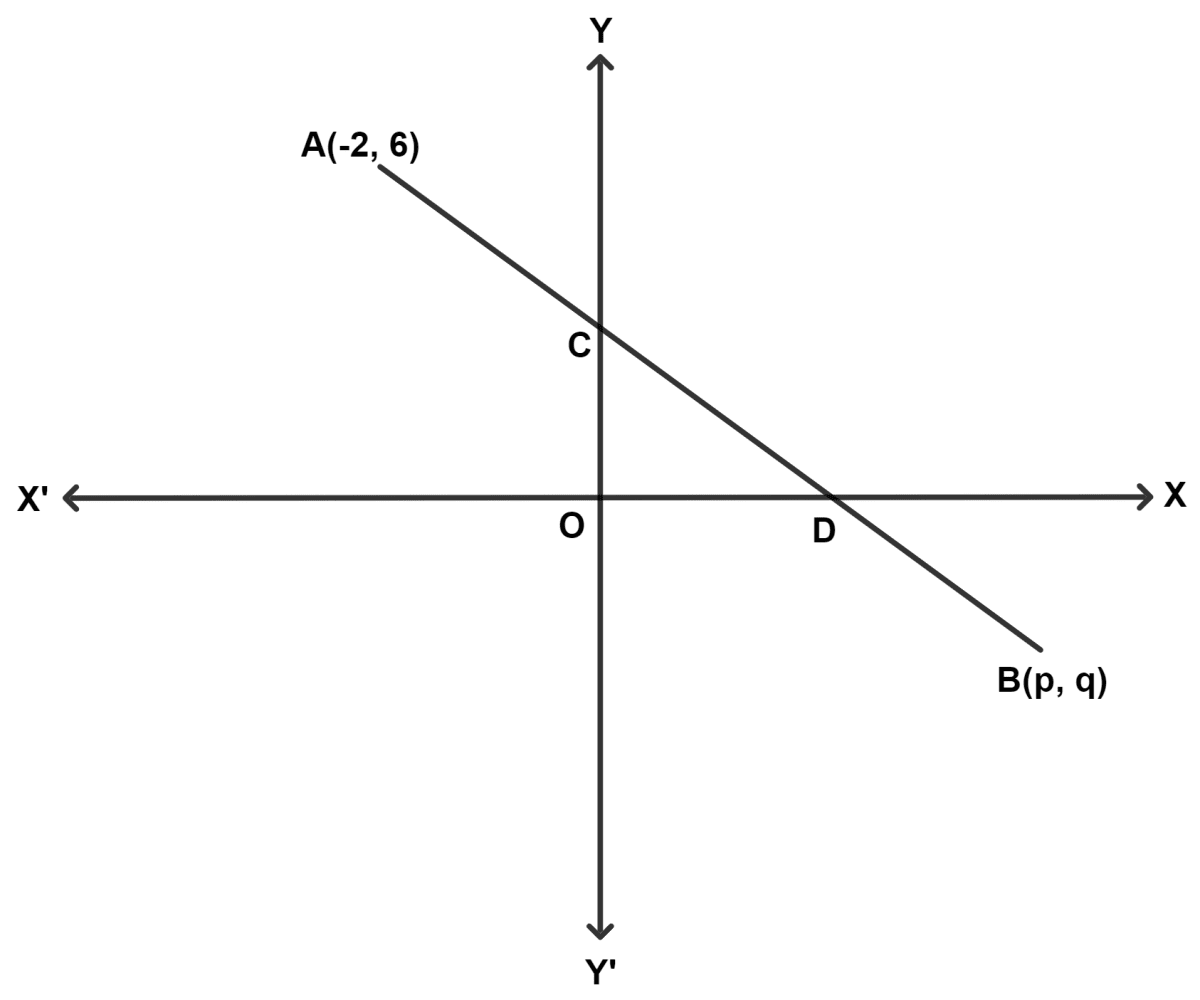
In the given figure, if the line segment AB is intercepted by the y-axis and x-axis at C and D, respectively, such that AC : AD = 1 : 4 and D is the midpoint of CB. Find the coordinates of D, C and B.

In the given figure, if the line segment AB is intercepted by the y-axis and x-axis at C and D, respectively, such that AC : AD = 1 : 4 and D is the midpoint of CB. Find the coordinates of D, C and B. Maths Competency Focused Practice Questions Class 10 Solutions.

Answer

Let coordinates of C be (0, b) and D be (a, 0).

Given,

AC : AD = 1 : 4

Let AC = x and AD = 4x.

From figure,

⇒ AD = AC + CD

⇒ 4x = x + CD

⇒ CD = 4x - x = 3x.

AC : CD = 1 : 3.

By section formula,

(x,y)=(m1x2+m2x1m1+m2,m1y2+m2y1m1+m2)(0,b)=(1×a+3×21+3,1×0+3×61+3)(0,b)=(a64,0+184)(0,b)=(a64,184)a64=0 and b=184a6=0 and b=92a=6 and b=92.\Rightarrow (x, y) = \Big(\dfrac{m_1x_2 + m_2x_1}{m_1 + m_2}, \dfrac{m_1y_2 + m_2y_1}{m_1 + m_2}\Big) \\[1em] \Rightarrow (0, b) = \Big(\dfrac{1 \times a + 3 \times -2}{1 + 3}, \dfrac{1 \times 0 + 3 \times 6}{1 + 3}\Big) \\[1em] \Rightarrow (0, b) = \Big(\dfrac{a - 6}{4}, \dfrac{0 + 18}{4}\Big) \\[1em] \Rightarrow (0, b) = \Big(\dfrac{a - 6}{4}, \dfrac{18}{4}\Big) \\[1em] \Rightarrow \dfrac{a - 6}{4} = 0 \text{ and } b = \dfrac{18}{4} \\[1em] \Rightarrow a - 6 = 0 \text{ and } b = \dfrac{9}{2} \\[1em] \Rightarrow a = 6 \text{ and } b = \dfrac{9}{2}.

C = (0 , b) = (0,92)\Big(0, \dfrac{9}{2}\Big) and D = (6, 0).

Given, D is the mid-point of CB.

(6,0)=(0+p2,92+q2)(6,0)=(p2,9+2q2×2)(6,0)=(p2,9+2q4)p2=6 and 9+2q4=0p=12 and 9+2q=0p=12 and 2q=9p=12 and q=92B=(p,q)=(12,92).\therefore (6, 0) = \Big(\dfrac{0 + p}{2}, \dfrac{\dfrac{9}{2} + q}{2}\Big) \\[1em] \Rightarrow (6, 0) = \Big(\dfrac{p}{2}, \dfrac{9 + 2q}{2 \times 2}\Big) \\[1em] \Rightarrow (6, 0) = \Big(\dfrac{p}{2}, \dfrac{9 + 2q}{4}\Big) \\[1em] \Rightarrow \dfrac{p}{2} = 6 \text{ and } \dfrac{9 + 2q}{4} = 0 \\[1em] \Rightarrow p = 12 \text{ and } 9 + 2q = 0 \\[1em] \Rightarrow p = 12 \text{ and } 2q = -9 \\[1em] \Rightarrow p = 12 \text{ and } q = -\dfrac{9}{2} \\[1em] \Rightarrow B = (p, q) = \Big(12, -\dfrac{9}{2}\Big).

Hence, coordinates of B = (12,92),C=(0,92)\Big(12, -\dfrac{9}{2}\Big), C = \Big(0, \dfrac{9}{2}\Big) and D = (6, 0).

PrevNext