
In two concentric circles, a chord of larger circle which is ________ to smaller circle is bisected at the point of contact.
secant
tangent
chord
diameter
Answer
In two concentric circles, a chord of larger circle which is tangent to smaller circle is bisected at the point of contact.
Hence, option 2 is the correct option.
The length of the tangent drawn to a circle of radius 8 cm, from a point which is at a distance of 10 cm from the centre of the circle is :
6 cm
7 cm
9 cm
2 cm
Answer
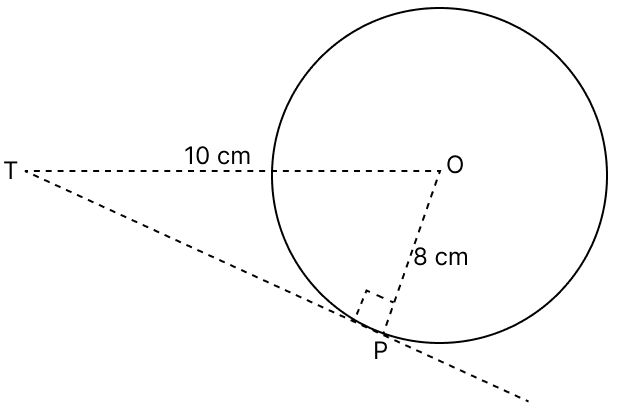
We know that,
The tangent at any point of a circle and the radius through this point are perpendicular to each other.
In right ∆OTP, we have
OT2 = PT2 + OP2
PT2 = OT2 - OP2
PT2 = 100 - 64
PT2 = 36
PT = = 6 cm.
Hence, option 1 is the correct option.
There are ________ two tangents to a circle passing through a point lying outside the circle.
at least
at most
exactly
maximum
Answer
A standard theorem in circle states:
From a point lying outside a circle, exactly two tangents can be drawn to the circle.
Hence, option 3 is the correct option.
If two tangents are drawn from an external point to a circle, then the tangents are equally inclined to the line joining the point and the centre of the circle, i.e., the centre lies on the ________ of the angle between the two tangents.
perpendicular
bisector
perpendicular bisector
none of these
Answer
When two tangents are drawn from an external point to a circle, the line joining the external point and the centre of the circle bisects the angle between the two tangents.
Hence, option 2 is the correct option.
From a point M, the length of the tangent to a circle is 24 cm and the distance of M from the centre is 25 cm. The radius of the circle is :
7 cm
12 cm
24.5 cm
12.5 cm
Answer
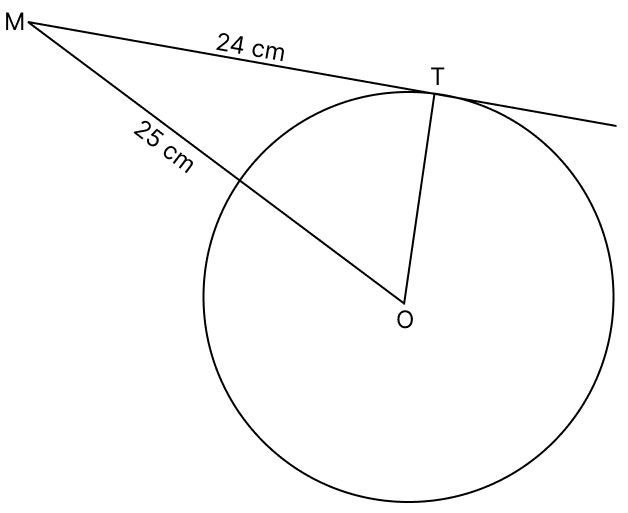
We know that,
The tangent at any point of a circle and the radius through this point are perpendicular to each other.
In right ∆MOT, we have
MO2 = MT2 + OT2
OT2 = MO2 - MT2
OT2 = 252 - 242
OT2 = 625 - 576
OT2 = 49
OT =
OT = 7 cm.
Hence, option 1 is the correct option.
PQ is a tangent to a circle at point P. Centre of the circle is O. If ΔOPQ is an isosceles triangle, then ∠QOP =
30°
60°
45°
90°
Answer
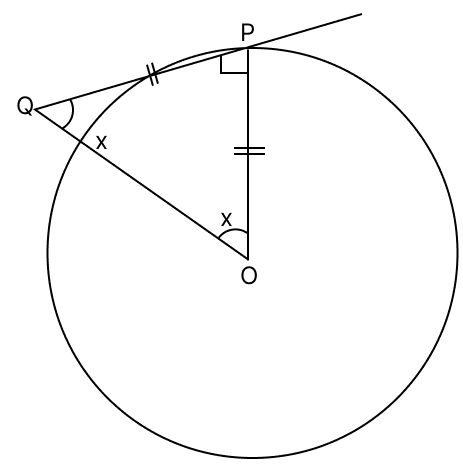
Let QP = OP
We know that,
The tangent at any point of a circle and the radius through this point are perpendicular to each other.
∠OPQ = 90°
∠QOP = ∠OQP = x [Anglers opposite to equal sides are equal in a triangle]
By angles sum triangle property,
x + x + 90° = 180°
2x + 90° = 180°
2x = 180° - 90°
2x = 90°
x =
x = 45°
∠QOP = 45°
Hence, option 3 is the correct option.
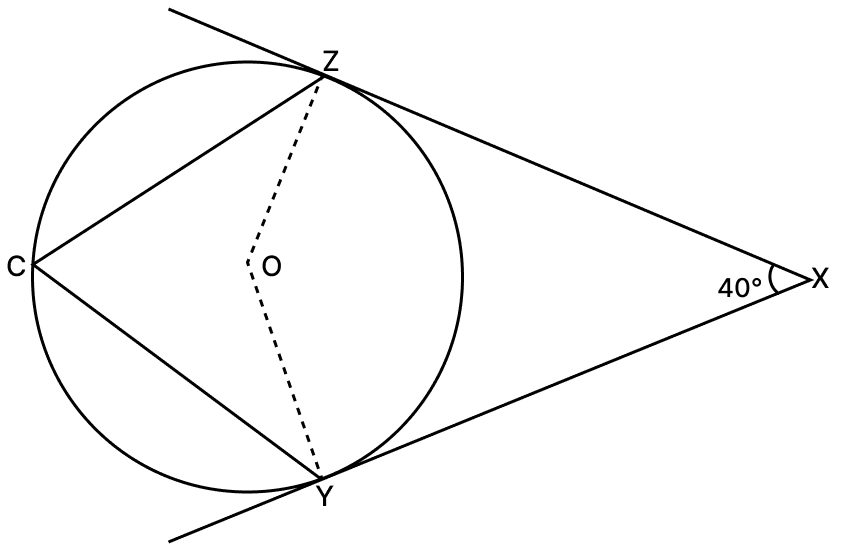
In the figure XY and XZ are tangents at points Y and Z respectively to a circle with centre O. If C is a point on the circle and ∠ZXY = 40°, then ∠ZCY = ?
80°
70°
140°
40°
Answer
From figure,
The tangent at any point of a circle and the radius through this point are perpendicular to each other.
∠OZX = 90°
∠OYX = 90°
∠ZXY + ∠ZOY + ∠OZX + ∠OYX = 360° [Angle sum property of quadrilateral]
40° + 90° + 90° + ∠ZOY = 360°
220° + ∠ZOY = 360°
∠ZOY = 360° - 220°
∠ZOY = 140°.
We know that,
Angle at the centre is double the angle at a point on the remaining part of the circle.
∠ZCY = ∠ZOY
∠ZCY =
∠ZCY = 70°.
Hence, option 2 is the correct option.
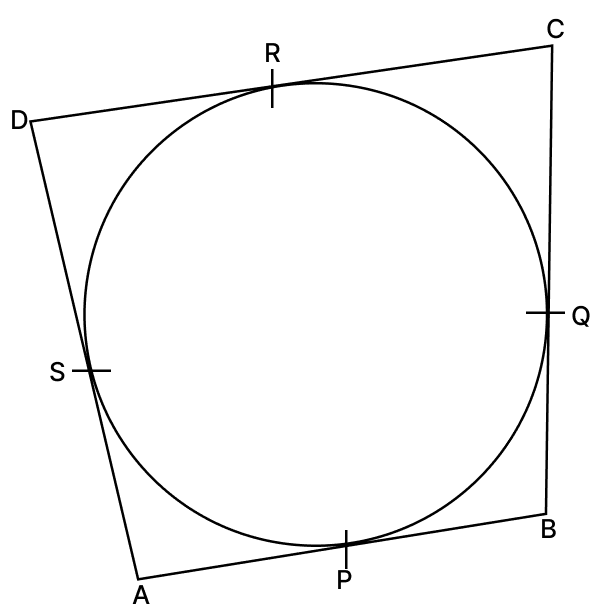
In the given figure, if sides AB, BC, CD and DA of a quadrilateral ABCD touch a circle at points P, Q, R and S respectively, then CR + PB =
BC
AB
CD
AD
Answer
Tangents drawn from the same external point to a circle are equal.
From B,
BP = BQ ........(1)
From C,
CR = CQ ..........(2)
Adding equation (1) and (2), we get :
∴ CR + PB = CQ + BQ = BC
Hence, option 1 is the correct option.
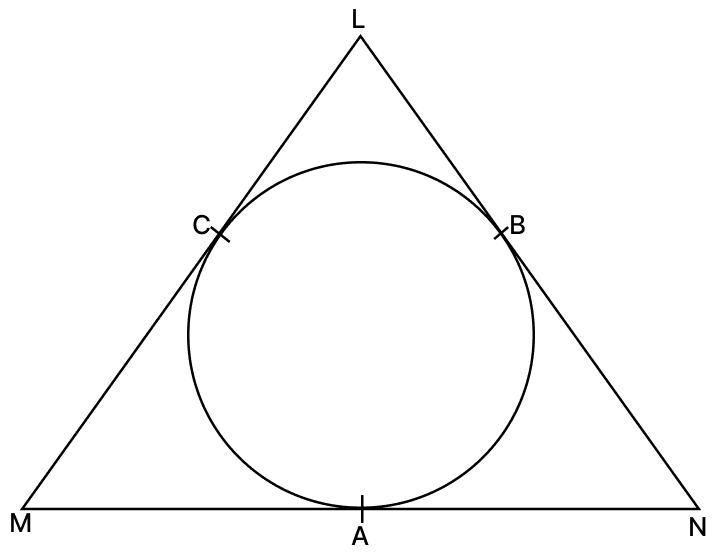
In the figure, sides MN, NL and LM of ΔLMN touch a circle at the points A, B and C respectively. If AN = 5 cm, CL = 4 cm and CM = 6 cm, then the perimeter of ΔLMN is :
30 cm
45 cm
60 cm
15 cm
Answer
Tangents drawn from the same external point to a circle are equal.
From M,
MA = CM = 6 cm
From N,
NA = NB = 5 cm
From L,
LB = LC = 4 cm
MN = MA + AN = 6 + 5 = 11
NL = NB + BL = 5 + 4 = 9
LM = LC + CM = 4 + 6 = 10
Perimeter of ΔLMN = MN + LN + LM
= 11 + 9 + 10
= 30 cm.
Hence, option 1 is the correct option.
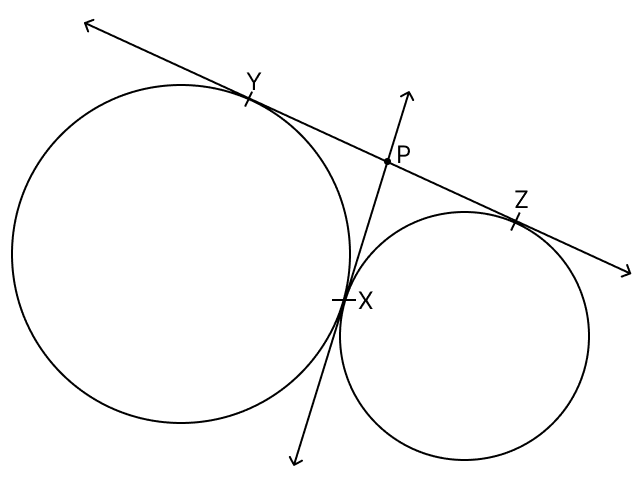
In the figure, two circles touch each other at X. YZ and PX are common tangents to these circles. If YP = 3.8 cm, then YZ = ?
1.9 cm
11.4 cm
7.6 cm
7 cm
Answer
We know that if two tangents are drawn from an external point to a circle then, the lengths of the tangents are equal.
From figure,
PX and PY are the tangents to the first circle.
∴ PX = PY = 3.8 cm
PX and PZ are tangents to the second circle.
∴ PZ = PX = 3.8 cm
From figure,
YZ = PZ + PY = 3.8 + 3.8 = 7.6 cm.
Hence, option 3 is the correct option.
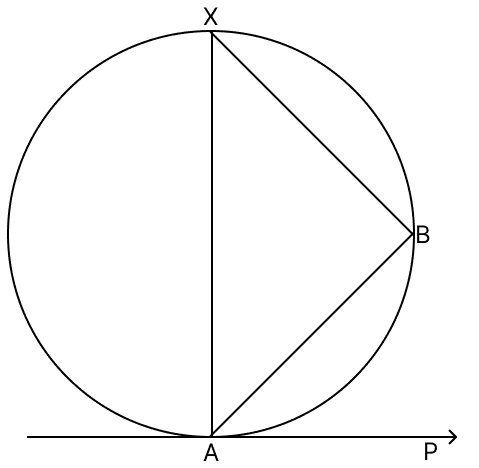
In the figure, AB is a chord of the circle such that ∠AXB = 50°. If AP is tangent to the circle at point A, then ∠BAP = ?
65°
50°
40°
can’t be determined
Answer
From figure,
∠BAP = ∠AXB = 50° [Angle in alternate segment are equal]
Hence, option 2 is the correct option.
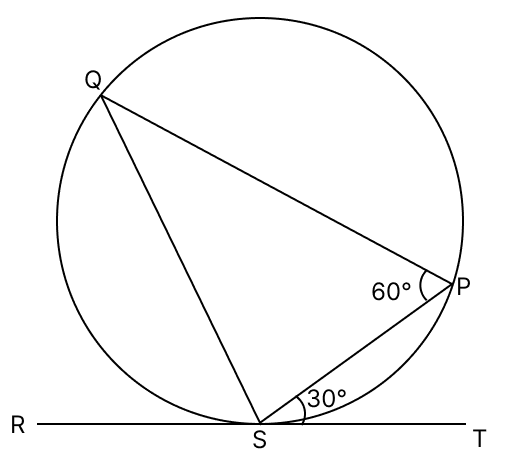
In the given figure, RT is a tangent touching the circle at S. If ∠PST = 30° and ∠SPQ = 60°, then ∠PSQ is :
40°
30°
60°
90°
Answer
We know that,
Angle between tangent and the chord at the point of contact is equal to angle of the alternate segment.
∴ ∠PQS = ∠PST = 30°
In △ PQS,
By angle sum property of triangle,
⇒ ∠PQS + ∠QPS + ∠PSQ = 180°
⇒ 30° + 60° + ∠PSQ = 180°
⇒ ∠PSQ + 90° = 180°
⇒ ∠PSQ = 180° - 90° = 90°.
Hence, option 4 is the correct option.
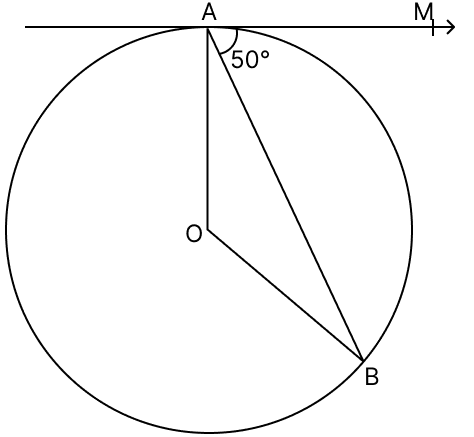
In the given figure, O is the centre of the circle and AB is a chord. If the tangent AM at A makes an angle of 50° with AB, then ∠AOB = ?
100°
75°
80°
150°
Answer
In a circle, radius through the point of contact is perpendicular to the tangent.
∠OAM = 90°
∠OAB + ∠BAM = 90°
∠OAB + 50° = 90°
∠OAB = 90° - 50°
∠OAB = 40°
OA = OB (Radii of same circle)
∠OBA = ∠OAB = 40° [Angles opposite to equal sides in a triangle are equal]
In △AOB,
By angle sum property of triangle,
⇒ ∠OBA + ∠OAB + ∠AOB = 180°
⇒ 40° + 40° + ∠AOB = 180°
⇒ ∠AOB + 80° = 180°
⇒ ∠AOB = 180° - 80° = 100°.
Hence, option 1 is the correct option.
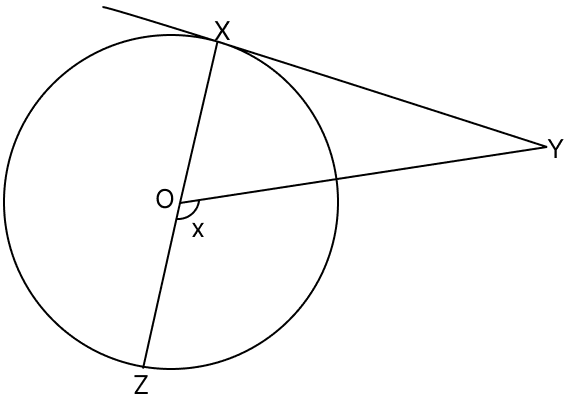
In the figure, XY is a tangent at X to the circle with centre O. If ∠XYO = 25°, then x = ?
25°
115°
65°
60°
Answer
∠XYO = 25°
In a circle, radius through the point of contact is perpendicular to the tangent.
∠OXY = 90°
In △ XOY,
By angle sum property of triangle,
⇒ ∠XYO + ∠OXY + ∠XOY = 180°
⇒ 25° + 90° + ∠XOY = 180°
⇒ ∠XOY + 115° = 180°
⇒ ∠XOY = 180° - 115° = 65°.
From figure,
∠XOY + x = 180° [Linear pairs]
x = 180° - 65°
x = 115°.
Hence, option 2 is the correct option.
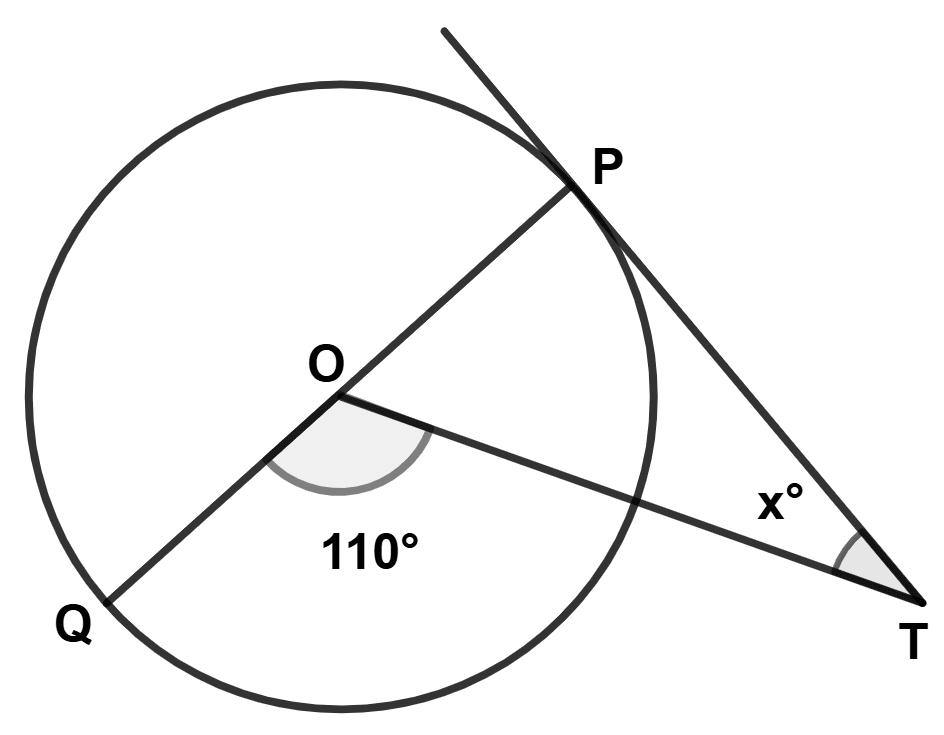
In the adjoining diagram, O is the center of the circle and PT is a tangent. The value of x is :
20°
40°
55°
70°
Answer
From figure,
⇒ ∠QOT + ∠TOP = 180° (Linear Pair)
⇒ 110° + ∠TOP = 180°
⇒ ∠TOP = 180° - 110° = 70°.
⇒ ∠OPT = 90° (Tangent is perpendicular to radius at point of intersection)
In △ TOP,
⇒ ∠OPT + ∠TOP + ∠PTO = 180°
⇒ 90° + 70° + x°= 180°
⇒ x° + 160° = 180°
⇒ x° = 180° - 160° = 20°.
Hence, option 1 is the correct option.
In the given figure, PT and QT are tangents to a circle such that ∠TPS = 45° and ∠TQS = 30°. Then, the value of x is :
30°
45°
75°
105°
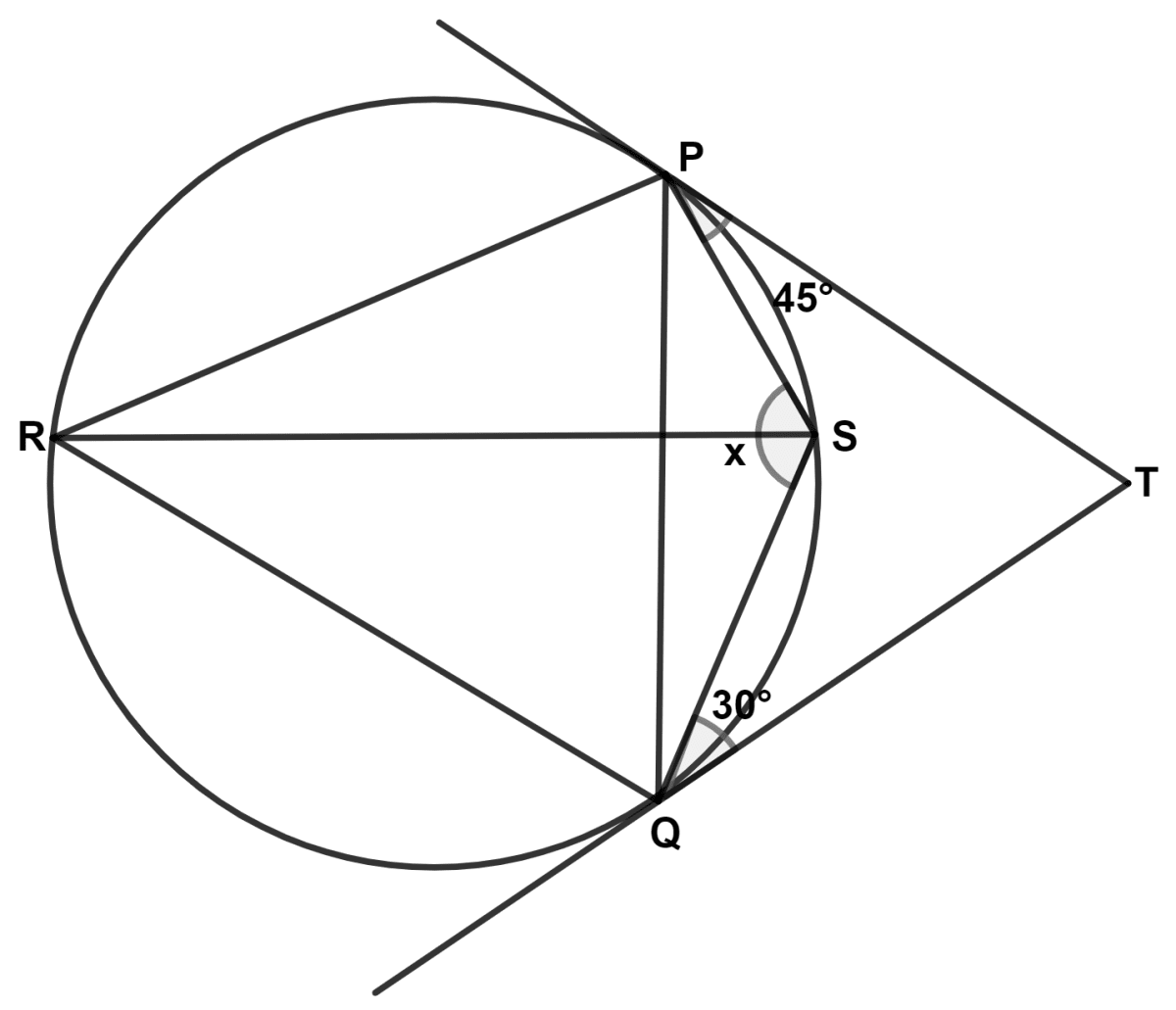
Answer
We know that,
The angle between a tangent and a chord through point of contact is equal to an angle in the alternate segment.
∴ ∠SQP = ∠SPT = 45° and ∠SPQ = ∠SQT = 30°.
In △ SQP,
⇒ ∠SQP + ∠SPQ + ∠QSP = 180°
⇒ 45° + 30° + ∠QSP = 180°
⇒ 75° + ∠QSP = 180°
⇒ ∠QSP (x) = 180° - 75° = 105°.
Hence, option 4 is the correct option.
In the given figure, XQY is a tangent at Q to a circle. If PM is a chord parallel to XY and ∠MQY = 70°, then ∠PQM = ?
20°
35°
40°
70°
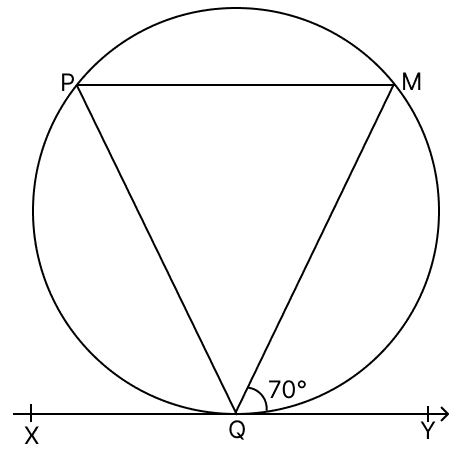
Answer
From figure,
MQ is chord and XQY is a tangent.
∠P = ∠MQY (∵ angles in alternate segment are equal.)
As PM || XQY
∠MQY = ∠M (∵ alternate angles are equal)
∴ ∠P = ∠M = 70°
We know that sum of angles in a triangle = 180°.
In △PQM,
⇒ ∠P + ∠M + ∠PQM = 180°
⇒ 70° + 70° + ∠PQM = 180°
⇒ 140° + ∠PQM = 180°
⇒ ∠PQM = 180° - 140°
⇒ ∠PQM = 40°.
Hence, option 3 is the correct option.
In the given diagram, O is the center of the circle, and PQ is a tangent at A. If ∠ABC = 50°, then values of x, y and z respectively are :
50°, 100°, 40°
50°, 50°, 65°
40°, 80°, 50°
50°, 25°, 78°
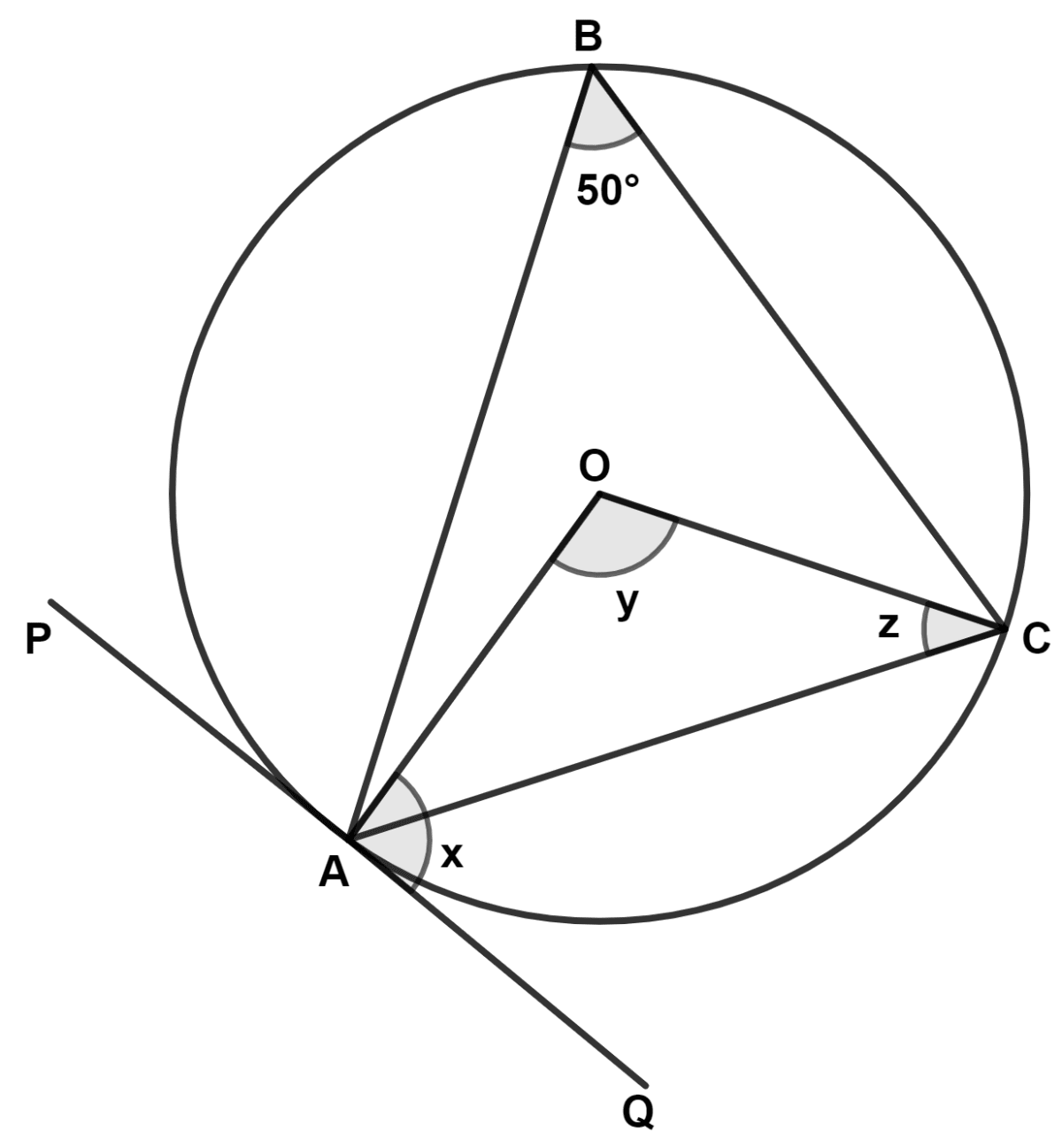
Answer
We know that,
The angle subtended by an arc at the centre is double the angle subtended by it at any point on the remaining part of the circle.
∴ ∠AOC (y) = 2∠ABC = 2 × 50° = 100°.
In △ AOC,
⇒ OA = OC (Radii of same circle)
⇒ ∠OAC = ∠OCA = z (Angle opposite to equal sides are equal)
By angle sum property of triangle,
⇒ ∠OAC + ∠OCA + ∠AOC = 180°
⇒ z + z + 100° = 180°
⇒ 2z = 180° - 100°
⇒ 2z = 80°
⇒ z = = 40°.
We know that,
The tangent at any point of a circle is perpendicular to the radius through the point of contact.
⇒ ∠CAQ (x) = ∠OAQ - ∠OAC = 90° - 40° = 50°.
Hence, option 1 is the correct option.
In the given diagram, the radius of the circle with centre O is 3 cm. PA and PB are the tangents to the circle which are at right angle to each other. The length of OP is:
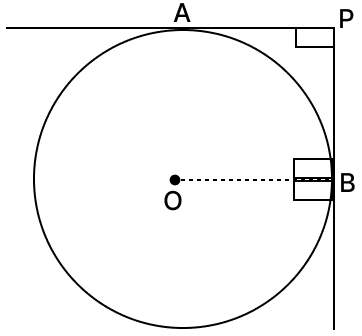
cm
3 cm
cm
cm
Answer
Join OA and AP.
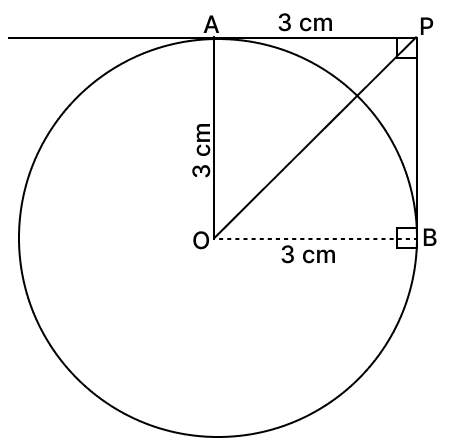
Given,
Radius of circle (OB) = 3 cm
PB and AP are at right angles.
We know that,
Radius and tangent at point of contact are perpendicular to each other.
OA ⊥ AP
From figure,
⇒ OA = OB = 3 cm [Radius of circle]
⇒ OB is perpendicular to PB
⇒ ∠OBP = 90°
This shows APBO is square.
OA = PB = AP = OB = 3 cm.
In right angled triangle OBP,
⇒ OP2 = OB2 + PB2
⇒ OP2 = 32 + 32
⇒ OP2 = 9 + 9
⇒ OP2 = 18
⇒ OP =
⇒ OP = cm.
Hence, option 3 is the correct option.
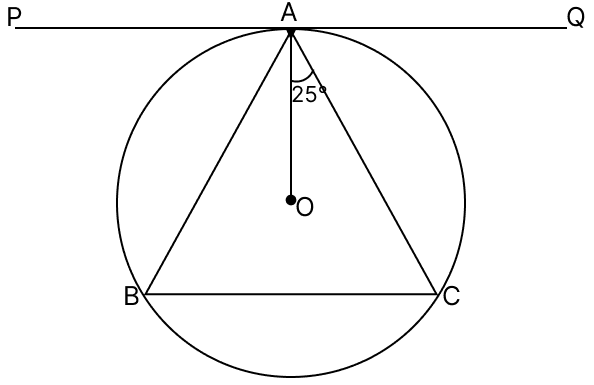
In the adjoining diagram, PQ is a tangent at A to the circle with centre O. If ∠OAC = 25°, then ∠ABC is:
20°
65°
70°
130°
Answer
Given,
∠OAC = 25°
We know that,
Radius from the center and tangent are perpendicular to each other at point of contact.
⇒ ∠OAQ = ∠OAP = 90°
From figure,
⇒ ∠OAQ = ∠OAC + ∠CAQ
⇒ 90° = 25° + ∠CAQ
⇒ ∠CAQ = 90° - 25°
⇒ ∠CAQ = 65°.
We know that,
The angle between a tangent and a chord through the point of contact is equal to an angle in alternate segment. Hence,
⇒ ∠ABC = ∠CAQ
⇒ ∠ABC = 65°.
Hence, option 2 is the correct option.