
(i)
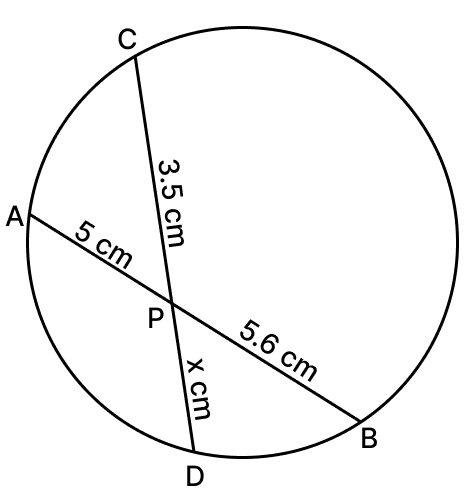
(ii)
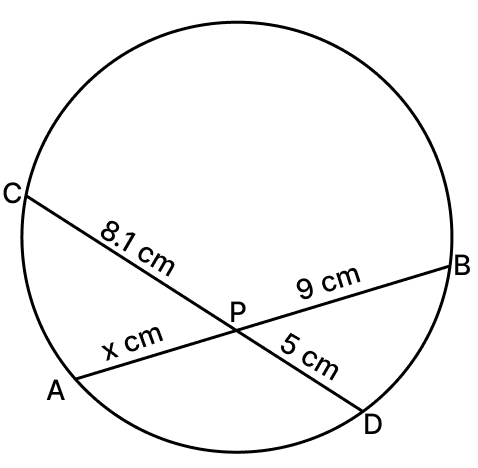
(iii)
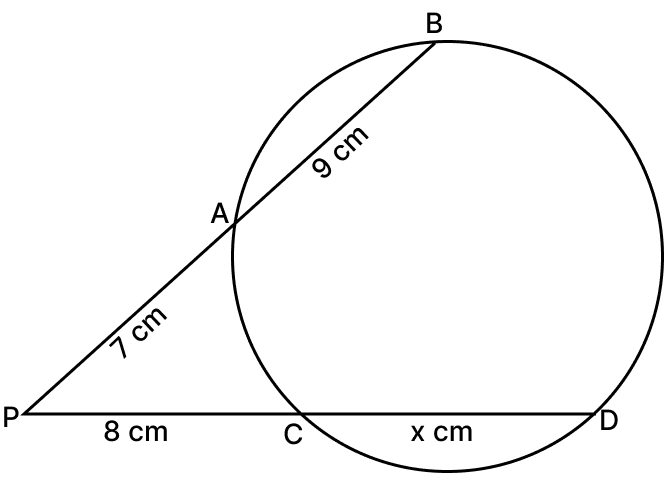
(iv)
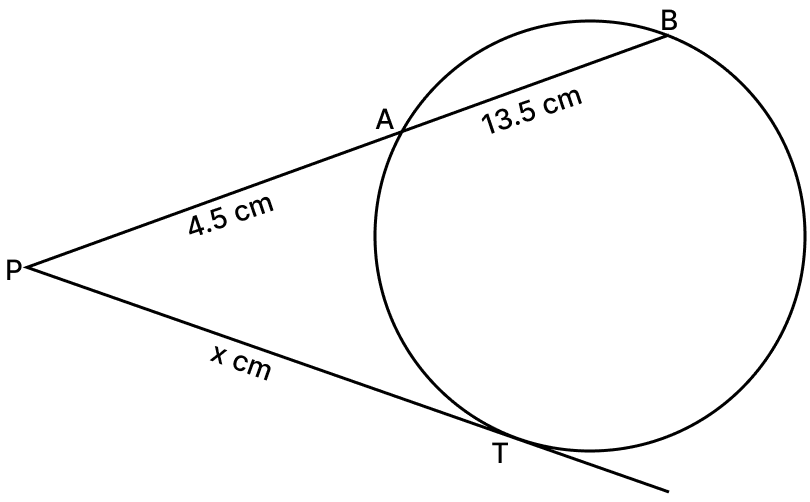
(v)
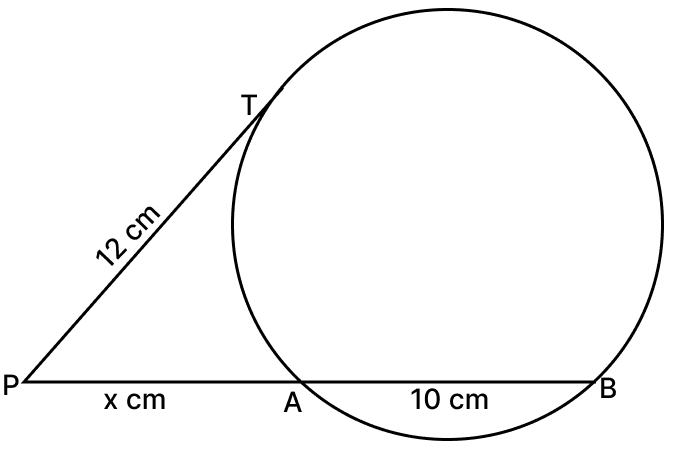
Find the unknown length x in each of the following figures.
Answer
We know that,
If two chords of a circle intersect internally, then the products of the length of segments are equal.
(i) PA × PB = PC × PD
5 × 5.6 = 3.5 × x
x =
x = 8 cm.
Hence, x = 8 cm.
(ii) PA × PB = PC × PD
x × 9 = 8.1 × 5
x =
x = 4.5 cm
Hence, x = 4.5 cm.
We know that,
If two chords of a circle intersect externally, then the products of the length of segments are equal.
(iii) PA × PB = PC × PD
⇒ PB = PA + AB = 7 + 9 = 16
⇒ PD = PC + CD = 8 + x
⇒ 7 × 16 = 8 × (8 + x)
⇒ 112 = 64 + 8x
⇒ 8x = 112 - 64
⇒ x =
⇒ x = 6 cm.
Hence, x = 6 cm.
(iv) We know that,
If a chord and a tangent intersect externally, then the product of lengths of the segments of the chord is equal to the square of the length of the tangent from the point of contact to the point of intersection.
∴ PT2 = AP × BP
x2 = 4.5 × 18
x2 = 81
x = 9 cm.
Hence, x = 9 cm.
(v) We know that,
If a chord and a tangent intersect externally, then the product of lengths of the segments of the chord is equal to the square of the length of the tangent from the point of contact to the point of intersection.
∴ PT2 = AP × BP
⇒ BP = AP + AB = x + 10
⇒ 122 = x × (x + 10)
⇒ 144 = x2 + 10x
⇒ x2 + 10x - 144 = 0
⇒ x2 + 18x - 8x - 144 = 0
⇒ x(x + 18) - 8(x + 18) = 0
⇒ (x - 8)(x + 18) = 0
⇒ (x - 8) = 0 or (x + 18) = 0 [Using Zero-product rule]
⇒ x = 8 or x = -18
∴ x = 8 because length cannot be negative.
Hence, x = 8 cm.
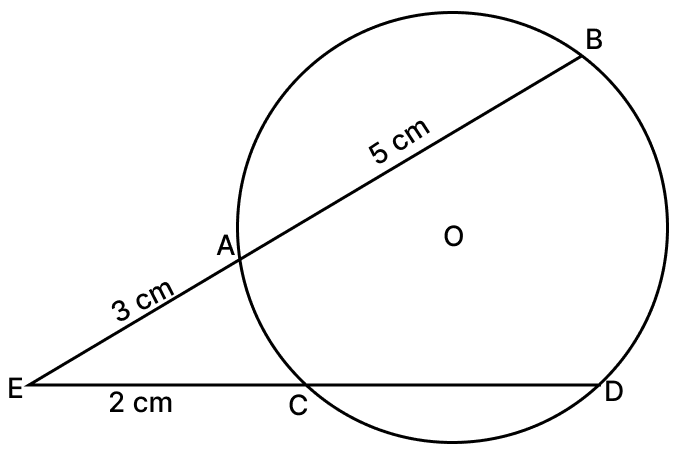
Two chords AB and CD of a circle intersect externally at E. If EC = 2 cm, EA = 3 cm and AB = 5 cm, find the length of CD.
Answer
We know that,
If two chords of a circle intersect externally, then the products of the length of segments are equal.
From figure,
EA × EB = EC × ED ....(1)
EB = EA + AB = 3 + 5 = 8 cm
Substituting values in equation (1) we get,
⇒ 3 × 8 = 2 × ED
⇒ 24 = 2 × ED
⇒ ED =
⇒ ED = 12 cm.
⇒ CD = ED - EC = 12 - 2 = 10 cm
Hence, CD = 10 cm.
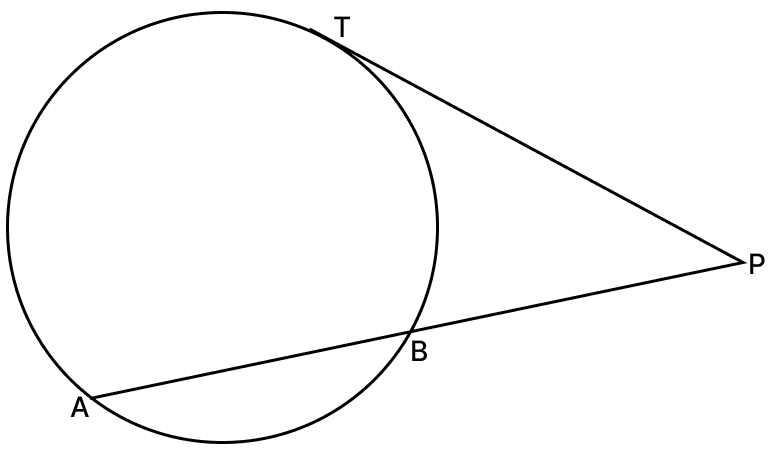
In the adjoining figure, PT is a tangent to the circle. Find PT, if AP = 16 cm and AB = 12 cm.
Answer
We know that,
If a chord and a tangent intersect externally, then the product of lengths of the segments of the chord is equal to the square of the length of the tangent from the point of contact to the point of intersection.
∴ PT2 = AP × BP
From figure,
BP = AP - AB = 16 - 12 = 4 cm.
Substituting values we get,
PT2 = 16 × 4
PT2 = 64
PT =
PT = 8 cm.
Hence, PT = 8 cm.
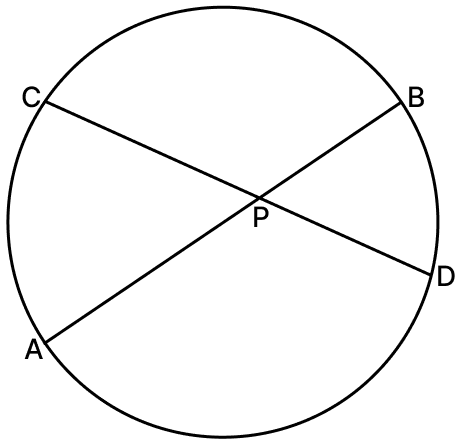
Two chords AB and CD of a circle intersect at a point P inside the circle such that AB = 12 cm, AP = 2.4 cm and PD = 7.2 cm. Find CD.
Answer
We know that,
If two chords of a circle intersect internally, then the products of the length of segments are equal.
AP × PB = CP × PD
PB = AB - AP = 12 - 2.4 = 9.6 cm
Substituting values we get,
⇒ 2.4 × 9.6 = CP × 7.2
⇒ CP =
⇒ CP = 3.2 cm
⇒ CD = CP + PD = 3.2 + 7.2 = 10.4 cm
Hence, CD = 10.4 cm.
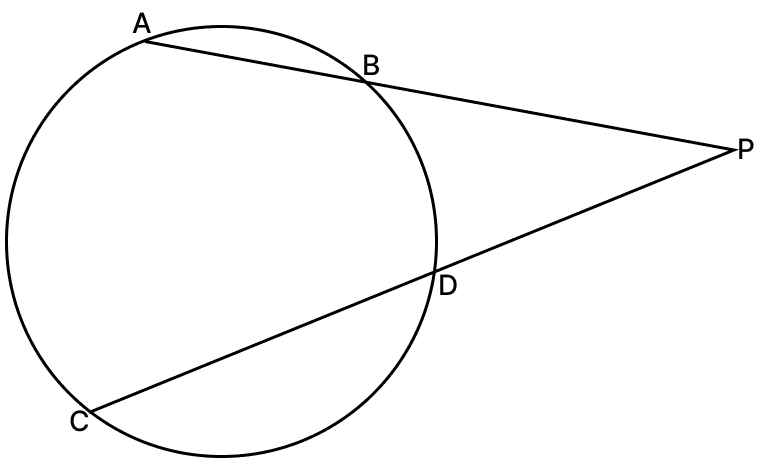
If AB and CD are two chords of a circle which when produced meet at a point P outside the circle such that PA = 12 cm, AB = 4 cm and CD = 10 cm, find PD.
Answer
We know that,
If two chords of a circle intersect externally, then the products of the length of segments are equal.
PA × PB = CP × PD ........(1)
PB = PA - AB
PB = 12 - 4 = 8 cm
Let length of PD be x.
PC = x + CD = x + 10
Substituting values in equation (1) we get,
⇒ 12 × 8 = (x + 10) × x
⇒ 96 = x2 + 10x
⇒ x2 + 10x - 96 = 0
⇒ x2 + 16x - 6x - 96 = 0
⇒ x(x + 16) - 6(x + 16) = 0
⇒ (x - 6)(x + 16) = 0
⇒ x = 6 [Length cannot be negative]
⇒ PD = 6 cm.
Hence, PD = 6 cm.
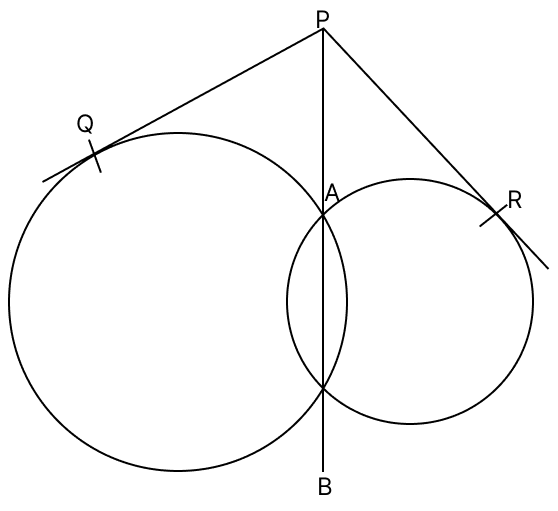
In the given figure, two circles intersect each other at the points A and B. If PQ and PR are tangents to these circles from a point P on BA produced, show that PQ = PR.
Answer
We know that,
If a chord and a tangent intersect externally, then the product of lengths of the segments of the chord is equal to the square of the length of the tangent from the point of contact to the point of intersection.
For circle 1:
∴ PQ2 = PA × PB
For circle 2:
∴ PR2 = PA × PB
Thus,
PQ2 = PR2
Taking square root on both sides,
PQ = PR
Hence, proved that PQ = PR.
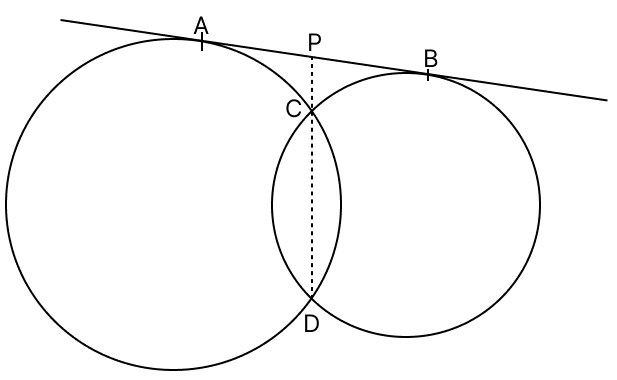
In the given figure, AB is a direct common tangent to two intersecting circles. Their common chord when produced intersects AB at P. Prove that P is the mid-point of AB.
Answer
We know that,
If a chord and a tangent intersect externally, then the product of lengths of the segments of the chord is equal to the square of the length of the tangent from the point of contact to the point of intersection.
For circle 1:
∴ PA2 = PC × PD
For circle 2:
∴ PB2 = PC × PD
Thus,
PA2 = PB2
Taking square root on both sides,
PA = PB
Point P divides AB into two equal parts.
Hence, proved P is the mid-point of AB.
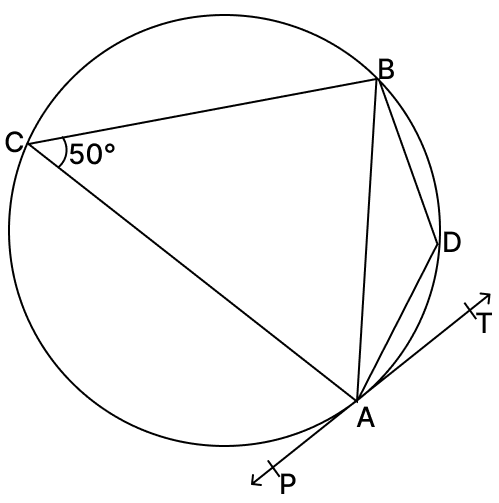
In the given figure, PAT is tangent at A. If ∠ACB = 50°, find :
(i) ∠TAB
(ii) ∠ADB
Answer
(i) ∠TAB = ∠ACB = 50° [Angles in the alternate segment are equal]
Hence, ∠TAB = 50°.
(ii) ∠ADB + ∠ACB = 180° [Opposite angles of cyclic quadrilateral]
∠ADB = 180° - 50°
∠ADB = 130°.
Hence, ∠ADB = 130°.
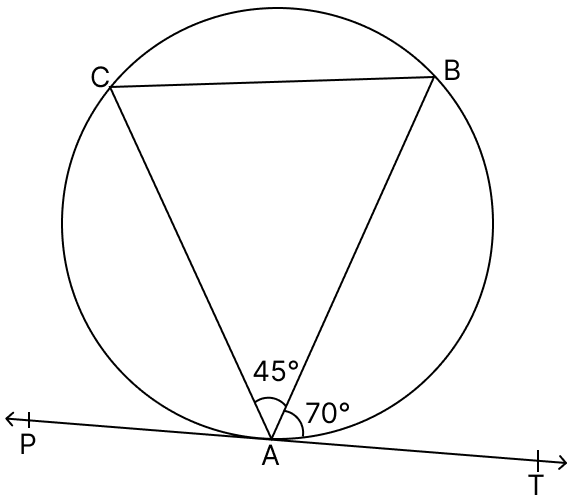
In the given figure, PAT is tangent at A. If ∠TAB = 70° and ∠BAC = 45°, find ∠ABC.
Answer
From figure,
∠ACB = ∠TAB = 70° [Angles in the alternate segment are equal]
In ΔABC,
⇒ ∠ACB + ∠BAC + ∠ABC = 180° [By angle sum property of triangle]
⇒ ∠ABC = 180° - (∠BAC + ∠ACB)
⇒ ∠ABC = 180° - (45° + 70°)
⇒ ∠ABC = 65°.
Hence, ∠ABC = 65°.
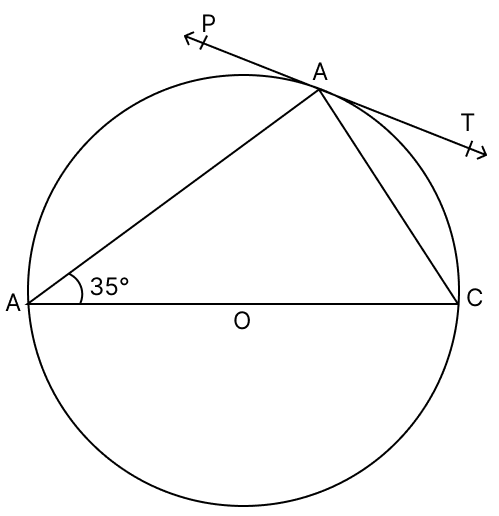
In the given figure, PAT is tangent at A to the circle with centre O. If ∠ABC = 35°, find :
(i) ∠TAC
(ii) ∠PAB
Answer
(i) ∠TAC = ∠ABC = 35° [Angles in the alternate segment are equal]
Hence, ∠TAC = 35°.
(ii) Since BC is a diameter, ∠BAC is an angle in a semicircle.Therefore, ∠BAC = 90°
⇒ ∠ACB + ∠BAC + ∠ABC = 180°
⇒ ∠ACB + 90° + 35° = 180°
⇒ ∠ACB = 180° - 90° - 35°
⇒ ∠ACB = 55°
⇒ ∠PAB = ∠ACB [Angles in the alternate segment are equal]
⇒ ∠PAB = 55°
Hence, ∠PAB = 55°.
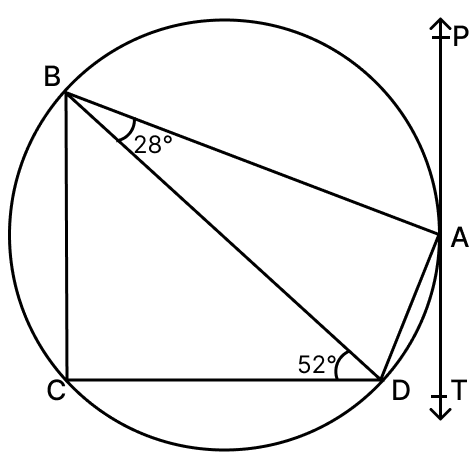
In the given figure, PAT is tangent at A and BD is a diameter of the circle. If ∠ABD = 28° and ∠BDC = 52°, find :
(i) ∠TAD
(ii) ∠BAD
(iii) ∠PAB
(iv) ∠CBD
Answer
(i) ∠TAD = ∠ABD = 28° [Angles in the alternate segment are equal]
Hence, ∠TAD = 28°.
(ii) ∠BAD = 90° [Angle in the semicircle]
Hence, ∠BAD = 90°.
(iii) ∠PAB = ∠ADB [Angles in the alternate segment]
By angle sum property of triangle :
⇒ ∠ADB + ∠ABD + ∠BAD = 180°
⇒ ∠ADB + 28° + 90° = 180°
⇒ ∠ADB = 180° - (28° + 90°)
⇒ ∠ADB = 62°
⇒ ∠PAB = 62°.
Hence, ∠PAB = 62°.
(iv) In ΔBCD, since BD is the diameter ∠BCD = 90°.
By angle sum property of triangle,
⇒ ∠CBD + ∠BCD + ∠BDC = 180°
⇒ ∠CBD + 90° + 52° = 180°
⇒ ∠CBD = 180° - 90° - 52°
⇒ ∠CBD = 38°.
Hence, ∠CBD = 38°.
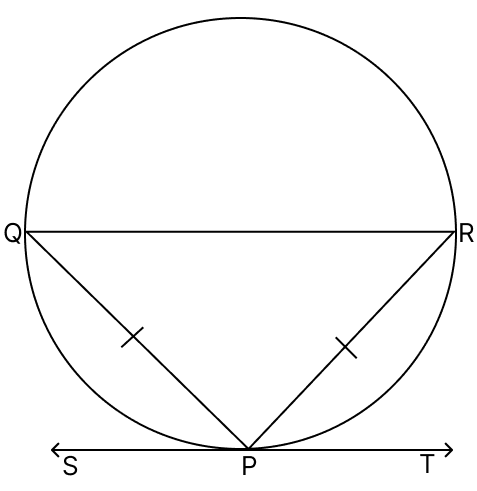
In the given figure, PQ and PR are two equal chords of a circle. Show that the tangent at P is parallel to QR.
Answer
Given,
PQ = PR
∠PRQ = ∠PQR [Angles opposite to equal sides in a triangle are equal]
∠TPR = ∠PQR [Angles in alternate segment]
∴ ∠PRQ = ∠TPR
These are pair of alternate interior angles.
If the alternate interior angles are equal, then lines P and QR should be parallel.
Hence, proved tangent at P is parallel to QR.
In the given figure, AB is a chord of the circle with centre O and BT is a tangent to the circle. If ∠OAB = 35°, find the values of x and y.
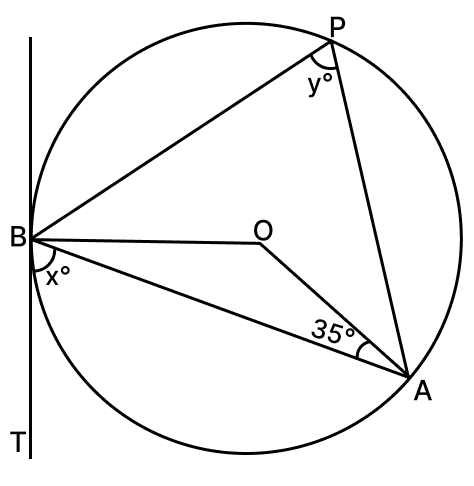
Answer
In △OAB,
OA = OB (∵ both are radius of the common circle.)
So, △OAB is a isosceles triangle with,
∠OBA = ∠OAB = 35°.
Since sum of angles in a triangle = 180°.
In △OAB,
⇒ ∠OBA + ∠OAB + ∠AOB = 180°
⇒ 35° + 35° + ∠AOB = 180°
⇒ 70° + ∠AOB = 180°
⇒ ∠AOB = 180° - 70°
⇒ ∠AOB = 110°.
Arc AB subtends ∠AOB at centre and ∠ACB at remaining part of circle.
∴ ∠AOB = 2∠ACB (∵ angle subtended at centre is double the angle subtended at remaining part of the circle.)
⇒ 110° = 2y
⇒ y =
⇒ y = 55°.
From figure,
∠ABT = ∠ACB = 55° (∵ Angles in alternate segments are equal.)
∴ x = 55°.
Hence, the value of x = 55 and y = 55.
In the given figure PT is a tangent to the circle. Chord BA produced meets the tangent PT at P. Given PT = 20 cm and PA = 16 cm.
(i) Prove that △ PTB ~ △ PAT
(ii) Find the length of AB.
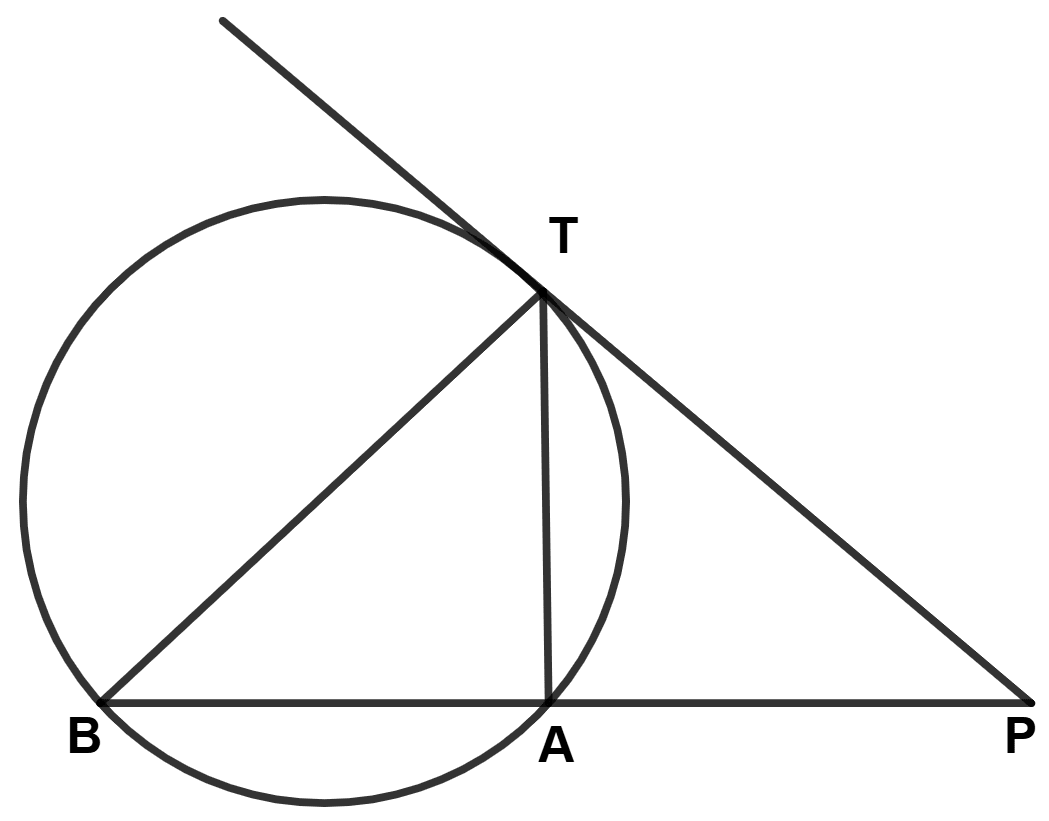
Answer
(i) In △ PTB and △ PAT,
⇒ ∠PTA = ∠PBT (Alternate segment theorem)
⇒ ∠TPA = ∠BPT (Common angle)
∴ △ PTB ~ △ PAT (By A.A. axiom)
Hence, proved that △ PTB ~ △ PAT.
(ii) We know that,
If a chord and a tangent intersect externally, then the product of the lengths of segments of the chord is equal to the square of the length of the tangent from the point of contact to the point of intersection.
⇒ PA × PB = PT2
⇒ PA × (PA + AB) = PT2
⇒ 16 × (16 + AB) = 202
⇒ 16 × (16 + AB) = 400
⇒ 16 + AB = 25
⇒ AB = 25 - 16 = 9 cm.
Hence, AB = 9 cm.
In a right-angled ΔABC, the perpendicular BD on hypotenuse AC is drawn. Prove that :
(i) AC × AD = AB2
(ii) AC × CD = BC2
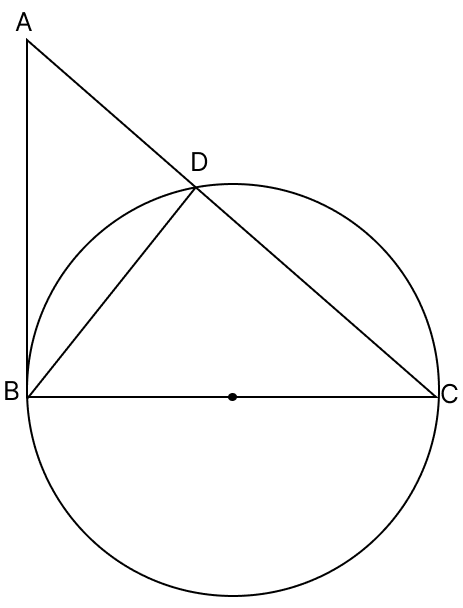
Answer
(i) In ΔABC and ΔADB,
⇒ ∠ABC = ∠ADB = 90°
⇒ ∠BAC = ∠DAB [Common angles]
△ABC ∼ △ADB [By AA similarity]
Since, corresponding sides of similar triangle are proportional to each other.
AB2 = AC × AD
Hence, AB2 = AC × AD.
(ii) In ΔABC and ΔBDC
⇒ ∠ABC = ∠CDB = 90°
⇒ ∠C [Common angles]
△ABC ∼ △BDC [By AA similarity]
BC2 = AC × CD
Hence, BC2 = AC × CD.
In the given figure, ABCD is a cyclic quadrilateral in which CB = CD and TC is a tangent to the circle at C. If O is the centre of the circle and BC is produced to E such that ∠DCE = 110°, find:
(i) ∠DCT
(ii) ∠BOC
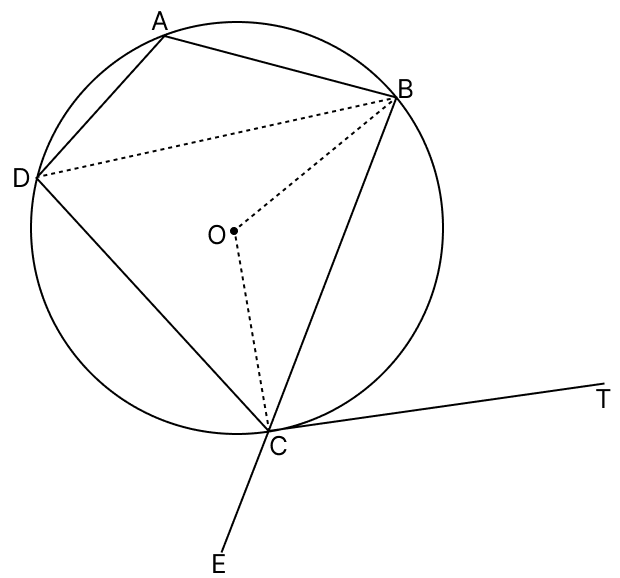
Answer
(i) From figure,
⇒ ∠DCE + ∠DCB = 180° [Linear pair]
⇒ ∠DCB = 180° - ∠DCE
⇒ ∠DCB = 180° - 110°
⇒ ∠DCB = 70°.
Given,,
CB = CD
∠BDC = ∠DBC = 55° [Angles opposite to equal sides in a triangle are equal]
Arc BC subtends ∠BOC at center and ∠BDC on the remaining part of the circle.
⇒ ∠BOC = 2(∠BDC)
⇒ ∠BOC = 2(55°) = 110°
⇒ ∠BCT = ∠BDC = 55° [Angles in alternate segments]
From figure,
⇒ ∠DCT = ∠DCB + ∠BCT
⇒ ∠DCT = 70° + 55° = 125°.
Hence, ∠DCT = 125°.
(ii) From part (i), we get :
∠BOC = 110°
Hence, ∠BOC = 110°.
In the given figure, AC is a tangent to the circle with centre O. If ∠ADB = 55°, find x and y. Give reasons for your answers.
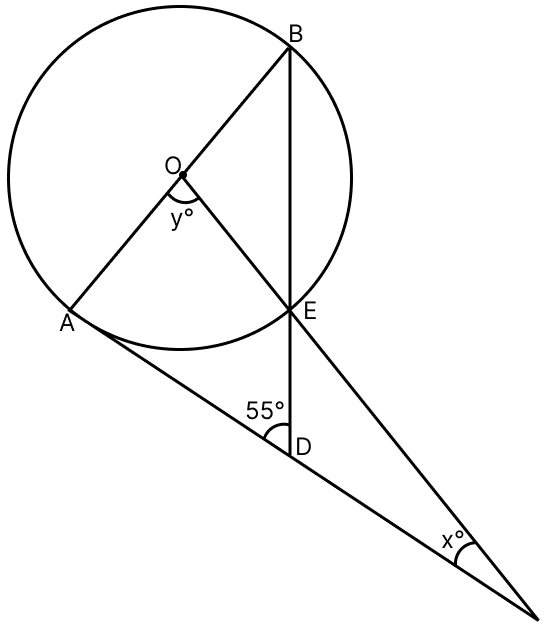
Answer
We know that,
Angle between the radius and tangent at the point of contact is right angle.
∴ ∠A = 90°.
Also in △OBE, OB = OE = radius of the circle.
∴ ∠B = ∠OEB …..(i)
In △ABD,
⇒ ∠A + ∠B + ∠ADB = 180°
⇒ 90° + ∠B + 55° = 180°
⇒ ∠B + 145° = 180°
⇒ ∠B = 180° - 145° = 35°.
∴ ∠OEB = 35°.
From figure,
∠DEC = ∠OEB = 35° (∵ vertically opposite angles are equal.)
∠EDC + ∠ADE = 180° (∵ both form a linear pair)
∠EDC + 55° = 180°
∠EDC = 180° - 55°
∠EDC = 125°.
In △EDC,
⇒ ∠DEC + ∠EDC + ∠DCE = 180°
⇒ 35° + 125° + x° = 180°
⇒ x° + 160° = 180°
⇒ x° = 180° - 160° = 20°.
In △AOC,
⇒ ∠AOC + ∠OAC + ∠ACO = 180°
⇒ y° + 90° + x° = 180°
⇒ y° + 90° + 20° = 180°
⇒ y° + 110° = 180°
⇒ y° = 180° - 110° = 70°.
Hence, the value of x = 20° and y = 70°.
In the given figure (drawn not to scale) chords AD and BC intersect at P, where AB = 9 cm, PB = 3 cm and PD = 2 cm.
(i) Prove that △ APB ~ △ CPD
(ii) Find the length of CD
(iii) Find area △ APB : area △ CPD.
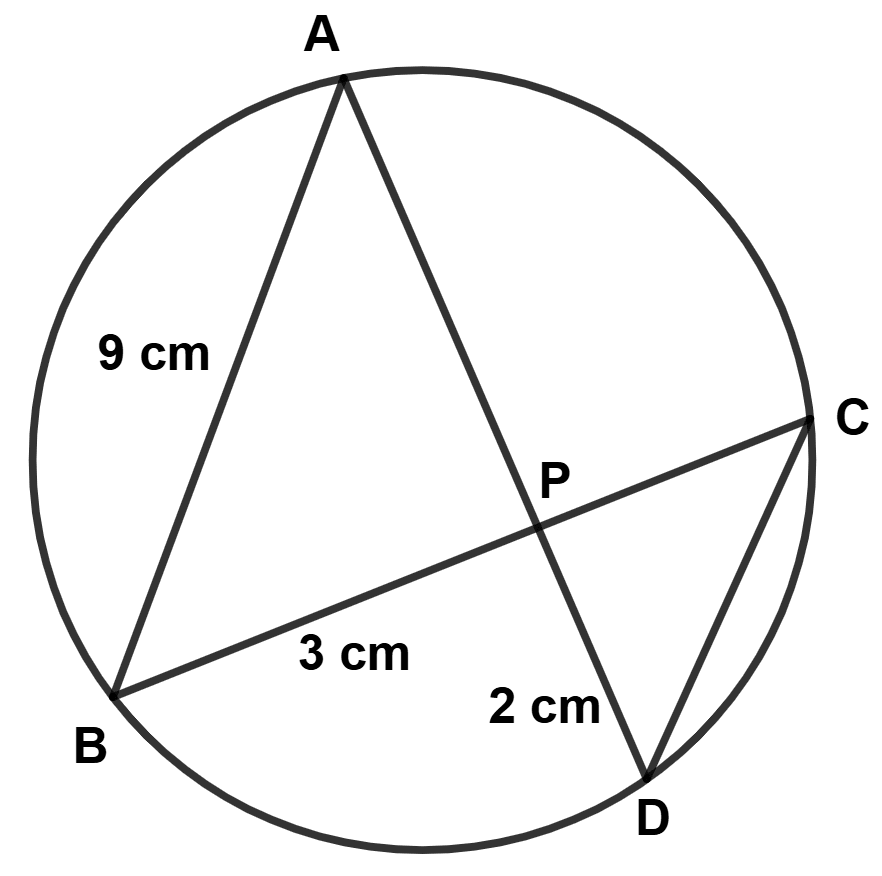
Answer
(i) In △ APB and △ CPD,
⇒ ∠APB = ∠CPD (Vertically opposite angles are equal)
⇒ ∠BAP = ∠DCP (Angles in same segment are equal)
∴ △ APB ~ △ CPD (By A.A. axiom)
Hence, proved that △ APB ~ △ CPD.
(ii) We know that,
Corresponding sides of similar triangles are proportional.
Hence, CD = 6 cm.
(iii) We know that,
Ratio of area of similar triangles is equal to the ratio of square of the corresponding sides.
Hence, area △ APB : area △ CPD = 9 : 4.
X, Y, Z and C are the points on the circumference of a circle with centre O. AB is a tangent to the circle at X and ZY = XY. Given ∠OBX = 32° and ∠AXZ = 66°. Find:
(i) ∠BOX
(ii) ∠CYX
(iii) ∠ZYX
(iv) ∠OXY
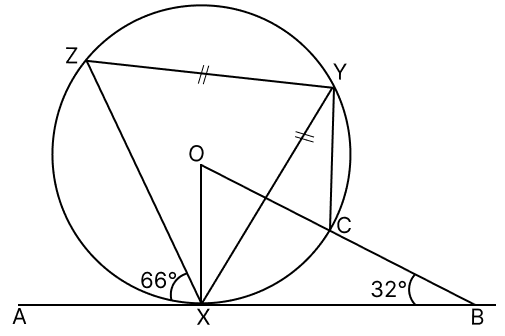
Answer
(i) Given,
In ΔBOX, OX ⟂ BX (radius ⟂ tangent at its point of contact)
⇒ ∠OXB = 90°.
By angle‑sum property of triangle,
⇒ ∠BOX + ∠OBX + ∠OXB = 180°
⇒ ∠BOX + 32° + 90° = 180°
⇒ ∠BOX + 122° = 180°
⇒ ∠BOX = 180° - 122°
⇒ ∠BOX = 58°.
Hence, ∠BOX = 58°.
(ii) From figure,
∠COX = ∠BOX = 58°
We know that,
The angle which, an arc of a circle subtends at the centre is double that which it subtends at any point on the remaining part of the circumference.
Hence, ∠CYX = 29°.
(iii) We know that,
The angle between a tangent and a chord through the point of contact is equal to an angle in alternate segment.
∠ZYX = ∠AXZ = 66°
Hence, ∠ZYX = 66°.
(iv) From figure,
In isosceles ΔZXY,
ZY = XY
We know that,
The angles opposite to equal side of a triangle are equal.
∠ZXY = ∠XZY
By angle sum property in ΔXYZ,
We know that,
The angle between a tangent and a chord through the point of contact is equal to an angle in alternate segment.
∠YXB = ∠XZY = 57°.
Also,
∠ZXY = ∠XZY = 57°.
From figure,
⇒ ∠OXY = ∠OXB - ∠YXB
⇒ ∠OXY = 90° - 57° = 33°.
Hence, ∠OXY = 33°.
In the given diagram O is the centre of the circle. Chord SR produced meets the tangent XTP at P.
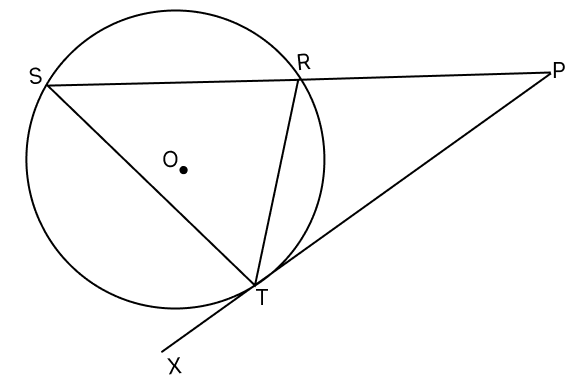
(i) Prove that ΔPTR ~ ΔPST
(ii) Prove that PT2 = PR × PS
(iii) If PR = 4 cm and PS = 16 cm, find the length of the tangent PT.
Answer
(i) We know that,
The angle between a tangent and a chord through the point of contact is equal to the angle in the alternate segment of the circle.
∴ ∠PTR = ∠PST
⇒ ∠RPT = ∠TPS [Common angles]
Therefore, by AA similarity, ΔPTR ~ ΔPST.
Hence, proved that ΔPTR ~ ΔPST.
(ii) Since, corresponding sides of similar triangles are proportional we have :
⇒
⇒ PT2 = PR × PS.
Hence, proved that PT2 = PR × PS.
(iii) Given,
PR = 4 cm and PS = 16 cm.
Hence, PT = 8 cm.