
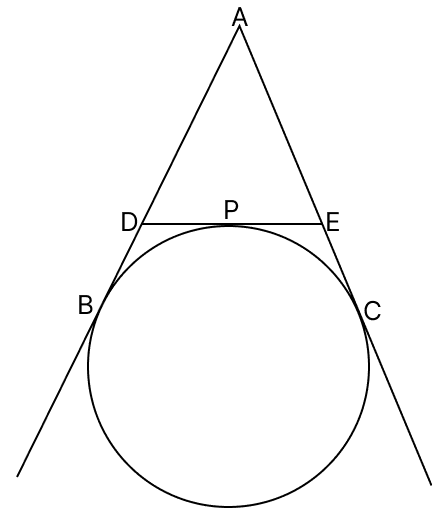
Assertion (A): In the figure, AB, AC and DE are tangents to the circle. If AC = 7 cm, then perimeter of ΔADE is 14 cm.
Reason (R): The lengths of tangents to a circle from an exterior point are equal.
Both A and R are true, and R is the correct explanation of A.
Both A and R are true, but R is not the correct explanation of A.
A is true, but R is false.
A is false, but R is true.
Answer
The lengths of tangents to a circle from an exterior point are equal.
∴ Reason (R) is true.
∴ AB = AC = 7 cm
⇒ Perimeter of ΔADE = AD + AE + DE
We can write DE as (DP + PE)
⇒ Perimeter of ΔADE = AD + AE + (DP + PE)
Substituting DP with DB and PE with EC:
⇒ Perimeter of ΔADE = AD + AE + (DB + EC)
⇒ Perimeter of ΔADE = (AD + DB) + (AE + EC)
⇒ Perimeter of ΔADE = AB + AC
⇒ Perimeter of ΔADE = 7 + 7
⇒ Perimeter of ΔADE = 14 cm.
Assertion (A) is true. The equal-tangent property stated in Reason (R) is exactly what is used to prove the perimeter, so R is the correct explanation of A.
Hence, option 1 is the correct option.
Assertion (A): From a point P, 10 cm away from the centre of a circle, a tangent PT of length 8 cm is drawn, then the radius of the circle is 5 cm.
Reason (R): In a circle, radius through the point of contact is perpendicular to the tangent.
Both A and R are true, and R is the correct explanation of A.
Both A and R are true, but R is not the correct explanation of A.
A is true, but R is false.
A is false, but R is true.
Answer
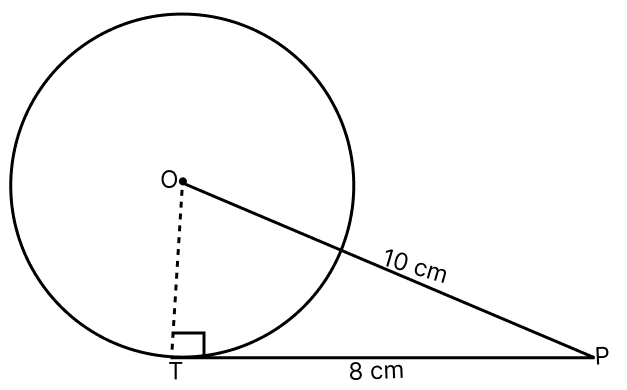
In a circle, radius through the point of contact is perpendicular to the tangent.
In right angled triangle OPT,
OP2 = OT2 + PT2
102 = OT2 + 82
OT2 = 100 - 64
OT2 = 36
OT = 6 cm.
Assertion (A) is false.
In a circle, the radius through the point of contact is perpendicular to the tangent is true.
Reason (R) is true.
Assertion (A) is false, but Reason (R) is true.
Hence, option 4 is the correct option.
Assertion (A): In two concentric circles, the chord of the larger circle, which touches the smaller circle, is bisected at the point of contact.
Reason (R): A line joining centre to any point of a chord of a circle bisects the chord.
Both A and R are true, and R is the correct explanation of A.
Both A and R are true, but R is not the correct explanation of A.
A is true, but R is false.
A is false, but R is true.
Answer
In concentric circles, a chord of the larger circle touching the smaller circle is bisected at the point of contact.
Assertion (A) is true.
A line from the centre bisects a chord only when it is perpendicular to the chord, not to any point on the chord.
Reason (R) is false.
Assertion (A) is true, but Reason (R) is false.
Hence, option 3 is the correct option.