
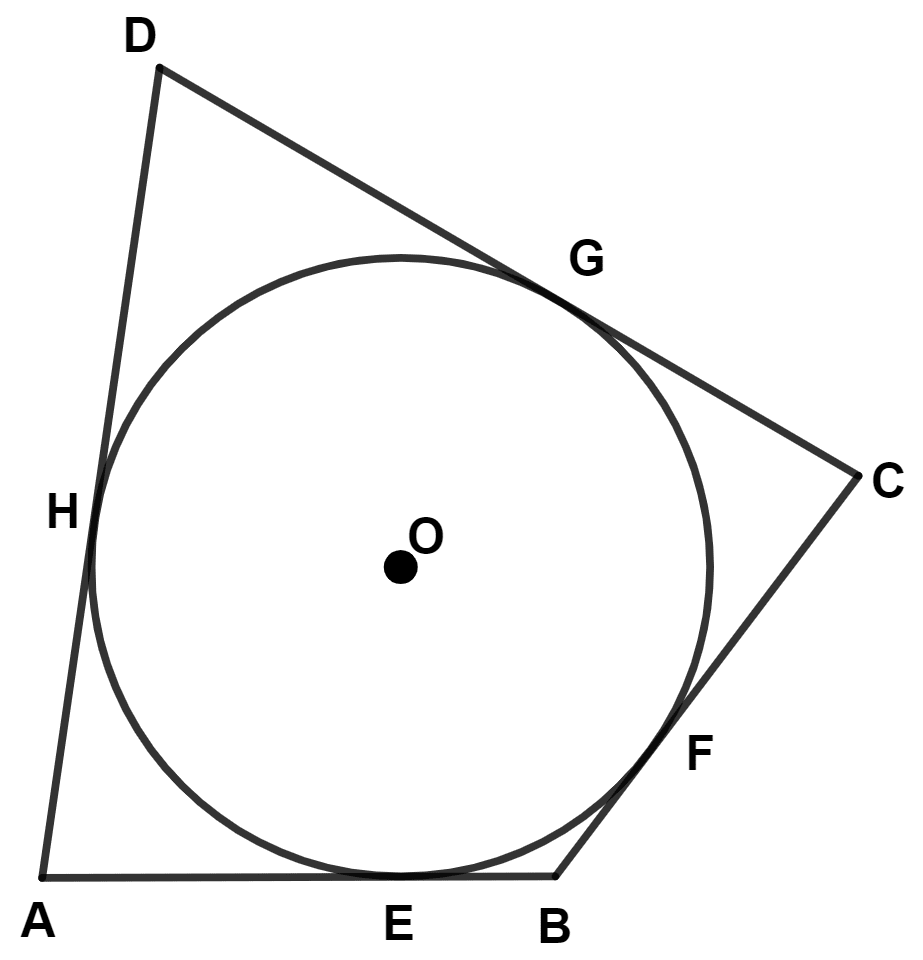
In the given figure O is the centre of the circle. ABCD is a quadrilateral whose sides AB, BC, CD and DA touch the circle at E, F, G and H respectively. If AB = 15 cm, BC = 18 cm and AD = 24 cm, find the length of CD.
Answer
We know that,
The length of tangents drawn from an external point to the circle are equal.
⇒ AE = AH = x (let)
⇒ BE = BF = y (let)
⇒ CF = CG = z (let)
⇒ DG = DH = k (let)
Given,
⇒ AB = 15
⇒ AE + EB = 15
⇒ x + y = 15 .......(1)
⇒ BC = 18
⇒ BF + CF = 18
⇒ y + z = 18 ........(2)
⇒ AD = 24
⇒ AH + DH = 24
⇒ x + k = 24 ..........(3)
Adding equations (2) and (3), we get :
⇒ y + z + x + k = 18 + 24
⇒ x + y + z + k = 42
⇒ 15 + z + k = 42 [From equation (1)]
⇒ z + k = 42 - 15
⇒ z + k = 27.
⇒ CD = CG + DG = k + z = 27 cm.
Hence, length of CD = 27 cm.
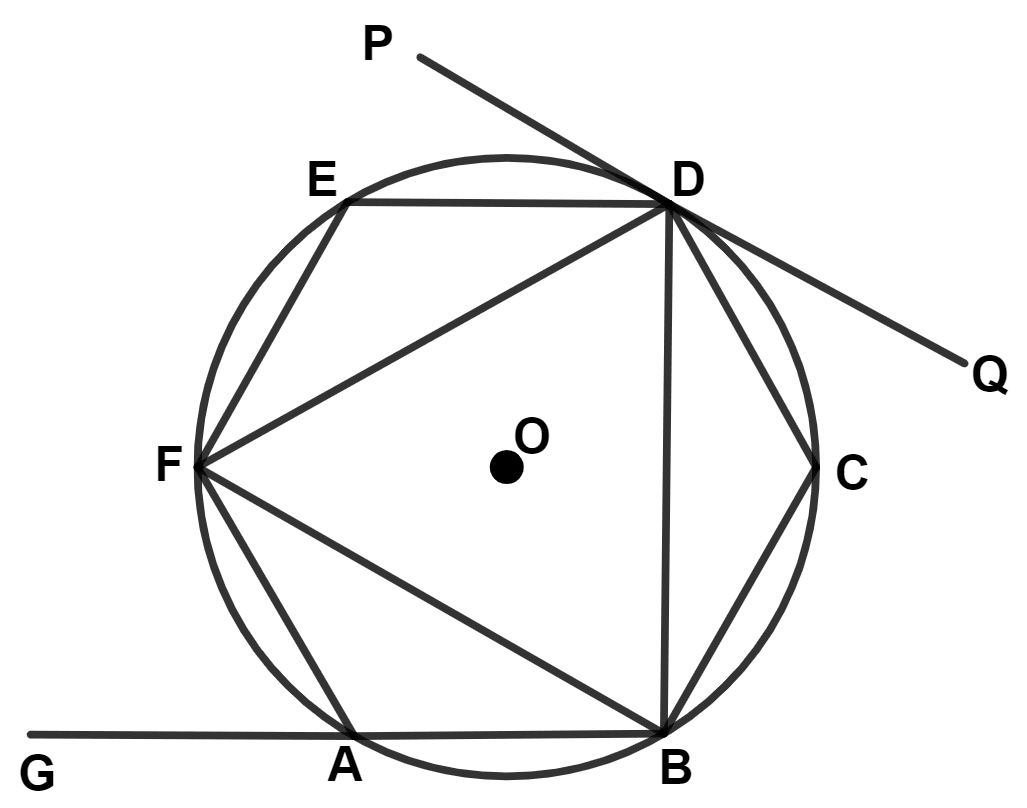
In the given diagram, ABCDEF is a regular hexagon inscribed in a circle with centre O. PQ is a tangent to the circle at D. Find the value of :
(a) ∠FAG
(b) ∠BCD
(c) ∠PDE
Answer
(a) By formula,
Each interior angle of a n sided polygon =
∴ ∠FAB = 120°
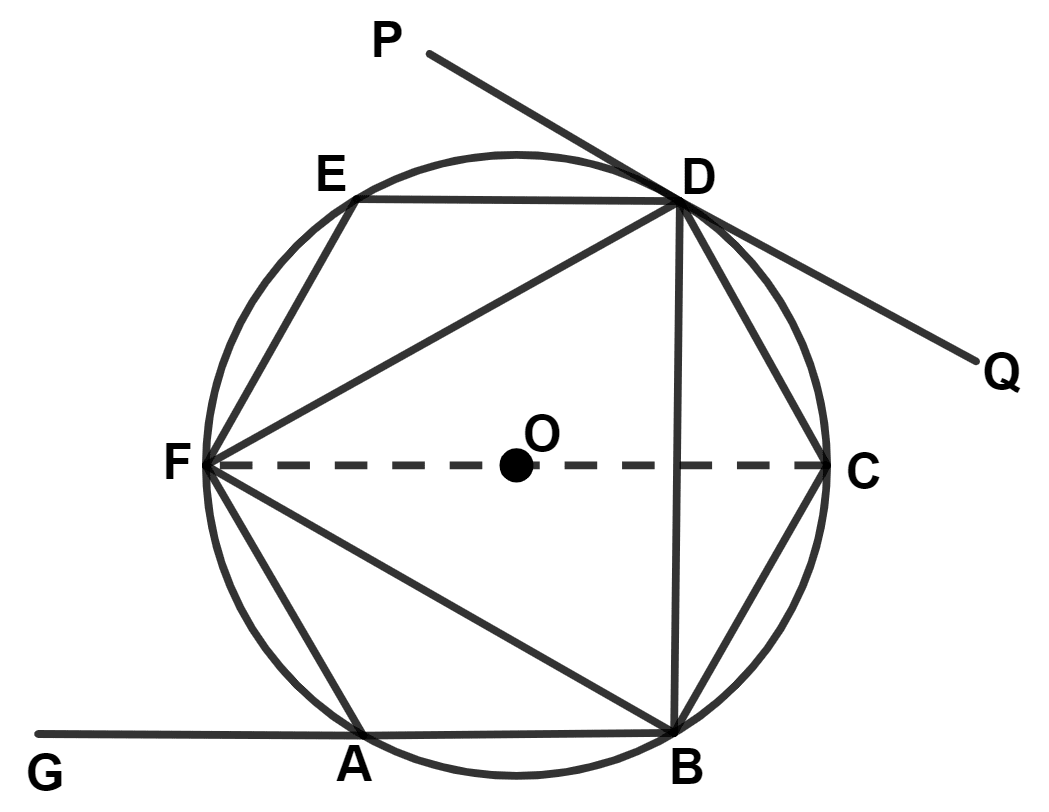
From figure,
∠FAG and ∠FAB form a linear pair.
∴ ∠FAB + ∠FAG = 180°
⇒ 120° + ∠FAG = 180°
⇒ ∠FAG = 180° - 120° = 60°.
Hence, ∠FAG = 60°.
(b) Each interior angle of regular hexagon = 120°.
Hence, ∠BCD = 120°.
(c) In triangle DEF,
⇒ ∠DEF = 120° (Each interior angle of a regular hexagon equals to 120°)
⇒ DE = EF (Sides of a regular hexagon)
⇒ ∠EDF = ∠EFD = a (let) (Angles opposite to equal sides are equal)
By angle sum property of triangle,
⇒ ∠DEF + ∠EDF + ∠EFD = 180°
⇒ 120° + a + a = 180°
⇒ 2a = 180° - 120°
⇒ 2a = 60°
⇒ a = = 30°
⇒ ∠EFD = 30°.
By alternate segment theorem,
The angle between a tangent to a circle and a chord drawn from the point of contact is equal to the angle subtended by that chord in the alternate segment of the circle.
∴ ∠PDE = ∠EFD = 30°.
Hence, ∠PDE = 30°.
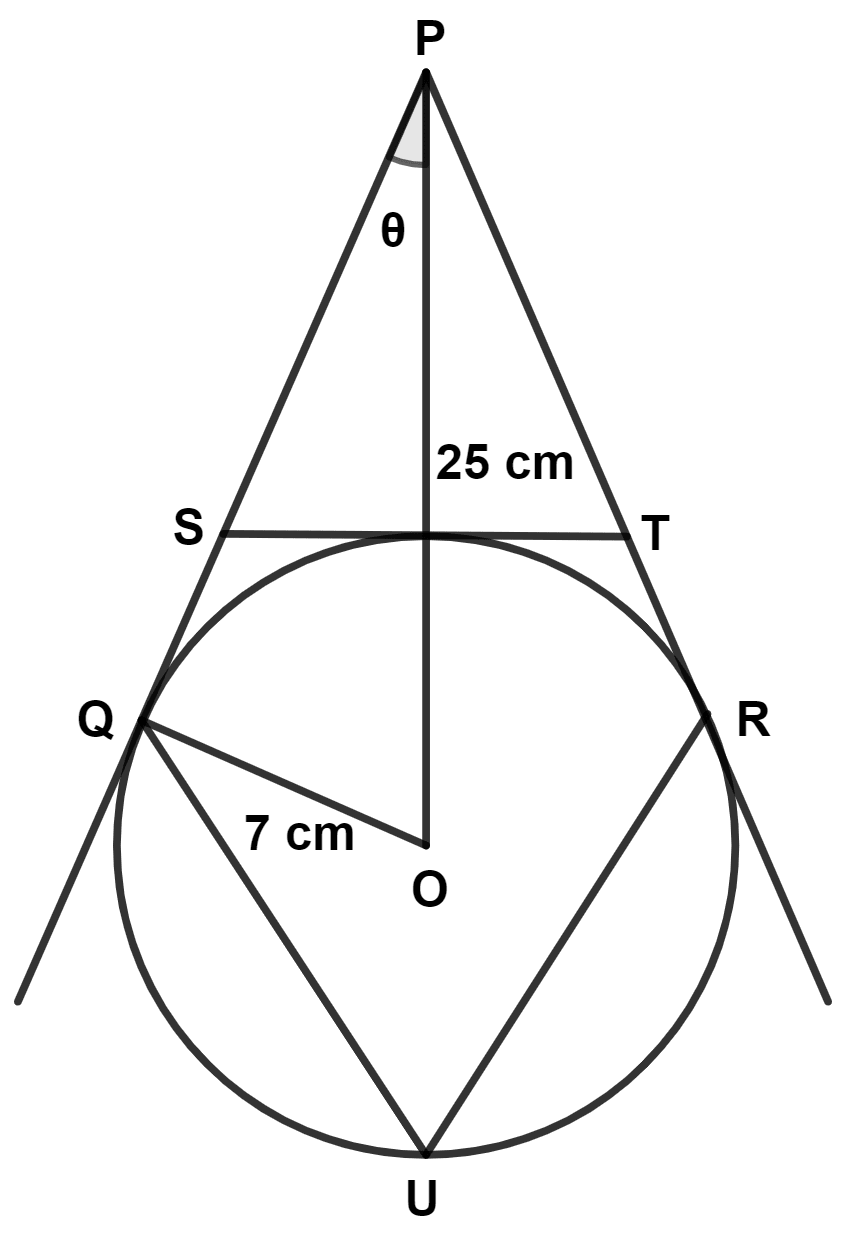
In the adjoining diagram PQ, PR and ST are the tangents to the circle with centre O and radius 7 cm. Given OP = 25 cm. Find :
(a) length of ST
(b) value of ∠OPQ, i.e. θ
(c) ∠QUR, in nearest degree
Answer
(a) We know that,
The radius of a circle and tangent are perpendicular at the point of contact.
∴ ∠PQO = 90°
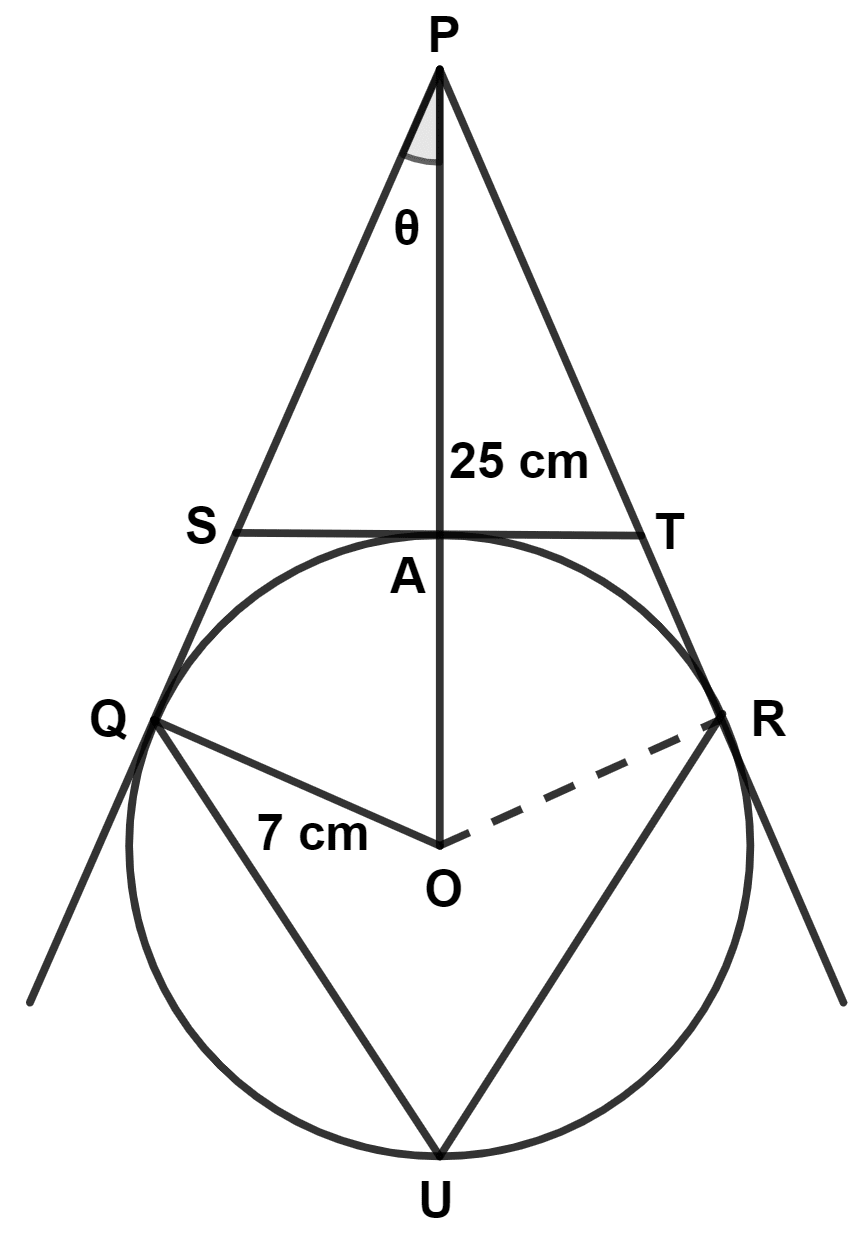
In right-angled triangle PQO,
⇒ PO2 = PQ2 + OQ2
⇒ 252 = PQ2 + 72
⇒ 625 = PQ2 + 49
⇒ PQ2 = 625 - 49
⇒ PQ2 = 576
⇒ PQ = = 24 cm.
In △ POQ,
⇒ tan θ =
⇒ tan θ = ...............(1)
From figure,
⇒ ∠PAS = 90°
⇒ PA = OP - OA = 25 - 7 = 18 cm.
⇒ tan θ =
⇒ tan θ = ...........(2)
From equation (1) and (2), we get :
From figure,
⇒ ST = 2 × AS = = 10.5 cm
Hence, ST = 10.5 cm.
(b) From equation (1),
⇒ tan θ =
⇒ tan θ = 0.292
⇒ tan θ = tan 16° 16'
⇒ θ = 16° 16'.
Hence, θ = 16° 16'.
(c) In △ POQ,
⇒ ∠POQ + ∠PQO + ∠QPO = 180°
⇒ ∠POQ + 90° + 16° 16' = 180°
⇒ ∠POQ + 106° 16' = 180°
⇒ ∠POQ = 180° - 106° 16' = 73° 44' = 74°.
We know that,
Tangent from an external point to the circle are equal in length.
∴ PQ = PR.
Also,
OR = OQ (Both equal to radius of circle)
In △ POQ and △ POR,
⇒ PQ = PR (Proved above)
⇒ OQ = OR (Radius of same circle)
⇒ PO = PO (Common side)
∴ △ POQ ≅ △ POR (By S.S.S. axiom)
We know that,
Corresponding parts of congruent triangles are equal.
∴ ∠POR = ∠POQ = 74°
From figure,
⇒ ∠QOR = ∠POR + ∠POQ = 74° + 74° = 148°.
We know that,
The angle subtended by an arc of a circle at its center is twice the angle it subtends anywhere on the circle's circumference.
⇒ ∠QOR = 2∠QUR
⇒ ∠QUR = = 74°.
Hence, ∠QUR = 74°.
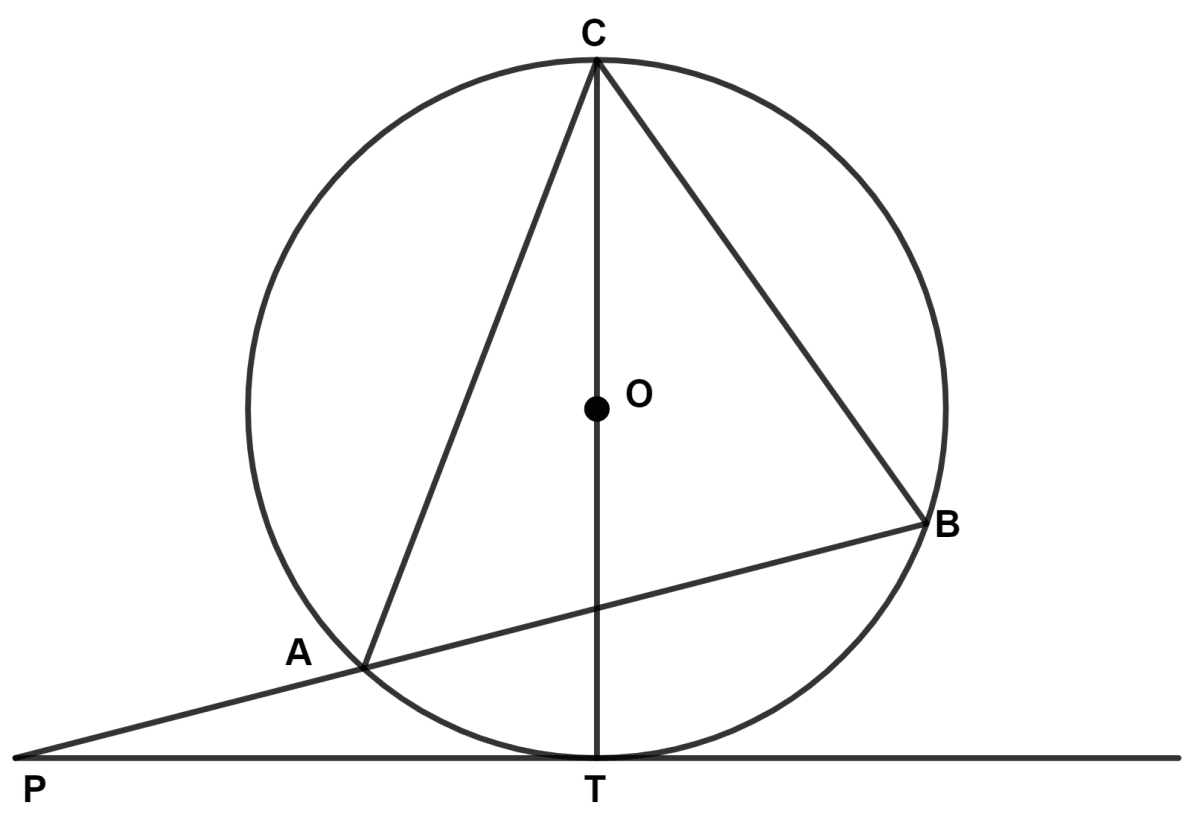
In the given figure, angle ABC = 70° and angle ACB = 50°. Given, O is the centre of the circle and PT is the tangent to the circle. Then calculate the following angles
(a) ∠CBT
(b) ∠BAT
(c) ∠PBT
(d) ∠APT
Answer
Join AT and BT.
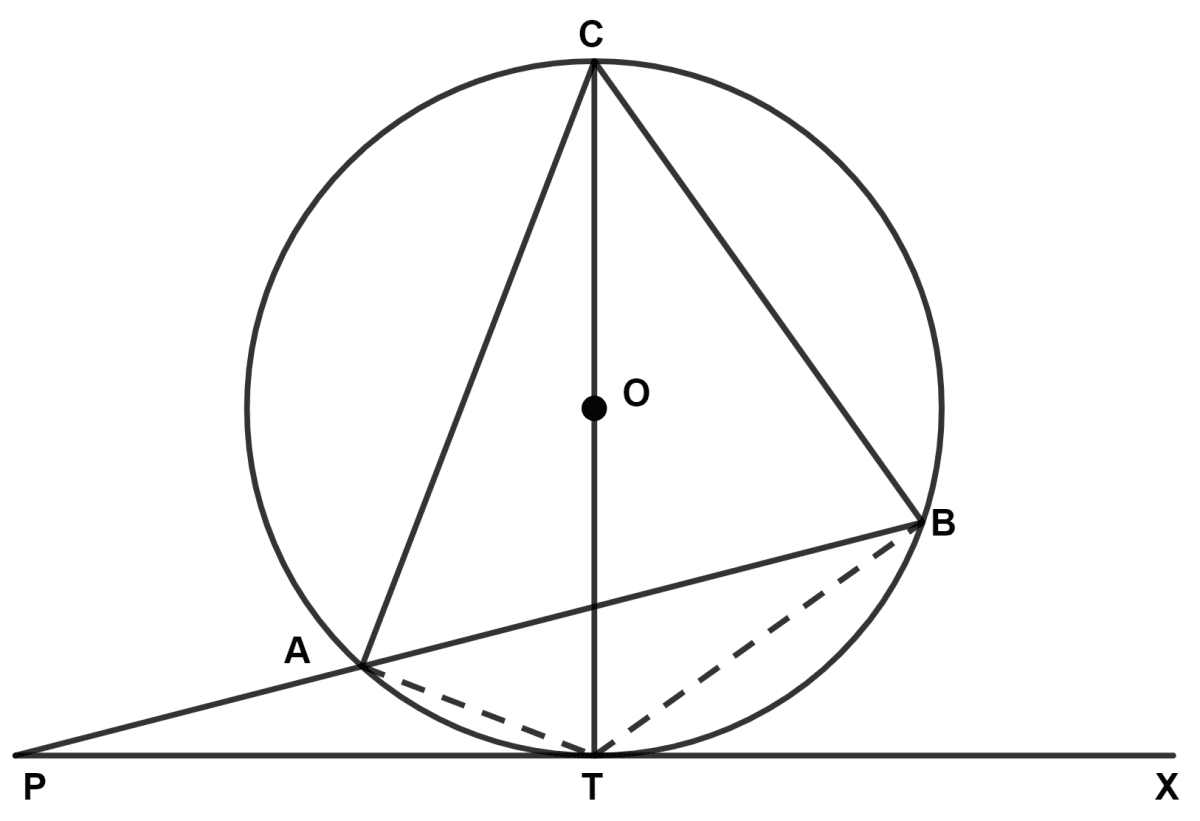
(a) We know that,
Angle in a semicircle is a right angle.
∴ ∠CBT = 90°.
Hence, ∠CBT = 90°.
(b) In cyclic quadrilateral ATBC,
⇒ ∠CBT + ∠CAT = 180° (∵ Sum of opposite angles of a cyclic quadrilateral = 180°)
⇒ 90° + ∠CAT = 180°
⇒ ∠CAT = 180° - 90° = 90°.
In △ABC,
⇒ ∠CBA + ∠CAB + ∠ACB = 180° [By angle sum property of triangle]
⇒ 70° + ∠CAB + 50° = 180°
⇒ ∠CAB + 120° = 180°
⇒ ∠CAB = 180° - 120°
⇒ ∠CAB = 60°.
From figure,
∠BAT = ∠CAT - ∠CAB = 90° - 60° = 30°.
Hence, ∠BAT = 30°.
(c) From figure,
∠BTX = ∠BAT = 30° [Angle in same segment are equal]
∠PBT = ∠CBT - ∠CBA = 90° - 70° = 20°.
Hence, ∠PBT = 20°.
(d) Since, ∠PTB and ∠BTX are linear pairs.
⇒ ∠PTB = 180° - ∠BTX = 180° - 30° = 150°.
In △PBT,
⇒ ∠PBT + ∠PTB + ∠APT = 180° [By angle sum property of triangle]
⇒ 20° + 150° + ∠APT = 180°
⇒ ∠APT + 170° = 180°
⇒ ∠APT = 180° - 170°
⇒ ∠APT = 10°.
Hence, ∠APT = 10°.