
Hitler invaded Poland in ............... .
- September, 1939
- September, 1919
- October, 1936
- July, 1942
Answer
September, 1939
Reason — The Second World War began when Hitler invaded Poland in September 1939, which led Britain and France to declare war on Germany.
Which of the following was the immediate cause of The World War II?
- Japanese Invasion of China
- Failure of League of Nations
- Hitler's Invasion of Poland
- Rise of Fascism and Nazism
Answer
Hitler's Invasion of Poland
Reason — Although the real causes of the war were much deeper and varied in character, the invasion of Poland by Germany in September 1939 was the immediate cause for the outbreak of the Second World War.
Arrange the following events in chronological order.
(i) Treaty of Versailles
(ii) Hitler's invasion of Poland
(iii) Japanese attack on Pearl Harbour
(iv) Japanese invasion of China
- (i), (ii), (iii) and (iv)
- (i), (iv), (ii) and (iii)
- (i), (iii), (iv) and (ii)
- (i), (iv), (iii) and (ii)
Answer
(i), (iv), (ii) and (iii)
Reason — The Treaty of Versailles was signed at the end of the First World War in 1919, Japan invaded China in 1931, Hitler invaded Poland in September 1939 and Japan attacked Pearl Harbour on December 7, 1941.
When was the first atomic bomb dropped and where?
- August 6, 1947; Berlin
- August 6, 1945; Hiroshima
- August 8, 1945; Nagasaki
- August 8, 1947, New Mexico
Answer
August 6, 1945; Hiroshima
Reason — On August 6, 1945, the first atomic bomb ever to be used on humans was dropped on Hiroshima. It destroyed half of the city killing thousands of people.
Arrange the various conferences in chronological order.
(i) Potsdam
(ii) Yalta
(iii) San Francisco
- (i), (ii) and (iii)
- (iii), (ii) and (i)
- (ii), (i) and (iii)
- (ii), (iii) and (i)
Answer
(ii), (i) and (iii)
Reason — The Big Three met at Yalta in February 1945 and resolved to convene a conference at San Francisco to draw up the 'Charter of the United Nations'. The Potsdam Conference was held on July 26, 1945, and the San Francisco conference led to the establishment of the United Nations Organisation on October 24, 1945.
Which of the following was NOT done during the Cold War?
- Piling up of arms
- Military alliances
- Actual combat
- Proxy wars
Answer
Actual combat
Reason — During the Cold War, the USA and the USSR did not engage in actual fight against each other. Though there was a state of extreme political tension, it involved piling up of arms, military alliances, propaganda and proxy wars but no armed conflict.
NATO was primarily formed to ............... .
- protect communist countries
- defend democratic nations from the threat of communism
- promote isolationism
- promote the policy of non-alignment
Answer
defend democratic nations from the threat of communism
Reason — NATO is a military alliance formed by the Capitalist bloc led by the USA. Based on the principle of collective security, it aimed at protecting the democratic nations of the Western bloc from the threat of communism.
Which of the following statements best describes the Warsaw Pact?
- A military alliance of capitalist countries
- An alliance formed to protect democracies
- A non-military economic union
- A military bloc of communist countries led by the erstwhile USSR
Answer
A military bloc of communist countries led by the erstwhile USSR
Reason — The Warsaw Pact was a military alliance of the communist countries led by the erstwhile USSR, formed to counter NATO.
What does the cartoon given below depict about NATO through the missile?
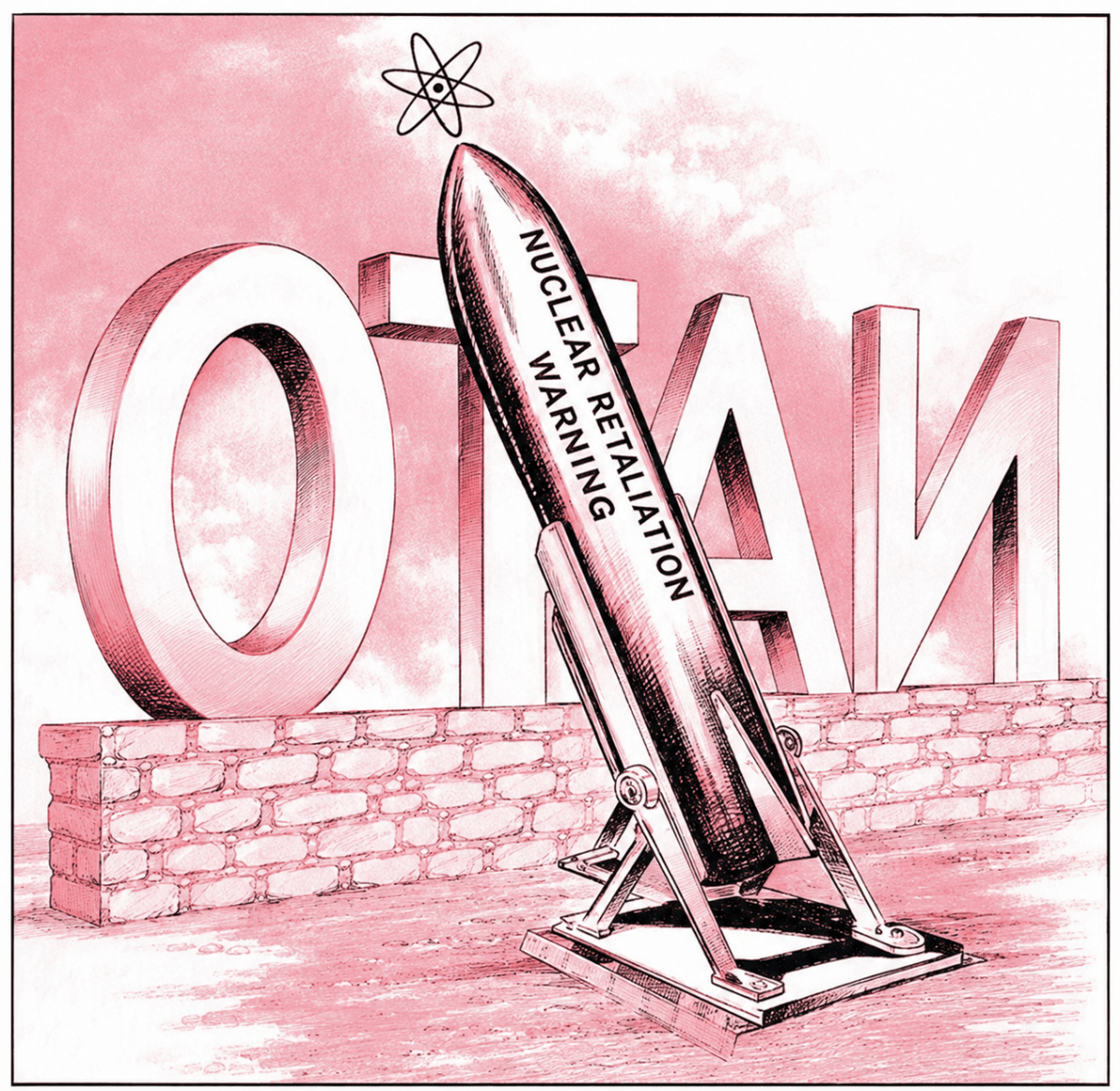
- NATO's role in curbing nuclear arms
- NATO's defence relies on nuclear threat
- NATO's attempt at declaring the USA as super power
- NATO's decision to start direct war with the USSR
Answer
NATO's defence relies on nuclear threat
Reason — The missile in the cartoon indicates that NATO's defence strategy depended on the threat of nuclear weapons to deter any aggression against its member nations.
(I) The peace treaties signed after the end of the First World War sowed the seeds for the Second World War.
(II) The Second World War was a continuation of the First World War.
- (II) contradicts (I)
- (II) is the reason for (I)
- (I) is true but (II) is false
- (I) and (II) are independent of each other.
Answer
(II) is the reason for (I)
Explanation — The harsh peace treaties after the First World War created conditions that led to the Second World War. Hence, Statement II is the reason for Statement I.
(I) The Treaty of Versailles was signed to end the First World War and prevent further wars.
(II) The Treaty of Versailles sowed seeds of bitterness and conflict which finally culminated in the Second World War.
- (II) contradicts (I)
- (II) is the reason for (I)
- (I) is true but (II) is false
- (I) and (II) are independent of each other.
Answer
(II) contradicts (I)
Explanation — Although the Treaty of Versailles was signed to end the First World War, its harsh terms created bitterness and resentment, led to the Second World War. Thus, Statement II contradicts the purpose stated in Statement I.
(I) Hitler wanted to re-establish the prestige of Germany after the First World War.
(II) Hitler flouted the military clauses in the Treaty of Versailles and declared re-armament.
- (II) contradicts (I)
- (I) is the reason for (II)
- (I) is true but (II) is false
- (I) and (II) are independent of each other.
Answer
(I) is the reason for (II)
Explanation — Hitler wanted to restore Germany's prestige after the First World War. Therefore, he violated the military clauses of the Treaty of Versailles and started re-armament.
(I) Britain and France followed the policy of appeasement towards dictatorial countries like Germany and Italy.
(II) They wanted to check the rising tide of Communism and Bolshevism.
- (II) contradicts (I)
- (II) is the reason for (I)
- (I) is true but (II) is false
- (I) and (II) are independent of each other.
Answer
(II) is the reason for (I)
Explanation — Britain and France followed the policy of appeasement because they wanted to check the growing influence of Communism and Bolshevism. Hence, Statement II is the reason for Statement I.
What was the issue between Germany and Poland that led to the Second World War?
Answer
Hitler invaded Poland in September 1939 for the following reasons:
- Germany wanted to regain her lost territories.
- The city of Danzing was inhabited mainly by the Germans and by occupying Danzing Corridor, Germany could connect with East Prussia.
- Germany signed a Non-Aggression Pact with Russia in August 1939, Poland was accused of committing atrocities against Germans living there.
On September 1, 1939, the German armies marched into Poland. The invasion of Poland marked the beginning of the Second World War.
How was the Treaty of Versailles responsible for the Second World War?
Answer
The Treaty of Versailles was responsible for the Second World War because of the following reasons-
- The treaty demanded annexation of German territories and creation of many States. This sowed the seeds of bitterness and conflict.
- All the German colonies were forcibly taken away from her and she was divided into two parts for the benefit of Poland.
- She was burdened with huge war indemnity which she could never pay.
- Her military power was reduced.
- This treaty was based on the spirit of revenge and Germany was forced to sign the treaty.
How did the rise of Fascism and Nazism lead to the Second World War?
Answer
The rise of Fascism in Italy and Nazism in Germany led to the Second World War because:
- Italy wanted to revive the glory of the Old Roman Empire. Mussolini established dictatorship, joined the Anti-Comintern Pact (1937), formed a ten-year alliance with Germany (1939), and attacked Abyssinia.
- Germany, under Hitler, wanted to restore Germany's prestige. He violated the Treaty of Versailles, declared re-armament, annexed Austria (1938), and dismembered Czechoslovakia.
Thus, Mussolini and Hitler drove the countries of the world towards another World War.
What was the Berlin-Rome-Tokyo Axis? Why did Italy join the side of Germany and Japan in the Second World War?
Answer
The Berlin–Rome–Tokyo Axis was the alliance between Germany, Italy, and Japan during the Second World War. These three countries fought against the Allied Powers.
Italy joined the Allies in the First World War to gain territories of Turkey and Germany. But she could get no part of the German and Turkish colonial empire. So, she felt cheated. Further, Italy was ruled by Mussolini and Germany was ruled by Hitler. The ideologies of both leaders were similar. They glorified wars and wanted to make their country powerful. Hence, Italy joined the side of Germany and Japan in the Second World War.
What was the immediate cause of the Second World War? Which incident brought the USA in the Second World War?
Answer
Hitler's invasion of Poland in September, 1939 was the immediate cause of the Second World War.
On December 7, 1941, Japan under the Premiership of General Tojo, ordered a surprise aerial attack on the Pearl Harbour. This incident caused America to declare war on Japan, Germany and Italy.
Why did the USA drop atom bombs on the Japanese cities of Hiroshima and Nagasaki?
Answer
The USA warned the Japanese people and the government to stop the fighting and surrender. But when Japan refused to surrender, the USA dropped atom bombs on the Japanese cities of Hiroshima and Nagasaki.
With reference to the newspaper headline given below, what is meant by V-J Day and what made Japan to surrender to the Allies.

Answer
V-J Day stands for Victory over Japan Day.
Japan surrendered to the Allies after the USA dropped atom bombs on the Japanese cities of Hiroshima and Nagasaki in August, 1945.
Mention two important consequences of the Second World War.
Answer
Two important consequences of the Second World War were-
Defeat of the Axis Powers — The Axis Powers made remarkable success initially but were defeated by the Allied Powers.
Formation of the UN — The United Nations Organisation was established to bring peace and avoid another world war.
What is meant by the 'Cold War'?
Answer
After the Second World War, the USA and the erstwhile USSR emerged as two great powers representing contrasting ideologies. They divided the world into two rival blocs —
- The Capitalist bloc led by the USA
- The Communist bloc led by the USSR.
There was a state of extreme political tension between the two but no armed conflict. This is known as the Cold War.
Mention any two characteristics of the Cold War.
Answer
Two characteristics of the Cold War were-
- There was no armed struggle.
- The rivals continued to maintain their peace time diplomatic relations along with their hostility.
Give two causes that led to the Cold War.
Answer
Two causes that led to the Cold War were-
- The ideological conflict between both the United States and the Soviet Union.
- The emergence of nuclear weapons and the fear of communism in the United States.
Name two countries each belonging to the Capitalist Bloc and the Communist Bloc.
Answer
Two countries belonging to the Capitalist Bloc were Britain and France.
Two countries belonging to the Communist Bloc were Poland and Hungary.
What were the views of each of the two Cold War blocs about the other bloc?
Answer
During the Cold War, the two major blocs, the Democratic and Capitalist Bloc or the western bloc led by the USA and the Communist bloc or the Eastern Bloc led by the USSR, had distinct views about each other:
- Western Bloc (USA-led): Supported capitalism and regarded the Communist Eastern Bloc as a threat to its political and economic system. It tried to check the spread of Communism.
- Eastern Bloc (USSR-led): Followed communism and considered the Capitalist Western Bloc a threat to its system. It viewed the West's efforts to contain Communism as aggressive and responded accordingly.
Name any two countries which became independent after the Second World War.
Answer
Two countries which became independent after the Second World War were Myanmar and Malaya.
Name the two military alliances formed during the Cold War.
Answer
The two military alliances formed during the Cold War were-
- NATO (North Atlantic Treaty Organisation) — a military alliance formed by the Capitalist bloc led by the USA.
- The Warsaw Pact — a military alliance of the communist countries led by the erstwhile USSR, formed to counter NATO.
Explain briefly NATO's principle of collective security.
Answer
According to NATO's principle of collective security, an armed attack against any one member nation is considered an attack against all the member nations. Therefore, all the members are bound to come to the defence of the attacked member. This mutual guarantee of defence was intended to protect the democratic nations of the Western Bloc from the threat of Communism and to deter any aggression against them.
State how each of the following factors were the causes of the Second World War:
(a) The failure of the League of Nations.
(b) The Aggressive Nationalism of Germany.
(c) The Policy of Appeasement.
Answer
(a) The League suffered an early blow when the USA did not join the League. Even those who joined the League were not interested in the principle of collective security.
- The League of Nations succeeded in allaying the threat of war in cases where the parties were small nations.
- The League did nothing when Poland, with the backing of France, seized a part of Lithuania in 1920.
- In 1923, there was a threat of war between Italy and Greece.
- Italy refused to submit to the League's intervention and the dispute was settled by direct mediation of Great Britain and France.
- Thereafter, in every crisis, the League was either defied or ignored.
- The authority of the League was flouted by Japan when it seized Manchuria; and by Italy when it conquered Ethiopia.
- The coercive machinery of the League was not adequate to perform the task given to it.
- The economic sanctions were of no use against a determined aggressor.
- Moreover, the member states were not willing to apply economic sanctions as it affected their economy as well.
- Besides, the League failed to maintain international peace and the countries of Europe lost faith in its usefulness.
(b) The humiliating Treaty of Versailles created a spirit of revenge and aggressive nationalism in Germany.
- Germany wanted to get rid of the harsh Treaty of Versailles through rearmament and an aggressive policy.
- In 1938, Hitler annexed Austria and dismembered Czechoslovakia.
- On 1 September 1939, Germany invaded Poland.
- Britain and France issued an ultimatum to Germany.
- When Germany ignored the ultimatum, Britain and France declared war on Germany on 3 September 1939, marking the beginning of the Second World War.
- The German armies conquered Poland in less than three weeks before any effective aid could reach it.
(c) Appeasement meant accepting the hostile demands of an aggressive nation to preserve peace.
- Britain and France followed appeasement towards Germany and Italy because they believed the dictators had genuine grievances arising from the Treaty of Versailles.
- They also wanted to check the spread of Communism and Russian Bolshevism.
- They feared that Germany might turn towards Russian Bolshevism.
- Therefore, they allowed Germany to rearm, remilitarise the Rhineland, and annex Austria and Czechoslovakia.
- This policy strengthened Fascism and Nazism, enabling them to unleash the Second World War.
The League of Nations was unable to eliminate power struggles leading to another World War. In this context describe how the following were connected with the Second World War:
(a) Japanese invasion of China.
(b) Ideological differences between nations.
(c) Hitler's invasion of Poland.
Answer
(a) Japanese policy of expansion was one of the causes of the War.
- Japan's ambitions rose after the First World War.
- She was determined to dominate the Far East.
- Japan started an undeclared war against China in 1931.
- China appealed to the League of Nations to declare sanctions against Japan.
- Britain and France, the leading members of the League did not pay any attention to the appeal.
- Japan joined the Berlin-Rome Axis to form the Berlin-Rome-Tokyo Axis to further its policy of expansion and conquest.
- In 1933, Japan left the League of Nations and started occupying the British and American properties in China.
- Britain and France followed the policy of appeasement, thinking that the Japanese could be used to weaken China.
- Thus, a war was inevitable under these circumstances.
(b) Ideological differences between nations refer to the ideologies of fascism and nazism in Italy and Germany, respectively. Fascism and Nazism believed in the following-
- To have faith in the totalitarian rule.
- To despise democratic political systems.
- To uphold One-Party and one leader.
- To believe in aggressive nationalism and imperialism.
- To hold that the state is supreme and it could suppress the fundamental rights and freedoms of individuals.
- To regard war as an instrument for furthering national interests.
- To uphold intensely nationalistic, anti-communist and anti-democratic rule.
The ideology of fascism and nazism was extremely aggressive and led to the Second World War.
(c) Hitler invaded Poland in September 1939 for the following reasons:
- Germany wanted to regain her lost territories.
- The city of Danzing was inhabited mainly by the Germans and by occupying Danzing Corridor, Germany could connect with East Prussia.
- Germany signed a Non-Aggression Pact with Russia in August 1939, Poland was accused of committing atrocities against Germans living there.
- On September 1, 1939, the German armies marched into Poland.
- France and Britain gave an ultimatum to Germany.
- In reply, Germany attacked France.
- On September 3, Britain and France declared war on Germany.
- The German armies completed the conquest of Poland in less than three weeks so as to ensure that no aid reached Poland.
- The invasion of Poland marked the beginning of the Second World War.
Look at the newspaper clipping given below and answer the questions that follow:

(a) Japan declared war against which country? Where did Japan order an attack? What were the consequences of the bombing of Hawaii?
(b) Japan made two crucial mistakes during this attack. What were these mistakes and what were the consequences of these mistakes?
(c) How was this attack finally avenged by the USA?
Answer
(a) Japan ordered an attack on the U.S.A on December 7, 1941. It was aimed at neutralizing the U.S. Pacific Fleet and securing Japan’s dominance in the Pacific. The attack was on the U.S. naval base at Pearl Harbor, Hawaii.
The consequences of the attack on the USA were following:
- The most immediate consequence was the entrance of the United States into World War II. The attack on Pearl Harbor led to a formal declaration of war against Japan.
- The United States massively mobilized its economy and military for the war effort.
- The attack led to the internment of Japanese-Americans, as fear and suspicion towards Japan grew
- The war with Japan ultimately led to the development and use of atomic weapons, culminating in the bombings of Hiroshima and Nagasaki.
- In the aftermath of the war, the United States played a leading role in the establishment of the United Nations and the creation of a new international order.
(b) The Japanese made following two crucial mistakes at Pearl Harbour:
- They did not destroy the ship repair facilities at the base
- They did not seek out and destroy the US carriers (Lexington and the Enterprise). Due to these mistakes, most of the ships, that were damaged, were soon back in action.
(c) This attack was finally avenged by Atomic Bombings of Hiroshima and Nagasaki. In August 1945, the U.S. dropped atomic bombs on the Japanese cities of Hiroshima and Nagasaki. These bombings, which caused enormous destruction and loss of life, led to Japan’s unconditional surrender.
Study the picture on the right and answer the questions:

(a) Identify the object in the picture. Which country was responsible for its production?
(b) Where was this object used for the first time? How did it bring an end to the War?
(c) How can a future war be avoided following the teachings of Mahatma Gandhi?
Answer
(a) The object in the picture is the Atom Bomb. It was produced by the United States of America (USA).
(b) The first atomic bomb was dropped on Hiroshima in Japan by the USA. It destroyed half of the city killing thousands of people. Still Japan refused to surrender. After that another atomic bomb was dropped on the Japanese city Nagasaki. This made Japan surrender on the terms of Potsdam declaration bringing an end to the Second World War.
(c) The Gandhian strategy is the combination of truth, sacrifice, non-violence, selfless service and cooperation.
- According to Gandhiji, one should be brave and not a coward.
- He should present his views, suggestions and thoughts without being violent.
- One should fight a war with the weapons of truth and non violence.
- Gandhi said that "There is no god higher than truth."
- According to Gandhi's thoughts, non-violence is the ultimate solution of every kind of problem in the world.
Thus, a future war can be avoided by following the teachings of Mahatma Gandhi.
With the surrender of Japan, the Second World War was finally over. The war had far-reaching consequences. Against this background, write short notes on:
(a) Effect of World War II on Japan.
(b) The division of Germany.
(c) Division of the world into two Power Blocs.
Answer
(a) After the defeat of Germany, the Allied powers turned their attention towards Japan.
- When Japan refused to surrender, America dropped the atomic bombs on Hiroshima and Nagasaki.
- Japan offered to surrender on the terms of Potsdam declaration and the war came to an end.
- The American army was to occupy Japan until 1952.
- After this period, the Japanese would resume sole control over their own affairs.
- Emperor Hirohito was left on the throne as a constitutional monarch and the Japanese Parliament retained some of its law making powers.
- All lands acquired or seized by Japan since 1895 were taken away.
(b) At the end of World War II, Germany was divided into zones, each zone under the army of each of the Allied Powers.
- The Federal Republic of Germany (FRG) commonly known as West Germany was administered by UK, France and the U.S. with Bonn as the capital. It came under the capitalist ideology of the Anglo-American and their Allies and became part of the Capitalist bloc.
- The German Democratic Republic (GDR), known as East Germany was administered by the Soviet Union with East Berlin as the capital. It came under the influence of the political ideologies of communist Russia and became part of the Communist (or Eastern) bloc.
(c) Towards the end of the War, the apparent harmony between the USA and the Soviet Union declined and old suspicion and ideological differences came to the forefront.
- Though both the countries did not engage in actual fight against each other, there was a state of extreme political tension between the two.
- This state of tension between countries in which each side adopted policies designed to strengthen itself and weaken the other without armed conflict, is known as the 'Cold War.'
- The Cold War also involved an arms race involving piling up of nuclear and conventional weapons, formation of military alliances, economic warfare and trade embargoes, propaganda and proxy wars, especially those involving superpower support for opposing sides within civil wars.
- Thus, the USA and the USSR continued to maintain diplomatic relations and did not resort to overt clashes, but treated each other with hostility.
- This led to the division of the world into two power blocs.
- The Democratic and Capitalist bloc was led by the USA. It was called the Western bloc or the American bloc and it believed in liberal democracy based on Capitalism.
- The Communist Bloc was led by the USSR. It was called the Eastern bloc or the Soviet bloc and it believed in Communism based on Marxist theory.
With reference to the consequences of Second World War, explain the impact on the following:
(a) The Axis powers.
(b) Origin of the Cold War.
(c) The formation of the UN.
Answer
(a) The Axis powers (Germany, Italy and Japan) were defeated in the Second World War. In November 1942, the Allied forces (Britain, France, The Soviet Union and The USA) recaptured African territories lost by France. This was followed by their victory over Italy and then Germany.
After the defeat of Germany, the Allied powers turned their attention towards Japan. Japan had won and had occupied most of South East Asia. The Allied forces liberated Myanmar, Malaya, the Philippines and Singapore. In the Potsdam Conference held on July 26, 1945, the Allied Powers asked Japan to surrender but Japan refused. Consequently, America dropped the atomic bombs on Hiroshima and Nagasaki. Japan offered to surrender on the terms of Potsdam declaration and the war came to an end.
After the war, Germany was divided into zones, each zone under the army of each of the Allied Powers. Japan and Italy also became very weak. Unlike Germany, they were not divided into zones to be governed by conquering forces. The American army was to occupy Japan until 1952. All lands acquired and seized by Japan since 1895 were taken away.
(b) Towards the end of the War, the apparent harmony between the USA and the Soviet Union declined and old suspicion and ideological differences came to the forefront.
- Though both the countries did not engage in actual fight against each other, there was a state of extreme political tension between the two.
- This state of tension between countries in which each side adopted policies designed to strengthen itself and weaken the other without armed conflict, is known as the 'Cold War.'
- The Cold War also involved an arms race involving piling up of nuclear and conventional weapons, formation of military alliances, economic warfare and trade embargoes, propaganda and proxy wars, especially those involving superpower support for opposing sides within civil wars.
- Thus, the USA and the USSR continued to maintain diplomatic relations and did not resort to overt clashes, but treated each other with hostility.
- This led to the division of the world into two power blocs.
(c) The horrors of the two World Wars and the failure of the League of Nations led to a meeting of the Big Three — Roosevelt (President of the USA), Churchill (Prime Minister of Britain) and Stalin (Premier of the USSR) at Yalta in February 1945. They resolved to convene a conference of the representatives of all nations at San Francisco to draw up the 'Charter of the United Nations.' This led to the establishment of the United Nations Organisation on October 24, 1945.
The cartoon given below shows Uncle Sam forging a sword while reading about Russia's proposal for an international arms treaty.
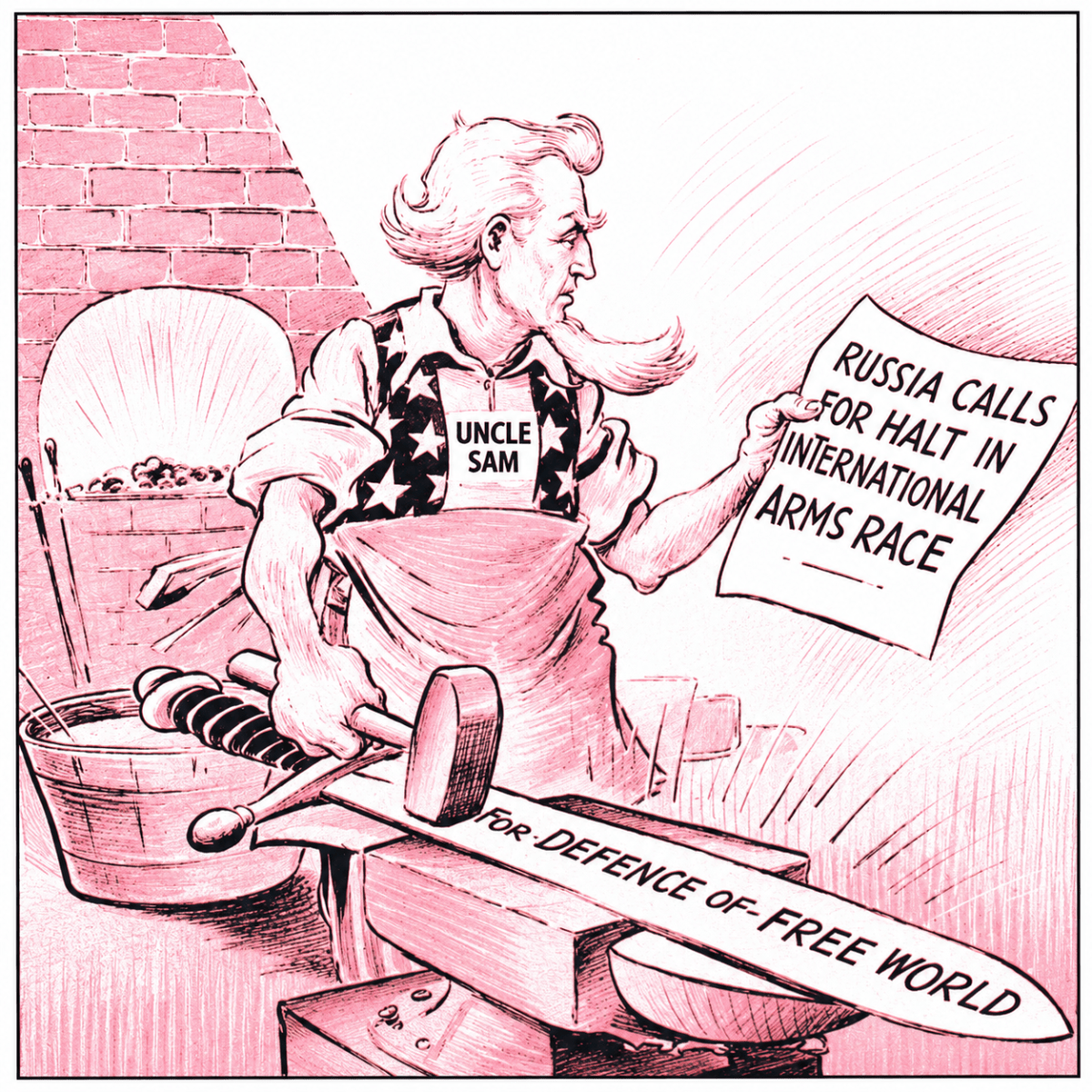
(a) The cartoon reflects which consequence of the Second World War? Give any two of its characteristic features.
(b) Who is conventionally referred to as Uncle Sam? What attitude is he likely to be expressing while reading the message? What policy is reflected in the phrase "For Defence of Free World"?
(c) What is referred to by the statement "Russia calls for halt in international arms race"? Whom, do you think, the cartoon is criticising, the USA, the USSR or both? Give reasons to support your answer.
Answer
(a) The cartoon reflects the Cold War, which was a consequence of the Second World War. Two of its characteristic features were:
- There was no armed struggle between the rivals, but a state of extreme political tension in which each side adopted policies designed to strengthen itself and weaken the other, while maintaining peace time diplomatic relations.
- It involved an arms race involving piling up of nuclear and conventional weapons, formation of military alliances, propaganda and proxy wars.
(b) Uncle Sam is the popular personification of the USA (the American government). While reading the message, he is likely to be expressing distrust and suspicion, as he continues to forge the sword instead of stopping, showing that he does not take the Russian proposal at face value and treats it as mere propaganda. The phrase "For Defence of Free World" reflects the American policy of containment of Communism, i.e., the United States, as the leader of the Free World, took upon itself the responsibility of preventing Communism from spreading.
(c) The statement refers to the proposal made by the Soviet Union to halt the piling up of nuclear and conventional weapons, i.e., to end the arms race between the two power blocs. The cartoon is criticising both the USA and the USSR. The USA is criticised because it continues to forge weapons in the name of the "Defence of Free World" even while a proposal to halt the arms race lies before it. The USSR is criticised because its call to halt the arms race appears to be propaganda, as it was itself piling up arms against the Western bloc. Thus, the cartoon shows that both the blocs openly propagated against each other and left no opportunity to weaken the opponent, while continuing the arms race.
How was the Second World War different from the First World War?
Answer
The Second World War was different from the First World War in the following ways:
- The First World War was fought between 1914 and 1918 while the Second World War was fought between 1939 and 1945.
- The First World War was triggered by the assassination of the archduke of Austria-Hungary while the Second World War was triggered by the bitterness over the outcome of the First World War which was used by Adolf Hitler to lead Germany to war.
- The First World War was a war between countries for acquiring colonies or territory or resources whereas the Second World War was a war of ideologies such as Fascism, Nazism, Communism and Capitalism.
- While First World War was fought in the trenches and used machine guns and poisonous gas, Second World War was fought using modern artillery and machines utilizing more airplanes, ships, tanks, and submarines. Special operations methods were also developed during the Second World War together with atomic missiles and secret communications. It led to the development of the atomic bomb which was the catalyst in ending the war.
- About 10 million people died in the First World War and about 50 million people were lost in the Second World War.
The dropping of atomic bombs on Hiroshima and Nagasaki in Japan during the Second World War heralded an era of Nuclear Warfare. Give your views on the given statement.
Answer
The USA and the Soviet Union emerged as the two super powers of the world after the Second World War. But ideological differences and suspicion of each other led to Cold War between them. Shortly after the war, the Soviet Union developed their own atomic bomb triggering a nuclear arms race with both countries developing even more powerful nuclear weapons than those used in Hiroshima and Nagasaki.
Since then, other nations namely the United Kingdom, France, China, India, Pakistan, Israel and North Korea have developed nuclear weapons.
Thus, we can say that the bombing of Hiroshima and Nagasaki in Japan by the United States of America during the Second World War heralded an era of Nuclear Warfare.
Find out the causes of the recent war between Ukraine and Russia.
Answer
Causes of the Russia–Ukraine War
1. Political Causes —
(i) Opposition to NATO Expansion: Russia strongly opposed Ukraine's efforts to join NATO, fearing Western military presence near its borders.
(ii) Pro-Western Government in Ukraine: After the 2014 Euromaidan Revolution, Ukraine’s new leadership shifted away from Russian influence and moved closer to the European Union and the West.
(iii) Loss of Russian Political Influence: Russia wanted to regain influence over Ukraine, which it sees as part of its geopolitical sphere.
2. Military and Strategic Causes —
(i) Security Concerns: Russia viewed Ukraine’s growing ties with the West as a threat to its national security.
(ii) Build-up of Russian Troops: Russia stationed large numbers of troops along Ukraine's borders, preparing for conflict under the pretext of national defense.
(iii) Use of Proxy Forces: Russia supported armed separatist groups in Eastern Ukraine (Donetsk and Luhansk) to destabilize the region and weaken Ukraine.
3. Economic Causes —
(i) Control over Natural Resources and Trade Routes: Russia is interested in Ukraine’s strategic location, fertile land, and energy pipelines that supply gas to Europe.
(ii) Preventing Ukraine’s EU Integration: Russia feared losing trade influence if Ukraine fully integrated into the European Union’s economy.
4. Historical and Cultural Causes —
(i) Claim over Historical Unity: Russia claims that Ukraine is historically a part of Russian civilization, questioning its independence and nationhood.
(ii) Annexation of Crimea (2014): Russia had already seized Crimea from Ukraine, which escalated tensions and was seen as the first major step toward conflict.
Do you think the concept of Cold War is still visible in the 21st century global geopolitics? Give reasons to support your answer.
Answer
Yes, the concept of the Cold War is still visible in the 21st century global geopolitics in the following ways:
- Rivalry between great powers — There is a state of extreme political tension between the USA and Russia, and a growing strategic rivalry between the USA and China, without any direct armed conflict between them.
- Military alliances — NATO continues to exist and has expanded, while Russia and China have strengthened their mutual military cooperation.
- Arms race — Nations continue to pile up and modernise nuclear and conventional weapons, and compete in missile, space and military technology.
- Proxy wars — The great powers support opposing sides in conflicts such as those in Ukraine and Syria, instead of fighting each other directly.
- Economic warfare — Sanctions, trade embargoes and trade wars are used as instruments to weaken rivals.
- Propaganda — The rival powers carry on propaganda against each other, now largely through information and cyber warfare.