
In an experiment for determination of refractive index of glass of a prism by i − δ plot, it was found that a ray incident at angle 35°, suffers minimum deviation of 40° and that it emerges at angle 79°. In that case which of the following is closest to the maximum possible value of the refractive index?
- 1.6
- 1.7
- 1.8
- 1.5
Answer
1.5
Reason — The angle of the prism is
Since i ≠ e, the ray is not in the minimum deviation position, so δm < 40°. Hence
Of the given options, 1.5 is closest to this maximum possible value.
Note: The stem calls 40° the minimum deviation, but in minimum deviation i = e, which is not so here (35° ≠ 79°). The 40° is only the deviation of this ray, as in the original JEE Main 2016 question; the answer above uses that reading.
The angle of incidence for a ray of light at a refracting surface of a prism is 45°. The angle of prism is 60°. If the ray suffers deviation through the prism, the angle of minimum deviation and refractive index of the material of the prism respectively, are :
- 45°;
- 30°;
- 45°;
- 30°;
Answer
30°;
Reason — The stem gives only i = 45° and A = 60°. It does not state that the ray passes symmetrically through the prism, so these data alone do not fix δm and n. For example, a prism of n = 1.5 also refracts this ray, but not symmetrically (r = 28.1°, r' = 31.9°, e = 52.4°), and its minimum deviation is about 37.2°, not 30°.
The options settle the answer. For A = 60°, the pair δm and n must satisfy the prism formula, and only option 2 does (options 1 and 3 would need n ≈ 1.59, and option 4 would need n = ):
For this prism, the angle of incidence for minimum deviation is i = = 45°, the given angle, so the given ray passes symmetrically through the prism with r = r' = = 30°.
Note: The textbook's key (b) and its solution assume that the ray passes symmetrically through the prism (minimum deviation position); the stem omits this condition.
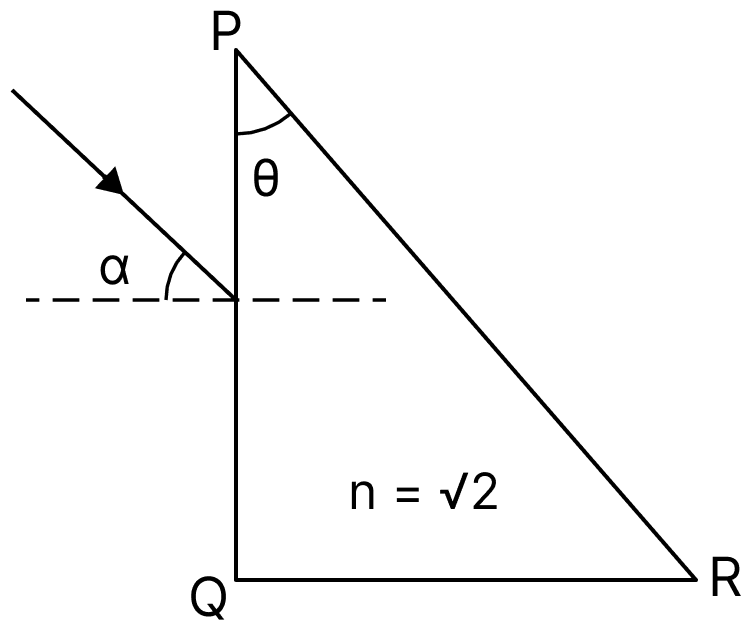
A parallel beam of light is incident from air at an angle α on the side PQ of a right-angled triangular prism of refractive index n = . Light undergoes total internal reflection in the prism at the face PR when α has a minimum value of 45°. The angle θ of the prism is :
- 15°
- 22.5°
- 30°
- 45°
Answer
15°
Reason —
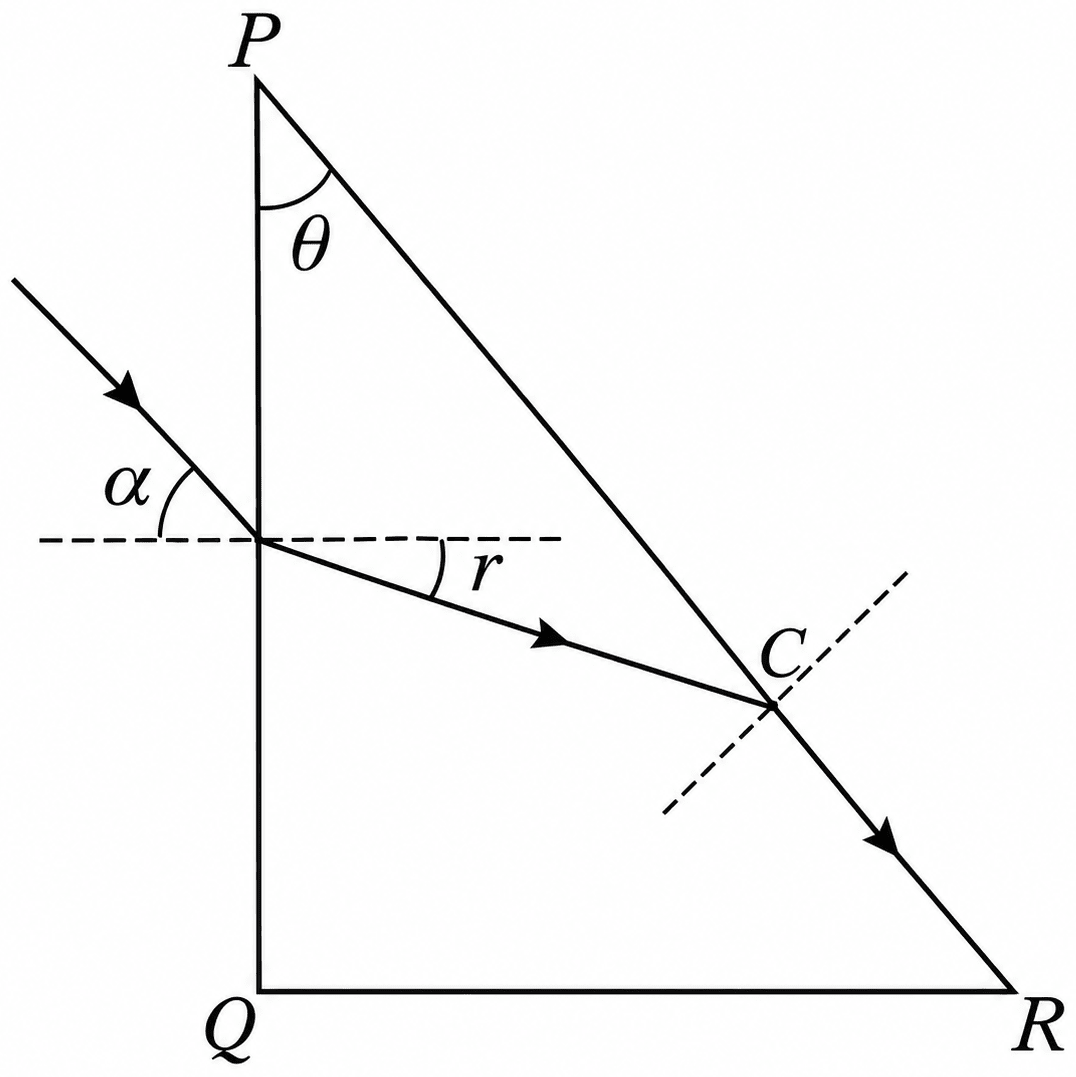
The critical angle of the prism is given by sin θc = , so θc = 45°. At the face PQ, for α = 45°,
The refracted ray meets the face PR at an angle of incidence (θ + r), which increases with α. Total internal reflection just begins at the minimum α when this angle equals θc,
A thin prism having refracting angle 10° is made of glass of refractive index 1.42. This prism is combined with another thin prism of glass of refractive index 1.7. This combination produces dispersion without deviation. The refracting angle of second prism should be :
- 4°
- 6°
- 8°
- 10°
Answer
6°
Reason — For no deviation, the deviations (n − 1)A of the two thin prisms must be equal and opposite,
The refractive index of the material of a prism is and the angle of the prism is 30°. One of the two refracting surfaces of the prism is made a mirror inwards, by silver coating. A beam of monochromatic light entering the prism from the other face will retrace its path (after reflection from the silvered surface) if its angle of incidence on the prism is :
- 60°
- zero
- 30°
- 45°
Answer
45°
Reason — The ray retraces its path only if it falls normally on the silvered face, so r' = 0 and r = A − r' = 30°. By Snell's law at the other face,
A monochromatic light is incident at a certain angle on an equilateral triangular prism and suffers minimum deviation. If the refractive index of the material of the prism is , then the angle of incidence is :
- 30°
- 45°
- 90°
- 60°
Answer
60°
Reason — In minimum deviation, r = = 30°. By Snell's law,
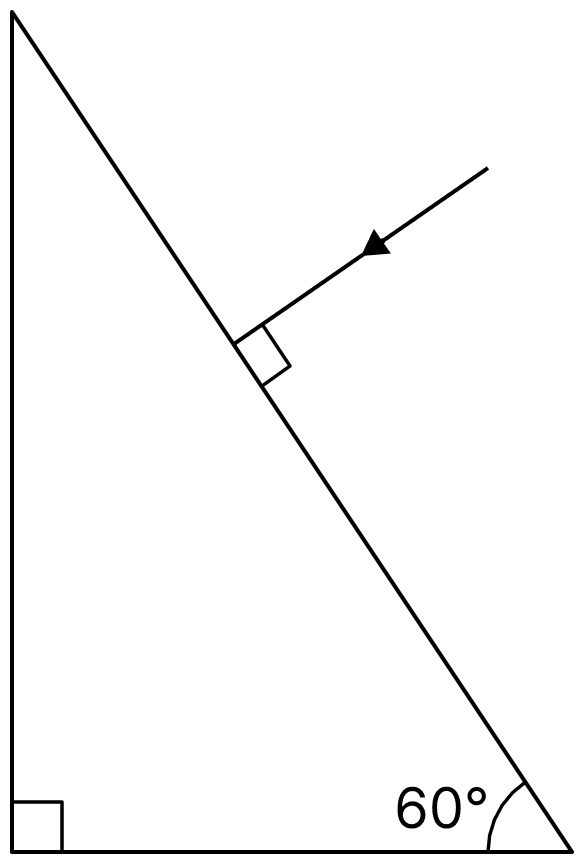
Find the value of the angle of emergence from the prism. Refractive index of the glass is .
- 90°
- 60°
- 30°
- 45°
Answer
60°
Reason — The ray falls normally on the inclined face, so it enters undeviated and meets the vertical face at an angle of incidence equal to the angle between the two faces, i.e. 90° − 60° = 30°. This is less than the critical angle (sin−1 ≈ 35.3°), so the ray emerges. By Snell's law,
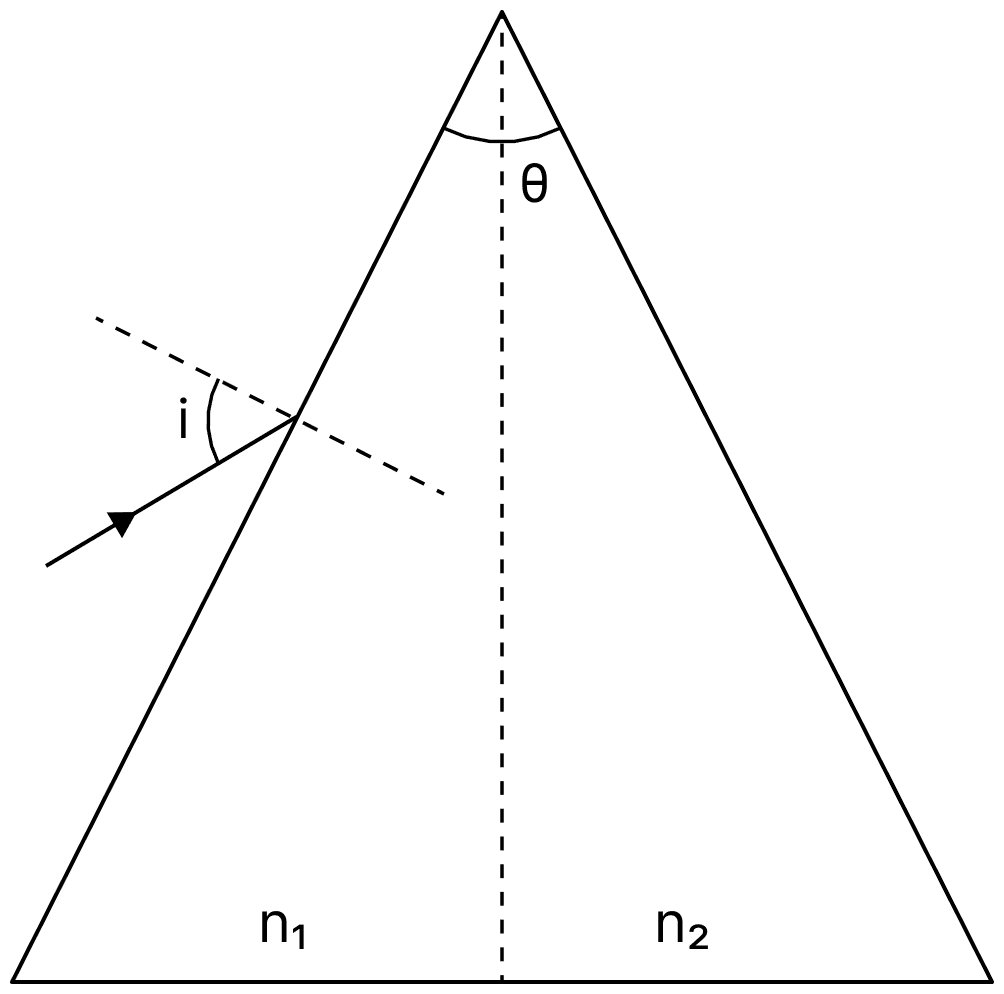
For a prism of prism angle θ = 60°, the refractive indices of the left half and the right half are, respectively, n1 and n2 (n2 ≥ n1) as shown in the figure. The angle of incidence i is chosen such that the incident light rays will have minimum deviation if n1 = n2 = n = 1.5. For the case of unequal refractive indices, n1 = n and n2 = n + Δn (where Δn << n), the angle of emergence e = i + Δe. Which of the following statement(s) is(are) correct?
- The value of Δe (in radians) is greater than that of Δn.
- Δe is proportional to Δn.
- Δe lies between 2.0 and 3.0 milliradians, if Δn = 2.8 × 10⁻³.
- Δe lies between 1.0 and 1.6 milliradians, if Δn = 2.8 × 10⁻³.
Answer
Δe is proportional to Δn.
Δe lies between 2.0 and 3.0 milliradians, if Δn = 2.8 × 10⁻³.
Reason — For n = 1.5 in minimum deviation, r = 30° and the ray inside travels parallel to the base, i.e. normal to the dividing face, so it is not refracted there. Also sin i = 1.5 × sin 30° = 0.75.
At the second face, r' = 30°, so sin e = (n + Δn) sin 30°. Differentiating with e ≈ i,
So Δe ∝ Δn and Δe < Δn. For Δn = 2.8 × 10⁻³,
Hence statements 2 and 3 are correct.
The refracting angle of a prism is A and the refractive index of its material is . The angle of minimum deviation is :
- 180° − 3A
- 180° + 2A
- 90° − A
- 180° − 2A
Answer
180° − 2A
Reason — Using the prism formula,
Given below are two statements :
Statement I : When the white light passed through a prism, the red light bends lesser than yellow and violet.
Statement II : The refractive indices are different for different wavelengths in dispersive medium.
In the light of the above statements, choose the correct answer from the options given below :
- Both Statement I and Statement II are true.
- Statement I is true but Statement II is false.
- Both Statement I and Statement II are false.
- Statement I is false but Statement II is true.
Answer
Both Statement I and Statement II are true.
Reason — In a dispersive medium the refractive index is different for different wavelengths, being least for red and greater for yellow and violet (nr < ny < nv). Since δ = (n − 1)A, the red light bends the least. Thus both statements are true.
A light ray enters through a right-angled prism at point P with the angle of incidence 30° as shown in figure. It travels through the prism parallel to its base BC and emerges along the face AC. The refractive index of the prism is :
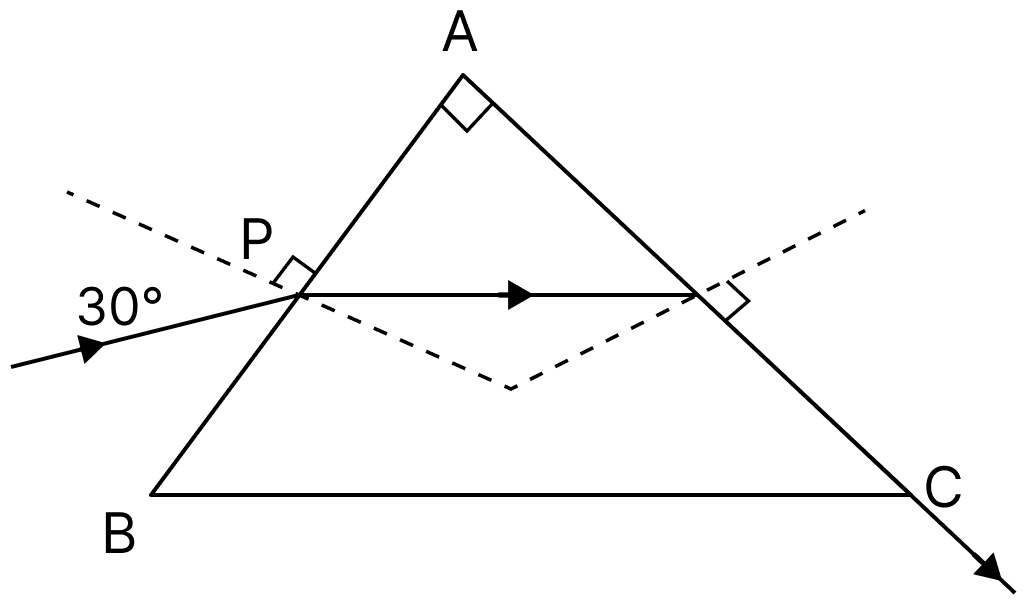
Answer
Reason — The prism angle at A is 90°, so r1 + r2 = 90°. As the ray emerges along AC, the angle of incidence there is the critical angle, so sin r2 = , i.e. cos r1 = . At P, sin 30° = n sin r1, i.e. sin r1 = .
A prism of angle A = 1° has a refractive index μ = 1.5. A good estimate for the minimum angle of deviation (in degrees) is close to . Value of N is ............... .
Answer
Given,
- Angle of prism, A = 1°
- Refractive index, μ = 1.5
The prism is thin, so its minimum deviation is
Comparing with ,
Hence, the value of N is 5.
In the given figure, the equilateral prism is immersed in a liquid of refractive index n. For incident angle 60° at the side AC, the refracted light beam just grazes along face AC. The refractive index of the liquid n = . The value of x is ............... .
(Given : refractive index of glass = 1.5)
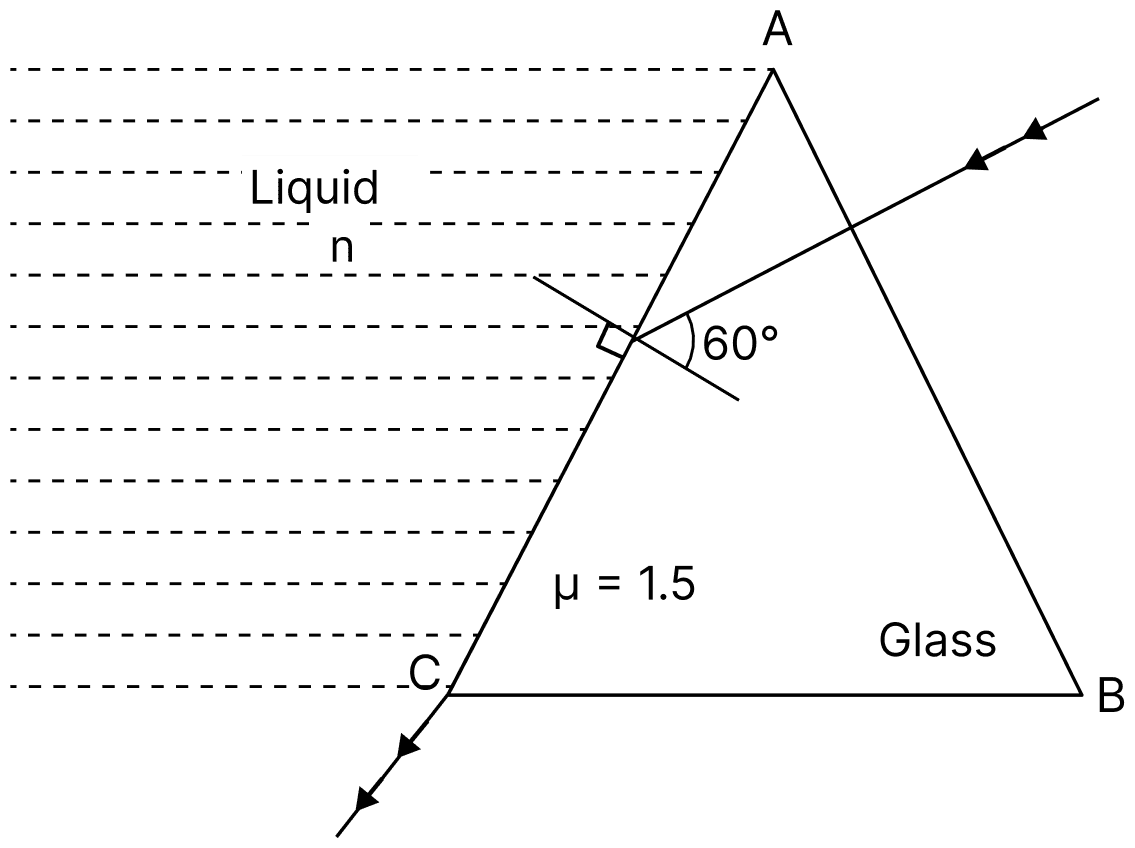
Answer
Given,
- Refractive index of glass, ng = 1.5
- Angle of incidence inside the glass at the face AC = 60°
- The refracted beam grazes along AC, so the angle of refraction in the liquid = 90°
Applying Snell's law at the face AC (glass to liquid),
Comparing with n = , x = 27.
Hence, the value of x is 27.