
Assuming the earth as an insulated spherical conductor of radius 6400 km. Calculate its capacitance.
Answer
Given,
- Radius of the earth, a = 6400 km = 6.4 × 10⁶ m
- N-m2 C-2
For an isolated spherical conductor,
Substituting the value of a,
Hence, the capacitance of the earth is 711 µF.
A parallel plate capacitor of plate area A = 600 cm2 and plate separation, d = 2.0 mm is connected to a DC source of 200 V. Calculate in SI unit :
(i) the magnitude of the uniform electric field E between the plates.
(ii) the charge density σ on any plate.
Answer
Given,
- Area of each plate, A = 600 cm2 = 6 × 10⁻² m2
- Separation between the plates, d = 2.0 mm = 2.0 × 10⁻³ m
- Potential difference, V = 200 V
- ε0 = 8.85 × 10⁻¹² C2 N-1 m-2
(i) The field between the plates is uniform, so
(ii) The field between the plates in terms of the surface charge density is E = σ/ε0, so
Hence, E = 105 V m-1 and σ = 8.85 × 10⁻⁷ C m-2.
A parallel plate capacitor of capacitance C, with air between the plates, is shown in Fig. (a). A sheet of dielectric constant K = 5 is introduced between the plates so as to fill the space, as shown in Fig. (b).
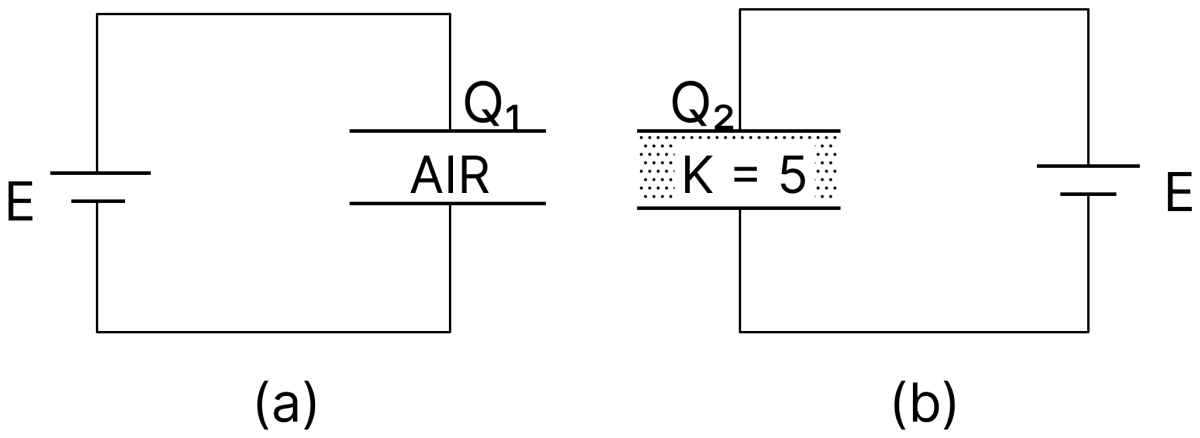
What are the values of the potential differences V1 and V2 across the plates in case (a) and (b) respectively? What are the charges Q1 and Q2 on the plates? In both cases, a battery of emf E is kept connected to the capacitor.
Answer
Given,
- Capacitance with air, C
- Dielectric constant of the sheet, K = 5
- The battery of emf E remains connected in both cases
Potential differences : In both the cases the battery remains connected across the plates, so the potential difference is fixed by the battery,
Charges : In case (a) the capacitance is C, hence
In case (b) the dielectric fills the whole space, so the capacitance becomes KC and
Hence, V1 = V2 = E, while Q1 = CE and Q2 = 5CE.
A 900 pF capacitor is charged by a 100 V battery. How much energy is stored by the capacitor?
Answer
Given,
- Capacitance, C = 900 pF = 900 × 10-12 F
- Potential difference, V = 100 V
The energy stored in a capacitor is
Substituting the values,
Hence, the energy stored by the capacitor is 4.5 × 10⁻⁶ J.
Derive the expression for the energy stored in a capacitor of capacitance C, charged to a potential V.
Answer
While a capacitor is being charged, work has to be done in carrying charge from one plate to the other against the potential difference that already exists between them. This work is stored as the electric potential energy of the capacitor.
Let q be the charge on the capacitor at some instant, so that the potential difference between the plates is q/C. The work done in transferring a further small charge dq is
Integrating from q = 0 to the final charge Q,
This work is stored as the energy of the capacitor. Using Q = CV,
Derive an expression for the capacitance of a parallel plate capacitor in terms of the areas of the plates and the distance between them. Assume there is a vacuum in between the plates with the electric field between the plates E = σ/ε0 (where the symbols have their usual meaning).
Answer
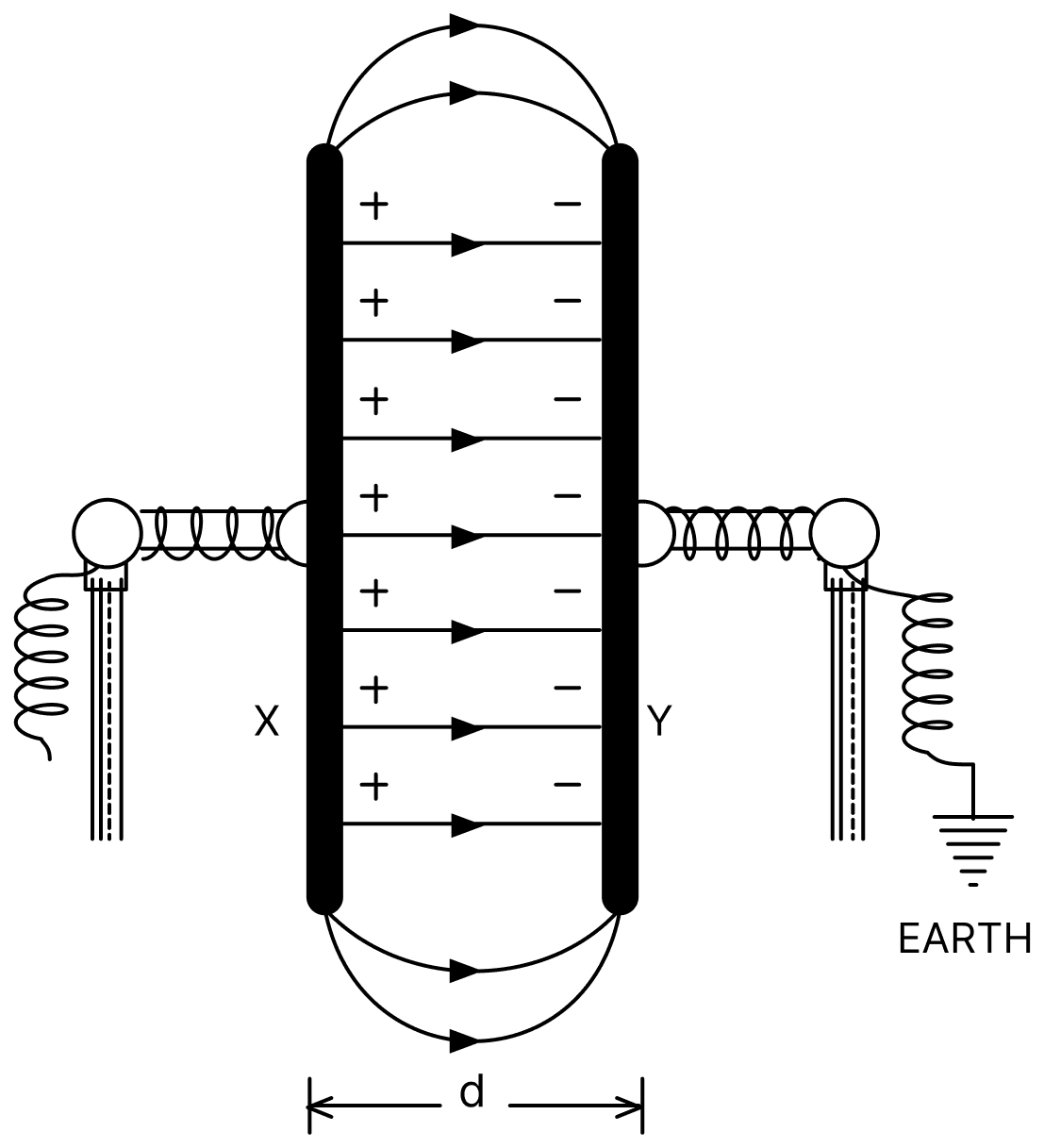
Consider a parallel-plate capacitor whose plates each have area A and are held a distance d apart, with vacuum between them. Let the plates carry charges +Q and −Q, so that the surface density of charge is
The electric field in the space between the plates is uniform and is given by
Since the field is uniform, the potential difference between the plates is
By definition the capacitance is
Thus the capacitance is directly proportional to the area of the plates and inversely proportional to the distance between them.
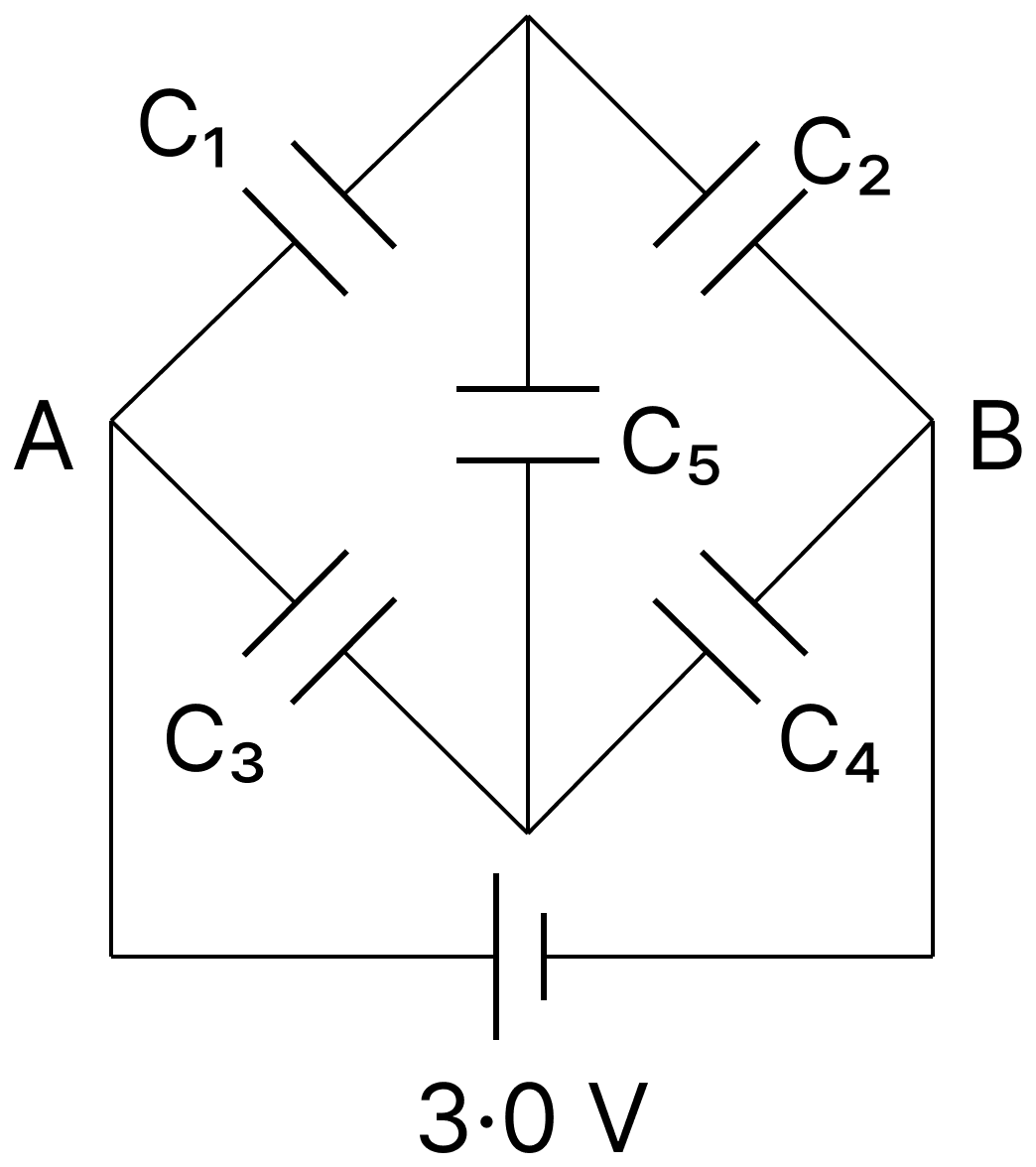
Find the equivalent capacitance of the circuit between the points A and B, given C1 = C2 = C3 = C4 = 10 µF and C5 = 5 µF.
Answer
Given,
- C1 = C2 = C3 = C4 = 10 µF
- C5 = 5 µF
The network is a Wheatstone-type bridge in which C5 forms the bridge arm. The balance condition is
The bridge is balanced, so the two ends of C5 are at the same potential and it carries no charge. It may therefore be removed.
The remaining arms give two series branches,
These two branches are in parallel between A and B,
Hence, the equivalent capacitance between A and B is 10 µF.
Note: The answer is printed in the textbook as "10 mF". The correct unit is the microfarad, since all the given capacitances are in microfarads.
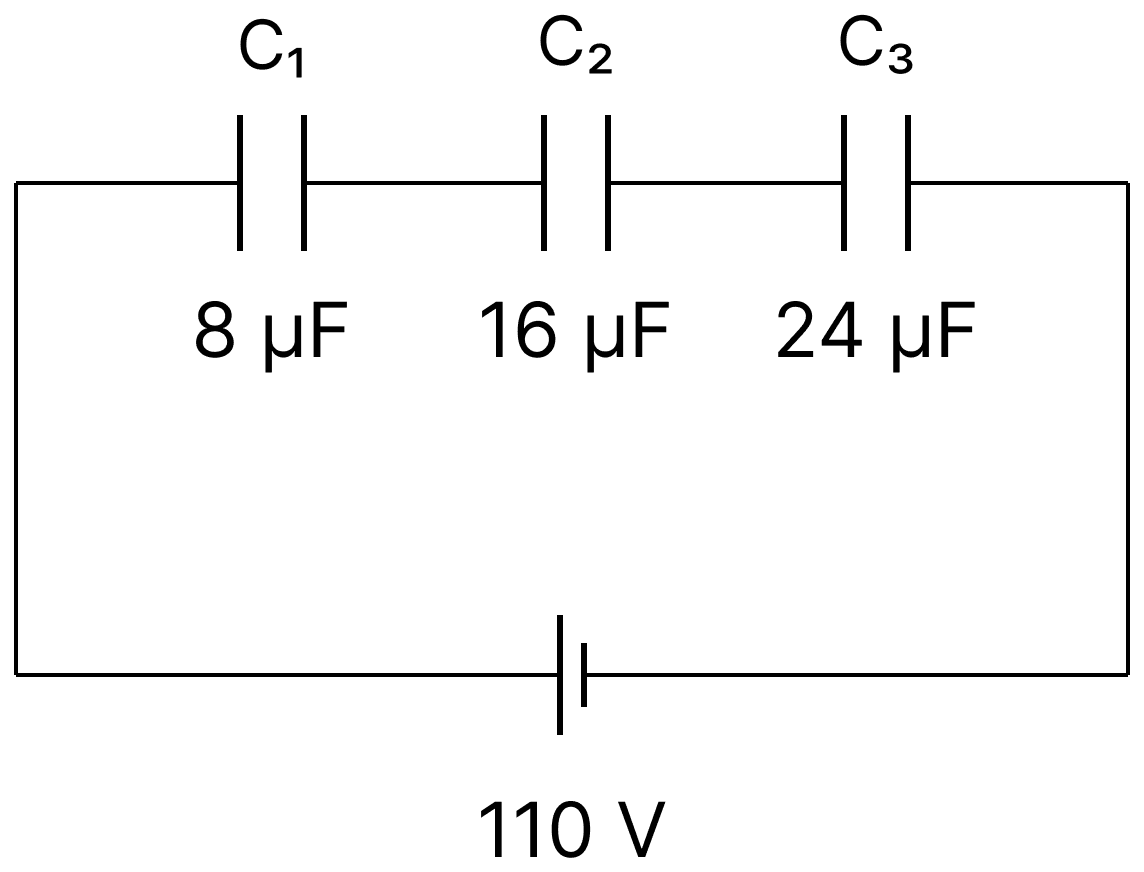
Find the electric charge Q1 on plates of capacitor C1, shown in figure.
Answer
Given,
- C1 = 8 µF, C2 = 16 µF, C3 = 24 µF, joined in series
- Applied potential difference, V = 110 V
For a series combination,
In a series combination every capacitor carries the same charge, which is the charge drawn from the source,
Hence, the charge on the plates of C1 is 4.8 × 10⁻⁴ C.
An isolated 16 µF parallel plate air capacitor has a potential difference of 100 V (Fig. a). A dielectric slab having relative permittivity (i.e., dielectric constant) = 5 is introduced to fill the space between the two plates completely (Fig. b). Calculate :
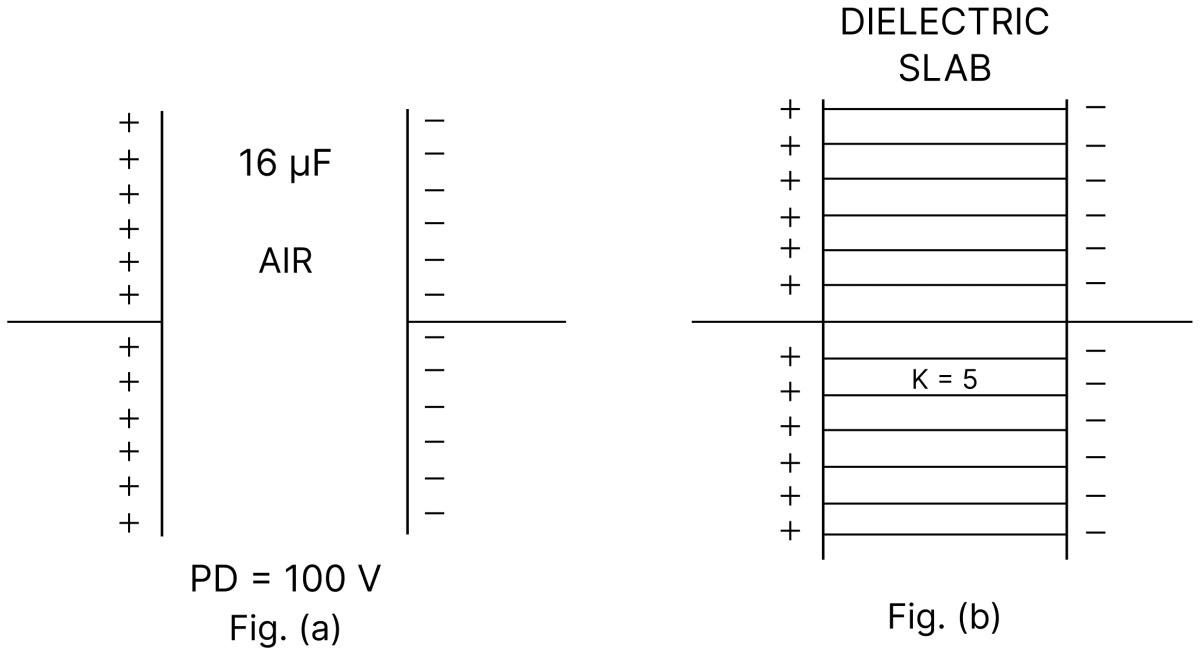
(i) the new capacitance of the capacitor,
(ii) the new potential difference between the two plates of capacitor.
Answer
Given,
- Capacitance with air, C0 = 16 µF
- Initial potential difference, V0 = 100 V
- Dielectric constant, K = 5
(i) When the dielectric fills the space between the plates completely,
(ii) The capacitor is isolated, so the charge on the plates remains unchanged,
Hence the new potential difference is
Hence, the new capacitance is 80 µF and the new potential difference is 20 V.
Three capacitors each of capacitance C are connected in series. Their equivalent capacitance is Cs. The same three capacitors are now connected in parallel. Their equivalent capacitance becomes Cp. Find the ratio .
Answer
Given,
- Three capacitors each of capacitance C
For the series combination,
For the parallel combination,
Therefore
Hence, Cp : Cs = 9 : 1.
Three capacitors C1 = 6 µF, C2 = 12 µF and C3 = 20 µF are connected to a 100 V battery, as shown in Fig.
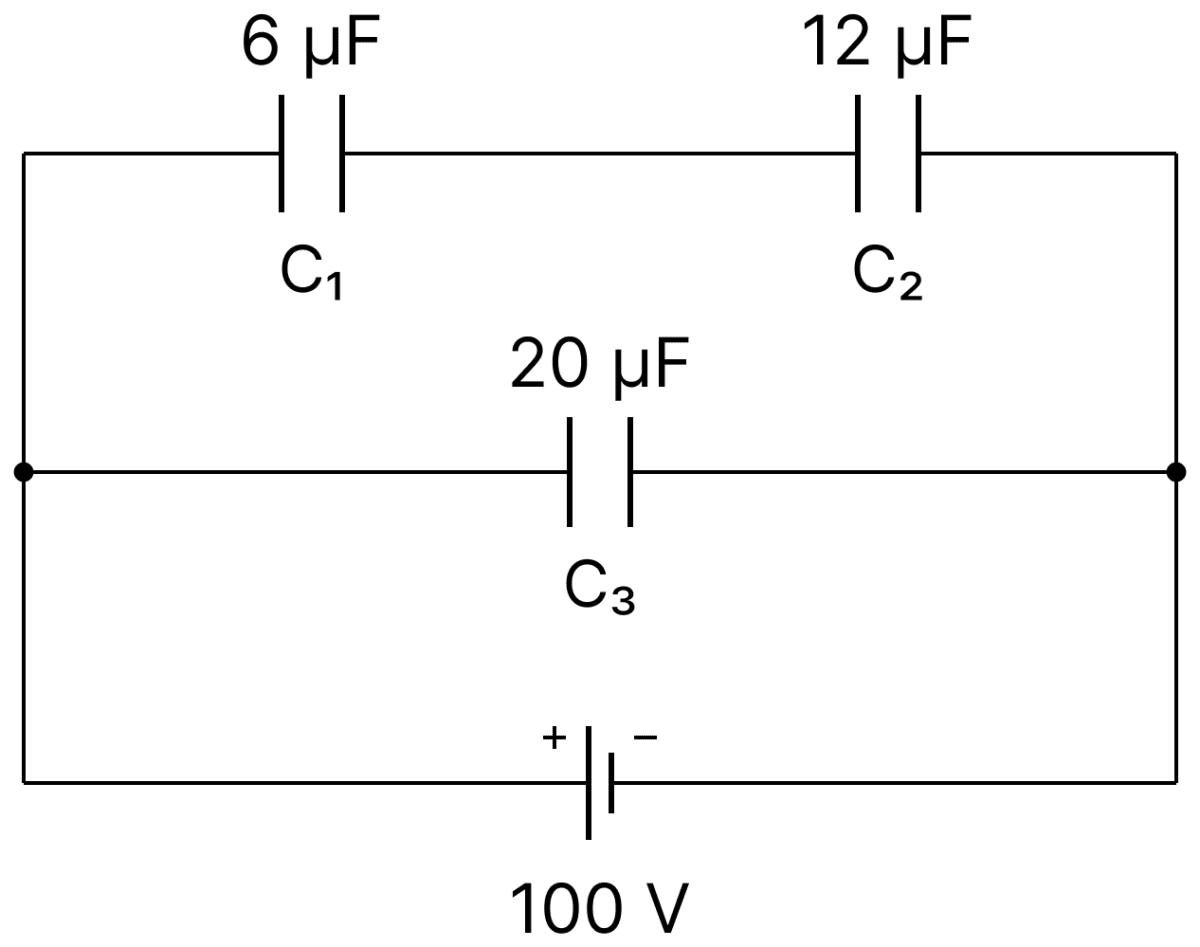
(i) Charge on each plate of capacitor C1.
(ii) Electrostatic potential energy stored in capacitor C3.
Answer
Given,
- C1 = 6 µF, C2 = 12 µF, C3 = 20 µF
- EMF of the battery, V = 100 V
From the figure, C1 and C2 are in series and this branch is in parallel with C3 across the battery.
(i) For the series branch,
The full 100 V acts across this branch, and in series both capacitors carry the same charge,
(ii) The capacitor C3 is directly across the battery, so it has 100 V across it,
Hence, the charge on each plate of C1 is 400 µC and the energy stored in C3 is 0.1 J.
A parallel plate air capacitor has a capacitance of 5 µF. It becomes 50 µF when a dielectric medium occupies the entire space between its two plates. What is the dielectric constant of the medium?
Answer
Given,
- Capacitance with air, C0 = 5 µF
- Capacitance with the dielectric, C = 50 µF
The dielectric constant is the ratio of the two capacitances,
Hence, the dielectric constant of the medium is 10.
You provided with 8 µF capacitors. Show with the help of a diagram how you will arrange minimum number of them to get a resultant capacitance of 20 µF.
Answer
Given,
- Capacitance of each capacitor = 8 µF
- Required resultant capacitance = 20 µF
Two capacitors of 8 µF joined in series give
If this series pair is joined in parallel with two more single capacitors of 8 µF each, the resultant capacitance is
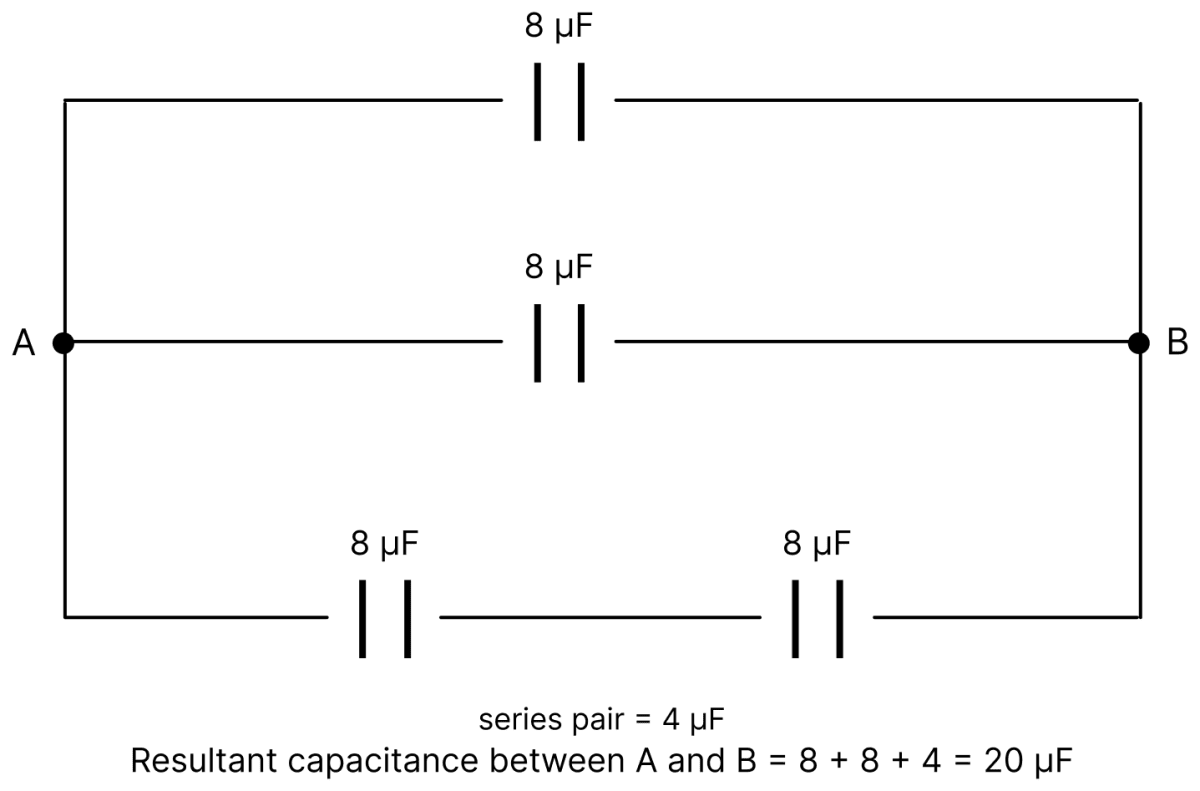
Hence, a minimum of 4 capacitors is required — two of them joined in series, and this pair connected in parallel with the other two.
Deduce an expression for equivalent capacitance C when three capacitors C1, C2 and C3 are connected in parallel.
Answer
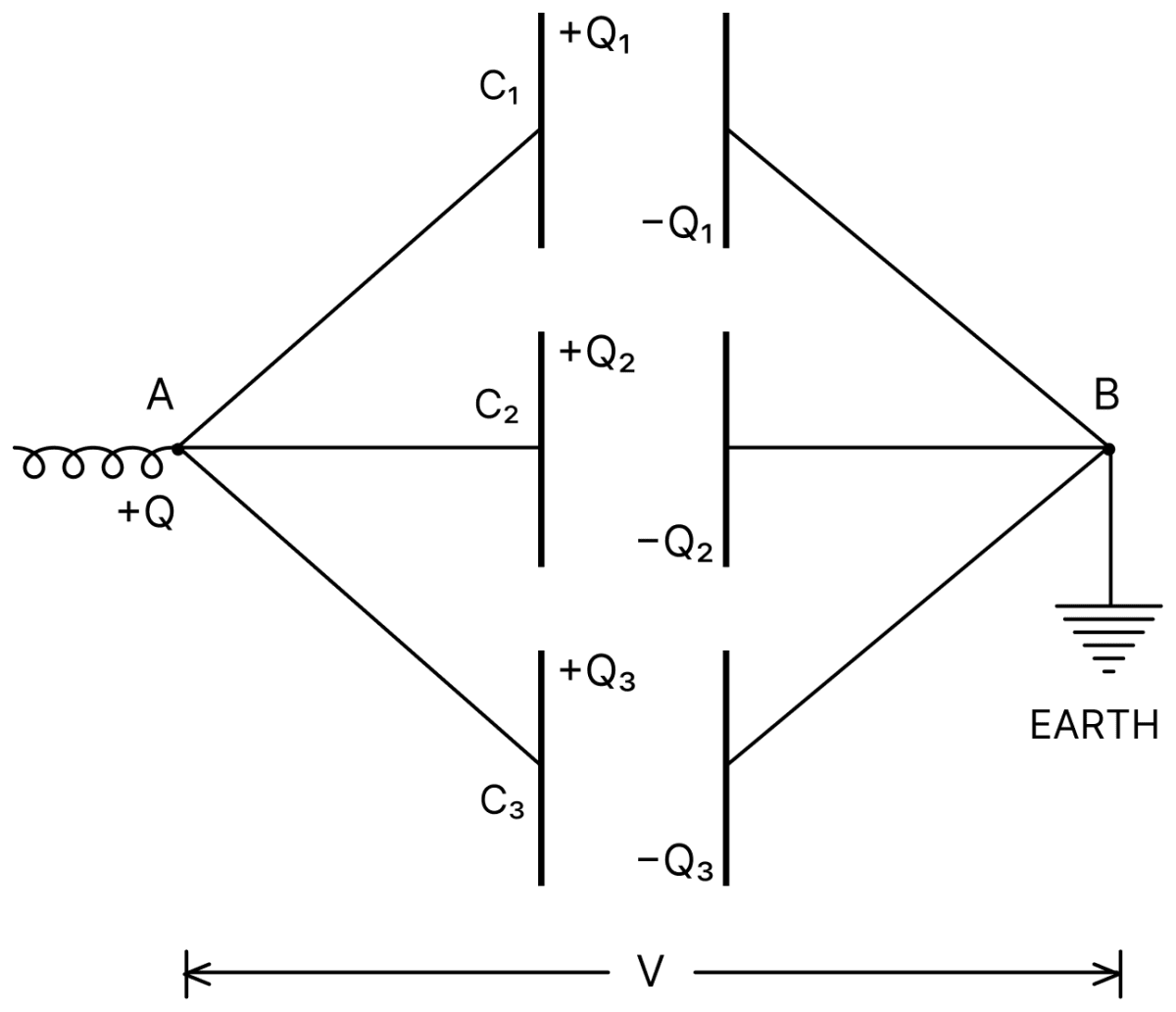
In a parallel combination, one plate of each capacitor is connected to the point A and the other plate to the point B. Hence each capacitor has the same potential difference V across it, while the charges on them are different.
The charges on the three capacitors are
The total charge drawn from the source is
If a single capacitor of capacitance C between A and B takes the same charge Q at the same potential difference V, then Q = CV. Comparing the two expressions,
Thus in a parallel combination the equivalent capacitance is the sum of the individual capacitances.
Three capacitors of capacitance C1 = 3 µF, C2 = 6 µF and C3 = 10 µF are connected to a 10 V battery as shown in Fig. Calculate :
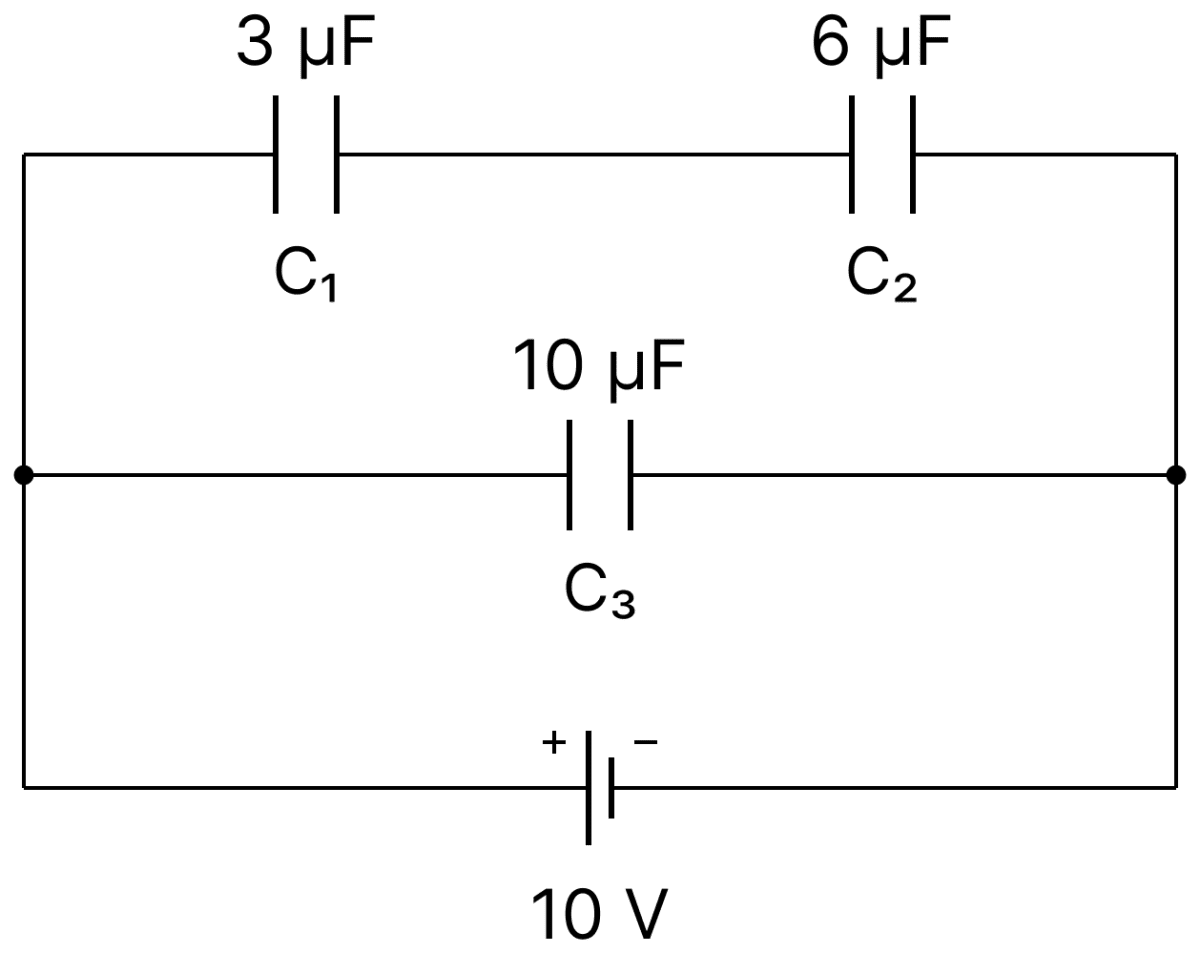
(i) Equivalent capacitance.
(ii) Electrostatic potential energy stored in the system.
Answer
Given,
- C1 = 3 µF, C2 = 6 µF, C3 = 10 µF
- EMF of the battery, V = 10 V
(i) From the figure, C1 and C2 are in series and this branch is in parallel with C3.
(ii) The energy stored is
Hence, the equivalent capacitance is 12 µF and the energy stored is 6 × 10⁻⁴ J.
A parallel plate capacitor is charged by a battery, which is then disconnected. A dielectric slab having dielectric constant (relative permittivity) K, is now introduced between its two plates in order to occupy the space completely. State, in terms of K, its effect on the following :
(i) the capacitance of the capacitor,
(ii) the potential difference between its plates,
(iii) the energy stored in the capacitor.
Answer
The battery has been disconnected, so the charge Q on the plates remains unchanged.
(i) The capacitance becomes K times its original value,
(ii) Since Q is constant and V = Q/C,
(iii) The energy stored is U = Q2/2C, so
Hence, C' = KC, V' = V/K and U' = U/K. As K > 1, the capacitance increases while the potential difference and the stored energy both decrease.
Obtain an expression for equivalent capacitance C, when three capacitors having capacitances C1, C2 and C3 are connected in series.
Answer
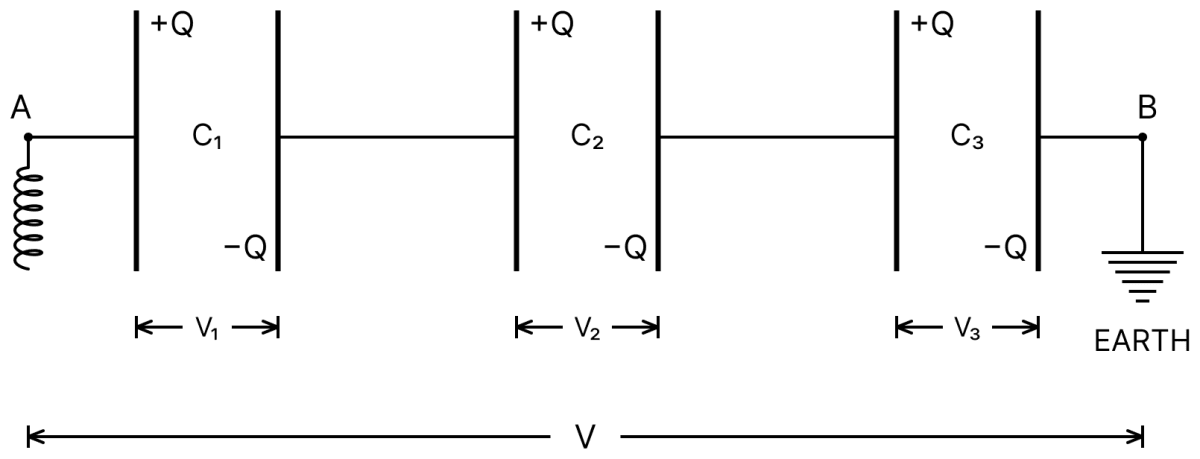
In a series combination the capacitors are joined end to end. On giving a charge +Q to the first plate, equal and opposite charges appear on the plates of each capacitor by induction, so every capacitor carries the same charge Q, while the potential differences across them are different.
The potential differences are
If V is the total potential difference between the end points A and B, then
For a single equivalent capacitor C carrying the same charge Q at the same potential difference V, we have V = Q/C. Comparing,
Thus in a series combination the reciprocal of the equivalent capacitance is the sum of the reciprocals of the individual capacitances.
Three capacitors C1 = 6 µF, C2 = 3 µF and C3 = 8 µF are connected to a 50 V battery as shown in figure given below. Calculate :
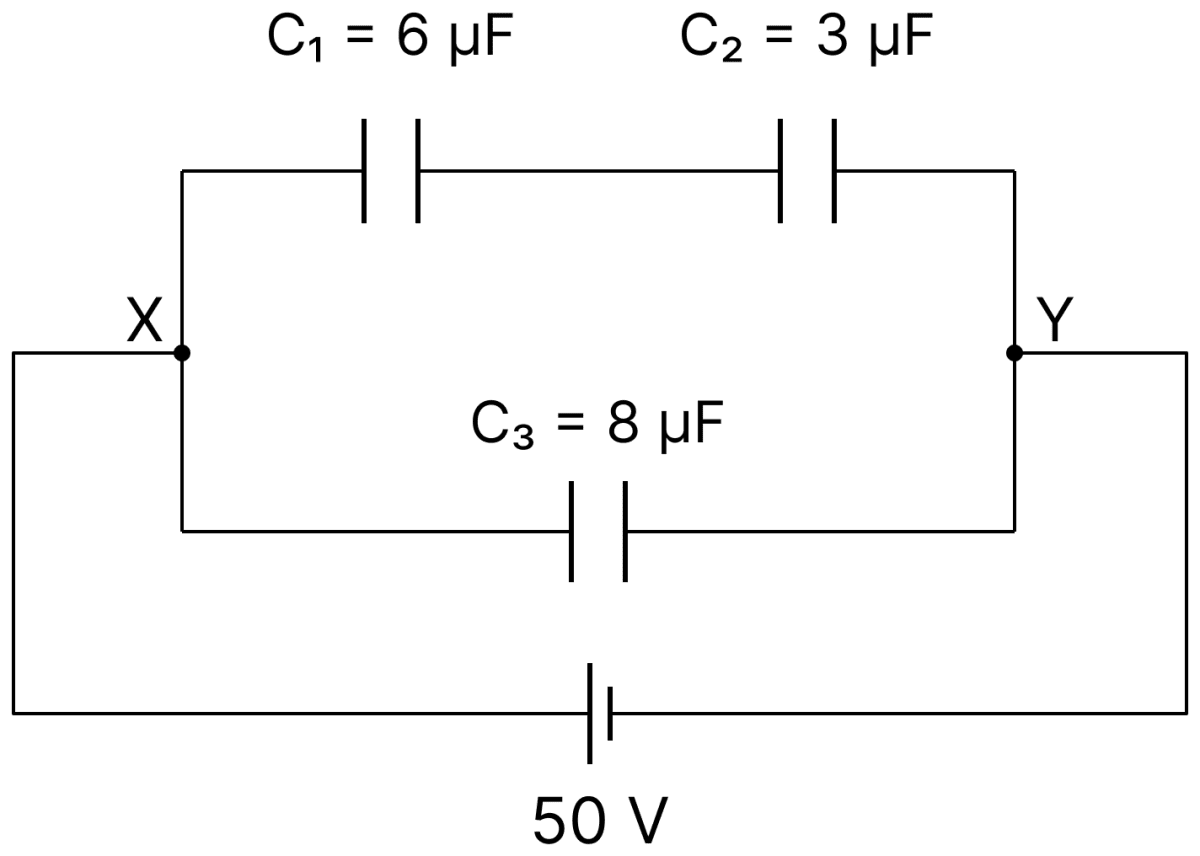
(a) The equivalent capacitance of the circuit between the points X and Y.
(b) The charge on C1.
Answer
Given,
- C1 = 6 µF, C2 = 3 µF, C3 = 8 µF
- EMF of the battery, V = 50 V
(a) From the figure, C1 and C2 are in series between X and Y, and C3 is in parallel with this branch.
(b) The full 50 V acts across the series branch, and both capacitors of that branch carry the same charge,
Hence, the equivalent capacitance between X and Y is 10 µF and the charge on C1 is 100 µC.
Consider 10 identical capacitors each of capacitance 5 µF. The ratio of the minimum and maximum possible values of the capacitance that can be obtained from them, is :
- 1 : 50
- 1 : 100
- 50 : 1
- 100 : 1
Answer
1 : 100
Explanation:
The minimum capacitance is obtained when all ten are joined in series,
and the maximum when all ten are joined in parallel,
Hence
The capacitance of a parallel plate capacitor does not depend on :
- area of each plate
- potential difference between the two plates
- nature of the medium between the two plates
- distance between the two plates
Answer
potential difference between the two plates
Explanation:
The capacitance of a parallel-plate capacitor is
which depends only on the plate area A, the separation d and the dielectric constant K of the medium. On changing the potential difference the charge changes in the same proportion, so the ratio Q/V, that is C, is unaltered.
Calculate equivalent capacitance of the circuit shown in the figure given below:
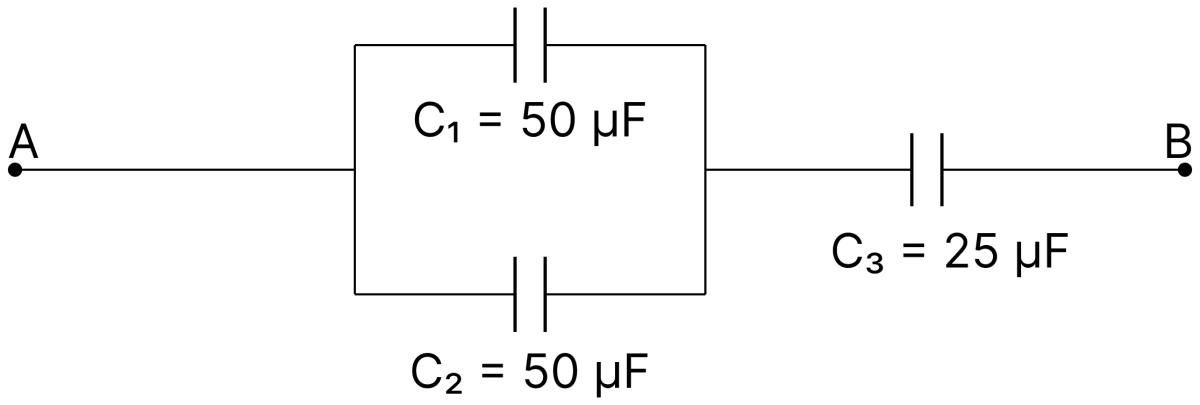
Answer
Given,
- C1 = 50 µF, C2 = 50 µF, C3 = 25 µF
From the figure, C1 and C2 are joined in parallel, and this combination is in series with C3.
For the parallel part,
For the series combination with C3,
Hence, the equivalent capacitance of the circuit is 20 µF.
The air between the two plates of a parallel plate capacitor having capacitance of 20 µF is replaced with a slab of a dielectric material having dielectric constant (Relative permittivity) = 6.
As a result, capacitance of the capacitor
- remains 20 µF
- becomes 120 µF
- becomes 20/6 µF
- becomes infinity
Answer
becomes 120 µF
Explanation:
When the dielectric completely fills the space between the plates, the capacitance becomes K times its value with air,
Calculate equivalent capacitance :
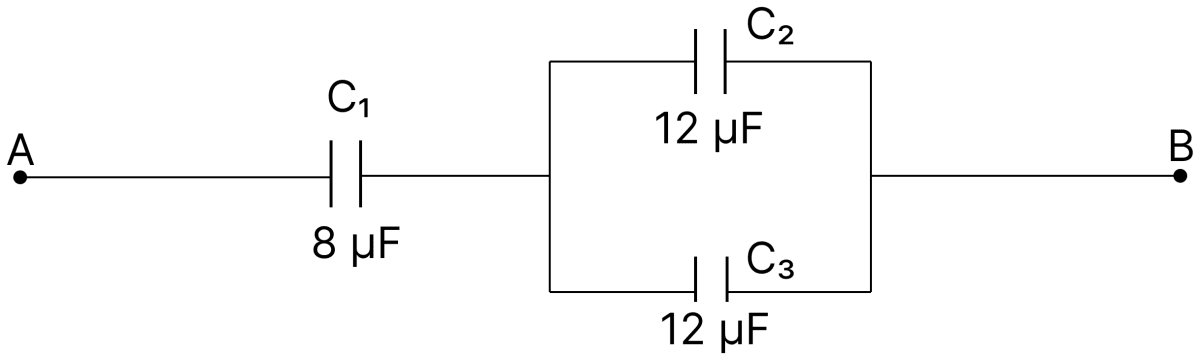
Answer
Given,
- C1 = 8 µF, C2 = 12 µF, C3 = 12 µF
From the figure, C2 and C3 are joined in parallel, and this combination is in series with C1.
For the parallel part,
For the series combination with C1,
Hence, the equivalent capacitance between A and B is 6 µF.