Fill in the blanks with fractions.
- Three guavas together weigh 1 kg. If they are roughly of the same size, each guava will roughly weigh .......... kg.
- A wholesale merchant packed 1 kg of rice in four packets of equal weight. The weight of each packet is .......... kg.
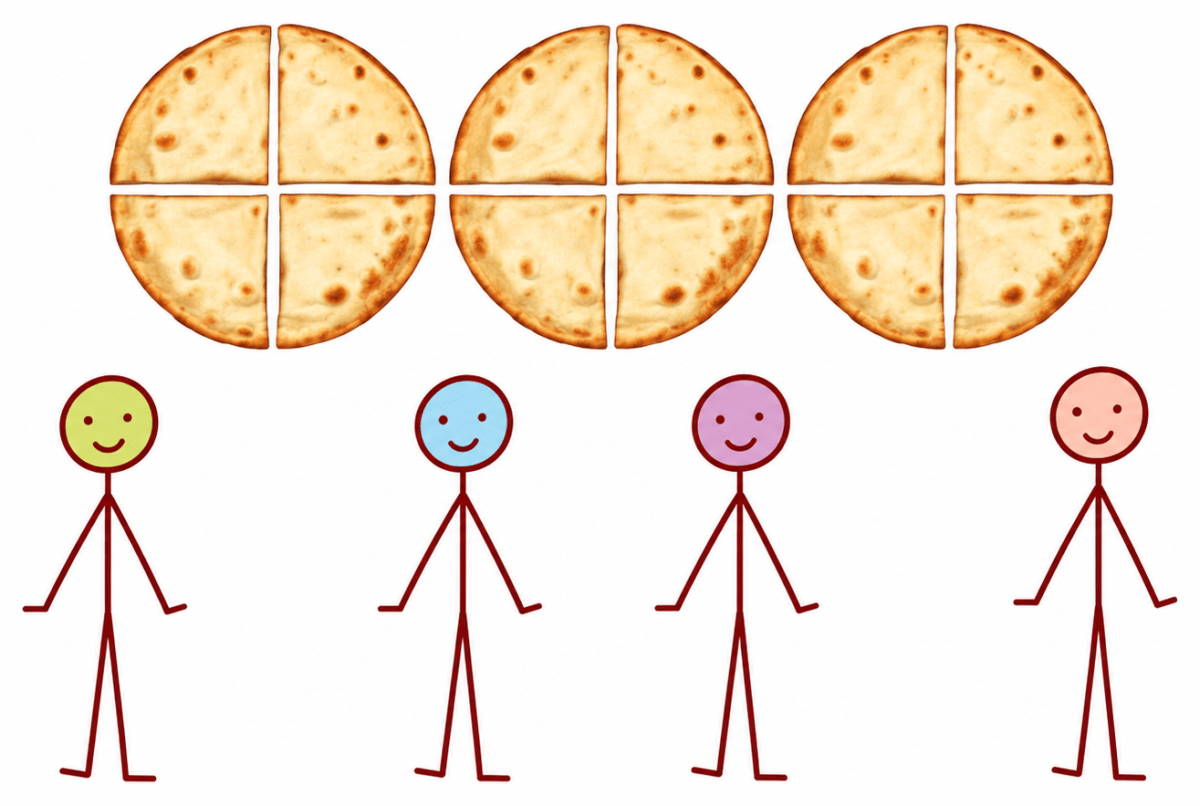
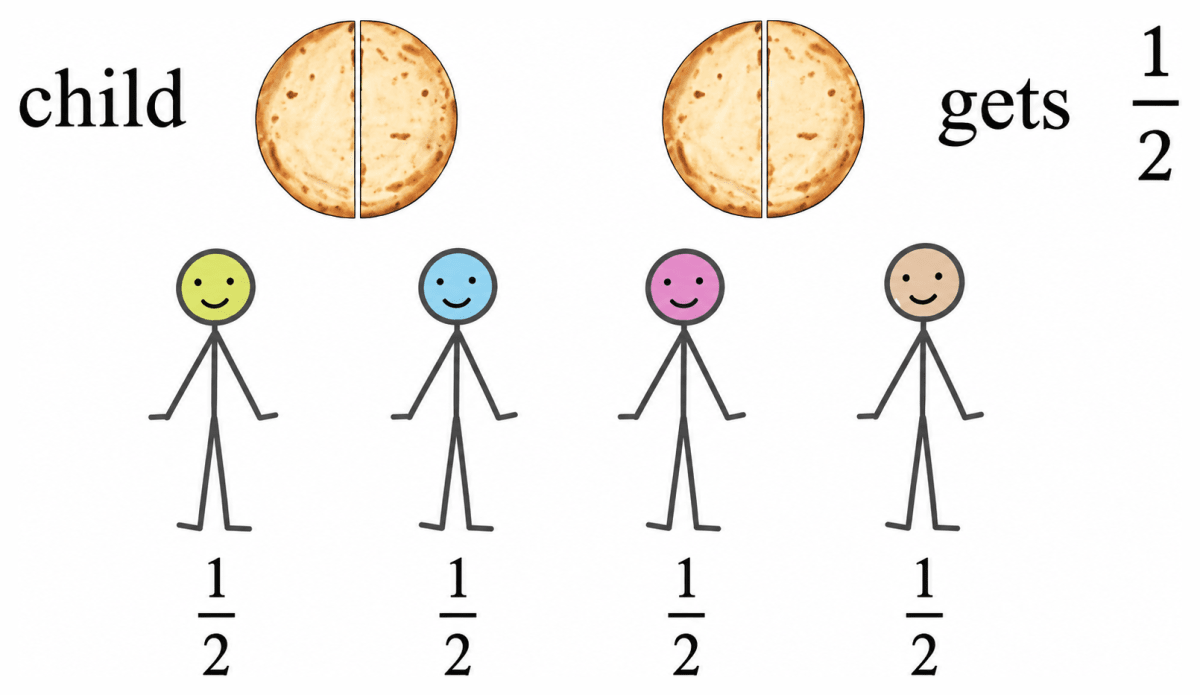
- Four friends ordered 3 glasses of sugarcane juice and shared it equally among themselves. Each one drank .......... glass of sugarcane juice.
- The big fish weighs 21 kg. The small one weighs 41 kg. Together they weigh .......... kg.
Answer
1. Three guavas together weigh 1 kg. If they are roughly of the same size, each guava will roughly weigh 31 kg.
Explanation —
Weight of 3 guavas together = 1 kg
The guavas are roughly of the same size, so 1 kg is shared equally into 3 parts.
=Weight of each guava=31 of 1 kg=31 kg
2. A wholesale merchant packed 1 kg of rice in four packets of equal weight. The weight of each packet is 41 kg.
Explanation —
Weight of rice packed = 1 kg
This 1 kg is packed into 4 packets of equal weight.
=Weight of each packet=41 of 1 kg=41 kg
3. Four friends ordered 3 glasses of sugarcane juice and shared it equally among themselves. Each one drank 43 glass of sugarcane juice.
Explanation —
Number of glasses of sugarcane juice = 3
Number of friends sharing them equally = 4
Here 3 glasses are shared equally among 4 friends. So each share is 3 times 41 of a glass.
=Juice each friend drank=41+41+41[3 times 41 glass]=43 glass
4. The big fish weighs 21 kg. The small one weighs 41 kg. Together they weigh 43 kg.
Explanation —
Weight of the big fish = 21 kg
Weight of the small fish = 41 kg
Weight of both fish together = (Weight of big fish) + (Weight of small fish)
Substituting the above values, we get:
=(21+41) kg=(2×21×2+41) kg[Making the fractional unit the same]=(42+41) kg=42+1 kg=43 kg
Arrange these fraction words in order of size from the smallest to the biggest in the empty box below:
One and a half, three quarters, one and a quarter, half, quarter, two and a half.
Answer
First, let us write each fraction word as a fraction:
| Fraction word | Fraction | In quarters |
|---|
| One and a half | 121 | 46 |
| Three quarters | 43 | 43 |
| One and a quarter | 141 | 45 |
| Half | 21 | 42 |
| Quarter | 41 | 41 |
| Two and a half | 221 | 410 |
Since all the fractions are now written using the same fractional unit 41, we can compare them by comparing the number of quarters:
41<42<43<45<46<410
So, the fraction words in order of size from the smallest to the biggest are:
Quarter, half, three quarters, one and a quarter, one and a half, two and a half.
∴ The required order is 41<21<43<141<121<221.
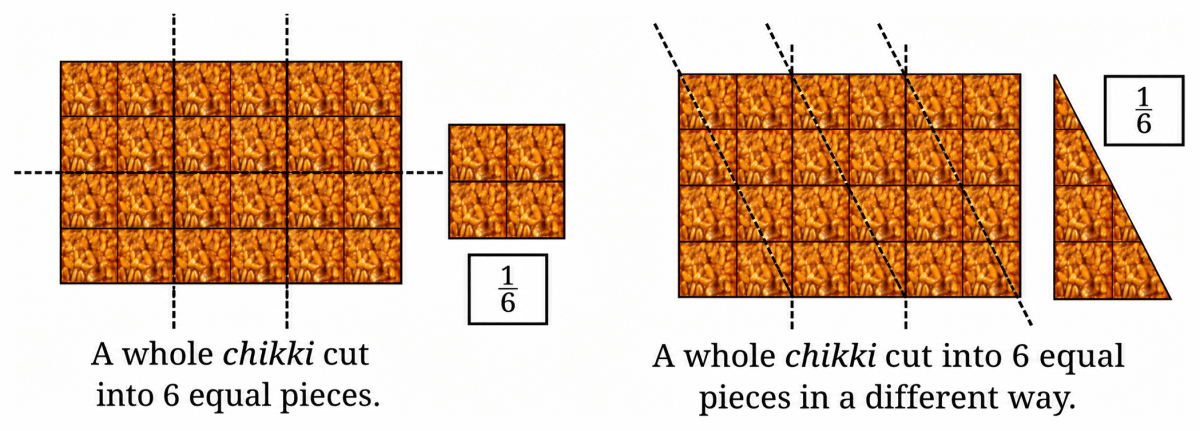
By dividing the whole chikki into 6 equal parts in different ways, we get 61 chikki pieces of different shapes. Are they of the same size?
Answer
Yes, all the pieces are of the same size.
In both the pictures, the same whole chikki has been cut into 6 equal parts. So each part is 1 out of 6 equal parts, that is, 61 of the whole chikki.
In the first picture the chikki is cut by straight cuts into 6 rectangular pieces, and in the second picture it is cut in a different way, so that one of the pieces is a triangle. The shapes of the pieces are different, but each piece is still one of 6 equal shares of the same chikki.
Each piece = 61 of the whole chikki
Hence, the pieces have different shapes but they are all of the same size, each being 61 of the whole chikki.
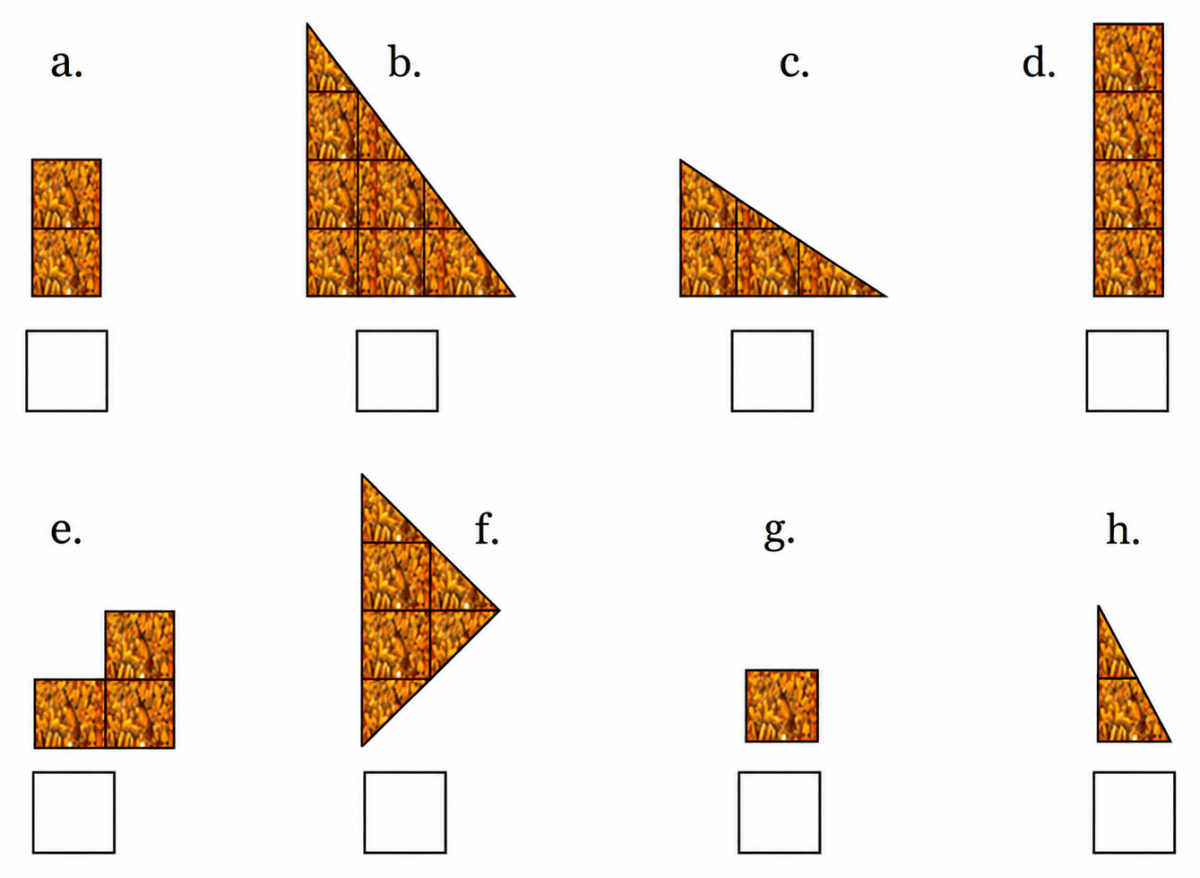
The figures below show different fractional units of a whole chikki. How much of a whole chikki is each piece?
Answer
The whole chikki is made up of small equal squares arranged in 4 rows and 6 columns.
Number of small squares in the whole chikki
= 4 × 6
= 24
So, each small square is 241 of the whole chikki. Now we count how many such small squares make up each piece.
(a) The piece is a rectangle of 1 column and 2 rows, so it has 2 small squares.
=242=121[Dividing both by 2]
∴ Piece (a) is 121 of the whole chikki.
(b) The piece is a triangle which is half of a rectangle of 3 columns and 4 rows.
Number of small squares = 21×3×4
= 1 × 3 × 2 [Dividing 2 and 4 by 2]
= 6
Part of the whole = 246=41
[Dividing both by 6]
∴ Piece (b) is 41 of the whole chikki.
(c) The piece is a triangle which is half of a rectangle of 3 columns and 2 rows.
Number of small squares = 21×3×2
= 1 × 3 × 1 [Dividing 2 and 2 by 2]
= 3
Part of the whole = 243=81
[Dividing both by 3]
∴ Piece (c) is 81 of the whole chikki.
(d) The piece is a rectangle of 1 column and 4 rows, so it has 4 small squares.
=244=61[Dividing both by 4]
∴ Piece (d) is 61 of the whole chikki.
(e) The piece is an L-shape made of 3 small squares.
=243=81[Dividing both by 3]
∴ Piece (e) is 81 of the whole chikki.
(f) The piece is a triangle which is half of a rectangle of 2 columns and 4 rows.
Number of small squares = 21×2×4
= 1 × 1 × 4 [Dividing 2 and 2 by 2]
= 4
Part of the whole = 244=61 [Dividing both by 4]
∴ Piece (f) is 61 of the whole chikki.
(g) The piece is one small square.
Part of the whole = 241
∴ Piece (g) is 241 of the whole chikki.
(h) The piece is a triangle which is half of a rectangle of 1 column and 2 rows.
Number of small squares = 21×1×2
= 1 × 1 × 1 [Dividing 2 and 2 by 2]
= 1
Part of the whole = 241
∴ Piece (h) is 241 of the whole chikki.
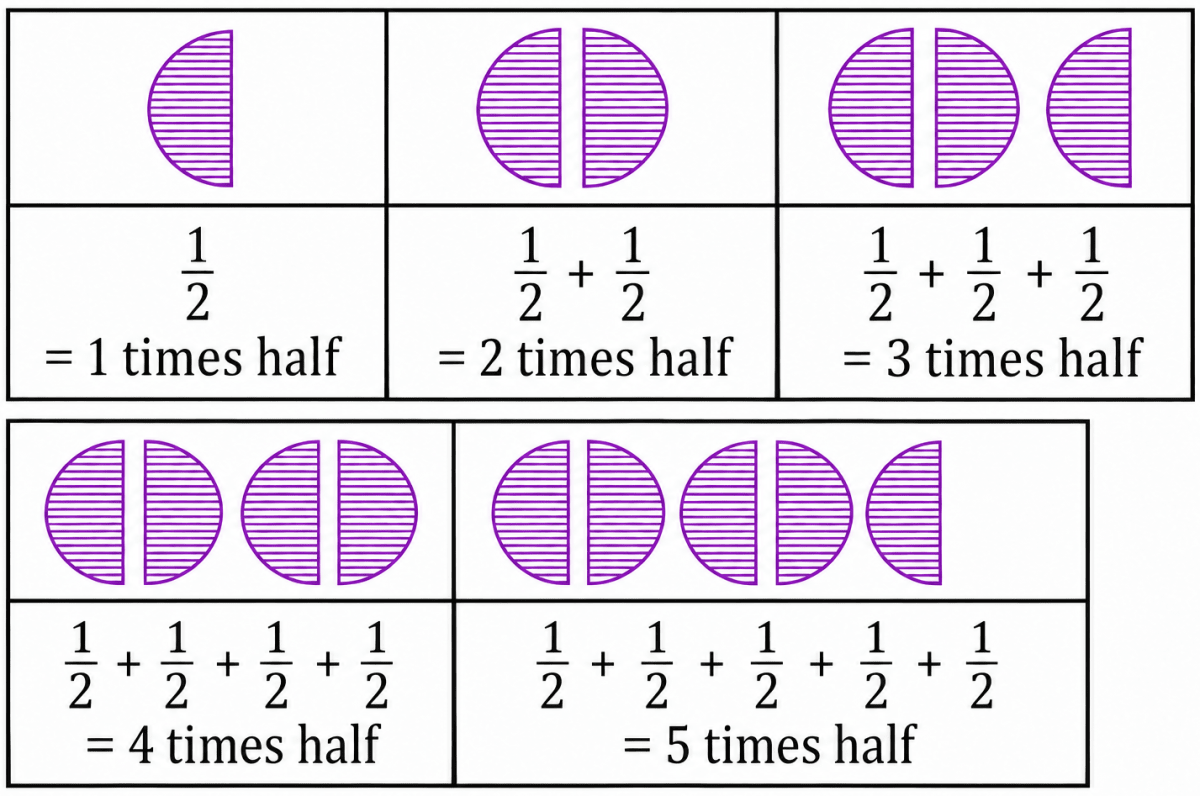
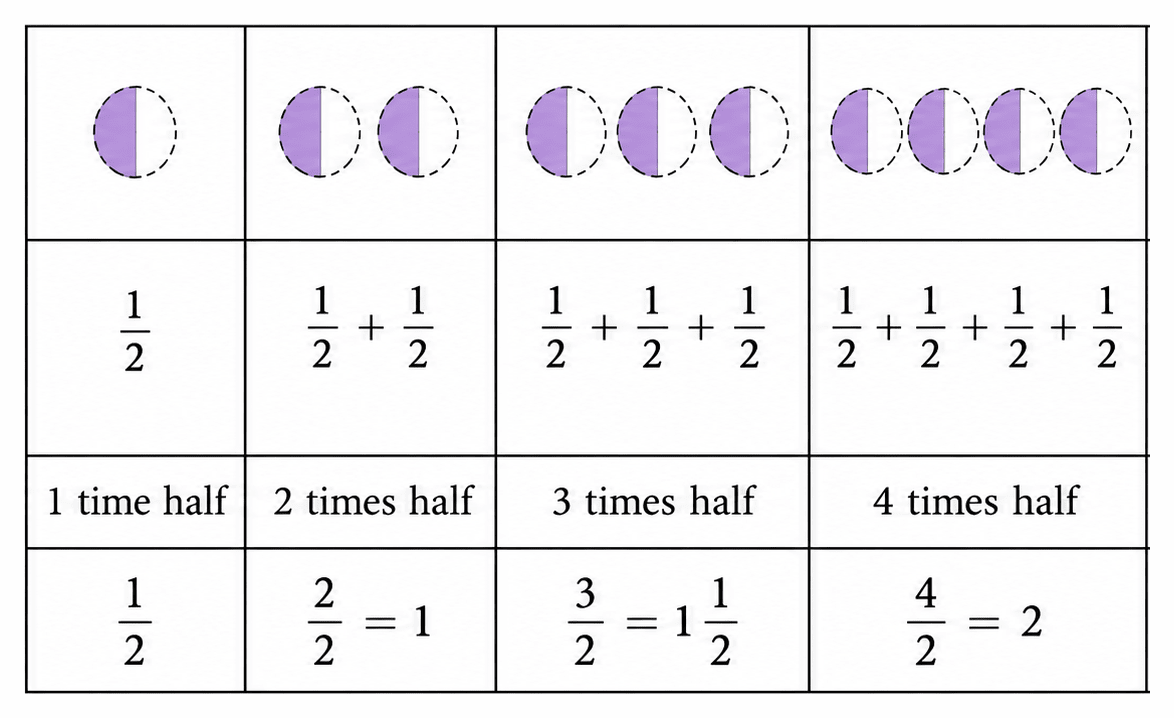
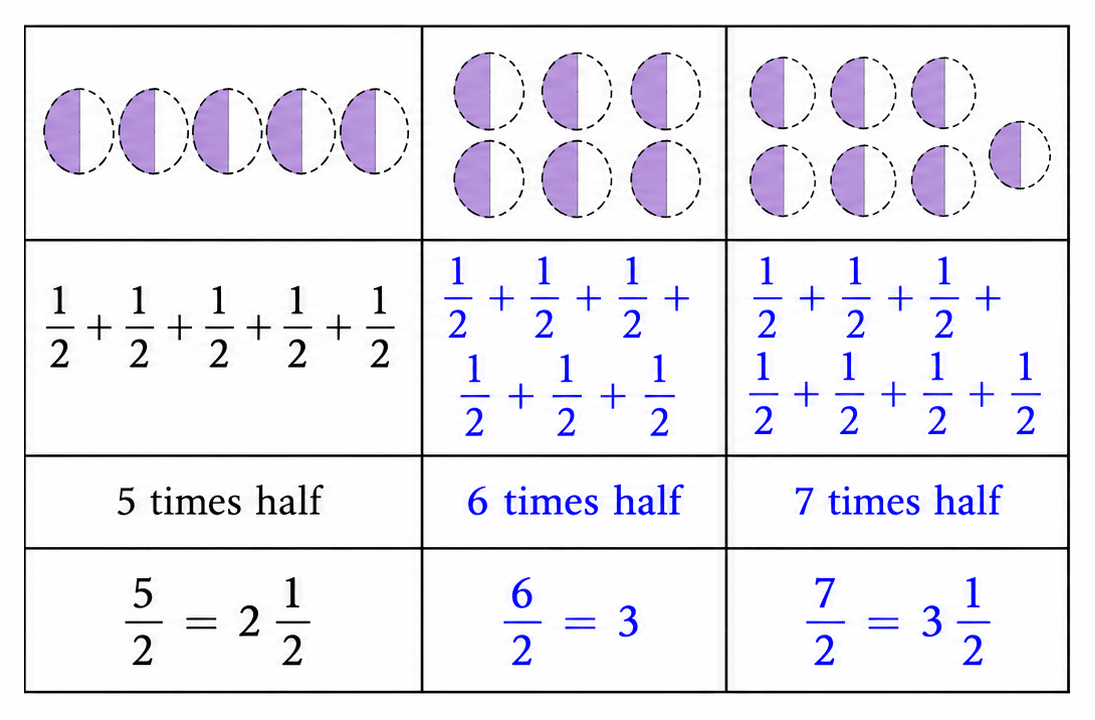
Continue this table of 21 for 2 more steps.
Answer
The table in the chapter is built by collecting together the fractional unit 21, and it ends at 5 times half. The next two steps are 6 times half and 7 times half.
The two new steps can be shown as:
21+21+21+21+21+21 = 6 times 21
21+21+21+21+21+21+21 = 7 times 21
Hence, the next two steps are 6 times half = 3 and 7 times half = 321.
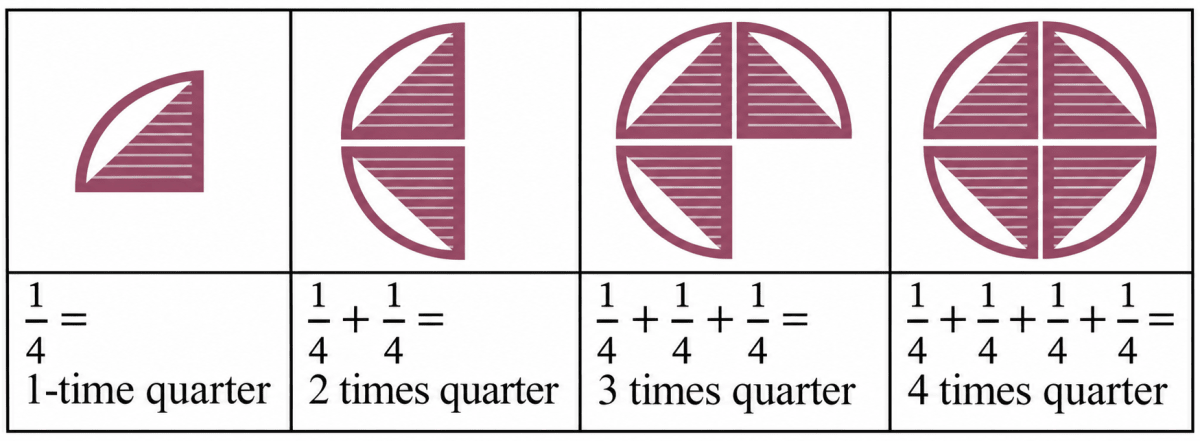
Can you create a similar table for 41?
Answer
Yes, a similar table can be made for 41 by collecting together the fractional unit 41 (quarter rotis) one at a time.
| Addition statement | Reading | Value |
|---|
| 41 | 1 time quarter | 41 |
| 41+41 | 2 times quarter | 42=21 |
| 41+41+41 | 3 times quarter | 43 |
| 41+41+41+41 | 4 times quarter | 44=1 |
Hence, a similar table can be made for 41, and 4 times 41 makes 1 whole.
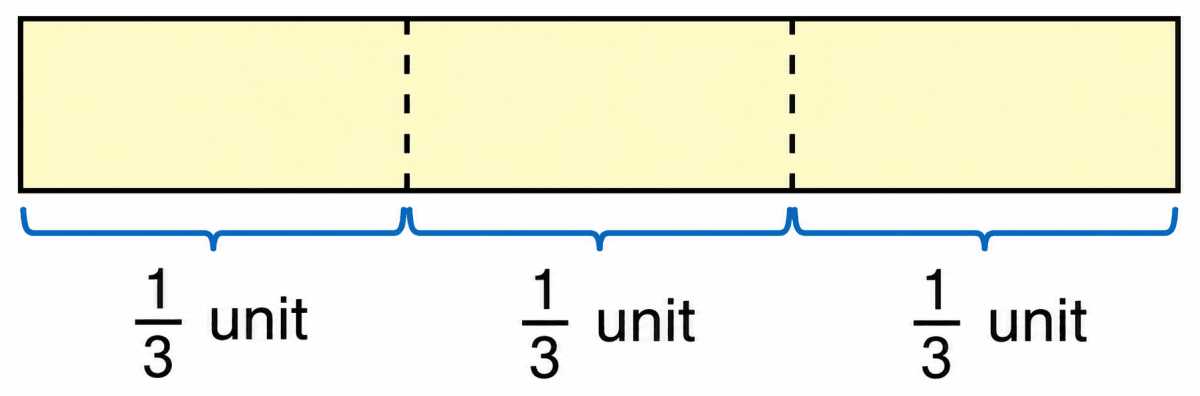
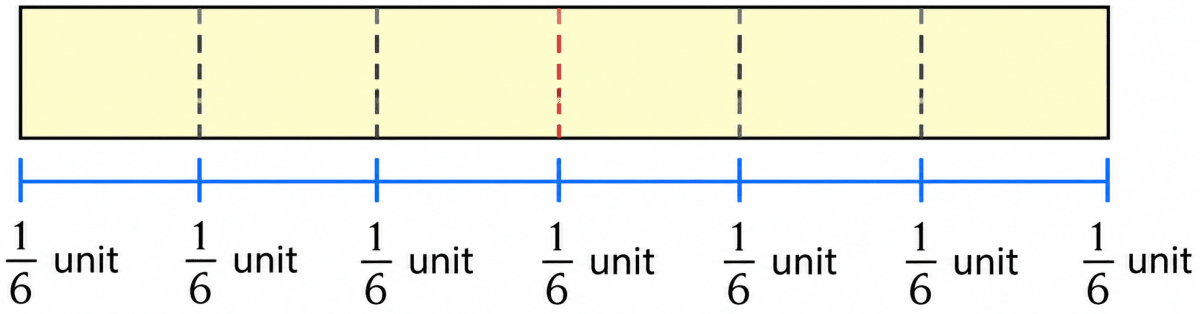
Make 31 using a paper strip. Can you use this to also make 61?
Answer
Making 31:
Take a paper strip and treat its length as 1 unit. Fold the strip into 3 equal parts and open it out. The two creases divide the strip into 3 equal parts, so the length of each part is 31 unit.
Making 61 from it:
Yes, the same strip can be used. Now fold the strip once more into two equal parts, that is, fold each 31 part into half. Each 31 part gets divided into 2 equal parts, so the strip now has 6 equal parts.
Number of equal parts = 3 × 2 = 6
So, length of each part = 61 unit
Also, half of 31=61
Hence, folding the strip into 3 equal parts gives 31, and folding it once more into half gives 61.
Draw a picture and write an addition statement as above to show:
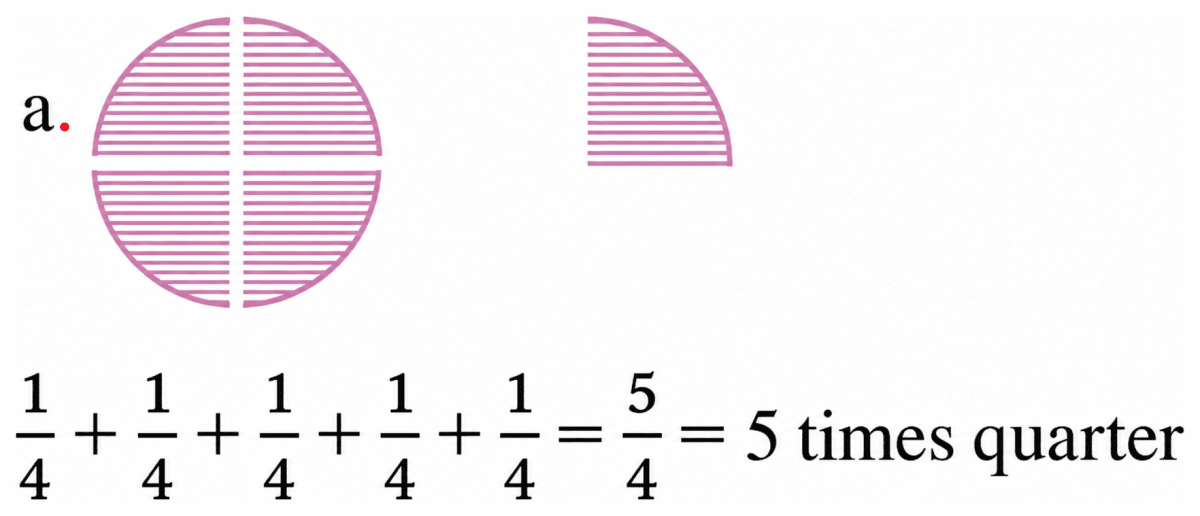
(a) 5 times 41 of a roti
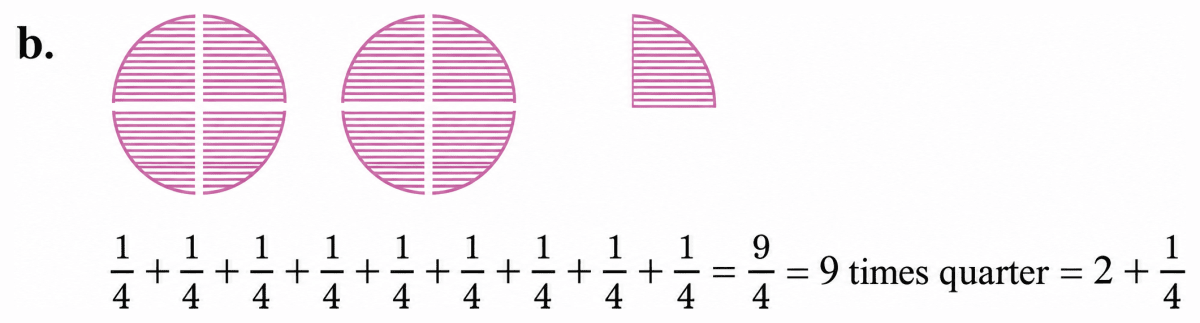
(b) 9 times 41 of a roti
Answer
(a) 5 times 41 of a roti
Here 5 quarter pieces of roti are collected together. Four quarter pieces make 1 whole roti and one quarter piece is left over.
The addition statement is:
=41+41+41+41+41=41+1+1+1+1=45=141[Converting improper fraction to mixed fraction]
∴ 5 times 41 of a roti = 45=141 rotis.
(b) 9 times 41 of a roti
Here 9 quarter pieces of roti are collected together. Eight quarter pieces make 2 whole rotis and one quarter piece is left over.
The addition statement is:
=41+41+41+41+41+41+41+41+41=41+1+1+1+1+1+1+1+1=49=241[Converting improper fraction to mixed fraction]
∴ 9 times 41 of a roti = 49=241 rotis.
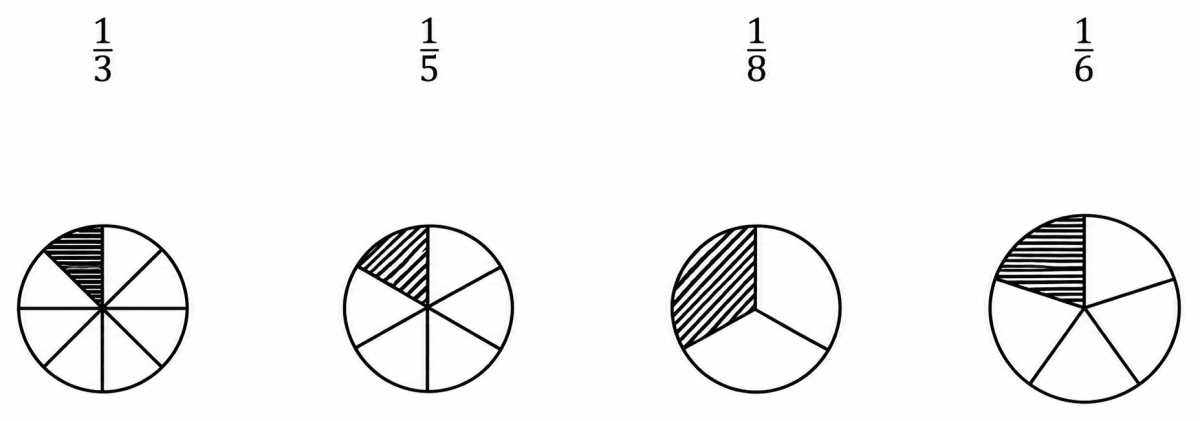
Match each fractional unit with the correct picture:
Answer
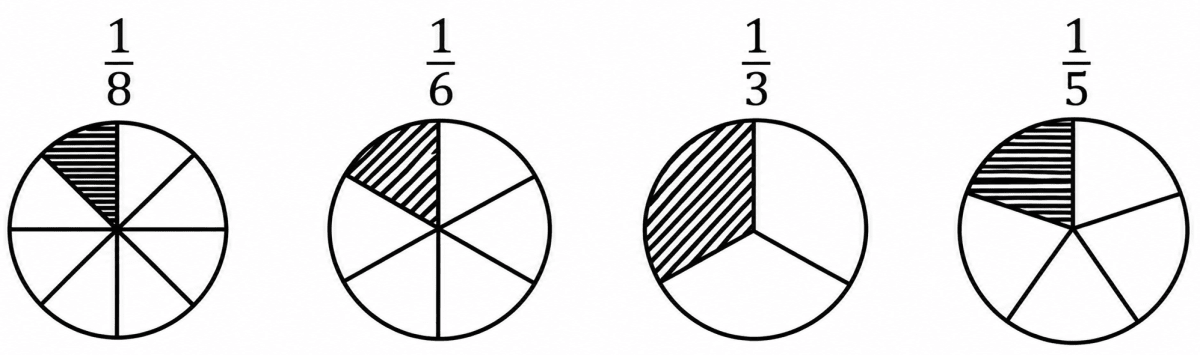
To match a fractional unit with a picture, we count the number of equal parts into which each circle is divided. If a circle is divided into 8 equal parts, then each shaded part is 81, and so on.
Counting the equal parts in the four pictures:
| Picture | Number of equal parts | Each part is |
|---|
| First circle | 8 | 81 |
| Second circle | 6 | 61 |
| Third circle | 3 | 31 |
| Fourth circle | 5 | 51 |
So, the matching is:
Here, the fractional unit is dividing a length of 1 unit into three equal parts. Write the fraction that gives the length of the blue line in the box or in your notebook.
Answer
Here, the length of 1 unit is divided into 3 equal parts.
So, the fractional unit is 31.
From the figure, the blue line covers 2 such equal parts.
Length of the blue line = 2 times 31
=2×31=32×1=32
∴ The length of the blue line = 32 unit.
Here, a unit is divided into 5 equal parts. Write the fraction that gives the length of the blue lines in the respective boxes or in your notebook.
Answer
Here, the length of 1 unit is divided into 5 equal parts.
So, the fractional unit is 51.
From the figure, the shorter blue line covers 2 such equal parts.
Length of the shorter blue line = 2 times 51
=2×51=52×1=52
The longer blue line covers 4 such equal parts.
Length of the longer blue line = 4 times 51
=4×51=54×1=54
∴ The shorter blue line is 52 unit long and the longer blue line is 54 unit long.
Now, a unit is divided into 8 equal parts. Write the appropriate fractions in your notebook.
Answer
Here, the length of 1 unit is divided into 8 equal parts.
So, the fractional unit is 81.
Each mark on the number line is obtained by collecting together the fractional unit 81 again and again.
1 time 81=81, 2 times 81=82, 3 times 81=83, and so on.
So, the fractions marked from 0 to 1 (excluding 0) are:
81, 82, 83, 84, 85, 86, 87 and 88=1
Continuing in the same way, the fractions marked from 1 to 2 (excluding 1) are:
89, 810, 811, 812, 813, 814, 815 and 816=2
∴ The marks from 0 to 1 are 81,82,83,…,88=1, and the marks after 1 up to 2 are 89,810,…,816=2.
On a number line, draw lines of lengths 101, 103, and 54.
Answer
To draw all the three lengths on the same number line, the distance between 0 and 1 is divided into 10 equal parts.
So, the length of each part is 101 unit.
Length 101 = 1 time 101, so this line covers 1 part starting from 0.
Length 103 = 3 times 101, so this line covers 3 parts starting from 0.
To draw the length 54 using the same fractional unit, we write:
=54=5×24×2=108
So, the line of length 54 covers 8 parts starting from 0.
Therefore, draw three separate line segments, all beginning at 0: the first ending at 101, the second ending at 103, and the third ending at 108=54.
The three required lengths are shown below:
Write five more fractions of your choice and mark them on the number line.
Answer
This is an open-ended question. Five fractions have to be chosen by the student, so the answer will be different for different students.
One possible answer is shown below.
Let the five fractions chosen be 102, 104, 105, 107 and 109.
Since the fractional unit of each of these fractions is 101, the distance between 0 and 1 is divided into 10 equal parts.
Now, starting from 0, we count 2 parts for 102, 4 parts for 104, 5 parts for 105, 7 parts for 107 and 9 parts for 109, and mark these points on the number line.
Hence, the five chosen fractions are marked on the number line as shown above.
How many fractions lie between 0 and 1? Think, discuss with your classmates, and write your answer.
Answer
Let us divide the length of 1 unit into equal parts, taking a different fractional unit each time.
Dividing 1 unit into 2 equal parts, we get 1 fraction between 0 and 1, that is, 21.
Dividing 1 unit into 3 equal parts, we get 2 fractions between 0 and 1, that is, 31 and 32.
Dividing 1 unit into 4 equal parts, we get 3 fractions between 0 and 1, that is, 41, 42 and 43.
In the same way, on dividing 1 unit into 10 equal parts we get 9 fractions between 0 and 1, on dividing it into 100 equal parts we get 99 fractions between 0 and 1, and so on.
In general, if 1 unit is divided into n equal parts, then the fractions
n1, n2, n3, …, nn−1
all lie between 0 and 1.
Since the unit can be divided into as many equal parts as we wish, the value of n can be made larger and larger without ever stopping. So, the fractions lying between 0 and 1 can never be counted completely.
∴ Infinitely many fractions lie between 0 and 1.
What is the length of the blue line and black line shown below? The distance between 0 and 1 is 1 unit long, and it is divided into two equal parts. The length of each part is 21. So the blue line is 21 units long. Write the fraction that gives the length of the black line in the box.
Answer
Here, the distance between 0 and 1 is 1 unit long and it is divided into 2 equal parts.
So, the fractional unit is 21.
The blue line covers 1 such part.
∴ Length of the blue line = 1 time 21=21 unit
From the figure, the black line covers 3 such parts.
Length of the black line = 3 times 21
=3×21=23×1=23
∴ The blue line is 21 unit long and the black line is 23 units long.
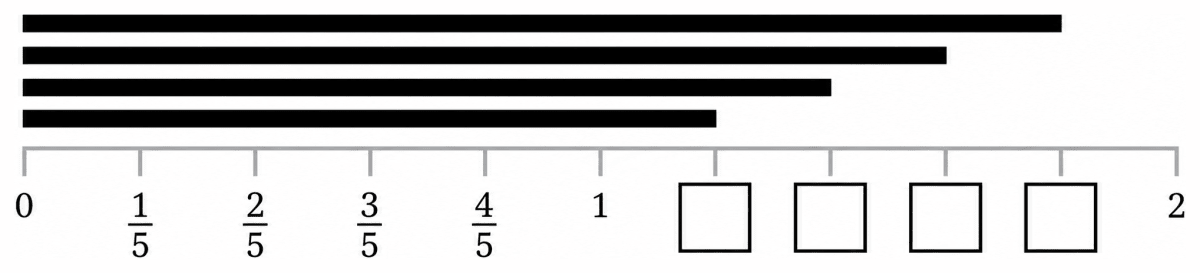
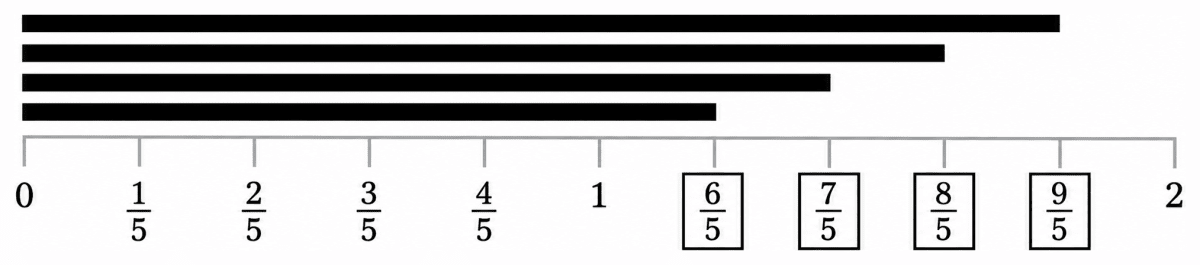
Write the fraction that gives the lengths of the black lines in the respective boxes.
Answer
Here, the length of 1 unit is divided into 5 equal parts.
So, the fractional unit is 51.
Counting the number of such equal parts covered by each black line, starting from the shortest line at the bottom, we get:
The shortest black line covers 6 parts.
∴ Its length = 6 times 51=56 units
The next black line covers 7 parts.
∴ Its length = 7 times 51=57 units
The next black line covers 8 parts.
∴ Its length = 8 times 51=58 units
The longest black line at the top covers 9 parts.
∴ Its length = 9 times 51=59 units
∴ The lengths of the black lines are 56,57,58 and 59 units, and these are the fractions to be written in the boxes at the respective marks.
Figure out the number of whole units in each of the following fractions:
(a) 38
(b) 511
(c) 49
Answer
(a) 38
Here, the fractional unit is 31 and 3 times 31=33=1 whole unit.
=38=33+33+32=1+1+32=2+32
∴ There are 2 whole units in 38.
(b) 511
Here, the fractional unit is 51 and 5 times 51=55=1 whole unit.
=511=55+55+51=1+1+51=2+51
∴ There are 2 whole units in 511.
(c) 49
Here, the fractional unit is 41 and 4 times 41=44=1 whole unit.
=49=44+44+41=1+1+41=2+41
∴ There are 2 whole units in 49.
Can all fractions greater than 1 be written as such mixed numbers?
Answer
No, all fractions greater than 1 cannot be written as mixed numbers.
A mixed number has a whole part and a fractional part which is less than 1. So, a fraction greater than 1 can be written as a mixed number only when something is left over after taking out the complete whole units from it.
If the numerator is a multiple of the denominator, then nothing is left over. For example:
=48=44+44=1+1=2[No fractional part is left]
Here 48 is exactly 2 whole units. As there is no fractional part, it cannot be written as a mixed number.
∴ Only those fractions greater than 1 whose numerator is not a multiple of the denominator can be written as mixed numbers.
Write the following fractions as mixed fractions (e.g., 29=421):
(a) 29
(b) 59
(c) 1921
(d) 947
(e) 1112
(f) 619
Answer
(a) 29
We have:
=29=28+1[Since 9 = 8 + 1]=28+21=4+21[Taking out the whole units]=421
∴ 29=421
(b) 59
We have:
=59=55+4[Since 9 = 5 + 4]=55+54=1+54[Taking out the whole units]=154
∴ 59=154
(c) 1921
We have:
=1921=1919+2[Since 21 = 19 + 2]=1919+192=1+192[Taking out the whole units]=1192
∴ 1921=1192
(d) 947
We have:
=947=945+2[Since 47 = 45 + 2]=945+92=5+92[Taking out the whole units]=592
∴ 947=592
(e) 1112
We have:
=1112=1111+1[Since 12 = 11 + 1]=1111+111=1+111[Taking out the whole units]=1111
∴ 1112=1111
(f) 619
We have:
=619=618+1[Since 19 = 18 + 1]=618+61=3+61[Taking out the whole units]=361
∴ 619=361
Write the following mixed numbers as fractions:
(a) 341
(b) 732
(c) 994
(d) 361
(e) 2113
(f) 3109
Answer
(a) 341
We have:
=341=3+41=43×4+41[Writing 3 as a fraction with denominator 4]=412+1=413
∴ 341=413
(b) 732
We have:
=732=7+32=37×3+32[Writing 7 as a fraction with denominator 3]=321+2=323
∴ 732=323
(c) 994
We have:
=994=9+94=99×9+94[Writing 9 as a fraction with denominator 9]=981+4=985
∴ 994=985
(d) 361
We have:
=361=3+61=63×6+61[Writing 3 as a fraction with denominator 6]=618+1=619
∴ 361=619
(e) 2113
We have:
=2113=2+113=112×11+113[Writing 2 as a fraction with denominator 11]=1122+3=1125
∴ 2113=1125
(f) 3109
We have:
=3109=3+109=103×10+109[Writing 3 as a fraction with denominator 10]=1030+9=1039
∴ 3109=1039
Check whether 31 and 62 are equivalent fractions or not, using paper strips.
Answer
Take two paper strips of the same length. Each strip is taken to be 1 unit long.
Fold the first strip into 3 equal parts and shade 1 part. The shaded length is 31 unit.
Fold the second strip into 6 equal parts and shade 2 parts. The shaded length is 62 unit.
Now place the second strip just below the first strip so that their left ends match.
The two shaded lengths are seen to be exactly equal.
We can also check this by using fractional units:
=62=6÷22÷2[Dividing numerator and denominator by 2]=31
Hence, 31 and 62 are equivalent fractions.
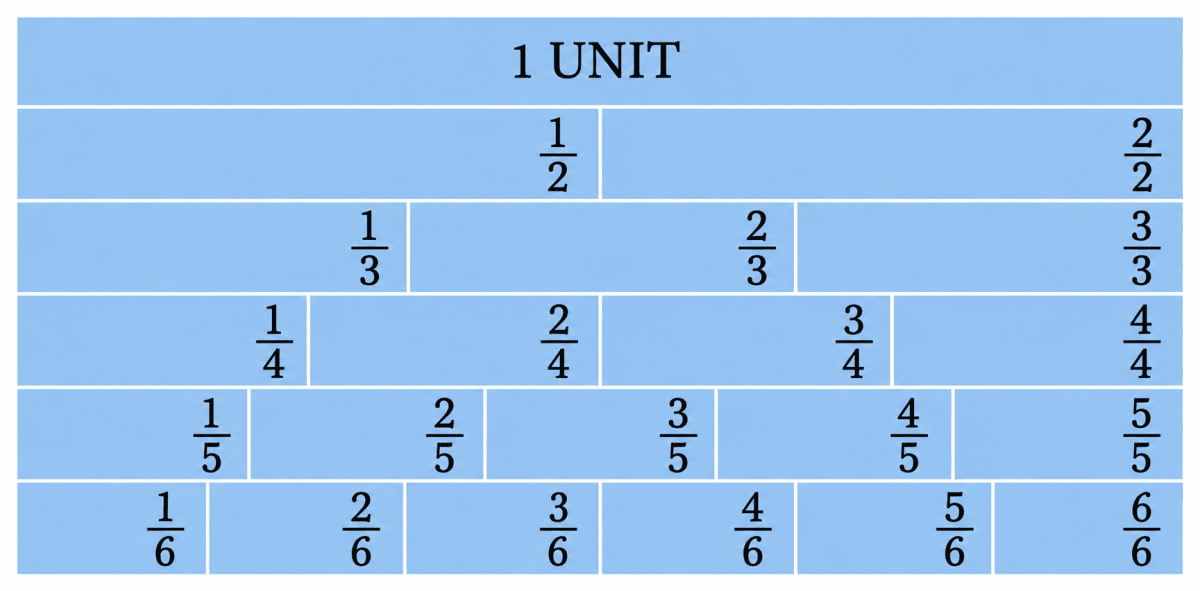
Answer the following questions after looking at the fraction wall:
(i) Are the lengths 21 and 63 equal?
(ii) Are 32 and 64 equivalent fractions? Why?
(iii) How many pieces of length 61 will make a length of 21?
(iv) How many pieces of length 61 will make a length of 31?
Answer
(i) From the fraction wall, the strip showing 21 and the 3 pieces of the strip showing 61 end at the same point. So, the two lengths are equal.
=63=6÷33÷3[Dividing numerator and denominator by 3]=21
Hence, the lengths 21 and 63 are equal.
(ii) In the fraction wall, the length of 2 pieces of 31 is exactly the same as the length of 4 pieces of 61.
=64=6÷24÷2[Dividing numerator and denominator by 2]=32
Both fractions denote the same length, though they are expressed in different fractional units.
Hence, 32 and 64 are equivalent fractions.
(iii) We need the number of pieces of length 61 that together make a length of 21.
=21=2×31×3[Making the fractional unit one-sixth]=63=3×61
Hence, 3 pieces of length 61 will make a length of 21.
(iv) We need the number of pieces of length 61 that together make a length of 31.
=31=3×21×2[Making the fractional unit one-sixth]=62=2×61
Hence, 2 pieces of length 61 will make a length of 31.
Are 63, 84, 105 equivalent fractions? Why?
Answer
Let us write each of the given fractions in its simplest form:
=63=6÷33÷3=21=84=8÷44÷4=21=105=10÷55÷5=21
Each of the three fractions denotes the same length, namely 21 of a unit. This can also be seen in the fraction wall, where 3 pieces of 61, 4 pieces of 81 and 5 pieces of 101 all end at the same point as 21.
Hence, 63,84 and 105 are equivalent fractions, as they all represent the same length 21.
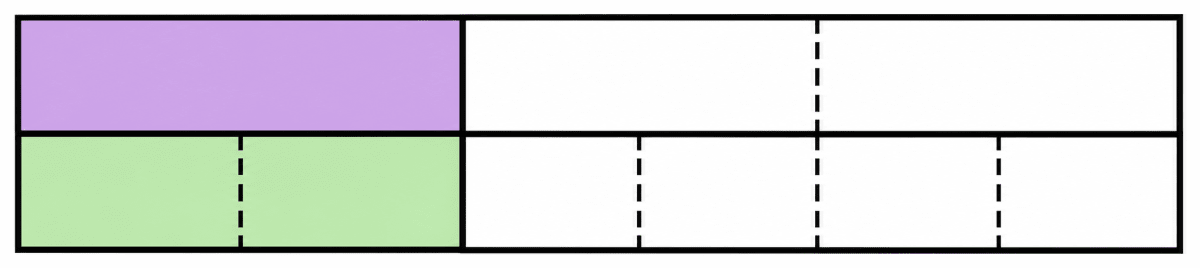
Write two equivalent fractions for 62.
Answer
Equivalent fractions are obtained by multiplying or dividing the numerator and the denominator by the same number.
Dividing the numerator and the denominator by 2, we get:
=62=6÷22÷2=31
Multiplying the numerator and the denominator by 3, we get:
=62=6×32×3=186
Hence, two equivalent fractions for 62 are 31 and 186.
Note: Other equivalent fractions such as 93, 124, 155, … are also correct answers.
64=□□=□□=□□= ............ (Write as many as you can)
Answer
Dividing the numerator and the denominator of 64 by 2, we get:
64=6÷24÷2=32
Now, multiplying the numerator and the denominator of 32 by 3, 4, 5, … in turn, we get:
=32=3×32×3=96=32=3×42×4=128=32=3×52×5=1510
Hence, 64=32=96=128=1510= ............
Note: This list never ends. We can keep multiplying the numerator and the denominator of 32 by the same number to get as many equivalent fractions as we want.
Three rotis are shared equally by four children. Show the division in the picture and write a fraction for how much each child gets. Also, write the corresponding division facts, addition facts and multiplication facts.
Fraction of roti each child gets is ............... .
Division fact:
Addition fact:
Multiplication fact:
Compare your picture and answers with your classmates!
Answer
Given:
Number of rotis = 3
Number of children = 4
Divide each roti into 4 equal parts. Each part is 41 roti.
From the 3 rotis, we get 12 such parts in all. Distributing them equally, each child gets 3 parts, that is, 3 pieces of 41 roti.
=Share of each child=3×41 roti=43 roti
Fraction of roti each child gets is 43.
Division fact: 3÷4=43
Addition fact: 3=43+43+43+43
Multiplication fact: 3=4×43
Hence, each child gets 43 roti.
Draw a picture to show how much each child gets when 2 rotis are shared equally by 4 children. Also, write the corresponding division facts, addition facts, and multiplication facts.
Answer
Given:
Number of rotis = 2
Number of children = 4
Divide each roti into 2 equal halves. Each half is 21 roti.
From the 2 rotis, we get 4 halves in all. Distributing these 4 equal halves among 4 children, each child gets 1 half.
=Share of each child=2÷4 roti=42 roti=21 roti
Fraction of roti each child gets is 21.
Division fact: 2÷4=42=21
Addition fact: 2=21+21+21+21
Multiplication fact: 2=4×21
Hence, each child gets 21 roti.
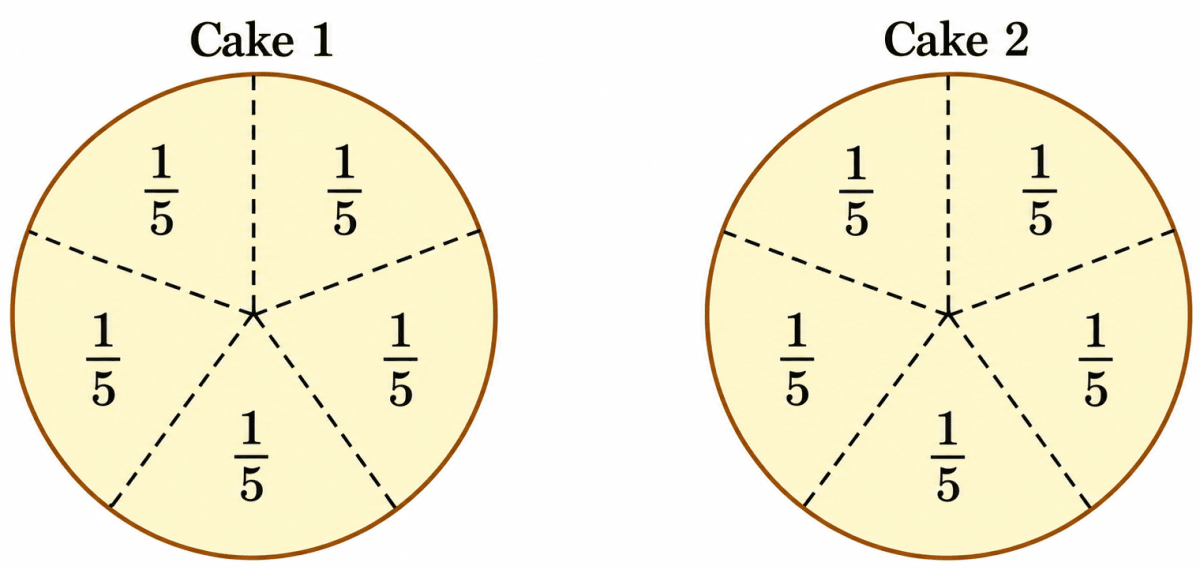
Anil was in a group where 2 cakes were divided equally among 5 children. How much cake would Anil get?
Answer
Given:
Number of cakes = 2
Number of children = 5
Divide each cake into 5 equal parts. Each part is 51 cake.
From the 2 cakes, we get 10 such parts in all. Distributing them equally, each child gets 2 parts, that is, 2 pieces of 51 cake.
=Share of each child=2÷5=2×51 cake=52 cake
Hence, Anil would get 52 of a cake.
Find some more fractions equivalent to 21. Write them in the boxes here:
□ □ □ □
Answer
To get a fraction equivalent to a given fraction, we multiply both its numerator and its denominator by the same number.
We have:
=21=2×41×4=84=21=2×51×5=105=21=2×61×6=126=21=2×71×7=147
So, the four boxes can be filled as shown below:
84 105 126 147
∴ Four more fractions equivalent to 21 are 84,105,126 and 147.
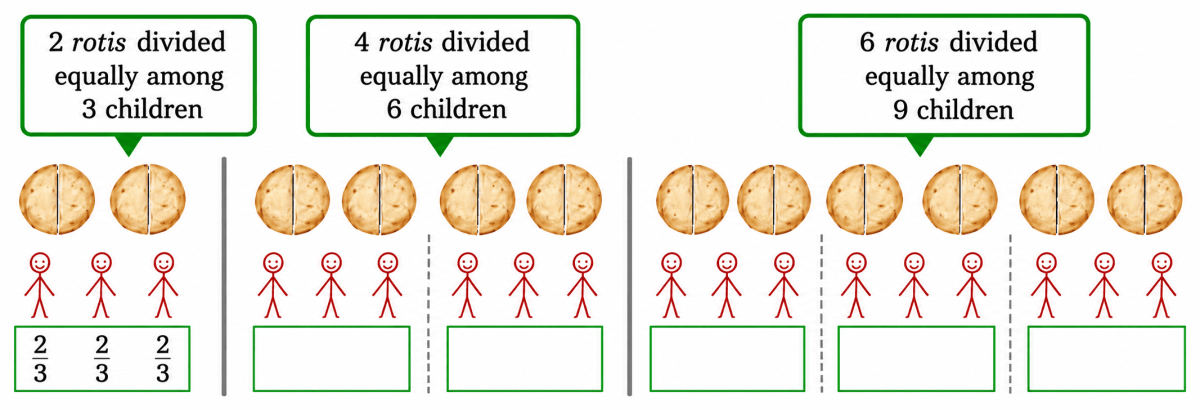
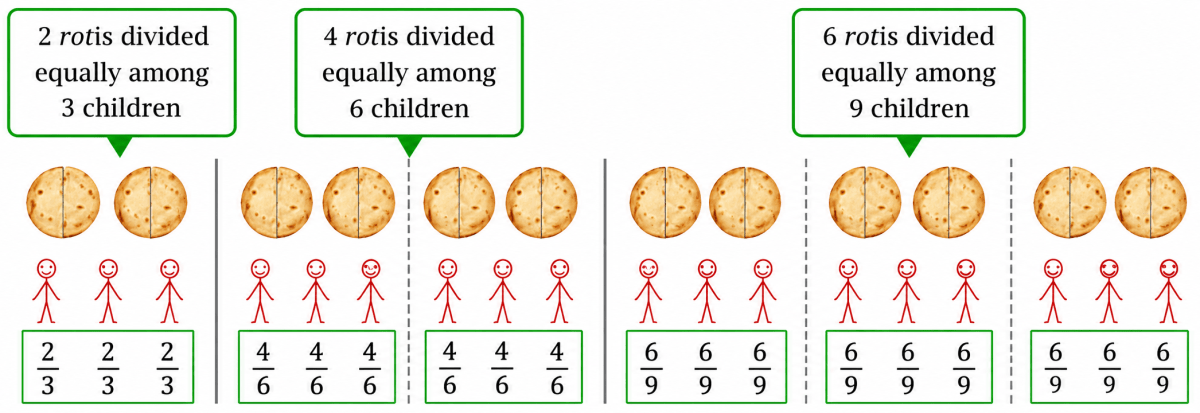
Equally divide the rotis in the situations shown below and write down the share of each child. Are the shares in each of these cases the same? Why?
(i) Do you notice anything about the relationship between the numerator and denominator in each of these fractions?
Answer
When a whole number of rotis is shared equally among a number of children, the share of each child is given by:
Share of each child = Number of childrenNumber of rotis
Dividing the rotis equally in each of the three situations shown, we get:
| Situation | Number of rotis | Number of children | Share of each child |
|---|
| 1 | 2 | 3 | 32 |
| 2 | 4 | 6 | 64 |
| 3 | 6 | 9 | 96 |
Now, let us express the second and the third share in the simplest form:
=64=6÷24÷2=32=96=9÷36÷3=32
⇒ 32=64=96
∴ The share of each child is the same in all the three situations.
The shares are the same because in each situation the number of rotis and the number of children have both been multiplied by the same number. In the second situation twice as many rotis are shared among twice as many children, and in the third situation three times as many rotis are shared among three times as many children. So the quantity of roti received by one child does not change.
Hence, the share of each child is 32 roti in every case, and the three shares are the same because 32,64 and 96 are equivalent fractions.
(i) In each of these fractions, the numerator and the denominator of 32 have been multiplied by the same number:
=32=3×12×1=64=3×22×2=96=3×32×3
Hence, multiplying (or dividing) the numerator and the denominator of a fraction by the same non-zero number gives an equivalent fraction, and 32 is the simplest form of both 64 and 96.
Find the missing numbers:
5 glasses of juice shared equally among 4 friends is the same as .......... glasses of juice shared equally among 8 friends.
So, 45=8□.
Answer
The number of friends has increased from 4 to 8, that is, it has become 2 times. So, the number of glasses of juice must also become 2 times for each friend to get the same share.
We have:
=45=4×25×2=810
∴ 5 glasses of juice shared equally among 4 friends is the same as 10 glasses of juice shared equally among 8 friends, that is, 45=810.
Find the missing numbers:
4 kg of potatoes divided equally in 3 bags is the same as 12 kg of potatoes divided equally in .......... bags.
So, 34=□12
Answer
The quantity of potatoes has increased from 4 kg to 12 kg, that is, it has become 3 times. So, the number of bags must also become 3 times for each bag to hold the same quantity.
We have:
=34=3×34×3=912
∴ 4 kg of potatoes divided equally in 3 bags is the same as 12 kg of potatoes divided equally in 9 bags, that is, 34=912.
Find the missing numbers:
7 rotis divided among 5 children is the same as .......... rotis divided among .......... children.
So, 57=□□.
Answer
Here we may choose any multiplier we like, as long as the number of rotis and the number of children are both multiplied by the same number. Taking the multiplier as 2, we get:
=57=5×27×2=1014
Some other correct answers are 57=1521 and 57=2028.
∴ 7 rotis divided among 5 children is the same as 14 rotis divided among 10 children, that is, 57=1014.
In which group will each child get more chikki?
1 chikki divided between 2 children or 5 chikkis divided among 8 children.
Answer
Given:
Share of each child in the first group = 21 chikki
Share of each child in the second group = 85 chikki
To compare 21 and 85, we make their fractional units the same.
Since 8 is a multiple of 2, we take 8 as the common denominator.
=21=2×41×4=84[Multiplying numerator and denominator by 4]=85=85[Already has denominator 8]
Both fractions now use the same fractional unit 81, so we compare their numerators:
4 < 5
⇒ 84<85
∴ 21<85
Hence, each child in the second group, where 5 chikkis are divided among 8 children, will get more chikki.
In which group will each child get more?
1 chikki divided between 2 children or 4 chikkis divided among 7 children.
Answer
Given:
Share of each child in the first group = 21 chikki
Share of each child in the second group = 74 chikki
First, we write 21 as an equivalent fraction whose numerator is 4:
=21=2×41×4=84[Multiplying numerator and denominator by 4]
Now we compare 74 and 84.
In both of these, 4 chikkis are being shared, but in the first case they are shared among 7 children and in the second case among 8 children. If the number of units shared is the same but the number of children is more, then each share is less.
⇒ 74>84
∴ 74>21 [Since 84=21]
Hence, each child in the second group, where 4 chikkis are divided among 7 children, will get more chikki.
Suppose the number of children is kept the same, but the number of units that are being shared is increased? What can you say about each child's share now? Why? Discuss how your reasoning explains 51<52, 73<74, and 21<85.
Answer
If the number of children is kept the same and the number of units being shared is increased, then each child's share becomes larger.
This is because the same number of children now share a greater quantity, so every child receives more. In terms of fractions, when the denominator (the number of children) remains unchanged and the numerator (the number of units) increases, each child simply receives a greater number of the same fractional unit.
Let us apply this reasoning to the given pairs.
51 and 52: In both cases the units are shared among 5 children, so the fractional unit is 51 in both. Since 2 units of 51 are more than 1 unit of 51,
∴ 51<52
73 and 74: In both cases the units are shared among 7 children, so the fractional unit is 71 in both. Since 4 units of 71 are more than 3 units of 71,
∴ 73<74
21 and 85: Here the numbers of children are different, so we first make the fractional units the same.
=21=2×41×4=84[Multiplying numerator and denominator by 4]
Now both fractions use the fractional unit 81, and 5 units of 81 are more than 4 units of 81.
⇒ 84<85
∴ 21<85
Hence, when the number of children is kept the same and the number of units shared is increased, each child's share becomes larger.
Now, decide in which of the two groups will each child get a larger share:
- Group 1 : 3 glasses of sugarcane juice divided equally among 4 children.
Group 2: 7 glasses of sugarcane juice divided equally among 10 children. - Group 1 : 4 glasses of sugarcane juice divided equally among 7 children.
Group 2: 5 glasses of sugarcane juice divided equally among 7 children.
Which groups were easier to compare? Why?
Answer
1. Given:
Share of each child in Group 1 = 43 glass
Share of each child in Group 2 = 107 glass
The denominators 4 and 10 are different, so we find equivalent fractions having the same fractional unit. A common multiple of 4 and 10 is 20.
=43=4×53×5=2015[Multiplying numerator and denominator by 5]=107=10×27×2=2014[Multiplying numerator and denominator by 2]
Both fractions now use the same fractional unit 201, so we compare their numerators:
15 > 14
⇒ 2015>2014
∴ 43>107
Hence, each child in Group 1 gets a larger share.
2. Given:
Share of each child in Group 1 = 74 glass
Share of each child in Group 2 = 75 glass
Both fractions already use the same fractional unit 71, so we compare their numerators:
5 > 4
⇒ 75>74
Hence, each child in Group 2 gets a larger share.
Hence, the groups in part 2 were easier to compare, because the number of children in both the groups is the same. The two shares therefore already have the same fractional unit, and they can be compared directly by comparing the numerators, without first finding equivalent fractions.
Find equivalent fractions for the given pairs of fractions such that the fractional units are the same.
(a) 27 and 53
(b) 38 and 65
(c) 43 and 53
(d) 76 and 58
(e) 49 and 25
(f) 101 and 92
(g) 38 and 411
(h) 613 and 91
Answer
To make the fractional units of two fractions the same, we find a common multiple of their denominators and convert both fractions into equivalent fractions having that common multiple as the denominator.
(a) 27 and 53
A common multiple of 2 and 5 is 2 × 5 = 10.
=27=2×57×5=1035[Multiplying numerator and denominator by 5]=53=5×23×2=106[Multiplying numerator and denominator by 2]
∴ The required equivalent fractions are 1035 and 106.
(b) 38 and 65
Since 6 is a multiple of 3, a common multiple of 3 and 6 is 6.
=38=3×28×2=616[Multiplying numerator and denominator by 2]=65=65[Already has denominator 6]
∴ The required equivalent fractions are 616 and 65.
(c) 43 and 53
A common multiple of 4 and 5 is 4 × 5 = 20.
=43=4×53×5=2015[Multiplying numerator and denominator by 5]=53=5×43×4=2012[Multiplying numerator and denominator by 4]
∴ The required equivalent fractions are 2015 and 2012.
(d) 76 and 58
A common multiple of 7 and 5 is 7 × 5 = 35.
=76=7×56×5=3530[Multiplying numerator and denominator by 5]=58=5×78×7=3556[Multiplying numerator and denominator by 7]
∴ The required equivalent fractions are 3530 and 3556.
(e) 49 and 25
Since 4 is a multiple of 2, a common multiple of 4 and 2 is 4.
=49=49[Already has denominator 4]=25=2×25×2=410[Multiplying numerator and denominator by 2]
∴ The required equivalent fractions are 49 and 410.
(f) 101 and 92
A common multiple of 10 and 9 is 10 × 9 = 90.
=101=10×91×9=909[Multiplying numerator and denominator by 9]=92=9×102×10=9020[Multiplying numerator and denominator by 10]
∴ The required equivalent fractions are 909 and 9020.
(g) 38 and 411
A common multiple of 3 and 4 is 3 × 4 = 12.
=38=3×48×4=1232[Multiplying numerator and denominator by 4]=411=4×311×3=1233[Multiplying numerator and denominator by 3]
∴ The required equivalent fractions are 1232 and 1233.
(h) 613 and 91
A common multiple of 6 and 9 is 18.
=613=6×313×3=1839[Multiplying numerator and denominator by 3]=91=9×21×2=182[Multiplying numerator and denominator by 2]
∴ The required equivalent fractions are 1839 and 182.
Express the following fractions in lowest terms:
(a) 5117
(b) 14464
(c) 147126
(d) 112525
Answer
A fraction is in its lowest terms when its numerator and denominator have no common factor other than 1. To express a fraction in lowest terms, we divide both the numerator and the denominator by their highest common factor.
(a) 5117
Here, 17 = 17 × 1 and 51 = 17 × 3, so the highest common factor of 17 and 51 is 17.
=5117=51÷1717÷17[Dividing numerator and denominator by 17]=31
Now, 1 and 3 have no common factor other than 1.
∴ 5117 in lowest terms is 31.
(b) 14464
Here, 64 = 16 × 4 and 144 = 16 × 9, so the highest common factor of 64 and 144 is 16.
=14464=144÷1664÷16[Dividing numerator and denominator by 16]=94
Now, 4 and 9 have no common factor other than 1.
∴ 14464 in lowest terms is 94.
(c) 147126
Here, 126 = 21 × 6 and 147 = 21 × 7, so the highest common factor of 126 and 147 is 21.
=147126=147÷21126÷21[Dividing numerator and denominator by 21]=76
Now, 6 and 7 have no common factor other than 1.
∴ 147126 in lowest terms is 76.
(d) 112525
Here, 525 = 7 × 75 and 112 = 7 × 16, so the highest common factor of 525 and 112 is 7.
=112525=112÷7525÷7[Dividing numerator and denominator by 7]=1675
Now, 75 and 16 have no common factor other than 1.
∴ 112525 in lowest terms is 1675.
Compare the following fractions and justify your answers:
(a) 38, 25
(b) 94, 73
(c) 107, 149
(d) 512, 58
(e) 49, 25
Answer
To compare two fractions, we first change them into equivalent fractions having the same denominator, that is, the same fractional unit, and then compare their numerators.
(a) 38 and 25
A common multiple of 3 and 2 is 6.
=38=3×28×2=616[Multiplying numerator and denominator by 2]=25=2×35×3=615[Multiplying numerator and denominator by 3]
Comparing the numerators, 16 > 15
⇒ 616>615
∴ 38>25
(b) 94 and 73
A common multiple of 9 and 7 is 9 × 7 = 63.
=94=9×74×7=6328[Multiplying numerator and denominator by 7]=73=7×93×9=6327[Multiplying numerator and denominator by 9]
Comparing the numerators, 28 > 27
⇒ 6328>6327
∴ 94>73
(c) 107 and 149
A common multiple of 10 and 14 is 70.
=107=10×77×7=7049[Multiplying numerator and denominator by 7]=149=14×59×5=7045[Multiplying numerator and denominator by 5]
Comparing the numerators, 49 > 45
⇒ 7049>7045
∴ 107>149
(d) 512 and 58
Both the fractions already have the same denominator 5, that is, the same fractional unit 51.
Comparing the numerators, 12 > 8
∴ 512>58
(e) 49 and 25
Since 4 is a multiple of 2, a common multiple of 4 and 2 is 4.
=49=49[Already has denominator 4]=25=2×25×2=410[Multiplying numerator and denominator by 2]
Comparing the numerators, 9 < 10
⇒ 49>410
∴ 49>25
Write the following fractions in ascending order.
(a) 107, 1511, 52
(b) 2419, 65, 127
Answer
(a) 107, 1511, 52
A common multiple of 10, 15 and 5 is 30.
Converting each fraction into an equivalent fraction with denominator 30, we get:
=107=10×37×3=3021[Multiplying numerator and denominator by 3]=1511=15×211×2=3022[Multiplying numerator and denominator by 2]=52=5×62×6=3012[Multiplying numerator and denominator by 6]
Arranging the numerators in ascending order, 12 < 21 < 22
⇒ 3012<3021<3022
∴ The fractions in ascending order are 52<107<1511.
(b) 2419, 65, 127
Since 24 is a multiple of both 6 and 12, a common multiple of 24, 6 and 12 is 24.
Converting each fraction into an equivalent fraction with denominator 24, we get:
=2419=2419[Already has denominator 24]=65=6×45×4=2420[Multiplying numerator and denominator by 4]=127=12×27×2=2414[Multiplying numerator and denominator by 2]
Arranging the numerators in ascending order, 14 < 19 < 20
⇒ 2414<2419<2420
∴ The fractions in ascending order are 127<2419<65.
Write the following fractions in descending order.
(a) 1625, 87, 413, 3217
(b) 43, 512, 127, 45
Answer
(a) 1625, 87, 413, 3217
Since 32 is a multiple of 16, 8 and 4, a common multiple of 16, 8, 4 and 32 is 32.
Converting each fraction into an equivalent fraction with denominator 32, we get:
=1625=16×225×2=3250[Multiplying numerator and denominator by 2]=87=8×47×4=3228[Multiplying numerator and denominator by 4]=413=4×813×8=32104[Multiplying numerator and denominator by 8]=3217=3217[Already has denominator 32]
Arranging the numerators in descending order, 104 > 50 > 28 > 17
⇒ 32104>3250>3228>3217
∴ The fractions in descending order are 413>1625>87>3217.
(b) 43, 512, 127, 45
A common multiple of 4, 5 and 12 is 60.
Converting each fraction into an equivalent fraction with denominator 60, we get:
=43=4×153×15=6045[Multiplying numerator and denominator by 15]=512=5×1212×12=60144[Multiplying numerator and denominator by 12]=127=12×57×5=6035[Multiplying numerator and denominator by 5]=45=4×155×15=6075[Multiplying numerator and denominator by 15]
Arranging the numerators in descending order, 144 > 75 > 45 > 35
⇒ 60144>6075>6045>6035
∴ The fractions in descending order are 512>45>43>127.
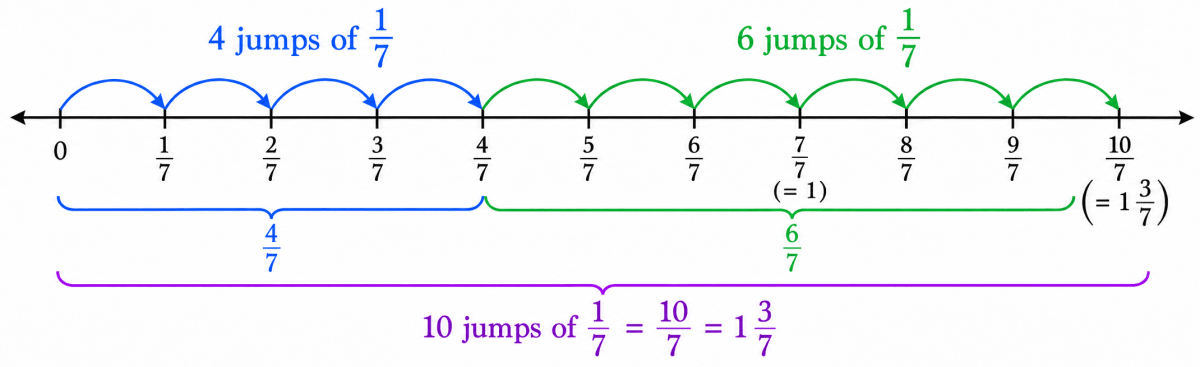
Try adding 74+76 using a number line. Do you get the same answer? (i.e., 173)
Answer
Both the fractions have the same fractional unit, i.e., 71.
On the number line, divide each unit length into 7 equal parts. Each such part has length 71.
Starting from 0, take 4 jumps of 71 each to reach 74. From 74, take 6 more jumps of 71 each.
Altogether, 10 jumps of 71 have been taken from 0. So, the point reached is 710.
We have:
=74+76=74+6[Adding the number of fractional units]=710=173[Converting improper fraction to mixed fraction]
∴ Yes, the number line gives the same answer 710=173.
Add the following fractions using Brahmagupta's method:
(a) 72+75+76
(b) 43+31
(c) 32+65
(d) 32+72
(e) 43+31+51
(f) 32+54
(g) 54+32
(h) 53+85
(i) 29+45
(j) 38+72
(k) 43+31+51
(l) 32+54+73
(m) 29+45+67
Answer
(a) 72+75+76
All three fractions have the same fractional unit 71, so the numerators can be added directly.
=72+75+76=72+5+6[Adding the number of fractional units]=713
∴ The answer is 713
(b) 43+31
The denominators are 4 and 3. A common multiple of 4 and 3 is 12.
=43+31=4×33×3+3×41×4[Making the fractional unit 121 common]=129+124=129+4=1213
∴ The answer is 1213
(c) 32+65
The denominators are 3 and 6. The smallest common multiple of 3 and 6 is 6.
=32+65=3×22×2+65[Making the fractional unit 61 common]=64+65=64+5=69=6÷39÷3[Expressing in lowest terms]=23
∴ The answer is 23
(d) 32+72
The denominators are 3 and 7. A common multiple of 3 and 7 is 21.
=32+72=3×72×7+7×32×3[Making the fractional unit 211 common]=2114+216=2114+6=2120
∴ The answer is 2120
(e) 43+31+51
The denominators are 4, 3 and 5. The smallest common multiple of 4, 3 and 5 is 60.
=43+31+51=4×153×15+3×201×20+5×121×12[Making the fractional unit 601 common]=6045+6020+6012=6045+20+12=6077
∴ The answer is 6077
(f) 32+54
The denominators are 3 and 5. The smallest common multiple of 3 and 5 is 15.
=32+54=3×52×5+5×34×3[Making the fractional unit 151 common]=1510+1512=1510+12=1522
∴ The answer is 1522
(g) 54+32
The denominators are 5 and 3. The smallest common multiple of 5 and 3 is 15.
=54+32=5×34×3+3×52×5[Making the fractional unit 151 common]=1512+1510=1512+10=1522
∴ The answer is 1522
(h) 53+85
The denominators are 5 and 8. A common multiple of 5 and 8 is 40.
=53+85=5×83×8+8×55×5[Making the fractional unit 401 common]=4024+4025=4024+25=4049
∴ The answer is 4049
(i) 29+45
The denominators are 2 and 4. The smallest common multiple of 2 and 4 is 4.
=29+45=2×29×2+45[Making the fractional unit 41 common]=418+45=418+5=423
∴ The answer is 423
(j) 38+72
The denominators are 3 and 7. A common multiple of 3 and 7 is 21.
=38+72=3×78×7+7×32×3[Making the fractional unit 211 common]=2156+216=2156+6=2162
∴ The answer is 2162
(k) 43+31+51
The denominators are 4, 3 and 5. The smallest common multiple of 4, 3 and 5 is 60.
=43+31+51=4×153×15+3×201×20+5×121×12[Making the fractional unit 601 common]=6045+6020+6012=6045+20+12=6077
∴ The answer is 6077
(l) 32+54+73
The denominators are 3, 5 and 7. The smallest common multiple of 3, 5 and 7 is 105.
=32+54+73=3×352×35+5×214×21+7×153×15[Making the fractional unit 1051 common]=10570+10584+10545=10570+84+45=105199
∴ The answer is 105199
(m) 29+45+67
The denominators are 2, 4 and 6. The smallest common multiple of 2, 4 and 6 is 12.
=29+45+67=2×69×6+4×35×3+6×27×2[Making the fractional unit 121 common]=1254+1215+1214=1254+15+14=1283
∴ The answer is 1283
Rahim mixes 32 litres of yellow paint with 43 litres of blue paint to make green paint. What is the volume of green paint he has made?
Answer
Given:
Volume of yellow paint = 32 litres
Volume of blue paint = 43 litres
Volume of green paint = ?
Volume of green paint = (Volume of yellow paint) + (Volume of blue paint)
Substituting the above values, we get:
=(32+43) litres=(3×42×4+4×33×3) litres[Making the fractional unit 121 common]=(128+129) litres=128+9 litres=1217 litres=1125 litres[Converting improper fraction to mixed fraction]
∴ The volume of green paint made by Rahim = 1125 litres.
Geeta bought 52 meter of lace and Shamim bought 43 meter of the same lace to put a complete border on a table cloth whose perimeter is 1 meter long. Find the total length of the lace they both have bought. Will the lace be sufficient to cover the whole border?
Answer
Given:
Length of lace bought by Geeta = 52 m
Length of lace bought by Shamim = 43 m
Perimeter of the table cloth = 1 m
Total length of the lace = (Length bought by Geeta) + (Length bought by Shamim)
Substituting the above values, we get:
=(52+43) m=(5×42×4+4×53×5) m[Making the fractional unit 201 common]=(208+2015) m=208+15 m=2023 m=1203 m[Converting improper fraction to mixed fraction]
Now, comparing the total length of the lace with the perimeter of the table cloth:
1 m = 2020 m
Since 2023>2020, the total length of the lace is more than 1 m.
∴ The total length of the lace bought by them = 1203 m, and yes, the lace will be sufficient to cover the whole border.
Carry out the following subtractions using Brahmagupta's method:
(a) 158−153
(b) 52−154
(c) 65−94
(d) 32−21
Answer
(a) 158−153
Both the fractions have the same fractional unit 151.
=158−153=158−3[Subtracting the number of fractional units]=155=15÷55÷5[Expressing in lowest terms]=31
∴ The answer is 31
(b) 52−154
The denominators are 5 and 15. The smallest common multiple of 5 and 15 is 15.
=52−154=5×32×3−154[Making the fractional unit 151 common]=156−154=156−4=152
∴ The answer is 152
(c) 65−94
The denominators are 6 and 9. The smallest common multiple of 6 and 9 is 18.
=65−94=6×35×3−9×24×2[Making the fractional unit 181 common]=1815−188=1815−8=187
∴ The answer is 187
(d) 32−21
The denominators are 3 and 2. The smallest common multiple of 3 and 2 is 6.
=32−21=3×22×2−2×31×3[Making the fractional unit 61 common]=64−63=64−3=61
∴ The answer is 61
Subtract as indicated:
(a) 413 from 310
(b) 518 from 323
(c) 729 from 745
Answer
(a) 413 from 310
Subtracting 413 from 310 means finding 310−413.
The denominators are 3 and 4. The smallest common multiple of 3 and 4 is 12.
=310−413=3×410×4−4×313×3[Making the fractional unit 121 common]=1240−1239=1240−39=121
∴ The answer is 121
(b) 518 from 323
Subtracting 518 from 323 means finding 323−518.
The denominators are 3 and 5. The smallest common multiple of 3 and 5 is 15.
=323−518=3×523×5−5×318×3[Making the fractional unit 151 common]=15115−1554=15115−54=1561
∴ The answer is 1561
(c) 729 from 745
Subtracting 729 from 745 means finding 745−729.
Both the fractions have the same fractional unit 71.
=745−729=745−29[Subtracting the number of fractional units]=716
∴ The answer is 716
Solve the following problem:
(a) Jaya's school is 107 km from her home. She takes an auto for 21 km from her home daily, and then walks the remaining distance to reach her school. How much does she walk daily to reach the school?
Answer
Given:
Total distance from home to school = 107 km
Distance covered by auto = 21 km
Distance walked = ?
Distance walked = (Total distance) − (Distance covered by auto)
Substituting the above values, we get:
=(107−21) km=(107−2×51×5) km[Making the fractional unit 101 common]=(107−105) km=107−5 km=102 km=10÷22÷2 km[Expressing in lowest terms]=51 km
∴ Jaya walks 51 km daily to reach the school.
Solve the following problem:
Jeevika takes 310 minutes to take a complete round of the park and her friend Namit takes 413 minutes to do the same. Who takes less time and by how much?
Answer
Given:
Time taken by Jeevika = 310 minutes
Time taken by Namit = 413 minutes
First, let us compare the two times. The smallest common multiple of 3 and 4 is 12.
310=3×410×4=1240 and 413=4×313×3=1239
Since 1239<1240, we get 413<310.
So, Namit takes less time than Jeevika.
Difference in time = (Time taken by Jeevika) − (Time taken by Namit)
Substituting the above values, we get:
=(310−413) minutes=(1240−1239) minutes[Making the fractional unit 121 common]=1240−39 minutes=121 minutes
∴ Namit takes less time than Jeevika, by 121 minutes.
Can you find four different fractional units that add up to 1?
It turns out that this problem has six solutions! Can you find at least one of them? Can you find them all? You can try using similar reasoning as in the cases of two and three fractional units—or find your own method!
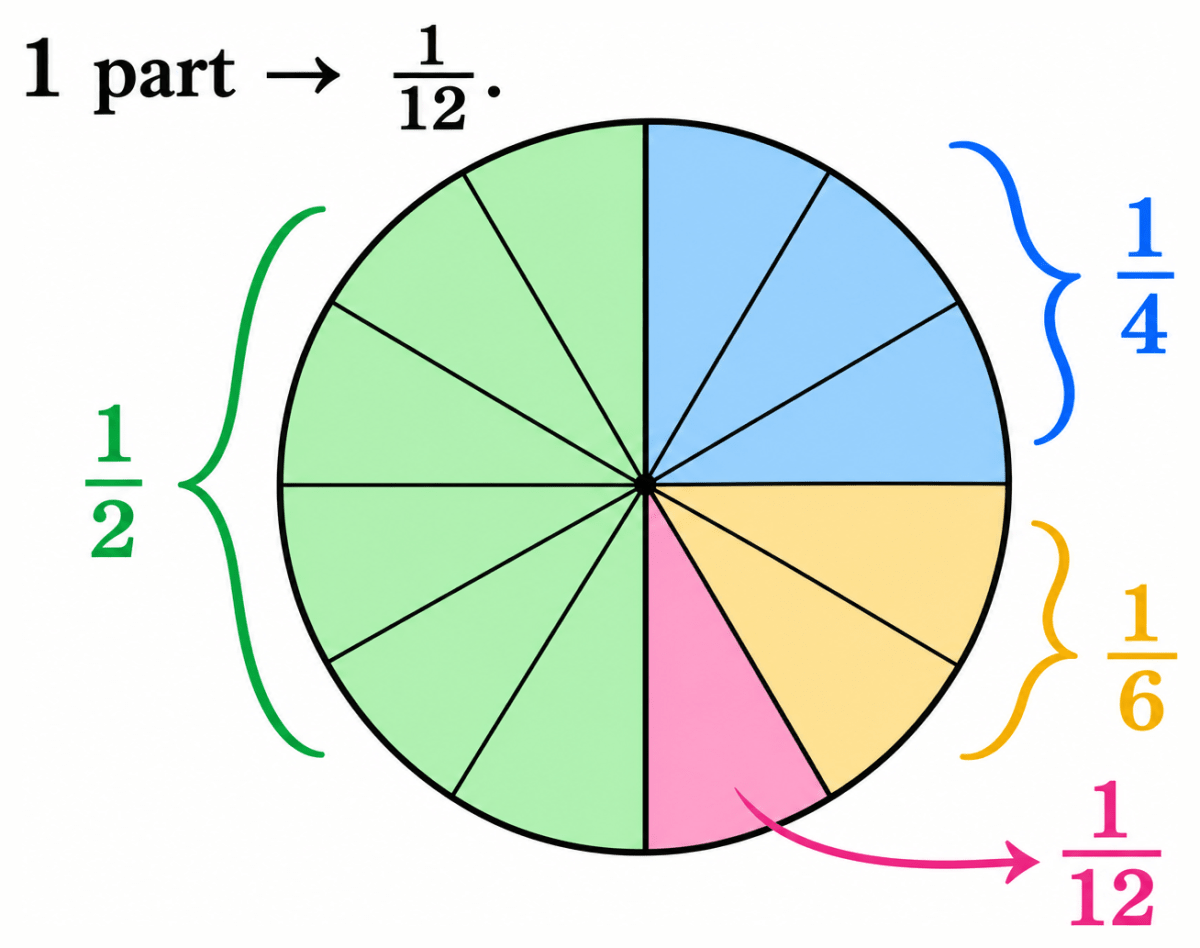
Once you find one solution, try to divide a circle into parts to visualise it!
Answer
Let the four different fractional units be arranged from the largest to the smallest.
Step 1: The largest fractional unit must be 21.
If the largest fractional unit were 31 or smaller, then the four different fractional units could at most be 31,41,51 and 61.
=31+41+51+61=6020+6015+6012+6010[Making the fractional unit 601 common]=6057<1
So, the sum would always be less than 1. Hence, 21 must be one of the four fractional units.
Step 2: The remaining three fractional units must add up to 21.
Now we look for three different fractional units, each smaller than 21, whose sum is 1−21=21. We consider the next largest fractional unit.
If it is 31:
The last two fractions must add up to
21−31=61.
Let the larger of these last two fractional units be n1. Since the two fractions are different and their sum is 61, we only need to check n=7,8,9,10, and 11. This gives:
- 61−71=421
- 61−81=241
- 61−91=181
- 61−101=151
- 61−111=665, which is not a fractional unit.
So the four possible pairs are (71,421), (81,241), (91,181) and (101,151).
If it is 41:
The last two fractions must add up to
21−41=41.
The larger of these two fractional units can only be 51, 61 or 71. We get:
- 41−51=201
- 41−61=121
- 41−71=283, which is not a fractional unit.
So the two possible pairs are (51,201) and (61,121).
If it is 51:
The last two fractions would have to add up to
21−51=103.
If the larger of the last two were 71 or smaller, then even the largest possible pair would be
71+81=5615<103.
So it would have to be 61. But then the last fraction would be
103−61=152,
which is not a fractional unit. Hence, there is no solution with 51 as the next largest fractional unit.
If the next largest fractional unit is 61 or smaller, then the greatest possible sum of the three remaining different fractional units is
61+71+81=16873<21.
Therefore, there are no further possibilities.
Step 3: The six solutions.
| S. No. | Four different fractional units | Check (common fractional unit) |
|---|
| 1 | 21+31+71+421 | 4221+4214+426+421=4242=1 |
| 2 | 21+31+81+241 | 2412+248+243+241=2424=1 |
| 3 | 21+31+91+181 | 189+186+182+181=1818=1 |
| 4 | 21+31+101+151 | 3015+3010+303+302=3030=1 |
| 5 | 21+41+51+201 | 2010+205+204+201=2020=1 |
| 6 | 21+41+61+121 | 126+123+122+121=1212=1 |
Step 4: Visualising a solution with a circle.
Taking the solution 21+41+61+121=1, divide a circle into 12 equal parts. Then group 6 parts together to form 21, 3 parts to form 41, 2 parts to form 61, and the last 1 part is 121.
Hence, there are exactly six sets of four different fractional units that add up to 1, as listed in the table above.