
All pure substances have:
- the same physical state
- the same colour
- the same composition
- a definite set of properties
Answer
a definite set of properties
Reason — All pure substances have a definite set of properties. These properties include physical state, colour and composition, but they are not the same for all substances.
Pure substances can exist in different states - solid, liquid or gas. Different pure substances have different colours. Each pure substance has a fixed composition, but it is not the same as that of other substances.
Sugar is a compound which consists of the elements:
- carbon and hydrogen
- hydrogen and oxygen
- carbon, hydrogen and oxygen
- hydrogen, carbon and sulphur
Answer
carbon, hydrogen and oxygen
Reason — Sugar has the chemical formula C12H22O11, which signifies that it is made up of carbon (C), hydrogen (H) and oxygen (O).
Carbon and hydrogen describe compounds like hydrocarbons, not sugar. Hydrogen and oxygen form water. Sugar doesn't contain sulphur.
Sulphur and carbon are:
- metals
- non-metals
- metalloids
- noble gases
Answer
non-metals
Reason — Sulphur and carbon are non-metals with dull surfaces that do not shine.
Sulphur and carbon do not show metallic properties like conductivity or malleability. Metalloids have properties of both metals and non-metals (e.g., silicon). Noble gases (like helium, neon) are inert gases, unlike sulphur and carbon.
The most abundant elements in the universe are:
- neon and argon
- hydrogen and helium
- aluminium and copper
- oxygen and nitrogen
Answer
hydrogen and helium
Reason — The most abundant elements in the universe are hydrogen and helium.
Neon and argon are noble gases, but not the most abundant in the universe. Aluminium and copper are metals found mainly on Earth, not abundant in the universe. Oxygen and nitrogen are abundant in Earth’s atmosphere, not in the entire universe.
The symbol of which of the following elements is derived from its Latin name ?
- Cobalt
- Copper
- Calcium
- Chlorine
Answer
Copper
Reason — Among the following elements the symbol of copper i.e., Cu is derived from its latin name "Cuprum".
The metal which is not a good conductor of electricity is:
- silver
- aluminium
- copper
- tungsten
Answer
tungsten
Reason — Metals are good conductors of electricity excepting tungsten, which is a poor conductor of electricity.
Silver is the best conductor of electricity. Aluminium is a good conductor and commonly used in power cables. Copper is a very good conductor, widely used in wiring.
The symbol of sodium metal is:
- S
- Sn
- Na
- Ne
Answer
Na
Reason — The symbol of sodium metal is Na, derived from its Latin name "Natrium".
S is sulphur.
Sn is tin.
Ne is neon.
From the list given below, select the correct substance which is most suitable to the given statements:
[oxygen, diamond, zinc, graphite, gold]
(a) A metal which is brittle.
(b) A non-metal which is a good conductor of electricity.
(c) The hardest naturally occurring substance.
(d) The most ductile metal.
(e) A gaseous non-metal.
Answer
(a) Zinc
(b) Graphite
(c) Diamond
(d) Gold
(e) Oxygen
Classify the following substances into elements and compounds.
Mercury, sulphur, sugar, water, sand, gold, carbon, oxygen, alcohol, iron, marble, baking soda.
Answer
- Elements — Mercury, sulphur, gold, carbon, oxygen, iron
- Compounds — Sugar, water, sand, alcohol, marble, baking soda
Give the symbols of: carbon, calcium, copper, chlorine, cobalt, argon, silicon, aluminium.
Answer
- Carbon — C
- Calcium — Ca
- Copper — Cu
- Chlorine — Cl
- Cobalt — Co
- Argon — Ar
- Silicon — Si
- Aluminium — Al
Give the names of the elements represented by the following symbols:
(a) B
(b) He
(c) Si
(d) Be
(e) Li
(f) P
(g) K
(h) F
Answer
(a) B — Boron
(b) He — Helium
(c) Si — Silicon
(d) Be — Beryllium
(e) Li — Lithium
(f) P — Phosphorus
(g) K — Potassium
(h) F — Fluorine
Define a pure substance.
Answer
A substance which has a definite composition and consistent properties throughout is called a pure substance.
Name the types of pure substances you know.
Answer
Pure substances are of two types,
- Elements
- Compounds
Define:
(a) Elements
(b) Compounds.
Answer
(a) An element is defined as a pure substance made up of only one kind of atoms that cannot be converted into anything simpler than itself by any physical or chemical process.
(b) Compounds are pure substances formed by the chemical combination of two or more elements in a definite proportion by mass.
Give two examples for each of the following:
(a) Non-metals which are solids
(b) Metals which are soft
(c) Non-metals which are lustrous
(d) Elements which are liquids
(e) Inert gases
Answer
(a) Non-metals which are solids:
- Sulphur (S)
- Phosphorus (P)
(b) Metals which are soft:
- Sodium (Na)
- Potassium (K)
(c) Non-metals which are lustrous:
- Iodine (I)
- Carbon (C) in the form of diamond
(d) Elements which are liquids:
- Mercury (Hg) — Metal
- Bromine (Br2) — Non metal
(e) Inert gases:
- Helium (He)
- Neon (Ne)
Name the elements present in the following compounds.
(a) Sugar
(b) Ammonia
(c) Marble
(d) Washing soda
Answer
(a) Sugar — Carbon, hydrogen and oxygen
(b) Ammonia — Nitrogen and hydrogen
(c) Marble — Calcium, carbon and oxygen
(d) Washing soda — Sodium, carbon and oxygen
Give three differences between metals and non-metals
Answer
The differences between metals and non-metals are given below:
| Metals | Non-metals |
|---|---|
| Metals are usually lustrous | Non-metals are non lustrous |
| They have high melting and boiling points | They have low melting and boiling points |
| Metals are ductile | Non-metals are not ductile |
| Metals have high density | Non-metals have low density |
Give three differences between elements and compounds.
Answer
The differences between elements and compounds are given below:
| Elements | Compounds |
|---|---|
| An element is made up of only one kind of atoms. | A compound is made up of two or more atoms of different elements combined chemically in a definite whole number ratio by mass. |
| An element has its own set of properties. | The properties of a compound are completely different from those of its constituent elements. |
| An element cannot be broken down into simpler substances by any physical or chemical means. | A compound can be broken into its constituent elements by chemical means. |
Name the elements which form water. State three characteristics of water to justify that it is a compound.
Answer
Hydrogen and Oxygen combine to form water.
Three characteristics of water are :
- Water consists of two elements, hydrogen and oxygen.
- In the formation of water, hydrogen and oxygen always combine in a fixed proportion i.e., two hydrogen atoms and one oxygen atom.
- The properties of water are entirely different from those of its constituent elements. Hydrogen and oxygen are gases but water is a liquid under normal conditions.
State four important characteristics of compounds.
Answer
- A compound consists of two or more elements.
- The constituting elements of a compound are always same, combined in a definite proportion in every sample of that compound, i.e. from whichever source it is obtained.
- A compound is pure and homogeneous and has the same properties throughout its bulk.
- The physical and chemical properties of a compound differ from those of its constituent elements.
How is sodium chloride different from its constituent elements, sodium and chlorine in its properties? Justify.
Answer
The compound "sodium chloride" made up of sodium and chlorine. Sodium is a metal that is stored in kerosene oil as it reacts very fast with air and water. Chlorine is a reactive greenish yellow gas which is poisonous.
When these two elements combine chemically they form common salt, a non poisonous white solid substance that we use in our food to add taste and to obtain nutrition.
(a) What are the four types of elements ? Name them.
(b) Give two examples of each type of the elements you have mentioned above.
Answer
(a) Four types of elements are :
- Metals
- Non-metals
- Metalloids
- Noble (Inert) gases
(b) Examples :
- Metals — Zinc, Lead
- Non-metals — Carbon, Hydrogen
- Metalloids — Boron, Silicon
- Noble (Inert) gases — Neon, Argon
Atoms of different kinds combine to form molecules of:
- an element
- a compound
- a mixture
- all of the above
Answer
a compound
Reason — When atoms of two or more different elements combine, they form a molecule of a compound. Whereas, molecule of element forms when two or more atoms of the same element combine.
Molecules of an element are made of same kind of atoms. In mixtures, substances are not chemically combined.
The compound used as common salt is:
- sodium chloride
- calcium chloride
- sodium oxide
- hydrogen chloride
Answer
sodium chloride
Reason — The compound used as common salt is sodium chloride made up of sodium and chlorine.
Sand is a compound of:
- silicon and nitrogen
- silicon and oxygen
- oxygen and sulphur
- none of the above
Answer
silicon and oxygen
Reason — Sand or silica is a compound of silicon and oxygen in the ratio of 1 : 2 .
Calcium chloride is used for de-icing and drying agents, not as table salt. Sodium oxide is a reactive compound, not used as salt. Hydrogen chloride is a gas that forms hydrochloric acid in water.
The atomicity of ozone is:
- 2
- 3
- 4
- 8
Answer
3
Reason — The number of atoms in a molecule of an element is called its atomicity. Ozone (O3) is made of three oxygen atoms, hence the atomicity of ozone is three.
The molecular formula of ammonia is:
- NO
- NH3
- NO2
- N2O
Answer
NH3
Reason — Ammonia is made up of nitrogen and hydrogen. The valency of nitrogen is 3 and valency of hydrogen is 1.
The combining power of magnesium and oxygen is the same, i.e. 2. What will be the molecular formula of magnesium oxide ?
- Mg2O2
- MgO2
- Mg2O
- MgO
Answer
MgO
Reason — The combining power of magnesium and oxygen is the same, i.e. 2.
When the subscript numbers are same, we don't write them. So, the molecular formula of magnesium oxide is MgO.
Define:
(a) Atom
(b) Molecule
(c) Atomicity
(d) Formula
Answer
(a) An atom can be defined as the smallest indivisible unit of an element which exhibits all the properties of that element and may or may not have independent existence.
(b) A molecule can be defined as the smallest unit of an element or a compound which exhibits all the properties of that element or compound and has independent existence. They are divisible into atoms.
(c) The number of atoms in a molecule of an element is called its atomicity.
(d) A formula (plural: formulae) is a short way of representing the molecule of an element or a compound. It indicates the types and numbers of atoms present in a molecule.
State the difference between the following:
(a) 2H and H2
(b) H2O and 3H2O?
Answer
(a) 2H represents two atoms of hydrogen while H2 represents one molecule of hydrogen.
(b) H2O indicates that water molecule is formed by the combination of two elements i.e., Hydrogen and Oxygen. The number of hydrogen atom is two and that of oxygen atom is one.
If we write 3Н2О it represents three molecules of water. It contains six atoms of hydrogen and three atoms of oxygen.
Write the molecular formulae of compounds calcium oxide, hydrogen sulphide, lead sulphide, zinc oxide and carbon dioxide.
Answer
- Calcium oxide — CaO
- Hydrogen sulphide — H2S
- Lead sulphide — PbS
- Zinc oxide — ZnO
- Carbon dioxide — CO2
Give two examples each of compounds existing in the following states:
(a) Solid
(b) Liquid
(c) Gaseous
Answer
(a) Solid :
- Common salt (Sodium chloride-NaCl)
- Sodium hydroxide (NaOH)
(b) Liquid :
- Water (H2O)
- Hydrochloric acid (HCl)
(c) Gaseous :
- Carbon dioxide (CO2)
- Ammonia (NH3)
State two conditions necessary to write the molecular formula of a compound.
Answer
Two conditions necessary to write the molecular formula of a compound are :
- The symbols of elements.
- The valency of that element i.e. its combining power.
State the number of atoms of each element, present in
(a) C6H12O6
(b) H2SO4
(c) HNO3
(d) CaCO3
Also name these compounds.
Answer
(a) C6H12O6 — Glucose
- Carbon (C): 6 atoms
- Hydrogen (H): 12 atoms
- Oxygen (O): 6 atoms
(b) H2SO4 — Sulphuric acid
- Hydrogen (H): 2 atoms
- Sulphur (S): 1 atom
- Oxygen (O): 4 atoms
(c) HNO3 — Nitric acid
- Hydrogen (H): 1 atom
- Nitrogen (N): 1 atom
- Oxygen (O): 3 atoms
(d) CaCO3 — Calcium carbonate
- Calcium (Ca): 1 atom
- Carbon (C): 1 atom
- Oxygen (O): 3 atoms
Why are symbols and formulae of substances important?
Answer
The symbols and formulae of substances give information about the elements present in the compound and the number of each kind of atom in one molecule of the compound. They also allow us to represent chemical reactions using equations.
Mention three gaseous elements and write their molecular formulae.
Answer
Three gaseous elements along with their molecular formulae are given below:
- Hydrogen – H2
- Oxygen – O2
- Nitrogen – N2
State the information obtained from the formula of a compound.
Answer
A formula gives us the following information about a compound.
- Types of elements present in the compound.
- Number of each kind of atoms in one molecule of the compound.
- Ratio of different types of atoms present in the molecules.
Gold is used to make jewellery because it is:
- dull
- lustrous and attractive
- highly reactive
- very cheap
Answer
lustrous and attractive
Reason — Gold is used to make jewellery because it is lustrous and attractive. It looks shiny and does not tarnish easily in air.
Brass and bronze are:
- elements
- mixtures
- compounds
- all of the above
Answer
mixtures
Reason — Brass is a mixture of copper and zinc and bronze is a mixture of copper and tin.
Brass and bronze are not single elements; they are made of more than one metal. So, they can't be elements. Compounds have a fixed chemical formula, but alloys do not.
The hardest naturally occurring substance is:
- graphite
- iron
- diamond
- coal
Answer
diamond
Reason — Diamond is a form of carbon, it is hardest naturally occuring substance. Hence, it is used to cut glass.
Graphite is soft and slippery (used in pencils). Iron is strong, but not the hardest natural substance. Coal is soft and brittle.
The inert gas filled in electric bulbs is:
- Helium
- Argon
- Neon
- Both (1) and (3)
Answer
Both (2) and (3)
Reason — Nobel gases (Inert gases) like argon and neon are filled in electric bulbs due to their inert nature. They do not react with the tungsten filament of the bulb and prevents it from destruction.
Helium is an inert gas but is not commonly used in electric bulbs due to cost and suitability.
Which of the following metals is used to make heavy tools and machines?
- Iron
- Aluminium
- Copper
- Silver
Answer
Iron
Reason — Iron is strong and easily available. Therefore, it is used to make heavy tools and machines.
Aluminium is light and used in aircraft, utensils, and packaging, not heavy machines. Copper is used mainly for electrical wiring due to good conductivity. Silver is expensive and used in jewellery and electronics, not heavy machinery.
Assertion: Elements and compounds are pure substances.
Reason: Elements and compounds are made up of only one kind of atoms and molecules respectively.
- Both A and R are true and R is the correct explanation of A.
- Both A and R are true and R is not the correct explanation of A.
- A is true and R is false.
- A is false and R is true.
Answer
Both A and R are true and R is the correct explanation of A.
Reason — A is true as pure substances have a fixed composition and definite properties. Both elements and compounds fit this definition.
R is true as an element contains only one type of atom, and a compound contains only one type of molecule.
Therefore, Both A and R are true and R is the correct explanation of A is the correct option.
Assertion: The chemical formula of a compound gives the exact number of atoms of different types present in it.
Reason: Carbon and oxygen combine chemically to form a molecule of carbon dioxide.
- Both A and R are true and R is the correct explanation of A.
- Both A and R are true and R is not the correct explanation of A.
- A is true and R is false.
- A is false and R is true.
Answer
Both A and R are true and R is not the correct explanation of A.
Reason — A is true as a chemical formula is like a symbolic representation of a molecule. The formula directly gives the exact number of each type of atom.
R is true as carbon and oxygen elements combine to form a molecule of carbon dioxide.
Therefore, Both A and R are true and R is not the correct explanation of A is the correct option.
Assertion: Graphite is used to make the lead of pencils.
Reason: Graphite can mark paper black.
- Both A and R are true and R is the correct explanation of A.
- Both A and R are true and R is not the correct explanation of A.
- A is true and R is false.
- A is false and R is true.
Answer
Both A and R are true and R is the correct explanation of A.
Reason — A is true as Pencil “lead” is actually made of graphite, not lead metal.
R is true as Graphite is soft and slippery, so it leaves a black mark on paper when rubbed.
Therefore, Both A and R are true and R is the correct explanation of A is the correct option.
Assertion: Metals have low melting and boiling points.
Reason: Most non-metals are dull in appearance and brittle in nature.
- Both A and R are true and R is the correct explanation of A.
- Both A and R are true and R is not the correct explanation of A.
- A is true and R is false.
- A is false and R is true.
Answer
A is false and R is true.
Reason — A is false as most metals actually have high melting and boiling points.
R is true as non-metals are generally dull (not shiny) and brittle (break easily).
Therefore, A is false and R is true is the correct option.
Fill in the blanks:
(a) ............... refers to the number of atoms in the molecule of an element.
(b) The most abundant element in the earth's crust is ............... .
(c) A metal which is a liquid at room temperature is ............... .
(d) The most abundant element in the atmosphere is ............... .
(e) A metal which is a poor conductor of electricity is ............... .
(f) A diatomic gaseous element is ............... .
(g) A liquid non-metal is ............... .
(h) Elements that do not react chemically are ............... .
(i) The Latin name of iron is ............... .
(j) The horizontal rows in the Periodic table are called ............... .
(k) The vertical columns in the Periodic table are called ............... .
Answer
(a) Atomicity refers to the number of atoms in the molecule of an element.
(b) The most abundant element in the earth's crust is oxygen.
(c) A metal which is a liquid at room temperature is mercury.
(d) The most abundant element in the atmosphere is nitrogen.
(e) A metal which is a poor conductor of electricity is lead.
(f) A diatomic gaseous element is oxygen(O2).
(g) A liquid non-metal is bromine.
(h) Elements that do not react chemically are noble gases.
(i) The Latin name of iron is ferrum.
(j) The horizontal rows in the Periodic table are called periods.
(k) The vertical columns in the Periodic table are called groups.
Indicate whether the following statements are true or false.
(a) A compound is made up of just one kind of atom. ...............
(b) Metals reflect light and are good conductors of electricity. ...............
(c) Metals can be polished. ...............
(d) Elements are made up of compounds. ...............
(e) All elements are artificially prepared. ...............
(f) Molecules can exist independently. ...............
(g) Molecules combine to form atoms. ...............
(h) Noble gases are highly reactive. ...............
(i) Ozone is a triatomic molecule. ...............
Answer
(a) False
Correct Statement — A compound is made of two or more different kinds of atoms.
(b) True
(c) True
(d) False
Correct Statement — Compounds are made up of elements.
(e) False
Correct Statement — Most elements occur naturally, only a few are synthetic.
(f) True
(g) False
Correct Statement — Atoms combine to form molecules.
(h) False
Correct Statement — Noble gases are inert, i.e., non-reactive under normal conditions.
(i) True
Match the columns:
| Column A | Column B |
|---|---|
| (a) Metals | (i) Non-reactive |
| (b) Molecules | (ii) Brittle |
| (c) Non-metals | (iii) Lustrous |
| (d) Noble gases | (iv) Smallest unit of compound |
Answer
| Column A | Column B |
|---|---|
| (a) Metals | (iii) Lustrous |
| (b) Molecules | (iv) Smallest unit of compound |
| (c) Non-metals | (ii) Brittle |
| (d) Noble gases | (i) Non-reactive |
Circle the odd one out on the basis of the property given in the brackets.
(a) hydrogen, nitrogen, chlorine, phosphorus (state)
(b) sodium, potassium, iron, lithium (hardness)
(c) graphite, diamond, iodine, coal (forms of a same element)
(d) helium, neon, argon, bromine (reactivity)
Answer
(a) Phosphorus
Reason — Phosphorus is present in solid state under normal conditions, whereas, hydrogen, nitrogen, and chlorine are gases at room temperature.
(b) Iron
Reason — Iron is hard metal, while, sodium, potassium and lithium are soft metals.
(c) Iodine
Reason — Coal, diamond and graphite are all different forms of carbon but iodine is a different element.
(d) Bromine
Reason — Bromine is a reactive element. while helium, neon and argon are non-reactive noble gases.
Name:
(a) Three different forms of carbon.
(b) A form of carbon used as a gem.
(c) Two substances used to make electric wires.
(d) Two substances used to make jewellery.
(e) A substance used as an insulator.
Answer
(a) Coal, diamond and graphite.
(b) Diamond
(c) Copper and aluminium
(d) Gold and platinum
(e) Wood or Plastic
Give one use of each of the following substances:
(a) Iron
(b) Brass
(c) Coal
Answer
(a) Iron is used to make heavy tools and machines.
(b) Brass is used to make utensils, door knobs, handles, etc.
(c) Coal is used as fuel.
Give reason:
A frying pan is made up of steel but its handle is made up of wood.
Answer
A frying pan is made up of steel but its handle is made up of wood or plastic. This is because steel is a good conductor of heat and it allows heat to pass to the food kept in the pan for cooking while wood and plastic being bad-conductors or insulators do not get too hot to burn our hand.
Give reason:
Graphite is used to make lead of the pencils.
Answer
Graphite can mark the paper black. So, it is used to make the lead of pencils.
Give reason:
Argon is filled in electric bulbs.
Answer
Argon is filled in electric bulbs due to its inert nature. It does not react with the tungsten filament of the bulb and prevents it from destruction.
Give reason:
Copper and aluminium are used to make electric wires.
Answer
Copper and aluminium are good conductors of heat and electricity. They can be drawn into wires and beaten into sheets. Therefore, they are used to make electric wires.
(a) What do you understand by 'Periodic Table'?
(b) A part of the Periodic Table is given below with the symbols of some elements. Write the symbols of the missing elements.
| Group → Period ↓ | IA | IIA | IIIA | IVA | VA | VIA | VIIA | Zero |
|---|---|---|---|---|---|---|---|---|
| 1 | H | He | ||||||
| 2 | Li | B | N | F | ||||
| 3 | Mg | Si | S | Ar | ||||
| 4 | K | Ca | x | x | x | x | x | x |
Answer
(a) Periodic Table is a systematic arrangement of elements in a tabular form arranged into rows ("periods") and columns ("groups"), for our convenient study.
(b)
| Group → Period ↓ | IA | IIA | IIIA | IVA | VA | VIA | VIIA | Zero |
|---|---|---|---|---|---|---|---|---|
| 1 | H | He | ||||||
| 2 | Li | Be | B | C | N | O | F | Ne |
| 3 | Na | Mg | Al | Si | P | S | Cl | Ar |
| 4 | K | Ca | x | x | x | x | x | x |
What do you understand by the statement — 'Metals are ductile and malleable'? Give one example of each.
Answer
Metals are ductile, which means they can be drawn or stretched into thin wires. Metals are malleable, which means they can be beaten into thin sheets.
Example of a ductile metal: Copper is highly ductile and is commonly used in electrical wiring.
Example of a malleable metal: Aluminium is malleable and is used to make foil and packaging materials.
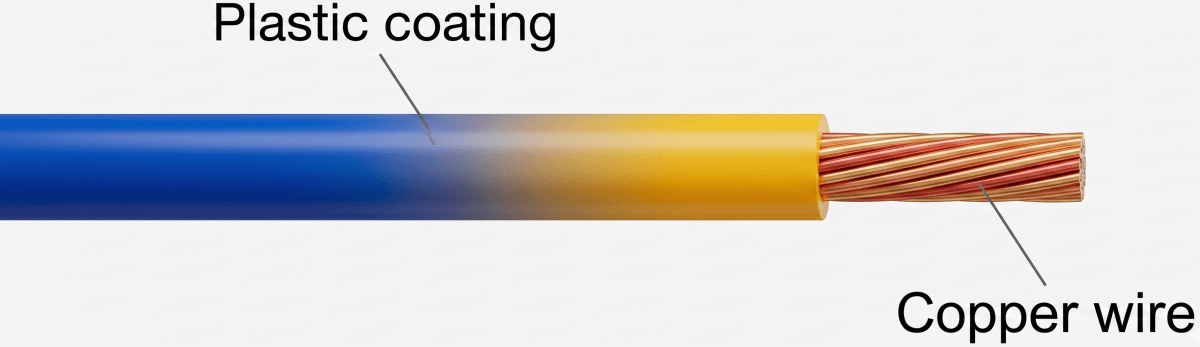
An electrician was repairing an electric wire in John's house. John noticed that the wire was coated with plastic, but a small portion of it was exposed. Since John had studied the properties and uses of elements and compounds in class, he could easily recognize that the wire was made of copper.
(a) What type of element is copper?
(b) Why is copper used for making electrical wires?
(c) Although silver is more ductile and a better conductor of electricity than copper, it is not used to make wires. Explain why.
(d) Why is it necessary to cover metal wires with plastic?
(e) What type of substance is plastic?
Answer
(a) Copper is a metal.
(b) Copper is used for making electrical wires because it is a good conductor of electricity and is ductile (can be drawn into thin wires).
(c) Silver is more ductile and a better conductor of electricity than copper, it is not used to make wires because it is expensive.
(d) It is necessary to cover metal wires with plastic because plastic is a bad conductor of electricity. It acts as an insulator and protects us from electric shock by preventing direct contact with the live metal wire.
(e) Plastic is a compound. It is also a bad conductor of electricity and acts as an insulator.