KnowledgeBoat Logo
|
OPEN IN APP

Chapter 16

Quadrilaterals — Exercise 16(A)

Class - 6 Concise Mathematics Selina


Exercise 16(A)

Question 1

Two angles of a quadrilateral are 89° and 113°. If the other two angles are equal, find the equal angles.

Answer

Let the measure of each of the equal angles be xx.

We know that,

The sum of the angles of a quadrilateral is 360°.

∴89°+113°+x+x=360°⇒2x+202°=360°⇒2x=360°−202°⇒2x=158°⇒x=158°2⇒x=79°\therefore 89\degree + 113\degree + x + x = 360\degree \\[1em] \Rightarrow 2x + 202\degree = 360\degree \\[1em] \Rightarrow 2x = 360\degree - 202\degree \\[1em] \Rightarrow 2x = 158\degree \\[1em] \Rightarrow x = \dfrac{158\degree}{2} \\[1em] \Rightarrow x = 79\degree

Hence, the measure of each of the equal angles is 79°.

Question 2

Two angles of a quadrilateral are 68° and 76°. If the other two angles are in the ratio 5 : 7, find the measure of each of them.

Answer

Let the measures of the other two angles of the given quadrilateral be 5x5x and 7x7x respectively.

We know that,

The sum of the angles of a quadrilateral is 360°.

∴68°+76°+5x+7x=360°⇒12x+144°=360°⇒12x=360°−144°⇒12x=216°⇒x=216°12⇒x=18°\therefore 68\degree + 76\degree + 5x + 7x = 360\degree \\[1em] \Rightarrow 12x + 144\degree = 360\degree \\[1em] \Rightarrow 12x = 360\degree - 144\degree \\[1em] \Rightarrow 12x = 216\degree \\[1em] \Rightarrow x = \dfrac{216\degree}{12} \\[1em] \Rightarrow x = 18\degree

∴ Third angle = 5x=5×18°=90°5x = 5 \times 18\degree = 90\degree

Fourth angle = 7x=7×18°=126°7x = 7 \times 18\degree = 126\degree

Hence, the other two angles of the quadrilateral are 90° and 126°.

Question 3

Angles of a quadrilateral are (4x)°,5(x+2)°,(7x−20)°(4x)\degree, 5(x + 2)\degree, (7x - 20)\degree and 6(x+3)°6(x + 3)\degree. Find :

(i) the value of xx.

(ii) each angle of the quadrilateral.

Answer

We know that the sum of the angles of a quadrilateral is 360°.

(i) (4x)°+5(x+2)°+(7x−20)°+6(x+3)°=360°(4x)\degree + 5(x + 2)\degree + (7x - 20)\degree + 6(x + 3)\degree = 360\degree

⇒(4x+5x+10+7x−20+6x+18)°=360°⇒(22x+8)°=360°⇒22x=360°−8°=352°⇒x=35222⇒x=16\Rightarrow (4x + 5x + 10 + 7x - 20 + 6x + 18)\degree = 360\degree \\[1em] \Rightarrow (22x + 8)\degree = 360\degree \\[1em] \Rightarrow 22x = 360\degree - 8\degree = 352\degree \\[1em] \Rightarrow x = \dfrac{352}{22} \\[1em] \Rightarrow x = 16

Hence, x=16\bm{x = 16}

(ii) First angle = (4x)°=(4×16)°=64°(4x)\degree = (4 \times 16)\degree = 64\degree

Second angle = 5(x+2)°=5(16+2)°=90°5(x + 2)\degree = 5(16 + 2)\degree = 90\degree

Third angle = (7x−20)°=(7×16−20)°=92°(7x - 20)\degree = (7 \times 16 - 20)\degree = 92\degree

Fourth angle = 6(x+3)°=6(16+3)°=114°6(x + 3)\degree = 6(16 + 3)\degree = 114\degree

Hence, the angles of the quadrilateral are 64°, 90°, 92° and 114°.

Question 4

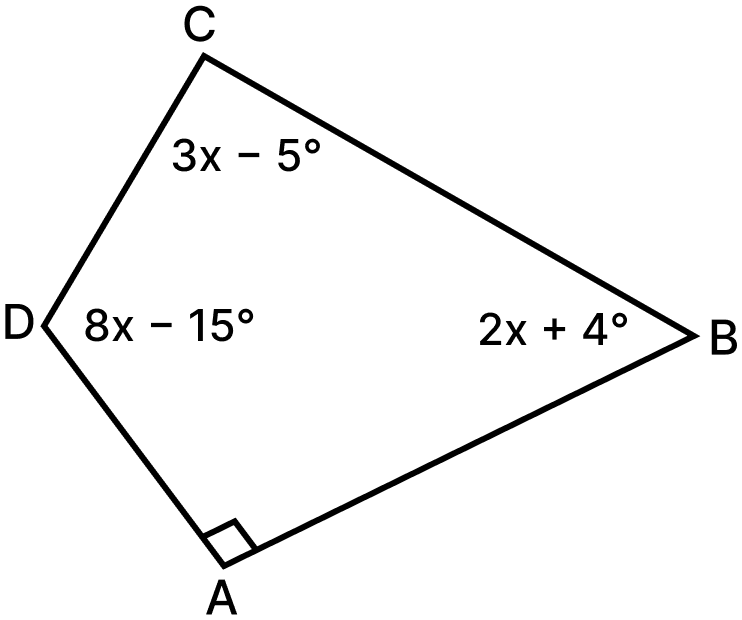
Use the information given in the following figure to find :

Use the information given in the following figure to find:. Quadrilaterals, Mathematics Solutions ICSE Class 7.

(i) xx.

(ii) ∠B and ∠C.

Answer

In quadrilateral ABCD,

∠A=90°,∠B=2x+4°,∠C=3x−5° and ∠D=8x−15°∠A = 90\degree, ∠B = 2x + 4\degree, ∠C = 3x - 5\degree \text{ and } ∠D = 8x - 15\degree

(i) ∠A + ∠B + ∠C + ∠D = 360° [Sum of the angles of a quadrilateral is 360°]

⇒90°+2x+4°+3x−5°+8x−15°=360°⇒13x+74°=360°⇒13x=360°−74°=286°⇒x=286°13⇒x=22°\Rightarrow 90\degree + 2x + 4\degree + 3x - 5\degree + 8x - 15\degree = 360\degree \\[1em] \Rightarrow 13x + 74\degree = 360\degree \\[1em] \Rightarrow 13x = 360\degree - 74\degree = 286\degree \\[1em] \Rightarrow x = \dfrac{286\degree}{13} \\[1em] \Rightarrow x = 22\degree

Hence, x=22°\bm{x = 22\degree}

(ii) ∠B = 2x+4°=2×22°+4°=48°2x + 4\degree = 2 \times 22\degree + 4\degree = 48\degree

∠C = 3x−5°=3×22°−5°=61°3x - 5\degree = 3 \times 22\degree - 5\degree = 61\degree

Hence, ∠B = 48° and ∠C = 61°.

Question 5

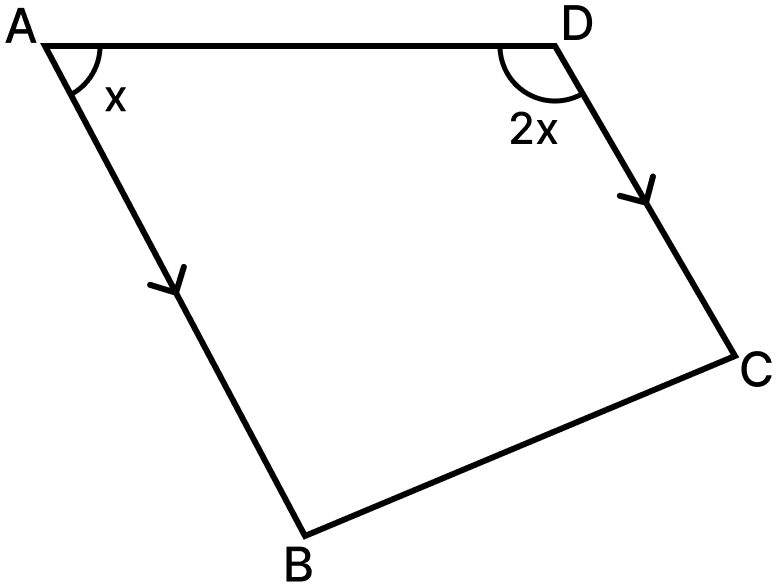
In quadrilateral ABCD, side AB is parallel to side DC. If ∠A : ∠D = 1 : 2 and ∠C : ∠B = 4 : 5. Calculate each angle of the quadrilateral.

Answer

Given, in quadrilateral ABCD, AB ∥ DC, ∠A : ∠D = 1 : 2 and ∠C : ∠B = 4 : 5.

In quadrilateral ABCD, side AB is parallel to side DC. If ∠A: ∠D = 1: 2 and ∠C: ∠B = 4: 5. Calculate each angle of the quadrilateral. Quadrilaterals, Mathematics Solutions ICSE Class 7.

Let ∠A=x and ∠D=2x∠A = x \text{ and } ∠D = 2x.

As AB ∥ DC and AD is a transversal, ∠A and ∠D are co-interior angles.

⇒ ∠A + ∠D = 180°

⇒x+2x=180°⇒3x=180°⇒x=180°3⇒x=60°\Rightarrow x + 2x = 180\degree \\[1em] \Rightarrow 3x = 180\degree \\[1em] \Rightarrow x = \dfrac{180\degree}{3} \\[1em] \Rightarrow x = 60\degree

∴ ∠A = 60° and ∠D = 2×60°=120°2 \times 60\degree = 120\degree

Again, let ∠C=4y and ∠B=5y∠C = 4y \text{ and } ∠B = 5y.

As AB ∥ DC and BC is a transversal, ∠B and ∠C are co-interior angles.

⇒ ∠B + ∠C = 180°

⇒5y+4y=180°⇒9y=180°⇒y=180°9⇒y=20°\Rightarrow 5y + 4y = 180\degree \\[1em] \Rightarrow 9y = 180\degree \\[1em] \Rightarrow y = \dfrac{180\degree}{9} \\[1em] \Rightarrow y = 20\degree

∴ ∠C = 4×20°=80°4 \times 20\degree = 80\degree

∠B = 5×20°=100°5 \times 20\degree = 100\degree

Hence, ∠A = 60°, ∠B = 100°, ∠C = 80° and ∠D = 120°.

Question 6

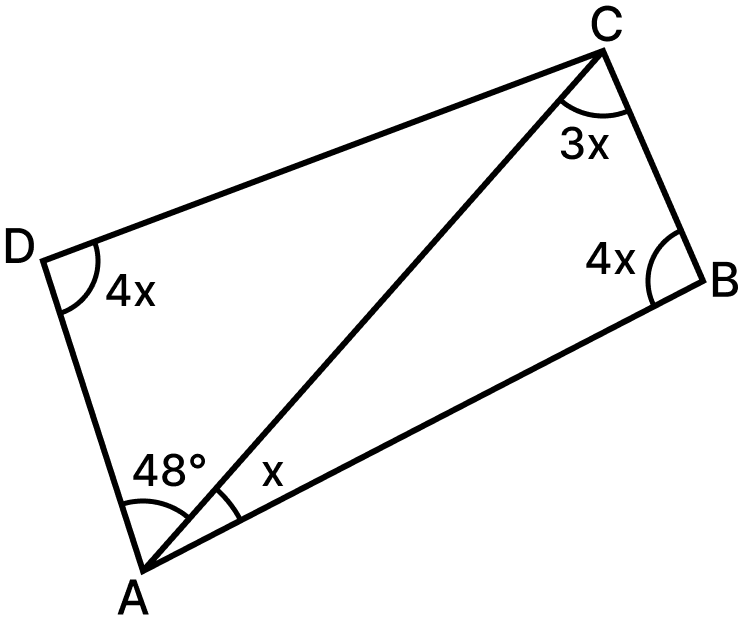
From the following figure find,

From the following figure find,. Quadrilaterals, Mathematics Solutions ICSE Class 7.

(i) xx

(ii) ∠ABC

(iii) ∠ACD

Answer

Given, in quadrilateral ABCD, ∠DAC=48°,∠CAB=x,∠ABC=4x,∠BCD=3x and ∠CDA=4x∠DAC = 48\degree, ∠CAB = x, ∠ABC = 4x, ∠BCD = 3x \text{ and } ∠CDA = 4x.

(i) ∠DAB = ∠DAC + ∠CAB = 48°+x48\degree + x

Now, ∠DAB + ∠ABC + ∠BCD + ∠CDA = 360° [Sum of the angles of a quadrilateral is 360°]

⇒48°+x+4x+3x+4x=360°⇒12x+48°=360°⇒12x=360°−48°=312°⇒x=312°12⇒x=26°\Rightarrow 48\degree + x + 4x + 3x + 4x = 360\degree \\[1em] \Rightarrow 12x + 48\degree = 360\degree \\[1em] \Rightarrow 12x = 360\degree - 48\degree = 312\degree \\[1em] \Rightarrow x = \dfrac{312\degree}{12} \\[1em] \Rightarrow x = 26\degree

Hence, x=26°\bm{x = 26\degree}

(ii) ∠ABC = 4x=4×26°=104°4x = 4 \times 26\degree = 104\degree

Hence, ∠ABC = 104°.

(iii) ∠CDA = 4x=4×26°=104°4x = 4 \times 26\degree = 104\degree

In ΔACD, we have :

⇒ ∠DAC + ∠CDA + ∠ACD = 180° [Sum of the angles of a triangle is 180°]

⇒ 48° + 104° + ∠ACD = 180°

⇒ ∠ACD = (180° − 152°) = 28°

Hence, ∠ACD = 28°.

Question 7

In quadrilateral ABCD, ∠C=64°,∠D=∠C−8°;∠A=5(a+2)° and ∠B=2(2a+7)°∠C = 64\degree, ∠D = ∠C - 8\degree; ∠A = 5(a + 2)\degree \text{ and } ∠B = 2(2a + 7)\degree. Calculate ∠A.

Answer

Given, in quadrilateral ABCD, ∠C=64°,∠D=∠C−8°,∠A=5(a+2)° and ∠B=2(2a+7)°∠C = 64\degree, ∠D = ∠C - 8\degree, ∠A = 5(a + 2)\degree \text{ and } ∠B = 2(2a + 7)\degree.

⇒ ∠D = (64° − 8°) = 56°

We know that,

The sum of the angles of a quadrilateral is 360°.

∴5(a+2)°+2(2a+7)°+64°+56°=360°⇒(5a+10)°+(4a+14)°+120°=360°⇒(9a+144)°=360°⇒9a=360°−144°⇒9a=216°⇒a=2169⇒a=24\therefore 5(a + 2)\degree + 2(2a + 7)\degree + 64\degree + 56\degree = 360\degree \\[1em] \Rightarrow (5a + 10)\degree + (4a + 14)\degree + 120\degree = 360\degree \\[1em] \Rightarrow (9a + 144)\degree = 360\degree \\[1em] \Rightarrow 9a = 360\degree - 144\degree \\[1em] \Rightarrow 9a = 216\degree \\[1em] \Rightarrow a = \dfrac{216}{9} \\[1em] \Rightarrow a = 24

∴ ∠A = 5(a+2)°=5(24+2)°=130°5(a + 2)\degree = 5(24 + 2)\degree = 130\degree

Hence, ∠A = 130°.

Question 8

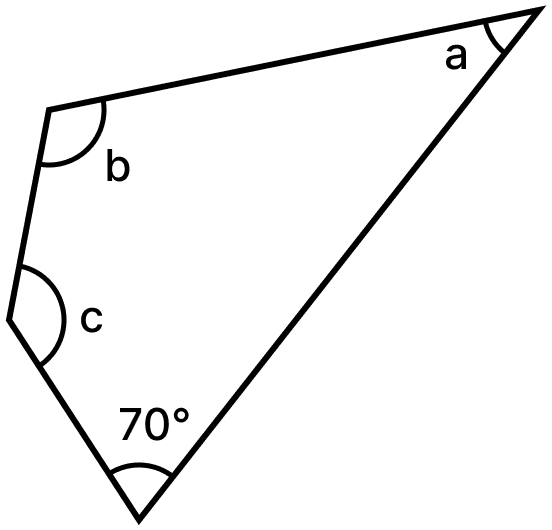
In the given figure :

b=2a+15°b = 2a + 15\degree and

c=3a+5°c = 3a + 5\degree,

find the values of bb and cc.

In the given figure: b = 2a + 15 degree and c = 3a + 5 degree, find the values of b and c. Quadrilaterals, Mathematics Solutions ICSE Class 7.

Answer

Given, a,b,ca, b, c and 70° are the angles of the quadrilateral, b=2a+15° and c=3a+5°b = 2a + 15\degree \text{ and } c = 3a + 5\degree.

We know that,

The sum of the angles of a quadrilateral is 360°.

∴a+b+c+70°=360°⇒a+2a+15°+3a+5°+70°=360°⇒6a+90°=360°⇒6a=360°−90°⇒6a=270°⇒a=270°6⇒a=45°\therefore a + b + c + 70\degree = 360\degree \\[1em] \Rightarrow a + 2a + 15\degree + 3a + 5\degree + 70\degree = 360\degree \\[1em] \Rightarrow 6a + 90\degree = 360\degree \\[1em] \Rightarrow 6a = 360\degree - 90\degree \\[1em] \Rightarrow 6a = 270\degree \\[1em] \Rightarrow a = \dfrac{270\degree}{6} \\[1em] \Rightarrow a = 45\degree

∴ b=2a+15°=2×45°+15°=105°b = 2a + 15\degree = 2 \times 45\degree + 15\degree = 105\degree

c=3a+5°=3×45°+5°=140°c = 3a + 5\degree = 3 \times 45\degree + 5\degree = 140\degree

Hence, b=105° and c=140°\bm{b = 105\degree \text{ and } c = 140\degree}

Question 9

Three angles of a quadrilateral are equal. If the fourth angle is 69°, find the measure of equal angles.

Answer

Let the measure of each of the three equal angles be xx.

We know that,

The sum of the angles of a quadrilateral is 360°.

∴x+x+x+69°=360°⇒3x+69°=360°⇒3x=360°−69°⇒3x=291°⇒x=291°3⇒x=97°\therefore x + x + x + 69\degree = 360\degree \\[1em] \Rightarrow 3x + 69\degree = 360\degree \\[1em] \Rightarrow 3x = 360\degree - 69\degree \\[1em] \Rightarrow 3x = 291\degree \\[1em] \Rightarrow x = \dfrac{291\degree}{3} \\[1em] \Rightarrow x = 97\degree

Hence, the measure of each of the equal angles is 97°.

Question 10

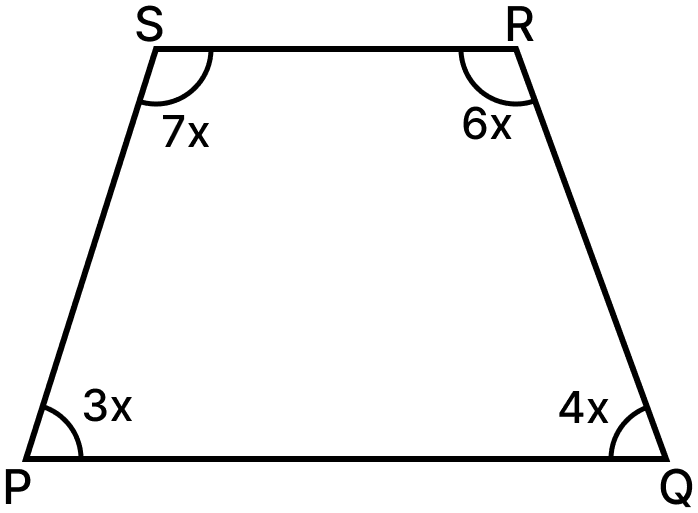
In quadrilateral PQRS, ∠P : ∠Q : ∠R : ∠S = 3 : 4 : 6 : 7. Calculate each angle of the quadrilateral and then prove that PQ and SR are parallel to each other.

Is PS also parallel to QR?

Answer

Let the measures of the angles ∠P, ∠Q, ∠R and ∠S be 3x,4x,6x3x, 4x, 6x and 7x7x respectively.

In quadrilateral PQRS, ∠P: ∠Q: ∠R: ∠S = 3: 4: 6: 7. Calculate each angle of the quadrilateral and then prove that PQ and SR are parallel to each other. Is PS also parallel to QR? Quadrilaterals, Mathematics Solutions ICSE Class 7.

We know that,

The sum of the angles of a quadrilateral is 360°.

∴3x+4x+6x+7x=360°⇒20x=360°⇒x=360°20⇒x=18°\therefore 3x + 4x + 6x + 7x = 360\degree \\[1em] \Rightarrow 20x = 360\degree \\[1em] \Rightarrow x = \dfrac{360\degree}{20} \\[1em] \Rightarrow x = 18\degree

∴ ∠P = 3x3x = 3 × 18° = 54°

∠Q = 4x4x = 4 × 18° = 72°

∠R = 6x6x = 6 × 18° = 108°

∠S = 7x7x = 7 × 18° = 126°

Now, ∠P + ∠S = (54° + 126°) = 180°

As ∠P and ∠S are co-interior angles formed by the transversal PS and their sum is 180°, we get PQ ∥ SR.

Also, ∠P + ∠Q = (54° + 72°) = 126° ≠ 180°

As ∠P and ∠Q are co-interior angles formed by the transversal PQ and their sum is not 180°, PS is not parallel to QR.

Hence, ∠P = 54°, ∠Q = 72°, ∠R = 108°, ∠S = 126°, PQ ∥ SR and PS is not parallel to QR.

Question 11

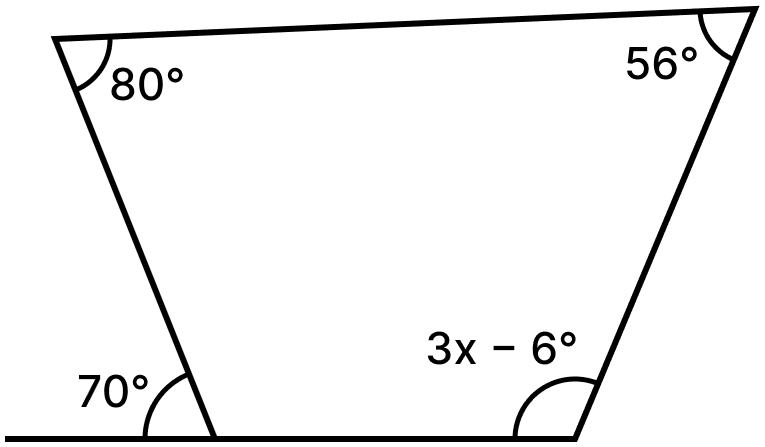
Use the information given in the following figure to find the value of xx.

Use the information given in the following figure to find the value of x. Quadrilaterals, Mathematics Solutions ICSE Class 7.

Answer

Given, the interior angles of the quadrilateral at the top two vertices are 80° and 56°, the interior angle at the bottom-right vertex is 3x−6°3x - 6\degree and the exterior angle at the bottom-left vertex is 70°.

The interior angle at the bottom-left vertex and the exterior angle 70° form a linear pair.

⇒ Interior angle at the bottom-left vertex = (180° − 70°) = 110°

We know that,

The sum of the angles of a quadrilateral is 360°.

∴80°+56°+110°+3x−6°=360°⇒3x+240°=360°⇒3x=360°−240°⇒3x=120°⇒x=120°3⇒x=40°\therefore 80\degree + 56\degree + 110\degree + 3x - 6\degree = 360\degree \\[1em] \Rightarrow 3x + 240\degree = 360\degree \\[1em] \Rightarrow 3x = 360\degree - 240\degree \\[1em] \Rightarrow 3x = 120\degree \\[1em] \Rightarrow x = \dfrac{120\degree}{3} \\[1em] \Rightarrow x = 40\degree

Hence, x=40°\bm{x = 40\degree}

Question 12

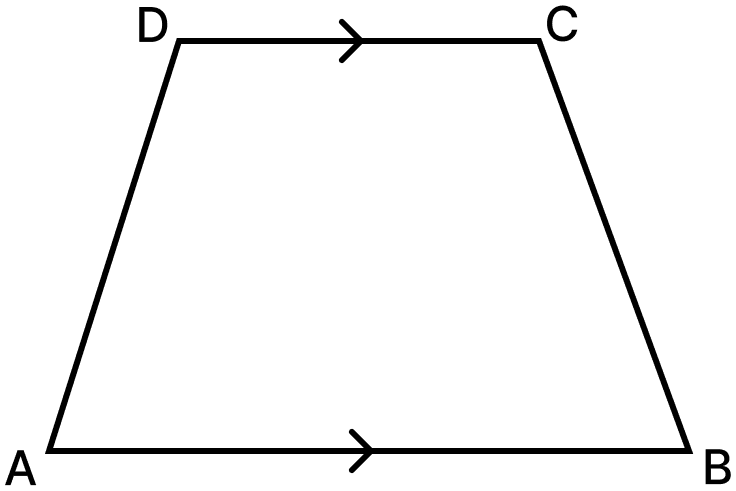
The following figure shows a quadrilateral in which sides AB and DC are parallel. If ∠A:∠D=4:5,∠B=(3x−15)° and ∠C=(4x+20)°∠A : ∠D = 4 : 5, ∠B = (3x - 15)\degree \text{ and } ∠C = (4x + 20)\degree, find each angle of the quadrilateral ABCD.

The following figure shows a quadrilateral in which sides AB and DC are parallel. If ∠A: ∠D = 4: 5, ∠B = (3x - 15) degree and ∠C = (4x + 20) degree, find each angle of the quadrilateral ABCD. Quadrilaterals, Mathematics Solutions ICSE Class 7.

Answer

Given, in quadrilateral ABCD, AB ∥ DC, ∠A:∠D=4:5,∠B=(3x−15)° and ∠C=(4x+20)°∠A : ∠D = 4 : 5, ∠B = (3x - 15)\degree \text{ and } ∠C = (4x + 20)\degree.

Let ∠A=(4y)° and ∠D=(5y)°∠A = (4y)\degree \text{ and } ∠D = (5y)\degree.

As AB ∥ DC and AD is a transversal, ∠A and ∠D are co-interior angles.

⇒ ∠A + ∠D = 180°

⇒4y+5y=180°⇒9y=180°⇒y=1809⇒y=20\Rightarrow 4y + 5y = 180\degree \\[1em] \Rightarrow 9y = 180\degree \\[1em] \Rightarrow y = \dfrac{180}{9} \\[1em] \Rightarrow y = 20

∴ ∠A = (4 × 20)° = 80°

∠D = (5 × 20)° = 100°

As AB ∥ DC and BC is a transversal, ∠B and ∠C are co-interior angles.

⇒ ∠B + ∠C = 180°

⇒(3x−15)°+(4x+20)°=180°⇒(7x+5)°=180°⇒7x=180°−5°=175°⇒x=1757⇒x=25\Rightarrow (3x - 15)\degree + (4x + 20)\degree = 180\degree \\[1em] \Rightarrow (7x + 5)\degree = 180\degree \\[1em] \Rightarrow 7x = 180\degree - 5\degree = 175\degree \\[1em] \Rightarrow x = \dfrac{175}{7} \\[1em] \Rightarrow x = 25

∴ ∠B = (3x−15)°=(3×25−15)°=60°(3x - 15)\degree = (3 \times 25 - 15)\degree = 60\degree

∠C = (4x+20)°=(4×25+20)°=120°(4x + 20)\degree = (4 \times 25 + 20)\degree = 120\degree

Hence, ∠A = 80°, ∠B = 60°, ∠C = 120° and ∠D = 100°.

PrevNext