
Write the smallest whole number. Can you write the largest whole number?
Answer
The smallest whole number is 0.
No, we cannot write the largest whole number because the process of finding the successor of a whole number does not stop anywhere. For every whole number, there exists a successor which is greater than it. Hence, there is no largest whole number.
Write the successor of each of the following numbers:
(i) 3999
(ii) 378915
(iii) 5001299
Answer
The successor of a whole number is 1 more than the given number.
(i) The successor of 3999 = 3999 + 1 = 4000.
(ii) The successor of 378915 = 378915 + 1 = 378916.
(iii) The successor of 5001299 = 5001299 + 1 = 5001300.
Write the predecessor of each of the following numbers:
(i) 500
(ii) 38794
(iii) 54789011
Answer
The predecessor of a whole number is 1 less than the given number.
(i) The predecessor of 500 = 500 - 1 = 499.
(ii) The predecessor of 38794 = 38794 - 1 = 38793.
(iii) The predecessor of 54789011 = 54789011 - 1 = 54789010.
Write the whole number (in each of the following) whose successor is:
(i) 50795
(ii) 720300
(iii) 8300000
Answer
The required whole number = predecessor of the given number = given number - 1.
(i) The required whole number = 50795 - 1 = 50794.
(ii) The required whole number = 720300 - 1 = 720299.
(iii) The required whole number = 8300000 - 1 = 8299999.
Write the whole number (in each of the following) whose predecessor is:
(i) 5347
(ii) 72399
(iii) 3012999
Answer
The required whole number = successor of the given number = given number + 1.
(i) The required whole number = 5347 + 1 = 5348.
(ii) The required whole number = 72399 + 1 = 72400.
(iii) The required whole number = 3012999 + 1 = 3013000.
Write next three consecutive whole numbers of the following numbers:
(i) 79
(ii) 598
(iii) 35669
Answer
(i) The next three consecutive whole numbers of 79 are:
79 + 1, 79 + 2, 79 + 3 i.e. 80, 81, 82.
(ii) The next three consecutive whole numbers of 598 are:
598 + 1, 598 + 2, 598 + 3 i.e. 599, 600, 601.
(iii) The next three consecutive whole numbers of 35669 are:
35669 + 1, 35669 + 2, 35669 + 3 i.e. 35670, 35671, 35672.
Write three consecutive whole numbers occurring just before 320001
Answer
Three consecutive whole numbers occurring just before 320001 are:
320001 - 1, 320001 - 2 and 320001 - 3 i.e., 319998, 319999 and 320000..
(i) How many whole numbers are there between 38 and 68?
(ii) How many whole numbers are there between 99 and 300?
Answer
(i) The whole numbers between 38 and 68 are:
39, 40, 41, ......, 67
Whole numbers between 68 and 38 = 67 - 39 + 1 = 29.
Hence, there are 29 whole numbers between 38 and 68.
(ii) The whole numbers between 99 and 300 are:
100, 101, 102, ......, 299
Number of these numbers = 299 - 100 + 1 = 200.
Hence, there are 200 whole numbers between 99 and 300.
Write all whole numbers between 100 and 200 which do not change if the digits are written in reverse order.
Answer
A whole number which does not change when its digits are written in reverse order is called a palindrome.
A 3-digit palindrome has the form 'aba', where the hundreds digit and the units digit are the same.
For the number to lie between 100 and 200, the hundreds digit must be 1, so the units digit must also be 1.
The tens digit can be any digit from 0 to 9.
Hence, the required whole numbers are:
101, 111, 121, 131, 141, 151, 161, 171, 181, 191.
How many 2-digit whole numbers are there between 5 and 92?
Answer
The two-digit whole numbers between 5 and 92 are:
10, 11, 12, ......, 91
Number of these numbers = 91 - 10 + 1 = 82.
Hence, there are 82 two-digit whole numbers between 5 and 92.
How many 3-digit whole numbers are there between 72 and 407?
Answer
The 3-digit whole numbers between 72 and 407 are:
100, 101, 102, ......, 406
Number of these numbers = 406 - 100 + 1 = 307.
Hence, there are 307 three-digit whole numbers between 72 and 407.
Fill in the blanks to make each of the following a true statement:
(i) 378 + 1024 = 1024 + ....
(ii) 337 + (528 + 1164) = (337 + ....) + 1164
(iii) (21 + 18) + .... = (21 + 13) + 18
(iv) 3056 + 0 = .... = 0 + 3056
Answer
(i) According to the Commutative Property of Addition: a + b = b + a.
378 + 1024 = 1024 + 378.
(ii) According to the Associative Law of Addition: a + (b + c) = (a + b) + c.
337 + (528 + 1164) = (337 + 528) + 1164.
(iii) Using the Commutative and Associative properties of Addition:
(21 + 18) + 13 = (21 + 13) + 18.
(iv) According to the Additive Identity property, adding 0 to any whole number gives the number itself.
3056 + 0 = 3056 = 0 + 3056.
Add the following numbers and check by reversing the order of addends:
(i) 3189 + 53885
(ii) 33789 + 50311
Answer
(i) 3189 + 53885
Reversing the order:
In both cases, the sum is the same.
Hence, 3189 + 53885 = 57074 and the result is verified.
(ii) 33789 + 50311
Reversing the order:
In both cases, the sum is the same.
Hence, 33789 + 50311 = 84100 and the result is verified.
By suitable arrangements, find the sum of:
(i) 311, 528, 289
(ii) 723, 834, 66, 277
(iii) 78, 203, 435, 7197, 422
Answer
(i) 311 + 528 + 289
⇒ (311 + 289) + 528
⇒ 600 + 528
⇒ 1128.
Hence, 311 + 528 + 289 = 1128.
(ii) 723 + 834 + 66 + 277
⇒ (723 + 277) + (834 + 66)
⇒ 1000 + 900
⇒ 1900.
Hence, 723 + 834 + 66 + 277 = 1900.
(iii) 78 + 203 + 435 + 7197 + 422
⇒ (78 + 422) + (203 + 7197) + 435
⇒ 500 + 7400 + 435
⇒ 8335.
Hence, 78 + 203 + 435 + 7197 + 422 = 8335.
Fill in the blanks to make each of the following a true statement:
(i) 375 × 57 = 57 × ....
(ii) (33 × 16) × 25 = 33 × (.... × 25)
(iii) 37 × 24 = 37 × 18 + 37 × ....
(iv) 7205 × 1 = .... = 1 × 7205
(v) 366 × 0 = ....
(vi) .... × 579 = 0
(vii) 473 × 108 = 473 × 100 + 473 × ....
(viii) 684 × 97 = 684 × 100 - .... × 3
(ix) 0 ÷ 5 = ....
(x) (14 - 14) ÷ 7 = ....
Answer
(i) According to the Commutative Property of Multiplication: a × b = b × a.
375 × 57 = 57 × 375.
(ii) According to the Associative Law of Multiplication: (a × b) × c = a × (b × c).
(33 × 16) × 25 = 33 × (16 × 25).
(iii) Using the Distributive Law of Multiplication over Addition: a × (b + c) = a × b + a × c.
Since 24 = 18 + 6, we have:
37 × 24 = 37 × 18 + 37 × 6.
(iv) According to the Multiplicative Identity property, any number multiplied by 1 equals itself.
7205 × 1 = 7205 = 1 × 7205.
(v) According to the Multiplication by Zero property, any number multiplied by 0 equals 0.
366 × 0 = 0.
(vi) Any number multiplied by 0 gives 0.
0 × 579 = 0.
(vii) Using the Distributive Law of Multiplication over Addition.
Since 108 = 100 + 8, we have:
473 × 108 = 473 × 100 + 473 × 8.
(viii) Using the Distributive Law of Multiplication over Subtraction.
Since 97 = 100 - 3, we have:
684 × 97 = 684 × (100 - 3) = 684 × 100 - 684 × 3.
(ix) Zero divided by any non-zero whole number is 0.
0 ÷ 5 = 0.
(x) (14 - 14) ÷ 7 = 0 ÷ 7 = 0.
Determine the following products by suitable arrangement:
(i) 4 × 528 × 25
(ii) 625 × 239 × 16
(iii) 125 × 40 × 8 × 25
Answer
(i) 4 × 528 × 25
⇒ 528 × (4 × 25)
⇒ 528 × 100
⇒ 52800.
Hence, 4 × 528 × 25 = 52800.
(ii) 625 × 239 × 16
⇒ 239 × (625 × 16)
⇒ 239 × 10000
⇒ 2390000.
Hence, 625 × 239 × 16 = 2390000.
(iii) 125 × 40 × 8 × 25
⇒ (125 × 8) × (40 × 25)
⇒ 1000 × 1000
⇒ 1000000.
Hence, 125 × 40 × 8 × 25 = 1000000.
Find the value of the following:
(i) 54279 × 92 + 54279 × 8
(ii) 60678 × 262 - 60678 × 162
Answer
(i) 54279 × 92 + 54279 × 8
Using the Distributive Law of Multiplication over Addition: a × b + a × c = a × (b + c).
⇒ 54279 × (92 + 8)
⇒ 54279 × 100
⇒ 5427900.
Hence, 54279 × 92 + 54279 × 8 = 5427900.
(ii) 60678 × 262 - 60678 × 162
Using the Distributive Law of Multiplication over Subtraction: a × b - a × c = a × (b - c).
⇒ 60678 × (262 - 162)
⇒ 60678 × 100
⇒ 6067800.
Hence, 60678 × 262 - 60678 × 162 = 6067800.
Find the following products by using suitable properties:
(i) 739 × 102
(ii) 1938 × 99
(iii) 1005 × 188
Answer
(i) 739 × 102
⇒ 739 × (100 + 2)
Using the Distributive Law of Multiplication over Addition:
⇒ 739 × 100 + 739 × 2
⇒ 73900 + 1478
⇒ 75378.
Hence, 739 × 102 = 75378.
(ii) 1938 × 99
⇒ 1938 × (100 - 1)
Using the Distributive Law of Multiplication over Subtraction:
⇒ 1938 × 100 - 1938 × 1
⇒ 193800 - 1938
⇒ 191862.
Hence, 1938 × 99 = 191862.
(iii) 1005 × 188
⇒ (1000 + 5) × 188
Using the Distributive Law of Multiplication over Addition:
⇒ 1000 × 188 + 5 × 188
⇒ 188000 + 940
⇒ 188940.
Hence, 1005 × 188 = 188940.
Divide 7750 by 17 and check the result by division algorithm.
Answer
Dividend = 7750
Divisor = 17
Quotient = 455
Remainder = 15
Verification: Dividend = (Divisor × Quotient) + Remainder
Substituting values we get:
(Divisor × Quotient) + Remainder
= (17 × 455) + 15
= 7735 + 15
= 7750
Since L.H.S. = R.H.S.
Hence, the result is verified by the division algorithm.
Find the number which when divided by 38 gives the quotient 23 and remainder 17
Answer
Given,
Divisor = 38
Quotient = 23
Remainder = 17
Using formula, Dividend = (Divisor × Quotient) + Remainder
= (38 × 23) + 17
= 874 + 17
= 891.
Hence, the required number = 891.
Which least number should be subtracted from 1000 so that the difference is exactly divisible by 35?
Answer
To find the least number to be subtracted from 1000 so that the difference is exactly divisible by 35, we divide 1000 by 35 and find the remainder.
The remainder when 1000 is divided by 35 is 20.
So, the least number to be subtracted from 1000 = 20.
Therefore, 1000 - 20 = 980, which is exactly divisible by 35.
Hence, the least number to be subtracted from 1000 is 20.
Which least number should be added to 1000 so that 53 divides the sum exactly?
Answer
To find the least number to be added to 1000 so that the sum is exactly divisible by 53, we divide 1000 by 53 and find the remainder.
The remainder when 1000 is divided by 53 is 46.
The least number to be added to 1000 = 53 - 46 = 7.
Therefore, 1000 + 7 = 1007, which is exactly divisible by 53.
Hence, the least number to be added to 1000 is 7.
Find the largest three-digit number which is exactly divisible by 47
Answer
The largest three-digit number = 999.
To find the largest three-digit number exactly divisible by 47, we divide 999 by 47 and subtract the remainder from 999.
The remainder when 999 is divided by 47 is 12.
Therefore, 999 - 12 = 987.
Hence, the largest three-digit number which is exactly divisible by 47 is 987.
Find the smallest five-digit number which is exactly divisible by 254
Answer
The smallest 5-digit number = 10000.
To find the smallest 5-digit number exactly divisible by 254, we divide 10000 by 254 and add the difference between the divisor and remainder to 10000.
The remainder when 10000 is divided by 254 is 94.
Required number to be added = 254 - 94 = 160.
Number = 10000 + 160 = 10160.
Hence, the smallest five-digit number which is exactly divisible by 254 is 10160.
A vendor supplies 72 litres of milk to a student's hostel in the morning and 28 litres of milk in the evening every day. If the milk costs ₹ 60 per litre, how much money is due to the vendor per day?
Answer
Quantity of milk supplied in the morning = 72 litres.
Quantity of milk supplied in the evening = 28 litres.
Total quantity of milk supplied per day = 72 + 28 = 100 litres.
Cost of 1 litre of milk = ₹ 60.
Total money due to the vendor per day = 100 × 60 = ₹ 6000.
Hence, the money due to the vendor per day is ₹ 6000.
State whether the following statements are true (T) or false (F):
(i) If the product of two whole numbers is zero, then at least one of them will be zero.
(ii) If the product of two whole numbers is 1, then each of them must be equal to 1.
(iii) If a and b are whole numbers such that a ≠ 0 and b ≠ 0, then ab may be zero.
Answer
(i) True.
Reason: If a × b = 0, then either a = 0 or b = 0 (or both). For example, 0 × 5 = 0 and 7 × 0 = 0.
(ii) True.
Reason: The only pair of whole numbers whose product is 1 is (1, 1), since 1 × 1 = 1. No other whole numbers can have a product of 1.
(iii) False.
Reason: If a ≠ 0 and b ≠ 0, then both a and b are non-zero whole numbers. The product of two non-zero whole numbers is always non-zero. Hence, ab cannot be zero.
Replace each * by the correct digit in each of the following:
Answer
Units column: * + 6 = 0 (with a carry). So, * + 6 = 10, which gives * = 4. (Carry = 1)
Tens column: 7 + * + 1 = 5 (with a carry). So, 7 + * + 1 = 15, which gives * = 7. (Carry = 1)
Hundreds column: * + 2 + 1 = 2 (with a carry). So, * + 3 = 12, which gives * = 9. (Carry = 1)
Thousands column: 3 + 5 + 1 = 9. So, the * in the result = 9.
Hence, the completed sum is:
Verification: 3974 + 5276 = 9250.
Replace each * by the correct digit in each of the following:
Answer
Units column: * - 5 = 7. Since this requires borrowing, * + 10 - 5 = 7, which gives * = 2. (Borrow 1 from tens)
Tens column: After borrowing, 0 - 1 - * = 5 requires further borrowing. So, 10 + 0 - 1 - * = 5, which gives * = 4. (Borrow 1 from hundreds)
Hundreds column: After borrowing, 5 - 1 - 0 = 4. So, the * in the result = 4.
Thousands column: 6 - * = 4, which gives * = 2.
Hence, the completed subtraction is:
Verification: 6502 - 2045 = 4457.
Replace each * by the correct digit in each of the following:
Answer
Units column: 4 - 7 requires borrowing. So, 10 + 4 - 7 = 7. The * in the result = 7. (Borrow 1)
Tens column: After borrowing, * - 1 - 4 = 6 requires borrowing. So, * + 10 - 1 - 4 = 6, which gives * = 1 (in the minuend). (Borrow 1)
Hundreds column: After borrowing, 0 - 1 - * = 6 requires borrowing. So, 10 + 0 - 1 - * = 6, which gives * = 3 (in the subtrahend). (Borrow 1)
Thousands column: After borrowing, 0 - 1 - * = 8 requires borrowing. So, 10 + 0 - 1 - * = 8, which gives * = 1 (in the subtrahend). (Borrow 1)
Ten thousands column: After borrowing, 7 - 1 - 8 requires borrowing. So, 10 + 7 - 1 - 8 = 8. The * in the result = 8. (Borrow 1)
Hundred thousands column: 1 - 1 = 0, The leftmost digit becomes 0, which is omitted.
Hence, the completed subtraction is:
Verification: 170014 - 81347 = 88667.
Using shorter method, find:
(i) 3246 + 9999
(ii) 7501 + 99999
(iii) 5377 - 999
(iv) 25718 - 9999
(v) 123 × 999
(vi) 203 × 9999
Answer
(i) 3246 + 9999
⇒ 3246 + (10000 - 1)
⇒ 3246 + 10000 - 1
⇒ 13246 - 1
⇒ 13245.
Hence, 3246 + 9999 = 13245.
(ii) 7501 + 99999
⇒ 7501 + (100000 - 1)
⇒ 7501 + 100000 - 1
⇒ 107501 - 1
⇒ 107500.
Hence, 7501 + 99999 = 107500.
(iii) 5377 - 999
⇒ 5377 - (1000 - 1)
⇒ 5377 - 1000 + 1
⇒ 4377 + 1
⇒ 4378.
Hence, 5377 - 999 = 4378.
(iv) 25718 - 9999
⇒ 25718 - (10000 - 1)
⇒ 25718 - 10000 + 1
⇒ 15718 + 1
⇒ 15719.
Hence, 25718 - 9999 = 15719.
(v) 123 × 999
⇒ 123 × (1000 - 1)
⇒ 123 × 1000 - 123 × 1
⇒ 123000 - 123
⇒ 122877.
Hence, 123 × 999 = 122877.
(vi) 203 × 9999
⇒ 203 × (10000 - 1)
⇒ 203 × 10000 - 203 × 1
⇒ 2030000 - 203
⇒ 2029797.
Hence, 203 × 9999 = 2029797.
Without using a diagram, find:
(i) 9th square number
(ii) 7th triangular number
Answer
(i) The nth square number is given by n × n = n2.
So, the 9th square number = 9 × 9 = 92 = 81.
(ii) The nth triangular number is given by .
So, the 7th triangular number = = = = 28.
(i) Can a rectangular number be a square number?
(ii) Can a triangular number be a square number?
Answer
(i) Yes, a rectangular number can be a square number.
Reason: Yes, a rectangular number can be a square number if it can also be arranged in a square pattern.
For example, 36 can be arranged as 6 × 6, so it is a square number. It can also be arranged as 4 × 9 or 3 × 12, so it is also a rectangular number.
(ii) Yes, a triangular number can be a square number.
Reason: Some numbers are both triangular and square. For example, 1 is both the 1st triangular number and the 1st square number. Similarly, 36 is both a triangular number (8th triangular number = = 36) and a square number (62 = 36).
Observe the following pattern and fill in the blanks:
1 × 9 + 1 = 10
12 × 9 + 2 = 110
123 × 9 + 3 = 1110
1234 × 9 + 4 = .......
12345 × 9 + 5 = .......
Answer
Observing the pattern,
The result consists of as many 1s as the number of digits in the first multiplicand, followed by 0.
1234 × 9 + 4 = 11106 + 4 = 11110.
12345 × 9 + 5 = 111105 + 5 = 111110.
Observe the following pattern and fill in the blanks:
9 × 9 + 7 = 88
98 × 9 + 6 = 888
987 × 9 + 5 = 8888
9876 × 9 + 4 = .......
98765 × 9 + 3 = .......
Answer
Observing the pattern, each line gives a number consisting of repeated 8.
The number of 8 in the result is equal to the number of digits in the first multiplicand plus 1.
9876 × 9 + 4 = 88888.
98765 × 9 + 3 = 888888.
Look at the following figures made up of dots:
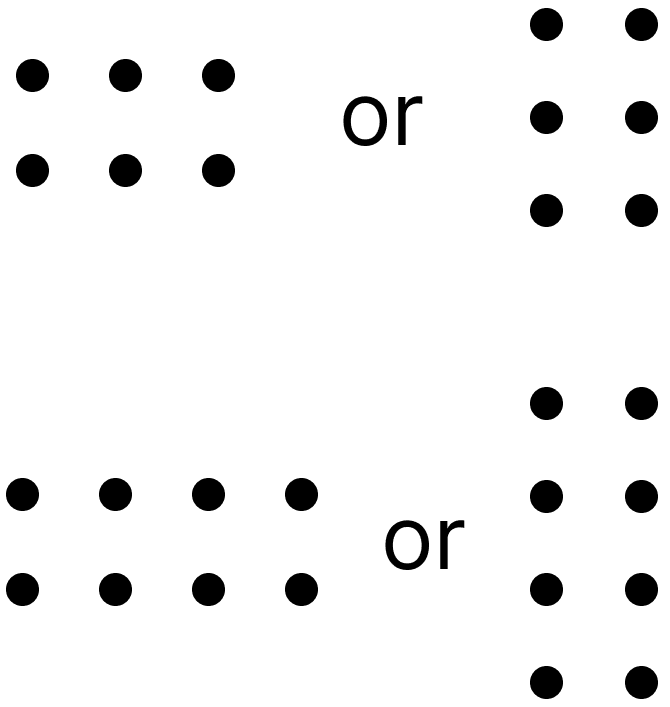
These figures show the arrangement of the numbers 2 × 3 or 3 × 2; 2 × 4 or 4 × 2 i.e. the numbers 6 and 8.
The numbers 6 and 8 are called rectangular numbers. Can you write two more rectangular numbers?
Answer
A rectangular number is a number that can be arranged in a rectangle (with length and breadth being different).
Two more rectangular numbers are:
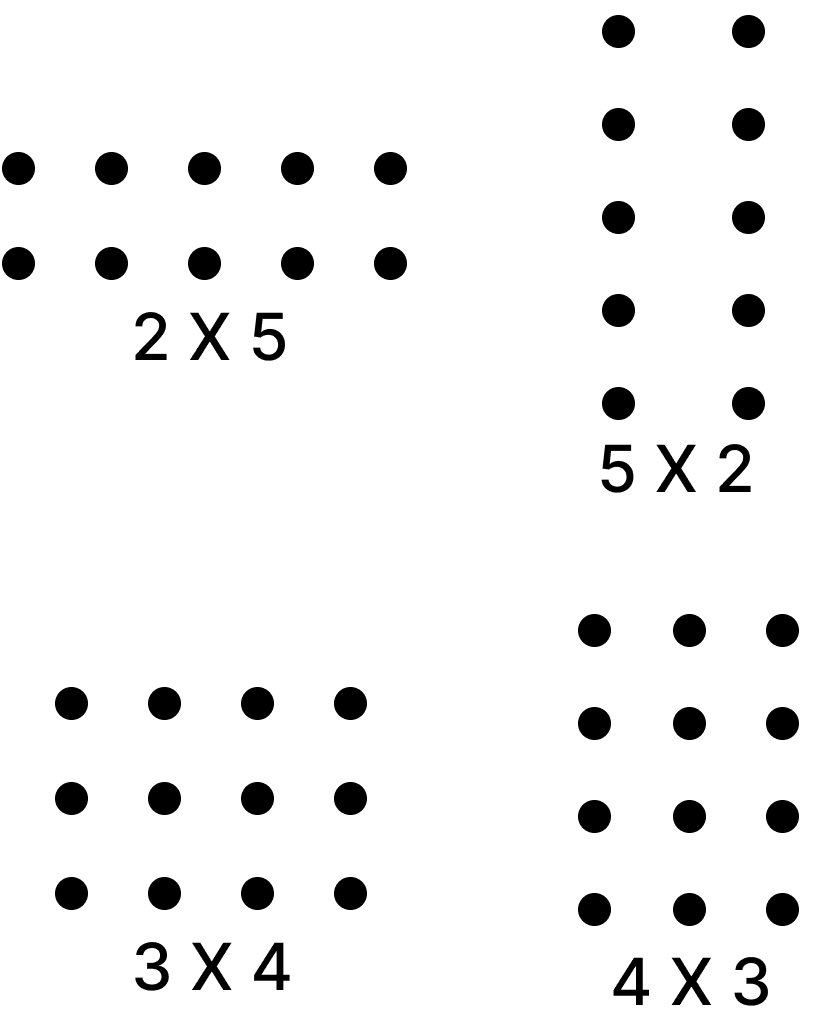
10 (which can be arranged as 2 × 5 or 5 × 2)
12 (which can be arranged as 3 × 4 or 4 × 3)
Fill in the blanks:
(i) A whole number is less than all those whole numbers that lie to its .... on the number line.
(ii) One more than a given whole is called its ....
(iii) There is at least one whole number between two .... whole numbers.
(iv) 738 × 335 = 738 × (300 + 30 + ....)
(v) If a is a non-zero whole number and a × a = a, then a = ....
(vi) .... is the only whole number which is not a natural number.
(vii) The additive identity in whole numbers is ....
(viii) .... is the successor of the largest 3-digit number.
(ix) Division of a whole number by .... is not defined.
Answer
(i) A whole number is less than all those whole numbers that lie to its right on the number line.
(ii) One more than a given whole is called its successor.
(iii) There is atleast one whole number between two non-consecutive whole numbers.
(iv) Since 335 = 300 + 30 + 5, we have:
738 × 335 = 738 × (300 + 30 + 5).
(v) Given, a × a = a where a ≠ 0.
Dividing both sides by a (since a ≠ 0):
a = 1.
So, a = 1.
(vi) 0 is the only whole number which is not a natural number.
(vii) The additive identity in whole numbers is 0.
(viii) The largest 3-digit number is 999. Its successor is 999 + 1 = 1000.
So, 1000 is the successor of the largest 3-digit number.
(ix) Division of a whole number by zero (0) is not defined.
State whether the following statements are true (T) or false (F):
(i) The successor of a one-digit number is always a one-digit number.
(ii) The predecessor of every two-digit number is a one-digit number.
(iii) The predecessor of a 3-digit number is always a 3-digit number.
(iv) The successor of a 3-digit number is always a 3-digit number.
(v) If a is any whole number, then a ÷ a = 1
(vi) If a is any non-zero whole number, then 0 ÷ a = 0
(vii) On adding two different whole numbers, we always get a natural number.
(viii) Between two whole numbers there is a whole number.
(ix) There is a natural number which when added to a natural number, gives that number.
(x) If the product of two whole numbers is zero, then at least one of them is zero.
(xi) Any non-zero whole number divided by itself gives the quotient 1.
Answer
(i) False.
Reason: The successor of 9 (a one-digit number) is 10, which is a two-digit number.
(ii) False.
Reason: The predecessor of 99 (a two-digit number) is 98, which is also a two-digit number.
(iii) False.
Reason: The predecessor of 100 (a 3-digit number) is 99, which is a 2-digit number.
(iv) False.
Reason: The successor of 999 (a 3-digit number) is 1000, which is a 4-digit number.
(v) False.
Reason: If a = 0, then a ÷ a = 0 ÷ 0 is not defined. So, the statement is not true for all whole numbers.
(vi) True.
Reason: Zero divided by any non-zero whole number is always 0. For example, 0 ÷ 5 = 0.
(vii) True.
Reason: When two different whole numbers are added, at least one of them is non-zero. So, the sum is at least 1, which is a natural number.
(viii) False.
Reason: Between two consecutive whole numbers (such as 5 and 6), there is no whole number.
(ix) False.
Reason: The number 0, when added to any natural number, gives that number. But 0 is not a natural number. There is no natural number that acts as the additive identity for natural numbers.
(x) True.
Reason: If a × b = 0, then either a = 0 or b = 0 (or both).
(xi) True.
Reason: Any non-zero whole number a satisfies a ÷ a = 1, since a × 1 = a.
The whole number which does not have a predecessor in whole number system is
0
1
2
none of these
Answer
The smallest whole number is 0, thus 0 has no predecessor in the whole number system.
Hence, option 1 is the correct option.
The predecessor of the smallest 4-digit number is
99
999
1000
1001
Answer
The smallest 4-digit number = 1000.
Its predecessor = 1000 - 1 = 999.
Hence, option 2 is the correct option.
The predecessor of 1 million is
9999
99999
999999
1000001
Answer
1 million = 10,00,000 (1 followed by six zeros).
Its predecessor = 10,00,000 - 1 = 9,99,999.
Hence, option 3 is the correct option.
The product of the predecessor and the successor of the greatest 2-digit number is
9900
9800
9700
none of these
Answer
The greatest 2-digit number = 99.
Predecessor of 99 = 99 - 1 = 98.
Successor of 99 = 99 + 1 = 100.
Product of predecessor and successor = 98 × 100 = 9800.
Hence, option 2 is the correct option.
The sum of the successor of the greatest 3-digit number and the predecessor of the smallest 3-digit number is
1000
1100
1101
1099
Answer
The greatest 3-digit number = 999.
Successor of 999 = 999 + 1 = 1000.
The smallest 3-digit number = 100.
Predecessor of 100 = 100 - 1 = 99.
Sum = 1000 + 99 = 1099.
Hence, option 4 is the correct option.
The number of whole numbers between 22 and 54 is
30
31
32
42
Answer
The whole numbers between 22 and 54 are:
23, 24, 25, ......, 53.
Number of these numbers = 53 - 23 + 1 = 31.
Hence, option 2 is the correct option.
The number of whole numbers between the smallest whole number and the greatest 2-digit number is
100
99
98
88
Answer
The smallest whole number = 0.
The greatest 2-digit number = 99.
The whole numbers between 0 and 99 are:
1, 2, 3, ......, 98.
Number of these numbers = 98 - 1 + 1 = 98.
Hence, option 3 is the correct option.
If a is whole number such that a + a = a, then a is equal to
0
1
2
none of these
Answer
Given, a + a = a
⇒ 2a = a
⇒ 2a - a = 0
⇒ a = 0.
Hence, option 1 is the correct option.
The value of (93 × 63 + 93 × 37) is
930
9300
93000
none of these
Answer
Using the Distributive Law of Multiplication over Addition:
93 × 63 + 93 × 37
⇒ 93 × (63 + 37)
⇒ 93 × 100
⇒ 9300.
Hence, option 2 is the correct option.
Which of the following is not equal to zero?
0 × 5
0 ÷ 5
(10 - 10) ÷ 5
(5 - 0) ÷ 5
Answer
0 × 5 = 0.
0 ÷ 5 = 0.
(10 - 10) ÷ 5 = 0 ÷ 5 = 0.
(5 - 0) ÷ 5 = 5 ÷ 5 = 1.
Option 4 gives 1, which is not equal to zero.
Hence, option 4 is the correct option.
Which of the following statement is true?
21 - (13 - 5) = (21 - 13) - 5
21 - 13 is not a whole number
21 × 1 = 21 × 0
13 - 21 is not a whole number
Answer
Let us check each option:
L.H.S. = 21 - (13 - 5) = 21 - 8 = 13. R.H.S. = (21 - 13) - 5 = 8 - 5 = 3. Since L.H.S. ≠ R.H.S., this statement is false.
21 - 13 = 8, which is a whole number. So, the statement is false.
21 × 1 = 21 and 21 × 0 = 0. Since 21 ≠ 0, the statement is false.
13 - 21 = -8, which is a negative number. Negative numbers are not whole numbers. So, the statement is true.
Hence, option 4 is the correct option.
If p and q are two whole numbers, then which of the following may not be a whole number?
p + q
p - q
p + 2q
p × q
Answer
The sum, sum with a multiple, and product of two whole numbers are always whole numbers (closure property of addition and multiplication).
However, the difference of two whole numbers may not be a whole number. For example, if p = 3 and q = 5, then p - q = 3 - 5 = -2, which is not a whole number.
Hence, option 2 is the correct option.
On dividing a number by 9 we get 47 as quotient and 5 as remainder. The number is
418
428
429
none of these
Answer
Given:
Divisor = 9
Quotient = 47
Remainder = 5
By formula, Dividend = (Divisor × Quotient) + Remainder
= (9 × 47) + 5
= 423 + 5
= 428.
Hence, option 2 is the correct option.
By using dot (•) pattern, which of the following numbers can be arranged in two ways namely a triangle and a rectangle?
12
11
10
9
Answer
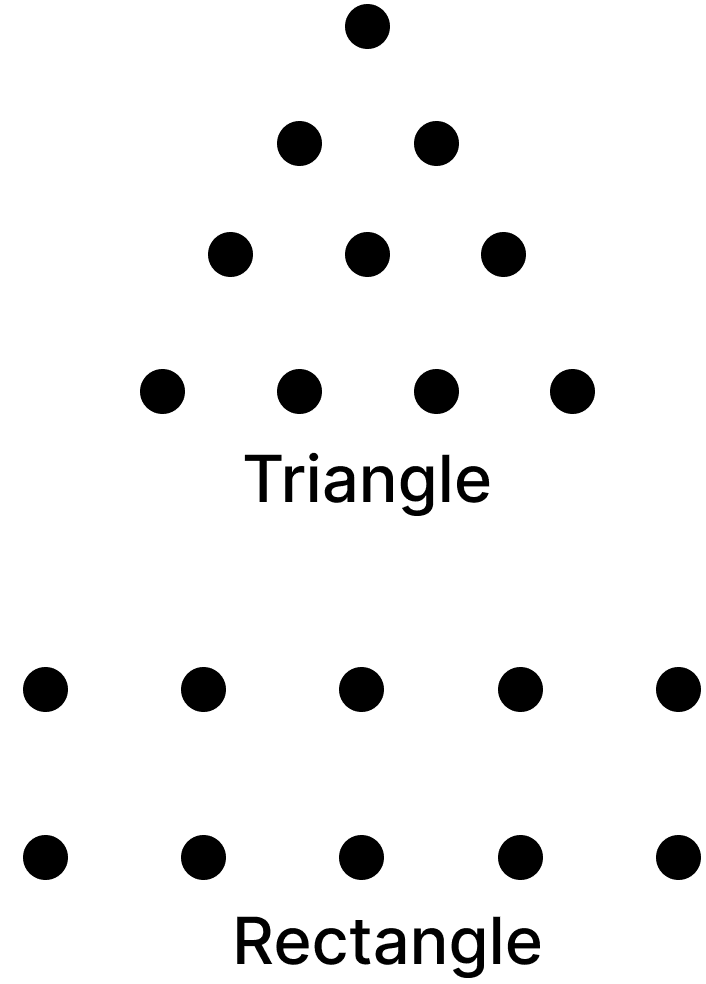
Triangular numbers are: 1, 3, 6, 10, 15, ...
A rectangle means at least one arrangement with different rows and columns:
10 = 2 × 5
Hence, option 3 is the correct option.
Statement I: 41 - 1 = 40
Statement II: When we subtract 1 from the predecessor of any whole number, we get the original number.
Statement I is true but statement II is false.
Statement I is false but statement II is true.
Both Statement I and statement II are true.
Both Statement I and statement II are false.
Answer
Statement I: 41 - 1 = 40. This is correct since 41 - 1 = 40.
∴ Statement I is true.
Statement II: Let us take an example. Consider the whole number 41.
Predecessor of 41 = 41 - 1 = 40.
Subtracting 1 from the predecessor: 40 - 1 = 39.
But the original number is 41, not 39. So, the statement is incorrect.
(In fact, when we subtract 1 from the predecessor, we get a number that is 2 less than the original.)
∴ Statement II is false.
Hence, option 1 is the correct option.
Statement I: 4 × (5 + 6) = 4 × 5 + 4 × 6
Statement II: If a, b and c are three whole numbers then a × (b + c) = a × b + a × c
Statement I is true but statement II is false.
Statement I is false but statement II is true.
Both Statement I and statement II are true.
Both Statement I and statement II are false.
Answer
Statement I:
L.H.S. = 4 × (5 + 6) = 4 × 11 = 44.
R.H.S. = 4 × 5 + 4 × 6 = 20 + 24 = 44.
Since L.H.S. = R.H.S., Statement I is true.
∴ Statement I is true.
Statement II: This is the Distributive Law of Multiplication over Addition, which is a fundamental property of whole numbers.
∴ Statement II is true.
Both Statement I and Statement II are true.
Hence, option 3 is the correct option.
Statement I: 3 ÷ 0 = 0
Statement II: When we divide a whole number by 0, we get 0.
Statement I is true but statement II is false.
Statement I is false but statement II is true.
Both Statement I and statement II are true.
Both Statement I and statement II are false.
Answer
Statement I: Division of any whole number by 0 is not defined. So, 3 ÷ 0 ≠ 0; in fact, 3 ÷ 0 is undefined.
∴ Statement I is false.
Statement II: Division of a whole number by 0 is not defined; we do not get 0.
∴ Statement II is false.
Hence, option 4 is the correct option.
Statement I: 66 = 12 × 5 + 6
Statement II: Dividend = divisor × remainder + quotient, for all whole numbers where divisor ≠ 0
Statement I is true but statement II is false.
Statement I is false but statement II is true.
Both Statement I and statement II are true.
Both Statement I and statement II are false.
Answer
Statement I: Let us check.
12 × 5 + 6 = 60 + 6 = 66.
So, 66 = 12 × 5 + 6 is correct.
∴ Statement I is true.
Statement II: The correct division algorithm states:
Dividend = Divisor × Quotient + Remainder
The given statement has 'remainder' and 'quotient' interchanged, which is incorrect.
∴ Statement II is false.
Hence, option 1 is the correct option.
Write next three consecutive whole numbers of the number 9998
Answer
The next three consecutive whole numbers of 9998 are:
9998 + 1, 9998 + 2 and 9998 + 3 i.e. 9999, 10000 and 10001.
Write three consecutive whole numbers occurring just before 567890
Answer
Three consecutive whole numbers occurring just before 567890 are:
567890 - 1, 567890 - 2 and 567890 - 3 i.e. 567889, 567888 and 567887.
Find the product of the successor and the predecessor of the smallest number of 3-digits.
Answer
The smallest 3-digit number = 100.
Successor of 100 = 100 + 1 = 101.
Predecessor of 100 = 100 - 1 = 99.
Product = 101 × 99
⇒ 101 × (100 - 1)
⇒ 101 × 100 - 101 × 1
⇒ 10100 - 101
⇒ 9999.
Hence, the product of the successor and the predecessor of the smallest 3-digit number is 9999.
Find the number of whole numbers between the smallest and the greatest numbers of 2-digits.
Answer
The smallest 2-digit number = 10.
The greatest 2-digit number = 99.
The whole numbers between 10 and 99 are:
11, 12, 13, ...., 98.
Number of these numbers = 98 - 11 + 1 = 88.
Hence, there are 88 whole numbers between the smallest and the greatest 2-digit numbers.
Find the following sum by suitable arrangements:
(i) 678 + 1319 + 322 + 5681
(ii) 777 + 546 + 1463 + 223 + 537
Answer
(i) 678 + 1319 + 322 + 5681
⇒ (678 + 322) + (1319 + 5681)
⇒ 1000 + 7000
⇒ 8000.
Hence, 678 + 1319 + 322 + 5681 = 8000.
(ii) 777 + 546 + 1463 + 223 + 537
⇒ (777 + 223) + (1463 + 537) + 546
⇒ 1000 + 2000 + 546
⇒ 3546.
Hence, 777 + 546 + 1463 + 223 + 537 = 3546.
Determine the following products by suitable arrangements:
(i) 625 × 437 × 16
(ii) 309 × 25 × 7 × 8
Answer
(i) 625 × 437 × 16
⇒ 437 × (625 × 16)
⇒ 437 × 10000
⇒ 4370000.
Hence, 625 × 437 × 16 = 4370000.
(ii) 309 × 25 × 7 × 8
⇒ (309 × 7) × (25 × 8)
⇒ 2163 × 200
⇒ 432600.
Hence, 309 × 25 × 7 × 8 = 432600.
Find the value of the following by using suitable properties:
(i) 236 × 414 + 236 × 563 + 236 × 23
(ii) 370 × 1587 - 37 × 10 × 587
Answer
(i) 236 × 414 + 236 × 563 + 236 × 23
Using the Distributive Law of Multiplication over Addition:
⇒ 236 × (414 + 563 + 23)
⇒ 236 × 1000
⇒ 236000.
Hence, 236 × 414 + 236 × 563 + 236 × 23 = 236000.
(ii) 370 × 1587 - 37 × 10 × 587
⇒ 370 × 1587 - 370 × 587 [since 37 × 10 = 370]
Using the Distributive Law of Multiplication over Subtraction:
⇒ 370 × (1587 - 587)
⇒ 370 × 1000
⇒ 370000.
Hence, 370 × 1587 - 37 × 10 × 587 = 370000.
Divide 6528 by 29 and check the result by division algorithm.
Answer
Dividend = 6528
Divisor = 29
Quotient = 225
Remainder = 3
Verification: Dividend = (Divisor × Quotient) + Remainder
Substituting values we get:
(Divisor × Quotient) + Remainder
= (29 × 225) + 3
= 6525 + 3
= 6528
Since L.H.S. = R.H.S.
Hence, the result is verified by the division algorithm.
Find the greatest 4-digit number which is exactly divisible by 357
Answer
The greatest 4-digit number = 9999.
To find the greatest 4-digit number exactly divisible by 357, we divide 9999 by 357 and subtract the remainder from 9999.
The remainder when 9999 is divided by 357 is 3.
Therefore, 9999 - 3 = 9996.
Hence, the greatest 4-digit number which is exactly divisible by 357 is 9996.
Find the smallest 5-digit number which is exactly divisible by 279.
Answer
The smallest 5-digit number = 10000.
To find the smallest 5-digit number exactly divisible by 279, we divide 10000 by 279 and add the difference between the divisor and remainder to 10000.
The remainder when 10000 is divided by 279 is 235.
Required number to be added = 279 - 235 = 44.
Number = 10000 + 44 = 10044.
Hence, the smallest 5-digit number which is exactly divisible by 279 is 10044.
The height of a slippery pole is 10 m and an insect is trying to climb the pole. The insect climbs 5 m in one minute and then slips down by 4 m. In how much time will insect reach the top?
Answer
Height of the pole = 10 m.
In each minute, the insect climbs 5 m and then slips down 4 m.
So, the net gain in height per minute = 5 - 4 = 1 m.
Let us track the insect's progress:
- At the end of 1st minute: climbs to 5 m, slips down to 1 m.
- At the end of 2nd minute: climbs to 6 m, slips down to 2 m.
- At the end of 3rd minute: climbs to 7 m, slips down to 3 m.
- At the end of 4th minute: climbs to 8 m, slips down to 4 m.
- At the end of 5th minute: climbs to 9 m, slips down to 5 m.
- During the 6th minute: starts at 5 m and climbs 5 m to reach 10 m (top of the pole).
Once the insect reaches the top, it does not slip down.
Hence, the insect will reach the top in 6 minutes.
Which is greater, the sum of first twenty whole numbers or the product of first twenty whole numbers?
Answer
The first twenty whole numbers are: 0, 1, 2, 3, ......, 19.
Sum of first twenty whole numbers:
Sum = 0 + 1 + 2 + 3 + ...... + 19 = 190.
Product of first twenty whole numbers:
Product = 0 × 1 × 2 × 3 × ...... × 19
Since one of the factors is 0, the product is 0.
⇒ Product = 0.
Comparing: 190 > 0.
Hence, the sum of the first twenty whole numbers (190) is greater than their product (0).
If a whole number is divisible by 2 and 4, is it divisible by 8 also?
Answer
A whole number which is divisible by 2 and 4 may not necessarily be divisible by 8.
Reason: Let us consider some examples.
Take the number 12. It is divisible by 2 (12 ÷ 2 = 6) and divisible by 4 (12 ÷ 4 = 3). But 12 is not divisible by 8 (12 ÷ 8 = 1 remainder 4).
Similarly, take 20. It is divisible by 2 (20 ÷ 2 = 10) and divisible by 4 (20 ÷ 4 = 5). But 20 is not divisible by 8 (20 ÷ 8 = 2 remainder 4).
Hence, if a whole number is divisible by 2 and 4 it may or may not be divisible by 8.