
Write the opposite of the following:
(i) Loss of ₹5000
(ii) 30 km East of Delhi
(iii) 200 m above sea level
(iv) 325 BC
(v) Spending ₹2700
(vi) 25°C above freezing point
Answer
We use the fact that integers are used to represent statements which are opposite to each other in real life.
(i) The opposite of "Loss" is "Gain" or "Profit".
Hence, the opposite of Loss of ₹5000 is Gain (Profit) of ₹5000.
(ii) The opposite of "East" is "West".
Hence, the opposite of 30 km East of Delhi is 30 km West of Delhi.
(iii) The opposite of "above sea level" is "below sea level".
Hence, the opposite of 200 m above sea level is 200 m below sea level.
(iv) The opposite of "BC" (Before Christ) is "AD" (Anno Domini).
Hence, the opposite of 325 BC is 325 AD.
(v) The opposite of "Spending" is "Earning".
Hence, the opposite of Spending ₹2700 is Earning ₹2700.
(vi) The opposite of "above freezing point" is "below freezing point".
Hence, the opposite of 25°C above freezing point is 25°C below freezing point.
Write each of the following using appropriate sign '+' or '-':
(i) Gain of 3 kg weight
(ii) Earning ₹1340
(iii) 20°C below freezing point
(iv) Loss of ₹470
(v) Depositing ₹2500 in a bank
(vi) 240 m below sea level
(vii) A jet plane flying at a height of 9320 m
(viii) 6 m down in the basement of a building
Answer
Gains, earnings, deposits, heights above sea level and altitudes are represented by '+' sign, while losses, expenditures, withdrawals, depths below sea level and depths below the ground are represented by '-' sign.
(i) Gain represents a positive change.
Hence, Gain of 3 kg weight = +3 kg.
(ii) Earning represents money received.
Hence, Earning ₹1340 = +₹1340.
(iii) "Below freezing point" represents a negative temperature.
Hence, 20°C below freezing point = -20°C.
(iv) Loss represents a negative change.
Hence, Loss of ₹470 = -₹470.
(v) Depositing represents adding money to the account.
Hence, Depositing ₹2500 in a bank = +₹2500.
(vi) "Below sea level" represents a depth.
Hence, 240 m below sea level = -240 m.
(vii) "At a height" represents an altitude above the ground.
Hence, A jet plane flying at a height of 9320 m = +9320 m.
(viii) "Down in the basement" represents a depth below the ground.
Hence, 6 m down in the basement of a building = -6 m.
In each of the following pairs, which number is to the right of the other on the number line?
(i) 3, 5
(ii) 0, -2
(iii) -3, -5
(iv) 2, -7
Answer
On the number line, the greater number always lies to the right of the smaller number.
(i) Comparing 3 and 5: 5 > 3.
Hence, 5 is to the right of 3 on the number line.
(ii) Comparing 0 and -2: 0 > -2 (since zero is greater than every negative integer).
Hence, 0 is to the right of -2 on the number line.
(iii) Comparing -3 and -5: |-3| = 3 and |-5| = 5. Since 3 < 5, we get -3 > -5.
Hence, -3 is to the right of -5 on the number line.
(iv) Comparing 2 and -7: 2 > -7 (since every positive integer is greater than every negative integer).
Hence, 2 is to the right of -7 on the number line.
In each of the following pairs, which number is to the left of the other on the number line?
(i) -3, 0
(ii) 2, -5
(iii) -4, -7
(iv) -10, -16
Answer
On the number line, the smaller number always lies to the left of the greater number.
(i) Comparing -3 and 0: -3 < 0.
Hence, -3 is to the left of 0 on the number line.
(ii) Comparing 2 and -5: -5 < 2.
Hence, -5 is to the left of 2 on the number line.
(iii) Comparing -4 and -7: |-4| = 4 and |-7| = 7. Since 4 < 7, we get -7 < -4.
Hence, -7 is to the left of -4 on the number line.
(iv) Comparing -10 and -16: |-10| = 10 and |-16| = 16. Since 10 < 16, we get -16 < -10.
Hence, -16 is to the left of -10 on the number line.
Draw a number line and answer the following questions:
(i) Which integers lie between -9 and -2?
(ii) Which is the largest among them?
(iii) Which is the smallest among them?
Answer
The number line is shown below:

(i) The integers strictly between -9 and -2 are the integers greater than -9 and less than -2.
Hence, the integers between -9 and -2 are -8, -7, -6, -5, -4 and -3.
(ii) On the number line, the integer farthest to the right among -8, -7, -6, -5, -4 and -3 is -3.
Hence, the largest integer among them is -3.
(iii) On the number line, the integer farthest to the left among -8, -7, -6, -5, -4 and -3 is -8.
Hence, the smallest integer among them is -8.
Write four consecutive integers just greater than -9
Answer
Four consecutive integers just greater than -9 are obtained by repeatedly adding 1 to -9.
-9 + 1 = -8
-8 + 1 = -7
-7 + 1 = -6
-6 + 1 = -5
Hence, the four consecutive integers just greater than -9 are -8, -7, -6 and -5.
Write four consecutive integers just before -2.
Answer
Four consecutive integers just before -2 are obtained by repeatedly subtracting 1 from -2.
-2 - 1 = -3
-3 - 1 = -4
-4 - 1 = -5
-5 - 1 = -6
Listing them in order from smallest to largest, the four consecutive integers just before -2 are -6, -5, -4 and -3.
Hence, the four consecutive integers just before -2 are -6, -5, -4 and -3.
Draw a number line and answer the following questions:
(i) Which number will we reach if we move 6 units to the right of -1?
(ii) Which number will we reach if we move 7 units to the left of 2?
(iii) In which direction should we move to reach 3 from -3?
(iv) In which direction should we move to reach -8 from -3?
Answer
The number line is drawn for reference:
(i) Starting from -1 and moving 6 units to the right:

Hence, after moving 6 units to the right of -1, we reach 5.
(ii) Starting from 2 and moving 7 units to the left:

Hence, after moving 7 units to the left of 2, we reach -5.
(iii) On the number line, 3 lies to the right of -3.

Hence, to reach 3 from -3, we should move in the right direction.
(iv) On the number line, -8 lies to the left of -3.

Hence, to reach -8 from -3, we should move in the left direction.
Using the number line, write the integer which is:
(i) 5 more than -1
(ii) 5 less than -1
(iii) 7 less than 2
(iv) 3 more than -7
Answer
To find an integer "more than" a given integer, we move to the right on the number line. To find an integer "less than" a given integer, we move to the left on the number line.
(i) Start at -1 and move 5 units to the right:

Hence, the integer which is 5 more than -1 is 4.
(ii) Start at -1 and move 5 units to the left:

Hence, the integer which is 5 less than -1 is -6.
(iii) Start at 2 and move 7 units to the left:

Hence, the integer which is 7 less than 2 is -5.
(iv) Start at -7 and move 3 units to the right:

Hence, the integer which is 3 more than -7 is -4.
(i) How many integers are there between -15 and -7?
(ii) How many integers are there between -6 and 3?
(iii) How many whole numbers are there between -6 and 6?
(iv) How many negative integers are there between -7 and 4?
Answer
By "between" we mean strictly between (the end points are not included).
(i) The integers strictly between -15 and -7 are:
-14, -13, -12, -11, -10, -9, -8.
Counting them gives 7 integers.
Hence, there are 7 integers between -15 and -7.
(ii) The integers strictly between -6 and 3 are:
-5, -4, -3, -2, -1, 0, 1, 2.
Counting them gives 8 integers.
Hence, there are 8 integers between -6 and 3.
(iii) Whole numbers are 0, 1, 2, 3, 4, 5, 6, ... .
The whole numbers strictly between -6 and 6 are:
0, 1, 2, 3, 4, 5.
Counting them gives 6 whole numbers.
Hence, there are 6 whole numbers between -6 and 6.
(iv) Negative integers are -1, -2, -3, ... .
The negative integers strictly between -7 and 4 are:
-6, -5, -4, -3, -2, -1.
Counting them gives 6 negative integers.
Hence, there are 6 negative integers between -7 and 4.
Evaluate the following:
(i) |13 - 5|
(ii) |5 - 13|
(iii) |-11| + |9|
(iv) |-8| + |-6|
(v) |7| - |-3|
(vi) |-19| - |-13|
Answer
The absolute value of an integer is its numerical value regardless of its sign. We have |a| = a if a ≥ 0 and |a| = -a if a < 0.
(i) |13 - 5| = |8| = 8.
Hence, |13 - 5| = 8.
(ii) |5 - 13| = |-8| = 8.
Hence, |5 - 13| = 8.
(iii) |-11| + |9| = 11 + 9 = 20.
Hence, |-11| + |9| = 20.
(iv) |-8| + |-6| = 8 + 6 = 14.
Hence, |-8| + |-6| = 14.
(v) |7| - |-3| = 7 - 3 = 4.
Hence, |7| - |-3| = 4.
(vi) |-19| - |-13| = 19 - 13 = 6.
Hence, |-19| - |-13| = 6.
Use the appropriate symbol < or > to fill in the following blanks:
(i) -3 ..... 7
(ii) 0 ..... -2
(iii) -10 ..... -11
(iv) -6 ..... -2
(v) -5 ..... -13
(vi) -30 ..... -19
Answer
We use the rules of comparison of integers: every negative integer is less than every positive integer; zero is greater than every negative integer; for two negative integers, the one with the smaller absolute value is greater.
(i) -3 is negative and 7 is positive. Every negative integer is less than every positive integer.
Hence, -3 < 7.
(ii) Zero is greater than every negative integer.
Hence, 0 > -2.
(iii) Both -10 and -11 are negative. |-10| = 10 and |-11| = 11. Since 10 < 11, the one with smaller absolute value (-10) is greater.
Hence, -10 > -11.
(iv) Both -6 and -2 are negative. |-6| = 6 and |-2| = 2. Since 6 > 2, the one with bigger absolute value (-6) is smaller.
Hence, -6 < -2.
(v) Both -5 and -13 are negative. |-5| = 5 and |-13| = 13. Since 5 < 13, the one with smaller absolute value (-5) is greater.
Hence, -5 > -13.
(vi) Both -30 and -19 are negative. |-30| = 30 and |-19| = 19. Since 30 > 19, the one with bigger absolute value (-30) is smaller.
Hence, -30 < -19.
Arrange the following integers in ascending order:
(i) -5, 3, 0, -9, 2
(ii) -28, -33, 9, -4, -31, -2, 35
Answer
Ascending order means arranging from the smallest to the greatest.
(i) The given integers are -5, 3, 0, -9, 2.
The negative integers are -5 and -9. |-5| = 5 and |-9| = 9. Since 5 < 9, we have -9 < -5.
The non-negative integers are 0, 3 and 2. In increasing order: 0 < 2 < 3.
Since every negative integer is less than zero (and every positive integer):
-9 < -5 < 0 < 2 < 3.
Hence, the given integers in ascending order are -9, -5, 0, 2, 3.
(ii) The given integers are -28, -33, 9, -4, -31, -2, 35.
The negative integers are -28, -33, -4, -31, -2. Their absolute values are 28, 33, 4, 31, 2.
Arranging the absolute values in increasing order: 2 < 4 < 28 < 31 < 33. So the negatives in increasing order are -33 < -31 < -28 < -4 < -2.
The positive integers are 9 and 35. In increasing order: 9 < 35.
Since every negative integer is less than positive integer :
-33 < -31 < -28 < -4 < -2 < 9 < 35.
Hence, the given integers in ascending order are -33, -31, -28, -4, -2, 9, 35.
Arrange the following integers in descending order:
(i) -31, 25, -37, 43, 0, -5
(ii) -101, 95, -3, -8, 36, -7, -84
Answer
Descending order means arranging from the greatest to the smallest.
(i) The given integers are -31, 25, -37, 43, 0, -5.
The positive integers are 25 and 43. In decreasing order: 43 > 25.
Then comes 0, which is greater than every negative integer.
The negative integers are -31, -37 and -5. Their absolute values are 31, 37 and 5.
Arranging the absolute values in decreasing order: 37 > 31 > 5. So the negatives in decreasing order are -5 > -31 > -37.
Combining: 43 > 25 > 0 > -5 > -31 > -37.
Hence, the given integers in descending order are 43, 25, 0, -5, -31, -37.
(ii) The given integers are -101, 95, -3, -8, 36, -7, -84.
The positive integers are 95 and 36. In decreasing order: 95 > 36.
The negative integers are -101, -3, -8, -7 and -84. Their absolute values are 101, 3, 8, 7 and 84.
Arranging the absolute values in decreasing order: 101 > 84 > 8 > 7 > 3. So the negatives in decreasing order are -3 > -7 > -8 > -84 > -101.
Combining: 95 > 36 > -3 > -7 > -8 > -84 > -101.
Hence, the given integers in descending order are 95, 36, -3, -7, -8, -84, -101.
State whether the following statements are true (T) or false (F):
(i) 0 is the smallest positive integer.
(ii) Every negative integer is less than every natural number.
(iii) -7 is to the right of -6 on the number line.
(iv) The absolute value of an integer is always greater than the integer.
Answer
(i) The number 0 is neither positive nor negative. The positive integers are 1, 2, 3, ... and the smallest among them is 1.
Hence, the statement is False.
(ii) Natural numbers are 1, 2, 3, ..., which are all positive integers. Every negative integer is less than every positive integer, hence less than every natural number.
Hence, the statement is True.
(iii) Finding the absolute values,
|-7| = 7 and |-6| = 6. Since 7 > 6, we get -7 < -6, so -7 lies to the left of -6 (not the right).
Hence, the statement is False.
(iv) For a positive integer a, |a| = a (not greater than a). For 0, |0| = 0 (not greater than 0). Only for a negative integer is the absolute value greater than the integer itself.
Hence, the statement is False.
Evaluate the following, using the number line:
(i) 4 + (-5)
(ii) (-4) + 5
(iii) 7 + (-3)
(iv) -6 + (-2)
Answer
To add a positive integer, we move to the right on the number line. To add a negative integer, we move to the left on the number line.
(i) Start at 4 on the number line and move 5 units to the left:

Hence, 4 + (-5) = -1.
(ii) Start at -4 on the number line and move 5 units to the right:

Hence, (-4) + 5 = 1.
(iii) Start at 7 on the number line and move 3 units to the left:

Hence, 7 + (-3) = 4.
(iv) Start at -6 on the number line and move 2 units to the left:

Hence, -6 + (-2) = -8.
Evaluate the following:
(i) (-8) + (-14)
(ii) -35 + (-47)
(iii) 91 + (-48)
(iv) (-203) + 501
(v) (-36) + 29
(vi) (-131) + 97
Answer
To add two negative integers, we add their absolute values and put the negative sign before the result. To add a positive integer and a negative integer, we subtract the smaller absolute value from the larger absolute value and give the sign of the integer with the larger absolute value.
(i) Both integers are negative. Add their absolute values and put the negative sign:
(-8) + (-14) = -(8 + 14) = -22.
Hence, (-8) + (-14) = -22.
(ii) Both integers are negative. Add their absolute values and put the negative sign:
-35 + (-47) = -(35 + 47) = -82.
Hence, -35 + (-47) = -82.
(iii) Different signs. |91| = 91 and |-48| = 48. Subtract: 91 - 48 = 43. The integer with the larger absolute value (91) is positive, so the answer is positive.
91 + (-48) = +(91 - 48) = 43.
Hence, 91 + (-48) = 43.
(iv) Different signs. |-203| = 203 and |501| = 501. Subtract: 501 - 203 = 298. The integer with the larger absolute value (501) is positive, so the answer is positive.
(-203) + 501 = +(501 - 203) = 298.
Hence, (-203) + 501 = 298.
(v) Different signs. |-36| = 36 and |29| = 29. Subtract: 36 - 29 = 7. The integer with the larger absolute value (-36) is negative, so the answer is negative.
(-36) + 29 = -(36 - 29) = -7.
Hence, (-36) + 29 = -7.
(vi) Different signs. |-131| = 131 and |97| = 97. Subtract: 131 - 97 = 34. The integer with the larger absolute value (-131) is negative, so the answer is negative.
(-131) + 97 = -(131 - 97) = -34.
Hence, (-131) + 97 = -34.
Evaluate the following:
(i) -1083 + (-3974)
(ii) 706 + (-394)
(iii) 1309 + (-2811)
Answer
(i) Both integers are negative. Add their absolute values and put the negative sign:
-1083 + (-3974) = -(1083 + 3974) = -5057.
Hence, -1083 + (-3974) = -5057.
(ii) Different signs. |706| = 706 and |-394| = 394. Subtract: 706 - 394 = 312. The integer with the larger absolute value (706) is positive, so the answer is positive.
706 + (-394) = +(706 - 394) = 312.
Hence, 706 + (-394) = 312.
(iii) Different signs. |1309| = 1309 and |-2811| = 2811. Subtract: 2811 - 1309 = 1502. The integer with the larger absolute value (-2811) is negative, so the answer is negative.
1309 + (-2811) = -(2811 - 1309) = -1502.
Hence, 1309 + (-2811) = -1502.
Fill in the following blanks:
(i) -(-5) = ...
(ii) -(-30) = ...
(iii) -(-539) = ...
Answer
For every integer a, the additive inverse of -a is a, i.e. -(-a) = a. So, the negative of a negative integer is the corresponding positive integer.
(i) -(-5) = 5.
Hence, -(-5) = 5.
(ii) -(-30) = 30.
Hence, -(-30) = 30.
(iii) -(-539) = 539.
Hence, -(-539) = 539.
Write down the additive inverses of:
(i) 9
(ii) -11
(iii) -237
(iv) 567
Answer
The additive inverse of an integer a is -a, since a + (-a) = 0.
(i) The additive inverse of 9 is -9.
(Check: 9 + (-9) = 0.)
Hence, the additive inverse of 9 is -9.
(ii) The additive inverse of -11 is -(-11) = 11.
(Check: -11 + 11 = 0.)
Hence, the additive inverse of -11 is 11.
(iii) The additive inverse of -237 is -(-237) = 237.
(Check: -237 + 237 = 0.)
Hence, the additive inverse of -237 is 237.
(iv) The additive inverse of 567 is -567.
(Check: 567 + (-567) = 0.)
Hence, the additive inverse of 567 is -567.
(i) Write the integer which is its own additive inverse.
(ii) Write the integer which is 4 more than its additive inverse.
(iii) Write the integer which is 2 less than its additive inverse.
Answer
If a is an integer, its additive inverse is -a (and a + (-a) = 0).
(i) Let the required integer be a. Then a is its own additive inverse, so
a = -a
⇒ 2a = 0
⇒ a = 0.
Hence, 0 is the integer which is its own additive inverse.
(ii) Let the required integer be a. Its additive inverse is -a. Then a is 4 more than -a:
a = (-a) + 4
⇒ a + a = 4
⇒ 2a = 4
⇒ a = 2.
(Check: additive inverse of 2 is -2, and 2 = -2 + 4. ✓)
Hence, 2 is the integer which is 4 more than its additive inverse.
(iii) Let the required integer be a. Its additive inverse is -a. Then a is 2 less than -a:
a = (-a) - 2
⇒ a + a = -2
⇒ 2a = -2
⇒ a = -1.
(Check: additive inverse of -1 is 1, and -1 = 1 - 2. ✓)
Hence, -1 is the integer which is 2 less than its additive inverse.
Evaluate the following, using the number line:
(i) 4 - (-2)
(ii) -4 - (-2)
(iii) 3 - 6
(iv) -3 - (-5)
Answer
To subtract a positive integer, we move to the left on the number line. To subtract a negative integer, we move to the right on the number line.
(i) To find 4 - (-2), start at 4 and move 2 units to the right:

Hence, 4 - (-2) = 6.
(ii) To find -4 - (-2), start at -4 and move 2 units to the right:

Hence, -4 - (-2) = -2.
(iii) To find 3 - 6, start at 3 and move 6 units to the left:

Hence, 3 - 6 = -3.
(iv) To find -3 - (-5), start at -3 and move 5 units to the right:

Hence, -3 - (-5) = 2.
Subtract:
(i) -6 from 9
(ii) 6 from -9
(iii) -6 from -9
(iv) -725 from -63
(v) -376 from 10
(vi) 92 from -620
Answer
To subtract one integer from another, we change the sign of the integer to be subtracted and then add. That is, a - b = a + (-b).
(i) Subtract -6 from 9:
9 - (-6) = 9 + 6 = 15.
Hence, the result is 15.
(ii) Subtract 6 from -9:
-9 - 6 = -9 + (-6) = -(9 + 6) = -15.
Hence, the result is -15.
(iii) Subtract -6 from -9:
-9 - (-6) = -9 + 6 = -(9 - 6) = -3.
Hence, the result is -3.
(iv) Subtract -725 from -63:
-63 - (-725) = -63 + 725 = +(725 - 63) = 662.
Hence, the result is 662.
(v) Subtract -376 from 10:
10 - (-376) = 10 + 376 = 386.
Hence, the result is 386.
(vi) Subtract 92 from -620:
-620 - 92 = -620 + (-92) = -(620 + 92) = -712.
Hence, the result is -712.
Evaluate the following:
(i) -237 - (+1884)
(ii) -346 - (-1275)
(iii) -190 - (-3512)
(iv) -2718 - (+6827)
Answer
We use the rule a - b = a + (-b), i.e. change the sign of the integer to be subtracted and add.
(i) -237 - (+1884) = -237 + (-1884)
= -(237 + 1884)
= -2121.
Hence, -237 - (+1884) = -2121.
(ii) -346 - (-1275) = -346 + 1275
= +(1275 - 346)
= 929.
Hence, -346 - (-1275) = 929.
(iii) -190 - (-3512) = -190 + 3512
= +(3512 - 190)
= 3322.
Hence, -190 - (-3512) = 3322.
(iv) -2718 - (+6827) = -2718 + (-6827)
= -(2718 + 6827)
= -9545.
Hence, -2718 - (+6827) = -9545.
(i) The sum of two integers is 17. If one of them is -35, find the other.
(ii) The sum of two integers is -80. If one of them is -90, then find the other.
Answer
If the sum of two integers and one of them are known, the other integer = sum - (the given integer).
(i) Sum = 17 and one integer = -35.
Other integer = 17 - (-35)
= 17 + 35
= 52.
(Check: -35 + 52 = 17. ✓)
Hence, the other integer is 52.
(ii) Sum = -80 and one integer = -90.
Other integer = -80 - (-90)
= -80 + 90
= +(90 - 80)
= 10.
(Check: -90 + 10 = -80. ✓)
Hence, the other integer is 10.
What must be added to -23 to get -9?
Answer
Let x be the integer that must be added to -23 to get -9.
Then, -23 + x = -9.
⇒ x = -9 - (-23)
= -9 + 23
= +(23 - 9)
= 14.
(Check: -23 + 14 = -9. ✓)
Hence, 14 must be added to -23 to get -9.
Find the predecessor of 0.
Answer
The predecessor of an integer a is a - 1.
Predecessor of 0 = 0 - 1 = -1.
Hence, the predecessor of 0 is -1.
Find the successor and the predecessor of the following integers:
(i) -31
(ii) -735
(iii) -240
Answer
For an integer a, its successor is a + 1 and its predecessor is a - 1.
(i) For -31:
Successor = -31 + 1 = -30.
Predecessor = -31 - 1 = -32.
Hence, the successor of -31 is -30 and the predecessor of -31 is -32.
(ii) For -735:
Successor = -735 + 1 = -734.
Predecessor = -735 - 1 = -736.
Hence, the successor of -735 is -734 and the predecessor of -735 is -736.
(iii) For -240:
Successor = -240 + 1 = -239.
Predecessor = -240 - 1 = -241.
Hence, the successor of -240 is -239 and the predecessor of -240 is -241.
Find the value of:
(i) 6 - 9 + 4
(ii) -5 - (-3) + 2
(iii) 7 + (-5) + (-6)
(iv) 6 - 3 - (-5)
Answer
We group the positive integers and the negative integers separately and then add their results.
(i) 6 - 9 + 4 = (6 + 4) - 9
= 10 - 9
= 1.
Hence, 6 - 9 + 4 = 1.
(ii) -5 - (-3) + 2 = -5 + 3 + 2
= (3 + 2) - 5
= 5 - 5
= 0.
Hence, -5 - (-3) + 2 = 0.
(iii) 7 + (-5) + (-6) = 7 - 5 - 6
= 7 - (5 + 6)
= 7 - 11
= -4.
Hence, 7 + (-5) + (-6) = -4.
(iv) 6 - 3 - (-5) = 6 - 3 + 5
= (6 + 5) - 3
= 11 - 3
= 8.
Hence, 6 - 3 - (-5) = 8.
Evaluate the following:
(i) -77 + (-84) + 318
(ii) 54 + (-218) - (-76)
(iii) -121 - (-78) + (-193) + 576
(iv) -65 + (-76) - (-28) + 32
Answer
We group the positive integers and the negative integers separately.
(i) -77 + (-84) + 318 = -77 - 84 + 318
= 318 - (77 + 84)
= 318 - 161
= 157.
Hence, -77 + (-84) + 318 = 157.
(ii) 54 + (-218) - (-76) = 54 - 218 + 76
= (54 + 76) - 218
= 130 - 218
= -(218 - 130)
= -88.
Hence, 54 + (-218) - (-76) = -88.
(iii) -121 - (-78) + (-193) + 576 = -121 + 78 - 193 + 576
= (78 + 576) - (121 + 193)
= 654 - 314
= 340.
Hence, -121 - (-78) + (-193) + 576 = 340.
(iv) -65 + (-76) - (-28) + 32 = -65 - 76 + 28 + 32
= (28 + 32) - (65 + 76)
= 60 - 141
= -(141 - 60)
= -81.
Hence, -65 + (-76) - (-28) + 32 = -81.
Find the value of:
(i) 8 - 6 + (-2) - (-3) + 1
(ii) 31 + (-23) - 35 + 18 - 4 - (-3)
Answer
We group the positive and the negative integers separately.
(i) 8 - 6 + (-2) - (-3) + 1 = 8 - 6 - 2 + 3 + 1
= (8 + 3 + 1) - (6 + 2)
= 12 - 8
= 4.
Hence, 8 - 6 + (-2) - (-3) + 1 = 4.
(ii) 31 + (-23) - 35 + 18 - 4 - (-3) = 31 - 23 - 35 + 18 - 4 + 3
= (31 + 18 + 3) - (23 + 35 + 4)
= 52 - 62
= -(62 - 52)
= -10.
Hence, 31 + (-23) - 35 + 18 - 4 - (-3) = -10.
Rashmi deposited ₹4370 in her account on Monday and then withdrew ₹2875 on Tuesday. Next day she deposited ₹1550. What was her balance on Thursday?
Answer
A deposit is represented by a positive integer and a withdrawal is represented by a negative integer.
Amount deposited on Monday = +₹4370.
Amount withdrawn on Tuesday = -₹2875.
Amount deposited on Wednesday = +₹1550.
There is no transaction on Thursday, so the balance on Thursday is the same as the balance at the end of Wednesday.
Balance on Thursday = (+4370) + (-2875) + (+1550)
= 4370 + 1550 - 2875
= 5920 - 2875
= ₹3045.
Hence, Rashmi's balance on Thursday was ₹3,045.
Fill in the blanks:
(i) The absolute value of 0 is .....
(ii) The sum of two negative integers is always a ..... integer.
(iii) The smallest positive integer is .....
(iv) The largest negative integer is .....
(v) The predecessor of -99 is .....
Answer
(i) The absolute value of an integer is its numerical value regardless of its sign. So |0| = 0.
Hence, the absolute value of 0 is 0.
(ii) When we add two negative integers, we add their absolute values and put a negative sign before the result. So the sum is always negative.
Hence, the sum of two negative integers is always a negative integer.
(iii) The positive integers are 1, 2, 3, 4, ... and the smallest among them is 1.
Hence, the smallest positive integer is 1.
(iv) The negative integers are -1, -2, -3, -4, ... and the largest among them is -1.
Hence, the largest negative integer is -1.
(v) Predecessor of -99 = -99 - 1 = -100.
Hence, the predecessor of -99 is -100.
State whether the following statements are true (T) or false (F):
(i) The sum of a positive integer and a negative integer is always a negative integer.
(ii) The sum of an integer and its negative is always zero.
(iii) The sum of three integers can never be zero.
(iv) |-7| < |-3|
(v) -20 is to the left of -21 on the number line.
(vi) The successor of -29 is -30
(vii) The difference of two integers is always an integer.
(viii) Additive inverse of a negative integer is always a positive integer.
Answer
(i) When a positive integer and a negative integer are added, the sign of the sum is the sign of the integer with the larger absolute value. For example, 8 + (-3) = 5 (positive). So the sum is not always negative.
Hence, the statement is False.
(ii) For every integer a, a + (-a) = 0. So the sum of an integer and its negative (additive inverse) is always zero.
Hence, the statement is True.
(iii) Three integers can sum to zero. For example, 1 + 2 + (-3) = 0.
Hence, the statement is False.
(iv) |-7| = 7 and |-3| = 3. Since 7 > 3, we have |-7| > |-3|.
Hence, the statement is False.
(v) Comparing -20 and -21: |-20| = 20 and |-21| = 21. Since 20 < 21, we have -20 > -21. So -20 lies to the RIGHT of -21, not to the left.
Hence, the statement is False.
(vi) Successor of -29 = -29 + 1 = -28, not -30.
Hence, the statement is False.
(vii) For any two integers a and b, a - b = a + (-b). Since the sum of two integers is always an integer (closure under addition), the difference of two integers is also always an integer.
Hence, the statement is True.
(viii) The additive inverse of a negative integer -a (where a is positive) is -(-a) = a, which is positive.
Hence, the statement is True.
State whether the following statements are true or false. If a statement is false, write the corresponding correct statement.
(i) -8 is to the right of -10 on the number line.
(ii) -100 is to the right of -50 on the number line.
(iii) Smallest negative integer is -1
(iv) -26 is greater than -25
(v) -187 is the predecessor of -188
Answer
(i) Comparing -8 and -10: |-8| = 8 and |-10| = 10. Since 8 < 10, we have -8 > -10. So -8 lies to the right of -10.
Hence, the statement is True.
(ii) Comparing -100 and -50: |-100| = 100 and |-50| = 50. Since 100 > 50, we have -100 < -50. So -100 lies to the LEFT of -50.
Hence, the statement is False. The correct statement is: "-100 is to the left of -50 on the number line."
(iii) The negative integers are -1, -2, -3, -4, ... and continue indefinitely. So there is no smallest negative integer. (In fact, -1 is the LARGEST negative integer.)
Hence, the statement is False. The correct statement is: "The largest negative integer is -1" (there is no smallest negative integer).
(iv) Comparing -26 and -25: |-26| = 26 and |-25| = 25. Since 26 > 25, we have -26 < -25. So -26 is less than -25.
Hence, the statement is False. The correct statement is: "-26 is less than -25" (or equivalently, -25 is greater than -26).
(v) Predecessor of -188 = -188 - 1 = -189, not -187. (In fact, -187 is the successor of -188.)
Hence, the statement is False. The correct statement is: "-189 is the predecessor of -188" (or equivalently, "-187 is the successor of -188").
The integer which is 5 more than -2 is
-7
-3
3
7
Answer
Calculating :
-2 + 5 = 3.
Hence, option 3 is the correct option.
The number of integers between -1 and 1 is
0
1
2
3
Answer
The integers strictly between -1 and 1 are the integers greater than -1 and less than 1.
The only such integer is 0.
So, the number of integers between -1 and 1 = 1.
Hence, option 2 is the correct option.
The number of integers between -3 and 2 are
2
3
4
5
Answer
The integers strictly between -3 and 2 are -2, -1, 0 and 1.
Counting them gives 4 integers.
Hence, option 3 is the correct option.
The greatest integer lying between -10 and -15 is
-10
-11
-14
-15
Answer
The integers strictly between -10 and -15 are -11, -12, -13 and -14.
For negative numbers, the one with the smaller absolute value (the one closer to zero) is the greater number.
Here, |-11| = 11, is the smallest absolute value. Thus, -11 is the greatest integer.
Hence, option 2 is the correct option.
The smallest integer lying between -10 and -15 is
-10
-11
-14
-15
Answer
The integers strictly between -10 and -15 are -11, -12, -13 and -14.
For negative numbers, the one with the smaller absolute value (the one closer to zero) is the greater number.
Among these, |-14| = 14 is the largest absolute value, so -14 is the smallest.
Hence, option 3 is the correct option.
Which of the following statement is true?
|10 - 4| = |10| + |-4|
Additive inverse of -5 is 5
-1 lies on the right of 0 on the number line
-7 is greater than -3
Answer
Let additive inverse of -5 be x, then
-5 + x = 0
x = 5.
Only option 2 is true.
Hence, option 2 is the correct option.
Which of the following statement is false?
-20 - (-5) = -15
|-18| > |-13|
23 + (-31) = 8
Every negative integer is less than 5
Answer
Solving,
23 + (-31) = -(31 - 23)
= -8.
Only option 3 is false.
Hence, option 3 is the correct option.
Which of the following statements is false?
(-3) + (-11) is an integer
(-19) + 13 = 13 + (-19)
(-15) + 0 = -15 = 0 + (-15)
Negative of -7 does not exist
Answer
Let us check each option.
The sum of two integers is always an integer (closure property of addition). So, this statement (-3) + (-11) is true.
Addition is commutative for integers: a + b = b + a. So, this statement(-19) + 13 = 13 + (-19) is true.
Zero is the additive identity: a + 0 = a = 0 + a. So, this statement (-15) + 0 = -15 = 0 + (-15) is true.
The negative (additive inverse) of -7 is -(-7) = 7, which exists. So the statement "negative of -7 does not exist" is false.
Only option 4 is false.
Hence, option 4 is the correct option.
If the sum of two integers is -17 and one of them is -9, then the other is
8
-8
26
-26
Answer
Other integer = sum - (the given integer)
= -17 - (-9)
= -17 + 9
= -(17 - 9)
= -8.
Hence, option 2 is the correct option.
On subtracting -7 from -4, we get
3
-3
-11
none of these
Answer
Subtracting -7 from -4:
-4 - (-7) = -4 + 7
= +(7 - 4)
= 3.
Hence, option 1 is the correct option.
(-12) + 17 - (-10) is equal to
-5
5
15
-15
Answer
(-12) + 17 - (-10) = -12 + 17 + 10
= (17 + 10) - 12
= 27 - 12
= 15.
Hence, option 3 is the correct option.
Which of the following statements is true?
-13 > -8 - (-6)
-5 - 4 > -12 + 2
(-8) - 3 = (-3) - (-8)
(-15) - (-22) < (-22) - (-15)
Answer
Let us evaluate both sides of each option.
LHS = -13 and RHS = -8 - (-6) = -8 + 6 = -2. Is -13 > -2? Since |-13| > |-2|, we have -13 < -2. False.
LHS = -5 - 4 = -9 and RHS = -12 + 2 = -10. Is -9 > -10? Since |-9| < |-10|, we have -9 > -10. True.
LHS = (-8) - 3 = -11 and RHS = (-3) - (-8) = -3 + 8 = 5. Since -11 ≠ 5, False.
LHS = (-15) - (-22) = -15 + 22 = 7 and RHS = (-22) - (-15) = -22 + 15 = -7. Is 7 < -7? No, 7 > -7. False.
Only option 2 is true.
Hence, option 2 is the correct option.
The statement "when an integer is added to itself, the sum is less than the integer" is
always true
never true
true only when the integer is negative
true when the integer is zero or positive
Answer
Let the integer be a. Then a + a = 2a. We must check when 2a < a.
If a is positive (e.g. a = 5): 2a = 10 and a = 5. Then 2a > a, so the statement is false.
If a = 0: 2a = 0 and a = 0. Then 2a = a, so the statement is false (the sum is not less than the integer).
If a is negative (e.g. a = -5): 2a = -10 and a = -5. Since |-10| > |-5|, we have -10 < -5, i.e. 2a < a, so the statement is true.
So the statement is true only when the integer is negative.
Hence, option 3 is the correct option.
Statement I: If a and b are natural numbers, then a + b is a whole number.
Statement II: Sum of two natural numbers is always a natural number. Also, every natural number is a whole number.
Statement I is true but statement II is false.
Statement I is false but statement II is true.
Both Statement I and statement II are true.
Both Statement I and statement II are false.
Answer
Let us first consider Statement I.
Natural numbers are 1, 2, 3, 4, ... and whole numbers are 0, 1, 2, 3, 4, ... . The sum of two natural numbers is again a natural number, and every natural number is also a whole number.
For example, 3 + 5 = 8, which is both a natural number and a whole number.
∴ Statement I is true.
Now let us consider Statement II.
The closure property of addition for natural numbers states that the sum of two natural numbers is always a natural number. Also, by definition, the set of whole numbers contains all natural numbers (0 being the only whole number that is not a natural number).
∴ Statement II is true.
Statement II correctly explains Statement I, since "sum is a natural number" together with "every natural number is a whole number" gives "sum is a whole number".
Thus, both Statement I and Statement II are true.
Hence, option 3 is the correct option.
Statement I: Sum of all the negative integers is less than zero.
Statement II: Zero is the smallest whole number.
Statement I is true but statement II is false.
Statement I is false but statement II is true.
Both Statement I and statement II are true.
Both Statement I and statement II are false.
Answer
Let us first consider Statement I.
When we add negative integers, we add their absolute values and put a negative sign before the result. So the sum of negative integers is always a negative integer, which is less than zero.
∴ Statement I is true.
Now let us consider Statement II.
Whole numbers are 0, 1, 2, 3, 4, ... . The smallest among them is 0.
∴ Statement II is true.
Thus, both Statement I and Statement II are true.
Hence, option 3 is the correct option.
Statement I: A car travels 500 m south and then 500 m north. The total distance travelled by the car is zero.
Statement II: To find the total distance traveled by the car, we add the absolute values of the distances.
Statement I is true but statement II is false.
Statement I is false but statement II is true.
Both Statement I and statement II are true.
Both Statement I and statement II are false.
Answer
Let us first consider Statement I.
Distance is a non-negative quantity that measures how much the car has actually moved, regardless of direction. The car travels 500 m and then another 500 m, so the total distance travelled = 500 + 500 = 1000 m, not zero. (Note: the displacement is zero, but the distance is not.)
∴ Statement I is false.
Now let us consider Statement II.
Distances in opposite directions are represented by integers of opposite signs, but distance itself is always non-negative. To find the total distance, we add the absolute values of the individual distances.
∴ Statement II is true.
Thus, Statement I is false but Statement II is true.
Hence, option 2 is the correct option.
Statement I: Absolute value of an integer is always non-negative.
Statement II: The absolute value of a number is the distance of that number from 0 on the number line.
Statement I is true but statement II is false.
Statement I is false but statement II is true.
Both Statement I and statement II are true.
Both Statement I and statement II are false.
Answer
Let us first consider Statement I.
For any integer a, |a| = a if a ≥ 0 and |a| = -a if a < 0. In either case |a| ≥ 0, so the absolute value is always non-negative.
∴ Statement I is true.
Now let us consider Statement II.
On the number line, the absolute value of a number represents how far the number is from 0, regardless of direction. Since distance is non-negative, this matches the definition of absolute value.
∴ Statement II is true.
Statement II correctly explains why Statement I is true: distance from 0 is always non-negative, which is exactly why the absolute value is non-negative.
Thus, both Statement I and Statement II are true.
Hence, option 3 is the correct option.
Use the appropriate symbol < or > to fill in the following blanks:
(i) (-3) + (-6) (-3) - (-6)
(ii) (-21) - (-10) (-31) + (-11)
(iii) 45 - (-11) (57) + (-4)
(iv) (-25) - (-42) (-42) - (-25)
Answer
We first evaluate both sides and then compare them.
(i) LHS = (-3) + (-6) = -(3 + 6) = -9.
RHS = (-3) - (-6) = -3 + 6 = 3.
Since -9 is negative and 3 is positive, -9 < 3.
Hence, (-3) + (-6) < (-3) - (-6).
(ii) LHS = (-21) - (-10) = -21 + 10 = -(21 - 10) = -11.
RHS = (-31) + (-11) = -(31 + 11) = -42.
Comparing -11 and -42: |-11| = 11 and |-42| = 42. Since 11 < 42, we have -11 > -42.
Hence, (-21) - (-10) > (-31) + (-11).
(iii) LHS = 45 - (-11) = 45 + 11 = 56.
RHS = 57 + (-4) = 57 - 4 = 53.
Since 56 > 53,
Hence, 45 - (-11) > 57 + (-4).
(iv) LHS = (-25) - (-42) = -25 + 42 = +(42 - 25) = 17.
RHS = (-42) - (-25) = -42 + 25 = -(42 - 25) = -17.
Since 17 is positive and -17 is negative, 17 > -17.
Hence, (-25) - (-42) > (-42) - (-25).
Find the value of:
(i) 12 + (-3) + 5 - (-2)
(ii) 39 - 35 + 7 - (-4) + 21
(iii) -15 - (-2) - 71 - 8 + 6
Answer
We group the positive and negative integers separately.
(i) 12 + (-3) + 5 - (-2) = 12 - 3 + 5 + 2
= (12 + 5 + 2) - 3
= 19 - 3
= 16.
Hence, 12 + (-3) + 5 - (-2) = 16.
(ii) 39 - 35 + 7 - (-4) + 21 = 39 - 35 + 7 + 4 + 21
= (39 + 7 + 4 + 21) - 35
= 71 - 35
= 36.
Hence, 39 - 35 + 7 - (-4) + 21 = 36.
(iii) -15 - (-2) - 71 - 8 + 6 = -15 + 2 - 71 - 8 + 6
= (2 + 6) - (15 + 71 + 8)
= 8 - 94
= -(94 - 8)
= -86.
Hence, -15 - (-2) - 71 - 8 + 6 = -86.
Evaluate:
(i) |-13| - |-15|
(ii) |35 - 41| - |7 - (-2)|
Answer
(i) |-13| = 13 and |-15| = 15.
|-13| - |-15| = 13 - 15
= -(15 - 13)
= -2.
Hence, |-13| - |-15| = -2.
(ii) 35 - 41 = -(41 - 35) = -6, so |35 - 41| = |-6| = 6.
7 - (-2) = 7 + 2 = 9, so |7 - (-2)| = |9| = 9.
|35 - 41| - |7 - (-2)| = 6 - 9
= -(9 - 6)
= -3.
Hence, |35 - 41| - |7 - (-2)| = -3.
Arrange the following integers in ascending order:
-39, 35, -102, 0, -51, -5, -6, 7
Answer
Ascending order means arranging from the smallest to the greatest.
The given integers are -39, 35, -102, 0, -51, -5, -6, 7.
The negative integers are -39, -102, -51, -5 and -6. Their absolute values are 39, 102, 51, 5 and 6.
Arranging the absolute values in increasing order: 5 < 6 < 39 < 51 < 102. So the negatives in increasing order are -102 < -51 < -39 < -6 < -5.
Then comes 0.
The positive integers are 35 and 7. In increasing order: 7 < 35.
Combining: -102 < -51 < -39 < -6 < -5 < 0 < 7 < 35.
Hence, the given integers in ascending order are -102, -51, -39, -6, -5, 0, 7, 35.
Find the successor and the predecessor of -199
Answer
For an integer a, its successor is a + 1 and its predecessor is a - 1.
Successor of -199 = -199 + 1 = -198.
Predecessor of -199 = -199 - 1 = -200.
Hence, the successor of -199 is -198 and the predecessor of -199 is -200.
Subtract the sum of -235 and 137 from -152
Answer
Sum of -235 and 137 = -235 + 137
= -(235 - 137)
= -98.
Now subtract -98 from -152:
-152 - (-98) = -152 + 98
= -(152 - 98)
= -54.
Hence, the required result is -54.
What must be added to -176 to get -95?
Answer
Let x be the integer that must be added to -176 to get -95.
Then, -176 + x = -95.
⇒ x = -95 - (-176)
= -95 + 176
= +(176 - 95)
= 81.
Hence, 81 must be added to -176 to get -95.
What is the difference in height between a point 270 m above sea level and 80 m below sea level?
Answer
Heights above sea level are represented by positive integers and depths below sea level are represented by negative integers.
Height of the first point = +270 m.
Height of the second point = -80 m.
Difference in height = 270 - (-80)
= 270 + 80
= 350 m.
Hence, the difference in height between the two points is 350 m.
Can the sum of successor and predecessor of an integer be an odd integer?
Answer
Let the integer be a.
Successor of a = a + 1.
Predecessor of a = a - 1.
Sum of successor and predecessor = (a + 1) + (a - 1)
= a + a + 1 - 1
= 2a.
Now 2a is always an even integer (since 2 × any integer is even), regardless of the value of a.
So the sum of the successor and predecessor of an integer is always even, and can never be odd.
Hence, the sum of the successor and predecessor of an integer can never be an odd integer.
What are the opposites (additive inverses) of integers which are 5 units away from -8? Use number line.
Answer
On the number line, integers which are 5 units away from -8 lie 5 units to the right of -8 and 5 units to the left of -8.
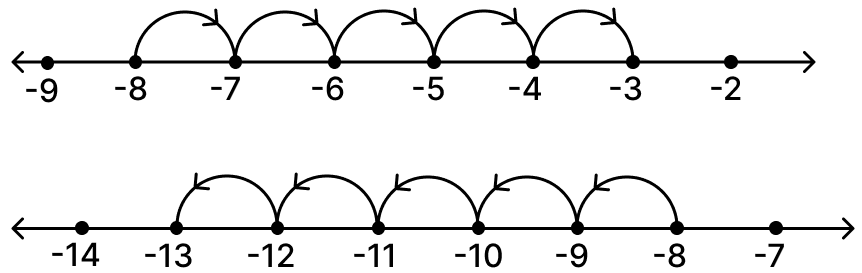
5 units to the right of -8: -8 + 5 = -3.
5 units to the left of -8: -8 - 5 = -13.
So the integers 5 units away from -8 are -3 and -13.
The additive inverse (opposite) of -3 is -(-3) = 3.
The additive inverse (opposite) of -13 is -(-13) = 13.
Hence, the opposites (additive inverses) of the required integers are 3 and 13.
What is the sum of all integers from -500 to 500?
Answer
The integers from -500 to 500 are:
-500, -499, -498, ..., -1, 0, 1, ..., 498, 499, 500.
We can pair each negative integer with its additive inverse on the positive side:
(-500) + 500 = 0,
(-499) + 499 = 0,
(-498) + 498 = 0,
. . .
(-1) + 1 = 0.
The integer 0 is left without a pair, but 0 contributes 0 to the sum.
So the total sum = (sum of all the pairs) + 0 = 0 + 0 + ... + 0 + 0 = 0.
Hence, the sum of all integers from -500 to 500 is 0.
In a shopping mall in Hyderabad, there are 7 floors (storeys) above ground floor, and there are three parking basements. The buttons in a lift from bottom to top are labeled as P3, P2, P1, G, 1, 2, 3, 4, 5, 6, 7. The movement between two floors is:
Movement = Target floor - Starting floor.
(i) How can you label them as integers only?
(ii) What is the movement from P3 to third floor?
(iii) What is the movement from third floor to P3?
(iv) What is the maximum movement, and between which floors?
Answer
(i) The ground floor (G) is taken as 0. Floors above the ground floor are labelled by positive integers and the parking basements (below the ground floor) are labelled by negative integers, according to how far they are from G.
So the labels are:
P3 → -3, P2 → -2, P1 → -1, G → 0, 1 → +1, 2 → +2, 3 → +3, 4 → +4, 5 → +5, 6 → +6, 7 → +7.
Hence, the floors as integers (from bottom to top) are -3, -2, -1, 0, 1, 2, 3, 4, 5, 6, 7.
(ii) Movement from P3 to the third floor = (Target floor) - (Starting floor)
= 3 - (-3)
= 3 + 3
= 6.
(The positive sign indicates upward movement.)
Hence, the movement from P3 to the third floor is +6, i.e. 6 floors upward.
(iii) Movement from third floor to P3 = (Target floor) - (Starting floor)
= (-3) - 3
= -6.
(The negative sign indicates downward movement.)
Hence, the movement from the third floor to P3 is -6, i.e. 6 floors downward.
(iv) The bottom-most floor is P3 (= -3) and the top-most floor is the 7th floor (= +7).
The maximum upward movement is from P3 to the 7th floor:
Movement = 7 - (-3) = 7 + 3 = 10.
The maximum downward movement is from the 7th floor to P3:
Movement = (-3) - 7 = -10.
In either case, the magnitude of the movement is 10, which is the maximum possible.
Hence, the maximum movement is 10 floors, between P3 and the 7th floor (i.e. either +10 from P3 to the 7th floor or -10 from the 7th floor to P3).