
Fill in the blanks:
(i) A number having exactly two factors is called a ....
(ii) A number having more than two factors is called a ...
(iii) 1 is neither ..... nor ........
(iv) The smallest prime number is ....
(v) The smallest odd prime number is ....
(vi) The smallest composite number is .....
(vii) The smallest odd composite number is ...
(viii) All prime numbers (except 2) are ....
Answer
(i) A number having exactly two factors (1 and itself) is called a prime number.
(ii) A number having more than two factors is called a composite number.
(iii) 1 is neither prime nor composite.
(iv) The smallest prime number is 2.
(v) The smallest odd prime number is 3.
(vi) The smallest composite number is 4.
(vii) The smallest odd composite number is 9.
(viii) All prime numbers (except 2) are odd numbers.
State whether the following statements are true (T) or false (F):
(i) The sum of three odd numbers is an even number.
(ii) The sum of two odd numbers and one even number is an even number.
(iii) The product of two even numbers is always an even number.
(iv) The product of three odd numbers is an odd number.
(v) If an even number is divided by 2, the quotient is always an odd number.
(vi) All prime numbers are odd.
(vii) All even numbers are composite.
(viii) Prime numbers do not have any factors.
(ix) Two consecutive numbers cannot be both prime.
(x) Two prime numbers are always co-prime numbers.
Answer
(i) False.
Reason: The sum of three odd numbers is always odd. For example, 1 + 3 + 5 = 9 (odd).
(ii) True.
Reason: Sum of two odd numbers is even, and even + even = even. For example, 3 + 5 + 4 = 12 (even).
(iii) True.
Reason: The product of any two even numbers always contains 2 as a factor. For example, 4 × 6 = 24 (even).
(iv) True.
Reason: The product of three odd numbers is always odd. For example, 3 × 5 × 7 = 105 (odd).
(v) False.
Reason: If an even number is divided by 2, the quotient may be even or odd. For example, 8 ÷ 2 = 4 (even).
(vi) False.
Reason: 2 is a prime number which is even.
(vii) False.
Reason: 2 is even but it is a prime number, not composite.
(viii) False.
Reason: Prime numbers have exactly two factors, namely 1 and the number itself.
(ix) False.
Reason: 2 and 3 are two consecutive natural numbers and both are prime.
(x) True.
Reason: Two prime numbers have no common factor other than 1, so they are always co-prime.
Write all the factors of the following natural numbers:
(i) 68
(ii) 27
(iii) 210
Answer
(i) 68
68 = 1 × 68
68 = 2 × 34
68 = 4 × 17
Hence, factors of 68 are 1, 2, 4, 17, 34 and 68.
(ii) 27
27 = 1 × 27
27 = 3 × 9
Hence, factors of 27 are 1, 3, 9 and 27.
(iii) 210
210 = 1 × 210
210 = 2 × 10⁵
210 = 3 × 70
210 = 5 × 42
210 = 6 × 35
210 = 7 × 30
210 = 10 × 21
210 = 14 × 15
Hence, factors of 210 are 1, 2, 3, 5, 6, 7, 10, 14, 15, 21, 30, 35, 42, 70, 105 and 210.
Write first six multiples of the following natural numbers:
(i) 3
(ii) 5
(iii) 12
Answer
(i) The first six multiples of 3 are:
3 × 1 = 3, 3 × 2 = 6, 3 × 3 = 9, 3 × 4 = 12, 3 × 5 = 15, 3 × 6 = 18
Hence, the first six multiples of 3 are 3, 6, 9, 12, 15 and 18.
(ii) The first six multiples of 5 are:
5 × 1 = 5, 5 × 2 = 10, 5 × 3 = 15, 5 × 4 = 20, 5 × 5 = 25, 5 × 6 = 30
Hence, the first six multiples of 5 are 5, 10, 15, 20, 25 and 30.
(iii) The first six multiples of 12 are:
12 × 1 = 12, 12 × 2 = 24, 12 × 3 = 36, 12 × 4 = 48, 12 × 5 = 60, 12 × 6 = 72
Hence, the first six multiples of 12 are 12, 24, 36, 48, 60 and 72.
Write:
(i) the seventh multiple of 36
(ii) the even multiples of 9 less than 100
(iii) the odd multiples of 17 less than 150
(iv) the first 3-digit even multiple of 7
(v) the multiples of 6 between 40 and 80
(vi) the greatest 2-digit even multiple of 5
Answer
(i) The seventh multiple of 36 = 36 × 7 = 252.
Hence, the seventh multiple of 36 is 252.
(ii) Even multiples of 9 are obtained by multiplying 9 by even numbers.
9 × 2 = 18, 9 × 4 = 36, 9 × 6 = 54, 9 × 8 = 72, 9 × 10 = 90
(9 × 12 = 108, which is greater than 100.)
Hence, the even multiples of 9 less than 100 are 18, 36, 54, 72 and 90.
(iii) Odd multiples of 17 are obtained by multiplying 17 by odd numbers.
17 × 1 = 17, 17 × 3 = 51, 17 × 5 = 85, 17 × 7 = 119
(17 × 9 = 153, which is greater than 150.)
Hence, the odd multiples of 17 less than 150 are 17, 51, 85 and 119.
(iv) The smallest 3-digit number is 100. We find the smallest multiple of 7 which is a 3-digit even number.
7 × 15 = 105 (odd)
7 × 16 = 112 (even)
Hence, the first 3-digit even multiple of 7 is 112.
(v) Multiples of 6 are 6, 12, 18, 24, 30, 36, 42, 48, 54, 60, 66, 72, 78, 84, ...
Hence, the multiples of 6 between 40 and 80 are 42, 48, 54, 60, 66, 72 and 78.
(vi) The greatest 2-digit number is 99. An even multiple of 5 must end in 0.
The greatest 2-digit number ending in 0 is 90, and 90 = 5 × 18.
Hence, the greatest 2-digit even multiple of 5 is 90.
Find the common factors of:
(i) 20 and 28
(ii) 35 and 50
(iii) 56 and 120
Answer
(i) The factors of 20 are 1, 2, 4, 5, 10 and 20.
The factors of 28 are 1, 2, 4, 7, 14 and 28.
Hence, the common factors of 20 and 28 are 1, 2 and 4.
(ii) The factors of 35 are 1, 5, 7 and 35.
The factors of 50 are 1, 2, 5, 10, 25 and 50.
Hence, the common factors of 35 and 50 are 1 and 5.
(iii) The factors of 56 are 1, 2, 4, 7, 8, 14, 28 and 56.
The factors of 120 are 1, 2, 3, 4, 5, 6, 8, 10, 12, 15, 20, 24, 30, 40, 60 and 120.
Hence, the common factors of 56 and 120 are 1, 2, 4 and 8.
Find the common factors of:
(i) 4, 8, 12
(ii) 10, 30 and 45
Answer
(i) The factors of 4 are 1, 2 and 4.
The factors of 8 are 1, 2, 4 and 8.
The factors of 12 are 1, 2, 3, 4, 6 and 12.
Hence, the common factors of 4, 8 and 12 are 1, 2 and 4.
(ii) The factors of 10 are 1, 2, 5 and 10.
The factors of 30 are 1, 2, 3, 5, 6, 10, 15 and 30.
The factors of 45 are 1, 3, 5, 9, 15 and 45.
Hence, the common factors of 10, 30 and 45 are 1 and 5.
Write all natural numbers less than 100 which are common multiples of 3 and 4.
Answer
The common multiples of 3 and 4 are the multiples of LCM(3, 4) = 12.
Multiples of 12 less than 100 are: 12, 24, 36, 48, 60, 72, 84, 96.
Hence, the natural numbers less than 100 which are common multiples of 3 and 4 are 12, 24, 36, 48, 60, 72, 84 and 96.
(i) Write the odd numbers between 36 and 53.
(ii) Write the even numbers between 232 and 251.
Answer
(i) The odd numbers between 36 and 53 are 37, 39, 41, 43, 45, 47, 49 and 51.
(ii) The even numbers between 232 and 251 are 234, 236, 238, 240, 242, 244, 246, 248 and 250.
(i) Write four consecutive odd numbers succeeding 79.
(ii) Write three consecutive even numbers preceding 124.
Answer
(i) The odd numbers immediately after 79 are obtained by adding 2 successively.
79 + 2 = 81, 81 + 2 = 83, 83 + 2 = 85, 85 + 2 = 87.
Hence, the four consecutive odd numbers succeeding 79 are 81, 83, 85 and 87.
(ii) The even numbers immediately before 124 are obtained by subtracting 2 successively.
124 − 2 = 122, 122 − 2 = 120, 120 − 2 = 118.
Hence, the three consecutive even numbers preceding 124 are 118, 120 and 122.
What is greatest prime number between 1 and 15?
Answer
The prime numbers between 1 and 15 are 2, 3, 5, 7, 11 and 13.
Hence, the greatest prime number between 1 and 15 is 13.
Which of the following numbers are prime?
(i) 29
(ii) 57
(iii) 43
(iv) 61
Answer
(i) 29
As 5 × 5 = 25 < 29 and 6 × 6 = 36 > 29, so 5 is the largest number such that 5 × 5 ≤ 29.
The prime numbers less than or equal to 5 are 2, 3 and 5.
29 is not divisible by 2, 3 or 5.
Hence, 29 is a prime number.
(ii) 57
Sum of digits of 57 = 5 + 7 = 12, which is divisible by 3.
So, 57 is divisible by 3 (57 = 3 × 19).
Hence, 57 is not a prime number.
(iii) 43
As 6 × 6 = 36 < 43 and 7 × 7 = 49 > 43, so 6 is the largest number such that 6 × 6 ≤ 43.
The prime numbers less than or equal to 6 are 2, 3 and 5.
43 is not divisible by 2, 3 or 5.
Hence, 43 is a prime number.
(iv) 61
As 7 × 7 = 49 < 61 and 8 × 8 = 64 > 61, so 7 is the largest number such that 7 × 7 ≤ 61.
The prime numbers less than or equal to 7 are 2, 3, 5 and 7.
61 is not divisible by 2, 3, 5 or 7.
Hence, 61 is a prime number.
Which of the following pairs of numbers are co-prime?
(i) 12 and 35
(ii) 15 and 37
(iii) 27 and 32
(iv) 17 and 85
(v) 515 and 516
(vi) 215 and 415
Answer
(i) The factors of 12 are 1, 2, 3, 4, 6 and 12.
The factors of 35 are 1, 5, 7 and 35.
The only common factor is 1.
Hence, 12 and 35 are co-prime.
(ii) The factors of 15 are 1, 3, 5 and 15.
The factors of 37 are 1 and 37 (since 37 is prime).
The only common factor is 1.
Hence, 15 and 37 are co-prime.
(iii) The factors of 27 are 1, 3, 9 and 27.
The factors of 32 are 1, 2, 4, 8, 16 and 32.
The only common factor is 1.
Hence, 27 and 32 are co-prime.
(iv) The factors of 17 are 1 and 17.
The factors of 85 are 1, 5, 17 and 85.
The common factors are 1 and 17.
Hence, 17 and 85 are not co-prime.
(v) 515 and 516 are two consecutive natural numbers.
Any two consecutive natural numbers are always co-prime.
Hence, 515 and 516 are co-prime.
(vi) The factors of 215 are 1, 5, 43 and 215.
The factors of 415 are 1, 5, 83 and 415.
The common factors are 1 and 5.
Hence, 215 and 415 are not co-prime.
Express each of the following numbers as the sum of two odd primes:
(i) 24
(ii) 36
(iii) 84
(iv) 98
Answer
(i) 24 = 5 + 19
(Other ways: 24 = 7 + 17, 24 = 11 + 13)
(ii) 36 = 7 + 29
(Other ways: 36 = 13 + 23, 36 = 17 + 19, 36 = 5 + 31)
(iii) 84 = 17 + 67
(Other ways: 84 = 11 + 73, 84 = 13 + 71, 84 = 5 + 79, 84 = 23 + 61, 84 = 31 + 53, 84 = 37 + 47, 84 = 41 + 43)
(iv) 98 = 19 + 79
(Other ways: 98 = 31 + 67)
Express each of the following numbers as the sum of twin-primes:
(i) 24
(ii) 36
(iii) 84
(iv) 120
Answer
Twin primes are pairs of prime numbers whose difference is 2. The twin-primes less than 100 are: (3, 5), (5, 7), (11, 13), (17, 19), (29, 31), (41, 43), (59, 61), (71, 73).
(i) 24 = 11 + 13
(ii) 36 = 17 + 19
(iii) 84 = 41 + 43
(iv) 120 = 59 + 61
Express each of the following numbers as the sum of three odd primes:
(i) 21
(ii) 35
(iii) 49
(iv) 63
Answer
(i) 21 = 3 + 7 + 11
(Other ways: 21 = 5 + 5 + 11, 21 = 7 + 7 + 7, 21 = 3 + 5 + 13)
(ii) 35 = 5 + 11 + 19
(Other ways: 35 = 5 + 7 + 23, 35 = 3 + 13 + 19, 35 = 5 + 13 + 17, 35 = 7 + 11 + 17, 35 = 11 + 11 + 13)
(iii) 49 = 7 + 11 + 31
(Other ways: 49 = 5 + 7 + 37, 49 = 7 + 13 + 29, 49 = 13 + 13 + 23)
(iv) 63 = 7 + 13 + 43
(Other ways: 63 = 5 + 11 + 47, 63 = 3 + 7 + 53, 63 = 11 + 23 + 29, 63 = 17 + 23 + 23)
Which of the following numbers are divisible by 5 or by 10:
(i) 3725
(ii) 48970
(iii) 56823
(iv) 760035
(v) 7893217
(vi) 4500010
Answer
A number is divisible by 5 if its last digit is 0 or 5.
A number is divisible by 10 if its last digit is 0.
(i) 3725 — last digit is 5.
Hence, 3725 is divisible by 5 only.
(ii) 48970 — last digit is 0.
Hence, 48970 is divisible by both 5 and 10.
(iii) 56823 — last digit is 3.
Hence, 56823 is divisible neither by 5 nor by 10.
(iv) 760035 — last digit is 5.
Hence, 760035 is divisible by 5 only.
(v) 7893217 — last digit is 7.
Hence, 7893217 is divisible neither by 5 nor by 10.
(vi) 4500010 — last digit is 0.
Hence, 4500010 is divisible by both 5 and 10.
Which of the following numbers are divisible by 2, 4 or 8:
(i) 54014
(ii) 723840
(iii) 6531088
(iv) 75689604
(v) 786235
(vi) 5321048
Answer
A number is divisible by 2 if its last digit is 0, 2, 4, 6 or 8.
A number is divisible by 4 if the number formed by its last two digits is divisible by 4.
A number is divisible by 8 if the number formed by its last three digits is divisible by 8.
(i) 54014 — last digit 4, divisible by 2.
Last two digits = 14, not divisible by 4.
Hence, 54014 is divisible by 2 only.
(ii) 723840 — last digit 0, divisible by 2.
Last two digits = 40, divisible by 4.
Last three digits = 840, and 840 ÷ 8 = 105, divisible by 8.
Hence, 723840 is divisible by 2, 4 and 8.
(iii) 6531088 — last digit 8, divisible by 2.
Last two digits = 88, divisible by 4.
Last three digits = 088 = 88, and 88 ÷ 8 = 11, divisible by 8.
Hence, 6531088 is divisible by 2, 4 and 8.
(iv) 75689604 — last digit 4, divisible by 2.
Last two digits = 04 = 4, divisible by 4.
Last three digits = 604, and 604 is not divisible by 8 because 8 × 75 = 600 and remainder is 4.
Hence, 75689604 is divisible by 2 and 4 only.
(v) 786235 — last digit 5, not divisible by 2.
Hence, 786235 is not divisible by 2, 4 or 8.
(vi) 5321048 — last digit 8, divisible by 2.
Last two digits = 48, divisible by 4.
Last three digits = 048 = 48, and 48 ÷ 8 = 6, divisible by 8.
Hence, 5321048 is divisible by 2, 4 and 8.
Which of the following numbers are divisible by 3 or 9:
(i) 7341
(ii) 59031
(iii) 12345678
(iv) 560319
(v) 720634
(vi) 3721509
Answer
A number is divisible by 3 if the sum of its digits is divisible by 3.
A number is divisible by 9 if the sum of its digits is divisible by 9.
(i) 7341 — sum of digits = 7 + 3 + 4 + 1 = 15.
15 is divisible by 3 but not by 9.
Hence, 7341 is divisible by 3 only.
(ii) 59031 — sum of digits = 5 + 9 + 0 + 3 + 1 = 18.
18 is divisible by both 3 and 9.
Hence, 59031 is divisible by both 3 and 9.
(iii) 12345678 — sum of digits = 1 + 2 + 3 + 4 + 5 + 6 + 7 + 8 = 36.
36 is divisible by both 3 and 9.
Hence, 12345678 is divisible by both 3 and 9.
(iv) 560319 — sum of digits = 5 + 6 + 0 + 3 + 1 + 9 = 24.
24 is divisible by 3 but not by 9.
Hence, 560319 is divisible by 3 only.
(v) 720634 — sum of digits = 7 + 2 + 0 + 6 + 3 + 4 = 22.
22 is not divisible by 3.
Hence, 720634 is not divisible by 3 or 9.
(vi) 3721509 — sum of digits = 3 + 7 + 2 + 1 + 5 + 0 + 9 = 27.
27 is divisible by both 3 and 9.
Hence, 3721509 is divisible by both 3 and 9.
Examine the following numbers for divisibility by 11:
(i) 10428
(ii) 70169803
(iii) 7136985
Answer
A number is divisible by 11 if the difference between the sum of digits at odd places and the sum of digits at even places is either 0 or divisible by 11.
(i) 10428
Sum of digits at odd places (from right) = 8 + 4 + 1 = 13
Sum of digits at even places (from right) = 2 + 0 = 2
Difference = 13 − 2 = 11, which is divisible by 11.
Hence, 10428 is divisible by 11.
(ii) 70169803
Sum of digits at odd places (from right) = 3 + 8 + 6 + 0 = 17
Sum of digits at even places (from right) = 0 + 9 + 1 + 7 = 17
Difference = 17 − 17 = 0.
Hence, 70169803 is divisible by 11.
(iii) 7136985
Sum of digits at odd places (from right) = 5 + 9 + 3 + 7 = 24
Sum of digits at even places (from right) = 8 + 6 + 1 = 15
Difference = 24 − 15 = 9, which is not divisible by 11.
Hence, 7136985 is not divisible by 11.
Examine the following numbers for divisibility by 6:
(i) 93573
(ii) 217944
(iii) 5034126
(iv) 901352
(v) 639210
(vi) 1790184
Answer
A number is divisible by 6 if it is divisible by both 2 and 3.
(i) 93573 — last digit 3, not divisible by 2.
Hence, 93573 is not divisible by 6.
(ii) 217944 — last digit 4, divisible by 2.
Sum of digits = 2 + 1 + 7 + 9 + 4 + 4 = 27, divisible by 3.
Hence, 217944 is divisible by 6.
(iii) 5034126 — last digit 6, divisible by 2.
Sum of digits = 5 + 0 + 3 + 4 + 1 + 2 + 6 = 21, divisible by 3.
Hence, 5034126 is divisible by 6.
(iv) 901352 — last digit 2, divisible by 2.
Sum of digits = 9 + 0 + 1 + 3 + 5 + 2 = 20, not divisible by 3.
Hence, 901352 is not divisible by 6.
(v) 639210 — last digit 0, divisible by 2.
Sum of digits = 6 + 3 + 9 + 2 + 1 + 0 = 21, divisible by 3.
Hence, 639210 is divisible by 6.
(vi) 1790184 — last digit 4, divisible by 2.
Sum of digits = 1 + 7 + 9 + 0 + 1 + 8 + 4 = 30, divisible by 3.
Hence, 1790184 is divisible by 6.
In each of the following replace '*' by a digit so that the number formed is divisible by 9:
(i) 4710*82
(ii) 70*356722
Answer
For a number to be divisible by 9, the sum of its digits must be divisible by 9.
(i) 4710*82
Sum of given digits (except *) = 4 + 7 + 1 + 0 + 8 + 2 = 22.
We need 22 + * to be divisible by 9.
22 + 5 = 27, which is divisible by 9.
Hence, * should be replaced by 5. The number formed is 4710582.
(ii) 70*356722
Sum of given digits (except *) = 7 + 0 + 3 + 5 + 6 + 7 + 2 + 2 = 32.
We need 32 + * to be divisible by 9.
32 + 4 = 36, which is divisible by 9.
Hence, * should be replaced by 4. The number formed is 704356722.
In each of the following replace '*' by (i) the smallest digit (ii) the greatest digit so that the number formed is divisible by 3:
(a) 4*672
(b) 4756*2
Answer
For a number to be divisible by 3, the sum of its digits must be divisible by 3.
(a) 4*672
Sum of given digits (except *) = 4 + 6 + 7 + 2 = 19.
We need 19 + * to be divisible by 3.
The values of * which make 19 + * divisible by 3 are 2 (gives 21), 5 (gives 24) and 8 (gives 27).
(i) The smallest digit is 2. The number formed is 42672.
(ii) The greatest digit is 8. The number formed is 48672.
(b) 4756*2
Sum of given digits (except *) = 4 + 7 + 5 + 6 + 2 = 24.
We need 24 + * to be divisible by 3.
The values of * which make 24 + * divisible by 3 are 0 (gives 24), 3 (gives 27), 6 (gives 30) and 9 (gives 33).
(i) The smallest digit is 0. The number formed is 475602.
(ii) The greatest digit is 9. The number formed is 475692.
In each of the following replace * by a digit so that the number formed is divisible by 11:
(i) 8*9484
(ii) 9*53762
Answer
A number is divisible by 11 if the difference between the sum of digits at odd places (from ones) and the sum of digits at even places (from tens) is either 0 or divisible by 11.
(i) 8*9484
Digits from right: 4, 8, 4, 9, *, 8.
Sum of digits at odd places (from right) = 4 + 4 + * = 8 + *.
Sum of digits at even places (from right) = 8 + 9 + 8 = 25.
Difference = 25 − (8 + *) = 17 − *.
For divisibility by 11, 17 − * = 0 (impossible) or 17 − * = 11 ⇒ * = 6.
Hence, * should be replaced by 6. The number formed is 869484.
(ii) 9*53762
Digits from right: 2, 6, 7, 3, 5, *, 9.
Sum of digits at odd places (from right) = 2 + 7 + 5 + 9 = 23.
Sum of digits at even places (from right) = 6 + 3 + * = 9 + *.
Difference = 23 − (9 + *) = 14 − *.
For divisibility by 11, 14 − * = 0 (impossible) or 14 − * = 11 ⇒ * = 3.
Hence, * should be replaced by 3. The number formed is 9353762.
In each of the following replace * by (i) the smallest digit (ii) the greatest digit so that the number formed is divisible by 6:
(a) 2*4706
(b) 5825*34
Answer
For a number to be divisible by 6, it must be divisible by both 2 and 3.
(a) 2*4706
Last digit is 6, so the number is divisible by 2.
Sum of given digits (except *) = 2 + 4 + 7 + 0 + 6 = 19.
We need 19 + * to be divisible by 3.
The values of * which make 19 + * divisible by 3 are 2, 5 and 8.
(i) The smallest digit is 2. The number formed is 224706.
(ii) The greatest digit is 8. The number formed is 284706.
(b) 5825*34
Last digit is 4, so the number is divisible by 2.
Sum of given digits (except *) = 5 + 8 + 2 + 5 + 3 + 4 = 27.
We need 27 + * to be divisible by 3.
The values of * which make 27 + * divisible by 3 are 0, 3, 6 and 9.
(i) The smallest digit is 0. The number formed is 5825034.
(ii) The greatest digit is 9. The number formed is 5825934.
Which of the following numbers are prime:
(i) 101
(ii) 251
(iii) 323
(iv) 397
Answer
(i) 101
As 10 × 10 = 100 < 101 and 11 × 11 = 121 > 101, so 10 is the largest number such that 10 × 10 ≤ 101.
The prime numbers less than or equal to 10 are 2, 3, 5 and 7.
101 is not divisible by 2, 3, 5 or 7.
Hence, 101 is a prime number.
(ii) 251
As 15 × 15 = 225 < 251 and 16 × 16 = 256 > 251, so 15 is the largest number such that 15 × 15 ≤ 251.
The prime numbers less than or equal to 15 are 2, 3, 5, 7, 11 and 13.
251 is not divisible by 2, 3, 5, 7, 11 or 13.
Hence, 251 is a prime number.
(iii) 323
Note that 17 × 19 = 323, so 17 and 19 are factors of 323.
Hence, 323 is not a prime number.
(iv) 397
As 19 × 19 = 361 < 397 and 20 × 20 = 400 > 397, so 19 is the largest number such that 19 × 19 ≤ 397.
The prime numbers less than or equal to 19 are 2, 3, 5, 7, 11, 13, 17 and 19.
397 is not divisible by 2, 3, 5, 7, 11, 13, 17 or 19.
Hence, 397 is a prime number.
Determine if 372645 is divisible by 45.
Answer
To determine if 372645 is divisible by 45, we test it for divisibility by 5 and 9 both (since 45 = 5 × 9 and 5, 9 are co-prime).
The number 372645 has digit 5 at the unit's place, so it is divisible by 5.
Sum of digits = 3 + 7 + 2 + 6 + 4 + 5 = 27, which is divisible by 9, so 372645 is divisible by 9.
Since 5 and 9 are co-prime, the number 372645 is divisible by their product, i.e., by 45.
Hence, 372645 is divisible by 45.
A number is divisible by 12. By what other numbers will that number be divisible?
Answer
If a number is divisible by 12, then it is divisible by each of the factors of 12.
The factors of 12 are 1, 2, 3, 4, 6 and 12.
Hence, the number is also divisible by 1, 2, 3, 4 and 6.
A number is divisible by both 3 and 8. By which other numbers will that number be always divisible?
Answer
Let a natural number, say n, be divisible by both 3 and 8.
Since 3 and 8 are co-prime numbers and if a number is divisible by two co-prime numbers, then it is divisible by their product.
So, n is divisible by 3 × 8 = 24.
We know that,
If a number is divisible by another number, then it is divisible by each of the factors of that number
Thus, n is divisible by all the factors of 24.
The factors of 24 are 1, 2, 3, 4, 6, 8, 12 and 24.
Hence, the number is always divisible by 1, 2, 4, 6, 12 and 24.
State whether the following statements are true (T) or false (F):
(i) If a number is divisible by 4, it must be divisible by 8.
(ii) If a number is divisible by 3, it must be divisible by 9.
(iii) If a number is divisible by 9, it must be divisible by 3.
(iv) If a number is divisible by 9 and 10 both, it must be divisible by 90.
(v) If a number divides the sum of two numbers, then it must divide the two numbers separately.
(vi) If a number is divisible by 3 and 8 both, it must be divisible by 12.
(vii) If a number is divisible by 6 and 15 both, it must be divisible by 90.
Answer
(i) False.
Reason: For example, 12 is divisible by 4 but not by 8.
(ii) False.
Reason: For example, 6 is divisible by 3 but not by 9.
(iii) True.
Reason: Since 3 is a factor of 9, every number divisible by 9 is also divisible by 3.
(iv) True.
Reason: 9 and 10 are co-prime, so any number divisible by both is divisible by 9 × 10 = 90.
(v) False.
Reason: For example, 5 divides the sum 3 + 7 = 10, but 5 does not divide 3 or 7 separately.
(vi) True.
Reason: Since 3 and 8 are co-prime, the number is divisible by 3 × 8 = 24, and 12 is a factor of 24, so the number is divisible by 12 as well.
(vii) False.
Reason: 6 and 15 are not co-prime (HCF = 3). The LCM of 6 and 15 is 30. For example, 30 is divisible by both 6 and 15 but not by 90.
Here are two different factor trees of the number 90. Write the missing numbers:
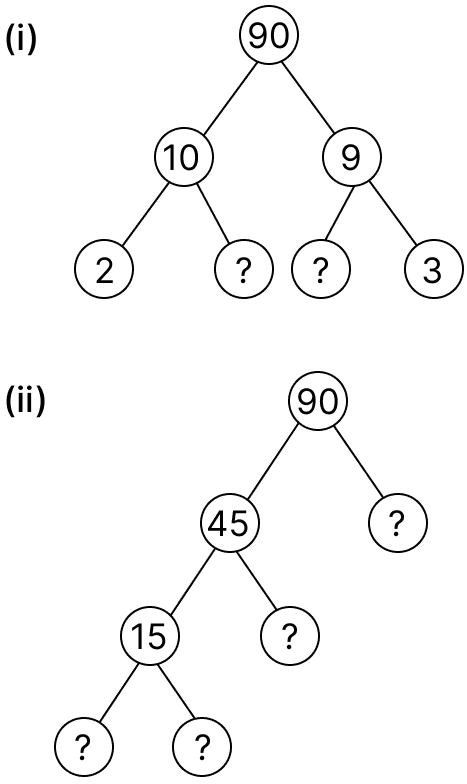
Answer
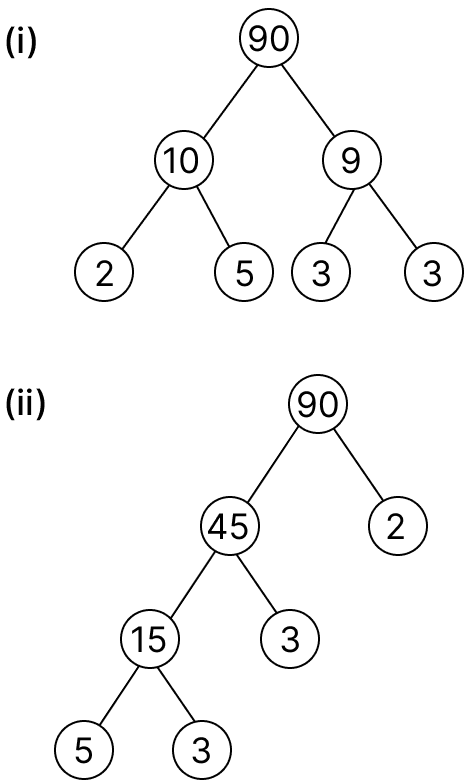
(i) In the first factor tree, 90 = 10 × 9.
10 = 2 × ?, so the missing number is 5 (since 10 = 2 × 5).
9 = ? × 3, so the missing number is 3 (since 9 = 3 × 3).
(ii) In the second factor tree, 90 = 45 × ?, so the missing number is 2 (since 90 = 45 × 2).
45 = 15 × ?, so the missing number is 3 (since 45 = 15 × 3).
15 = ? × ?, so the missing numbers are 3 and 5 (since 15 = 3 × 5).
Find the prime factorisation of the following numbers:
(i) 72
(ii) 172
(iii) 450
(iv) 980
(v) 8712
(vi) 13500
Answer
(i) 72
| 2 | 72 |
|---|---|
| 2 | 36 |
| 2 | 18 |
| 3 | 9 |
| 3 | 3 |
| 1 |
Hence, 72 = 2 × 2 × 2 × 3 × 3.
(ii) 172
| 2 | 172 |
|---|---|
| 2 | 86 |
| 43 | 43 |
| 1 |
Hence, 172 = 2 × 2 × 43.
(iii) 450
| 2 | 450 |
|---|---|
| 3 | 225 |
| 3 | 75 |
| 5 | 25 |
| 5 | 5 |
| 1 |
Hence, 450 = 2 × 3 × 3 × 5 × 5.
(iv) 980
| 2 | 980 |
|---|---|
| 2 | 490 |
| 5 | 245 |
| 7 | 49 |
| 7 | 7 |
| 1 |
Hence, 980 = 2 × 2 × 5 × 7 × 7.
(v) 8712
| 2 | 8712 |
|---|---|
| 2 | 4356 |
| 2 | 2178 |
| 3 | 1089 |
| 3 | 363 |
| 11 | 121 |
| 11 | 11 |
| 1 |
Hence, 8712 = 2 × 2 × 2 × 3 × 3 × 11 × 11.
(vi) 13500
| 2 | 13500 |
|---|---|
| 2 | 6750 |
| 3 | 3375 |
| 3 | 1125 |
| 3 | 375 |
| 5 | 125 |
| 5 | 25 |
| 5 | 5 |
| 1 |
Hence, 13500 = 2 × 2 × 3 × 3 × 3 × 5 × 5 × 5.
Write the smallest and the greatest 3-digit numbers and express them as the product of prime.
Answer
The smallest 3-digit number is 100.
| 2 | 100 |
|---|---|
| 2 | 50 |
| 5 | 25 |
| 5 | 5 |
| 1 |
So, 100 = 2 × 2 × 5 × 5.
The greatest 3-digit number is 999.
| 3 | 999 |
|---|---|
| 3 | 333 |
| 3 | 111 |
| 37 | 37 |
| 1 |
So, 999 = 3 × 3 × 3 × 37.
Write the smallest five digit number and express it in the form of its prime factors.
Answer
The smallest 5-digit number is 10000.
| 2 | 10000 |
|---|---|
| 2 | 5000 |
| 2 | 2500 |
| 2 | 1250 |
| 5 | 625 |
| 5 | 125 |
| 5 | 25 |
| 5 | 5 |
| 1 |
Hence, 10000 = 2 × 2 × 2 × 2 × 5 × 5 × 5 × 5.
I am the smallest number, having four different prime factors. Can you find me?
Answer
The smallest four prime numbers are 2, 3, 5 and 7.
The smallest number with four distinct prime factors is the product of the smallest four prime numbers.
Required number = 2 × 3 × 5 × 7 = 210.
Hence, the smallest number having four different prime factors is 210.
Find the HCF of the given numbers by prime factorisation method:
(i) 28, 36
(ii) 54, 72, 90
(iii) 105, 140, 175
Answer
(i) 28, 36
| 2 | 28 |
|---|---|
| 2 | 14 |
| 7 | 7 |
| 1 |
So, 28 = 2 × 2 × 7.
| 2 | 36 |
|---|---|
| 2 | 18 |
| 3 | 9 |
| 3 | 3 |
| 1 |
So, 36 = 2 × 2 × 3 × 3.
The common prime factor is 2, occurring twice in both numbers.
Hence, HCF of 28 and 36 = 2 × 2 = 4.
(ii) 54, 72, 90
| 2 | 54 |
|---|---|
| 3 | 27 |
| 3 | 9 |
| 3 | 3 |
| 1 |
So, 54 = 2 × 3 × 3 × 3.
| 2 | 72 |
|---|---|
| 2 | 36 |
| 2 | 18 |
| 3 | 9 |
| 3 | 3 |
| 1 |
So, 72 = 2 × 2 × 2 × 3 × 3.
| 2 | 90 |
|---|---|
| 3 | 45 |
| 3 | 15 |
| 5 | 5 |
| 1 |
So, 90 = 2 × 3 × 3 × 5.
The common prime factors are 2 (one time) and 3 (two times) in all three numbers.
Hence, HCF of 54, 72 and 90 = 2 × 3 × 3 = 18.
(iii) 105, 140, 175
| 3 | 105 |
|---|---|
| 5 | 35 |
| 7 | 7 |
| 1 |
So, 105 = 3 × 5 × 7.
| 2 | 140 |
|---|---|
| 2 | 70 |
| 5 | 35 |
| 7 | 7 |
| 1 |
So, 140 = 2 × 2 × 5 × 7.
| 5 | 175 |
|---|---|
| 5 | 35 |
| 7 | 7 |
| 1 |
So, 175 = 5 × 5 × 7.
The common prime factors are 5 (one time) and 7 (one time) in all three numbers.
Hence, HCF of 105, 140 and 175 = 5 × 7 = 35.
Find the HCF of the given numbers by division method:
(i) 198, 429
(ii) 20, 64, 104
(iii) 120, 144, 204
Answer
(i) 198, 429
Hence, HCF of 198 and 429 = 33.
(ii) 20, 64, 104
First, find HCF of 20 and 64:
So, HCF of 20 and 64 = 4.
Now, find HCF of 4 and 104:
So, HCF of 4 and 104 = 4.
Hence, HCF of 20, 64 and 104 = 4.
(iii) 120, 144, 204
First, find HCF of 120 and 144:
So, HCF of 120 and 144 = 24.
Now, find HCF of 24 and 204:
So, HCF of 24 and 204 = 12.
Hence, HCF of 120, 144 and 204 = 12.
Fill in the blanks:
(i) HCF of two consecutive natural numbers is ....
(ii) HCF of two consecutive odd numbers is ....
(iii) HCF of two consecutive even numbers is ....
Answer
(i) Two consecutive natural numbers do not share any common factor other than 1.
Hence, HCF of two consecutive natural numbers is 1.
(ii) Two consecutive odd numbers (e.g., 5 and 7, or 9 and 11) have no common factor other than 1.
Hence, HCF of two consecutive odd numbers is 1.
(iii) Two consecutive even numbers (e.g., 6 and 8, or 10 and 12) are both divisible by 2, but not by any other common factor.
Hence, HCF of two consecutive even numbers is 2.
Find the greatest number which can divide 257 and 329 so as to leave a remainder 5 in each case.
Answer
When 257 is divided by the required number, 5 is left as a remainder. So 257 − 5 = 252 is exactly divisible by that number.
Similarly, 329 − 5 = 324 is exactly divisible by that number.
Therefore, the required number is the HCF of 252 and 324.
Hence, the required greatest number is 36.
Find the largest number that will divide 623, 729 and 841 leaving remainders 3, 9 and 1 respectively.
Answer
When 623 is divided by the required number, 3 is left as a remainder. So 623 − 3 = 620 is exactly divisible by that number.
Similarly, 729 − 9 = 720 and 841 − 1 = 840 are exactly divisible by that number.
Therefore, the required number is the HCF of 620, 720 and 840.
First, find HCF of 620 and 720:
So, HCF of 620 and 720 = 20.
Now, find HCF of 20 and 840:
So, HCF of 20 and 840 = 20.
Hence, the largest required number is 20.
Meenu purchases two bags of rice of weights 75 kg and 69 kg. Find the maximum value of weight which can measure the weight of the rice exact number of times.
Answer
The required maximum weight that can measure the weight of rice in both bags an exact number of times is the HCF of 75 and 69.
So, HCF of 75 and 69 = 3.
Hence, the maximum weight which can measure the rice exactly is 3 kg.
Three tankers contain 403 litres, 434 litres and 465 litres of diesel respectively. Find the maximum capacity of a container that can measure the diesel of three containers exact number of times.
Answer
The required maximum capacity of a container that can measure the diesel in all three tankers exactly is the HCF of 403, 434 and 465.
First, find HCF of 403 and 434:
So, HCF of 403 and 434 = 31.
Now, find HCF of 31 and 465:
So, HCF of 31 and 465 = 31.
Hence, the maximum capacity of the container is 31 litres.
Find the LCM of the given numbers by prime factorisation method:
(i) 28, 98
(ii) 36, 40, 126
(iii) 108, 135, 162
(iv) 24, 28, 196
Answer
(i) 28, 98
Prime factorisation of the given numbers are:
28 = 2 × 2 × 7
98 = 2 × 7 × 7
2 occurs as a prime factor maximum 2 times and 7 also 2 times.
Hence, LCM of 28 and 98 = 2 × 2 × 7 × 7 = 196.
(ii) 36, 40, 126
Prime factorisation of the given numbers are:
36 = 2 × 2 × 3 × 3
40 = 2 × 2 × 2 × 5
126 = 2 × 3 × 3 × 7
2 occurs as a prime factor maximum 3 times, 3 occurs 2 times, 5 occurs 1 time and 7 also 1 time.
Hence, LCM of 36, 40 and 126 = 2 × 2 × 2 × 3 × 3 × 5 × 7 = 2520.
(iii) 108, 135, 162
Prime factorisation of the given numbers are:
108 = 2 × 2 × 3 × 3 × 3
135 = 3 × 3 × 3 × 5
162 = 2 × 3 × 3 × 3 × 3
3 occurs as a prime factor maximum 4 times, 2 occurs 2 times and 5 occurs 1 time.
Hence, LCM of 108, 135 and 162 = 2 × 2 × 3 × 3 × 3 × 3 × 5 = 1620.
(iv) 24, 28, 196
Prime factorisation of the given numbers are:
24 = 2 × 2 × 2 × 3
28 = 2 × 2 × 7
196 = 2 × 2 × 7 × 7
2 occurs as a prime factor maximum 3 times, 3 occurs 1 time and 7 also 2 times.
Hence, LCM of 24, 28 and 196 = 2 × 2 × 2 × 3 × 7 × 7 = 1176.
Find the LCM of the given numbers by division method:
(i) 480, 672
(ii) 6, 8, 45
(iii) 24, 40, 84
(iv) 20, 36, 63, 77
Answer
(i) 480, 672
| 2 | 480, 672 |
|---|---|
| 2 | 240, 336 |
| 2 | 120, 168 |
| 2 | 60, 84 |
| 2 | 30, 42 |
| 3 | 15, 21 |
| 5 | 5, 7 |
| 7 | 1, 7 |
| 1, 1 |
Hence, LCM of 480 and 672 = 2 × 2 × 2 × 2 × 2 × 3 × 5 × 7 = 3360.
(ii) 6, 8, 45
| 2 | 6, 8, 45 |
|---|---|
| 2 | 3, 4, 45 |
| 2 | 3, 2, 45 |
| 3 | 3, 1, 45 |
| 3 | 1, 1, 15 |
| 5 | 1, 1, 5 |
| 1, 1, 1 |
Hence, LCM of 6, 8 and 45 = 2 × 2 × 2 × 3 × 3 × 5 = 360.
(iii) 24, 40, 84
| 2 | 24, 40, 84 |
|---|---|
| 2 | 12, 20, 42 |
| 2 | 6, 10, 21 |
| 3 | 3, 5, 21 |
| 5 | 1, 5, 7 |
| 7 | 1, 1, 7 |
| 1, 1, 1 |
Hence, LCM of 24, 40 and 84 = 2 × 2 × 2 × 3 × 5 × 7 = 840.
(iv) 20, 36, 63, 77
| 2 | 20, 36, 63, 77 |
|---|---|
| 2 | 10, 18, 63, 77 |
| 3 | 5, 9, 63, 77 |
| 3 | 5, 3, 21, 77 |
| 5 | 5, 1, 7, 77 |
| 7 | 1, 1, 7, 77 |
| 11 | 1, 1, 1, 11 |
| 1, 1, 1, 1 |
Hence, LCM of 20, 36, 63 and 77 = 2 × 2 × 3 × 3 × 5 × 7 × 11 = 13860.
Find the least number which when increased by 15 is exactly divisible by 15, 35 and 48.
Answer
First, we find the LCM of 15, 35 and 48.
| 2 | 15, 35, 48 |
|---|---|
| 2 | 15, 35, 24 |
| 2 | 15, 35, 12 |
| 2 | 15, 35, 6 |
| 3 | 15, 35, 3 |
| 5 | 5, 35, 1 |
| 7 | 1, 7, 1 |
| 1, 1, 1 |
LCM of 15, 35 and 48 = 2 × 2 × 2 × 2 × 3 × 5 × 7 = 1680.
Thus, 1680 is the least number exactly divisible by 15, 35 and 48.
According to given condition, the required number when increased by 15 gives 1680.
The required number = 1680 − 15 = 1665.
Hence, the required least number is 1665.
Find the least number which when divided by 6, 15 and 18 leaves remainder 5 in each case.
Answer
First, we find the LCM of 6, 15 and 18.
| 2 | 6, 15, 18 |
|---|---|
| 3 | 3, 15, 9 |
| 3 | 1, 5, 3 |
| 5 | 1, 5, 1 |
| 1, 1, 1 |
LCM of 6, 15 and 18 = 2 × 3 × 3 × 5 = 90.
Thus, 90 is the least number exactly divisible by 6, 15 and 18.
The required least number which leaves remainder 5 when divided by these numbers = 90 + 5 = 95.
Hence, the required least number is 95.
Find the least number which when divided by 24, 36, 45 and 54 leaves a remainder of 3 in each case.
Answer
First, we find the LCM of 24, 36, 45 and 54.
| 2 | 24, 36, 45, 54 |
|---|---|
| 2 | 12, 18, 45, 27 |
| 2 | 6, 9, 45, 27 |
| 3 | 3, 9, 45, 27 |
| 3 | 1, 3, 15, 9 |
| 3 | 1, 1, 5, 3 |
| 5 | 1, 1, 5, 1 |
| 1, 1, 1, 1 |
LCM of 24, 36, 45 and 54 = 2 × 2 × 2 × 3 × 3 × 3 × 5 = 1080.
The required least number which leaves remainder 3 = 1080 + 3 = 1083.
Hence, the required least number is 1083.
Find the greatest 3-digit number which is exactly divisible by 8, 20 and 24.
Answer
First, we find the LCM of 8, 20 and 24.
| 2 | 8, 20, 24 |
|---|---|
| 2 | 4, 10, 12 |
| 2 | 2, 5, 6 |
| 3 | 1, 5, 3 |
| 5 | 1, 5, 1 |
| 1, 1, 1 |
LCM of 8, 20 and 24 = 2 × 2 × 2 × 3 × 5 = 120.
The greatest 3-digit number is 999.
We divide 999 by 120 and find the remainder.
The remainder is 39.
The required greatest 3-digit number = 999 − 39 = 960.
Hence, the greatest 3-digit number divisible by 8, 20 and 24 is 960.
Find the smallest 4-digit number which is exactly divisible by 32, 36 and 48.
Answer
First, we find the LCM of 32, 36 and 48.
| 2 | 32, 36, 48 |
|---|---|
| 2 | 16, 18, 24 |
| 2 | 8, 9, 12 |
| 2 | 4, 9, 6 |
| 2 | 2, 9, 3 |
| 3 | 1, 9, 3 |
| 3 | 1, 3, 1 |
| 1, 1, 1 |
LCM of 32, 36 and 48 = 2 × 2 × 2 × 2 × 2 × 3 × 3 = 288.
The smallest 4-digit number is 1000.
We divide 1000 by 288 and find the remainder.
The remainder is 136.
The required smallest 4-digit number = 1000 + (288 − 136) = 1000 + 152 = 1152.
Hence, the smallest 4-digit number divisible by 32, 36 and 48 is 1152.
Find the greatest 4-digit number which is exactly divisible by each of 8, 12 and 20.
Answer
First, we find the LCM of 8, 12 and 20.
| 2 | 8, 12, 20 |
|---|---|
| 2 | 4, 6, 10 |
| 2 | 2, 3, 5 |
| 3 | 1, 3, 5 |
| 5 | 1, 1, 5 |
| 1, 1, 1 |
LCM of 8, 12 and 20 = 2 × 2 × 2 × 3 × 5 = 120.
The greatest 4-digit number is 9999.
We divide 9999 by 120 and find the remainder.
The remainder is 39.
The required greatest 4-digit number = 9999 − 39 = 9960.
Hence, the greatest 4-digit number divisible by 8, 12 and 20 is 9960.
Find the least number of five digits which is exactly divisible by 32, 36 and 45.
Answer
First, we find the LCM of 32, 36 and 45.
| 2 | 32, 36, 45 |
|---|---|
| 2 | 16, 18, 45 |
| 2 | 8, 9, 45 |
| 2 | 4, 9, 45 |
| 2 | 2, 9, 45 |
| 3 | 1, 9, 45 |
| 3 | 1, 3, 15 |
| 5 | 1, 1, 5 |
| 1, 1, 1 |
LCM of 32, 36 and 45 = 2 × 2 × 2 × 2 × 2 × 3 × 3 × 5 = 1440.
The smallest 5-digit number is 10000.
We divide 10000 by 1440 and find the remainder.
The remainder is 1360.
The required least 5-digit number = 10000 + (1440 − 1360) = 10000 + 80 = 10080.
Hence, the least 5-digit number divisible by 32, 36 and 45 is 10080.
Three boys step off together from the same spot. Their steps measure 63 cm, 70 cm and 77 cm respectively. What is the minimum distance each should cover so that all can cover the same distance in complete steps?
Answer
The required minimum distance is the LCM of 63, 70 and 77.
| 2 | 63, 70, 77 |
|---|---|
| 3 | 63, 35, 77 |
| 3 | 21, 35, 77 |
| 5 | 7, 35, 77 |
| 7 | 7, 7, 77 |
| 11 | 1, 1, 11 |
| 1, 1, 1 |
LCM of 63, 70 and 77 = 2 x 3 x 3 x 5 x 7 x 11 = 6930 cm.
Converting to metres and centimetres: 6930 cm = 69 m 30 cm.
Hence, the minimum distance each should cover is 6930 cm or 69 m 30 cm.
Traffic lights at three different road crossing change after 48 seconds, 72 seconds and 108 seconds respectively. At what time will they change together again if they change simultaneously at 7 A.M.?
Answer
The required time interval after which the traffic lights will change together again is the LCM of 48, 72 and 108.
| 2 | 48, 72, 108 |
|---|---|
| 2 | 24, 36, 54 |
| 2 | 12, 18, 27 |
| 2 | 6, 9, 27 |
| 3 | 3, 9, 27 |
| 3 | 1, 3, 9 |
| 3 | 1, 1, 3 |
| 1, 1, 1 |
LCM of 48, 72 and 108 = 2 × 2 × 2 × 2 × 3 × 3 × 3 = 432 seconds.
Converting to minutes: 432 seconds = 7 minutes 12 seconds.
The traffic lights change simultaneously at 7 A.M. So they will change together again at:
7 A.M. + 7 min 12 sec = 7:07:12 A.M.
Hence, they will change together again at 7 minutes 12 seconds past 7 A.M.
If the product of two numbers is 4032 and their HCF is 12, find their LCM.
Answer
We know that:
HCF × LCM = Product of two numbers
⇒ 12 × LCM = 4032
⇒ LCM =
⇒ LCM = 336.
Hence, their LCM is 336.
The HCF and LCM of two numbers are 9 and 270 respectively. If one of the numbers is 45, find the other number.
Answer
We know that:
Product of HCF and LCM of two numbers = Product of the numbers
⇒ 9 × 270 = 45 × (other number)
⇒ Other number =
⇒ Other number =
⇒ Other number = 54.
Hence, the other number is 54.
Find the HCF of 180 and 336. Hence, find their LCM.
Answer
To find HCF of 180 and 336 by division method:
So, HCF of 180 and 336 = 12.
Now, LCM =
⇒ LCM =
⇒ LCM = 180 × 28
⇒ LCM = 5040.
Hence, HCF = 12 and LCM = 5040.
Can two numbers have 15 as their HCF and 110 as their LCM? Give reason to justify your answer.
Answer
We know that the LCM of two numbers is always exactly divisible by their HCF.
On dividing 110 by 15:
We get quotient = 7 and remainder = 5.
Since the remainder ≠ 0, 110 is not exactly divisible by 15.
Hence, two numbers cannot have 15 as their H.C.F. and 110 as their L.C.M. and L.C.M. of two numbers is always exactly divisible by H.C.F.
Fill in the blanks:
(i) The only natural number which has exactly one factor is ....
(ii) The only prime number which is even is ....
(iii) The HCF of two co-prime numbers is ....
(iv) Two perfect numbers are ... and ....
(v) The only prime-triplet is ....
(vi) The LCM of two or more given numbers is the lowest their common ...
(vii) The HCF of two or more of given numbers is the highest of their common ...
Answer
(i) The only natural number which has exactly one factor is 1.
(ii) The only prime number which is even is 2.
(iii) The HCF of two co-prime numbers is 1.
(iv) Two perfect numbers are 6 and 28.
(v) The only prime-triplet is 3, 5, 7.
(vi) The LCM of two or more given numbers is the lowest of their common multiples.
(vii) The HCF of two or more given numbers is the highest of their common factors.
State whether the following statements are true (T) or false (F):
(i) Every natural number has a finite number of factors.
(ii) Every natural number has an infinite number of its multiples.
(iii) There are infinitely many prime numbers.
(iv) The HCF of two numbers is smaller than the smaller of the numbers.
(v) The LCM of two numbers is greater than the larger of the numbers.
Answer
(i) True.
Reason: Every natural number has a limited number of factors, with the largest factor being the number itself.
(ii) True.
Reason: Every natural number can be multiplied by infinitely many natural numbers giving infinite multiples.
(iii) True.
Reason: It has been proven (since the time of Euclid) that there are infinitely many prime numbers.
(iv) False.
Reason: The HCF of two numbers is less than or equal to the smaller of the two numbers. For example, HCF(6, 12) = 6, which is equal to the smaller number.
(v) False.
Reason: The LCM of two numbers is greater than or equal to the larger of the two numbers. For example, LCM(6, 12) = 12, which is equal to the larger number.
State whether the following statements are true or false. If a statement is false, justify your answer:
(i) The sum of two prime numbers is always an even number.
(ii) The sum of two prime numbers is always a prime number.
(iii) The sum of two prime numbers can never be a prime number.
(iv) No odd number can be written as the sum of two prime numbers.
(v) If two numbers are co-prime, then atleast one of them must be prime.
(vi) If a number is divisible by 18, it must be divisible by 3 and 6 both.
(vii) If a number is divisible by 2 and 4 both, it must be divisible by 8.
(viii) If a number is divisible by 3 and 6 both, it must be divisible by 18.
(ix) HCF of an even number and an odd number is always 1.
Answer
(i) False.
Reason: For example, 2 and 7 both are prime numbers but their sum = 2 + 7 = 9, which is an odd number.
(ii) False.
Reason: For example, 3 and 5 both are prime numbers but their sum = 3 + 5 = 8, which is a composite number.
(iii) False.
Reason: For example, 2 and 5 both are prime numbers but their sum = 2 + 5 = 7, which is a prime number.
(iv) False.
Reason: For example,13 is an odd number and 13 = 2 + 11, which is the sum of two prime numbers.
(v) False.
Reason: For example, 8 and 15 are co-prime but neither 8 is prime nor 15 is prime.
(vi) True.
Reason: Since 3 and 6 are factors of 18, any number divisible by 18 is divisible by both 3 and 6.
(vii) False.
Reason: For example, 20 is divisible by 2 and 4 both but not divisible by 8.
(viii) False.
Reason: 12 is divisible by 3 and 6 both but 12 is not divisible by 18.
(ix) False.
Reason: For example, 6 is even and 9 is odd but HCF(6, 9) = 3.
All factors of 6 are
1, 6
2, 3
1, 2, 3
1, 2, 3, 6
Answer
The factors of 6 are obtained from:
6 = 1 × 6 and 6 = 2 × 3.
So, the factors of 6 are 1, 2, 3 and 6.
Hence, option 4 is the correct option.
Which of the following is an odd composite number?
7
9
11
12
Answer
7 is a prime number.
9 = 3 × 3, so it has factors 1, 3 and 9 (more than two factors). Hence, 9 is an odd composite number.
11 is a prime number.
12 is an even composite number.
Hence, option 2 is the correct option.
The number of even numbers between 68 and 90 is
10
11
12
31
Answer
The even numbers between 68 and 90 (exclusive) are: 70, 72, 74, 76, 78, 80, 82, 84, 86 and 88.
Counting these, we get 10 even numbers.
Hence, option 1 is the correct option.
Which of the following is a prime number?
69
87
91
97
Answer
69 = 3 × 23, so 69 is not prime.
87 = 3 × 29, so 87 is not prime.
91 = 7 × 13, so 91 is not prime.
97: As 9 × 9 = 81 < 97 and 10 × 10 = 100 > 97, primes ≤ 9 are 2, 3, 5, 7. None of these divide 97. So 97 is prime.
Hence, option 4 is the correct option.
Which of the following is a pair of twin-prime numbers?
19, 21
43, 47
59, 61
73, 79
Answer
Twin primes are pairs of primes whose difference is 2.
19, 21: 21 = 3 × 7 is not prime.
43, 47: difference is 4, not twin primes.
59, 61: both are primes and difference is 2. ✓
73, 79: difference is 6, not twin primes.
Hence, option 3 is the correct option.
The number of distinct prime factors of the largest 4-digit number is
2
3
5
none of these
Answer
The largest 4-digit number is 9999.
By prime factorisation:
9999 = 3 × 3 × 11 × 101.
The distinct prime factors are 3, 11 and 101 — that is 3 distinct prime factors.
Hence, option 2 is the correct option.
The number of distinct prime factors of the smallest 5-digit number is
2
4
6
8
Answer
The smallest 5-digit number is 10000.
Prime factorisation: 10000 = 2 × 2 × 2 × 2 × 5 × 5 × 5 × 5.
The distinct prime factors are 2 and 5 — that is 2 distinct prime factors.
Hence, option 1 is the correct option.
The sum of the prime factors of 1729 is
13
19
32
39
Answer
The prime factorisation of 1729 is 7 × 13 × 19.
Sum of prime factors = 7 + 13 + 19 = 39.
Hence, option 4 is the correct option.
Which of the following is a pair of co-prime numbers?
8, 45
3, 18
5, 35
6, 39
Answer
8, 45: 8 = 2³, 45 = 3² × 5. No common factor other than 1. Co-prime ✓
3, 18: 18 = 2 × 3². Common factor is 3. Not co-prime.
5, 35: 35 = 5 × 7. Common factor is 5. Not co-prime.
6, 39: 6 = 2 × 3, 39 = 3 × 13. Common factor is 3. Not co-prime.
Hence, option 1 is the correct option.
Every natural number has an infinite number of
prime factors
factors
multiples
none of these
Answer
Every natural number has an infinite number of multiples.
Hence, option 3 is the correct option.
Which of the following numbers is divisible by 4?
308594
506784
732106
9301538
Answer
A number is divisible by 4 if the number formed by its last two digits is divisible by 4.
308594: last two digits = 94, not divisible by 4.
506784: last two digits = 84, and 84 ÷ 4 = 21, divisible by 4. ✓
732106: last two digits = 06 = 6, not divisible by 4.
9301538: last two digits = 38, not divisible by 4.
Hence, option 2 is the correct option.
Which of the following numbers is divisible by 8?
503786
505268
305678
703568
Answer
A number is divisible by 8 if the number formed by its last three digits is divisible by 8.
503786: last three digits = 786, not divisible by 8.
505268: last three digits = 268, not divisible by 8.
305678: last three digits = 678, not divisible by 8.
703568: last three digits = 568, and 568 ÷ 8 = 71, divisible by 8. ✓
Hence, option 4 is the correct option.
Which of the following numbers is divisible by 3?
50762
42063
52871
37036
Answer
A number is divisible by 3 if the sum of its digits is divisible by 3.
50762: sum = 5 + 0 + 7 + 6 + 2 = 20, not divisible by 3.
42063: sum = 4 + 2 + 0 + 6 + 3 = 15, divisible by 3. ✓
52871: sum = 5 + 2 + 8 + 7 + 1 = 23, not divisible by 3.
37036: sum = 3 + 7 + 0 + 3 + 6 = 19, not divisible by 3.
Hence, option 2 is the correct option.
Which of the following numbers is divisible by 9?
972063
730542
785423
5612844
Answer
A number is divisible by 9 if the sum of its digits is divisible by 9.
972063: sum = 9 + 7 + 2 + 0 + 6 + 3 = 27, divisible by 9. ✓
730542: sum = 7 + 3 + 0 + 5 + 4 + 2 = 21, not divisible by 9.
785423: sum = 7 + 8 + 5 + 4 + 2 + 3 = 29, not divisible by 9.
5612844: sum = 5 + 6 + 1 + 2 + 8 + 4 + 4 = 30, not divisible by 9.
Hence, option 1 is the correct option.
Which of the following numbers is divisible by 6?
560324
650374
798653
750972
Answer
A number is divisible by 6 if it is divisible by both 2 and 3.
560324: even. Sum = 5 + 6 + 0 + 3 + 2 + 4 = 20, not divisible by 3.
650374: even. Sum = 6 + 5 + 0 + 3 + 7 + 4 = 25, not divisible by 3.
798653: ends in 3, odd. Not divisible by 2.
750972: even. Sum = 7 + 5 + 0 + 9 + 7 + 2 = 30, divisible by 3. ✓
Hence, option 4 is the correct option.
The digit by which * should be replaced in 54 * 281 so that the number formed is divisible by 9 is
6
7
8
9
Answer
For divisibility by 9, the sum of digits must be divisible by 9.
Sum of given digits (except *) = 5 + 4 + 2 + 8 + 1 = 20.
We need 20 + * to be divisible by 9.
20 + 7 = 27, which is divisible by 9.
So, * = 7.
Hence, option 2 is the correct option.
The digit by which '*' should be replaced in 7254*98 so that the number formed is divisible by 22 is
0
1
2
6
Answer
22 = 2 × 11, and 2, 11 are co-prime. So the number must be divisible by both 2 and 11.
Last digit is 8, so divisible by 2 for any value of *.
For divisibility by 11:
Digits from right: 8, 9, *, 4, 5, 2, 7.
Sum of digits at odd places (from right) = 8 + * + 5 + 7 = 20 + *.
Sum of digits at even places (from right) = 9 + 4 + 2 = 15.
Difference = (20 + *) − 15 = 5 + *.
For divisibility by 11: 5 + * = 11 ⇒ * = 6.
Hence, option 4 is the correct option.
If a number is divisible by 5 and 6 both, then it may not be divisible by
10
15
30
60
Answer
5 and 6 are co-prime, so any number divisible by both is divisible by 5 × 6 = 30.
So the number is divisible by every factor of 30, namely 1, 2, 3, 5, 6, 10, 15 and 30.
But 60 is not a factor of 30, so the number may not be divisible by 60. (For example, 30 itself is divisible by 5 and 6 but not by 60.)
Hence, option 4 is the correct option.
The number of common prime factors of 60, 75 and 105 is
2
3
4
5
Answer
Prime factorisation of the given numbers are:
60 = 2 × 2 × 3 × 5
75 = 3 × 5 × 5
105 = 3 × 5 × 7
The common prime factors of 60, 75 and 105 are 3 and 5 — that is 2 common prime factors.
Hence, option 1 is the correct option.
The HCF of 144 and 198 is
6
9
12
18
Answer
By division method:
So, HCF of 144 and 198 = 18.
Hence, option 4 is the correct option.
The LCM of 30 and 45 is
15
30
45
90
Answer
Prime factorisation of the given numbers are:
30 = 2 × 3 × 5
45 = 3 × 3 × 5
LCM = 2 × 3 × 3 × 5 = 90.
Hence, option 4 is the correct option.
If HCF of two numbers is 15 and their product is 1575, then their LCM is
15
105
525
1575
Answer
We know that:
HCF × LCM = Product of two numbers
⇒ 15 × LCM = 1575
⇒ LCM =
⇒ LCM = 105.
Hence, option 2 is the correct option.
If the LCM of two natural numbers is 180, then which of the following is not the HCF of the numbers?
45
60
75
90
Answer
LCM of two numbers is always exactly divisible by their HCF. So the HCF must be a factor of the LCM.
180 ÷ 45 = 4 ✓ (45 is a factor)
180 ÷ 60 = 3 ✓ (60 is a factor)
180 ÷ 75 = 2.4 ✗ (75 is not a factor)
180 ÷ 90 = 2 ✓ (90 is a factor)
So 75 cannot be the HCF.
Hence, option 3 is the correct option.
Statement I: 4 × 5 = 20. So 20 is a multiple of 4 and 5.
Statement II: If a is a factor of c, then c is called a multiple of a.
Statement I is true but statement II is false.
Statement I is false but statement II is true.
Both Statement I and statement II are true.
Both Statement I and statement II are false.
Answer
Statement I: Since 4 × 5 = 20, both 4 and 5 are factors of 20, and 20 is a multiple of both 4 and 5.
∴ Statement I is true.
Statement II: This is the correct definition. If a is a factor of c (i.e., a divides c), then c is called a multiple of a.
∴ Statement II is true.
Both statements are true and Statement II correctly explains Statement I.
Hence, option 3 is the correct option.
Statement I: 5, 7, 11, 13 and 17 are prime numbers.
Statement II: The smallest natural number is 1.
Statement I is true but statement II is false.
Statement I is false but statement II is true.
Both Statement I and statement II are true.
Both Statement I and statement II are false.
Answer
Statement I: Each of 5, 7, 11, 13 and 17 has exactly two factors (1 and itself). So they are all prime numbers.
∴ Statement I is true.
Statement II: The set of natural numbers is {1, 2, 3, ...}, so the smallest natural number is 1.
∴ Statement II is true.
Both statements are true.
Hence, option 3 is the correct option.
Statement I: 2, 4, 6 and 9 are composite numbers.
Statement II: A number is said to be a composite number if it has prime factors.
Statement I is true but statement II is false.
Statement I is false but statement II is true.
Both Statement I and statement II are true.
Both Statement I and statement II are false.
Answer
Statement I: 2 is a prime number, not a composite number (its only factors are 1 and 2). So 2, 4, 6 and 9 are not all composite.
∴ Statement I is false.
Statement II: A composite number is one which has more than two different factors (i.e., more than just 1 and itself). The given definition is incomplete/incorrect — every prime number also has prime factors (itself), but is not composite.
∴ Statement II is false.
Hence, option 4 is the correct option.
Statement I: 41 and 43 is a pair of twin prime numbers.
Statement II: A pair of prime numbers with a difference of 2 are called twin prime numbers.
Statement I is true but statement II is false.
Statement I is false but statement II is true.
Both Statement I and statement II are true.
Both Statement I and statement II are false.
Answer
Statement I: Both 41 and 43 are prime numbers, and their difference is 43 − 41 = 2. So they form a pair of twin primes.
∴ Statement I is true.
Statement II: This is the correct definition of twin prime numbers.
∴ Statement II is true.
Hence, option 3 is the correct option.
Statement I: The sum of the only prime triplet is 15.
Statement II: There exists one and only one prime triplet, i.e. 3, 5 and 7.
Statement I is true but statement II is false.
Statement I is false but statement II is true.
Both Statement I and statement II are true.
Both Statement I and statement II are false.
Answer
A prime triplet is a set of three consecutive prime numbers of the form p, p + 2, p + 4.
The only such set is 3, 5, 7.
Sum = 3 + 5 + 7 = 15.
∴ Both Statement I and statement II are true.
Hence, option 3 is the correct option.
Statement I: 24 is a perfect number.
Statement II: If the sum of all the factors of a number is equal to twice the number, then the number is called a perfect number.
Statement I is true but statement II is false.
Statement I is false but statement II is true.
Both Statement I and statement II are true.
Both Statement I and statement II are false.
Answer
Statement I: The factors of 24 are 1, 2, 3, 4, 6, 8, 12 and 24.
Sum = 1 + 2 + 3 + 4 + 6 + 8 + 12 + 24 = 60.
Twice the number = 2 × 24 = 48.
Since 60 ≠ 48, 24 is not a perfect number.
∴ Statement I is false.
Statement II: This is the correct definition of a perfect number.
∴ Statement II is true.
Hence, option 2 is the correct option.
Write all factors of:
(i) 88
(ii) 105
(iii) 96
Answer
(i) 88
88 = 1 × 88
88 = 2 × 44
88 = 4 × 22
88 = 8 × 11
Hence, factors of 88 are 1, 2, 4, 8, 11, 22, 44 and 88.
(ii) 105
105 = 1 × 10⁵
105 = 3 × 35
105 = 5 × 21
105 = 7 × 15
Hence, factors of 105 are 1, 3, 5, 7, 15, 21, 35 and 105.
(iii) 96
96 = 1 × 96
96 = 2 × 48
96 = 3 × 32
96 = 4 × 24
96 = 6 × 16
96 = 8 × 12
Hence, factors of 96 are 1, 2, 3, 4, 6, 8, 12, 16, 24, 32, 48 and 96.
Find the common multiples of 8 and 12.
Answer
The multiples of 8 are: 8, 16, 24, 32, 40, 48, 56, 64, 72, 80, 88, 96, ...
The multiples of 12 are: 12, 24, 36, 48, 60, 72, 84, 96, ...
Hence, the common multiples of 8 and 12 are 24, 48, 72, 96, ... (i.e., multiples of 24).
Which of the following pairs of numbers are co-prime?
(i) 25 and 105
(ii) 59 and 97
(iii) 161 and 192
Answer
(i) 25 and 105
The factors of 25 are 1, 5 and 25.
The factors of 105 are 1, 3, 5, 7, 15, 21, 35 and 105.
The common factors are 1 and 5.
Hence, 25 and 105 are not co-prime.
(ii) 59 and 97
Both 59 and 97 are prime numbers.
The only common factor is 1.
Hence, 59 and 97 are co-prime.
(iii) 161 and 192
161 = 7 × 23, so factors of 161 are 1, 7, 23 and 161.
192 = 26 × 3, so factors of 192 are 1, 2, 3, 4, 6, 8, 12, 16, 24, 32, 48, 64, 96 and 192.
The only common factor is 1.
Hence, 161 and 192 are co-prime.
Using divisibility tests, determine which of the following numbers are divisible by 4, 6, 8, 9 or 11:
(i) 197244
(ii) 613440
(iii) 4100448
Answer
(i) 197244
Divisibility by 4: Last two digits = 44, and 44 ÷ 4 = 11. Divisible by 4.
Divisibility by 6: Last digit 4 (even, divisible by 2). Sum of digits = 1 + 9 + 7 + 2 + 4 + 4 = 27 (divisible by 3). Divisible by 6.
Divisibility by 8: Last three digits = 244, and 244 ÷ 8 = 30.5. Not divisible by 8.
Divisibility by 9: Sum of digits = 27, divisible by 9. Divisible by 9.
Divisibility by 11: Sum at odd places (from right) = 4 + 2 + 9 = 15. Sum at even places = 4 + 7 + 1 = 12. Difference = 15 − 12 = 3, not divisible by 11. Not divisible by 11.
Hence, 197244 is divisible by 4, 6 and 9.
(ii) 613440
Divisibility by 4: Last two digits = 40, divisible by 4. Divisible by 4.
Divisibility by 6: Last digit 0 (divisible by 2). Sum of digits = 6 + 1 + 3 + 4 + 4 + 0 = 18 (divisible by 3). Divisible by 6.
Divisibility by 8: Last three digits = 440, and 440 ÷ 8 = 55. Divisible by 8.
Divisibility by 9: Sum of digits = 18, divisible by 9. Divisible by 9.
Divisibility by 11: Sum at odd places (from right) = 0 + 4 + 1 = 5. Sum at even places = 4 + 3 + 6 = 13. Difference = 13 − 5 = 8, not divisible by 11. Not divisible by 11.
Hence, 613440 is divisible by 4, 6, 8 and 9.
(iii) 4100448
Divisibility by 4: Last two digits = 48, divisible by 4. Divisible by 4.
Divisibility by 6: Last digit 8 (divisible by 2). Sum of digits = 4 + 1 + 0 + 0 + 4 + 4 + 8 = 21 (divisible by 3). Divisible by 6.
Divisibility by 8: Last three digits = 448, and 448 ÷ 8 = 56. Divisible by 8.
Divisibility by 9: Sum of digits = 21, not divisible by 9. Not divisible by 9.
Divisibility by 11: Sum at odd places (from right) = 8 + 4 + 0 + 4 = 16. Sum at even places = 4 + 0 + 1 = 5. Difference = 16 − 5 = 11, divisible by 11. Divisible by 11.
Hence, 4100448 is divisible by 4, 6, 8 and 11.
In 92*389, replace * by a digit so that the number formed is divisible by 11.
Answer
In 92*389:
Digits from right: 9, 8, 3, *, 2, 9.
Sum of digits at odd places (from right) = 9 + 3 + 2 = 14.
Sum of digits at even places (from right) = 8 + * + 9 = 17 + *.
Difference = (17 + *) − 14 = 3 + *.
For divisibility by 11, 3 + * = 0 (impossible) or 3 + * = 11 ⇒ * = 8.
Hence, * should be replaced by 8. The number formed is 928389.
Find the prime factorisation of the following numbers:
(i) 168
(ii) 2304
Answer
(i) 168
| 2 | 168 |
|---|---|
| 2 | 84 |
| 2 | 42 |
| 3 | 21 |
| 7 | 7 |
| 1 |
Hence, 168 = 2 × 2 × 2 × 3 × 7.
(ii) 2304
| 2 | 2304 |
|---|---|
| 2 | 1152 |
| 2 | 576 |
| 2 | 288 |
| 2 | 144 |
| 2 | 72 |
| 2 | 36 |
| 2 | 18 |
| 3 | 9 |
| 3 | 3 |
| 1 |
Hence, 2304 = 2 × 2 × 2 × 2 × 2 × 2 × 2 × 2 × 3 × 3.
Find the GCD of the given numbers by prime factorisation method:
(i) 24, 45
(ii) 180, 252, 324
Answer
(i) 24, 45
Prime factorisation of the given numbers are:
24 = 2 × 2 × 2 × 3
45 = 3 × 3 × 5
The only common prime factor is 3 (appearing once in each).
Hence, GCD of 24 and 45 = 3.
(ii) 180, 252, 324
Prime factorisation of the given numbers are:
180 = 2 × 2 × 3 × 3 × 5
252 = 2 × 2 × 3 × 3 × 7
324 = 2 × 2 × 3 × 3 × 3 × 3
The common prime factors are 2 (twice) and 3 (twice) in all three numbers.
Hence, GCD of 180, 252 and 324 = 2 × 2 × 3 × 3 = 36.
Find the HCF of the given numbers by division method:
(i) 54, 82
(ii) 84, 120, 156
Answer
(i) 54, 82
Hence, HCF of 54 and 82 = 2.
(ii) 84, 120, 156
First, find HCF of 84 and 120:
So, HCF of 84 and 120 = 12.
Now, find HCF of 12 and 156:
So, HCF of 12 and 156 = 12.
Hence, HCF of 84, 120 and 156 = 12.
Find the LCM of the given numbers by prime factorisation method:
(i) 27, 90
(ii) 36, 48, 210
Answer
(i) 27, 90
Prime factorisation of the given numbers are:
27 = 3 × 3 × 3
90 = 2 × 3 × 3 × 5
Maximum power of 2 is 1 (in 90), 3 is 3 (in 27), and 5 is 1 (in 90).
Hence, LCM of 27 and 90 = 2 × 3 × 3 × 3 × 5 = 270.
(ii) 36, 48, 210
Prime factorisation of the given numbers are:
36 = 2 × 2 × 3 × 3
48 = 2 × 2 × 2 × 2 × 3
210 = 2 × 3 × 5 × 7
Maximum power of 2 is 4 (in 48), 3 is 2 (in 36), 5 is 1 (in 210), and 7 is 1 (in 210).
Hence, LCM of 36, 48 and 210 = 2 × 2 × 2 × 2 × 3 × 3 × 5 × 7 = 5040.
Find the LCM of the given numbers by division method:
(i) 48, 60
(ii) 112, 168, 266
Answer
(i) 48, 60
| 2 | 48, 60 |
|---|---|
| 2 | 24, 30 |
| 2 | 12, 15 |
| 2 | 6, 15 |
| 3 | 3, 15 |
| 5 | 1, 5 |
| 1, 1 |
Hence, LCM of 48 and 60 = 2 × 2 × 2 × 2 × 3 × 5 = 240.
(ii) 112, 168, 266
| 2 | 112, 168, 266 |
|---|---|
| 2 | 56, 84, 133 |
| 2 | 28, 42, 133 |
| 2 | 14, 21, 133 |
| 3 | 7, 21, 133 |
| 7 | 7, 7, 133 |
| 19 | 1, 1, 19 |
| 1, 1, 1 |
Hence, LCM of 112, 168 and 266 = 2 × 2 × 2 × 2 × 3 × 7 × 19 = 6384.
Find the greatest number which divides 2706, 7041 and 8250 leaving remainder 6, 21 and 42 respectively.
Answer
When 2706 is divided by the required number, 6 is left as remainder. So 2706 − 6 = 2700 is exactly divisible by that number.
Similarly, 7041 − 21 = 7020 and 8250 − 42 = 8208 are exactly divisible by that number.
Therefore, the required number is the HCF of 2700, 7020 and 8208.
First, find HCF of 2700 and 7020:
So, HCF of 2700 and 7020 = 540.
Now, find HCF of 540 and 8208:
So, HCF of 540 and 8208 = 108.
Hence, the required greatest number is 108.
Find the least number which on decreasing by 20 is exactly divisible by 18, 21, 28 and 30.
Answer
First, we find the LCM of 18, 21, 28 and 30.
| 2 | 18, 21, 28, 30 |
|---|---|
| 2 | 9, 21, 14, 15 |
| 3 | 9, 21, 7, 15 |
| 3 | 3, 7, 7, 5 |
| 5 | 1, 7, 7, 5 |
| 7 | 1, 7, 7, 1 |
| 1, 1, 1, 1 |
LCM of 18, 21, 28 and 30 = 2 × 2 × 3 × 3 × 5 × 7 = 1260.
According to given condition, the required number, when decreased by 20, gives 1260.
The required number = 1260 + 20 = 1280.
Hence, the required least number is 1280.
There are three heaps of rice weighing 120 kg, 144 kg and 204 kg. Find the maximum capacity of a bag so that the rice of each heap can be packed in exact number of bags.
Answer
The required maximum capacity of a bag is the HCF of 120, 144 and 204.
First, find HCF of 120 and 144:
So, HCF of 120 and 144 = 24.
Now, find HCF of 24 and 204:
So, HCF of 24 and 204 = 12.
Hence, the maximum capacity of a bag is 12 kg.
Three bells are ringing continuously at intervals of 30, 36 and 45 minutes respectively. At what time will they ring together again if they ring simultaneously at 8 a.m.?
Answer
The required time interval is the LCM of 30, 36 and 45.
| 2 | 30, 36, 45 |
|---|---|
| 2 | 15, 18, 45 |
| 3 | 15, 9, 45 |
| 3 | 5, 3, 15 |
| 5 | 5, 1, 5 |
| 1, 1, 1 |
LCM of 30, 36 and 45 = 2 × 2 × 3 × 3 × 5 = 180 minutes.
Converting to hours: 180 minutes = 3 hours.
The bells ring simultaneously at 8 a.m. So they will ring together again at:
8 a.m. + 3 hours = 11 a.m.
Hence, the bells will ring together again at 11 a.m.
Three brands A, B and C of biscuits are available in packets of 12, 15 and 21 biscuits respectively. If a shopkeeper wants to buy equal number of biscuits of each brand, what is the minimum number of packets of each brand he should buy?
Answer
The minimum equal number of biscuits of each brand the shopkeeper should buy is the LCM of 12, 15 and 21.
| 2 | 12, 15, 21 |
|---|---|
| 2 | 6, 15, 21 |
| 3 | 3, 15, 21 |
| 5 | 1, 5, 7 |
| 7 | 1, 1, 7 |
| 1, 1, 1 |
LCM of 12, 15 and 21 = 2 × 2 × 3 × 5 × 7 = 420.
So, the shopkeeper needs 420 biscuits of each brand.
Number of packets of brand A = 420 ÷ 12 = 35.
Number of packets of brand B = 420 ÷ 15 = 28.
Number of packets of brand C = 420 ÷ 21 = 20.
Hence, the shopkeeper should buy 35 packets of brand A, 28 packets of brand B and 20 packets of brand C.
Two numbers are co-prime and their LCM is 4940. If one of the numbers is 65, find the other number.
Answer
If two numbers are co-prime, their LCM equals the product of the numbers.
⇒ Product of the numbers = LCM = 4940
⇒ 65 × (other number) = 4940
⇒ Other number =
⇒ Other number = 76.
Hence, the other number is 76.
Write 2-digit odd numbers whose sum of digits is 8.
Answer
For a 2-digit number to be odd, the unit's digit must be odd (1, 3, 5, 7 or 9).
We need digits with sum 8:
- Unit's digit 1: ten's digit = 7. Number = 71.
- Unit's digit 3: ten's digit = 5. Number = 53.
- Unit's digit 5: ten's digit = 3. Number = 35.
- Unit's digit 7: ten's digit = 1. Number = 17.
(Unit's digit 9 gives ten's digit −1, not valid.)
Hence, the 2-digit odd numbers whose sum of digits is 8 are 17, 35, 53 and 71.
Write all pairs of 2-digit twin primes such that on changing the places of their digits, they still remain prime numbers.
Answer
The 2-digit twin primes are: (11, 13), (17, 19), (29, 31), (41, 43), (59, 61) and (71, 73).
We check each pair by reversing the digits:
- (11, 13): Reversed → (11, 31). Both 11 and 31 are prime. ✓
- (17, 19): Reversed → (71, 91). 91 = 7 × 13, not prime. ✗
- (29, 31): Reversed → (92, 13). 92 is even, not prime. ✗
- (41, 43): Reversed → (14, 34). Both even, not prime. ✗
- (59, 61): Reversed → (95, 16). 95 = 5 × 19, 16 = 24, not prime. ✗
- (71, 73): Reversed → (17, 37). Both 17 and 37 are prime. ✓
Hence, the required pairs of 2-digit twin primes are (11, 13) and (71, 73).
There are just four natural numbers less than 100, which have exactly three factors. One of them is 25, what are the other three? What can be said about these numbers?
Answer
A natural number has exactly three factors only if it is the square of a prime number (the factors are 1, the prime, and the square).
For 25 = 52, the factors are 1, 5 and 25.
We look for squares of primes less than 100:
- 22 = 4 (factors: 1, 2, 4) ✓
- 32 = 9 (factors: 1, 3, 9) ✓
- 52 = 25 (factors: 1, 5, 25) ✓ (given)
- 72 = 49 (factors: 1, 7, 49) ✓
- 112 = 121 > 100 ✗
Hence, the other three numbers are 4, 9 and 49. These numbers are squares of prime numbers.
Find two positive integers such that their product is 1,00,000 and none of them contains 0 as a digit.
Answer
1,00,000 = 105 = (2 × 5)5 = 25 × 55.
To ensure neither number contains 0 as a digit, we group all the 2's into one number and all the 5's into the other:
25 = 32
55 = 3125
Verification: 32 × 3125 = 1,00,000. ✓
Neither 32 nor 3125 contains 0 as a digit.
Hence, the two positive integers are 32 and 3125.
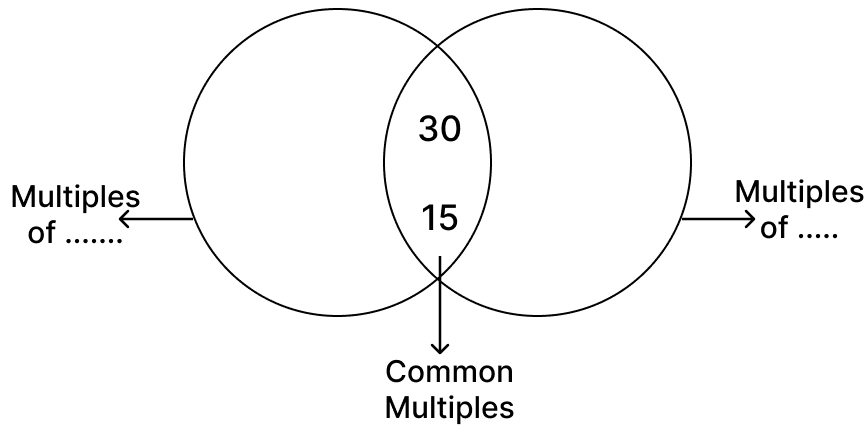
In the diagram below, Aditya has erased all the numbers except the common multiples. Fill in the missing numbers in the empty regions, if the highest number in the diagram is 30.
Answer
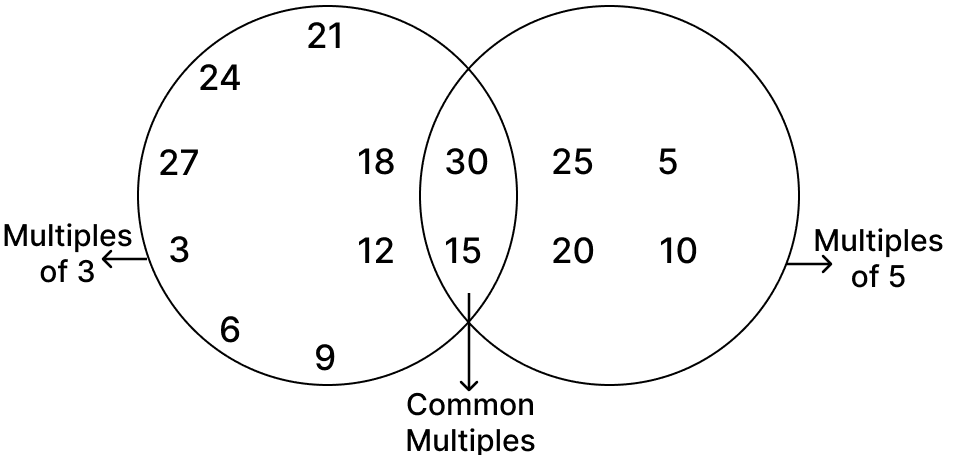
The common multiples shown are 15 and 30. So the two circles represent multiples of two numbers whose common multiples (up to 30) include 15 and 30.
The two numbers must be factors of 15 (excluding 1 and 15 themselves, as the circles need separate non-common multiples in the highest range up to 30).
The factors of 15 are 1, 3, 5 and 15. So the two numbers are 3 and 5.
Multiples of 3 (up to 30, excluding common multiples): 3, 6, 9, 12, 18, 21, 24, 27.
Multiples of 5 (up to 30, excluding common multiples): 5, 10, 20, 25.
Common multiples (already given): 15, 30.
Hence, the left circle represents Multiples of 3 (containing 3, 6, 9, 12, 18, 21, 24, 27), the right circle represents Multiples of 5 (containing 5, 10, 20, 25), and the common region contains 15 and 30.
2024 is a leap year (as February has 29 days). Leap years occur in the years that are multiples of 4, except for those years that are divisible by 100 but not 400.
(i) From the year you were born till now, which years were leap years?
(ii) From the year 2024 till 2099, how many leap years are there?
Answer
(i) This depends on the student's year of birth. The student should list all years which are multiples of 4 (and not exceptions) from their birth year up to the present year.
For example, if the student was born in 2014 and the present year is 2026, the leap years are: 2016, 2020, 2024.
Hence, list the multiples of 4 between your birth year and the present year, excluding any year divisible by 100 but not by 400.
(ii) From 2024 till 2099 (both inclusive):
Multiples of 4 from 2024 to 2096:
2024, 2028, 2032, ..., 2096.
This forms an arithmetic sequence with first term 2024, common difference 4 and last term 2096.
Number of terms = .
We must check exceptions: years divisible by 100 but not 400 are not leap years. The only century year in this range is 2100, but 2100 > 2099, so it's not in our range. There are no exceptions in 2024–2099.
Hence, there are 19 leap years from 2024 till 2099.