
The number of lines of symmetry of a protractor is
0
1
2
unlimited
Answer
A protractor has the shape of a semicircle. The only line of symmetry of a protractor is the vertical line passing through the centre and the 90° mark, which divides it into two identical halves.
Therefore, the number of lines of symmetry of a protractor = 1.
Hence, option 2 is the correct option.
If the perimeter of a regular pentagon is 60 cm, then its each side is
10 cm
12 cm
15 cm
20 cm
Answer
Given:
Perimeter of regular pentagon = 60 cm
A regular pentagon has 5 sides of equal length.
Perimeter of regular pentagon = 5 × length of a side
⇒ 60 = 5 × length of a side
⇒ length of a side =
⇒ length of a side = 12 cm
Hence, option 2 is the correct option.
If the perimeter of a square is 42 cm, then find its area.
Answer
Given:
Perimeter of square = 42 cm
Let a be the side of the square.
Perimeter of square = 4 × side
⇒ 4 × a = 42
⇒ a =
⇒ a = 10.5 cm
Area of square = side × side
= 10.5 × 10.5 cm2
= 110.25 sq. cm
Hence, the area of the square is 110.25 sq. cm.
Using ruler and compass, construct an angle of 90°.
Answer
Steps:
Draw any line l and take a point O on it.
With O as centre and any suitable radius, draw an arc to cut the line l at points A and B.
With A and B as centres, draw two arcs of equal radius cutting each other at C.
Join OC and produce it to form the ray OC.
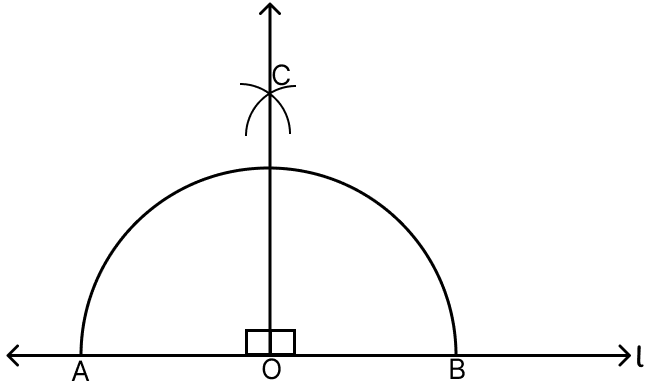
Hence, ∠BOC = 90° is the required angle constructed using ruler and compass.
On a squared paper, sketch a quadrilateral with exactly two lines of symmetry. Also sketch the lines of symmetry.
Answer
A rectangle is a quadrilateral that has exactly two lines of symmetry. The two lines of symmetry are the lines passing through the mid-points of its opposite sides.
Steps:
On the squared paper, draw a rectangle ABCD.
Draw a horizontal dotted line passing through the mid-points of AD and BC. This is one line of symmetry.
Draw a vertical dotted line passing through the mid-points of AB and DC. This is the second line of symmetry.
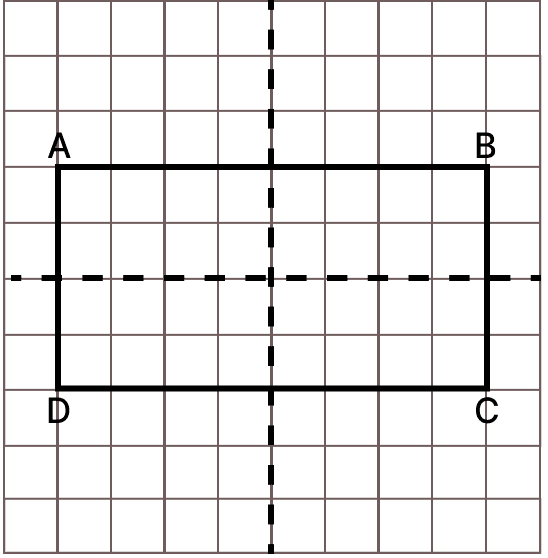
Hence, the rectangle ABCD is the required quadrilateral with exactly two lines of symmetry.
If the area of a rectangular plot is 396 sq. m and its breadth is 18 m. Find the length of the plot and the cost of fencing it at the rate of ₹ 7.50 per metre.
Answer
Given:
Area of rectangular plot = 396 sq. m
Breadth of plot = 18 m
Area of rectangle = length × breadth
⇒ Length =
⇒ Length = m
⇒ Length = 22 m
Perimeter of rectangle = 2(length + breadth)
= 2(22 + 18) m
= 2 × 40 m
= 80 m
Cost of fencing the plot = Perimeter × Rate per metre
= 80 × ₹ 7.50
= ₹ 600
Hence, the length of the plot is 22 m and the cost of fencing it is ₹ 600.
Draw a line segment AB of length 6.4 cm. Take a point P on AB such that AP = 4.5 cm. Draw a perpendicular to AB at P. (use ruler and compass).
Answer
Steps:
Draw a line segment AB = 6.4 cm using ruler and compass.
With A as centre and radius 4.5 cm, draw an arc cutting AB at point P. So, AP = 4.5 cm.
With P as centre and any suitable radius, draw an arc to cut AB at points C and D.
With C and D as centres, draw two arcs of equal radius cutting each other at point Q.
Draw a line passing through points P and Q.
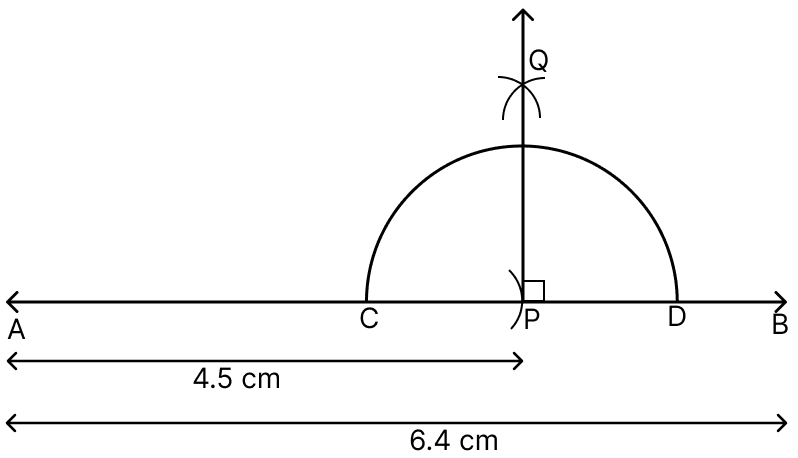
Hence, PQ is the required perpendicular to AB at point P.
Copy the adjoining figure. How many lines of symmetry it has? Draw its all lines of symmetry.

Answer
The given figure is a plus-shaped (cross-shaped) figure with all arms of equal length.
This figure has the following lines of symmetry:
A horizontal line passing through the centre.
A vertical line passing through the centre.
A diagonal line from top-left to bottom-right.
A diagonal line from top-right to bottom-left.
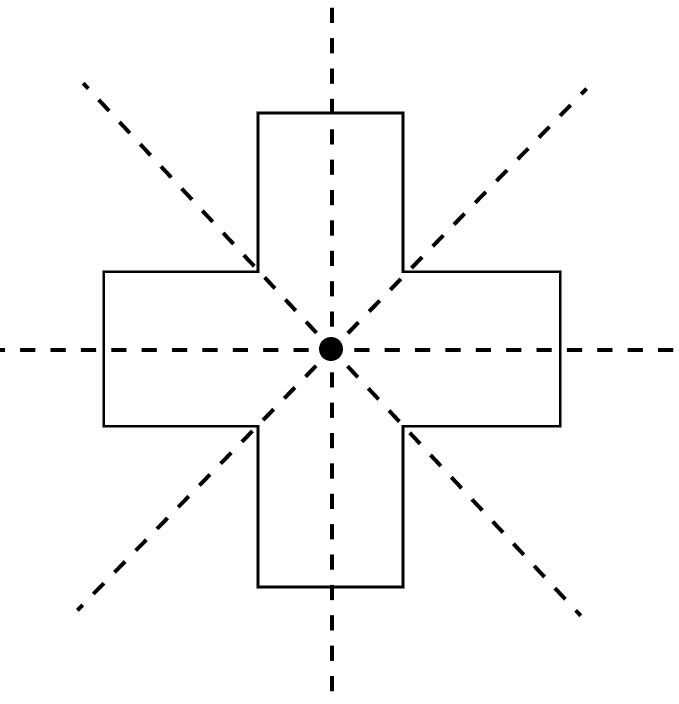
Therefore, the figure has 4 (four) lines of symmetry.
Hence, the given figure has four lines of symmetry.
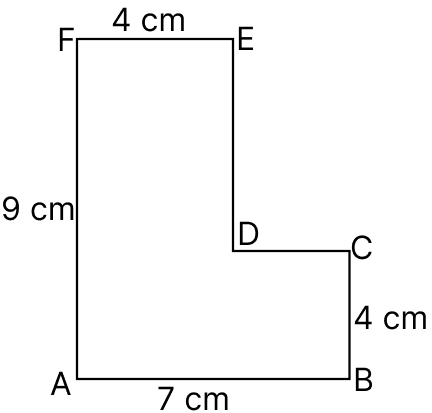
In the adjoining figure, all adjacent sides are at right angles. Find:
(i) the perimeter of the figure.
(ii) the area enclosed by the figure.
Answer
In the figure:
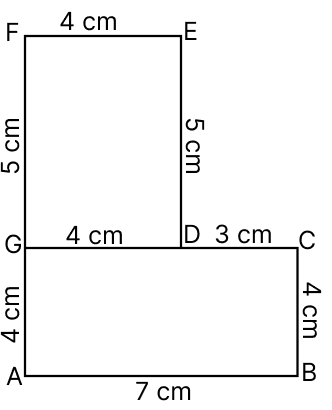
AB = 7 cm, BC = 4 cm, FE = 4 cm and AF = 9 cm.
Since all adjacent sides are at right angles, we have:
GD = FE = 4 cm and AG = BC = 4 cm
GC = AB = 7 cm
DC = GC - GD = 7 − 4 = 3 cm
GF = AF − AG = 9 − 4 = 5 cm
DE = 5 cm
(i) Perimeter of the figure
= AB + BC + CD + DE + EF + FA
= (7 + 4 + 3 + 5 + 4 + 9) cm
= 32 cm.
Hence, the perimeter of the figure is 32 cm.
(ii) From figure,
Area of rectangle ABCG = AB × BC
= 7 × 4 sq. cm
= 28 sq. cm
In the upper rectangle GFED:
GF = AF − AG = 9 − 4 = 5 cm and FE = 4 cm
Area of rectangle GFED = GF × FE
= 5 × 4 sq. cm
= 20 sq. cm
Total area enclosed by the figure = Area of rectangle ABCG + Area of rectangle GFED
= (28 + 20) sq. cm
= 48 sq. cm
Hence, the area enclosed by the figure is 48 sq. cm.
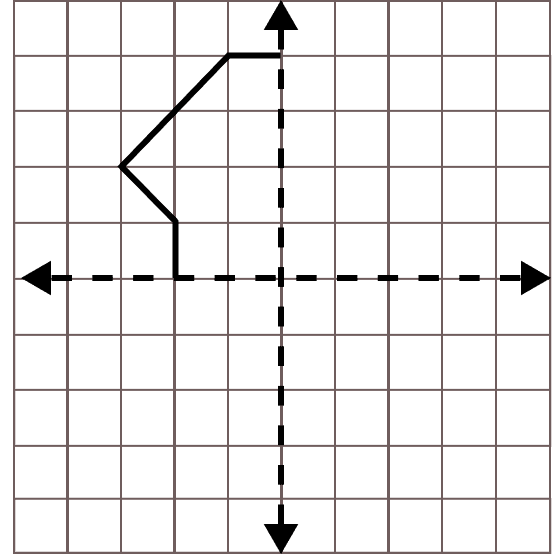
Copy the adjoining figure on a squared paper and complete the figure such that the resultant figure is symmetrical about both the dotted lines.
Answer
The given figure has a portion drawn in one of the four quadrants formed by the two dotted lines (one horizontal and one vertical). To make the resultant figure symmetrical about both the dotted lines, we need to reflect the given portion across each dotted line.
Steps:
Copy the given figure on a squared paper.
Reflect the given portion across the vertical dotted line. Mark each point of the original figure at the same distance on the other side of the vertical dotted line and join them to obtain the mirror image.
Reflect the figure (including the original and its reflection from Step 2) across the horizontal dotted line. Mark each point at the same distance on the other side of the horizontal dotted line and join them.
The completed figure obtained will be symmetric about both the dotted lines.
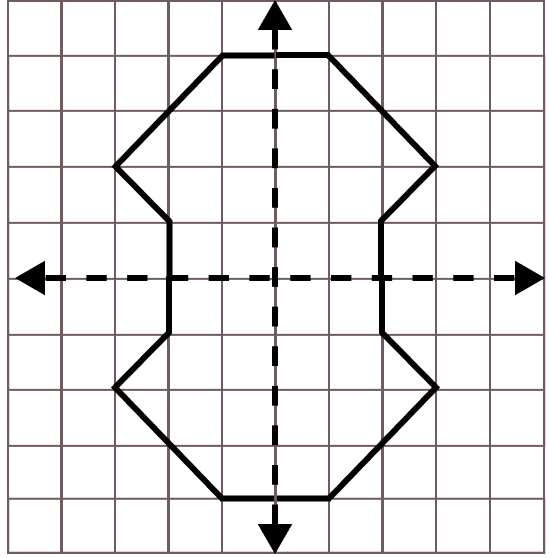
Hence, the completed figure is symmetrical about both the dotted lines.