
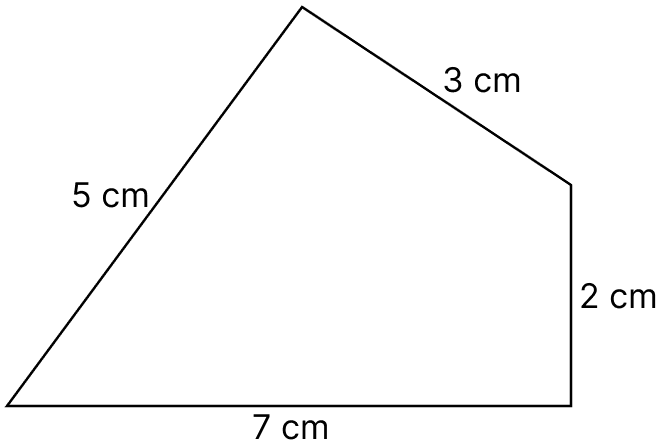
Find the perimeter of the following figure:
Answer
The perimeter of a closed plane figure is the length of its boundary.
The given figure is a quadrilateral with sides 5 cm, 3 cm, 2 cm and 7 cm.
Perimeter = Sum of all sides
= 5 + 3 + 2 + 7 cm
= 17 cm
Hence, the perimeter of the figure is 17 cm.
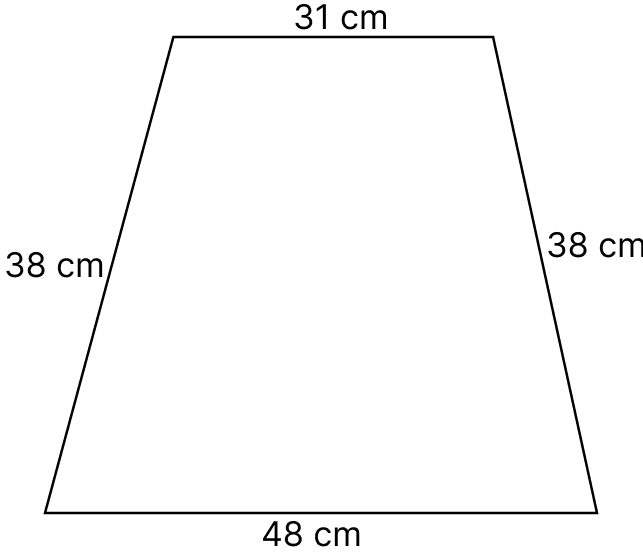
Find the perimeter of the following figure:
Answer
The perimeter of a closed plane figure is the length of its boundary.
The given figure is a quadrilateral with sides 31 cm, 38 cm, 48 cm and 38 cm.
Perimeter = Sum of all sides
= 31 + 38 + 48 + 38 cm
= 155 cm
Hence, the perimeter of the figure is 155 cm.
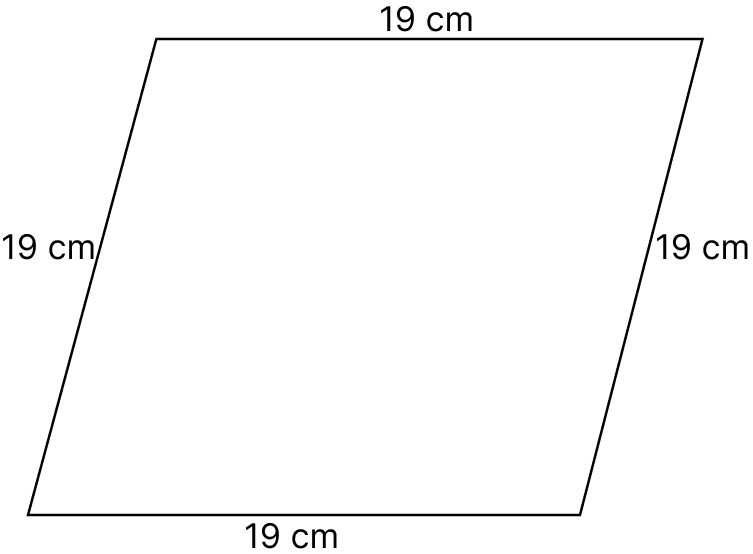
Find the perimeter of the following figure:
Answer
The perimeter of a closed plane figure is the length of its boundary.
The given figure is a rhombus with each side measuring 19 cm.
Perimeter = 4 × side
= 4 × 19 cm
= 76 cm
Hence, the perimeter of the figure is 76 cm.
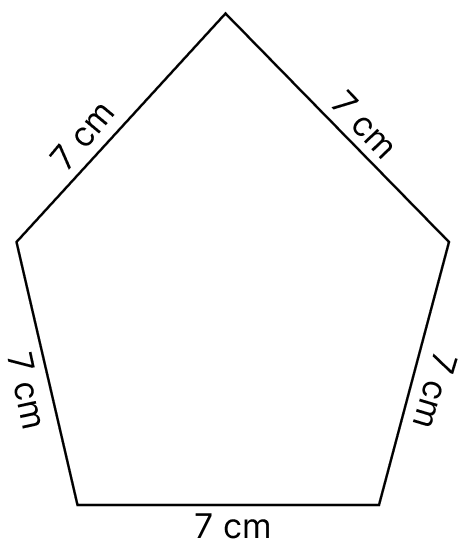
Find the perimeter of the following figure:
Answer
The perimeter of a closed plane figure is the length of its boundary.
The given figure is a regular pentagon with each side measuring 7 cm.
Perimeter = 5 × side
= 5 × 7 cm
= 35 cm
Hence, the perimeter of the figure is 35 cm.
Find the perimeter of each of the following shapes:
(i) A triangle of sides 3 cm, 4 cm and 6 cm.
(ii) A triangle of sides 7 cm, 5.4 cm and 10.2 cm.
(iii) An equilateral triangle of side 11 cm.
(iv) An isosceles triangle with equal sides 10 cm each and third side 7 cm.
Answer
(i) Perimeter of triangle = Sum of all sides
= 3 + 4 + 6 cm
= 13 cm
Hence, the perimeter of the triangle is 13 cm.
(ii) Perimeter of triangle = Sum of all sides
= 7 + 5.4 + 10.2 cm
= 22.6 cm
Hence, the perimeter of the triangle is 22.6 cm.
(iii) Perimeter of equilateral triangle = 3 × side
= 3 × 11 cm
= 33 cm
Hence, the perimeter of the equilateral triangle is 33 cm.
(iv) Perimeter of isosceles triangle = Sum of all sides
= 10 + 10 + 7 cm
= 27 cm
Hence, the perimeter of the isosceles triangle is 27 cm.
The lid of a rectangular box of sides 40 cm by 10 cm is sealed all round with tape. What is the length of the tape required?
Answer
Given:
Length of the lid = 40 cm
Breadth of the lid = 10 cm
The length of the tape required will be equal to the perimeter of the rectangular lid.
Perimeter of rectangle = 2(length + breadth)
= 2(40 + 10) cm
= 2 × 50 cm
= 100 cm
= 1 m
Hence, the length of the tape required is 1 m.
A table-top measures 2 m 25 cm by 1 m 50 cm. What is the perimeter of the tabletop?
Answer
Given:
Length of the table-top = 2 m 25 cm = 2.25 m
Breadth of the table-top = 1 m 50 cm = 1.50 m
Perimeter of rectangle = 2(length + breadth)
= 2(2.25 + 1.50) m
= 2 × 3.75 m
= 7.5 m
Hence, the perimeter of the tabletop is 7.5 m.
The perimeter of a rectangle is 58 m. If its length is 17 m, find its breadth.
Answer
Given:
Perimeter of rectangle = 58 m
Length = 17 m
Let b be the breadth of the rectangle.
Perimeter of rectangle = 2(length + breadth)
⇒ 58 = 2(17 + b)
⇒ = 17 + b
⇒ 29 = 17 + b
⇒ b = 29 - 17
⇒ b = 12 m
Hence, the breadth of the rectangle is 12 m.
A rectangular piece of land measures 0.7 km by 0.5 km. Each side is to be fenced with 4 rows of wires. What is the length of the wire needed?
Answer
Given:
Length of the land = 0.7 km
Breadth of the land = 0.5 km
Perimeter of rectangular land = 2(length + breadth)
= 2(0.7 + 0.5) km
= 2 × 1.2 km
= 2.4 km
Since each side is to be fenced with 4 rows of wires,
Length of the wire needed = 4 × Perimeter
= 4 × 2.4 km
= 9.6 km
Hence, the length of the wire needed is 9.6 km.
Find the perimeter of a regular hexagon with each side measuring 7.5 m.
Answer
Given:
Each side of the regular hexagon = 7.5 m
Perimeter of regular hexagon = 6 × side
= 6 × 7.5 m
= 45 m
Hence, the perimeter of the regular hexagon is 45 m.
The lengths of two sides of a triangle are 12 cm and 14 cm. The perimeter of the triangle is 36 cm. What is the length of its third side?
Answer
Given:
Two sides of the triangle = 12 cm and 14 cm
Perimeter of the triangle = 36 cm
Let x be the third side of the triangle.
Perimeter of triangle = Sum of all sides
⇒ 36 = 12 + 14 + x
⇒ 36 = 26 + x
⇒ x = 36 - 26
⇒ x = 10 cm
Hence, the length of the third side is 10 cm.
The perimeter of a regular pentagon is 100 cm. How long is its each side?
Answer
Given:
Perimeter of regular pentagon = 100 cm
Perimeter of regular pentagon = 5 × side
⇒ 100 = 5 × side
⇒ side =
⇒ side = 20 cm
Hence, each side of the regular pentagon is 20 cm.
A piece of string is 30 cm long. What will be the length of each side if the string is used to form:
(i) a square?
(ii) an equilateral triangle?
(iii) a regular hexagon?
Answer
The length of the string = 30 cm
(i) When the string is used to form a square, the perimeter of the square = 30 cm.
Perimeter of square = 4 × side
⇒ 30 = 4 × side
⇒ side =
⇒ side = 7.5 cm
Hence, the length of each side of the square is 7.5 cm.
(ii) When the string is used to form an equilateral triangle, the perimeter of the triangle = 30 cm.
Perimeter of equilateral triangle = 3 × side
⇒ 30 = 3 × side
⇒ side =
⇒ side = 10 cm
Hence, the length of each side of the equilateral triangle is 10 cm.
(iii) When the string is used to form a regular hexagon, the perimeter of the hexagon = 30 cm.
Perimeter of regular hexagon = 6 × side
⇒ 30 = 6 × side
⇒ side =
⇒ side = 5 cm
Hence, the length of each side of the regular hexagon is 5 cm.
Find the cost of fencing a rectangular park of length 225 m and breadth 115 m at the rate of ₹ 13 per metre.
Answer
Given:
Length of the park = 225 m
Breadth of the park = 115 m
Rate of fencing = ₹ 13 per metre
Perimeter of rectangular park = 2(length + breadth)
= 2(225 + 115) m
= 2 × 340 m
= 680 m
Cost of fencing = Perimeter × Rate
= 680 × 13
= ₹ 8840
Hence, the cost of fencing the rectangular park is ₹ 8840.
Meera went to a rectangular park 140 m long and 90 m wide. She took 5 complete rounds on its boundary. What is the distance covered by her?
Answer
Given:
Length of the park = 140 m
Breadth of the park = 90 m
Number of rounds = 5
Perimeter of rectangular park = 2(length + breadth)
= 2(140 + 90) m
= 2 × 230 m
= 460 m
Distance covered in 5 rounds = 5 × Perimeter
= 5 × 460 m
= 2300 m
Hence, the distance covered by Meera is 2300 m.
Pinky runs 8 times around a rectangular park with length 80 m and breadth 55 m while Pankaj runs 7 times around a square park of side 75 m. Who covers more distance and by how much?
Answer
For Pinky:
Perimeter of rectangular park = 2(length + breadth)
= 2(80 + 55) m
= 2 × 135 m
= 270 m
Distance covered by Pinky in 8 rounds = 8 × 270 m = 2160 m
For Pankaj:
Perimeter of square park = 4 × side
= 4 × 75 m
= 300 m
Distance covered by Pankaj in 7 rounds = 7 × 300 m = 2100 m
Difference in distances covered = 2160 m - 2100 m = 60 m
Hence, Pinky covers more distance by 60 m.
A rectangular park is 104 m long and 56 m wide. Anjali walks around it at the rate of 4 km/h. What time will she take in making 5 rounds of the park?
Answer
Given:
Length of the park = 104 m
Breadth of the park = 56 m
Speed of Anjali = 4 km/h
Number of rounds = 5
Perimeter of rectangular park = 2(length + breadth)
= 2(104 + 56) m
= 2 × 160 m
= 320 m
Total distance covered in 5 rounds = 5 × 320 m = 1600 m
Speed of Anjali = 4 km/h = 4 × 1000 m/h = 4000 m/h
So, Anjali covers 4000 m in 60 minutes.
∴ Anjali covers 1 m in minutes.
∴ Anjali covers 1600 m in minutes
Hence, Anjali takes 24 minutes in making 5 rounds of the park.
A wire is in the shape of a regular pentagon of side 12 cm. It is rebent into the shape of a rectangle whose length is times its breadth. Find the length and the breadth of the rectangle.
Answer
Given:
Side of regular pentagon = 12 cm
Length of rectangle = × breadth
Length of the wire = Perimeter of regular pentagon
= 5 × side
= 5 × 12 cm
= 60 cm
Let the breadth of the rectangle be b cm.
Then, length of the rectangle = b cm
Since the wire is rebent into the shape of a rectangle,
Perimeter of rectangle = Length of wire
⇒ 2(length + breadth) = 60
⇒ 2 = 60
⇒ 2 × = 60
⇒ 5b = 60
⇒ b =
⇒ b = 12 cm
Length of rectangle = × 12 = 18 cm
Hence, the length of the rectangle is 18 cm and the breadth is 12 cm.
Find the area of the region enclosed by the following figures by counting squares:
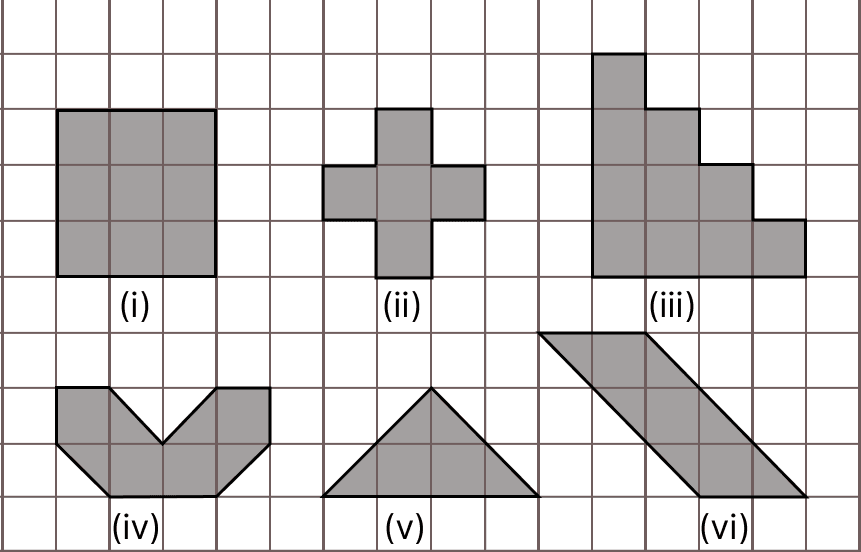
Answer
To estimate the area of a closed plane figure using a square paper, the following conventions are adopted:
- The area of one complete square is taken as 1 sq. unit.
- If more than half the square is covered by the region, then count it as 1 sq. unit.
- If less than half the square is covered by the region, then ignore this portion.
- If exactly half the square is covered by the region, then take its area as sq. unit.
(i) By counting the unit squares enclosed by the figure:
Number of complete covered squares = 9
Area of the region enclosed by the figure = 9 × 1 sq. unit = 9 sq. units
Hence, the area of the region enclosed by figure (i) is 9 sq. units.
(ii) By counting the unit squares enclosed by the figure:
Area of the region enclosed by the figure = 5 sq. units
Hence, the area of the region enclosed by figure (ii) is 5 sq. units.
(iii) By counting the unit squares enclosed by the figure:
Area of the region enclosed by the figure = 10 sq. units
Hence, the area of the region enclosed by figure (iii) is 10 sq. units.
(iv) By counting the unit squares enclosed by the figure:
Area of the region enclosed by the figure = 6 sq. units
Hence, the area of the region enclosed by figure (iv) is 6 sq. units.
(v) By counting the unit squares enclosed by the figure:
Area of the region enclosed by the figure = 4 sq. units
Hence, the area of the region enclosed by figure (v) is 4 sq. units.
(vi) By counting the unit squares enclosed by the figure:
Area of the region enclosed by the figure = 6 sq. units
Hence, the area of the region enclosed by figure (vi) is 6 sq. units.
Find the areas of the rectangles whose lengths and breadths are:
(i) 9 m and 6 m
(ii) 17 m and 3 m
(iii) 14 m and 4 m
Which one has the largest area and which one has the smallest area?
Answer
Area of rectangle = length × breadth
(i) Length = 9 m, Breadth = 6 m
Area = 9 × 6 = 54 sq. m
(ii) Length = 17 m, Breadth = 3 m
Area = 17 × 3 = 51 sq. m
(iii) Length = 14 m, Breadth = 4 m
Area = 14 × 4 = 56 sq. m
On comparing the areas: 56 sq. m > 54 sq. m > 51 sq. m
Hence, rectangle (iii) has the largest area (56 sq. m) and rectangle (ii) has the smallest area (51 sq. m).
Find the areas of the rectangles whose two adjacent sides are:
(i) 14 cm and 23 cm
(ii) 3 km and 4 km
(iii) 2 m and 90 cm
Answer
Area of rectangle = length × breadth
(i) Length = 23 cm, Breadth = 14 cm
Area = 23 × 14 = 322 sq. cm
Hence, the area of the rectangle is 322 sq. cm.
(ii) Length = 4 km, Breadth = 3 km
Area = 4 × 3 = 12 sq. km
Hence, the area of the rectangle is 12 sq. km.
(iii) Length = 2 m = 200 cm, Breadth = 90 cm
Area = 200 × 90 = 18000 sq. cm
Converting to sq. m:
Area = sq. m = 1.8 sq. m
Hence, the area of the rectangle is 1.8 sq. m.
Find the areas of the squares whose sides are:
(i) 8 cm
(ii) 14 m
(iii) 2 m 50 cm
Answer
Area of square = side × side
(i) Side = 8 cm
Area = 8 × 8 = 64 sq. cm
Hence, the area of the square is 64 sq. cm.
(ii) Side = 14 m
Area = 14 × 14 = 196 sq. m
Hence, the area of the square is 196 sq. m.
(iii) Side = 2 m 50 cm = 2.5 m
Area = 2.5 × 2.5 = 6.25 sq. m
Hence, the area of the square is 6.25 sq. m.
A room is 4 m long and 3 m 25 cm wide. How many square metres of carpet is needed to cover the floor of the room?
Answer
Given:
Length of the room = 4 m
Breadth of the room = 3 m 25 cm = 3.25 m
Area of carpet needed = Area of the floor of the room
= length × breadth
= 4 × 3.25 sq. m
= 13 sq. m
Hence, 13 sq. m of carpet is needed to cover the floor of the room.
What is the cost of tiling a rectangular field 50 m long and 30 m wide at the rate of ₹ 20 per square metre?
Answer
Given:
Length of the field = 50 m
Breadth of the field = 30 m
Rate of tiling = ₹ 20 per sq. m
Area of rectangular field = length × breadth
= 50 × 30 sq. m
= 1500 sq. m
Cost of tiling = Area × Rate
= 1500 × 20
= ₹ 30000
Hence, the cost of tiling the rectangular field is ₹ 30000.
A floor is 5 m long and 4 m wide. A square carpet of side 3 m is laid on the floor. Find the area of the floor that is not carpeted.
Answer
Given:
Length of the floor = 5 m
Breadth of the floor = 4 m
Side of the square carpet = 3 m
Area of the floor = length × breadth
= 5 × 4 sq. m
= 20 sq. m
Area of the square carpet = side × side
= 3 × 3 sq. m
= 9 sq. m
Area of the floor not carpeted = Area of the floor - Area of the carpet
= 20 - 9
= 11 sq. m
Hence, the area of the floor that is not carpeted is 11 sq. m.
In the adjoining figure, find the area of the path (shown shaded) which is 2 m wide all around.
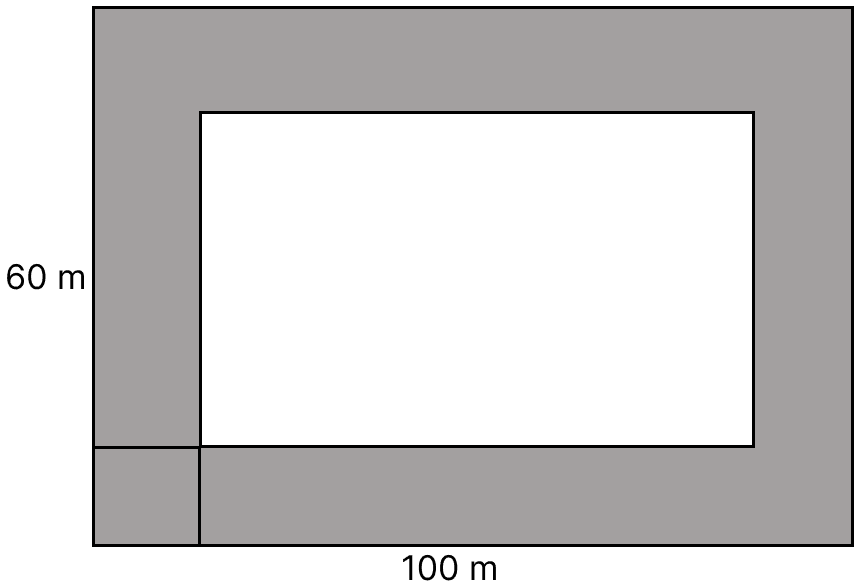
Answer
Given:
Length of the outer rectangle = 100 m
Breadth of the outer rectangle = 60 m
Width of the path = 2 m
Area of the outer rectangle = length × breadth
= 100 × 60 sq. m
= 6000 sq. m
Length of the inner rectangle = 100 - (2 + 2) = 96 m
Breadth of the inner rectangle = 60 - (2 + 2) = 56 m
Area of the inner rectangle = 96 × 56 sq. m
= 5376 sq. m
Area of the path = Area of outer rectangle - Area of inner rectangle
= 6000 - 5376
= 624 sq. m
Hence, the area of the path is 624 sq. m.
Four square flower beds of side 1 m 50 cm are dug on a rectangular piece of land 8 m long and 6 m 50 cm wide. What is the area of the remaining part of land?
Answer
Given:
Length of the land = 8 m
Breadth of the land = 6 m 50 cm = 6.5 m
Side of each flower bed = 1 m 50 cm = 1.5 m
Number of flower beds = 4
Area of the rectangular land = length × breadth
= 8 × 6.5 sq. m
= 52 sq. m
Area of one square flower bed = side × side
= 1.5 × 1.5 sq. m
= 2.25 sq. m
Area of 4 flower beds = 4 × 2.25 = 9 sq. m
Area of the remaining part of land = Area of land - Area of 4 flower beds
= 52 - 9
= 43 sq. m
Hence, the area of the remaining part of land is 43 sq. m.
How many tiles whose length and breadth are 12 cm and 5 cm respectively will be needed to cover a rectangular region whose length and breadth are respectively:
(i) 70 cm and 36 cm
(ii) 144 cm and 1 m.
Answer
Area of one tile = length × breadth
= 12 × 5 sq. cm
= 60 sq. cm
(i) Length of the region = 70 cm
Breadth of the region = 36 cm
Area of the rectangular region = 70 × 36 sq. cm
= 2520 sq. cm
Number of tiles needed =
=
= 42
Hence, 42 tiles are needed to cover the rectangular region.
(ii) Length of the region = 144 cm
Breadth of the region = 1 m = 100 cm
Area of the rectangular region = 144 × 100 sq. cm
= 14400 sq. cm
Number of tiles needed =
=
= 240
Hence, 240 tiles are needed to cover the rectangular region.
The area of a rectangular plot is 340 sq. m. If its breadth is 17 m, find its length and the perimeter.
Answer
Given:
Area of rectangular plot = 340 sq. m
Breadth = 17 m
Area of rectangle = length × breadth
⇒ Length =
=
= 20 m
Perimeter of rectangle = 2(length + breadth)
= 2(20 + 17) m
= 2 × 37 m
= 74 m
Hence, the length of the plot is 20 m and the perimeter is 74 m.
If the area of a rectangular plot is 144 sq. m and its length is 16 m. Find the breadth of the plot and the cost of fencing it at the rate of ₹ 60 per metre.
Answer
Given:
Area of rectangular plot = 144 sq. m
Length = 16 m
Rate of fencing = ₹ 60 per metre
Area of rectangle = length × breadth
⇒ Breadth =
=
= 9 m
Perimeter of rectangle = 2(length + breadth)
= 2(16 + 9) m
= 2 × 25 m
= 50 m
Cost of fencing = Perimeter × Rate
= 50 × 60
= ₹ 3000
Hence, the breadth of the plot is 9 m and the cost of fencing is ₹ 3000.
The perimeter of a square is equal to that of a rectangle of length 17 m and breadth 11 m. Find the area of the square.
Answer
Given:
Length of rectangle = 17 m
Breadth of rectangle = 11 m
Perimeter of square = Perimeter of rectangle
Perimeter of rectangle = 2(length + breadth)
= 2(17 + 11) m
= 2 × 28 m
= 56 m
Perimeter of square = 4 × side
⇒ 56 = 4 × side
⇒ side =
⇒ side = 14 m
Area of square = side × side
= 14 × 14 sq. m
= 196 sq. m
Hence, the area of the square is 196 sq. m.
A rectangle has same area as that of a square of side 10 m. If the breadth of the rectangle is 8 m, find the perimeter of the rectangle.
Answer
Given:
Side of square = 10 m
Breadth of rectangle = 8 m
Area of square = side × side
= 10 × 10 sq. m
= 100 sq. m
Area of rectangle = Area of square = 100 sq. m
Area of rectangle = length × breadth
⇒ Length =
=
= 12.5 m
Perimeter of rectangle = 2(length + breadth)
= 2(12.5 + 8) m
= 2 × 20.5 m
= 41 m
Hence, the perimeter of the rectangle is 41 m.
Split the following shapes into rectangles and find their areas. (The measures are given in centimetres):
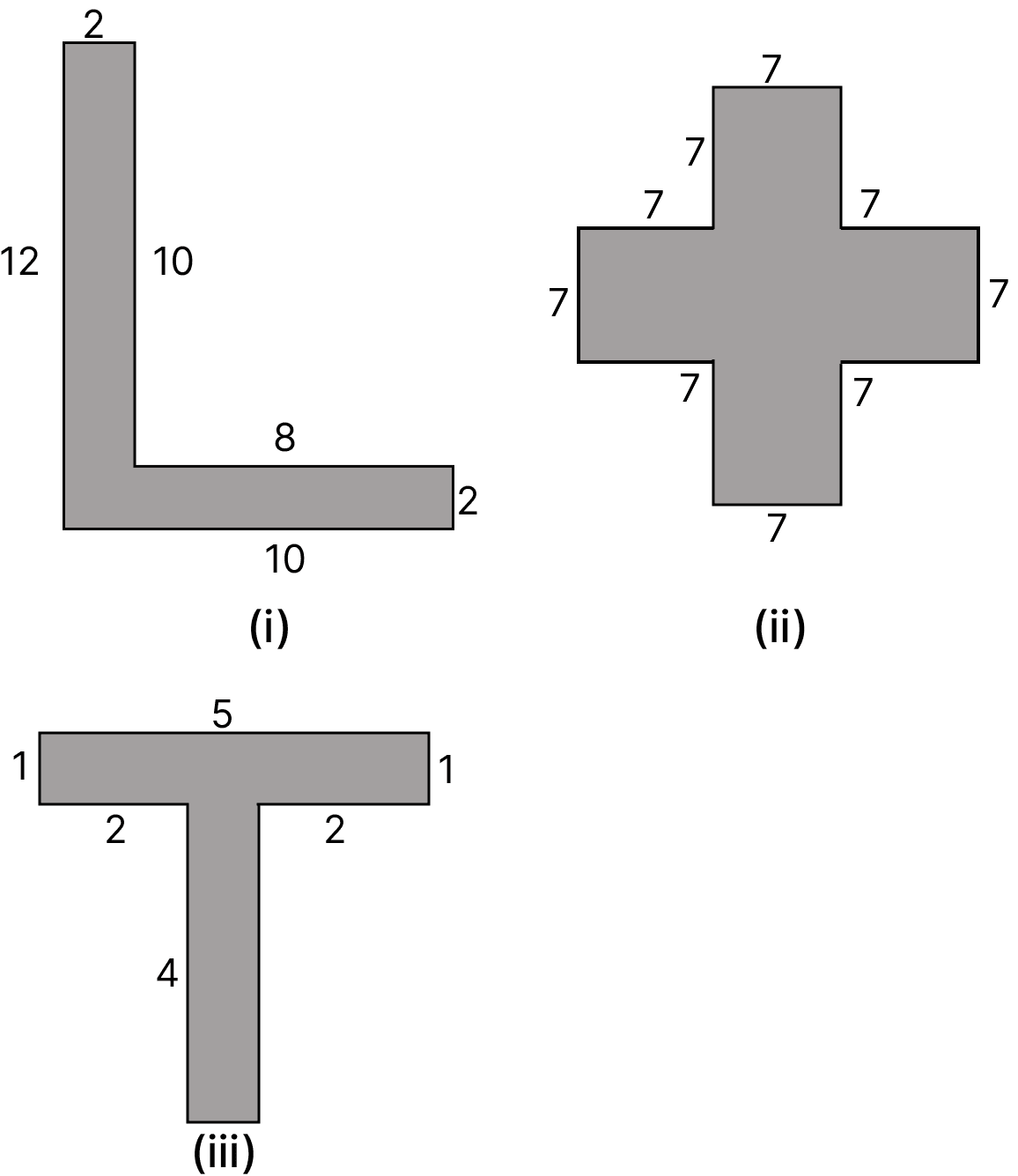
Answer
(i) Splitting the L-shape into two rectangles:
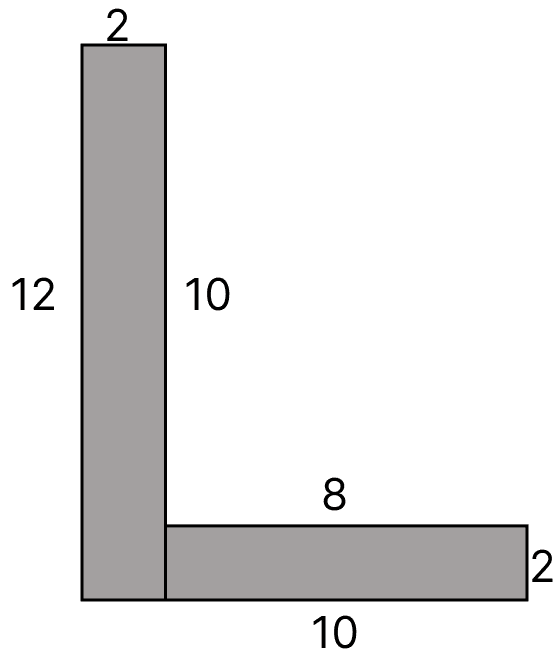
Rectangle 1 (vertical part): length = 12 cm, breadth = 2 cm
Area of Rectangle 1 = 12 × 2 = 24 sq. cm
Rectangle 2 (horizontal part at the bottom): length = 8 cm, breadth = 2 cm
Area of Rectangle 2 = 8 × 2 = 16 sq. cm
Total area = Area of Rectangle 1 + Area of Rectangle 2
= 24 + 16
= 40 sq. cm
Hence, the area of figure (i) = 40 sq. cm.
(ii) Splitting the plus-shaped figure into three rectangles:
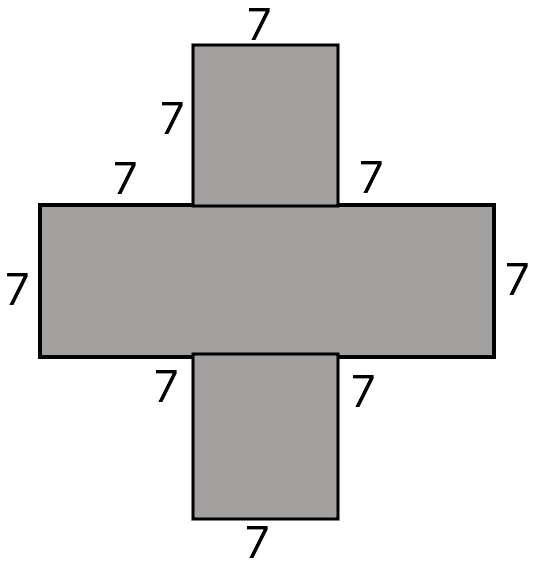
Central horizontal rectangle: length = 7 + 7 + 7 = 21 cm, breadth = 7 cm
Area = 21 × 7 = 147 sq. cm
Top square : side = 7 cm
Area = 7 × 7 = 49 sq. cm
Bottom square : side = 7 cm
Area = 7 × 7 = 49 sq. cm
Total area = 147 + 49 + 49
= 245 sq. cm.
Hence, the area of figure (ii) is 245 sq. cm.
(iii) Splitting the T-shape into two rectangles:
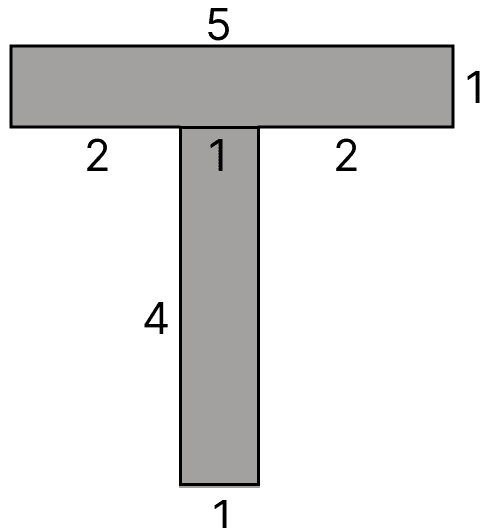
Top bar of T: length = 5 cm, breadth = 1 cm
Area of top bar = 5 × 1 = 5 sq. cm
Stem of T (vertical part): length = 4 cm, breadth = 1 cm
Area of stem = 4 × 1 = 4 sq. cm
Total area = 5 + 4
= 9 sq. cm.
Hence, the area of figure (iii) is 9 sq. cm.
Fill in the blanks:
(i) The perimeter of a closed plane figure is the length of its .....
(ii) The unit of measurement of perimeter is same as that of .....
(iii) If the side of a rhombus is 7 cm then its perimeter is .....
(iv) The area of a closed plane figure is measured in ......
Answer
(i) The perimeter of a closed plane figure is the length of its boundary.
(ii) The unit of measurement of perimeter is same as that of length.
(iii) Since a rhombus has 4 equal sides, perimeter = 4 × side = 4 × 7 = 28 cm.
If the side of a rhombus is 7 cm then its perimeter is 28 cm.
(iv) The area of a closed plane figure is measured in square units (sq. units).
State whether the following statements are true (T) or false (F):
(i) Centimetre is the unit of area.
(ii) The sum of lengths of a polygon is called its area.
(iii) If the side of a square is doubled, then its perimeter is also doubled.
(iv) If the side of a square is doubled, then its area is also doubled.
(v) To find the cost of constructing a road, we find its area.
(vi) To find the cost of fencing a field, we find its perimeter.
Answer
(i) False. Centimetre is the unit of length, not area. Area is measured in square centimetres (sq. cm).
(ii) False. The sum of lengths of the sides of a polygon is called its perimeter, not its area.
(iii) True. If side = s, then original perimeter = 4s. If side is doubled (i.e., 2s), then new perimeter = 4(2s) = 8s = 2 × 4s. So, perimeter is also doubled.
(iv) False. If side = s, then original area = s2. If side is doubled (i.e., 2s), then new area = (2s)2 = 4s2. So, area becomes four times, not double.
(v) True. Construction of a road covers its surface, so we find its area.
(vi) True. Fencing is done along the boundary, so we find the perimeter.
If the perimeter of a square is 50 cm, then its side is
200 cm
150 cm
25 cm
12.5 cm
Answer
Given:
Perimeter of square = 50 cm
Perimeter of square = 4 × side
⇒ 50 = 4 × side
⇒ side =
⇒ side = 12.5 cm
Hence, option 4 is the correct option.
The area of the rectangle with length 25 cm and breadth 12 cm is
300 sq. m
74 cm
300 sq. cm
74 sq. cm
Answer
Given:
Length = 25 cm
Breadth = 12 cm
Area of rectangle = length × breadth
= 25 × 12
= 300 sq. cm
Hence, option 3 is the correct option.
If the perimeter of a square is 36 cm, then its area is
6 sq. cm
9 sq. cm
18 sq. cm
81 sq. cm
Answer
Given:
Perimeter of square = 36 cm
Perimeter of square = 4 × side
⇒ 36 = 4 × side
⇒ side =
⇒ side = 9 cm
Area of square = side × side
= 9 × 9
= 81 sq. cm
Hence, option 4 is the correct option.
If the area of rectangular plot is 180 sq. m and its length is 15 m, then its breadth is
12 m
12 cm
60 m
9 m
Answer
Given:
Area of rectangular plot = 180 sq. m
Length = 15 m
Area of rectangle = length × breadth
⇒ Breadth =
=
= 12 m
Hence, option 1 is the correct option.
If the length and the breadth of a rectangle are doubled, then its perimeter
remains the same
doubles
becomes four times
becomes half
Answer
Let the length = l and the breadth = b.
Original perimeter = 2(l + b)
If length and breadth are doubled, new length = 2l and new breadth = 2b.
New perimeter = 2(2l + 2b)
= 2 × 2(l + b)
= 2 × Original perimeter
Thus, the new perimeter is twice the original perimeter.
Hence, option 2 is the correct option.
If the length and the breadth of a rectangle are doubled then its area
remains same
becomes half
doubles
becomes four times
Answer
Let the length = l and the breadth = b.
Original area = l × b
If length and breadth are doubled, new length = 2l and new breadth = 2b.
New area = 2l × 2b
= 4 × (l × b)
= 4 × Original area
Thus, the new area becomes four times the original area.
Hence, option 4 is the correct option.
If the sides of a square are halved, then its area
remains same
becomes half
becomes one-fourth
doubles
Answer
Let the side of the square = s.
Original area = s × s = s2
If the side is halved, new side =
New area =
= × Original area
Thus, the new area becomes one-fourth of the original area.
Hence, option 3 is the correct option.
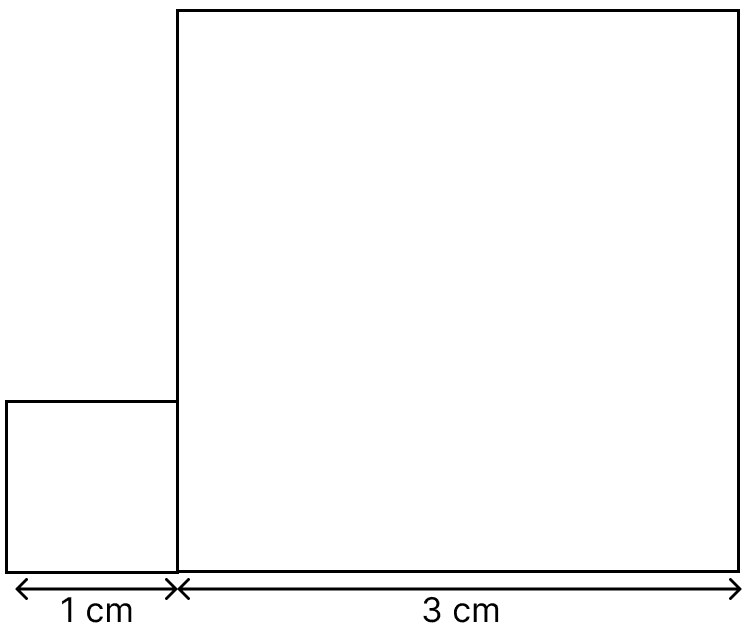
In the adjoining figure, a square of side 1 cm is joined to a square of side 3 cm. The perimeter of the new figure is
13 cm
14 cm
15 cm
16 cm
Answer
When the square of side 1 cm is joined to the square of side 3 cm, one side of the smaller square (1 cm) coincides with a part of one side of the bigger square.
Perimeter of bigger square = 4 × 3 = 12 cm
Perimeter of smaller square = 4 × 1 = 4 cm
When joined, the side of the smaller square (1 cm) is no longer on the boundary, and 1 cm of the side of the bigger square is also no longer on the boundary.
Perimeter of new figure = (Perimeter of bigger square - 1) + (Perimeter of smaller square - 1)
= (12 - 1) + (4 - 1)
= 11 + 3
= 14 cm
Hence, option 2 is the correct option.
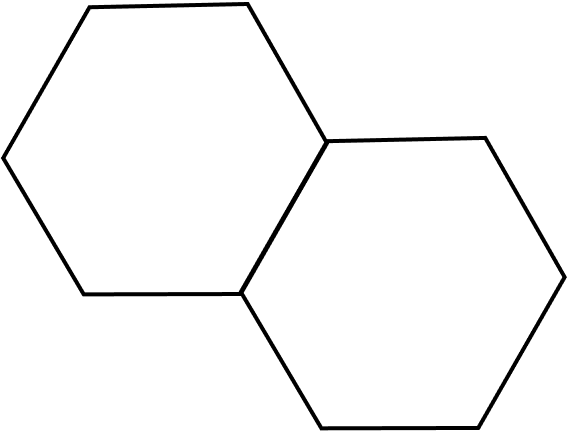
Two regular hexagons of perimeter 30 cm each are joined as shown in the adjoining figure. The perimeter of the new figure is
65 cm
60 cm
55 cm
50 cm
Answer
Given:
Perimeter of each regular hexagon = 30 cm
Side of each hexagon = = 5 cm
When two hexagons are joined along one side, one side of each hexagon (5 cm) coincides.
Sum of perimeters of both hexagons = 30 + 30 = 60 cm
Perimeter of new figure = 60 - 2 × 5
= 60 - 10
= 50 cm
Hence, option 4 is the correct option.
If the area of a square is numerically equal to its perimeter, then the length of each side is
1 unit
2 units
3 units
4 units
Answer
Let the side of the square = s.
Area of square = s2
Perimeter of square = 4s
Given, Area = Perimeter
⇒ s2 = 4s
⇒ s2 - 4s = 0
⇒ s(s - 4) = 0
⇒ s = 4 (since s ≠ 0)
Thus, the length of each side is 4 units.
Hence, option 4 is the correct option.
Four square tables with side 1.3 m are placed end to end to form one big rectangular table. The perimeter of the rectangular table is
5.2 m
10.4 m
13 m
20.8 m
Answer
Given:
Side of each square table = 1.3 m
Number of tables = 4
When four square tables are placed end to end, the length of the rectangular table = 4 × 1.3 = 5.2 m
The breadth of the rectangular table = 1.3 m
Perimeter of rectangle = 2(length + breadth)
= 2(5.2 + 1.3) m
= 2 × 6.5 m
= 13 m
Hence, option 3 is the correct option.
The area of a rectangle is 180 cm2. If its length is 15 cm, then the ratio of its breadth to its length is
1 : 12
12 : 1
5 : 4
4 : 5
Answer
Given:
Area of rectangle = 180 cm2
Length = 15 cm
Area = length × breadth
⇒ Breadth =
=
= 12 cm
Ratio of breadth to length = 12 : 15
=
=
= 4 : 5
Hence, option 4 is the correct option.
A picture is 60 cm wide and 1.8 m long. The ratio of its width to its perimeter in lowest form is
1 : 2
1 : 3
1 : 6
1 : 8
Answer
Given:
Width of picture = 60 cm
Length of picture = 1.8 m = 180 cm
Perimeter of picture = 2(length + width)
= 2(180 + 60) cm
= 2 × 240 cm
= 480 cm
Ratio of width to perimeter = 60 : 480
=
=
= 1 : 8
Hence, option 4 is the correct option.
Statement I: I have two wires of 27 m each. I bend one into a circle and the other into an equilateral triangle. Both shapes have the same perimeter.
Statement II: The perimeter of a closed shape is the length of its boundary.
Statement I is true but statement II is false.
Statement I is false but Statement II is true.
Both Statement I and Statement II are true.
Both Statement I and Statement II are false.
Answer
Statement I: The perimeter of a closed shape made from a wire is equal to the length of the wire. Since both wires are 27 m each, the perimeter of both the circle and the equilateral triangle will be 27 m. So, both shapes have the same perimeter. Statement I is true.
Statement II: The perimeter of a closed shape is the length of its boundary. This is the correct definition of perimeter. Statement II is true.
Both Statement I and Statement II are true.
Hence, option 3 is the correct option.
Statement I: Two rectangular sheets, of length 20 m and width 10 m each, are placed edge to edge along their longer sides. The perimeter of the resulting figure is 80 m.
Statement II: Perimeter of a pentagon is five times the length of any side.
Statement I is true but statement II is false.
Statement I is false but Statement II is true.
Both Statement I and Statement II are true.
Both Statement I and Statement II are false.
Answer
Statement I: When two rectangles of length 20 m and width 10 m are placed edge to edge along their longer sides (20 m), the resulting figure is a rectangle of length 20 m and width 20 m (i.e., a square).
Perimeter = 2(20 + 20) = 2 × 40 = 80 m. Statement I is true.
Statement II: The perimeter of a pentagon is five times the length of any side only if it is a regular pentagon (all sides equal). In general, a pentagon has 5 sides which may not all be equal. Statement II is false.
Statement I is true but Statement II is false.
Hence, option 1 is the correct option.
Statement I: A mobile phone is 15 cm long and 8 cm wide. The sum of the areas of the front and the back of the mobile phone is 240 cm2.
Statement II: Area of a square with side a is a2.
Statement I is true but statement II is false.
Statement I is false but Statement II is true.
Both Statement I and Statement II are true.
Both Statement I and Statement II are false.
Answer
Statement I:
Area of the front (or back) of the mobile phone = length × breadth = 15 × 8 = 120 cm2
Sum of the areas of the front and the back = 2 × 120 = 240 cm2. Statement I is true.
Statement II: The area of a square with side a is given by side × side = a × a = a2. Statement II is true.
Both Statement I and Statement II are true.
Hence, option 3 is the correct option.
Statement I: A room has two doors of equal dimensions. The perimeter of each door is 7 m. The sum of their widths is 3 m. Therefore, the height of each door is 2 m.
Statement II: Length of the rectangle = perimeter + width
Statement I is true but statement II is false.
Statement I is false but Statement II is true.
Both Statement I and Statement II are true.
Both Statement I and Statement II are false.
Answer
Statement I:
Sum of widths of two equal doors = 3 m
So, width of each door = = 1.5 m
Perimeter of each door = 7 m
Perimeter = 2(length + width)
⇒ 7 = 2(height + 1.5)
⇒ = height + 1.5
⇒ 3.5 = height + 1.5
⇒ height = 3.5 - 1.5
⇒ height = 2 m. Statement I is true.
Statement II:
Perimeter of rectangle = 2(length + width)
⇒ × Perimeter = length + width
⇒ Length = Perimeter - width
So, the correct formula is Length = perimeter - width, not + width. Statement II is false.
Statement I is true but Statement II is false.
Hence, option 1 is the correct option.
Statement I: Area and perimeter of a given shape always have the same units.
Statement II: Area of a closed plane figure measures the region enclosed by its boundary.
Statement I is true but statement II is false.
Statement I is false but Statement II is true.
Both Statement I and Statement II are true.
Both Statement I and Statement II are false.
Answer
Statement I: Perimeter is measured in units of length (cm, m, km, etc.), while area is measured in square units (sq. cm, sq. m, sq. km, etc.). So, area and perimeter do not have the same units. Statement I is false.
Statement II: The area of a closed plane figure is indeed the measurement of the region (surface) enclosed by its boundary. Statement II is true.
Statement I is false but Statement II is true.
Hence, option 2 is the correct option.
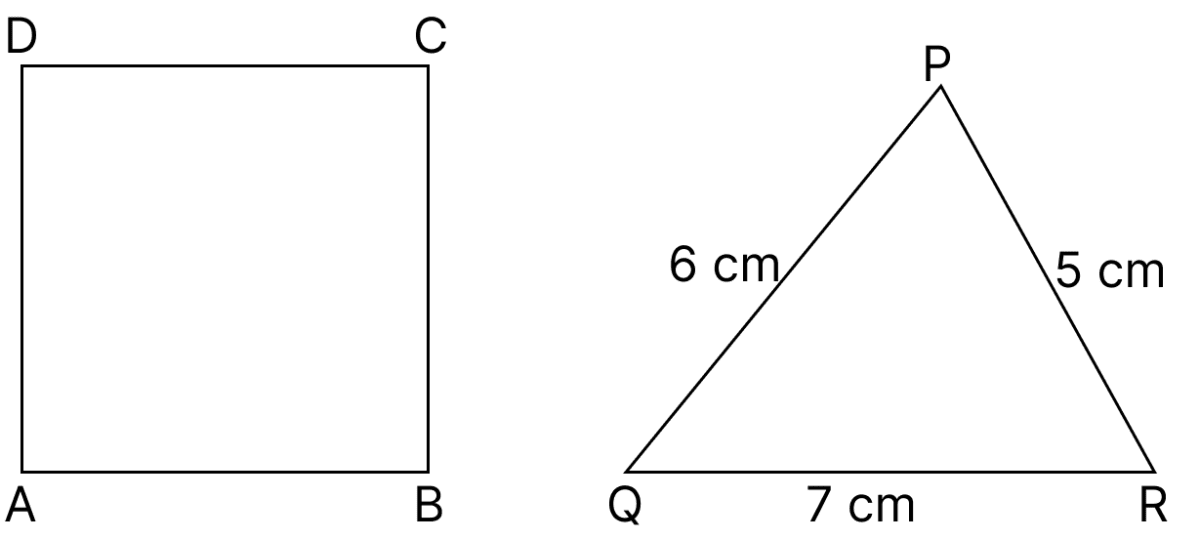
The perimeter of a square ABCD is twice the perimeter of △PQR. Find the area of the square ABCD.
Answer
Given:
Triangle PQR has sides PQ = 6 cm, QR = 7 cm and PR = 5 cm.
Perimeter of △PQR = Sum of all sides
= 6 + 7 + 5 cm
= 18 cm
Perimeter of square ABCD = 2 × Perimeter of △PQR
= 2 × 18 cm
= 36 cm
Perimeter of square = 4 × side
⇒ 36 = 4 × side
⇒ side =
⇒ side = 9 cm
Area of square ABCD = side × side
= 9 × 9
= 81 sq. cm
Hence, the area of the square ABCD is 81 sq. cm.
The perimeter of an equilateral triangle is 42 cm. Find the perimeter of a square, each side of which is double the side of the triangle.
Answer
Given:
Perimeter of equilateral triangle = 42 cm
Perimeter of equilateral triangle = 3 × side
⇒ 42 = 3 × side
⇒ side =
⇒ side of triangle = 14 cm
Side of square = 2 × side of triangle
= 2 × 14
= 28 cm
Perimeter of square = 4 × side
= 4 × 28
= 112 cm
Hence, the perimeter of the square is 112 cm.
A wire of length 60 cm is cut into two pieces. One piece is used to form a rectangle of length 10 cm and width 8 cm. The other piece is bent into the shape of a regular hexagon. What is the length of each side of hexagon?
Answer
Given:
Total length of wire = 60 cm
Length of rectangle = 10 cm
Width of rectangle = 8 cm
Perimeter of rectangle = 2(length + width)
= 2(10 + 8) cm
= 2 × 18 cm
= 36 cm
Length of wire used for rectangle = 36 cm
Length of wire used for hexagon = 60 - 36 = 24 cm
Perimeter of regular hexagon = 6 × side
⇒ 24 = 6 × side
⇒ side =
⇒ side = 4 cm
Hence, the length of each side of the hexagon is 4 cm.
A wire is in the shape of a square of side 10 cm. If the wire is rebent into a rectangle of length 12 cm, find its breadth. Which encloses more area, the square or the rectangle and by how much?
Answer
Given:
Side of square = 10 cm
Length of rectangle = 12 cm
Length of wire = Perimeter of square
= 4 × side
= 4 × 10
= 40 cm
Since the wire is rebent into a rectangle,
Perimeter of rectangle = Length of wire = 40 cm
Perimeter of rectangle = 2(length + breadth)
⇒ 40 = 2(12 + breadth)
⇒ = 12 + breadth
⇒ 20 = 12 + breadth
⇒ breadth = 20 - 12
⇒ breadth = 8 cm
Area of square = side × side
= 10 × 10
= 100 sq. cm
Area of rectangle = length × breadth
= 12 × 8
= 96 sq. cm
Since 100 sq. cm > 96 sq. cm, the square encloses more area.
Difference in areas = 100 - 96 = 4 sq. cm
Hence, the breadth of the rectangle is 8 cm and the square encloses more area than the rectangle by 4 sq. cm.
A rectangular room is 9 m long and 6 m wide. Find the cost of covering the floor with carpet 2 m wide at ₹ 350 per metre.
Answer
Given:
Length of room = 9 m
Breadth of room = 6 m
Width of carpet = 2 m
Rate of carpet = ₹ 350 per metre
Area of the floor = length × breadth
= 9 × 6 sq. m
= 54 sq. m
Area of carpet = Area of floor (since the carpet exactly covers the floor) = 54 sq. m
Length of carpet =
=
= 27 m
Cost of carpet = Length × Rate
= 27 × 350
= ₹ 9450
Hence, the cost of covering the floor with carpet is ₹ 9450.
If the cost of fencing a square plot at the rate of ₹ 30 per metre is ₹ 2400, then find the length of each side of the field.
Answer
Given:
Total cost of fencing = ₹ 2400
Rate of fencing = ₹ 30 per metre
Perimeter of square plot =
=
= 80 m
Perimeter of square = 4 × side
⇒ 80 = 4 × side
⇒ side =
⇒ side = 20 m
Hence, the length of each side of the field is 20 m.
If the cost of fencing a rectangular park at the rate of ₹ 30 per metre is ₹ 2400 and the length of the park is 24 m, find the breadth of the park.
Answer
Given:
Total cost of fencing = ₹ 2400
Rate of fencing = ₹ 30 per metre
Length of the park = 24 m
Perimeter of rectangular park =
=
= 80 m
Perimeter of rectangle = 2(length + breadth)
⇒ 80 = 2(24 + breadth)
⇒ = 24 + breadth
⇒ 40 = 24 + breadth
⇒ breadth = 40 - 24
⇒ breadth = 16 m
Hence, the breadth of the park is 16 m.
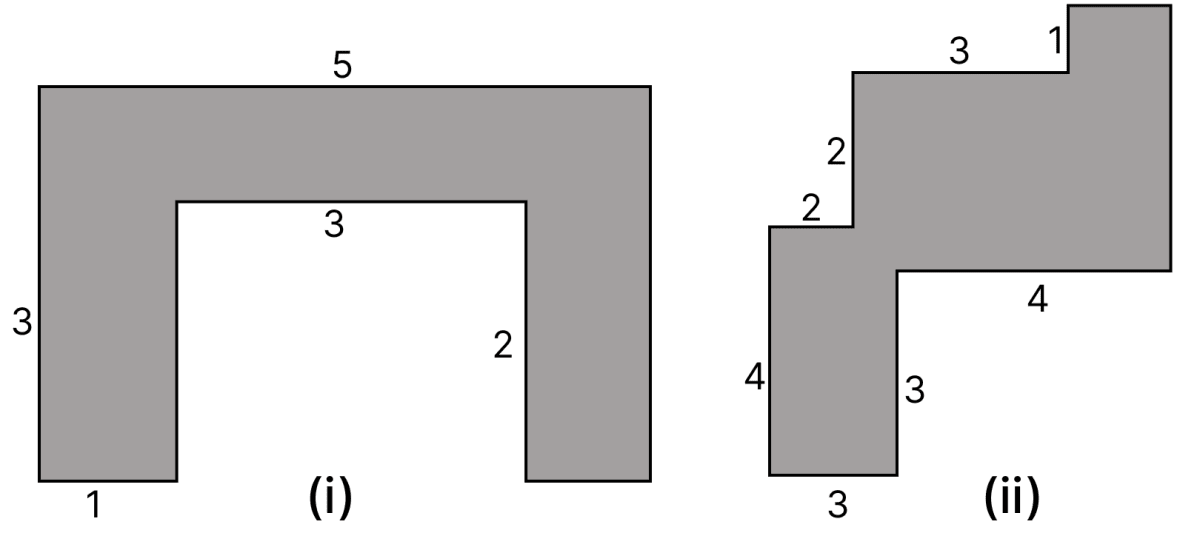
By splitting the following figures into rectangles, find their areas (The measures are given in centimetres).
Answer
(i) Splitting the U-shape figure into three rectangles:
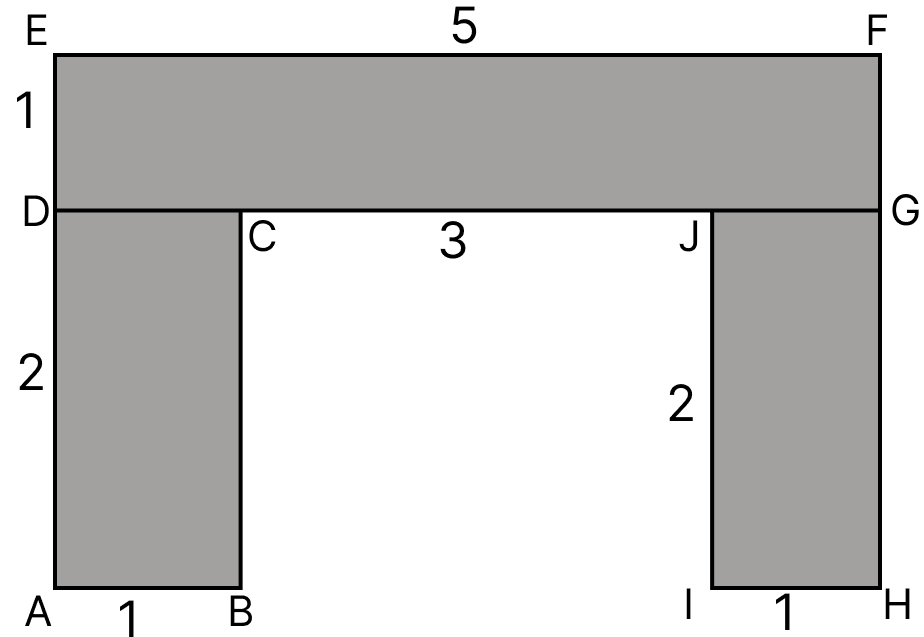
Rectangle DEFG: length = 5 cm, breadth = 1 cm
Area = 5 × 1 = 5 sq. cm
Rectangle JIHG: length = 2 cm, breadth = 1 cm
Area = 2 × 1 = 2 sq. cm
Rectangle ABCD: length = 2 cm, breadth = 1 cm
Area = 2 × 1 = 2 sq. cm
Total area of figure (i) = 5 + 2 + 2
= 9 sq. cm
Hence, the area of figure (i) is 9 sq. cm.
(ii) Splitting the figure:
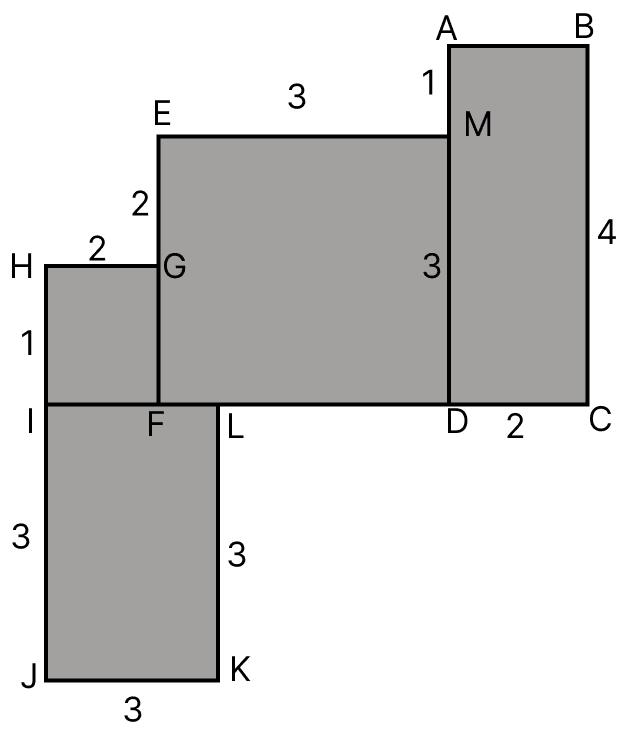
As, LC = 4 and EM = 3 = FD = LF + LD
IF + FL = JK = 3
HG = IF = 2
2 + FL = 3
Therefore, FL = 1
Now, LC = 4, FL + LD = 3
LD = 2
LD + DC = 4
2 + DC = 4
DC = 2
Rectangle ABCD: length = 2 cm, breadth = 4 cm
Area = 2 × 4 = 8 sq. cm
Rectangle HIGF: length = 2 cm, breadth = 1 cm
Area = 2 × 1 = 2 sq. cm
Square MEFD: length = 3 cm, breadth = 3 cm
Area = 3 × 3 = 9 sq. cm
Rectangle IJKL: length = 3 cm, breadth = 3 cm
Area = 3 × 3 = 9 sq. cm
Total area of figure (ii) = 8 + 2 + 9 + 9
= 28 sq. cm
Hence, the area of figure (ii) is 28 sq. cm.
How many envelopes of size 25 cm × 15 cm can be made from a rectangular sheet of size 4 m × 1.2 m?
Answer
Given:
Length of sheet = 4 m = 400 cm
Breadth of sheet = 1.2 m = 120 cm
Size of each envelope = 25 cm × 15 cm
Area of the rectangular sheet = length × breadth
= 400 × 120 sq. cm
= 48000 sq. cm
To make one envelope, paper of double the size of the envelope is needed (because an envelope is formed by folding paper to make front and back).
Paper needed for one envelope = 2 × (25 × 15) sq. cm
= 2 × 375 sq. cm
= 750 sq. cm
Number of envelopes that can be made =
=
= 64
Hence, 64 envelopes can be made from the rectangular sheet.
The perimeter of a rectangle is 36 cm. What will be length and breadth (in natural numbers) of that rectangle whose area is
(i) maximum?
(ii) minimum?
Answer
Given:
Perimeter of rectangle = 36 cm
Perimeter of rectangle = 2(length + breadth)
⇒ 36 = 2(length + breadth)
⇒ length + breadth =
⇒ length + breadth = 18 cm
The possible pairs of (length, breadth) in natural numbers with sum 18 are:
| Length | Breadth | Area (length × breadth) |
|---|---|---|
| 17 | 1 | 17 sq. cm |
| 16 | 2 | 32 sq. cm |
| 15 | 3 | 45 sq. cm |
| 14 | 4 | 56 sq. cm |
| 13 | 5 | 65 sq. cm |
| 12 | 6 | 72 sq. cm |
| 11 | 7 | 77 sq. cm |
| 10 | 8 | 80 sq. cm |
| 9 | 9 | 81 sq. cm |
(i) The maximum area is 81 sq. cm when length = 9 cm and breadth = 9 cm.
Hence, for maximum area, length = 9 cm and breadth = 9 cm.
(ii) The minimum area is 17 sq. cm when length = 17 cm and breadth = 1 cm.
Hence, for minimum area, length = 17 cm and breadth = 1 cm.
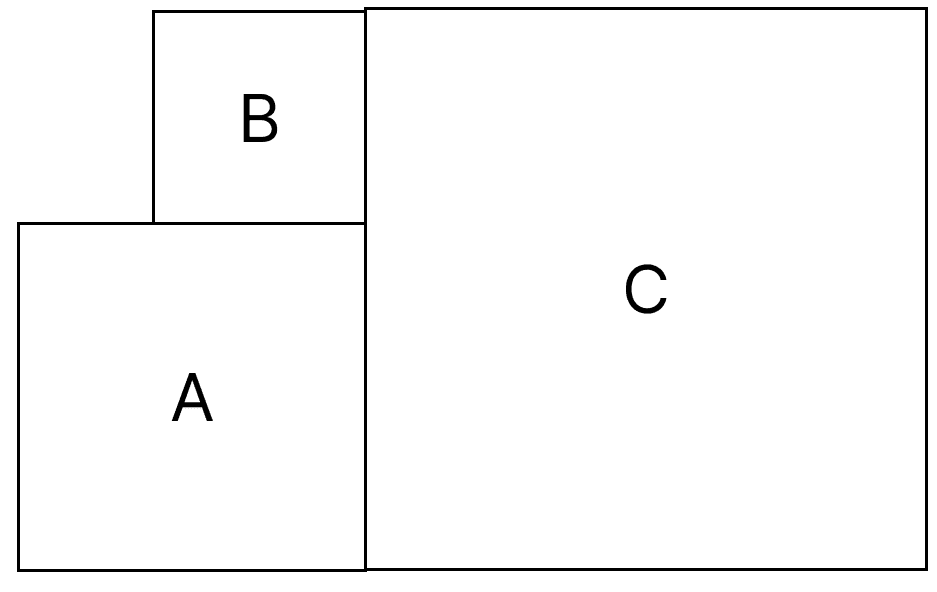
In the adjoining figure, A, B and C are squares. If the area of the square A is 25 sq. cm and the perimeter of the square B is 12 cm, then find the perimeter and the area of the square C.
Answer
Given:
Area of square A = 25 sq. cm
Perimeter of square B = 12 cm
For square A:
Area of square = side × side
⇒ 25 = side × side
⇒ side2 = 25
⇒ side =
⇒ side of A = 5 cm
For square B:
Perimeter of square = 4 × side
⇒ 12 = 4 × side
⇒ side =
⇒ side of B = 3 cm
From the figure, side of square C = side of A + side of B
= 5 + 3
= 8 cm
Perimeter of square C = 4 × side
= 4 × 8
= 32 cm
Area of square C = side × side
= 8 × 8
= 64 sq. cm
Hence, the perimeter of square C is 32 cm and the area is 64 sq. cm.
Study the following floor plan of a house prepared by an architect.
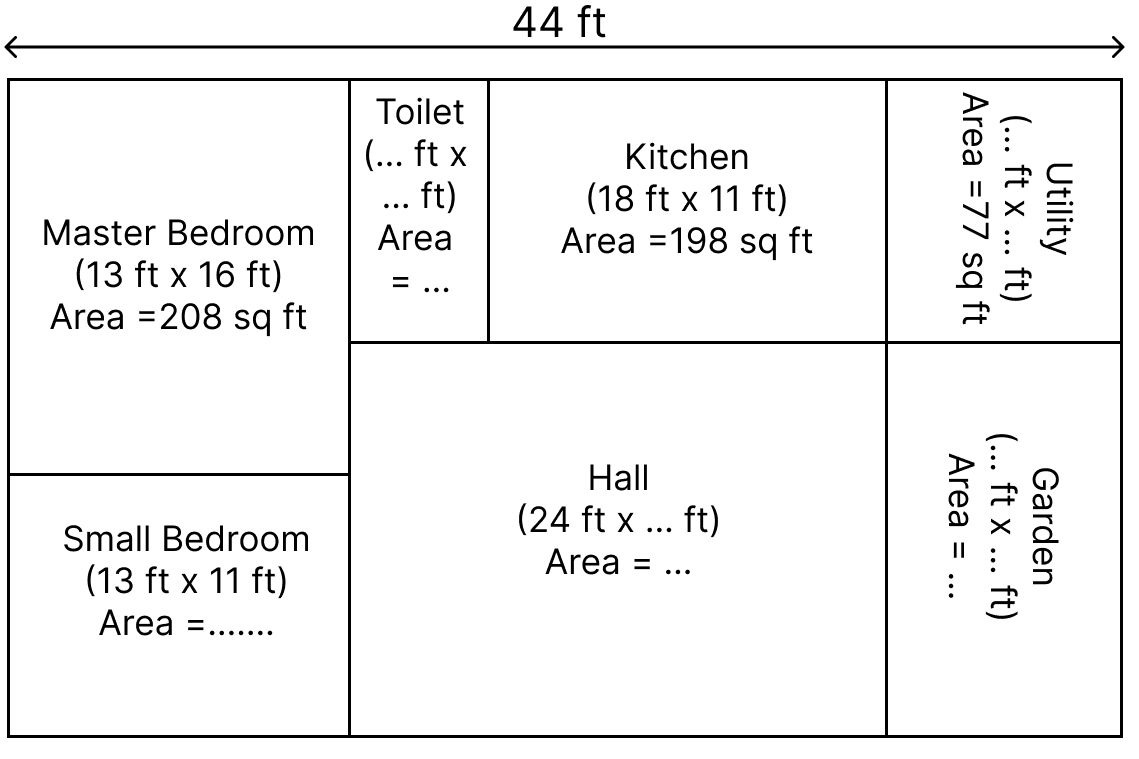
Some of the measurements are given.
(i) Find the missing measurements.
(ii) Find out the total area of the house (including the Garden).
Answer
(i) Finding missing measurements:
The total width of the house = 44 ft.
The top portion of the house contains: Master Bedroom, Toilet, Kitchen and Utility (placed side by side).
For Utility:
Area of Utility = 77 sq. ft, Height = 11 ft (same as Kitchen)
Width of Utility = = = 7 ft
So, Utility dimensions = 7 ft × 11 ft.
For Toilet:
Width of Toilet = Total width - (Master Bedroom width + Kitchen width + Utility width)
= 44 - (13 + 18 + 7)
= 44 - 38
= 6 ft
Height of Toilet = 11 ft (same as Kitchen and Utility)
So, Toilet dimensions = 6 ft × 11 ft.
Area of Toilet = 6 × 11 = 66 sq. ft.
For Hall:
Width of Hall = 24 ft
Height of Hall = 16 ft (same as Master Bedroom)
So, Hall dimensions = 24 ft × 16 ft.
Area of Hall = 24 × 16 = 384 sq. ft.
For Garden:
Width of Garden = Total width - (Small Bedroom width + Hall width)
= 44 - (13 + 24)
= 44 - 37
= 7 ft
Height of Garden = 16 ft (same as Hall)
So, Garden dimensions = 7 ft × 16 ft.
Area of Garden = 7 × 16 = 112 sq. ft.
For Small Bedroom:
Small Bedroom dimensions = 13 ft × 11 ft.
Area of Small Bedroom = 13 × 11 = 143 sq. ft.
The missing measurements are:
- Toilet: 6 ft × 11 ft, Area = 66 sq. ft
- Utility: 7 ft × 11 ft, Area = 77 sq. ft
- Hall: 24 ft × 16 ft, Area = 384 sq. ft
- Garden: 7 ft × 16 ft, Area = 112 sq. ft
- Small Bedroom: 13 ft x 11 ft, Area = 143 sq. ft
(ii) Total area of the house:
Total length of the house = Master Bedroom height + Small Bedroom height = 16 + 11 = 27 ft
Total width of the house = 44 ft
Total area of the house = length × width
= 44 × 27
= 1188 sq. ft
Hence, the total area of the house (including the Garden) is 1188 sq. ft.