
Construct a circle of radius:
(i) 2 cm
(ii) 3.5 cm
Answer
(i) Steps:
Mark a point O, as the centre of the circle.
Open the compass to the required radius of 2 cm by placing the pointer end at the zero mark of the ruler and the pencil end at the mark indicating 2 cm.
Place the pointer of the compass at O and hold it from the knob firmly.
Revolve (swing) the pencil end of the compass slowly to draw the circle.
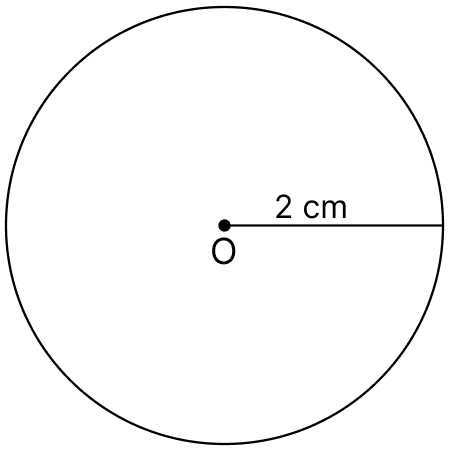
Hence, the required circle of radius 2 cm with O as its centre is constructed.
(ii) Steps:
Mark a point O, as the centre of the circle.
Open the compass to the required radius of 3.5 cm by placing the pointer end at the zero mark of the ruler and the pencil end at the mark indicating 3.5 cm.
Place the pointer of the compass at O and hold it from the knob firmly.
Revolve (swing) the pencil end of the compass slowly to draw the circle.
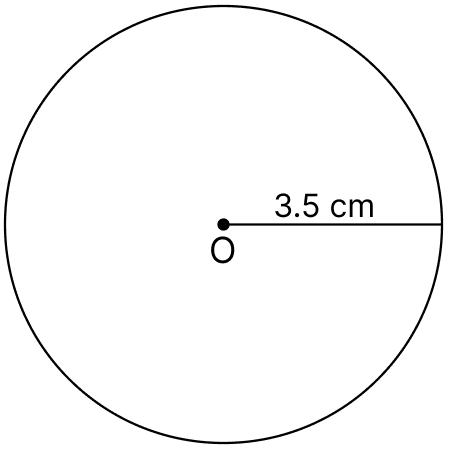
Hence, the required circle of radius 3.5 cm with O as its centre is constructed.
With the same centre O, draw two circles of radii 2.6 cm and 4.1 cm.
Answer
Steps:
Mark a point O on the sheet of paper, as the common centre of the two circles.
Open the compass to the required radius of 2.6 cm.
Place the pointer of the compass at O and revolve the pencil end of the compass slowly to draw the first circle.
Now, open the compass to the required radius of 4.1 cm.
Place the pointer of the compass at the same point O and revolve the pencil end of the compass slowly to draw the second circle.
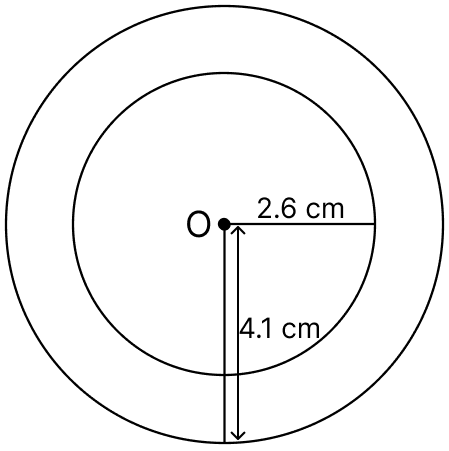
Hence, two concentric circles of radii 2.6 cm and 4.1 cm with O as their common centre are constructed.
Draw any circle and mark points A, B and C such that
(i) A is on the circle.
(ii) B is in the interior of the circle.
(iii) C is in the exterior of the circle.
Answer
Steps:
Mark a point O on the sheet of paper, as the centre of the circle.
Open the compass to any suitable radius.
Place the pointer of the compass at O and revolve the pencil end slowly to draw the circle.
Mark a point A on the circle.
Mark a point B inside the circle (i.e., in the interior of the circle).
Mark a point C outside the circle (i.e., in the exterior of the circle).
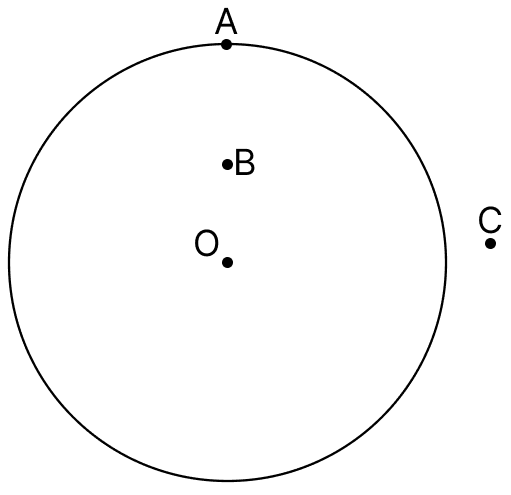
Hence, A is on the circle, B is in the interior of the circle and C is in the exterior of the circle.
Draw a circle and any two of its (non-perpendicular) diameters. If you join the ends of these diameters, what is the figure obtained? What figure is obtained if the diameters are perpendicular to each other?
Answer
Steps:
Mark a point O as the centre of the circle and draw a circle of any suitable radius with O as centre.
Draw any two diameters AC and BD of the circle which are not perpendicular to each other.
Join the ends A, B, C and D in order.
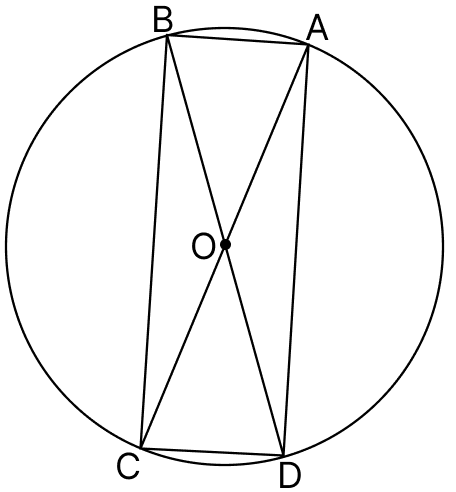
The figure obtained on joining the ends of the two non-perpendicular diameters is a rectangle.
When the two diameters are perpendicular to each other, the figure obtained on joining the ends of the diameters is a square.
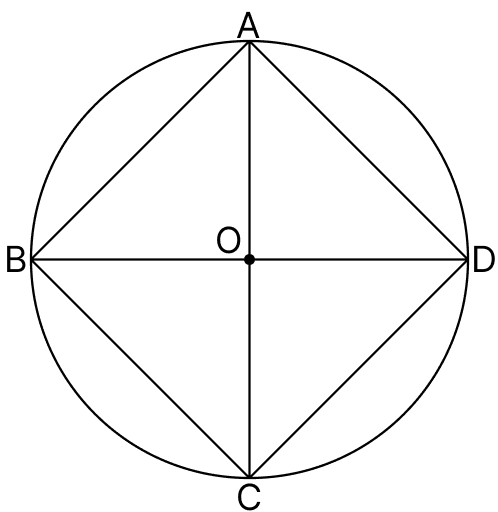
Hence, the figure obtained is a rectangle and a square when diameters are perpendicular to each other.
Let A, B be the centres of two circles of equal radii; draw them so that each one of them passes through the centre of the other. Let them intersect at C and D.
Examine whether are at right angles.
Answer
Steps:
Draw a line segment AB of any suitable length.
With A as centre and radius equal to AB, draw a circle.
With B as centre and the same radius (equal to AB), draw another circle which passes through A.
Let the two circles intersect at points C and D.
Join CD.
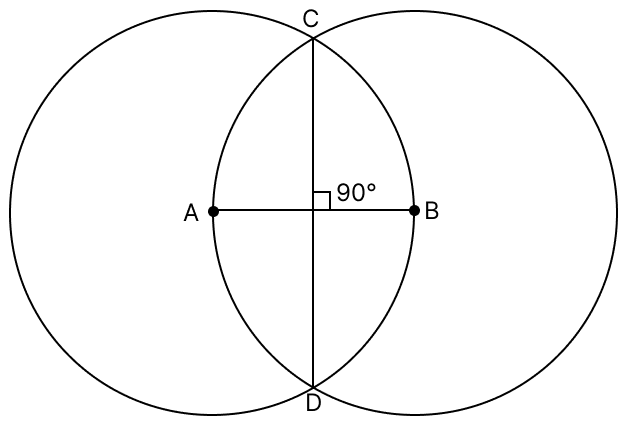
On measuring the angle between , we see that they intersect at right angles.
Hence, are at right angles.
Construct a line segment of length 6.3 cm using ruler and compass.
Answer
Steps:
Draw a line l and mark a point A on it.
Place the pointer end of the compass at the zero mark of the ruler and open the compass so that the pencil end is on the mark indicating 6.3 cm of the ruler.
Without changing the opening of the compass, place the pointer end at A and draw an arc to cut line l at the point B.

Hence, AB is the required line segment of length 6.3 cm.
Construct of length 8.3 cm. From this cut off of length 5.6 cm. Measure the length of .
Answer
Steps:
Draw a line l and mark a point A on it.
Using compass and ruler, set the opening of the compass to 8.3 cm. With A as centre, draw an arc cutting line l at point B. Thus AB = 8.3 cm.
Now set the opening of the compass to 5.6 cm. With A as centre, draw another arc cutting AB at point C. Thus AC = 5.6 cm.
Measure BC using a ruler.
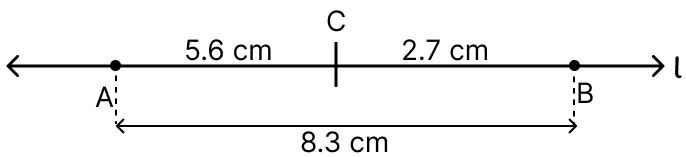
BC = AB − AC = 8.3 cm − 5.6 cm = 2.7 cm.
Hence, the length of = 2.7 cm.
Draw any line segment . Without measuring , construct a copy of .
Answer
Steps:
Draw any line segment PQ whose length is not known.
Place the pointer end of the compass at the point P and open the compass till the pencil end exactly coincides with the point Q. This opening of the compass gives the length of the segment PQ.
Draw any line l and take a point R on it. Without changing the opening of the compass, place the pointer end at the point R and draw an arc to cut the line l at the point S.
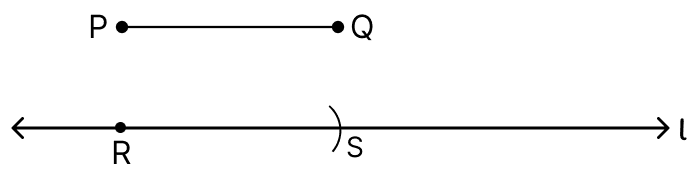
Hence, is a copy of the line segment .
Given some line segment , whose length you do not know, construct such that the length of is twice that of .
Answer
Steps:
Draw a line segment AB of any length.
Draw any line l and mark a point P on it.
Place the pointer end of the compass at the point A and open the compass till the pencil end exactly coincides with the point B. This opening of the compass gives the length of the segment AB.
Without changing the opening of the compass, place the pointer end at the point P and draw an arc to cut the line l at the point R. So, PR = AB.
Again, without changing the opening of the compass, place the pointer end at the point R and draw another arc to cut the line l at the point Q. So, RQ = AB.
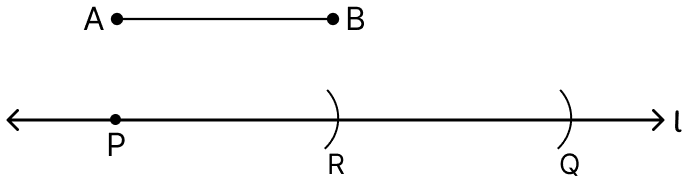
Thus, PQ = PR + RQ = AB + AB = 2 × AB.
Hence, PQ is the required line segment whose length is twice that of AB.
Take a line segment of length 10 cm. From , cut off of length 4.3 cm and of length 2.5 cm. Measure the length of segment .
Answer
Steps:
Draw a line segment PQ of length 10 cm using ruler and compass.
With P as centre and radius 4.3 cm, draw an arc cutting PQ at point A. So, PA = 4.3 cm.
With Q as centre and radius 2.5 cm, draw an arc cutting PQ at point B. So, BQ = 2.5 cm.
Measure the length of segment AB using a ruler.

AB = PQ − PA − BQ = 10 cm − 4.3 cm − 2.5 cm = 3.2 cm.
Hence, the length of line segment = 3.2 cm.
Given two line segments of lengths 7.5 cm and 4.6 cm respectively. Construct line segments.
(i) of length equal to the sum of the lengths of
(ii) of length equal to the difference of the lengths of
Verify these lengths by measurements.
Answer
Steps:
- Draw a line segment AB = 7.5 cm and a line segment CD = 4.6 cm using ruler and compass.
(i) Construction of PQ = AB + CD:
Draw any line l and mark a point P on it.
With the compass, take the length of AB (= 7.5 cm). Place the pointer at P and draw an arc cutting line l at point R. So, PR = AB = 7.5 cm.
Now, with the compass, take the length of CD (= 4.6 cm). Place the pointer at R and draw an arc cutting line l at point Q. So, RQ = CD = 4.6 cm.
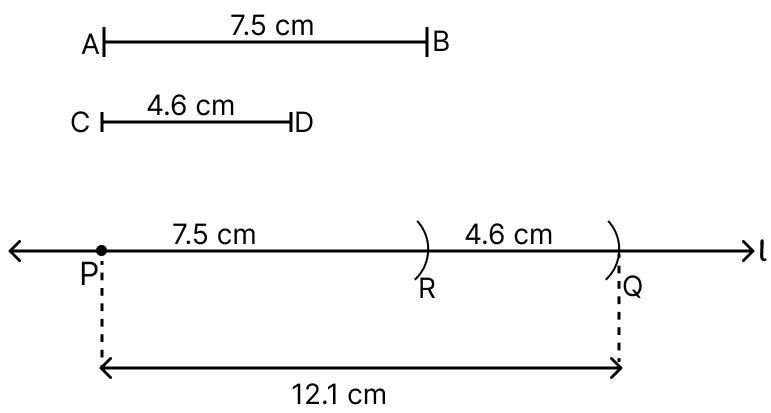
Thus, PQ = PR + RQ = 7.5 cm + 4.6 cm = 12.1 cm.
On measuring PQ with a ruler, we find PQ = 12.1 cm.
Hence, the length of = 12.1 cm.
(ii) Construction of XY = AB − CD:
Draw any line m and mark a point Z on it.
With the compass, take the length of AB (= 7.5 cm). Place the pointer at Z and draw an arc cutting line m at point Y. So, ZY = AB = 7.5 cm.
Now, with the compass, take the length of CD (= 4.6 cm). Place the pointer at Z and draw an arc cutting ZY at point X. So, ZX = CD = 4.6 cm.
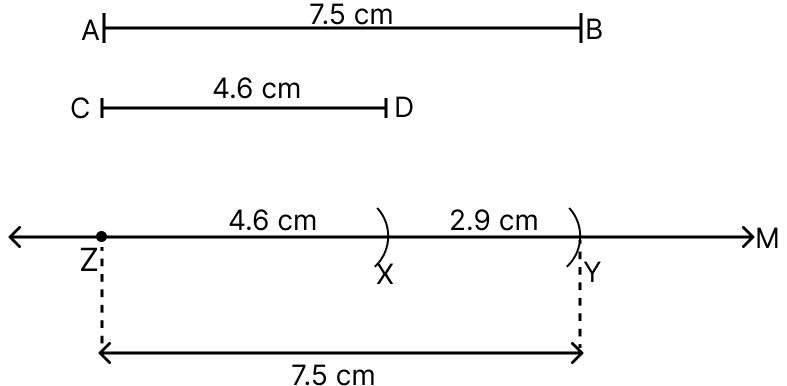
Thus, XY = ZY − XZ = 7.5 cm − 4.6 cm = 2.9 cm.
On measuring XY with a ruler, we find XY = 2.9 cm.
Hence, the length of XY = 2.9 cm.
Draw a line segment of length 5.6 cm. Draw a perpendicular to it from a point A outside by using ruler and compass.
Answer
Steps:
Draw a line segment of length 5.6 cm.
Mark a point A outside the line segment .
With A as centre and any suitable radius, draw an arc to cut or the line containing at points C and D.
With C and D as centres, draw two arcs of equal radius cutting each other at Q' on the other side of .
Join A and Q'. Let AQ' intersect at N.
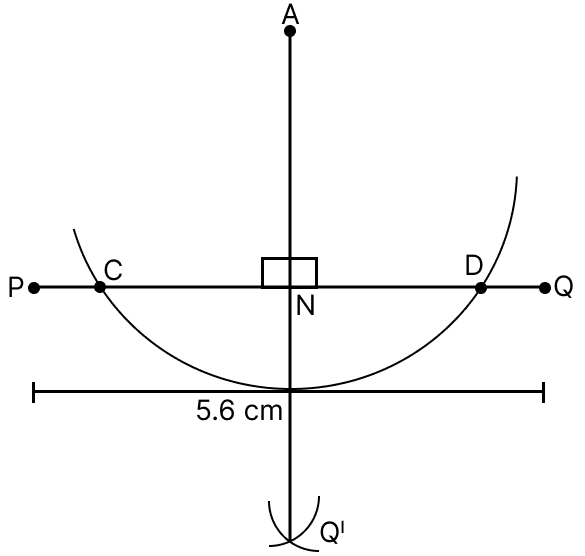
Hence, AN is the required perpendicular from point A to the line segment .
Draw a line segment of length 6.2 cm. Draw a perpendicular to it at a point M on by using ruler and compass.
Answer
Steps:
Draw a line segment of length 6.2 cm.
Mark any point M on .
With M as centre and any suitable radius, draw an arc to cut at points C and D.
With C and D as centres, draw two arcs of equal radius cutting each other at point Q.
Draw a line passing through points M and Q.
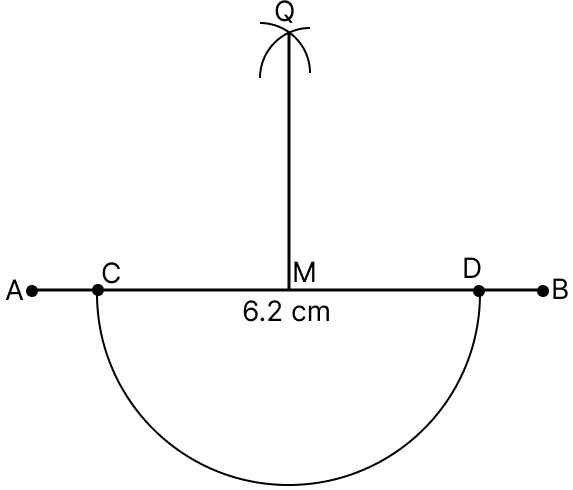
Hence, MQ is the required perpendicular to at the point M.
Draw a line l and take a point P on it. Through P, draw a line segment perpendicular to l. Now draw a perpendicular to at Q (use ruler and compass).
Answer
Steps:
Draw a line l and mark a point P on it.
With P as centre and any suitable radius, draw an arc to cut the line l at points C and D.
With C and D as centres, draw two arcs of equal radius cutting each other at point Q.
Join P and Q. Then is the required line segment perpendicular to l at point P.
Produce PQ beyond Q to form a line PQ'.
With Q as centre and any suitable radius, draw an arc to cut the line PQ' at points E and F.
With E and F as centres, draw two arcs of equal radius on both side cutting each other at point R and S.
Draw a line passing through points S,Q and R.
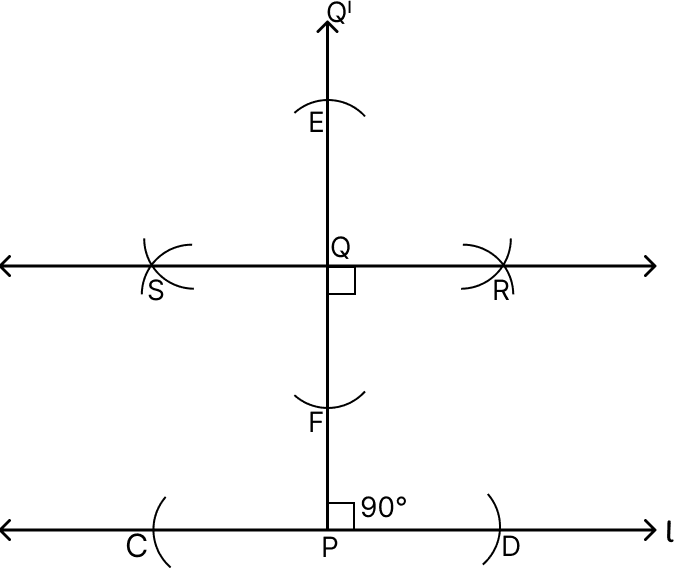
Hence, RS is the required perpendicular to PQ at point Q.
Draw a line segment of length 6.4 cm and construct its axis of symmetry (use ruler and compass).
Answer
The axis of symmetry of a line segment is its perpendicular bisector.
Steps:
Draw a line segment of length 6.4 cm.
With A as centre and any suitable radius , draw arcs on each side of .
With B as centre and the same radius, draw arcs on each side of to cut the previous arcs at C and D.
Draw line CD.
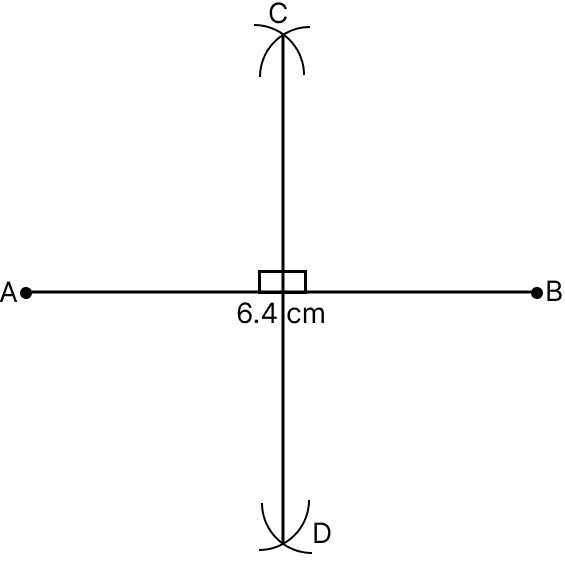
Hence, CD is the required axis of symmetry (perpendicular bisector) of line segment .
Draw the perpendicular bisector of whose length is 8.3 cm.
(i) Take any point P on the bisector drawn. Examine whether PX = PY.
(ii) If M is mid-point of , what can you say about the lengths MX and MY?
Answer
Steps:
Draw a line segment of length 8.3 cm.
With X as centre and any suitable radius , draw arcs on each side of .
With Y as centre and the same radius, draw arcs on each side of to cut the previous arcs at C and D.
Draw line CD. This line CD is the required perpendicular bisector of .
Mark any point P on the bisector CD.
Let CD meet at point M.
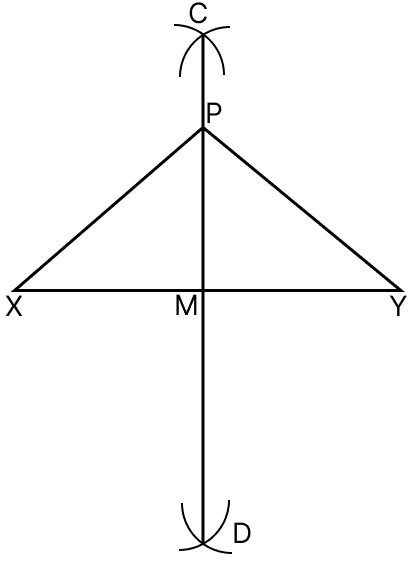
(i) On measuring PX and PY with the help of a ruler or divider, we find that PX = PY.
Hence, yes, PX = PY.
(ii) Since M lies on the perpendicular bisector of and M is the mid-point of , therefore, .
Hence, the lengths MX and MY are equal.
Draw a line segment of length 8.8 cm. Using ruler and compass, divide it into four equal parts. Verify by actual measurement.
Answer
Steps:
Draw a line segment of length 8.8 cm.
Construct the perpendicular bisector of AB. Let it meet AB at the point M. Then M is the mid-point of AB, so AM = MB = 4.4 cm.
Construct the perpendicular bisector of AM. Let it meet AM at the point N. Then N is the mid-point of AM, so AN = NM = 2.2 cm.
Construct the perpendicular bisector of MB. Let it meet MB at the point O. Then O is the mid-point of MB, so MO = OB = 2.2 cm.
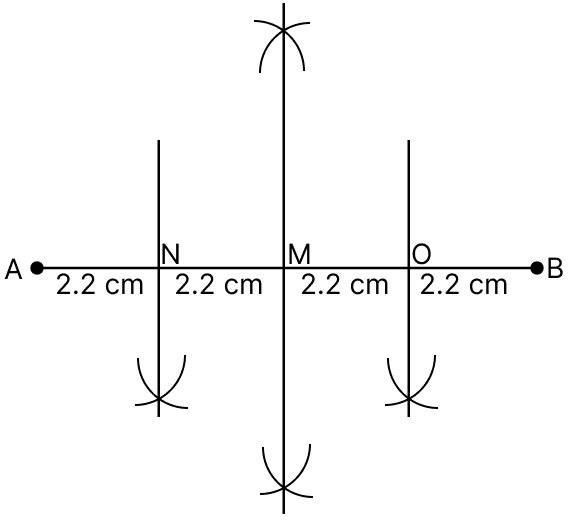
Thus, the line segment is divided into four equal parts AN, NM, MO and OB.
On measuring with a ruler, we find AN = NM = MO = OB = 2.2 cm.
Hence, the line segment has been divided into four equal parts, each of length 2.2 cm.
With of length 5.6 cm as diameter, draw a circle.
Answer
Steps:
Draw a line segment of length 5.6 cm.
Construct the perpendicular bisector of . Let it meet at point M. Then M is the mid-point of .
With M as centre and radius equal to MP , draw a circle.
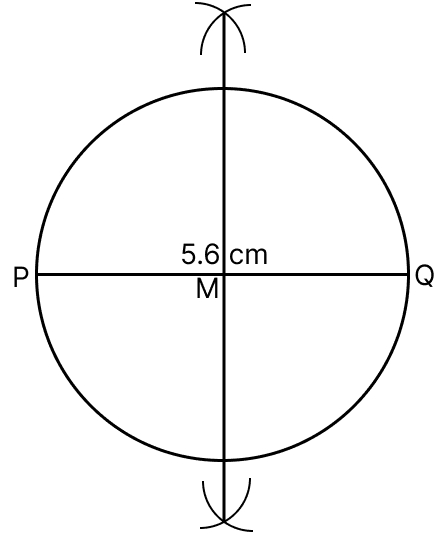
Hence, the required circle with as diameter is drawn.
Draw a circle with centre C and radius 4.2 cm. Draw any chord AB. Construct the perpendicular bisector of AB and examine if it passes through C.
Answer
Steps:
Mark a point C on the sheet of paper.
With C as centre and radius 4.2 cm, draw a circle.
Mark any two points A and B on the circle and join them. is a chord of the circle.
With A as centre and any suitable radius , draw arcs on each side of AB.
With B as centre and the same radius, draw arcs on each side of AB to cut the previous arcs at P and Q.
Draw a line passing through points P and Q.
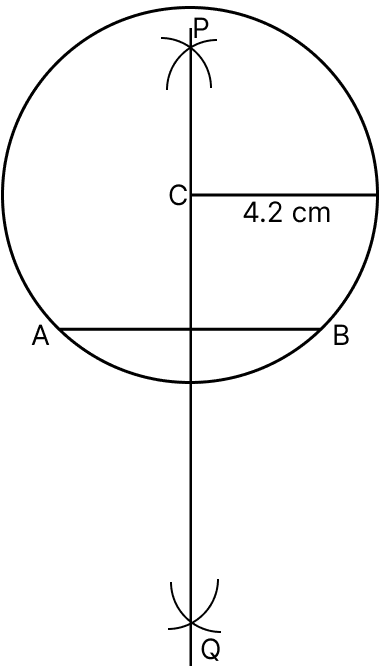
On examining, we find that the perpendicular bisector PQ of chord passes through the centre C of the circle.
Hence, yes, the perpendicular bisector of passes through C.
Draw a circle of radius 3.5 cm. Draw any two of its (non-parallel) chords. Construct the perpendicular bisectors of these chords. Where do they meet?
Answer
Steps:
Mark a point O on the sheet of paper as the centre of the circle.
With O as centre and radius 3.5 cm, draw a circle.
Draw any two non-parallel chords AB and CD of the circle.
Construct the perpendicular bisector of chord AB. For this, take A and B as centres and equal radius , draw arcs on both sides of AB, and join the points of intersection of the arcs.
Similarly, construct the perpendicular bisector of chord CD.
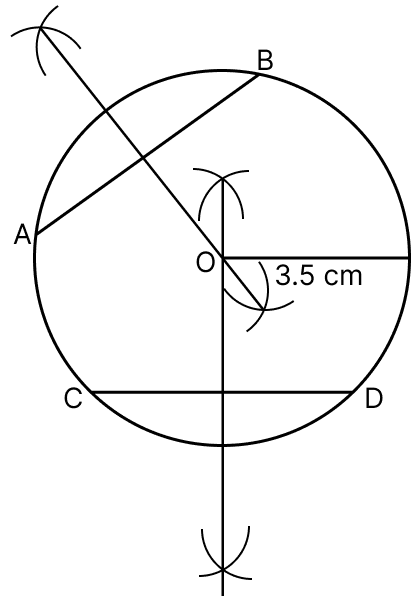
On examining, we find that the perpendicular bisectors of the two chords meet at the centre O of the circle.
Hence, the perpendicular bisectors of the two chords meet at the centre of the circle.
Draw an angle of 80° and make a copy of it using ruler and compass.
Answer
Steps:
Draw a ray OA.
Place the centre of the protractor at O and the zero line along OA. Mark a point at 80°.
Remove the protractor and join O with the marked point and produce it to B. Then ∠AOB = 80°.
To make a copy of ∠AOB, draw any ray PQ.
With O as centre and any (suitable) radius, draw an arc to meet ray OA at C and ray OB at D.
With P as centre and the same radius (as in step 5), draw an arc to meet PQ at R.
Measure the segment CD with the compass.
With R as centre and radius equal to CD, draw an arc to meet the previous arc at S.
Join PS and produce it to form a ray PT.
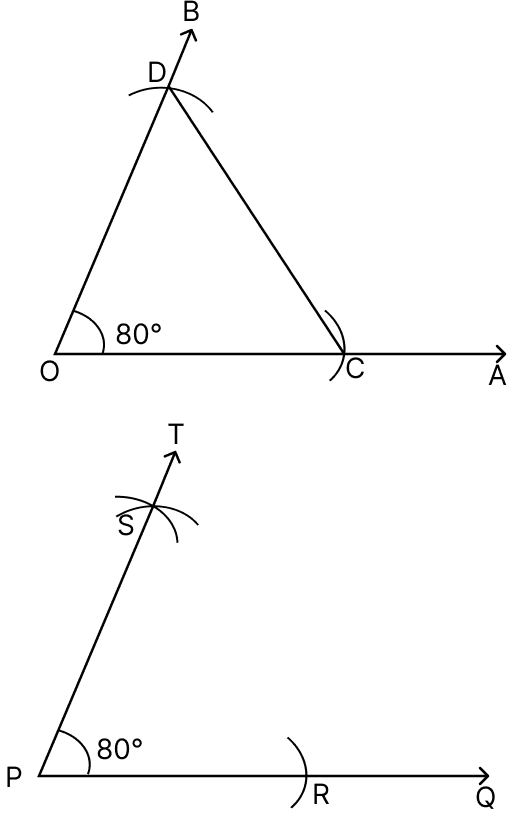
Then ∠QPT = ∠AOB = 80°.
Hence, ∠QPT is a copy of ∠AOB.
Draw an angle of measure 127° and construct its bisector.
Answer
Steps:
Draw a ray OA.
Place the centre of the protractor at O and the zero line along OA. Mark a point at 127°.
Remove the protractor and join O with the marked point and produce it to B. Then ∠AOB = 127°.
With O as centre and any (suitable) radius, draw an arc to meet ray OA at C and ray OB at D.
With C as centre and any suitable radius , draw an arc. Also, with D as centre and same radius, draw another arc to meet the previous arc at E.
Join OE and produce it to form a ray.
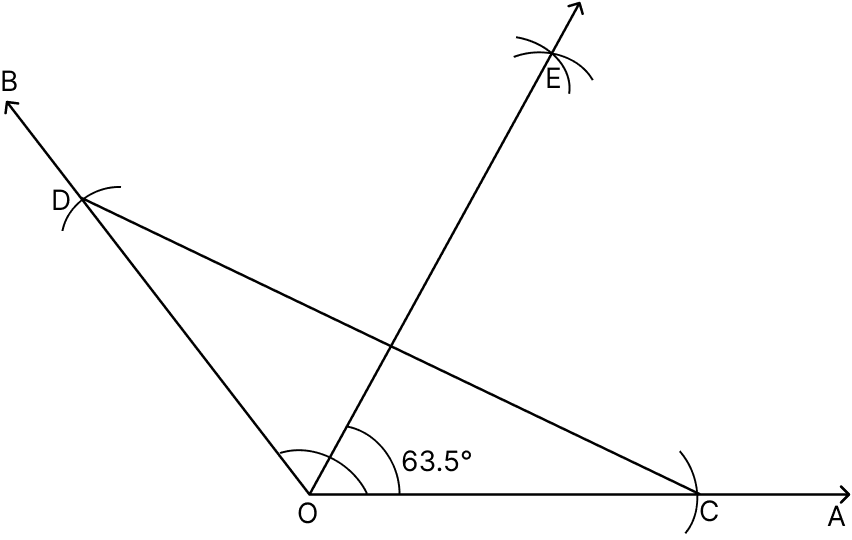
Hence, ray OE is the required bisector of ∠AOB, and ∠AOE = ∠EOB = 63.5°.
Draw ∠POQ = 64°. Also draw its line of symmetry.
Answer
The line of symmetry of an angle is its angle bisector.
Steps:
Draw a ray OP.
Place the centre of the protractor at O and the zero line along OP. Mark a point at 64°.
Remove the protractor and join O with the marked point and produce it to Q. Then ∠POQ = 64°.
With O as centre and any (suitable) radius, draw an arc to meet ray OP at C and ray OQ at D.
With C as centre and any suitable radius , draw an arc. Also, with D as centre and same radius, draw another arc to meet the previous arc at E.
Join OE and produce it to form a ray.
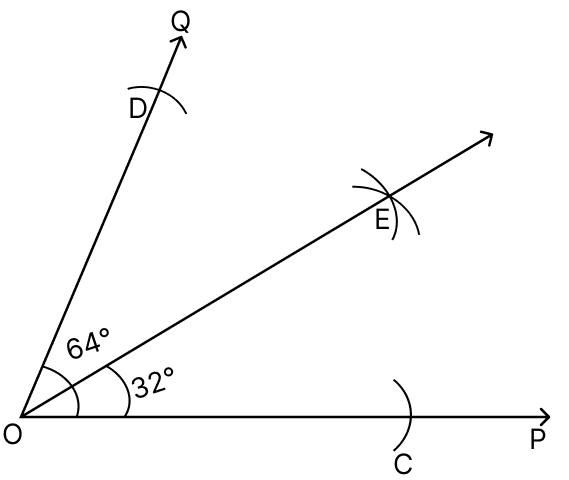
Hence, ray OE is the line of symmetry of ∠POQ, and ∠POE = ∠EOQ = 32°.
Draw a right angle and construct its bisector.
Answer
Steps:
Draw any line l and take a point O on it.
With O as centre and suitable radius, draw an arc to cut the line l at points A and B.
With A and B as centres, draw two arcs of equal radius cutting each other at C.
Join OC and produce it to form ray OC. Then ∠BOC = 90°.
To bisect ∠BOC, with O as centre and any suitable radius, draw an arc to meet OB at P and OC at Q.
With P and Q as centres and equal radii , draw two arcs cutting each other at D.
Join OD and produce it to form a ray.
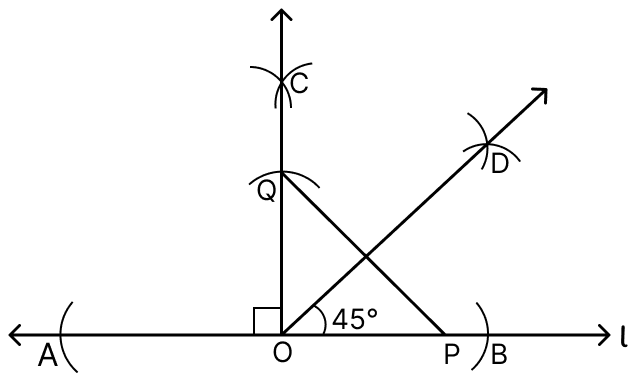
Hence, ray OD is the bisector of right angle ∠BOC, and ∠BOD = ∠DOC = 45°.
Draw an angle of 152° and divide it into four equal parts.
Answer
Steps:
Draw a ray OA.
Place the centre of the protractor at O and the zero line along OA. Mark a point at 152°.
Remove the protractor and join O with the marked point and produce it to B. Then ∠AOB = 152°.
With O as centre and any (suitable) radius, draw an arc to meet ray OA at C and ray OB at D.
With C and D as centres, draw arcs of equal radius cutting each other at E. Join OE and produce it. Then OE bisects ∠AOB, so ∠AOE = ∠EOB = 76°.
Let OE meet the first arc at point F.
Now bisect ∠AOE: with C and F as centres, draw arcs of equal radius cutting each other at G. Join OG and produce it.
Similarly, bisect ∠EOB: with F and D as centres, draw arcs of equal radius cutting each other at H. Join OH and produce it.
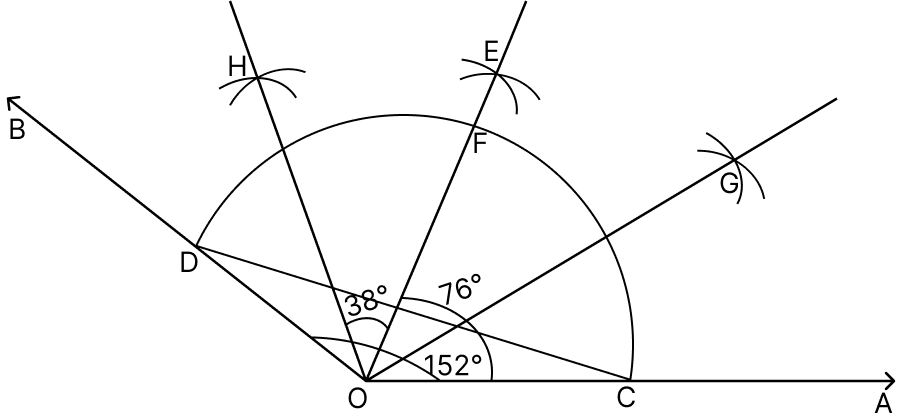
Then OG bisects ∠AOE and OH bisects ∠EOB.
Therefore, ∠AOG = ∠GOE = ∠EOH = ∠HOB = 38°.
and ∠AOE = ∠AOG + ∠GOE = 76°
∠EOB = ∠EOH + ∠HOB = 76°
Hence, the angle of 152° is divided into four equal parts each of measure 38°.
Draw an angle of measure 45° and bisect it.
Answer
Steps:
Draw any line l and take a point O on it.
With O as centre and suitable radius, draw two arcs to cut line l at points A and B.
With A and B as centres, draw two arcs of equal radius cutting each other at C. Join OC and produce it. Then ∠BOC = 90°.
Now we bisect ∠BOC by drawing two equal arc from point B and F, cutting each other at point D. Join OD and the bisector is ray OD. Then ∠BOD = 45°.
Now to bisect ∠BOD, with O as centre and any suitable radius, draw an arc to meet OB at P and OD at Q.
With P and Q as centres and equal radii , draw two arcs cutting each other at E.
Join OE and produce it to form a ray.
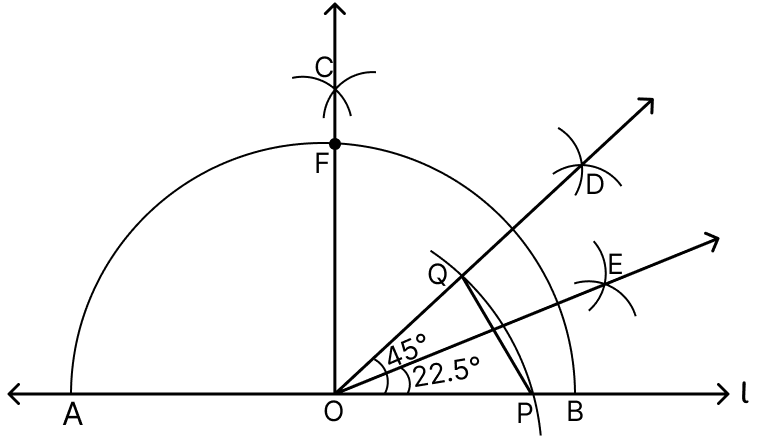
Hence, ray OE is the bisector of ∠BOD = 45°, and ∠BOE = ∠EOD = 22.5°.
Construct a square of side 4 cm, using ruler and protractor.
Answer
Steps:
Draw a line segment AB = 4 cm using a ruler.
At A, using protractor, draw ∠XAB = 90°. From AX, cut off AD = 4 cm.
At B, using protractor, draw ∠YBA = 90°. From BY, cut off BC = 4 cm.
Join CD.
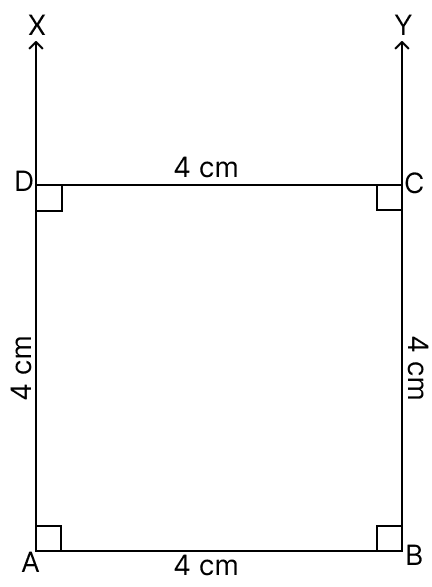
Hence, ABCD is the required square of side 4 cm.
Construct a rectangle of sides 6 cm and 3 cm, using ruler and compass.
Answer
Steps:
Draw a line segment AB = 6 cm.
At A, construct a perpendicular AX to AB using ruler and compass. From AX, cut off AD = 3 cm.
At B, construct a perpendicular BY to AB using ruler and compass. From BY, cut off BC = 3 cm.
Join CD.
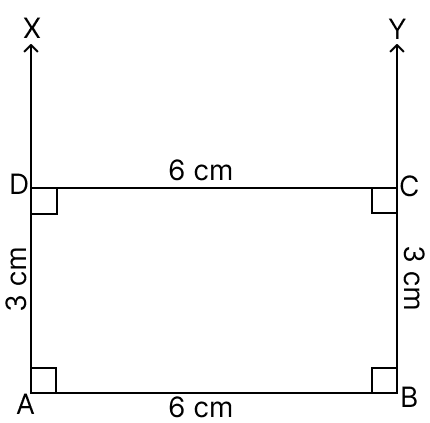
Hence, ABCD is the required rectangle of sides 6 cm and 3 cm.
Using a ruler and protractor, construct a rectangle in which one of the diagonals divides the opposite angles into 50° and 40°.
Answer
Steps:
Draw a line segment AB of any suitable length using a ruler.
At B, using protractor, draw ∠ABY = 90°.
At A, using protractor, draw ∠BAX = 90°.
At A, using protractor, construct ∠BAC = 50° such that AC lies inside the right angle ABY.
At A, using protractor, draw ∠CAX = 40° (so that ∠BAC = 50°). The ray AX is perpendicular to AB.
From AX, cut off AD = BC using compass (so that AD = BC and ABCD becomes a rectangle).
Join CD.
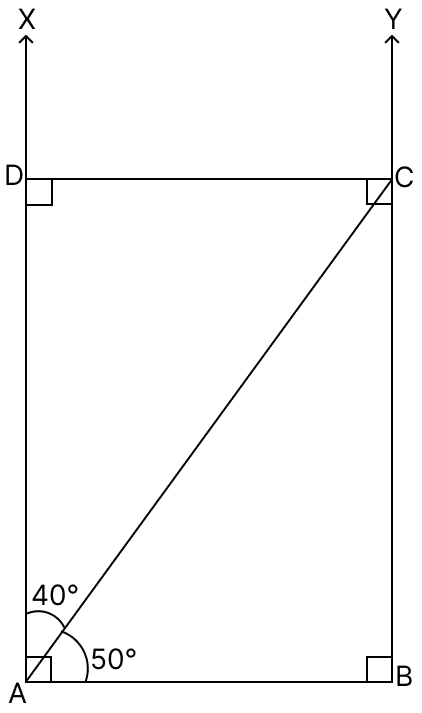
Hence, ABCD is the required rectangle in which diagonal AC divides the opposite angles into 50° and 40°.
Construct a toy house tent as given in the adjoining figure.
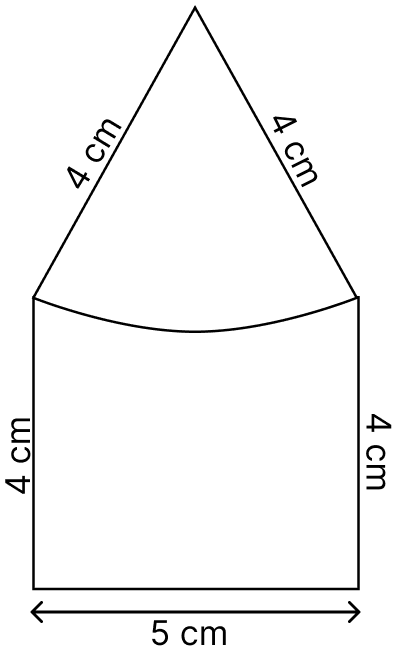
Answer
Steps:
Draw a line segment AB = 5 cm using a ruler.
At A, construct a perpendicular AX to AB. From AX, cut off AD = 4 cm.
At B, construct a perpendicular BY to AB. From BY, cut off BC = 4 cm.
Join DC. Then ABCD is a rectangle of length 5 cm and breadth 4 cm.
With D as centre and radius = 4 cm, draw an arc.
With C as centre and radius = 4 cm, draw another arc to cut the previous arc at point E.
Join DE and CE.
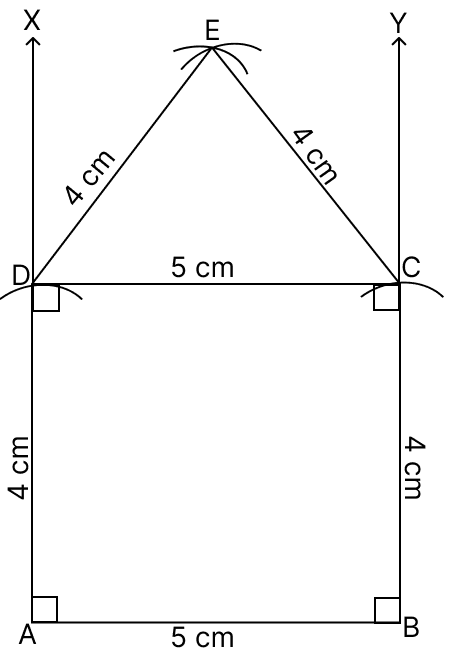
Hence, ABCED is the required toy house tent.
Construct a square of side 5 cm, with a small circle of radius 1 cm inside it, having the same centre as the square.
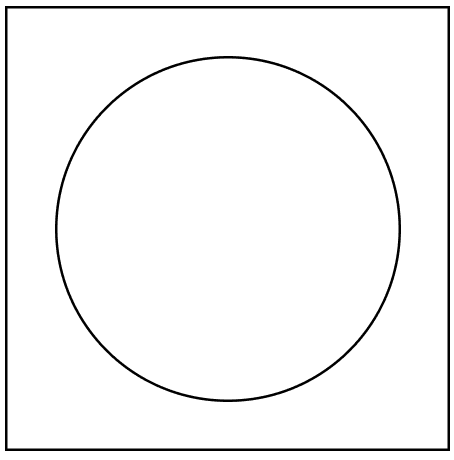
Answer
Steps:
Draw a line segment AB = 5 cm.
At A, construct a perpendicular AX to AB using ruler and compass. From AX, cut off AD = 5 cm.
At B, construct a perpendicular BY to AB using ruler and compass. From BY, cut off BC = 5 cm.
Join CD. Then ABCD is a square of side 5 cm.
Draw both the diagonals AC and BD of the square. Let them intersect at point O. Then O is the centre of the square.
With O as centre and radius = 1 cm, draw a circle.
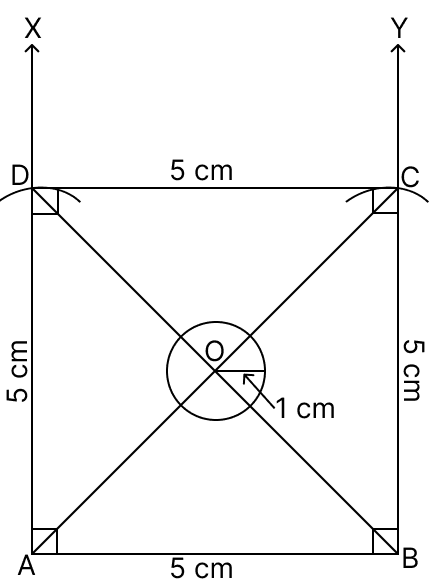
Hence, ABCD is the required square of side 5 cm with a circle of radius 1 cm inside it, having the same centre O as the square.
Can you construct a square in the centre of a rectangle as shown in the adjoining figure?
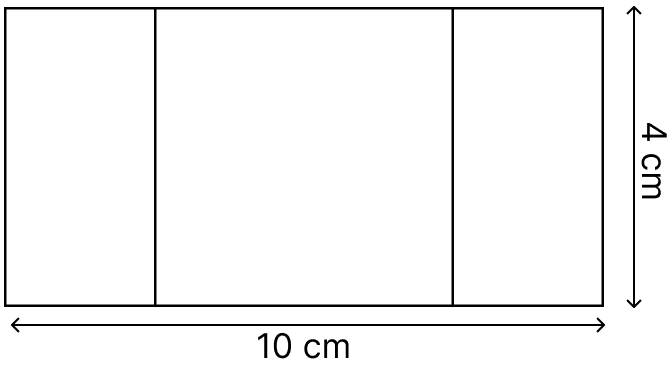
Answer
Yes, we can construct a square in the centre of a rectangle.
Steps:
Draw a line segment AB = 10 cm using a ruler.
At A, construct a perpendicular AX to AB. From AX, cut off AD = 4 cm.
At B, construct a perpendicular BY to AB. From BY, cut off BC = 4 cm.
Join CD. Then ABCD is a rectangle with AB = 10 cm and BC = 4 cm.
Find the mid-point M of AB by drawing its perpendicular bisector. So AM = MB = 5 cm.
From M, cut off MP = 2 cm along MA and MQ = 2 cm along MB. So PQ = MP + MQ = 4 cm.
At P, draw a line perpendicular to AB cutting CD at point S.
At Q, draw a line perpendicular to AB cutting CD at point R.
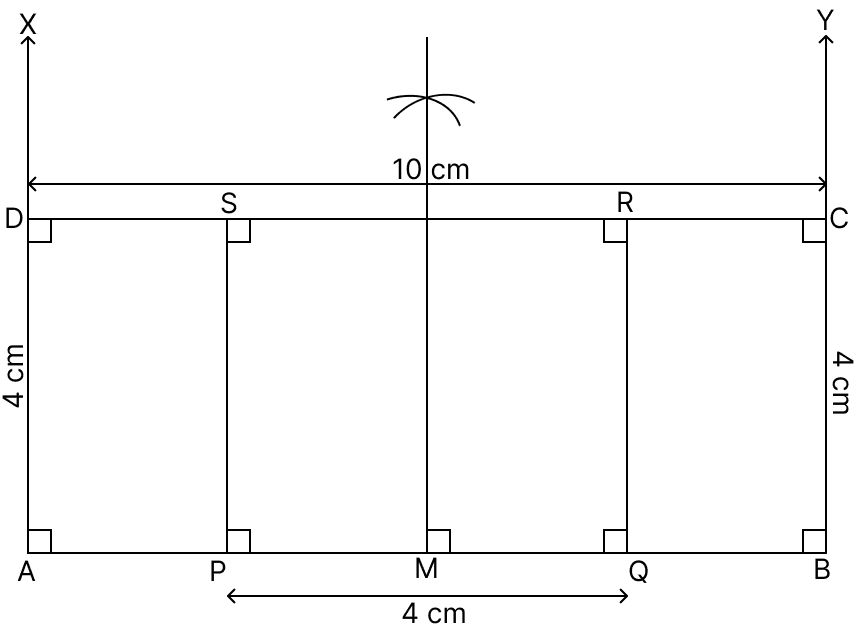
Then PQRS is a square of side 4 cm constructed at the centre of the rectangle ABCD.
Hence, the square is constructed in the centre of the rectangle.
Fill in the blanks:
(i) A ruler is used to draw line ..... and to measure their .....
(ii) A divider is used to compare .....
(iii) A compass is used to draw circles or arcs of .....
(iv) A protractor is used to draw and measure .....
(v) The set squares are two triangular pieces having angles of ........ and .....
(vi) To bisect a line segment of length 7 cm, the opening of the compass should be more than .....
(vii) The perpendicular bisector of a line segment is also its line of .....
Answer
(i) A ruler is used to draw line segments and to measure their lengths.
(ii) A divider is used to compare lengths of line segments.
(iii) A compass is used to draw circles or arcs of circles.
(iv) A protractor is used to draw and measure angles.
(v) The set squares are two triangular pieces having angles of 30°, 60°, 90° and 45°, 45°, 90°.
(vi) To bisect a line segment of length 7 cm, the opening of the compass should be more than 3.5 cm.
(vii) The perpendicular bisector of a line segment is also its line of symmetry.
State whether the following statements are true (T) or false (F):
(i) There is only one set square in a geometry box.
(ii) An angle can be copied with the help of a ruler and compass.
(iii) The perpendicular bisector of a line segment can be drawn by paper folding.
(iv) A perpendicular to a line from a given point not on it can be drawn by paper folding.
(v) A 45° - 45° - 90° set square and a protractor have the same number of line(s) of symmetry.
Answer
(i) False. There are two set squares in a geometry box, one with angles 30°, 60°, 90° and the other with angles 45°, 45°, 90°.
(ii) True. An angle can be copied with the help of a ruler and compass.
(iii) True. The perpendicular bisector of a line segment can be drawn by paper folding.
(iv) True. A perpendicular to a line from a given point not on it can be drawn by paper folding.
(v) True. Both a 45° - 45° - 90° set square and a protractor have 1 line of symmetry each.
A circle of any radius can be constructed with the help of a:
ruler
divider
compass
protractor
Answer
A circle of any radius can be constructed with the help of a compass.
Hence, option 3 is the correct option.
The instrument in a geometry box having the shape of a semicircle is:
ruler
divider
compass
protractor
Answer
The instrument in a geometry box having the shape of a semicircle is the protractor.
Hence, option 4 is the correct option.
The instrument used to measure an angle is:
ruler
protractor
divider
compass
Answer
The instrument used to measure an angle is the protractor.
Hence, option 2 is the correct option.
Which of the following angles cannot be constructed using ruler and compass?
15°
45°
75°
85°
Answer
Using ruler and compass, we can construct angles of 60°, 90° and their bisectors. Angles such as 15°, 30°, 45°, 75°, etc., can be constructed by repeatedly bisecting or by adding/subtracting these standard angles. However, 85° cannot be constructed using only a ruler and compass.
Hence, option 4 is the correct option.
The number of perpendiculars that can be drawn to a line from a point not on it is:
1
2
4
infinitely many
Answer
From a point not on a given line, only one perpendicular can be drawn to the line.
Hence, option 1 is the correct option.
The number of perpendicular bisectors that can be drawn of a given line segment is:
0
1
2
infinitely many
Answer
Only one perpendicular bisector can be drawn of a given line segment.
Hence, option 2 is the correct option.
The number of lines of symmetry in a picture of a divider is:
0
1
2
4
Answer
A picture of a divider has 1 line of symmetry which passes through the centre between its two legs.
Hence, option 2 is the correct option.
The number of lines of symmetry in a picture of a compass is:
0
1
2
none of these
Answer
A picture of a compass has 0 lines of symmetry because the pencil end and the pointer end of the compass are different from each other.
Hence, option 1 is the correct option.
The number of lines of symmetry in a ruler is:
0
1
2
4
Answer
A ruler has 2 lines of symmetry — one along its length (horizontal axis) and one along its width (vertical axis).
Hence, option 3 is the correct option.
The number of lines of symmetry in a 30° - 60° - 90° set square is:
0
1
2
3
Answer
A 30° - 60° - 90° set square is a scalene triangle in which all three sides are of different lengths. Therefore, it has 0 lines of symmetry.
Hence, option 1 is the correct option.
The number of lines of symmetry in a protractor is:
0
1
2
more than 2
Answer
A protractor has 1 line of symmetry — the vertical line passing through the centre and the 90° mark.
Hence, option 2 is the correct option.
Statement I: We can construct angles measuring 15°, 30° and 60° using a ruler and a compass.
Statement II: We can draw angle bisectors using a ruler and a compass.
Statement I is true but Statement II is false.
Statement I is false but Statement II is true.
Both Statement I and Statement II are true.
Both Statement I and Statement II are false.
Answer
Statement I: We can construct an angle of 60° using ruler and compass. By bisecting it, we get 30°. By further bisecting 30°, we get 15°. So, Statement I is true.
Statement II: We can draw angle bisectors using a ruler and a compass. So, Statement II is true.
Hence, option 3 is the correct option.
Statement I: The smallest length that can be measured with the ruler in your geometry box is 0.001 m.
Statement II: 1 cm = 100 mm
Statement I is true but Statement II is false.
Statement I is false but Statement II is true.
Both Statement I and Statement II are true.
Both Statement I and Statement II are false.
Answer
Statement I: A ruler in a geometry box has millimetre markings. The smallest length that can be measured is 1 mm = 0.001 m. So, Statement I is true.
Statement II: 1 cm = 10 mm, not 100 mm. So, Statement II is false.
Hence, option 1 is the correct option.
Statement I: On the lower reading scale of a protractor, as we move from left to right, the value of the angle decreases.
Statement II: A protractor has two reading scales for measuring an angle.
Statement I is true but Statement II is false.
Statement I is false but Statement II is true.
Both Statement I and Statement II are true.
Both Statement I and Statement II are false.
Answer
Statement I: On the lower reading scale of a protractor, the value of 0° is on the right side and the value of 180° is on the left side. Therefore, as we move from left to right, the value of the angle decreases. So, Statement I is true.
Statement II: A protractor has two reading scales — an inner scale and an outer scale — for measuring angles in either direction. So, Statement II is true.
Hence, option 3 is the correct option.
Statement I: A protractor is a semicircle.
Statement II: The angle between the zero line and the central line of a protractor is 90°.
Statement I is true but Statement II is false.
Statement I is false but Statement II is true.
Both Statement I and Statement II are true.
Both Statement I and Statement II are false.
Answer
Statement I: A protractor has the shape of a semicircle. So, Statement I is true.
Statement II: The central line of a protractor is perpendicular to the zero line, so the angle between them is 90°. So, Statement II is true.
Hence, option 3 is the correct option.
Statement I: A circle is a closed curve such that its every point is at a fixed distance from the centre.
Statement II: When two protractors are placed along their straight edges, the resulting figure is a circle.
Statement I is true but Statement II is false.
Statement I is false but Statement II is true.
Both Statement I and Statement II are true.
Both Statement I and Statement II are false.
Answer
Statement I: A circle is a closed curve such that every point on it is at a fixed distance (radius) from a fixed point (centre). So, Statement I is true.
Statement II: A protractor is a semicircle. When two protractors are placed along their straight edges, the two semicircles together form a complete circle. So, Statement II is true.
Hence, option 3 is the correct option.
Draw a line segment of length 5.4 cm. Construct a perpendicular at A by using a ruler and compass.
Answer
Steps:
Draw a line segment of length 5.4 cm.
Produce BA beyond A to any convenient point so that A becomes a point on a line.
With A as centre and any suitable radius, draw an arc cutting BA produced at point C and AB at point D.
With C and D as centres, draw two arcs of equal radius cutting each other at point P.
Join AP and produce it.
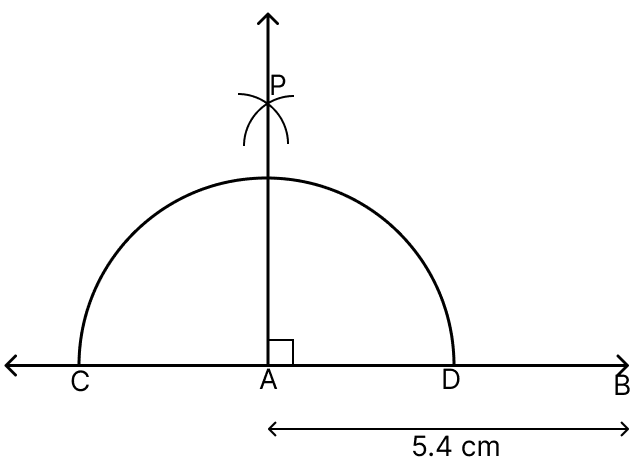
Hence, AP is the required perpendicular to at A.
Draw a line segment of length 6.8 cm. Draw a perpendicular to it from a point A outside PQ by using a ruler and compass.
Answer
Steps:
Draw a line segment of length 6.8 cm.
Mark a point A outside the line segment .
With A as centre and any suitable radius, draw an arc to cut or the line containing at points C and D.
With C and D as centres, draw two arcs of equal radius cutting each other at the point Q' on the other side of PQ.
Join A and Q'. Let AQ' intersect PQ at N.
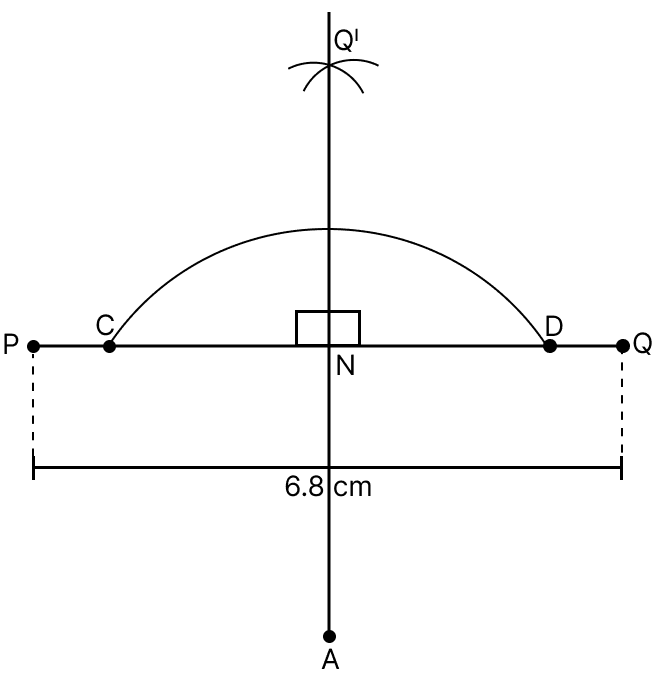
Hence, AN is the required perpendicular from point A to the line segment .
Draw a line segment of length 6.5 cm and construct its axis of symmetry.
Answer
The axis of symmetry of a line segment is its perpendicular bisector.
Steps:
Draw a line segment of length 6.5 cm.
With A as centre and any suitable radius , draw arcs on each side of AB.
With B as centre and the same radius, draw arcs on each side of AB to cut the previous arcs at C and D.
Draw line CD.
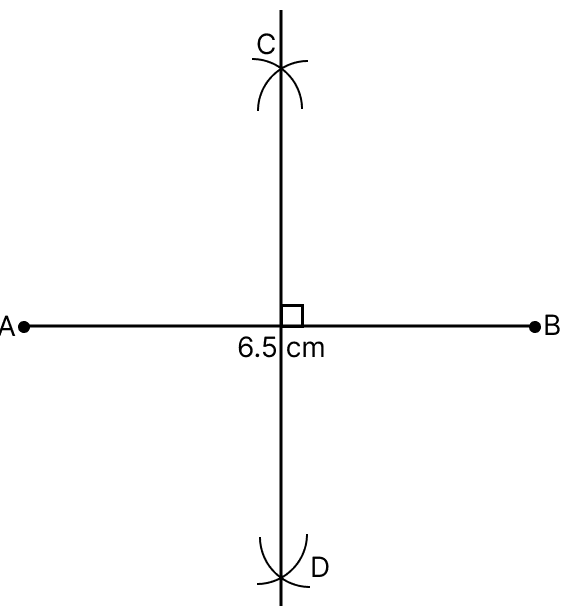
Hence, CD is the required axis of symmetry (perpendicular bisector) of line segment .
Draw ∠AOB = 76° with the help of a protractor. Bisect this angle by using a ruler and compass. Measure the two parts by your protractor and see how accurate you are.
Answer
Steps:
Draw a ray OA.
Place the centre of the protractor at O and the zero line along OA. Mark a point at 76°.
Remove the protractor and join O with the marked point and produce it to B. Then ∠AOB = 76°.
With O as centre and any suitable radius, draw an arc to meet ray OA at C and ray OB at D.
With C as centre and any suitable radius , draw an arc. Also, with D as centre and the same radius, draw another arc to meet the previous arc at E.
Join OE and produce it to form ray OE.
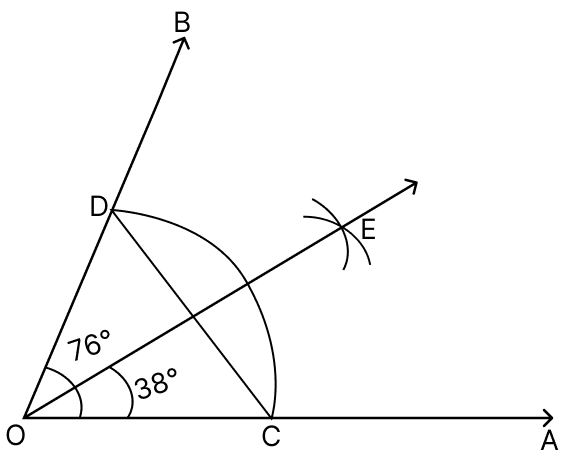
Then OE is the bisector of ∠AOB.
On measuring the two parts with a protractor, we find:
∠AOE = 38° and ∠EOB = 38°.
Hence, ray OE bisects ∠AOB into two equal parts of 38° each.
By using a ruler and compass, construct an angle of 135° and bisect it. Measure any one part by protractor and see how accurate you are.
Answer
Steps:
Draw a straight line AOA'.
Construct a perpendicular OC to line AOA' at O. Then ∠AOC = 90°.
Bisect ∠A'OC by drawing two equal arcs from centre O, cutting line OA' at point D and OC at point E. Now, from points D and E draw two arcs of equal length intersecting each other at point B. Join OB and OB is the bisector of ∠A'OC. Then ∠COB = 45°.
Therefore, ∠AOB = ∠AOC + ∠COB = 90° + 45° = 135°.
Now bisect ∠AOB. With O as centre, draw two equal arcs that cut OA at point P and OB at point Q.
With P and Q as centres and equal radii , draw two arcs cutting each other at R.
Join OR and produce it to form ray OR.
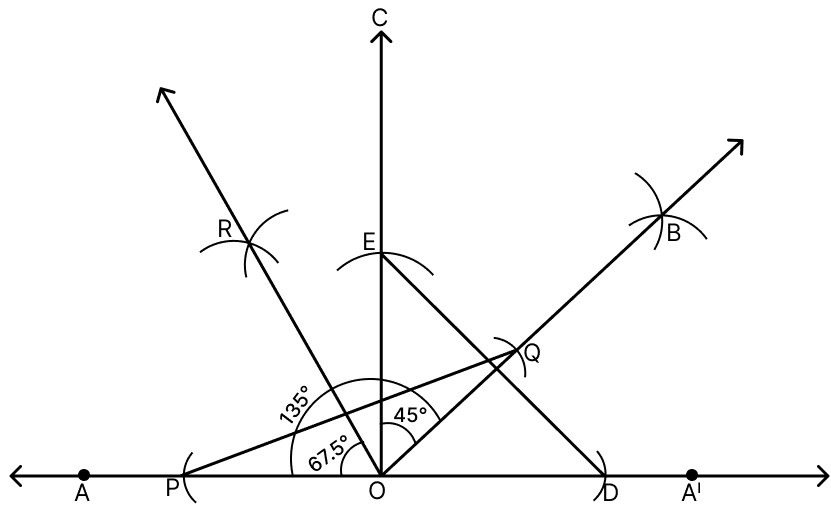
Then OR is the bisector of ∠AOB.
On measuring one of the parts with a protractor, we find:
∠AOR = 67.5° (and ∠ROB = 67.5°).
Hence, ray OR bisects ∠AOB into two equal parts of 67.5° each.