
The value of the expression when is
none of these
Answer
Substituting in the given expression, we get :
Hence, option 3 is the correct option.
By joining any two points of a circle, we obtain its
radius
circumference
diameter
chord
Answer
A line segment obtained by joining any two points on the circumference of a circle is called a chord of the circle.
Hence, option 4 is the correct option.
Which of the following statements is true?
Every closed curve is a polygon
Every closed simple curve is a polygon
Every simple curve made up entirely of line segments is a polygon
Every simple closed curve made up entirely of line segments is a polygon
Answer
A polygon is a simple closed figure made up entirely of line segments.
Hence, a curve is a polygon only if it is simple, closed and made up entirely of line segments.
Hence, option 4 is the correct option.
The median of the numbers 3, 1, 0, 6, 5, 3, 4, 1, 2, 2 is
2
2.5
3
none of these
Answer
Arranging the given data in ascending order, we get :
0, 1, 1, 2, 2, 3, 3, 4, 5, 6
Total number of observations = 10 (even)
Since the number of observations is even, the median is the average of the two middle terms (i.e., 5th and 6th observations).
The two middle terms are 2 and 3.
=
= 2.5
Hence, option 2 is the correct option.
If the perimeter of a regular octagon is 72 cm, then its side is
6 cm
8 cm
9 cm
12 cm
Answer
A regular octagon has 8 equal sides.
=
= 9 cm
Hence, option 3 is the correct option.
If Anandi's present age is x years and her father's age is 3 years less than 4 times her age, then her father's present age is
(4x - 3) years
(3x - 4) years
4(x - 3) years
(4x + 3) years
Answer
Anandi's present age = x years
4 times Anandi's age = 4x years
3 years less than 4 times her age = (4x - 3) years
Hence, Anandi's father's present age = (4x - 3) years.
Hence, option 1 is the correct option.
Statement I: All letters in the word 'HECTOR' have at least one line of symmetry.
Statement II: All the English alphabets have at least one line of symmetry.
Statement I is true but statement II is false.
Statement I is false but Statement II is true.
Both Statement I and Statement II are true.
Both Statement I and Statement II are false.
Answer
Statement I: The letters in the word 'HECTOR' are H, E, C, T, O, R.
Among these letters, H, E, C, T and O have at least one line of symmetry, but the letter R has no line of symmetry.
So, Statement I is false.
Statement II: Letters such as F, G, J, L, N, P, Q, R, S and Z do not have any line of symmetry.
So, Statement II is false.
Hence, option 4 is the correct option.
Statement I: Length of a hall is 40 m and its width is half of its length. Therefore, the perimeter of the hall is three times its length.
Statement II: Area is measured in square units.
Statement I is true but statement II is false.
Statement I is false but Statement II is true.
Both Statement I and Statement II are true.
Both Statement I and Statement II are false.
Answer
Statement I:
Length of the hall = 40 m
Width of the hall = = 20 m
Perimeter of the hall = 2(Length + Width)
= 2(40 + 20)
= 2 × 60
= 120 m
3 × Length = 3 × 40 = 120 m
So, the perimeter of the hall is three times its length.
Hence, Statement I is true.
Statement II: Area is always measured in square units (e.g., sq. m, sq. cm, sq. km).
Hence, Statement II is true.
Hence, option 3 is the correct option.
A cuboidal box has height h cm. Its length is 4 times the height and the breadth is 7 cm less than the length. Express the length and the breadth of the box in terms of its height.
Answer
Height of the cuboidal box = h cm
Length of the box = 4 times the height
= 4 × h
= 4h cm
Breadth of the box = 7 cm less than the length
= (4h - 7) cm
Hence, length of the box = 4h cm and breadth of the box = (4h - 7) cm.
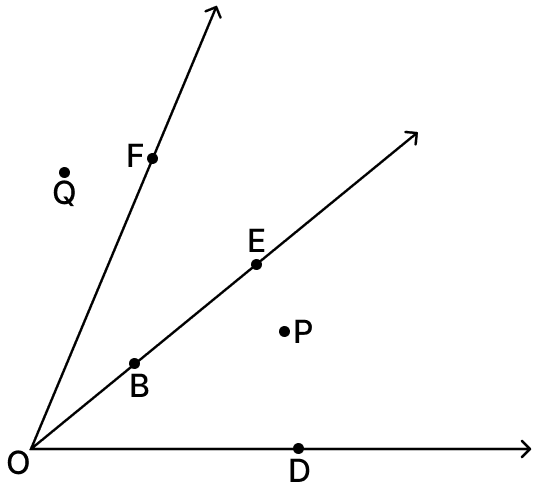
In the adjoining figure, name the point(s)
(i) in the interior of ∠EOD
(ii) in the exterior of ∠FOE
Answer
(i) The point lying in the interior of ∠EOD is P.
Hence, the point in the interior of ∠EOD is P.
(ii) The points lying in the exterior of ∠FOE are D, P and Q.
Hence, the points in the exterior of ∠FOE are D, P and Q.
Write the following statement in mathematical form using literals, numbers and the signs of basic operations:
"Three times a number x is equal to 12 less than twice the number y."
Answer
Three times a number x = 3x
Twice the number y = 2y
12 less than twice the number y = 2y - 12
According to the given statement :
3x = 2y - 12
Hence, the required mathematical form is 3x = 2y - 12.
If the area of a rectangular plot is 240 sq. m and its breadth is 12 m, then find the perimeter of the plot.
Answer
Given,
Area of the rectangular plot = 240 sq. m
Breadth of the plot = 12 m
=
= 20 m
Perimeter of the rectangular plot = 2(Length + Breadth)
= 2(20 + 12)
= 2 × 32
= 64 m.
Hence, the perimeter of the plot is 64 m.
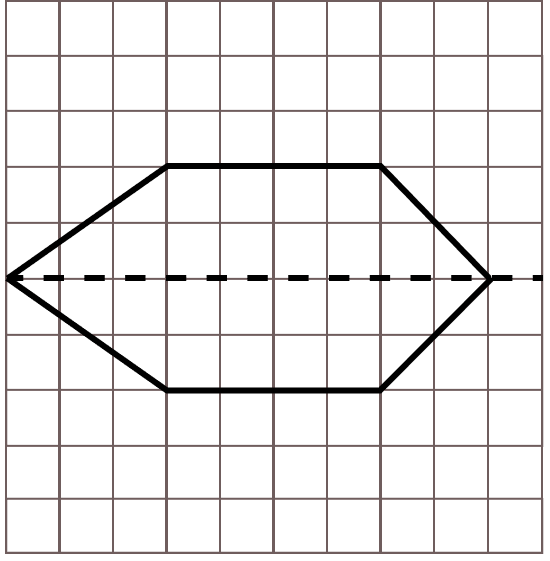
On a squared paper, sketch a hexagon with exactly one line of symmetry.
Answer
A hexagon has six sides. We sketch a hexagon on a squared paper such that it has exactly one line of symmetry.
The required sketch of a hexagon with exactly one line of symmetry is as shown below:
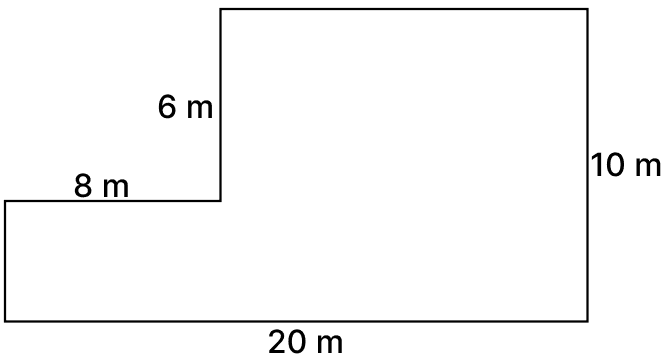
Find the area of the region enclosed by the adjoining polygon.
Answer
The given polygon can be considered as a rectangle of dimensions 20 m × 10 m with a smaller rectangle of dimensions 8 m × 6 m cut out from one of its corners.
The smaller rectangle to be cut out is shown with dotted line in the figure.
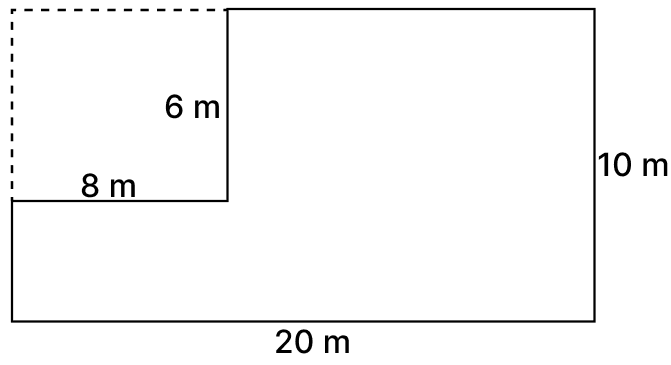
Area of the bigger rectangle = Length × Breadth
= 20 × 10
= 200 sq. m
Area of the cut-out rectangle = 8 × 6
= 48 sq. m
Area of the given polygon = Area of bigger rectangle - Area of cut-out rectangle
= 200 - 48
= 152 sq. m
Hence, the area of the region enclosed by the polygon is 152 sq. m.
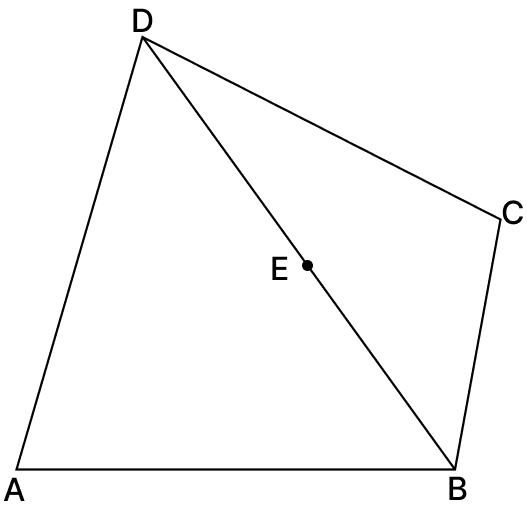
In the adjoining figure, count the number of segments and name them.
Answer
On observing the given figure, we find that the line segments are :
, , , , , ,
Hence, there are 7 line segments in the given figure, namely , , , , , and .
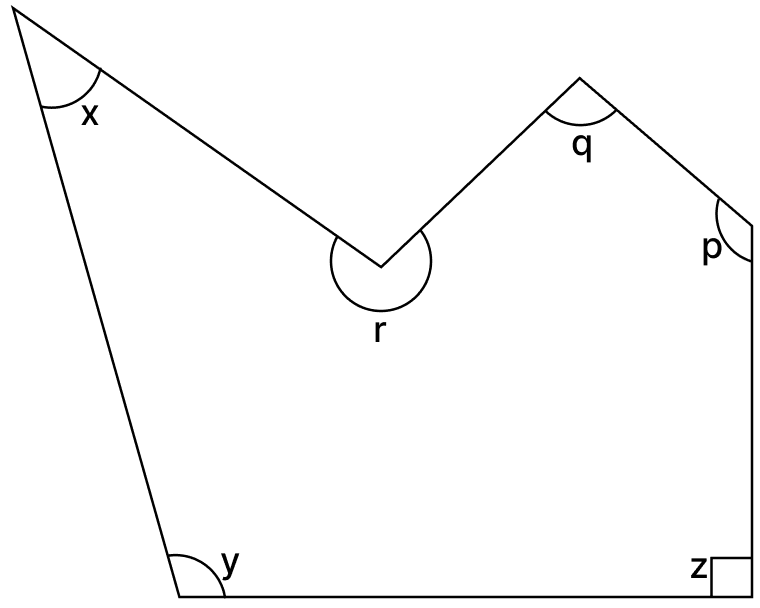
In the adjoining figure, state which of the angles marked with small letters are acute, obtuse, reflex or right angle (you may judge the nature of angle by observation).
Answer
By observing the given figure:
∠x is less than 90°, so ∠x is an acute angle.
∠y is greater than 90° but less than 180°, so ∠y is an obtuse angle.
∠p is greater than 90° but less than 180°, so ∠p is an obtuse angle.
∠q is greater than 90° but less than 180°, so ∠q is an obtuse angle.
∠r is greater than 180° but less than 360°, so ∠r is a reflex angle.
∠z is equal to 90°, so ∠z is a right angle.
Hence, ∠x is acute; ∠y, ∠p and ∠q are obtuse; ∠r is reflex; ∠z is a right angle.
There are 40 employees in a Government Office. They were asked how many children they have. The result was:
1, 2, 3, 1, 0, 2, 0, 1, 2, 2, 1, 3, 5, 2, 0, 0, 2, 4, 1, 1
2, 2, 0, 3, 0, 0, 2, 1, 3, 6, 0, 2, 1, 0, 3, 2, 2, 2, 1, 4
(i) Arrange the above data in ascending order.
(ii) Construct frequency distribution table for the given data.
Answer
(i) Arranging the given data in ascending order, we get :
0, 0, 0, 0, 0, 0, 0, 0, 0, 1, 1, 1, 1, 1, 1, 1, 1, 1, 2, 2, 2, 2, 2, 2, 2, 2, 2, 2, 2, 2, 2, 3, 3, 3, 3, 3, 4, 4, 5, 6
(ii) The frequency distribution table for the given data is as shown below :
| Number of children | Tally marks | Number of employees (Frequency) |
|---|---|---|
| 0 | 9 | |
| 1 | 9 | |
| 2 | 13 | |
| 3 | 5 | |
| 4 | || | 2 |
| 5 | | | 1 |
| 6 | | | 1 |
| Total | 40 |
A survey was carried out on 32 students of class VI in a school. Data about different modes of transport used by them to travel to school was displayed in a pictograph as under:
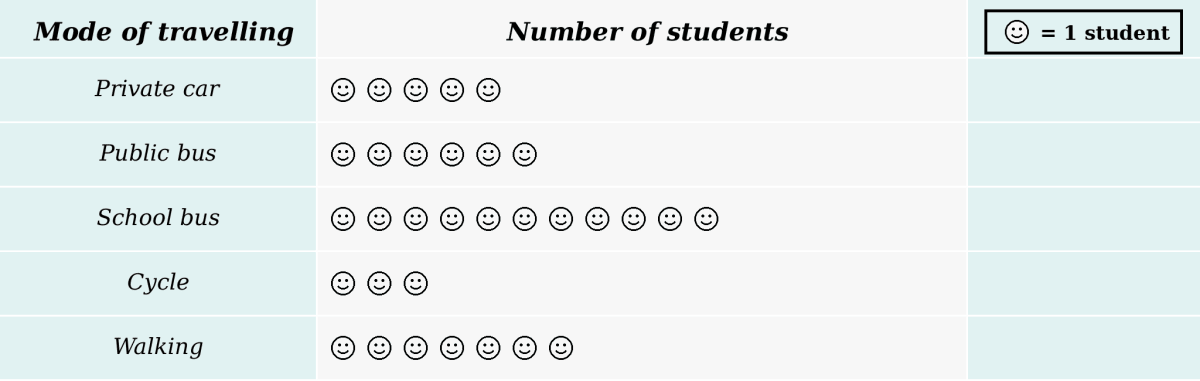
Observe the pictograph and answer the following questions:
(i) Which is the most popular mode of transport?
(ii) What is the number of students who travel either by cycle or walking?
(iii) What are the advantages of using school bus as mode of transport?
(iv) What mode of transport would you suggest and why?
Answer
From the given pictograph, the number of students using different modes of transport are :
Private car = 5 students
Public bus = 6 students
School bus = 11 students
Cycle = 3 students
Walking = 7 students
(i) The mode of transport with the maximum number of students is the school bus (11 students).
Hence, the most popular mode of transport is the school bus.
(ii) Number of students travelling by cycle = 3
Number of students walking = 7
Total number of students travelling either by cycle or walking = 3 + 7 = 10
Hence, 10 students travel either by cycle or walking.
(iii) The advantages of using school bus as mode of transport are :
Students reach school in time.
It saves energy (diesel/petrol).
It is the safest mode of transport.
It reduces traffic congestion on the roads.
(iv) The suggested mode of transport is the school bus because it is safe, punctual, saves fuel and reduces traffic congestion.
If p = 4, q = 3 and r = 2, then find the value of the algebraic expression
Answer
Given,
p = 4, q = 3 and r = 2
Substituting the values of p, q and r in the given expression, we get :
Hence, the value of the given algebraic expression is .
A room is 5 m long and 3 m 50 cm wide. How many square metres of carpet is needed to cover the floor of the room completely?
Answer
Length of the room = 5 m
Width of the room = 3 m 50 cm = 3.5 m
(Since 50 cm = 0.5 m)
Area of the floor of the room = Length × Width
= 5 × 3.5
= 17.5 sq. m
Hence, 17.5 sq. m of carpet is needed to cover the floor of the room completely.
Solve the linear equation 3(2x - 1) = 5 - (3x - 2)
Answer
Given equation :
3(2x - 1) = 5 - (3x - 2)
Removing the brackets on both sides, we get :
6x - 3 = 5 - 3x + 2
6x - 3 = 7 - 3x
Transposing -3x to the left side and -3 to the right side, we get :
6x + 3x = 7 + 3
9x = 10
x =
Hence, x = .
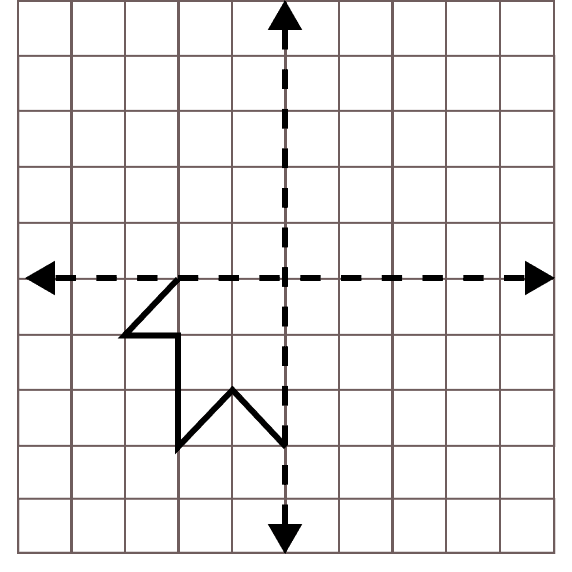
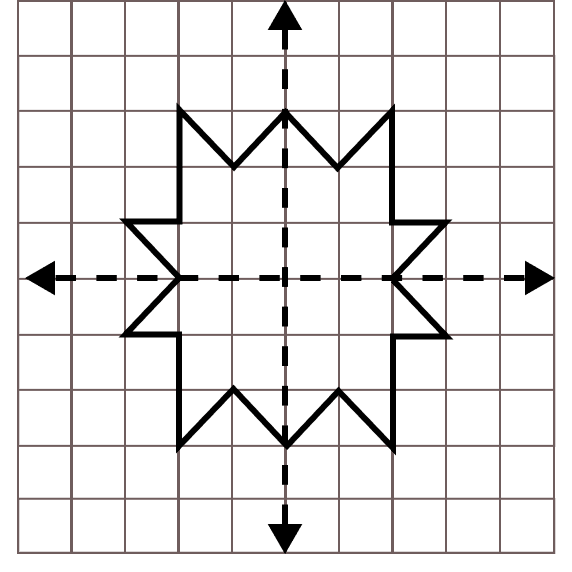
Copy the adjoining figure on a squared paper and complete the figure such that the resultant figure is symmetrical about the dotted lines.
Answer
To complete the figure such that it is symmetrical about the two dotted lines (horizontal and vertical), we reflect the given portion across each of the dotted lines.
The required symmetrical figure is as shown below:
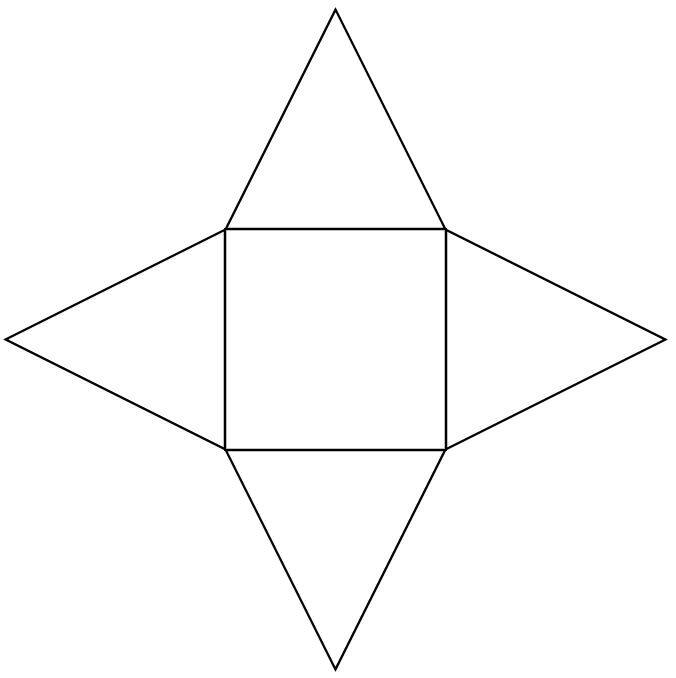
Draw a net for a square pyramid.
Answer
A square pyramid has 1 square base and 4 triangular faces meeting at a common apex.
The net of a square pyramid consists of one square (base) with four identical isosceles triangles attached to its four sides.
The required net of a square pyramid is as shown below:
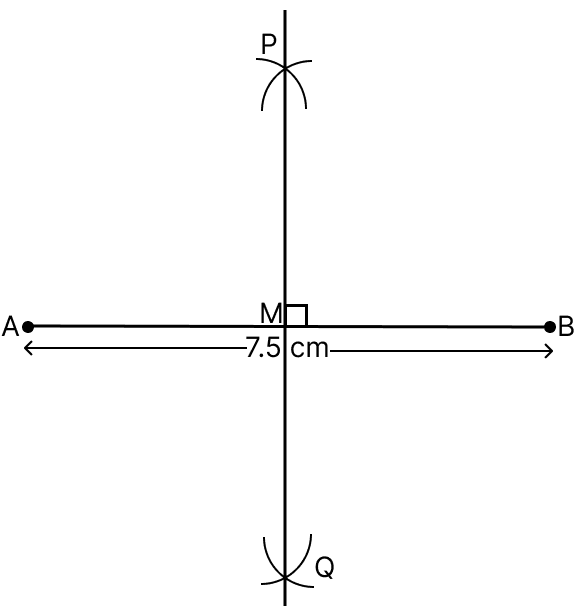
Draw a line segment of length 7.5 cm and construct its axis of symmetry.
Answer
Steps of construction:
Draw a line segment AB of length 7.5 cm using a ruler.
With A as centre and radius more than half of AB (i.e., more than 3.75 cm), draw two arcs, one above AB and the other below AB.
With B as centre and the same radius, draw two arcs, one above and the other below AB, intersecting the earlier drawn arcs at points P and Q respectively.
Join P and Q. The line PQ intersects AB at its midpoint M.
The line PQ is the required axis of symmetry (perpendicular bisector) of the line segment AB.
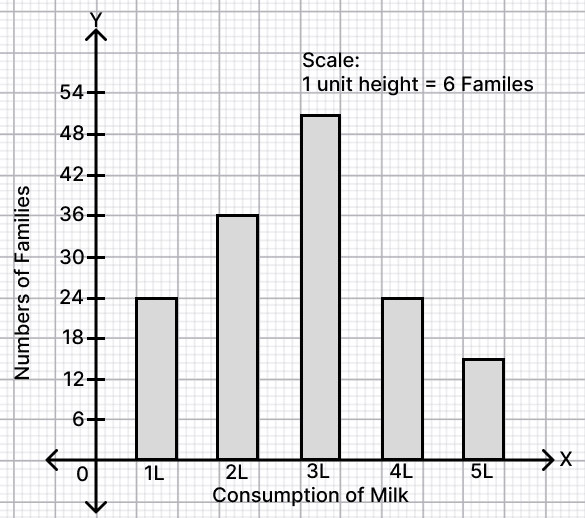
A survey was carried out on 150 families of a colony about the consumption of milk per day. The result was recorded as:
| Consumption of milk (in litres) | 1 | 2 | 3 | 4 | 5 |
|---|---|---|---|---|---|
| Number of families | 24 | 36 | 51 | 24 | 15 |
Represent the above data by a vertical bar graph, choosing scale: 1 unit height = 6 families.
Answer
Steps:
- On a graph paper, draw two mutually perpendicular lines OX and OY which intersect each other at point O.
The line OX is taken horizontal and is called the x-axis, whereas the line OY is taken vertical and is called the y-axis.
On the x-axis, starting from O, mark points at equal distances. At these points write the consumption of milk (in litres).
Along y-axis, mark the heights of the bars (rectangles) in proportion to the given data (Number of families) using the scale: 1 unit height = 6 families.
The heights of the bars for various consumption values are :
1 L : = 4 units
2 L : = 6 units
3 L : = 8.5 units
4 L : = 4 units
5 L : = 2.5 units
The required bar graph is as shown below:
Draw a rough sketch of a regular hexagon. Connecting three of its vertices, draw
(i) an isosceles triangle
(ii) an equilateral triangle
(iii) a right angled triangle.
Answer
A regular hexagon has 6 vertices. Let the vertices be labelled A, B, C, D, E and F.
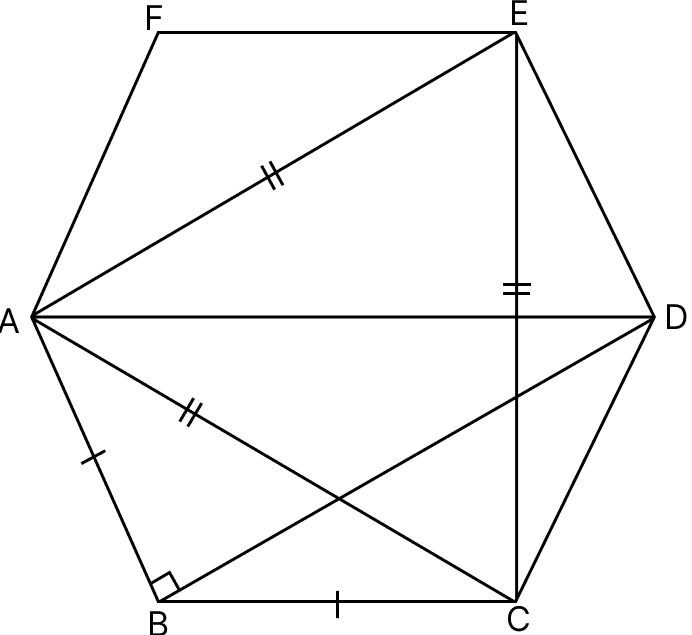
(i) Isosceles triangle: By joining the vertices A, B and C, we obtain an isosceles triangle in which two sides AB and BC are equal.
(ii) We know that,
In a regular hexagon, all pairs of opposite vertices are at an equal distance from one another.
Thus, AE = AC = EC.
Equilateral triangle: By joining the alternate vertices A, C and E of the hexagon, we obtain an equilateral triangle in which all three sides are equal.
(iii) Right-angled triangle: By joining the vertices A, B and D (where AD is the longest diagonal passing through the centre),
As we know that all interior angles of a regular hexagon = 120°. Since, all sides of a regular hexagon are equal that means BC = CD, therefore, BCD is an isosceles triangle,
∠CBD = ∠CDB
As this is a regular hexagon, ∠C = 120°
Now sum of all angles of triangle BCD,
∠CBD + ∠CDB + ∠C = 180°
2∠CBD + 120° = 180°
2∠CBD = 180° - 120°
2∠CBD = 60°
∠CBD = 30°
As, ∠ABD + ∠CBD = ∠B = 120°
∠ABD + 30° = 120°
∠ABD = 120° - 30°
∠ABD = 90°
So, we get a right-angled triangle ABD with the right angle at B.
The cost of cultivating a rectangular field at the rate of ₹ 5 per square metre is ₹ 2880. If the length of the field is 32 m, find the cost of fencing the field at the rate of ₹ 90 per metre.
Answer
Total cost of cultivation = ₹ 2880
Rate of cultivation = ₹ 5 per sq. m
Length of the field = 32 m
Perimeter of the field = 2(Length + Breadth)
= 2(32 + 18)
= 2 × 50
= 100 m
Rate of fencing = ₹ 90 per metre
Total cost of fencing = Perimeter × Rate of fencing
= 100 × 90
= ₹ 9000
Hence, the cost of fencing the field is ₹ 9000.
By using ruler and compass, construct an angle of 45° and bisect it. Measure any one part.
Answer
Steps of construction:
Draw any line l and take a point O on it.
With O as centre and suitable radius, draw two arcs to cut line l at points A and B.
With A and B as centres, draw two arcs of equal radius cutting each other at C. Join OC and produce it. Then ∠BOC = 90°.
Now we bisect ∠BOC by drawing two equal arc from point B and F, cutting each other at point D. Join OD and the bisector is ray OD. Then ∠BOD = 45°.
Now to bisect ∠BOD, with O as centre and any suitable radius, draw an arc to meet OB at P and OD at Q.
With P and Q as centres and equal radii , draw two arcs cutting each other at E.
Join OE and produce it to form a ray.
On measuring with a protractor, each part of the bisected angle equals .
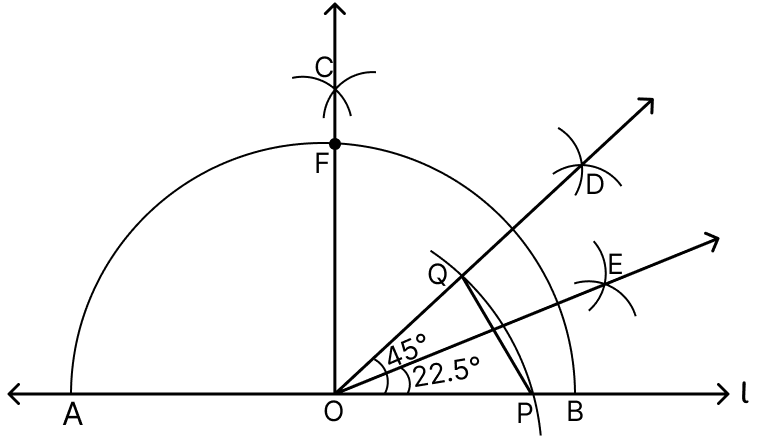
Hence, each part of the bisected angle measures .
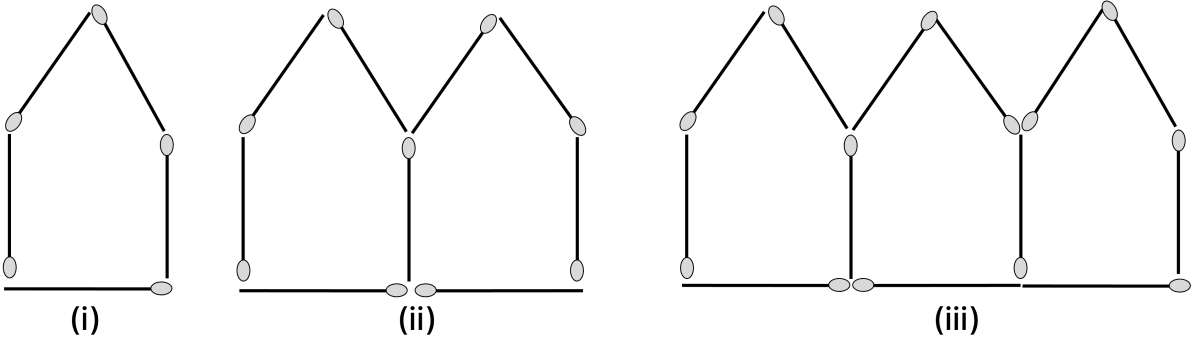
Look at the following matchstick pattern of polygons. Complete the table. Also write the general rule that gives the number of matchsticks.
| Number of polygon | 1 | 2 | 3 | 4 | 5 | ... | n |
|---|---|---|---|---|---|---|---|
| Number of matchsticks | ... | ... | ... | ... | ... | ... | ... |
Answer
On observing the given matchstick pattern, we find that each polygon (pentagon-shaped) is formed using 5 matchsticks. When a new polygon is added to the pattern, it shares one matchstick with the previous polygon, so 4 new matchsticks are added each time.
So, the number of matchsticks follows the pattern :
For 1 polygon : 5 matchsticks
For 2 polygons : 5 + 4 = 9 matchsticks
For 3 polygons : 9 + 4 = 13 matchsticks
For 4 polygons : 13 + 4 = 17 matchsticks
For 5 polygons : 17 + 4 = 21 matchsticks
The completed table is as shown below :
| Number of polygons | 1 | 2 | 3 | 4 | 5 | ... | n |
|---|---|---|---|---|---|---|---|
| Number of matchsticks | 5 | 9 | 13 | 17 | 21 | ... | 4n + 1 |
General rule: The number of matchsticks required to form n polygons is given by :
Number of matchsticks = 4n + 1