
What is the place value of 5 in the number 6524783?
5 lakh
5 ten thousand
50 thousand
5 crore
Answer
In the number 6524783, the digit 5 lies at the lakhs place.
Place value of 5 = 5 × 1,00,000 = 5,00,000 = 5 lakh.
Hence, option 1 is the correct option.
Which of the following is the smallest whole number?
1
0
-1
None of these
Answer
The whole numbers are 0, 1, 2, 3, 4, … They begin from 0, so the smallest whole number is 0. (-1 is not a whole number.)
Hence, option 2 is the correct option.
The additive inverse of -18 is
18
-18
0
Answer
The additive inverse of a number is the number which when added to it gives 0.
Since -18 + 18 = 0, the additive inverse of -18 is 18.
Hence, option 1 is the correct option.
Which of the following numbers is a factor of every number?
0
1
2
3
Answer
1 is a factor of every number. 0 cannot be considered a factor because division by 0 is not defined.
Hence, option 2 is the correct option.
Which of the following is a well-defined set?
The set of tall students in a class
The set of good books
The set of prime numbers less than 20
The set of beautiful flowers
Answer
A set is well-defined if its members can be definitely identified. “Tall students”, “good books” and “beautiful flowers” depend on personal opinion and are not well-defined. The set of prime numbers less than 20 is well-defined.
Hence, option 3 is the correct option.
Which of the following is an improper fraction?
Answer
In an improper fraction the numerator is greater than or equal to the denominator. In , the numerator 9 is greater than the denominator 7.
Hence, option 3 is the correct option.
What is the place value of 7 in the number 45.672?
7 tenths
7 hundredths
7 ones
7 thousandths
Answer
In 45.672, the digit 7 is the second digit after the decimal point, i.e., it is at the hundredths place.
Place value of 7 = 7 hundredths.
Hence, option 2 is the correct option.
The ratio of 3 km to 750 m is
1:250
4:1
1:4
250:1
Answer
Converting to the same unit: 3 km = 3 × 1000 m = 3000 m.
Ratio of 3 km to 750 m = = 4 : 1.
Hence, option 2 is the correct option.
Which of the following is a variable?
5
x
3 + 4
8
Answer
A variable is a symbol that can take different values. Here, x is a variable, while 5, 3 + 4 and 8 are constants.
Hence, option 2 is the correct option.
How many end points does a ray have?
0
1
2
Infinite
Answer
A ray has exactly one end point; it starts at a fixed point and extends without end in one direction.
Hence, option 2 is the correct option.
Which pair of lines can never meet?
Perpendicular lines
Intersecting lines
Parallel lines
Slanting lines
Answer
Parallel lines never meet, however far they are extended in either direction.
Hence, option 3 is the correct option.
How many lines of symmetry does an equilateral triangle have?
1
2
3
4
Answer
An equilateral triangle has 3 lines of symmetry, one through each vertex and the mid-point of the opposite side.
Hence, option 3 is the correct option.
What is the perimeter of a square with side 8 cm?
16 cm
24 cm
32 cm
64 cm
Answer
Perimeter of a square = 4 × side = 4 × 8 = 32 cm.
Hence, option 3 is the correct option.
The median of the data set 4, 7, 3, 9, 5 is
4
5
7
3
Answer
Arranging the data 4, 7, 3, 9, 5 in ascending order: 3, 4, 5, 7, 9.
The number of observations = 5 (odd), so the median is the middle term = = 3rd term = 5.
Hence, option 2 is the correct option.
The average (mean) of the first five even numbers is
6
7
8
5
Answer
The first five even numbers are 2, 4, 6, 8, 10.
Mean = .
Hence, option 1 is the correct option.
In the number 846793, insert commas appropriately and write the number names:
(a) In the Indian system (b) In the International system
Answer
Given,
Number = 846793
(a) Indian system: Starting from the right, commas are placed after every two digits after the first three digits.
⇒ 8,46,793 — Eight lakh forty-six thousand seven hundred and ninety-three.
(b) International system: Starting from the right, commas are placed after every three digits.
⇒ 846,793 — Eight hundred forty-six thousand seven hundred and ninety-three.
Find the absolute value of the following integers:
(a) -15 (b) 12 (c) 0
Answer
The absolute value of an integer is its distance from 0 on the number line, and is never negative.
(a) |-15| = 15
(b) |12| = 12
(c) |0| = 0
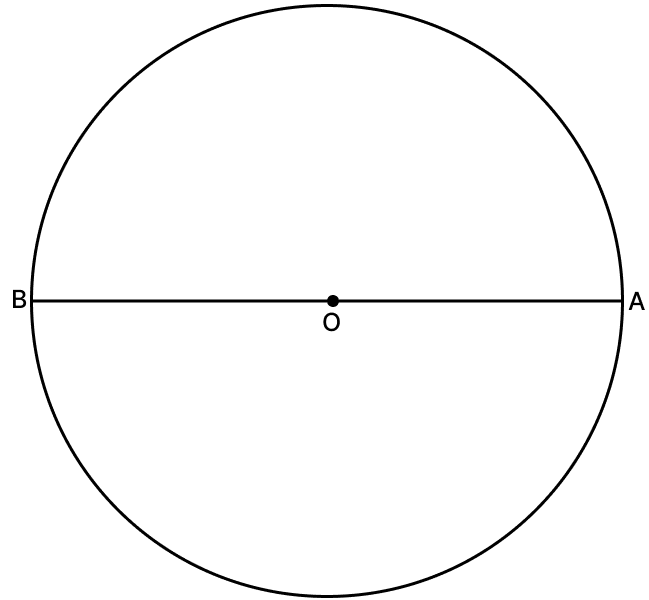
Draw a circle using a compass and mark:
(a) Centre as O (b) Radius as OA (c) Diameter as AB
Answer
Steps of construction:
(i) Mark a point O as the centre.
(ii) Open the compass to a suitable radius. Place the compass needle at O and draw a complete circle.
(iii) Mark any point A on the circle and join OA. Then OA is a radius.
(iv) Extend AO to meet the circle again at B and join AB. Then AB is a diameter passing through the centre O.
Find the mean of: 8, 12, 15, 9, 16
Answer
Given,
Observations = 8, 12, 15, 9, 16
By formula,
Mean =
=
=
= 12.
Hence, the mean = 12.
Using the digits 3, 8, 0, 5 form:
(a) The greatest 4-digit number (without repeating any digit)
(b) The smallest 4-digit number (without repeating any digit)
Answer
(a) To form the greatest number, arrange the digits in descending order:
8 > 5 > 3 > 0, so the greatest 4-digit number = 8530.
(b) To form the smallest number, arrange the digits in ascending order. The thousands place cannot be 0, so we place the smallest non-zero digit (3) first:
Smallest 4-digit number = 3058.
Use prime factorisation to find the HCF and LCM of 24 and 32. Hence, verify that HCF × LCM = product of two numbers.
Answer
Given,
Numbers = 24 and 32
Prime factorisation of 24 and 32:
⇒ 24 = 2 × 2 × 2 × 3 = 23 × 3
⇒ 32 = 2 × 2 × 2 × 2 × 2 = 25
HCF = product of the common prime factors with the lowest powers = 23 = 8
LCM = product of all prime factors with the highest powers = 25 × 3 = 32 × 3 = 96
Verification:
HCF × LCM = 8 × 96 = 768
Product of the two numbers = 24 × 32 = 768
Since 768 = 768, HCF × LCM = product of the two numbers is verified.
A rectangular garden is 25 m long and 15 m wide. Find:
(a) Its perimeter (b) Its area
Answer
Given,
Length = 25 m, Width = 15 m.
(a) Perimeter = 2 × (length + width)
⇒ Perimeter = 2 × (25 + 15) = 2 × 40 = 80 m.
(b) Area = length × width
⇒ Area = 25 × 15 = 375 m2.
Round off the following numbers:
(a) 6,847 to the nearest 100
(b) 94,562 to the nearest 1000
(c) 7,83,456 to the nearest 10000
Answer
(a) Given,
Number = 6,847
The tens digit is 4 (less than 5), so we round down.
⇒ 6,847 ≈ 6,800
(b) Given,
Number = 94,562
The hundreds digit is 5, so we round up.
⇒ 94,562 ≈ 95,000
(c) Given,
Number = 7,83,456
The thousands digit is 3 (less than 5), so we round down.
⇒ 7,83,456 ≈ 7,80,000
Show that multiplication is distributive over addition for whole numbers using the numbers 8, 5 and 3.
Answer
Given,
a = 8, b = 5 and c = 3.
The distributive property of multiplication over addition states that:
a × (b + c) = (a × b) + (a × c)
LHS = 8 × (5 + 3) = 8 × 8 = 64
RHS = (8 × 5) + (8 × 3) = 40 + 24 = 64
Since LHS = RHS = 64, multiplication is distributive over addition for the whole numbers 8, 5 and 3.
The temperature in a hill station on Tuesday morning was 3°C below zero. By afternoon, the temperature rose by 8°C.
(a) Represent the morning temperature and the change using integers
(b) What was the temperature in the afternoon?
Answer
(a) “3°C below zero” is represented as the integer -3°C (morning temperature).
A rise of 8°C is represented as the integer +8°C (the change).
(b) Afternoon temperature = morning temperature + change
⇒ Afternoon temperature = -3 + 8
⇒ Afternoon temperature = 5°C.
Write the set of all even numbers between 1 and 15 in:
(a) Roster form (b) Set-builder form
Answer
Given,
Even numbers between 1 and 15 are 2, 4, 6, 8, 10, 12, 14.
(a) Roster form: {2, 4, 6, 8, 10, 12, 14}
(b) Set-builder form: {x : x is an even number between 1 and 15}
Simplify and express it in lowest terms. Compare and using cross multiplication.
Answer
Given,
Fractions = and , .
Simplifying :
HCF of 48 and 72 :
⇒ 72 = 23 × 32
⇒ 48 = 24 × 3
⇒ HCF = 23 × 3 = 8 × 3 = 24
The HCF of 48 and 72 is 24.
Comparing and by cross multiplication:
Cross multiply: 5 × 12 = 60 and 7 × 8 = 56.
Since 60 > 56, we have .
Meena buys 3.5 kg of apples for ₹ 210.
(a) What is the cost per kg?
(b) If she buys 7.2 kg of apples, how much will she have to pay?
Answer
Given,
Cost of 3.5 kg of apples = ₹ 210.
(a) Cost per kg = = ₹ 60.
(b) Cost of 7.2 kg of apples = 7.2 × 60 = ₹ 432.
A box contains 45 chocolates and 30 toffees.
(a) What is the ratio of chocolates to toffees?
(b) What is the ratio of toffees to total items?
Answer
Given,
Number of chocolates = 45, number of toffees = 30, total items = 45 + 30 = 75.
(a) Ratio of chocolates to toffees = = 3 : 2.
(b) Ratio of toffees to total items = = 2 : 5.
Identify the variable term, constant term and the coefficient of the variable term in the expression 5x + 12. Solve the equation 4x + 7 = 23.
Answer
Given,
Expression = 5x + 12.
Variable term = 5x
Constant term = 12
Coefficient of the variable term = 5
Solving 4x + 7 = 23:
⇒ 4x + 7 = 23
⇒ 4x = 23 - 7 [transposing 7]
⇒ 4x = 16
⇒ x = = 4.
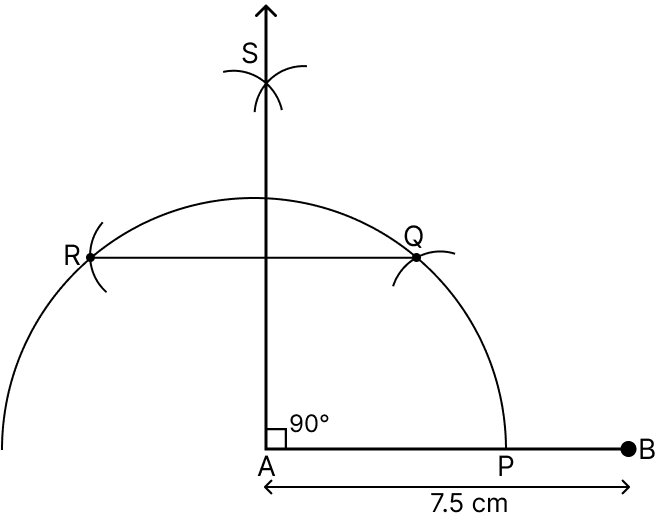
Draw a line segment AB = 7.5 cm. Construct a perpendicular at point A using compass and ruler.
Answer
Steps of construction:
(i) Draw a line segment AB = 7.5 cm using a ruler.
(ii) With A as centre and a convenient radius, draw an arc cutting AB at a point P.
(iii) With P as centre and the same radius, draw an arc cutting the first arc at Q; with Q as centre, draw another arc cutting it at R.
(iv) With Q and R as centres and a radius more than half of QR, draw two arcs meeting at S.
(v) Join AS and produce it. Then AS is perpendicular to AB at A, i.e., ∠SAB = 90°.
Classify the following angles as acute, obtuse, right, straight or reflex:
(a) 35° (b) 90° (c) 125° (d) 180° (e) 280°
Answer
Recall: an acute angle is less than 90°, a right angle is exactly 90°, an obtuse angle is between 90° and 180°, a straight angle is exactly 180°, and a reflex angle is between 180° and 360°.
(a) 35° → Acute angle (since 35° < 90°)
(b) 90° → Right angle
(c) 125° → Obtuse angle (since 90° < 125° < 180°)
(d) 180° → Straight angle
(e) 280° → Reflex angle (since 180° < 280° < 360°)
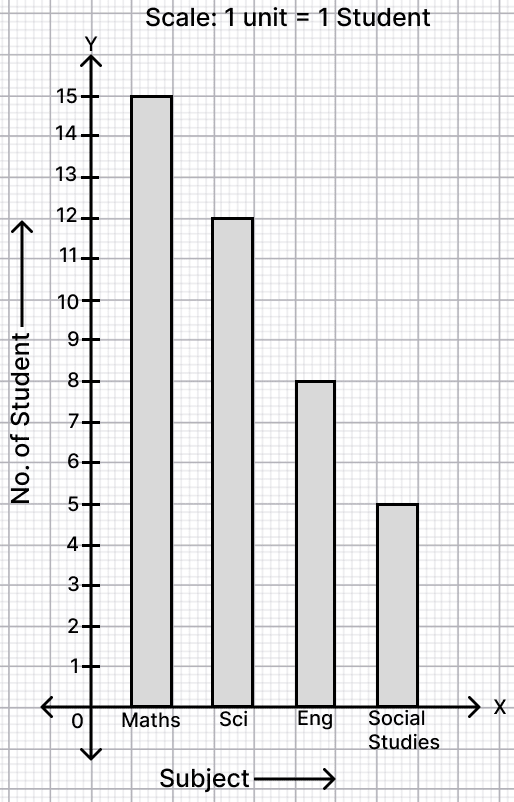
A group of 40 students were asked their favourite subject. The replies were: 15 liked Mathematics, 12 liked Science, 8 liked English and the rest liked Social Studies. Draw a bar graph representing this data.
Answer
Given,
Number of students who liked Social Studies = 40 - (15 + 12 + 8) = 40 - 35 = 5.
The data to be represented is:
| Subject | Number of students |
|---|---|
| Mathematics | 15 |
| Science | 12 |
| English | 8 |
| Social Studies | 5 |
Taking the subjects on the horizontal axis and the number of students on the vertical axis (scale: 1 unit = 1 student), the bar graph is drawn with bars of equal width and equal spacing.
Rani has 36 red balloons and 48 yellow balloons. She wants to make balloon bunches using the same number of each colour in every bunch, with no balloons left over.
(a) What is the greatest number of bunches she can make?
(b) How many red and yellow balloons will be in each bunch?
Answer
Given,
Red balloons = 36, Yellow balloons = 48.
The greatest number of equal bunches with no balloons left over is the HCF of 36 and 48.
Prime factorisation of 36 and 48:
⇒ 36 = 22 × 32
⇒ 48 = 24 × 3
⇒ HCF = 22 × 3 = 4 × 3 = 12
(a) The greatest number of bunches she can make = 12.
(b) Number of red balloons in each bunch = = 3
Number of yellow balloons in each bunch = = 4
Hence, each bunch will have 3 red and 4 yellow balloons.
The floor of a rectangular room is 6 m long and 4 m wide. Tiles of size 30 cm × 20 cm are to be laid on it.
(a) What is the area of the floor?
(b) What is the area of one tile?
(c) How many tiles will be required to cover the entire floor?
Answer
Given,
Floor dimensions = 6 m × 4 m, Tile size = 30 cm × 20 cm.
(a) Area of the floor = length × width
⇒ Area = 6 × 4 = 24 m2.
(b) Area of one tile = 30 × 20 = 600 cm2.
(c) First convert the floor area into cm2:
⇒ 24 m2 = 24 × 10000 cm2 = 2,40,000 cm2 [since 1 m2 = 10000 cm2]
Number of tiles required = = 400 tiles.
In a week, Arjun recorded the number of books he read each day:
| Day | Books |
|---|---|
| Monday | 2 |
| Tuesday | 3 |
| Wednesday | 1 |
| Thursday | 4 |
| Friday | 2 |
| Saturday | 5 |
| Sunday | 3 |
Draw a bar chart and answer the following questions:
(a) What was the total number of books read over the week?
(b) What was the average (mean) number of books per day?
(c) On which day did he read the maximum books?
Answer
Taking the days of the week on the horizontal axis and the number of books on the vertical axis (scale: 1 unit = 1 book), the bar chart is drawn with bars of equal width.
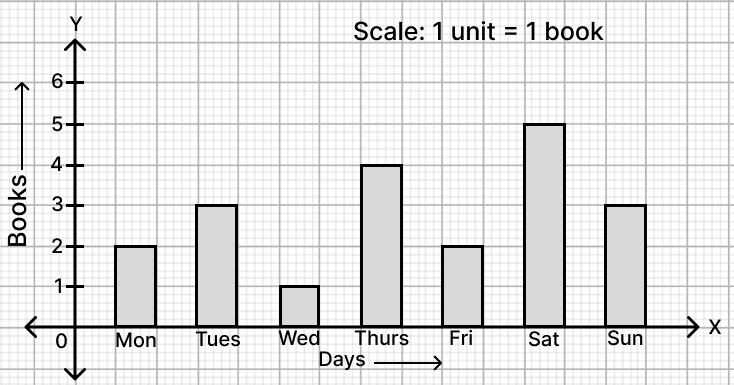
(a) Total number of books read over the week
⇒ 2 + 3 + 1 + 4 + 2 + 5 + 3
⇒ 20 books.
(b) Mean = books per day.
(c) Arjun read the maximum number of books (5) on Saturday.
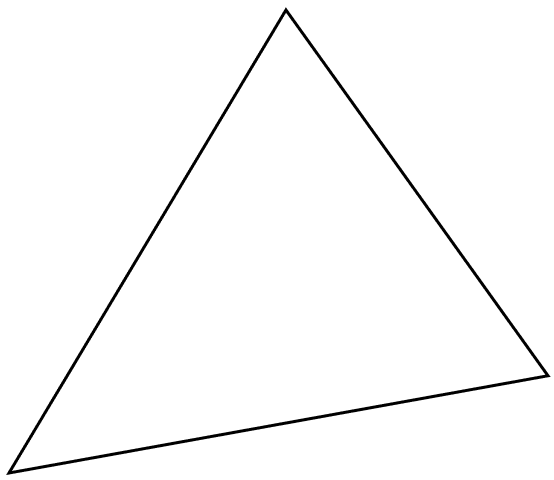
Draw a triangle that has no line of symmetry. Name the triangle.
Answer
A triangle whose three sides are of different lengths has no line of symmetry. Such a triangle is a scalene triangle.
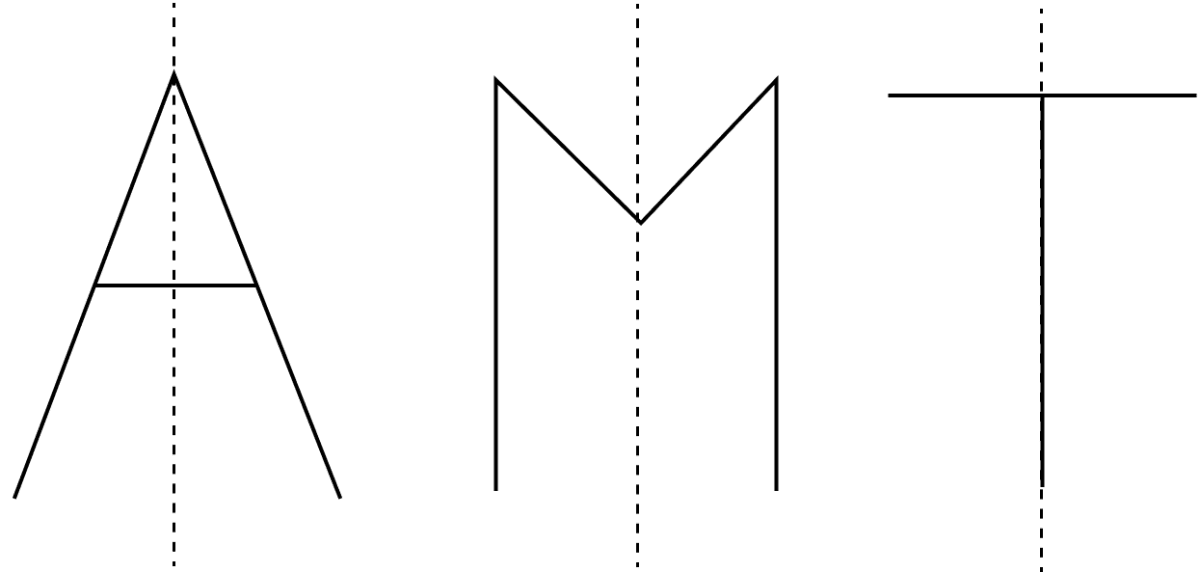
List any three capital English letters that have exactly one vertical line of symmetry.
Answer
The capital English letters having exactly one vertical line of symmetry include A, M, T.
Convert the following into percentage:
(a) 17 : 100
(b) 3 : 25
(c) 18 out of 20 students passed the test. What percent passed?
Answer
(a) Given,
⇒ 17 : 100 =
⇒ = 17%.
(b) Given,
⇒ 3 : 25 =
= 12%
(c) Given,
Students passed = 18 out of 20.
Percentage passed = = 90%.
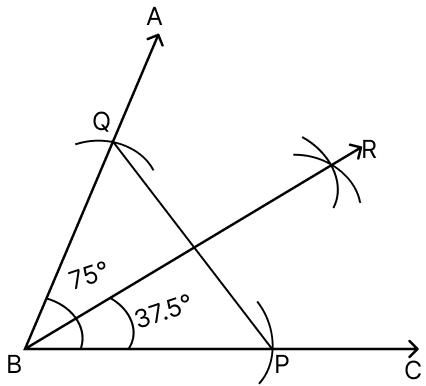
Construct ∠ABC = 75° using a protractor. Bisect this angle using a compass and ruler. Measure the two angles formed and verify.
Answer
Steps of construction:
(i) Draw a ray BC. With the help of a protractor, place its centre at B and mark a point at 75°. Join B to this point to obtain ray BA, so that ∠ABC = 75°.
(ii) With B as centre and a convenient radius, draw an arc cutting BA at P and BC at Q.
(iii) With P and Q as centres and a radius more than half of PQ, draw two arcs meeting at R.
(iv) Join BR. Then BR bisects ∠ABC.
Each of the two angles formed = = 37.5°.
On measuring with the protractor, ∠ABR = ∠RBC = 37.5°, and 37.5° + 37.5° = 75° = ∠ABC, which verifies the bisection.
From the adjoining figure, write
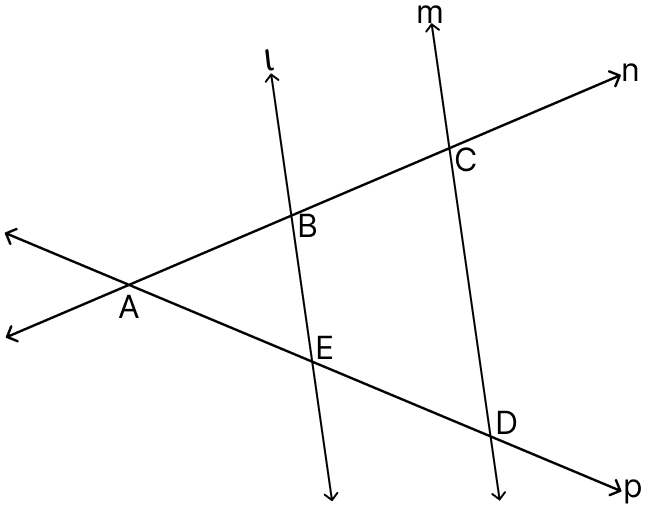
(a) All pairs of parallel lines
(b) All pairs of intersecting lines
(c) Lines whose point of intersection is E
(d) Collinear points
Answer
From the given figure (with lines l, m, n, p and points A, B, C, D, E):
(a) Pairs of parallel lines: l and m (l ∥ m).
(b) Pairs of intersecting lines: n and p; n and l; n and m; p and l; p and m.
(c) Lines whose point of intersection is E: l and p.
(d) Collinear points: A, B, C and A, E, D.