
Which number is the greatest in the given list?
67,05,432
6,70,543
76,05,432
67,50,432
Answer
Comparing the numbers, the three 7-digit numbers are 67,05,432; 76,05,432 and 67,50,432, while 6,70,543 has only 6 digits. Among the 7-digit numbers, 76,05,432 is the greatest.
Hence, option 3 is the correct option.
Which is the value of 45 × 103 using distributive property?
4500
4635
4535
4545
Answer
By distributive property,
Hence, option 2 is the correct option.
Which of the following statements is true?
-8 is greater than -5
|-12| = -12
(-9) + (-3) = -12
0 is the smallest negative integer
Answer
Checking each statement :
-8 is greater than -5 → false, since -8 lies to the left of -5 on the number line.
|-12| = -12 → false, since |-12| = 12.
(-9) + (-3) = -12 → true.
0 is the smallest negative integer → false, since 0 is neither positive nor negative.
Hence, option 3 is the correct option.
Which of these numbers is not divisible by 9?
729
486
634
891
Answer
A number is divisible by 9 if the sum of its digits is divisible by 9.
729 → 7 + 2 + 9 = 18 (divisible by 9)
486 → 4 + 8 + 6 = 18 (divisible by 9)
634 → 6 + 3 + 4 = 13 (not divisible by 9)
891 → 8 + 9 + 1 = 18 (divisible by 9)
Hence, option 3 is the correct option.
If A = {3, 6, 9, 12}, then n(A) =
3
4
6
12
Answer
n(A) means the number of elements in set A.
A = {3, 6, 9, 12} has 4 elements, so n(A) = 4.
Hence, option 2 is the correct option.
Which fraction is equivalent to ?
Answer
Reducing to its lowest terms :
, which is equivalent to .
Hence, option 2 is the correct option.
Which of the following is equal to 0.625?
Answer
Writing 0.625 as a fraction :
.
Hence, option 1 is the correct option.
If 4 pens cost ₹ 60, how much would 7 pens cost?
₹ 105
₹ 100
₹ 120
₹ 140
Answer
Cost of 1 pen = = ₹ 15.
Cost of 7 pens = 7 × 15 = ₹ 105.
Hence, option 1 is the correct option.
The literal coefficient in 9y is
9
y
0
1
Answer
In the term 9y, the number 9 is the numerical coefficient and the letter y is the literal coefficient.
Hence, option 2 is the correct option.
Which of these is an example of a closed figure?
Open curve
A line
Rectangle
Ray
Answer
A rectangle is a closed figure as it begins and ends at the same point; an open curve, a line and a ray are not closed figures.
Hence, option 3 is the correct option.
Which of these angles is greater than a right angle but less than a straight angle?
Acute angle
Obtuse angle
Reflex angle
Right angle
Answer
An angle greater than a right angle (90°) but less than a straight angle (180°) is called an obtuse angle.
Hence, option 2 is the correct option.
How many lines of symmetry does a square have?
2
3
4
6
Answer
A square has 4 lines of symmetry — two diagonals and two lines joining the mid-points of opposite sides.
Hence, option 3 is the correct option.
The area of a rectangle of length 12 cm and breadth 5 cm is
17 cm2
34 cm2
60 cm2
30 cm2
Answer
Area of rectangle = length × breadth = 12 × 5 = 60 cm2.
Hence, option 3 is the correct option.
The average (mean) of the numbers 6, 8, 10, 12 is
8
9
10
11
Answer
By formula,
Hence, option 2 is the correct option.
Which of the following is not a type of data representation?
Bar graph
Pictograph
Line plot
Addition chart
Answer
Bar graph, pictograph and line plot are all ways of representing data, but an "addition chart" is not a type of data representation.
Hence, option 4 is the correct option.
Using the division algorithm, check whether 265 = 15 × 17 + 10.
Answer
By the division algorithm,
Dividend = Divisor × Quotient + Remainder.
Here, Divisor = 15, Quotient = 17 and Remainder = 10.
Since this equals the dividend 265, the statement is verified.
Hence, 265 = 15 × 17 + 10 is verified to be true.
Write the first 6 multiples of 7. Which of them is also a multiple of 14?
Answer
The first 6 multiples of 7 are :
7 × 1 = 7, 7 × 2 = 14, 7 × 3 = 21, 7 × 4 = 28, 7 × 5 = 35, 7 × 6 = 42.
So, the multiples are 7, 14, 21, 28, 35, 42.
Among these, the multiples of 14 are 14, 28 and 42.
Hence, the first 6 multiples of 7 are 7, 14, 21, 28, 35, 42; of these 14, 28 and 42 are also multiples of 14.
State whether the following sets are finite or infinite:
(a) Set of all whole numbers
(b) Set of odd numbers between 3 and 15
(c) Set of months in a year
Answer
(a) The set of all whole numbers is 0, 1, 2, 3, … which goes on without end, so it is an infinite set.
(b) The set of odd numbers between 3 and 15 is {5, 7, 9, 11, 13}, which has a countable number of elements, so it is a finite set.
(c) The set of months in a year has 12 elements, so it is a finite set.
Hence, (a) Infinite, (b) Finite, (c) Finite.
Add: 25.67 + 8.934 + 0.5
Answer
Writing each number with the same number of decimal places and adding :
Hence, 25.67 + 8.934 + 0.5 = 35.104.
Draw a rough diagram of two intersecting lines and label them properly.
Answer
Two lines AB and CD that cross each other at a single point O are called intersecting lines, and O is their point of intersection.
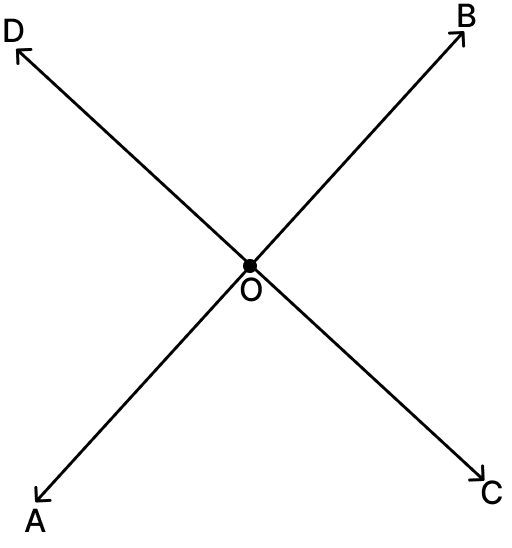
Hence, lines AB and CD intersect each other at point O.
Arrange the following numbers in descending order:
84627, 8467, 846720, 84672. Also, identify the smallest and largest number.
Answer
First we count the number of digits :
846720 → 6 digits, 84627 → 5 digits, 84672 → 5 digits, 8467 → 4 digits.
The 6-digit number 846720 is the largest and the 4-digit number 8467 is the smallest. Among the two 5-digit numbers, 84672 > 84627.
Arranging in descending (largest to smallest) order :
846720, 84672, 84627, 8467.
Hence, descending order is 846720, 84672, 84627, 8467; smallest = 8467 and largest = 846720.
Find all the prime numbers between 40 and 60.
Answer
A prime number has exactly two factors — 1 and itself.
Checking the numbers from 40 to 60, the prime numbers are :
41, 43, 47, 53, 59.
Hence, the prime numbers between 40 and 60 are 41, 43, 47, 53 and 59.
A square has a perimeter of 36 cm. Find the length of one side and its area.
Answer
Given, perimeter of square = 36 cm.
By formula, Perimeter of a square = 4 × side.
By formula, Area of a square = side × side.
Area = 9 × 9 = 81 cm2
Hence, the length of one side = 9 cm and area = 81 cm2.
Convert 3600 cm2 into m2.
Answer
We know that 1 m = 100 cm, so 1 m2 = 100 × 100 = 10000 cm2.
3600 cm2 =
= 0.36 m2
Hence, 3600 cm2 = 0.36 m2.
Estimate the following by rounding off each number to the nearest 1000:
(a) 8,756 + 5,234
(b) 12,845 - 6,379
Also write the actual answers and compare them with the estimates.
Answer
(a) Rounding each number to the nearest 1000 :
8,756 → 9,000 (since 756 ≥ 500, round up)
5,234 → 5,000 (since 234 < 500, round down)
Estimated sum = 9,000 + 5,000 = 14,000.
Actual sum = 8,756 + 5,234 = 13,990.
Comparison : The estimate 14,000 is very close to the actual answer 13,990 (difference of only 10).
(b) Rounding each number to the nearest 1000 :
12,845 → 13,000 (since 845 ≥ 500, round up)
6,379 → 6,000 (since 379 < 500, round down)
Estimated difference = 13,000 - 6,000 = 7,000.
Actual difference = 12,845 - 6,379 = 6,466.
Comparison : The estimate 7,000 is close to the actual answer 6,466 (difference of 534).
Hence, (a) Estimated = 14,000 and Actual = 13,990; (b) Estimated = 7,000 and Actual = 6,466.
Using a number line, solve (-8) + (-4) + 6. Verify the associative identity of addition for integers -8, -4 and 6.
Answer
To add a positive integer, we move to the right on the number line. To add a negative integer, we move to the left on the number line.
(i) Start at -8 on the number line and move 4 units to the left:
-8 → -9 → -10 → -11 → -12.
(-8) + (-4) = -12
(ii) Start at -12 on the number line and move 6 units to the right:
-12 → -11 → -10 → -9 → -8 → −7 → −6.
(-12) + 6 = -6
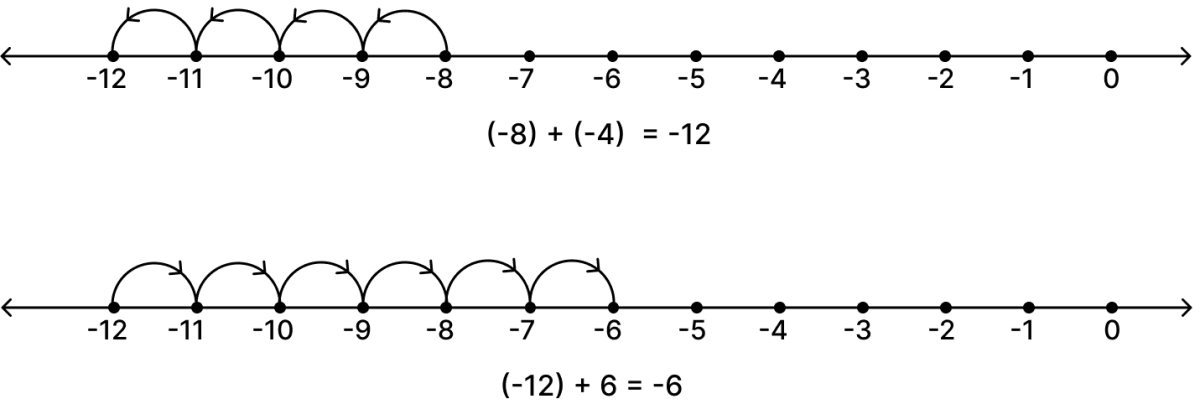
Verification of associative property : The associative property states that [a + b] + c = a + [b + c].
Taking a = -8, b = -4 and c = 6 :
L.H.S. = [(-8) + (-4)] + 6 = (-12) + 6 = -6.
R.H.S. = (-8) + [(-4) + 6] = (-8) + 2 = -6.
Since L.H.S. = R.H.S. = -6, the associative property is verified.
Hence, (-8) + (-4) + 6 = -6 and the associative property of addition is verified.
Classify the following sets as empty, singleton, finite or infinite sets:
(a) A = { }
(b) B = {50}
(c) C = {1, 4, 9, 16, 25}
(d) D = {x : x is a natural number greater than 20}
(e) E = {x : x is a negative whole number}
Answer
(a) A = { } has no elements, so it is an empty set.
(b) B = {50} has exactly one element, so it is a singleton set.
(c) C = {1, 4, 9, 16, 25} has 5 elements (a countable number), so it is a finite set.
(d) D = {x : x is a natural number greater than 20} is 21, 22, 23, … which never ends, so it is an infinite set.
(e) E = {x : x is a negative whole number} — whole numbers are 0, 1, 2, 3, …, so there is no negative whole number. Hence E is an empty set.
Hence, (a) Empty set, (b) Singleton set, (c) Finite set, (d) Infinite set and (e) Empty set.
Add: . Show all steps.
Answer
L.C.M. of the denominators 7, 14 and 7 :
L.C.M. of the denominators 7, 14 and 7 = 2 × 7 = 14
Hence, .
Multiply: 4.8 × 3.5
Answer
Multiplying without the decimal points : 48 × 35 = 1680.
The total number of decimal places in 4.8 and 3.5 is 1 + 1 = 2.
So, placing the decimal point 2 places from the right in 1680 :
4.8 × 3.5 = 16.80
= 16.8
Hence, 4.8 × 3.5 = 16.8
Find the ratio of 450 mL to 1.8 L in simplest form. Are the ratios 6 : 8 and 15 : 20 in proportion? Justify your answer.
Answer
To find the ratio, both quantities must be in the same unit.
1.8 L = 1.8 × 1000 = 1800 mL.
450 mL: 1.8 L = 450 : 1800
=
HCF of 450 and 1800 :
⇒ 450 = 2 × 32 × 52
⇒ 1800 = 23 × 32 × 52
⇒ HCF = 2 × 32 × 52 = 2 × 9 × 25 = 450
The HCF of 450 and 1800 is 450.
=
= 1 : 4.
To check whether 6 : 8 and 15 : 20 are in proportion, we use cross multiplication :
Product of extremes = 6 × 20 = 120.
Product of means = 8 × 15 = 120.
Since the two products are equal (120 = 120), the ratios are in proportion.
Hence, the ratio is 1 : 4, and the ratios 6 : 8 and 15 : 20 are in proportion.
Write any two binomials using the variables x and y. Also, identify their terms.
Answer
A binomial is an algebraic expression having exactly two terms.
Two binomials using x and y are : x + y and 3x − 2y.
Terms of (x + y) : x and y.
Terms of (3x − 2y) : 3x and −2y.
Hence, two binomials are x + y (terms x and y) and 3x − 2y (terms 3x and −2y).
Draw a line segment of length 9.2 cm and construct its perpendicular bisector using a compass and ruler.
Answer
Steps of construction :
(i) Draw a line segment AB = 9.2 cm.
(ii) With A as centre and radius more than half of AB (more than 4.6 cm), draw two arcs, one above and one below AB.
(iii) With B as centre and the same radius, draw two arcs cutting the previous arcs at P and Q.
(iv) Join PQ. The line PQ is the required perpendicular bisector of AB, cutting AB at its mid-point M so that AM = MB = 4.6 cm.
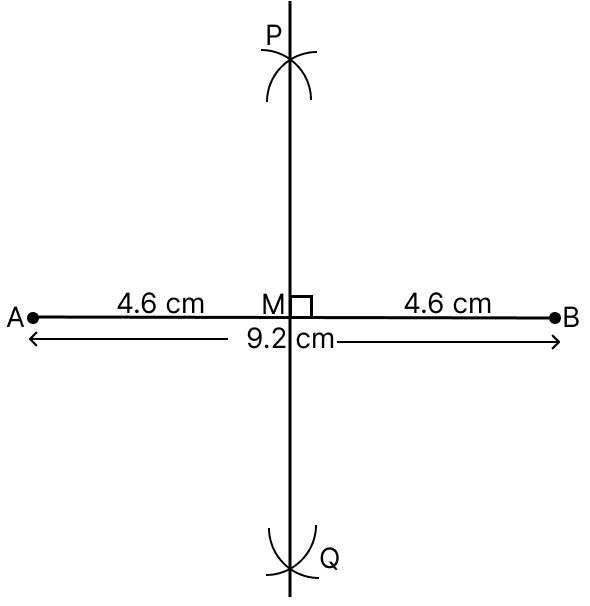
Hence, PQ is the required perpendicular bisector of the line segment AB.
Name the types of triangle based on:
(a) Sides
(b) Angles
Give one example each.
Answer
(a) On the basis of sides, triangles are of three types :
(i) Scalene triangle — all three sides are of different lengths. Example : sides 3 cm, 4 cm, 5 cm.
(ii) Isosceles triangle — two sides are equal. Example : sides 5 cm, 5 cm, 8 cm.
(iii) Equilateral triangle — all three sides are equal. Example : sides 6 cm, 6 cm, 6 cm.
(b) On the basis of angles, triangles are of three types :
(i) Acute-angled triangle — all angles are less than 90°. Example : 60°, 60°, 60°.
(ii) Right-angled triangle — one angle is exactly 90°. Example : 90°, 45°, 45°.
(iii) Obtuse-angled triangle — one angle is greater than 90°. Example : 120°, 30°, 30°.
Hence, based on sides — Scalene, Isosceles, Equilateral; based on angles — Acute-angled, Right-angled, Obtuse-angled.
Draw an equilateral triangle. Mark all lines of symmetry and mention the number of lines of symmetry.
Answer
An equilateral triangle has 3 lines of symmetry. Each line of symmetry passes through one vertex and the mid-point of the opposite side.
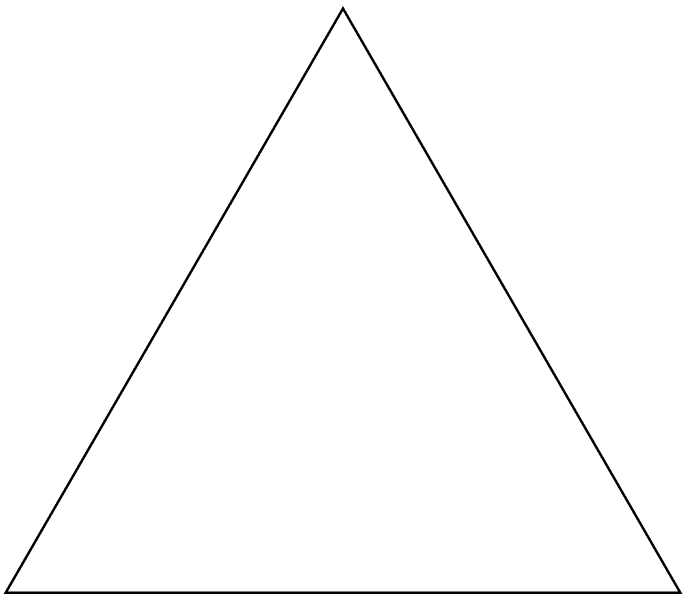
Hence, an equilateral triangle has 3 lines of symmetry.
Ravi wants to fence his rectangular vegetable garden and also plant grass in it. The garden is 12 m long and 8 m wide.
(a) What is the length of fencing required?
(b) If the cost of fencing is ₹ 75 per metre, what will be the total fencing cost?
(c) What is the area of the garden?
(d) If grass costs ₹ 40 per square metre, how much will it cost to plant grass in the entire garden?
Answer
Given, length of garden = 12 m and breadth = 8 m.
(a) Length of fencing = perimeter of the rectangle.
Perimeter = 2 (length + breadth)
= 2 × (12 + 8)
= 2 × 20
= 40 m.
(b) Total fencing cost = length of fencing × cost per metre.
= 40 × 75 = ₹ 3000.
(c) Area of garden = length × breadth.
= 12 × 8 = 96 m2.
(d) Cost of planting grass = area × cost per square metre.
= 96 × 40 = ₹ 3840.
Hence, (a) 40 m, (b) ₹ 3000, (c) 96 m2, (d) ₹ 3840.
Test whether 4,56,832 is divisible by 6 and 9. Show your working using divisibility rules.
Answer
Divisibility by 6 : A number is divisible by 6 if it is divisible by both 2 and 3.
Divisible by 2? — The last digit of 4,56,832 is 2, which is even, so it is divisible by 2.
Divisible by 3? — Sum of digits = 4 + 5 + 6 + 8 + 3 + 2 = 28. Since 28 is not divisible by 3, the number is not divisible by 3.
As the number is not divisible by 3, it is not divisible by 6.
Divisibility by 9 : A number is divisible by 9 if the sum of its digits is divisible by 9.
Sum of digits = 28. Since 28 is not divisible by 9, the number is not divisible by 9.
Hence, 4,56,832 is neither divisible by 6 nor by 9.
The ages of 8 students are: 11, 13, 12, 14, 11, 15, 12, 13.
(a) Find the mean and median of the data
(b) Which value (mean or median) do you think best represents the central tendency of this data? Explain why.
Answer
Given ages : 11, 13, 12, 14, 11, 15, 12, 13.
(a) By formula,
To find the median, arrange the ages in ascending order :
11, 11, 12, 12, 13, 13, 14, 15.
There are 8 observations (an even number), so the median is the average of the 4th and 5th observations.
Hence, Mean = 12.625 and Median = 12.5
(b) The median best represents the central tendency of this data. The median (12.5) lies exactly in the middle of the data and is not affected by the higher value 15, whereas the mean (12.625) is slightly pulled upward by that larger value.
Hence, the median best represents the central tendency of this data.
Subtract 62.75 from the sum of 48.92 and 76.58. Also round off the answer to the nearest tenth.
Answer
First, find the sum of 48.92 and 76.58 :
48.92 + 76.58 = 125.50.
Now subtract 62.75 from this sum :
125.50 - 62.75 = 62.75.
Rounding off 62.75 to the nearest tenth : the digit in the hundredths place is 5, so we round the tenths digit up.
62.75 → 62.8.
Hence, the answer is 62.75, which rounded to the nearest tenth is 62.8.
Amit is designing a logo using geometric shapes. He draws:
(a) A closed curve with 4 straight sides
(b) A straight line that extends infinitely in both directions
(c) A shape that has a centre and all points on the boundary are at the same distance from it.
Answer the following questions:
(a) What is the name of the closed curve with 4 sides?
(b) What is the name of the second shape Amit drew?
(c) What is the third shape? What is the name of the line segment joining the centre to any point on the boundary?
Answer
(a) A closed curve made up of 4 straight sides is a quadrilateral.
(b) A straight line that extends infinitely in both directions is called a line.
(c) A shape with a centre, where all points on the boundary are at the same distance from the centre, is a circle. The line segment joining the centre to any point on the boundary is called the radius.
Hence, (a) Quadrilateral, (b) Line, (c) Circle; the segment is the Radius.
Using only ruler and compass, construct an angle of 90°. Then construct an angle of 45° by bisecting it.
Answer
Steps of construction :
Draw a line l. Mark two points O and A on the line l.
With O as centre and a convenient radius, draw an arc cutting OA at P.
With P as centre and the same radius, cut the arc at Q. With Q as centre and the same radius, cut the arc again at R.
With Q and R as centres and radius more than half of QR, draw two arcs intersecting at S. Join OS. Then ∠AOS = 90°.
To get 45°, bisect ∠AOS : with P and the point M, as centres, draw two arcs intersecting at T. Join OT. Then ∠AOT = 45°.
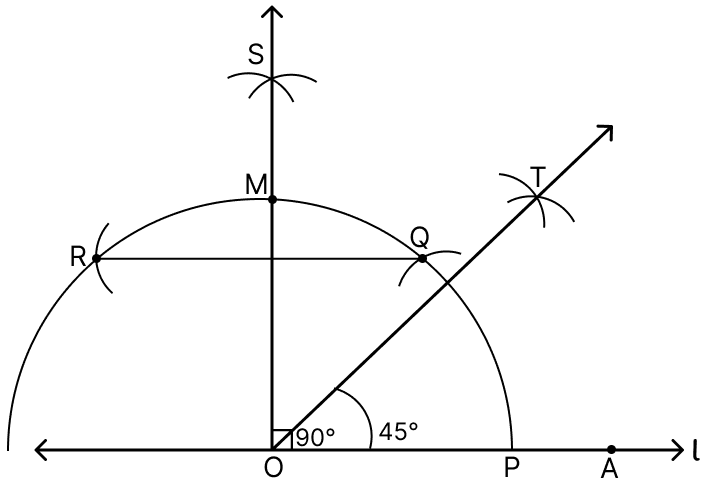
Hence, ∠AOS = 90° and on bisecting it, ∠AOT = 45° is constructed.
A basket contains 30 fruits. of them are mangoes and are oranges. Find how many mangoes and oranges are there in the basket.
Answer
Given, total number of fruits = 30.
Number of mangoes = of 30.
Number of oranges = of 30.
Hence, there are 6 mangoes and 12 oranges in the basket.
Study the following floor plan of a house prepared by an architect.
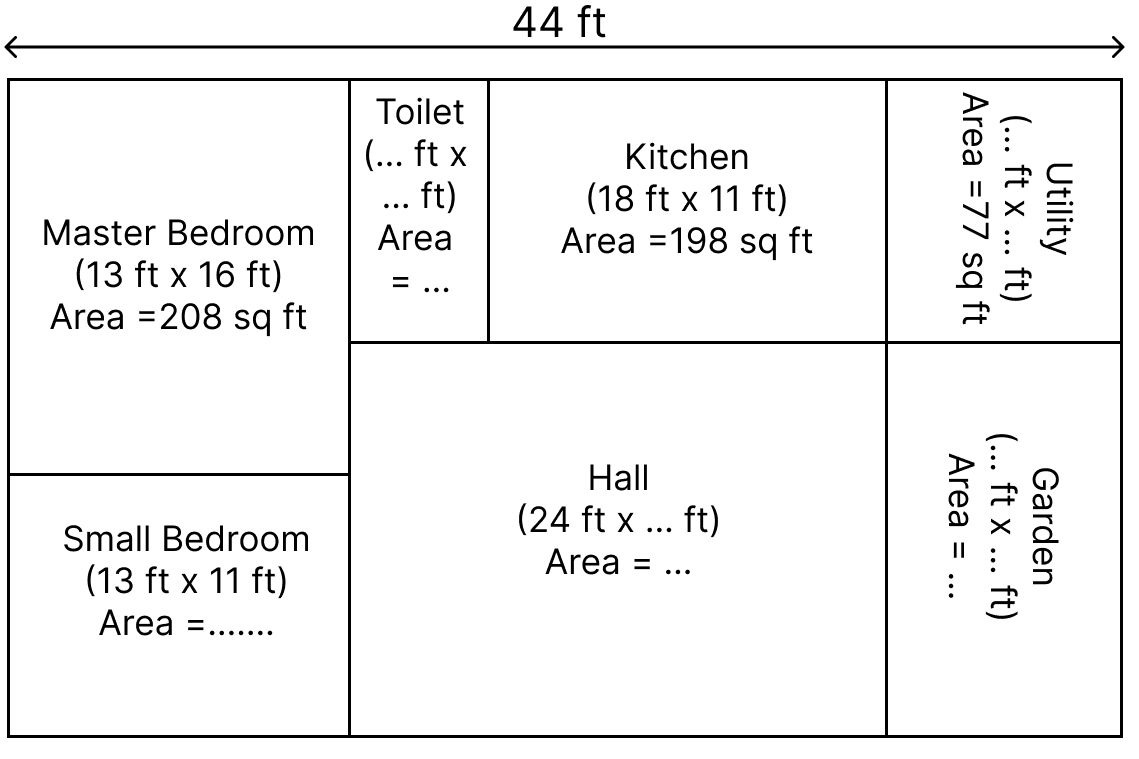
Some of the measurements are given.
(a) Find the missing measurements
(b) Find out the total area of the house (including the Garden)
Answer
(a) Finding the missing measurements:
The total length of the house is 44 ft. The length of the left part containing the Master Bedroom and Small Bedroom is 13 ft.
So, length of the remaining part
= 44 − 13
= 31 ft.
The total breadth of the house
= Breadth of Master Bedroom + Breadth of Small Bedroom
= 16 + 11
= 27 ft.
Top row of rooms:
The Kitchen has breadth 11 ft. Hence, the Toilet and Utility also have breadth 11 ft.
For Utility,
Area = length × breadth
77 = length × 11
length = = 7 ft.
So, Utility = 7 ft × 11 ft = 77 sq ft.
Length of Toilet
= 31 − length of Kitchen − length of Utility
= 31 − 18 − 7
= 6 ft.
So, Toilet = 6 ft × 11 ft = 66 sq ft.
Bottom row of rooms:
Breadth of bottom row
= Total breadth − Breadth of top row
= 27 − 11
= 16 ft.
Hall = 24 ft × 16 ft
Area of Hall = length × breadth
= 24 × 16
= 384 sq ft.
Length of Garden
= 31 − length of Hall
= 31 − 24
= 7 ft.
So, Garden = 7 ft × 16 ft
Area of Garden = length × breadth
= 7 × 16
= 112 sq ft.
For Small Bedroom,
Area = length × breadth
= 13 × 11
= 143 sq ft.
So the missing measurements are:
Toilet = 6 ft × 11 ft, Area = 66 sq ft;
Utility = 7 ft × 11 ft, Area = 77 sq ft;
Hall = 24 ft × 16 ft, Area = 384 sq ft;
Garden = 7 ft × 16 ft, Area = 112 sq ft;
Small Bedroom = 13 ft × 11 ft, Area = 143 sq ft.
(b) Total area of the house:
Total area of the house = length × breadth
= 44 ft × 27 ft
= 1188 sq ft.
(Check: 208 + 66 + 198 + 77 + 143 + 384 + 112 = 1188 sq ft.)
Hence, the missing measurements are Toilet 6 ft × 11 ft = 66 sq ft, Utility 7 ft × 11 ft = 77 sq ft, Hall 24 ft × 16 ft = 384 sq ft, Garden 7 ft × 16 ft = 112 sq ft and Small Bedroom 13 ft × 11 ft = 143 sq ft; the total area of the house = 1188 sq ft.