
Express the following ratios in simplest form:
(i) 20 : 40
(ii) 40 : 20
(iii) 81 : 108
(iv) 98 : 63
Answer
(i) 20 : 40
The given ratio is 20 : 40.
Let us find H.C.F. of 20 and 40:
H.C.F. = 20
.
Hence, the answer is 1 : 2
(ii) 40 : 20
The given ratio is 40 : 20.
Let us find H.C.F. of 40 and 20:
H.C.F. = 20
Hence, the answer is 2 : 1
(iii) 81 : 108
The given ratio is 81 : 108.
Let us find H.C.F. of 81 and 108:
H.C.F. = 27
Hence, the answer is 3 : 4
(iv) 98 : 63
The given ratio is 98 : 63.
Let us find H.C.F. of 98 and 63:
H.C.F. = 7
Hence, the answer is 14 : 9
Fill in the missing numbers in the following equivalent ratios:
(i)
(ii)
Answer
(i)
Let,
=
First, reduce to its simplest form:
x = 2
Now,
Cross multiplication,
2y = 18
y = 9
Hence, the missing numbers are 2 and 9.
(ii)
First, reduce to its simplest form:
Now compare each fraction with :
Thus,
.
Hence, the missing numbers are 5, 12 and 25 respectively.
Find the ratio of each of the following in simplest form:
(i) 2.1 m to 1.2 m
(ii) 91 cm to 1.04 m
(iii) 3.5 kg to 250 g
(iv) 60 paise to 4 rupees
(v) 1 minute to 15 seconds
(vi) 15 mm to 2 cm
Answer
(i) 2.1 m to 1.2 m
Multiply both terms by 10 to remove decimals:
2.1 m : 1.2 m = 21 : 12
H.C.F. of 21 and 12 is 3.
Hence, the answer is 7 : 4.
(ii) 91 cm to 1.04 m
Convert m into cm: 1.04 m = 1.04 × 100 cm = 104 cm.
Ratio = 91 : 104
H.C.F. of 91 and 104 is 13.
Hence, the answer is 7 : 8.
(iii) 3.5 kg to 250 g
Convert kg into g: 3.5 kg = 3.5 × 1000 g = 3500 g.
Ratio = 3500 : 250
H.C.F. of 3500 and 250 is 250.
Hence, the answer is 14 : 1.
(iv) 60 paise to 4 rupees
Convert rupees into paise: 4 rupees = 4 × 100 paise = 400 paise.
Ratio = 60 : 400
H.C.F. of 60 and 400 is 20.
Hence, the answer is 3 : 20.
(v) 1 minute to 15 seconds
Convert minute into seconds: 1 minute = 60 seconds.
Ratio = 60 : 15
H.C.F. of 60 and 15 is 15.
Hence, the answer is 4 : 1.
(vi) 15 mm to 2 cm
Convert cm into mm: 2 cm = 2 × 10 mm = 20 mm.
Ratio = 15 : 20
H.C.F. of 15 and 20 is 5.
Hence, the answer is 3 : 4.
The length and the breadth of a rectangular park are 125 m and 60 m respectively. What is the ratio of the length to the breadth of the park?
Answer
Given:
Length = 125 m
Breadth = 60 m
Ratio of length to breadth = 125 : 60
H.C.F. of 125 and 60 is 5.
Hence, the ratio of length to breadth is 25 : 12.
The population of a village is 4800. If the number of females is 2160, find the ratio of males to that of females.
Answer
Given:
Total population = 4800
Number of females = 2160
Number of males = Total population − Number of females
Number of males = 4800 − 2160 = 2640
Ratio of males to females = 2640 : 2160
H.C.F. of 2640 and 2160 is 240.
Hence, the ratio of males to females is 11 : 9.
In a class, there are 30 boys and 25 girls. Find the ratio of the number of:
(i) boys to that of girls
(ii) girls to that of total number of students
(iii) boys to that of total number of students
Answer
Given:
Number of boys = 30
Number of girls = 25
Total number of students = 30 + 25 = 55
(i) Ratio of boys to girls = 30 : 25
H.C.F. of 30 and 25 is 5.
Hence, the ratio of boys to girls is 6 : 5.
(ii) Ratio of girls to total = 25 : 55
H.C.F. of 25 and 55 is 5.
Hence, the ratio of girls to total number of students is 5 : 11.
(iii) Ratio of boys to total = 30 : 55
H.C.F. of 30 and 55 is 5.
Hence, the ratio of boys to total number of students is 6 : 11.
In a year, Reena earns ₹1,50,000 and saves ₹50,000. Find the ratio of:
(i) money she earns to the money she saves
(ii) money that she saves to the money she spends
Answer
Given:
Money Reena earns = ₹1,50,000
Money Reena saves = ₹50,000
Money Reena spends = Money earned − Money saved
Money Reena spends = ₹1,50,000 − ₹50,000 = ₹1,00,000
(i) Ratio of money earned to money saved = 1,50,000 : 50,000 = 150 : 50 = 3 : 1
Hence, the ratio of money earned to money saved is 3 : 1.
(ii) Ratio of money saved to money spent = 50,000 : 1,00,000 = 50 : 100 = 1 : 2
Hence, the ratio of money saved to money spent is 1 : 2.
The monthly expenses on transport of a student have increased from ₹350 to ₹500. Find the ratio of:
(i) increase in expenses to original expenses
(ii) original expenses to increased expenses
(iii) increased expenses to increase in expenses
Answer
Given:
Original expenses = ₹350
Increased expenses = ₹500
Increase in expenses = ₹500 − ₹350 = ₹150
(i) Ratio of increase in expenses to original expenses = 150 : 350
H.C.F. of 150 and 350 is 50.
Hence, the required ratio is 3 : 7.
(ii) Ratio of original expenses to increased expenses = 350 : 500
H.C.F. of 350 and 500 is 50.
Hence, the required ratio is 7 : 10.
(iii) Ratio of increased expenses to increase in expenses = 500 : 150
H.C.F. of 500 and 150 is 50.
Hence, the required ratio is 10 : 3.
Out of 30 students in a class, 6 like football, 12 like cricket and the remaining like tennis. Find the ratio of:
(i) number of students liking football to number of students liking tennis.
(ii) number of students liking cricket to total number of students.
Answer
Given:
Total students = 30
Students liking football = 6
Students liking cricket = 12
Students liking tennis = 30 − 6 − 12 = 12
(i) Ratio of football lovers to tennis lovers = 6 : 12
H.C.F. of 6 and 12 is 6.
Hence, the required ratio is 1 : 2.
(ii) Ratio of cricket lovers to total students = 12 : 30
H.C.F. of 12 and 30 is 6.
Hence, the required ratio is 2 : 5.
Which ratio is greater?
(i) 3 : 4 or 2 : 3
(ii) 11 : 21 or 15 : 28
Answer
(i) 3 : 4 or 2 : 3
The given ratios are 3 : 4 and 2 : 3, which are equivalent to the fractions and respectively.
Let us find the L.C.M. of 4 and 3:
L.C.M. = 2 × 2 × 3 = 12.
Clearly, .
Hence, (3 : 4) > (2 : 3).
(ii) 11 : 21 or 15 : 28
The given ratios are 11 : 21 and 15 : 28, which are equivalent to the fractions and respectively.
Let us find the L.C.M. of 21 and 28:
L.C.M. = 2 x 2 × 3 × 7 = 84.
Clearly, .
Hence, (15 : 28) > (11 : 21).
Divide ₹560 between Ramu and Munni in the ratio 3 : 2.
Answer
Given:
Total money = ₹560
Ratio = 3 : 2
Find total parts: 3 + 2 = 5 parts.
Find the value of 1 part: 560 ÷ 5 = ₹112. So, 1 part = ₹112.
Now calculate shares by multiplying each part with ₹112:
Ramu's share: 3 × ₹112 = ₹336
Munni's share: 2 × ₹112 = ₹224
Hence, Ramu gets ₹336 and Munni gets ₹224.
Two people invested ₹15,000 and ₹25,000 respectively to start a business. They decided to share the profits in the ratio of their investments. If their profit is ₹12000, how much does each get?
Answer
Given:
First investment = ₹15,000
Second investment = ₹25,000
Ratio of investments = 15000 : 25000 = 15 : 25 = 3 : 5
Total profit = ₹12,000
Find total parts: 3 + 5 = 8 parts.
Find the value of 1 part: 12000 ÷ 8 = ₹1,500. So, 1 part = ₹1,500.
Now calculate shares by multiplying each part with ₹1500:
First person's share: 3 × ₹1,500 = ₹4,500
Second person's share: 5 × ₹1,500 = ₹7,500
Hence, the first person gets ₹4,500 and the second person gets ₹7,500.
The ratio of Ankur's money to Roma's money is 9 : 11. If Ankur has ₹540, how much money does Roma have?
Answer
Given:
Ratio (Ankur : Roma) = 9 : 11
Ankur's money = ₹540
Since 9 parts represent Ankur's money, 9 parts = ₹540.
1 part = 540 ÷ 9 = ₹60.
Roma's money = 11 parts = 11 × ₹60 = ₹660.
Hence, Roma has ₹660.
The ratio of weights of tin and zinc in an alloy is 2 : 5. How much zinc is there in 31.5 g of alloy?
Answer
Given:
Ratio (Tin : Zinc) = 2 : 5
Total weight of alloy = 31.5 g
Find total parts: 2 + 5 = 7 parts.
Find the value of 1 part: 31.5 ÷ 7 = 4.5 g. So, 1 part = 4.5 g.
Weight of zinc = 5 parts = 5 × 4.5 g = 22.5 g.
Hence, the weight of zinc in the alloy is 22.5 g.
Check whether the given two ratios form a proportion or not:
(i) 4 : 6 and 12 : 18
(ii) 15 : 45 and 40 : 120
(iii) 14 : 4 and 18 : 6
(iv) 12 : 18 and 28 : 12
Answer
In a proportion, product of extremes = product of means.
(i) 4 : 6 and 12 : 18
Product of extremes = 4 × 18 = 72
Product of means = 6 × 12 = 72
Since product of extremes = product of means, the ratios are in proportion.
Hence, 4 : 6 and 12 : 18 form a proportion.
(ii) 15 : 45 and 40 : 120
Product of extremes = 15 × 120 = 1800
Product of means = 45 × 40 = 1800
Since product of extremes = product of means, the ratios are in proportion.
Hence, 15 : 45 and 40 : 120 form a proportion.
(iii) 14 : 4 and 18 : 6
Product of extremes = 14 × 6 = 84
Product of means = 4 × 18 = 72
Since product of extremes ≠ product of means, the ratios are not in proportion.
Hence, 14 : 4 and 18 : 6 do not form a proportion.
(iv) 12 : 18 and 28 : 12
Product of extremes = 12 × 12 = 144
Product of means = 18 × 28 = 504
Since product of extremes ≠ product of means, the ratios are not in proportion.
Hence, 12 : 18 and 28 : 12 do not form a proportion.
Write true (T) or false (F) against each of the following statements:
(i) 16 : 24 = 20 : 30
(ii) 16 : 24 = 30 : 20
(iii) 21 : 6 : : 35 : 10
(iv) 5.2 : 3.9 : : 3 : 4
Answer
(i) 16 : 24 = 20 : 30
Product of extremes = 16 × 30 = 480
Product of means = 24 × 20 = 480
Product of extremes = product of means.
Hence, the statement is True.
(ii) 16 : 24 = 30 : 20
Product of extremes = 16 × 20 = 320
Product of means = 24 × 30 = 720
Product of extremes ≠ product of means.
Hence, the statement is False.
(iii) 21 : 6 :: 35 : 10
Product of extremes = 21 × 10 = 210
Product of means = 6 × 35 = 210
Product of extremes = product of means.
Hence, the statement is True.
(iv) 5.2 : 3.9 :: 3 : 4
Product of extremes = 5.2 × 4 = 20.8
Product of means = 3.9 × 3 = 11.7
Product of extremes ≠ product of means.
Hence, the statement is False.
Find which of the following are in proportion:
(i) 12, 16, 6, 8
(ii) 2, 3, 4, 5
(iii) 18, 10, 9, 5
(iv) 18, 9, 10, 5
Answer
Four numbers a, b, c, d are in proportion if and only if a × d = b × c.
(i) 12, 16, 6, 8
Product of extremes = 12 × 8 = 96
Product of means = 16 × 6 = 96
Since 96 = 96, the numbers are in proportion.
Hence, 12, 16, 6, 8 are in proportion.
(ii) 2, 3, 4, 5
Product of extremes = 2 × 5 = 10
Product of means = 3 × 4 = 12
Since 10 ≠ 12, the numbers are not in proportion.
Hence, 2, 3, 4, 5 are not in proportion.
(iii) 18, 10, 9, 5
Product of extremes = 18 × 5 = 90
Product of means = 10 × 9 = 90
Since 90 = 90, the numbers are in proportion.
Hence, 18, 10, 9, 5 are in proportion.
(iv) 18, 9, 10, 5
Product of extremes = 18 × 5 = 90
Product of means = 9 × 10 = 90
Since product of extremes = product of means, the numbers are in proportion.
Hence, 18, 9, 10, 5 are in proportion.
Are the following statements true?
(i) 39 kg : 36 kg = 26 men : 24 men
(ii) 45 km : 60 km = 12 hours : 15 hours
(iii) 40 people : 200 people = ₹1000 : ₹5000
(iv) 7.5 litres : 15 litres = 15 children : 30 children
Answer
(i) 39 kg : 36 kg = 26 men : 24 men
Both ratios are equal.
Hence, the statement is True.
(ii) 45 km : 60 km = 12 hours : 15 hours
. The ratios are not equal.
Hence, the statement is False.
(iii) 40 people : 200 people = ₹1000 : ₹5000
Both ratios are equal.
Hence, the statement is True.
(iv) 7.5 litres : 15 litres = 15 children : 30 children
Both ratios are equal.
Hence, the statement is True.
Determine if the following ratios form a proportion. Also write the middle terms and extreme terms when the ratios form a proportion:
(i) 25 cm : 1 m and ₹40 : ₹160
(ii) 39 litre : 65 litre and 6 bottles : 10 bottles
(iii) 2 kg : 80 kg and 30 sec : 5 minutes
(iv) 200 g : 2.5 kg and ₹4 : ₹50
Answer
(i) 25 cm : 1 m and ₹40 : ₹160
Convert m into cm: 1 m = 100 cm.
First ratio = 25 : 100 = 1 : 4
Second ratio = 40 : 160 = 1 : 4
Both ratios are equal, so they form a proportion.
Proportion: 25 : 100 :: 40 : 160
Hence, extreme terms are 25 cm and ₹160; middle terms are 100 cm and ₹40.
(ii) 39 litre : 65 litre and 6 bottles : 10 bottles
First ratio = 39 : 65 = 3 : 5
Second ratio = 6 : 10 = 3 : 5
Both ratios are equal, so they form a proportion.
Proportion: 39 : 65 :: 6 : 10
Hence, extreme terms are 39 litre and 10 bottles; middle terms are 65 litre and 6 bottles.
(iii) 2 kg : 80 kg and 30 sec : 5 minutes
Convert 5 minutes into seconds: 5 min = 5 × 60 sec = 300 sec.
First ratio = 2 : 80 = 1 : 40
Second ratio = 30 : 300 = 1 : 10
Since 1 : 40 ≠ 1 : 10, the ratios are not equal.
Hence, the ratios do not form a proportion.
(iv) 200 g : 2.5 kg and ₹4 : ₹50
Convert kg into g: 2.5 kg = 2.5 × 1000 g = 2500 g.
First ratio = 200 : 2500 = 2 : 25
Second ratio = 4 : 50 = 2 : 25
Both ratios are equal, so they form a proportion.
Proportion: 200 : 2500 :: 4 : 50
Hence, extreme terms are 200 g and ₹50; middle terms are 2500 g and ₹4.
If the cost of 9 m cloth is ₹378, find the cost of 4 m cloth.
Answer
Given:
Cost of 9 m cloth = ₹378
Cost of 1 m cloth = = ₹42
Cost of 4 m cloth = 4 × ₹42 = ₹168
Hence, the cost of 4 m cloth is ₹168.
The weight of 36 books is 12 kg. What is weight of 75 such books?
Answer
Given:
Weight of 36 books = 12 kg
Weight of 1 book = kg = kg
Weight of 75 books = 75 × kg = 25 kg
Hence, the weight of 75 books is 25 kg.
Five pens cost ₹115. How many pens can you buy in ₹207?
Answer
Given:
Cost of 5 pens = ₹115
Cost of 1 pen = = ₹23
Number of pens that can be bought in ₹207 = = 9
Hence, 9 pens can be bought in ₹207.
A car consumes 8 litres of petrol in covering a distance of 100 km. How many kilometres will it travel in 26 litres of petrol?
Answer
Given:
Distance covered in 8 litres of petrol = 100 km
Distance covered in 1 litre of petrol = km = 12.5 km
Distance covered in 26 litres of petrol = 26 × 12.5 km = 325 km
Hence, the car will travel 325 km in 26 litres of petrol.
A truck requires 108 litres of diesel for covering a distance of 594 km. How much diesel will be required by the truck to cover a distance of 1650 km?
Answer
Given:
Diesel needed for 594 km = 108 litres
Diesel needed for 1 km = litre = litre
Diesel needed for 1650 km = = 150 × 2 = 300 litres
Hence, 300 litres of diesel will be required to cover 1650 km.
A transport company charges ₹5400 to carry 80 quintals of weight. What will it charge to carry 126 quintals of weight (same distance)?
Answer
Given:
Charge for carrying 80 quintals = ₹5400
Charge for carrying 1 quintal = = ₹67.50
Charge for carrying 126 quintals = 126 × ₹67.50 = ₹8505
Hence, the transport company will charge ₹8505 to carry 126 quintals.
42 metres of cloth is required to make 20 shirts of the same size. How much cloth will be required to make 36 shirts of that size?
Answer
Given:
Cloth required for 20 shirts = 42 m
Cloth required for 1 shirt = m = 2.1 m
Cloth required for 36 shirts = 36 × 2.1 m = 75.6 m
Hence, 75.6 m of cloth will be required to make 36 shirts.
Cost of 5 kg of local rice in a village is ₹107.50.
(i) What will be the cost of 8 kg of rice?
(ii) What quantity of rice can be purchased in ₹64.5?
Answer
Given:
Cost of 5 kg of rice = ₹107.50
Cost of 1 kg of rice = = ₹21.50
(i) Cost of 8 kg of rice = 8 × ₹21.50 = ₹172
Hence, the cost of 8 kg of rice is ₹172.
(ii) Quantity of rice that can be bought in ₹64.5 = kg = 3 kg
Hence, 3 kg of rice can be purchased in ₹64.5.
20 tons of iron costs ₹6,00,000. Find the cost of 560 kg of iron. (1 ton = 1000 kg)
Answer
Given:
20 tons of iron = 20 × 1000 kg = 20000 kg
Cost of 20000 kg of iron = ₹6,00,000
Cost of 1 kg of iron = = ₹30
Cost of 560 kg of iron = 560 × ₹30 = ₹16800
Hence, the cost of 560 kg of iron is ₹16,800.
Cost of 4 dozen bananas is ₹180. How many bananas can be purchased for ₹37.50?
Answer
Given:
Number of bananas in 4 dozen = 4 × 12 = 48 bananas
Cost of 48 bananas = ₹180
Cost of 1 banana = = ₹3.75
Number of bananas that can be bought in ₹37.50 = = 10
Hence, 10 bananas can be purchased for ₹37.50.
Aman purchases 12 pens for ₹156 and Payush buys 9 pens for ₹108. Can you say who got the pens cheaper?
Answer
For Aman:
Cost of 12 pens = ₹156
Cost of 1 pen = = ₹13
For Payush:
Cost of 9 pens = ₹108
Cost of 1 pen = = ₹12
Since ₹12 < ₹13, Payush got the pens at a cheaper rate.
Hence, Payush got the pens cheaper.
Rohit made 42 runs in 6 overs and Virat made 63 runs in 7 overs. Who made more runs per over?
Answer
For Rohit:
Runs in 6 overs = 42
Runs per over = = 7 runs
For Virat:
Runs in 7 overs = 63
Runs per over = = 9 runs
Since 9 > 7, Virat made more runs per over.
Hence, Virat made more runs per over.
Find the value of:
(i) 18% of ₹450
(ii) 14% of kg
(iii) % of ₹1200
(iv) % of 600 m
(v) % of 1 hour 20 minutes
(vi) 0.6% of 5 km
Answer
(i) 18% of ₹450
Hence, 18% of ₹450 = ₹81.
(ii) 14% of kg
kg
Hence, 14% of kg.
(iii) % of ₹1200
% = %
Hence, % of ₹1200 = ₹333.
(iv) % of 600 m
m
Hence, % of 600 m = 3.75 m.
(v) % of 1 hour 20 minutes
% = %
1 hour 20 minutes = 60 + 20 = 80 minutes
minutes
Hence, % of 1 hour 20 minutes = 5 minutes.
(vi) 0.6% of 5 km
5 km = 5 × 1000 m = 5000 m
m
Hence, 0.6% of 5 km = 30 m.
In a class of 60 students, 45% are girls. Find the number of boys in the class.
Answer
Given:
Total students = 60
Percentage of girls = 45%
Number of girls = 45% of 60 =
Number of boys = Total students − Number of girls = 60 − 27 = 33
Hence, there are 33 boys in the class.
Mr. Malkani saves 22% of his salary every month. If his salary is ₹12750 per month, what is his expenditure?
Answer
Given:
Monthly salary = ₹12750
Savings = 22% of salary
Savings =
Expenditure = Salary − Savings = ₹12750 − ₹2805 = ₹9945
Hence, Mr. Malkani's monthly expenditure is ₹9945.
On a rainy day, 94% of the students were present in a school. If the number of students absent on that day was 174, find the total strength of the school.
Answer
Given:
Percentage of students present = 94%
Percentage of students absent = 100% − 94% = 6%
Number of students absent = 174
Let the total strength of the school = x.
Then, 6% of x = 174
Hence, the total strength of the school is 2900.
The speed of a car is km/h, find the distance covered by it in hours.
Answer
Given:
Speed of car = km/h = km/h
Time = hours = hours
Distance = Speed × Time
km
Hence, the car covers km in hours.
If the speed of a car is 50.4 km/h, find the distance covered in 3.6 hours.
Answer
Given:
Speed of car = 50.4 km/h
Time = 3.6 hours
Distance = Speed × Time = 50.4 × 3.6
km
Hence, the car covers 181.44 km in 3.6 hours.
If a car covers a distance of 201.25 km in 3.5 hours, find the speed of the car.
Answer
Given:
Distance = 201.25 km
Time = 3.5 hours
Speed =
km/h
Hence, the speed of the car is 57.5 km/h.
A bus travels 160 km in 4 hours and a train travels 320 km in 5 hours at uniform speeds, then find the ratio of the distances travelled by them in one hour.
Answer
Given:
Distance travelled by bus in 4 hours = 160 km
Distance travelled by bus in 1 hour = = 40 km
Distance travelled by train in 5 hours = 320 km
Distance travelled by train in 1 hour = = 64 km
Ratio of distances travelled in one hour (bus : train) = 40 : 64
H.C.F. of 40 and 64 is 8.
Hence, the ratio of the distances travelled by them in one hour is 5 : 8.
Fill in the blanks:
(i) In the ratio 3 : 5, the first term is ... and second term is ...
(ii) In a ratio, the first term is also called ... and second term is also called ...
(iii) If two terms of a ratio have no common factor (except 1), then the ratio is said to be in ...
(iv) To simplify a ratio, we divide the two terms by their ...
(v) The simplest form of the ratio 8 : 12 is ...
(vi) 90 cm : 1.5 m = ...
(vii) When two ratios are equal, they are said to be in ...
(viii) 4.5% of ₹40 is equal to ...
Answer
(i) In the ratio 3 : 5, the first term is 3 and second term is 5.
(ii) In a ratio, the first term is also called antecedent and second term is also called consequent.
(iii) If two terms of a ratio have no common factor (except 1), then the ratio is said to be in simplest form (or lowest terms).
(iv) To simplify a ratio, we divide the two terms by their H.C.F. (Highest Common Factor).
(v) The simplest form of the ratio 8 : 12 is 2 : 3.
(Reason: H.C.F. of 8 and 12 is 4. So, 8 : 12 = 2 : 3.)
(vi) 90 cm : 1.5 m = 3 : 5.
(Reason: 1.5 m = 150 cm. So, 90 : 150 = 3 : 5.)
(vii) When two ratios are equal, they are said to be in proportion.
(viii) 4.5% of ₹40 is equal to ₹1.80.
(Reason: .)
State whether the following statements are true (T) or false (F):
(i) Ratio exists only between two quantities of the same kind.
(ii) Ratio has no units.
(iii) Ratio a : b is same as the ratio b : a.
(iv) If we multiply or divide both terms of a ratio by the same non-zero number, then the ratio remains the same.
(v) The ratio a : b is said to be in simplest form if HCF of a and b is 1.
Answer
(i) True. A ratio is a comparison of two quantities of the same kind in the same units.
(ii) True. A ratio is a pure number and has no units.
(iii) False. The order in a ratio matters. In general, a : b ≠ b : a (unless a = b).
(iv) True. Multiplying or dividing both terms by the same non-zero number gives equivalent ratios.
(v) True. A ratio a : b is in simplest form when H.C.F. of a and b is 1.
A ratio equivalent to 5 : 7 is
10 : 21
15 : 14
20 : 28
25 : 49
Answer
To find an equivalent ratio, multiply both terms of 5 : 7 by the same non-zero number.
5 : 7 = (5 × 4) : (7 × 4) = 20 : 28
Hence, option 3 is the correct option.
The ratio 384 : 480 in the simplest form is
2 : 5
3 : 5
5 : 4
4 : 5
Answer
H.C.F. of 384 and 480 is 96.
Hence, option 4 is the correct option.
The ratio of 20 minutes to 1 hour is
20 : 1
1 : 3
1 : 4
2 : 5
Answer
1 hour = 60 minutes.
Ratio = 20 : 60 = 1 : 3.
Hence, option 2 is the correct option.
The ratio of 150 g to 2 kg is
75 : 1
40 : 3
3 : 40
3 : 200
Answer
2 kg = 2000 g.
Ratio = 150 : 2000
H.C.F. of 150 and 2000 is 50.
Hence, option 3 is the correct option.
In a class of 40 students, 25 students play cricket and the remaining play tennis. The ratio of number of students playing crickets to the number of students playing tennis is
5 : 8
5 : 3
3 : 5
8 : 5
Answer
Number of students playing cricket = 25
Number of students playing tennis = 40 − 25 = 15
Ratio = 25 : 15 = 5 : 3
Hence, option 2 is the correct option.
Two numbers are in the ratio 3 : 5. If the sum of numbers is 144, then the smaller number is
54
72
90
48
Answer
Total parts = 3 + 5 = 8
Value of 1 part = = 18
Smaller number = 3 × 18 = 54
Hence, option 1 is the correct option.
The ratio of number of girls to the number of boys in a class is 5 : 4. If there are 25 girls in the class, then the number of boys in the class is
15
20
30
40
Answer
5 parts represent girls, so 5 parts = 25.
1 part = = 5
Number of boys = 4 parts = 4 × 5 = 20
Hence, option 2 is the correct option.
The ratio of the number of sides of a square and the number of edges of a cube is
1 : 2
1 : 3
1 : 4
2 : 3
Answer
Number of sides of a square = 4
Number of edges of a cube = 12
Ratio = 4 : 12 = 1 : 3
Hence, option 2 is the correct option.
On a shelf, the books with green cover and that with brown cover are in the ratio 2 : 3. If there are 18 books with green cover, then the number of books with brown cover is
12
24
27
36
Answer
2 parts represent green-cover books, so 2 parts = 18.
1 part = = 9
Number of brown-cover books = 3 parts = 3 × 9 = 27
Hence, option 3 is the correct option.
In a box, the ratio of the number of red marbles to that of blue marbles is 4 : 7. Which of the following could be the total number of marbles in the box?
14
21
22
28
Answer
Total parts = 4 + 7 = 11
The total number of marbles must be a multiple of 11.
Among the given options, 22 = 2 × 11 is a multiple of 11.
Hence, option 3 is the correct option.
If a, b, c and d are in proportion, then
ab = cd
ad = bc
ac = bd
none of these
Answer
If a, b, c, d are in proportion, then a : b :: c : d, which means:
Product of extremes = Product of means
⇒ a × d = b × c
Hence, option 2 is the correct option.
If the weight of 5 bags of rice is 272 kg, then the weight of 1 bag of rice is
50.4 kg
54.4 kg
54.004 kg
54.04 kg
Answer
Weight of 1 bag = = 54.4 kg
Hence, option 2 is the correct option.
If 7 pencils cost ₹35, then the cost of one dozen pencils is
₹60
₹70
₹30
₹5
Answer
Cost of 1 pencil = = ₹5
Cost of 1 dozen (12) pencils = 12 × ₹5 = ₹60
Hence, option 1 is the correct option.
The ratio 2 : 3 expressed as percentage is
40%
60%
%
%
Answer
Hence, option 3 is the correct option.
0.025 when expressed as percentage is
250%
25%
4%
2.5%
Answer
Hence, option 4 is the correct option.
In a class, 45% of the students are girls. If there are 18 girls in the class, then the total number of students in the class is
44
40
36
30
Answer
Let the total number of students be x.
Then, 45% of x = 18.
Hence, option 2 is the correct option.
Statement I: When two quantities of the same or different kind are compared by division, it is called a ratio.
Statement II: The ratio of 6 hours to 24 hours is 1 : 4.
Statement I is true but statement II is false.
Statement I is false but statement II is true.
Both Statement I and statement II are true.
Both Statement I and statement II are false.
Answer
Statement I: A ratio is a comparison of two quantities of the same kind (in the same units) by division — not of different kinds. So, Statement I is false.
Statement II: 6 hours : 24 hours = = 1 : 4. So, Statement II is true.
Hence, option 2 is the correct option.
Statement I: The terms of a ratio can be divided by a common non-zero number.
Statement II: The first term of a ratio is called the antecedent.
Statement I is true but statement II is false.
Statement I is false but statement II is true.
Both Statement I and statement II are true.
Both Statement I and statement II are false.
Answer
Statement I: Dividing both terms of a ratio by the same non-zero number gives an equivalent ratio. So, Statement I is true.
Statement II: By definition, in a ratio a : b, the first term a is called the antecedent. So, Statement II is true.
Hence, option 3 is the correct option.
Statement I: Sugar can be purchased at ₹40/kg and tea at ₹300/kg. The ratio of the price of sugar to the price of tea is 2 : 15.
Statement II: When you write a ratio, the order in which you write the terms is important.
Statement I is true but statement II is false.
Statement I is false but statement II is true.
Both Statement I and statement II are true.
Both Statement I and statement II are false.
Answer
Statement I: Ratio of price of sugar to price of tea = 40 : 300 = = 2 : 15. So, Statement I is true.
Statement II: The order matters in a ratio because a : b is not the same as b : a in general. So, Statement II is true.
Hence, option 3 is the correct option.
Statement I: When two ratios are equal, they are said to be in proportion.
Statement II: If the numbers a, b, c, d are in proportion, then ab = cd.
Statement I is true but statement II is false.
Statement I is false but statement II is true.
Both Statement I and statement II are true.
Both Statement I and statement II are false.
Answer
Statement I: By definition, an equality of two ratios is called a proportion. So, Statement I is true.
Statement II: If a, b, c, d are in proportion, then a × d = b × c, NOT ab = cd. So, Statement II is false.
Hence, option 1 is the correct option.
Statement I: At school, recess lasts for 30 minutes, and the Maths period is 40 minutes long. The ratio of Maths period to recess time is 4 : 3.
Statement II: A ratio has no units.
Statement I is true but statement II is false.
Statement I is false but statement II is true.
Both Statement I and statement II are true.
Both Statement I and statement II are false.
Answer
Statement I: Ratio of Maths period to recess = 40 : 30 = = 4 : 3. So, Statement I is true.
Statement II: A ratio is a pure number and has no units. So, Statement II is true.
Hence, option 3 is the correct option.
Statement I: Raman got 80, 70, 90 marks out of 100 each in Physics, Chemistry and Maths. His total percentage is 80%.
Statement II: %
Statement I is true but statement II is false.
Statement I is false but statement II is true.
Both Statement I and statement II are true.
Both Statement I and statement II are false.
Answer
Statement I: Total marks obtained = 80 + 70 + 90 = 240. Maximum marks = 3 × 100 = 300.
Percentage = . So, Statement I is true.
Statement II: . So, Statement II is true.
Hence, option 3 is the correct option.
From the adjoining figure, find the ratio of:
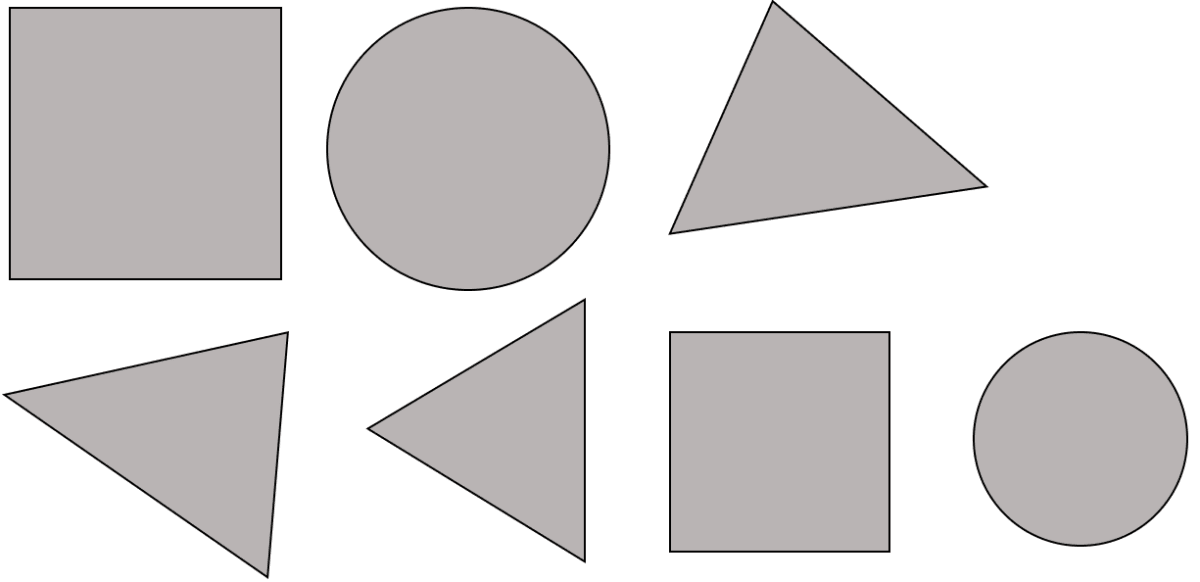
(i) Number of triangles to the number of circles inside the rectangle.
(ii) Number of squares to the number of all the figures inside the rectangle.
(iii) Number of circles to the number of remaining figures inside the rectangle.
Answer
From the figure, on counting we have:
Number of triangles = 3
Number of circles = 2
Number of squares = 2
Total number of figures inside the rectangle = 3 + 2 + 2 = 7
(i) Ratio of number of triangles to number of circles = 3 : 2
Hence, the required ratio is 3 : 2.
(ii) Ratio of number of squares to total number of figures = 2 : 7
Hence, the required ratio is 2 : 7.
(iii) Number of remaining figures (excluding circles) = 3 + 2 = 5
Ratio of number of circles to number of remaining figures = 2 : 5
Hence, the required ratio is 2 : 5.
The length of a pencil is 16 cm and its diameter is 6 mm. What is the ratio of the diameter of the pencil to that of its length?
Answer
Given:
Length of pencil = 16 cm
Diameter of pencil = 6 mm
Convert cm into mm: 16 cm = 16 × 10 mm = 160 mm.
Ratio of diameter to length = 6 : 160
H.C.F. of 6 and 160 is 2.
Hence, the ratio of the diameter to the length of the pencil is 3 : 80.
The length and the breadth of a steel tape are 10 m and 2.4 cm respectively. Find the ratio of the length to the breadth.
Answer
Given:
Length of steel tape = 10 m
Breadth of steel tape = 2.4 cm
Convert m into cm: 10 m = 10 × 100 cm = 1000 cm.
Ratio of length to breadth = 1000 : 2.4
Multiply both terms by 10 to remove the decimal:
= (1000 × 10) : (2.4 × 10) = 10000 : 24
H.C.F. of 10000 and 24 is 8.
Hence, the ratio of the length to the breadth is 1250 : 3.
A certain club has 100 members, out of which 25 play tennis, 28 play badminton, 12 play chess and the rest do not play any game. Find the ratio of number of members who play:
(i) badminton to the number of those who play chess.
(ii) badminton to the number of those who do not play any game.
(iii) tennis to the number of those who do not play any game.
(iv) tennis to the number of those who play either badminton or chess.
Answer
Given:
Total members = 100
Tennis players = 25
Badminton players = 28
Chess players = 12
Members who do not play any game = 100 − 25 − 28 − 12 = 35
(i) Ratio of badminton players to chess players = 28 : 12
H.C.F. of 28 and 12 is 4.
Hence, the required ratio is 7 : 3.
(ii) Ratio of badminton players to non-players = 28 : 35
H.C.F. of 28 and 35 is 7.
Hence, the required ratio is 4 : 5.
(iii) Ratio of tennis players to non-players = 25 : 35
H.C.F. of 25 and 35 is 5.
Hence, the required ratio is 5 : 7.
(iv) Players of badminton or chess = 28 + 12 = 40
Ratio of tennis players to (badminton or chess) players = 25 : 40
H.C.F. of 25 and 40 is 5.
Hence, the required ratio is 5 : 8.
Do the ratios 15 cm to 3 m and 25 seconds to 3 minutes form a proportion?
Answer
Given:
First ratio: 15 cm to 3 m
Convert m into cm: 3 m = 3 × 100 cm = 300 cm.
First ratio = 15 : 300 = 1 : 20
Second ratio: 25 seconds to 3 minutes
Convert minutes into seconds: 3 min = 3 × 60 = 180 seconds.
Second ratio = 25 : 180 = 5 : 36
Compare: 1 : 20 and 5 : 36.
Product of extremes = 1 × 36 = 36
Product of means = 20 × 5 = 100
Since 36 ≠ 100, the ratios are not equal.
Hence, the given ratios do not form a proportion.
Divide ₹500 among Suresh and Awanti in the ratio 3 : 7.
Answer
Given:
Total money = ₹500
Ratio = 3 : 7
Find total parts: 3 + 7 = 10 parts.
Find the value of 1 part: 500 ÷ 10 = ₹50. So, 1 part = ₹50.
Now calculate shares by multiplying each part with ₹50:
Suresh's share: 3 × ₹50 = ₹150
Awanti's share: 7 × ₹50 = ₹350
Hence, Suresh gets ₹150 and Awanti gets ₹350.
The ratio of the number of girls to that of boys in a school is 9 : 11. If the number of boys in the school is 2035, find:
(i) the number of girls in the school.
(ii) the number of students in the school.
Answer
Given:
Ratio (Girls : Boys) = 9 : 11
Number of boys = 2035
Since 11 parts represent the boys, 11 parts = 2035.
1 part = = 185.
(i) Number of girls = 9 parts = 9 × 185 = 1665.
Hence, the number of girls is 1665.
(ii) Total students = Girls + Boys = 1665 + 2035 = 3700.
Hence, the total number of students in the school is 3700.
The ratio of income to expenditure of a family is 7 : 6. Find the savings if the income of family is ₹42,000.
Answer
Given:
Ratio (Income : Expenditure) = 7 : 6
Income = ₹42,000
Since 7 parts represent the income, 7 parts = ₹42,000.
1 part = = ₹6,000.
Expenditure = 6 parts = 6 × ₹6,000 = ₹36,000.
Savings = Income − Expenditure = ₹42,000 − ₹36,000 = ₹6,000.
Hence, the savings of the family is ₹6,000.
An employee earns ₹72,000 in 3 months.
(i) How much does he earn in 7 months?
(ii) In how many months will he earn ₹3,60,000?
Answer
Given:
Earnings in 3 months = ₹72,000
Earnings in 1 month = = ₹24000.
(i) Earnings in 7 months = 7 × ₹24000 = ₹1,68,000.
Hence, the employee earns ₹1,68,000 in 7 months.
(ii) Number of months to earn ₹3,60,000 = = 15 months.
Hence, the employee will earn ₹3,60,000 in 15 months.
A train travels 110 km in 2 hours and a car travels 245 km in hours. What is the ratio of the speed of the train to that of the car?
Answer
Given:
Distance travelled by train = 110 km in 2 hours
Speed of train = = 55 km/h
Distance travelled by car = 245 km in hours = hours
Speed of car = km/h
Ratio (Speed of train : Speed of car) = 55 : 70
H.C.F. of 55 and 70 is 5.
Hence, the ratio of the speed of the train to that of the car is 11 : 14.
What is the ratio of the number of prime numbers to the composite numbers from the numbers 1 to 45?
Answer
Prime numbers between 1 and 45 are:
2, 3, 5, 7, 11, 13, 17, 19, 23, 29, 31, 37, 41, 43
Number of prime numbers = 14.
The number 1 is neither prime nor composite.
Total numbers from 1 to 45 = 45.
Composite numbers = 45 − (number of primes) − 1 (for the number 1)
Composite numbers = 45 − 14 − 1 = 30.
Ratio (Primes : Composites) = 14 : 30
H.C.F. of 14 and 30 is 2.
Hence, the required ratio is 7 : 15.
Divide ₹6000 among Irfan, Nagma and Ishan in the ratio 3 : 5 : 7.
Answer
Given:
Total money = ₹6000
Ratio = 3 : 5 : 7
Find total parts: 3 + 5 + 7 = 15 parts.
Find the value of 1 part: 6000 ÷ 15 = ₹400. So, 1 part = ₹400.
Now calculate shares by multiplying each part with ₹400:
Irfan's share: 3 × ₹400 = ₹1200
Nagma's share: 5 × ₹400 = ₹2000
Ishan's share: 7 × ₹400 = ₹2800
Hence, Irfan gets ₹1200, Nagma gets ₹2000 and Ishan gets ₹2800.
Sapna weighs 54 kg on earth and 9 kg on moon. If a monkey weighs 3.5 kg on moon, then how much will it weigh on the earth?
Answer
Given:
Sapna's weight on earth = 54 kg
Sapna's weight on moon = 9 kg
Ratio of earth weight to moon weight = 54 : 9 = 6 : 1
So, weight on earth = 6 × weight on moon.
Monkey's weight on moon = 3.5 kg
Monkey's weight on earth = 6 × 3.5 = 21 kg.
Hence, the monkey will weigh 21 kg on the earth.
If 5 men can do a certain construction work in 14 days, then how long will 7 men take to complete the same construction work?
Answer
Given:
5 men complete the work in 14 days.
This is an inverse proportion problem — more men means fewer days.
Total work = 5 men × 14 days = 70 man-days.
Let 7 men take x days to complete the same work.
Then, 7 × x = 70
⇒ x = = 10 days.
Hence, 7 men will take 10 days to complete the construction work.