
The difference between the place value and face value of 5 in the numeral 70542 is:
0
42
495
537
Answer
In the numeral 70542:
Place value of 5 = 500
Face value of 5 = 5
Difference between place value and face value = 500 - 5 = 495
Hence, option 3 is the correct option.
The sum of the successor of 99 and the predecessor of 101 is
198
200
201
199
Answer
Successor of 99 = 99 + 1 = 100
Predecessor of 101 = 101 - 1 = 100
Sum = 100 + 100 = 200
Hence, option 2 is the correct option.
If and are two co-prime numbers, then their LCM is
Answer
If two numbers are co-prime, then their HCF = 1.
We know that, product of two numbers = HCF × LCM
⇒ y = 1 × LCM
⇒ LCM =
Hence, option 1 is the correct option.
Which of the following statement is true?
|15 - 6| = |15| + |-6|
Additive inverse of -3 is 3
-1 lies on the right of 0 on the number line
-4 is greater than -3
Answer
Let us check each option:
|15 - 6| = |9| = 9, but |15| + |-6| = 15 + 6 = 21. So 9 ≠ 21. False.
Additive inverse of -3 is 3, since -3 + 3 = 0. True.
-1 lies on the left of 0 on the number line, not on the right. False.
-4 is less than -3 (i.e., -4 < -3). False.
Hence, option 2 is the correct option.
The fraction equivalent to is
Answer
Now let us check each option:
✓
— not equal to
— not equal to
— not equal to
Hence, option 1 is the correct option.
Which of the following numbers is divisible by 6?
5372
6495
7632
7568
Answer
A number is divisible by 6 if it is divisible by both 2 and 3.
5372: Ends in 2, so divisible by 2. Sum of digits = 5 + 3 + 7 + 2 = 17, not divisible by 3. So not divisible by 6.
6495: Ends in 5, so not divisible by 2. So not divisible by 6.
7632: Ends in 2, so divisible by 2. Sum of digits = 7 + 6 + 3 + 2 = 18, divisible by 3. So divisible by 6. ✓
7568: Ends in 8, so divisible by 2. Sum of digits = 7 + 5 + 6 + 8 = 26, not divisible by 3. So not divisible by 6.
Hence, option 3 is the correct option.
Statement I: HCF of 12 and 18 is 6.
Statement II: 6 is a common factor of 12 and 18.
Statement I is true but statement II is false.
Statement I is false but statement II is true.
Both Statement I and statement II are true.
Both Statement I and statement II are false.
Answer
Statement I: Factors of 12 = 1, 2, 3, 4, 6, 12. Factors of 18 = 1, 2, 3, 6, 9, 18.
Common factors = 1, 2, 3, 6. Highest common factor = 6.
So HCF of 12 and 18 is 6. Statement I is true.
Statement II: From the list of common factors above, 6 is a common factor of 12 and 18. Statement II is true.
Hence, option 3 is the correct option.
Statement I: The ratio of 5 cm to 1 m is 5 : 1.
Statement II: If two friends divide 30 pencils between them in the ratio 5 : 1, they get 25 and 5 pencils respectively.
Statement I is true but statement II is false.
Statement I is false but statement II is true.
Both Statement I and statement II are true.
Both Statement I and statement II are false.
Answer
Statement I: 1 m = 100 cm
Ratio of 5 cm to 1 m = or 1 : 20, not 5 : 1. Statement I is false.
Statement II: Sum of terms of the ratio = 5 + 1 = 6
First friend gets = pencils
Second friend gets = pencils
So they get 25 and 5 pencils respectively. Statement II is true.
Hence, option 2 is the correct option.
Write the greatest and the smallest 4-digit numbers using four different digits with the condition that the digit 4 occurs at tens place.
Answer
Greatest 4-digit number: To get the greatest number, place the largest available digits at higher places. The digit 4 must be at tens place.
Thousands place: largest digit = 9
Hundreds place: next largest digit (different from 9 and 4) = 8
Tens place: 4 (given)
Ones place: next largest digit (different from 9, 8, 4) = 7
So, the greatest 4-digit number = 9847
Smallest 4-digit number: To get the smallest number, place the smallest available digits at higher places. The digit at thousands place cannot be 0.
Thousands place: smallest non-zero digit = 1
Hundreds place: smallest digit (different from 1 and 4) = 0
Tens place: 4 (given)
Ones place: next smallest digit (different from 1, 0, 4) = 2
So, the smallest 4-digit number = 1042
Find the prime factorisation of 980.
Answer
We use repeated division by prime numbers:
Hence, prime factorisation of 980 = 2 × 2 × 5 × 7 × 7 = 22 × 5 × 72
Find the value of -15 - (-2) - 71 - (-8) + 6.
Answer
Solving,
-15 - (-2) - 71 - (-8) + 6
= -15 + 2 - 71 + 8 + 6 [since -(-2) = +2 and -(-8) = +8]
= (-15 - 71) + (2 + 8 + 6)
= -86 + 16
= -70.
Hence, -15 - (-2) - 71 - (-8) + 6 = -70.
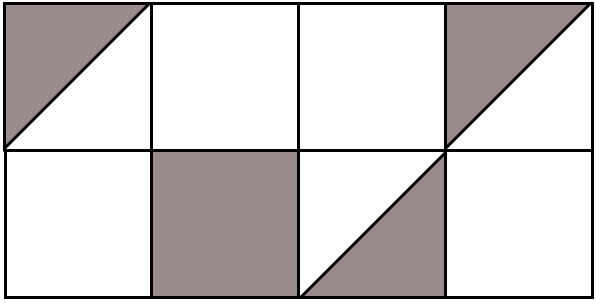
What fraction of the adjoining figure is the shaded part?
Answer
From the figure, the rectangle is divided into 8 equal parts.
Out of that one full and three half rectangle are shaded.
Number of shaded parts =
∴ Fraction =
Hence, required fraction = .
Write the mixed fraction as a decimal number.
Answer
Multiplying the numerator and denominator of by 25 to make the denominator 1000:
∴
The length of a pencil is 14 cm and its diameter is 7 mm. What is the ratio of the diameter of the pencil to that of its length?
Answer
Length of pencil = 14 cm = 14 × 10 mm = 140 mm
Diameter of pencil = 7 mm
(Converting both quantities to the same unit, i.e., mm.)
Ratio of diameter to length = = 1 : 20.
Estimate the product 2459 × 653 by rounding off each factor to its
(i) nearest ten
(ii) nearest hundreds
Use commas in your answers as per Indian System.
Answer
(i) Rounding off to nearest ten:
2459 → 2460 (since 9 is rounded up)
653 → 650 (since 3 is rounded down)
Estimated product = 2460 × 650 = 15,99,000
(ii) Rounding off to nearest hundred:
2459 → 2500 (since the tens digit is 5)
653 → 700 (since the tens digit is 5)
Estimated product = 2500 × 700 = 17,50,000
By using distributive laws, find: 257 × 1007
Answer
Using distributive law of multiplication over addition:
257 × 1007 = 257 × (1000 + 7)
= 257 × 1000 + 257 × 7
= 2,57,000 + 1,799
= 2,58,799
Hence, 257 × 1007 = 2,58,799.
Using number line, subtract (-3) from (-8).
Answer
Subtract (-3) from (-8), i.e. (-8) - (-3)
To subtract a negative number,
We start at the first number and move to the right (towards larger values) by the value of the second number.
On the number line, we start at -8 and move 3 units to the right (since we are adding 3):

Starting at -8, moving 3 units to the right we reach -5.
∴ (-8) - (-3) = -5.
Find the greatest number that will divide 76, 113 and 186 leaving remainders 4, 5 and 6 respectively.
Answer
The greatest number that will divide 76, 113 and 186 leaving remainders 4, 5 and 6 respectively is the HCF of (76 - 4), (113 - 5) and (186 - 6), i.e., HCF of 72, 108 and 180.
Prime factorisation of 72 :
Prime factorisation of 108 :
Prime factorisation of 180 :
72 = 2 × 2 × 2 × 3 × 3 = 23 × 32
108 = 2 × 2 × 3 × 3 × 3 = 22 × 33
180 = 2 × 2 × 3 × 3 × 5 = 22 × 32 × 5
Since HCF is found by taking only the common prime factors with the smallest powers, we take 22 and 32, which are common to 72, 108 and 180.
HCF = 22 × 32 = 4 × 9 = 36
Hence, the required greatest number is 36..
Arrange the following integers in descending order:
-506, 2376, 2367, -311, -509, 245
Answer
To arrange in descending order, we go from the greatest to the smallest.
For positive integers: 2376 > 2367 > 245
For negative integers, the one with the smaller absolute value is greater:
-311 > -506 > -509 (since 311 < 506 < 509)
Combining (all positives are greater than all negatives):
2376, 2367, 245, -311, -506, -509
Arrange the following fractions in ascending order:
Answer
To compare the fractions, we convert them to like fractions by taking the LCM of denominators.
LCM of 12, 4, 8, 6:
12 = 22 × 3
4 = 22
8 = 23
6 = 2 × 3
LCM = 23 × 3 = 24
Converting to like fractions with denominator 24:
Now,
∴ Ascending order:
Simplify:
Answer
Converting mixed fractions to improper fractions:
So, the expression becomes:
LCM of 6, 4, 1, 8 = 24
Converting to like fractions with denominator 24:
Hence,
Write all possible natural numbers using the digits 3, 0, 8. Repetition of digits is not allowed. Also find their sum.
Answer
Using the digits 3, 0, 8 without repetition:
1-digit natural numbers: 3, 8 (0 is not a natural number)
2-digit natural numbers (the first digit cannot be 0):
Starting with 3: 30, 38
Starting with 8: 80, 83
So, 2-digit numbers: 30, 38, 80, 83
3-digit natural numbers (the first digit cannot be 0):
Starting with 3: 308, 380
Starting with 8: 803, 830
So, 3-digit numbers: 308, 380, 803, 830
All possible natural numbers: 3, 8, 30, 38, 80, 83, 308, 380, 803, 830
Sum of all these numbers:
= 3 + 8 + 30 + 38 + 80 + 83 + 308 + 380 + 803 + 830
= 11 + 68 + 163 + 688 + 1633
Sum = 2563
Munna and Munni are aged 14 years and 10 years. Their mother wants to divide ₹ 180 between them in the ratio of their ages. How much does each get?
Answer
Ages of Munna and Munni = 14 years and 10 years
Ratio of their ages = 14 : 10 = or 7 : 5
Sum of the terms of the ratio = 7 + 5 = 12
Total money to be divided = ₹ 180
Munna gets
Munni gets
Hence, Munna gets = ₹ 105 and Munni gets = ₹ 75.
Do the ratios 15 cm to 3 m and 15 seconds to 3 minutes form a proportion? Justify your answer.
Answer
First ratio: 15 cm to 3 m
Converting to the same unit: 3 m = 3 × 100 cm = 300 cm
Ratio of 15 cm to 3 m = or 1 : 20
Second ratio: 15 seconds to 3 minutes
Converting to the same unit: 3 minutes = 3 × 60 seconds = 180 seconds
Ratio of 15 seconds to 3 minutes = or 1 : 12
Since , the two ratios are not equal.
No, the given ratios do not form a proportion.
To stitch a shirt, 2 m 25 cm cloth is needed. Out of 30 m cloth, how many shirts can be stitched and how much cloth will remain?
Answer
Cloth needed to stitch one shirt = 2 m 25 cm = (2 × 100 + 25) cm = 225 cm
Total cloth available = 30 m = 30 × 100 cm = 3000 cm
Number of shirts that can be stitched
=
On dividing 3000 by 225:
3000 ÷ 225 → quotient = 13, remainder = 3000 - (225 × 13) = 3000 - 2925 = 75
So, 13 shirts can be stitched and 75 cm of cloth will remain.
Hence, 13 shirts can be stitched and 75 cm of cloth will remain.
Four bells are ringing at intervals of 40, 30, 36 and 45 minutes respectively. At what time will they ring together again if they start ringing simultaneously at 9 A.M.?
Answer
The bells will ring together again after a time which is the LCM of 40, 30, 36 and 45 minutes.
LCM of 40, 30, 36 and 45:
LCM = 23 × 32 × 5 = 8 × 9 × 5 = 360
So, the bells will ring together again after 360 minutes.
360 minutes = hours = 6 hours
The bells start ringing at 9 A.M.
They will ring together again at 9 A.M. + 6 hours = 3 P.M.
Hence, the bells will ring together simultaneously at 3 P.M.
I bought fruits worth ₹ and vegetables worth ₹ . If I gave a fifty-rupee note to the shopkeeper, how much will I get back?
Answer
Cost of fruits = ₹
Cost of vegetables = ₹
Total cost = ₹
LCM of 4 and 2 = 4
= ₹
= ₹
= ₹
Money given to the shopkeeper = ₹ 50
Money to get back = ₹ 50 - ₹
= ₹
= ₹
Hence, the money i will get back = ₹ .
Javed purchased vegetables weighing 10 kg. Out of this, 3 kg 450 g was potatoes, 2 kg 10 g was onions, 1 kg 750 g was tomatoes and the rest were green vegetables. What was the weight of green vegetables?
Answer
Converting all weights into grams (1 kg = 1000 g):
Total weight of vegetables = 10 kg = 10000 g
Weight of potatoes = 3 kg 450 g = 3000 + 450 = 3450 g
Weight of onions = 2 kg 10 g = 2000 + 10 = 2010 g
Weight of tomatoes = 1 kg 750 g = 1000 + 750 = 1750 g
Total weight of potatoes, onions and tomatoes = 3450 + 2010 + 1750
= 7210 g
= 7 kg 210 g
∴ Weight of green vegetables = Total weight - (weight of potatoes + onions + tomatoes)
= 10000 g - 7210 g
= 2790 g = 2000 g + 790 g
Hence, weight of green vegetables = 2 kg 790 g.
To get a closer finish in a 100 m race, the runners are given different starting positions, depending upon how fast they can run. A starting position of +10 means that the runner starts 10 m in front of the starting line, and -5 means that the runner starts 5 m behind the starting line. The competitors’ starting positions are:
Abbas: 0
Mohan: -3
Rishi: -20
Peter: +10
Tarush: +15
Sahel: +5
(i) Who starts farthest from the finish line?
(ii) How far does Tarush have to run to reach the finish line?
(iii) How far does Mohan have to run to reach the finish line?
(iv) How many metres are there between the starting positions of Rishi and Peter?
Answer
The finish line is at the 100 m mark. A position of +10 means the runner is 10 m in front of the starting line, so the runner is closer to the finish line. A position of -5 means the runner is 5 m behind the starting line, so the runner is farther from the finish line.
Distance to the finish line for each runner = 100 - (starting position)
(i) The runner with the lowest, that is, the most negative starting position, is farthest from the finish line.
Arranging the starting positions:
-20 < -3 < 0 < +5 < +10 < +15
The lowest starting position is -20, which belongs to Rishi.
Hence, Rishi starts farthest from the finish line.
(ii) Tarush's starting position = +15
Distance Tarush has to run to reach the finish line = 100 - 15 = 85 m
Hence, Tarush has to run 85 m to reach the finish line.
(iii) Mohan's starting position = -3
Distance Mohan has to run to reach the finish line = 100 - (-3) = 100 + 3 = 103 m
Hence, Mohan has to run 103 m to reach the finish line.
(iv) Rishi's starting position = -20
Peter's starting position = +10
Distance between their starting positions = 10 - (-20) = 10 + 20 = 30 m
Hence, the distance between the starting positions of Rishi and Peter is 30 m.