
Find the rule which gives the number of matchsticks required to make the following matchstick patterns. Use a variable (literal) to write the rule.
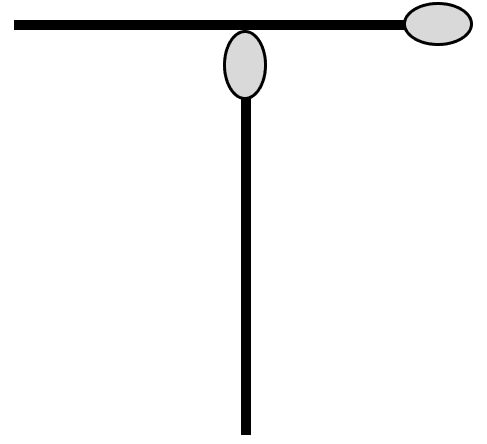
(i) A pattern of letter T as
(ii) A pattern of letter V as

(iii) A pattern of letter Z as

(iv) A pattern of letter U as

Answer
Let n denote the number of letters formed.
(i) The letter T requires 2 matchsticks (one horizontal and one vertical).
Number of matchsticks required to make n T's = 2n.
(ii) The letter V requires 2 matchsticks (two slanting sticks).
Number of matchsticks required to make n V's = 2n.
(iii) The letter Z requires 3 matchsticks (top horizontal, slanting, bottom horizontal).
Number of matchsticks required to make n Z's = 3n.
(iv) The letter U requires 3 matchsticks (left vertical, bottom horizontal, right vertical).
Number of matchsticks required to make n U's = 3n.
If there are 24 mangoes in a box, how will you write the number of mangoes in terms of the number of boxes? (Use b for the number of boxes.)
Answer
Number of mangoes in 1 box = 24
Number of mangoes in b boxes = 24 × b = 24b
Anuradha is drawing a dot Rangoli (a beautiful pattern of lines joining dots). She has 8 dots in a row. How many dots will her Rangoli have for r rows? How many dots are there if there are 12 rows?
Answer
Number of dots in 1 row = 8
Number of dots in r rows = 8 × r = 8r
For 12 rows, the number of dots = 8 × 12 = 96.
Anu and Meenu are sisters. Anu is 5 years younger than Meenu. Can you write Anu's age in terms of Meenu's age? Take Meenu's age as x years.
Answer
Meenu's age = x years
Since Anu is 5 years younger than Meenu,
Anu's age = (Meenu's age − 5) years = (x − 5) years.
Oranges are to be transferred from larger boxes to smaller boxes. When a larger box is emptied, the oranges from it fill 3 smaller boxes and still 7 oranges are left. If the number of oranges in a smaller box are taken to be x, then what is the number of oranges in the larger box?
Answer
Number of oranges in 1 smaller box = x
Number of oranges in 3 smaller boxes = 3x
Number of oranges left = 7
Number of oranges in a larger box = 3x + 7
Hence, the number of oranges in the larger box is (3x + 7).
Harsha's score in Mathematics is 15 more than three-fourth of her score in Science. If she scores x marks in Science, find her score in Mathematics?
Answer
Harsha's Science score = x marks
Three-fourth of her Science score =
Mathematics score = 15 more than three-fourth of Science score
=
Hence, Harsha's score in Mathematics = marks.
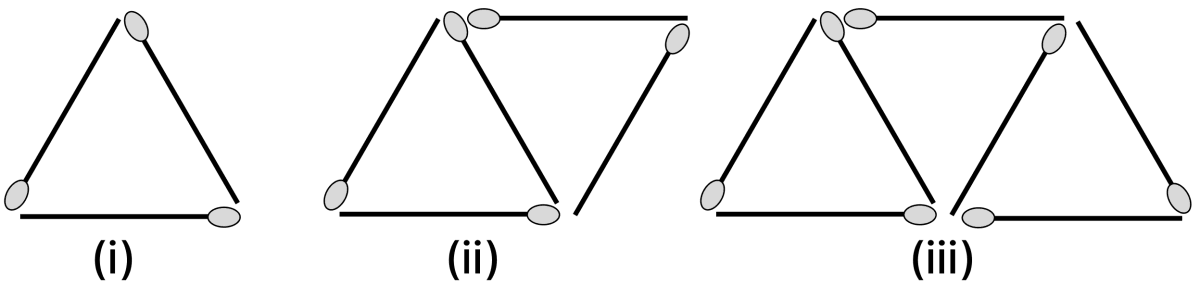
Look at the following matchstick pattern of equilateral triangles. The triangles are not separate. Two neighbouring triangles have a common matchstick. Observe the pattern and find the rule that gives the number of matchsticks.
Answer
Let x be the number of triangles.
For 1 triangle, matchsticks = 3.
Each additional triangle adds 2 matchsticks (since 1 matchstick is shared with the previous triangle).
For x triangles, matchsticks = 3 + 2(x − 1) = 3 + 2x - 2
= 2x + 1.
Hence, the rule is (2x + 1) matchsticks for x triangles.
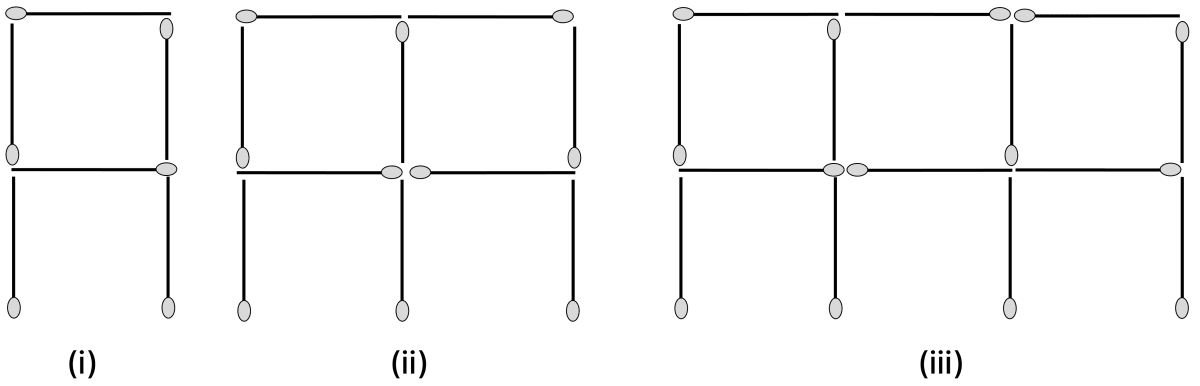
Observe at the following matchstick pattern of letter A. The A's are not separate. Two neighbouring A's have two common matchsticks. Find the rule that gives the number of matchsticks.
Answer
Let x be the number of A's formed.
For each letter A, matchsticks = 6.
Remaining A's = x - 1
Each additional A adds 4 matchsticks (since 2 matchsticks are shared with the previous A).
For x number of A's, matchsticks = 6 + 4(x − 1) = 6 + 4x - 4
= 4x + 2.
Hence, the rule is (4x + 2) matchsticks for x number of A's.
If the side of an equilateral triangle is l, then express the perimeter of the triangle in terms of l.
Answer
An equilateral triangle has 3 equal sides, each of length l.
Perimeter = sum of all sides = l + l + l = 3l.
The side of a regular hexagon is l. Express its perimeter in terms of l.
Answer
A regular hexagon has 6 equal sides, each of length l.
Perimeter = sum of all sides = l + l + l + l + l + l = 6l.
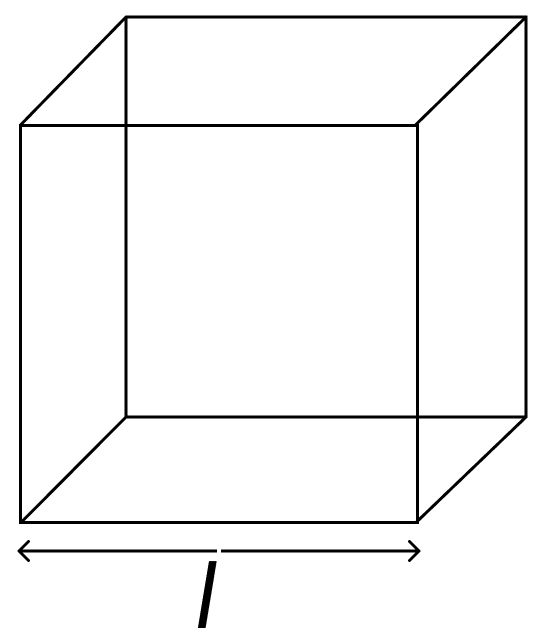
The length of an edge of a cube is l. Find the formula for the sum of lengths of all the edges of the cube.
Answer
A cube has 12 edges, all of equal length l.
Sum of lengths of all edges = 12 × l = 12l.
If the radius of a circle is r units, then express the length of a diameter of the circle in terms of r.
Answer
We know that the diameter of a circle is twice its radius.
Diameter = 2 × radius = 2r units.
Write all the terms of each of the following algebraic expressions:
(i) 3 − 7x
(ii)
(iii) 3x5 + 4y3 − 7xy2 + 3
(iv)
Answer
(i) The terms of 3 − 7x are 3 and −7x.
(ii) The terms of are 2, -5a and .
(iii) The terms of 3x5 + 4y3 − 7xy2 + 3 are 3x5, 4y3, −7xy2 and 3.
(iv) The terms of are and 9.
Write down the algebraic expression whose terms are:
(i) 5, −2x
(ii) −3, 5x2, −7x5
(iii) a2, −2b2, 3c2, 7
(iv)
Answer
(i) The required expression is 5 − 2x.
(ii) The required expression is −3 + 5x2 −7x5.
(iii) The required expression is a2 − 2b2 + 3c2 + 7.
(iv) The required expression is .
State the number of terms in each of the following algebraic expressions:
(i) x ÷ 2 + y − 3
(ii)
(iii) 5 x ab − 7
(iv) 7 x a + b ÷ 3 − c + 5
Answer
(i) The terms are x ÷ 2, y and −3.
Hence, the expression has 3 terms.
(ii) The terms are .
Hence, the expression has 3 terms.
(iii) The terms are 5 x ab and −7.
Hence, the expression has 2 terms.
(iv) The terms are 7 x a, b ÷ 3, −c and 5.
Hence, the expression has 4 terms.
Identify monomials, binomials and trinomials from the following algebraic expressions:
(i) x2 − 2y2
(ii) xy + yz + zx
(iii) 5 + 5x
(iv) 5x
(v) + 3
(vi) −7
(vii) a2 − b2 − c3 + 5abc
(viii) −5a2b2c2
(ix) 1 + x + x2 + x3 + x4
(x) x ÷ 5 + y ÷ 3
(xi) 5p × ab
(xii) 3 ÷ a − 2 × b + c
Answer
An expression with 1 term is a monomial, 2 terms is a binomial and 3 terms is a trinomial.
(i) x2 − 2y2 has 2 terms → Binomial.
(ii) xy + yz + zx has 3 terms → Trinomial.
(iii) 5 + 5x has 2 terms → Binomial.
(iv) 5x has 1 term → Monomial.
(v) + 3 has 2 terms → Binomial.
(vi) −7 has 1 term → Monomial.
(vii) a2 − b2 − c3 + 5abc has 4 terms → Multinomial .
(viii) −5a2b2c2 has 1 term → Monomial.
(ix) 1 + x + x2 + x3 + x4 has 5 terms → Multinomial.
(x) x ÷ 5 + y ÷ 3 has 2 terms → Binomial.
(xi) 5p × ab = 5pab has 1 term → Monomial.
(xii) 3 ÷ a − 2 × b + c has 3 terms → Trinomial.
Write down the numerical as well as literal coefficient of each of the following monomials:
(i) −7x
(ii) -2x3y2
(iii) 6abcd2
Answer
(i) In −7x:
Numerical coefficient = −7
Literal coefficient = x
(ii) In -2x3y2:
Numerical coefficient = -2
Literal coefficient = x3y2
(iii) In 6abcd2:
Numerical coefficient = 6
Literal coefficient = abcd2
Write the numerical coefficient of each term of the expression:
Answer
The terms of the given expression are
Numerical coefficient of x4 is 1 .
Numerical coefficient of - 5xy2 is −5.
Numerical coefficient of is 7.
Numerical coefficient of is .
Numerical coefficient of (constant term) is .
In −7xy2z3, write down the coefficient of:
(i) x
(ii) 7x
(iii) −xy2
(iv) xy
(v) z3
(vi) −7z
(vii) xyz
(viii) 7yz2
Answer
We have −7xy2z3.
(i) Coefficient of x = −7y2z3.
(ii) Coefficient of 7x = −y2z3.
(iii) Coefficient of −xy2 = 7z3.
(iv) Coefficient of xy = −7yz3.
(v) Coefficient of z3 = −7xy2.
(vi) Coefficient of −7z = xy2z2.
(vii) Coefficient of xyz = −7yz2.
(viii) Coefficient of 7yz2 = −xyz.
State true or false:
(i) If 5 is constant and y is variable, then 5y and 5 + y are variables.
(ii) 7x has two terms, 7 and x.
(iii) 5 + xy is a trinomial.
(iv) 7a × bc is a binomial.
(v) 7x3 + 2x2 + 3x − 5 is a polynomial.
(vi) 7x3 + 2x2 + 3x − 5 is a multinomial.
(vii) is a polynomial.
(viii) Coefficient of x in −3xy is −3.
(ix) 3xy, −2yx are like terms.
Answer
(i) True. Both 5y and 5 + y depend on the value of y, so they are variables.
(ii) False. 7x is a single term (a monomial) with 7 as its numerical coefficient and x as its literal coefficient.
(iii) False. 5 + xy has 2 terms, so it is a binomial (not a trinomial).
(iv) False. 7a × bc = 7abc is a single term (a monomial).
(v) True. All the powers of x are non-negative integers.
(vi) True. The expression has 4 terms, so it is a multinomial.
(vii) False. has a negative power of x, so the expression is not a polynomial.
(viii) False. The coefficient of x in −3xy is −3y.
(ix) True. Since 3xy and −2yx have the same literal coefficient, so they are like terms.
In the following, which pairs contain like terms?
(i) 5x, −2x
(ii) 5x, 5y
(iii) −2xyz, −3x2y2z2
(iv) 10xyz, −10xyz
(v) 2x2y, 2xy2
(vi) 2xy, −3yx
(vii) x, x2
(viii) 6, 6x
(ix) 2xy, 3xyz
Answer
Two terms are like terms if they have the same literal (variable) part.
(i) 5x and −2x have the same literal part x → Like terms.
(ii) 5x and 5y have different variables → Unlike terms.
(iii) −2xyz and −3x2y2z2 have different powers → Unlike terms.
(iv) 10xyz and −10xyz have the same literal part xyz → Like terms.
(v) 2x2y and 2xy2 have different powers → Unlike terms.
(vi) 2xy and −3yx have the same literal part (xy = yx) → Like terms.
(vii) x and x2 have different powers → Unlike terms.
(viii) 6 has no variable while 6x has x → Unlike terms.
(ix) 2xy and 3xyz have different variables → Unlike terms.
Hence, the pairs containing like terms are (i), (iv) and (vi).
Identify which of the following algebraic expressions are polynomials. If so, write their degrees.
(i)
(ii)
(iii)
Answer
An algebraic expression is a polynomial only when the powers of the variable are non-negative integers.
(i)
Since the highest power of x in the expression is 2, the expression is a polynomial with degree 2.
(ii)
Power of x is negative, so it is not a polynomial.
It is not a polynomial.
(iii)
Since the highest power of x is 8, the expression is a polynomial with degree 8.
Which out of following are expressions with numbers only?
(i) 2y + 3
(ii) (7 × 20) − 8z
(iii) 5 × (21 − 7) + 9 × 2
(iv) 5 − 11n
(v) (5 × 4) − 45 + p
(vi) 3 × (11 + 7) − 24 ÷ 2
Answer
An expression with numbers only does not contain any variable.
(i) 2y + 3 contains the variable y → Not an expression with numbers only.
(ii) (7 × 20) − 8z contains the variable z → Not an expression with numbers only.
(iii) 5 × (21 − 7) + 9 × 2 contains only numbers → Expression with numbers only.
(iv) 5 − 11n contains the variable n → Not an expression with numbers only.
(v) (5 × 4) − 45 + p contains the variable p → Not an expression with numbers only.
(vi) 3 × (11 + 7) − 24 ÷ 2 contains only numbers → Expression with numbers only.
Hence, (iii) and (vi) are expressions with numbers only.
Write expression for the following:
(i) 11 added to 2m
(ii) 11 subtracted from 2m
(iii) 3 added to 5 times y
(iv) 3 subtracted from 5 times y
(v) y is multiplied by −8 and then 5 is added to the result
(vi) y is multiplied by 5 and then the result is subtracted from 16
Answer
(i) 11 added to 2m = 2m + 11.
(ii) 11 subtracted from 2m = 2m − 11.
(iii) 3 added to 5 times y = 5y + 3.
(iv) 3 subtracted from 5 times y = 5y − 3.
(v) y multiplied by −8 = −8y. Then 5 added to it = −8y + 5.
(vi) y multiplied by 5 = 5y. Then 5y subtracted from 16 = 16 − 5y.
Write the following in mathematical form using signs and symbols:
(i) 6 more than thrice a number x
(ii) 7 taken away from y
(iii) 3 less than quotient of x by y
Answer
(i) Thrice the number x = 3x. 6 more than this = 3x + 6.
(ii) 7 taken away from y = y − 7.
(iii) Quotient of x by y = , 3 less than this = .
Form six expressions using t and 4. Use not more than one number operation and every expression must have t in it.
Answer
Using one operation each between t and 4, six expressions are:
(i) t + 4
(ii) t − 4
(iii) 4 − t
(iv) 4t (= 4 × t)
(v)
(vi)
A student scored x marks in English but the teacher deducted 5 marks for bad handwriting. What was the student's final score in English?
Answer
Marks scored = x
Marks deducted = 5
Final score = x − 5
Hence, the student's final score in English is (x − 5) marks.
Raju's father's age is 2 years more than 3 times Raju's age. If Raju's present age is y years, then what is his father's age?
Answer
Raju's present age = y years
3 times Raju's age = 3y years
2 more than 3 times Raju's age = 3y + 2
Hence, Raju's father's age is (3y + 2) years.
Mohini is x years old. Express the following in algebraic form:
(i) three times Mohini's age next year.
(ii) four times Mohini's age 3 years ago.
(iii) the present age of Mohini's uncle, if his uncle is 5 times as old as Mohini will be two years from now.
Answer
Mohini's present age = x years.
(i) Mohini's age next year = (x + 1) years.
Three times this = 3(x + 1) years.
(ii) Mohini's age 3 years ago = (x − 3) years.
Four times this = 4(x − 3) = (4x − 12) years.
(iii) Mohini's age 2 years from now = (x + 2) years.
Uncle's age = 5(x + 2) = (5x + 10) years.
A bus travels at v km per hour. It is going from Delhi to Jaipur. After the bus has travelled 5 hours, Jaipur is still 20 km away. What is the distance from Delhi to Jaipur?
Answer
Speed of the bus = v km/h
Time travelled = 5 hours
Distance covered in 5 hours = speed × time = 5v km
Remaining distance to Jaipur = 20 km
Total distance from Delhi to Jaipur = Distance covered + Remaining distance = 5v + 20
Hence, the distance from Delhi to Jaipur is (5v + 20) km.
Add:
(a) 2x, 5x
(b) 7p, −2p
(c) 2a + 4b, 9a + 10b
(d) 2xy, 3yx
(e)
Answer
(a) 2x + 5x = (2 + 5)x = 7x.
(b) 7p + (−2p) = (7 − 2)p = 5p.
(c) (2a + 4b) + (9a + 10b)
= (2a + 9a) + (4b + 10b)
= 11a + 14b.
(d) 2xy + 3yx = 2xy + 3xy = (2 + 3)xy = 5xy.
(e)
Hence, the sum is .
Subtract:
(a) 12y from 19y
(b) 6z from 5z
(c) 10p from 20p
(d) 13m from 23m
(e) 48n from 50n
Answer
(a) 19y − 12y = (19 − 12)y = 7y.
(b) 5z − 6z = (5 − 6)z = −z.
(c) 20p − 10p = (20 − 10)p = 10p.
(d) 23m − 13m = (23 − 13)m = 10m.
(e) 50n − 48n = (50 − 48)n = 2n.
Solve:
(a) 6x + (9x − 2x)
(b) 11y + 2y + 3x
(c) 11z + 3z + z
(d) 8ab + (−3ab)
(e) 3x − 4x + 7x
(f) 35b − (16b + 9b)
(g) (9a − 3a) + 4a
Answer
(a) 6x + (9x − 2x) = 6x + 7x = 13x.
(b) 11y + 2y + 3x = 13y + 3x = 13y + 3x.
(c) 11z + 3z + z = (11 + 3 + 1)z = 15z.
(d) 8ab + (−3ab) = (8 − 3)ab = 5ab.
(e) 3x − 4x + 7x = (3 − 4 + 7)x = 6x.
(f) 35b − (16b + 9b) = 35b − 25b = 10b.
(g) (9a − 3a) + 4a = 6a + 4a = 10a.
Multiply:
(a) 5 × b
(b) x × y
(c) 2a × 3b
(d) a × a
(e) 6a × 2a
Answer
(a) 5 × b = 5b.
(b) x × y = xy.
(c) 2a × 3b = (2 × 3) × (a × b) = 6ab.
(d) a × a = a2.
(e) 6a × 2a = (6 × 2) × (a × a) = 12a2.
Divide:
(a) 12x ÷ 2x
(b) 24ab ÷ 8a
(c) 9x ÷ 3y
(d) 25a2 ÷ 5a
(e) 49xy ÷ 7xy
Answer
(a) = 6.
(b) = 3b.
(c) = 3 .
(d) = 5a.
(e) = 7.
Find the value of:
(i) 3x + 2y when x = 3 and y = 2
(ii) 5x - 3y when x = 2 and y = 5
(iii) a + 2b - 5c when a = 2, b = 3 and c = 1
(iv) 2p + 3q + 4r + pqr when p = 1, q = 2 and r = 3
(v) 3ab + 4bc - 5ca when a = 4, b = 5 and c = 2
Answer
(i) Substituting x = 3 and y = 2 in the given expression, we get:
3x + 2y
= 3(3) + 2(2)
= 9 + 4
∴ 3x + 2y = 13
(ii) Substituting x = 2 and y = 5 in the given expression, we get:
5x - 3y
= 5(2) - 3(5)
= 10 - 15
∴ 5x - 3y = -5
(iii) Substituting a = 2, b = 3 and c = 1 in the given expression, we get:
a + 2b - 5c
= 2 + 2(3) - 5(1)
= 2 + 6 - 5
∴ a + 2b - 5c = 3
(iv) Substituting p = 1, q = 2 and r = 3 in the given expression, we get:
2p + 3q + 4r + pqr
= 2(1) + 3(2) + 4(3) + (1)(2)(3)
= 2 + 6 + 12 + 6
∴ 2p + 3q + 4r + pqr = 26
(v) Substituting a = 4, b = 5 and c = 2 in the given expression, we get:
3ab + 4bc - 5ca
= 3(4)(5) + 4(5)(2) - 5(2)(4)
= 60 + 40 - 40
∴ 3ab + 4bc - 5ca = 60
Find the value of:
(i) 2x2 - 3x + 4 when x = 2
(ii) 4x3 - 5x2 - 6x + 7 when x = 3
(iii) 3x3 + 9x2 - x + 8 when x = 4
(iv) 2x4 - 5x3 + 7x - 3 when x = 2
Answer
(i) Substituting x = 2 in the given expression, we get:
2x2 - 3x + 4
= 2(2)2 - 3(2) + 4
= 2(4) - 6 + 4
= 8 - 6 + 4
∴ 2x2 - 3x + 4 = 6
(ii) Substituting x = 3 in the given expression, we get:
4x3 - 5x2 - 6x + 7
= 4(3)3 - 5(3)2 - 6(3) + 7
= 4(27) - 5(9) - 18 + 7
= 108 - 45 - 18 + 7
∴ 4x3 - 5x2 - 6x + 7 = 52
(iii) Substituting x = 4 in the given expression, we get:
3x3 + 9x2 - x + 8
= 3(4)3 + 9(4)2 - 4 + 8
= 3(64) + 9(16) - 4 + 8
= 192 + 144 - 4 + 8
∴ 3x3 + 9x2 - x + 8 = 340
(iv) Substituting x = 2 in the given expression, we get:
2x4 - 5x3 + 7x - 3
= 2(2)4 - 5(2)3 + 7(2) - 3
= 2(16) - 5(8) + 14 - 3
= 32 - 40 + 14 - 3
∴ 2x4 - 5x3 + 7x - 3 = 3
If x = 5, find the values of:
(i) 6 - 7x2
(ii) 3x2 + 8x - 10
(iii) 2x3 - 4x2 - 6x + 25
Answer
(i) Substituting x = 5 in the given expression, we get:
6 - 7x2
= 6 - 7(5)2
= 6 - 7(25)
= 6 - 175
∴ 6 - 7x2 = -169
(ii) Substituting x = 5 in the given expression, we get:
3x2 + 8x - 10
= 3(5)2 + 8(5) - 10
= 3(25) + 40 - 10
= 75 + 40 - 10
∴ 3x2 + 8x - 10 = 105
(iii) Substituting x = 5 in the given expression, we get:
2x3 - 4x2 - 6x + 25
= 2(5)3 - 4(5)2 - 6(5) + 25
= 2(125) - 4(25) - 30 + 25
= 250 - 100 - 30 + 25
∴ 2x3 - 4x2 - 6x + 25 = 145
If x = 2, y = 3 and z = 1, find the values of:
(i) x ÷ y
(ii)
(iii)
Answer
(i) Substituting x = 2 and y = 3 in the given expression, we get:
x ÷ y
= 2 ÷ 3
∴ x ÷ y =
(ii) Substituting x = 2, y = 3 and z = 1 in the given expression, we get:
=
=
∴ = 6
(iii) Substituting x = 2, y = 3 and z = 1 in the given expression, we get:
∴ =
If a = 2, b = 3 and c = 1, find the value of: a2 + b2 + c2 - 2ab - 2bc - 2ca + 3abc
Answer
Substituting a = 2, b = 3 and c = 1 in the given expression, we get:
a2 + b2 + c2 - 2ab - 2bc - 2ca + 3abc
= (2)2 + (3)2 + (1)2 - 2(2)(3) - 2(3)(1) - 2(1)(2) + 3(2)(3)(1)
= 4 + 9 + 1 - 12 - 6 - 4 + 18
= 14 - 22 + 18
= -8 + 18
∴ a2 + b2 + c2 - 2ab - 2bc - 2ca + 3abc = 10
If p = 4, q = -3 and r = 2, find the value of: p3 + q3 - r3 - 3pqr
Answer
Substituting p = 4, q = -3 and r = 2 in the given expression, we get:
p3 + q3 - r3 - 3pqr
= (4)3 + (-3)3 - (2)3 - 3(4)(-3)(2)
= 64 + (-27) - 8 - (-72)
= 64 - 27 - 8 + 72
= 136 - 35
∴ p3 + q3 - r3 - 3pqr = 101.
If m = 1, n = 2 and p = 3, find the value of: 2mn4 - 15m2n - p
Answer
Substituting m = 1, n = 2 and p = 3 in the given expression, we get:
2mn4 - 15m2n - p
= 2(1)(2)4 - 15(1)2(2) - 3
= 2(1)(16) - 15(1)(2) - 3
= 32 - 30 - 3
∴ 2mn4 - 15m2n - p = -1
For x = 5 and y = 2, verify the following:
(i) (x + y)2 = x2 + 2xy + y2
(ii) (x - y)2 = x2 - 2xy + y2
(iii) x2 - y2 = (x + y)(x - y)
(iv) (x + y)2 = (x - y)2 + 4xy
(v) (x + y)3 = x3 + y3 + 3x2y + 3xy2
Answer
(i) Substituting x = 5 and y = 2 in the given result, we get:
LHS = (x + y)2
= (5 + 2)2
= (7)2
= 49
RHS = x2 + 2xy + y2
= (5)2 + 2(5)(2) + (2)2
= 25 + 20 + 4
= 49
Since, LHS = RHS.
Hence, (x + y)2 = x2 + 2xy + y2 is verified for x = 5 and y = 2.
(ii) Substituting x = 5 and y = 2 in the given result, we get:
LHS = (x - y)2
= (5 - 2)2
= (3)2
= 9
RHS = x2 - 2xy + y2
= (5)2 - 2(5)(2) + (2)2
= 25 - 20 + 4
= 9
Since, LHS = RHS.
Hence, (x - y)2 = x2 - 2xy + y2 is verified for x = 5 and y = 2.
(iii) Substituting x = 5 and y = 2 in the given result, we get:
LHS = x2 - y2
= (5)2 - (2)2
= 25 - 4
= 21
RHS = (x + y)(x - y)
= (5 + 2)(5 - 2)
= 7 × 3
= 21
Since, LHS = RHS.
Hence, x2 - y2 = (x + y)(x - y) is verified for x = 5 and y = 2.
(iv) Substituting x = 5 and y = 2 in the given result, we get:
LHS = (x + y)2
= (5 + 2)2
= (7)2
= 49
RHS = (x - y)2 + 4xy
= (5 - 2)2 + 4(5)(2)
= (3)2 + 40
= 9 + 40
= 49
Since, LHS = RHS.
Hence, (x + y)2 = (x - y)2 + 4xy is verified for x = 5 and y = 2.
(v) Substituting x = 5 and y = 2 in the given result, we get:
LHS = (x + y)3
= (5 + 2)3
= (7)3
= 343
RHS = x3 + y3 + 3x2y + 3xy2
= (5)3 + (2)3 + 3(5)2(2) + 3(5)(2)2
= 125 + 8 + 3(25)(2) + 3(5)(4)
= 125 + 8 + 150 + 60
= 343
Since, LHS = RHS.
Hence, (x + y)3 = x3 + y3 + 3x2y + 3xy2 is verified for x = 5 and y = 2.
State which of the following are equations with a variable. In case of an equation with a variable, identify the variable.
(i) 17 + x = 5
(ii) 2b − 3 = 7
(iii) (y - 7) > 5
(iv)
(v) 7 × 3 − 19 = 2
(vi) 5 × 4 − 8 = 3t
(vii) 2p < 15
(viii) 7 = 11 × 5 − 12 × 4
(ix)
Answer
(i) 17 + x = 5 is an equation with variable x.
(ii) 2b − 3 = 7 is an equation with variable b.
(iii) (y - 7) > 5 is not an equation (it is an inequality).
(iv) is not an equation with variable.
(v) 7 × 3 − 19 = 2 is not an equation with a variable.
(vi) 5 × 4 − 8 = 3t is an equation with variable t.
(vii) 2p < 15 is not an equation (it is an inequality).
(viii) 7 = 11 × 5 − 12 × 4 is not an equation with a variable.
(ix) is an equation with variable q.
Solve each of the following linear equations:
(i) x + 6 = 8
(ii) x − 2 = −5
(iii) 4x = 6
(iv)
(v) 2y − 3 = 2
(vi) 5y + 2 = 4
Answer
(i) Given x + 6 = 8
⇒ x = 8 − 6 [Transposing +6 to RHS]
∴ x = 2
(ii) Given x − 2 = −5
⇒ x = −5 + 2 [Transposing −2 to RHS]
∴ x = −3
(iii) Given 4x = 6
⇒ [Dividing both sides by 4]
∴ x =
(iv) Given
⇒ x = 5 × 2
∴ x = 10
(v) Given 2y − 3 = 2
⇒ 2y = 2 + 3 [Transposing −3 to RHS]
⇒ 2y = 5
⇒ [Dividing both sides by 2]
∴ y =
(vi) Given 5y + 2 = 4
⇒ 5y = 4 − 2 [Transposing +2 to RHS]
⇒ 5y = 2
⇒ [Dividing both sides by 5]
∴ y =
Solve the following linear equations:
(i) 5(x + 1) = 25
(ii) 2(3x − 1) = 10
(iii)
Answer
(i) We have:
5(x + 1) = 25
⇒ x + 1 = 5 [Dividing both sides by 5]
⇒ x = 5 − 1 [Transposing +1 to RHS]
∴ x = 4.
(ii) We have:
2(3x − 1) = 10
⇒ 3x − 1 = 5 [Dividing both sides by 2]
⇒ 3x = 5 + 1 [Transposing −1 to RHS]
⇒ 3x = 6
⇒
∴ x = 2.
(iii) We have:
⇒ 3x − 1 = 11 × 4 [Multiplying both sides by 4]
⇒ 3x − 1 = 44
⇒ 3x = 44 + 1 = 45
⇒ x =
⇒ x = 15
∴ x = 15.
Solve the following linear equations:
(i) 5x − 6 = 12 − x
(ii)
(iii) 5p + 7 = 19 − 2p
(iv)
(v)
(vi)
Answer
(i) We have:
5x − 6 = 12 − x
⇒ 5x + x = 12 + 6 [Transposing −x to LHS and −6 to RHS]
⇒ 6x = 18
⇒
∴ x = 3.
(ii) We have:
∴ n =
(iii) We have:
5p + 7 = 19 − 2p
⇒ 5p + 2p = 19 − 7 [Transposing −2p to LHS and +7 to RHS]
⇒ 7p = 12
⇒
∴ p = .
(iv) We have:
∴ x = .
(v) We have:
∴ x = 6.
(vi) We have:
∴ y = 4.
Fill in the blanks:
(i) In algebra, we use ..... to represent variables (generalized numbers).
(ii) A symbol or letter which can be given various numerical values is called a .....
(iii) If Jaggu's present age is x years, then his age 7 years from now is .....
(iv) If one pen costs ₹x, then the cost of 9 pens is .....
(v) An equation is a statement that the two expressions are ......
(vi) The numerical coefficient of the monomial −5x2y3 is .....
(vii) 7 less than thrice a number y is .....
(viii) If 3x + 4 = 19, then the value of x is .....
(ix) The number of pencils bought for ₹x at the rate of ₹2 per pencil is ......... .
(x) 3p2q and −5pq2 are ..... terms.
(xi) The value of the expression 3 − 5x for x = 4 is .....
Answer
(i) In algebra, we use letters (literals) to represent variables.
(ii) A symbol or letter which can be given various numerical values is called a variable.
(iii) Jaggu's age 7 years from now = (x + 7) years.
(iv) Cost of 9 pens at ₹x each = ₹9x.
(v) An equation is a statement that the two expressions are equal.
(vi) Numerical coefficient of −5x2y3 is −5.
(vii) Thrice y = 3y. 7 less than this = 3y − 7.
(viii) 3x + 4 = 19 ⇒ 3x = 15 ⇒ x = 5.
(ix) Number of pencils = = .
(x) 3p2q and −5pq2 have different powers of p and q, so they are unlike terms.
(xi) Value of 3 − 5x at x = 4 = 3 − 5(4) = 3 − 20 = −17.
State whether the following statements are true (T) or false (F):
(i) If x is variable then 5x is also variable.
(ii) If y is variable then y − 5 is also variable.
(iii) The number of angles in a triangle is a variable.
(iv) The value of an algebraic expression changes with the change in the value of the variable.
(v) If the length of a rectangle is twice its breadth, then its area is a constant.
(vi) An equation is satisfied only for a definite value of the variable.
(vii) If x toffees are distributed equally among 5 children, then each child gets 5x toffees.
(viii) t minutes are equal to 60t seconds.
(ix) If x is a negative integer, then −x is a positive integer.
(x) x = 5 is a solution of the equation 3x + 2 = 13.
(xi) 2y - 7 > 13 is an equation.
(xii) 'One third of a number x added to itself gives 8' can be expressed as .
(xiii) The difference between the ages of two sisters Lata and Asha is a variable.
Answer
(i) True. The value of 5x depends on the value of x, so 5x is a variable.
(ii) True. The value of y − 5 depends on the value of y, so y − 5 is a variable.
(iii) False. The number of angles in any triangle is always 3, which is a constant.
(iv) True. The value of an expression depends on the value of the variable.
(v) False. If breadth is b, then length = 2b and area = 2b2, which depends on b. So the area is a variable.
(vi) True. A linear equation in one variable has exactly one solution.
(vii) False. Each child gets toffees, not 5x.
(viii) True. Since 1 minute = 60 seconds, t minutes = 60t seconds.
(ix) True. The additive inverse of a negative integer is positive.
(x) False. At x = 5, 3x + 2 = 3(5) + 2 = 17, which is not equal to 13.
(xi) False. 2y - 7 > 13, it is an inequality, not an equation.
(xii) False. The correct expression is (or ).
(xiii) False. The difference between the ages of two persons remains the same throughout their lives, so it is a constant.
I think of a number x, add 5 to it. The result is then multiplied by 2 and the final result is 24. The correct algebraic statement is
x + 5 × 2 = 24
(x + 5) × 2 = 24
2 × x + 5 = 24
x + 5 = 2 × 24
Answer
Adding 5 to x gives (x + 5). Multiplying the result by 2 gives 2(x + 5). This equals 24.
So, (x + 5) × 2 = 24.
Hence, option 2 is the correct option.
Which of the following is an equation?
x + 5
7x
2y + 3 = 11
2p < 7
Answer
An equation is a statement having an equality sign (=) between two expressions.
x + 5 is just an expression (no equality sign).
7x is just an expression.
2y + 3 = 11 has an equality sign — it is an equation.
2p < 7 is an inequality.
Hence, option 3 is the correct option.
If each matchbox contains 48 matchsticks, then the number of matchsticks required to fill n such boxes is
48 + n
48 − n
48 ÷ n
48 n
Answer
Matchsticks in 1 box = 48.
Matchsticks in n boxes = 48 × n.
Hence, option 4 is the correct option.
If the perimeter of a regular hexagon is x metres, then the length of each of its sides is
(x + 6) metres
(x − 6) metres
(x ÷ 6) metres
(6 ÷ x) metres
Answer
A regular hexagon has 6 equal sides. If perimeter = x, then:
Length of each side = = (x ÷ 6) metres.
Hence, option 3 is the correct option.
x = 3 is the solution of the equation
x + 7 = 4
x + 10 = 7
x + 7 = 10
x + 3 = 7
Answer
Substitute x = 3 in each equation:
3 + 7 = 10 ≠ 4.
3 + 10 = 13 ≠ 7.
3 + 7 = 10. ✓
3 + 3 = 6 ≠ 7.
Hence, option 3 is the correct option.
The solution of the equation 3x − 2 = 10 is
x = 1
x = 2
x = 3
x = 4
Answer
We have:
3x − 2 = 10
⇒ 3x = 10 + 2 = 12
⇒ x = = 4
Hence, option 4 is the correct option.
The operation not involved in forming the expression from the variable x and number 5 is
addition
subtraction
multiplication
division
Answer
In 5x + :
- involves division.
- 5x involves multiplication.
- 5x + involves addition.
- There is no subtraction.
Hence, option 2 is the correct option.
The quotient of x by 3 added to 7 is written as
Answer
Quotient of x by 3 = .
Adding 7 to this = .
Hence, option 1 is the correct option.
If there are x chairs in a row, then the number of persons that can be seated in 8 rows are
64
x + 8
8x
none of these
Answer
Persons that can be seated in 1 row = x.
Persons that can be seated in 8 rows = 8 × x = 8x.
Hence, option 3 is the correct option.
If Arshad earns ₹x per day and spends ₹y per day, then his saving for the month of March is
₹(31x − y)
₹31(x − y)
₹31(x + y)
₹31(y − x)
Answer
Daily savings = earnings − expenditure = ₹(x − y).
Number of days in March = 31.
Total savings in March = 31 × (x − y) = ₹31(x − y).
Hence, option 2 is the correct option.
If the length of a rectangle is 3 times its breadth and the breadth is x units, then its perimeter is
4x units
6x units
8x units
10x units
Answer
Breadth = x units.
Length = 3 × breadth = 3x units.
Perimeter = 2(length + breadth) = 2(3x + x) = 2 × 4x = 8x units.
Hence, option 3 is the correct option.
Rashmi has a sum of ₹x. She spent ₹800 on grocery, ₹600 on clothes and ₹500 on education and received ₹200 as a gift. How much money (in ₹) is left with her?
x − 1700
x − 1900
x + 200
x − 2100
Answer
Total amount spent = 800 + 600 + 500 = ₹1900.
Amount left after spending = x − 1900.
Money received as gift = ₹200.
Final amount = (x − 1900) + 200 = x − 1700.
Hence, option 1 is the correct option.
For any two integers a and b, which of the following suggests that the operation of addition is commutative?
a × b = b × a
a + b = b + a
a − b = b − a
a + b > a
Answer
The commutative property of addition states that for any two integers a and b, a + b = b + a.
Hence, option 2 is the correct option.
The number of unlike terms in the expression
2x2y − 3y2z − 5yx2 + yz(x + y) + 7 is
3
4
5
6
Answer
Let us simplify the given expression:
The simplified expression has 4 unlike terms: -3x2y, -2y2z, xyz and 7.
Hence, option 2 is the correct option.
The value of the polynomial 3x2 − 5x + 3 when x = 1 is
−1
0
1
11
Answer
Substituting x = 1 in 3x2 − 5x + 3 :
= 3(1)2 − 5(1) + 3
= 3 − 5 + 3
= 1.
Hence, option 3 is the correct option.
Statement I: The number of terms in the expression x + 2y + y is 3.
Statement II: 3x + 4 = 0 is a linear equation.
Statement I is true but statement II is false.
Statement I is false but statement II is true.
Both Statement I and statement II are true.
Both Statement I and statement II are false.
Answer
Statement I: The terms of x + 2y + y = x + 3y are x and 3y. So, the expression has 2 terms. Hence, Statement I is false.
Statement II: 3x + 4 = 0 contains the variable x with highest power 1, so it is a linear equation. Hence, Statement II is true.
Hence, option 2 is the correct option.
Statement I: If John's present age is x years, then five less than double his age is (2x − 5) years.
Statement II: 3x × 4y is an algebraic expression with only one term.
Statement I is true but statement II is false.
Statement I is false but statement II is true.
Both Statement I and statement II are true.
Both Statement I and statement II are false.
Answer
Statement I: Double of John's age = 2x. Five less than this = 2x − 5. Hence, Statement I is true.
Statement II: 3x × 4y = 12xy, which is a single term (monomial). Hence, Statement II is true.
Hence, option 3 is the correct option.
Statement I: The value of the expression 4y + 3x when x = 2 and y = 3 is 22.
Statement II: An expression is a combination of terms connected by mathematical operations of addition, subtraction or both.
Statement I is true but statement II is false.
Statement I is false but statement II is true.
Both Statement I and statement II are true.
Both Statement I and statement II are false.
Answer
Statement I: Substituting x = 2 and y = 3 in 4y + 3x:
= 4(3) + 3(2)
= 12 + 6
= 18
The value of the expression is 18, not 22. Hence, Statement I is false.
Statement II: By definition, an algebraic expression is a combination of terms connected by mathematical operations such as addition or subtraction. Hence, Statement II is true.
Hence, option 2 is the correct option.
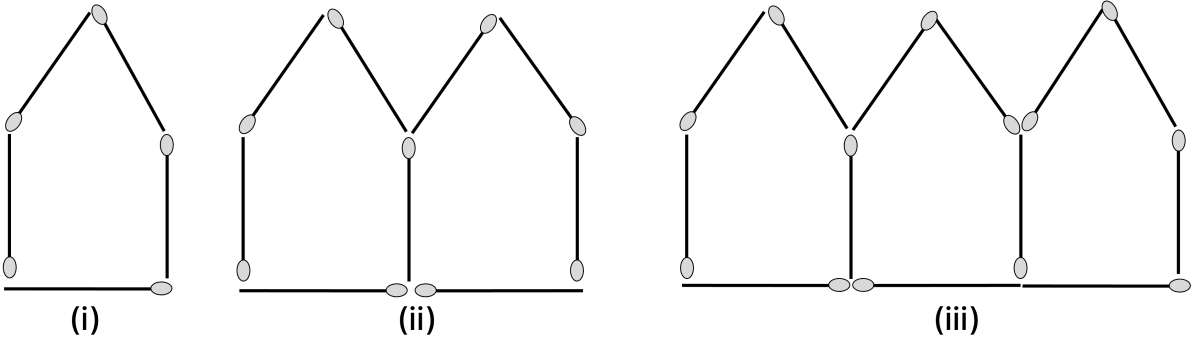
Look at the following matchstick pattern of polygons. Complete the table. Also write the general rule that gives the number of matchsticks.
| Number of polygons | 1 | 2 | 3 | 4 | 5 | ... | n |
|---|---|---|---|---|---|---|---|
| Number of matchsticks | ... | ... | ... | ... | ... | ... | ... |
Answer
Each polygon (house-shape) is formed using 5 matchsticks. Two neighbouring polygons have one common matchstick. So, for every new polygon added after the first, 4 more matchsticks are required.
| Number of polygons | 1 | 2 | 3 | 4 | 5 | ... | n |
|---|---|---|---|---|---|---|---|
| Number of matchsticks | 5 | 9 | 13 | 17 | 21 | ... | 4n + 1 |
Observe that:
5 = 4 × 1 + 1
9 = 4 × 2 + 1
13 = 4 × 3 + 1
17 = 4 × 4 + 1
21 = 4 × 5 + 1
Hence, the general rule that gives the number of matchsticks is 4n + 1, where n is the number of polygons.
Consider the expression
(i) How many terms are there? What do you call such an expression?
(ii) List out the terms.
(iii) In the term , write down the numerical coefficient and the literal coefficient.
(iv) In the term , what is the coefficient of x?
Answer
(i) The given expression has 3 terms.
Since the expression has three terms, it is called a trinomial.
(ii) The terms of the expression are:
and
(iii) In the term :
Numerical coefficient =
Literal coefficient = xy2
(iv) In the term , the coefficient of x is the remaining factor after removing x from the term.
Hence, the coefficient of x is .
Write an algebraic expression for each of the following:
(i) If 1 metre cloth costs ₹ x, then what is cost of 6 metre cloth?
(ii) If the cost of a notebook is ₹ x and the cost of a book is ₹ y, then what is the cost of 5 notebooks and 2 books?
(iii) The score of Ragini in Mathematics is 23 more than two-third of her score in English. If she scores x marks in English, what is her score in Mathematics?
(iv) If the length of a side of a regular pentagon is x cm, then what is the perimeter of the pentagon?
Answer
(i) Cost of 1 metre cloth = ₹ x
∴ Cost of 6 metre cloth = ₹ (6 × x)
∴ Cost of 6 metre cloth = ₹ 6x
(ii) Cost of 1 notebook = ₹ x
Cost of 5 notebooks = ₹ 5x
Cost of 1 book = ₹ y
Cost of 2 books = ₹ 2y
∴ Total cost of 5 notebooks and 2 books = ₹ (5x + 2y)
∴ The cost of 5 notebooks and 2 books = ₹ (5x + 2y)
(iii) Ragini's score in English = x marks
Two-third of her score in English =
Score in Mathematics = 23 more than two-third of her score in English
∴ Ragini's score in Mathematics = marks
(iv) Length of one side of the regular pentagon = x cm
A regular pentagon has 5 equal sides.
Perimeter of the pentagon = 5 × length of one side
= 5 × x
∴ Perimeter of the regular pentagon = 5x cm
When x = 4 and y = 2, find the value of:
(i) x + y
(ii) x - y
(iii) x2 + 2
(iv) x2 - 2xy + y2
Answer
Given, x = 4 and y = 2.
(i) Substituting x = 4 and y = 2 in x + y, we get:
x + y = 4 + 2
∴ x + y = 6
(ii) Substituting x = 4 and y = 2 in x - y, we get:
x - y = 4 - 2
∴ x - y = 2
(iii) Substituting x = 4 in x2 + 2, we get:
x2 + 2 = (4)2 + 2
= 4 × 4 + 2
= 16 + 2
∴ x2 + 2 = 18
(iv) Substituting x = 4 and y = 2 in x2 - 2xy + y2, we get:
x2 - 2xy + y2 = (4)2 - 2(4)(2) + (2)2
= 16 - 16 + 4
= 4
∴ x2 - 2xy + y2 = 4
When a = 3, b = 0 and c = 4, find the value of:
(i) ab + 2bc + 3ca + 4abc
(ii) a3 + b3 + c3 - 3abc
Answer
Given, a = 3, b = 0 and c = 4.
(i) Substituting a = 3, b = 0 and c = 4 in ab + 2bc + 3ca + 4abc, we get:
ab + 2bc + 3ca + 4abc
= (3)(0) + 2(0)(4) + 3(4)(3) + 4(3)(0)(4)
= 0 + 0 + 36 + 0
= 36.
∴ ab + 2bc + 3ca + 4abc = 36.
(ii) Substituting a = 3, b = 0 and c = 4 in a3 + b3 + c3 - 3abc, we get:
a3 + b3 + c3 - 3abc
= (3)3 + (0)3 + (4)3 - 3(3)(0)(4)
= 27 + 0 + 64 - 0
= 91.
∴ a3 + b3 + c3 - 3abc = 91.
Solve the following linear equations:
(i)
(ii) 3(y - 1) = 2(y + 1)
(iii) n - 3 = 5n - 5
(iv)
Answer
(i) We have:
Hence, x = 3.
(ii) We have:
3(y - 1) = 2(y + 1)
⇒ 3y - 3 = 2y + 2 [Removing brackets]
⇒ 3y - 2y = 2 + 3 [Transposing -3 to RHS and +2y to LHS]
⇒ y = 5
Hence, y = 5.
(iii) We have:
n - 3 = 5n - 5
⇒ n - 5n = -5 + 3 [Transposing -3 to RHS and +5n to LHS]
⇒ -4n = -2
⇒ n =
⇒ n =
Hence, n = .
(iv) We have:
Hence, x = .