
How many lines can be drawn through a given point?
Answer
A single point in a plane does not determine any direction. Through a given point, we can draw lines in every possible direction (360°). Since there is no second point to fix the direction, we can keep drawing lines forever.
∴ An unlimited (infinite) number of lines can be drawn through a given point.
How many lines can be drawn through two distinct given points?
Answer
Two distinct points fix a unique direction. Once we have two fixed points, the direction of the line is "locked", and only one straight line can pass through both points.
∴ Exactly one line can be drawn through two distinct given points.
How many lines can be drawn through three collinear points?
Answer
By definition, collinear points are points that lie on the same straight line. Therefore, only one line can be drawn passing through all three collinear points.
∴ Only one line can be drawn through three collinear points.
Mark three non-collinear points A, B and C in your notebook. Draw lines through these points taking two at a time and name these lines. How many such different lines can be drawn?
Answer
Non-collinear points are points that do not lie on the same straight line. Taking the points two at a time we get the following pairs — (A, B), (B, C) and (C, A).
Through each pair of points we can draw exactly one line. So, we get three lines, namely line AB, line BC and line CA.
∴ Three different lines can be drawn through three non-collinear points A, B and C.
Use the adjoining figure to name:
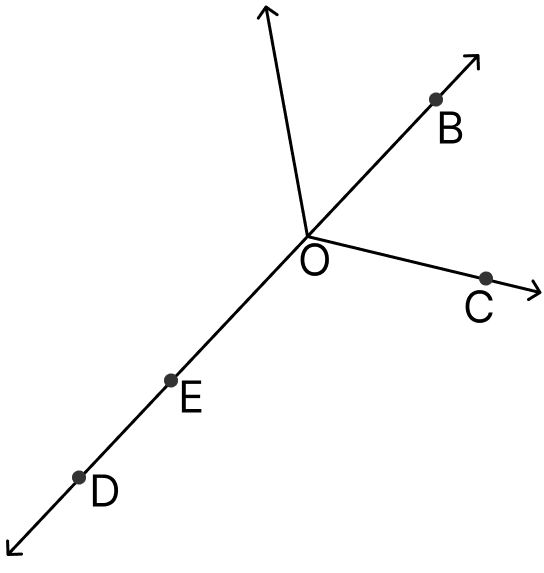
(i) Five points.
(ii) A line.
(iii) Four rays.
(iv) Five line segments.
Answer
(i) Five points — O, B, C, D and E.
(ii) A line — .
(iii) Four rays — .
(iv) Five line segments — .
Use the adjoining figure to name:
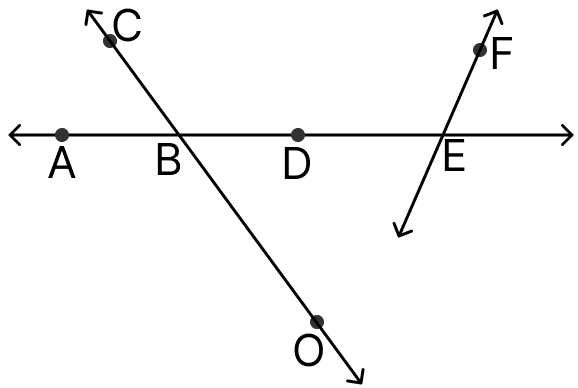
(i) Line containing point E.
(ii) Line passing through A.
(iii) Line on which point O lies.
(iv) Two pairs of intersecting lines.
Answer
(i) The line containing point E is the horizontal line through A, B, D and E.
∴ contains point E.
(ii) The line passing through A is the same horizontal line through A, B, D and E.
∴ passes through A.
(iii) Point O lies on the line that passes through C, B and O.
∴ Point O lies on .
(iv) Two pairs of intersecting lines are:
.
From the adjoining figure, write
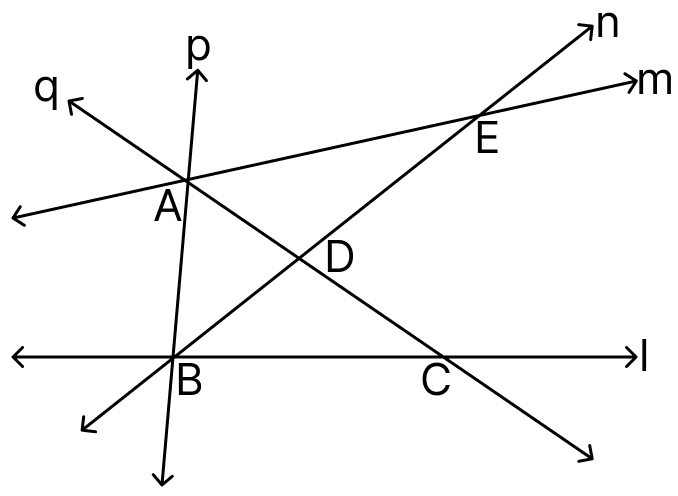
(i) collinear points.
(ii) concurrent lines and their points of concurrence.
Answer
(i) Collinear points are three or more points lying on the same line.
Collinear points are — A, D, C ; B, D, E .
(ii) Concurrent lines are three or more lines passing through the same point. The point at which they meet is called the point of concurrence.
∴ Lines l, n, p at B ; Lines m, p, q at A.
In the adjoining figure, write
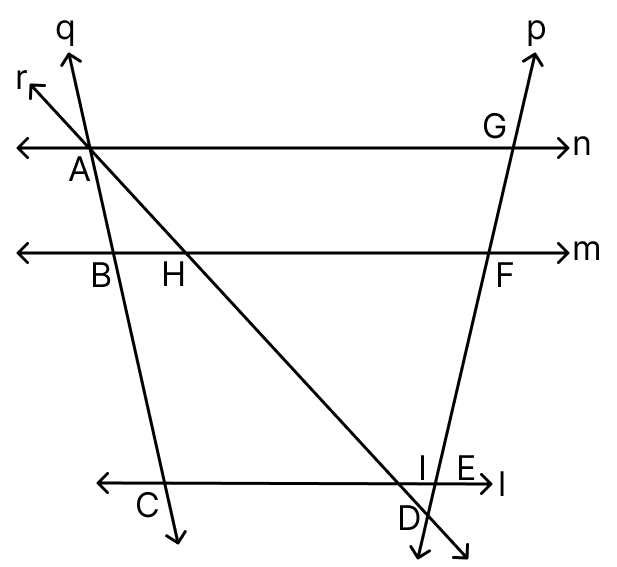
(i) all pairs of parallel lines.
(ii) all pairs of intersecting lines.
(iii) concurrent lines.
(iv) collinear points.
Answer
(i) Lines that never meet are parallel lines.
∴ Pairs of parallel lines are l, m ; l, n; m, n.
(ii) Lines that cross each other are intersecting lines.
∴ Pairs of intersecting lines are l, p ; m, p ; n, p ; l, q ; m, q ; n, q ; l, r ; m, r ; n, r ; p, q ; p, r ; and q, r.
(iii) Three or more lines passing through the same point are concurrent.
∴ Lines n, r and q are concurrent.
(iv) Collinear points are points lying on the same line.
∴ Collinear points are A, B, C ; A, H, I, D ; D, E, F, G ; B, H, F and C, I, E.
Count the number of line segments drawn in each of the following figures and name them:
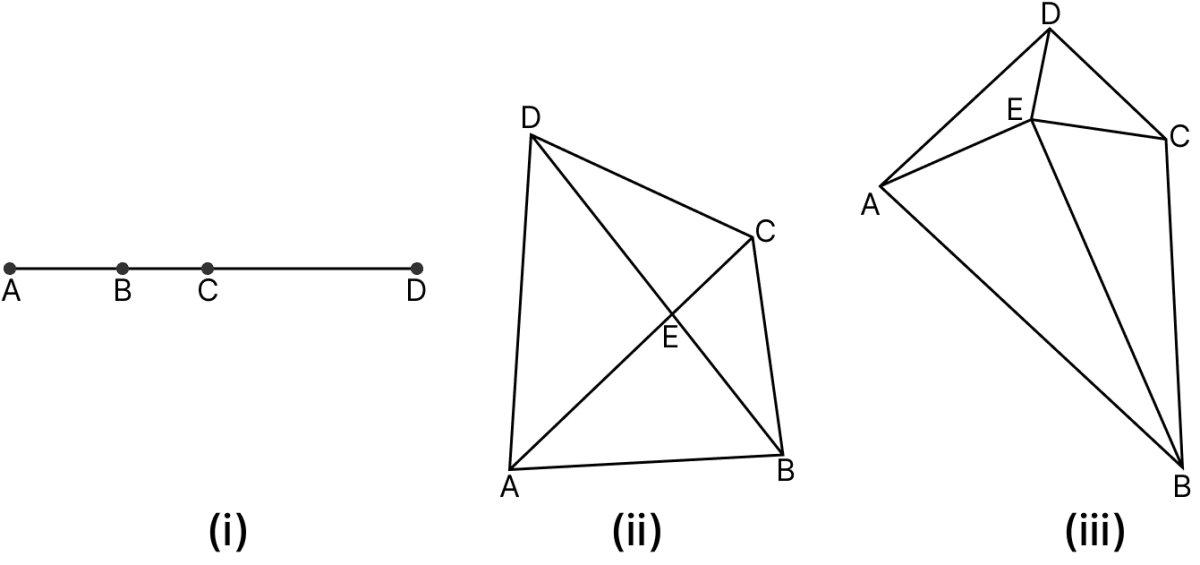
Answer
(i) The figure has four collinear points A, B, C and D. The line segments that can be named are:
.
∴ Number of line segments = 6.
(ii) In the figure, the line segments are:
.
∴ Number of line segments = 10.
(iii) In the figure, the line segments are:
.
∴ Number of line segments = 8.
Consider the adjoining figure of the line . State whether the following statements are true (T) or false (F) in context of the given figure.
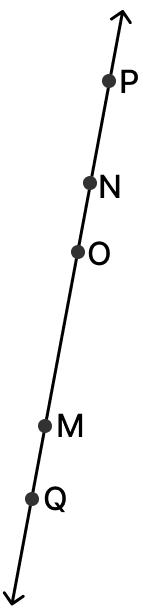
(i) Q, M, O, N and P are points on the line .
(ii) M, O and N are points on the line segment .
(iii) M and N are end points of the segment .
(iv) O and N are end points of the segment .
(v) M is a point on the ray .
(vi) M is one of the end point of the segment .
(vii) Ray is same as ray .
(viii) Ray is not opposite to ray .
(ix) Ray is different from ray .
(x) O is not an initial point of ray .
(xi) N is the initial point of .
Answer
From the figure, the points lie on line MN in the order Q, M, O, N, P.
(i) True — All five points Q, M, O, N and P lie on the line MN.
(ii) True — Since O lies between M and N, the points M, O and N all lie on the line segment MN.
(iii) True — M and N are the end points of the segment MN, by definition.
(iv) False — The end points of the segment OP are O and P (not O and N). N is a point on the segment OP, not an end point.
(v) False — Ray OP starts at O and extends in the direction of P. M lies on the opposite side of O, so M is not a point on ray OP.
(vi) False — The end points of segment QO are Q and O. M lies between Q and O, so it is not an end point of QO.
(vii) False — Ray OP starts at O and goes towards P, while ray OM starts at O and goes towards M (opposite direction). They are opposite rays, hence not the same.
(viii) False — Ray OM and ray OP have the same initial point O but extend in opposite directions, so they are opposite rays. Hence, the statement "ray OM is not opposite to ray OP" is false.
(ix) True — Ray OP has initial point O while ray QP has initial point Q. Since the initial points differ, the rays are different.
(x) False — O is the initial (starting) point of ray OP.
(xi) True — Ray NP and ray NM both start from N, so N is the initial point of both rays.
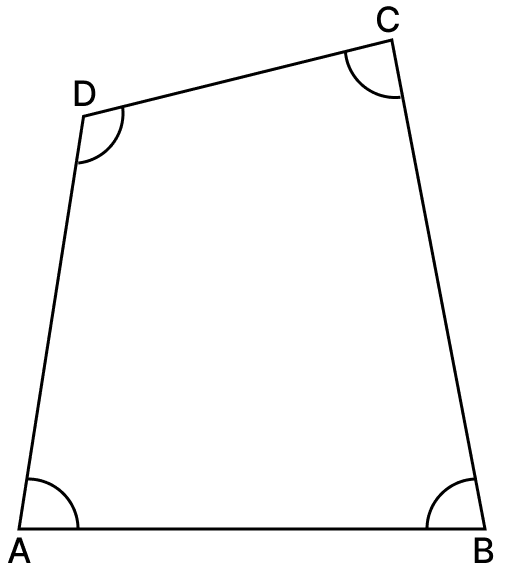
How many angles are there in the adjoining figure? Name them.
Answer
The given figure is a quadrilateral ABCD. A quadrilateral has four vertices and therefore four angles, one at each vertex.
∴ The number of angles in the figure is 4. They are ∠A, ∠B, ∠C and ∠D (or ∠DAB, ∠ABC, ∠BCD and ∠CDA).
In the adjoining figure, name the point(s)
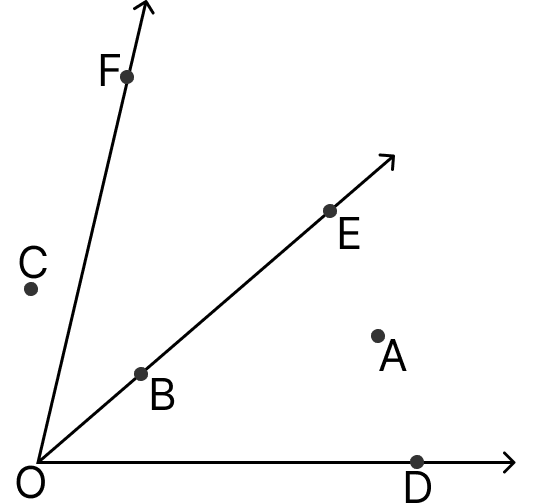
(i) in the interior of ∠DOE
(ii) in the exterior of ∠EOF
(iii) on ∠EOF
Answer
(i) The interior of ∠DOE is the region of the plane lying between the rays OD and OE.
∴ The point in the interior of ∠DOE is A.
(ii) The exterior of ∠EOF is the region of the plane lying outside the angle EOF.
∴ The points in the exterior of ∠EOF are A, D and C.
(iii) The points lying on the boundary (on either of the rays OE or OF) belong to the angle ∠EOF.
∴ The points on ∠EOF is O, B, E, F.
Draw rough diagrams of two angles such that they have
(i) one point in common
(ii) two points in common
(iii) one ray in common
Answer
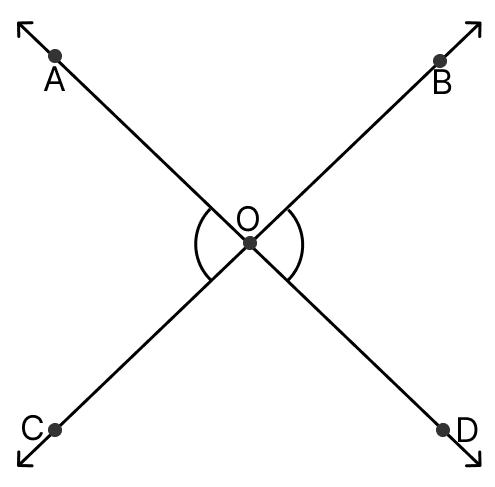
(i) Two angles having only one common point. O is the common point in two angles, ∠AOC and ∠BOD.
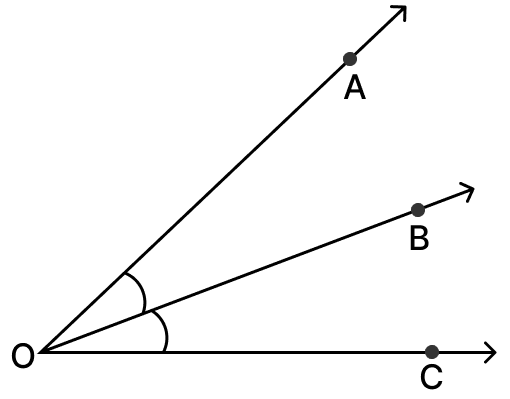
(ii) Two angles having two points in common.Point 0 and B are common in two angles, ∠AOB and ∠BOC.
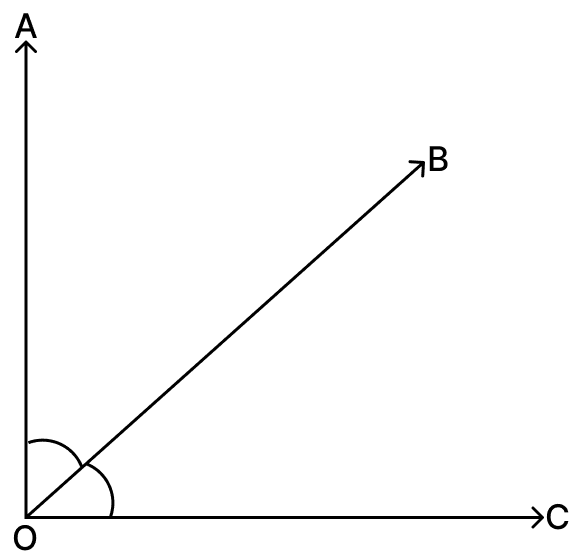
(iii) Two angles having one ray in common. is the common ray in two angles, ∠AOB and ∠BOC .
Draw rough diagrams to illustrate the following:
(i) open simple curve
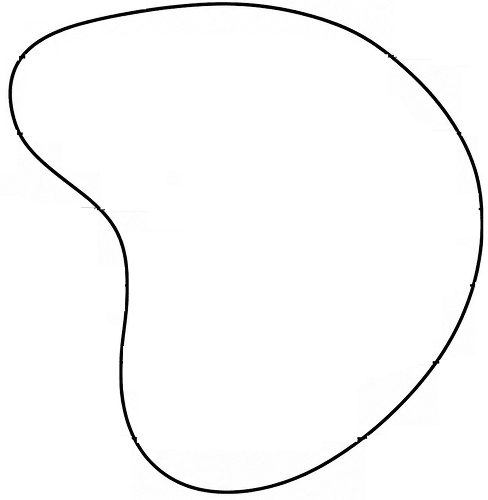
(ii) closed simple curve
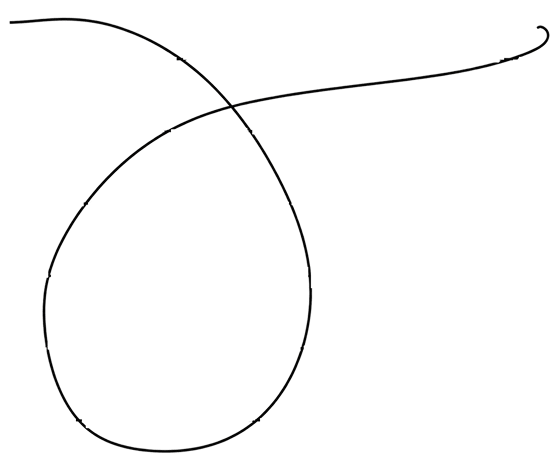
(iii) open curve that is not simple
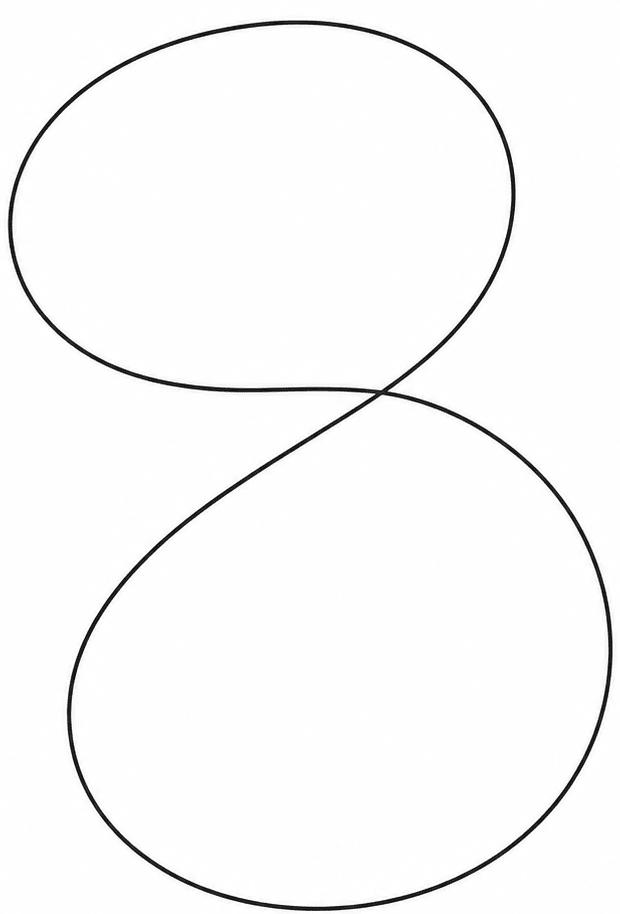
(iv) closed curve that is not simple
Answer
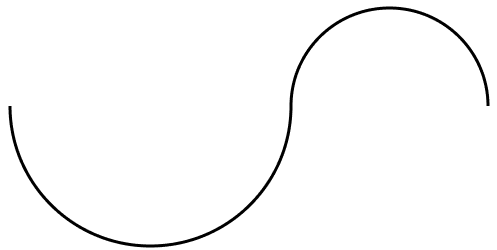
(i) An open simple curve has different beginning and end points and does not cross itself at any point.
(ii) A closed simple curve has the same beginning and end points and does not cross itself at any point.
(iii) An open curve that is not simple has different beginning and end points but crosses itself at some point.
(iv) A closed curve that is not simple has the same beginning and end points but crosses itself at some point.
Consider the adjoining figure and answer the following questions:

(i) Is it a curve?
(ii) Is it a closed curve?
(iii) Is it a polygon?
Answer
(i) Yes, the given figure is a curve as it is drawn without lifting the pencil from the paper.
∴ It is a curve.
(ii) Yes, the given figure has the same starting and ending point, so it is a closed curve.
∴ It is a closed curve.
(iii) Yes, the given figure is a simple closed curve made up entirely of line segments, so it is a polygon.
∴ It is a polygon.
Draw a rough sketch of a triangle ABC. Mark a point P in its interior and a point Q in its exterior. Is the point A in its exterior or in its interior?
Answer
A rough sketch of triangle ABC is drawn below with point P inside the triangle and point Q outside the triangle.
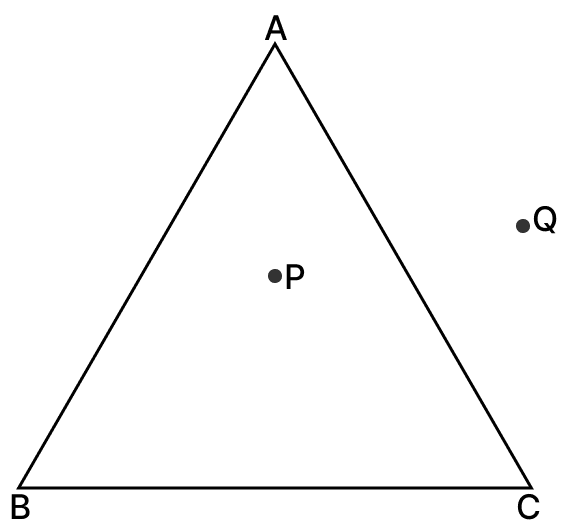
Point A is a vertex of triangle ABC and lies on the boundary of the triangle. A point on the boundary is neither in the interior nor in the exterior of the triangle.
∴ Point A lies neither in the interior nor in the exterior of the triangle. It lies on the triangle (boundary).
Draw a rough sketch of a quadrilateral PQRS. Draw its diagonals. Name them.
Answer
A rough sketch of quadrilateral PQRS is drawn below. The diagonals of a quadrilateral are the line segments joining its non-adjacent (opposite) vertices.
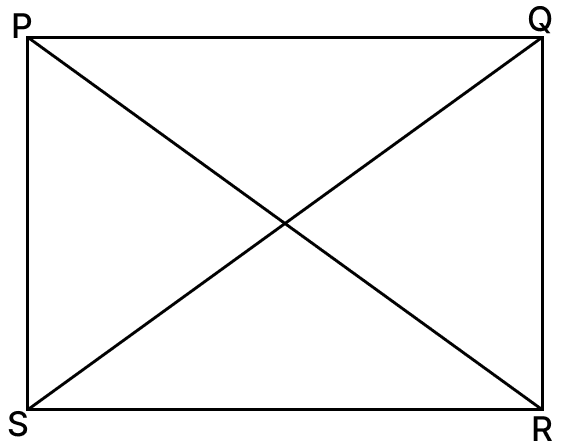
In quadrilateral PQRS, the pairs of non-adjacent vertices are (P, R) and (Q, S).
∴ The diagonals are .
In context of the given figure:
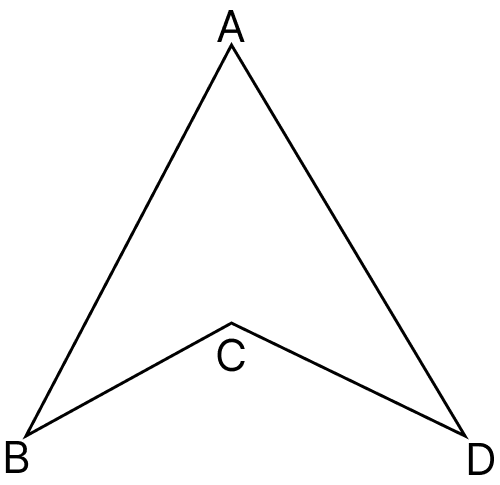
(i) Is it a simple closed curve?
(ii) Is it a quadrilateral?
(iii) Draw its diagonals and name them.
(iv) State which diagonal lies in the interior and which diagonal lies in the exterior of the quadrilateral.
Answer
(i) The given figure has the same starting and end point and does not cross itself at any point.
∴ Yes, it is a simple closed curve.
(ii) The given figure is a simple closed curve made up entirely of four line segments.
∴ Yes, it is a quadrilateral.
(iii) The diagonals are obtained by joining the non-adjacent vertices of the quadrilateral.
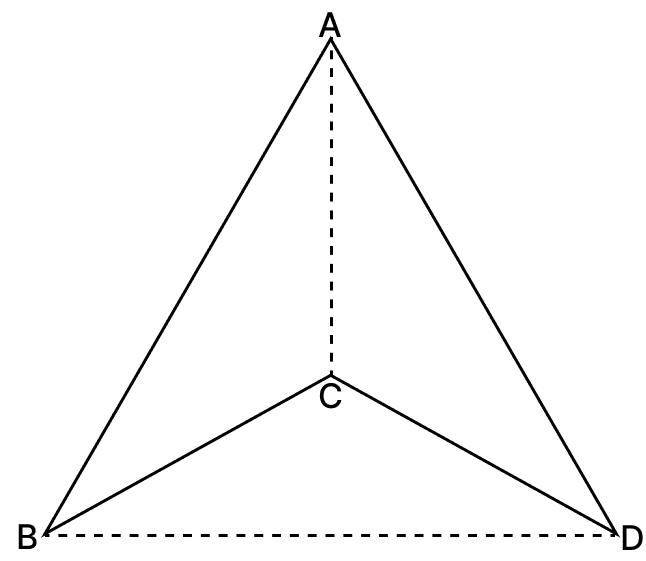
∴ The diagonals are .
(iv) On observing the figure carefully, we find that one diagonal lies completely inside the quadrilateral while the other lies completely outside it (since the quadrilateral is concave).
∴ Diagonal lies in the interior and diagonal lies in the exterior of the quadrilateral ABCD.
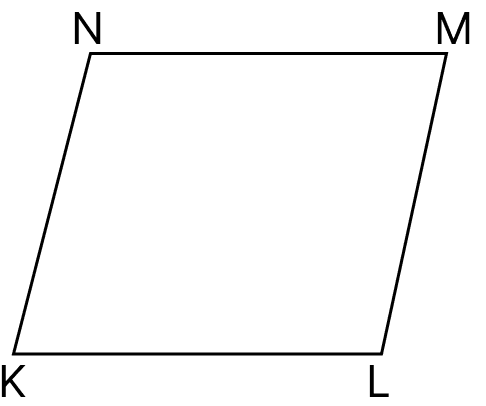
Draw a rough sketch of a quadrilateral KLMN. State:
(i) two pairs of opposite sides
(ii) two pairs of opposite angles
(iii) two pairs of adjacent sides
(iv) two pairs of adjacent angles
Answer
A rough sketch of quadrilateral KLMN is drawn below.
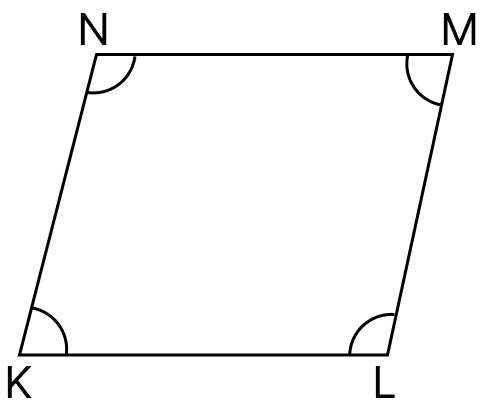
(i) Opposite sides are the sides which do not have any common vertex.
∴ The two pairs of opposite sides are .
(ii) Opposite angles are the angles which do not have any common side.
∴ The two pairs of opposite angles are (∠K, ∠M) and (∠L, ∠N).
(iii) Adjacent sides are the sides which have a common vertex.
∴ The two pairs of adjacent sides are .
(iv) Adjacent angles are the angles which have a common side.
∴ The two pairs of adjacent angles are (∠K, ∠L) and (∠L, ∠M).
In the adjoining figure, identify:
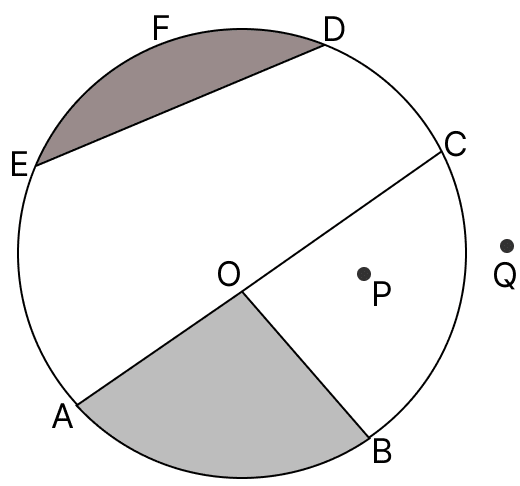
(i) the centre of the circle
(ii) three radii
(iii) a diameter
(iv) a chord
(v) two points in the interior
(vi) a point in the exterior
(vii) a sector
(viii) a segment.
Answer
(i) The centre of the circle is the fixed point from which all points on the circle are at an equal distance.
∴ The centre of the circle is O.
(ii) A radius is a line segment from the centre of the circle to any point on the circle.
∴ The three radii are .
(iii) A diameter is a chord of the circle that passes through its centre.
∴ The diameter is .
(iv) A chord is a line segment joining any two points on the circle.
∴ A chord is .
(v) A point lies in the interior of a circle if its distance from the centre is less than the radius of the circle.
∴ Two points in the interior are O and P.
(vi) A point lies in the exterior of a circle if its distance from the centre is greater than the radius of the circle.
∴ A point in the exterior is Q.
(vii) A sector is the part of the circular region enclosed by an arc of the circle and its two bounding radii.
∴ A sector is AOB (enclosed by radii and arc AB).
(viii) A segment is the part of the circular region enclosed by a chord and the corresponding arc.
Segment EFD(shaded portion).
State whether the following statements are true (T) or false (F):
(i) Every diameter of a circle is also a chord.
(ii) Every chord of a circle is also a diameter.
(iii) Two diameters of a circle will necessarily intersect.
(iv) The centre of the circle is always in its interior.
Answer
(i) True
Reason — A chord is a line segment joining any two points on the circle. A diameter is a chord that passes through the centre of the circle. So every diameter is also a chord.
(ii) False
Reason — Only those chords which pass through the centre of the circle are called diameters. A chord that does not pass through the centre is not a diameter.
(iii) True
Reason — Every diameter of a circle passes through the centre. So any two diameters of a circle will always meet (intersect) at the centre of the circle.
(iv) True
Reason — The centre of a circle is the fixed point from which the distance to every point on the circle is equal to the radius. Since this distance is zero (which is less than the radius), the centre always lies in the interior of the circle.
Fill in the following blanks:
(i) There is exactly one line passing through ..... distinct points in a plane.
(ii) Two different lines in a plane either ..... at exactly one point or are parallel.
(iii) The curves which have different beginning and end points are called ..... curves.
(iv) A curve which does not cross itself at any point is called a ..... curve.
(v) A simple closed curve made up entirely of line segments is called a .... .
(vi) A quadrilateral has ..... diagonals.
(vii) A line segment has a ..... length.
Answer
(i) There is exactly one line passing through two distinct points in a plane.
(ii) Two different lines in a plane either intersect at exactly one point or are parallel.
(iii) The curves which have different beginning and end points are called open curves.
(iv) A curve which does not cross itself at any point is called a simple curve.
(v) A simple closed curve made up entirely of line segments is called a polygon.
(vi) A quadrilateral has two diagonals.
(vii) A line segment has a definite length.
Fill in the blanks with correct word(s) to make the statement true:
(i) Radius of a circle is one-half of its .....
(ii) A radius of a circle is a line segment with one end point at ..... and the other end-point on .....
(iii) A chord of a circle is a line segment with its end points ....
(iv) A diameter of a circle is a chord that ..... the centre of the circle.
(v) All radii of a circle are .....
Answer
(i) Radius of a circle is one-half of its diameter.
(ii) A radius of a circle is a line segment with one end point at the centre and the other end-point on the circle.
(iii) A chord of a circle is a line segment with its end points on the circle.
(iv) A diameter of a circle is a chord that passes through the centre of the circle.
(v) All radii of a circle are equal in length.
State whether the following statements are true (T) or false (F):
(i) The line segment is the shortest route from A to B.
(ii) A line cannot be drawn wholly on a sheet of paper.
(iii) A line segment is made of infinite (uncountable) number of points.
(iv) Two lines in a plane always intersect.
(v) Through a given point only one line can be drawn.
(vi) Two different lines can be drawn passing through two distinct points.
(vii) Every simple closed curve is a polygon.
(viii) Every polygon has atleast three sides.
(ix) A vertex of a quadrilateral lies in its interior.
(x) A line segment with its end-points lying on a circle is called a diameter of the circle.
(xi) Diameter is the longest chord of the circle.
(xii) The end-points of a diameter of a circle divide the circle into two parts; each part is called a semicircle.
(xiii) A diameter of a circle divides the circular region into two parts; each part is called a semicircular region.
(xiv) The diameters of a circle are concurrent. The centre of the circle is the point common to all diameters.
(xv) Every circle has unique centre and it lies inside the circle.
(xvi) Every circle has unique diameter.
Answer
(i) True — The shortest distance between two points is the straight line segment joining them.
(ii) True — A line extends indefinitely in both directions, so only a part of it can be shown on a sheet of paper.
(iii) True — Between any two points of a line segment, infinitely many points can be found.
(iv) False — Two parallel lines in a plane never intersect.
(v) False — Infinitely many lines can be drawn through a single given point.
(vi) False — Only one unique line can be drawn passing through two distinct points.
(vii) False — A simple closed curve is a polygon only if it is made up entirely of line segments. A circle, for example, is a simple closed curve but not a polygon.
(viii) True — The polygon with the least number of sides is a triangle, which has three sides.
(ix) False — A vertex of a quadrilateral lies on its boundary, not in its interior.
(x) False — A line segment with its end points on a circle is called a chord. It is called a diameter only when it also passes through the centre of the circle.
(xi) True — The diameter is the longest chord of the circle because it passes through the centre.
(xii) True — A diameter divides the circle into two equal arcs, each called a semicircle.
(xiii) True — A diameter divides the circular region into two equal parts, each called a semicircular region.
(xiv) True — All diameters of a circle pass through its centre, so they are concurrent at the centre.
(xv) True — A circle has a unique centre and the centre lies in the interior of the circle.
(xvi) False — A circle has infinitely many diameters (any chord passing through the centre is a diameter).
Which of the following has no end points?
a line
a ray
a line segment
none of these
Answer
A line extends indefinitely in both directions, so it has no end points. A ray has one end point (its initial point) and a line segment has two end points.
Hence, option 1 is the correct option.
Which of the following has definite length?
a line
a ray
a line segment
none of these
Answer
A line and a ray extend indefinitely, so their lengths cannot be measured. A line segment has two fixed end points and therefore a definite, measurable length.
Hence, option 3 is the correct option.
The number of points required to name a line is
1
2
3
4
Answer
A line is denoted by writing two distinct points on it, for example line AB.
Hence, option 2 is the correct option.
The number of lines that can be drawn through a given point is
1
2
3
infinitely many
Answer
Through a single given point, lines can be drawn in every possible direction.
Hence, option 4 is the correct option.
The number of lines that can be drawn passing through two distinct points is
1
2
3
infinitely many
Answer
Two distinct points determine a unique straight line, so exactly one line can be drawn through them.
Hence, option 1 is the correct option.
The maximum number of points of intersection of three lines drawn in a plane is
1
2
3
6
Answer
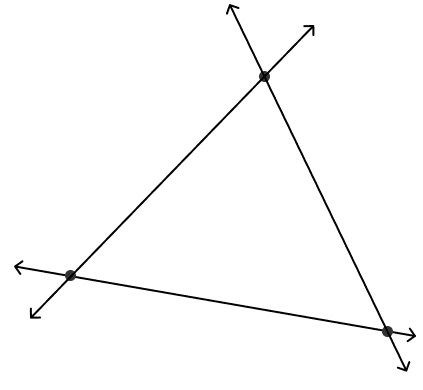
For 3 lines in a plane, the maximum number of intersection points happens when:
No two lines are parallel and no three lines pass through the same point. So, the maximum number of intersections points are 3.
Hence, option 3 is the correct option.
The minimum number of points of intersection of three lines drawn in a plane is
0
1
2
3
Answer
The minimum number of intersection points occurs when all three lines are parallel to one another. Parallel lines never meet, so there are 0 points of intersection.
Hence, option 1 is the correct option.
In the given figure, the number of line segments is

5
10
12
15
Answer
There are 5 collinear points A, B, C, D and E.
The line segments are .
Hence, option 2 is the correct option.
The number of diagonals of a triangle is
0
1
2
3
Answer
A diagonal is a line segment joining two non-adjacent vertices of a polygon. In a triangle, every pair of vertices is adjacent, so there are no diagonals.
Hence, option 1 is the correct option.
In a polygon with 5 sides, the number of diagonals is
3
4
5
10
Answer
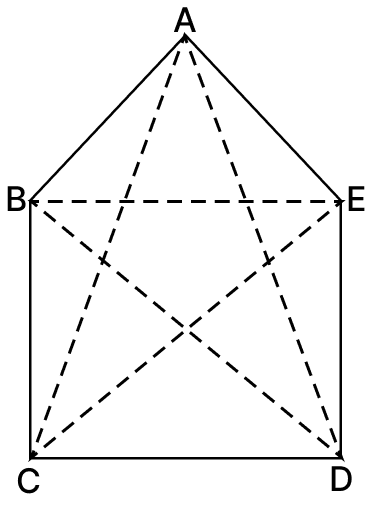
A polygon with 5 sides is called a pentagon.
A diagonal means a line joining two non-adjacent corners of a polygon.
So, the number of diagonals in a pentagon is 5.
Hence, option 3 is the correct option.
In context of the given figure, which of the following statement is correct?

B is not a point on segment
B is the initial point of the ray
D is a point on the ray
C is a point on the ray
Answer
From the figure, the points lie on a line in the order A, B, C and D.
Ray BD starts at B and extends in the direction of D, passing through C. So C is a point on ray BD. This statement is correct.
Hence, option 4 is the correct option.
The figure formed by two rays with same initial point is known as
a line
a line segment
a ray
an angle
Answer
By definition, an angle is a figure formed by two rays having the same initial point. The common initial point is called its vertex and the two rays are called its arms.
Hence, option 4 is the correct option.
In the adjoining figure, the number of angles is
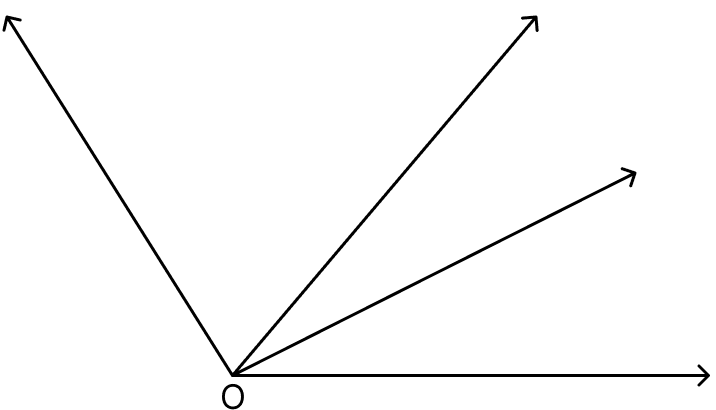
3
4
5
6
Answer
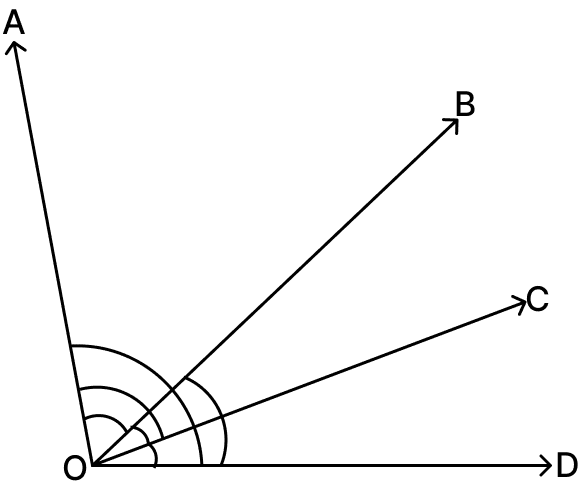
The figure has four rays starting from a common point O. Angles formed are :
∠AOB, ∠AOC, ∠AOD, ∠BOC, ∠BOD, ∠COD
Thus, 6 angles are formed.
Hence, option 4 is the correct option.
Which of the following statements is false?
A triangle has three sides
A triangle has three vertices
A triangle has three angles
A triangle has two diagonals
Answer
A triangle has three sides, three vertices and three angles. Since all three vertices of a triangle are adjacent to each other, a triangle has no diagonals.
Hence, option 4 is the correct option.
By joining any two points of a circle, we obtain its
radius
chord
diameter
circumference
Answer
A line segment joining any two points of a circle is called a chord of the circle.
Hence, option 2 is the correct option.
If the radius of a circle is 4 cm, then the length of its diameter is
2 cm
4 cm
8 cm
16 cm
Answer
The length of a diameter of a circle is twice its radius.
Length of diameter = 2 × radius
Length of diameter = 2 × 4 cm = 8 cm.
Hence, option 3 is the correct option.
Statement I: A dot made on a sheet of paper with a pencil is the geometrical representation of a point.
Statement II: Conceptually, a point has no dimensions. In other words, it has no length, width or thickness.
Statement I is true but statement II is false.
Statement I is false but statement II is true.
Both Statement I and statement II are true.
Both Statement I and statement II are false.
Answer
Both Statement I and Statement II are true.
Explanation
A small dot marked by a sharp pencil on a sheet of paper (or a prick made by a fine needle) is used to represent a point in geometry. It marks the exact location we want to show. So, Statement I is true.
A point only determines a location — conceptually it has no length, no width and no thickness, i.e. it has no dimensions. The dot we draw is only a visual representation; the true mathematical point is dimensionless. So, Statement II is also true.
Hence, option 3 is the correct option.
Statement I: The front surface of the green board in the classroom is a part of a plane.
Statement II: Conceptually, a plane is a flat surface that extends infinitely in all directions, with no thickness.
Statement I is true but statement II is false.
Statement I is false but statement II is true.
Both Statement I and statement II are true.
Both Statement I and statement II are false.
Answer
Both Statement I and Statement II are true.
Explanation
A plane is a flat (smooth) surface. The front surface of the green board in the classroom is flat, so it represents a part of a plane. A page of a notebook, the surface of a wall, the floor or ceiling of a room and the top of a table are all such examples. So, Statement I is true.
Conceptually, a plane has length and breadth but no thickness, and it extends indefinitely in all directions. We can show only a portion of it on paper (usually a rectangle or parallelogram), but the actual plane is unlimited. So, Statement II is also true.
Hence, option 3 is the correct option.
Statement I: The diagonal of a polygon is the line segment joining two non-adjacent vertices.
Statement II: The polygon with the minimum number of sides is a triangle.
Statement I is true but statement II is false.
Statement I is false but statement II is true.
Both Statement I and statement II are true.
Both Statement I and statement II are false.
Answer
Both Statement I and Statement II are true.
Explanation
In a polygon, the line segments formed by joining two non-adjacent vertices (vertices which are not the end points of the same side) are called diagonals of the polygon. So, Statement I is true.
A polygon is a simple closed curve made up entirely of line segments. To enclose a region, we need at least three line segments, so the polygon with the least number of sides has three sides — which is a triangle. A polygon with two sides is not possible. So, Statement II is also true.
Hence, option 3 is the correct option.
Statement I: If r is the radius of a circle and l is the length of any chord then 0 ≤ l ≤ 2r.
Statement II: A chord is formed by joining any two points on a circle.
Statement I is true but statement II is false.
Statement I is false but statement II is true.
Both Statement I and statement II are true.
Both Statement I and statement II are false.
Answer
Both Statement I and Statement II are true.
Explanation
A chord is a line segment joining any two points of a circle. So, Statement II is true.
The longest possible chord of a circle is its diameter, whose length is 2r (twice the radius). The length l of any chord cannot be negative and cannot exceed the diameter, so it must satisfy 0 ≤ l ≤ 2r. So, Statement I is also true.
Hence, option 3 is the correct option.
Statement I: The terms circle and circular region have the same meaning.
Statement II: The interior of a circle together with its boundary is called the circular region.
Statement I is true but statement II is false.
Statement I is false but statement II is true.
Both Statement I and statement II are true.
Both Statement I and statement II are false.
Answer
Statement I is false but Statement II is true.
Explanation
A circle is just the simple closed curve — i.e. the collection of all points in a plane which are at a fixed distance (the radius) from a fixed point (the centre). It does not include the interior.
The circular region, on the other hand, is the collection of all points of the plane which either lie on the circle or are inside it, i.e. the interior of the circle together with its boundary.
So, "circle" and "circular region" do not have the same meaning — Statement I is false, while Statement II correctly describes the circular region and is true.
Hence, option 2 is the correct option.
Statement I: The essential component of the sector and the segment of a circle is the arc.
Statement II: A chord which passes through the centre of a circle is its diameter.
Statement I is true but statement II is false.
Statement I is false but statement II is true.
Both Statement I and statement II are true.
Both Statement I and statement II are false.
Answer
Both Statement I and Statement II are true.
Explanation
A sector of a circle is the part of the circular region enclosed by an arc of the circle and its two bounding radii. A segment of a circle is the part of the circular region cut off by a chord, and it is bounded by the chord and an arc. So, in both a sector and a segment, an arc is an essential (common) component. Statement I is true.
A chord is a line segment joining any two points of a circle. When a chord passes through the centre of the circle, it becomes the longest chord — called the diameter — and its length is equal to 2 × radius. So, Statement II is also true.
Hence, option 3 is the correct option.
(i) Name all the rays shown in the given figure whose initial point is A.
(ii) Is ray different from ray ?
(iii) Is ray different from ray ?
(iv) Is ray different from ray ?
(v) Is ray different from ray ?

Answer
From the figure, the points lie on a line in the order E, A, B, C and D.
(i) Rays whose initial point is A — from A we can draw rays in two opposite directions on the line. Rays extend in one direction, and ray extends in the opposite direction.
∴ The rays with initial point A are .
(ii) Ray AB starts at A and goes in the direction of B. Ray AD also starts at A and goes in the same direction (through B and C to D). Since they have the same initial point and same direction, they are the same ray.
∴ Ray AB is not different from ray AD. They are the same ray.
(iii) Ray CA starts at C and goes in the direction of A. Ray CE also starts at C and goes in the same direction (through A to E). Since they have the same initial point and same direction, they are the same ray.
∴ Ray CA is not different from ray CE. They are the same ray.
(iv) Ray BA has initial point B and goes towards A. Ray CA has initial point C and goes towards A. Since their initial points are different, the rays are different.
∴ Yes, ray BA is different from ray CA.
(v) Ray ED has initial point E and extends in the direction of D. Ray DE has initial point D and extends in the direction of E (opposite direction). Since their initial points are different and they extend in opposite directions, they are different rays.
∴ Yes, ray ED is different from ray DE. They are opposite rays.
From the adjoining figure, write
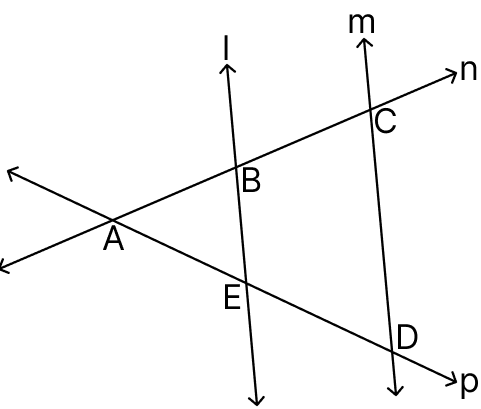
(i) all pairs of parallel lines.
(ii) all pairs of intersecting lines.
(iii) lines whose point of intersection is E.
(iv) collinear points.
Answer
(i) Parallel lines are lines that never meet.
∴ The pairs of parallel lines are l, m.
(ii) Intersecting lines are lines that cross each other.
∴ Pairs of intersecting lines are l, n; l, p; m, n; m, p; n, p.
(iii) Two or more lines whose point of intersection is E.
∴ Lines l and p intersect at E.
(iv) Collinear points are points lying on the same line.
∴ The collinear points are A, B, C ; A, E, D .
In the adjoining figure:
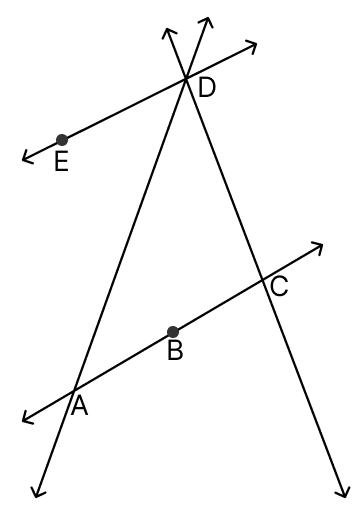
(a) Name:
(i) parallel lines.
(ii) all pairs of intersecting lines.
(iii) concurrent lines.
(b) State whether true or false:
(i) points A, B and D are collinear.
(ii) lines AB and ED intersect at C.
Answer
(a)
(i) Parallel lines are
(ii) The pairs of intersecting lines are :
.
(iii) Concurrent lines are three or more lines passing through the same point.
∴ Lines are concurrent.
(b)
(i) False — Points A, B and D do not lie on the same straight line; therefore, they are not collinear.
(ii) False — From the figure, line AB and line ED do not intersect at C.
In context of the adjoining figure, state whether the following statements are true (T) or false (F):
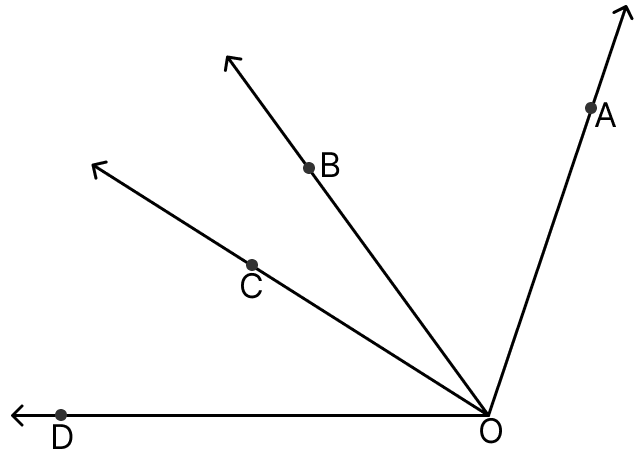
(i) Point A is in the interior of ∠AOD.
(ii) Point B is in the interior of ∠AOC.
(iii) Point C is in the exterior of ∠AOB.
(iv) Point D is in the exterior of ∠AOC.
Answer
(i) False — Point A lies on the ray OA (i.e., on the boundary of ∠AOD), so it is not in the interior of ∠AOD.
(ii) True — Point B lies between the rays OA and OC, so B is in the interior of ∠AOC.
(iii) True — Point C lies outside the angle AOB (i.e., outside the region between rays OA and OB), so C is in the exterior of ∠AOB.
(iv) True — Point D lies outside the region between rays OA and OC, so D is in the exterior of ∠AOC.
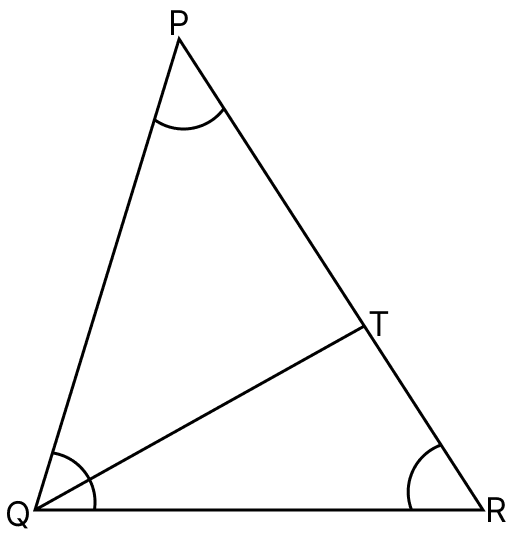
How many angles are marked in the adjoining figure? Name them.
Answer
In the figure, triangle PQR is drawn with point T on side PR. The line segment QT is drawn from vertex Q to point T.
The angles formed are:
At vertex P — ∠QPR .
At vertex Q — ∠PQR, ∠PQT, ∠TQR .
At vertex R — ∠PRQ .
∴ Fie angles are marked in the figure.
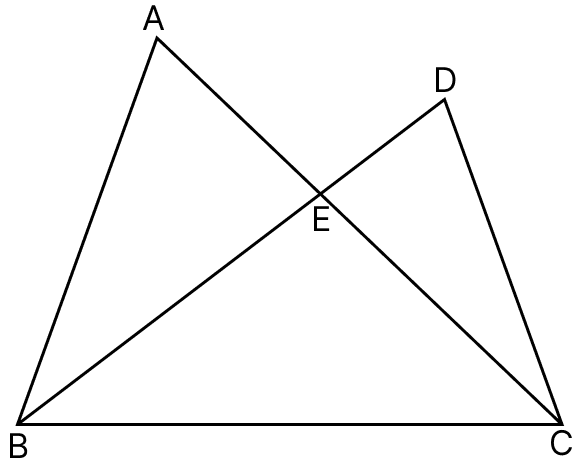
In context of the adjoining figure, name
(i) all triangles
(ii) all triangles having point E as common vertex.
Answer
In the given figure, we have two overlapping triangles △ABC and △DBC sharing the common base BC. The line segments AC and BD intersect each other at point E in the interior of the figure.
(i) Looking carefully at the figure, the line segments drawn are AB, BC, CA, BD and DC. These line segments, along with the intersection point E, form the following triangles:
- △ABC (formed by sides AB, BC and CA)
- △DBC (formed by sides DB, BC and CD)
- △ABE (formed by sides AB, BE and EA)
- △BEC (formed by sides BE, EC and CB)
- △CDE (formed by sides CD, DE and EC)
∴ The five triangles in the figure are △ABC, △DBC, △ABE, △BEC and △CDE.
(ii) Point E is the intersection point of segments AC and BD. A triangle has point E as a vertex only if two of its sides meet at E.
The triangles having point E as common vertex are △ABE, △BEC and △CDE.
∴ The triangles having point E as common vertex are △ABE, △BEC and △CDE.
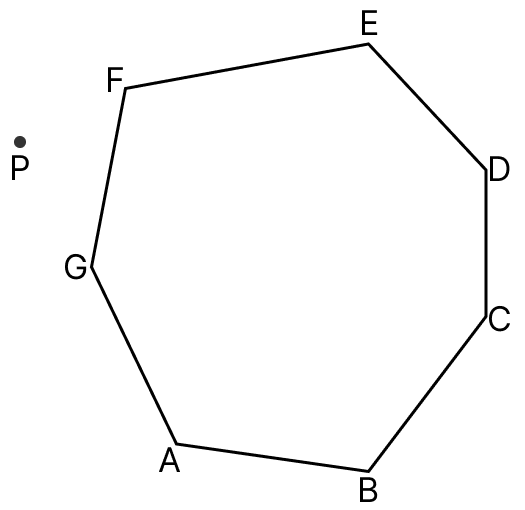
In context of the adjoining figure, answer the following questions:
(i) Is ABCDEFG a polygon?
(ii) How many sides does it have?
(iii) How many vertices does it have?
(iv) Are adjacent sides?
(v) Is a diagonal of the polygon?
(vi) Are diagonals of the polygon?
(vii) Is point P in the interior of the polygon?
(viii) Is point A in the exterior of the polygon?
Answer
(i) The figure ABCDEFG is a simple closed curve made up entirely of line segments. Therefore, it satisfies the definition of a polygon.
∴ Yes, ABCDEFG is a polygon.
(ii) The sides of the polygon ABCDEFG are . So, the polygon has 7 sides.
∴ The polygon ABCDEFG has 7 sides.
(iii) The vertices of the polygon ABCDEFG are A, B, C, D, E, F and G. So, the polygon has 7 vertices.
∴ The polygon ABCDEFG has 7 vertices.
(iv) Two sides of a polygon with a common end point are called adjacent sides.
The side has end points A and B, and the side (same as ) has end points F and E. They do not share any common end point, so they are not adjacent sides.
∴ No, are not adjacent sides.
(v) The diagonals of a polygon are the line segments formed by joining non-adjacent vertices.
The segment (same as ) joins the vertices G and F, which are adjacent vertices (they are the end points of the same side ). So, is a side of the polygon, not a diagonal.
∴ No, is not a diagonal of the polygon; it is a side of the polygon.
(vi) Let us check each line segment:
- In : vertex A is adjacent to B and G, but not to C. So, A and C are non-adjacent vertices.
- In : vertex A is adjacent to B and G, but not to D. So, A and D are non-adjacent vertices.
- In : vertex A is adjacent to B and G, but not to E. So, A and E are non-adjacent vertices.
Since each of these segments joins two non-adjacent vertices, they are all diagonals of the polygon.
∴ Yes, are all diagonals of the polygon.
(vii) Looking at the figure, point P does not lie inside the boundary of polygon ABCDEFG.
∴ No, point P is not in the interior of the polygon.
(viii) Point A is a vertex of the polygon ABCDEFG, so it lies on the boundary of the polygon, not in its exterior.
∴ No, point A is not in the exterior of the polygon; it lies on its boundary.
Can a sector and a segment of a circle coincide? If so, name it.
Answer
A sector of a circle is the part of the circular region enclosed by an arc and its two bounding radii.
A segment of a circle is the part of the circular region enclosed by an arc and a chord.
Consider the special case when the chord of a circle is its diameter:
- The diameter divides the circle into two equal halves. Each half is bounded by the diameter (which is the chord) and a semicircular arc. Each half is therefore a semicircular segment.
- The diameter also consists of two radii lying along a single straight line in opposite directions. The region enclosed by these two radii and the semicircular arc is a semicircular sector.
In this case, the sector and the segment refer to the same semicircular region, so they coincide.
∴ Yes, a sector and a segment of a circle can represent the same region in the special case of a semicircle (when the chord is a diameter).
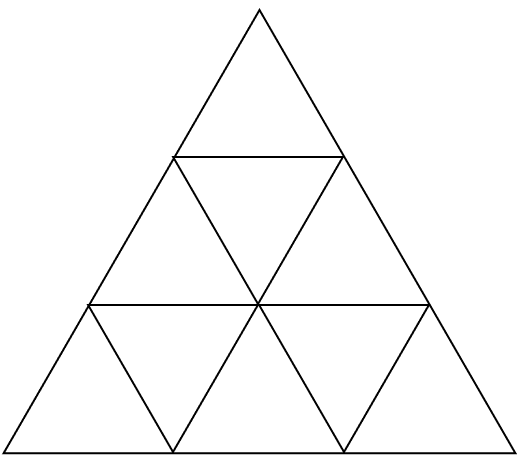
In the adjoining figure, find:
(i) the number of triangles pointing up.
(ii) the total number of triangles.
Answer
The adjoining figure shows a large equilateral triangle whose each side is divided into 3 equal parts, creating a network of 9 unit triangles inside it (6 pointing up and 3 pointing down).
Let us count the triangles of each size carefully.
(i) Triangles pointing up:
- Size 1 (unit upward triangles): There are 6 unit upward triangles.
- Size 2 (formed by 4 unit triangles together): There are 3 such upward triangles.
- Size 3 (the whole large triangle): There is 1 such upward triangle.
Total triangles pointing upwards = 6 + 3 + 1 = 10.
∴ The number of triangles pointing up is 10.
(ii) Triangles pointing down:
- Size 1 (unit downward triangles): There are 3 unit downward triangles.
- No larger downward triangles exist in this figure.
Total downward triangles = 3
Total number of triangles = Triangles pointing up + Triangles pointing down
= 10 + 3 = 13
∴ There are total 13 triangles in the figure.
In the adjoining figure, find the total number of squares.

Answer
The adjoining figure shows a 4 × 4 grid, that is, a large square divided into 16 unit squares by horizontal and vertical lines.
To find the total number of squares, we need to count squares of each possible size separately.
- Squares of size 1 × 1: There are 4 × 4 = 16 such squares.
- Squares of size 2 × 2: There are 3 × 3 = 9 such squares.
- Squares of size 3 × 3: There are 2 × 2 = 4 such squares.
- Squares of size 4 × 4: There is 1 × 1 = 1 such square (the whole figure).
Total number of squares = 16 + 9 + 4 + 1 = 30
∴ There are total 30 squares in the figure.