
Why is it better to use a divider and a ruler than a ruler only, while measuring the length of a line segment?
Answer
When we measure the length of a line segment using a ruler only, the following errors may occur:
(i) The thickness of the ruler may cause an error in measurement.
(ii) The angular positioning of the eye may cause an error in measurement (parallax error).
A divider is a pair of pointers having sharp ends. When we use a divider along with a ruler, the sharp ends of the divider give the exact position of the endpoints of the line segment on the ruler.
Hence, it gives accurate measurement and avoids errors due to the thickness of the ruler or the positioning of the eye (due to angular viewing).
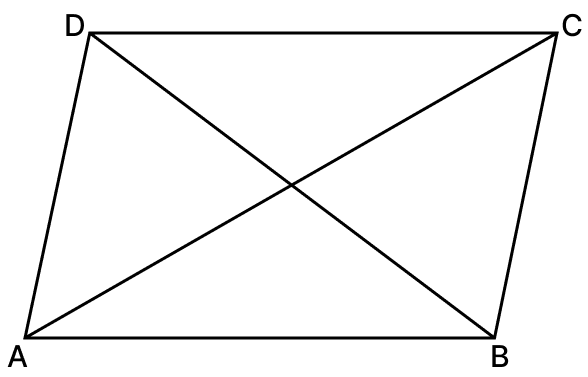
In the adjoining figure, compare the line segments with the help of a divider and fill in the blanks by using the symbol >, = or <:
(i) AB .... CD
(ii) BC .... AB
(iii) AC .... BD
(iv) CD .... BD
Answer
On measuring the given line segments with the help of a divider, we get:
(i) AB = CD
(ii) BC < AB
(iii) AC > BD
(iv) CD < BD
If A, B and C are collinear points such that AB = 6 cm, BC = 4 cm and AC = 10 cm, which one of them lies between the other two?
Answer
Given:
A, B and C are collinear points.
AB = 6 cm, BC = 4 cm, AC = 10 cm
Let's check:
AB + BC = 6 cm + 4 cm = 10 cm = AC
Since AB + BC = AC, point B lies between A and C.
∴ Point B lies between A and C.
In the adjoining figure, verify the following by measurement:

(i) AB + BC = AC
(ii) AC - BC = AB
Answer
On measuring the given line segments with the help of a ruler, we get:
AB = 3 cm, BC = 2 cm, AC = 5 cm
(i) AB + BC = 3 cm + 2 cm = 5 cm = AC
∴ AB + BC = AC is verified.
(ii) AC - BC = 5 cm - 2 cm = 3 cm = AB
∴ AC - BC = AB is verified.
In the adjoining figure, verify by measurement that:

(i) AC + BD = AD + BC
(ii) AB + CD = AD - BC
Answer
On measuring the given line segments with the help of a ruler, we get:
AB = 2 cm, BC = 1 cm, CD = 1.5 cm, AC = 3 cm, BD = 2.5 cm, AD = 4.5 cm
(i) AC + BD = 3 cm + 2.5 cm = 5.5 cm
AD + BC = 4.5 cm + 1 cm = 5.5 cm
∴ AC + BD = AD + BC is verified.
(ii) AB + CD = 2 cm + 1.5 cm = 3.5 cm
AD - BC = 4.5 cm - 1 cm = 3.5 cm
∴ AB + CD = AD - BC is verified.
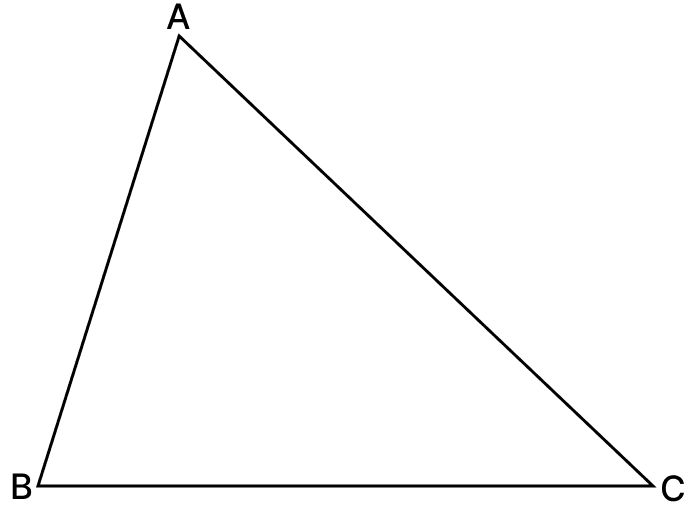
In the adjoining figure, measure the lengths of the sides of the triangle ABC and verify:
(i) AB + BC > AC
(ii) BC + AC > AB
(iii) AC + AB > BC
Answer
On measuring the sides of triangle ABC with the help of a ruler, we get:
AB = 4.5 cm, BC = 5 cm, AC = 3.5 cm
(i) AB + BC = 4.5 cm + 5 cm = 9.5 cm
Since 9.5 cm > 3.5 cm,
∴ AB + BC > AC is verified.
(ii) BC + AC = 5 cm + 3.5 cm = 8.5 cm
Since 8.5 cm > 4.5 cm,
∴ BC + AC > AB is verified.
(iii) AC + AB = 3.5 cm + 4.5 cm = 8 cm
Since 8 cm > 5 cm,
∴ AC + AB > BC is verified.
What fraction of a clockwise revolution does the hour hand of a clock turn through when it goes from:
(i) 4 to 10
(ii) 2 to 5
(iii) 7 to 10
(iv) 8 to 5
(v) 11 to 5
(vi) 6 to 3
Also find the number of right angles turned in each case.
Answer
In one complete revolution, the hour hand of a clock covers 12 hours (numbers).
So, 1 hour movement = of a revolution.
Also, one complete revolution = 4 right angles, so 1 hour = of a right angle and 3 hours = 1 right angle.
(i) From 4 to 10 (clockwise), hour hand moves through 6 hours.
Fraction of revolution = =
Number of right angles = = 2
∴ Fraction of revolution = and number of right angles = 2.
(ii) From 2 to 5 (clockwise), hour hand moves through 3 hours.
Fraction of revolution = =
Number of right angles = = 1
∴ Fraction of revolution = and number of right angles = 1.
(iii) From 7 to 10 (clockwise), hour hand moves through 3 hours.
Fraction of revolution = =
Number of right angles = = 1
∴ Fraction of revolution = and number of right angles = 1.
(iv) From 8 to 5 (clockwise), hour hand moves through 9 hours.
Fraction of revolution = =
Number of right angles = = 3
∴ Fraction of revolution = and number of right angles = 3.
(v) From 11 to 5 (clockwise), hour hand moves through 6 hours.
Fraction of revolution = =
Number of right angles = = 2
∴ Fraction of revolution = and number of right angles = 2.
(vi) From 6 to 3 (clockwise), hour hand moves through 9 hours.
Fraction of revolution = =
Number of right angles = = 3
∴ Fraction of revolution = and number of right angles = 3.
Where will the hour hand of a clock stop if it
(i) starts at 10 and makes of a revolution, clockwise?
(ii) starts at 4 and makes of a revolution, clockwise?
(iii) starts at 4 and makes of a revolution, clockwise?
Answer
One complete revolution of the hour hand = 12 hours.
(i) of a revolution = = 6 hours
Starting from 10 and moving 6 hours clockwise: 10 → 11 → 12 → 1 → 2 → 3 → 4
∴ The hour hand will stop at 4.
(ii) of a revolution = = 3 hours
Starting from 4 and moving 3 hours clockwise: 4 → 5 → 6 → 7
∴ The hour hand will stop at 7.
(iii) of a revolution = = 9 hours
Starting from 4 and moving 9 hours clockwise: 4 → 5 → 6 → 7 → 8 → 9 → 10 → 11 → 12 → 1
∴ The hour hand will stop at 1.
Where will the hour hand of a clock stop if it starts from
(i) 6 and turns through 1 right angle?
(ii) 8 and turns through 2 right angles?
(iii) 10 and turns through 3 right angles?
(iv) 7 and turns through 2 straight angles?
Answer
One complete revolution of the hour hand = 12 hours.
1 right angle = of a revolution = = 3 hours.
1 straight angle = of a revolution = = 6 hours.
(i) Starting from 6 and turning through 1 right angle (3 hours, clockwise): 6 → 7 → 8 → 9
∴ The hour hand will stop at 9.
(ii) Starting from 8 and turning through 2 right angles (6 hours, clockwise): 8 → 9 → 10 → 11 → 12 → 1 → 2
∴ The hour hand will stop at 2.
(iii) Starting from 10 and turning through 3 right angles (9 hours, clockwise): 10 → 11 → 12 → 1 → 2 → 3 → 4 → 5 → 6 → 7
∴ The hour hand will stop at 7.
(iv) Starting from 7 and turning through 2 straight angles (12 hours, clockwise): This is one complete revolution.
∴ The hour hand will stop at 7 (same position).
What fraction of a revolution have you turned through if you stand facing
(i) north and turn clockwise to face west?
(ii) south and turn anti-clockwise to face east?
(iii) east and turn clockwise (or anti-clockwise) to face west?
Also find the number of right angles turned in each case.
Answer
One complete revolution = 4 right angles = 360°.
So, revolution = 1 right angle = 90°.
(i) Facing north and turning clockwise to face west:
The sequence is: North → East → South → West.
This is 3 right angles or of a revolution.
∴ Fraction of revolution = and number of right angles = 3.
(ii) Facing south and turning anti-clockwise to face east:
The sequence is: South → East.
This is 1 right angle or of a revolution.
∴ Fraction of revolution = and number of right angles = 1.
(iii) Facing east and turning (clockwise or anti-clockwise) to face west:
This is 2 right angles or of a revolution.
∴ Fraction of revolution = and number of right angles = 2.
Match the following:
| (i) Straight angle | (a) More than half a revolution |
| (ii) Right angle | (b) Less than one-fourth of a revolution |
| (iii) Complete angle | (c) Half of a revolution |
| (iv) Acute angle | (d) One-fourth of a revolution |
| (v) Obtuse angle | (e) Between 1⁄4 and 1⁄2 of a revolution |
| (vi) Reflex angle | (f) One complete revolution |
Answer
| (i) Straight angle | (c) Half of a revolution |
| (ii) Right angle | (d) One-fourth of a revolution |
| (iii) Complete angle | (f) One complete revolution |
| (iv) Acute angle | (b) Less than one-fourth of a revolution |
| (v) Obtuse angle | (e) Between 1⁄4 and 1⁄2 of a revolution |
| (vi) Reflex angle | (a) More than half a revolution |
Classify the angles whose magnitudes are given below:
(i) 56°
(ii) 125°
(iii) 90°
(iv) 180°
(v) 215°
(vi) 328°
(vii) 89°
(viii) 178°
Answer
(i) 56° lies between 0° and 90°.
∴ 56° is an acute angle.
(ii) 125° lies between 90° and 180°.
∴ 125° is an obtuse angle.
(iii) 90° is exactly a right angle.
∴ 90° is a right angle.
(iv) 180° is exactly a straight angle.
∴ 180° is a straight angle.
(v) 215° lies between 180° and 360°.
∴ 215° is a reflex angle.
(vi) 328° lies between 180° and 360°.
∴ 328° is a reflex angle.
(vii) 89° lies between 0° and 90°.
∴ 89° is an acute angle.
(viii) 178° lies between 90° and 180°.
∴ 178° is an obtuse angle.
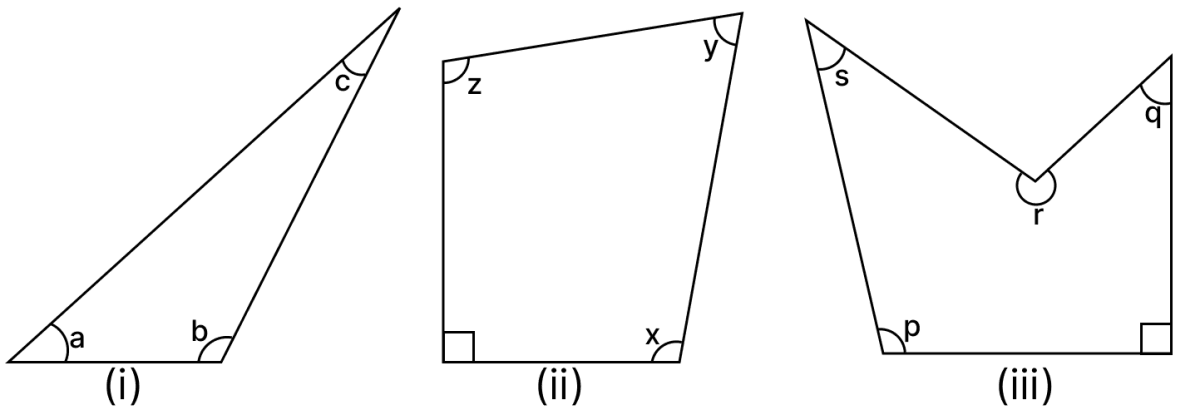
State which of the following angles with a small letter in the following diagrams are acute, which are obtuse and which are reflex:
Answer
(i) In the given figure:
Angle a is less than 90°, so ∠a is acute.
Angle b is greater than 90°, so ∠b is obtuse.
Angle c is less than 90°, so ∠c is acute.
(ii) In the given figure:
∠x is greater than 90°, so ∠x is obtuse.
∠y is less than 90° so ∠y is acute.
∠z is between 90° and 180°, so ∠z is obtuse.
(iii) In the given figure:
∠p is greater than 90°, so ∠p is obtuse.
∠q is less than 90°, so ∠q is acute.
∠r is between 180° and 360°, so ∠r is reflex.
∠s is less than 90°, so ∠s is acute.
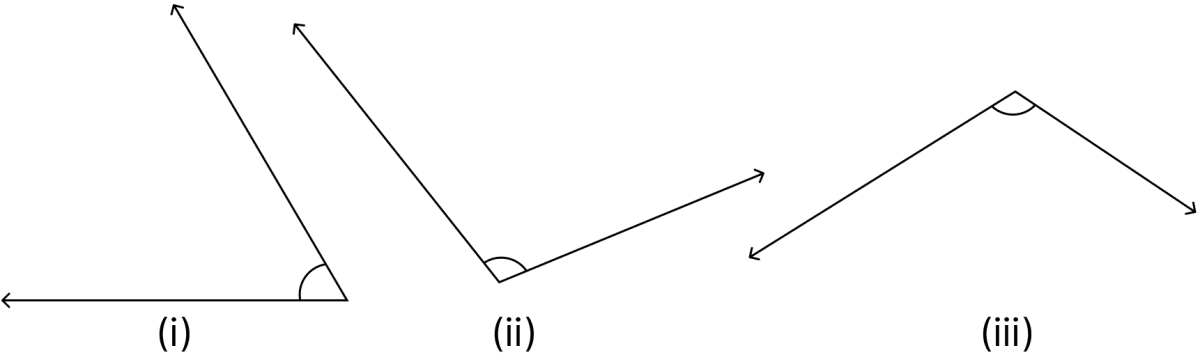
Use your protractor to measure each of the angles marked in the following figures:
Answer
On measuring each of the angles with the help of a protractor, we get:
(i) The measure of the angle = 62°
(ii) The measure of the angle = 116°
(iii) The measure of the angle = 121°
Use your protractor to measure the reflex angles marked in the following figures:
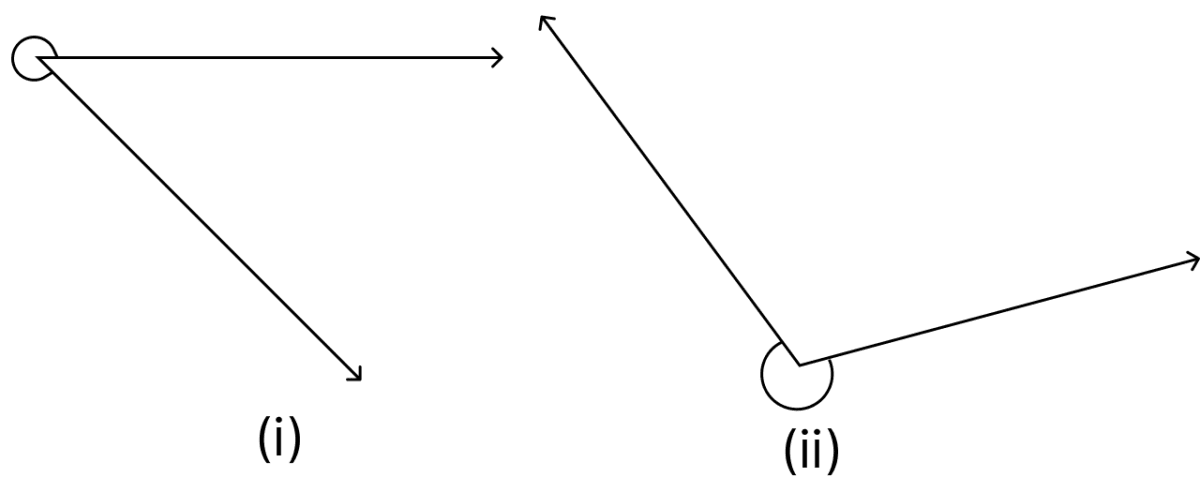
Answer
To measure a reflex angle, we first measure the smaller angle (less than 180°) using a protractor, and then subtract it from 360°.
(i) On measuring the smaller angle, we get 45°.
Reflex angle = 360° - 45° = 315°
(ii) On measuring the smaller angle, we get 125°.
Reflex angle = 360° - 125° = 235°
Find the measure of the angle between the hands of the clock in each figure:
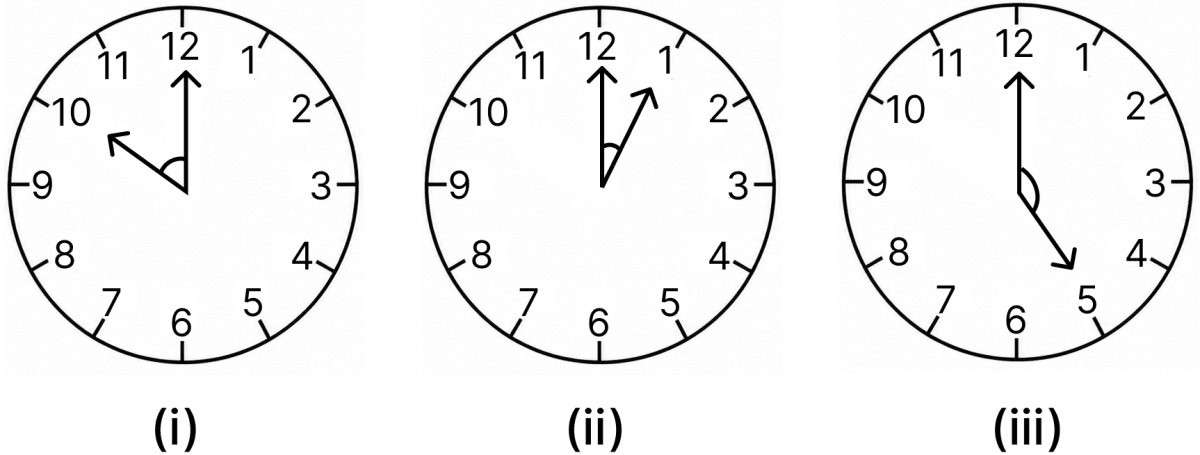
Answer
In a clock, the angle between any two consecutive numbers = = 30°.
(i) The hour hand is at 10 and the minute hand is at 12. The angle covers 2 numbers.
Angle between the hands = 2 × 30° = 60°
(ii) The hour hand is at 12 and the minute hand is at 1. The angle covers 1 number.
Angle between the hands = 1 × 30° = 30°
(iii) The hour hand is at 5 and the minute hand is at 12. The angle covers 5 numbers.
Angle between the hands = 5 × 30° = 150°
Write the measure of the smaller angle formed by the hour and minute hands of a clock at 7 o'clock. Also write the measure of the other angle and also state what types of angles these are.
Answer
At 7 o'clock, the hour hand is at 7 and the minute hand is at 12.
Angle between any two consecutive numbers = = 30°
The smaller angle covers the distance from 7 to 12 (5 numbers in the shorter way).
Smaller angle = 5 × 30° = 150°
The other angle = 360° - 150° = 210°
Since 150° lies between 90° and 180°, the smaller angle 150° is an obtuse angle.
Since 210° lies between 180° and 360°, the other angle 210° is a reflex angle.
There are two set-squares in your geometry box. What are measures of the angles formed at their corners? Do they have any angle measure that is common?
Answer
In a geometry box, there are two set-squares:
(i) One set-square has angles: 30°, 60° and 90°.
(ii) The other set-square has angles: 45°, 45° and 90°.
Yes, both set-squares have a common angle measure of 90° (right angle).
Which of the following are models for perpendicular lines?
(i) The adjacent edges of a postcard.
(ii) The line segment forming the letter 'L'.
(iii) The adjacent edges of your Math book.
(iv) The line segments forming the letter 'V'.
Answer
Two lines are called perpendicular if they intersect at right angles (90°).
(i) The adjacent edges of a postcard meet at right angles.
∴ Yes, they are models for perpendicular lines.
(ii) The line segments forming the letter 'L' meet at right angles.
∴ Yes, they are models for perpendicular lines.
(iii) The adjacent edges of a Math book meet at right angles.
∴ Yes, they are models for perpendicular lines.
(iv) The line segments forming the letter 'V' meet at an acute angle, not at a right angle.
∴ No, they are not models for perpendicular lines.
In the figure given below, line l is perpendicular to line m.
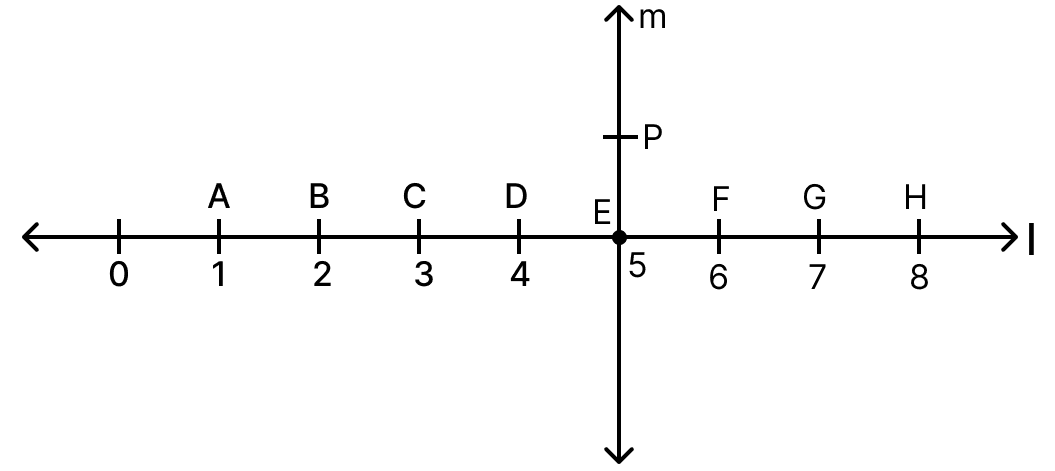
(a) Is CE = EG?
(b) Does bisect segment ?
(c) Identify any two line segments for which is the perpendicular bisector.
(d) Are these true?
(i) AC > FG
(ii) CD = GH
(iii) BC < EG
Answer
From the figure, the points are at positions: A(1), B(2), C(3), D(4), E(5), F(6), G(7), H(8) on line l, and line m is perpendicular to line l at point E.
(a) CE = 5 - 3 = 2 units
EG = 7 - 5 = 2 units
Since CE = EG = 2 units,
∴ Yes, CE = EG.
(b) BE = 5 - 2 = 3 units
EH = 8 - 5 = 3 units
Since BE = EH, point E is the mid-point of . Also, is perpendicular to line l.
∴ Yes, bisects segment .
(c) is perpendicular bisector of any line segment whose midpoint is E and which lies along line l.
For example:
(i) , since DE = EF = 1 unit and .
(ii) , since BE = EH = 3 units and .
∴ is the perpendicular bisector of and .
(d) (i) AC = 3 - 1 = 2 units
FG = 7 - 6 = 1 unit
Since 2 > 1,
∴ AC > FG is True.
(ii) CD = 4 - 3 = 1 unit
GH = 8 - 7 = 1 unit
Since CD = GH,
∴ CD = GH is True.
(iii) BC = 3 - 2 = 1 unit
EG = 7 - 5 = 2 units
Since 1 < 2,
∴ BC < EG is True.
Name the following triangles with regards to sides:
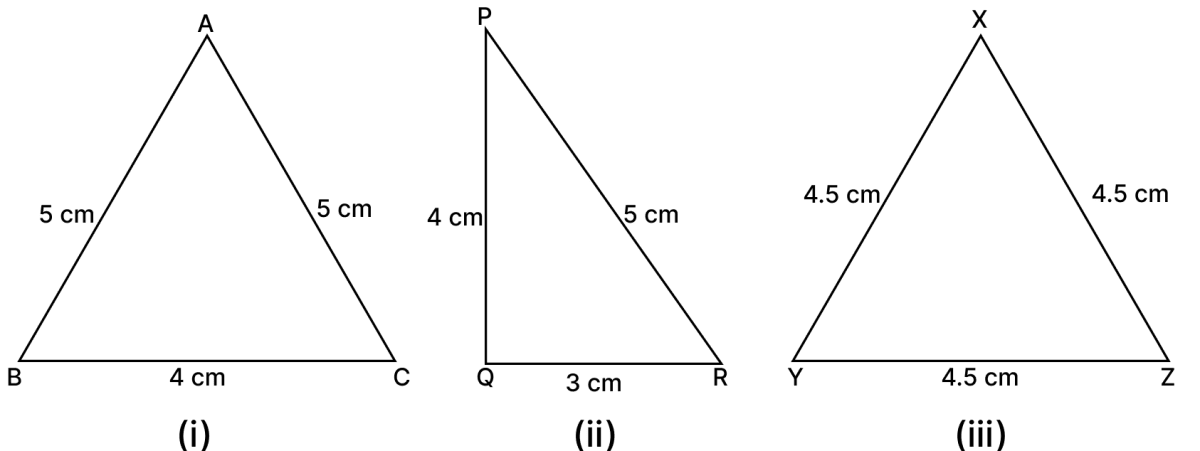
Answer
(i) In triangle ABC, AB = 5 cm, BC = 4 cm and AC = 5 cm.
Since two sides (AB and AC) are equal,
∴ Triangle ABC is an isosceles triangle.
(ii) In triangle PQR, PQ = 4 cm, QR = 3 cm and RP = 5 cm.
Since all three sides are different in length,
∴ Triangle PQR is a scalene triangle.
(iii) In triangle XYZ, XY = 4.5 cm, YZ = 4.5 cm and XZ = 4.5 cm.
Since all three sides are equal in length,
∴ Triangle XYZ is an equilateral triangle.
Name the following triangles with regards to angles:
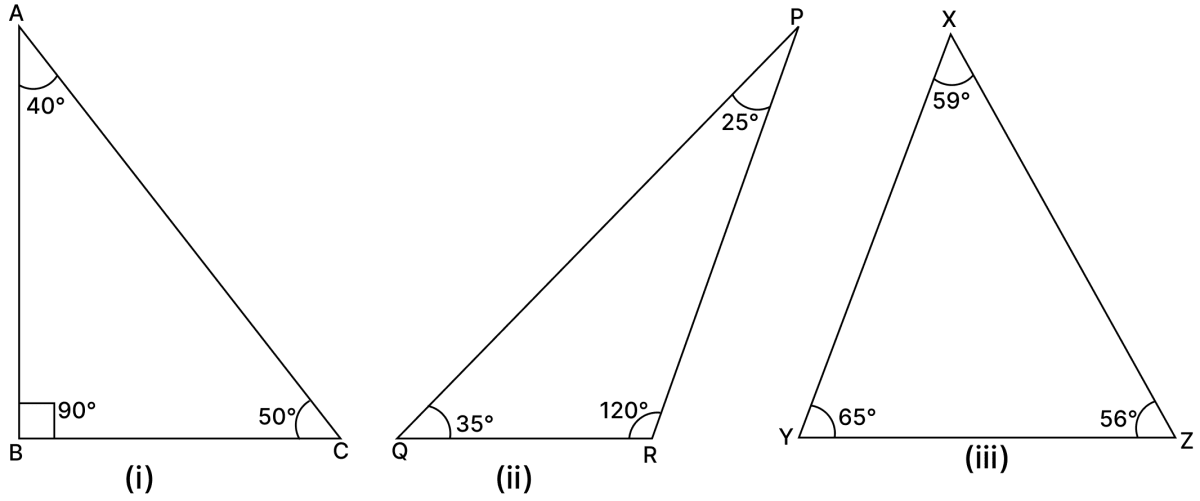
Answer
(i) In triangle ABC, ∠A = 40°, ∠B = 90° and ∠C = 50°.
Since one angle (∠B) is a right angle,
∴ Triangle ABC is a right-angled triangle.
(ii) In triangle PQR, ∠P = 25°, ∠Q = 35° and ∠R = 120°.
Since one angle (∠R) is greater than 90° (obtuse),
∴ Triangle PQR is an obtuse-angled triangle.
(iii) In triangle XYZ, ∠X = 59°, ∠Y = 65° and ∠Z = 56°.
Since all three angles are less than 90° (acute),
∴ Triangle XYZ is an acute-angled triangle.
Name each of the following triangles in two different ways (you may judge the nature of the angle by observation):
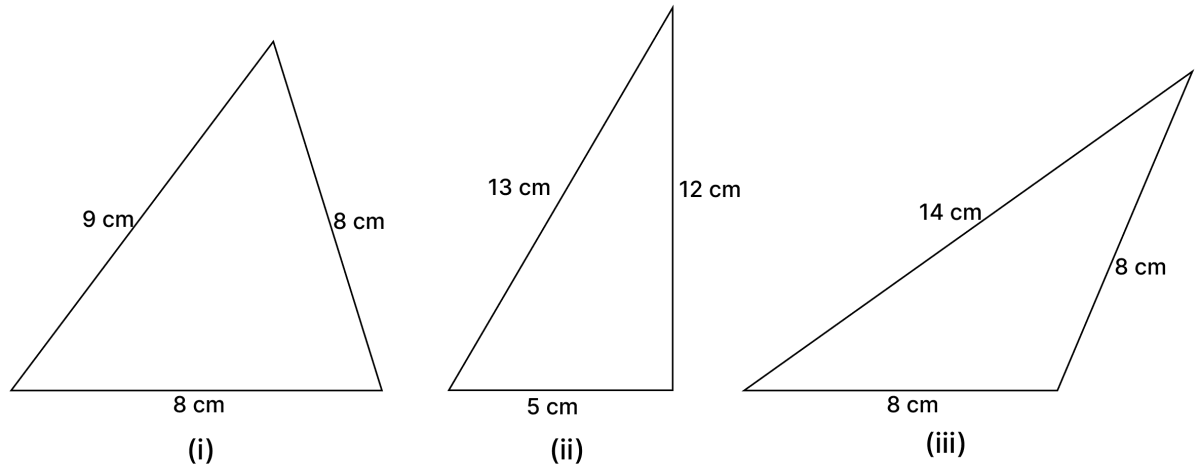
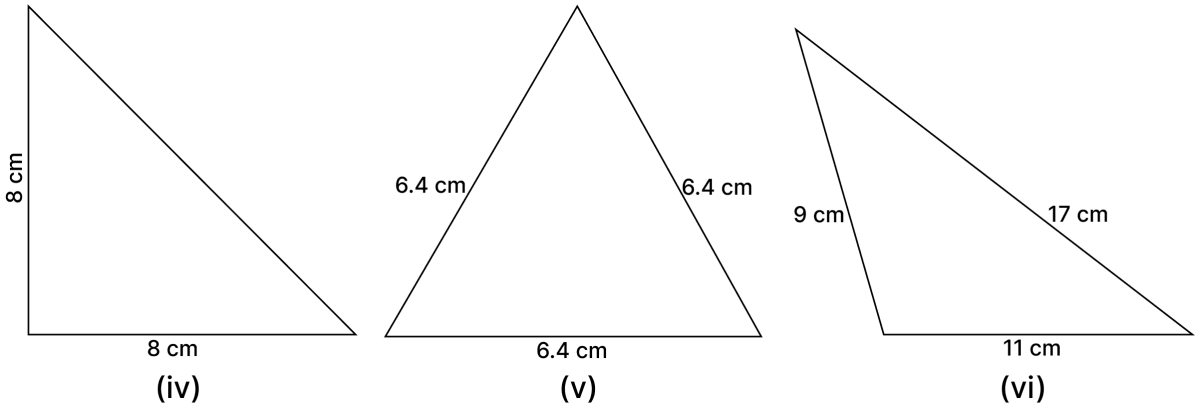
Answer
(i) The triangle has sides 9 cm, 8 cm and 8 cm. Two sides are equal and all angles appear less than 90°.
∴ It is an isosceles acute-angled triangle.
(ii) The triangle has sides 13 cm, 12 cm and 5 cm. All sides are different and the angle opposite to the longest side is 90°.
Check: 52 + 122 = 25 + 144 = 169 = 132
∴ It is a scalene right-angled triangle.
(iii) The triangle has sides 14 cm, 8 cm, 8 cm and an obtuse angle (the angle appears greater than 90°). Two sides are same and one angle is obtuse.
∴ It is an isosceles obtuse-angled triangle.
(iv) The triangle has sides 8 cm and 8 cm with the included angle 90°. Two sides are equal and one angle is right.
∴ It is an isosceles right-angled triangle.
(v) The triangle has all sides equal to 6.4 cm. All three sides are equal so all angles are 60° (acute).
∴ It is an equilateral acute-angled triangle.
(vi) The triangle has sides 11 cm, 9 cm and 17 cm. All sides are different.
Check: 92 + 112 = 81 + 121 = 202 < 172 = 289
So, the angle opposite to the longest side is obtuse.
∴ It is a scalene obtuse-angled triangle.
Match the following:
| Measures of triangles | Types of triangles |
|---|---|
| (i) 3 sides of equal length | (a) Scalene |
| (ii) 2 sides of equal length | (b) Isosceles right-angled |
| (iii) all sides of different length | (c) Obtuse-angled |
| (iv) 3 acute angles | (d) Right-angled |
| (v) 1 right angle | (e) Equilateral |
| (vi) 1 obtuse angle | (f) Acute-angled |
| (vii) 1 right angle with two sides of equal length | (g) Isosceles |
Answer
| Measures of triangles | Types of triangles |
|---|---|
| (i) 3 sides of equal length | (e) Equilateral |
| (ii) 2 sides of equal length | (g) Isosceles |
| (iii) All sides of different length | (a) Scalene |
| (iv) 3 acute angles | (f) Acute-angled |
| (v) 1 right angle | (d) Right-angled |
| (vi) 1 obtuse angle | (c) Obtuse-angled |
| (vii) 1 right angle with two sides of equal length | (b) Isosceles right-angled |
State which of the following statements are true and which are false:
(i) A triangle can have two right angles.
(ii) A triangle cannot have more than one obtuse angle.
(iii) A triangle has at least two acute angles.
(iv) If all the three sides of a triangle are equal, it is called a scalene triangle.
(v) A triangle has four sides.
(vi) An isosceles triangle is an equilateral triangle also.
(vii) An equilateral triangle is an isosceles triangle also.
(viii) A scalene triangle has all its angles equal.
Answer
(i) False
Reason — The sum of angles of a triangle is 180°. If a triangle had two right angles, their sum alone would be 180°, leaving 0° for the third angle, which is not possible.
(ii) True
Reason — If a triangle had two obtuse angles (each greater than 90°), their sum alone would exceed 180°, which violates the angle sum property.
(iii) True
Reason — Since the sum of angles of a triangle is 180°, a triangle can have at most one angle that is right or obtuse. So at least two angles must be acute.
(iv) False
Reason — If all three sides of a triangle are equal, it is called an equilateral triangle, not a scalene triangle.
(v) False
Reason — A triangle has three sides, not four.
(vi) False
Reason — An isosceles triangle has only two sides equal, so it is not necessarily an equilateral triangle (which has all three sides equal).
(vii) True
Reason — An equilateral triangle has all three sides equal, which means it has at least two equal sides. So it is also an isosceles triangle.
(viii) False
Reason — A scalene triangle has all sides of different lengths, so all its angles are also different (not equal).
State whether the following statements are true (T) or false (F):
(i) Each angle of a rectangle is a right angle.
(ii) The opposite sides of a rectangle are equal in length.
(iii) The diagonals of a square are perpendicular to one another.
(iv) All sides of a rhombus are equal in length.
(v) All sides of a parallelogram are equal in length.
(vi) The opposite sides of a trapezium are parallel.
(vii) The diagonals of a parallelogram are equal.
Answer
(i) True
Reason — By definition, all four interior angles of a rectangle are right angles (90°).
(ii) True
Reason — Since every rectangle is a parallelogram, its opposite sides are equal in length.
(iii) True
Reason — The diagonals of a square intersect at right angles (since a square is also a rhombus).
(iv) True
Reason — By definition, all four sides of a rhombus are equal in length.
(v) False
Reason — In a parallelogram, only opposite sides are equal in length, not all sides. If all sides are equal, it becomes a rhombus.
(vi) False
Reason — In a trapezium, only one pair of opposite sides is parallel, not both pairs.
(vii) False
Reason — The diagonals of a parallelogram bisect each other but are not necessarily equal. They are equal only in a rectangle or a square.
Examine whether the following figures are polygons. Give reasons.
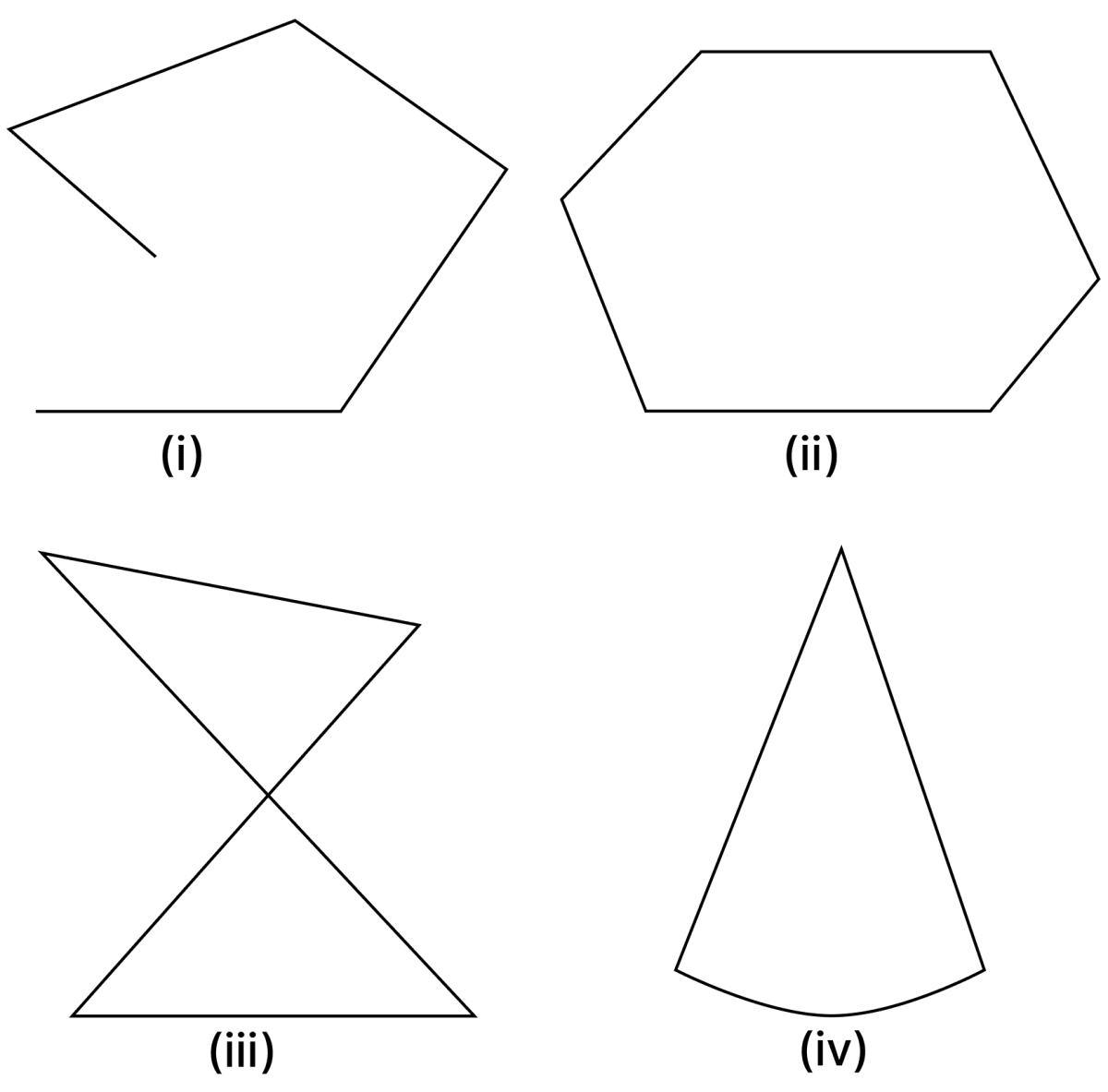
Answer
A polygon is a closed plane figure made up of line segments only.
(i) The figure is not a polygon because it is not closed (has an open part).
(ii) The figure is a polygon because it is a simple closed figure made up of line segments.
(iii) The figure is not a polygon because it is not a simple curve; its line segments cross each other (it is self-intersecting).
(iv) The figure is not a polygon because it contains a curved line.
Name each of the following polygons:
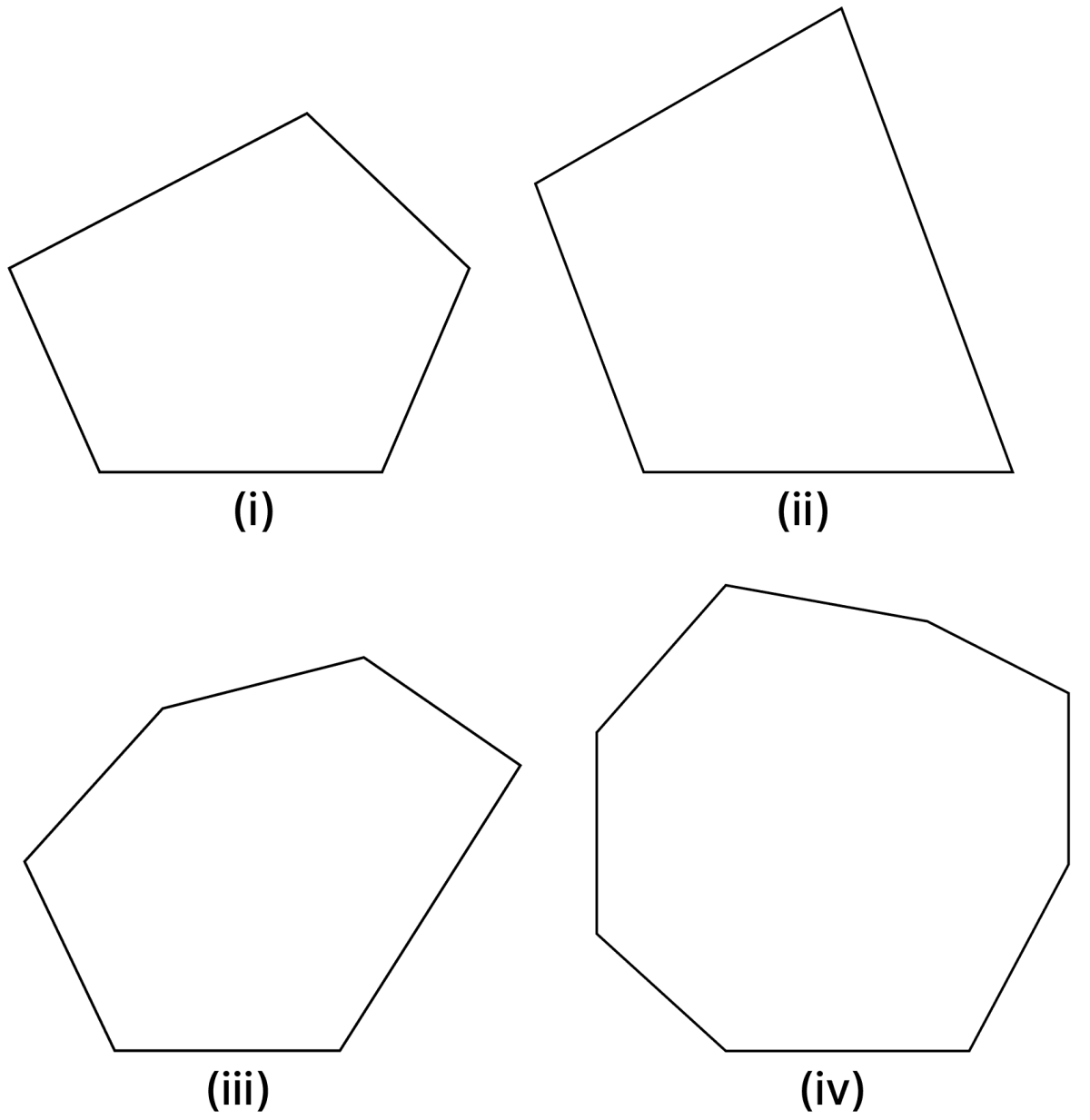
Answer
A polygon is named according to the number of sides it has.
(i) The polygon has 5 sides.
∴ It is a pentagon.
(ii) The polygon has 4 sides.
∴ It is a quadrilateral.
(iii) The polygon has 6 sides.
∴ It is a hexagon.
(iv) The polygon has 8 sides.
∴ It is an octagon.
Draw a rough sketch of a pentagon and draw its diagonals.
Answer
A pentagon has 5 sides. The diagonals are line segments joining non-adjacent vertices. A pentagon has 5 diagonals.
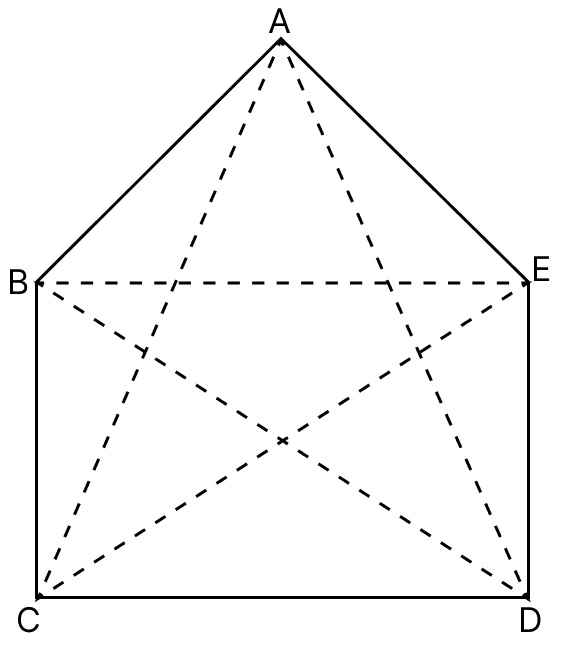
In the figure, ABCDE is a pentagon. Its diagonals are AC, AD, BD, BE and CE.
Draw a rough sketch of a regular hexagon. Connecting three of its vertices draw:
(i) an isosceles triangle
(ii) a right-angled triangle.
Answer
A regular hexagon has 6 equal sides and 6 equal interior angles.
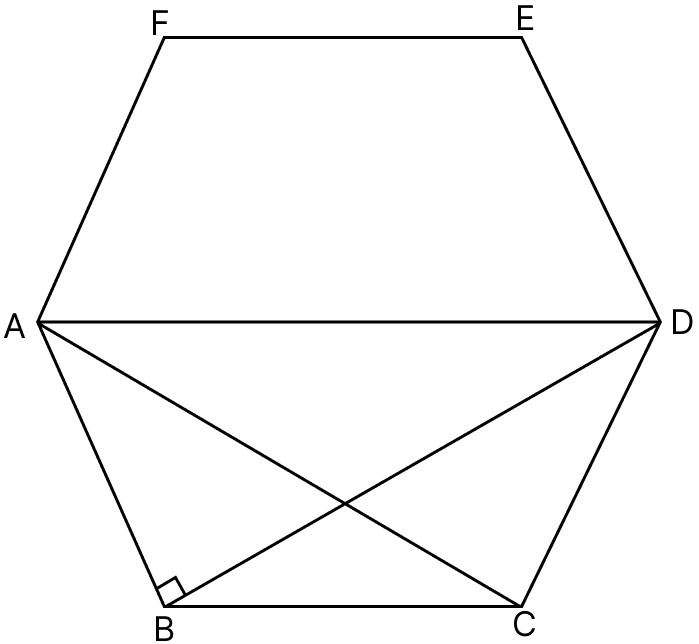
(i) Isosceles triangle: Connecting vertices A, B and C of the hexagon ABCDEF, we get triangle ABC in which two sides are equal. So, ABC is an isosceles triangle.
(ii) Right-angled triangle: Connecting vertices A, B and D of hexagon ABCDEF (where AD is a diameter of the hexagon).
As we know that all interior angles of a regular hexagon = 120°. Since, all sides of a regular hexagon are equal that means BC = CD, therefore, BCD is an isosceles triangle,
∠CBD = ∠CDB (Angles opposite to equal sides are equal)
As this is a regular hexagon, ∠C = 120°
Now sum of all angles of triangle BCD,
∠CBD + ∠CDB + ∠C = 180°
2∠CBD + 120° = 180°
2∠CBD = 180° - 120° = 60°
∠CBD = 30°
As, ∠ABD + ∠CBD = ∠B = 120°
∠ABD + 30° = ∠B = 120°
∠ABD = 120° - 30°
∠ABD = 90°
So, we get a right-angled triangle ABD with the right angle at B.
Can you identify the regular quadrilateral?
Answer
A regular polygon is one in which all sides are equal in length and all angles are equal in measure.
A quadrilateral has 4 sides. The quadrilateral having all 4 sides equal and all 4 angles equal (90° each) is a square.
∴ The regular quadrilateral is a square.
What is the shape of
(i) your geometry box?
(ii) a brick?
(iii) a matchbox?
(iv) a drum?
(v) a playing die?
(vi) a sweet laddu?
Answer
(i) The shape of a geometry box is a cuboid.
(ii) The shape of a brick is a cuboid.
(iii) The shape of a matchbox is a cuboid.
(iv) The shape of a drum is a cylinder.
(v) The shape of a playing die is a cube.
(vi) The shape of a sweet laddu is a sphere.
Match the following:
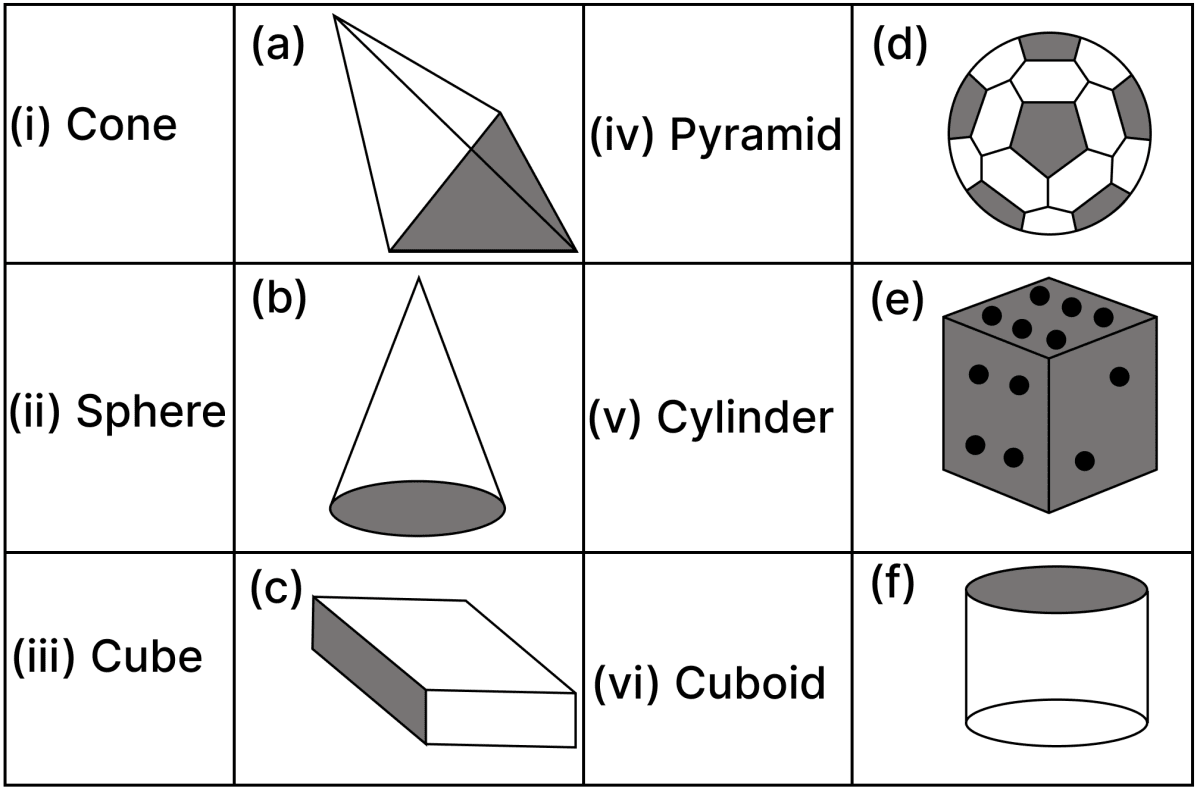
Answer
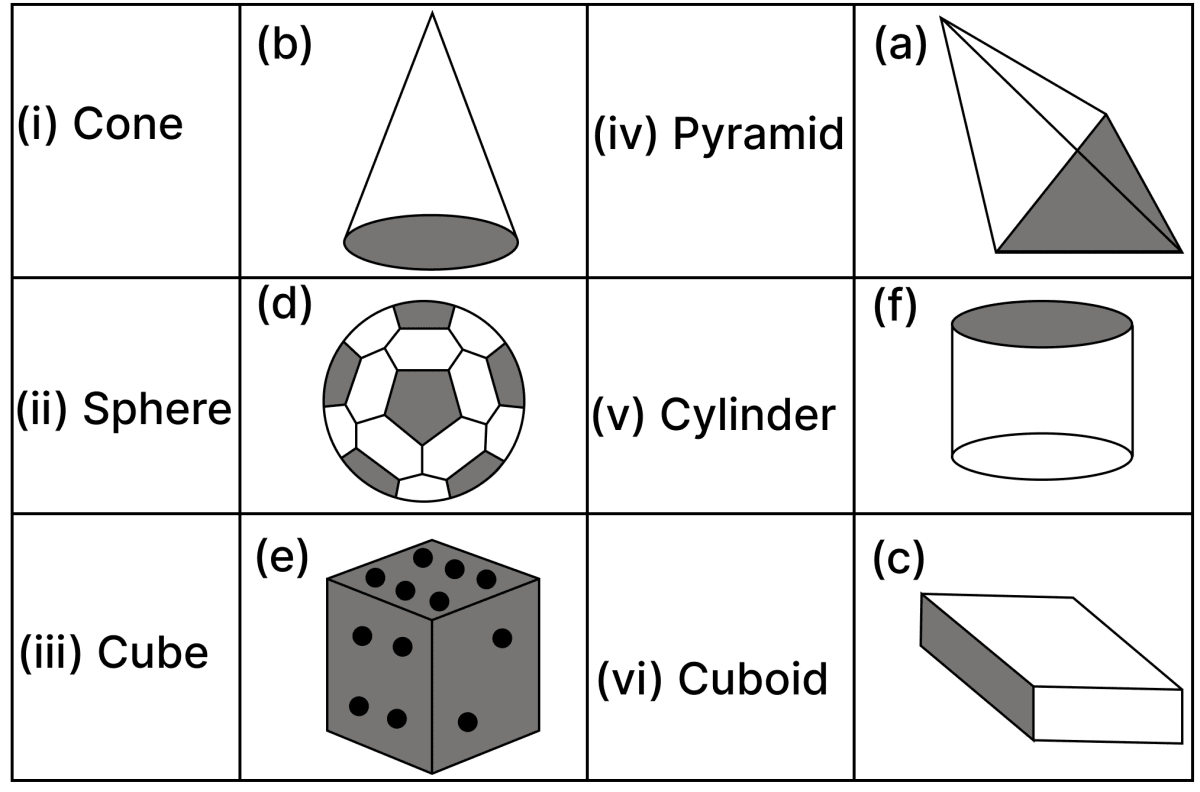
Fill in the blanks:
(i) A cube has ..... square faces, ..... edges and ..... vertices.
(ii) A triangular prism has ..... triangular faces, ..... rectangular faces, ..... edges and ..... vertices.
(iii) A triangular pyramid has ..... faces, ..... edges and ..... vertices.
Answer
(i) A cube has 6 square faces, 12 edges and 8 vertices.
(ii) A triangular prism has 2 triangular faces, 3 rectangular faces, 9 edges and 6 vertices.
(iii) A triangular pyramid has 4 faces, 6 edges and 4 vertices.
Fill in the following blanks:
(i) An angle whose measure is less than that of a right angle is .....
(ii) An angle greater than 180° and less than a complete angle is called ... .
(iii) An angle whose measure is the sum of the measures of two right angles is ..... .
(iv) When the sum of measures of two angles is that of a right angle, then each one of them is .....
(v) When the sum of measures of two angles is that of a straight angle and if one of them is acute then the other is ..... .
(vi) A triangle having one of its angles as right angle and with lengths of two sides equal is called ..... triangle.
(vii) A cuboid has ..... faces, ..... edges and ..... vertices.
(viii) A rectangular pyramid has ..... faces, ..... edges and ..... vertices.
Answer
(i) An angle whose measure is less than that of a right angle is an acute angle.
(ii) An angle greater than 180° and less than a complete angle is called a reflex angle.
(iii) An angle whose measure is the sum of the measures of two right angles is a straight angle (since 90° + 90° = 180°).
(iv) When the sum of measures of two angles is that of a right angle, then each one of them is an acute angle.
(v) When the sum of measures of two angles is that of a straight angle and if one of them is acute, then the other is an obtuse angle.
(vi) A triangle having one of its angles as right angle and with lengths of two sides equal is called an isosceles right-angled triangle.
(vii) A cuboid has 6 faces, 12 edges and 8 vertices.
(viii) A rectangular pyramid has 5 faces, 8 edges and 5 vertices.
State whether the following statements are true (T) or false (F):
(i) Each angle of an equilateral triangle is a right angle.
(ii) The adjacent sides of a rectangle are equal in length.
(iii) The diagonals of a rectangle are equal in length.
(iv) The diagonals of a rectangle are perpendicular to one another.
(v) The diagonals of a rhombus are equal in length.
(vi) Any three line segments make up a triangle.
(vii) All the faces of a triangular prism are triangles.
(viii) All the faces of a triangular pyramid are triangles.
Answer
(i) False
Reason — Each angle of an equilateral triangle is 60°, not 90° (right angle).
(ii) False
Reason — In a rectangle, only opposite sides are equal in length, not adjacent sides. If adjacent sides are equal, it becomes a square.
(iii) True
Reason — The diagonals of a rectangle are equal in length.
(iv) False
Reason — The diagonals of a rectangle bisect each other but are not perpendicular. They are perpendicular only in a square.
(v) False
Reason — The diagonals of a rhombus bisect each other at right angles but are generally not equal in length. They are equal only in a square.
(vi) False
Reason — Three line segments can form a triangle only if the sum of the lengths of any two sides is greater than the third side (triangle inequality).
(vii) False
Reason — A triangular prism has 2 triangular faces and 3 rectangular faces, so not all faces are triangles.
(viii) True
Reason — A triangular pyramid (tetrahedron) has 4 triangular faces — 1 triangular base and 3 triangular side faces.
State whether the following statement is true or false. Justify your answer.
'An angle whose measure is greater than that of a right angle is obtuse'.
Answer
False
Justification — An angle greater than a right angle (90°) need not be an obtuse angle. An obtuse angle lies strictly between 90° and 180°. Angles greater than 90° also include:
Straight angle (exactly 180°)
Reflex angle (between 180° and 360°)
Complete angle (exactly 360°)
For example, 200° is greater than 90° but it is a reflex angle, not an obtuse angle.
∴ The given statement is false.
Comparison of lengths is possible in case of
two lines
two line segments
two rays
a ray and a line segment
Answer
A line extends infinitely in both directions, and a ray extends infinitely in one direction. So lengths of lines and rays cannot be measured.
Only line segments have finite definite lengths that can be compared.
Hence, option 2 is the correct option.
A reflex angle measures
more than 90° but less than 180°
more than 180° but less than 270°
more than 180° but less than 360°
none of these
Answer
By definition, a reflex angle is an angle whose measure lies between 180° and 360°.
Hence, option 3 is the correct option.
A scalene triangle cannot be
an acute-angled triangle
an obtuse-angled triangle
a right-angled triangle
an equilateral triangle
Answer
A scalene triangle has all three sides of different lengths. An equilateral triangle has all three sides equal.
So a scalene triangle cannot be an equilateral triangle (these are mutually exclusive).
Hence, option 4 is the correct option.
An obtuse-angled triangle can be
right-angled
isosceles
equilateral
none of these
Answer
An obtuse-angled triangle has one obtuse angle (greater than 90°).
It cannot be right-angled (already has obtuse angle, sum would exceed 180°).
It cannot be equilateral (equilateral has all 60° angles, all acute).
It can be isosceles (e.g., 100°, 40°, 40° — two equal angles, two equal sides).
Hence, option 2 is the correct option.
If you are facing north and turn through of a turn in anti-clockwise direction, in which direction will you face?
east
south
west
north
Answer
of a turn = 3 right angles.
Facing north and turning anti-clockwise:
North → West (1 right angle) → South (2 right angles) → East (3 right angles)
Hence, option 1 is the correct option.
Open any two adjacent fingers of your hand. What kind of angle you get?
acute
right
obtuse
straight
Answer
When we open two adjacent fingers of the hand, the angle formed between them is less than 90°.
∴ The angle is an acute angle.
Hence, option 1 is the correct option.
If the sum of two angles is an obtuse angle, then which of the following is not possible?
one right angle and one acute angle
one obtuse angle and one acute angle
two acute angles
two right angles
Answer
An obtuse angle is between 90° and 180°.
Right angle (90°) + acute angle (e.g., 20°) = 110° (obtuse) — possible.
Obtuse angle (e.g., 100°) + acute angle (e.g., 20°) = 120° (obtuse) — possible.
Two acute angles (e.g., 60° + 60°) = 120° (obtuse) — possible.
Two right angles = 90° + 90° = 180° (straight angle, not obtuse) — not possible.
Hence, option 4 is the correct option.
If the sum of two angles is greater than 180°, then which of the following is not possible?
two obtuse angles
two right angles
one obtuse and one acute angle
one reflex and one acute angle
Answer
Two obtuse angles (each > 90°): sum > 180° — possible.
Two right angles: 90° + 90° = 180° (not greater than 180°) — not possible.
Obtuse (e.g., 120°) + acute (e.g., 70°) = 190° > 180° — possible.
Reflex angle (> 180°) + acute angle: sum > 180° always — possible.
Hence, option 2 is the correct option.
Which of the following statements is false?
Every equilateral triangle is an isosceles triangle.
Every isosceles triangle is an equilateral triangle.
Every parallelogram is a trapezium.
Every trapezium is a quadrilateral.
Answer
Every equilateral triangle is an isosceles triangle — True (it has at least two equal sides).
Every isosceles triangle is an equilateral triangle — False (isosceles only has 2 sides equal; equilateral has all 3 sides equal).
Every parallelogram is a trapezium — True (it has at least one pair of parallel sides).
Every trapezium is a quadrilateral — True (it has 4 sides).
Hence, option 2 is the correct option.
Which of the following statements is correct?
Every rhombus is a square.
Every parallelogram is a rectangle.
Every square is a rhombus.
Every rectangle is a square.
Answer
Every rhombus is a square — False (a rhombus has all sides equal but not necessarily right angles).
Every parallelogram is a rectangle — False (a parallelogram does not necessarily have right angles).
Every square is a rhombus — True (a square has all four sides equal, which is the defining property of a rhombus).
Every rectangle is a square — False (a rectangle has opposite sides equal but not necessarily all sides equal).
Hence, option 3 is the correct option.
A quadrilateral whose each angle is a right angle is a
trapezium
parallelogram
rhombus
rectangle
Answer
A quadrilateral with each angle equal to 90° (a right angle) is by definition a rectangle.
Hence, option 4 is the correct option.
If a solid shape is completely bounded by plane faces, then the least number of faces it may have is
3
4
5
6
Answer
A solid bounded by plane faces is called a polyhedron. The minimum number of faces needed to enclose a 3-D region with plane faces is 4 (as in a tetrahedron or triangular pyramid).
A triangular pyramid (tetrahedron) has exactly 4 triangular faces.
Hence, option 2 is the correct option.
Statement I: From 8:00 PM to 8:50 PM, the minute hand of a clock covers an angle of 300°.
Statement II: .
Statement I is true but statement II is false.
Statement I is false but statement II is true.
Both Statement I and statement II are true.
Both Statement I and statement II are false.
Answer
Statement I:
From 8:00 PM to 8:50 PM, the minute hand moves through 50 minutes.
In 60 minutes (1 full revolution), the minute hand covers 360°.
In 50 minutes, the minute hand covers = = = 300°.
∴ Statement I is true.
Statement II:
= = = 300°.
∴ Statement II is true.
Both statements are true.
Hence, option 3 is the correct option.
Statement I: The sum of two right angles and one acute angle is a reflex angle.
Statement II: 135° is an obtuse angle.
Statement I is true but statement II is false.
Statement I is false but statement II is true.
Both Statement I and statement II are true.
Both Statement I and statement II are false.
Answer
Statement I:
Sum of two right angles + one acute angle = 90° + 90° + acute angle = 180° + acute angle.
Since an acute angle is between 0° and 90°, the sum lies between 180° and 270°, which is a reflex angle.
∴ Statement I is true.
Statement II:
135° lies between 90° and 180°, so 135° is an obtuse angle.
∴ Statement II is true.
Both statements are true.
Hence, option 3 is the correct option.
Statement I: An equilateral triangle is an isosceles triangle as well.
Statement II: In an equilateral triangle, all the sides are equal, but in an isosceles triangle at least two sides are equal.
Statement I is true but statement II is false.
Statement I is false but statement II is true.
Both Statement I and statement II are true.
Both Statement I and statement II are false.
Answer
Statement I:
An equilateral triangle has all three sides equal, which means it also has at least two sides equal. So every equilateral triangle is also an isosceles triangle.
∴ Statement I is true.
Statement II:
In an equilateral triangle, all three sides are equal. In an isosceles triangle, at least two sides are equal.
∴ Statement II is true.
Both statements are true and Statement II is the correct explanation of Statement I.
Hence, option 3 is the correct option.
Statement I: Every rhombus is a parallelogram.
Statement II: The opposite sides of a parallelogram, as well as a rhombus, are parallel to each other.
Statement I is true but statement II is false.
Statement I is false but statement II is true.
Both Statement I and statement II are true.
Both Statement I and statement II are false.
Answer
Statement I:
A rhombus is a parallelogram with two adjacent sides equal (in fact, all sides equal). So every rhombus is a parallelogram.
∴ Statement I is true.
Statement II:
In a parallelogram, both pairs of opposite sides are parallel. Since a rhombus is a parallelogram, the same is true for a rhombus.
∴ Statement II is true.
Both statements are true.
Hence, option 3 is the correct option.
Statement I: A cube is a special cuboid in which the length, width and height are equal.
Statement II: A cuboid has 6 faces, 12 edges and 6 vertices.
Statement I is true but statement II is false.
Statement I is false but statement II is true.
Both Statement I and statement II are true.
Both Statement I and statement II are false.
Answer
Statement I:
A cube is a special cuboid in which length, width and height are all equal.
∴ Statement I is true.
Statement II:
A cuboid has 6 faces, 12 edges and 8 vertices (not 6 vertices).
∴ Statement II is false.
Hence, option 1 is the correct option.
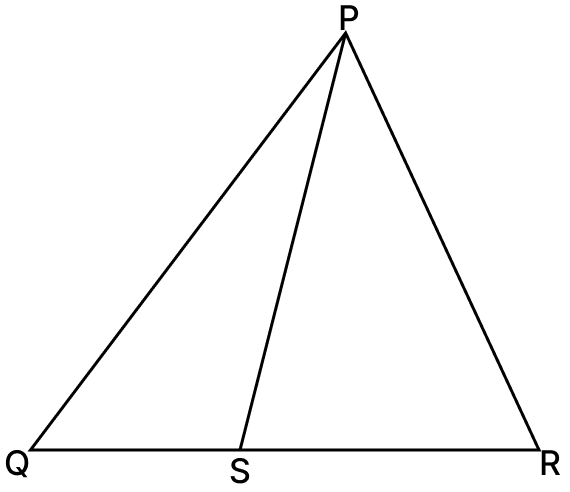
In the adjoining figure, identify the longest and shortest line segments by measuring their lengths.
Answer
On measuring the line segments in the figure (triangle PQR with point S on QR), we get:
PQ = 5 cm
PR = 6 cm
PS = 4 cm
QS = 3 cm
SR = 4 cm
QR = 7 cm
The longest line segment is QR (7 cm).
The shortest line segment is QS (3 cm).
Where will the hour hand of a clock stop if it starts from 10 and turns through 3 right angles?
Answer
1 right angle = of a revolution = 3 hours (since one full revolution = 12 hours).
3 right angles = 3 × 3 = 9 hours.
Starting from 10 and moving 9 hours clockwise:
10 → 11 → 12 → 1 → 2 → 3 → 4 → 5 → 6 → 7
∴ The hour hand will stop at 7.
Classify the angles whose measures are given below:
(i) 56°
(ii) 125°
(iii) 90°
(iv) 180°
(v) 215°
(vi) 328°
Answer
(i) 56° lies between 0° and 90°.
∴ 56° is an acute angle.
(ii) 125° lies between 90° and 180°.
∴ 125° is an obtuse angle.
(iii) 90° is exactly a right angle.
∴ 90° is a right angle.
(iv) 180° is exactly a straight angle.
∴ 180° is a straight angle.
(v) 215° lies between 180° and 360°.
∴ 215° is a reflex angle.
(vi) 328° lies between 180° and 360°.
∴ 328° is a reflex angle.
Name the types of the following triangles:
(i) ΔABC with AB = 8 cm, AC = 7 cm and BC = 5.5 cm.
(ii) ΔPQR with PQ = RP = 5 cm and QR = 7.3 cm.
(iii) ΔDEF with ∠D = 90°.
(iv) ΔXYZ with ∠Y = 90° and XY = YZ.
(v) ΔLMN with ∠L = 30°, ∠M = 70° and ∠N = 80°.
Answer
(i) In ΔABC, AB = 8 cm, AC = 7 cm and BC = 5.5 cm.
Since all three sides are different,
∴ ΔABC is a scalene triangle.
(ii) In ΔPQR, PQ = RP = 5 cm and QR = 7.3 cm.
Since two sides (PQ and RP) are equal,
∴ ΔPQR is an isosceles triangle.
(iii) In ΔDEF, ∠D = 90°.
Since one angle is a right angle,
∴ ΔDEF is a right-angled triangle.
(iv) In ΔXYZ, ∠Y = 90° and XY = YZ.
Since one angle is a right angle and two sides are equal,
∴ ΔXYZ is an isosceles right-angled triangle.
(v) In ΔLMN, ∠L = 30°, ∠M = 70° and ∠N = 80°.
Since all three angles are less than 90° (all acute), and all are different,
∴ ΔLMN is an acute-angled triangle.
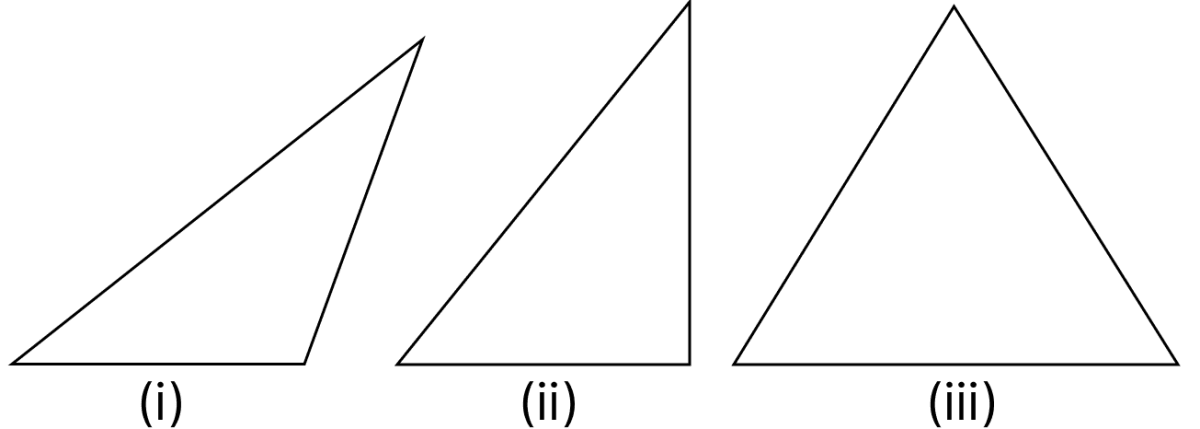
Name each of the following triangles in two different ways (you may use ruler and protractor):
Answer
On measuring the sides and angles of each triangle using ruler and protractor, we get:
(i) The triangle has 2 same sides and one side is different and one angle is obtuse (greater than 90°).
∴ It is an isosceles obtuse-angled triangle.
(ii) The triangle has all three sides different and one angle is a right angle (90°).
∴ It is a scalene right-angled triangle.
(iii) The triangle has two sides equal and all three angles are acute (less than 90°).
∴ It is an isosceles acute-angled triangle.
State whether the following statements are true or false:
(i) A rectangle is a regular quadrilateral.
(ii) A rhombus is a regular quadrilateral.
(iii) Every parallelogram is a rhombus.
(iv) The diagonals of a rhombus intersect at right angles.
(v) A polygon having 6 sides is called an octagon.
(vi) A road roller has two plane circular faces and one curved face.
(vii) A rectangular pyramid has 5 rectangular faces.
Answer
(i) False
Reason — A regular quadrilateral has all sides equal and all angles equal. A rectangle has all angles equal (90° each) but not all sides equal. So a rectangle is not a regular quadrilateral.
(ii) False
Reason — A rhombus has all sides equal but its angles are not necessarily equal. So a rhombus is not a regular quadrilateral.
(iii) False
Reason — A parallelogram has both pairs of opposite sides equal but not all sides equal in general. A rhombus has all four sides equal. So every parallelogram is not a rhombus.
(iv) True
Reason — The diagonals of a rhombus always intersect each other at right angles.
(v) False
Reason — A polygon with 6 sides is called a hexagon, not an octagon. An octagon has 8 sides.
(vi) True
Reason — A road roller is in the shape of a cylinder, which has two plane circular faces and one curved face.
(vii) False
Reason — A rectangular pyramid has 1 rectangular base and 4 triangular faces, making 5 faces in total. Only 1 face is rectangular, not all 5.
If the lengths of two sides of an isosceles triangle are 3 cm and 7 cm, then what is the length of the third side?
Answer
In an isosceles triangle, two sides are equal. The third side must be either 3 cm or 7 cm.
Case 1: If the sides are 3 cm, 3 cm and 7 cm.
Sum of two smaller sides = 3 cm + 3 cm = 6 cm
Since 6 cm < 7 cm, the triangle inequality (sum of two sides must be greater than the third side) is violated.
∴ Triangle cannot be formed.
Case 2: If the sides are 7 cm, 7 cm and 3 cm.
Sum of any two sides:
7 + 7 = 14 > 3 ✓
7 + 3 = 10 > 7 ✓
The triangle inequality is satisfied.
∴ Triangle can be formed.
Hence, the length of the third side is 7 cm.
If the lengths of three consecutive sides of an isosceles trapezium are 5 cm, 6 cm and 8 cm, then what is the length of the fourth side?
Answer
In an isosceles trapezium, the two non-parallel sides (the legs) are equal in length, while the parallel sides (the bases) are of different lengths.
Let the four consecutive sides be in order: AB, BC, CD and DA, where AB and CD are the two parallel sides and BC and DA are the two non-parallel sides (legs).
Given three consecutive sides are 5 cm, 6 cm and 8 cm.
Let AB = 5 cm, BC = 6 cm and CD = 8 cm.
Since BC and DA are the non-parallel sides of the isosceles trapezium, DA = BC = 6 cm.
∴ The length of the fourth side is 6 cm.
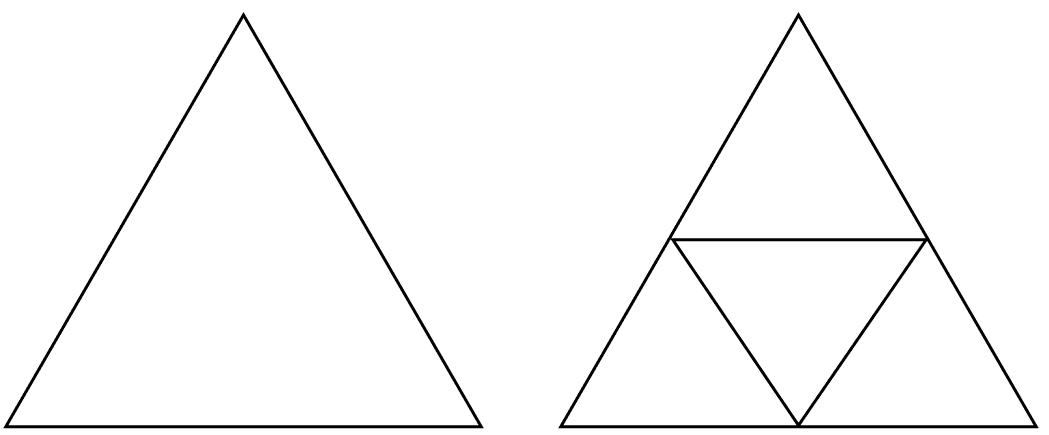
Find out the number of acute angles in each of the figures below:
Answer
Figure 1 (Equilateral triangle):
An equilateral triangle has 3 equal angles, each measuring 60°. Since 60° is less than 90°, all three are acute angles.
∴ Number of acute angles = 3.
Figure 2 (Equilateral triangle with an inverted smaller triangle inside, forming 4 small triangles):
When an equilateral triangle is divided by joining the mid-points of its three sides, four smaller equilateral triangles are formed. Each of these smaller triangles has 3 acute angles of 60° each.
Total acute angles = 4 × 3 = 12 acute angles.
The circle has been divided into 2, 3, 4, 6, 8 and 12 parts below. What are the degree measures of the resulting angles? Do not use protractor to answer this question.
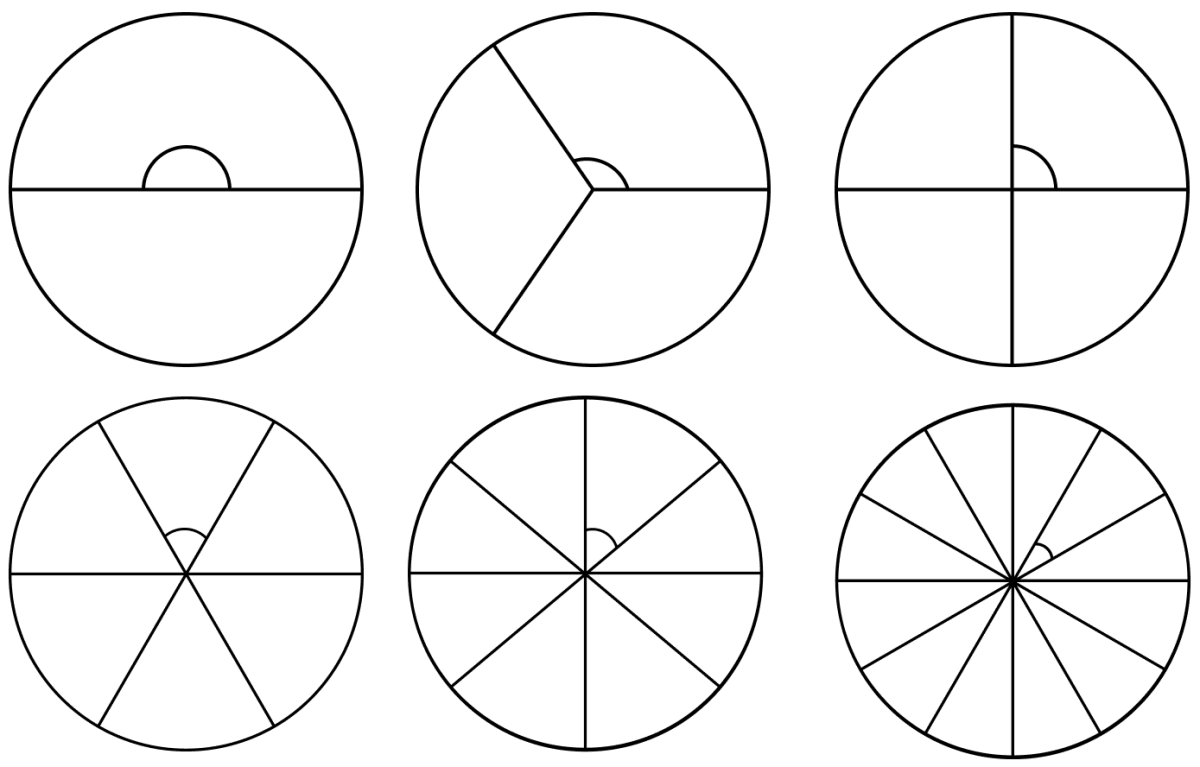
Answer
The total angle at the centre of a circle is 360°. When divided into n equal parts, each angle = .
(i) Circle divided into 2 equal parts:
Each angle = = 180°
(ii) Circle divided into 3 equal parts:
Each angle = = 120°
(iii) Circle divided into 4 equal parts:
Each angle = = 90°
(iv) Circle divided into 6 equal parts:
Each angle = = 60°
(v) Circle divided into 8 equal parts:
Each angle = = 45°
(vi) Circle divided into 12 equal parts:
Each angle = = 30°
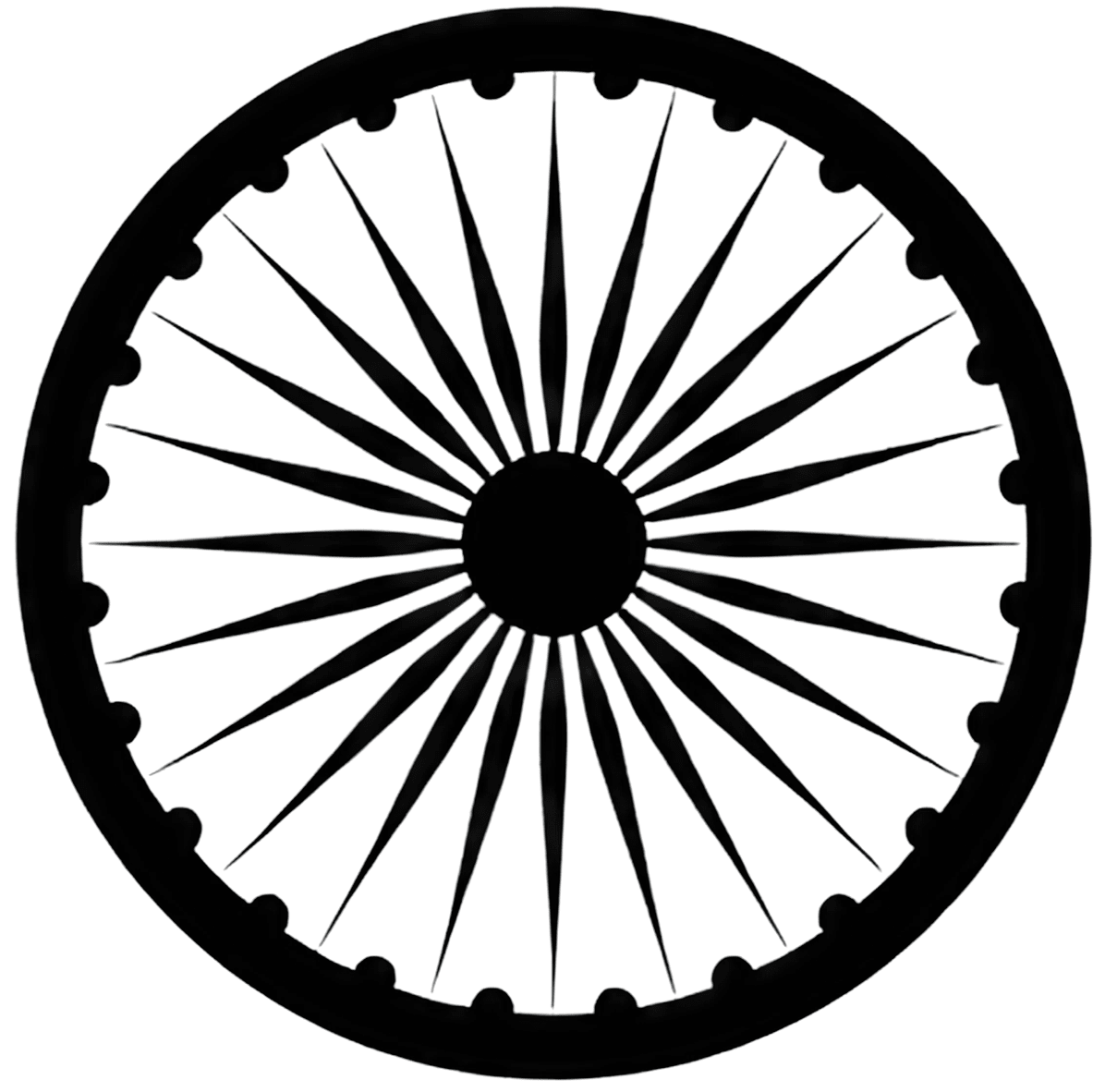
The Ashoka Chakra in Indian Flag is navy blue in colour, and signifies Dharma Chakra or Wheel of law made by 3rd century Mauryan Emperor Ashoka. It has 24 spokes (or lines from the centre). What is the degree measure of the angle between two spokes next to each other?
Answer
The total angle at the centre of the Ashoka Chakra is 360°.
The Ashoka Chakra has 24 spokes, which divide the centre into 24 equal angles.
Angle between two adjacent spokes = = 15°
∴ The degree measure of the angle between two spokes next to each other is 15°.