
Avanti's present age is y years and her mother's age is 4 years less than 3 times her age, then her mother's present age is
(3y + 4) years
(4y - 3) years
(3y - 4) years
3(y - 4) years
Answer
Given:
Avanti's present age = y years
3 times Avanti's age = 3 × y = 3y years
Mother's age is 4 years less than 3 times Avanti's age.
∴ Mother's present age = (3y - 4) years
Hence, option 3 is the correct option.
Which of the following statements is false?
Every square is a rhombus.
An equilateral triangle is a regular polygon.
A triangle having all acute angles is scalene.
Every square is a regular polygon.
Answer
Let us examine each statement:
Every square is a rhombus — True, because a square has all four sides equal, which is the defining property of a rhombus.
An equilateral triangle is a regular polygon — True, because all its sides are equal and all its angles are equal (each 60°).
A triangle having all acute angles is scalene — False, because an equilateral triangle also has all acute angles (each 60°), but it is not scalene. So an acute-angled triangle can be scalene, isosceles or equilateral.
Every square is a regular polygon — True, because all its sides are equal and all its angles are equal (each 90°).
Hence, option 3 is the correct option.
If p = 3, q = 2 and r = 5, find the value of:
2p2 + 3q - r2 + 2pr - 5pqr
Answer
Given:
p = 3, q = 2, r = 5
Substituting the values in the given expression:
2p2 + 3q - r2 + 2pr - 5pqr
= 2(3)2 + 3(2) - (5)2 + 2(3)(5) - 5(3)(2)(5)
= 2 × 9 + 6 - 25 + 30 - 150
= 18 + 6 - 25 + 30 - 150
= 54 - 175
= -121
∴ The value of the expression is -121.
Fill in the following blanks:
(i) A polygon is a closed simple curve made up of entirely .....
(ii) A cuboid has 6 rectangular faces, ..... edges and ..... vertices.
Answer
(i) A polygon is a closed simple curve made up of entirely line segments.
(ii) A cuboid has 6 rectangular faces, 12 edges and 8 vertices.
In the monomial -3x2yz3, write
(i) the numerical coefficient
(ii) the literal coefficient
(iii) the coefficient of x2
(iv) the coefficient of 3xy.
Answer
Given monomial: -3x2yz3
(i) The numerical coefficient is the number multiplied with the literal part.
∴ Numerical coefficient = -3
(ii) The literal coefficient is the product of the variable factors.
∴ Literal coefficient = x2yz3
(iii) Coefficient of x2 = = -3yz3
∴ Coefficient of x2 = -3yz3
(iv) Coefficient of 3xy = = -xz3
∴ Coefficient of 3xy = -xz3
Look at the following pattern of squares formed by matchsticks:

Find the rule that gives the number of matchsticks required in terms of the number of squares formed.
Answer
Let us count the number of matchsticks for each pattern:
For 1 square, number of matchsticks required = 4
For 2 squares, number of matchsticks required = 4 + 3 = 7
For 3 squares, number of matchsticks required = 7 + 3 = 10
For 4 squares, number of matchsticks required = 10 + 3 = 13
We notice that the first square needs 4 matchsticks, and each new square added to the pattern requires 3 more matchsticks (because one side is shared with the previous square).
So, for n squares, number of matchsticks required = 4 + 3(n - 1)
= 4 + 3n - 3
= 3n + 1
∴ If n squares are formed, then the number of matchsticks required = 3n + 1.
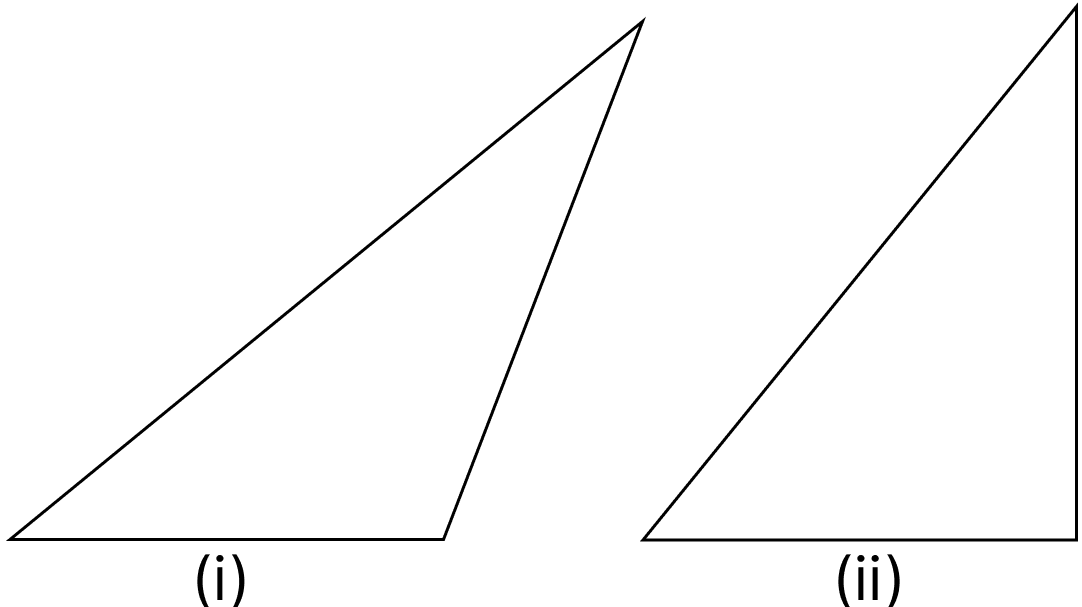
Name each of the following triangles in two ways (you may judge by observation or use ruler and protractor):
Answer
(i) On observation, one angle of the triangle is greater than 90° (obtuse angle), so it is an obtuse angled triangle. Also, all three sides of the triangle are of different lengths, so it is a scalene triangle.
∴ The triangle is an obtuse angled and scalene triangle.
(ii) On observation, one angle of the triangle is a right angle (90°), so it is a right angled triangle. Also, the two sides forming the right angle are equal in length, so it is an isosceles triangle.
∴ The triangle is an isosceles and right angled triangle.
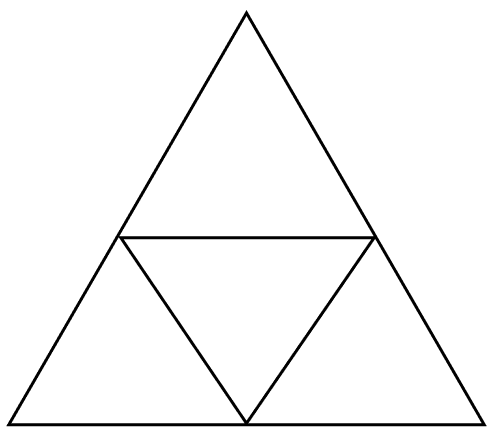
Draw a net of a regular tetrahedron.
Answer
A regular tetrahedron is a special triangular pyramid whose base and all four faces are equilateral triangles of the same size.
A regular tetrahedron has 4 triangular faces, 6 edges and 4 vertices.
To draw its net, we unfold it so that all 4 equilateral triangles lie flat in a plane. One common net consists of one equilateral triangle in the centre with three equilateral triangles attached to its three sides.
Solve the linear equation: 4 - 3(3x + 2) = 4(7 - 3x)
Also verify the solution.
Answer
Given equation:
4 - 3(3x + 2) = 4(7 - 3x)
Removing brackets on both sides:
⇒ 4 - 9x - 6 = 28 - 12x
⇒ -2 - 9x = 28 - 12x
⇒ -9x + 12x = 28 + 2
⇒ 3x = 30
⇒ x =
⇒ x = 10
∴ x = 10
Verification:
Substituting x = 10 in the given equation:
LHS = 4 - 3(3 × 10 + 2)
= 4 - 3(30 + 2)
= 4 - 3 × 32
= 4 - 96
= -92
RHS = 4(7 - 3 × 10)
= 4(7 - 30)
= 4 × (-23)
= -92.
Since LHS = RHS, the solution x = 10 is verified.
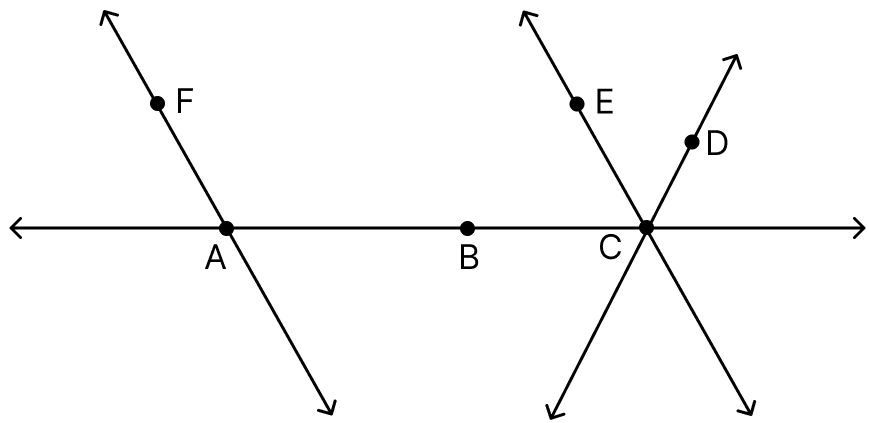
Use the adjoining figure to name:
(i) parallel lines
(ii) concurrent lines
(iii) collinear points
(iv) two opposite rays
Answer
(i) Parallel lines: Two lines are parallel if they never meet however far they are extended.
From the figure, the parallel lines are and .
(ii) Concurrent lines: Three or more lines are said to be concurrent if they all pass through the same point.
From the figure, the lines , and all pass through the point C, so they are concurrent lines.
(iii) Collinear points: Three or more points are said to be collinear if they all lie on the same straight line.
From the figure, the points A, B and C lie on the same line, so A, B and C are collinear points.
(iv) Two opposite rays: Two rays are opposite if they share the same endpoint and extend in exactly opposite directions, forming a straight line.
From the figure, the rays and have the common endpoint B and extend in opposite directions.
∴ and are two opposite rays.