
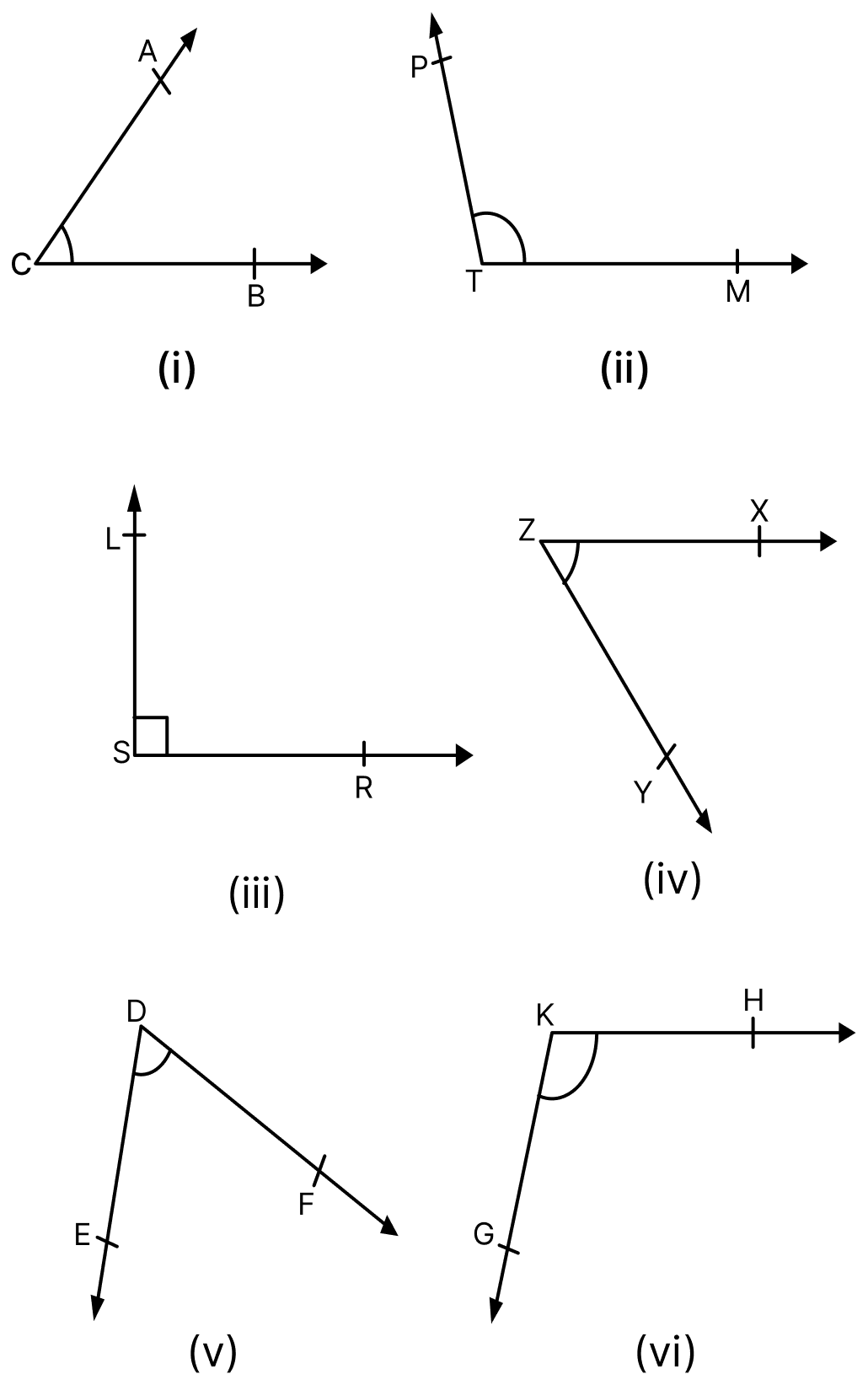
Name each of the following angles. Also name the vertex and the arms in each case:
Answer
An angle is named by taking a point on one arm, then the vertex, and then a point on the other arm. The common point of the two arms is the vertex.
(i) The angle is ∠ACB (or ∠BCA); its vertex is C and its arms are .
(ii) The angle is ∠PTM (or ∠MTP); its vertex is T and its arms are .
(iii) The angle is ∠LSR (or ∠RSL); its vertex is S and its arms are .
(iv) The angle is ∠XZY (or ∠YZX); its vertex is Z and its arms are .
(v) The angle is ∠EDF (or ∠FDE); its vertex is D and its arms are .
(vi) The angle is ∠HKG (or ∠GKH); its vertex is K and its arms are .
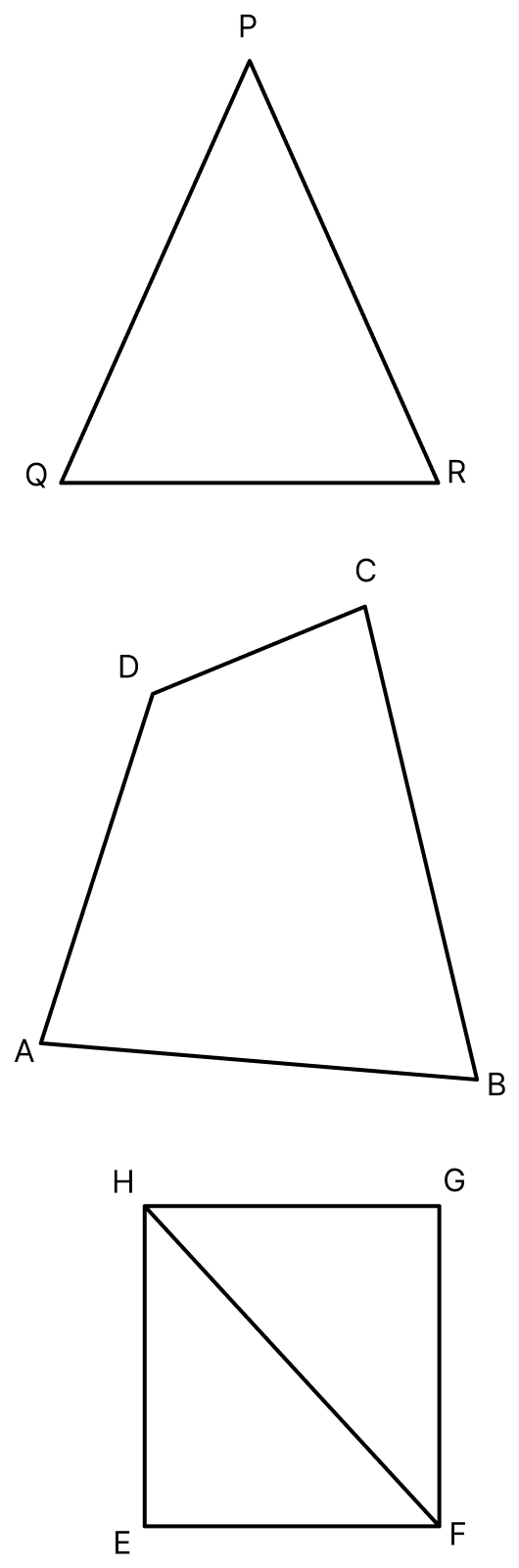
How many angles are formed in each of the figures given below? Name them.
Answer
(i) It is a triangle PQR, so three angles are formed, namely ∠PQR, ∠QRP and ∠QPR.
(ii) It is a quadrilateral ABCD, so four angles are formed, namely ∠ABC, ∠BCD, ∠CDA and ∠DAB.
(iii) In this figure (a quadrilateral EFGH with a diagonal), eight angles are formed, namely ∠HEF, ∠EFH, ∠EHF, ∠EHG, ∠EFG, ∠HFG, ∠FHG and ∠HGF.
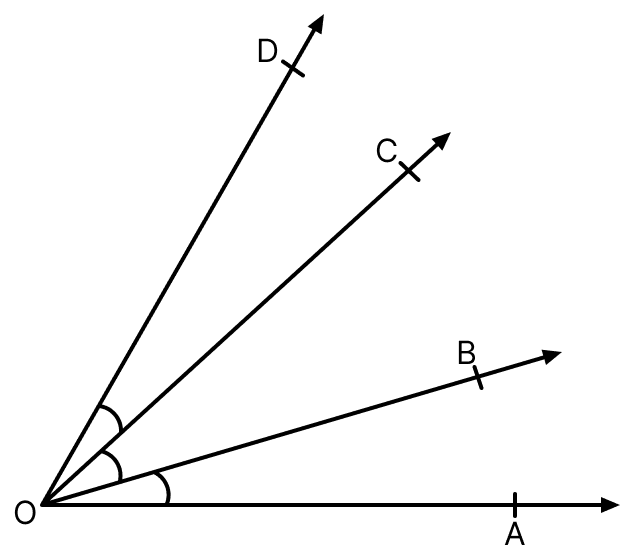
Name all possible angles in the adjoining figure.
Answer
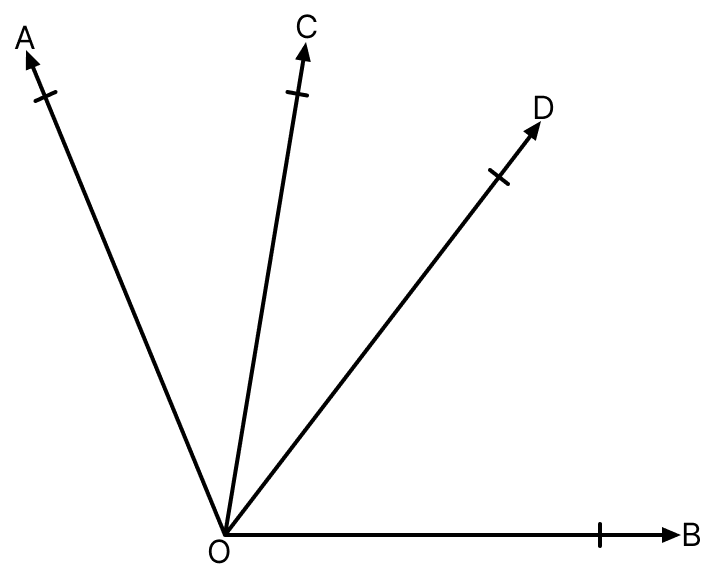
The rays OA, OB, OC and OD start from the common point O. Taking the arms two at a time, the possible angles are:
∠AOB, ∠AOC, ∠AOD, ∠BOC, ∠BOD and ∠COD.
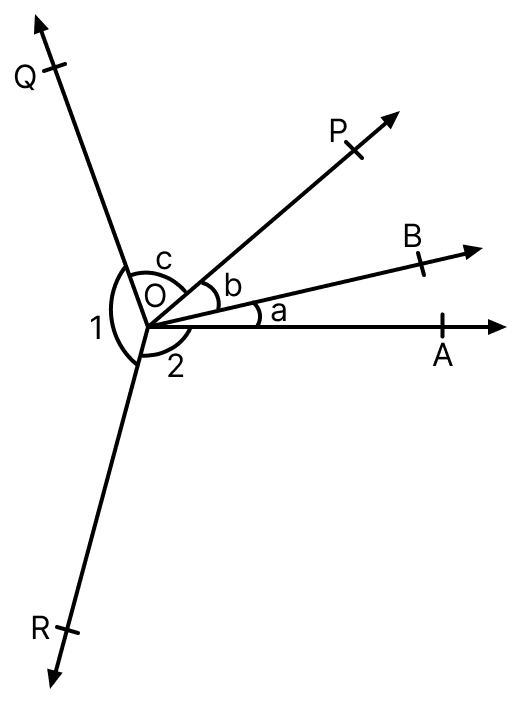
Name the angles shown, using capital letters:
Answer
Naming each angle by a point on one arm, the vertex O, and a point on the other arm:
⇒ ∠a = ∠AOB
⇒ ∠b = ∠BOP
⇒ ∠c = ∠POQ
⇒ ∠1 = ∠QOR
⇒ ∠2 = ∠ROA
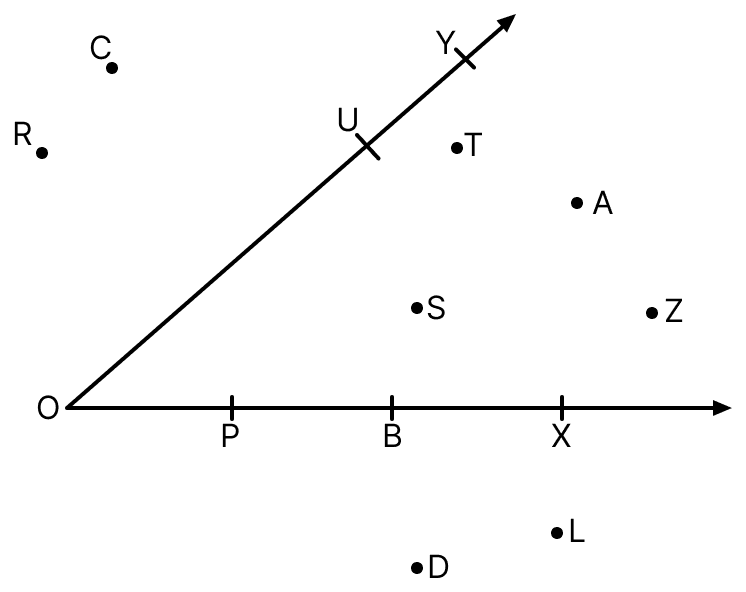
In the adjoining figure; name the points:
(i) On the angle;
(ii) In the interior of the angle;
(iii) In the exterior of the angle.
Answer
(i) The points lying on the angle (on its arms or at the vertex) are Y, U, O, P, B and X.
(ii) The points lying in the interior of the angle are T, A, S and Z.
(iii) The points lying in the exterior of the angle are C, R, D and L.
Look at the adjoining figure and state which of the following statements are true and which are false:
(i) Point C is in the interior of ∠AOC.
(ii) Point C is in the interior of ∠AOD.
(iii) Point D is in the interior of ∠AOC.
(iv) Point B is in the exterior of ∠AOD.
(v) Point C lies on ∠AOB.
Answer
(i) False. Point C lies on the arm OC of ∠AOC, so it lies on the angle, not in its interior.
(ii) True. The ray OC lies between OA and OD, so point C is in the interior of ∠AOD.
(iii) False. The ray OD lies outside ∠AOC, so point D is not in the interior of ∠AOC.
(iv) True. The ray OB lies outside ∠AOD, so point B is in the exterior of ∠AOD.
(v) False. Point C lies in the interior of ∠AOB, not on it.
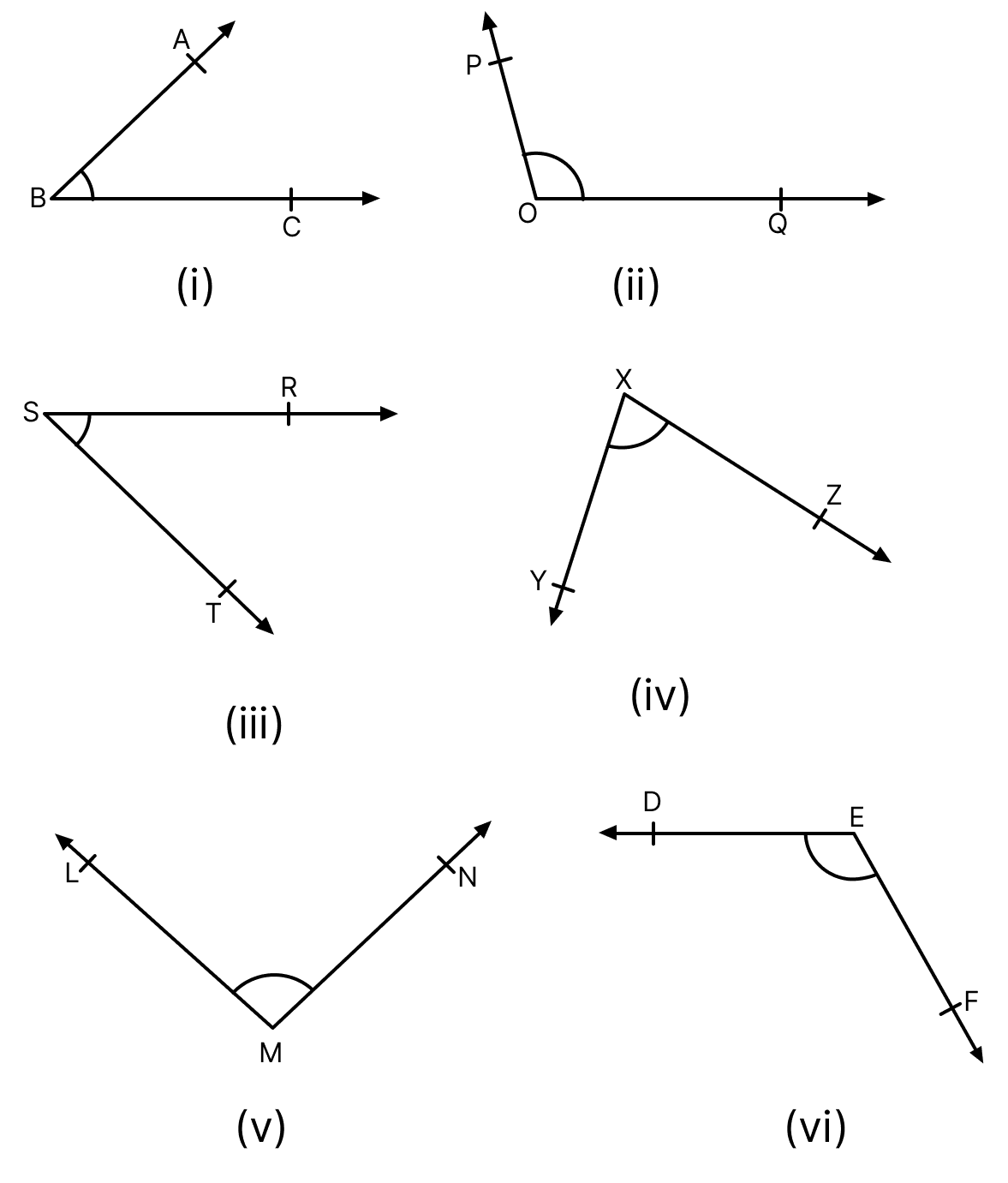
Measure each one of the following angles using protractor:
Answer
To measure each angle, place the protractor so that its centre is exactly on the vertex and its base line lies along one arm. Then read off the mark on the scale (starting from 0°) through which the other arm passes.
(i) 50°
(ii) 110°
(iii) 50°
(iv) 80°
(v) 80°
(vi) 110°