
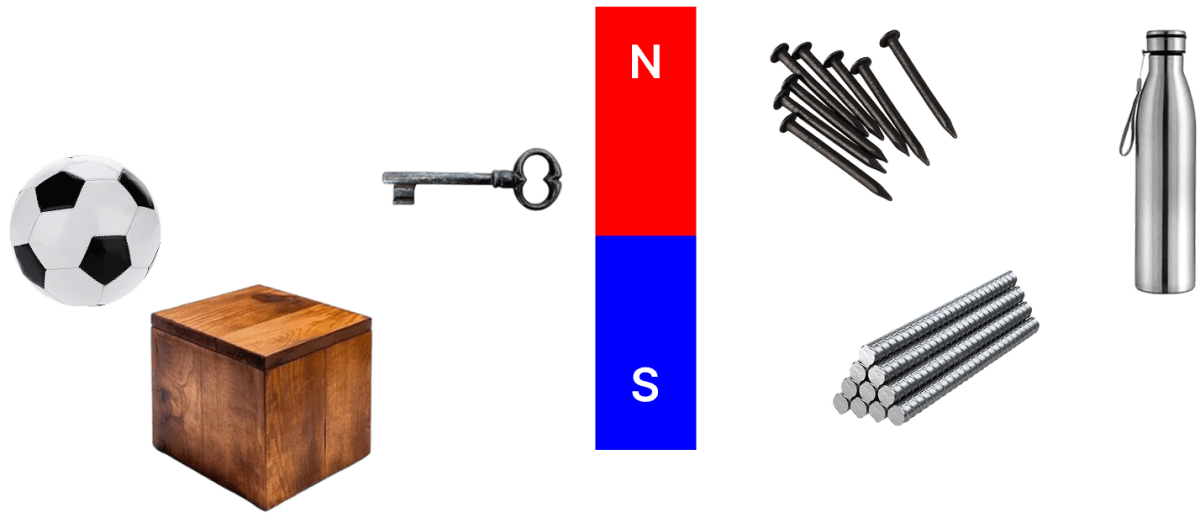
Observe the given images. A magnet and some materials are given. Circle the objects that you think will get attracted to the magnet.
Answer
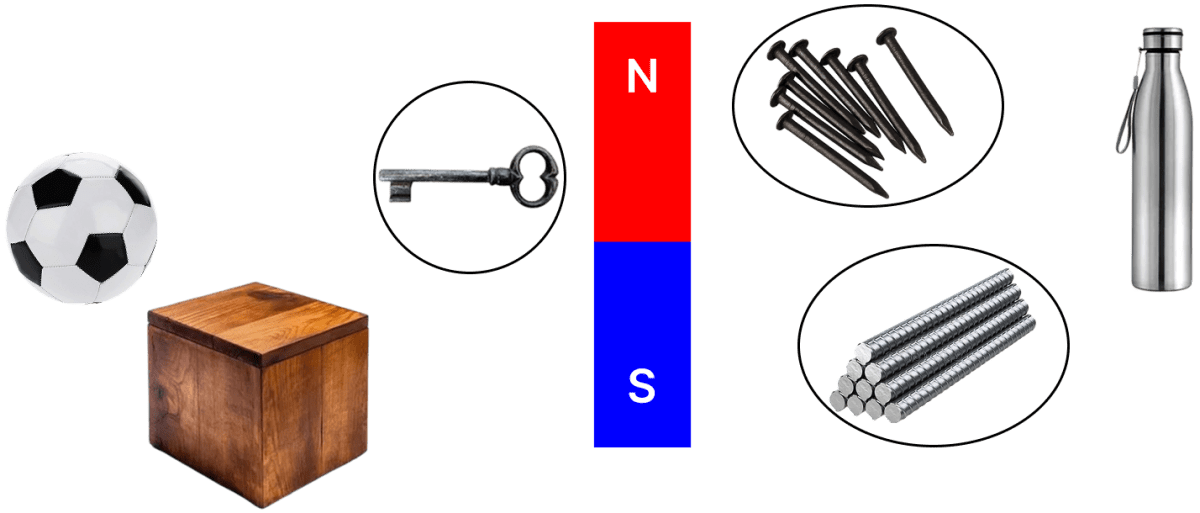
A magnet only attracts magnetic materials like iron, steel etc. but can not attract non-magnetic materials like wood, plastic.
So, here, the magnet will attract iron nails, key, iron rods and bottle but will not attract football and wooden block. The diagram is shown below :
What are materials that get attracted to a magnet called?
Answer
The materials that are easily attracted by a magnet are known as magnetic materials. Iron, steel, nickel and cobalt are magnetic materials.
Are all magnets of the same strength?
Answer
No, all magnets are not of the same strength. For example, a neodymium magnet is much stronger than a simple bar magnet of the same size.
Look at your surroundings. List a few uses of magnets.
Answer
Uses of magnets :
- Magnets are used in televisions, computers, speakers and microphones.
- Magnet are used in doors of refrigerators for closing mechanism.
- Magnets are used in electric motors, electric bells, loudspeakers and generators.
- Magnets are used in toys.
- Magnets are used in magnetic compasses.
Find out the location of magnets in appliances like refrigerators and computers.
Answer
Refrigerator
- Magnets are present in the door seals to keep the door tightly closed.
- Some refrigerators also use magnets in the motor of the compressor.
Computer
- Magnets are found in the hard disk drive (HDD), where they help in reading and writing data.
- Small magnets are also used in speakers, microphones, and cooling fans inside the computer.
You have one magnet with a marked north and south pole and a one unmarked magnet. How will you find the poles of the unmarked magnet?
Answer
We can find the poles of unmarked magnet with the following method :
- Take the marked magnet (with known north and south poles).
- Bring its north pole near one end of the unmarked magnet.
- If it attracts, that end of the unmarked magnet is its south pole.
- If it repels, that end is its north pole.
- Repeat the test with the other end of the unmarked magnet to confirm.
This method works because like poles repel and unlike poles attract each other.
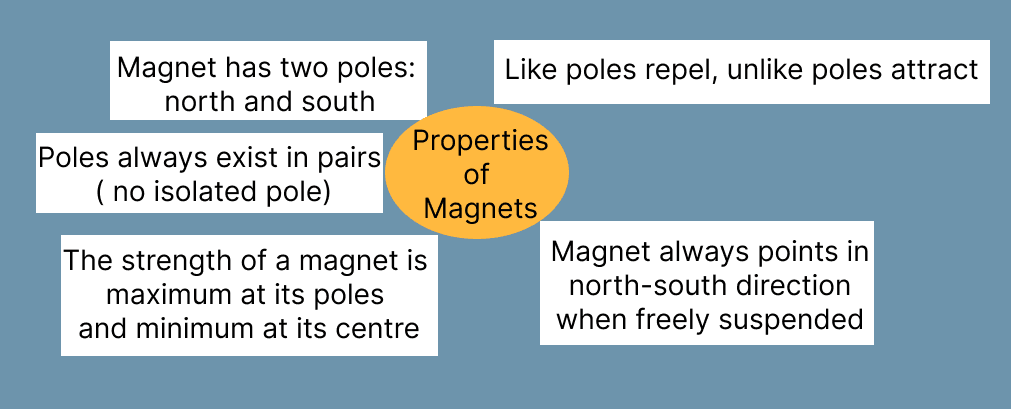
Fill in the boxes.

Answer
Give examples of natural magnets, artificial magnets, magnetic materials and non-magnetic materials.
Answer
- Natural magnet : Lodestone, hematite
- Artificial magnet : Iron bar magnet, electromagnet
- Magnetic material : Steel, iron
- Non-magnetic material : Copper, wood
How is a magnetic compass useful?
Answer
A magnetic compass is a simple device that works on the directive property of a magnet. It consists of a small magnetic needle mounted at the centre of a circular case, which can rotate freely on a frictionless pivot. The needle always aligns itself in the north–south direction of the Earth. Hence, a magnetic compass is used to find geographical directions and is especially useful for sailors, travellers, and navigators to determine their direction.
Find out the applications of electromagnets.
Answer
Applications of electromagnets are following:
- An electromagnet is used in electric motors, electric bells, loudspeakers and generators.
- It is employed in magnetic separation equipments for separation of iron ores in industries, for picking up and moving heavy iron objects like scrap iron.
- It is used by doctors to detect and treat a variety of ailments.
- It is used to deflect electronic beam in a television.
- It is used for making strong, permanent magnets.
- The bottom of Maglev trains (the fastest trains in the world) and their tracks both have electromagnets to run the train very fast.
Do you think the strength of the magnet will get affected if you travel with it to a hotter city? Why?
Answer
Yes, the strength of a magnet can be affected in a hotter city. When a magnet is heated, its molecules start moving faster. This disturbs their proper arrangement, due to which the magnet becomes weaker.
Some of the facts that you have learnt till now are listed below. Tick (✓) the facts that are correct and cross (x) the facts that are incorrect.
(a) Permanent magnets are usually made of steel.
(b) Temporary magnets are usually made of iron and nickel.
(c) Magnets can be made using electricity.
(d) Magnetic lines of force rarely form closed continuous curves.
(e) Demagnetisation is achieved only by hammering.
Answer
(a) ✓
(b) ✓
(c) ✓
(d) x
Corrected fact — Magnetic lines of force always form closed continuous curves.
(e) x
Corrected fact — Demagnetisation is achieved by following methods :
- By rough handling
- By dropping the magnet on the floor or on a hard surface a number of times
- By hammering the magnet repeatedly
- By heating the magnet to a very high temperature
- By passing alternating electric current around the magnet
Fill in the blanks.
(a) ............... magnets are weak and ............... magnets are strong.
(b) ............... is a true test for magnetism.
(c) Magnets that retain their magnetism for a short period of time are called ............... magnets.
(d) During demagnetisation, the ............... of the molecules of the magnet leads to loss of magnetism.
(e) The soft iron strips that are used in storage of magnets are called ............... .
Answer
(a) Permanent magnets are weak and temporary magnets are strong.
(b) Repulsion is a true test for magnetism.
(c) Magnets that retain their magnetism for a short period of time are called temporary magnets.
(d) During demagnetisation, the disorientation of the molecules of the magnet leads to loss of magnetism.
(e) The soft iron strips that are used in storage of magnets are called magnetic keepers.
State whether the following statements are true or false. Correct the false statements.
(a) Both the poles of the magnet exist in pairs.
(b) The strength of the magnetic field of a magnet increases as we move away from it.
(c) Magnetic lines of force may intersect one another.
(d) Magnetic induction is a temporary method of making magnets.
(e) The magnet remains unaffected even if handled roughly.
Answer
(a) True
(b) False
Corrected statement — The strength of the magnetic field of a magnet decreases as we move away from it.
(c) False
Corrected statement — Magnetic lines of force never intersect one another.
(d) True
(e) False
Corrected statement — The magnet is demagnetised if handled roughly.
Which method of making magnets involves the use of two magnets?
- Single touch method
- Double touch method
- Magnetic induction
- Electrical method
Answer
Double touch method
Reason — In the double touch method, two permanent magnets are used. Their opposite poles are touched simultaneously at the ends of the iron bar and moved towards the center, aligning the molecules and magnetising the bar. Single touch, magnetic induction and electrical method use only single magnet to magnetise.
Which of the following is an example of permanent magnets?
- Door of the refrigerator
- Door bell
- Generators
- Electric cranes
Answer
Door of the refrigerator
Reason — Permanent magnets are used in the lining on the door of the refrigerator to keep the door sealed tightly.
Which of the following is made when electricity is passed through it?
- Lodestone
- Natural magnet
- Permanent magnet
- Electromagnet
Answer
Electromagnet
Reason — An electromagnet is a device in which magnetic field is produced by the flow of electric current such that the magnetic field generated lasts as long as there is current in the circuit.
Which is not a method of demagnetising a magnet?
- Heating
- Hammering
- Suspending
- Alternating current
Answer
Suspending
Reason — Demagnetisation of a magnet is achieved by following methods :
- By rough handling
- By dropping the magnet on the floor or on a hard surface a number of times
- By hammering the magnet repeatedly
- By heating the magnet to a very high temperature
- By passing alternating electric current around the magnet
Which of the following is an example of a magnetic keeper?
- Steel
- Nickel
- Soft iron
- Electromagnet
Answer
Soft iron
Reason — A magnetic keeper is a piece of soft iron placed across the poles of a bar magnet when not in use and it helps to preserve the magnet’s strength by providing a closed path for the magnetic lines of force.
Match the columns.
| Column A | Column B | ||
|---|---|---|---|
| 1. | Artificial magnets | (a) | Giant magnet |
| 2. | Poles | (b) | Strong magnets |
| 3. | Electromagnet | (c) | Maximum strength of magnet |
| 4. | Self-demagnetisation | (d) | Temporary magnet |
| 5. | Earth | (e) | Poles left free |
Answer
| Column A | Column B | ||
|---|---|---|---|
| 1. | Artificial magnets | (b) | Strong magnets |
| 2. | Poles | (c) | Maximum strength of magnet |
| 3. | Electromagnet | (d) | Temporary magnet |
| 4. | Self-demagnetisation | (e) | Poles left free |
| 5. | Earth | (a) | Giant magnet |
Give reasons for the following statements.
(a) Wood cannot be magnetised.
(b) Magnetite was later on called leading stone.
(c) Magnetic compass is based on one of magnet's properties.
(d) Magnetic induction is temporary.
(e) Magnets should be stored properly.
Answer
(a) Wood is a non-magnetic material i.e., it does not contain magnetic molecules that can align to produce magnetism so only materials like iron, nickel, and cobalt can be magnetised but wood cannot be magnetised
(b) Magnetite always points in the north–south direction when freely suspended. Since it "leads" the way (like a guide), it was called leading stone, which later became lodestone.
(c) A freely suspended magnet always aligns itself in the north–south direction due to Earth’s magnetic field and this property of a magnet is known as the directive property of magnets which is used in a magnetic compass for navigation.
(d) In magnetic induction, a magnetic material like soft iron becomes a magnet when placed near a strong magnet. Once the external magnet is removed, the induced magnetism disappears quickly, hence it is temporary.
(e) If magnets are not stored properly, they may lose their magnetism due to self-demagnetisation so storing them with magnetic keepers (soft iron strips) and in pairs with unlike poles facing each other helps preserve their strength.
Explain the following terms.
(a) Directive property of a magnet
(b) Earth's magnetic field
(c) Single touch method
(d) Demagnetisation
(e) Magnetic keepers
Answer
(a) Directive property of a magnet: A freely suspended magnet always aligns itself in the north–south direction due to Earth’s magnetic field and this property of a magnet is known as the directive property of magnets which is used in a magnetic compass for navigation.
(b) Earth's magnetic field: The Earth itself behaves like a giant bar magnet, with a magnetic north pole near the geographic south pole and vice versa. The space around Earth where its magnetic force can be felt is called the Earth’s magnetic field and it helps in navigation using a compass.
(c) Single touch method: A method of making magnets where one pole of a permanent magnet is rubbed along the length of an iron bar from one end to the other which aligns the molecules of the iron bar such that it gets magnetised.
(d) Demagnetisation: The process of destroying magnetism of a magnet is called demagnetisation.
The demagnetisation of a magnet can be done in the following manner:
- By rough handling
- By dropping the magnet on the floor or on a hard surface a number of times
- By hammering the magnet repeatedly
- By heating the magnet to a very high temperature
- By passing alternating electric current around the magnet
(e) Magnetic keepers: Magnetic keepers are soft iron strips placed across the poles of a magnet when not in use which provide a closed path for magnetic lines of force, preventing self-demagnetisation and preserving the magnet’s strength.
Differentiate between Natural magnet and artificial magnet. Give examples wherever applicable.
Answer
Differences between Natural magnet and artificial magnet:
| S. No. | Natural magnet | Artificial magnet |
|---|---|---|
| 1. | Found in nature in the form of naturally occurring materials like lodestone. | Man-made magnets prepared from magnetic materials. |
| 2. | Natural magnets are usually weak magnets. | Artificial magnets are stronger magnets. |
| 3. | Example : Lodestone (Magnetite) and hematite. | Example : Bar magnet and electromagnet. |
Differentiate between magnetic materials and non-magnetic materials. Give examples wherever applicable.
Answer
Differences between magnetic materials and non-magnetic materials:
| S. No. | Magnetic materials | Non-magnetic materials |
|---|---|---|
| 1. | These substances can be attracted by a magnet. | These substances are not attracted by a magnet. |
| 2. | These can be magnetised. | These cannot be magnetised. |
| 3. | Example : Iron and nickel. | Example : Wood and plastic. |
Differentiate between permanent magnet and temporary magnet. Give examples wherever applicable.
Answer
Differences between permanent magnet and temporary magnet:
| S. No. | Permanent magnet | Temporary magnet |
|---|---|---|
| 1. | Permanent magnets show magnetic properties all the times. | Temporary magnets show magnetic properties as long as the magnetising force is present around it. |
| 2. | Its magnetic strength cannot be changed. | Its magnetic strength can be changed. |
| 3. | Its polarity cannot be changed. | Its polarity can be changed by reversing the direction of the magnetising force. |
| 3. | Example : Bar magnet and horseshoe magnet. | Example : Electromagnets and soft iron rods. |
What are the properties of magnetic lines of force?
Answer
Properties of magnetic lines of force are:
- Magnetic lines of force always form closed continuous curves.
- The direction of the lines of force is from the north pole to the south pole outside the magnet and from the south pole to the north pole inside the magnet.
- No two magnetic lines of force intersect each other.
- Densely populated magnetic lines of force show a strong magnetic field whereas less populated lines show weak magnetic field.
- Magnetic lines of force give the direction of the magnetic field at each point by making a tangent.
How can you make a magnet?
Answer
A magnet can be made by magnetising a magnetic material such as iron or steel. Magnetisation is the process by which an ordinary magnetic material is converted into a magnet. A magnetic substance can be made into a temporary or permanent magnet using the following methods:
- Single touch method
- Double touch method
- Magnetic induction method
- Electrical method
How are permanent magnets useful?
Answer
Uses of Permanent Magnets :
Magnetic Compass: A permanent magnet is used as the needle in a compass and it helps in navigation by pointing in the north–south direction.
Refrigerator Doors: Permanent magnets are fitted in the door lining so that the door closes tightly.
Loudspeakers and Microphones: Permanent magnets are used in televisions, computers, speakers and microphones.
Toys and Games: Many toys, puzzles, and magnetic boards use permanent magnets.
Magnetic Locks and Closures: Used in bags, cupboards, and doors for easy locking.
Credit Cards & ATM Cards: Magnetic strips are used in credit cards and ATM cards to store information.
What are the things to be kept in mind while storing magnets?
Answer
Things to keep in mind while storing magnets :
- Magnets should not be left with their poles free, as this causes self-demagnetisation and weakens the magnet over time.
- Bar magnets should be stored in pairs with their opposite poles placed close to each other.
- Soft iron strips called magnetic keepers should be placed across the ends of bar magnets to retain their magnetism for a longer time.
- Horseshoe magnets should be stored with a single soft iron keeper placed across their poles.
- Magnets should be handled carefully and protected from mishandling to prevent loss of magnetic strength.
How are magnetic properties of a magnet destroyed?
Answer
Properties of a magnet can be destroyed by following ways :
- By rough handling
- By dropping the magnet on the floor or on a hard surface a number of times
- By hammering the magnet repeatedly
- By heating the magnet to a very high temperature
- By passing alternating electric current around the magnet
Explain in detail all the five properties of a magnet.
Answer
Attractive Property of a Magnet: A magnet attracts certain substances such as iron, steel, nickel, and cobalt so when a magnet is brought near these magnetic substances, it exerts a force of attraction on them which is called magnetic force and this behaviour is known as the attractive property of a magnet.
Directive Property of a Magnet: When a magnet is freely suspended by a light thread so that it can rotate freely, it always comes to rest in the north–south direction. Even if it is disturbed, it returns to this direction after some time which is known as the directive property of a magnet.
Existence of Magnetic Poles in Pairs: Every magnet has two poles—north pole and south pole which always exist together and cannot be separated. Even if a magnet is broken into smaller pieces, each piece will still have both a north pole and a south pole.
Law of Magnetic Poles: Like poles of two magnets repel each other, whereas unlike poles attract each other. That is, north pole repels north pole and south pole repels south pole, while north pole attracts south pole.
Strength of a Magnet: The magnetic strength of a magnet is maximum at its poles and minimum at its centre.
Write down any three ways of magnetising a magnetic substance.
Answer
Three ways of magnetising a magnetic substance are:
1. Single Touch Method : In this method, a bar magnet is taken and one of its poles is rubbed along the length of an iron bar in one direction only from A to B as shown in below figure.
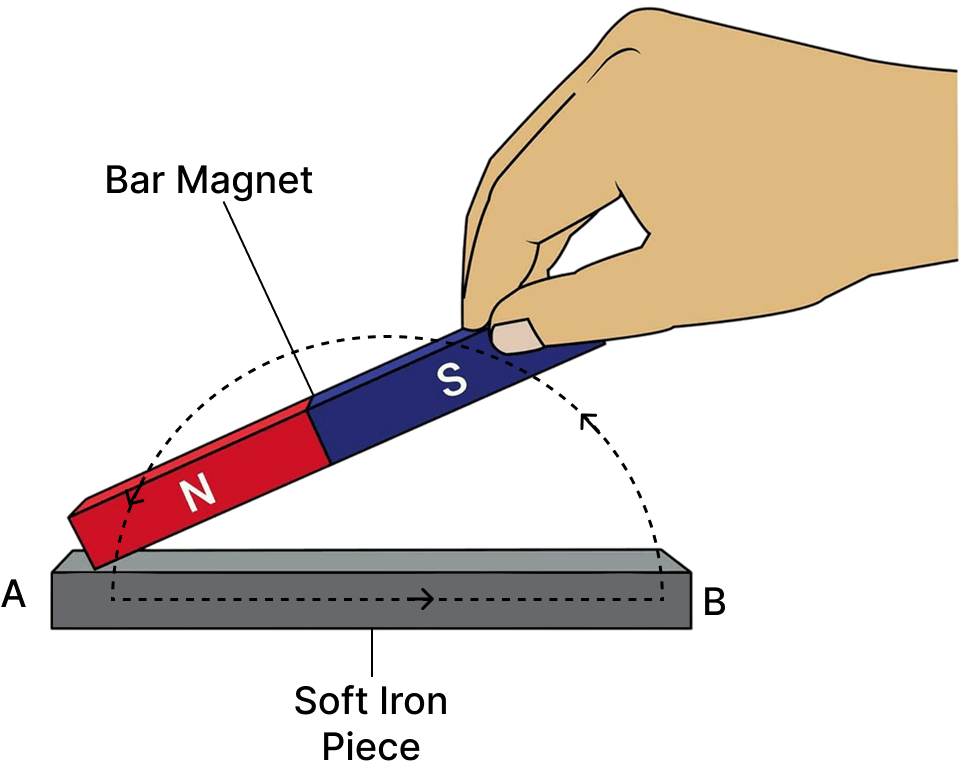
This process is repeated several times and after some time, the iron bar becomes magnetised, with one end acting as the north pole and the other as the south pole.
2. Double Touch Method : In this method, two identical bar magnets are taken. Their opposite poles are placed at the centre of an iron bar and then rubbed simultaneously from the centre towards the opposite ends as shown below :
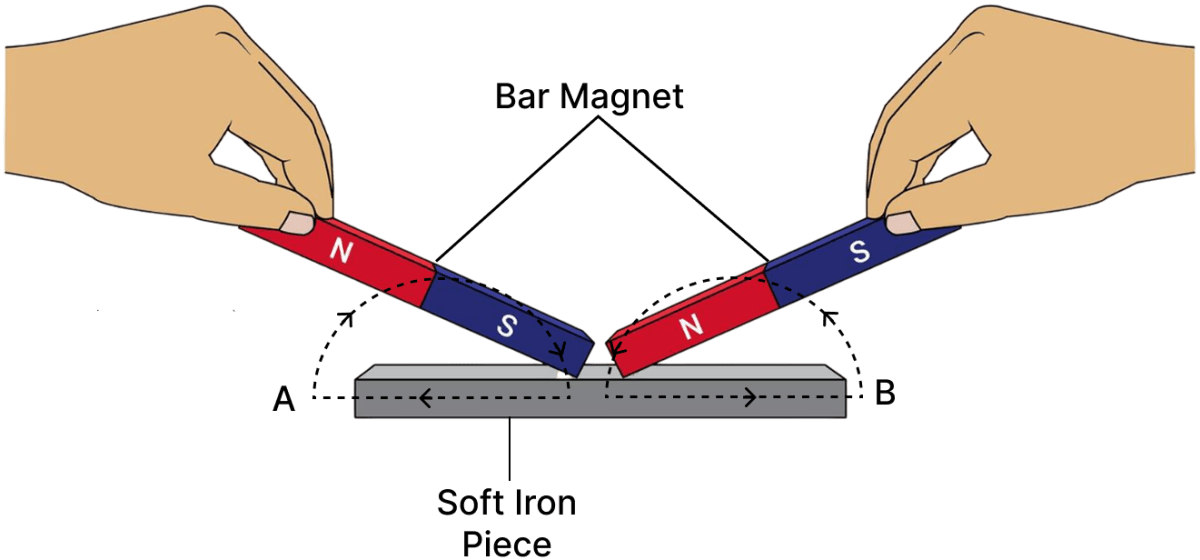
This process is repeated many times and as a result, the iron bar gets magnetised.
3. Electrical Method : In this method, an insulated copper wire is wound around a soft iron rod to form a coil as shown below
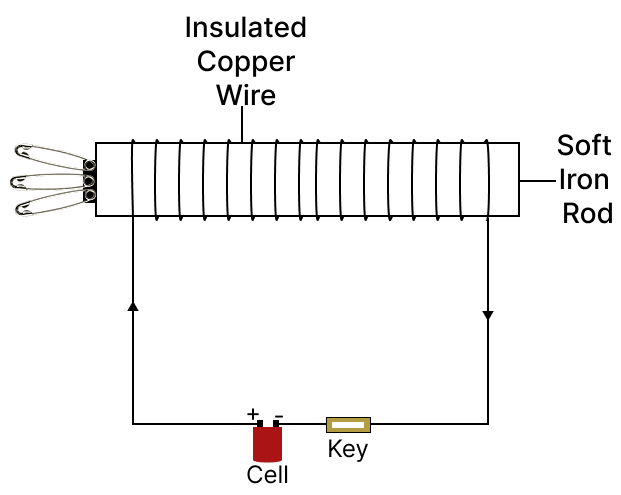
When electric current is passed through the coil, the iron rod becomes magnetised and acts as an electromagnet and when the current is switched off, the magnetism disappears.
What is an electromagnet? Draw a diagram to explain the properties of electromagnets.
Answer
An electromagnet is a device consists of a soft iron bar placed inside a cylindrical coil of wire in which magnetic field is produced by the flow of electric current and the magnetic field generated lasts as long as there is current in the circuit.
The diagram of a electromagnet is shown below :
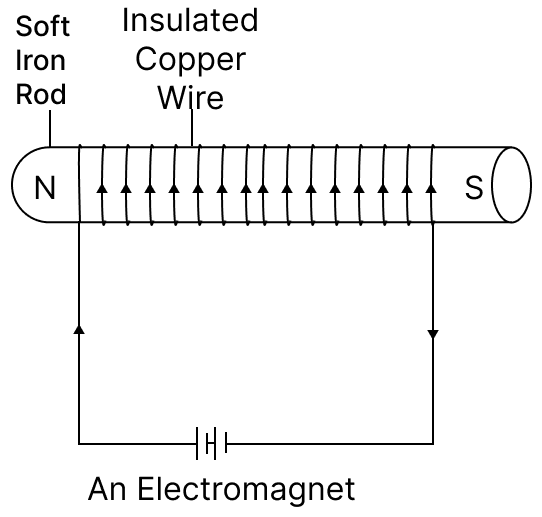
Properties of electromagnets are :
- The magnetism of an electromagnet is temporary and can be switched on and off unlike that of a permanent magnet. Therefore, it is a temporary magnet.
- The strength of an electromagnet can be changed as per the need. The strength of an electromagnet depends on the following factors:
- The strength of current flowing in the coil
- The number of turns in the coil
- The nature of material of the core
The strength can be increased by increasing the strength of current flowing in the coil and by increasing the number of turns in the coil.
How are permanent and temporary magnets useful?
Answer
Uses of Permanent Magnets
- Magnetic Compass: A permanent magnet is used as the needle in a compass and it helps in navigation by pointing in the north–south direction.
- Refrigerator Doors: Permanent magnets are fitted in the door lining so that the door closes tightly.
- Loudspeakers and Microphones: Permanent magnets are used in televisions, computers, speakers and microphones.
- Toys and Games : Many toys, puzzles, and magnetic boards use permanent magnets.
- Magnetic Locks and Closures: Used in bags, cupboards, and doors for easy locking.
- Credit Cards & ATM Cards: Magnetic strips are used in credit cards and ATM cards to store information.
Uses of Temporary Magnets
- Electromagnets in Cranes: Temporary magnets are used in cranes to lift heavy iron and steel objects in factories and scrap yards. When the current is switched off, the load is released easily.
- Electric Bells and Buzzers: Temporary magnets are used in electric bells such that the magnetism is produced only when electric current flows.
- Relays and Switches: Temporary magnets are used in electrical relays and switches to control circuits.
- Motors and Generators: Temporary magnets (electromagnets) are used in electric motors and generators where magnetism is required only during operation.
- Magnetic Separation: Temporary magnets are used to separate magnetic materials like iron from non-magnetic substances in industries.
- MRI and Scientific Instruments: Strong temporary magnets are used in scientific and medical equipment where magnetism must be controlled.
How can you demagnetise a magnet? Explain.
Answer
Ways to demagnetise a magnet :
- By Rough Handling or Improper Storage : Rough handling, frequent dropping, or storing magnets without soft iron keepers causes gradual weakening of magnetism over time which results in self-demagnetisation.
- By Dropping the Magnet on a Hard Surface : When a magnet is dropped repeatedly on the floor or a hard surface, it experiences sudden mechanical shocks which disturb the alignment of the magnetic domains inside the magnet. As a result, the magnet gradually loses its magnetic strength and becomes demagnetised.
- By Hammering the Magnet Repeatedly : When a magnet is hammered repeatedly, disorientation of the molecules of the magnet occurs. This results in loss of magnetism altogether.
- By Heating the Magnet : If a magnet is heated to a very high temperature and then allowed to cool in the east-west direction, it loses magnetism. On heating the magnet, its molecules gain thermal energy and then kinetic energy increases. This breaks the chain of molecules and results in demagnetisation of the magnet.
- By Passing Alternating Electric Current : If a magnet is placed inside a coil of insulated copper wire and alternating current is passed through the coil, the direction of the magnetic field keeps changing rapidly which disturbs the orderly alignment of the molecules of the magnet, resulting in demagnetisation of the magnet.
Observe the given picture carefully and answer the following questions.
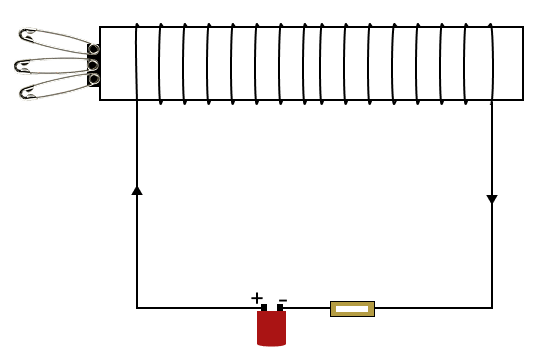
(a) Label the various components in the picture.
(b) What does this picture represent?
(c) What happens when the switch is turned off?
(d) Explain why does this happen.
Answer
(a) The labelled picture is shown below :
(b) This picture represents an electromagnet.
(c) When the switch is turned off, the current stops flowing through the coil and the soft iron bar loses its magnetism.
(d) The soft iron bar becomes magnetised only when current passes through the coil so when the current stops, the magnetic field disappears and the bar no longer behaves like a magnet.
Observe the given picture carefully and answer the following questions.
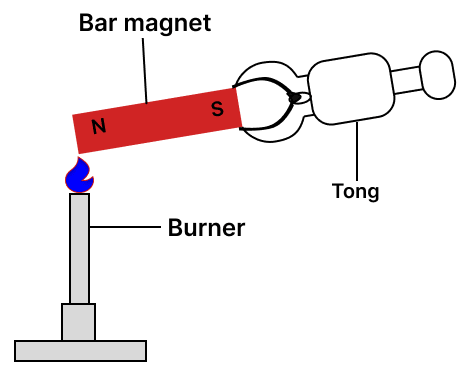
(a) What do you observe?
(b) What is this phenomenon called?
(c) Are there any other means to achieve the same purpose? Name them, if any.
Answer
(a) A bar magnet is being heated strongly over a flame using a tong which destroys its magnetism.
(b) It is called demagnetisation by heating.
(c) Yes, a magnet can also be demagnetised by :
- By rough handling
- By dropping the magnet on the floor or on a hard surface a number of times
- By hammering the magnet repeatedly
- By passing alternating electric current around the magnet
A student was studying about the properties of magnets. He compiled his notes in a table. However, there were some mistakes in the table. Correct the given table.
| Property of Magnets | Explanation | Correction(s) |
|---|---|---|
| Attractive property | A magnet attracts all kinds of materials. | |
| Directive property | The end of the magnet pointing towards the geographical north is the south pole and the end of the magnet pointing towards the geographical south is the south pole. | |
| Coexistence of poles | When a magnet is broken into a half, the north pole and south pole are separated. | |
| True test for magnetism | Like poles of the magnet attract each other while unlike poles repel each other. | |
| Strength of the magnet | The strength of the magnet is uniform throughout its length. |
Answer
| Property of Magnets | Explanation | Correction(s) |
|---|---|---|
| Attractive property | A magnet attracts all kinds of materials. | A magnet attracts only magnetic materials like iron. |
| Directive property | The end of the magnet pointing towards the geographical north is the south pole and the end of the magnet pointing towards the geographical south is the south pole. | The end of the magnet pointing towards the geographical north is the north pole. |
| Coexistence of poles | When a magnet is broken into a half, the north pole and south pole are separated. | When a magnet is broken into a half, each piece has a north pole and a south pole. |
| True test for magnetism | Like poles of the magnet attract each other while unlike poles repel each other. | Like poles of the magnet repel each other while unlike poles attract each other. |
| Strength of the magnet | The strength of the magnet is uniform throughout its length. | The strength of a magnet is maximum at its poles and minimum at its centre. |
Roshan's parents gifted him magnets on his birthday. His parents told him that magnets could attract objects. He played with those magnets all day and experimented by attracting different materials onto it. He noticed that some materials got attracted to it while some didn't. After a few days, his magnets were not working well.
Now, answer the following questions.
(a) What materials do you think got attracted to the magnets?
(b) What materials do you think didn't get attracted to the magnets?
(c) Why do you think his magnets stopped working?
(d) What should Roshan do to fix his magnets?
Answer
(a) Materials made of magnetic substances such as iron, steel, are attracted to the magnets.
(b) Non-magnetic substances such as wood, plastic, are not attracted to the magnets.
(c) Magnets stopped working due to following possible reasons :
- The magnets might have been subjected to rough handling (like dropping or banging).
- They might have been heated accidentally.
- They might have been stored improperly (without magnetic keepers).
All these can lead to loss of magnetism (demagnetisation).
(d) He should try to magnetise them again by :
- Single touch or double touch method (stroking with another magnet).
- Magnetic induction.
Also, in future, he should store them properly with magnetic keepers to prevent demagnetisation.
Why do you think dropping a magnet demagnetises it?
Answer
A magnet is made up of molecules so when the magnet is intact, these molecules are aligned in the same direction, giving it magnetism but dropping or rough handling of a magnet destroys the alignment. As a result, the magnet loses its strength or becomes demagnetised.
It is easier to separate iron filings from sand than to separate iron filings from a metallic mixture. Why?
Answer
It is easier to separate iron filings from sand because sand is a non-magnetic substance and is not attracted to a magnet, whereas iron filings are magnetic and get attracted easily. However, in a metallic mixture, more than one metal may be magnetic. As a result, the magnet attracts other magnetic metals along with iron, making the separation of only iron filings difficult.
Why doesn't the soft iron retain magnetism once the electric current stops flowing through the wire around it?
Answer
Soft iron is used in making temporary magnets (electromagnets) and its molecules align quickly when current flows, producing strong magnetism but once the current stops, they return to a random arrangement and hence, loose magnetism.
The strength of the magnetic field is defined as the measure of the intensity of a magnetic field in a given area of that field. The strength of the magnetic field is measured in a unit called Gauss. The following graph depicts the strength of a magnet at different temperatures.
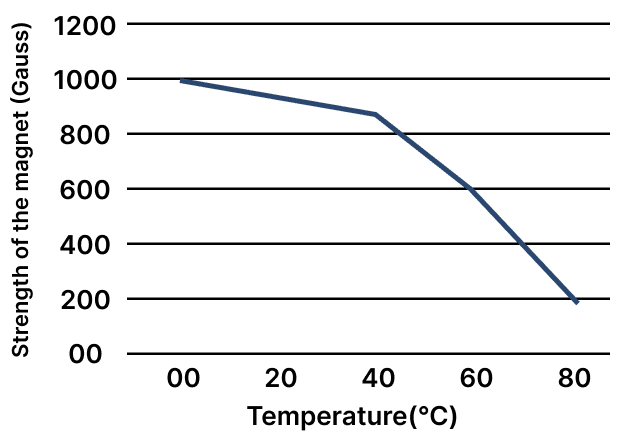
Observe the graph carefully.
Now, answer the following questions.
(a) At what temperature is the strength of the magnet the highest?
(b) At what temperature is the strength of the magnet the lowest?
(c) Why is the strength of the magnet reducing with increase in temperature?
(d) Is there any way to strengthen the magnet again? Why/Why not?
Answer
(a) The strength of the magnet is highest at 0°C.
(b) The strength of the magnet is lowest at 80°C.
(c) The strength of the magnet is reducing with increase in temperature because on increasing the temperature of the magnet, its molecules gain thermal energy and their kinetic energy increases which breaks the chain of the molecules and results in demagnetisation of the magnet.
(d) Yes, the magnet can be strengthen by remagnetising it via
- Single touch or double touch method (stroking with another magnet).
- Magnetic induction.