
Observe the given pictures and fill in the given table.
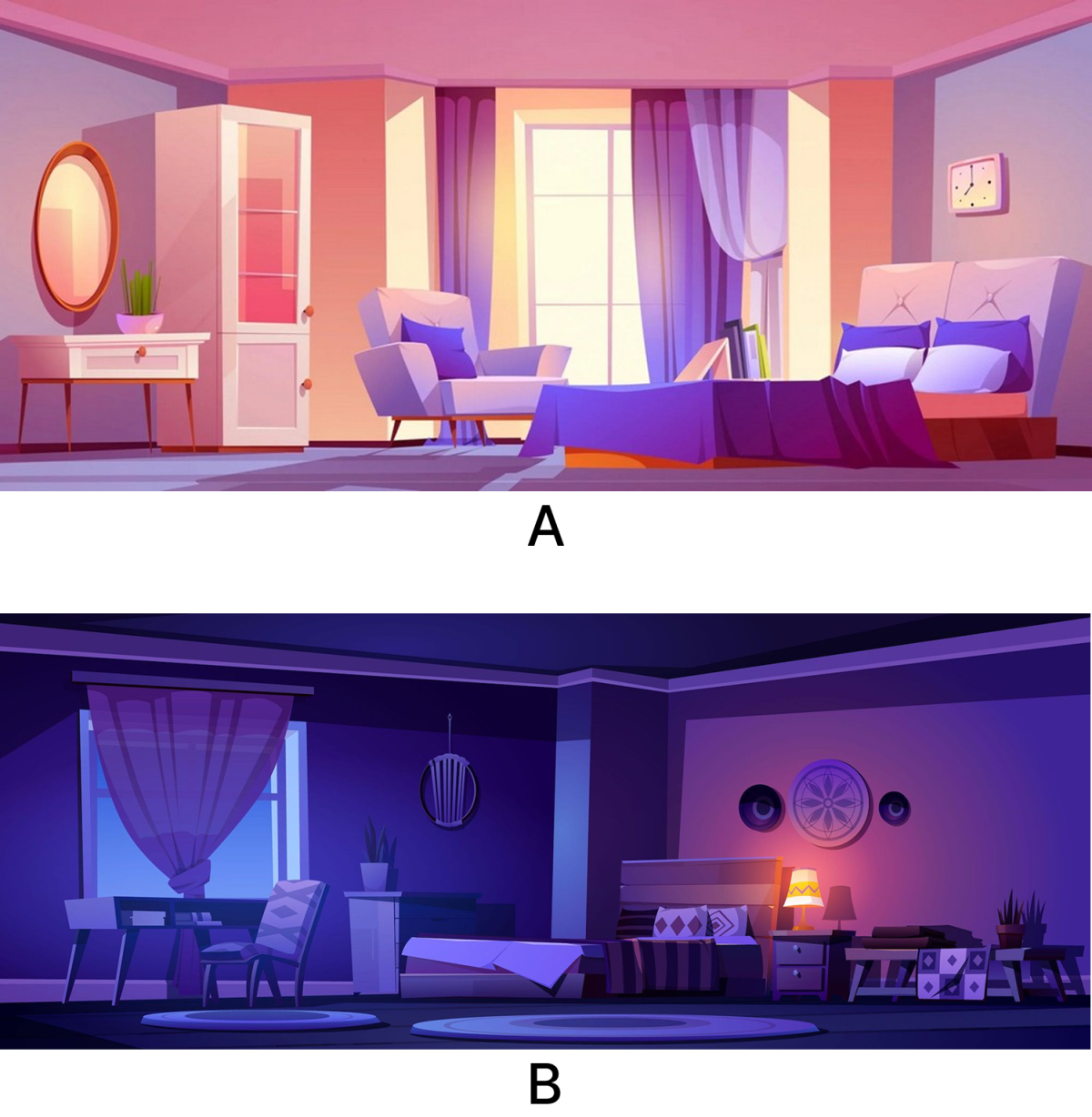
| Questions | Room A | Room B |
|---|---|---|
| What is the source of light? | ||
| Is the source artificial or natural? | ||
| Name one transparent object. | ||
| Name one opaque object. | ||
| Are shadows visible? (Yes/No) | ||
| Which room has more shadows? |
Answer
| Questions | Room A | Room B |
|---|---|---|
| What is the source of light? | Sun | Lamp |
| Is the source artificial or natural? | Natural | Artificial |
| Name one transparent object. | Window | Lamp's bulb |
| Name one opaque object. | Chair | Curtain |
| Are shadows visible? (Yes/No) | Yes | Yes |
| Which room has more shadows? | More shadows | Less shadows |
Why does a dark room have lesser shadows?
Answer
Whenever an opaque object is placed in the path of light, it blocks the path and casts its shadow and since a dark room has less amount of light so an opaque object blocks lesser amount of light and hence forms less shadows.
What is the shape and colour of a shadow?
Answer
A shadow is of the same shape as the object and always dark in colour irrespective of the colour of the object or light falling on it.
There is often a presence of a lighter shadow around the dark shadow. What is the lighter shadow called?
Answer
The lighter shadow is called penumbra.
Sun is the main source of light on earth. How is sun important for life on earth?
Answer
The sun is a natural source of light and energy and it illuminates the entire solar system. Without light and heat from the sun, we cannot imagine life on the earth because
- It provides light, which helps us see and supports plant growth through photosynthesis
- It gives heat, keeping the Earth warm enough for living beings to survive.
- It helps in the water cycle by causing evaporation.
- It supports food chains, as plants use sunlight to make food which animals and humans depend on.
Give two examples each of transparent, translucent and opaque objects from your surroundings.
Answer
Two examples each of transparent, translucent and opaque objects are :
- Transparent object : Glass, water.
- Translucent object : Paper, fog.
- Opaque object : Tree, book.
Circle the odd one out. Give reasons for your choice.
| 1. | LEDs | Bulbs | Sun | Candle |
| 2. | Table | Chair | Moon | Stars |
| 3. | Telescopes | Microscopes | Frosted Glass | Glass |
| 4. | Bag | Iron | Water | Bricks |
| 5. | Wax paper | Air | Fog | Tiffin box |
Answer
The odd one is shown below :
| 1. | LEDs | Bulbs | Sun | Candle |
| 2. | Table | Chair | Moon | Stars |
| 3. | Telescopes | Microscopes | Frosted Glass | Glass |
| 4. | Bag | Iron | Water | Bricks |
| 5. | Wax paper | Air | Fog | Tiffin box |
Reason :
- Sun — It is the only natural source of light whereas LEDs, bulbs, and candles are artificial sources.
- Stars — Stars are the only luminous object but table, chair, and the moon are non-luminous.
- Frosted glass — It is translucent and does not let you see clearly while telescopes, microscopes, and clear glass let you see a clear image.
- Water — It is the only liquid as bag, iron, and bricks are solids.
- Air — It is the only transparent material as wax paper and fog are translucent, and a tiffin box can be either opaque or translucent depending on the material it is made of.
If the source of light is placed on top of an object, will there be shadow formation? Why?
Answer
No, there will be no shadow formation.
When the source of light is placed directly on top of the object, the light rays fall symmetrically around the object and do not get blocked in any one direction. Hence, there is no region behind the object where light is completely obstructed, so no shadow is formed.
Do any other planets of the solar system also experience eclipse?
Answer
Yes, other planets of the solar system also experience eclipses.
An eclipse occurs whenever one celestial body comes between a source of light and another body. Just like Earth, other planets have moons and revolve around the Sun. When a moon comes between its planet and the Sun (solar eclipse), eclipses occur on those planets as well.
Some of the facts that you have learnt till now are listed below. Tick (✓) the facts that are correct and cross (x) the facts that are incorrect.
(a) Light can propagate in any type of motion.
(b) Translucent objects cast a faint shadow.
(c) The colour of the shadow depends on the object.
(d) The size of the shadow is independent of the size of source of light.
(e) Eclipse occurs when a heavenly body blocks the sunlight.
Answer
(a) x
Corrected fact — Light always propagates in rectilinear motion.
(b) ✓
(c) x
Corrected fact — The colour of the shadow does not change with the change in colour of the light source used and the colour of the object taken.
(d) x
Corrected fact — The size of the shadow depends on the following factors :
- Distance between the source of light and the object
- Distance between the object and the screen
- Size of the source of light and the object
(e) ✓
Fill in the blanks.
(a) Light propagates in ............... motion.
(b) Sun is a ............... source of light.
(c) ............... objects cast a shadow.
(d) A collection of rays coming from different directions which meet at a single point is called ............... beam.
(e) Blocking of the light of the sun by a heavenly body is called ............... .
Answer
(a) Light propagates in rectilinear motion.
(b) Sun is a natural source of light.
(c) Opaque objects cast a shadow.
(d) A collection of rays coming from different directions which meet at a single point is called convergent beam.
(e) Blocking of the light of the sun by a heavenly body is called eclipse.
State whether the following statements are true or false. Correct the false statements.
(a) Non-luminous objects like trees and chairs emit light of their own.
(b) A transparent material allows all the light to pass through.
(c) Translucent objects cast a dark shadow.
(d) The shape of shadow is independent of the object blocking light.
(e) A pinhole camera forms an inverted image.
Answer
(a) False
Corrected statement — Non-luminous objects like trees and chairs do not emit light of their own.
(b) True
(c) False
Corrected statement — Translucent objects cast a faint shadow.
(d) False
Corrected statement — The shape of a shadow is same as the shape of the object blocking light.
(e) True
What is the darker region of the shadow called?
- Umbra
- Penumbra
- Screen
- Dark shadow
Answer
Umbra
Reason — The darker region of the shadow formed on the screen is called umbra.
Which of the following is an example of a transparent object?
- Notebook
- Wax paper
- Cup
- Spectacles
Answer
Spectacles
Reason — Spectacle lenses are made of transparent material that allows light to pass through clearly, so objects can be seen distinctly.
What do you call ray of lights that are emitted by a point source which travel in different directions?
- Parallel beam
- Convergent beam
- Divergent beam
- Ray
Answer
Divergent beam
Reason — The rays of light emitted by a small (point) source which travel in different directions form a divergent beam of light.
Which of the following will cast a shadow?
- Butter paper
- Glass
- Cellophane
- School bag
Answer
School bag
Reason —
- Butter paper → It is a translucent in nature and allows partial light which forms faint/blurry shadow.
- Glass → It is a transparent object which allows almost all light and hence no shadow forms.
- School bag → A school bag is an opaque object, so it blocks light completely and forms a clear shadow.
- Cellophane → It is also a transparent object so no proper shadow.
Which is not a type of solar eclipse?
- Total
- Partial
- Annular
- Penumbral
Answer
Penumbral
Reason — There are three types of solar eclipse :
- Total solar eclipse
- Partial solar eclipse
- Annular solar eclipse
Penumbral eclipse is a type of lunar eclipse, not a solar eclipse.
Give reasons for the following statements.
(a) A table does not emit any light.
(b) Light does not completely pass through a coloured bottle.
(c) A glass does not cast any shadow.
(d) The length of shadows depends on the time of the day.
(e) The size of the shadow depends on the size of the light source.
Answer
(a) A table does not emit any light because it is a non-luminous object which only reflects light falling on it, but does not produce light of its own.
(b) Light does not completely pass through a coloured bottle since a coloured bottle is translucent in nature which allows only part of the light to pass, while absorbing and scattering the rest.
(c) A glass does not cast any shadow as glass is a transparent object which allows all light to pass through, so no shadow is formed.
(d) The length of shadows depends on the time of the day because the position of the Sun changes throughout the day so in the morning and evening, light comes at a slant and forms long shadows, while at noon sunlight is overhead so short shadows are formed.
(e) The size of the shadow depends on the size of the light source because an extended source of light forms both umbra and penumbra, whereas a point source forms only a sharp umbra. A larger light source produces a larger shadow with a lighter penumbra, while a smaller light source produces a smaller, darker shadow.
Match the columns.
| Column A | Column B | ||
|---|---|---|---|
| 1. | Nature of image formed by pinhole camera | (a) | Grey zone of a shadow |
| 2. | Lunar eclipse | (b) | Dark shadow |
| 3. | Example of penumbra | (c) | Inverted image |
| 4. | Luminous object | (d) | Full moon night |
| 5. | Shadow formed by opaque object | (e) | LEDs |
Answer
| Column A | Column B | ||
|---|---|---|---|
| 1. | Nature of image formed by pinhole camera | (c) | Inverted image |
| 2. | Lunar eclipse | (d) | Full moon night |
| 3. | Example of penumbra | (a) | Grey zone of a shadow |
| 4. | Luminous object | (e) | LEDs |
| 5. | Shadow formed by opaque object | (b) | Dark shadow |
Explain the following terms.
(a) Annular solar eclipse
(b) Propagation of light
(c) Transparent material
(d) Parallel beam of light
(e) Scattering of light
Answer
(a) Annular solar eclipse: When the sun and the moon are exactly in line, but the sun is not completely covered by the moon because the apparent size of the moon is smaller than that of the sun as seen from the earth so, a bright ring of light known as the corona is visible around the central circular dark region of the moon and this phenomenon is called annular solar eclipse.
(b) Propagation of light: Light always propagates in a straight line in a medium such that the path traversed by light in a medium between any two points is the shortest so light takes minimum time in travelling from one point to another and this property of light travelling in a straight line is known as rectilinear propagation of light.
(c) Transparent material: A material which allows light to pass through it completely so that an object is clearly visible when viewed through it, is called a transparent material. Examples are glass, air and water.
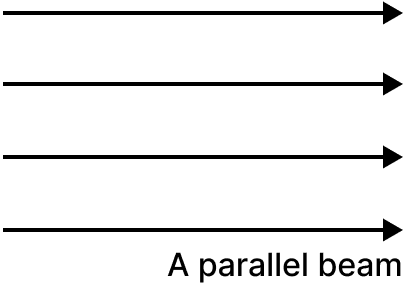
(d) Parallel beam of light: When a number of rays move parallel to each other, the beam is called a parallel beam of light. It is produced by a distant source of light like the sun.
A parallel beam is shown below :
(e) Scattering of light: : The phenomenon of the deflection of light from its straight path by particles of a medium such that some of the light is absorbed and re-emitted in different direction is called scattering of light.
Differentiate between luminous objects and non-luminous objects. Give examples if applicable.
Answer
| S. No. | Luminous objects | Non-luminous objects |
|---|---|---|
| 1. | They emit their own light. | They do not emit their own light. |
| 2. | These objects are visible when their emitted light is received by the eyes. | These objects are visible only when they reflect the light falling on them. |
| 3. | Example : Sun, Stars. | Example : Chair, Table. |
Differentiate between transparent, translucent and opaque objects. Give examples if applicable.
Answer
| S. No. | Transparent objects | Translucent objects | Opaque objects |
|---|---|---|---|
| 1. | It allows light to pass through it completely. | It allows light to pass through it only partially. | It does not allow light to pass through it. |
| 2. | An object is clearly visible when viewed through it. | Visibility through it is poor. | It always casts its shadow when kept in the path of light. |
| 3. | Use : To make showcases, windowpanes, doors, spectacles, binoculars, telescopes and microscopes. | Use : To make doors and windowpanes of bathrooms, clinics and offices and laboratory equipments. | Use : To make doors, ceilings and walls, etc. |
| 4. | Example : glass, air and water. | Example : wax paper, coloured bottle and fog. | Example : wooden door, metal and brick wall. |
Differentiate between solar eclipse and lunar eclipse. Give examples if applicable.
Answer
| S. No. | Solar eclipse | Lunar eclipse |
|---|---|---|
| 1. | It occurs when the moon comes in between the sun and the earth and its shadow falls on the sun. | It occurs when the earth comes in between the sun and the moon and its shadow falls on the moon. |
| 2. | It occurs only on a new moon day. | It occurs on a full moon night. |
| 3. | It is of three types i.e., total solar eclipse, partial solar eclipse and annular solar eclipse. | It is of three types i.e., total lunar eclipse, partial lunar eclipse and penumbral lunar eclipse. |
How does light travel in a medium?
Answer
Light travels in a medium along a straight-line path. Between any two points in the same medium, light follows the shortest possible path and therefore takes the minimum time to travel. This property of light travelling in straight lines in a given medium is known as rectilinear propagation of light.
What causes shadow formation?
Answer
Shadow formation occurs due to the rectilinear propagation of light, which means that light travels in straight lines so when an opaque object is placed in the path of light, it obstructs these straight-line paths. As a result, light cannot reach the region behind the object and a shadow is formed on the opposite side of the light source.
What causes an eclipse to occur?
Answer
Eclipses occur due to blocking of sunlight by a heavenly body which thereby casts its shadow on another heavenly body.
What are the types of lunar eclipse?
Answer
There are three types of lunar eclipse :
- Total lunar eclipse: When the moon is completely in the umbra region (darker region) of the earth so that it does not receive any light and hence is not visible to the people on the earth.
- Partial lunar eclipse: During its course of revolution around the earth when the moon moves in the penumbral region (grey region) of the earth's shadow, it receives some light from the sun, which it reflects back to the earth. Thus,the moon becomes partially visible.
- Penumbral lunar eclipse: When the moon passes through the earth's penumbra, it experiences penumbral lunar eclipse.
What are the advantages and disadvantages of a pinhole camera?
Answer
Advantages of a Pinhole Camera :
- There is no need of focussing.
- Since there is no lens used in a pinhole camera, the image obtained is free from optical defects like colour distortion.
Disadvantages of a Pinhole Camera :
- The image is obtained on a screen and no permanent record of the image can be maintained.
- The image formed lacks sharpness and is faint so no details can be observed in it.
- An image of a moving object cannot be captured using a pinhole camera. It only forms images of stationary objects.
What are the characteristics of a shadow?
Answer
A shadow has the following characteristics :
- A shadow is always formed on the opposite side of the light source.
- The shadow is of the same shape as the object.
- The clarity and length of the shadow depends on the position of the light source. For example, a shadow is long and comparatively faint in the morning and evening whereas at noon, it is shorter and dark.
Explain solar eclipse with a diagram.
Answer
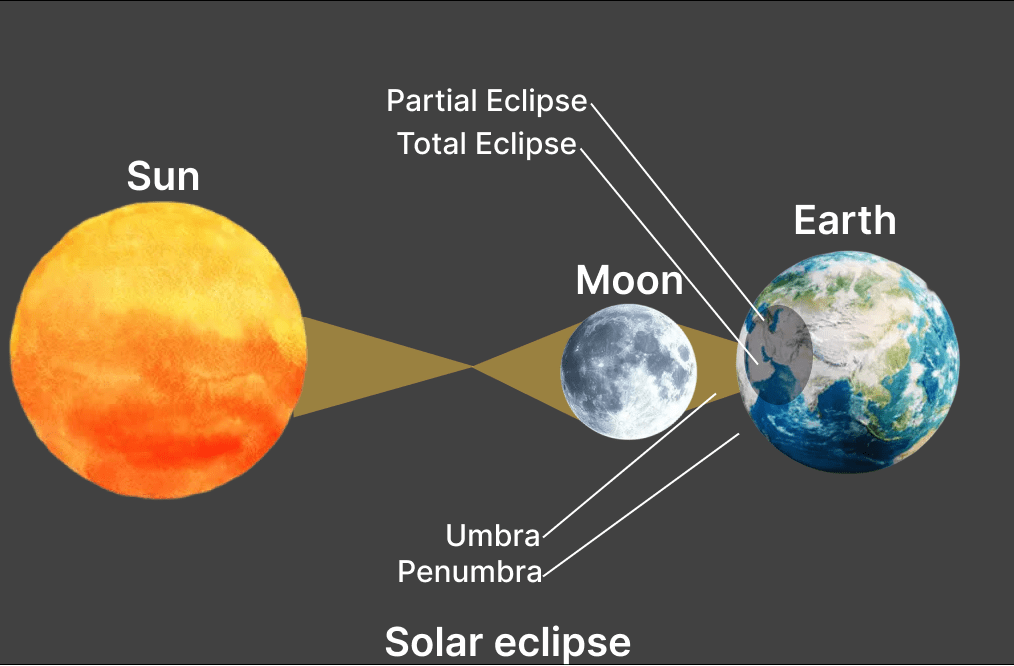
A solar eclipse occurs when the moon during its course of revolution passes between the sun and the earth and the three heavenly bodies position themselves in a straight line such that the moon fully or partially covers the sun, as viewed from some parts of the earth.
Since the light from the sun is blocked by the moon, the shadow of the moon falls on the earth and it becomes dark during the daytime. Solar eclipse occurs only on a new moon day.
The formation of solar eclipse is shown below :
Explain in detail the image formation by a pinhole camera.
Answer
The formation of an image by a pinhole camera can be understood by a simple ray diagram shown below.
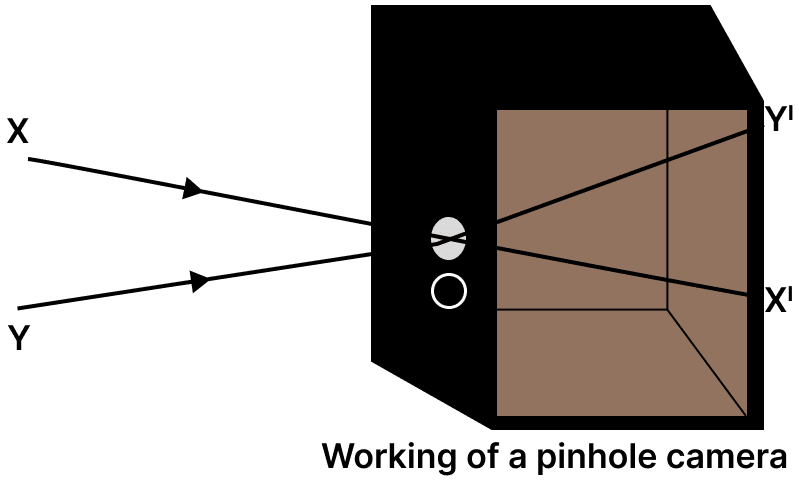
Consider an object XY kept in front of the pinhole O of the camera. Although light rays from the object travel in all directions, we will only take those rays into consideration that pass through the pinhole and thus contribute to image formation.
A ray of light coming from point X travels along XO, passes through the pinhole O and finally falls on the screen at X'. Similarly, a light ray coming from point Y travels along YO, passes through the pinhole O and falls on the screen at Y'. All the other rays which start between X and Y pass through the pinhole and fall on the screen between X'and Y'. While passing through the pinhole, the light rays intersect and cross over. Thus, the final image Y'X' is an inverted image of the object XY.
What do the size and shape of shadows depend on?
Answer
The size of the shadow depends on the following factors :
- Distance between the source of light and the object
- Distance between the object and the screen
- Size of the source of light and the object
The shape of a shadow depends only on the shape of the opaque object.
Write an experiment to prove that light travels in a straight line.
Answer
Experiment :
Aim : To prove that light travels in a straight line
Materials Required : Three sheets of cardboards of same size, plasticine or clay and candle.
Procedure :
- Take the three cardboards and make a hole in the centre of each. Make sure that the size and position of the hole is same in each cardboard.
- Place the cardboards in vertical position on a table with the help of clay or plasticine in such a way that the holes in them are in a straight line.
- Light the candle and place it on the table in front of the cardboards as shown in the figure.
- Look through the hole of the last cardboard and observe.
- Now displace any one of the cardboards slightly and look through the hole of the last cardboard again and observe.
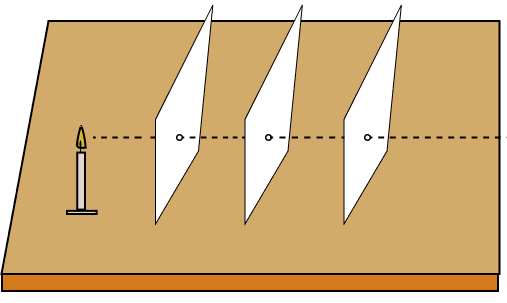
Observation :
- The flame of the candle can be seen clearly through the holes when all the three holes on cardboards are in straight line.
- We cannot see the flame if anyone of the cardboards are displaced.
Conclusion : Light always travels in a straight line.
Opaque objects cast a dark shadow. Three opaque objects are placed one after the other in the given figure. Draw the shadow that will be casted on the screen.
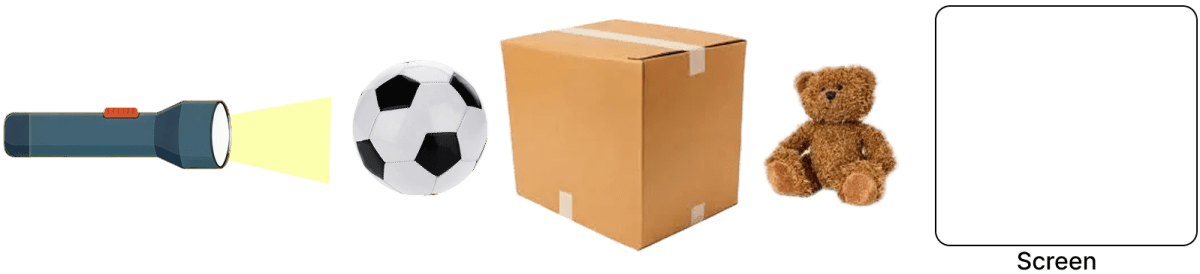
Answer
Shadow of the given arrangement is given below :
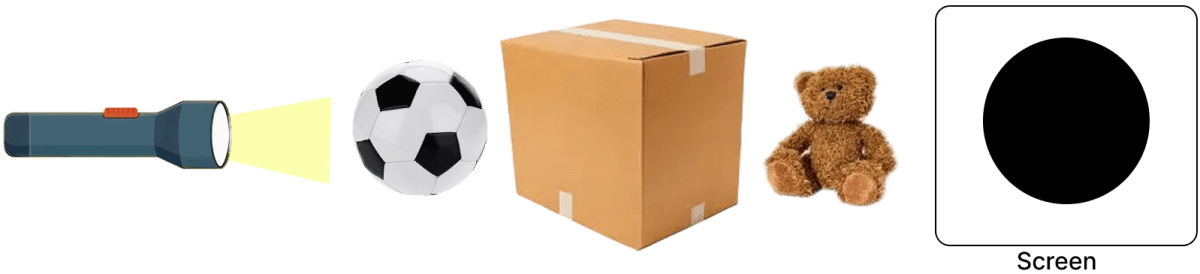
Explanation:
Light travels in straight lines, showing rectilinear propagation of light. Since the torch acts approximately as a point source of light, each opaque object can form an umbra (completely dark region) and not a noticeable penumbra.
The football, being the first opaque object closest to the light source, blocks the light completely and produces a dark umbra on the screen but the box and the teddy bear are placed entirely within the umbra formed by the football. As no light reaches these objects, they do not form separate umbra or penumbra on the screen.
Hence, the shadow observed on the screen is only the umbra corresponding to the football, with no additional penumbra due to the objects placed behind it.
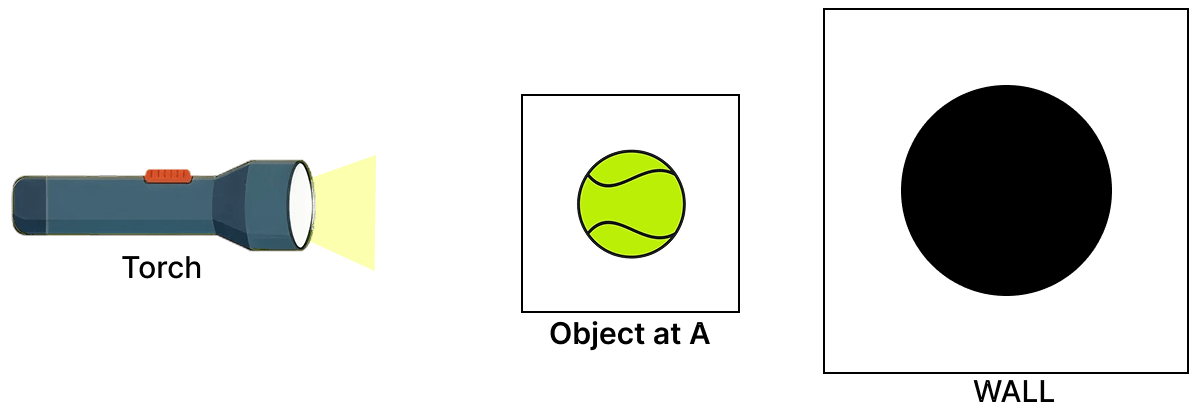
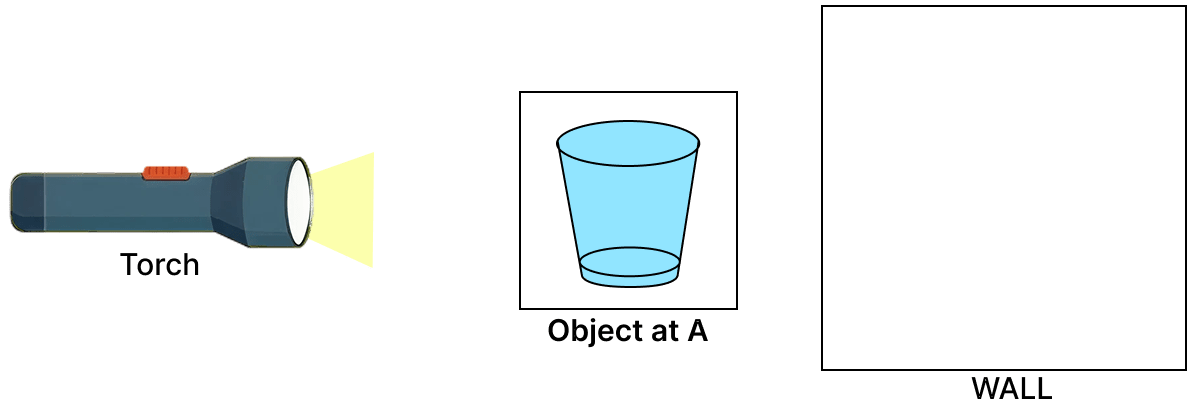
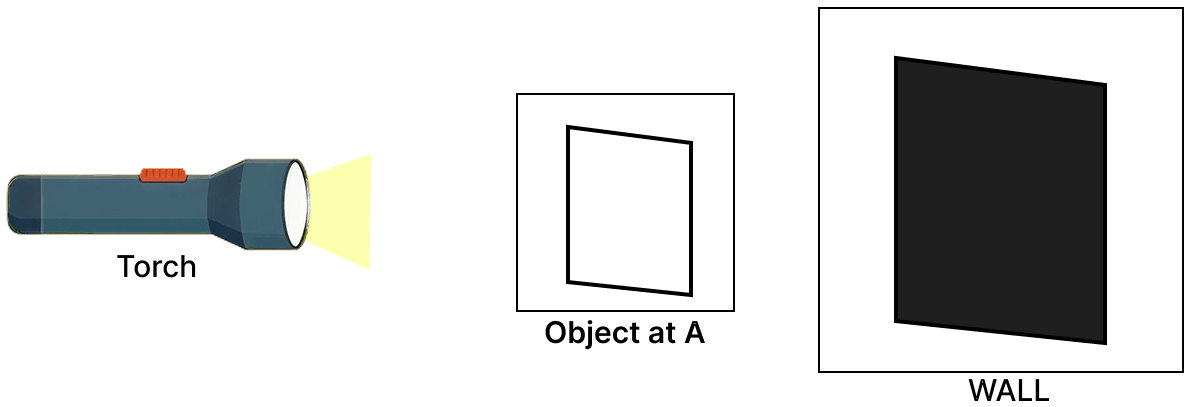
You have three objects. A tennis ball, an empty glass and butter paper. Place these objects one by one at position A. Draw the shadow obtained in each case in your notebook.
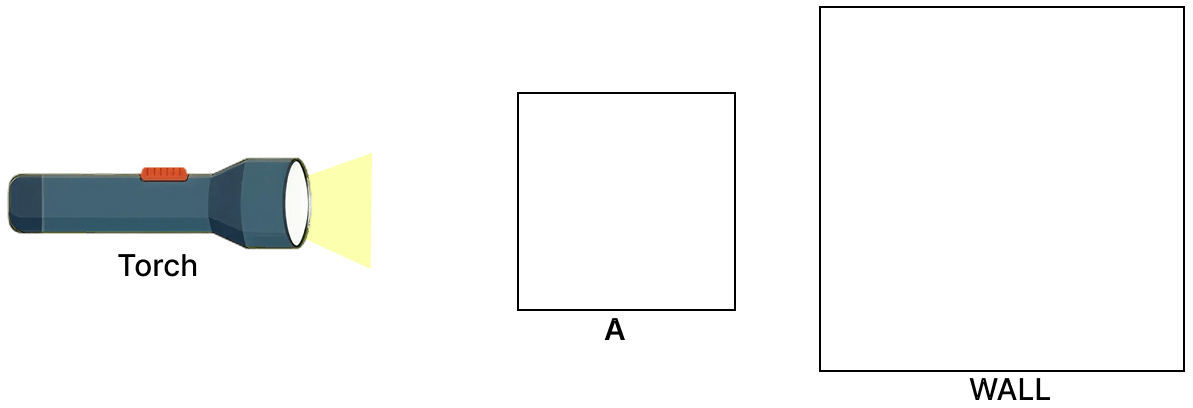
Answer
For a tennis ball
For an empty glass
For a butter paper
A passage is given below. Underline the errors and correct them in the given table.
All the bodies in our solar system are luminous except the sun and the stars. We can see other heavenly bodies of the solar system only when the light from earth falls on them. The sun revolves around the earth and the moon revolves around the earth. While revolving, the sun, earth and moon come in a straight line. This results in blocking of light from the moon. Eclipse is defined as the partial or total blocking of the heat of the sun by a heavenly body. There are two types of eclipses called the solar eclipse and the lunar eclipse. When the earth casts its shadow on the earth, a solar eclipse is said to occur. When the earth casts its shadow on the moon, a lunar eclipse is said to occur. Solar eclipse occurs on a full moon night. Lunar eclipse occurs on a new moon night.
| Incorrect Word | Correct Word |
|---|---|
Answer
All the bodies in our solar system are luminous except the sun and the stars. We can see other heavenly bodies of the solar system only when the light from earth falls on them. The sun revolves around the earth and the moon revolves around the earth. While revolving, the sun, earth and moon come in a straight line. This results in blocking of light from the moon. Eclipse is defined as the partial or total blocking of the heat of the sun by a heavenly body. There are two types of eclipses called the solar eclipse and the lunar eclipse. When the earth casts its shadow on the earth, a solar eclipse is said to occur. When the earth casts its shadow on the moon, a lunar eclipse is said to occur. Solar eclipse occurs on a full moon night. Lunar eclipse occurs on a new moon night.
| Incorrect Word | Correct Word |
|---|---|
| Luminous | Non-Luminous |
| Earth | Sun |
| Sun | Earth |
| Earth | Sun |
| Moon | Sun |
| Heat | Light |
| Earth | Moon |
| Full moon night | New moon day |
| New moon night | Full moon night |
Assertion (A) : Luminous objects emit light.
Reason (R) : Sun is a natural source of light and bulbs are artificial source of light.
- Both A and R are true, and R is the correct explanation of A.
- Both A and R are true, but R is not the correct explanation of A.
- A is true, and R is false.
- A is false, and R is true.
Answer
Both A and R are true, but R is not the correct explanation of A.
Reason —
Assertion (A) is true because luminous objects are those that emit their own light, whether they are natural (like the Sun) or artificial (like an electric bulb).
Reason (R) is true because the Sun is a natural source of light and bulbs are artificial sources of light.
However, the reason does not justify the assertion because it only classifies light sources as natural or artificial but does not explain why luminous objects emit light or define the property of luminosity. Therefore, although both statements are correct, the reason does not explain the assertion.
Assertion (A) : Light scatters when it is passed through air.
Reason (R) : Light maybe be absorbed, deflected, passed through or bounced back.
- Both A and R are true, and R is the correct explanation of A.
- Both A and R are true, but R is not the correct explanation of A.
- A is true, and R is false.
- A is false, and R is true.
Answer
Both A and R are true, and R is the correct explanation of A.
Reason —
Assertion (A) is true because when light travels through air, it interacts with tiny dust particles and various gases which causes the light to scatter in different directions.
Reason (R) is true because when light passes through air, some of it is absorbed, some of it is deflected, some passes through and some of it bounces back in different directions due to the presence of various gases and dust particles in air.
Assertion (A) : Opaque objects cast shadows.
Reason (R) : Opaque objects do not allow light to pass through.
- Both A and R are true, and R is the correct explanation of A.
- Both A and R are true, but R is not the correct explanation of A.
- A is true, and R is false.
- A is false, and R is true.
Answer
Both A and R are true, and R is the correct explanation of A.
Reason —
Assertion (A) is true because a shadow is formed when light is blocked by an object. Since opaque objects block light completely, they produce a dark shadow on the opposite side of the light source.
Reason (R) is true because opaque objects stop all the light from passing through them due to this, no light reaches the space behind them, and a shadow is formed there.
Hence, here the reason (R) clearly explains the assertion (A).
Assertion (A) : Solar eclipse occurs when the earth, moon and sun come in a straight line.
Reason (R) : Solar eclipse occurs on a new moon day.
- Both A and R are true, and R is the correct explanation of A.
- Both A and R are true, but R is not the correct explanation of A.
- A is true, and R is false.
- A is false, and R is true.
Answer
Both A and R are true, and R is the correct explanation of A.
Reason —
Assertion (A) is true because a solar eclipse happens when the Moon comes between the Earth and the Sun, and all three are aligned in a straight line such that the moon fully or partially covers the sun, as viewed from some parts of the earth.
Reason (R) is true since the light from the sun is blocked by the moon, the shadow of the moon falls on the earth and it becomes dark during the daytime thus, solar eclipse occurs only on a new moon day.
Here, reason (R) correctly explains that during the solar eclipse, the earth, moon and sun come in a straight line because in this position the moon is between the sun and the earth which is called new moon day.
Mona went to Rohini's house on a Sunday morning. She noticed that all the lights in Rohini's house were switched off. She switched on the lights of the house in the evening. Mona also noticed that Rohini switched off the lights and fan every time she left the room.
Now, answer the following questions.
(a) What was the source of light in Rohini's house in the daytime?
(b) What was the source of light in Rohini's house in the evening?
(c) Why do you think she turned off the fans and lights when she left the room every time?
Answer
(a) The Sunlight (natural light) entering through windows and doors was the source of light in the daytime.
(b) The electric bulbs or tube lights (artificial light) were the source of light in the evening.
(c) She turned off the fans and lights when she left the room every time to save electricity and avoid wastage of energy, as using lights and fans unnecessarily increases power consumption.
Moon is a non-luminous body. Why do you think it shines?
Answer
As the Moon is a non-luminous body, which means it does not produce its own light so it shines by the reflection of the sunlight that falls on its surface. The bright part of the Moon we see from Earth is simply the sunlight bouncing off the Moon.
Do you see shadows at night? How and why?
Answer
Yes, we can see shadows at night if there is a source of light such that :
- Under the streetlight or moonlight, our body blocks the light and casts a shadow on the ground.
- Inside a room at night, a lamp or bulb creates shadows of objects.
But in complete darkness, where there is no light source, no shadow is formed because shadows need light to exist.
If the sun was half its size, would that effect the shadow formation on earth? How?
Answer
If the Sun were half its size but stayed at the same distance from Earth then the Sun would still be a huge, bright luminous source, so Earth would continue to get sunlight but since its apparent size in the sky would shrink, the way shadows form would change such that shadows would become sharper and more well-defined (less penumbra, more umbra) and during eclipses, the Moon could cover the smaller Sun more easily, making total solar eclipses more common and longer-lasting.
Shadows are formed when opaque objects block the passage of light. The length of a shadow is different at different times of the day. The size of shadow is dependent on many aspects including the size of sourcе of light, distance between the source of light and object, and distance between the screen and the object.
Jolly is 120 cm tall. She plotted a graph of the length of her shadows at different times of the day.
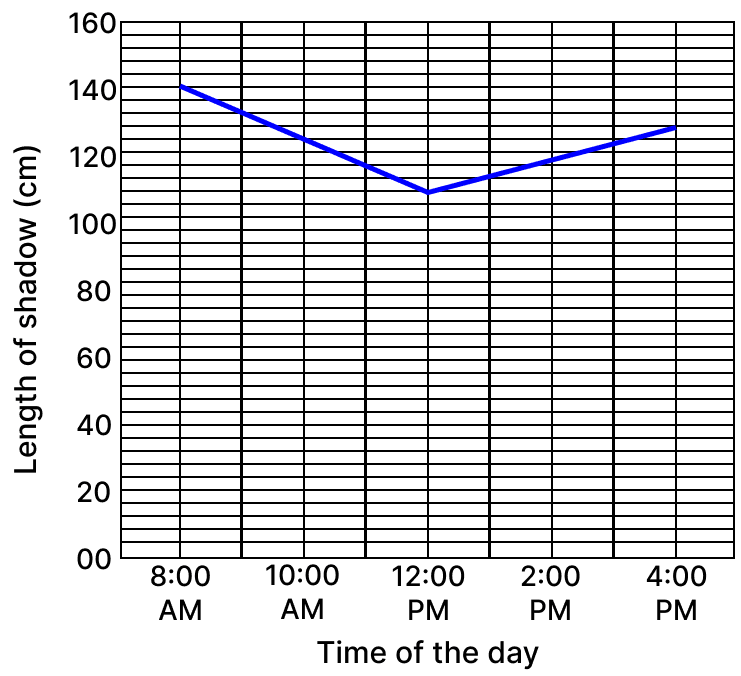
Observe the graph carefully. Now, answer the following questions.
(a) When is the length of Jolly's shadow the shortest? Why?
(b) When is the length of Jolly's shadow the longest? Why?
(c) What can you conclude from the graph?
(d) Will the shape of the graph differ from individual to individual?
Answer
(a) Jolly's shadow length is shortest at 12:00 PM (noon) because at noon the Sun is highest in the sky, so sunlight falls more vertically so that least sunlight is blocked and hence, shortest shadow is produced.
(b) Jolly's shadow length is longest at 8:00 AM (early morning) because in the morning the Sun is low on the horizon, so rays strike at a shallow angle so that maximum sunlight is blocked and thus long shadow is produced.
(c) From the graph we can conclude that shadow length of an object depends on the Sun’s position (time of day) such that shadow length decreases from morning to noon and increases from noon to evening.
(d) No, the shape of the graph will not differ from individual to individual because here the graph shows that the shadow length of any object is dependent on sun's position not on object's size.