
Lever, inclined plane, pulley, wheel and axle, screw and wedge are types of simple machines. Mention the type of simple machine used in these examples.
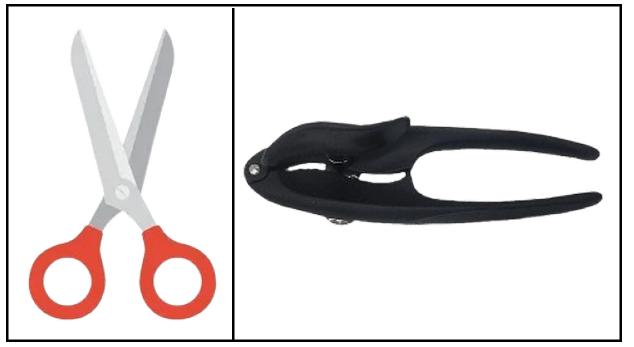
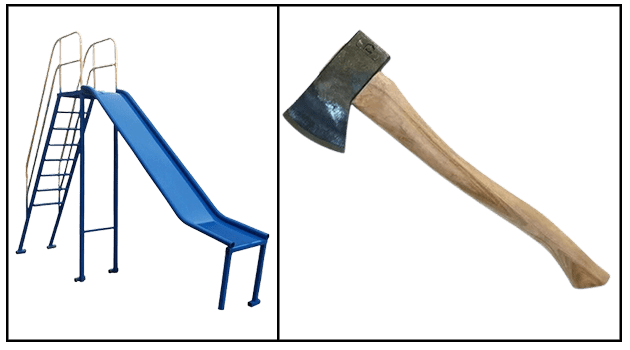
Answer
- Scissors - Class I lever
- Nutcracker - Class II lever
- Children's slide - Inclined plane
- Axe - Wedge
What are complex machines?
Answer
Complex machines are combination of two or more simple machines working together to make a task easier. For example, a bicycle which has wheels, lever and pulleys is a complex machine.
Look around you, name five machines (simple and complex) that make your work easier.
Answer
Here are five machines (simple and complex) around us that make our work easier :
| S. No. | Simple Machine | Complex Machine |
|---|---|---|
| 1. | Scissors | Bicycle |
| 2. | Stapler | Mixer/Grinder |
| 3. | Pencil Sharpener | Car |
| 4. | Hammer | Aeroplane |
| 5. | Bottle opener | Fan |
Find out and write about the different types of levers.
Answer
Levers are classified into three categories :
Class I lever
- In class I lever, the fulcrum is between the effort and the load.
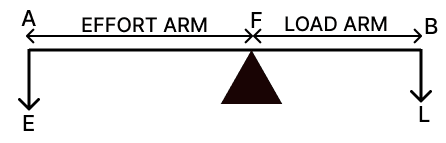
- A class I lever always changes the direction of force, i.e., applying a downward force (effort) on the lever results in an upward movement of the load.
- The mechanical advantage of class I lever can be greater than, equal to or less than 1.
- Scissors, pliers, crow bar, oars of a rowing boat and see-saw are some examples of class I lever.
Class II lever
- In class II lever, the load is between the fulcrum and the effort.
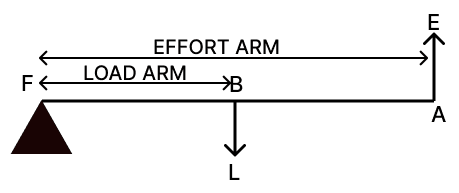
- The effort arm is always longer than the load arm. Therefore, the mechanical advantage is always greater than 1 (MA > 1). Hence, it is used as a force multiplier.
- Some examples of class II lever are bottle opener, wheel barrow and nutcracker.
Class III lever
- In class III lever, the effort is between the fulcrum and the load.
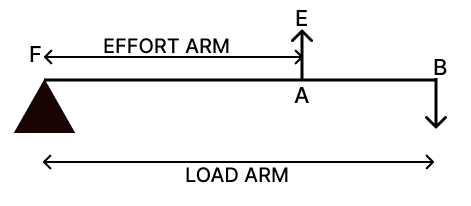
- Here the effort arm is smaller than the load arm. That is the input effort (E) is higher than the load (L). Therefore, its mechanical advantage is smaller than 1 (MA < 1). However, the distance moved by the load is greater than the distance moved by the effort. Hence, it is used as a speed multiplier.
- Tongs, fishing rod, knife and broom are some examples of class III lever.
Name one object around you that is getting work done and one object around you where work done is zero.
Answer
Object where work is done → A school bus while transporting us between home and school.
Object where work done is zero → A book lying on a table.
Construct a lever using your stationery. What is the effort, load and fulcrum in this case?
Answer
Material required : Take a scale (ruler), a pencil, and an eraser.
Steps :
- Place the pencil horizontally on the table – this will act as the fulcrum (the fixed support).
- Keep the scale (ruler) balanced on top of the pencil – this becomes the lever arm.
- Put the eraser at one end of the scale – this is the load.
- Press the other end of the scale with your finger – this is the effort.
So, in this lever made from stationery :
- Fulcrum → Pencil
- Load → Eraser
- Effort → Force applied by the finger on the scale
Give two more examples of ramps or slopes that make work easier.
Answer
Here are two more examples of ramps/slopes that make work easier :
- Wheelchair ramps → Built at building entrances so people using wheelchairs can move up or down smoothly without climbing stairs.
- Loading ramps → Used in warehouses or trucks so heavy boxes or goods can be pushed/pulled easily instead of lifting them straight up.
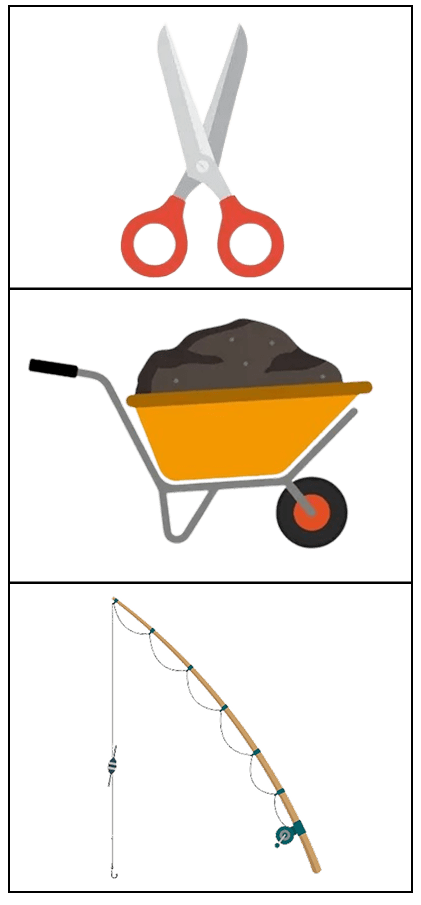
Identify the types of lever in the given simple machines.
Answer
- Scissors : It is a type of class I lever because the fulcrum is between the effort and the load.
- Wheel barrow : It is a type of class II lever because the load is between the fulcrum and the effort.
- Fishing rod : It is a type of class III lever because the effort is between the fulcrum and the load.
Solve the following numericals.
(a) What is the mechanical advantage of a machine that lifts a load of 100 N with an effort of 20 N?
(b) What is the effort required if the mechanical advantage is 9 and the load is 81 N?
Answer
(a) Given,
- Load = 100 N
- Effort = 20 N
As,
(b)
Given,
- Mechanical advantage = 9
- Load = 81 N
As,
Some of the facts that you have learnt till now are listed below. Tick (✓) the facts that are correct and cross (x) the facts that are incorrect.
(a) Efficiency of a machine can be 100%.
(b) A wheel and axle move together.
(c) A wedge is a combination of an axle and inclined plane.
(d) Screw acts as a fastener.
(e) Screwdriver is an example of screw.
Answer
(a) x
Corrected Fact — The efficiency of every machine used by us is always less than 100% as some of the input energy is used up in overcoming the friction between different parts of the machine and as heat from the working parts of the machine. Therefore, output energy is always less than the input energy and hence, in reality the efficiency can never be 100%.
(b) ✓
(c) x
Corrected Fact — A wedge is a combination of two inclined planes.
(d) ✓
(e) x
Corrected Fact — Screwdriver is an example of wheel and axle.
Fill in the blanks.
(a) The ratio of the load lifted by a machine to the effort applied on it is called ............... .
(b) Work done on an object is the product of ............... and ............... .
(c) There are three types of levers based on the positions of ..............., ............... and ............... .
(d) The ratio of work done by a machine to the work done on the machine is termed as ............... of the machine.
(e) The arrangement of several pulleys to pick heavy loads is called ............... .
Answer
(a) The ratio of the load lifted by a machine to the effort applied on it is called mechanical advantage.
(b) Work done on an object is the product of force and distance.
(c) There are three types of levers based on the positions of fulcrum, load and effort .
(d) The ratio of work done by a machine to the work done on the machine is termed as efficiency of the machine.
(e) The arrangement of several pulleys to pick heavy loads is called block and tackle system.
State whether the following statements are true or false. Correct the false statements.
(a) A girl riding a bicycle is getting zero work done.
(b) When the value of mechanical advantage is equal to one, it means that effort is equal to load.
(c) In class III lever, the fulcrum is between the load and the effort.
(d) In a fixed pulley, the pulley can move.
(e) Tyres of cars and buses are examples of wheel and axle.
Answer
(a) False
Corrected Statement — Work done on an object is the product of force and distance and since the girl is covering a significant distance by applying muscular force on the bicycle so work done is not zero.
(b) True
(c) False
Corrected Statement — In class III lever, the effort is between the fulcrum and the load while in class I lever, the fulcrum is between the effort and the load.
(d) False
Corrected Statement — In a fixed pulley, the pulley is attached to a hook or a wall and doesn't move while a movable pulley moves with the load.
(e) True
Which of the following is not a simple machine?
- Bicycle
- Scissors
- Doorknobs
- Bottle openers
Answer
Bicycle
Reason — A bicycle is a complex machine because it is made up of many simple machines (gears, levers, pulleys, wheels, and axles) working together to ease travelling but scissors (class I lever), doorknobs (wheel & axle), and bottle openers (class II lever) are examples of simple machines.
What is the formula to find out the mechanical advantage in a lever?
Answer
Reason — The ratio of the load lifted by a machine to the effort applied on it is defined as mechanical advantage and is given by
............... (i)
And,
Mechanical advantage of a lever is given by the ratio of the effort arm to the load arm i.e.,
............... (ii)
From (i) and (ii)
What type of simple machine is a bottle opener?
- Wedge
- Class I lever
- Class II lever
- Wheel and axle
Answer
Class II lever
Reason — Bottle opener is a class II lever where the load is between the fulcrum and the effort such that the effort arm is always longer than the load arm. Therefore, the mechanical advantage of the bottle opener is always greater than 1 (MA > 1).
Which of the following is not a feature of an inclined plane?
- Length of inclined plane
- Height of inclined plane
- Threads
- Slanting surface
Answer
Threads
Reason — An inclined plane is a simple machine that has a slanting surface used to raise or lower a load with less effort. Its main features are the length of the inclined plane, the height of the inclined plane, and its slanting surface while threads are a feature of a screw, which is actually a modified form of the inclined plane, but not a direct feature of an inclined plane itself.
Which feature of the screw determines its mechanical advantage?
- Thread
- Pitch
- Lead
- Interlock
Answer
Lead
Reason — The linear distance covered by the screw in one complete turn (360°) is called its lead which determines the mechanical advantage of the screw such that smaller the lead, the higher is the mechanical advantage and vice versa.
Match the columns.
| Column A | Column B | ||
|---|---|---|---|
| 1. | Fixed support in a lever | (a) | Door stopper |
| 2. | Children's slide | (b) | Screw driver |
| 3. | Fixed pulley | (c) | Fulcrum |
| 4. | Wheel and axle | (d) | Well |
| 5. | Wedge | (e) | Inclined plane |
Answer
| Column A | Column B | ||
|---|---|---|---|
| 1. | Fixed support in a lever | (c) | Fulcrum |
| 2. | Children's slide | (e) | Inclined plane |
| 3. | Fixed pulley | (d) | Well |
| 4. | Wheel and axle | (b) | Screw driver |
| 5. | Wedge | (a) | Door stopper |
Give reasons for the following statements.
(a) Work done by a standing man is zero.
(b) A simple machine neither provides energy nor does any work.
(c) Mechanical advantage of class II lever is always greater than 1.
(d) Effort depends on the steepness of inclined plane.
(e) Efficiency of a machine cannot be 100%.
Answer
(a) Work done by an object is the product of force and distance i.e.,
Work = Force x Distance
Since the man is standing so no distance is covered by him even after applying muscular force to counter gravitational pull of the earth and hence, no work is done by the man.
(b) A simple machine works on an object only when we do some work on it by applying force. Therefore, a simple machine neither provides energy nor does any work on its own.
(c) As, mechanical advantage of a lever is given by the ratio of the effort arm to the load arm i.e.,
In class II lever, the effort arm is always longer than the load arm i.e.,
Effort arm > Load arm
Hence, mechanical advantage of class II lever is always greater than 1.
(d) The mechanical advantage of an inclined plane is equal to the ratio of the length of the inclined plane to its vertical height i.e.,
Higher the value of h, steeper is the slope. Hence, effort depends on the steepness of inclined plane.
(e) The efficiency of every machine used by us is always less than 100% because some of the input energy is used up in overcoming the friction between different parts of the machine and as heat from the working parts of the machine. Therefore, output energy is always less than the input energy.
Differentiate between class I, class II and class III lever. Give examples if applicable.
Answer
| S. No. | Class I lever | Class II lever | Class III lever |
|---|---|---|---|
| 1. | In class I lever, the fulcrum is between the effort and the load. | In class II lever, the load is between the fulcrum and the effort. | In class III lever, the effort is between the fulcrum and the load. |
| 2. | The mechanical advantage can be greater than, equal to or less than 1. | The mechanical advantage is always greater than 1. | The mechanical advantage is always less than 1. |
| 3. | Example : scissors, pliers and see-saw. | Example : bottle opener, wheel barrow and nutcracker. | Example : fishing rod, knife and broom. |
Differentiate between fixed pulley and movable pulley. Give examples if applicable.
Answer
| S. No. | Fixed pulley | Movable pulley |
|---|---|---|
| 1. | In a fixed pulley, the pulley is attached to a hook or a wall and doesn't move. | A movable pulley moves with the load. |
| 2. | It changes the direction of the force, but does not amplify it. | It amplifies the force and acts as a force multiplier. |
| 3. | The mechanical advantage of a fixed pulley is equal to 1. | The mechanical advantage of a fixed pulley is greater than 1. |
| 4. | Example: well and flagpole. | Example: cranes and block and tackle pulley in sailing boats. |
Differentiate between inclined plane and screw. Give examples if applicable.
Answer
| S. No. | Inclined plane | Screw |
|---|---|---|
| 1. | An inclined plane is a slanting surface which connects two points at different heights. | A screw is an inclined plane wound around a rod spirally making a number of turns on it. |
| 2. | An inclined plane reduces the effort needed to lift objects. | It is commonly used for holding things together and lifting materials. |
| 3. | The mechanical advantage of an inclined plane is equal to the ratio of the length of the inclined plane to its vertical height such that longer length and shorter height provide more advantage. | The mechanical advantage of the screw is determined by its lead such that, smaller the lead, the higher is the mechanical advantage. |
| 4. | Example : children's slide and ramp for wheelchair. | Example : screws and bottles. |
What are simple machines? Give examples.
Answer
Simple machines are basic devices that make our work easier by either multiplying force, increasing the speed of the object or changing its direction. Examples: Lever, pulley, wheel and axle, screw, wedge, and inclined plane.
How is mechanical advantage calculated?
Answer
Mechanical advantage is defined as the ratio of the load lifted by a machine to the effort applied on it i.e.,
How do you calculate work?
Answer
Work done on an object is calculated by the following formula :
Work = Force x Distance
where, distance is the distance covered by the body in the direction of force acting on the body.
How should one take care of machines?
Answer
A machine should be lubricated properly to overcome friction between its parts that will reduce noise pollution and increase the efficiency of the machine.
What is a wedge?
Answer
A wedge is a simple machine made of wood or metal with two slanting sides ending in a sharp or pointed edge and is generally a combination of two inclined planes.
What are the three types of lever? Explain with diagrams and examples.
Answer
Three types of lever :
Class I lever
- In class I lever, the fulcrum is between the effort and the load.
- A class I lever always changes the direction of force, i.e. applying a downward force (effort) on the lever results in an upward movement of the load.
- The mechanical advantage of class I lever can be greater than, equal to or less than 1.
- Scissors, pliers, crow bar, oars of a rowing boat and see-saw are some examples of class I lever.
Class II lever
- In class II lever, the load is between the fulcrum and the effort.
- The effort arm is always longer than the load arm. Therefore, the mechanical advantage is always greater than 1 (MA > 1). Hence, it is used as a force multiplier.
- Some examples of class II lever are bottle opener, wheel barrow and nutcracker.
Class III lever
- In class III lever, the effort is between the fulcrum and the load.
- The effort arm is smaller than the load arm so that the input effort is higher than the load. Therefore, its mechanical advantage is smaller than 1 (MA < 1). However, the distance moved by the load is greater than the distance moved by the effort. Hence, it is used as a speed multiplier.
- Tongs, fishing rod, knife and broom are some examples of class III lever.
What is an inclined plane? How do we calculate the mechanical advantage of an inclined plane?
Answer
An inclined plane is a slanting surface which connects two points at different heights so that heavier objects can be moved up or down easily. An inclined plane reduces the effort needed to lift objects, but does not reduce the amount of work.
For example, at construction sites for lifting or moving heavy loads workers push the load using an inclined plane, so that it moves without much effort. Here the force is applied only at the time of pushing the load.
The mechanical advantage of an inclined plane is equal to the ratio of the length of the inclined plane to its vertical height i.e.,
How do simple machines function?
Answer
A simple machine works on the principle that it neither provides energy by itself nor does any work on its own.
It works on an object only when we do some work on it by applying force. The force applied on the machine to do work is called effort and the resulting force exerted by the machine is called the load.
How does a pulley make our work easy?
Answer
A pulley is a simple machine consisting of a wheel with a grooved rim in which a rope or a chain can pass. The wheel is mounted on an axle and is fitted to a frame called block and the wheel is free to rotate.
It makes work easy in two ways :
- Single fixed pulley changes the direction of force – we pull down instead of lifting up.
- Movable or block-and-tackle pulleys multiply the force applied, so we can lift heavier loads with less effort.
Example: Wells, cranes, lifts.
How is a wheel and axle used as both a force and speed multiplier?
Answer
A wheel and axle arrangement consists of a wheel attached to a cylindrical rod or shaft called the axle. The wheel and the axle must move together to form a simple machine in which the effort applied to the wheel helps in turning the axle and vice versa.
It is used in two ways :
Force Multiplier : On turning the large wheel the axle moves with more force. In this way one can turn heavy objects by spinning a wheel attached to an axle which in turn is connected to the heavy object. That's how a steering wheel works in a car.
Speed Multiplier : When the axle is turned, the wheel turns really fast so that it covers a larger distance with greater speed like in the tyres of a car and bus.
What is the mechanical advantage of a machine that lifts a load of 75 N with an effort of 15 N?
Answer
Given,
- Load = 75 N
- Effort = 15 N
As,
So, mechanical advantage of the machine is 5.
What is the effort required if the MA is 7 and the load is 45 N?
Answer
Given,
- Mechanical advantage = 7
- Load = 45 N
As,
So, the required effort is 6.43 N.
In class I lever, the distance between the fulcrum and the load is 32 cm and then distance between the fulcrum and the effort is 64 cm. What is the MА?
Answer
Given,
- Distance between the fulcrum and the load = Load arm = 32 cm
- Distance between the fulcrum and the effort = Effort arm = 64 cm
As, mechanical advantage of a lever is given by the ratio of the effort arm to the load arm i.e.,
So, the MА of class I lever is 2.
In class II lever, the length of the effort is 200 cm and then length of the load arm is 50 сm. Calculate the MA.
Answer
Given,
- Effort arm = 200 cm
- Load arm = 50 cm
As, mechanical advantage of a lever is given by the ratio of the effort arm to the load arm i.e.,
So, the MА of class II lever is 4.
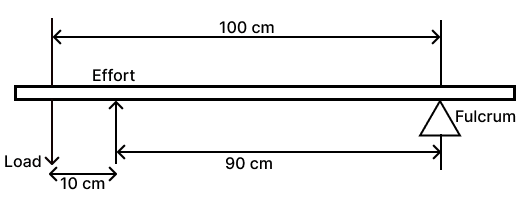
In class III lever, the distance from the fulcrum to the load is 100 cm and the distance from the effort to the load is 10 cm. Calculate the МА.
Answer
Given,
- Distance between the fulcrum and the load = Load arm = 100 cm
- Distance between the load and the effort = 10 cm
Now,
Effort arm = Distance between the fulcrum and the load - Distance between the load and the effort = 100 - 10 = 90 cm
As, mechanical advantage of a lever is given by the ratio of the effort arm to the load arm i.e.,
So, the MА of class III lever is 0.9.
Observe the given images and answer the following questions.
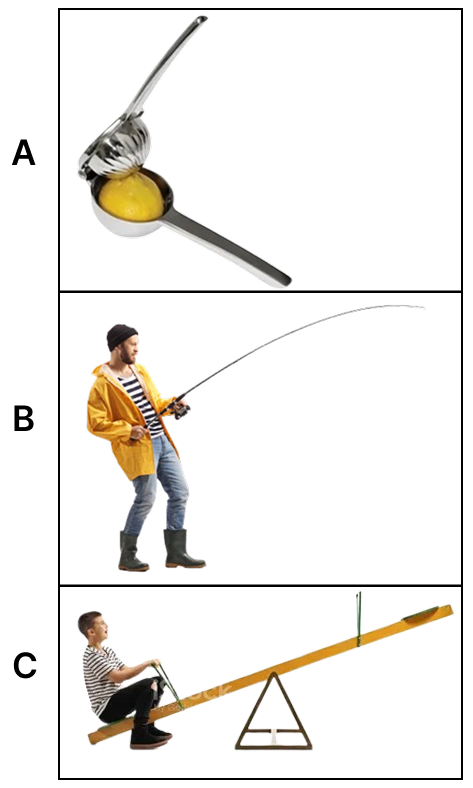
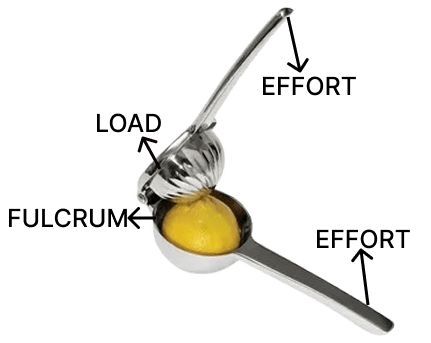
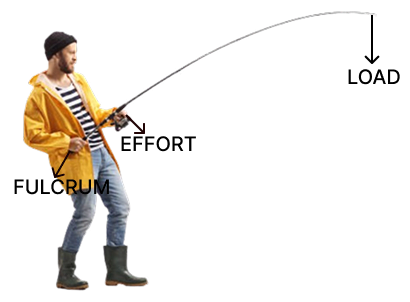
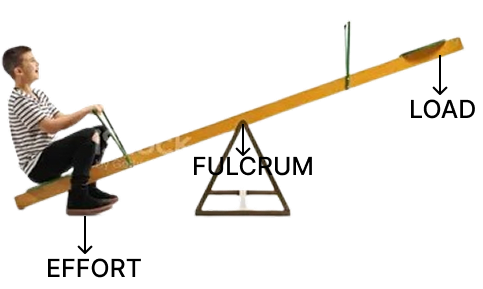
(a) Name the simple machines being used in each image.
(b) Mark the position of effort, load and fulcrum in each images.
Answer
(a)
A → Nutcracker
B → Fishing rod
C → See-saw
(b)
A.
B.
C.
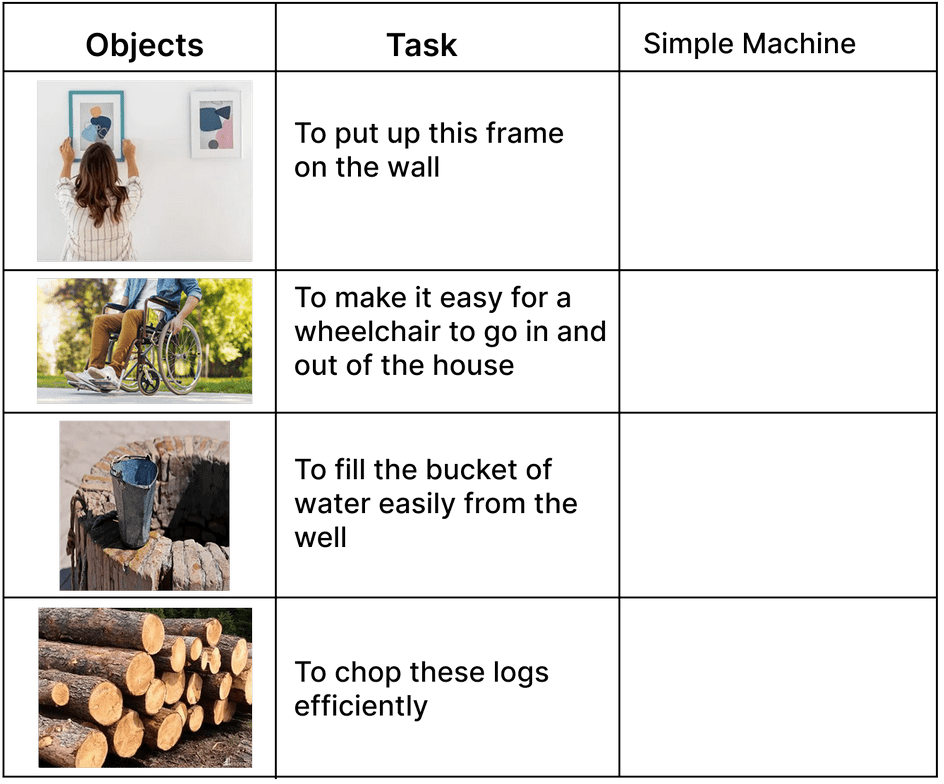
Simple machines can be commonly found in your surroundings. Some objects are given. Which simple machines will you use to get the following tasks done?
Answer
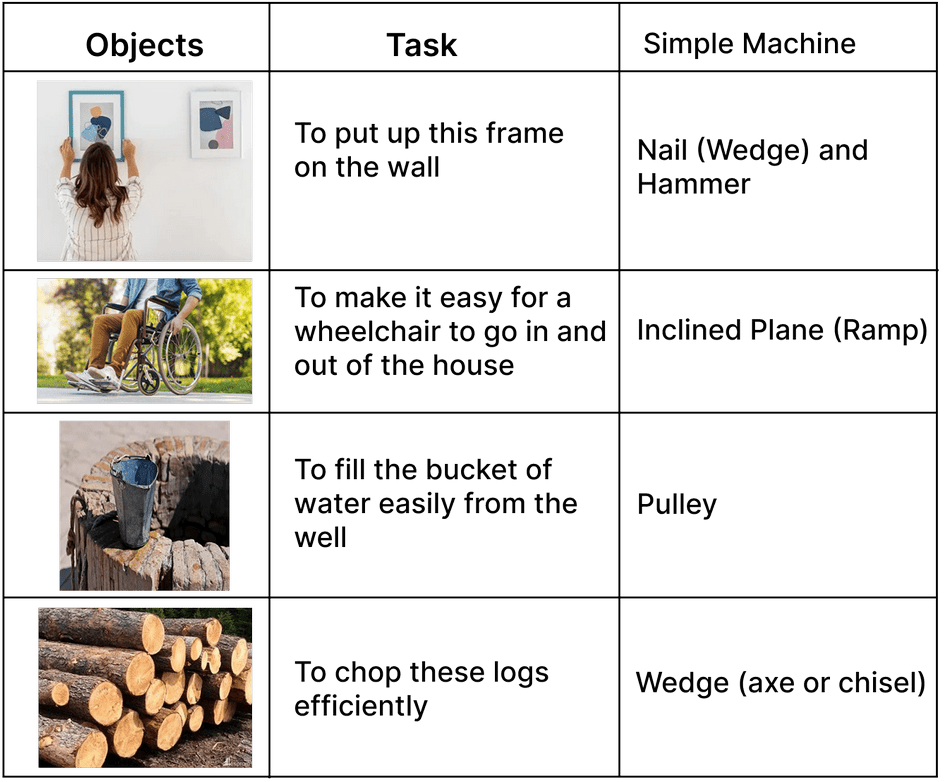
Tina and her younger brother are playing in the garden. They see the gardener using a few tools. Tina recognises the wheelbarrow that the gardener is using. She also sees the gardener using a big garden scissor. Meanwhile, she sees that her younger brother is running to pick the axe that is lying around. Tina stops him and tells him it's dangerous.
Now, answer the following questions.
(a) Which simple machine is used in a scissor?
(b) Which simple machine is used in a wheelbarrow?
(c) Which simple machine is used in an axe?
(d) Why did Tina call the axe dangerous? Are there any other machines that shouldn't be used without adult's supervision?
Answer
(a) A scissor is a class I lever in which the fulcrum is between the effort and the load.
(b) A wheelbarrow is a class II lever in which the load is between the fulcrum and the effort.
(c) An axe is a wedge that helps split wood or cut objects.
(d) Tina called the axe dangerous because it has sharp edges and can cause serious injury if handled carelessly, especially by children.
Yes. Machines like knives, saws, drills, mixers, sewing machines, lawn mowers, and electrical appliances should not be used without adult supervision, as they can cause cuts, shocks, or accidents.
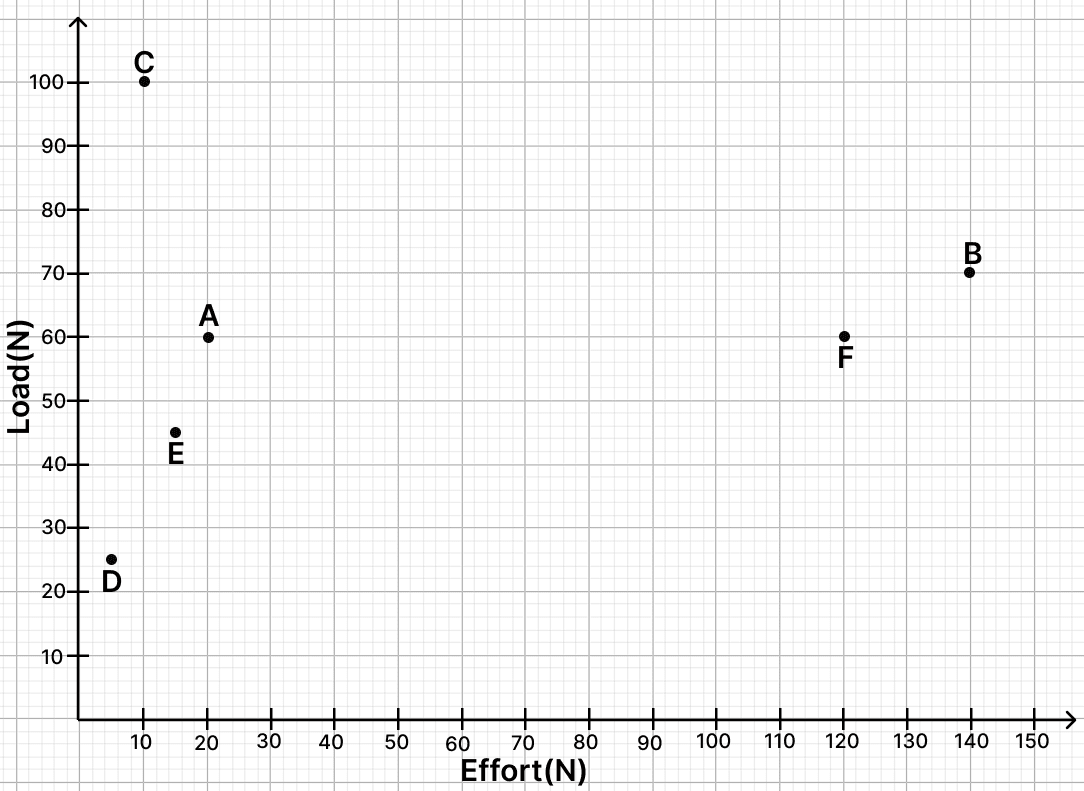
Mechanical advantage is the ratio of load lifted by a machine to the effort applied. Every simple machine has a mechanical advantage. The effort and load of some machines are given. Calculate the MA of each machine.
| Machine | Effort (N) | Load (N) | Mechanical Advantage |
|---|---|---|---|
| A | 20 | 60 | |
| B | 140 | 70 | |
| C | 10 | 100 | |
| D | 5 | 25 | |
| E | 15 | 45 | |
| F | 120 | 60 |
Draw a line graph of the given data. Take effort on X-axis and load on Y-axis.
Answer
As,
For machine A
So, mechanical advantage of the machine A is 3.
For machine B
So, mechanical advantage of the machine B is 0.5.
For machine C
So, mechanical advantage of the machine C is 10.
For machine D
So, mechanical advantage of the machine D is 5.
For machine E
So, mechanical advantage of the machine E is 3.
For machine F
So, mechanical advantage of the machine F is 0.5.
On summarizing all results in the table :
| Machine | Effort (N) | Load (N) | Mechanical Advantage |
|---|---|---|---|
| A | 20 | 60 | 3 |
| B | 140 | 70 | 0.5 |
| C | 10 | 100 | 10 |
| D | 5 | 25 | 5 |
| E | 15 | 45 | 3 |
| F | 120 | 60 | 0.5 |
The line graph of the given data is shown below :
Wedges are made up of two inclined planes. How will you find MA of a wedge?
Answer
The mechanical advantage of an inclined plane is equal to the ratio of the length of the inclined plane to its vertical height i.e.,
Since, wedge is very much similar to an inclined plane then their mechanical advantage should be similar too.
The mechanical advantage of a wedge is equal to the ratio of the length of the inclined plane to its thickness because here thickness is same as height of the inclined plane i.e.,
If you want to increase the MA of a machine, what should be increased or decreased?
Answer
To increase the mechanical advantage (MA) of a machine, one must increase the effort arm or input distance and decrease the load arm or output distance. For example, in a lever, the MA can be increased by making the effort arm longer or the load arm shorter.
Is it possible to balance the load and effort by changing the position of fulcrum?
Answer
Yes, it is possible to balance the load and effort by changing the position of the fulcrum. In a lever, the fulcrum is the pivot point, and the distances of the load and effort from the fulcrum determine the mechanical advantage. If the fulcrum is moved closer to the load, the effort required decreases, making it easier to lift the load. If it is moved closer to the effort, the load becomes harder to lift. By adjusting the fulcrum’s position, one can balance or redistribute the load and effort to achieve the desired effect.
Efficiency is defined as the ratio of work done by a machine to the work done on a machine. Every machine that we use in our lives has an efficiency that allows us to assess the performance of the machine. Percentage efficiency of some machines is given in the table.
| Machine | Efficiency (%) |
|---|---|
| Heat engine | 40 |
| Solar panels | 15 |
| Steam turbine | 35 |
| Electric generator | 90 |
| Carnot engine | 50 |
Now, answer the following questions.
(a) Which machine has the highest efficiency? What does it mean?
(b) Which machine has the lowest efficiency? What does it mean?
(c) Are these simple machines or complex machines?
(d) What is the formula to calculate efficiency of a machine?
(f) Are any of these machines ideal? If no, why?
(g) Using the Internet, find out where these machines are used.
Answer
(a) The electric generator has the highest efficiency of 90%. This means that 90% of the work done on the generator (input energy) is converted into useful electrical energy (output work), with only 10% lost as heat or other forms of energy.
(b) The solar panels have the lowest efficiency of 15%. This means only 15% of the solar energy falling on the panels is converted into electricity, while the remaining 85% is lost, mostly as heat or reflection.
(c) All of these are complex machines, since they are made of multiple components and systems working together, unlike simple machines (like lever, pulley, or wedge).
(d) Efficiency
(e) No, none of these machines are ideal. An ideal machine would have 100% efficiency with no energy loss. In reality, some energy is always lost as heat, sound, or friction, so no real machine can be perfectly efficient.
(f) These machines are used in the following devices :
- Heat engine → Cars, trucks, and airplanes (internal combustion engines).
- Solar panels → Rooftops, solar farms, calculators, satellites.
- Steam turbine → Power plants (coal, nuclear, geothermal).
- Electric generator → Power stations, wind turbines, hydroelectric dams.
- Carnot engine → Theoretical model studied in thermodynamics.