
Observe the given images carefully and complete the given table.
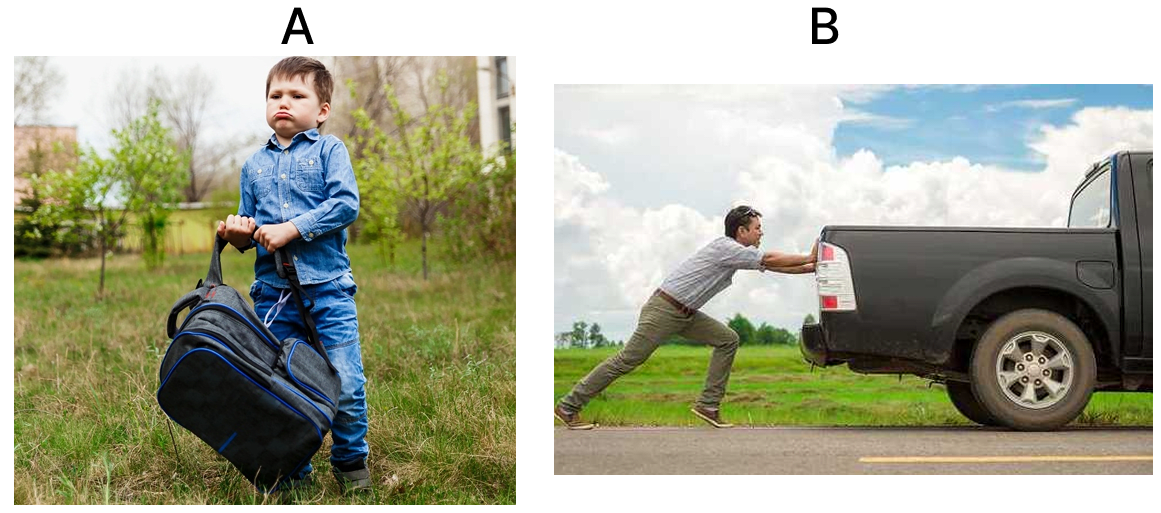
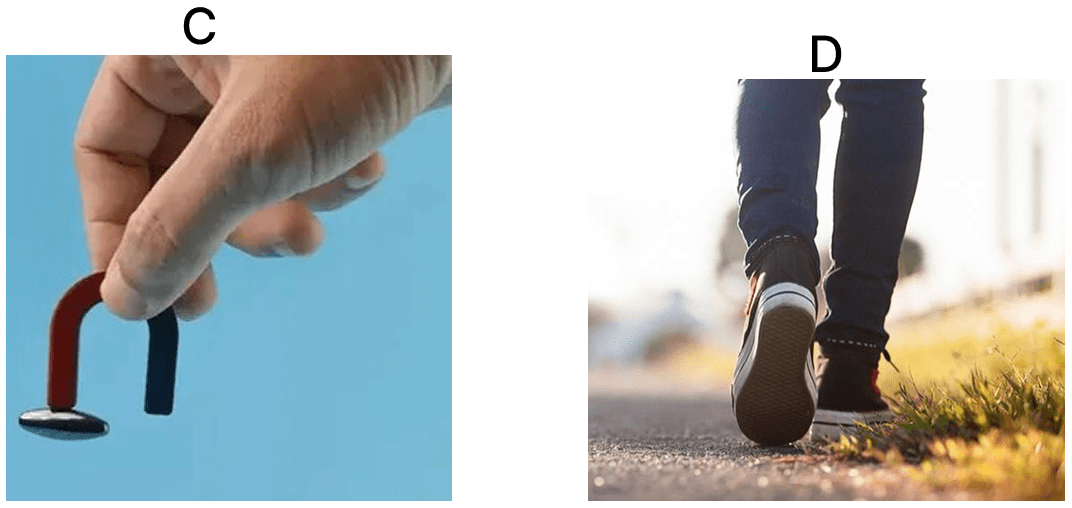
| Image | Push/Pull | Types(s) of Force |
|---|---|---|
| A | ||
| B | ||
| C | ||
| D |
Answer
| Image | Push/Pull | Types(s) of Force |
|---|---|---|
| A | Pull | Contact Force |
| B | Push | Contact Force |
| C | Pull | Non-Contact Force |
| D | Push | Contact Force |
Explanation
Image A — The boy is pulling the bag pack up to carry on his shoulders. Hence, it is a Pull and Contact force.
Image B — The person is pushing the car forward with this hands. Hence, it is a Push and Contact force.
Image C — The magnet is attracting the metal ball. As magnetic force is a non-contact force and the ball is pulled towards the magnet, hence, it is a Pull and Non-Contact force.
Image D — While walking, the person is pushing the ground with his feet. Hence, it is a Push and Contact force.
Does a push or pull always result in change of state of motion of an object? If no, why?
Answer
No, a push or pull does not always cause a change in motion because if there are opposing forces such as friction or an equal opposite force, the effect of the push or pull gets cancelled, like when we push against a wall and it does not move. Thus, whether motion changes or not depends on the strength of the applied force and the opposing forces acting on the object.
How is force different from energy?
Answer
Force is different from energy in the following ways :
| Feature | Force | Energy | Example |
|---|---|---|---|
| What it is | A push or pull on an object | The ability/capacity to do work or cause change | Pushing a swing (force) vs. food/battery storing energy |
| When it exists | Only while the push/pull is happening | Can be stored and used later | No push → no force; a charged battery still has energy |
| What it does | Changes an object’s motion or shape when applied | Can make things happen: move objects, heat, light, sound, etc. | Squeezing a sponge (force) vs. a torch lighting up (energy) |
| Where it “lives” | It’s an interaction between objects | It’s a property of objects or systems | Hands pushing a box vs. fuel in a car |
| Unit | Newton (N) | Joule (J) | A 10 N push; a battery of 1000 J |
How do our muscles obtain energy to exert a force?
Answer
Food is our fuel. Muscles use that fuel with oxygen to release energy and create force.
Why do you think we are unable to push a wall or a tree?
Answer
We are unable to push a wall or a tree because both are rigid and fixed to the ground. When we apply force, the wall or tree applies an equal and opposite force back on us so that the resultant force becomes zero. Since they are very heavy, firmly attached, and not free to move, our applied force is not enough to change their state of rest, so they remain unmoved.
Name two sports that are played by changing the speed and direction of motion of objects.
Answer
Two sports that are played by changing the speed and direction of motion of objects are:
- Cricket – the bowler and the batsman change the speed and direction of the ball.
- Football – players change the speed and direction of the ball while passing or shooting.
Some of the facts that you have learnt till now are listed below. Tick (✓) the facts that are correct and cross (x) the facts that are incorrect.
(a) Force can only change the direction and motion of a body.
(b) The SI unit of force is newton.
(c) The resultant force is the total force acting on a body.
(d) A lot of force can change the mass of a body.
(e) The body only moves if the applied force is sufficient.
Answer
(a) x
Corrected Fact — A force can change the direction and motion of a body but it can also change the shape and size of an object for example, if we take a ball of cotton and press it between the hands, its shape and size changes.
(b) ✓
(c) ✓
(d) x
Corrected Fact — Force applied on a body does not affect the mass of the body because the applied force does not change the composition of matter that is present in the body.
(e) ✓
Give three examples of force exerted by tension.
Answer
Three examples of force exerted by tension are:
- A bucket of water being lifted from a well using a rope.
- A person pulling a cart with the help of a rope.
- Clothes hanging on a clothesline tightly stretched between two poles
Write one word or few words for the following.
(a) This contact force comes into play when two bodies collide
(b) This force attracts iron and nickel towards the magnet
(c) Friction is reduced on this surface
(d) This type of friction exists when the two bodies are at rest
(e) This type of friction is more than rolling friction
Answer
(a) Collision force
(b) Magnetic force
(c) Smooth surface
(d) Static friction
(e) Sliding friction
Why do wrestlers and gymnasts rub powder/chalk on their hands?
Answer
Wrestlers and gymnasts rub powder or chalk on their hands to increase friction as the powder absorbs sweat and moisture from their palms, preventing slipping and giving them a better grip while performing or holding their opponent.
Write three advantages of friction.
Answer
Three advantages of friction are :
- Friction between our feet or footwear and the ground helps us to walk without slipping.
- The friction between treaded tyres and rough surface of the road enables vehicles to move safely on the road.
- Friction between the brake-shoe and the wheel slows down or stops a moving vehicle.
Why do we need to increase friction?
Answer
We need to increase friction because it helps us in daily life in the following way :
- Friction between our feet or footwear and the ground helps us to walk without slipping.
- The friction between treaded tyres and rough surface of the road enables vehicles to move safely on the road.
- Friction between the brake-shoe and the wheel slows down or stops a moving vehicle.
- Friction between a pencil or a pen and paper helps us to write. It is friction that allows your teacher to write on the blackboard.
- We are able to light a matchstick, cut anything, tie a knot or fix a nail on the wall because of friction.
- We are able to hold objects with our hands due to friction.
- We rub our hands in winter to make them warm as friction produces heat.
The soles of the footwear have ............... to increase friction.
Answer
The soles of the footwear have grooved designs to increase friction.
When the body has ............... shape, the friction is minimum.
Answer
When the body has streamline shape, the friction is minimum.
Observe the given image and answer the following questions.
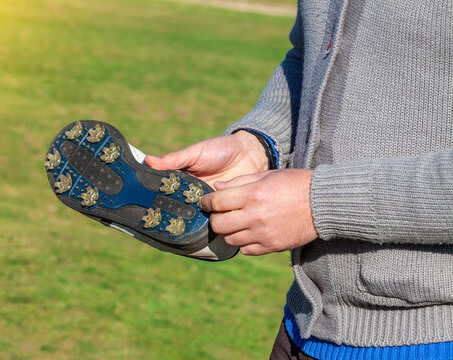
(a) Is this a method of increasing or decreasing friction?
(b) What are the disadvantages of friction?
Answer
(a) This a method of increasing friction as the image shows a person holding shoes with studs (spikes) at the bottom which increase their grip on the ground and hence, the friction increases.
(b) Following are the disadvantages of friction :
- Friction causes wear and tear of the rubbing surfaces. It damages the moving parts of a machine with time, tyres of vehicles and even the soles of our footwear.
- As friction produces heat, different parts of rotating machines get damaged with time and need periodic replacement. Sometimes, we need to make provisions for constant cooling of moving parts of big machines to avoid wear and tear which increases the cost of maintenance.
- Friction causes wastage of energy. We have to spend extra energy on machines to overcome friction. This decreases the efficiency of machines.
Fill in the blanks.
(a) ............... is a push or pull acting on a body that changes the motion of an object.
(b) Force applied does not change the ............... of an object.
(c) ............... and ............... are the two types of unbalanced forces.
(d) Sliding friction is ............... than rolling friction.
(e) Friction is caused due to ............... on the surface of objects.
Answer
(a) Force is a push or pull acting on a body that changes the motion of an object.
(b) Force applied does not change the mass of an object.
(c) Frictional force and gravitational force are the two types of unbalanced forces.
(d) Sliding friction is greater than rolling friction.
(e) Friction is caused due to irregularities on the surface of objects.
State whether the following statements are true or false. Correct the false statements.
(a) Force can change the shape and size of an object.
(b) Collision force is a non-contact force.
(c) Friction does not depend on weight of a body.
(d) Lubricating is a method used to increase friction.
(e) Presence of grooves in soles makes it easier to walk.
Answer
(a) True
(b) False
Corrected Statement — Collision force is a contact force which comes into play when two bodies collide with each other.
(c) False
Corrected Statement — Friction depends directly on the weight of a body such that if the body is heavier, then its frictional force is greater hence, more force will be required to move a heavier body than a lighter one.
(d) False
Corrected Statement — Friction is reduced by lubricating the two surfaces in contact in which substances like oil, grease and powdered graphite known as lubricants form a thin layer between the two surfaces in contact and fill the depressions present on the surfaces which reduces the unevenness of the surfaces and thus friction is reduced.
(e) True
Match the columns.
| Column A | Column B | ||
|---|---|---|---|
| 1. | Force | (a) | Polishing |
| 2. | Contact force | (b) | Electrostatic force |
| 3. | Non-contact force | (c) | Push or pull |
| 4. | Static friction | (d) | Normal force |
| 5. | Reduction of friction | (e) | Body at rest |
Answer
| Column A | Column B | ||
|---|---|---|---|
| 1. | Force | (c) | Push or pull |
| 2. | Contact force | (d) | Normal force |
| 3. | Non-contact force | (b) | Electrostatic force |
| 4. | Static friction | (e) | Body at rest |
| 5. | Reduction of friction | (a) | Polishing |
Which of the following is a unit of force?
- Metre
- Newton
- Kilogram
- Centimetre
Answer
Newton
Reason — The SI unit of force is newton (N).
Which of the following is not affected by force?
- Mass
- Motion
- Direction
- Shape
Answer
Mass
Reason — Mass of a body remains constant even when force is applied on it.
Which of the following is a contact force?
- Gravitational force
- Electrostatic force
- Tension
- Magnetic force
Answer
Tension
Reason — Tension is the force which is exerted by a string or rope when it is stretched and requires physical contact to act thus, it is a contact force.
Which of the following reduces friction?
- Rough surface
- Grooves
- Streamlining
- Ridges
Answer
Streamlining
Reason — Streamlining is a process in which a body's shape is streamlined to reduce friction while grooves and ridges are used for strong grips so they increase the overall friction. Since friction is caused by irregularities (roughness) of two surfaces so more roughness means more friction and vice versa.
What does friction not depend on?
- Weight of the body
- Nature of surface
- Area of surface in contact
- Temperature
Answer
Area of surface in contact
Reason —
For any two given surfaces, friction is independent of the shape or area of the surfaces in contact.
Friction depends on the following factors :
- Nature of surfaces in contact : As, friction arises due to irregularities on the surfaces of the objects so more the irregularities, greater will be the friction. Since a smooth surface has lesser irregularities as compared to a rough surface, friction is less for smooth surface and more for rough surface.
- Weight of the body : Frictional force depends directly on the weight of a body so if the body is heavier then its frictional force is greater. In other words, more force will be required to move a heavier body than a lighter one.
- Temperature : Friction depends upon whether the medium is solid, liquid or gas. The force of friction between a solid and another solid is more, it is less between a solid and a liquid and still less between a solid and a gas.
Give reasons for the following statements.
(a) Two bodies must interact with one another for force to act.
(b) Force can change the speed of a body.
(c) Friction depends on the weight of a body.
(d) Static friction is more than kinetic friction.
(e) Rollers and ball bearings are used to reduce friction.
Answer
(a) A force is a push or pull exerted by one body on another. Without interaction, no force exists. Even non-contact forces—gravity, magnetism—are interactions at a distance: Earth attracts objects; magnets attract iron. Hence, interaction is necessary for force.
(b) A force is a push or pull that changes speed. Put a toy car on the floor. Give it a strong push, it speeds up quickly. Give it a small push, it speeds up slowly. Now push it gently from the front (opposite its motion), it slows down and can stop.
(c) Friction is the force that opposes motion between two surfaces in contact. A heavier body presses harder against the surface, making the rough spots of the two surfaces interlock more tightly, increasing friction. Hence, the greater the weight of a body, the greater the friction it experiences.
(d) Static friction acts when objects are at rest. The rough spots of the two surfaces interlock tightly so a bigger force is needed to start the motion. Once the object slides, the rough spots don't lock as well, so kinetic friction is smaller. For example, it’s harder to start pushing a heavy box than to keep it moving.
(e) Rollers and ball bearings reduce friction because rolling friction is much smaller than sliding friction. The balls/rollers turn so the surfaces don’t rub and interlock as much—only tiny points/lines touch. This cuts heat and wear and makes movement easier. For example, moving a suitcase with wheels is easier than dragging it without wheels.
Explain the following terms.
(a) Force
(b) Unbalanced force
(c) Frictional force
(d) Gravitational force
(e) Static friction
Answer
(a) Force: Force is defined as a pull or push acting on a body which tends to change its state of rest or motion, or the speed or direction of motion, or its shape or size. For example, kicking a football applies force that makes it move
(b) Unbalanced force: When two or more forces act on a body and one force is greater than the other, the body changes its state of rest or motion. Such forces are called unbalanced forces. For example, if two boys push a box from opposite sides but one pushes harder, the box moves in the direction of the stronger force.
(c) Frictional force: The force that opposes the relative motion of two bodies is called frictional force. It slows down things by acting in the direction opposite to the motion of the moving body. It is a contact force as it arises due to contact between surfaces. For example, when we slide a book on a table, it gradually slows down and stops because of friction.
(d) Gravitational force: Gravitational force is the force by which the Earth pulls all objects towards itself. It is a non-contact force that acts at a distance. For example, when we throw a ball upward, it falls back due to Earth’s gravity. This is also the reason why we stay firmly on the ground.
(e) Static friction: Static friction is the frictional force that prevents an object from moving when a small force is applied and it has to be overcome to make the object start moving. For example, it is hard to push a heavy box at first because static friction resists its motion. Once the box starts sliding, kinetic friction takes over, which is smaller.
Differentiate between contact force and non-contact force. Give examples if applicable.
Answer
| S. No. | Contact force | Non-contact force |
|---|---|---|
| 1. | The forces in which the two interacting bodies are in physical contact with each other are called contact forces. | The forces which do not require a physical contact between the two interacting bodies and act at a distance are called non-contact forces. |
| 2. | There are various kinds of contact forces like applied force, normal force, tension, muscular force, collision force, friction and mechanical force. | The different types of non-contact forces are magnetic force, electrostatic force and gravitational force. |
Differentiate between static friction and kinetic friction. Give examples if applicable.
Answer
| S. No. | Static friction | Kinetic friction |
|---|---|---|
| 1. | Static friction is the friction that exists when the bodies in contact are at rest with respect to each other. | Kinetic friction is the friction that exists between two bodies when the applied force overcomes static friction and bodies start moving. |
| 2. | To move a body, the applied force should be greater than the static friction. | To move a body, the applied force can be less than or equal to the kinetic friction. |
| 3. | Static friction is more than kinetic friction. | Kinetic friction is less than static friction. |
Differentiate between sliding friction and rolling friction. Give examples if applicable.
Answer
| S. No. | Sliding friction | Rolling friction |
|---|---|---|
| 1. | The friction that exists between a body and a surface when the body slides over it is called sliding friction. | When an object rolls over a surface, the friction that exists between them is called rolling friction. |
| 2. | Sliding friction is more than rolling friction. | Rolling friction is less than sliding friction. |
How does force change the motion of an object?
Answer
Force can change the motion of an object in different ways. It can make a stationary object start moving, a moving object stop, increase or decrease the speed of a moving object, or even change the direction of motion. For example, a football at rest starts moving when kicked, or a bicycle slows down when brakes are applied.
Write about any two types of contact forces.
Answer
Two types of contact forces are explained below:
- Muscular force: The force applied by muscles of humans or animals. Example: Pushing a cart, pedaling a cycle, or pulling a rope.
- Frictional force: The force that opposes motion between two surfaces in contact. Example: A book sliding on a table eventually stops due to friction.
What are the types of non-contact forces?
Answer
The three main types of non-contact forces are :
- Gravitational force: It is the attractive force which acts between two or more than two bodies till infinity due to their masses. For example: the Earth pulls all objects towards its center.
- Magnetic force: The force exerted by a magnet. For example: A magnet attracts iron objects without touching them.
- Electrostatic force: The force exerted by a charged body on another charged or uncharged body is known as electrostatic force. For example: A charged comb attracts small pieces of paper even without contact.
What are the properties of friction?
Answer
Friction has the following properties :
- Friction always opposes motion.
- Friction produces heat.
- Friction causes wear and tear of the surfaces in contact.
How is friction disadvantageous to us?
Answer
Friction is disadvantageous to us due to following reasons :
- Friction causes wear and tear of the rubbing surfaces. It damages the moving parts of a machine with time, tyres of vehicles and even the soles of our footwear.
- As friction produces heat, different parts of rotating machines get damaged with time and need periodic replacement. Sometimes, we need to make provisions for constant cooling of moving parts of big machines to avoid wear and tear which increases the cost of maintenance.
- Friction causes wastage of energy. We have to spend extra energy on machines to overcome friction. This decreases the efficiency of machines.
What effects does force have on a body? Explain.
Answer
Force has the following effects on a body :
Force can Produce Motion
Force when applied on an object by pushing or pulling with another object can make the first object move. For example, we push a heavy box to move it. Thus. force can produce or stop motion such that the objects move in the direction of the force applied.Force can Stop Motion
We can stop a moving body by applying force in a direction opposite to the direction of its motion. For example, we can stop a moving pram by pulling it from behind and we can stop a moving ball with our hands by applying force.Force can Change the Speed of Motion
We can increase the speed of a moving object by applying force in the direction of its motion. For example, by kicking a moving football in the direction of its motion, we can increase its speed.Force can Change the Direction of Motion
We can also change the direction of a moving body by applying force in the desired direction. For example, in cricket when a batsman hits the moving ball with his bat, the direction of the ball changes.Force can Change the Shape and Size of an Object
We can change the shape and size of an object by applying force. For example, if we take a ball of cotton or candy floss and press it between hands, its shape and size changes.
What are the factors that affect friction?
Answer
Factors affecting friction :
- Nature of surfaces in contact : As, friction arises due to irregularities on the surfaces of the objects so more the irregularities, greater will be the friction. Since a smooth surface has lesser irregularities as compared to a rough surface, friction is less for smooth surface and more for rough surface.
- Weight of the body : Frictional force depends directly on the weight of a body so if the body is heavier then its frictional force is greater. In other words, more force will be required to move a heavier body than a lighter one.
- The nature of medium in which the body moves : A solid, liquid or gas, all exert the force of friction on a moving body. The force of friction between a solid and another solid is more, it is less between a solid and a liquid and still less between a solid and a gas.
What type of friction is associated with stationary objects? Explain with an example.
Answer
Static friction is the force that exists when the bodies in contact are at rest with respect to each other thus, static friction is associated with stationary objects.
For example : Suppose we want to move a heavy object placed on a table. To do so, we start pushing the object with a small force. In response to the applied force, the force of friction opposes the motion of the object and it remains at rest. As we gradually increase the applied force, the force of friction also keeps on increasing. Therefore, due to static friction, the applied force is balanced and the object remains stationary. On further increasing the force, the object begins to move on the table.
How is friction useful to us?
Answer
Friction plays an important role in our life. In fact, friction is said to be a necessary evil. Some advantages are as follows :
- Friction between our feet or footwear and the ground helps us to walk without slipping.
- The friction between treaded tyres and rough surface of the road enables vehicles to move safely on the road.
- Friction between the brake-shoe and the wheel slows down or stops a moving vehicle.
- Friction between a pencil or a pen and paper helps us to write.
- We are able to light a matchstick, cut anything, tie a knot or fix a nail on the wall because of friction.
- We are able to hold objects with our hands due to friction.
- We rub our hands in winter to make them warm as friction produces heat.
Write down the ways you can reduce friction on a body.
Answer
Following are the ways to reduce friction on a body :
- Polishing : By polishing a surface, we minimise its irregularities and make it smooth, so that friction decreases.
- Lubricating : We can reduce friction by lubricating the two surfaces in contact. Substances like oil, grease and powdered graphite known as lubricants form a thin layer between the two surfaces in contact and fill the depressions present on the surfaces which reduces the unevenness of the surfaces and thus friction is reduced.
- Streamlining : When a body moves through a liquid or a gas, it experiences friction which is minimum when the body has a streamline shape, i.e. narrow in the front and back, and broad in the middle. We streamline the shapes of boats, ships, aeroplanes and rockets to reduce friction.
- Using rollers or ball bearings : Since rolling friction is lesser than the sliding friction, we convert sliding friction into rolling friction by fitting wheels in vehicles and luggage trollies. Friction in machines can be decreased by use of ball bearings in between the moving surfaces.
You have studied about different types of forces in this chapter. Observe the given picture.
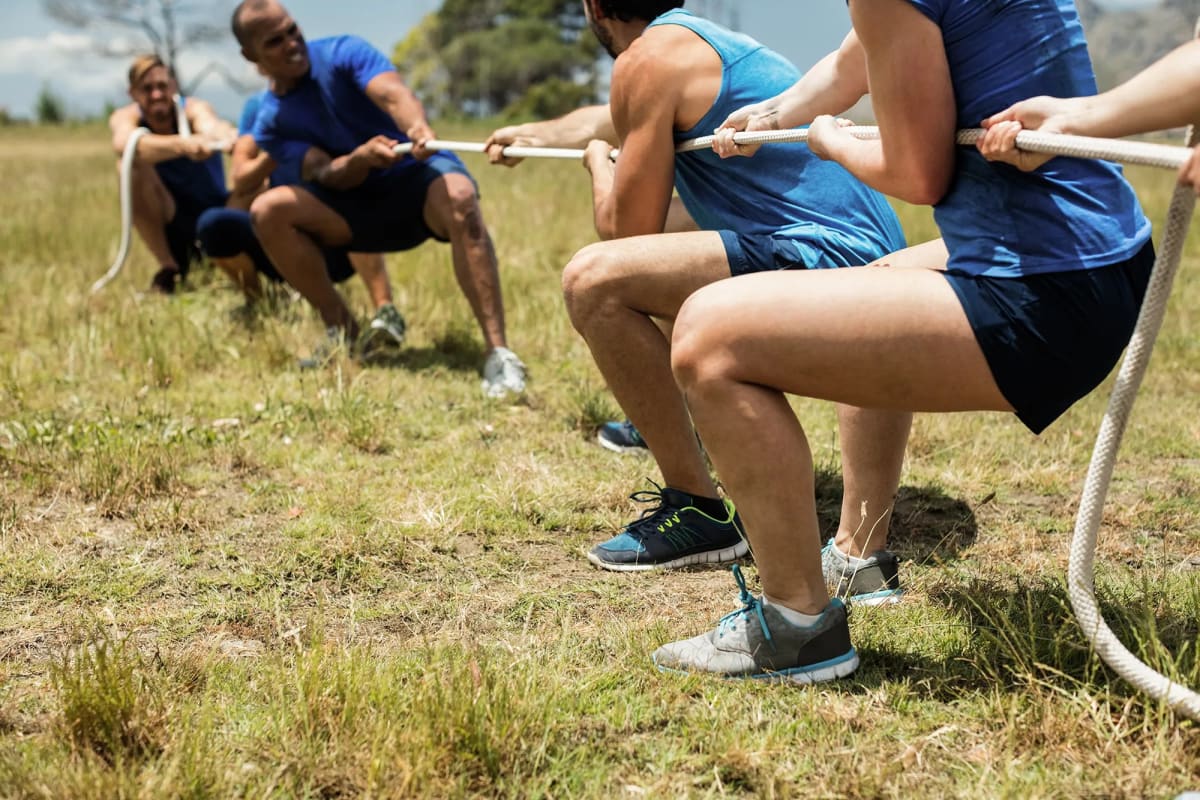
What are the types of forces displayed in the picture? Specify the exact location of the force exerted and the type of forces involved. Tabulate your observation. Discuss it in class.
Answer
| Location of Force | Type of Force | Explanation |
|---|---|---|
| Hands of players pulling the rope | Muscular force (contact force) | Players use their muscles to pull the rope. |
| Rope being pulled tightly | Tension force (contact force) | The rope is stretched due to equal and opposite pulls by both teams. |
| Feet of players against the ground | Frictional force (contact force) | Friction between the shoes and ground prevents slipping and helps players push backward. |
| Players standing on Earth | Gravitational force (non-contact force) | Earth pulls players downward, keeping them on the ground. |
| Ground supporting the players | Normal force (contact force) | The ground pushes upward on players, balancing their weight. |
What will be the resultant forces in the given figures?
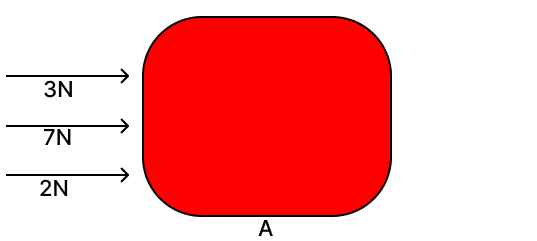
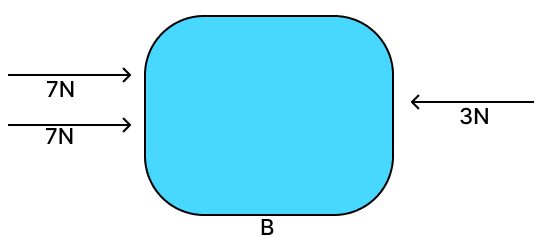
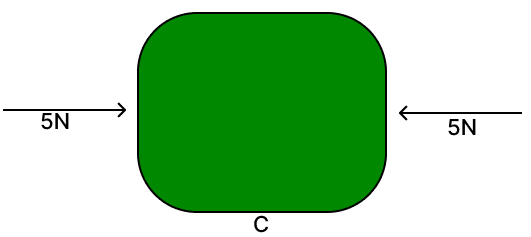
Answer
Case A
From the figure,
- Magnitudes of applied forces are 3 N, 7 N and 2 N.
- All forces are acting in the same direction.
Then,
Resultant force = 3 + 7 + 2 = 12 N (Towards right)
Case B
From the figure,
- Magnitudes of applied forces are 7 N, 7 N and 3 N.
- Both forces with magnitude 7 N each, are acting in the same direction while 3 N force is acting in their opposite direction.
Then,
Resultant force = (7 + 7) - 3 = 14 - 3 = 11 N (Towards right)
Case C
From the figure,
- Magnitudes of both applied forces is 5 N.
- Both forces are acting in the opposite direction.
Then,
Resultant force = 5 - 5 = 0 N
While performing tasks in our daily lives, we use different types of forces. Among many different forces we use muscular force to pick a bag up. The types of forces and actions are given. Complete the table.
| Action | Type(s) of Force |
|---|---|
| Weightlifting | |
| Tension | |
| Applied force | |
| Hydroelectricity | |
| Freely suspended magnet | |
| Nylon clothes sticking to your body | |
| Gravitational force |
Answer
The completed table is given below:
| Action | Type(s) of Force |
|---|---|
| Weightlifting | Tension, Applied force, Gravitational force |
| Stretching a rope | Tension |
| Pushing a car | Applied force |
| Hydroelectricity | Gravitational force, Mechanical force |
| Freely suspended magnet | Magnetic force |
| Nylon clothes sticking to your body | Electrostatic force |
| Object falling freely | Gravitational force |
Friction can be both advantageous and disadvantageous. Some objects and situations are given. Write the most appropriate method to either increase or decrease friction.
| Situation | Is the Friction Caused Advantageous or Disadvantageous? | Method of Increasing or Decreasing Friction |
|---|---|---|
| The car keeps slipping when parked in the driveway | ||
| The sole of a shoe has worn out | ||
| A person is able to run on a treadmill | ||
| The chart paper in your classroom is stuck to the wall |
Answer
The completed table is given below:
| Situation | Is the Friction Caused Advantageous or Disadvantageous? | Method of Increasing or Decreasing Friction |
|---|---|---|
| The car keeps slipping when parked in the driveway | Disadvantageous | Increase friction between the wheels and brake shoe by using handbrakes |
| The sole of a shoe has worn out | Disadvantageous | Increase friction by repairing/replacing the shoes with new soles or using shoes with treads |
| A person is able to run on a treadmill | Advantageous | No change needed/Increase friction if slippery by wearing proper sports shoes |
| The chart paper in your classroom is stuck to the wall | Advantageous | No change needed / If needed, increase friction using glue, tape or pins |
Read the following passage carefully.
Richa is helping her mother make juice. Her mother asks her to use the mixer. On using the mixer, Richa notices that the body of the mixer is heating up more than usual. She also notices that the mixer stops working every time it heats up. It starts working again after it has cooled down.
Now, answer the following questions.
(a) Why do you think the mixer is heating up?
(b) Why does the mixer stop working every time it heats up?
(c) What steps should be taken by Richa to solve this problem?
(d) If the mixer is used continuously, what do you think will happen to it?
Answer
(a) The mixer is heating up because of friction in the moving parts (motor, bearings, blades) and overloading (too much fruit/ice) or running for a long time makes the motor work harder, creating extra heat.
(b) Most mixers have a thermal safety device (thermal fuse) and when the motor gets too hot, this device cuts off the electricity to protect the motor. When it cools, it allows the mixer to run again.
(c) The following steps must be taken by Richa to solve this problem :
- Reduce the load : Blend in small batches; add a little water if the mixture is too thick.
- Give rest : Run the mixer in short intervals (e.g., 30–60 seconds on, then rest).
- Use correct speed for the task : Don’t force the lowest speed for hard items.
- Check ventilation : Keep the mixer on a clear surface so air can circulate.
- Sharpen the blades of the jars.
- Get it serviced to lubricate the motor to reduce friction between moving parts which will prevent overheating.
(d) If the mixer is used continuously the increased friction between its moving parts will cause wear and tear of the mixer leading to expensive repairs or replacement.
Do you think motion is caused by just one force acting on an object?
Answer
No, motion is usually not caused by just one force acting on an object. In real life, several forces act together. When we push a box, our push drives it forward, friction opposes, gravity pulls down, the floor’s normal pushes up. What matters is the net (resultant) force. Balanced forces mean no change, unbalanced forces start or change motion.
What are the forces acting on you when you are sitting?
Answer
When we are sitting on a chair, several forces act on you at the same time :
- Gravitational force (Weight) : The Earth pulls us downward with a force equal to our weight.
- Normal force : The chair pushes us upward with an equal force to balance our weight. This is why we don’t fall through the chair.
- Frictional force : Friction between us and the chair prevents us from slipping off the chair.
Hence, these forces balance each other, which is why we remain at rest while sitting.
What will require more force to be pushed if they are almost similar in size : a carton or a big rock? Why?
Answer
A big rock will require more force because the force required to push an object depends mainly on its mass (weight) and the friction between the object and the ground.
As a rock is made of solid minerals, so it is much heavier and denser than a carton (which is mostly hollow or filled with light material). Since, the rock has more weight, the frictional force between the rock and the ground is also greater. Hence, it needs a larger push to move compared to the carton.
We exert a force when we push or pull a body. Force is exerted when we pull a chair or push a door. Force is measured in newton (N). The given table shows values of five individuals that exerted a force in pushing the same box. Observe the table carefully and then answer the given questions.
| Individual | Force Exerted (N) |
|---|---|
| A | 112.5 |
| B | 48 |
| C | 135 |
| D | 102 |
| E | 81 |
(a) Which individual exerted maximum force while pushing the box?
(b) Which individual exerted minimum force while pushing the box?
(c) Why do you think the force exerted in pushing the box varies from person to person?
(d) What are the forces involved in pushing a box?
(e) How do you think the force exerted in pushing the box be reduced?
Answer
(a) C exerted maximum force (135 N) while pushing the box.
(b) B exerted minimum force (48 N) while pushing the box
(c) The force varies because each person has a different amount of strength as some individuals can push harder due to more muscular force, while others exert less force due to less strength or body build.
(d) Forces involved in pushing a box :
- Applied force : The push given by the individual.
- Frictional force : The resistance between the surface of the box and the ground.
(e) The force exerted in pushing the box can be reduced by reducing friction, such as using wheels, roller under the box or lubricating the contact surface.