
Some objects and some measuring instruments are given. Match the instruments that will be used to measure these objects.
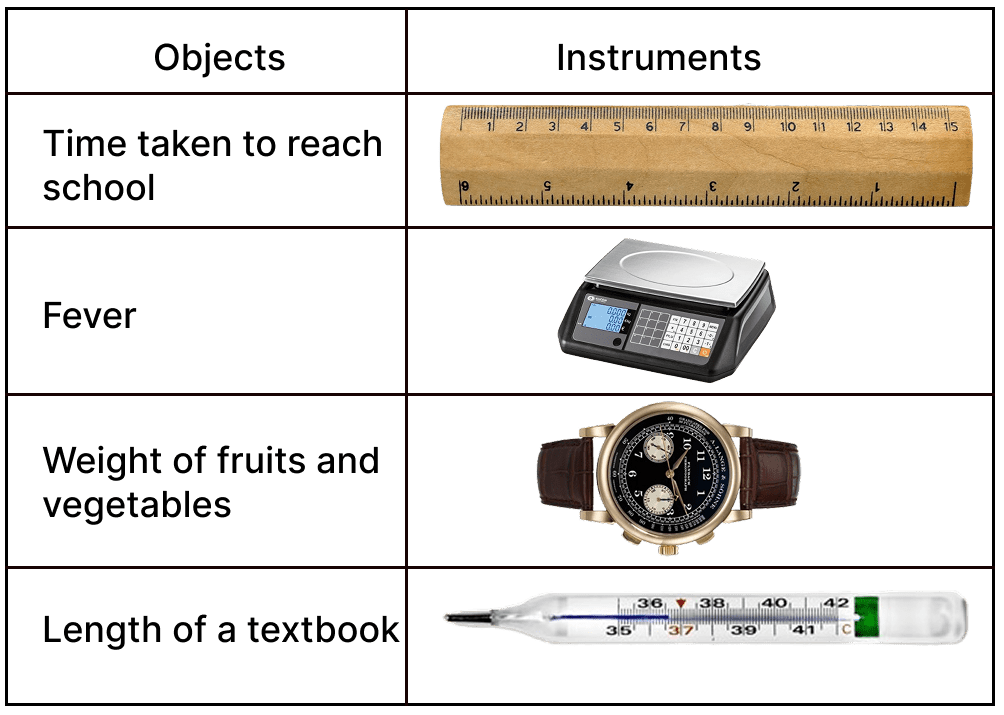
Answer
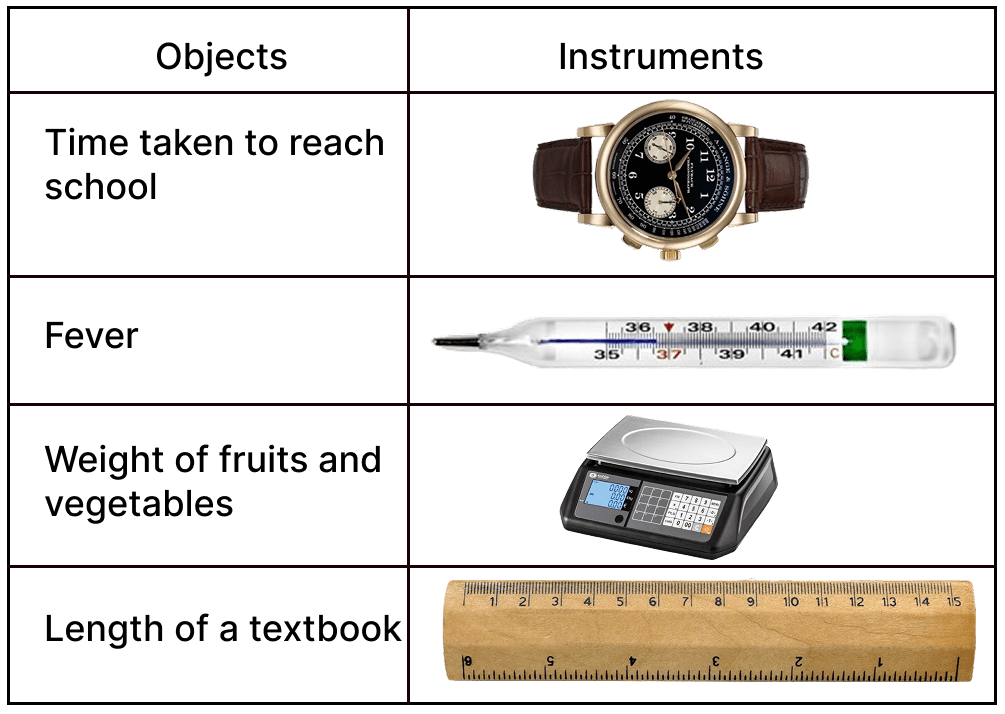
How did people measure the length of objects before invention of measuring instruments?
Answer
Before the invention of modern measuring instruments like rulers and tapes, people measured length using non-standard units based on their own body parts or everyday objects such as cubit as the length from the elbow to the tip of the middle finger or foot as the length of a person’s foot.
Are there any other instruments that measure weight of objects?
Answer
Yes, there are several instruments used to measure the weight of objects, apart from digital weighing machine like the beam balance, spring balance, etc.
Is there any difference between weight and mass?
Answer
Yes, there are lot of differences between weight and mass of an object :
| Mass | Weight |
|---|---|
| The amount of matter in an object. | The force with which gravity pulls an object toward the Earth. |
| It is constant everywhere in the universe. | It changes if gravity changes |
| It's SI unit is kilogram (kg). | It's SI unit is newton (N). |
Match the following.
| Column A | Column B | ||
|---|---|---|---|
| 1. | Fundamental quantities | (a) | Volume, area, density |
| 2. | Derived quantities | (b) | deci, centi, pico |
| 3. | Multiple | (c) | metre, kilogram, joule |
| 4. | Submultiple | (d) | kilo, hecto, mega |
| 5. | SI units | (e) | Length, mass, temperature |
Answer
| Column A | Column B | ||
|---|---|---|---|
| 1. | Fundamental quantities | (e) | Length, mass, temperature |
| 2. | Derived quantities | (a) | Volume, area, density |
| 3. | Multiple | (d) | kilo, hecto, mega |
| 4. | Submultiple | (b) | deci, centi, pico |
| 5. | SI units | (c) | metre, kilogram, joule |
Write down the instruments you will use to measure the length of the following objects.
(a) Circumference of a cup
(b) Length of the table
(c) Length of the curtains
(d) Thickness of a pencil
(e) Thickness of a notebook
Answer
(a) Circumference of a cup – Measuring tape
(b) Length of the table – Metre scale / measuring tape
(c) Length of the curtains – Measuring tape
(d) Thickness of a pencil – Screw gauge or vernier calipers
(e) Thickness of a notebook – Screw gauge or vernier calipers
Choose the correct word to fill in the blanks.
Cubit, measuring tape, square, electronic balance, Mass
(a) ............... is measured in mg, g and kg.
(b) We use ............... to measure straight and curved objects.
(c) ............... is one of the non-standard units.
(d) The area of ............... is side x side.
(e) Beam balance and ............... are commonly used to measure mass.
Answer
(a) Mass is measured in mg, g and kg.
(b) We use measuring tape to measure straight and curved objects.
(c) Cubit is one of the non-standard units.
(d) The area of square is side x side.
(e) Beam balance and electronic balance are commonly used to measure mass.
Some of the facts that you have learnt till now are listed below. Tick (✓) the facts that are correct and cross (x) the facts that are incorrect.
(a) Mercury is used as thermometric fluid in a thermometer.
(b) The SI unit of time is hour.
(c) The time displayed in analogue watches is in the hh:mm format.
(d) Clinical thermometer is used to check the temperature of humans.
(e) The Sl unit of temperature is kelvin.
Answer
(a) ✓
(b) x
Corrected Fact — The SI unit of time is second.
(c) ✓
(d) ✓
(e) ✓
Fill in the blanks.
(a) ............... quantities are derived from fundamental quantities.
(b) The distance between two extreme ends of an object is called ............... .
(c) ............... is the amount of matter contained in an object.
(d) The Sl unit of time is ............... .
(e) ............... thermometer measures temperature in the range of -10 °C to 110 °С.
Answer
(a) Derived quantities are derived from fundamental quantities.
(b) The distance between two extreme ends of an object is called length .
(c) Mass is the amount of matter contained in an object.
(d) The Sl unit of time is second .
(e) Laboratory thermometer measures temperature in the range of -10 °C to 110 °С.
State whether the given statements are true (T) or false (F). Correct the false statements.
(a) FPS system is the standard system of units.
(b) Area of a surface is measured using standard formulae and graph paper.
(c) The SI unit of mass is gram.
(d) One solar day is equal to 24 hours.
(e) Mercury is used as thermometric fluid in thermometers.
Answer
(a) False
Corrected Statement — FPS system was used in USA or UK not internationally.
(b) True
(c) False
Corrected Statement — The SI unit of mass is kilogram.
(d) True
(e) True
Write one word or few words for the following.
(a) The standard system of units accepted worldwide
(b) Error in measurement due to positioning of the eye
(c) The instrument used to measure long lengths of straight or curved objects
(d) Formula to calculate the area of a circle
(e) The instrument used in labs for accurate measurement of mass
Answer
(a) International System of Unit or SI units
(b) Parallax error
(c) Measuring tape
(d) π х (Radius)2
(e) Electronic balance
Match the columns.
| Column A | Column B | ||
|---|---|---|---|
| 1. | A non-standard unit | (a) | Thickness of wire |
| 2. | Screw gauge | (b) | Square |
| 3. | Two-dimensional figure | (c) | Cubit |
| 4. | One century | (d) | Kink |
| 5. | Important part of a clinical thermometer | (e) | 100 years |
Answer
| Column A | Column B | ||
|---|---|---|---|
| 1. | A non-standard unit | (c) | Cubit |
| 2. | Screw gauge | (a) | Thickness of wire |
| 3. | Two-dimensional figure | (b) | Square |
| 4. | One century | (e) | 100 years |
| 5. | Important part of a clinical thermometer | (d) | Kink |
Give reasons for the following statements.
(a) A standard system of units was accepted.
(b) The correct position of eye is important to take measurements.
(c) A tailor uses measuring tape to take measurements.
(d) Jerks should be given to a clinical thermometer before using.
(e) Labs prefer using electronic balances.
Answer
(a) In earlier times, people used non-standard methods of measurement. These methods were approximate and often varied from the actual values. To avoid confusion and to maintain uniformity, scientists all over the world accepted a set of standard units of measurement. These units are definite, exact, convenient, and remain the same everywhere.
(b) For taking measurements, the eye must be placed exactly vertical above the mark to be read. The correct position of the eye is very important because, in other positions, the reading appears either more or less than the actual value. Such an error caused by the wrong positioning of the eye is called parallax error.
(c) A tailor uses measuring tape because :
- It can measure long objects.
- It is flexible and is made of a ribbon of cloth, plastic or metal strip.
- It can be easily carried.
- It can be used to measure around curves or corners of objects.
- Like a ruler, a measuring tape is also available in various lengths such as 1 m, 2 m, 5 m, 10 m and 50 m.
(d) When the bulb of the thermometer is in contact with a body, the mercury expands and rises in the tube. After the thermometer is removed, the mercury near the bulb contracts, but the mercury in the tube stays separated at the kink. This keeps the level of mercury constant. By giving jerks before reuse, all the mercury is brought back near the bulb, which ensures accurate measurement.
(e) Labs prefer using electronic balances for scientific purposes where accurate measurements are required. Scientific work needs highly sensitive instruments that can measure with a high degree of accuracy. Electronic balances can measure the mass of even very small objects up to grams and milligrams. They also give readings instantly. Hence, they are accurate, reliable, and convenient to use.
Explain the following terms.
(a) Physical quantities
(b) Parallax error
(c) Beam balance
(d) Pendulum clock
(e) Thermometer
Answer
(a) Physical quantities — All the quantities that can be measured are known as physical quantities. Some examples of physical quantities are length, mass, area, time, temperature and volume.
(b) Parallax error — An error in measurement that arises due to wrong positioning of the eye is called parallax.
(c) Beam balance — A beam balance is a simple instrument to measure mass. It has a horizontal metallic beam supported at the centre with a pointer. Two equal pans hang from its ends. When both pans are empty or hold equal masses, the beam stays horizontal and the pointer vertical.
(d) Pendulum clock — A pendulum clock is a device that measures time using the principle of a simple pendulum. The pendulum swings at a regular rate, and this periodic motion is used to keep track of seconds and minutes.
(e) Thermometer — A thermometer is an instrument used to measure temperature. It consists of a thin glass capillary tube with a bulb at one end containing mercury. On contact with a hot body, the liquid expands and rises in the tube. The temperature is read from the calibrated scale in °C or °F.
Differentiate between fundamental quantities and derived quantities. Give examples if applicable.
Answer
Differences between fundamental quantities and derived quantities:
| S. No. | Fundamental Quantities | Derived Quantities |
|---|---|---|
| 1. | Fundamental quantities are those physical quantities that are unique and do not depend on any other quantity. | Derived quantities are those quantities that are derived from fundamental quantities. |
| 2. | Length, mass, time, temperature, electric current, luminous intensity and amount of substances are taken as the seven fundamental quantities. | Area, volume, speed, force and density are examples of derived quantities. |
Differentiate between standard units and non-standard units. Give examples if applicable.
Answer
Differences between standard units and non-standard units:
| S. No. | Standard units | Non-standard units |
|---|---|---|
| 1. | Standard units refer to a set of units which were accepted by scientists all over the world as units of measurement. | Non-standard units refer to the methods of measurement that were adopted by people in earlier times. |
| 2. | These units are definite, exact and convenient and remain the same everywhere. | These units were approximate and varied from actual values. |
| 3. | For example, metre is a standard unit of length and kilogram is internationally accepted unit to measure mass. | For example, cubit, handspan, footstep and arm length were used to measure length. Seeds, stones and pebbles were used as standard weights to measure mass. |
Differentiate between clinical thermometer and laboratory thermometer.
Answer
Differences between clinical thermometer and laboratory thermometer:
| S. No. | Clinical thermometer | Laboratory thermometer |
|---|---|---|
| 1. | It is used to measure the body temperature of humans. It is also called a doctor's thermometer. | It is used to measure temperature in laboratories for various experiments with a high degree of precision. |
| 2. | It measures temperature from 35°C to 42°C only. | It measures the temperature in the range of -10 °C to 110 °C. |
Why is measurement necessary?
Answer
Measurement is necessary to know the exact size, length, weight, or time of something, so that results are accurate and can be compared.
How is measuring tape an important instrument to measure length?
Answer
A measuring tape is flexible and can measure lengths of curved, round, or large objects easily, unlike a rigid scale.
What is area?
Answer
Area of an object is the space occupied by a two-dimensional figure on a plane. In other words, area is the surface enclosed within the boundary of a two-dimensional figure.
Why is mercury used in thermometers?
Answer
Mercury is used in thermometers due to following reasons :
- Mercury is easily visible through the glass as it is opaque and shiny.
- Mercury does not stick to the glass or wet it.
- Mercury can be used over a wide range of temperatures owing to its low freezing point (-39°C) and high boiling point (357°C).
- Mercury being a good conductor of heat, quickly absorbs heat to attain the temperature of the object.
Name some instruments used to measure time.
Answer
Instruments used to measure time :
- Pendulum clock
- Analogue watch
- Digital watch
- Stopwatch
- Stop clock
Write the steps to measure length using a ruler.
Answer
To measure the length of any material using the ruler, the given steps should be followed :
- Place the ruler along the length to be measured, parallel to its graduation (the markings on a ruler). The ruler should be parallel to the length being measured.
- Make sure that the zero mark of the ruler coincides with one of the ends of the length to be measured.
- If the zero mark on a ruler is broken or unclear, another mark (say 1) can be taken as the starting point. Note this mark and subtract it from the final reading to get the accurate length.
- For accurate measurements, the eye must be placed vertically above the mark. Viewing from other positions causes parallax error, making the reading appear more or less than the actual value.
How do we measure area?
Answer
The area of a surface is the measure of the region it covers. For regular surfaces, area can be calculated using standard mathematical formulae after measuring their dimensions like length, breadth, or radius. For example, the area of a rectangle = length × breadth. Area can also be measured by tracing the outline on a graph paper and counting the number of squares enclosed.
How is a beam balance used to measure mass?
Answer
To measure the mass of an object, it is placed on one pan and standard weights are kept on the other pan of the beam balance. The weights are adjusted till the beam is horizontal and the pointer points vertically up. The sum of the masses of the standard weights gives the mass of the object.
Ensure the following points to get the accurate reading of mass :
- Both the arms of the beam balance must be of equal length and both the pans must be of equal mass.
- When both the pans are empty, the beam should be horizontal and the pointer should be vertical.
What is a pendulum clock?
Answer
A pendulum clock is a time-measuring instrument that works on the principle of a simple pendulum. It uses a swinging pendulum as its timekeeping element, taking 1 second to swing from one extreme to the other, completing a full oscillation in 2 seconds. Its dial has 12 hour markings, each divided into 5 smaller divisions to show 60 minutes. Three hands—hour, minute, and second—are fixed at the center through gear wheels to indicate the time.
What are the features of a clinical thermometer?
Answer
Features of a clinical thermometer :
- A clinical thermometer is used to measure the body temperature of humans.
- It is also called a doctor's thermometer. If you look
- It measures temperature from 35°C to 42°C only.
- It has a slight bent or kink in the capillary tube just above the bulb.
- The mercury in the bulb expands according to the temperature such that its level increases in the capillary tube.
Convert the following.
(a) 250 km to m
(b) 400 m2 to cm2
(c) 5000 kg to tonnes
(d) 20 cm to mm
(e) 2 solar days to seconds
Answer
(a) As,
1 km = 1000 m
Then
250 km = 250 x 1 km = 250 x 1000 = 250000 m
(b) As, 1 m = 100 cm
Then
1 m2 = 1 m x 1 m = 100 cm x 100 cm = 104 cm2
Now,
400 m2 = 400 x 1 m2 = 400 x 104 cm2
(c) As, 1 tonne = 1000 kg
(d) As, 1 cm = 10 mm
Then
20 cm = 20 x 1 cm = 20 x 10 mm = 200 mm
(e) As,
1 Solar day = 86400 seconds
Then
2 Solar days = 2 x 1 Solar day = 2 x 86400 seconds = 172800 seconds
Mohan's father sells fruits and vegetables. Since Mohan has learnt about measuring mass at school, he is helping his father. He has a beam balance. Let us call the pans of the beam balance as A and B. There are known weights of 50 g, 200 g, 500 g and 1000 g at his shop.
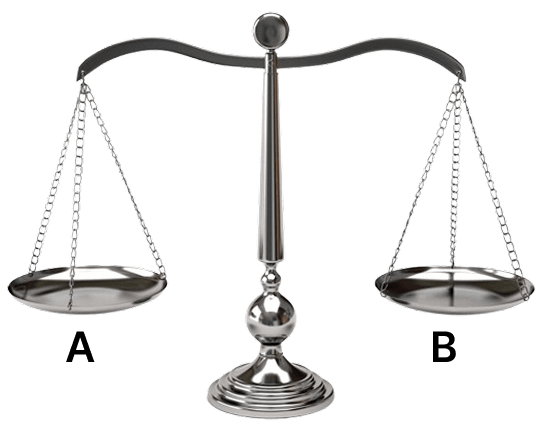
How will Mohan weigh the following items? What will he place on pan A and pan B in each case?
(a) 1 kg of onions
(b) 250 g of ginger
(c) 750 g of apples
(d) 1 kg and 200 g of potatoes
(e) 50 g of chillies
Answer
To measure the mass of fruits and vegetables, each item is placed on one pan and standard weights are kept on the other pan of the beam balance. The weights are adjusted till the beam is horizontal and the pointer points vertically up. The sum of the masses of the standard weights gives the mass of the item placed.
(a) As,
1 kg = 1000 g
So,
He will put weight of 1000 g on pan A and 1 kg of onions on pan B.
(b) As,
250 g = 200 g + 50 g
Since, there is no weight present which has mass of 250 g so, he will use weights which are available i.e., one weight of 200 g and one of 50 g.
Hence, he will put one weight of 200 g and one of 50 g on pan A and 250 g of ginger on pan B.
(c) As,
750 g = 500 g + 200 g + 50 g
Since, there is no weight present which has mass of 750 g so, he will use weights which are available i.e., one weight of 500 g, one with value of 200 g and one of 50 g.
Hence, he will put one weight of 500 g, one of 200 g and one of 50 g on pan A and 750 g of apples on pan B.
(d) As,
1 kg and 200 g = 1 kg + 200 g = 1000 g + 200 g
So, he will put one weight of 1000 g and one of 200 g on pan A and 1 kg and 200 g of potatoes on pan B.
(e) Now, he will put one weight of 50 g on pan A and 50 g of chillies on pan B.
Pushpa and her friends are competing against each other. They are running from point A to point B to see who complete the distance the fastest. However, they are getting confused as to how to record the time properly since only one of their friends has a wristwatch.
Now, answer the following questions.
(a) What will your suggestion be to Pushpa and her friends?
(b) Is there any other instrument that will be a better choice in this case?
(c) What will be the most appropriate unit for their observations?
Answer
(a) I would suggest that one person with the wristwatch should note down the start time and finish time for each runner, then calculate the difference to find the time taken by each.
(b) Yes — a stopwatch would be a better choice, because it can measure short time intervals more accurately than a wristwatch.
(c) The most appropriate unit for their observations would be seconds (s), since running times are usually short and need precise measurement.
Sunita and her mother went to the tailor to get clothes stitched. While the tailor was taking Sunita's measurements, she noticed that the measuring tape was worn out and the initial reading from 0 inches to 2 inches was not visible. The measurements that the tailor took are given.
| Measurements Taken by the Tailor (Inches) | |
|---|---|
| Length of shirt | 30 |
| Length of sleeve | 15 |
| Waist | 28 |
Now, answer the following questions.
(a) How will you correct the measurements taken?
(b) What suggestion will you give to the tailor?
Answer
(a) Since the first 2 inches of the measuring tape are missing, every measurement taken will be 2 inches more than the actual length so to correct them, subtract 2 inches from each reading :
| Measurements Taken by the Tailor (Inches) | Correct Measurement (inches) | |
|---|---|---|
| Length of shirt | 30 | 28 |
| Length of sleeve | 15 | 13 |
| Waist | 28 | 26 |
(b) I will suggest the tailor that if the zero is unclear or damaged on their measuring tape then they should start measuring from any clear mark and subtract that starting mark from the final reading. This way, the measurements will be accurate by adjusting for the missing portion.
You have a cricket ball, a string and a ruler. How will you find the radius of the ball?
Answer
To find the radius of the cricket ball :
- Wrap the string around the circumference of the cricket ball once.
- Mark the length of the string needed to go around the ball.
- Lay the string straight along a ruler and measure its length which gives the measurement of circumference of the ball.
By using the formula,
Circumference = 2πr
where r is the radius and π ≈ 3.14.
Rearrange to find the radius :
r =
Now, put measured value of circumference in the above formula to calculate the value of the radius.
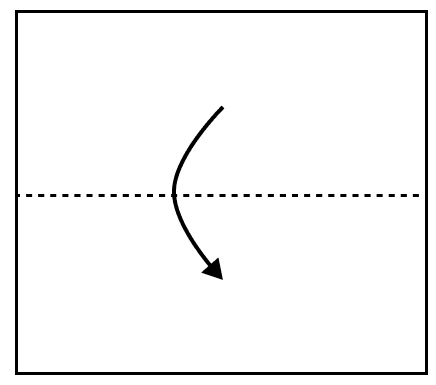
A rectangle of area 16 cm2 is folded into half along its length. Is it possible to find the area of the new rectangle?
Answer
When a rectangle is folded in half along its length then its length is reduced to half, but the width stays the same.
As,
Area = length × width
Even though the length is halved, the width is unchanged so the new area will be half of the original area i.e.,
Original area = 16 cm2
New area = × 16 cm2 = 8 cm2
How many hours are there in a century?
Answer
As,
1 century = 100 years
And
1 year (normal) = 365 days
But there are leap years, so average year length = 365.25 days
Total days in a century = 100 × 365.25 = 36,525 days
Now,
1 day = 24 hours
Total hours in 36,525 days = 36525 x 24 = 876,600 hours
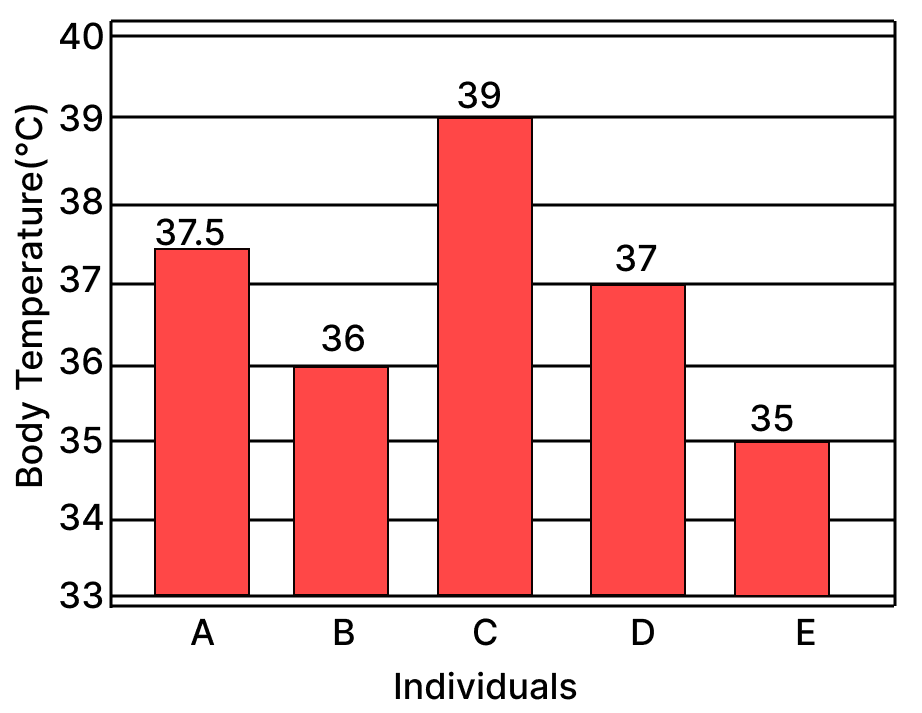
Body temperature is often recorded when you are ill. The doctor uses a clinical thermometer to measure the body temperature. A bar graph depicting the temperature of five individuals A, B, C, D and E is given. Observe the graph carefully.
Now, answer the following questions.
(a) Which individual has the lowest temperature?
(b) Which individual has the highest temperature?
(c) Name the individuals that have normal body temperature.
(d) Name the individuals that have a fever.
Answer
(a) E has the lowest temperature i.e., 35°C.
(b) C has the highest temperature i.e., 39°C.
(c) As, the normal temperature of a healthy human body is 37°C so here only D has this normal temperature.
(d) C has a fever.
Reason — The normal temperature of a healthy human body is 37°C. C has a temperature of 39°C which indicates a fever.