
The White Continent refers to
- Australia
- Antarctica
- Europe
- the Arctic
Answer
Antarctica
Reason — Owing to the permanent cover of ice on its land surface, Antarctica is called the White Continent. Australia and Europe are not covered by permanent ice sheets, and the Arctic is a polar region around the North Pole, not the ice-covered continent referred to here.
Antarctica lies closest to
- Australia
- South America
- Asia
- Africa
Answer
South America
Reason — The Antarctic Peninsula in the western part extends beyond the Antarctic Circle and reaches close to Cape Horn of South America. Therefore, South America is the continent nearest to Antarctica.
The Sun never sets in Antarctica during the month of
- January
- October
- June
- March
Answer
January
Reason — The summer months in Antarctica extend from November to February. During these months, the Sun never sets and the continent has 24 hours of sunshine. January falls within this summer period.
The southernmost active volcano of the world is
- Mt Vinson
- Mt Erebus
- Mt Sidley
- Mt McKinley
Answer
Mt Erebus
Reason — Mt Erebus is the southernmost active volcano of the world. It is also the second highest volcano of Antarctica after Mt Sidley, which is a dormant volcano.
The waters of this ocean wash the coast of Antarctica.
- Pacific
- Atlantic
- Southern
- Antarctic
Answer
Southern
Reason — Antarctica is surrounded by the Southern Ocean, which comprises the waters of the southern parts of the Pacific, Atlantic and Indian Oceans.
Antarctica is the ............... and ............... continent on Earth.
- warmest, calmest
- driest, windiest
- coldest, wettest
- coldest, driest
Answer
driest, windiest
Reason — Antarctica receives very little precipitation and is the driest continent. Strong, chilly winds blow almost throughout the year, making it the windiest continent as well.
Note — Option 4 is also factually correct because Antarctica is also the coldest and driest continent.
When was Antarctica first discovered?
- 1820
- 1920
- 2020
- 1720
Answer
1820
Reason — Antarctica was first discovered in 1820 by Russian explorers. Detailed exploration of the continent began later, at the beginning of the 20th century.
Which ocean surrounds the continent of Antarctica?
- the Pacific Ocean
- the Southern Ocean
- the Indian Ocean
- the Arctic Ocean
Answer
the Southern Ocean
Reason — The ocean surrounding Antarctica is the Southern Ocean. It comprises the waters of the southern parts of the Pacific, Atlantic and Indian Oceans.
Complete the relationship.
southernmost active volcano of the world : Mt Erebus : : second highest volcano of Antarctica : ...............
- Mt Vinson
- Mt Sidley
- Mt Beardmore
- Mt Vostok
Answer
No correct option is given.
Reason — Mt Erebus is the second highest volcano of Antarctica after Mt Sidley.
Note — The given options are inconsistent with the statement. Mt Erebus is the second highest volcano of Antarctica, while Mt Sidley is the highest volcano.
Precipitation in Antarctica is mostly in the form of ...............
- rainfall
- sleet
- drizzle
- snow
Answer
snow
Reason — Temperatures in Antarctica mostly remain below the freezing point, so precipitation occurs mainly in the form of snow.
Assertion (A): The continent was first discovered in 1820 by Russian explorers.
Reason (R): Detailed exploration of the continent commenced in the beginning of the 20th century.
- A is true, but R is false.
- A is false, but R is true.
- Both A and R are true, but R is not the correct explanation of A.
- Both A and R are true, and R is the correct explanation of A.
Answer
Both A and R are true, but R is not the correct explanation of A.
Explanation — The continent was first discovered in 1820 by Russian explorers, and detailed exploration commenced in the beginning of the 20th century, so both statements are true. However, R describes a separate event that occurred later and does not explain the discovery in 1820.
Assertion (A): Thousands of pristine blue lakes have appeared on the ice sheets of east Antarctica.
Reason (R): Most of these lakes are supraglacial or meltwater lakes.
- A is true, but R is false.
- A is false, but R is true.
- Both A and R are true, but R is not the correct explanation of A.
- Both A and R are true, and R is the correct explanation of A.
Answer
Both A and R are true, but R is not the correct explanation of A.
Explanation — Scientists have confirmed that thousands of pristine blue lakes have appeared on the ice sheets of east Antarctica, and most of these are indeed supraglacial or meltwater lakes, so both statements are true. However, R only describes the type of these lakes; it does not explain why they have appeared, so R is not the correct explanation of A.
Assertion (A): Antarctica is increasingly witnessing more scientists and tourists.
Reason (R): An increase in visitors means more disturbances to the fragile ecosystem and more pollution.
- A is true, but R is false.
- A is false, but R is true.
- Both A and R are true, but R is not the correct explanation of A.
- Both A and R are true, and R is the correct explanation of A.
Answer
Both A and R are true, but R is not the correct explanation of A.
Explanation — Antarctica's once-remote interior is indeed increasingly witnessing more scientists and tourists, and an increase in visitors does mean more disturbances to the fragile ecosystem and more pollution, so both statements are true. However, R describes a consequence of the rising number of visitors rather than the reason for it, so R is not the correct explanation of A.
Name the following:
a. The mountain range joining Lesser and Greater Antarctica
b. The eastern coastal area comprising mountains of ancient granite and gneiss
c. One of the largest glaciers in the world
d. The highest mountain peak of Antarctica
Answer
a. Transantarctic Mountains
b. Queen Maud Land
c. Beardmore Glacier
d. Mt Vinson
Write about the early explorations of the continent of Antarctica.
Answer
The continent of Antarctica was first discovered in 1820 by Russian explorers. Detailed exploration of the continent commenced in the beginning of the 20th century. Roald Amundsen of Norway and Ernest Shackleton, along with Robert Falcon Scott of England, further explored different parts of the continent.
Explain the location of Antarctica in your own words.
Answer
Antarctica is the southernmost continent and contains the geographic South Pole. The part of the continent that lies in the eastern hemisphere is known as Greater Antarctica. It is considerably larger than Lesser Antarctica, which lies in the western hemisphere and contains the Antarctic Peninsula.
The entire continent lies in the South Frigid Zone except for a small portion of the Antarctic Peninsula. This thin belt extends beyond the Antarctic Circle and reaches close to Cape Horn of South America.
Antarctica is surrounded by the Southern Ocean, which comprises the waters of the southern parts of the Pacific, Atlantic and Indian Oceans. The Weddell Sea and the Ross Sea are bays formed by the Southern Ocean.
Describe the physical features of the continent.
Answer
The physical features of Antarctica are as follows:
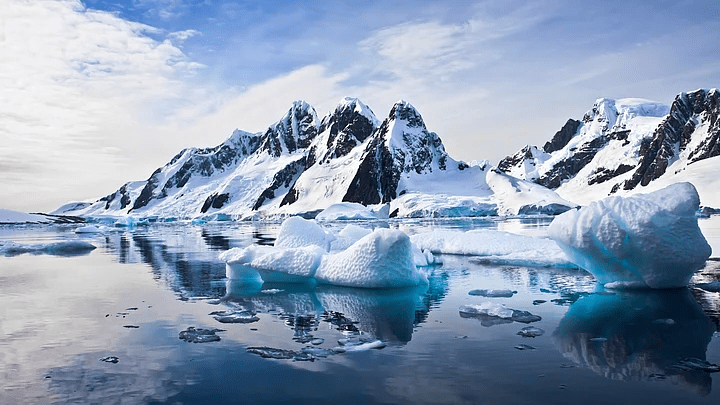
The continent is permanently frozen, and its land surface is covered with thick ice sheets whose thickness varies from 2,000 m to 5,000 m. Owing to this permanent cover of ice, Antarctica is called the White Continent.
A prominent feature is the Antarctic Plateau or Polar Plateau, a large area of east Antarctica extending over a diameter of about 1,000 kilometres. It includes the geographic South Pole region and has an average elevation of about 3,000 metres. Its high elevation, high latitude and long dark winters make it the coldest region of Antarctica and of the entire world. Antarctica is also the largest cold desert on the Earth.
In places such as Queen Maud Land in the eastern coastal area, the land is exposed as steep mountainous slopes made of ancient granite and gneiss rocks.
Between Lesser Antarctica and Greater Antarctica lies a vast mountain range called the Transantarctic Mountains.
Antarctica has active volcanoes. Mt Erebus, the southernmost active volcano of the world, is the second highest volcano of Antarctica after Mt Sidley, which is a dormant volcano. Mt Erebus is located on the shores of the Ross Sea.
The Beardmore Glacier, spanning over 200 kilometres, is one of the largest glaciers in the world. Mt Vinson is the highest mountain peak in Antarctica at 4,892 m.
The oceans around Antarctica have huge masses of floating ice called icebergs. The continent also has supraglacial or meltwater lakes and sub-glacial lakes. Lake Vostok is the largest sub-glacial lake discovered so far.
Write short notes describing the summer and winter seasons of Antarctica.
Answer
Summer — The summer months extend from November to February. The average summer temperature is about 0°C and occasionally rises above 0°C in some places. During these months, the Sun never sets and the continent has 24 hours of sunshine. Although Antarctica receives large amounts of solar radiation, the highly reflective ice and snow-covered surfaces reflect much of it back into space.
Winter — The winter months extend from May to August. During these months, there is darkness for 24 hours a day. Temperatures of about -60°C to -70°C are common, and -95°C has been the lowest temperature recorded by satellites at the South Pole. Snowstorms or blizzards are common during winter.
The average annual temperature of Antarctica is around -50°C.
What kind of scientific activities are carried out in Antarctica?
Answer
Antarctica is dominated by scientific activities rather than commercial undertakings. About 30 countries maintain around 70 research stations, of which more than 40 are permanent. Scientists carry out research and exploration, including studies related to recent climate change.
Explorations have also taken place to identify mineral resources in the land mass below the ice sheets, while weather stations keep a close watch on changes in weather conditions. Under India's programme, scientists study atmospheric sciences, meteorology and Earth sciences, including glaciology, geomagnetism, microbiology and environmental sciences.
What type of vegetation can be found in Antarctica?
Answer
Antarctica has no trees or bushes because the severe weather conditions do not support vegetation. The only plants that can survive the extreme cold are lichens, mosses and algae.
Name some of the minerals discovered in Antarctica. Why are they not commercially exploited?
Answer
The minerals discovered in Antarctica include coal, iron ore and copper ores, along with several other minerals located at different places across the continent.
They are not commercially exploited because the nations of the Antarctic Treaty System agreed in 1991 to put a halt to the exploitation of minerals by signing a comprehensive Protocol on Environmental Protection (the Madrid Protocol), which banned mining in Antarctica indefinitely. This agreement came into force in January 1998 in an effort to preserve the environment.
State the importance of the Madrid Protocol in the preservation of the environment in Antarctica.
Answer
The Madrid Protocol, or Protocol on Environmental Protection, was signed in 1991 by the nations of the Antarctic Treaty System. It banned mining in Antarctica indefinitely and came into force in January 1998. By preventing the commercial exploitation of mineral resources, it helps preserve Antarctica's fragile environment and keeps scientific activities more important than commercial undertakings.
Look at the given picture and answer the following questions.
a. Which mountain range is shown here?
b. Where is this range located in Antarctica?
Answer
a. The mountain range shown here is the Transantarctic Mountains.
b. This range is located between Lesser Antarctica and Greater Antarctica.
Give reasons and offer at least one solution for each of these scenarios.
a. The ozone hole over Antarctica is a worrying phenomenon.
b. Antarctica is devoid of permanent human habitation.
c. The size of Antarctica has begun to shrink.
Answer
a. Reason — Scientists have noticed a noteworthy thinning in the stratospheric ozone layer above Antarctica, termed the 'ozone hole'. Ozone absorbs large amounts of the harmful ultraviolet rays of the Sun. Thinning of the ozone layer allows more of these rays to reach the Earth and adversely affect living beings.
Solution — Measures that reduce substances and pollution responsible for damaging the ozone layer should be continued so that the ozone layer can recover.
b. Reason — Antarctica is the remotest place in the world and is covered with a thick blanket of ice. Long months without sunlight, lack of rain, extreme cold, harsh weather and the absence of vegetation make it unfavourable for permanent human settlement. It has no native population and only temporary inhabitants.
Solution — Well-equipped scientific research stations can provide safe temporary accommodation and essential facilities for scientists working there.
c. Reason — The size of Antarctica has started shrinking due to the melting of ice shelves. Global warming, caused by the rise in carbon dioxide from the burning of fossil fuels such as coal and petroleum, contributes to this melting.
Solution — The burning of fossil fuels such as coal and petroleum should be reduced to lower carbon dioxide emissions and help slow global warming and the melting of ice shelves.