Industries that require bulky raw materials or perishable raw materials are localised near one of the following points:
- market
- power
- urban areas
- raw material
Answer
raw material
Reason — Industries using bulky raw materials are located near the source to reduce heavy transport costs. Industries using perishable raw materials such as sugar cane, milk or fish are also located near the source so that the materials can be processed quickly.
What is common between Ruhr, Sambre-Meuse and Appalachian Mountain industrial belt?
- These are all industrial regions.
- These are all located close to coalfields.
- These are all densely-populated regions.
- These are all automobile manufacturing centres.
Answer
These are all located close to coalfields.
Reason — These industrial belts developed near coalfields because coal has been an important source of power for industries.
Which of the following industries is indispensable to the development of a country?
- a cotton-textile industry
- a shipbuilding industry
- an iron and steel industry
- an aeronautical industry
Answer
an iron and steel industry
Reason — The iron and steel industry is a basic industry. It supplies raw materials, mainly in the form of machinery, to industries such as engineering, electronics, automobile and shipbuilding. It also supports construction, infrastructure and the production of agricultural implements.
Identify the industry that has been a major employment generator and foreign exchange earner in recent times.
- the steel industry
- the cement industry
- the Information Technology industry
- the infrastructure industry
Answer
the Information Technology industry
Reason — In the 21st century, the Information Technology industry has been a major generator of employment and, in India, has also earned foreign exchange.
Match Column I with Column II and select the correct answer using the codes given below:
| Column I: Type of industry | Column II: Industries |
|---|---|
| A. Mineral-based industry | 1. Sugar mills |
| B. Cottage industry | 2. Iron and steel industries |
| C. Large-scale industry | 3. Fertiliser industry |
| D. Agro-based industry | 4. Carpet weaving |
- A-3, B-4, C-2, D-1
- A-2, B-1, C-3, D-4
- A-2, B-3, C-4, D-1
- A-4, B-1, C-2, D-3
Answer
A-3, B-4, C-2, D-1
Reason — Mineral-based industries derive their raw materials from minerals — the fertiliser industry is an example. Cottage industries include carpet weaving (carpet-making). The iron and steel industry is set up with a huge capital investment and involves large-scale production, making it a large-scale industry. Agro-based industries derive their raw materials from agriculture — sugar mills are an example.
Which of the following is a small-scale industry?
- iron and steel
- automobiles
- cotton textiles
- oil mills
Answer
oil mills
Reason — Oil mills are examples of small-scale industries. They work on a minimum scale of production, require little capital and have a lower rate of production than large-scale industries. Iron and steel, automobiles and cotton textile mills are shown as large-scale industries.
This industry provides rural employment and helps preserve the cultural heritage of the region. Identify the industry.
- agro-based industry
- cottage industry
- mineral-based industry
- large-scale industry
Answer
cottage industry
Reason — Cottage industries provide rural employment and help preserve the cultural heritage of a region because skills of craftsmanship are handed down from one generation to another.
Which of the following is considered a basic industry?
- shipbuilding
- automobile industry
- information technology
- iron and steel industry
Answer
iron and steel industry
Reason — The iron and steel industry is a basic industry because it supplies raw materials, mainly in the form of machinery, to a host of other industries such as engineering, electronics, automobile and shipbuilding. Shipbuilding, the automobile industry and information technology are among the industries that depend on it, so they are not basic industries themselves.
Which of the following is a major steel producing centres?
- Delhi
- Jammu
- Bokaro
- Kochi
Answer
Bokaro
Reason — Bokaro is one of India's major steel-producing centres. Other major centres include Jamshedpur, Bhilai, Rourkela, Visakhapatnam, Bhadravati and Salem.
Which of the following countries has the largest shipbuilding industry in the world?
- South Korea
- China
- France
- Germany
Answer
China
Reason — China has the world's largest shipbuilding industry, followed by South Korea and Japan.
Which of the following is an important centre of cotton textile producers in India?
- Uttar Pradesh
- Assam
- Madhya Pradesh
- Gujarat
Answer
Gujarat
Reason — Gujarat is listed among the important cotton textile producers in India, along with Maharashtra, Karnataka, Tamil Nadu and Punjab.
What is special about Dogger Bank in the North Sea and Grand Bank off the coast of Newfoundland?
- regions of mining
- regions of fishing
- regions of sugarcane
- regions of cotton textile
Answer
regions of fishing
Reason — Dogger Bank in the North Sea and Grand Bank off the coast of Newfoundland are ideal fishing grounds. Fish abound in the shallow waters of the continental shelf, where abundant fish food called planktons grows.
Choose the odd one out.
- Use gas instead of coal in the factories.
- Treat wastewater.
- Dispose off waste in landfill.
- Release toxic effluents into water bodies.
Answer
Release toxic effluents into water bodies.
Reason — Using gas instead of coal, treating wastewater and disposing of waste in landfills are preventive measures for controlling industrial pollution. Releasing toxic effluents into water bodies causes water pollution.
Assertion (A): The major sugar industries of the world are located in sugar cane growing regions.
Reason (R): The sugar cane juice begins to dry if not crushed within a day.
- Both (A) and (R) are true and (R) is the correct explanation of (A).
- Both (A) and (R) are true and (R) is not the correct explanation of (A).
- (A) is true but (R) is false.
- (A) is false but (R) is true.
Answer
Both (A) and (R) are true and (R) is the correct explanation of (A).
Explanation — Both A and R are true. Sugar cane juice begins to dry if it is not extracted within a day. Therefore, sugar mills are located close to cane-growing areas, and R correctly explains A.
Assertion (A): A small capital is required to start production in cottage industries.
Reason (R): Cottage industries are usually set up in the house of the manufacturer.
- A is true, but R is false.
- A is false, but R is true.
- Both A and R are true, but R is not the correct explanation of A.
- Both A and R are true, and R is the correct explanation of A.
Answer
Both A and R are true, and R is the correct explanation of A.
Explanation — Both A and R are true. Cottage industries are usually set up in the house of the manufacturer and operate on a small scale, so only a small capital is required to start production. Thus, R correctly explains A.
Assertion (A): Iron and steel industry supports all types of construction.
Reason (R): Industrial development of a country will be impeded in the absence of iron and steel industry.
- A is true, but R is false.
- A is false, but R is true.
- Both A and R are true, but R is not the correct explanation of A.
- Both A and R are true, and R is the correct explanation of A.
Answer
Both A and R are true, but R is not the correct explanation of A.
Explanation — Both statements are true. The iron and steel industry supports construction, infrastructure and several other industries. Its absence would therefore impede industrial development. R states a consequence of the importance of the iron and steel industry rather than explaining why it supports construction.
Assertion (A): Machines need to be energy-efficient and reduce noise levels.
Reason (R): Unwanted noise from factories may lead to hearing impairment, increased heart rate and blood pressure.
- A is true, but R is false.
- A is false, but R is true.
- Both A and R are true, but R is not the correct explanation of A.
- Both A and R are true, and R is the correct explanation of A.
Answer
Both A and R are true, and R is the correct explanation of A.
Explanation — Both statements are true. Unwanted factory noise may cause hearing impairment and may increase heart rate and blood pressure. Therefore, machines should be designed to reduce noise levels, so R explains the preventive measure stated in A.
State whether the following statements are 'true' or 'false'. Correct and rewrite the false statements.
(a) In a cottage industry, goods are generally produced for the consumption and sale in the local markets.
(b) Those industries that derive their raw materials from agriculture or are plant-based are called mineral-based industries.
(c) Cotton textile is one of the oldest industries in the world.
(d) Shipbuilding industry dates back to the Harappan times (2500 BCE) when the town of Lothal existed as a tidal dockyard.
(e) Sugar industry involves the development and use of systems for storing, retrieving and sending information.
Answer
(a) True
(b) False
Correct Statement — Those industries that derive their raw materials from agriculture or are plant-based are called agro-based industries.
(c) True
(d) True
(e) False
Correct Statement — The Information Technology (IT) industry involves the development and use of systems for storing, retrieving and sending information.
Give reason — Industries are vital to a country's economy.
Answer
Industries provide finished goods, create large-scale employment and supply products needed by many other sectors of the economy. Surplus goods can also be exported to earn foreign exchange, which strengthens the country's economy.
Give reason — All industries need an efficient network of transport.
Answer
An efficient transport network ensures the proper supply of raw materials to factories and the easy movement of finished products to consumers. Therefore, industries need roadways, railways, waterways and airways for the smooth movement of commodities.
Give reason — Fishing is a robber industry.
Answer
Fishing is called a robber industry, like mining, because overfishing may lead to a scarcity of fish if fish are caught faster than nature can replenish them. Therefore, protection and conservation of fish are necessary.
Give reason — The use of renewable sources of power should be encouraged.
Answer
Renewable sources of power such as solar, wind and hydroelectric power are cleaner than non-renewable sources such as coal and petroleum because they do not emit pollutants. Their use therefore helps to reduce industrial pollution.
Define the following terms:
a. agro-based industry
b. mineral-based industry
c. planktons
Answer
a. Agro-based industry — Industries that derive their raw materials from agriculture or are plant-based are called agro-based industries. Examples include cotton textiles, dairy, sugar mills, jute mills, oil mills and flour mills.
b. Mineral-based industry — Industries that derive their raw materials from minerals to produce finished goods are called mineral-based industries. Examples include iron and steel, cement, aluminium, fertiliser and petrochemicals.
c. Planktons — Planktons are the abundant fish food that grows in the shallow waters of the continental shelf.
Why are industries needed? Give any three reasons.
Answer
Industries are needed for the following reasons:
- Industries meet the growing demand for finished goods that make life more comfortable and improve the quality of life.
- Industries provide large-scale employment and help strengthen the economy.
- Industries manufacture products required by sectors such as transport, infrastructure, communication, trade, banking, health, education, agriculture and fishing, contributing to the growth and development of a nation.
Differentiate between large-scale and small-scale industries.
Answer
| Large-scale Industries | Small-scale Industries |
|---|---|
| They are set up with a huge capital investment. | They work on a minimum scale of production and require little capital. |
| They employ a large labour force. | They have fewer employees, and labour is often cheap and easily available. |
| They require vast amounts of raw materials and power and involve large-scale production of goods. | They have a lower rate of production. |
| Examples: iron and steel, aluminium and automobile industries. | Examples: oil mills and sugar mills. |
Distinguish between agro-based and mineral-based industries.
Answer
| Agro-based Industries | Mineral-based Industries |
|---|---|
| They derive their raw materials from agriculture or are plant-based. | They derive their raw materials from minerals to produce finished goods. |
| Examples: cotton textiles, dairy, sugar mills, jute mills, oil mills and flour mills. | Examples: iron and steel, cement, aluminium, fertiliser and petrochemicals. |
Explain any three factors that are important for the localisation of an industry.
Answer
Three factors important for the localisation of an industry are:
Raw materials — Industries that require large amounts of bulky or perishable raw materials should ideally be located near the source of raw materials. This reduces transport costs and allows perishable materials to be processed quickly. Steel plants are ideally located close to coalfields or iron ore deposits because these bulky raw materials are needed in large quantities.
Power — Industries require an uninterrupted supply of power to run machinery. Coal has influenced the location of many industrial belts; where coal is unavailable, power may be supplied from sources such as mineral oil, natural gas or hydroelectricity.
Market — Industries producing heavy and bulky finished goods are often located close to areas of consumption. Automobile, cement and electronic-goods industries are examples.
Why is the iron and steel industry considered a basic industry?
Answer
The iron and steel industry is considered a basic industry because it supplies raw materials, mainly in the form of machinery, to industries such as engineering, electronics, automobile and shipbuilding. It also supports construction, infrastructure and the production of agricultural implements. Therefore, industrial development would be impeded in its absence.
How do industries create pollution?
Answer
Industries create pollution in the following ways:
- Air pollution — Sulphur dioxide, carbon monoxide, nitrous oxides, carbon dioxide, dust and smoke emitted by thermal power plants, oil refineries, paper, fertiliser and cement factories pollute the air and may also cause acid rain.
- Water pollution — Toxic effluents and heavy metals released from chemical factories into water bodies cause water pollution.
- Soil pollution — Disposal of toxic wastes on land causes soil pollution and may contaminate underground water.
- Noise pollution — Unwanted noise from factories may lead to hearing impairment, increased heart rate and blood pressure.
Describe any three preventive measures of industrial pollution.
Answer
Three preventive measures of industrial pollution are:
- Use oil or gas instead of coal where possible, build tall chimneys and install pollution-control devices such as fabric filters and wet scrubbers to reduce smoke.
- Treat or recycle wastewater before releasing it from factories.
- Dispose of toxic wastes in landfills or by incineration, and recycle biodegradable wastes to produce compost.
Look at the picture and answer the following questions.
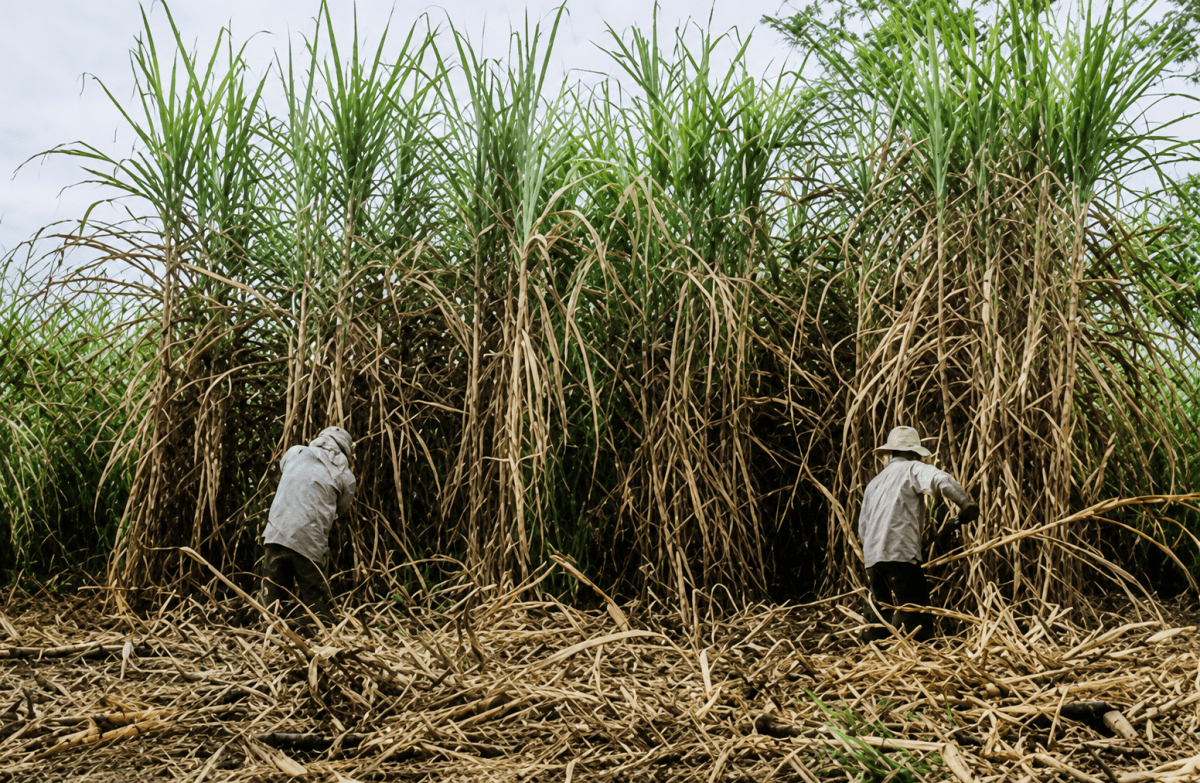
a. What type of industry is this?
b. Who are the largest producers of sugar in the world?
Answer
a. The picture represents the sugar industry, which is an agro-based industry.
b. The largest producers of sugar in the world are India, Brazil, EU, Thailand and China.
All industries need a good network of transport. Explain with an example.
Answer
All industries need a good network of roadways, railways, waterways and airways for the smooth movement of commodities. Transport brings raw materials to factories and carries finished products to consumers. For example, the iron and steel industry requires transport to bring bulky raw materials such as coal and iron ore to the plant and to carry finished steel to markets and other industries.
Why small-scale industries must be given a boost in our country?
Answer
Small-scale industries must be given a boost in our country because they work on a minimum scale of production and require little capital, so they can be started easily even with limited resources. The labour they use is often cheap and easily available, which allows them to generate employment for many people. By providing employment and producing goods with fewer resources, they support the livelihood of local people and contribute to the country's economy.
Industrial development should not be at the cost of damaging the environment.
Answer
Industries contribute greatly to economic progress, but they can also cause air, water and soil pollution and harm human beings and biodiversity. Industrial pollution can be reduced by using cleaner fuels, installing pollution-control devices, treating and recycling wastewater, disposing of wastes safely, planting trees around industrial zones, using renewable sources of power and following the 3 Rs — recycling of resources, reuse of products and reduction of wastage.
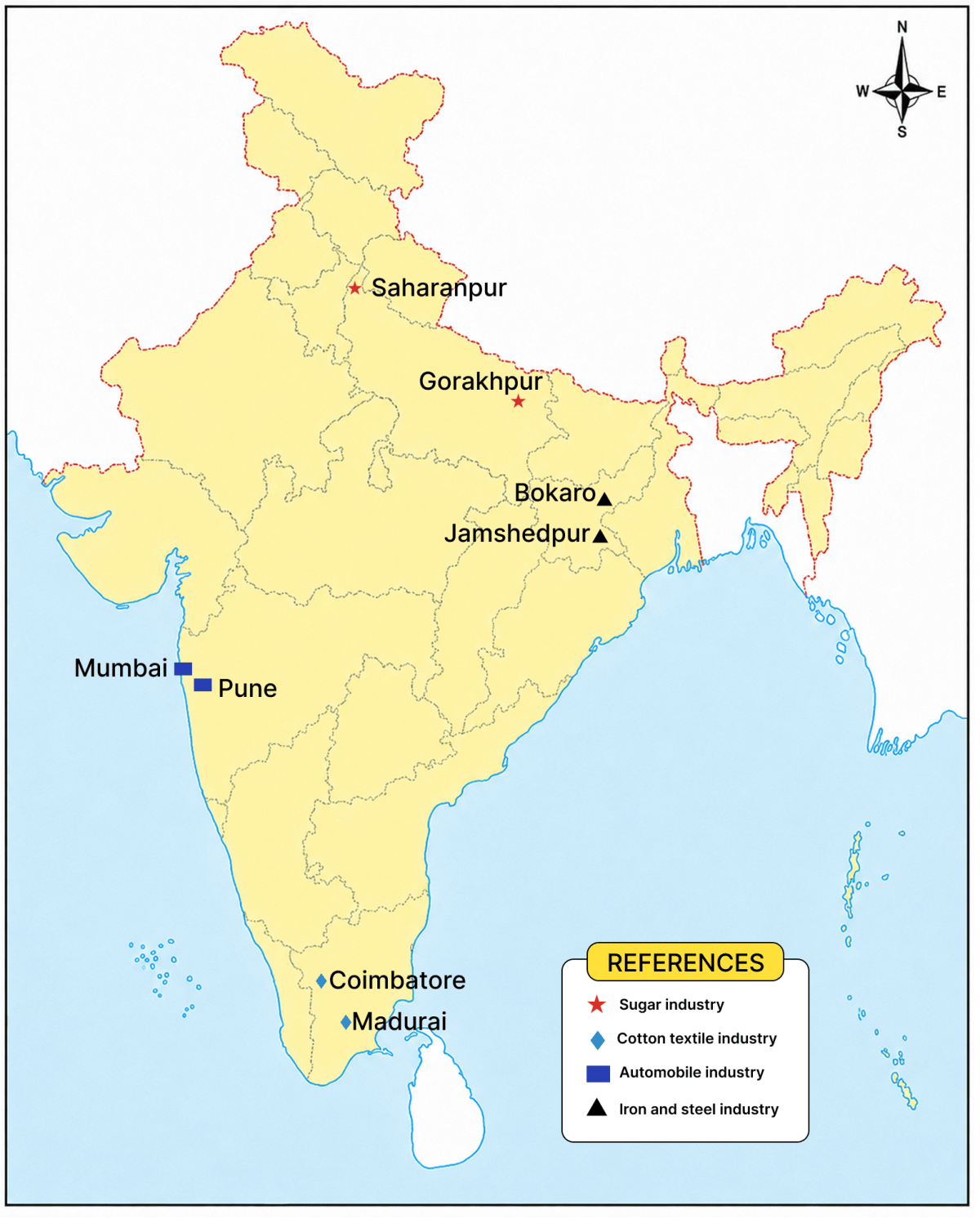
On an outline map of India, shade the following.
i. two regions of sugar industries in Uttar Pradesh
ii. two regions of cotton textile industries in Tamil Nadu
iii. two regions of automobile industry in Maharashtra
iv. two regions of iron and steel industry in Jharkhand
Answer
i. Sugar industries in Uttar Pradesh — Saharanpur and Gorakhpur.
ii. Cotton textile industries in Tamil Nadu — Coimbatore and Madurai.
iii. Automobile industry in Maharashtra — Mumbai and Pune.
iv. Iron and steel industry in Jharkhand — Jamshedpur and Bokaro.
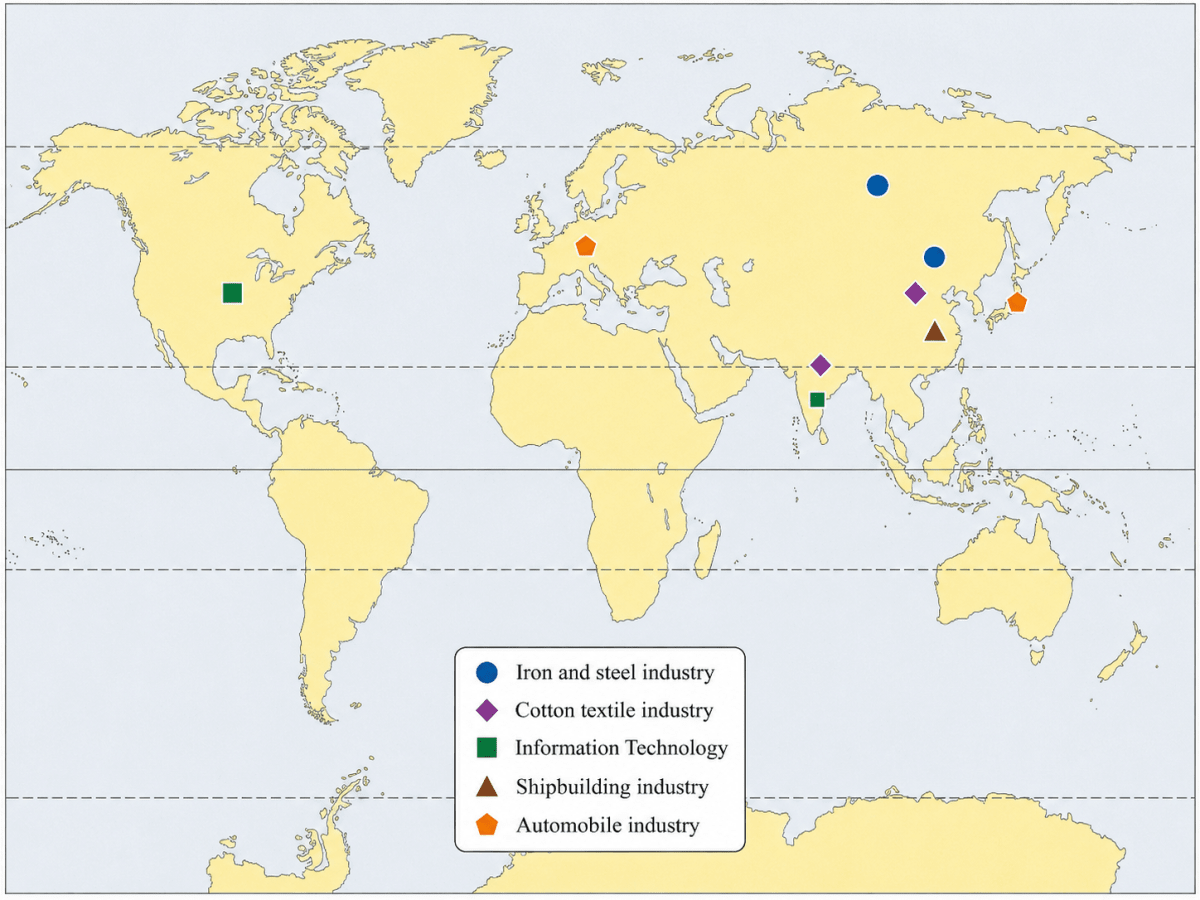
On an outline map of the world, shade, mark and name the following:
a. two leading countries producing iron and steel
b. two leading countries producing cotton textiles
c. two leading countries in the IT industry
d. a leading shipbuilding country in the world
e. two leading countries producing automobiles
Answer
a. Iron and steel — China and Russia
b. Cotton textiles — China and India
c. Information Technology (IT) — USA and India
d. Shipbuilding — China
e. Automobiles — Japan and Germany