
Is it possible to form a triangle by three line segments of the following lengths?
(i) 8 cm, 6 cm, 15 cm
(ii) 6 cm, 8 cm, 14 cm
(iii) 5 cm, 6 cm, 10 cm
(iv) 5.6 cm, 4.4 cm, 9 cm
(v) 6 cm, 6 cm, 6 cm
(vi) 10 cm, 7 cm, 4 cm
Answer
(i) 8 cm, 6 cm, 15 cm
Sum of smaller line segments: 8 cm + 6 cm = 14 cm
The length of longest line segment = 15 cm
14 cm < 15 cm
The sum of two smaller line segments is not greater than the longest line segment.
∴ Triangle cannot be formed.
(ii) 6 cm, 8 cm, 14 cm
Sum of smaller line segments: 6 cm + 8 cm = 14 cm
The length of longest line segment = 14 cm
14 cm = 14 cm
The sum of two smaller line segments is not greater than the longest line segment.
∴ Triangle cannot be formed.
(iii) 5 cm, 6 cm, 10 cm
Sum of smaller line segments: 5 cm + 6 cm = 11 cm
The length of longest line segment = 10 cm
11 cm > 10 cm
The sum of two smaller line segments is greater than the longest line segment.
∴ Triangle can be formed.
(iv) 5.6 cm, 4.4 cm, 9 cm
Sum of smaller line segments: 5.6 cm + 4.4 cm = 10 cm
The length of longest line segment = 9 cm
10 cm > 9 cm
The sum of two smaller line segments is greater than the longest line segment.
∴ Triangle can be formed.
(v) 6 cm, 6 cm, 6 cm
Sum of smaller line segments: 6 cm + 6 cm = 12 cm
The length of longest line segment = 6 cm
12 cm > 6 cm
The sum of two smaller line segments is greater than the longest line segment.
∴ Triangle can be formed.
(vi) 10 cm, 7 cm, 4 cm
Sum of smaller line segments: 7 cm + 4 cm = 11 cm
The length of longest line segment = 10 cm
11 cm > 10 cm
The sum of the two smaller line segments is greater than the longest line segment.
∴ Triangle can be formed.
Is it possible to have a triangle with angles of the following measures?
(i) 25°, 65°, 90°
(ii) 50°, 120°, 30°
(iii) 130°, 40°, 10°
(iv) 70°, 70°, 50°
(v) 30°, 90°, 90°
(vi) 60°, 50°, 60°
Answer
(i) 25°, 65°, 90°
Let's calculate the sum of the angles:
25° + 65° + 90° = 180°
The sum of the angles of a triangle is 180°.
∴ Triangle can be formed.
(ii) 50°, 120°, 30°
Let's calculate the sum of the angles:
50° + 120° + 30° = 200°
But the sum of the angles of a triangle is 180°.
Since 200° > 180°,
∴ Triangle cannot be formed.
(iii) 130°, 40°, 10°
Let's calculate the sum of the angles:
130° + 40° + 10° = 180°
The sum of the angles of a triangle is 180°.
∴ Triangle can be formed.
(iv) 70°, 70°, 50°
Let's calculate the sum of the angles:
70° + 70° + 50° = 190°
But the sum of the angles of a triangle is 180°.
Since 190° > 180°,
∴ Triangle cannot be formed.
(v) 30°, 90°, 90°
Let's calculate the sum of the angles:
30° + 90° + 90° = 210°
But the sum of the angles of a triangle is 180°.
Since 210° > 180°,
∴ Triangle cannot be formed.
(vi) 60°, 50°, 60°
Let's calculate the sum of the angles:
60° + 50° + 60° = 170°
But the sum of the angles of a triangle is 180°.
Since 170° < 180°,
∴ Triangle cannot be formed.
In a △ABC, if ∠A = 72° and ∠B = 65°, find the measure of ∠C.
Answer
Given:
∠A = 72°, ∠B = 65°, ∠C = ?
The sum of all three angles of a triangle is 180°.
∴ ∠A + ∠B + ∠C = 180°
⇒ 72° + 65° + ∠C = 180°
⇒ 137° + ∠C = 180°
⇒ ∠C = 180° - 137°
⇒ ∠C = 43°
∴ The measure of ∠C is 43°.
In a △PQR, if ∠P = 90° and ∠Q = ∠R, find the measure of each of the equal angles of the triangle.
Answer
Given:
∠P = 90° and ∠Q = ∠R
Let the measure of each of these equal angles be x.
The sum of all three angles of a triangle is 180°.
∴ ∠P + ∠Q + ∠R = 180°
Substituting the values in above, we get:
⇒ 90° + x + x = 180°
⇒ 90° + 2x = 180°
⇒ 2x = 180° - 90°
⇒ 2x = 90°
⇒ x =
⇒ x = 45°
∴ The measure of ∠Q = 45° and ∠R = 45°
The angles of a triangle are in the ratio 3 : 5 : 4. Find the measure of each of the angles.
Answer
Let the measure of given angles be 3x, 5x and 4x.
Since the sum of the angles of a triangle is 180°, we have:
3x + 5x + 4x = 180°
⇒ 12x = 180°
⇒ x =
⇒ x = 15°
Let's find the measure of each angle by substituting the value of x:
3x = 3 x 15° = 45°
5x = 5 x 15° = 75°
4x = 4 x 15° = 60°
∴ The three angles of a triangle are 45°, 75° and 60°.
One angle of a triangle measures 30° and the other two angles are in the ratio 3 : 2. Find these angles.
Answer
Given:
First angle = 30°
The other two angles are in the ratio 3 : 2.
∴ Second angle = 3x
And
Third angle = 2x
Since the sum of the angles of a triangle is 180°, we have:
30° + 3x + 2x = 180°
⇒ 30° + 5x = 180°
⇒ 5x = 180° - 30°
⇒ 5x = 150°
⇒ x =
⇒ x = 30°
Let's find the measure of other two angles by substituting the value of x:
Second angle = 3x = 3 x 30° = 90°
Third angle = 2x = 2 x 30° = 60°
∴ The other two angles are 90° and 60°.
In a right-angled triangle, the two acute angles are in the ratio 4 : 5. Find these angles.
Answer
Given:
The ratio of two acute angles = 4 : 5
∴ First acute angle = 4x
And
Second acute angle = 5x
As it is a right-angled triangle, one angle = 90°.
Since the sum of the angles of a triangle is 180°, we have:
90° + 4x + 5x = 180°
⇒ 90° + 9x = 180°
⇒ 9x = 180° - 90°
⇒ 9x = 90°
⇒ x =
⇒ x = 10°
Let's find the measure of two acute angles by substituting the value of x:
First acute angle = 4x = 4 x 10° = 40°
Second acute angle = 5x = 5 x 10° = 50°
∴ The measure of two acute angles is 40° and 50°.
One of the two equal angles of an isosceles triangle measures 65°. Find the measure of each angle of the triangle.
Answer
Given:
One of the two equal angles of an isosceles triangle = 65°
By the property of an isosceles triangle, two angles are equal.
∴ First equal angle = 65° = Second equal angle
Let the measure of the third angle be x.
Since the sum of the angles of a triangle is 180°, we have:
65° + 65° + x = 180°
⇒ 130° + x = 180°
⇒ x = 180° - 130°
⇒ x = 50°
∴ Third angle = 50°
∴ The measure of each angle of the triangle is 65°, 65° and 50°.
Find the measure of each of the two equal angles of an isosceles right-angled triangle.
Answer
One angle in isosceles right-angled triangle = 90°
The other two angles are equal.
Let each equal angle be x.
Since the sum of the angles of a triangle is 180°, we have:
90° + x + x = 180°
⇒ 90° + 2x = 180°
⇒ 2x = 180° - 90°
⇒ 2x = 90°
⇒ x =
⇒ x = 45°
∴ First equal angle = 45° and Second equal angle = 45°
∴ The measure of each of the two equal angles of an isosceles right-angled triangle is 45°.
If all the three angles of a triangle are of the same measure, find the measure of each of the angles.
Answer
Given:
All three angles of a triangle are of the same measure.
Let the measure of each angle be x.
Since the sum of the angles of a triangle is 180°, we have:
x + x + x = 180°
⇒ 3x = 180°
⇒ x =
⇒ x = 60°
∴ The measure of each of the angles is 60°.
In a right-angled triangle, if one of the acute angles measures 40°, find the measure of the other acute angle.
Answer
Given:
One acute angle = 40°
Since it is a right-angled triangle, one angle = 90°
Let the measure of the other acute angle be x.
Since the sum of the angles of a triangle is 180°, we have:
90° + 40° + x = 180°
⇒ 130° + x = 180°
⇒ x = 180° - 130°
⇒ x = 50°
∴ The measure of the other acute angle is 50°.
Find the unknown angles marked in the following figure:
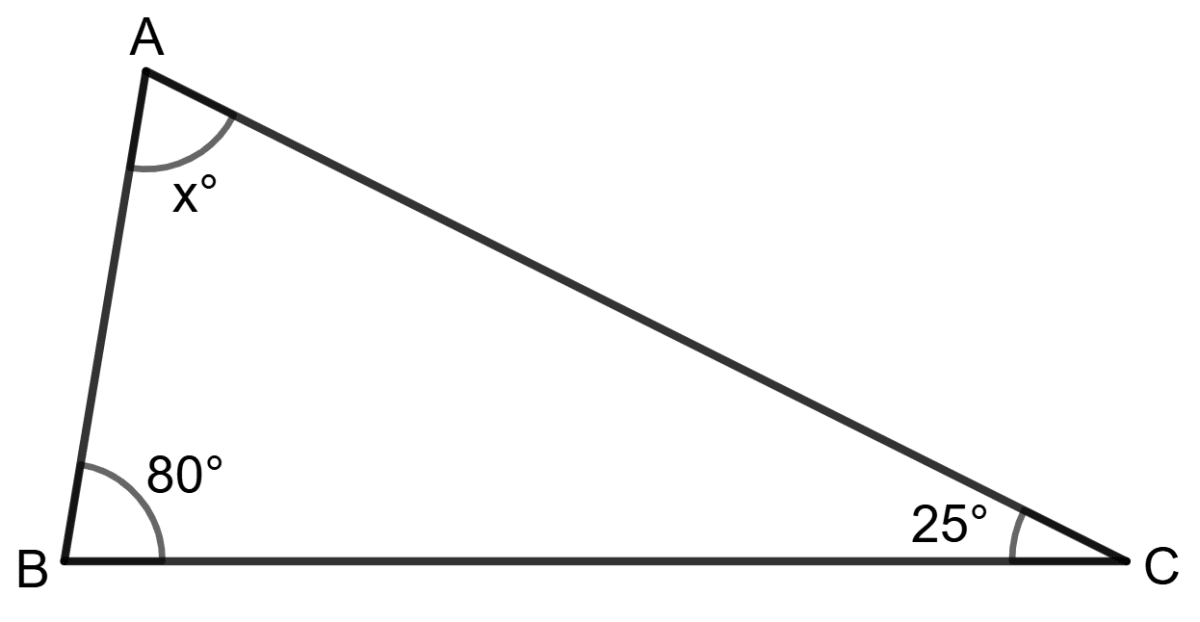
Answer
Given:
∠B = 80°, ∠C = 25°, ∠A = x°
∠B + ∠C + ∠A = 180° [Sum of the angles of a triangle]
∴ 80° + 25° + x° = 180°
⇒ 105° + x° = 180°
⇒ x° = 180° - 105°
⇒ x° = 75°
∴ ∠A = 75°
Find the unknown angles marked in the following figure:
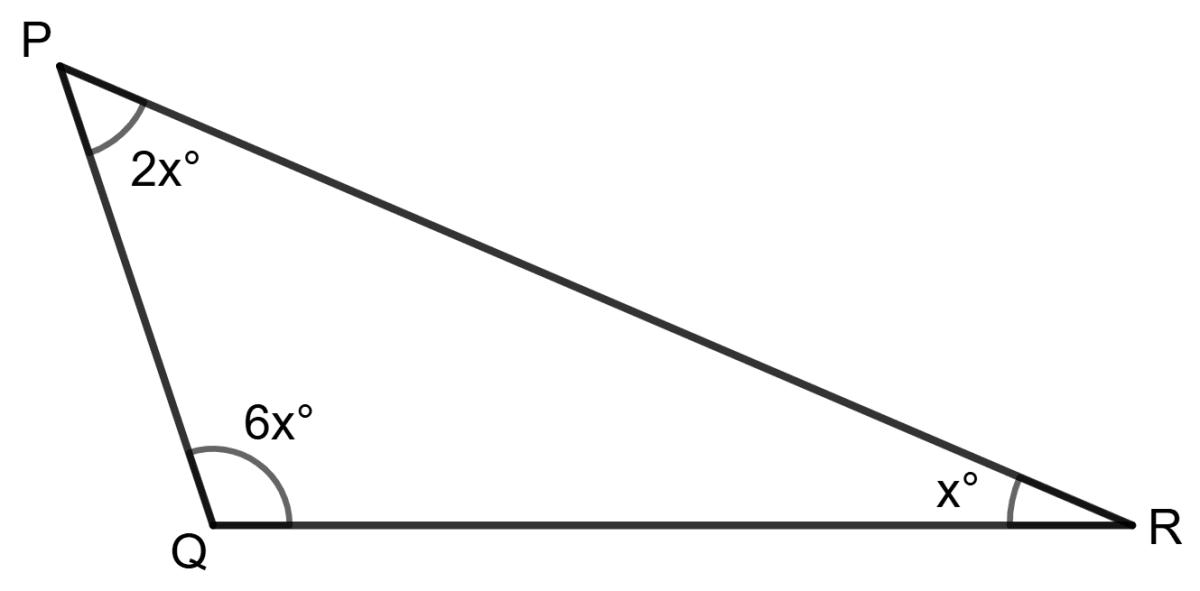
Answer
Given:
∠P = 2x°, ∠Q = 6x°, ∠R = x°
∠P + ∠Q + ∠R = 180° [Sum of the angles of a triangle]
∴ 2x° + 6x° + x° = 180°
⇒ 9x° = 180°
⇒ x° =
⇒ x° = 20°
∠R = x° = 20°
∠P = 2x° = 2 x 20° = 40°
∠Q = 6x° = 6 x 20° = 120°
∴ ∠P = 40°, ∠Q = 120° and ∠R = 20°
Find the unknown angles marked in the following figure:
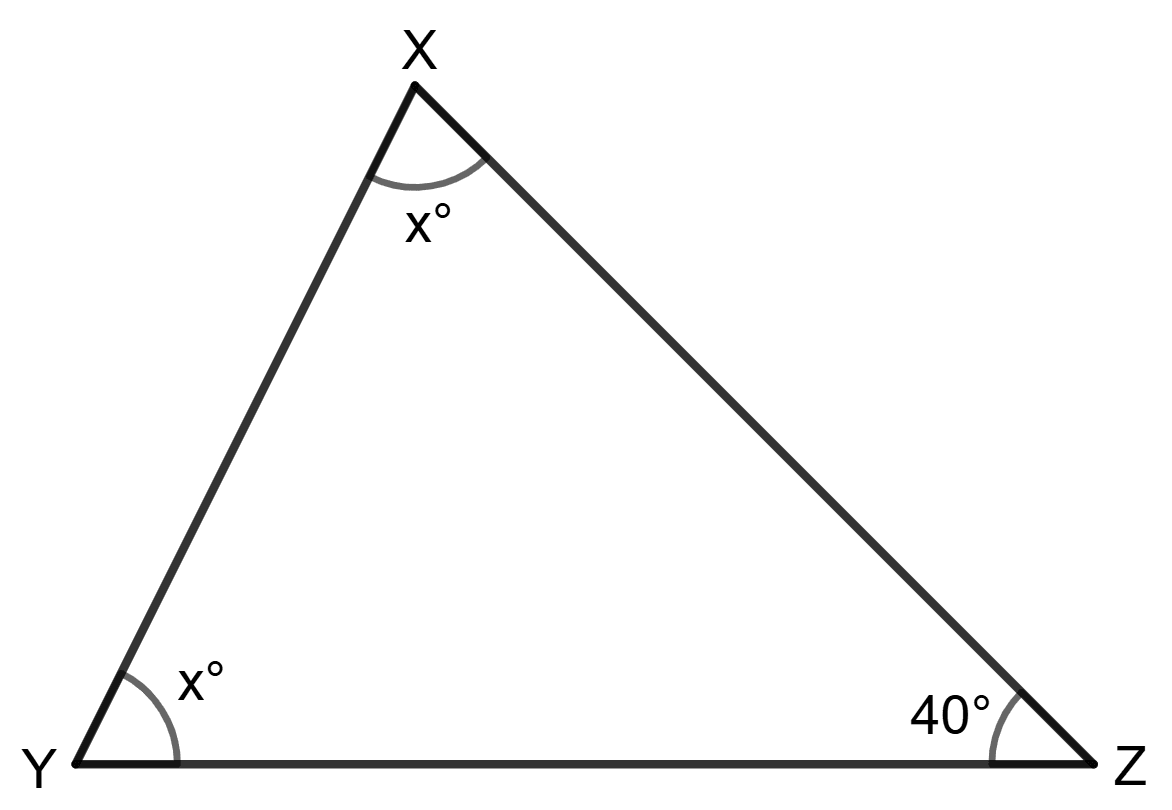
Answer
Given:
∠X = x°, ∠Y = x°, ∠Z = 40°
∠X + ∠Y + ∠Z = 180° [Sum of the angles of a triangle]
∴ x° + x° + 40° = 180°
⇒ 2x° + 40° = 180°
⇒ 2x° = 180° - 40°
⇒ 2x° = 140°
⇒ x° =
⇒ x° = 70°
∴ ∠X = 70° and ∠Y = 70°
Find the unknown angles marked in the following figure:
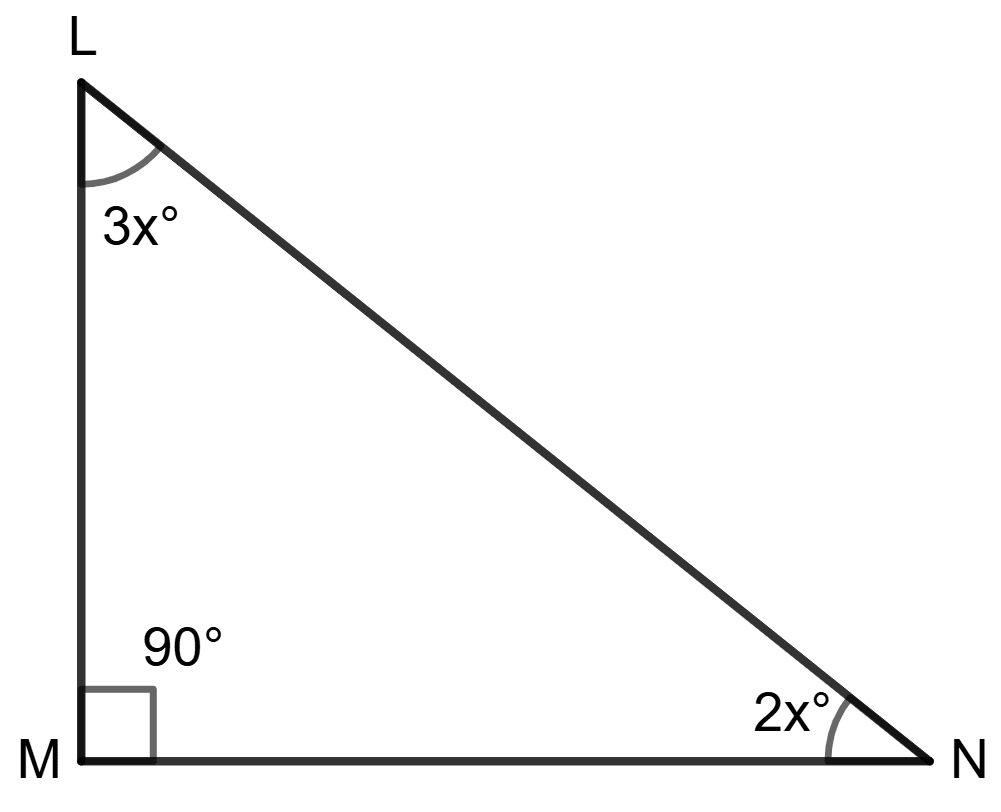
Answer
Given:
∠L = 3x°, ∠M = 90°, ∠N = 2x°
∠L + ∠M + ∠N = 180° [Sum of the angles of a triangle]
∴ 3x° + 90° + 2x° = 180°
⇒ 5x° + 90° = 180°
⇒ 5x° = 180° - 90°
⇒ 5x° = 90°
⇒ x° =
⇒ x° = 18°
∠L = 3x° = 3 x 18° = 54°
∠N = 2x° = 2 x 18° = 36°
∴ ∠L = 54° and ∠N = 36°
Find the unknown angles marked in the following figure:
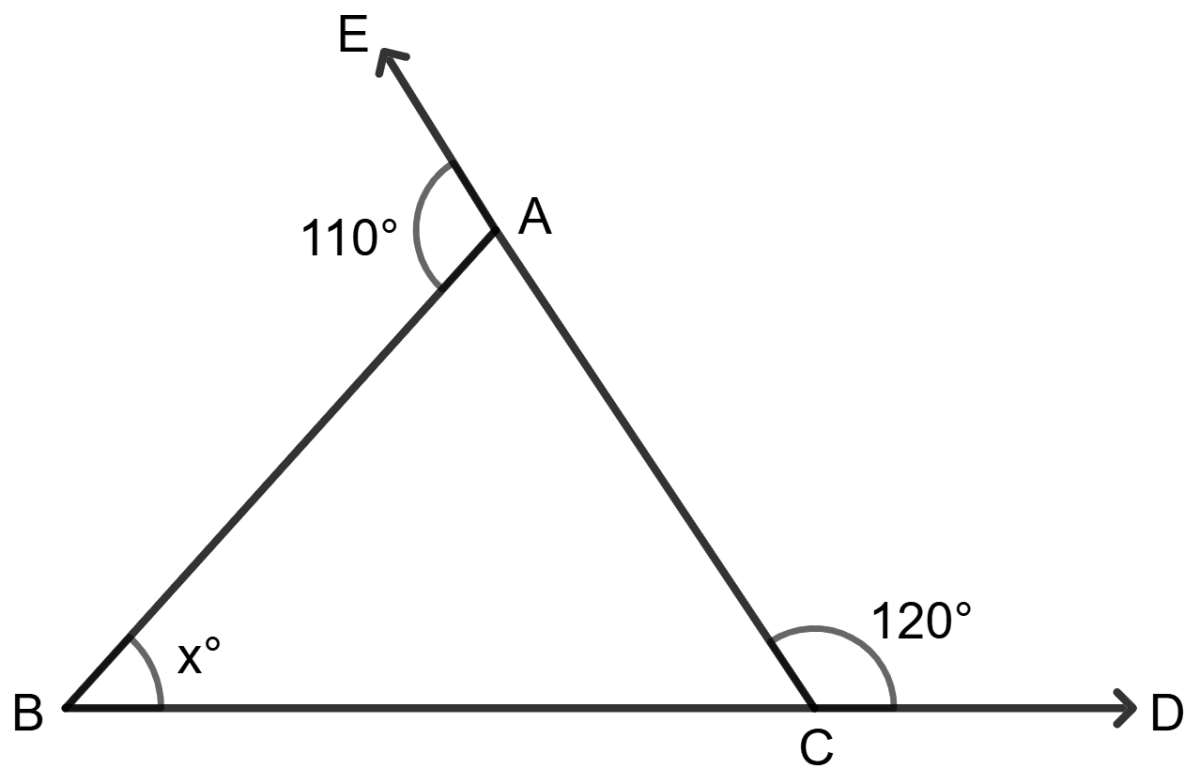
Answer
Given:
∠BAE = 110°, ∠ACD = 120°, ∠ABC = x°
Since, CE is a straight line:
∠BAE + ∠BAC = 180° [Linear pair]
⇒ 110° + ∠BAC = 180° [Substituting the value of ∠BAE]
⇒ ∠BAC = 180° - 110°
⇒ ∠BAC = 70°
Since BD is a straight line:
∠ACD + ∠ACB = 180° [Linear pair]
⇒ 120° + ∠ACB = 180° [Substituting the value of ∠ACD]
⇒ ∠ACB = 180° - 120°
⇒ ∠ACB = 60°
In △ABC, we have:
∠ABC + ∠BAC + ∠ACB = 180° [Sum of the angles of a triangle]
∴ x° + 70° + 60° = 180°
⇒ x° + 130° = 180°
⇒ x° = 180° - 130°
⇒ x° = 50°
∴ ∠B = 50°
Find the unknown angles marked in the following figure:
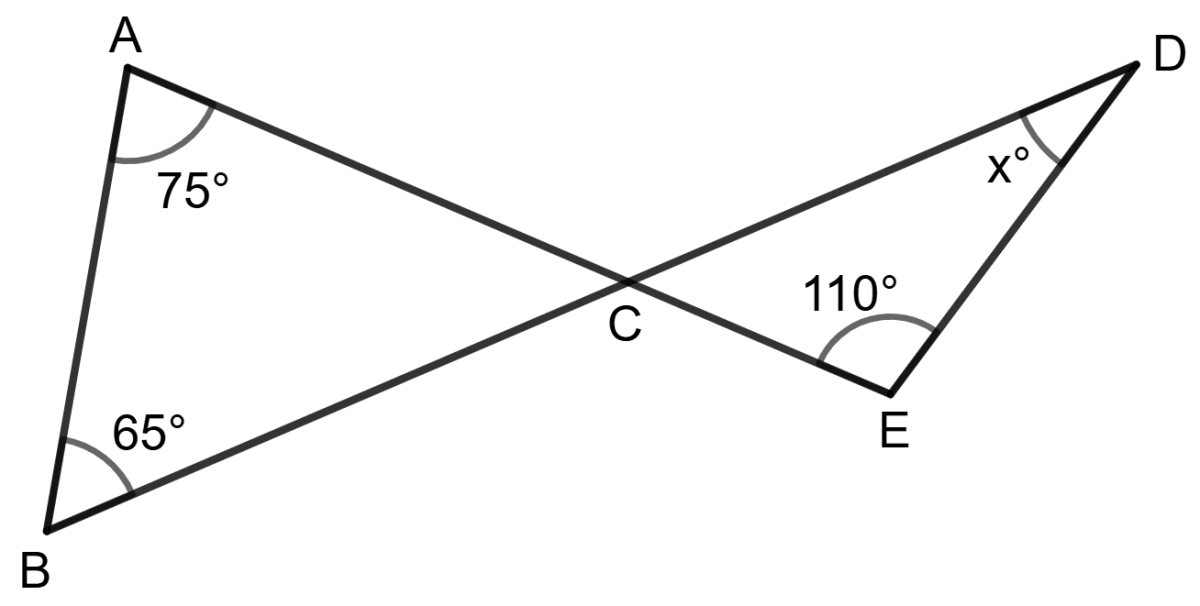
Answer
Given:
∠A = 75°, ∠B = 65°, ∠D = x°, ∠E = 110°
In △ABC, we have:
∠A + ∠B + ∠ACB = 180° [Sum of the angles of a triangle]
∴ 75° + 65° + ∠ACB = 180°
⇒ 140° + ∠ACB = 180°
⇒ ∠ACB = 180° - 140°
⇒ ∠ACB = 40°
Now,
∠ACB = ∠DCE [Vertically opposite angles are equal]
Now, in △CDE, we have:
∠DCE + ∠D + ∠E = 180° [Sum of the angles of a triangle]
∴ 40° + x° + 110° = 180°
⇒ 150° + x° = 180°
⇒ x° = 180° - 150°
⇒ x° = 30°
∴ ∠D = 30°
In the following figure, one side of a triangle has been produced. Find all the angles of the triangle in each case.
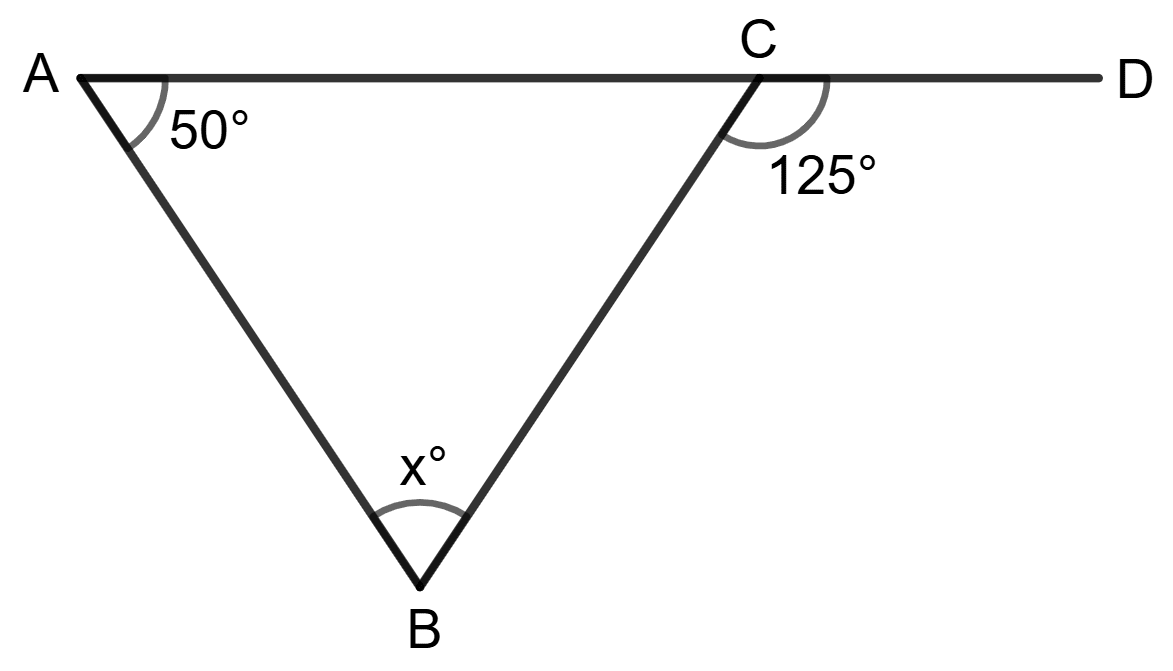
Answer
Given interior angles:
∠A = 50°, ∠B = x°
Exterior angle: ∠BCD = 125°
According to exterior angle property, an exterior angle of a triangle is equal to the sum of its interior opposite angles.
∴ ∠A + ∠B = ∠BCD
⇒ 50° + x° = 125°
⇒ x° = 125° - 50°
⇒ x° = 75°
⇒ ∠B = 75°
In △ABC, we have:
∠A + ∠B + ∠C = 180° [Sum of the angles of a triangle]
∴ 50° + 75° + ∠C = 180°
⇒ 125° + ∠C = 180°
⇒ ∠C = 180° - 125°
⇒ ∠C = 55°
∴ The angles of the triangle are ∠A = 50°, ∠B = 75°, ∠C = 55°
In the following figure, one side of a triangle has been produced. Find all the angles of the triangle in each case.
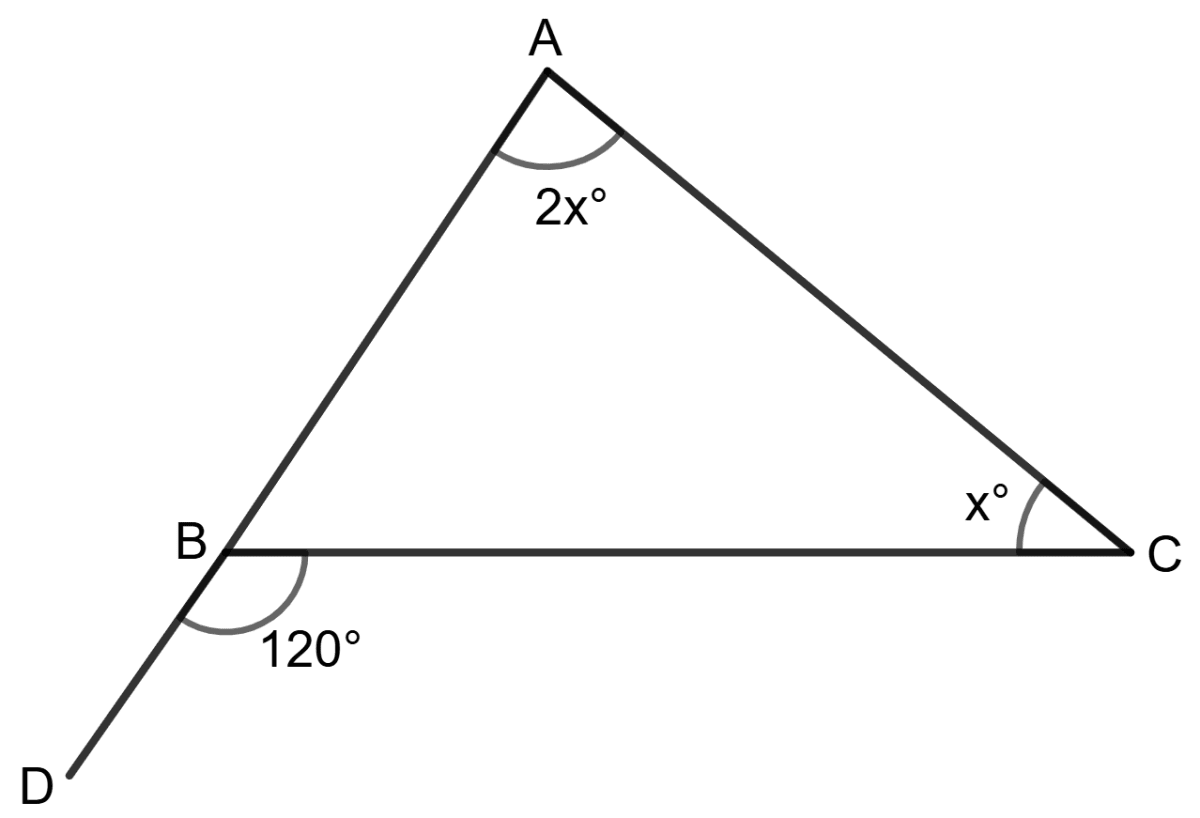
Answer
Given interior angles:
∠A = 2x°, ∠C = x°
Exterior angle: ∠CBD = 120°
According to exterior angle property, an exterior angle of a triangle is equal to the sum of its interior opposite angles.
∴ ∠A + ∠C = ∠CBD
2x° + x° = 120°
3x° = 120°
x° =
x° = 40°
⇒ ∠A = 2x° = 2 x 40° = 80°
⇒ ∠C = x° = 40°
In △ABC, we have:
∠A + ∠B + ∠C = 180° [Sum of the angles of a triangle]
∴ 80° + ∠B + 40° = 180°
⇒ 120° + ∠B = 180°
⇒ ∠B = 180° - 120°
⇒ ∠B = 60°
∴ The angles of the triangle are ∠A = 80°, ∠B = 60°, ∠C = 40°
In the following figure, one side of a triangle has been produced. Find all the angles of the triangle in each case.
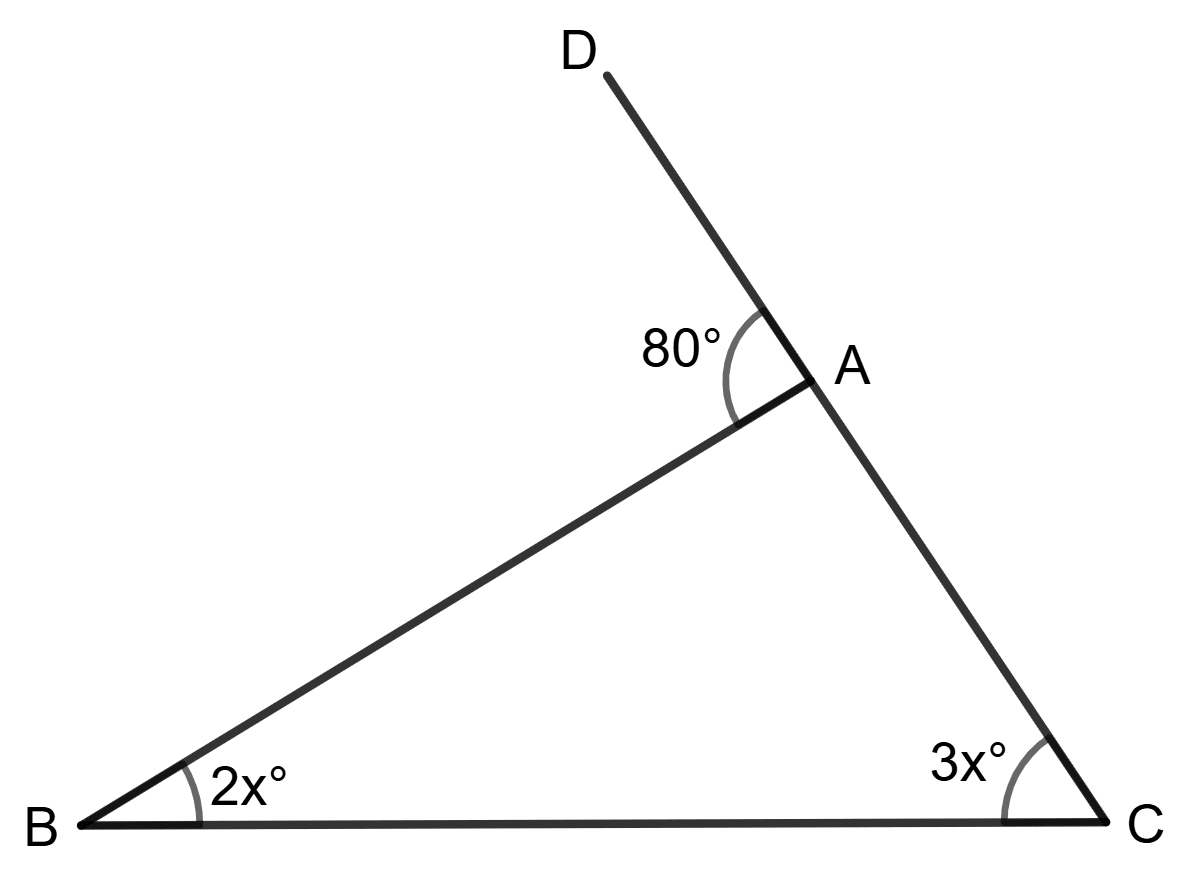
Answer
Given interior angles:
∠B = 2x°, ∠C = 3x°
Exterior angle: ∠BAD = 80°
According to exterior angle property, an exterior angle of a triangle is equal to the sum of its interior opposite angles.
∴ ∠B + ∠C = ∠BAD
2x° + 3x° = 80°
5x° = 80°
x° =
x° = 16°
⇒ ∠B = 2x° = (2 x 16°) = 32°
⇒ ∠C = 3x° = (3 x 16°) = 48°
In △ABC, we have:
∠A + ∠B + ∠C = 180° [Sum of the angles of a triangle]
∴ ∠A + 32° + 48° = 180°
⇒ ∠A + 80° = 180°
⇒ ∠A = 180° - 80°
⇒ ∠A = 100°
∴ The angles of the triangle are ∠A = 100°, ∠B = 32°, ∠C = 48°
In the following figure, one side of a triangle has been produced. Find all the angles of the triangle in each case.
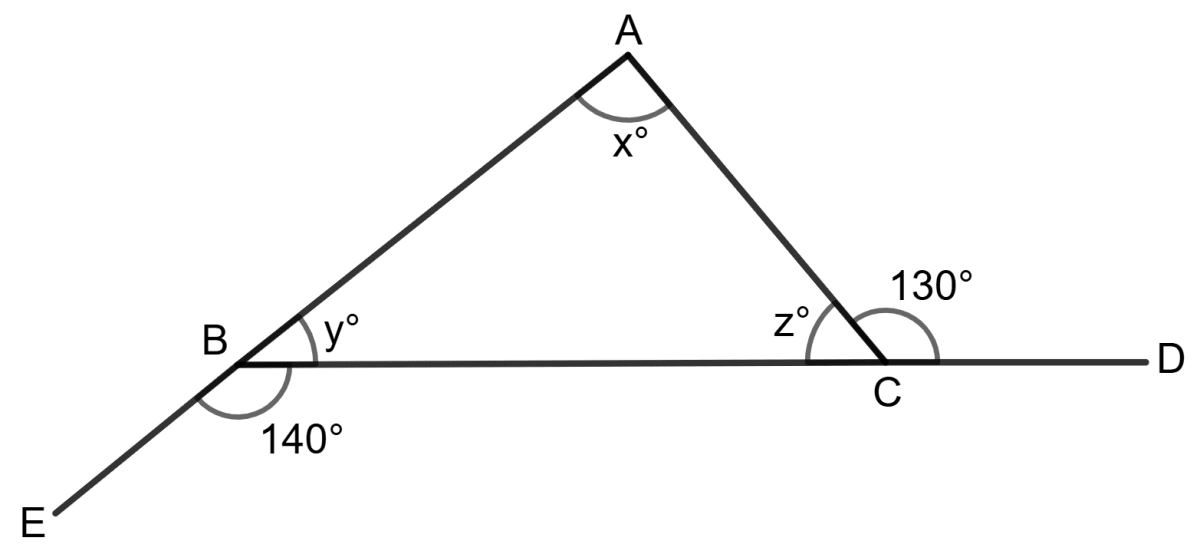
Answer
Given interior angles:
∠A = x°, ∠B = y°, ∠C = z°
Exterior angle: ∠CBE = 140°, ∠ACD = 130°
Since AE is a straight line:
∠CBE + ∠CBA = 180° [Linear pair]
⇒ 140° + y° = 180°
⇒ y° = 180° - 140°
⇒ y° = 40°
⇒ ∠B = 40°
Since BD is a straight line:
∠ACD + ∠ACB = 180°
⇒ 130° + z° = 180°
⇒ z° = 180° - 130°
⇒ z° = 50°
⇒ ∠C = 50°
In △ABC, we have:
∠A + ∠B + ∠C = 180° [Sum of the angles of a triangle]
∴ x° + 40° + 50° = 180°
⇒ x° + 90° = 180°
⇒ x° = 180° - 90°
⇒ x° = 90°
⇒ ∠A = 90°
∴ The angles of the triangle are ∠A = 90°, ∠B = 40°, ∠C = 50°
In the following figure, one side of a triangle has been produced. Find all the angles of the triangle in each case.
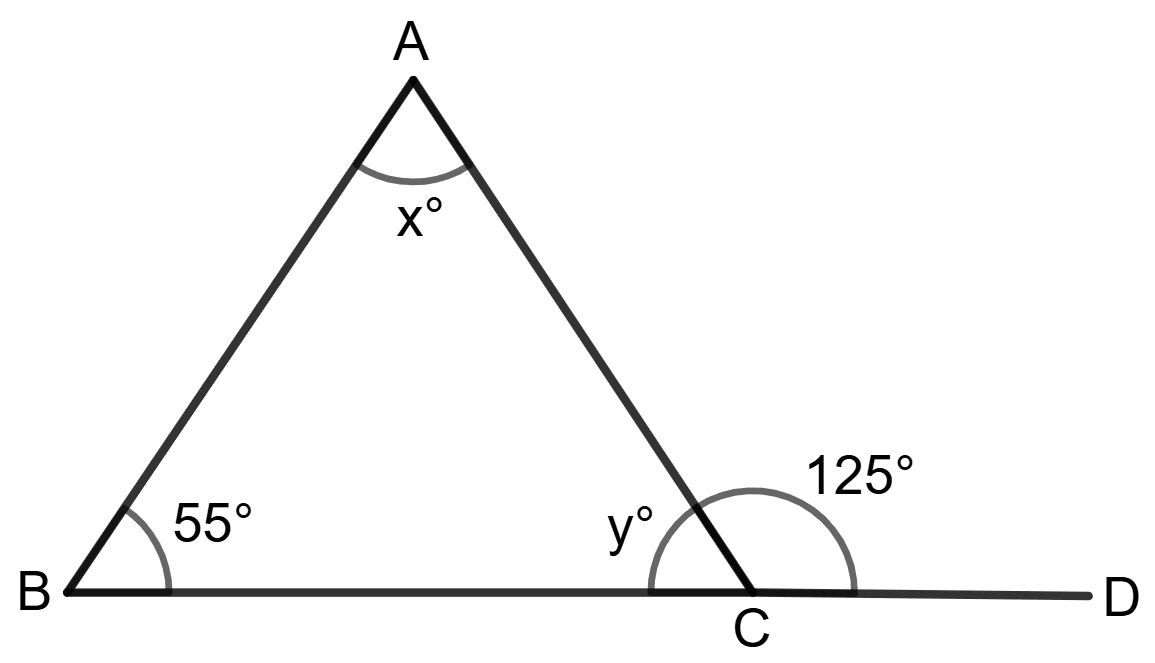
Answer
Given interior angles:
∠A = x°, ∠B = 55°, ∠C = y°
Exterior angle: ∠ACD = 125°
According to exterior angle property, an exterior angle of a triangle is equal to the sum of its interior opposite angles.
∴ ∠A + ∠B = ∠ACD [∠A and ∠B are opposite interior angles to ∠ACD]
⇒ x° + 55° = 125°
⇒ x° = 125° - 55°
⇒ x° = 70°
⇒ ∠A = x° = 70°
In △ABC, we have:
∠A + ∠B + ∠C = 180° [Sum of the angles of a triangle]
∴ 70° + 55° + y° = 180°
⇒ 125° + y° = 180°
⇒ y° = 180° - 125°
⇒ y° = 55°
⇒ ∠C = y° = 55°
∴ The angles of the triangle are ∠A = 70°, ∠B = 55°, ∠C = 55°
In the following figure, one side of a triangle has been produced. Find all the angles of the triangle in each case.
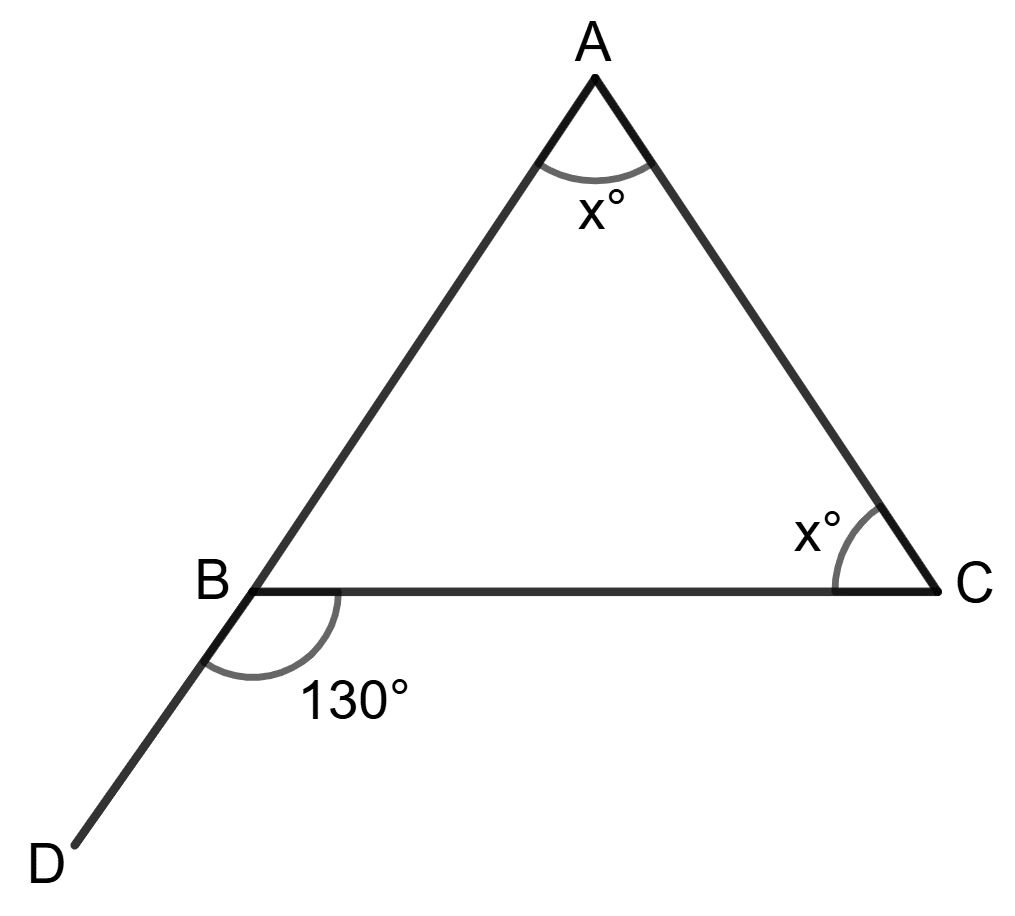
Answer
Given interior angles:
∠A = x°, ∠C = x°
Exterior angle: ∠CBD = 130°
According to exterior angle property, an exterior angle of a triangle is equal to the sum of its interior opposite angles.
∴ ∠A + ∠C = ∠CBD
x° + x° = 130°
2x° = 130°
x° =
x° = 65°
⇒ ∠A = x° = 65°
⇒ ∠C = x° = 65°
In △ABC, we have:
∠A + ∠B + ∠C = 180° [Sum of the angles of a triangle]
∴ 65° + ∠B + 65° = 180°
⇒ ∠B + 130° = 180°
⇒ ∠B = 180° - 130°
⇒ ∠B = 50°
∴ The angles of the triangle are ∠A = 65°, ∠B = 50°, ∠C = 65°
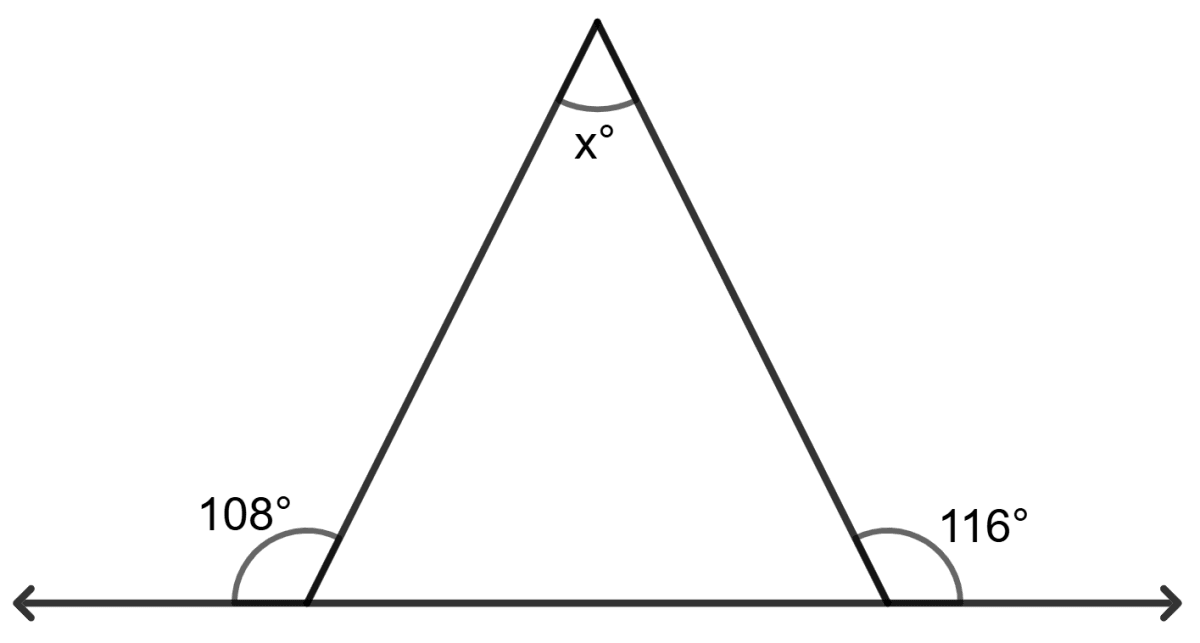
Calculate the size of each lettered angle in the following figure:
Answer
From the figure, we have:
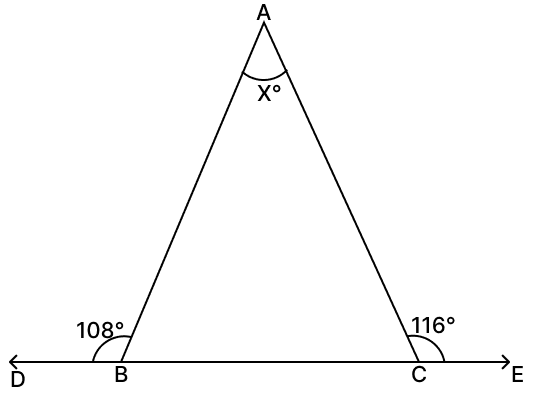
∠BAC = x°, ∠ABD = 108° and ∠ACE = 116°
Since, DE is a straight line and AB is a transversal:
∠ABD + ∠ABC = 180° [Linear pair]
⇒ 108° + ∠ABC = 180°
⇒ ∠ABC = 180° - 108°
⇒ ∠ABC = 72°
Since, DE is a straight line and AC is a transversal:
∠ACE + ∠ACB = 180° [Linear pair]
⇒ 116° + ∠ACB = 180°
⇒ ∠ACB = 180° - 116°
⇒ ∠ACB = 64°
Now, consider △ABC:
∠ABC + ∠BAC + ∠ACB = 180° [Sum of the angles of a triangle]
∴ 72° + x° + 64° = 180°
⇒ x° + 136° = 180°
⇒ x° = 180° - 136°
∴ x = 44°
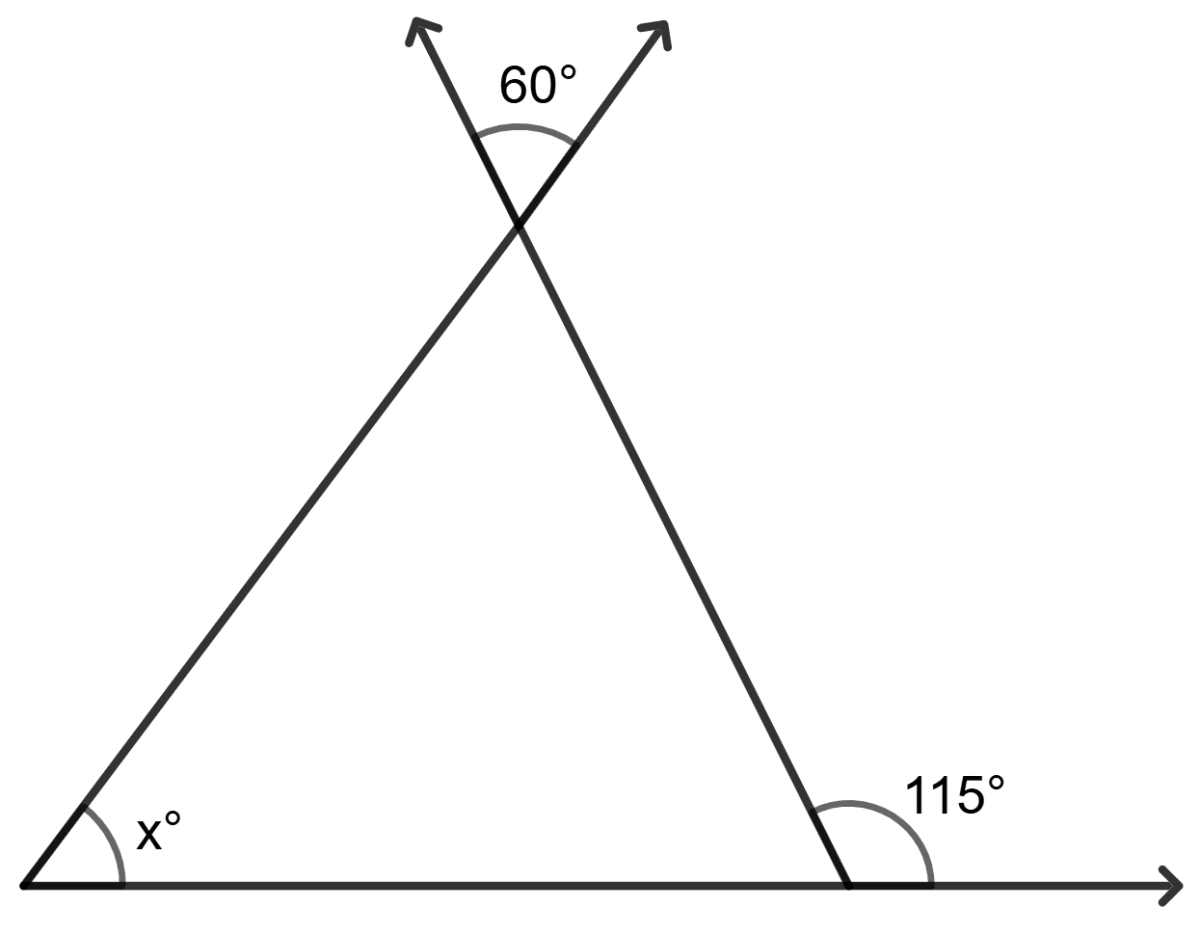
Calculate the size of each lettered angle in the following figure:
Answer
From figure, we have:
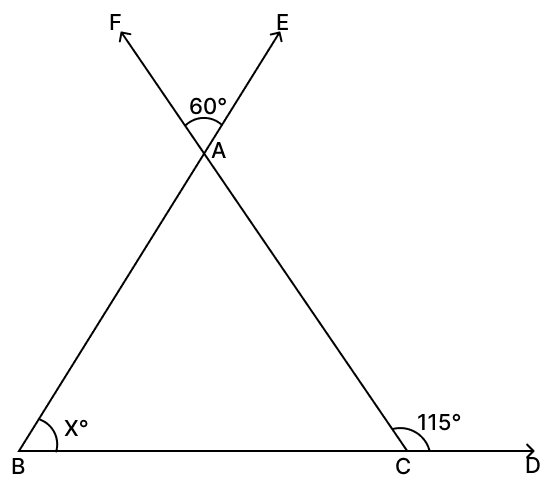
∠ABC = x°, ∠ACD = 115° and ∠FAE = 60°
∠BAC = ∠FAE [Vertically opposite angles]
⇒ ∠BAC = 60°
x° + ∠BAC = ∠ACD [Exterior angle = sum of interior opposite angles]
⇒ x° + 60° = 115°
⇒ x° = 115° - 60°
∴ x = 55°
Calculate the size of each lettered angle in the following figure:
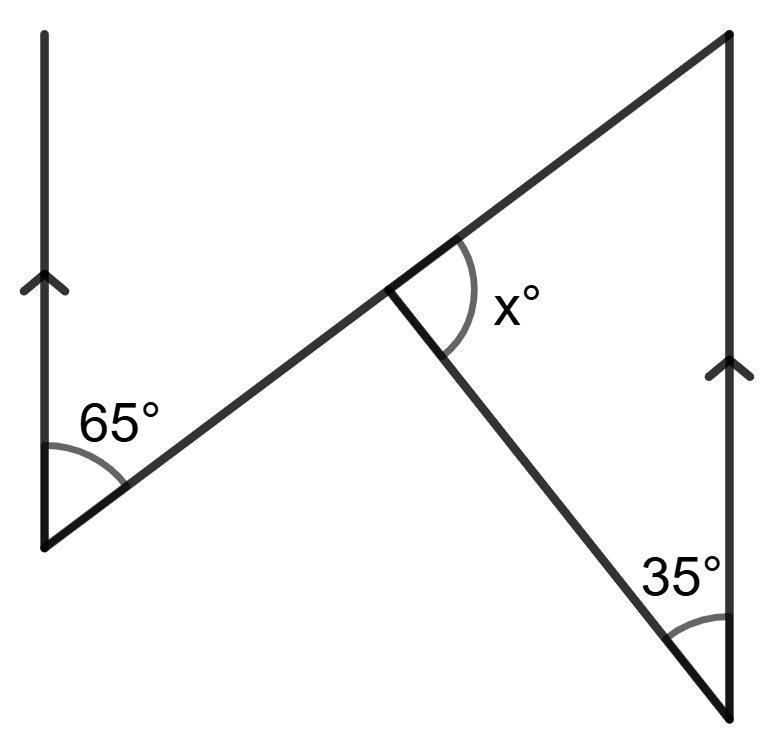
Answer
From the figure, we have:
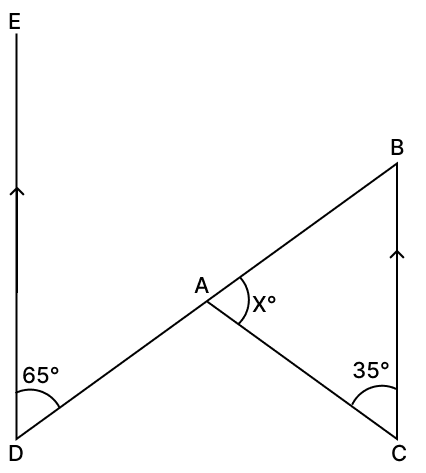
∠ADE = 65°, ∠ACB = 35° and ∠BAC = x°
Since ED || BC and BD is a transversal:
∠ABC = ∠ADE [Interior alternate angle]
⇒ ∠ABC = 65°
Now, consider △ABC:
∠ABC + ∠BAC + ∠ACB = 180° [Sum of the angles of a triangle]
∴ 65° + x° + 35° = 180°
⇒ x + 100° = 180°
⇒ x = 180° - 100°
∴ x = 80°
Calculate the size of each lettered angle in the following figure:
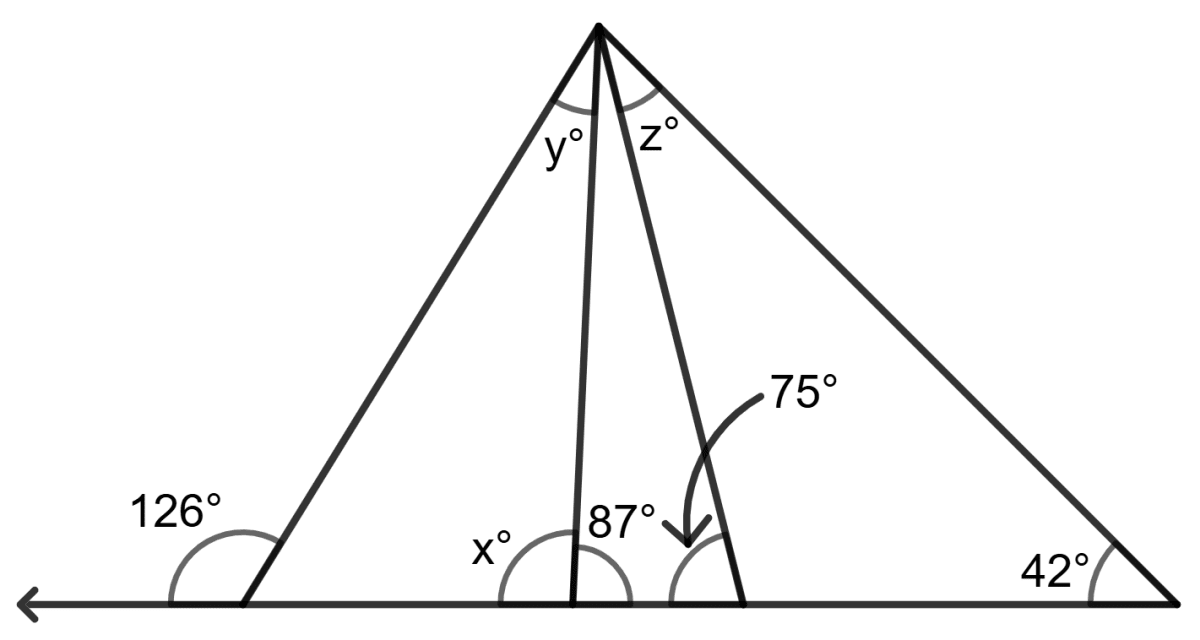
Answer
From the figure, we have:
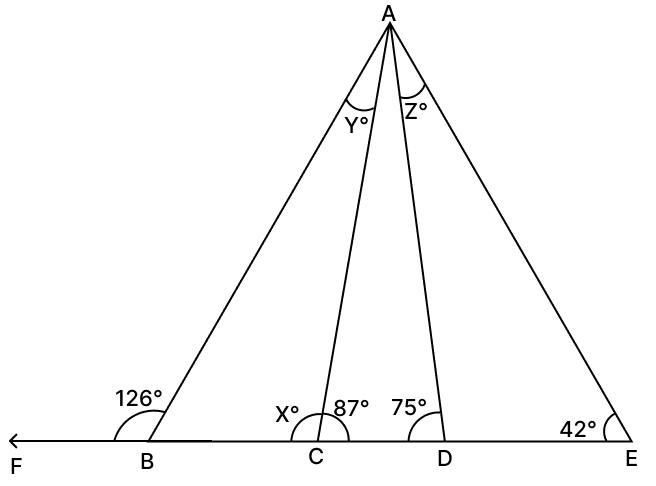
∠ACB = x°
∠ACD = 87°
∠ADC = 75°
∠AED = 42°
∠ABF = 126°
∠BAC = y°
∠EAD = z°
At vertex D:
75° = z° + ∠AED [Exterior angle = sum of interior opposite angles]
⇒ 75° = z° + 42°
⇒ z° = 75° - 42°
⇒ z° = 33°
Since EF is a straight line:
∠ACB + ∠ACD = 180° [Linear pair]
⇒ x° + 87° = 180°
⇒ x° = 180° - 87°
⇒ x° = 93°
At vertex B:
126° = x° + y° [Exterior angle = sum of interior opposite angles]
⇒ 126° = 93° + y°
⇒ y° = 126° - 93°
⇒ y° = 33°
∴ x° = 93°, y° = 33°, z° = 33°
Calculate the size of each lettered angle in the following figure:
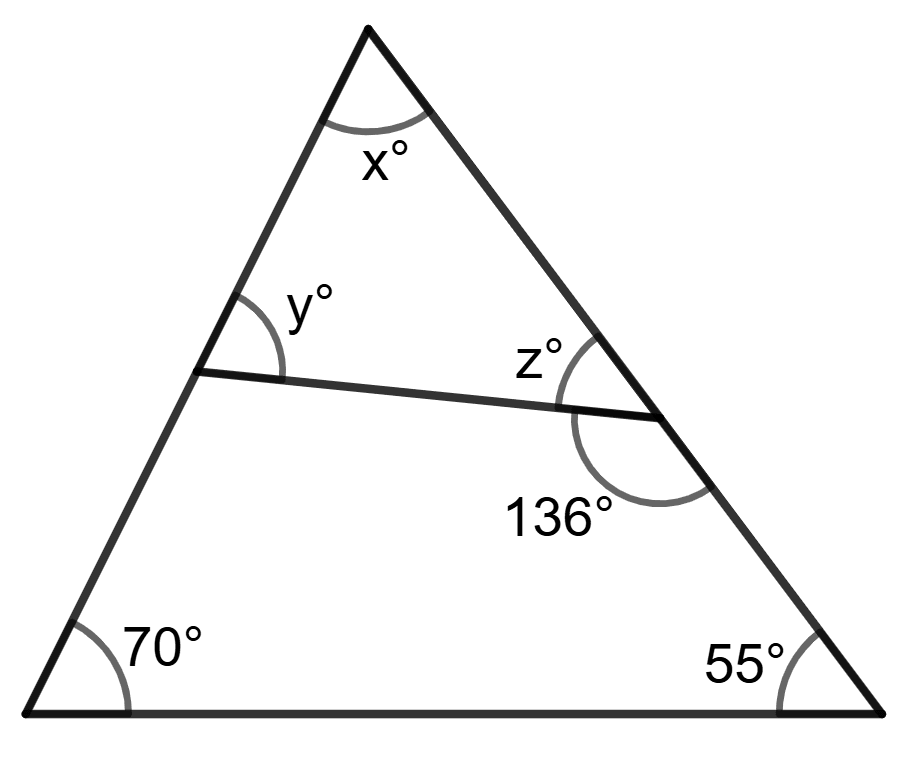
Answer
From the figure, we have:
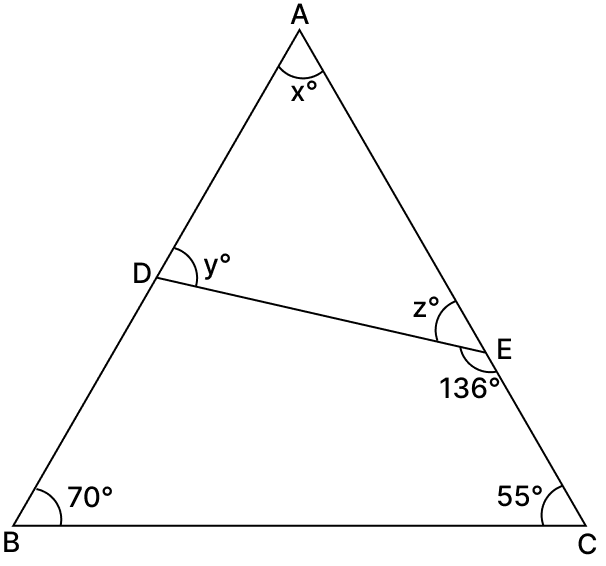
∠ABC = 70°
∠ACB = 55°
∠BAC = x°
∠ADE = y°
∠AED = z°
Consider △ABC,
∠ABC + ∠BAC + ∠ACB = 180° [Sum of the angles of a triangle]
∴ 70° + x° + 55° = 180°
x° + 125° = 180°
x° = 180° - 125°
x° = 55°
Now Consider △ADE,
x° + y° = 136° [Exterior angle = sum of interior opposite angles]
⇒ 55° + y° = 136°
⇒ y° = 136° - 55°
⇒ y° = 81°
Since AC is a straight line:
z° + 136° = 180°
z° = 180° - 136°
z° = 44°
∴ x° = 55°, y° = 81°, z° = 44°
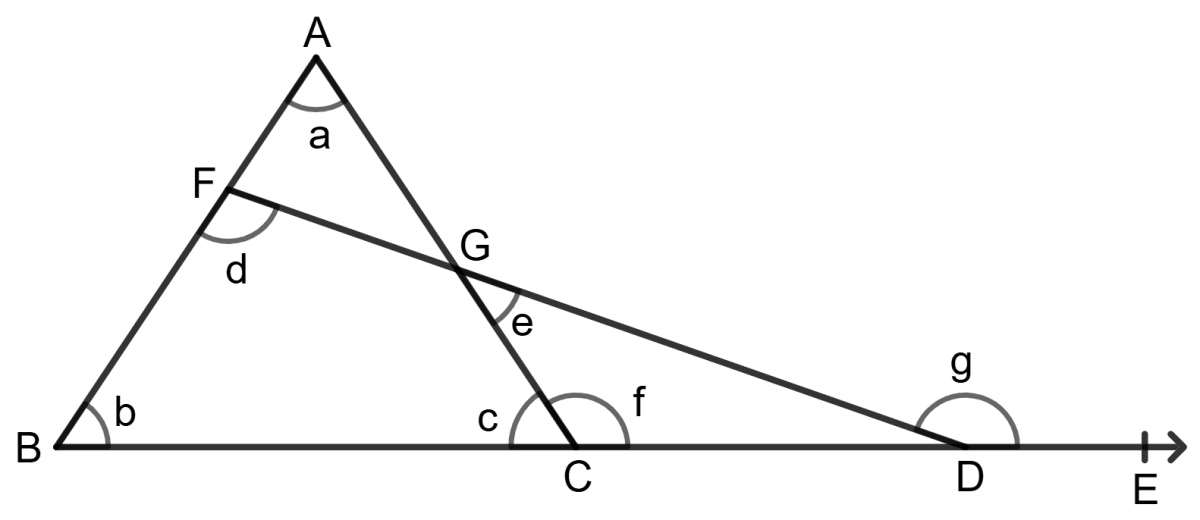
Use the given figure to express:
(i) a in terms of b and f;
(ii) e in terms of f and g;
(iii) d in terms of a and e;
(iv) c in terms of e and g.
Answer
(i)
Consider △ABC,
The angle f is an exterior angle at vertex C
Interior opposite angles are a and b
According to exterior angle property, an exterior angle of a triangle is equal to the sum of its interior opposite angles.
∴ a + b = f
a = f - b
(ii)
Consider △GCD,
The angle g is an exterior angle at vertex D
Interior opposite angles are e and f
According to exterior angle property, an exterior angle of a triangle is equal to the sum of its interior opposite angles.
∴ e + f = g
e = g - f
(iii)
Consider △AFG,
The angle d is an exterior angle at vertex F
Interior opposite angles are a and ∠AGF
∠AGF and e are vertically opposite angles, so ∠AGF = e.
According to exterior angle property, an exterior angle of a triangle is equal to the sum of its interior opposite angles.
∴ d = a + e
(iv)
Consider △GCD,
The angle c is an exterior angle at vertex C
The interior opposite angles are e and ∠GDC.
Since CE is a straight line:
∠GDC + ∠GDE = 180° [Linear pair]
∠GDC + g = 180°
∠GDC = 180° - g
According to exterior angle property, an exterior angle of a triangle is equal to the sum of its interior opposite angles.
∴ c = e + ∠GDC
c = e + 180° - g
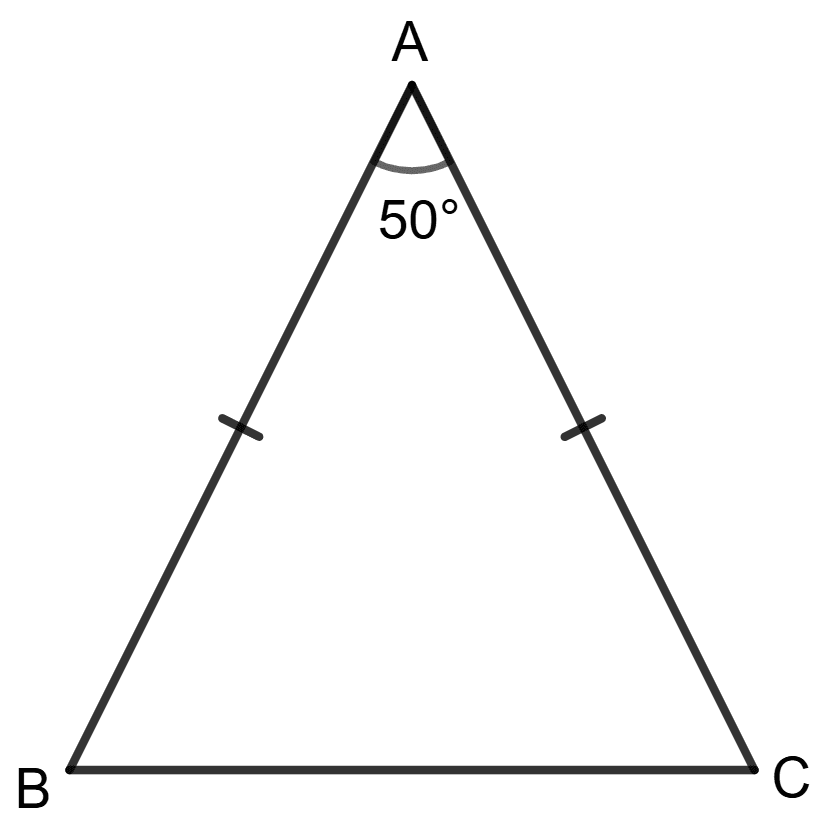
In the given figure, △ABC is an isosceles triangle in which AB = AC and ∠A = 50°. Find the measure of ∠B and ∠C.
Answer
Given:
AB = AC
∠A = 50°
∠B = ∠C = x [∵ angles opposite to equal sides of a triangle are equal]
Consider △ABC,
∠A + ∠B + ∠C = 180° [Sum of the angles of a triangle]
∴ 50° + x + x = 180°
⇒ 2x + 50° = 180°
⇒ 2x = 180° - 50°
⇒ 2x = 130°
⇒ x =
⇒ x = 65°
∴ ∠B = ∠C = 65°
In the given figure, △PQR is an isosceles triangle in which PQ = PR and ∠Q = 70°. Find ∠P.
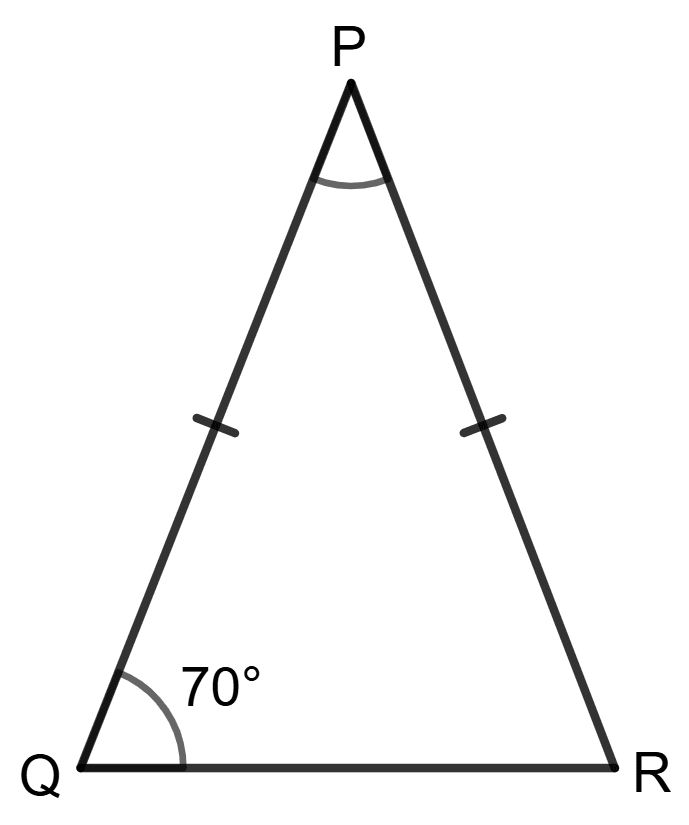
Answer
Given:
PQ = PR
∠Q = 70°
∠R = ∠Q [∵ angles opposite to equal sides of a triangle are equal]
⇒ ∠R = 70°
Consider △PQR,
∠P + ∠Q + ∠R = 180° [Sum of the angles of a triangle]
∴ ∠P + 70° + 70° = 180°
⇒ ∠P + 140° = 180°
⇒ ∠P = 180° - 140°
∴ ∠P = 40°
In the given figure, AB || CD. The line segments BC and AD intersect at O. Show that: z = x + y.
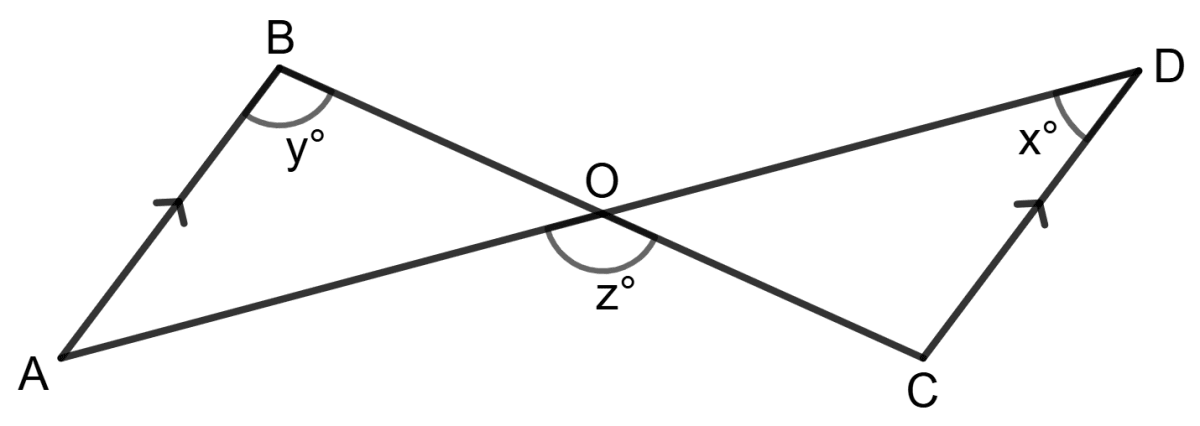
Answer
Given:
Since, AB || CD and BC is a transversal:
∠DCO = ∠ABO [Interior alternate angles]
∴ ∠DCO = y°
Now, consider △OCD,
z° is an exterior angle to this triangle
∴ z° = ∠ODC + ∠DCO [Exterior angle = sum of interior opposite angles]
z° = x° + y°
⇒ Hence proved
Each base angle of an isosceles triangle is 15° more than its vertical angle. Find each angle of the triangle.
Answer
Let the measure of the vertical angle be x°.
According to the problem, each base angle is 15° more than the vertical angle.
Vertical angle = x°
First base angle = (x + 15)°
Second base angle = (x + 15)° (since base angles of an isosceles triangle are equal)
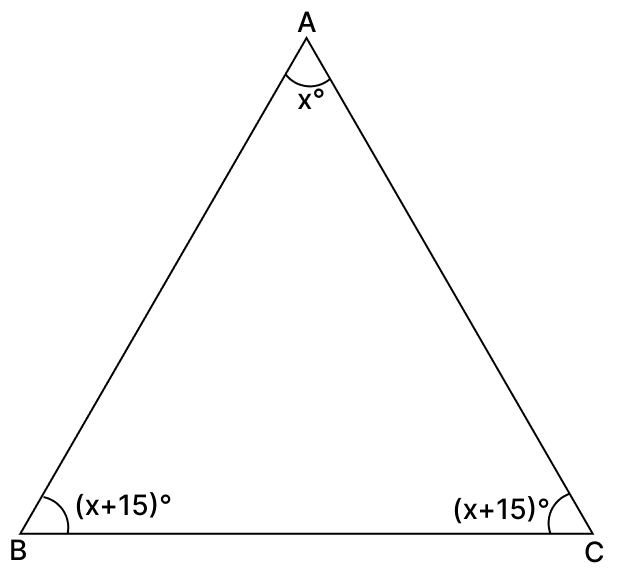
Consider △ABC,
∠A + ∠B + ∠C = 180° [Sum of the angles of a triangle]
∴ x° + (x + 15)° + (x + 15)° = 180°
⇒ 3x° + 30° = 180°
⇒ 3x° = 180° - 30°
⇒ 3x° = 150°
⇒ x° =
⇒ x° = 50°
∠A = x° = 50°
∠B = (x + 15)° = (50 + 15)° = 65°
∠C = (x + 15)° = (50 + 15)° = 65°
∴ The angles of triangle are 50°, 65° and 65°.
The vertical angle of an isosceles triangle is twice the sum of its base angles. Find each angle of the triangle.
Answer
In an isosceles triangle, the two base angles are equal.
Let the measure of each base angle be x.
First base angle = x
Second base angle = x
According to the problem, the vertical angle is twice the sum of its base angles:
Vertical angle = 2(x + x) = 2(2x) = 4x
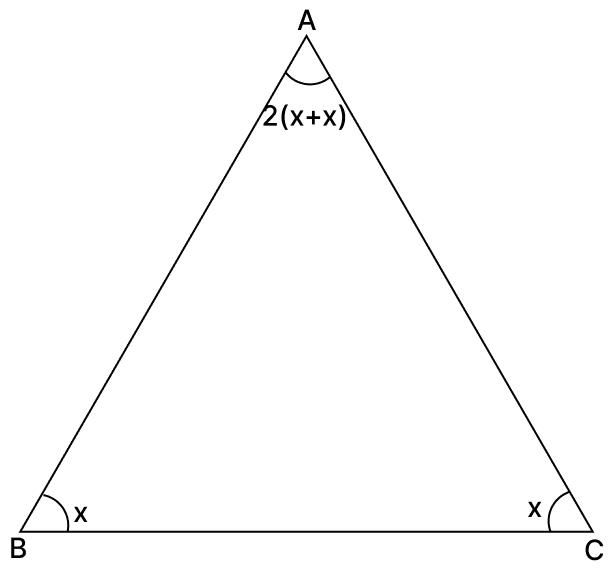
Consider △ABC,
∠A + ∠B + ∠C = 180° [Sum of the angles of a triangle]
∴ 4x + x + x = 180°
⇒ 6x = 180°
⇒ x =
⇒ x = 30°
∠A = 4x = 4 x 30° = 120°
∠B = x = 30°
∠C = x = 30°
∴ The angles of triangle are 120°, 30° and 30°.
In an isosceles triangle, each base angle is four times its vertical angle. Find each angle of the triangle.
Answer
Let the measure of the vertical angle be x°.
According to the problem, each base angle is four times the vertical angle.
Since base angles of an isosceles triangle are equal:
Vertical angle = x°
First base angle = 4x°
Second base angle = 4x°
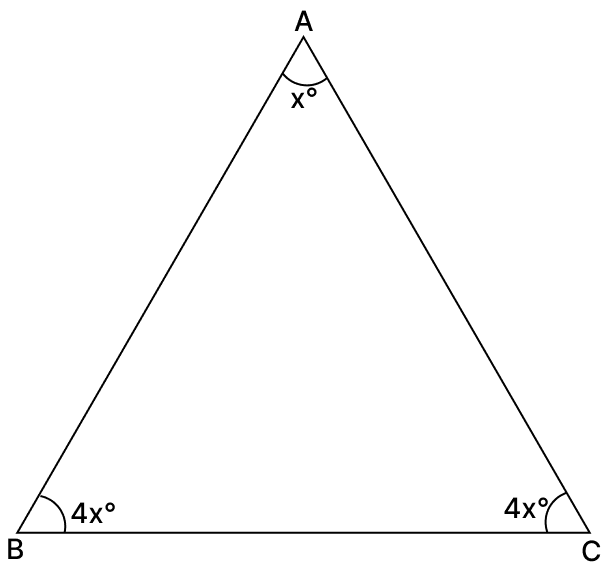
Consider △ABC,
∠A + ∠B + ∠C = 180° [Sum of the angles of a triangle]
∴ x° + 4x° + 4x° = 180°
⇒ 9x° = 180°
⇒ x° =
⇒ x° = 20°
∠A = x° = 20°
∠B = 4x° = 4 x 20° = 80°
∠C = 4x° = 4 x 20° = 80°
∴ The angles of the triangle are 20°, 80°, and 80°.
The ratio between the base angle and the vertical angle of an isosceles triangle is 2 : 5. Find each angle of the triangle.
Answer
Given:
The ratio between a base angle and the vertical angle is 2 : 5.
In an isosceles triangle, the two base angles are equal.
First base angle: 2x
Second base angle: 2x
Vertical angle: 5x
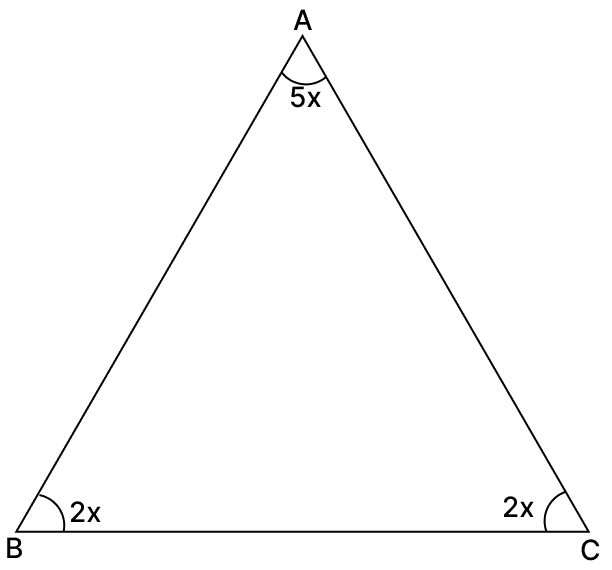
Consider △ABC,
∠A + ∠B + ∠C = 180° [Sum of the angles of a triangle]
∴ 5x + 2x + 2x = 180°
⇒ 9x = 180°
⇒ x =
⇒ x = 20°
∠A = 5x = 5 x 20° = 100°
∠B = 2x = 2 x 20° = 40°
∠C = 2x = 2 x 20° = 40°
∴ The three angles of the triangle are 40°, 40°, and 100°.
In the given figure, △ABC is an equilateral triangle whose side BC has been produced in both the directions to D and E respectively. Prove that ∠ACD = ∠ABE.
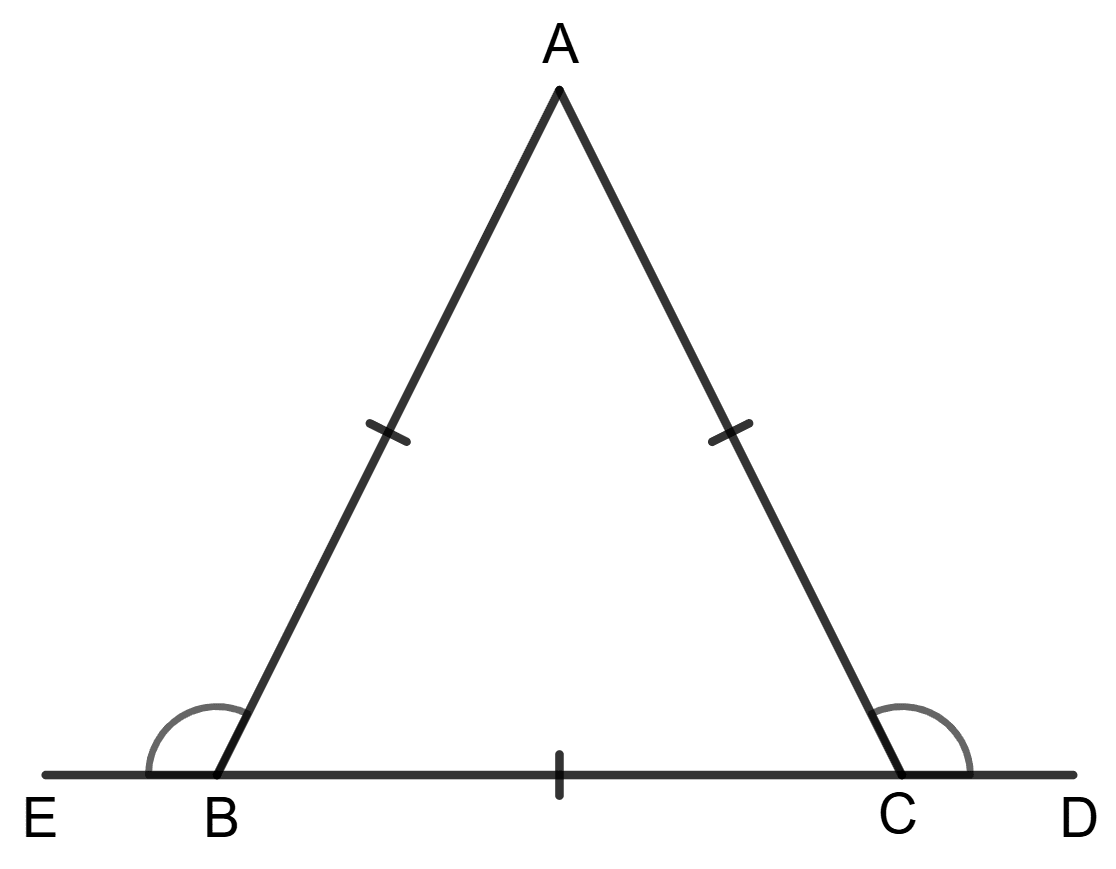
Answer
Since △ABC is an equilateral triangle, all its interior angles are equal and each measures 60°.
∠ABC = 60°.
∠ACB = 60°.
At vertex B:
∠ABE + ∠ABC = 180° [Linear pair]
⇒ ∠ABE + 60° = 180°
⇒ ∠ABE = 180° - 60°
⇒ ∠ABE = 120° .....(Equation 1)
At vertex C:
∠ACD + ∠ACB = 180° [Linear pair]
⇒ ∠ACD + 60° = 180°
⇒ ∠ACD = 180° - 60°
⇒ ∠ACD = 120° .....(Equation 2)
Comparing Equation 1 and Equation 2:
∠ABE = 120°
∠ACD = 120°
∴ ∠ACD = ∠ABE
⇒ Hence proved
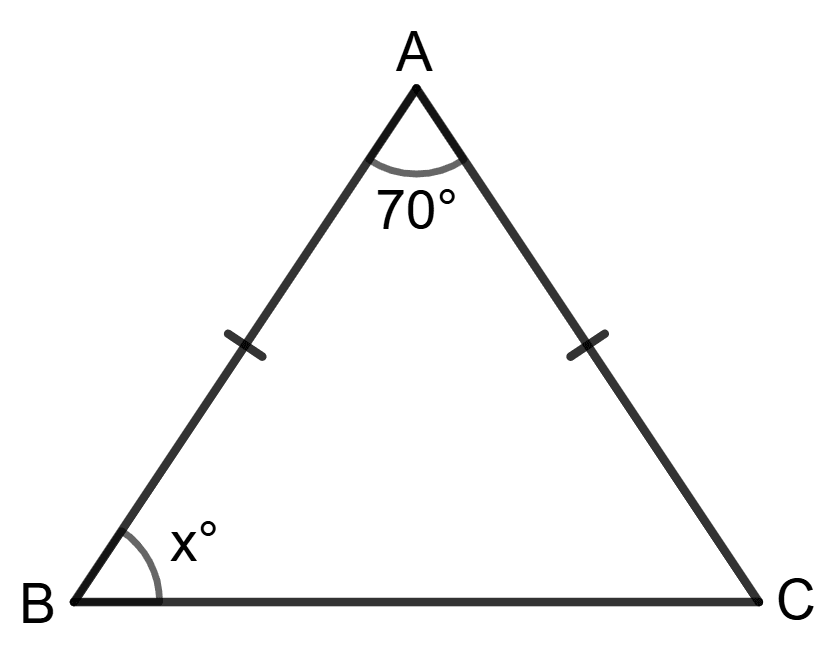
Find the unknown marked angles in the following figure:
Answer
From figure, we have:
AB = AC
∠A = 70°
∠B = ∠C = x° [∵ angles opposite to equal sides of a triangle are equal]
∠A + ∠B + ∠C = 180° [Sum of the angles of a triangle]
∴ 70° + x° + x° = 180°
⇒ 70° + 2x° = 180°
⇒ 2x° = 180° - 70°
⇒ 2x° = 110°
⇒ x° =
x° = 55°.
Find the unknown marked angles in the following figure:
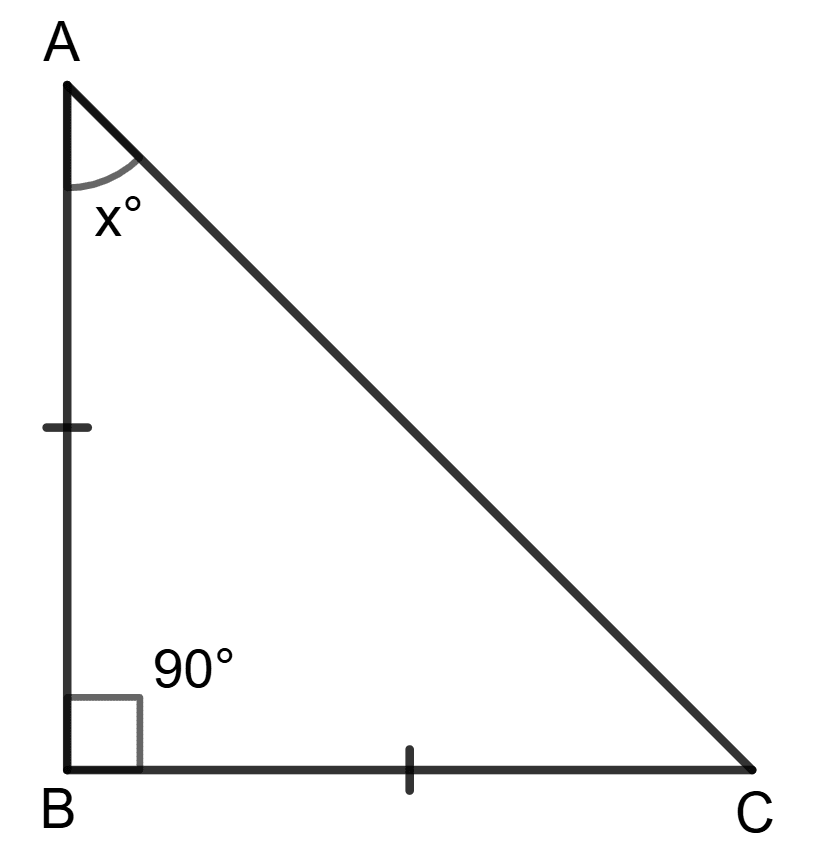
Answer
From figure, we have:
AB = BC
∠B = 90°
∠A = ∠C = x° [∵ angles opposite to equal sides of a triangle are equal]
∠A + ∠B + ∠C = 180° [Sum of the angles of a triangle]
∴ x° + 90° + x° = 180°
⇒ 90° + 2x° = 180°
⇒ 2x° = 180° - 90°
⇒ 2x° = 90°
⇒ x° =
x° = 45°.
Find the unknown marked angles in the following figure:
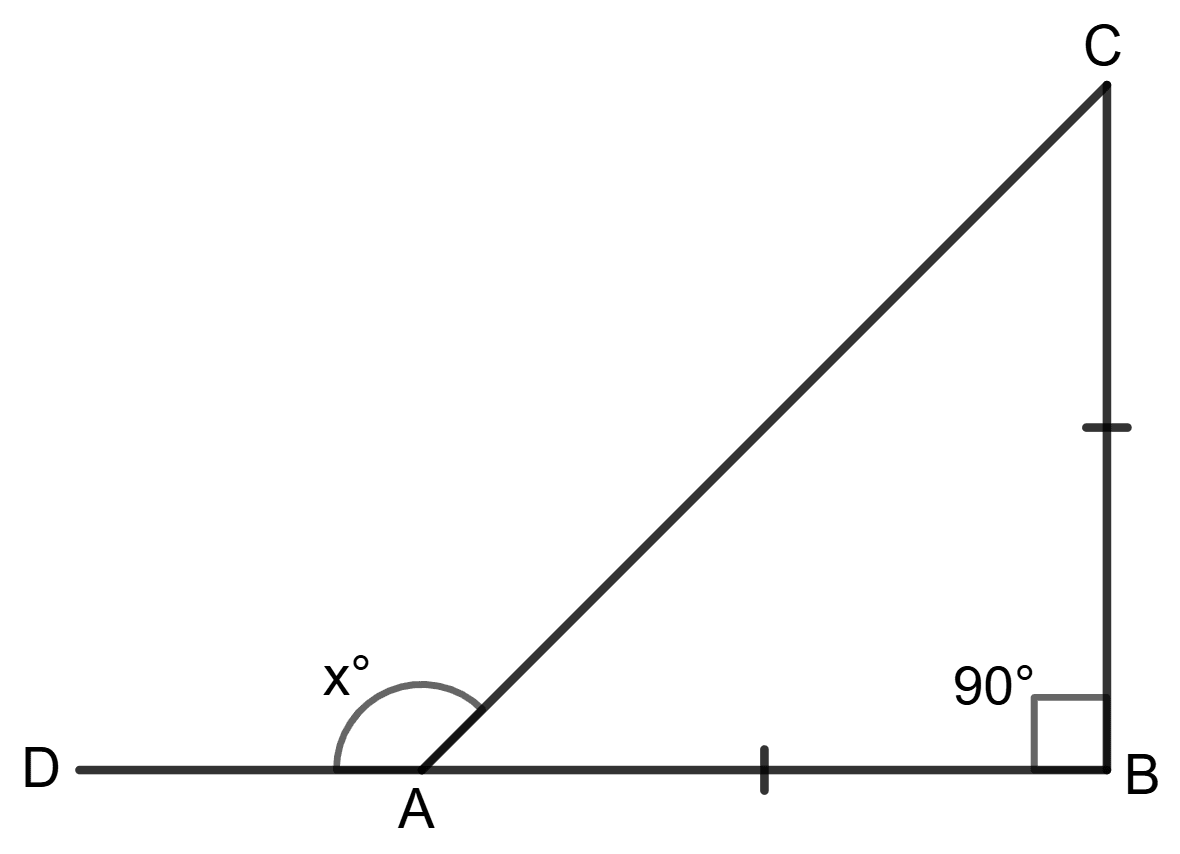
Answer
From figure, we have:
AB = BC
∠B = 90°
∠CAD = x°
∠CAB = ∠ACB [∵ angles opposite to equal sides of a triangle are equal]
∠ABC + ∠CAB + ∠ACB = 180° [Sum of the angles of a triangle]
∴ 90° + ∠ACB + ∠ACB = 180° [∵ ∠CAB = ∠ACB]
90° + 2∠ACB = 180°
2∠ACB = 180° - 90°
2∠ACB = 90°
∠ACB =
∠ACB = 45°
⇒ ∠CAB = 45°
Since BD is a straight line and AC is a transversal:
∠CAD + ∠CAB = 180° [Linear pair]
x° + 45° = 180°
x° = 180° - 45°
x° = 135°.
Find the unknown marked angles in the following figure:
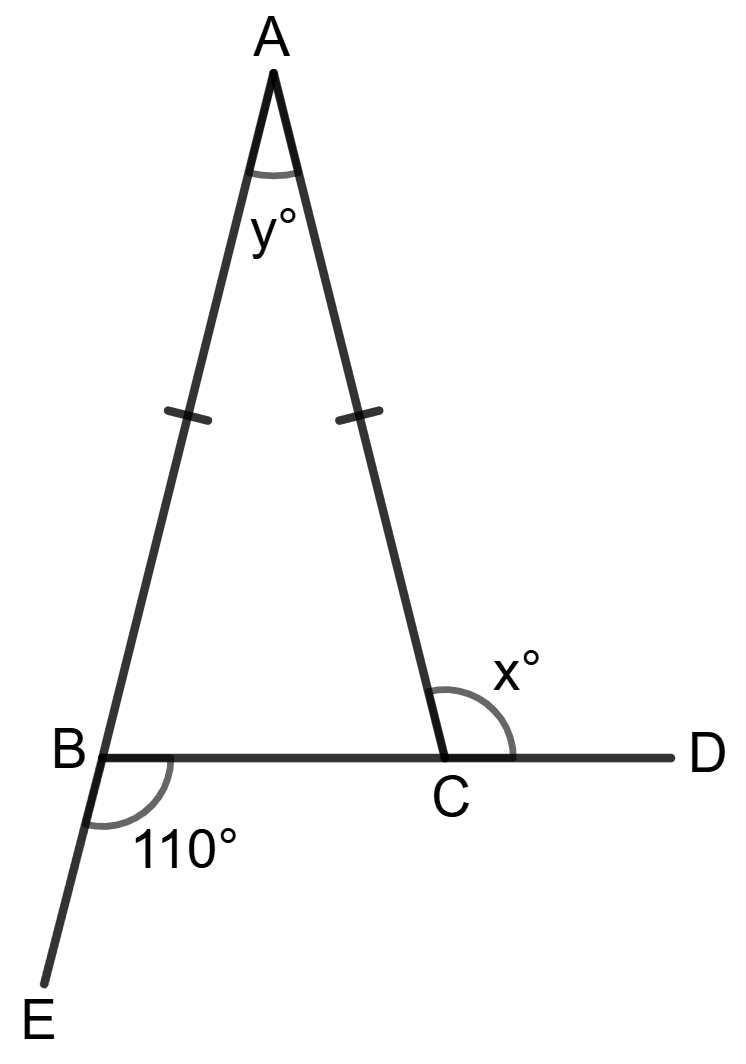
Answer
From figure, we have:
AB = BC
∠CBE = 110°
Since AE is a straight line and BD is a transversal:
∠ABC + ∠CBE = 180° [Linear pair]
∠ABC + 110° = 180°
∠ABC = 180° - 110°
∠ABC = 70°
Since, AB = BC we have:
∠ACB = ∠ABC [∵ angles opposite to equal sides of a triangle are equal]
⇒ ∠ACB = 70°
In △ABC,
∠ABC + ∠CAB + ∠ACB = 180° [Sum of the angles of a triangle]
∴ 70° + y° + 70° = 180°
⇒ 140° + y° = 180°
⇒ y° = 180° - 140°
⇒ y° = 40°
⇒ x° = y° + ∠ABC [Exterior angle = sum of interior opposite angles]
⇒ x° = 40° + 70°
⇒ x° = 110°
x° = 110°, y° = 40°
Find the unknown marked angles in the following figure:
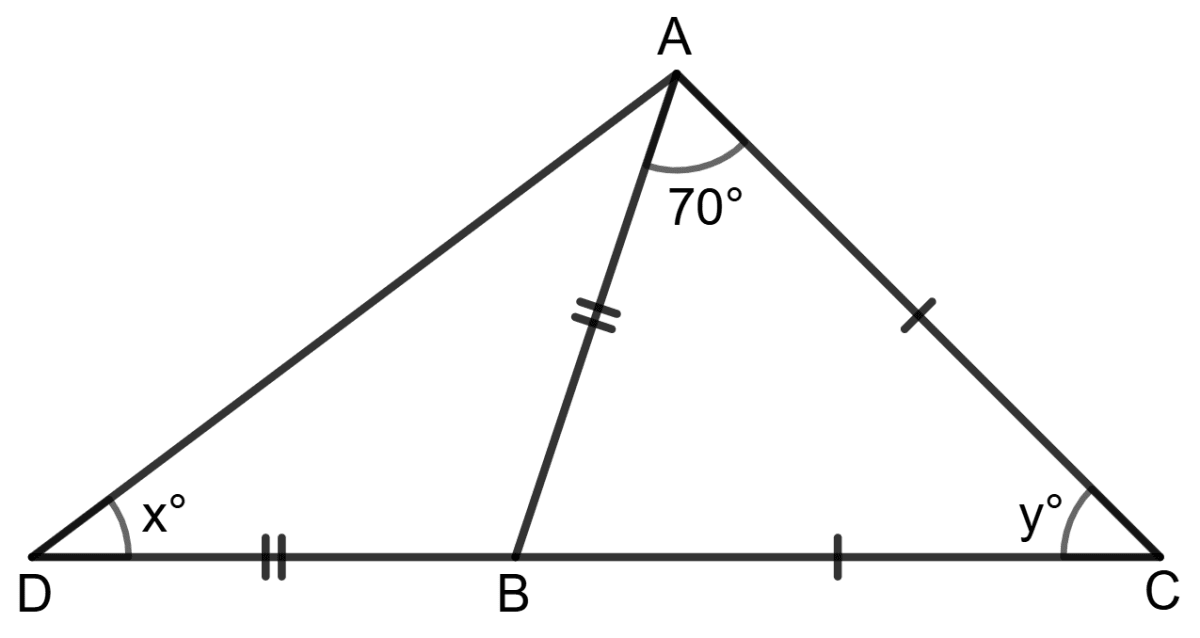
Answer
From figure,
∠CAB = 70°, ∠ACB = y° and ∠BDA = x°
Consider △ABC, we have:
AC = BC
∠ABC = ∠CAB [∵ angles opposite to equal sides of a triangle are equal]
⇒ ∠ABC = 70°
∠ABC + ∠CAB + ∠ACB = 180° [Sum of the angles of a triangle]
∴ 70° + 70° + y° = 180°
⇒ 140° + y° = 180°
⇒ y° = 180° - 140°
⇒ y° = 40°
Consider △ABD, we have:
AB = BD
∠BDA = ∠BAD = x° [∵ angles opposite to equal sides of a triangle are equal]
∠BDA + ∠BAD = ∠ABC [Exterior angle = sum of interior opposite angles]
⇒ x° + x° = 70°
⇒ 2x° = 70°
⇒ x° =
⇒ x° = 35°
x° = 35°, y° = 40°
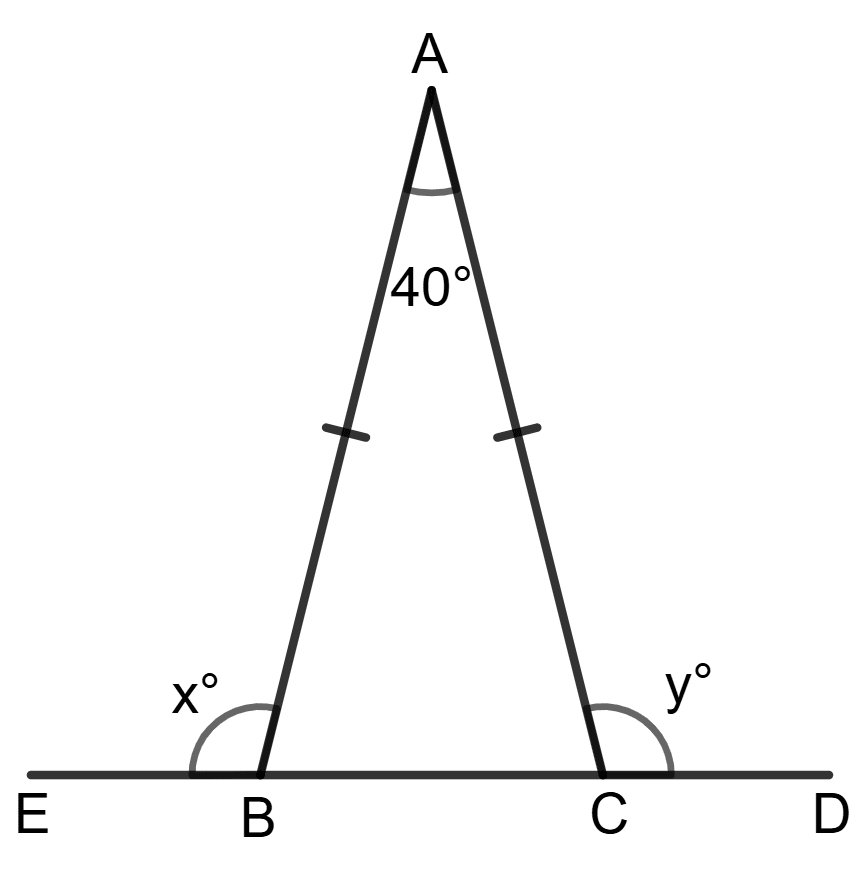
Find the unknown marked angles in the following figure:
Answer
From figure, we have:
∠BAC = 40°, ∠ABE = x° and ∠ACD = y°
Consider △ABC, we have:
AB = AC
∠ABC = ∠ACB [∵ angles opposite to equal sides of a triangle are equal]
∠BAC + ∠ABC + ∠ACB = 180° [Sum of the angles of a triangle]
∴ 40° + ∠ACB + ∠ACB = 180° [∵ ∠ABC = ∠ACB]
40° + 2∠ACB = 180°
2∠ACB = 180° - 40°
2∠ACB = 140°
∠ACB =
∠ACB = 70°
⇒ ∠ABC = 70°
At vertex B,
x° = ∠ACB + ∠BAC [Exterior angle = sum of interior opposite angles]
⇒ x° = 70° + 40°
⇒ x° = 110°
At vertex C:
y° = ∠BAC + ∠ABC [Exterior angle = sum of interior opposite angles]
⇒ y° = 40° + 70°
⇒ y° = 110°
x° = 110°, y° = 110°