
Read the given paragraph and answer the questions that follow.
Preeti was helping her cousin set up a mirror maze for a school fair. While adjusting the plane mirrors, she noticed that her image appeared exactly the same size but reversed sideways. Her science teacher had once told her that the image in a plane mirror is virtual, upright and laterally inverted.
Curious, she shone a torch on a mirror and marked the angles using chalk. She was excited to find that the angle at which the light hit the mirror (angle of incidence) was equal to the angle at which it reflected (angle of reflection), just like the law of reflection said!
- What type of image is formed by a plane mirror?
- Why did the tray show a clear reflection while the wooden board did not?
- What are the three primary colours of light?
Answer
- A plane mirror forms a virtual, upright (erect) and laterally inverted image that is of the same size as the object.
- The tray showed a clear reflection because it has a smooth, polished surface that gives regular reflection. The wooden board has a rough surface that scatters light in different directions (irregular reflection), so it did not form a clear reflection.
- The three primary colours of light are red, green and blue.
Circle the word that does not belong to other words given alongside it.
- Incident ray, Reflected ray, Normal, Electricity
- Red, Blue, Green, Yellow
- White light, Rainbow, Spectrum, Sound
Answer
- Electricity
Reason — Incident ray, reflected ray and normal are all terms related to reflection of light, whereas electricity is not. - Yellow
Reason — Red, blue and green are primary colours of light, whereas yellow is a secondary colour. - Sound
Reason — White light, rainbow and spectrum are all related to light and its colours, whereas sound is a different form of energy.
Match the columns.
| Column A | Column B |
|---|---|
| 1. Plane mirror | (a) Law of reflection |
| 2. Angle of incidence = Angle of reflection | (b) Lateral inversion |
| 3. Red, blue and green | (c) Made up of seven colours (spectrum) |
| 4. White light | (d) Primary colours of light |
Answer
| Column A | Column B |
|---|---|
| 1. Plane mirror | (b) Lateral inversion |
| 2. Angle of incidence = Angle of reflection | (a) Law of reflection |
| 3. Red, blue and green | (d) Primary colours of light |
| 4. White light | (c) Made up of seven colours (spectrum) |
Answer in one or a few word(s).
- A form of energy which gives us the sensation of vision
- The property of light due to which it travels in a straight line
- The angle which the incident ray makes with the normal
- The phenomenon in which the left side of the object appears to be the right side in the image formed by the plane mirror and vice versa
- The phenomenon of splitting of the white light into several different component colours
Answer
- Light energy
- Rectilinear propagation of light
- Angle of incidence
- Lateral inversion
- Dispersion of light
Write the correct word(s) in the given blanks.
- ............... is a region of space in which there are no particles in any form.
- This phenomenon of splitting of white light into several component colours is called ............... of light.
- A/An ............... object allows light of certain colours to pass and blocks other colours by absorbing them.
- ............... mirrors are also used in solar cookers to reflect sunlight towards the box.
- When the rays of light are reflected in such a way that they actually meet at some point on the screen, the image so formed is called ............... image.
Answer
- Vacuum is a region of space in which there are no particles in any form.
- This phenomenon of splitting of white light into several component colours is called dispersion of light.
- A/An transparent object allows light of certain colours to pass and blocks other colours by absorbing them.
- Plane mirrors are also used in solar cookers to reflect sunlight towards the box.
- When the rays of light are reflected in such a way that they actually meet at some point on the screen, the image so formed is called real image.
Write True or False for the following statements.
- Plane mirrors have a curved reflecting surface.
- The material used as the reflecting surface can be transparent, opaque or shiny.
- Regular reflection occurs when light falls on a rough surface like road, door, ordinary floor and table.
- A plane mirror is a planar reflecting surface on which specular reflection is observed.
- The image formed by a plane mirror is bigger in size as the object.
Answer
- False
Corrected Statement — Plane mirrors have a flat reflecting surface. - True
- False
Corrected Statement — Irregular reflection occurs when light falls on a rough surface like road, door, ordinary floor and table. - True
- False
Corrected Statement — The image formed by a plane mirror is of the same size as the object.
Find errors in the given sentences and correct them.
- Colours of light that cannot be obtained or created by mixing other colours are called secondary colours.
- Virtual image can be taken on a screen whereas, real image cannot be taken on a screen.
- Magenta light is obtained on mixing blue and green lights.
- Opaque objects are those which let the light pass through them.
Answer
- Colours of light that cannot be obtained or created by mixing other colours are called primary colours.
- Real image can be taken on a screen whereas, virtual image cannot be taken on a screen.
- Magenta light is obtained on mixing blue and red lights.
- Transparent objects are those which let the light pass through them.
Read the statements given below and provide reasons for them.
- Secondary colours are formed by mixing two primary colours.
- A plane mirror does not form a real image.
- White light splits into different colours when passed through a prism.
- Light reflects better from a smooth surface than a rough one.
- Speed of light is considered constant in air or vacuum.
Answer
- Secondary colours such as yellow, cyan and magenta are formed by mixing two primary colours of light. For example, red and green light mix to form yellow, blue and green form cyan, and red and blue form magenta.
- A plane mirror does not form a real image because the reflected rays of light do not actually meet. They only appear to come from a point behind the mirror, so the image is virtual and cannot be taken on a screen.
- White light is made up of seven colours. When it passes through a prism, each colour bends by a different amount, so the white light splits into its seven component colours (VIBGYOR). This splitting is called dispersion of light.
- A smooth surface reflects light better because all the parallel light rays are reflected parallel to each other (regular reflection), forming a clear image. A rough surface scatters the light rays in different directions (irregular reflection), so no clear image is formed.
- The speed of light is maximum in vacuum, and it does not change much on entering air. So, for convenience, the speed of light in air or vacuum is taken to be constant at 3 × 10⁸ m/s.
What are opaque objects?
Answer
Opaque objects are objects which do not allow light to pass through them. When white light falls on them, they absorb light of a few colours and reflect the others. Examples include a table, a book and an almirah.
Why is the light coming from sun also known as white light?
Answer
The light coming from the Sun is made up of seven colours (VIBGYOR). When these seven colours combine, they appear as white light. This is why sunlight is also known as white light.
Give two uses of plane mirrors in our daily lives.
Answer
Two uses of plane mirrors are:
- Plane mirrors are used in solar cookers to reflect sunlight towards the box.
- Plane mirrors are used at home, in salons and beauty parlours.
What is lateral inversion?
Answer
Lateral inversion is the phenomenon in which the left side of an object appears to be the right side in the image formed by a plane mirror and vice versa.
Mention the characteristics of a virtual image.
Answer
The characteristics of a virtual image are:
- It is always erect.
- It cannot be taken on a screen.
- It is formed behind the mirror.
- Its size may be the same, smaller or bigger than the size of the object.
Write the characteristics of the image formed by a plane mirror.
Answer
The characteristics of the image formed by a plane mirror are:
- The image is laterally inverted, that is, the left side of the object appears as the right side in the image.
- The image is formed behind the mirror. The distance of the image behind the mirror is the same as the distance of the object in front of it. If the object moves closer to the mirror, the image also moves closer.
- The image is of the same size as the object.
- The image is erect (upright).
- The image is virtual, because the rays of light do not actually meet but only appear to come from behind the mirror. Hence, it cannot be taken on a screen.
Differentiate between regular and irregular reflection.
Answer
| Regular Reflection | Irregular Reflection |
|---|---|
| It occurs when a parallel beam of light falls on a smooth, highly polished surface. | It occurs when a parallel beam of light falls on a rough surface. |
| All the reflected rays are parallel to each other. | The reflected rays travel in different directions. |
| A clear, well-defined image is formed. | No definite image is formed. |
| Example: reflection from a plane mirror or still water. | Example: reflection from a road, door or ordinary floor. |
Explain the laws of reflection.
Answer
When a ray of light strikes a reflecting surface, it follows certain laws called the laws of reflection. There are two laws of reflection:
- The angle of incidence is equal to the angle of reflection, i.e. ∠i = ∠r.
- The incident ray, the reflected ray and the normal at the point of incidence all lie in the same plane.
The rays of light are also reversible, which means the laws of reflection still hold even when the incident and reflected rays are reversed.
Why do objects appear coloured? What is the role of subtraction of colours in this?
Answer
Objects appear coloured because they absorb some colours of incident light and reflect others. The colour reflected by an opaque object enters our eyes and determines the colour in which the object appears. For example, a green leaf reflects green light and absorbs most of the other colours present in white light.
Subtraction of colours occurs when some colours are removed from light by absorption. A transparent coloured filter transmits selected colours and absorbs the others. Similarly, an opaque coloured object reflects certain colours and absorbs the rest. Thus, the colours remaining after absorption determine the colour seen by our eyes.
What are primary and secondary colours? How do they mix to form other colours? Explain with examples.
Answer
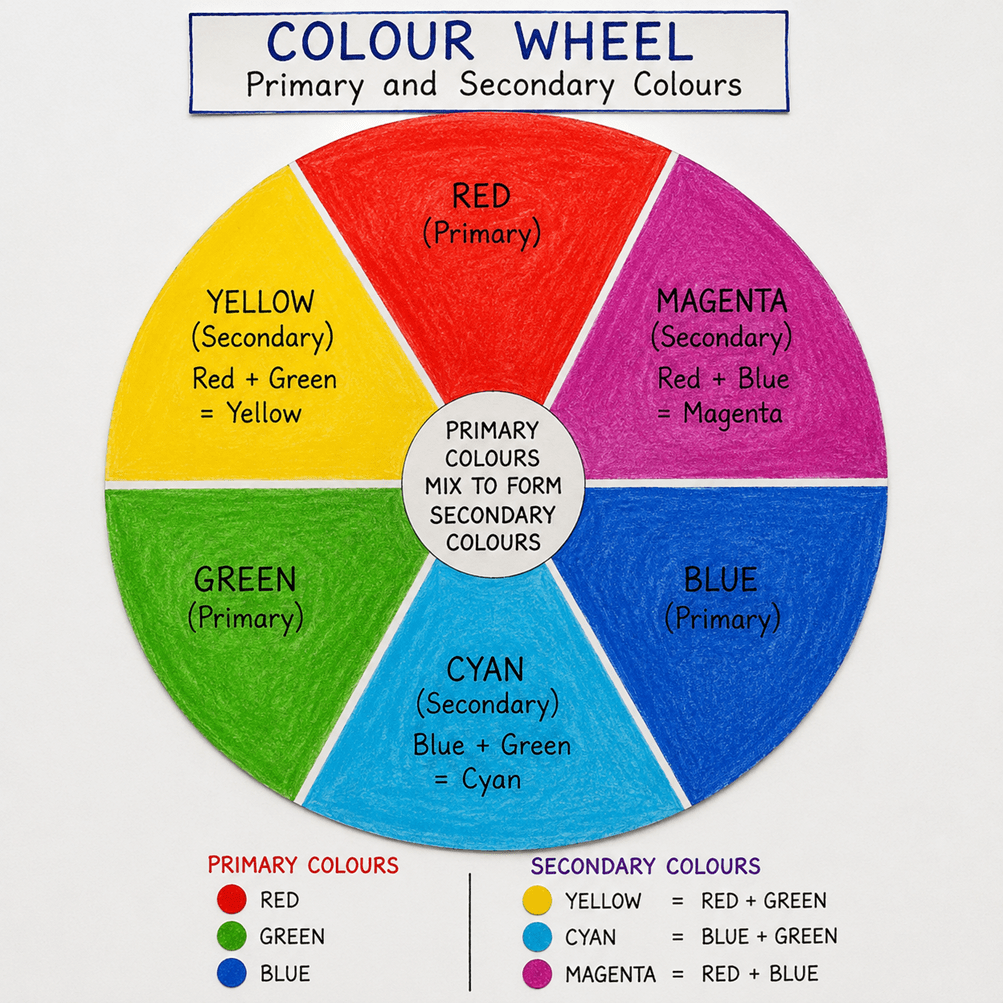
Primary colours are the colours of light that cannot be obtained or created by mixing other colours. The three primary colours are red, green and blue (RGB). When all three primary colours are mixed together, they produce white light.
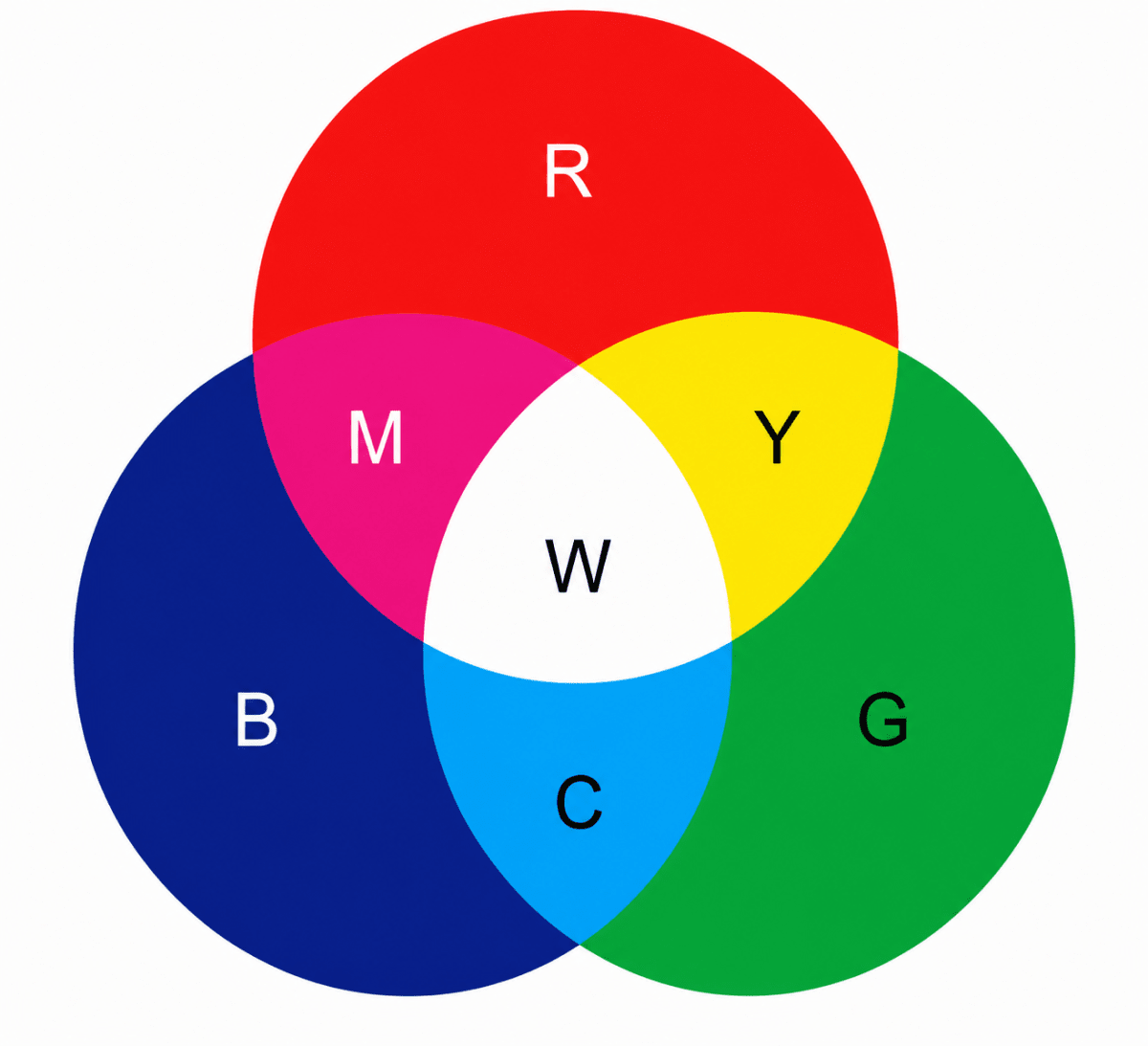
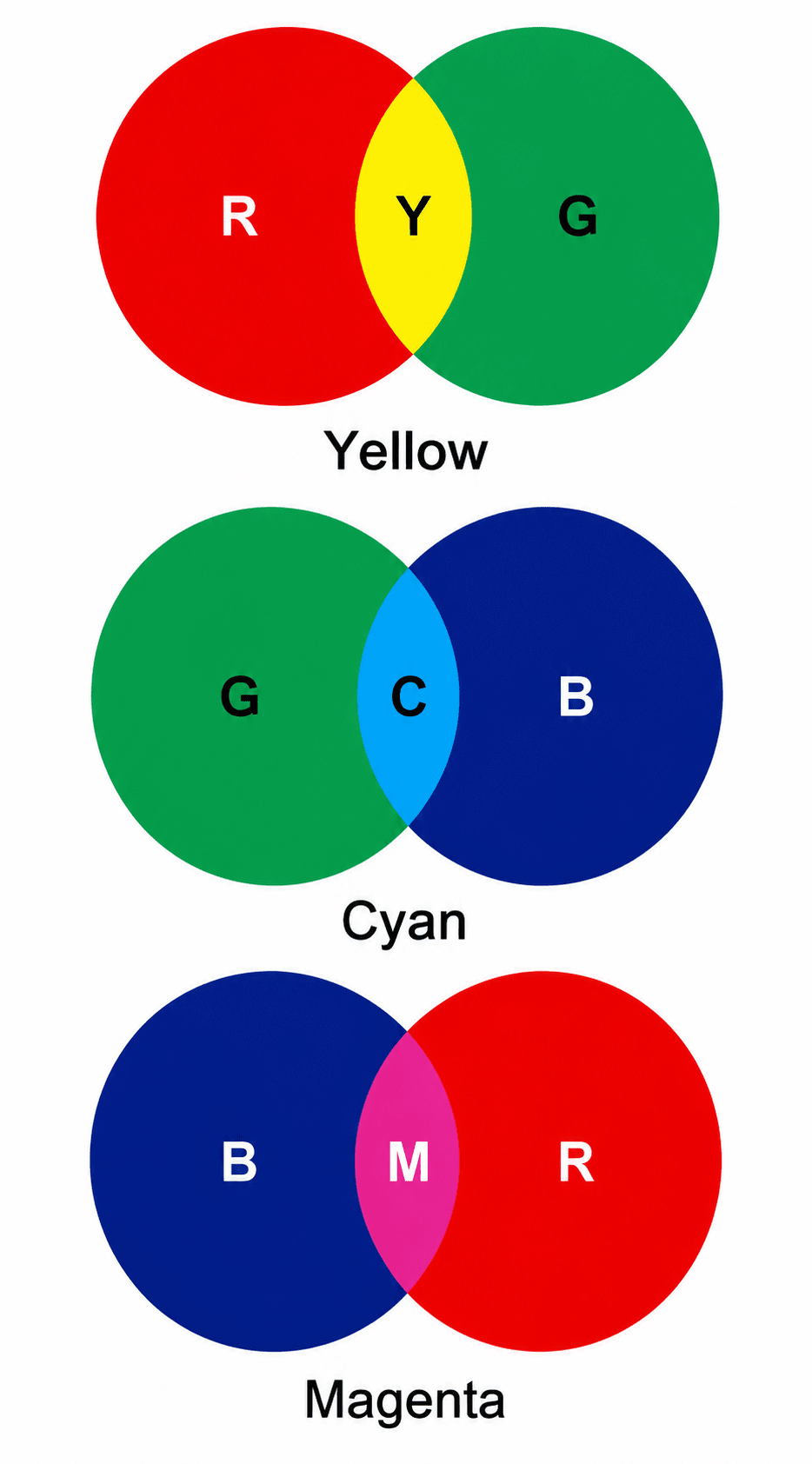
Secondary colours are the colours of light obtained by mixing two primary colours. The three secondary colours are yellow, cyan and magenta.
They mix to form other colours as follows:
- Red + Green = Yellow
- Blue + Green = Cyan
- Red + Blue = Magenta
- Red + Green + Blue = White
Read the given case study and answer the questions that follow.
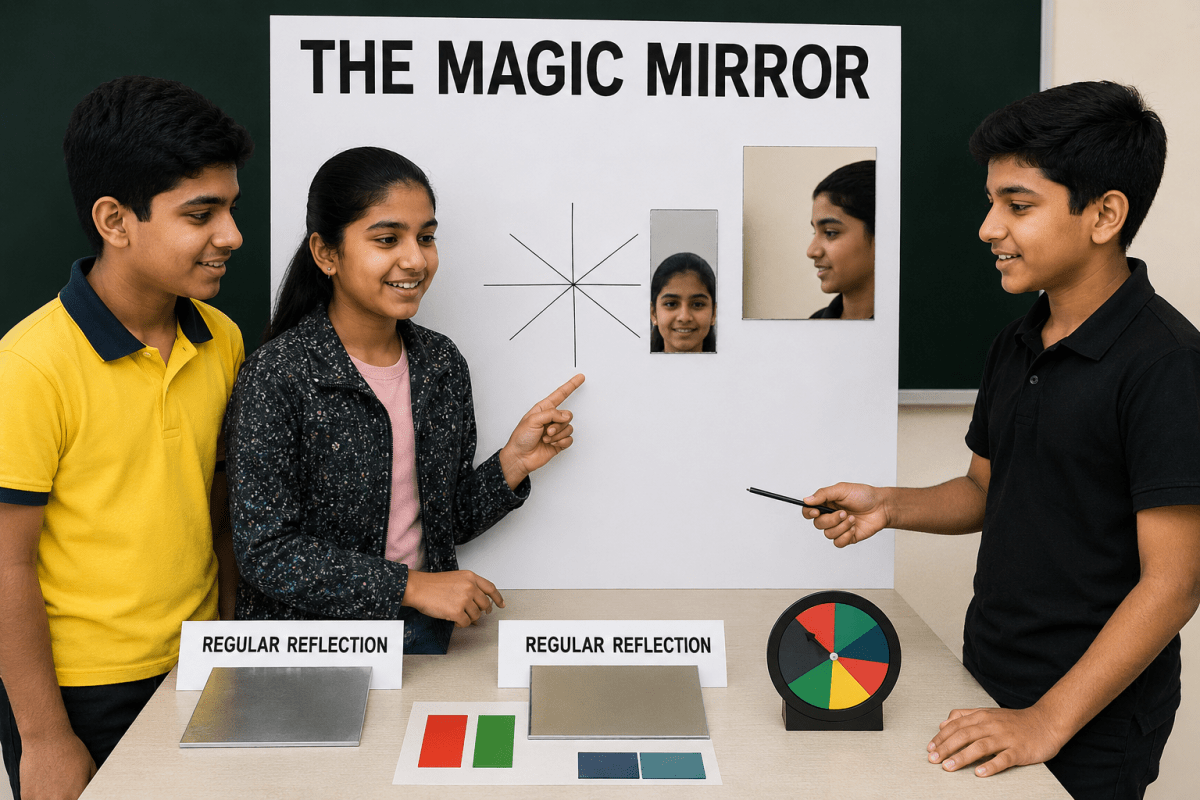
Sara and her friends were preparing for their science exhibition. Their project was called 'The Magic Mirror'. They used a plane mirror to show how light reflects and forms images. Sara explained, "The image formed in a plane mirror is virtual, upright, and laterally inverted."
To show the laws of reflection, they drew a normal, an incident ray and a reflected ray on a chart. "See," said her friend Rohit, "the angle of incidence is always equal to the angle of reflection!"
They also displayed the difference between regular and irregular reflection using a smooth metal sheet and sandpaper. Smooth surfaces gave a clear reflection, while rough ones scattered the light.
Another part of their model included a rotating colour disc. As it spun, the disc appeared white, showing the composition of white light made from primary colours — red, green and blue. They even showed how combining secondary colours like yellow, cyan and magenta works.
Finally, they placed red, blue, and green papers under different coloured lights and observed how their appearance changed, discussing the subtraction of colours.
- What kind of image is formed by a plane mirror?
- Which law did the students prove using the incident and reflected rays?
- What is the main difference between regular and irregular reflection?
- How did the rotating disc help show that white light is made of different colours?
- Why do coloured papers appear different under different lights?
Answer
- A plane mirror forms a virtual, upright (erect) and laterally inverted image of the same size as the object.
- The students proved the law of reflection, which states that the angle of incidence is equal to the angle of reflection.
- In regular reflection, light falls on a smooth surface and the reflected rays are parallel, forming a clear image. In irregular reflection, light falls on a rough surface and the rays scatter in different directions, so no clear image is formed.
- The rotating disc was coloured with the primary colours red, green and blue. When it spun fast, these colours mixed and the disc appeared white. This showed that white light is made by combining the primary colours.
- Coloured papers appear different under different lights because an object reflects only the colour of light that matches it and absorbs the rest. If the light needed for the paper to reflect is not present, the paper looks dark or changes its appearance. This is due to the subtraction of colours.
Read the given information carefully and answer the questions that follow.
Light rays change direction when they reflect off a surface, move from one transparent medium into another or travel through a medium whose composition is continuously changing. The law of reflection states that, on reflection from a smooth surface, the angle of the reflected ray is equal to the angle of the incident ray. (By convention, all angles in geometrical optics are measured with respect to the normal to the surface—that is, to a line perpendicular to the surface.) The reflected ray is always in the plane defined by the incident ray and the normal to the surface. The law of reflection can be used to understand the images produced by plane and curved mirrors. Unlike mirrors, most natural surfaces are rough on the scale of the wavelength of light, and, as a consequence, parallel incident light rays are reflected in many different directions, or diffusely. Diffuse reflection is responsible for the ability to see most illuminated surfaces from any position—rays reach the eyes after reflecting off every portion of the surface.
When light traveling in one transparent medium encounters a boundary with a second transparent medium (e.g., air and glass), a portion of the light is reflected and a portion is transmitted into the second medium. As the transmitted light moves into the second medium, it changes its direction of travel; that is, it is refracted. The law of refraction, also known as Snell's law, describes the relationship between the angle of incidence (θ1) and the angle of refraction (θ2), measured with respect to the normal ("perpendicular line") to the surface, in mathematical terms: n1 sin θ1 = n2 sin θ2, where n1 and n2 are the index of refraction of the first and second media, respectively. The index of refraction for any medium is a dimensionless constant equal to the ratio of the speed of light in a vacuum to its speed in that medium.
Source: https://www.britannica.com/science/light/Reflection-and-refraction
- When do light rays change their direction?
- What does law of reflection state?
- Give two examples of regular reflection.
Answer
- Light rays change their direction when they reflect off a surface, when they move from one transparent medium into another, or when they travel through a medium whose composition keeps changing.
- The law of reflection states that, on reflection from a smooth surface, the angle of the reflected ray is equal to the angle of the incident ray. Both angles are measured with respect to the normal to the surface.
- Two examples of regular reflection are reflection from a plane mirror and reflection from still water (or a highly polished floor).
A mirror forms a clear image, but a wooden surface does not. Analyse why one surface reflects light regularly while the other does not.
Answer
A mirror has a smooth and highly polished surface. When a parallel beam of light falls on it, all the rays are reflected parallel to each other. This is regular reflection, which forms a clear, well-defined image.
A wooden surface is rough. When a parallel beam of light falls on it, different parts of the surface reflect the rays in different directions. This is irregular reflection, which scatters the light, so no clear image is formed. This is why a mirror forms a clear image but a wooden surface does not.
A white object appears red under red light and blue under blue light, but a red object only appears red under white light. Analyse how different surfaces reflect light differently.
Answer
A white object reflects all the colours of light that fall on it. So, under red light it reflects red and appears red, and under blue light it reflects blue and appears blue.
A red object reflects only red light and absorbs all other colours. So, in white light (which contains red) it appears red. But if there is no red light to reflect, it would appear dark.
This shows that the colour of an object depends on which colours of light it reflects and which it absorbs.
Suppose you want to place mirrors in a shop to help customers see clothes from the back. Which mirror would you choose and why? Solve by comparing different types of reflection.
Answer
I would choose a plane mirror for the shop. A plane mirror has a smooth, polished surface that gives regular reflection, in which all the rays are reflected parallel to each other. This forms a clear, well-defined image of the same size as the object, so customers can clearly see the back view of the clothes.
A rough surface would give irregular reflection, scattering the light and forming no clear image, so it would not be useful here. Hence, the smooth plane mirror is the best choice.
Assume you have three coloured torches: red, green, and blue. You shine red and green light together on a wall. What colour will appear?
Answer
When red and green light are shone together on the wall, they mix to form yellow light. Therefore, the wall will appear yellow.
Design a simple activity using a mirror, torch and protractor to demonstrate the laws of reflection at home. Include steps and materials needed. Then discuss it in the class.
Answer
Aim: To demonstrate the laws of reflection using a mirror, a torch and a protractor.
Materials required: A plane mirror, a torch, a protractor, a sheet of white paper, a pencil and a scale.
Procedure:
- Fix the sheet of white paper on a flat table and draw a straight line on it. Place the plane mirror upright along this line.
- At a point on the line, draw a normal (a perpendicular line) using the protractor.
- Shine the torch on this point so that the light ray falls along a chosen angle to the normal. Mark this incident ray and measure the angle of incidence with the protractor.
- Observe the reflected ray and mark its path. Measure the angle of reflection with the protractor.
- Compare the two angles.
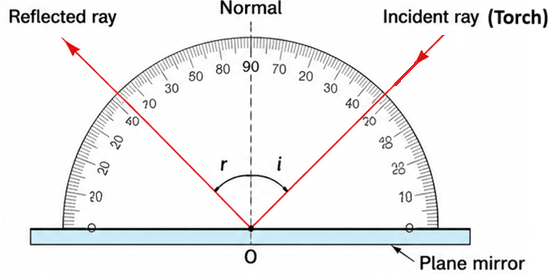
Observation: The angle of incidence is found to be equal to the angle of reflection, and the incident ray, the reflected ray and the normal all lie in the same plane.
Conclusion: This activity verifies the laws of reflection.
Create a colour wheel showing primary and secondary colours. Use crayons or paper cut outs to show how new colours are formed. Display your colour wheel in the class.
Answer
Aim: To make a colour wheel showing how primary colours mix to form secondary colours.
Materials required: A circular sheet of paper (or cardboard), crayons or coloured paper cut-outs, a pencil and a scale.
Procedure:
- Draw a large circle on the sheet and divide it into six equal sections.
- Colour three alternate sections with the primary colours — red, green and blue.
- In each section between two primary colours, fill in the secondary colour formed by mixing them:
- Between red and green, fill yellow (Red + Green = Yellow).
- Between blue and green, fill cyan (Blue + Green = Cyan).
- Between red and blue, fill magenta (Red + Blue = Magenta).
- Label all the colours neatly and display the wheel in the class.
This colour wheel shows how the three primary colours of light combine in pairs to form the three secondary colours.
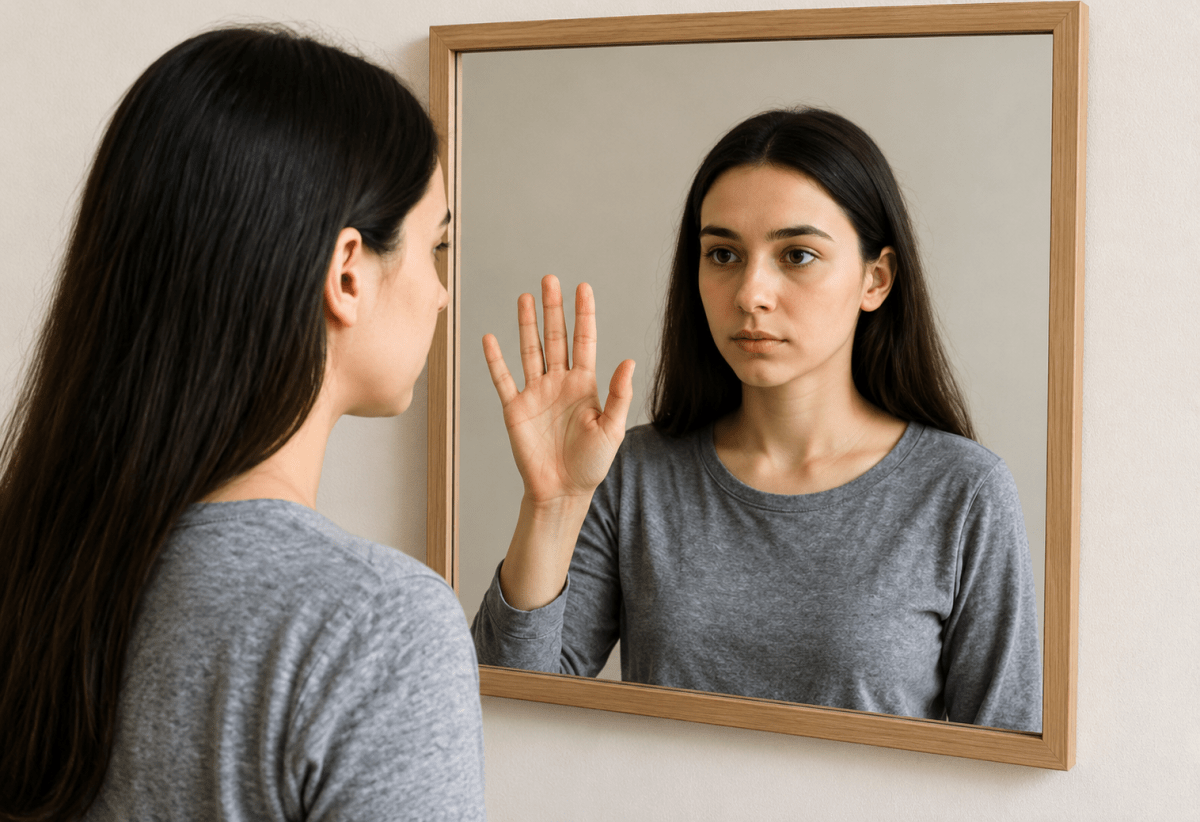
Priya stood in front of her dressing mirror and waved at herself. She noticed that her left hand looked like the right in the mirror. She thought, "Why does the mirror reverse sides but not flip me upside down?" She remembered her teacher saying that in plane mirrors, the image formed is laterally inverted, the same size, and appears behind the mirror.
She also observed how her mother used mirrors in corners of the living room to make it appear bigger. Her father explained, "Shops use plane mirrors to see around corners. Doctors also use small mirrors to look inside the mouth or ear." Priya realised mirrors are more useful than just for seeing ourselves.
- Why does the mirror reverse left and right but not top and bottom?
- What kind of image is formed by a plane mirror?
- Why do shops place mirrors at corners?
- What are some uses of plane mirrors in the medical field?
- What qualities make plane mirrors useful in daily life?
Answer
- A plane mirror shows lateral inversion, in which the left and right sides of the object appear interchanged in the image, while the top and bottom remain in their corresponding positions. Therefore, the image does not appear upside down.
- A plane mirror forms a virtual, upright (erect) and laterally inverted image of the same size as the object.
- Shops place plane mirrors at corners so that people can see around corners. Mirrors reflect light from areas that are not in the direct line of sight, helping to view hidden parts of the shop.
- Doctors and dentists use small mirrors to reflect light and view parts such as the inside of the mouth that are difficult to see directly.
- Plane mirrors are useful in daily life because they form a clear image of the same size as the object, can be used to see around corners and in hidden areas, give a feeling of more space in small rooms, and are used in many instruments and everyday places like homes and salons.
Toni wore a red shirt to school. When he walked into a dark room, the shirt didn't appear red anymore. Curious, he asked his teacher, who explained, "In white light, an object appears red because it reflects red and absorbs all other colours. In a dark room, there's no light to reflect."
This made Toni more curious. "What happens if I wear my red shirt under blue light?" The teacher said, "It will look dark or black because there's no red light to reflect." Toni noted that opaque objects appear coloured due to the colour they reflect. He also read that white light is made of seven colours and mixing primary colours in different ways gives secondary colours.

- Why did Toni's red shirt not appear red in a dark room?
- What causes an object to appear a certain colour?
- What are primary colours of light?
- What colour will a red shirt appear under blue light?
- What is white light made of?
Answer
- Toni's red shirt did not appear red in a dark room because there was no light to fall on it and be reflected. An object can only show its colour when light falls on it and is reflected to our eyes.
- An object appears a certain colour because of the colours of light it reflects and absorbs. The colour we see is the colour of light that the object reflects, while it absorbs the other colours.
- The primary colours of light are red, green and blue.
- A red shirt will appear dark or black under blue light, because it can only reflect red light. As there is no red light to reflect under blue light, it appears dark.
- White light is made of seven colours, known as VIBGYOR — Violet, Indigo, Blue, Green, Yellow, Orange and Red.
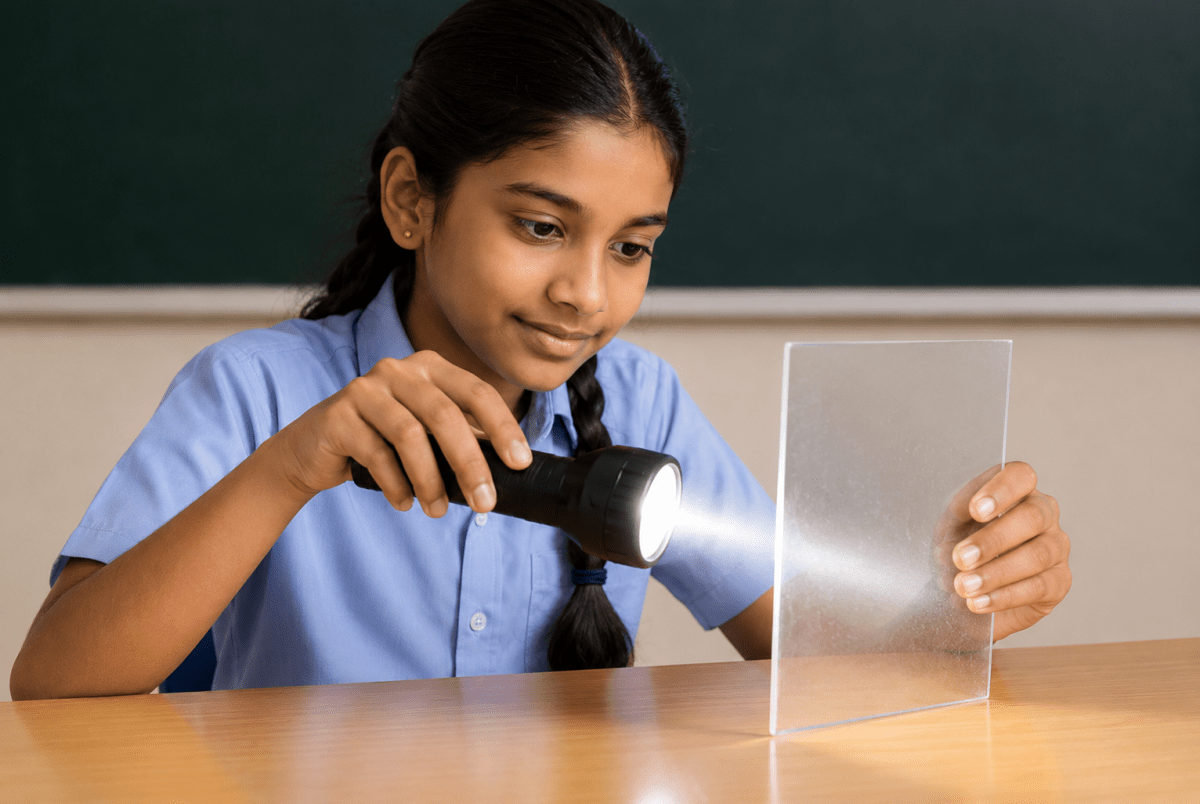
Mansi decided to test the laws of reflection at home. She took a plane mirror, a torch, and a protractor. She shone the torch at the mirror and marked the angle of incidence and angle of reflection on a paper. She noticed both angles were equal! "This proves the first law of reflection," she said.
She then tested a rough steel plate and noticed the light scattered in different directions. "This is irregular reflection," she said. "On a smooth surface like a mirror, we get regular reflection." She realised why mirrors give clear images and walls do not.
- What two angles did Mansi observe during her experiment?
- What is the first law of reflection?
- How did Mansi identify regular and irregular reflection?
- What surface gives a clear image and why?
- Why does light scatter from a rough surface?
Answer
- Mansi observed two angles — the angle of incidence and the angle of reflection.
- The first law of reflection states that the angle of incidence is equal to the angle of reflection (∠i = ∠r).
- On the smooth mirror, the light was reflected to form a clear beam, which is regular reflection. On the rough steel plate, the light scattered in different directions, which is irregular reflection.
- A smooth surface such as a mirror gives a clear image because it reflects all the parallel rays of light parallel to each other (regular reflection), forming a well-defined image.
- Light scatters from a rough surface because different parts of the rough surface face different directions. So the parallel rays falling on it are reflected in many different directions, causing irregular reflection.
Sam read that light travels at an incredible speed—about 3,00,000 km/s! He thought about the rainbow he saw last week. His teacher told him rainbows form because white light splits into seven colours when it passes through raindrops.
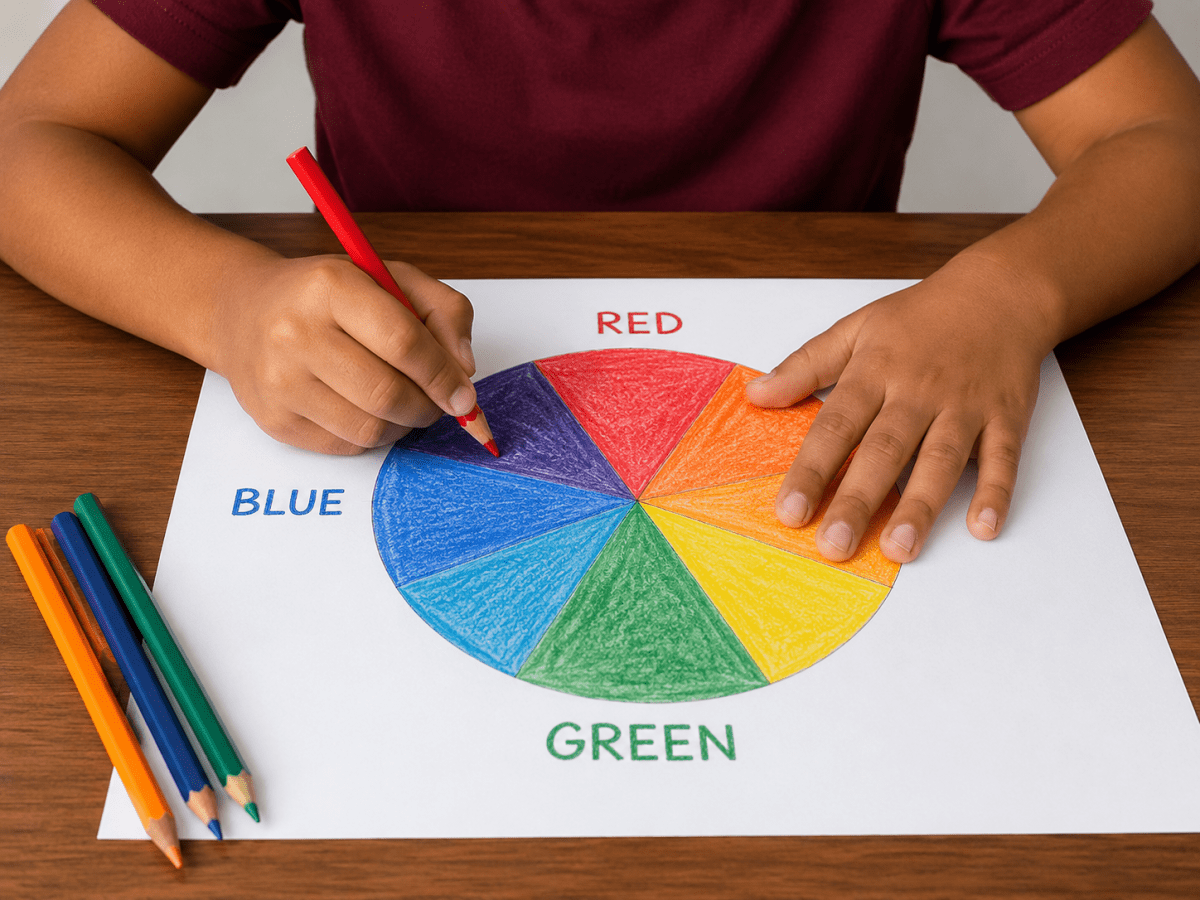
Sam drew a colour wheel to show how red, blue, and green make cyan, magenta and yellow. He even tried to mix light from coloured torches on a white wall and noticed how colours changed when he covered one of them. He realised how subtraction of colours works when certain colours are blocked.
- What is the speed of light?
- How is a rainbow formed?
- What happens when white light passes through a prism or raindrop?
- How can we create secondary colours using primary colours?
- What is colour subtraction and where do we see it?
Answer
- The speed of light in vacuum or air is about 3 × 10⁸ m/s (about 3,00,000 km/s).
- A rainbow is formed after a rainfall, when many tiny water droplets are suspended in the air. These droplets behave like small prisms. When sunlight passes through them, the white light splits into seven colours, forming a band of colours called a rainbow in the sky.
- When white light passes through a prism or a raindrop, it splits into its seven component colours (VIBGYOR). This phenomenon is called dispersion of light.
- We can create secondary colours by mixing two primary colours of light: Red + Green = Yellow, Blue + Green = Cyan, and Red + Blue = Magenta.
- Colour subtraction is the removal of some colours from light by absorption. A transparent coloured filter transmits selected colours and absorbs the others. For example, a red cellophane sheet transmits red light and absorbs most of the other colours. In an opaque coloured object, selected colours are reflected while the remaining colours are absorbed.
Fill in the blanks.
- The property of light due to which it bounces back after striking a shiny surface is called ............... .
- The angle of incidence is equal to the angle of ............... .
- The image formed by a plane mirror is ............... and of the same size as the object.
- The speed of light is maximum in ............... .
- ............... mirrors have a curved reflecting surface.
Answer
- The property of light due to which it bounces back after striking a shiny surface is called reflection.
- The angle of incidence is equal to the angle of reflection.
- The image formed by a plane mirror is virtual and of the same size as the object.
- The speed of light is maximum in vacuum.
- Spherical mirrors have a curved reflecting surface.
Write True or False.
- The image formed by a plane mirror is real and inverted.
- The speed of light in vacuum is 3 × 10⁸ m/s.
- The image of the right hand in a plane mirror looks like that of the left hand.
- The angle of incidence is always less than the angle of reflection.
- A red rose appears black in green light.
Answer
- False
Corrected Statement — The image formed by a plane mirror is virtual and erect. - True
- True
- False
Corrected Statement — The angle of incidence is always equal to the angle of reflection. - True
Match the columns.
| Column A | Column B |
|---|---|
| 1. Incident ray | (a) Gives regular reflection |
| 2. Reflected ray | (b) Perpendicular at the point of incidence |
| 3. Normal | (c) Bounces back from the surface |
| 4. Virtual image | (d) Cannot be formed on a screen |
| 5. Plane mirror | (e) Ray of light that strikes a surface |
Answer
| Column A | Column B |
|---|---|
| 1. Incident ray | (e) Ray of light that strikes a surface |
| 2. Reflected ray | (c) Bounces back from the surface |
| 3. Normal | (b) Perpendicular at the point of incidence |
| 4. Virtual image | (d) Cannot be formed on a screen |
| 5. Plane mirror | (a) Gives regular reflection |
State the two laws of reflection of light.
Answer
The two laws of reflection of light are:
- The angle of incidence is equal to the angle of reflection (∠i = ∠r).
- The incident ray, the reflected ray and the normal at the point of incidence all lie in the same plane.
What do you mean by a virtual image?
Answer
A virtual image is an image formed when the rays of light reflected from a surface appear to meet at a certain point but do not actually meet. It is always erect and cannot be taken on a screen.
Name the primary and secondary colours of light.
Answer
The primary colours of light are red, green and blue.
The secondary colours of light are yellow, cyan and magenta.
What do you observe when a ray of light falls normally on a plane mirror?
Answer
When a ray of light falls normally (perpendicularly) on a plane mirror, it strikes along the normal. In this case, the angle of incidence and the angle of reflection are both 0°, and the reflected ray retraces its path back in the same direction (∠i = ∠r = 0°).
Define regular reflection.
Answer
Regular reflection is the reflection in which a parallel beam of light falls on a smooth, highly polished surface such that all the rays of the beam are reflected parallel to each other.
Explain the concept of dispersion of light. How is a rainbow formed? List the seven colours of the spectrum.
Answer
Dispersion of light is the phenomenon of splitting of white light into its several component colours. White light is made up of seven colours, and when it passes through a prism, each colour bends by a different amount, so the white light splits into a band of seven colours.
A rainbow is formed after a rainfall, when a large number of tiny water droplets remain suspended in the air. These droplets behave like small prisms. When sunlight passes through them, the white light splits into seven colours, forming a band of colours called a rainbow in the sky.
The seven colours of the spectrum (VIBGYOR) are:
- Violet
- Indigo
- Blue
- Green
- Yellow
- Orange
- Red
Explain the phenomenon due to which a red rose appears black in green light.
Answer
In white light, a red rose appears red because it reflects only the red colour and absorbs all the other colours.
When the red rose is seen in green light, there is no red light present for it to reflect. The rose absorbs the green light and has no colour to reflect back. As it reflects nothing, the rose appears dark or black. This happens due to the absorption and reflection of colours by the object.
Compare real and virtual images with two examples each.
Answer
| Real Image | Virtual Image |
|---|---|
| It is formed when the reflected rays of light actually meet at a point. | It is formed when the reflected rays of light only appear to meet but do not actually meet. |
| It is always inverted. | It is always erect. |
| It can be taken on a screen. | It cannot be taken on a screen. |
| It is formed in front of the mirror. | It is formed behind the mirror. |
Examples of real images: an image formed on a cinema screen and an image formed by a pinhole camera.
Examples of virtual images: an image formed by a plane mirror and an image seen in the smooth surface of still water.
Explain lateral inversion with an example.
Answer
Lateral inversion is the phenomenon in which the left side of an object appears to be the right side in the image formed by a plane mirror and vice versa.
For example, when you stand in front of a mirror holding a book in your left hand, the image appears to hold the book in its right hand. Similarly, the letter B appears reversed in a mirror. However, letters like A, H, I, M, O, T, U, V, W, X and Y do not show lateral inversion because they are symmetric about a vertical line.
Discuss the role of reflection of light in our daily life.
Answer
Reflection of light plays an important role in our daily life:
- We are able to see objects around us because the light reflected by them enters our eyes.
- Plane mirrors, which work on reflection, are used at home, in salons and beauty parlours to see ourselves.
- Plane mirrors are used in solar cookers to reflect sunlight towards the box, and by soldiers for signalling.
- Reflection is used in instruments like microscopes, telescopes, periscopes and kaleidoscopes.
- Architects and interior designers use mirrors to give a feeling of more space in smaller houses.