
Read the given paragraph and answer the questions that follow.
One sunny afternoon, Shruti was helping her mother in the kitchen. She touched the end of a metal spoon placed in hot water and felt heat travel to her fingers. Her mother explained, "This is called conduction, where heat moves through solids." Shruti then learnt that temperature tells us how hot or cold something is. After making tea, Shruti poured it into a thermos flask. Her mother explained, "The thermos has a double wall with a vacuum in between, which keeps the heat inside." While walking in the park, Shruti noticed the wind moving the trees. Her mother said, "That's convection."
- What is conduction?
- Why does a thermos flask keep liquids warm?
- How is convection different from conduction?
Answer
- Conduction is the process of transfer of heat from a body at a higher temperature to a body at a lower temperature when both are in direct contact with each other.
- A thermos flask keeps liquids warm because the vacuum between its double walls minimises heat transfer by conduction and convection. Its silvered walls reduce heat loss by radiation, and its insulating stopper reduces heat loss through the mouth. Thus, the liquid remains warm for a long time.
- In conduction, heat is transferred through a substance without the actual movement of its molecules, as the molecules only vibrate about their fixed positions, and it mainly takes place in solids. In convection, heat is transferred by the actual movement of molecules, and it takes place in liquids and gases.
Circle the word that does not belong to other words given alongside it.
- Kettle, Heat, Temperature, Cold
- Radiation, Conduction, Convection, Solid
- Heating, Thermal expansion, Freezing, Melting
- Metal, Wood, Water, Vacuum
Answer
- Kettle
Reason — Heat, temperature and cold are all related to the thermal state of a body, whereas a kettle is an object used to heat water. - Solid
Reason — Radiation, conduction and convection are the three modes of heat transfer, whereas a solid is a state of matter. - Freezing Reason — Heating, thermal expansion and melting involve the supply or absorption of heat, whereas freezing takes place when heat is removed from a substance.
- Metal
Reason — Metal is a good conductor of heat. Wood and water are poor conductors, while conduction and convection cannot occur through a vacuum because it has no particles.
Match the columns.
| Column A | Column B |
|---|---|
| 1. Thermal expansion | (a) Heat transfer through solids |
| 2. Conduction | (b) A process where a substance expands when heated |
| 3. Thermos flask | (c) A container that keeps liquids hot or cold |
| 4. Convection | (d) Heat transfer through liquids and gases |
Answer
| Column A | Column B |
|---|---|
| 1. Thermal expansion | (b) A process where a substance expands when heated |
| 2. Conduction | (a) Heat transfer through solids |
| 3. Thermos flask | (c) A container that keeps liquids hot or cold |
| 4. Convection | (d) Heat transfer through liquids and gases |
Answer in one or a few word(s).
- The energy transferred between two bodies in contact due to the difference in their temperature
- The process during which a liquid changes into its vapour state at a constant temperature by absorbing heat
- The process in which a substance directly changes from its gaseous state into solid state at a fixed temperature
- The process of transfer of heat by the actual movement of molecules
Answer
- Heat
- Boiling
- Deposition
- Convection
Write the correct word(s) in the given blanks.
- The process during which a substance directly changes from its gaseous state into solid state at a fixed temperature is called ............... .
- When the temperature of a substance is increased, it results in ............... of the substance.
- Water and steam pipes often have a U-bend in them to allow ............... expansion.
- In ..............., no medium is required to transfer heat.
Answer
- The process during which a substance directly changes from its gaseous state into solid state at a fixed temperature is called deposition.
- When the temperature of a substance is increased, it results in expansion of the substance.
- Water and steam pipes often have a U-bend in them to allow thermal expansion.
- In radiation, no medium is required to transfer heat.
Write True or False for the following statements.
- This process of transfer of heat from a body at a higher temperature to a body at a lower temperature when both are in direct contact with each other is called convection.
- Substances which allow heat to flow through them easily are called bad conductors.
- A thermos flask is a device that prevents transmission of heat.
- When the temperature of a substance is decreased, it results in its expansion.
Answer
- False
Corrected Statement — This process of transfer of heat from a body at a higher temperature to a body at a lower temperature when both are in direct contact with each other is called conduction. - False
Corrected Statement — Substances which allow heat to flow through them easily are called good conductors. - True
- False
Corrected Statement — When the temperature of a substance is decreased, it results in its contraction.
Find errors in the given sentences and correct them.
- The process during which a substance changes from its gaseous state to liquid state at a particular temperature is known as sublimation.
- Vaporisation is a process in which a liquid changes into its solid state by liberating heat at a constant temperature.
- When heat is supplied to matter, the energy of its molecules decreases and they start vibrating vigorously. Due to this, the state of matter remains constant.
- The freezing point of water is taken as 373 K and the boiling point of water is marked as 273 K.
Answer
- The process during which a substance changes from its gaseous state to liquid state at a particular temperature is known as condensation.
- Vaporisation is a process in which a liquid changes into its vapour state by absorbing heat at a constant temperature.
- When heat is supplied to matter, the energy of its molecules increases and they start vibrating vigorously. Due to this, the state of matter may change.
- The freezing point of water is taken as 273 K and the boiling point of water is marked as 373 K.
Give reason — A thermos flask keeps tea hot for a long time.
Answer
A thermos flask keeps tea hot for a long time because it minimises heat loss through all three modes of heat transfer. The vacuum between its double walls reduces conduction and convection, the silvered walls reduce heat loss by radiation, and the insulating lid reduces heat transfer through the mouth. Hence, very little heat escapes and the tea stays hot.
Give reason — The temperature of boiling water remains constant even when heating continues.
Answer
When water boils, the heat supplied is used to change its state from liquid to vapour and not to raise its temperature. Therefore, the temperature of boiling water remains constant at its boiling point even when heating continues.
Give reason — The hot air rises above a heater in a room.
Answer
The air near the heater gets heated, expands and becomes less dense (lighter). Being lighter, this hot air rises up, while the cooler and denser air comes down to take its place. This sets up convection currents, due to which the hot air rises above the heater.
Give reason — Metal benches in parks have small gaps between them.
Answer
Metals expand on heating and contract on cooling. Small gaps are left between metal benches to provide space for the metal to expand in hot weather. If no gaps are left, the expansion may bend or damage the benches.
What does a thermometer consist of?
Answer
A thermometer consists of a graduated glass stem with a thin, long and uniform capillary bore. At one end, it has a bulb containing a thermometric liquid such as mercury or alcohol.
Define deposition.
Answer
Deposition is a process during which a substance directly changes from its gaseous state into its solid state at a fixed temperature. For example, naphthalene vapour changes directly into solid naphthalene on cooling.
Why do Eskimos make igloos from snow?
Answer
Eskimos make igloos from snow because snow contains a large amount of trapped air. Air is a bad conductor of heat, so it does not allow the body heat to escape. This keeps the inside of the igloo warm.
Give some examples of convection currents in nature.
Answer
Sea breeze, land breeze and monsoon are examples of convection currents in nature.
Write two applications of heat radiations.
Answer
- The base of a cooking vessel may be painted black so that it absorbs more heat radiation and helps the food cook faster.
- The inner surface of a solar cooker is painted black so that it absorbs the maximum amount of heat radiation from the Sun.
List the qualities of a good thermometer.
Answer
The qualities of a good thermometer are as follows.
- The stem of the thermometer should be made of thick glass to protect the capillary tube against any physical damage.
- The bulb of the thermometer should be thin-walled so that the liquid inside it quickly attains the temperature of the body.
- The bore of the capillary should be narrow so that the liquid moves through a large length even if the increase in volume of the liquid is small.
- The thermometric liquid used should expand uniformly, be opaque and clearly visible, be practically non-volatile, not stick to the walls of the capillary tube, and have a low freezing point and a high boiling point so that it can be used over a wide range of temperature.
Discuss the three temperature scales to measure temperature.
Answer
The three temperature scales used to measure temperature are as follows.
- Celsius scale — In this scale, the upper fixed point is 100°C, which is the boiling point of water, and the lower fixed point is 0°C, which is the freezing point of water. The interval between the two fixed points is divided into 100 equal parts.
- Fahrenheit scale — In this scale, the upper fixed point is 212°F, which is the boiling point of water, and the lower fixed point is 32°F, which is the freezing point of water. The interval between the two fixed points is divided into 180 equal parts.
- Kelvin scale — This is the SI scale of temperature. Its zero (0 K) is set at absolute zero, the lowest possible temperature in the universe. On this scale, the freezing point of water is 273 K and the boiling point of water is 373 K.
'As heat is a form of energy, heating an object can lead to many changes.' Explain this statement.
Answer
Heat is a form of energy, so when an object is heated, it can bring about several changes in the object.
- Change in temperature — On heating, the temperature of a substance increases. This change can be measured with a thermometer.
- Change in state of matter — On heating, a substance can change its state. For example, a solid can melt into a liquid and a liquid can change into vapour (gas).
- Change in dimensions — On heating, most substances expand, that is, their length, area and volume increase. This is called thermal expansion. On cooling, they contract.
How does a thermos flask work?
Answer
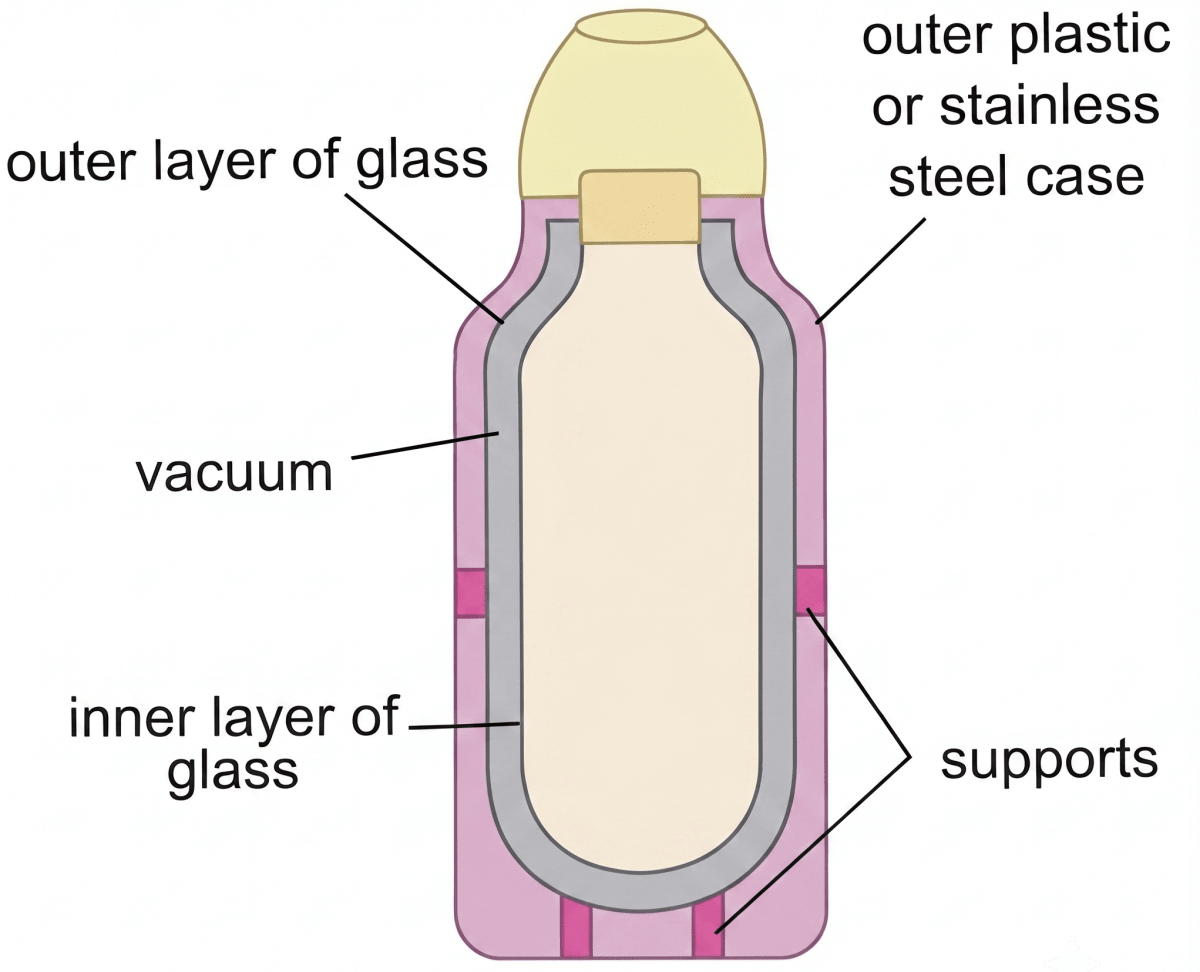
A thermos flask is a device that prevents the transmission of heat by minimising conduction, convection and radiation.
- It consists of a double-walled glass vessel with a vacuum between the two walls. The vacuum greatly reduces heat transfer by conduction and convection. The walls are made of glass, which is a poor conductor of heat.
- The mouth of the flask is closed with an insulator such as cork or plastic, which reduces heat transfer through the opening.
- The sides of the double wall facing each other are silvered (made shiny). Shiny surfaces are poor absorbers and radiators of heat, so they reduce heat transfer by radiation.
- The whole system is enclosed in a thick plastic or stainless steel case to protect it from damage.
In this way, a thermos flask keeps hot things hot and cold things cold for a long time.
Differentiate between conduction, convection and radiation.
Answer
| Conduction | Convection | Radiation |
|---|---|---|
| Heat is transferred by the vibration of molecules about their mean positions. | Heat is transferred by the actual movement of molecules. | There is no role of molecules in transferring heat. |
| There is no actual movement of molecules. | The molecules move while transferring heat. | There is no movement of molecules. |
| It is a slow process. | It is faster than conduction. | It is the fastest process. |
| A medium is required to transfer heat. | A medium is required to transfer heat. | No medium is required to transfer heat. |
| It occurs in solids, liquids and gases. | It occurs in liquids and gases. | It occurs in solids, liquids and gases. |
| Heat can be transferred in any direction. | Heat is transferred vertically upwards. | Heat is transferred in a straight line path. |
Read the given case study and answer the questions that follow.
It was a cold winter morning. Vineeta and her family were going on a picnic. Her mother poured hot tea into a thermos flask and packed it in the basket. Vineeta asked, "Why use this bottle?" Her mother smiled and said, "The thermos flask keeps things hot or cold. It has a vacuum that stops heat from escaping."
At the picnic spot, Vineeta touched a metal bench warmed by the sun. "Ouch! It's hot!" she shouted. Her father explained, "Heat from the sun made the metal warm. Metal conducts heat, so it feels hotter than the wooden bench."
Later, Vineeta saw steam rising from the tea. Her father said, "That's convection. Hot air or liquid rises, and cool ones sink." He also showed her how the temperature of the tea was measured using a thermometer.
Vineeta noticed tiny gaps in the metal railings of the park and asked why. "These are for thermal expansion," her father replied. "Metals expand in heat and need space to grow."
By the end of the day, Vineeta had learnt how heat changes things and how we use science in daily life.

- Why did Vineeta's mother use a thermos flask?
- Why did the metal bench feel hot to Vineeta?
- What is convection? Where did Vineeta observe it?
- How was the temperature of the tea measured?
- Why are there small gaps in metal railings?
Answer
Vineeta's mother used a thermos flask because it minimises heat transfer between the tea and the surroundings. The vacuum between its double walls reduces conduction and convection, so the hot tea remains warm for a long time.
The metal bench felt hot because metal is a good conductor of heat. The heat from the sun made the metal warm, and being a good conductor, the metal quickly passed this heat to Vineeta's hand, so it felt hotter than the wooden bench.
Convection is the process of transfer of heat by the actual movement of molecules in liquids and gases. Vineeta observed it when the warm air and water vapour above the hot tea rose upwards.
The temperature of the tea was measured using a thermometer.
Small gaps are left in the metal railings to allow for thermal expansion. Metals expand on heating, so the gaps give the metal the space to expand without bending or breaking.
Read the given information carefully and answer the questions that follow.
Heat, energy that is transferred from one body to another as the result of a difference in temperature. If two bodies at different temperatures are brought together, energy is transferred i.e. heat flows from the hotter body to the colder. The effect of this transfer of energy usually, but not always, is an increase in the temperature of the colder body and a decrease in the temperature of the hotter body. A substance may absorb heat without an increase in temperature by changing from one physical state (or phase) to another, as from a solid to a liquid (melting), from a solid to a vapour (sublimation), from a liquid to a vapour (boiling), or from one solid form to another (usually called a crystalline transition). The important distinction between heat and temperature (heat being a form of energy and temperature a measure of the amount of that energy present in a body) was clarified during the 18th and 19th centuries.
Heat as a form of energy
Because all of the many forms of energy, including heat, can be converted into work, amounts of energy are expressed in units of work, such as joules, foot-pounds, kilowatt-hours, or calories. Exact relationships exist between the amounts of heat added to or removed from a body and the magnitude of the effects on the state of the body. The two units of heat most commonly used are the calorie and the British thermal unit (BTU). The calorie (or gram-calorie) is the amount of energy required to raise the temperature of one gram of water from 14.5 to 15.5°C; the BTU is the amount of energy required to raise the temperature of one pound of water from 63 to 64°F.
Source: https://www.britannica.com/science/heat
- What is heat energy?
- How does a substance absorb heat without an increase in temperature?
- Explain sublimation.
- Name the units of heat that are commonly used.
- How is heat energy transferred from one body to another?
Answer
Heat is a form of energy that is transferred from one body to another as a result of a difference in temperature.
A substance can absorb heat without an increase in temperature by changing from one physical state (phase) to another, such as from a solid to a liquid (melting), from a solid to a vapour (sublimation), or from a liquid to a vapour (boiling).
Sublimation is the process during which a substance directly changes from its solid state into its gaseous state at a fixed temperature, without passing through the liquid state. For example, camphor changes directly into its gaseous form.
The two commonly used units of heat are the calorie and the British thermal unit (BTU).
When two bodies at different temperatures are brought together, heat energy flows from the hotter body to the colder body. This flow continues until both bodies reach the same temperature.
Sunita placed a metal spoon and a plastic spoon in hot soup. After a while, the metal spoon felt hot, but the plastic one didn't. Why did this happen?
Answer
The metal spoon felt hot because metal is a good conductor of heat. It quickly conducted the heat from the hot soup to its other end. The plastic spoon did not feel hot because plastic is a bad conductor (insulator) of heat and does not allow heat to pass through it easily.
A thermos flask is made with a vacuum layer, a shiny surface and a tight lid. Analyse how each part helps in reducing heat loss.
Answer
Each part reduces heat loss in a different way.
- Vacuum layer — The vacuum between the double walls greatly reduces heat transfer by conduction and convection because it contains no particles.
- Shiny surface — The silvered surfaces are poor absorbers and radiators of heat, so they reduce heat loss by radiation.
- Tight lid — The tight insulating lid closes the mouth of the flask and reduces heat transfer through it.
You are given three materials — metal, wood and glass. Which would you choose to make a cooking utensil and why?
Answer
I would choose metal to make a cooking utensil. This is because metals are good conductors of heat, so they allow heat to pass through them quickly and cook the food faster. Wood and glass are bad conductors of heat and would not let heat reach the food easily.
Water was heated in two different containers — one black and one silver. In which container will the water heat up faster?
Answer
The water in the black container will heat up faster. This is because black (dark) surfaces are good absorbers of heat, so the black container absorbs more heat. A silver (shiny) surface is a poor absorber and a good reflector of heat.
Design a simple model or drawing of a thermos flask and label the parts that help prevent heat loss.
Answer
A thermos flask can be drawn as a double-walled glass vessel enclosed in an outer case. The parts that help prevent heat loss are as follows.
- Double glass walls with a vacuum in between — greatly reduce heat transfer by conduction and convection.
- Silvered (shiny) walls — reduce heat transfer by radiation.
- Insulating cork or plastic lid — reduces heat transfer through the mouth.
- Outer plastic or stainless steel case — protects the glass vessel from damage.
Create a small experiment using a thermometer, hot water, and two different materials to show how heat transfers at different rates. Write down the steps.
Answer
Aim: To compare the rates of heat transfer through metal and wood.
Materials required: A thermometer, hot water, a beaker, a metal spoon, a wooden spoon, two small pins and equal amounts of wax.
Procedure:
- Pour hot water into a beaker and use the thermometer to record its temperature.
- Fix one small pin to the upper end of each spoon using an equal amount of wax. Keep the pins at the same distance from the lower ends of the spoons.
- Place equal lengths of the metal and wooden spoons in the hot water at the same time.
- Observe the pins without touching the spoons or the hot water.
Observation: The wax on the metal spoon softens first, so its pin falls earlier. The pin on the wooden spoon remains in place for a longer time.
Conclusion: Heat travels faster through metal than through wood. Therefore, metal is a good conductor of heat, whereas wood is a poor conductor of heat.
Satvik sat beside the campfire on a chilly evening. He noticed that even though the fire was small, he could feel warmth from a distance. He wondered why the iron chair he sat on felt colder than the wooden log, though both were outside for the same time. His sister explained, "It's because metal conducts heat faster than wood. That's why metal feels colder or hotter." As he held his hands near the fire, he didn't touch the flames but still felt warm. He thought, "If the air doesn't touch me directly, how do I feel warm?"

- Why does metal feel colder than wood on a winter day?
- How does Satvik feel the heat from the fire even without touching it?
- What does this story tell us about different materials and their heat-conducting ability?
Answer
Metal feels colder than wood on a winter day because metal is a good conductor of heat. When we touch it, heat is conducted away from our hand quickly, and this rapid loss of heat makes the metal feel cold. Wood is a bad conductor, so it does not draw heat away from our hand and feels warmer.
Satvik feels the heat from the fire by radiation. Heat travels from the fire in the form of waves and reaches him without requiring any medium or heating the intermediate space.
The story tells us that different materials conduct heat differently. Good conductors like metal allow heat to pass through them quickly, so they feel hotter or colder, while bad conductors like wood do not allow heat to pass easily.
Karishma observed that hot chocolate stayed warm even after two hours in a thermos flask. She wanted to know how the flask worked. She opened it and found two layers with space in between. She read that it had a vacuum between the layers to stop heat transfer. One layer was shiny and the lid was tight. Karishma compared the thermos flask with a regular steel bottle. She poured hot water in both and checked the temperature after one hour. The steel bottle's water cooled down faster.
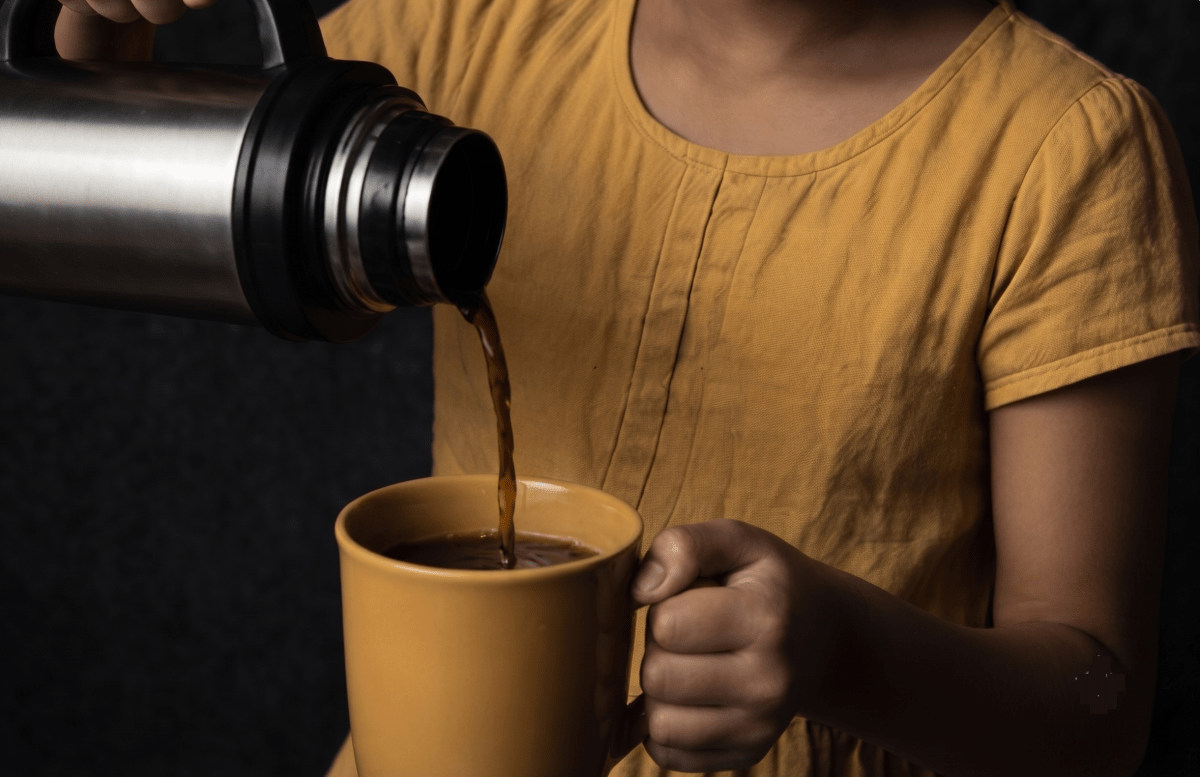
- What parts of the thermos flask help keep the drink warm?
- Why did the water in the steel bottle cool down faster than in the thermos flask?
- What can we conclude from Karishma's investigation?
Answer
The vacuum between the double walls reduces conduction and convection, the shiny silvered surface reduces radiation, and the tight insulating lid reduces heat transfer through the mouth. These parts help keep the drink warm.
The ordinary steel bottle has a single metal wall and no vacuum layer. Since steel is a good conductor of heat, heat passes rapidly through its wall and is then lost to the surroundings. A thermos flask minimises heat transfer, so the water in it stays warm for longer.
We can conclude that a thermos flask keeps a drink warm for much longer than an ordinary steel bottle, because its special design — a vacuum, a shiny surface and a tight lid — minimises heat loss by conduction, convection and radiation.
In school, Vinay and Ginni did an interesting experiment. They placed a metal wire between two fixed nails on a wooden board and hung a small weight at its center so that the wire became slightly tight. They then held a burning candle under the wire for a few minutes. As the wire got heated, it expanded and became slightly longer, causing the weight to move downward. When they poured cold water on the wire, it contracted, and the weight moved upward again. Their teacher explained, "This is thermal expansion—metals expand when heated and contract when cooled."
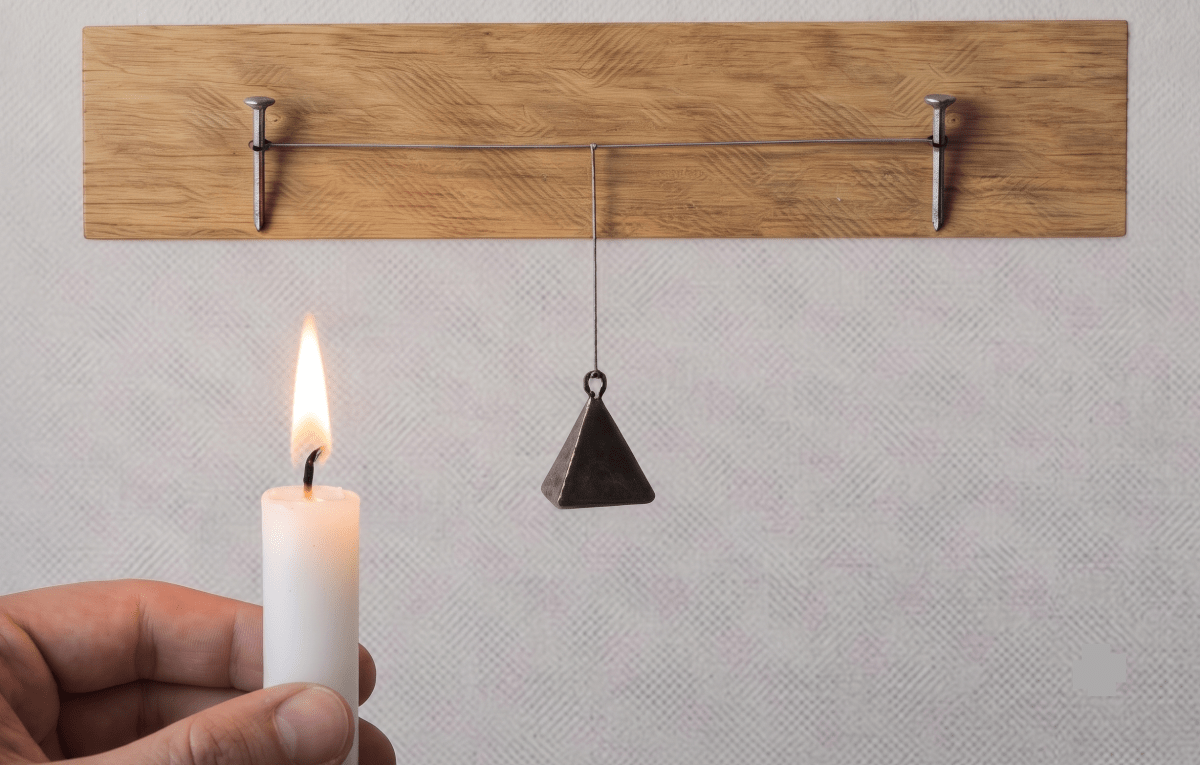
- What visible change did Vinay and Ginni observe in the metal wire?
- Why did the weight move downward when the wire was heated?
- What does this experiment show about thermal expansion?
Answer
They observed that on heating, the metal wire expanded and became slightly longer, which caused the weight hung at its centre to move downward. On cooling, the wire contracted and the weight moved upward again.
When the wire was heated, it expanded and became longer, so it sagged. Because of this increase in length, the weight hanging at its centre moved downward.
This experiment shows that metals expand when heated and contract when cooled. This expansion and contraction of solids on heating and cooling is called thermal expansion.
Sonia and her friends were asked to design a lunchbox that could keep food hot for 3 hours. They thought about the thermos flask. "Let's use double walls with air in between," said one. "Also, a tight lid and maybe an inner shiny layer," added another. They chose materials that didn't let heat escape easily and tried to cover all sides. After testing, they found their box kept food warm longer than an open container.
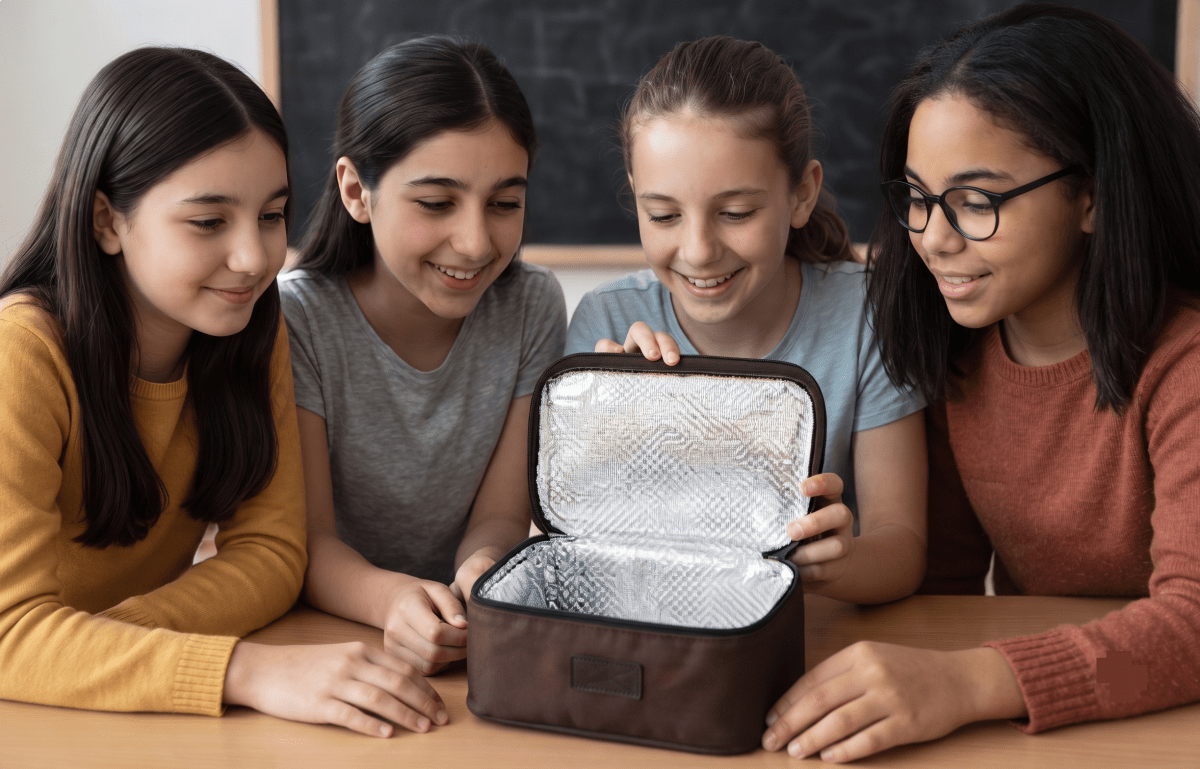
- What ideas did Sonia and her friends derive from the thermos flask?
- What features made their lunchbox more effective in keeping the food hot?
- Suggest one improvement for their design.
Answer
They derived the ideas of using double walls with air (or a vacuum) in between, a tight lid and an inner shiny layer, all of which help to reduce heat loss, just like in a thermos flask.
The sealed layer of trapped air between the double walls reduces conduction and restricts convection. The tight lid reduces heat transfer through the opening, and the shiny inner layer reduces heat loss by radiation. These features make the lunchbox more effective in keeping food hot.
One improvement could be to keep a vacuum between the double walls instead of air, as a vacuum prevents conduction and convection even better than air.
Fill in the blanks.
- The energy transferred between two bodies in contact due to the difference in their temperatures is called ............... .
- The instrument used to measure temperature is called a ............... .
- ............... is the process by which heat travels through solids.
- When water changes to steam at 100°C, the process is called ............... .
- The process of transfer of heat without any medium is known as ............... .
Answer
- The energy transferred between two bodies in contact due to the difference in their temperatures is called heat.
- The instrument used to measure temperature is called a thermometer.
- Conduction is the process by which heat travels through solids.
- When water changes to steam at 100°C, the process is called boiling.
- The process of transfer of heat without any medium is known as radiation.
Write True or False.
- The boiling point of water is 0°C.
- Metals are generally good conductors of heat.
- Heat flows from a colder object to a hotter object.
- In radiation, heat can travel through a vacuum.
- A thermometer is used to measure heat.
Answer
- False
Corrected Statement — The boiling point of water is 100°C. - True
- False
Corrected Statement — Heat flows from a hotter object to a colder object. - True
- False
Corrected Statement — A thermometer is used to measure temperature.
Match the columns.
| Column A | Column B |
|---|---|
| 1. Thermometer | (a) Expansion of solids |
| 2. Radiation | (b) Measure temperature |
| 3. Thermal expansion | (c) Transfer of heat through vacuum |
| 4. Convection | (d) Liquids and gases |
| 5. Mercury | (e) Used as thermometric liquid |
Answer
| Column A | Column B |
|---|---|
| 1. Thermometer | (b) Measure temperature |
| 2. Radiation | (c) Transfer of heat through vacuum |
| 3. Thermal expansion | (a) Expansion of solids |
| 4. Convection | (d) Liquids and gases |
| 5. Mercury | (e) Used as thermometric liquid |
What is a capillary tube?
Answer
A capillary tube is an extremely thin glass tube with a very narrow bore through which a liquid can rise or fall. In a thermometer, the thermometric liquid rises or falls in the capillary tube as the temperature changes.
Define temperature.
Answer
Temperature is the measure of the degree of hotness or coldness of a body.
How is heat transferred from the sun to the Earth?
Answer
Heat is transferred from the sun to the Earth by the process of radiation. In radiation, heat travels in the form of waves and does not need any medium, so it can travel through the vacuum present between the sun and the Earth.
What do you understand by 'change of state'?
Answer
Change of state means the change of a substance from one physical state into another (solid, liquid or gas) on heating or cooling. For example, on heating, ice (solid) changes into water (liquid) and water changes into steam (gas).
Write one application of convection in nature.
Answer
Sea breeze is an application of convection in nature. The land gets heated faster than the sea during the day, the warm air over the land rises up, and the cool air from the sea rushes in to take its place, forming the sea breeze.
What are the three modes of heat transfer? Explain each with an example.
Answer
The three modes of heat transfer are conduction, convection and radiation.
- Conduction — It is the transfer of heat from a body at a higher temperature to a body at a lower temperature when both are in direct contact, without the actual movement of molecules. For example, when one end of a metal rod is heated, the other end also becomes hot after some time.
- Convection — It is the transfer of heat by the actual movement of molecules in liquids and gases. For example, water in a vessel gets heated due to the convection currents set up in it.
- Radiation — It is the transfer of heat from a hot body to a cold body without any medium. For example, heat from the sun reaches the Earth by radiation.
Describe with an example how conduction takes place in daily life.
Answer
In conduction, heat travels from the hotter part of a body to its colder part without the molecules moving from their places. The molecules vibrate about their fixed positions and pass on heat to the neighbouring molecules. For example, when a metal spoon is placed in a cup of hot tea, the heat travels from the hot end of the spoon to its other end by conduction, and after some time the upper end of the spoon also becomes hot.
Why are gaps left in bridges and railway tracks?
Answer
Gaps are left in bridges and railway tracks to allow for the thermal expansion of metal. Metals expand in summer and contract in winter. If no gaps are left, the rails or the bridge may bend or get damaged due to expansion. For this reason, gaps are left between successive rail tracks, and one end of a metal bridge is kept on rollers so that it is free to expand and contract.
How does a thermos flask keep hot things hot and cold things cold?
Answer
A thermos flask keeps hot things hot and cold things cold by minimising heat transfer through conduction, convection and radiation.
- It has a double-walled glass vessel with a vacuum between the walls, which greatly reduces heat transfer by conduction and convection.
- Its inner walls are silvered (made shiny), which reduces heat transfer by radiation.
- Its mouth is closed with an insulating cork or plastic lid, which reduces heat transfer through the opening.
Since heat can neither escape from nor enter the flask easily, hot things remain hot and cold things remain cold for a long time.
State the differences between boiling and evaporation.
Answer
| Boiling | Evaporation |
|---|---|
| Boiling is the process in which a liquid changes into vapour at a fixed temperature called its boiling point. | Evaporation is the process in which a liquid changes into vapour at any temperature, usually below its boiling point. |
| It takes place throughout the liquid. | It takes place only at the surface of the liquid. |
| It is a rapid process and bubbles are formed. | It is generally a slow process and bubbles are not formed. |
| It requires a continuous supply of heat. | It absorbs heat from the liquid and its surroundings and produces cooling. |